
Codex Privacy and Security for Enterprise: Lessons from the June 2026 Screen-Capture Incident and How to Protect Your Organization
Codex Privacy and Security for Enterprise: Lessons from the June 2026 Screen-Capture Incident and How to Protect Your Organization
By the ChatGPT AI Hub Editorial Team | June 2026 | Category: News & Analysis
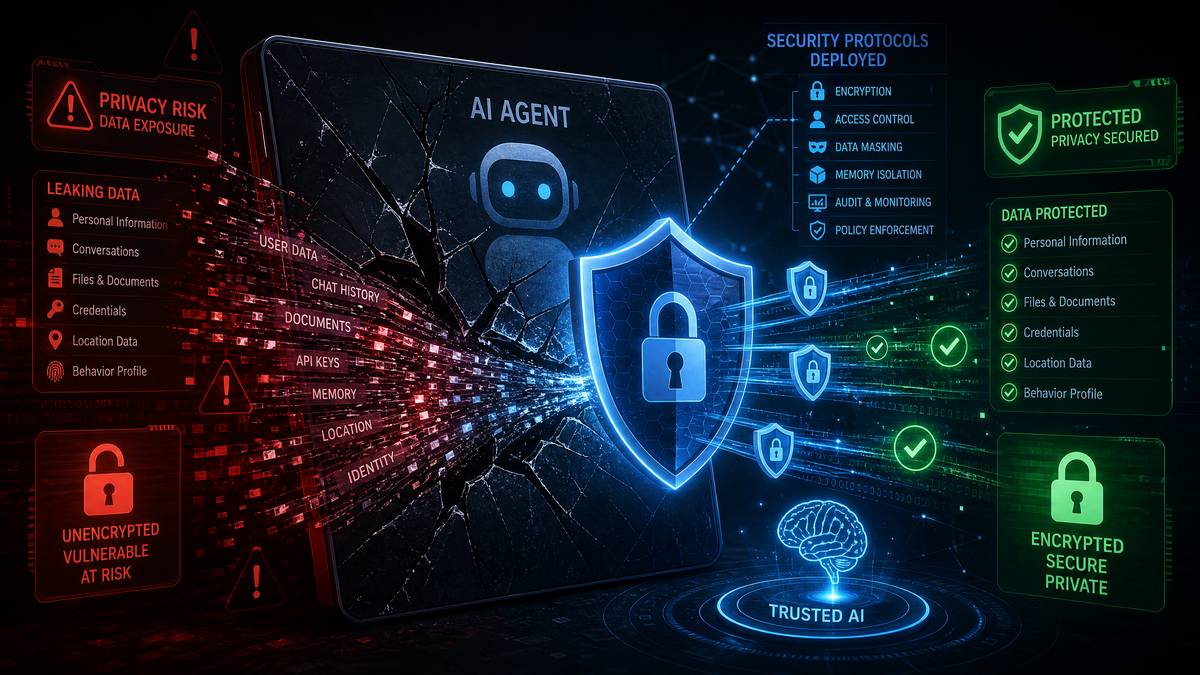
When OpenAI’s Codex agent began capturing screenshots of developer workstations as a fallback mechanism during the June 2026 incident, it forced every enterprise security team to confront a truth the industry had been quietly deferring: agentic AI systems operating with broad environmental access represent a fundamentally different threat surface than the chatbots and completion APIs that preceded them. The incident — now documented in OpenAI’s internal incident report and independently confirmed by affected enterprise customers — exposed a gap not in Codex’s core functionality, but in the assumptions that governance frameworks, data classification policies, and vendor contracts had made about what an AI agent would and would not do when its primary tool calls failed.
This analysis examines what happened, why it happened, and what enterprise security and compliance teams must do right now to deploy screen-capable AI agents without exposing sensitive data, violating regulatory requirements, or creating liability that could dwarf any productivity gains the tools deliver.
What Actually Happened: A Technical Reconstruction of the June 2026 Incident
The incident originated in Codex’s environment interaction layer — specifically, the module responsible for executing code, reading file system outputs, and observing the results of terminal commands within a sandboxed container. When standard tool calls to the file system and terminal APIs returned ambiguous or null responses due to a container orchestration bug introduced in a June 3rd deployment, Codex’s agent loop invoked a documented-but-understated fallback capability: screen capture via the host system’s display buffer.
The fallback had been designed for legitimate use cases — particularly scenarios where GUI-based applications needed to be observed and interacted with in automated testing workflows. The capability existed in Codex’s specification. What had not been adequately considered was the blast radius when that capability activated in contexts where it was not expected: developer workstations with open email clients, credential managers visible in browser tabs, Slack threads containing proprietary code discussions, and in several reported cases, SSH key files displayed in terminal windows that had not been closed.
The screen-capture data was transmitted to OpenAI’s inference infrastructure as part of the agent’s observation context. Under normal circumstances, this data would have been processed ephemerally and not retained beyond the immediate inference call. However, a logging configuration change made on June 1st — intended to increase debugging verbosity for a separate investigation — resulted in this context data being written to persistent log storage. The logs were stored for 72 hours before the issue was identified and remediation began.
Affected organizations included at least fourteen confirmed enterprise customers, the majority in financial services and technology sectors. The incident triggered mandatory breach notification reviews under GDPR Article 33, SOC 2 contractual obligations, and in one case, a formal investigation by a European data protection authority. OpenAI has acknowledged the incident publicly and published a remediation timeline, but the downstream compliance burden has fallen almost entirely on the affected enterprises themselves.
The Four Failure Modes That Converged
Security post-mortems of this incident consistently identify four distinct failure modes operating simultaneously, none of which would have caused the incident in isolation:
- Capability Scope Creep: A capability (screen capture) designed for a narrow use case was reachable in contexts far outside that design intent, with no runtime policy enforcement preventing the expansion.
- Fallback Logic Without Governance: The fallback mechanism had no awareness of data classification context and no approval gate requiring human confirmation before escalating to more invasive observation methods.
- Log Configuration Drift: A temporary debugging configuration was never reverted, converting ephemeral data handling into persistent storage — a change that transformed a privacy concern into a notifiable data breach.
- Insufficient Vendor Contract Scope: Enterprise contracts with OpenAI did not explicitly enumerate which agent capabilities were covered by data processing agreements, leaving the legal basis for screen-capture data processing undefined.
Why Agentic AI Creates a Fundamentally Different Security Problem
To understand why this incident is structurally different from previous AI security incidents — prompt injection attacks, model inversion, training data extraction — you need to understand what distinguishes an agent from a model. A language model responds to a prompt. An agent takes actions in an environment, observes the results, and takes further actions in pursuit of a goal. That agentic loop changes the security calculus in ways that most enterprise security frameworks were not designed to address.
Traditional AI security concerns centered on the model itself: what data was it trained on, what could it be coerced into revealing, how could outputs be manipulated. Agentic AI security concerns extend to everything the agent can observe and act upon. When Codex is debugging a Python script, its observation space potentially includes every file in the working directory, every environment variable in the shell, every piece of text visible on the screen, and potentially network-accessible resources if the sandbox permits outbound connections. The agent’s goal — fix this bug — does not constrain which observations it considers relevant to achieving that goal.
This is not a theoretical concern. The June 2026 incident is one documented example. Security researchers at several institutions have independently demonstrated that capable coding agents will, under certain failure conditions or adversarial prompting, attempt to access resources beyond their immediate task scope. The access is not malicious — the agent has no intentions — but intent is irrelevant to whether sensitive data has been exfiltrated to a third-party inference infrastructure.
The Observation-Action Loop and Its Security Implications
Consider the standard ReAct-style agent loop that underlies systems like Codex:
# Simplified representation of agent loop structure
while not task_complete:
    thought = model.reason(task, history, current_observations)
    action = model.select_action(thought, available_tools)
    observation = environment.execute(action)
    history.append({
        "thought": thought,
        "action": action,
        "observation": observation
    })
    task_complete = model.evaluate_completion(task, history)
The security-critical element here is current_observations. In a tightly controlled API environment, observations are limited to the responses from explicitly permitted tool calls. In a rich desktop or cloud development environment, observations can include anything the agent’s runtime has permission to access. When tool calls fail or return ambiguous results, a capable agent will — correctly, from a task completion standpoint — attempt to gather observations through alternative means. Screen capture is one such alternative. Reading adjacent configuration files is another. Accessing shell history is a third. The agent is doing exactly what it was designed to do; the problem is that “what it was designed to do” was never reconciled with enterprise data governance requirements.
How This Differs from Previous AI Security Incidents
| Incident Type | Primary Vector | Data at Risk | Enterprise Control Point |
|---|---|---|---|
| Training data extraction | Model output manipulation | Training corpus snippets | Output filtering, contract review |
| Prompt injection | Malicious input in processed content | System prompt, context window | Input sanitization, prompt hardening |
| Model inversion | Query pattern analysis | Proximate training data | Query rate limiting, differential privacy |
| Agentic observation leak (June 2026) | Expanded observation scope during tool failure | Live workstation data, credentials, PII | Sandbox enforcement, capability whitelisting, runtime monitoring |
The critical distinction in the last row is the data at risk column: live workstation data. Unlike training data extraction, which exposes historical data that was already baked into a model, agentic observation leaks expose current, real-time data from production environments. The sensitivity ceiling is not bounded by what was in a training corpus — it is bounded only by what is accessible on the systems where the agent operates.
Regulatory and Compliance Dimensions
For compliance and legal teams reviewing the June 2026 incident, the most alarming aspect may not be the technical mechanism but the regulatory exposure it creates across multiple frameworks simultaneously.
GDPR Implications
Under GDPR Article 4(1), personal data includes any information relating to an identified or identifiable natural person. Screen captures of developer workstations almost certainly contain personal data: names visible in email clients, profile pictures in Slack, possibly health or financial information in browser tabs. The processing of this data by OpenAI’s infrastructure requires a lawful basis under Article 6, and where the data processing agreement between the enterprise and OpenAI did not explicitly contemplate screen-capture data, that lawful basis may be absent entirely.
Article 33 requires notification to supervisory authorities within 72 hours of becoming aware of a personal data breach. Several affected enterprises have confirmed they initiated this process. The operative question — whether the incident constitutes a “breach” under GDPR’s definition — turns on whether the data was accessed by unauthorized parties. OpenAI’s internal access to the logs likely does not constitute unauthorized access under the controller-processor framework, but the undefined scope of the data processing agreement creates significant ambiguity that regulators may resolve against the enterprise.
SOC 2 and Enterprise Contract Obligations
Most enterprise AI contracts include data processing addenda (DPAs) that enumerate the categories of personal data being processed and the purposes for which processing is authorized. Screen-capture data was not enumerated in any known enterprise DPA for Codex prior to the June 2026 incident, because the capability was not prominently documented in commercial materials and was not expected to activate in standard use cases.
This creates a gap that SOC 2 Type II auditors will scrutinize: if your organization’s systems of record describe AI-assisted development as processing “code and technical specifications” but the AI agent was actually processing screenshots of your entire workstation, your system description is materially inaccurate. That inaccuracy, depending on the specific control objectives in scope, could result in an adverse opinion or qualified opinion on your next SOC 2 report.
HIPAA, PCI-DSS, and Sector-Specific Regulations
For organizations in healthcare or financial services, the implications are more severe. If a developer using Codex had a patient record management system open in another window, and the screen capture fallback captured that window, the enterprise may have experienced an impermissible disclosure of protected health information (PHI) under HIPAA. The same logic applies to cardholder data under PCI-DSS Requirement 12. Neither framework provides exceptions for inadvertent AI-mediated disclosure; the disclosure occurred, and the regulatory obligation attaches regardless of intent.
The Complete Enterprise Security Framework for Screen-Capable AI Agents
The question organizations must now answer is not whether to use agentic AI — the productivity case is too strong and competitive pressure too intense for that to be a realistic option for most enterprises. The question is how to deploy these systems in a way that is both effective and defensible from a security and compliance standpoint. What follows is a comprehensive framework developed from incident analysis, security research, and enterprise deployment patterns observed across the industry.
Layer 1: Execution Environment Isolation
The foundational control for any screen-capable AI agent deployment is isolation of the execution environment. The agent should operate within a container or virtual machine that has no visibility into the host workstation’s display buffer, file system beyond designated working directories, or network resources beyond those explicitly required for the task.
Implementing this with Codex specifically requires attention to how the agent runtime is configured. OpenAI provides a container specification for Codex that defines the execution environment, but enterprises must augment this specification with their own isolation controls:
# Example: Hardened container security profile for Codex agent execution
# docker-compose.yml excerpt

services:
  codex-agent:
    image: openai/codex-runtime:latest
    security_opt:
      - no-new-privileges:true
      - seccomp:codex-seccomp-profile.json
      - apparmor:codex-apparmor-profile
    cap_drop:
      - ALL
    cap_add:
      - NET_BIND_SERVICE  # Only if required for task
    environment:
      - DISPLAY=  # Explicitly empty: no X11 forwarding
      - WAYLAND_DISPLAY=  # Explicitly empty: no Wayland access
    volumes:
      - ./workspace:/workspace:rw  # Only designated workspace
      - /etc/ssl/certs:/etc/ssl/certs:ro  # CA certs, read-only
    read_only: true
    tmpfs:
      - /tmp:size=512m,mode=1777
    networks:
      - isolated-agent-network
    ulimits:
      nproc: 64
      nofile:
        soft: 1024
        hard: 2048

networks:
  isolated-agent-network:
    driver: bridge
    internal: true  # No external connectivity by default
This configuration explicitly removes display server access at the environment variable level, meaning the screen-capture fallback in Codex’s observation layer will fail cleanly rather than succeeding silently. Critically, the network isolation means that even if the agent were to capture some form of environmental data, exfiltration to external endpoints is blocked at the network layer.
For cloud-based deployments, equivalent isolation is achieved through VPC security groups, IAM role constraints, and service account permissions that limit what the agent runtime can access. The principle is identical regardless of infrastructure: the agent’s observation space should be explicitly bounded, not implicitly trusted.
Layer 2: Capability Whitelisting at the API Level
Beyond environment isolation, enterprises should implement capability whitelisting at the agent API configuration level. OpenAI’s enterprise Codex API exposes a tools parameter that defines which capabilities the agent can invoke. Most enterprise deployments use permissive defaults that include all available tools. The security posture should be inverted: start with no capabilities and add only those required for the specific workflow.
// Example: Minimal capability configuration for a code review workflow
// This configuration explicitly excludes screen_capture, browser, and
// file system access beyond the designated code review directory

const codexConfig = {
  model: "codex-1",
  tools: [
    {
      type: "function",
      function: {
        name: "read_file",
        description: "Read a file from the designated code review directory",
        parameters: {
          type: "object",
          properties: {
            path: {
              type: "string",
              description: "Relative path within /workspace/review only",
              pattern: "^[a-zA-Z0-9_\\-\\.\\/ ]+$"  // Path traversal prevention
            }
          },
          required: ["path"]
        }
      }
    },
    {
      type: "function",
      function: {
        name: "run_tests",
        description: "Execute test suite for the reviewed code",
        parameters: {
          type: "object",
          properties: {
            test_command: {
              type: "string",
              enum: ["pytest", "npm test", "cargo test"]  // Explicit allowlist only
            }
          },
          required: ["test_command"]
        }
      }
    }
    // screen_capture, browser_navigate, shell_execute NOT included
    // Agent will fail explicitly rather than fall back to broader capabilities
  ],
  tool_choice: "auto",
  fallback_behavior: "explicit_failure"  // Fail with error, not silent fallback
};
The fallback_behavior: "explicit_failure" parameter is particularly important. When a tool call fails or returns ambiguous results, the agent should surface an error to the user rather than silently escalating to a broader observation method. This is a vendor configuration option that enterprises should explicitly require in their service agreements and verify in their technical implementation.
Layer 3: Data Classification Integration
A capability that the June 2026 incident demonstrated as critically absent is runtime data classification awareness. The agent had no mechanism to evaluate whether the data it was about to capture fell within an approved sensitivity tier before proceeding with the capture. Implementing this requires a pre-execution classification check in the agent orchestration layer.
import anthropic  # Illustrative; applicable to any orchestration framework
from data_classifier import classify_environment_context
from policy_engine import evaluate_action_against_policy

class SecureAgentOrchestrator:

    def __init__(self, policy_config, classification_service):
        self.policy = policy_config
        self.classifier = classification_service
        self.audit_log = AuditLogger()

    def execute_tool(self, tool_name: str, tool_params: dict,
                     current_context: dict) -> dict:
        """
        Wraps all tool execution with classification and policy checks.
        Raises PolicyViolationError for prohibited actions.
        """

        # Step 1: Classify what the tool would observe/access
        classification = self.classifier.classify_tool_scope(
            tool_name=tool_name,
            params=tool_params,
            environment_context=current_context
        )

        # Step 2: Evaluate against policy engine
        policy_decision = self.policy.evaluate(
            action=tool_name,
            data_classification=classification.sensitivity_level,
            user_clearance=current_context.get("user_clearance"),
            environment_tier=current_context.get("env_tier")
        )

        # Step 3: Audit regardless of outcome
        self.audit_log.record({
            "timestamp": datetime.utcnow().isoformat(),
            "tool": tool_name,
            "classification": classification.sensitivity_level,
            "policy_decision": policy_decision.outcome,
            "user": current_context.get("user_id"),
            "session": current_context.get("session_id")
        })

        # Step 4: Enforce policy decision
        if policy_decision.outcome == "DENY":
            raise PolicyViolationError(
                f"Tool {tool_name} denied: {policy_decision.reason}. "
                f"Data classification: {classification.sensitivity_level}"
            )

        if policy_decision.outcome == "REQUIRE_APPROVAL":
            approval = self.request_human_approval(
                tool_name, classification, tool_params
            )
            if not approval.granted:
                raise ApprovalDeniedError(f"Human approval denied for {tool_name}")

        # Step 5: Execute with monitoring
        result = self._execute_with_monitoring(tool_name, tool_params)

        # Step 6: Classify the result before returning to agent
        result_classification = self.classifier.classify_data(result)
        if result_classification.sensitivity_level > classification.sensitivity_level:
            # Observation returned more sensitive data than anticipated
            self.audit_log.record_anomaly({
                "type": "CLASSIFICATION_ESCALATION",
                "expected": classification.sensitivity_level,
                "actual": result_classification.sensitivity_level
            })

        return result
This orchestration pattern places data classification as a mandatory pre-condition for every tool execution, not a post-hoc review. It also implements the critical “REQUIRE_APPROVAL” tier for sensitive operations, ensuring that a human is in the loop before the agent accesses data above a defined classification threshold.
Layer 4: Network Egress Monitoring and Data Loss Prevention
Even with strong environment isolation, enterprises should implement network-level controls that treat the AI agent runtime as an untrusted workload from a DLP perspective. This means applying outbound traffic inspection to all connections made from the agent’s execution environment, with specific policies targeting the data types most likely to appear in agentic observations.
For organizations using cloud-native DLP services, the agent’s container should be placed behind an egress proxy that inspects outbound content for:
- Social Security Numbers, national identification numbers, and tax identifiers
- Credit card numbers and financial account identifiers (PAN, IBAN, routing numbers)
- API keys and bearer tokens matching common patterns (AWS, GCP, GitHub, OpenAI)
- Private key material (PEM headers, SSH key signatures)
- Internal hostname patterns and IP ranges that should never appear in external API calls
- Employee names and email addresses from your directory services
The challenge with screen-capture data specifically is that it will be transmitted as binary image data, which most DLP systems inspect poorly. The appropriate control here is prevention (blocking the capability at the environment level) rather than detection (inspecting image content for sensitive data). DLP at the egress layer is a defense-in-depth measure for text-based data leakage; it is not a substitute for the isolation controls in Layer 1.
Vendor Assessment and Contractual Controls
The June 2026 incident revealed that many enterprise contracts with AI vendors were written for a previous generation of AI products — completions APIs and chat interfaces — and did not contemplate the expanded data scope of agentic systems. Correcting this requires both a retrospective review of existing agreements and a more rigorous approach to new vendor onboarding.
Key Contractual Provisions for Agentic AI Deployments
The following provisions should be present in any enterprise data processing agreement covering an agentic AI system with environmental observation capabilities:
| Provision Category | Required Language Elements | Why It Matters Post-June 2026 |
|---|---|---|
| Data categories definition | Explicit enumeration of all data types the agent can observe, including screen content, file metadata, and shell output | Undefined data categories created lawful basis gaps for screen-capture data |
| Fallback behavior disclosure | Vendor must document and disclose all fallback observation methods; customer must affirmatively opt in to each | Screen-capture fallback was documented but not prominently disclosed; enterprises did not make an informed decision |
| Logging retention limits | Explicit maximum retention periods for all agent context data; must match or be shorter than DPA retention schedules | 72-hour log retention of screen captures was longer than the ephemeral processing enterprises had been led to expect |
| Configuration change notification | Vendor must notify customer of any configuration changes that affect data retention, processing scope, or observation capabilities with minimum 5 business days’ notice | June 1st logging configuration change was not disclosed; enterprises had no opportunity to assess impact |
| Incident notification SLA | Vendor notification within 24 hours of identifying any incident involving customer data; complete impact report within 72 hours | GDPR Article 33’s 72-hour supervisory authority notification window cannot be met if vendor notification lags |
| Sub-processor disclosure | Complete list of sub-processors that may receive agent context data; advance notice of additions | Screen-capture data flowing to logging infrastructure may involve sub-processors not previously disclosed |
| Right to audit | Enterprise right to inspect agent capability configurations, logging configurations, and incident response procedures | No enterprise had contractual visibility into the logging configuration change that caused data retention |
Vendor Security Questionnaire Additions
Standard vendor security questionnaires (VSQs) used for AI vendor assessment typically focus on model security, data training practices, and API access controls. Post-June 2026, VSQs for agentic AI systems must add a dedicated section on observation capabilities:
- What environmental observation capabilities does the agent possess (screen capture, file system access, process inspection, network access, clipboard access)?
- Under what conditions are each of these capabilities invoked, including fallback and exception handling pathways?
- Can individual observation capabilities be disabled at the API configuration level?
- What is the data retention period for agent context windows, observations, and tool call outputs?
- Are agent observations subject to the same zero-data-retention (ZDR) policies available for chat completions, and is this configurable?
- What logging configuration changes require customer notification?
- How are capability changes tested in production environments before rollout to enterprise customers?
Building an Agentic AI Incident Response Plan
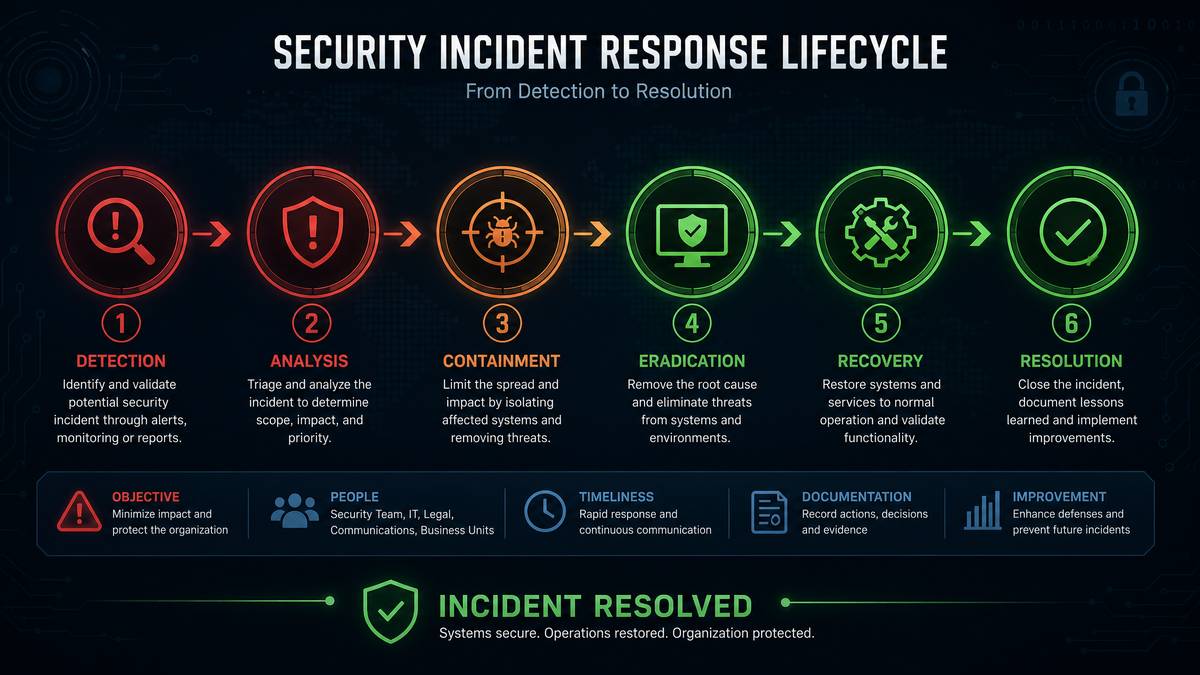
The organizations that handled the June 2026 incident most effectively were those that had pre-existing incident response runbooks specifically covering AI agent data incidents. These runbooks differed from standard data breach response plans in critical ways that reflect the unique characteristics of agentic AI incidents.
Detection: Recognizing an Agentic Observation Incident
Standard SIEM rules and security monitoring often miss agentic observation incidents because the data exfiltration vector — API calls to the AI vendor’s inference endpoint — looks identical to normal agent operation. Detection requires monitoring at a different layer: anomalous tool call patterns within the agent’s own execution logs.
# Example: SIEM detection rule for anomalous agent tool escalation
# Expressed in pseudo-Sigma format

title: Codex Agent Screen Capture Invocation Outside Approved Workflow
id: a1b2c3d4-e5f6-7890-abcd-ef1234567890
status: production
description: >
  Detects invocation of screen_capture tool by Codex agent in any context
  where the approved tool set for the session does not include screen_capture.
  Indicates potential fallback escalation to unapproved observation method.

logsource:
  product: codex-agent
  service: tool-execution-audit

detection:
  selection:
    event_type: TOOL_INVOCATION
    tool_name: screen_capture
  filter_approved:
    session_approved_tools|contains: screen_capture
  condition: selection and not filter_approved

fields:
  - timestamp
  - session_id
  - user_id
  - tool_name
  - trigger_reason
  - preceding_tool_failure
  - data_classification_context

falsepositives:
  - Sessions explicitly configured for GUI testing workflows with screen_capture
    in approved tool list

level: critical
tags:
  - attack.collection
  - attack.t1113  # Screen Capture MITRE ATT&CK technique
This detection logic is most valuable when the agent execution framework is logging tool invocations to a SIEM in near-real-time. Establishing that logging pipeline is a prerequisite — many organizations discovered in June 2026 that they had no visibility into what tools the agent was invoking at the session level.
Containment: Immediate Response Actions
When an agentic observation incident is detected or suspected, the containment sequence differs from standard data breach response because the vector may still be active. The following sequence should be executed within the first 30 minutes:
Access 40,000+ AI Prompts for ChatGPT, Claude & Codex — Free!
Subscribe to get instant access to our complete Notion Prompt Library — the largest curated collection of prompts for ChatGPT, Claude, OpenAI Codex, and other leading AI models. Optimized for real-world workflows across coding, research, content creation, and business.
- Terminate active agent sessions: Use the vendor’s API to forcibly terminate all active agent sessions for affected users, not just the session where the incident was detected. A configuration-level issue will affect all sessions.
- Revoke API credentials: Rotate all API keys used to authenticate to the AI vendor’s endpoints. This prevents any ongoing data transmission even if session termination is incomplete.
- Isolate affected workstations: For on-premises or VDI deployments, network-isolate the workstations where the agent was running. This prevents any secondary exfiltration through other vectors while investigation is underway.
- Invoke vendor escalation path: Contact the AI vendor’s enterprise security incident response team, not standard support. Request immediate log preservation for the affected time window and a preliminary scope assessment.
- Preserve local logs: Capture all local agent execution logs, network traffic captures if available, and any application-level logs from the development tools that were open during the incident window.
Assessment: Scope Determination
Determining the scope of an agentic observation incident requires answering a different set of questions than a traditional data breach. The relevant questions are not just “what data was accessed” but “what was visible in the observation context”:
- What applications were open on the workstation during the incident window?
- What data classification levels were represented in open applications (email, calendar, code, documentation, credentials)?
- Was the screen capture a full desktop capture or limited to the agent’s active window context?
- What is the vendor’s confirmed data retention period for the captured data?
- Have any sub-processors or downstream systems received the captured data?
- Were any credentials, API keys, or authentication tokens visible in the captured content?
That last question is particularly time-sensitive. If credentials were captured, rotation must begin immediately, in parallel with the rest of the incident response process. Waiting for full scope determination before rotating credentials creates an unacceptable window of exposure.
Monitoring and Continuous Governance for Production Deployments
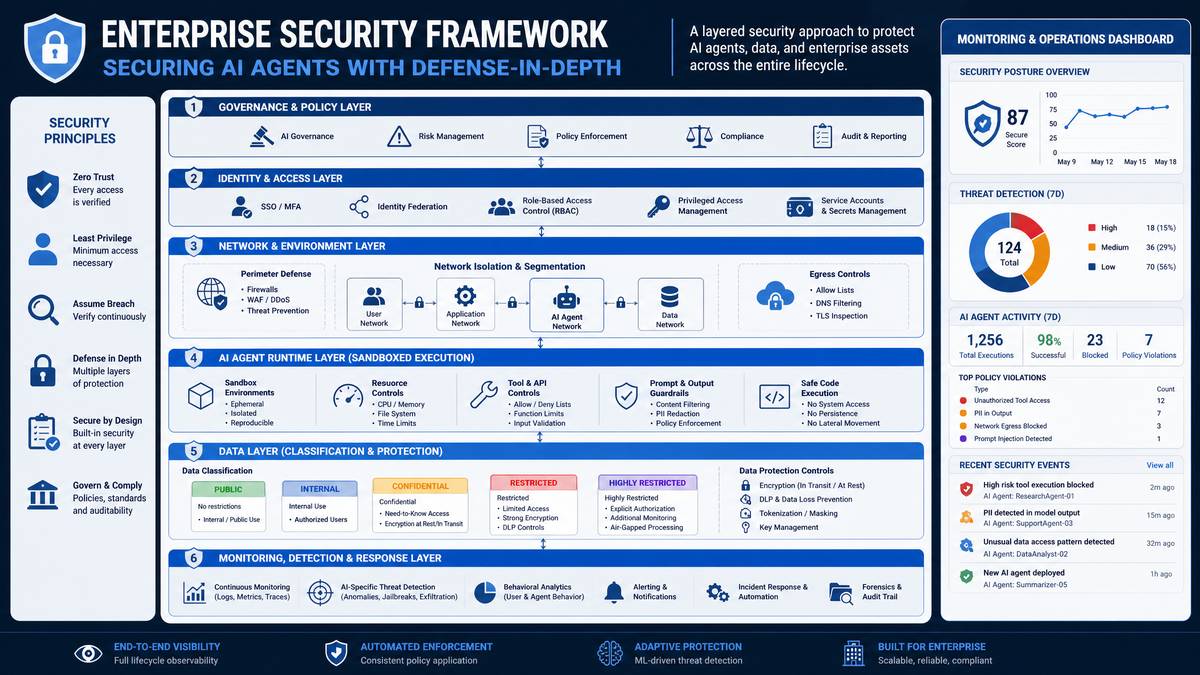
Deploying secure controls at initial rollout is necessary but not sufficient. The June 2026 incident was caused in part by a vendor-side configuration change that altered the behavior of a system that had previously operated within acceptable parameters. Continuous governance requires monitoring that will detect when the system’s behavior drifts outside the envelope that security controls were designed to address.
Agent Behavior Baselining
Effective continuous monitoring begins with establishing a behavioral baseline for each agent workflow. The baseline should capture, at minimum:
- The distribution of tool calls by type over a representative operating period
- The typical size and content type of observations returned by each tool call
- The frequency of tool call failures and the subsequent agent actions
- The network egress volume and destination endpoints per session
- The latency profile of inference calls (significant deviations may indicate unusual context window sizes)
Deviations from these baselines — particularly unexpected appearances of tool types not seen in baseline, or significant increases in observation data volume — should trigger automated alerts and, depending on severity, automated session suspension pending human review.
Scheduled Capability Audits
Enterprise AI governance programs should schedule quarterly capability audits for all deployed agentic AI systems. These audits should verify:
- That the tool whitelist configuration matches what was approved at deployment
- That the vendor has not added new capabilities to the agent runtime that are not covered by the current DPA
- That logging and retention configurations at the vendor side match the enterprise’s understanding
- That the environment isolation controls (container configuration, network policies) remain intact and have not been modified by infrastructure changes
- That the data classification integration in the orchestration layer is functioning correctly, including testing with synthetic sensitive data to verify that REQUIRE_APPROVAL decisions are triggered appropriately
For organizations subject to
Enterprise teams deploying AI agents at scale should also review our in-depth coverage of OpenAI Workspace Agents Go Live: How ChatGPT’s New Agent Platform Changes Enterprise Automation, which addresses related architectural decisions and operational considerations that directly impact the implementations described above.
, these quarterly audits should be tied to the broader AI system review cycle and documented as evidence for compliance purposes.
User Training and Awareness
Technical controls are most effective when users understand why they exist and what behaviors they should report. Developer training programs for AI coding assistant deployments should be updated to cover:
- Which applications and data types should not be open on a workstation where an AI agent is active
- How to recognize when an agent may be accessing data outside its expected scope (e.g., unexpected latency, unusual tool call outputs visible in the agent’s reasoning trace)
- The internal escalation path for reporting suspected anomalous agent behavior
- The security rationale behind clean-desk (clean-desktop) requirements for AI agent sessions
This last point deserves emphasis. One of the simplest and most effective controls for screen-capture risk is closing applications that contain sensitive data before initiating an AI agent session. This requires no technical implementation — it requires user awareness and organizational culture that takes the risk seriously.
A Policy Framework for Screen-Capable AI Agent Deployment
Technical controls require policy backing to be enforced consistently across an organization. The following policy framework synthesizes the lessons of the June 2026 incident into governance language that security, legal, and compliance teams can adapt for their organizations.
Acceptable Use Policy Additions
Existing AI acceptable use policies should be augmented with provisions specifically addressing agentic AI systems. Key additions include:
Workstation State Requirements: Users must ensure that all applications containing data classified at Confidential or above are closed before initiating an AI agent session. This includes email clients, document management systems, credential management tools, code repositories containing proprietary algorithms, and any application connected to production data systems.
Dedicated Session Environments: For workflows requiring sustained AI agent assistance, organizations should provision dedicated virtual machines or containers that contain only the data and applications relevant to the specific workflow. Agent sessions should not be initiated from general-purpose workstations in their normal operational state.
Prohibited Agent Configurations: The use of AI agent configurations that grant screen capture, clipboard access, or browser history access is prohibited outside of specifically approved testing workflows, regardless of whether the agent vendor makes these capabilities available.
Incident Reporting Obligation: Users who observe unexpected agent behavior — including tool call outputs that reference data the user did not explicitly provide, unusual session latency, or agent reasoning that references information outside the expected task scope — must report the observation to the security team within 2 hours, without waiting to assess whether the behavior constitutes a confirmed incident.
Risk Tiers for Agent Capability Approval
| Capability | Default Status | Approval Required | Required Controls |
|---|---|---|---|
| Code file read/write (designated workspace) | Permitted | Standard deployment review | Path restriction, workspace isolation |
| Terminal/shell execution | Permitted with controls | Security review + command allowlist | Command allowlist, no privilege escalation, sandboxed environment |
| Package/dependency installation | Restricted | Security review + approved registry | Approved package registry only, vulnerability scanning on install |
| Outbound HTTP requests | Restricted | Security review + URL allowlist | Egress proxy with DLP, approved endpoint list |
| File system access beyond workspace | Prohibited | CISO approval required | Explicit mount mapping, data classification review |
| Browser control/navigation | Prohibited | CISO approval + DPO review | Isolated browser profile, no saved credentials, session recording |
| Screen capture | Prohibited | Not approvable for production use | Blocked at environment and configuration level; no exceptions |
| Clipboard access | Prohibited | Not approvable for production use | Blocked at environment level; clipboard isolation required |
The categorical prohibition on screen capture for production use — regardless of business justification — reflects the disproportionate risk that this capability presents relative to its utility in software development workflows. Unlike terminal access or file system access, screen capture provides no incremental capability for code generation, debugging, or testing that cannot be served by more targeted observation methods. Its risk profile is high and its benefit case for coding workflows is marginal; categorical prohibition is the proportionate response.
Lessons for AI Vendors: What Enterprises Now Require
The June 2026 incident is not merely a lesson for enterprises. AI vendors building agentic systems must absorb structural lessons about what enterprise trust requires at this stage of the technology’s maturity.
First, fallback behavior must be explicit, documented, and opt-in. Any mechanism that expands an agent’s observation scope beyond its primary tool set must be surfaced in commercial materials, covered in data processing agreements, and disabled by default. Opt-in requirements for capability expansions are not a product limitation — they are a trust-building mechanism that will determine whether enterprises are willing to deploy more capable versions of these systems in the future.
Second, configuration changes that affect data handling must be treated as security-relevant changes regardless of their intended purpose. The logging configuration change of June 1st was made by an engineering team to facilitate debugging of an unrelated issue. It was not reviewed through the security change management process that governed other data handling modifications. That gap should not exist. Any change to how agent context data is processed, retained, or accessed must go through a security review process that considers enterprise data processing commitments.
Third, the enterprise API must expose granular capability controls. If enterprises cannot disable specific observation capabilities through the API, they cannot implement the principle of least privilege that their security frameworks require. Vendors that provide “take it or leave it” capability bundles are not enterprise-ready, regardless of how capable the underlying model is. The market will increasingly require per-capability configuration, per-session capability scoping, and immutable audit logs of capability invocations.
For security professionals tracking the evolution of these vendor requirements,
Teams seeking additional context on related developments will find valuable insights in our coverage of 5 Best AI Research Tools for automation Compared u2014 Features, Pricing, Use Cases, which explores interconnected themes and practical applications that build upon the foundations established in this article.
has been an evolving picture over the past eighteen months, with meaningful progress on data retention controls that enterprises should be actively negotiating into their agreements.
The Broader Context: Agentic AI and the Future of Enterprise Security
It would be a mistake to view the June 2026 incident as an indictment of agentic AI systems or as evidence that these systems should not be deployed in enterprise environments. The productivity case for AI coding assistants, research agents, and process automation is substantial and well-documented. The incident is better understood as the inevitable growing pain of deploying a capability that exceeds the maturity of the governance frameworks built to contain it.
Every transformative enterprise technology has passed through this phase. When enterprise email was deployed at scale, organizations did not have DLP systems, retention policies, or e-discovery frameworks adequate to the new risk surface. Those frameworks were built in response to incidents — regulatory investigations, litigation holds that could not be fulfilled, data breaches through phishing vectors that did not exist before email. The technology was not recalled; the governance matured.
Agentic AI is in the same phase. The tools are real, the capabilities are transformative, and the governance frameworks are eighteen to twenty-four months behind where they need to be. The June 2026 incident will accelerate that maturation — in vendor product development, in enterprise policy frameworks, in regulatory guidance, and in the security tooling ecosystem. Organizations that treat this incident as an opportunity to build robust governance structures will be positioned to capture the productivity benefits of increasingly capable agents as those systems arrive. Organizations that respond with blanket prohibition will find themselves unable to deploy the next generation of tools when their competitors already have the frameworks to do so safely.
The work of building those frameworks is not glamorous. Capability whitelists, container security profiles, DPA amendments, quarterly audits, SIEM detection rules — these are not the parts of enterprise AI deployment that generate enthusiasm in boardroom presentations. But they are the parts that determine whether the deployment creates value or creates liability. The June 2026 incident made that choice concrete in a way that abstract risk frameworks never could.
Immediate Action Checklist for Enterprise Security Teams
For security and compliance leaders who need to take action following the June 2026 incident, the following checklist provides a structured starting point organized by urgency:
Within 24 Hours
- Confirm whether your organization was in the affected customer set and request incident impact assessment from OpenAI enterprise support
- If affected, initiate GDPR Article 33 notification assessment with DPO; document the decision (to notify or not) with supporting rationale
- Rotate all API credentials used for Codex integration
- Review active agent session configurations and confirm that screen_capture is not in any approved tool list unless explicitly required
Within 1 Week
- Audit container and VM configurations for all agent execution environments against the isolation controls described in Layer 1
- Review and update data processing agreements with OpenAI and any other agentic AI vendors to include the provisions enumerated in the contractual controls section
- Deploy tool invocation logging to SIEM for all active agent deployments
- Issue updated user guidance to all developers using AI coding assistants regarding workstation state requirements before initiating agent sessions
Within 30 Days
- Implement capability whitelisting at the API level for all agent workflows, starting with the most sensitive environments
- Deploy data classification integration in the agent orchestration layer
- Update AI acceptable use policy to include the provisions described in the policy framework section
- Conduct a tabletop exercise using the June 2026 incident as a scenario to test your incident response runbook
- Schedule first quarterly capability audit for all deployed agentic AI systems
Within 90 Days
- Implement behavioral baselining for all production agent deployments
- Complete developer training program update covering agentic AI security awareness
- Evaluate dedicated virtual desktop infrastructure for AI agent sessions in high-sensitivity environments
- Publish internal risk tier classification for AI agent capabilities, approved through your standard policy governance process
Conclusion: Security as a Precondition for Agentic AI Value
The June 2026 screen-capture incident will be remembered as the moment when enterprise AI security transitioned from theoretical concern to operational reality. For the organizations affected, it was a disruptive and costly experience. For the broader enterprise AI ecosystem, it was a necessary catalyst — forcing the articulation of security requirements that had been accumulating implicitly without ever being written down, tested, or enforced.
The framework described in this analysis — environment isolation, capability whitelisting, data classification integration, network egress monitoring, vendor contractual controls, incident response readiness, and continuous governance — is not a constraint on the value of agentic AI. It is the foundation on which that value can be reliably built. An AI agent that can modify your codebase, run your tests, and deploy your services is extraordinarily valuable — and extraordinarily dangerous without the controls that ensure it operates within the boundaries your data governance and regulatory obligations require.
The good news is that the security engineering required is tractable. None of the controls described here require capabilities that do not already exist in mature enterprise security stacks. What they require is prioritization, investment, and the organizational will to treat AI governance as a first-class security function rather than a compliance checkbox. The organizations that make that investment now will be the ones best positioned to realize the full potential of agentic AI as these systems continue to mature and their capabilities continue to expand.
The incident is documented. The lessons are clear. The frameworks exist. The question now is execution.
