
50 GPT-5.5 Prompts for Product Managers: Roadmap Planning, Feature Prioritization, Competitive Analysis, and Stakeholder Communication

50 GPT-5.5 Prompts for Product Managers: Roadmap Planning, Feature Prioritization, Competitive Analysis, and Stakeholder Communication
This exhaustive guide delivers 50 practical, copy-pasteable prompts tailored for product managers using GPT-5.5. Each prompt includes the explicit prompt text, precise guidance on how to use it in a product workflow, and the expected output format. Prompts are grouped into logical sections covering Roadmap Planning, Feature Prioritization, User Story Generation, Sprint Planning, Competitive Intelligence, Go-to-Market Planning, Metrics Dashboards, and Executive & Stakeholder Communication. Use these prompts as templates — adapt variables (product name, timeline, constraints) to your context.
How to read and use this guide
Each numbered item contains three parts:
- Prompt (copy-pasteable): Ready to be pasted into GPT-5.5. Replace bracketed tokens like {PRODUCT}, {TIMEFRAME}, or {COMPETITOR} with real values.
- How to use: Practical notes on timing, provided inputs, and the model temperature/parameters you might choose.
- Expected output: A concise description of the structure and content the model should produce so you can validate results at a glance.
Section A — Roadmap Planning (7 prompts)
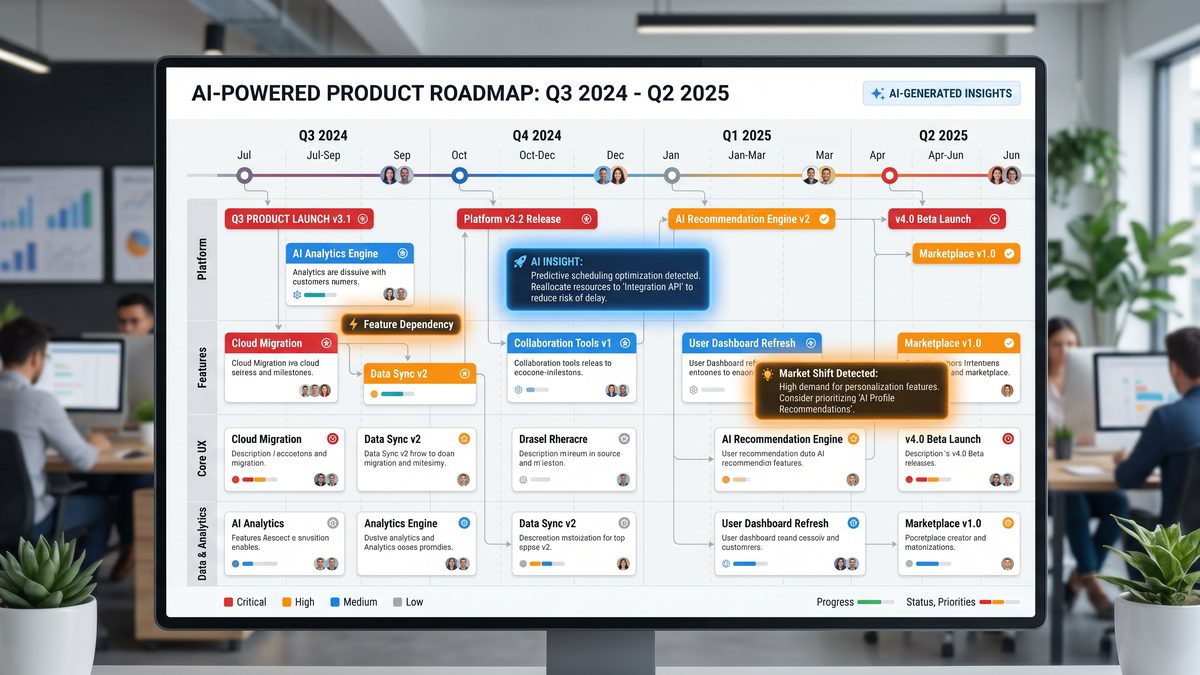
Prompt 1 — Strategic 12–18 Month Roadmap
Prompt:
You are a product strategy assistant. Create a strategic 12–18 month product roadmap for {PRODUCT}, a {SHORT_PRODUCT_DESC} competing in {MARKET}. Assume the company goals are: increase ARR by X%, grow MAUs by Y%, and reduce churn by Z% over the period. Provide a timeline grouped by quarter, with high-level themes, prioritized initiatives (MUST, SHOULD, NICE), key milestones, cross-functional dependencies (engineering, data, sales, marketing, support), required resources, and risk mitigations. End with 5 KPIs tied to each theme.
How to use: Input realistic company targets and a short description. Use when planning annual/quarterly allocations with execs. Set model temperature 0.2–0.4 for factual structure.
Expected output: A quarter-by-quarter roadmap table listing themes, prioritized initiatives with owner, milestones, dependencies, resources, risks and 5 KPIs tied to themes.
Prompt 2 — One-Page Executive Roadmap Summary
Prompt:
Create a concise one-page executive summary of the roadmap for {PRODUCT} targeted to the CEO and CFO. Include: 3 strategic priorities, expected business impact by priority (revenue, retention, engagement), top 5 milestones with dates, estimated budget range for major initiatives, and a short risk/mitigation section. Limit output to a single page (≈400 words).
How to use: Provide the roadmap from Prompt 1 and ask this to generate a slide or memo. Use conservative temperature 0.1–0.3.
Expected output: One-page narrative with bullets: 3 priorities, business impacts, milestone timeline, budget bands, and succinct risks.
Prompt 3 — Theme-to-Initiative Mapping Matrix
Prompt:
Produce a theme-to-initiative mapping matrix for the next 6 quarters for {PRODUCT}. For each theme, list initiatives, expected outcome (metric delta), owner, complexity (low/medium/high), and dependencies. Present the result as a table suitable for import into a roadmap tool.
How to use: Use when converting strategy themes into execution items; paste into exporting/importing process. Temperature 0.2.
Expected output: A table with columns: Theme, Initiative, Expected Outcome, Owner, Complexity, Dependencies, and Quarter.
Prompt 4 — Outcome-Focused Roadmap with OKRs
Prompt:
Convert our roadmap into an outcome-focused format. For each major initiative for {PRODUCT} over the next 4 quarters, write 1 Objective and 2–3 Key Results (OKRs) that directly map to measurable metrics. Indicate how to measure each Key Result (metric source, aggregation, baseline).
How to use: Provide raw initiatives. Use to align PMs and leaders on measurable goals. Temperature 0.25.
Expected output: List of Objectives and Key Results with metric definitions, data sources, aggregation method, and baselines.
Prompt 5 — Dependency and Resource Heatmap
Prompt:
Analyze the following initiatives for {PRODUCT}. For each initiative provide: required FTEs (by role), estimated calendar duration, critical external dependencies, and a risk score (1–5). Then synthesize a heatmap indicating quarters where resource contention is highest and recommendations for smoothing.
How to use: Attach initiative list and resource constraints. Useful for portfolio-level planning and tradeoffs. Temperature 0.3.
Expected output: Tabular resource estimates, risk scores, and a narrative recommending resource smoothing and phased starts.
Prompt 6 — Roadmap Trade-off Analysis (Speed vs Scope vs Quality)
Prompt:
For {PRODUCT}, perform a trade-off analysis between delivering a feature quickly, expanding scope, and maintaining high quality. Given initiative {INITIATIVE_NAME}, list three execution scenarios (Fast, Balanced, Conservative), with expected time-to-market, estimated effort, customer impact, revenue impact, and recommended scenario with justification.
How to use: Use to brief engineering and design leads when planning a release. Supply initiative details and constraints. Temperature 0.3–0.4.
Expected output: Three scenarios with quantified or semi-quantified impacts and a recommended approach including mitigation steps.
Prompt 7 — Market-Driven Roadmap Adjuster
Prompt:
We received new market signals: {LIST_SIGNALS} (e.g., competitor price drop, regulatory change, new technology). Re-evaluate the current 12-month roadmap for {PRODUCT} and realign priorities. Provide a list of initiatives that should be accelerated, delayed, or re-scoped and explain the rationale for each.
How to use: Use when external events necessitate roadmap changes. Provide the signals and existing roadmap. Temperature 0.35.
Expected output: Actionable list of initiatives to accelerate/delay/re-scope with clear rationales and suggested immediate actions.
Section B — Feature Prioritization (7 prompts)
Prompt 8 — RICE Prioritization Table
Prompt:
Create a RICE prioritization table for {PRODUCT} using this list of candidate features: {FEATURE_LIST}. For each feature estimate Reach (users/month), Impact (0.25/0.5/1/2), Confidence (0–100%), and Effort (person-months). Calculate the RICE score and produce sorted recommendations with a brief rationale and one suggested next step per top 5 features.
How to use: Provide numerical estimates where possible. Use for backlog grooming. Temperature 0.2–0.3.
Expected output: A table with Reach, Impact, Confidence, Effort, RICE score and a sorted list with rationales and next steps.
Prompt 9 — Value vs Complexity Quadrant
Prompt:
For {PRODUCT}, map candidate features {FEATURE_LIST} into a Value vs Complexity 2x2 quadrant. Define Value as expected contribution to target metric {TARGET_METRIC}. Define Complexity using engineering estimates. Output the quadrant and prioritize by quadrant with recommended immediate focus.
How to use: Use when needing a visual prioritization view for stakeholders. Follow-up with Gantt if necessary. Temperature 0.25.
Expected output: Descriptive quadrant mapping and a recommended prioritized list: Quick wins, Major investments, Time sinks, Low-priority.
Prompt 10 — Customer-Severity Prioritization
Prompt:
Prioritize feature requests by customer pain severity for {PRODUCT}. Given the following customer reports with severity indicators {CUSTOMER_CASES}, produce a prioritized backlog that weighs severity, number of affected customers, strategic alignment, and revenue risk. Provide a short justification for the top 10 items.
How to use: Upload customer cases from support/CS and use to inform the backlog. Temperature 0.3.
Expected output: Prioritized list of top 10 features/bugs with justifications citing severity, affected user count, and alignment.
Prompt 11 — Kano Model Prioritization
Prompt:
Apply the Kano model to classify {FEATURE_LIST} for {PRODUCT} into Must-Have, Performance, and Delighter categories. For each feature provide customer statements that would indicate the classification and recommend whether to include in MVP or later stages.
How to use: Use customer interviews or survey data to feed the prompt. Good before defining MVP scope. Temperature 0.35.
Expected output: Features categorized with sample customer statements and recommendations for release inclusion.
Prompt 12 — Cost of Delay (CoD) Calculator
Prompt:
Calculate the Cost of Delay for each feature in {FEATURE_LIST} for {PRODUCT}. For each item, accept inputs: estimated monthly value (USD), estimated delivery months, and probability of success. Provide CoD per month, recommended order to minimize CoD, and a short explanation of the decision-making rule used.
How to use: Provide numeric expected values; useful when budget-constrained. Temperature 0.2.
Expected output: Numeric CoD figures, ordered list to minimize total CoD, and method explanation.
Prompt 13 — Stakeholder Weighted Scoring
Prompt:
Create a weighted scoring matrix for {PRODUCT} that incorporates stakeholder inputs. Provide weights for criteria (e.g., revenue potential 30%, strategic fit 25%, technical feasibility 20%, time-to-market 15%, customer delight 10%). Score {FEATURE_LIST} and produce ranked output with sensitivity analysis showing how ranks change with ±10% weight shifts.
How to use: Collect stakeholder weights or use suggested defaults. Use to facilitate prioritization meetings. Temperature 0.3.
Expected output: Scored matrix, ranked features, and sensitivity analysis outcomes showing rank volatility.
Prompt 14 — Prioritization Decision Memo
Prompt:
Draft a one-page prioritization decision memo for the product leadership team with your recommended top 5 features from {FEATURE_LIST}. For each feature include: priority rank, business impact, estimated effort, proposed release quarter, and a 2-sentence rationale. Conclude with a one-paragraph recommendation for the backlog size and cadence.
How to use: Use after scoring. Paste into an email or slide. Temperature 0.15–0.25.
Expected output: One-page memo with concise bullets for each top feature and a final recommendation paragraph.
Section C — User Story Generation & Requirements (7 prompts)
Prompt 15 — User Story Bank from Use Cases
Prompt:
Generate user stories for {PRODUCT} from the following use cases: {USE_CASES}. For each use case, produce 5 user stories following the template "As a [user], I want [action] so that [benefit]". Include acceptance criteria (Given/When/Then) and suggested story points (T-shirt sizing: S/M/L/XL).
How to use: Provide clear use cases. Use to populate the backlog and sync with engineering. Temperature 0.3–0.4.
Expected output: For each use case, 5 formatted user stories with acceptance criteria and story size estimates.
Prompt 16 — Epic to Stories Decomposition
Prompt:
Decompose the epic "{EPIC_NAME}" for {PRODUCT} into a set of child user stories and technical tasks. For each child story include description, acceptance criteria, dependencies, and estimated points. Also tag whether UX work is required and whether a backend change is needed.
How to use: Submit the epic description and goals. Use while planning grooming sessions. Temperature 0.25.
Expected output: A hierarchical list: Epic -> stories -> technical tasks, with acceptance criteria and estimates.
Prompt 17 — Non-Functional Requirements (NFR) Checklist
Prompt:
Create a comprehensive non-functional requirements checklist for {PRODUCT} version {VERSION} with categories: Performance, Security, Reliability, Scalability, Privacy, Accessibility, Localization, and Observability. For each item provide a measurable target and suggested test or monitoring approach.
How to use: Use when defining release criteria and SLOs. Temperature 0.2.
Expected output: Checklist of NFR items with numeric targets or pass/fail definitions and test/monitoring approaches.
Prompt 18 — UX Acceptance Criteria and Edge Cases
Prompt:
For the feature "{FEATURE_NAME}" produce detailed UX acceptance criteria and enumerate edge cases and error states that must be validated. Include expected microcopy changes and a recommended validation checklist for QA and usability testing.
How to use: Collaborate with design and QA; supply design prototypes or mockups. Temperature 0.35.
Expected output: UX acceptance criteria, edge cases, microcopy suggestions, and a QA/usability validation checklist.
Prompt 19 — API Contract Draft for Backend Teams
Prompt:
Draft an API contract for the endpoint(s) required by "{FEATURE_NAME}" in {PRODUCT}. Include endpoint path(s), request/response JSON schemas, authentication method, rate limits, error codes, typical payload sizes, and migration notes for backward compatibility.
How to use: Provide functionality needs; useful for API-first development and backend/frontend alignment. Temperature 0.2.
Expected output: API contract with endpoint definitions, sample requests/responses, auth, errors, and migration notes.
Prompt 20 — Data Schema and Instrumentation Plan
Prompt:
Define the data schema and event instrumentation plan to support analytics for {FEATURE_NAME} in {PRODUCT}. Specify events, event properties, user properties, recommended event names, and downstream reporting tables or BI views. Include retention and privacy considerations.
How to use: Use with analytics and data engineering; include schema to avoid instrumentation gaps. Temperature 0.25.
Expected output: List of events and properties, naming conventions, BI table suggestions, and retention/privacy notes.
Prompt 21 — Regulatory Requirements Mapping
Prompt:
Map regulatory and compliance requirements relevant to {PRODUCT} and feature {FEATURE_NAME} (examples: GDPR, CCPA, HIPAA, SOC 2). For each regulation list specific controls needed, documentation artifacts required, and a compliance priority score (high/medium/low).
How to use: Use before release in regulated markets. Provide regions and feature data types. Temperature 0.2–0.3.
Expected output: Regulation-to-control mapping, artifact list, and compliance priority scores with suggested owners.
Section D — Sprint Planning & Execution (6 prompts)
Prompt 22 — Sprint Plan with Commitments and Buffer
Prompt:
Create a 2-week sprint plan for the following backlog items: {BACKLOG_ITEMS}. Assume team velocity = {VELOCITY} story points and capacity constraints: {CAPACITY}. Allocate stories to the sprint, identify a 15% buffer for bugs/unplanned work, and list specific acceptance criteria and definition-of-done checks for each selected story.
How to use: Use at sprint-planning meetings. Enter real velocity and capacity. Temperature 0.2.
Expected output: Sprint commitment list with story allocations, buffer calculation, acceptance criteria, and DoD checks.
Prompt 23 — Daily Standup Prompt Generator
Prompt:
Generate a concise standup template and questions for today's daily standup for the sprint running from {START_DATE} to {END_DATE}. Include prompts for blockers, cross-team coordination, and a section for risks to call out during the standup.
How to use: Use as daily agenda or to auto-generate standup notes. Temperature 0.4 for conversational tone.
Expected output: Short standup template and questions with optional follow-up actions to assign.
Prompt 24 — Sprint Risk Register and Mitigation
Prompt:
Produce a sprint risk register for the current sprint with columns: Risk Description, Likelihood (L/M/H), Impact (L/M/H), Mitigation Action, Owner, and Trigger Event. Include at least 10 common risks for software teams and one custom risk drawn from {PROJECT_SPECIFICS}.
How to use: Use at the start of a sprint and review mid-sprint. Temperature 0.3.
Expected output: Tabular risk register with actionable mitigations and owners.
Prompt 25 — Release Checklist and Cutover Plan
Prompt:
Draft a release checklist and cutover plan for deploying {RELEASE_NAME} for {PRODUCT}. Include pre-deploy checks, deployment steps, smoke tests, rollback plan, communication plan (internal and external), and post-deploy monitoring and validation steps with metrics to watch.
How to use: Use before major releases; share with engineering and ops. Temperature 0.2.
Expected output: Detailed checklist and playbook steps for deployment, rollback, and post-release validation.
Prompt 26 — Sprint Retrospective Facilitation Script
Prompt:
Create a 45-minute retrospective facilitation script for the recent sprint. Include step-by-step facilitator notes, timeboxes, prompts for appreciation, improvements, and action item capture. Provide a follow-up email template summarizing outcomes and owners.
How to use: Use to run retrospectives; paste into meeting notes. Temperature 0.4 for approachable language.
Expected output: Facilitation agenda, prompts, and a follow-up email template with action items and owners.
Prompt 27 — Predictive Burn-down and Early Warning Signals
Prompt:
Using the sprint backlog {BACKLOG_ITEMS} and current burn-down data {BURN_DATA}, produce a predictive burn-down forecast and list early warning signals that indicate the sprint will miss commitment. Suggest immediate corrective actions and reallocation alternatives.
How to use: Input burn data and backlog; useful mid-sprint for course correction. Temperature 0.25.
Expected output: Forecast chart description, early warning indicators, and suggested corrective actions prioritized by impact.
Section E — Competitive Intelligence & Market Research (7 prompts)
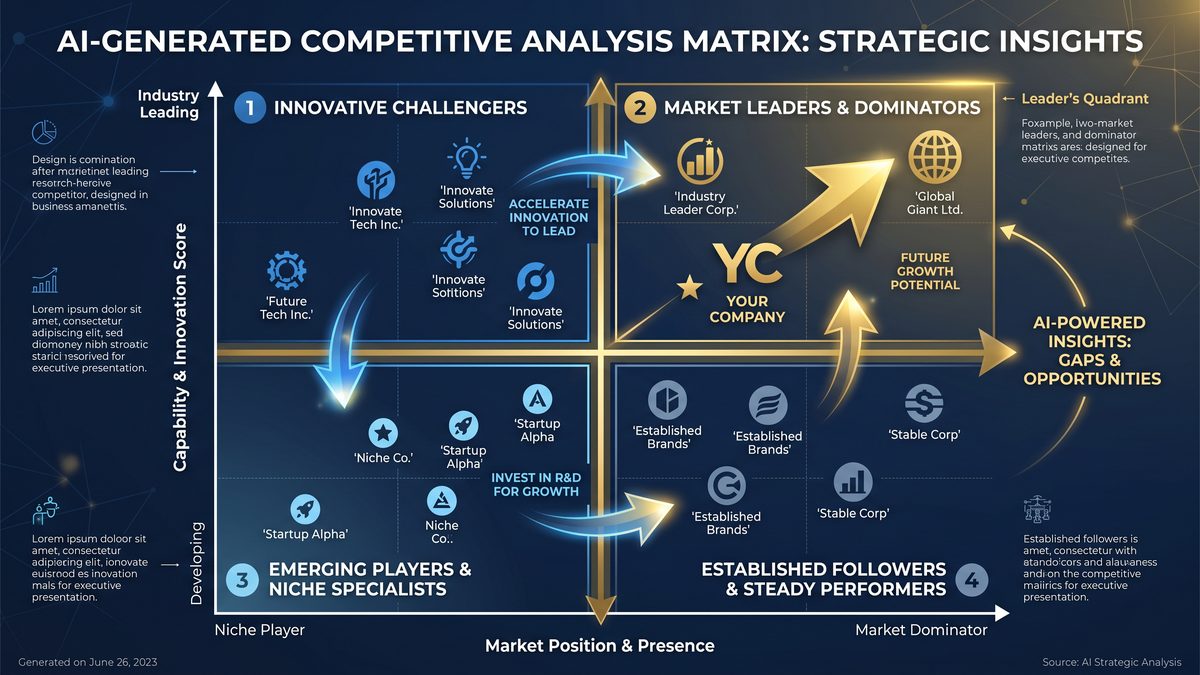
Prompt 28 — Competitor Feature Parity Matrix
Prompt:
Produce a competitor feature parity matrix for {PRODUCT} vs {COMPETITORS}. For each competitor list core product categories and indicate parity status: Leading / Parity / Lagging. Provide a short strategic implication for each parity status and three feature opportunities to close gaps or differentiate.
How to use: Provide competitor list and product categories. Great for product marketing and positioning. Temperature 0.3.
Expected output: Matrix with parity status per category and strategic implications plus three opportunity suggestions.
Prompt 29 — Competitive Pricing Analysis
Prompt:
Analyze competitor pricing for {PRODUCT} in {MARKET}. Produce a table of competitor plans, key features per plan, price points, billing cadence, and discount patterns. Recommend 3 pricing strategies (penetration, value-based, tier adjustment) with pros/cons for each and revenue uplift scenarios.
How to use: Provide competitor pricing data if available. Use for GTM and pricing reviews. Temperature 0.3.
Expected output: Pricing table and three recommended strategies with scenario analysis.
Prompt 30 — Win/Loss Interview Synthesis
Prompt:
Given a set of win/loss interview transcripts {TRANSCRIPTS}, synthesize key themes across wins and losses. For each theme include frequency, exemplar quotes, root causes, and recommended product or sales changes to improve win rates.
How to use: Paste interview transcripts or paste links. Use for sales enablement and roadmap input. Temperature 0.35.
Expected output: Thematic synthesis with supporting quotes and concrete recommendations prioritized by frequency and impact.
Prompt 31 — Market Sizing and TAM/SAM/SOM Calculation
Prompt:
Estimate TAM, SAM, and SOM for {PRODUCT} in {GEOGRAPHY} using public data assumptions: total enterprises/users, adoption rates, and average revenue per customer. Show calculations, assumptions, and sensitivity: optimistic/realistic/conservative cases.
How to use: Provide known inputs and request assumptions where unknown. Use for investor decks and strategic planning. Temperature 0.2.
Expected output: Numeric TAM/SAM/SOM figures with full calculation steps and scenario ranges.
Prompt 32 — SWOT Analysis with Strategic Options
Prompt:
Prepare a SWOT analysis for {PRODUCT}. For each quadrant list 6–8 items. For each weakness and threat propose a strategic option that the product or GTM team can act on, and estimate expected impact and effort required for each option.
How to use: Useful for leadership reviews; provide market context. Temperature 0.3.
Expected output: SWOT list with action-oriented strategic options and impact/effort estimates.
Prompt 33 — Competitive Messaging and Battle Card
Prompt:
Create a battle card for {COMPETITOR} targeted at sales and customer success teams. Include: competitor strengths, weaknesses, product differentiators for {PRODUCT}, objection handling scripts, sample rebuttals, and 3 quick demo points to highlight during sales calls.
How to use: Use for sales enablement and demo prep. Temperature 0.4 for usable narrative tone.
Expected output: Concise battle card with bullets for strengths/weaknesses, objection handling, and demo talking points.
Prompt 34 — Signal Monitoring Playbook
Prompt:
Design a signal monitoring playbook to detect changes in competitive behavior and market dynamics for {PRODUCT}. List signal types (pricing, feature launches, funding, hiring), data sources, frequency of checks, alert thresholds, and triage steps for the product team.
How to use: Use to implement a CI process with automated feeds. Temperature 0.25.
Expected output: Playbook with signal types, sources, sampling frequency, thresholds, and triage runbook.
Section F — Go-to-Market Planning & Launch (6 prompts)
Prompt 35 — GTM Plan Template by Segment
Prompt:
Create a go-to-market plan for the launch of {FEATURE_OR_PRODUCT} targeting segments: {SEGMENT_A}, {SEGMENT_B}, {SEGMENT_C}. For each segment provide messaging, acquisition channels, estimated CAC, sales motion (self-serve, inside sales, enterprise), onboarding touchpoints, and initial conversion metrics to measure.
How to use: Provide ICPs and channels. Use to coordinate marketing, sales, and CS. Temperature 0.3.
Expected output: Segment-specific GTM plan with tactical channel recommendations and suggested KPIs.
Prompt 36 — Launch Checklist and Marketing Playbook
Prompt:
Create a launch checklist and 90-day marketing playbook for {PRODUCT_LAUNCH}. Include pre-launch activities (beta, press outreach, analyst briefings), launch activities (announcement, webinars, content pieces), and post-launch activities (retention campaigns, case studies). Assign roles and timelines.
How to use: Use for planning coordinated launches. Provide team contacts and PR constraints. Temperature 0.25.
Expected output: Detailed checklist mapped over 90 days with tasks, owners, and timelines.
Prompt 37 — Pricing Packaging and Positioning Sheet
Prompt:
Draft recommended pricing tiers and packaging for {PRODUCT}. Provide feature-to-tier mapping, target customer profile for each tier, recommended list prices, and positioning copy for landing pages and sales pitches.
How to use: Use after competitive pricing and feature-value analysis. Temperature 0.3.
Expected output: Pricing tiers with feature lists, target profiles, price points, and two-sentence positioning copy per tier.
Prompt 38 — Channel Partner Playbook
Prompt:
Design a channel partner playbook to scale distribution of {PRODUCT}. Include partner profiles, onboarding checklist, co-selling motions, margin/commission structures, enablement assets, and KPI targets for partner success.
How to use: Use to evaluate partner go-to-market pilots. Temperature 0.35.
Expected output: Partner profile definitions, onboarding steps, commercial terms, enablement content list, and KPIs.
Prompt 39 — Beta Program Design and Metrics
Prompt:
Design a beta program for {PRODUCT} with objectives, recruitment criteria, onboarding flow, engagement cadence, feedback collection templates, and success metrics. Include a decision matrix for graduating features to GA vs. iterating further.
How to use: Use when running early access programs. Provide target participant criteria. Temperature 0.35.
Expected output: Beta program plan with recruitment, onboarding, engagement cadence, templates, success metrics, and graduation decision matrix.
Prompt 40 — Sales Enablement: Demo Script and Objection Handling
Prompt:
Create a 10-minute demo script for sales to show {FEATURE_OR_PRODUCT} focused on {TARGET_USE_CASE}. Include a 3-slide flow (problem, demo, value), two real customer examples to cite, and objection handling for the top 5 expected objections.
How to use: Provide value props and target use case. Useful in sales training. Temperature 0.4.
Expected output: Demo script with slide flow, customer examples, and objection handling scripts for top objections.
Product managers who master AI-assisted workflows can extend their prompting strategies to adjacent disciplines, including customer success and retention optimization. For a deeper exploration of this topic, see our comprehensive guide on How to Build Real-Time Voice Agents with ChatGPT’s Advanced Voice Mode and GPT-5.5: Complete Implementation Guide, which provides actionable frameworks and implementation strategies for enterprise teams.
Section G — Metrics Dashboards & Analytics (6 prompts)
Prompt 41 — Core KPI Dashboard Spec
Prompt:
Define a core KPI dashboard spec for {PRODUCT} using metrics aligned to unit economics and growth: ARR/MRR, CAC, LTV, churn (gross and net), MAU/DAU, conversion funnel metrics, feature adoption. For each metric define calculation, data source, aggregation frequency, and acceptable thresholds.
How to use: Provide product and business model. Use with BI/data teams to build dashboards. Temperature 0.2.
Expected output: Dashboard spec listing metrics with formal definitions, data sources, refresh frequency, and thresholds.
Prompt 42 — Funnel Analysis Deep Dive Prompt
Prompt:
Analyze the conversion funnel for {PRODUCT} with stages: Visit → Signup → Activation → Paid Conversion. Using the following table of counts by stage {FUNNEL_COUNTS}, identify biggest leaks, suggest 3 experiments to improve conversion at the highest-impact stage, and estimate potential uplift per experiment.
How to use: Provide funnel counts and any A/B results. Use for growth planning. Temperature 0.25.
Expected output: Leak identification, prioritized experiments with estimated uplifts and rationale.
Prompt 43 — Cohort Retention Analysis
Prompt:
Perform a cohort retention analysis for {PRODUCT} using cohorts by signup month: {COHORT_DATA}. Provide retention curves, likely causes for retention trends, and 5 retention experiments prioritized by expected ROI.
How to use: Paste cohort matrix. Use to guide product/CS experiments. Temperature 0.3.
Expected output: Retention curve explanation, root causes, and prioritized experiments with ROI rationale.
Prompt 44 — A/B Test Hypothesis and Analysis Template
Prompt:
Draft a rigorous A/B test plan for hypothesis: "{HYPOTHESIS}". Define primary and secondary metrics, sample size calculation, experiment duration, segmenting approach, guardrails for stopping, and an analysis template including statistical significance and practical significance interpretation.
How to use: Supply hypothesis and baseline metrics. Use for experimental governance. Temperature 0.15–0.25.
Expected output: Complete A/B plan with sample size calc, duration, metrics, and analysis template to use when evaluating results.
Prompt 45 — Data Quality Audit Checklist
Prompt:
Produce a data quality audit checklist for {PRODUCT} analytics. Cover event tracking completeness, duplicate events, schema drift, missing user identifiers, timestamp integrity, and ETL failures. For each check, include detection queries and remediation steps.
How to use: Collaborate with data engineering. Use to detect blind spots in analytics. Temperature 0.2.
Expected output: Checklist with detection queries (SQL-like pseudo-queries) and remediation actions.
Prompt 46 — Dashboard Narrative and Decision-Maker Cheat Sheet
Prompt:
For the core dashboard for {PRODUCT} produce a narrative cheat sheet for execs explaining the top 6 metrics, what they indicate, recent trend signals to watch for, and two action recommendations per metric when the metric is underperforming.
How to use: Use in weekly leadership reviews or to prep for meetings. Temperature 0.3.
Expected output: Metric-by-metric narrative with watcher signs and two action items per metric.
Section H — Executive Communication & Stakeholder Management (4 prompts)
Prompt 47 — Quarterly Business Review (QBR) Presentation Script
Prompt:
Draft a QBR presentation script and slide outline for {PRODUCT} covering: accomplishments vs goals, roadmap progress, metrics snapshot, key customer stories, blockers and asks from leadership. Provide speaker notes and 5 strategic questions to solicit executive input.
How to use: Use to create a slide deck and to prep the PM presenting. Temperature 0.25.
Expected output: Slide outline and corresponding speaker notes plus key questions for execs.
Prompt 48 — Stakeholder Update Email Template
Prompt:
Generate a concise stakeholder update email for {AUDIENCE} summarizing the past two weeks for {PRODUCT}. Include: 3 bullets of progress, 2 bullets of risks/issues (with owners), 1 ask, and 1 upcoming milestone. Keep tone concise and action-oriented.
How to use: Use for regular cadence updates to leadership and cross-functional partners. Temperature 0.35.
Expected output: Ready-to-send email with bullets and clear call-to-action.
Prompt 49 — Executive One-Pager for Board or Investors
Prompt:
Produce a one-page board-ready executive brief for {PRODUCT} including: Top-line metrics (revenue, growth rate, churn), one major customer win/loss, progress against key strategic initiatives, capital/resource asks (if any), and risk summary. Keep to 350–450 words.
How to use: Use prior to board meetings or investor updates. Provide up-to-date metrics. Temperature 0.2.
Expected output: Concise one-page brief with numbered items and a short ask section suitable for board deliverables.
Prompt 50 — Stakeholder Alignment Workshop Agenda
Prompt:
Design a 2-hour stakeholder alignment workshop agenda to resolve conflicting priorities across Product, Sales, Engineering, and Marketing. Include pre-read materials, timed agenda with activities (e.g., prioritization exercises, breakout groups), decision criteria, and a post-workshop action plan template.
How to use: Use to convene cross-functional stakeholders when trade-offs are blocked. Provide known conflict points. Temperature 0.35.
Expected output: Timed workshop agenda, activity instructions, pre-reads list, and post-workshop action plan template with owners.
The data analysis capabilities available through Codex complement these product management prompts by enabling PMs to validate hypotheses with real-time analytics. For a deeper exploration of this topic, see our comprehensive guide on Codex Voice Agent Masterclass: 30 Production-Ready Prompts for Building, Testing, and Deploying Conversational AI Systems, which provides actionable frameworks and implementation strategies for enterprise teams.
Appendix: Prompt Engineering Patterns & Best Practices for PMs
This appendix extracts pragmatic patterns from the above prompts so you can craft new prompts quickly. Use these patterns as shells — substitute variables in braces with real values from your product context.
| Pattern | Purpose | Template Notes |
|---|---|---|
| Roadmap synthesis | Turn backlog/strategy into time-bound roadmap | Always include company goals, time horizon, dependencies, owners, and KPIs |
| Prioritization matrix | Rank features by multiple criteria | Include numeric or ordinal scale and run sensitivity checks |
| Story decomposition | Convert epics into implementation-ready stories | Provide acceptance criteria and estimate sizing conventions |
| Data & analytics spec | Define metrics and instrumentation precisely | Always include calculation, data source, aggregation, and owner |
| GTM playbook | Align marketing, sales, and CS on launch | Segment-specific messaging, CAC estimates, and acquisition channels |
Model settings and practical tips
- Temperature: Use 0.1–0.3 for precise, factual outputs (roadmaps, APIs, contracts). Use 0.3–0.45 for creative framing, messaging, and scripts.
- System prompts: For complex workflows, set the system role to “Senior Product Manager” or “Product Strategy Assistant” to get role-aligned outputs.
- Chunking: For long inputs (transcripts, backlog lists), chunk into batches and ask for synthesis per batch then a final synthesis prompt that consolidates the per-batch outputs.
- Verification: Always request explicit output structure (tables, bullet lists) and example rows to validate the model is following the schema.
- Data sensitivity: Avoid sending PII or raw customer data unless your model deployment meets compliance requirements. For sensitive inputs, obfuscate or summarize before prompting.
Common prompt anti-patterns to avoid
- Vague goals: “Improve product” — always tie to concrete metrics or outcomes.
- No constraints: Provide deadlines, resource limits, or market constraints to make recommendations realistic.
- Overly long single prompts: Break into targeted sub-prompts (e.g., one for analysis, one for recommendations).
- Assuming exact numeric outputs: For financial or legal recommendations, use the model for qualitative guidance and validate numerics with domain experts.
Access 40,000+ AI Prompts for ChatGPT, Claude & Codex — Free!
Subscribe to get instant access to our complete Notion Prompt Library — the largest curated collection of prompts for ChatGPT, Claude, OpenAI Codex, and other leading AI models. Optimized for real-world workflows across coding, research, content creation, and business.
Quick Reference: Example Variables to Replace
When reusing these prompts, substitute variables like:
- {PRODUCT} — product or feature name
- {SHORT_PRODUCT_DESC} — one-line description
- {MARKET} — target market or industry
- {FEATURE_LIST} — comma-separated candidate features
- {INITIATIVE_NAME}, {EPIC_NAME}, {FEATURE_NAME} — specific items
- {BACKLOG_ITEMS}, {BURN_DATA}, {COHORT_DATA} — data tables or summaries
- {COMPETITORS} — competitor names
- {TARGET_METRIC} — the key metric you’re optimizing
Use this guide as a living toolkit. Copy each prompt into your GPT-5.5 session, replace the tokens with real context, and iterate — prompt engineering is an iterative process where even small adjustments to wording, constraints, and expected output structure yield significantly better results. If you desire, you can start by running Prompts 1, 8, 15, and 41 sequentially to quickly move from strategy to execution and measurement.
End of guide.
