
50 GPT-5.5 Prompts for Operations Managers: Supply Chain Optimization, Process Automation, Resource Allocation, and Performance Dashboards

50 Production-Ready GPT-5.5 Prompts for Operations Managers
Introduction
This guide compiles 50 highly specific, production-ready prompts tailored for Operations Managers working on supply chain optimization, process automation, resource allocation, and dashboard generation. Each prompt is crafted for GPT-5.5-class models and includes: the full prompt text ready to paste, a concise explanation of why it works, the expected inputs (data and context you should supply), and practical tips for customization to make it fit your environment.
These prompts are organized into four practical categories: Supply Chain Optimization, Process Automation, Resource Allocation, and Performance Metrics & Dashboard Generation. Use them directly in your workflows, embed them into your automation pipelines, or adapt them to your organization’s nomenclature, ERP exports, and reporting cadence.
Where relevant, we refer to companion materials that expand on adjacent competencies. For example, if you are integrating conversational automation with warehouse or field operations, review the voice interaction strategies in
Operations managers looking to extend their automation capabilities into voice-driven interfaces will find complementary strategies in our Codex Voice Agent Masterclass. This collection of 30 production-ready prompts covers the complete lifecycle of building, testing, and deploying conversational AI systems, including the prompt engineering patterns for handling complex multi-turn dialogues, error recovery, and graceful fallback mechanisms. Codex Voice Agent Masterclass: 30 Production-Ready Prompts.
— the masterclass covers designing voice-first agent flows, error handling, and actionable prompts for field technicians. This guide assumes you will pair these textual prompts with those operational patterns where voice or agent interfaces are required.
To reduce cost and operational risk when deploying many model calls across teams or automations, pair these prompts with policy and financial guardrails. See the implementation notes in
Organizations implementing ChatGPT scheduled tasks at scale need robust cost governance frameworks. Our enterprise guide to OpenAI spend controls and usage analytics provides a comprehensive methodology for monitoring token consumption, setting departmental budgets, and optimizing AI costs across distributed teams using the new administrative dashboard and real-time usage alerts. The Enterprise Guide to OpenAI Spend Controls and Usage Analytics.
for practical steps on throttling, batching, and quota enforcement while using models at scale. The guidance in that article directly complements resource allocation and cost forecasting prompts later in this guide.
Section A — Supply Chain Optimization (13 prompts)
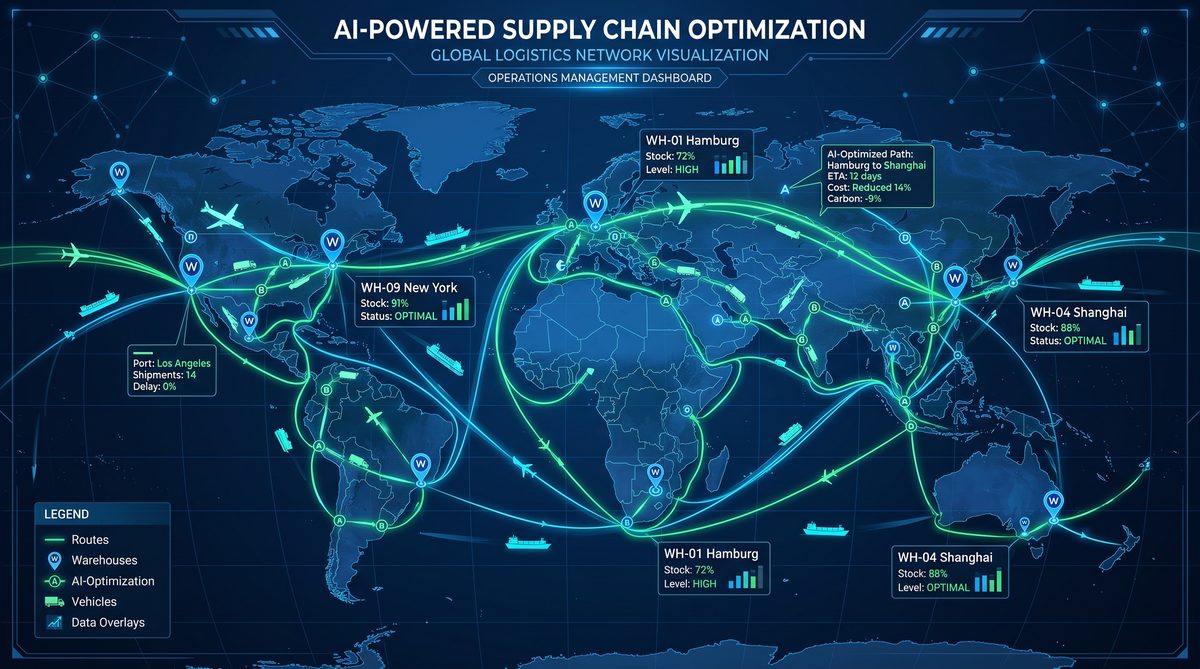
These prompts target upstream and downstream supply chain problems: demand forecasting, inventory optimization, supplier risk analysis, lead-time compression, dynamic reorder rules, and network optimization. Each prompt expects structured inputs like historical sales, lead times, supplier reliability scores, SKU hierarchies, and service level targets.
Prompt A1 — SKU-level Demand Forecast with Intermittent Demand Adjustment
You are an expert supply chain forecasting assistant. Given the historical weekly units sold for SKU: {sku}, the promotional calendar for the past 24 months, seasonality flags (0-1) for weeks, and an indicator for supply disruptions (0-1), produce a 26-week forecast with 80% and 95% prediction intervals. Adjust the forecast for intermittent demand using Croston-like adjustments and provide a short rationale of drivers for each significant deviation (>20% variance from baseline). Output: CSV with columns [week_start, forecast_mean, p80_low, p80_high, p95_low, p95_high, driver_notes].
Why it works: This prompt explicitly sets the forecasting horizon, statistical confidence bands, and a method for intermittent demand (Croston). It demands a structured CSV output for easy downstream automation.
Expected inputs: historical weekly sales timeseries, promotional calendar, seasonality flags, disruption indicator, SKU identifier.
How to customize: Replace ‘weekly’ with daily or monthly frequency; change horizon length; switch Croston to bootstrap or state-space models if you can provide model outputs for hybrid prompting. Add business rules to cap forecasted increases tied to inventory limits.
Prompt A2 — Multi-Echelon Inventory Optimization
You are a multi-echelon inventory optimization engine. Inputs: inventory positions and lead times at each node (manufacturing, central DCs, regional DCs, stores), historical demand per outlet, target service levels per product class, and per-node holding plus shortage costs. Recommend replenishment policy (base-stock, (s,S), or periodic review) for each node and SKU, compute steady-state safety stock and reorder points, and simulate expected fill-rate and total cost over the next 12 months. Provide configuration snippets for the ERP replenishment module.
Why it works: It requests policy recommendations, quantitative calculations (safety stock, reorder points), and operational artifacts (ERP config snippets) making outputs actionable.
Expected inputs: node inventory positions, lead times, demand profiles, cost parameters, service level targets.
How to customize: Narrow to single-echelon for simpler environments or include capacity constraints for network flow limitations. Specify the simulation seed and iterations to reproduce results.
Prompt A3 — Supplier Risk Scoring and Mitigation Plan
You are a procurement risk analyst. For each supplier in the attached list (supplier_id, country, on-time-rate, quality-defect-rate, financial_health_score, single-sourcing_flag), produce a normalized risk score (0-100), rank suppliers by criticality, and recommend mitigation actions (alternative sources, buffer strategies, contract clauses). For the top 5 highest-risk, provide a 90-day action plan with owners and KPIs.
Why it works: Forces a normalized scoring approach, ranking, and practical mitigation actions with ownership — all necessary for immediate vendor management follow-up.
Expected inputs: supplier attributes as listed, any contractual lead times, and strategic spend weights per SKU or category.
How to customize: Add geopolitical risk indices, supplier sustainability scores, or integrate third-party credit feeds. Use weighted scoring to emphasize quality or lead time according to business priorities.
Prompt A4 — Lead-Time Compression Plan
Act as a lean operations consultant. Given the following lead-time breakdown for product family {family}: procurement cycle (days), inspection and QA (days), production run (days), packaging (days), and outbound transit (days), analyze the top three drivers of lead-time variability. Provide five specific interventions to reduce lead time by at least 20% and estimate the expected days saved per intervention, required cross-functional owners, and implementation risks.
Why it works: Breaks down lead time by component and asks for prioritized interventions, owners, and risk analysis so teams can act with accountability.
Expected inputs: lead-time component data, process constraints, current cycle times, cross-functional org map if available.
How to customize: Target a specific plant, supplier, or transportation lane. Ask for A/B test designs to validate interventions before full rollout.
Prompt A5 — Dynamic Reorder Rule Generator
You are an operations rules engine. For each SKU provided, propose a dynamic reorder rule that updates monthly based on rolling 90-day demand, current lead time, and supplier reliability score. Express the rule as pseudocode or a configuration block for an inventory system. Include guardrails for maximum order quantity, minimum safety stock, and an escalation flow for stockouts.
Why it works: Produces executable rules or configs that can be integrated directly into replenishment engines, reducing manual adjustments.
Expected inputs: SKU-level rolling demand, lead times, supplier reliability, SKU min/max constraints.
How to customize: Change update cadence (weekly), swap demand window (60/180 days), or tune aggressiveness with a risk multiplier parameter.
Prompt A6 — Transportation Mode Mix Optimization
You are a transport network optimizer. Inputs: historical shipping volumes by lane, transit times by mode (air, ocean, truck, rail), mode costs, variability (std dev of transit days), and per-shipment value. Recommend the optimal mode mix for each lane to minimize total landed cost while meeting a target on-time delivery probability (e.g., 95%). Provide a sensitivity table for service level vs. incremental cost.
Why it works: Balances cost vs reliability using explicit on-time probability targets and provides sensitivity analysis to inform strategic choices.
Expected inputs: lane-level volumes, costs, transit time distributions, shipment values.
How to customize: Add emissions or sustainability constraints, capacity caps, or contract commitments to carriers.
Prompt A7 — SKU Rationalization Decision Matrix
You are a product portfolio steward. Given SKU-level metrics: annual revenue, gross margin, inventory turnover, SKU cannibalization index, criticality to strategic accounts, and fixed handling cost, produce a decision matrix recommending Keep, Consolidate, or Phase-out for each SKU. For consolidation candidates, propose specific parent SKUs to absorb demand and migration steps.
Why it works: Combines financial and operational KPIs into crisp recommendations, reducing SKU complexity and handling costs.
Expected inputs: SKU metrics as listed, business rules for critical customers, minimum assortment constraints.
How to customize: Adjust thresholds or add qualitative attributes like brand importance or regulatory constraints.
Prompt A8 — Network Reconfiguration Scenario Planner
You are a logistics scenario planner. Inputs: current facility locations, capacities, fixed and variable costs, customer geographic demand distribution, and transit cost matrix. Evaluate three reconfiguration scenarios (status quo, hub-and-spoke consolidation, and regional micro-fulfillment expansion). For each, provide total cost, average delivery lead time, service level, and transition cost with a recommended timeline.
Why it works: Poses specific scenarios and requests both steady-state metrics and transition costs, allowing for board-ready strategic comparisons.
Expected inputs: facility data, demand distribution, cost parameters, transit matrices.
How to customize: Add labor market constraints, local tax incentives, or warehouse automation capital costs.
Prompt A9 — Returns and Reverse Logistics Optimization
You are a reverse logistics specialist. Given returns rates by channel, average cost-to-process-return, refurbishment percentage, and resale value, recommend a returns routing policy (local repair centers, central refurbishment, resell-as-is) to maximize recovered value and minimize processing cost. Provide KPIs and a 6-month pilot plan for the top channel.
Why it works: Focuses on maximizing recovered value and includes a pilot plan to validate the approach operationally.
Expected inputs: channel-specific returns metrics, processing costs, resale/refurbish values.
How to customize: Add sustainability goals, landfill diversion targets, or partner obligations.
Prompt A10 — Inventory Aging and Shrink Strategy
You are a warehouse inventory strategist. Input a current inventory aging report broken into buckets (0-30, 31-90, 91-180, >180 days) with carrying cost per unit and salvage value. Recommend disposition strategies (discount, bundle, donation, destruction) with a prioritized action list and expected cost savings and margin impact.
Why it works: Prioritizes actions for obsolete stock with financial estimates to support disposition decisions.
Expected inputs: aging report, carrying costs, salvage values.
How to customize: Add constraints such as regional tax benefits for donation or storage capacity limits that force faster disposition.
Prompt A11 — Promotional Uplift Attribution for Inventory Planning
You are a promotional effectiveness analyst. Given SKU-level sales by week, promotion flags (type, discount %, advertising spend), and baseline seasonality, decompose observed uplift into promotion-driven vs. base demand using causal impact methods. Output expected incremental units attributable to promotion and recommend safety stock adjustments for the subsequent promotion cycle.
Why it works: Drives causal decomposition needed to avoid over-ordering for promotions and informs accurate safety stock during promotional periods.
Expected inputs: sales time series, promotion metadata, baseline seasonality indicators.
How to customize: Swap in difference-in-differences if you have control regions or add experiments to validate promotion elasticity.
Prompt A12 — Cross-Docking Opportunity Identification
You are a logistics operations analyst. Given inbound shipment patterns (volume, SKU mix, arrival windows) and store replenishment schedules, identify SKUs and shipment windows suitable for cross-docking. For each recommendation, compute labor, storage, and throughput benefits and provide a pilot plan for three SKUs.
Why it works: Identifies concrete cross-docking candidates with quantified benefits, enabling quick pilots tied to measurable outcomes.
Expected inputs: inbound shipment manifests, store schedules, labor and storage cost parameters.
How to customize: Limit to high-velocity SKUs or those with consistent same-day outbound demand to make cross-docking feasible.
Prompt A13 — Supplier Consolidation Impact Analysis
You are a strategic sourcing analyst. For a proposed consolidation of suppliers for component {component_family}, model the impact on cost, lead time variability, and supply risk over a 24-month horizon. Include break-even analysis for consolidation-related volume discounts vs. concentration risk, and recommend contract terms to mitigate risk.
Why it works: Quantifies trade-offs of consolidation with explicit break-even points and mitigations, making recommendations defensible.
Expected inputs: current supplier rates, volume discounts, lead time variability, demand forecast for the component family.
How to customize: Add requirements for dual-sourcing for critical parts or include freight optimization in savings calculations.
Section B — Process Automation (12 prompts)
These prompts are designed to help automate recurring operational tasks: standard operating procedure generation, RPA command generation, exception handling flows, automated root cause analysis, and orchestrating human-in-the-loop interventions. They are ready to be integrated into low-code automation platforms or used as templates for RPA scripts and orchestrator runs.
Prompt B1 — SOP Generation from Process Logs
You are a process documentation engine. Given a set of sequential event logs for process {process_name} (timestamp, actor, action, duration, status), extract the common path as a step-by-step Standard Operating Procedure (SOP) with decision points, expected durations, acceptance criteria, and checklist items for quality assurance. Highlight exceptions and map them to remediation steps.
Why it works: Converts raw event logs into actionable SOPs and exception remediations, saving manual documentation time and surfacing real-world deviations.
Expected inputs: event logs, process name, any existing documentation fragments.
How to customize: Tune for granularity (high-level vs. micro-steps), include screenshots or camera-capture references if available, or generate audit-specific SOP variants.
Prompt B2 — RPA Task Script Generator (Vendor-Neutral)
You are an RPA developer. For the task "process incoming invoice and post payment" provide a vendor-neutral automation script outline and pseudocode covering: login steps, data extraction from PDF (fields: invoice_no, vendor, amount, due_date), validation rules, GL account mapping heuristics, exception handling, and audit logging. Include sample regex patterns and retry logic.
Why it works: Creates a vendor-neutral blueprint that RPA teams can map to UiPath, Automation Anywhere, or other tool-specific actions, accelerating developer handoff.
Expected inputs: sample invoice format(s), GL mapping table, authentication method details.
How to customize: Add OCR extractor model suggestions or include API endpoints for ERP posting; tune retry/backoff parameters.
Prompt B3 — Exception Triage and SLA Escalation Flow
You are an incident triage orchestrator. Given exception types (missing data, validation failure, supplier dispute, payment delay) and their historical resolution times, generate an SLA-based escalation flow with clear thresholds, notification templates, and required attachments for each escalation level. Output the flow in decision-tree JSON for orchestration engines.
Why it works: Converts operational SLAs and exception types into a machine-readable escalation flow and human-friendly templates for consistent handling.
Expected inputs: exception taxonomy, historical resolution times, contacts and roles for escalation.
How to customize: Adjust thresholds by business-criticality and map to different communication channels like SMS or Slack for urgent cases.
Prompt B4 — Automated Root Cause Analysis (RCA) for Production Delays
You are an automated RCA assistant. Inputs: incident timeline, machine telemetry time series, operator logs, and production throughput data. Identify probable root causes ranked by likelihood, explain the causal chain, and recommend immediate corrective actions and longer-term countermeasures. Provide confidence scores for each hypothesis.
Why it works: Synthesizes diverse data sources to generate prioritized hypotheses with confidence scoring — valuable for rapid resolution and post-mortem documentation.
Expected inputs: incident artifacts (time series, logs), context about operational thresholds and normal ranges.
How to customize: Include maintenance schedules, parts replacement history, or external factors like environmental sensors (temperature, humidity).
Prompt B5 — Automated SLA Health Monitor
You are an SLA health monitoring agent. Given daily performance snapshots for metrics (order-to-ship time, invoice processing time, on-time delivery rate) calculate rolling 30-day SLA attainment, detect trend deviations beyond thresholds, and produce an alert with suggested corrective actions and a root cause hypothesis.
Why it works: Provides both detection and suggested remediation for SLA deviations, making alerts actionable for operations teams.
Expected inputs: daily metric snapshots, SLA thresholds, historical baselines.
How to customize: Adjust window sizes (14/60 days), include confidence intervals for noisy metrics, or add channel-specific alert escalation rules.
Prompt B6 — Automated Vendor Communication Drafts for Exceptions
You are a vendor communications specialist. For each invoice or shipment exception, generate a concise, professional vendor-facing message including a clear problem statement, required evidence, proposed resolution options, and a 72-hour SLA for vendor acknowledgment. Provide variations for tone (formal, neutral, urgent) and include placeholders for reference numbers.
Why it works: Generates ready-to-send messages tailored by tone with necessary fields, reducing turnaround time on vendor responses and standardizing communications.
Expected inputs: exception details, supplier info, reference numbers, tone preference.
How to customize: Add language localization or integrate with email template systems to populate headers and footers automatically.
Prompt B7 — Human-in-the-Loop Decision Interface Spec
You are an HITL (human-in-the-loop) interface designer. For decisions flagged as high-risk (criteria: cost > {threshold} or legal review required), produce a UI spec that includes displayed evidence (documents, extracted fields, confidence scores), required approval fields, recommended decision options, and audit trail requirements. Provide UX copy for confirmation and rejection flows.
Why it works: Specifies a practical HITL interface design supporting transparency, auditability, and decision hygiene for critical operational choices.
Expected inputs: risk criteria, document types, required audit fields, compliance obligations.
How to customize: Add role-based approvals, multi-signature requirements, or adaptive workflows where more evidence is shown for lower confidence scores.
Prompt B8 — End-to-End Automation ROI Calculator
You are a business case modeler. For a proposed automation of process {process_name} provide an ROI calculation including implementation cost, annual run-rate cost savings (labor, error reduction, cycle-time improvements), expected productivity uplift, payback period, and sensitivity to change in adoption rates. Present results and show assumptions in a tabular format.
Why it works: Ties automation proposals to financial outcomes and sensitivity analysis, enabling prioritization and executive buy-in.
Expected inputs: current process costs, proposed automation cost, expected labor savings, error rate reduction estimates.
How to customize: Include indirect benefits like customer satisfaction improvements or reduced regulatory fines; specify timeframe for amortization.
Prompt B9 — Event-Driven Workflow Generator (Webhook to Action)
You are a workflow orchestrator. Given event types (invoice_created, shipment_delayed, stock_below_threshold) and required actions (notify_team, open_ticket, reorder), generate an event-to-action mapping, with retry/backoff policies, idempotency keys, and sample JSON payloads for each webhook. Include monitoring hooks and metrics to track success rates.
Why it works: Produces clear event-driven rules and technical artifacts (payloads, idempotency guidance) for reliable automation integration.
Expected inputs: event taxonomy, action list, existing ticketing/notification endpoints.
How to customize: Add batching strategies for high-event volume or include rate limits and dead-letter handling strategies.
Prompt B10 — Test Case Suite for Automated Processes
You are an automation QA engineer. For process {process_name} generate a prioritized test suite covering happy path, boundary conditions, and common exceptions. For each test case include input data, expected output, pass/fail criteria, and suggested automated test harness code snippet (pseudo or test framework agnostic).
Why it works: Ensures automation is deployed with a robust test suite covering crucial scenarios, improving reliability and reducing production incidents.
Expected inputs: process definition, acceptance criteria, sample data ranges.
How to customize: Map test cases to CI/CD pipelines or include synthetic data generation instructions for load testing.
Prompt B11 — Compliance and Audit Log Generator
You are a compliance logger. For automated workflows producing financial or regulated outputs, define a minimal audit log schema (event_id, timestamp, actor, action, input_snapshot, output_snapshot, confidence_score, approval_signature) and provide retention rules, access controls, and redaction policies for PII.
Why it works: Standardizes audit logs to meet compliance and forensic needs while specifying privacy-preserving policies.
Expected inputs: types of regulated processes, required retention periods, sensitivity classification for fields.
How to customize: Add jurisdiction-specific retention rules or encryption standards for stored logs.
Prompt B12 — Continuous Improvement Feed for Automation Enhancements
You are an automation improvement analyst. Parse the recent month of exception tickets, their root causes, and resolution times and produce a ranked backlog of automation enhancements. For each enhancement provide expected impact, estimated implementation effort (T-shirt sizes), and dependencies.
Why it works: Generates a prioritized product backlog for the automation roadmap based on empirical exception data, aligning engineering effort with operational pain points.
Expected inputs: exception tickets, RCA tags, resolution times, and any fix history.
How to customize: Map to sprint planning or integrate with backlog management tools to auto-create tickets with acceptance criteria.
Section C — Resource Allocation (12 prompts)
Prompts in this section help allocate people, equipment, and budget across operations: workforce planning, shift optimization, capital allocation, maintenance scheduling, and cost forecasting. The outputs are designed to be used in tactical scheduling systems, finance-backed justifications, and capacity planning tools.
Prompt C1 — Shift Scheduling Optimizer with Labor Rules
You are a workforce scheduling optimizer. Inputs: required headcount per hour for each day of the week, employee availability windows, qualifications (skill tags), legal constraints (max hours/day, min rest hours), and preferences. Output an optimized weekly schedule minimizing total labor cost while meeting coverage and fairness constraints. Provide conflict reports and swap recommendations.
Why it works: Balances hard constraints (coverage, legal) with soft constraints (preferences) and produces an optimized schedule ready for export to payroll or scheduling systems.
Expected inputs: hourly demand, employee data, constraints, and pay rates.
How to customize: Add overtime cost models, part-time pools, or skill-upgrade training windows that change qualification availability over time.
Prompt C2 — Preventive Maintenance (PM) Planner
You are a maintenance planning expert. Given equipment list with MTBF, historical breakdown frequency, repair lead time, and spare parts lead time, produce a preventive maintenance schedule that minimizes unplanned downtime over the next 12 months within a target maintenance budget. Include spare parts reorder triggers.
Why it works: Converts failure statistics into a cost-aware PM plan with spare-parts logic ensuring maintenance readiness.
Expected inputs: equipment failure stats, parts lead times, budget constraints.
How to customize: Add conditional PM triggers based on telemetry or enable predictive maintenance by integrating vibration/temperature feeds.
Prompt C3 — Capital Expenditure Prioritization
You are a capex portfolio manager. For a set of capital projects (project_id, capex_cost, expected_savings, implementation_time, risk_score, strategic_fit_score), rank projects using NPV, payback period, and a strategic scoring model. Provide an optimal funding allocation given a total budget and constraints (e.g., at most 30% of budget in experimental projects).
Why it works: Combines financial metrics with strategic scoring and budget constraints to produce a prioritized capex plan ready for finance review.
Expected inputs: project financials, risk and strategic scores, available budget, constraints.
How to customize: Use different discount rates or include scenario analysis for market shock and capital funding variations.
Prompt C4 — Cross-Functional Resource Conflict Resolver
You are a resource allocation mediator. Given competing project requests with resource demands (FTEs by skill, equipment hours), project priority, and deadlines, produce a conflict resolution plan that reassigns resources, recommends scope changes, and provides stakeholder communication templates. Aim to maximize overall project value and minimize missed deadlines.
Why it works: Produces pragmatic reallocation and communication guidance to resolve conflicts and preserve stakeholder alignment.
Expected inputs: project resource requests, priorities, deadlines, team capacity.
How to customize: Include buffer policies, seasonality of resource availability, or cross-training plans to reduce future conflicts.
Prompt C5 — Dynamic Budget Forecast for Operational Spend
You are a financial forecaster for operations. Given monthly historical spend by category (transportation, labor, consumables), upcoming contractual changes, and planned operational changes, produce a rolling 12-month budget forecast with scenario bands (base, optimistic, conservative). Include monthly variance explanations and leading indicators to watch.
Why it works: Delivers a rolling budget that highlights drivers of variance and leading indicators for financial control.
Expected inputs: historical monthly spend, known contract adjustments, planned operational changes.
How to customize: Add headcount forecasts, FX exposure, or supplier price escalation clauses to the model.
Prompt C6 — Flexible Labor Pool Sourcing Plan
You are a labor sourcing strategist. Given anticipated seasonal demand spikes (dates and required FTEs), internal bench capacity, and external agency availability and cost, produce a staged sourcing plan that minimizes cost while ensuring coverage. Include onboarding timelines, training requirements, and quality control checkpoints.
Why it works: Creates a multi-stage plan that integrates timing and quality controls, reducing last-minute scramble and poor performance from ad-hoc temps.
Expected inputs: demand spike dates, internal bench, agency rates and lead times.
How to customize: Add regional labor law constraints, or include a plan for contingent workforce conversion to full-time hires where appropriate.
Prompt C7 — Equipment Utilization Balancer
You are an asset utilization optimizer. Given equipment runtime logs, scheduled downtime, and production demand by shift, redistribute work orders to balance utilization across assets, reduce overtime, and defer non-critical maintenance. Provide a rescheduling plan and predicted utilization percentages.
Why it works: Balances load to improve equipment lifetime, reduce overtime, and maintain throughput without immediate capital expansion.
Expected inputs: runtime logs, downtime schedule, work orders, production demand.
How to customize: Add setup time constraints or sequence-dependent changeover times to refine scheduling recommendations.
Prompt C8 — Cost-to-Serve Analysis by Customer Segment
You are a pricing and cost analyst. Given order profiles by customer segment (frequency, avg order size), fulfillment complexity (pick-lists, packaging), transportation cost to segment, and margin per order, compute cost-to-serve per segment and recommend pricing, minimum order quantities, or service-level tiers.
Why it works: Ties operational costs to commercial strategy, enabling targeted pricing or service differentiation to preserve margins.
Expected inputs: order profiles, fulfillment complexity metrics, transport costs, current margins.
How to customize: Segment further by channel or geography and include customer lifetime value to adjust recommendations.
Prompt C9 — Emergency Resource Redeployment Playbook
You are an emergency operations planner. For a sudden facility outage scenario, produce a redeployment playbook that reallocates personnel, redirects shipments, notifies affected customers, and estimates backlog recovery time. Include communication templates and prioritized customer remediation actions.
Why it works: Creates a practical, prioritized playbook to minimize customer impact during disruptions and provides KPIs to monitor recovery.
Expected inputs: facility capacities, backup site capabilities, customer exposure, transportation alternatives.
How to customize: Create templates for various severity levels and integrate with incident management tools to automate notifications.
Prompt C10 — Headcount Forecast Aligned to Growth Plan
You are an operations workforce forecaster. Based on revenue growth targets, productivity targets (units per FTE), attrition assumptions, and planned automation initiatives, project headcount needs by function for the next 24 months and provide a hiring plan with milestones.
Why it works: Connects strategic growth and automation targets to concrete headcount plans and hiring milestones for HR and operations alignment.
Expected inputs: revenue targets, current productivity, attrition rates, automation timelines.
How to customize: Add ramp-up curves for new hires or incorporate regional labor supply constraints into hiring timelines.
Prompt C11 — Spare Parts Inventory Prioritization
You are a spare-parts manager. Given a list of spare parts with criticality rating, lead time, unit cost, and failure impact, prioritize parts for stocking under a constrained spare parts budget. Provide reorder points and minimum coverage days for the top 50% critical items.
Why it works: Produces a prioritized stocking plan optimized under budget constraints to keep critical systems running while minimizing capital tied up in parts.
Expected inputs: parts list, criticality, lead times, costs, budget constraint.
How to customize: Include pooling options with nearby sites or vendor-managed inventory alternatives.
Prompt C12 — Operating Cost Sensitivity to Resource Allocation
You are a cost sensitivity analyst. For the current operating budget, model sensitivity of total operating cost to +/- 10%, 20%, and 30% changes in key resource buckets (labor, transportation, energy). Identify the most cost-lever sensitive areas and recommend short-term actions to reduce exposure.
Why it works: Exposes operational levers with the most cost sensitivity and enables contingency planning for volatile expense categories.
Expected inputs: current operating budget by category, baseline activity levels.
How to customize: Run scenario permutations (e.g., simultaneous labor and fuel increases) or include hedging strategies for commodity-linked costs.
Section D — Performance Metrics & Dashboard Generation (13 prompts)
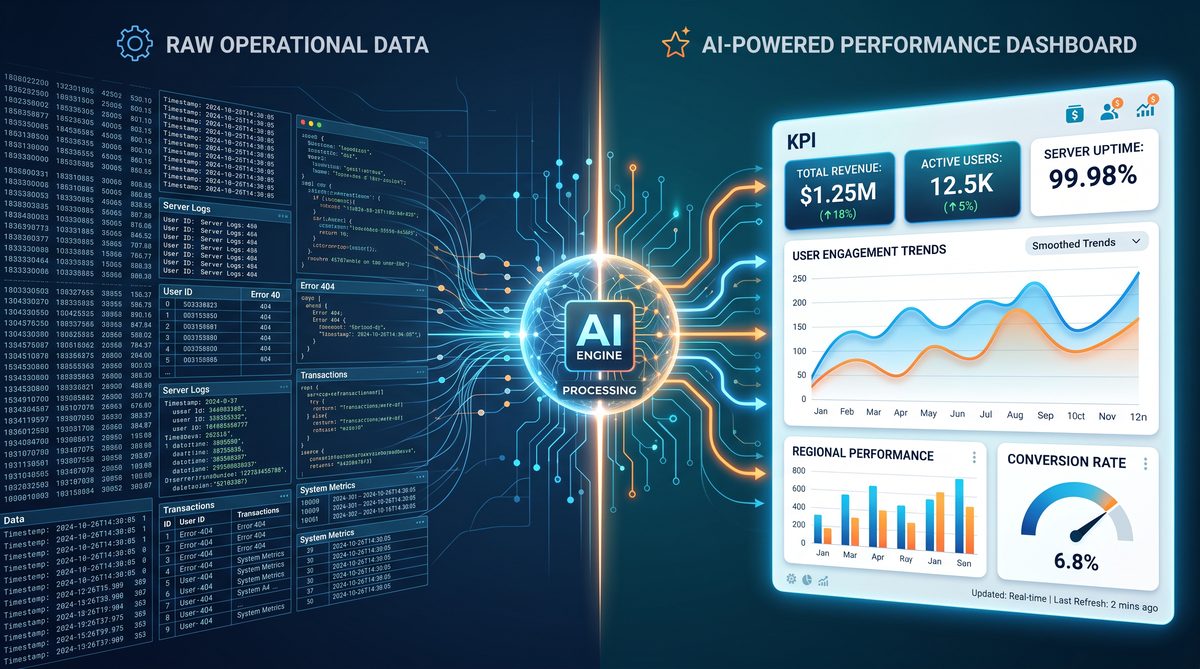
These prompts focus on distilling operational data into dashboards, KPIs, and executive reports. Outputs include SQL query templates, visualization specs, anomaly detection rules, and automated executive summaries.
Prompt D1 — KPI Definition Catalog for Operations
You are a KPI governance specialist. For operations, define 20 essential KPIs (e.g., OTIF, order cycle time, inventory turnover, days sales of inventory) with formal definitions, formulas, recommended aggregation cadence (hourly/daily/weekly), data sources, and examples of acceptable threshold ranges. Provide mapping to data fields used in our warehouse (schema: {db_schema}) and sample SQL queries for each KPI.
Why it works: Documents governance of KPIs with formulas and data mappings, ensuring consistent calculations across teams and dashboards.
Expected inputs: db schema, list of commonly used data sources, business thresholds if any.
How to customize: Narrow the KPI list to region-specific metrics or expand to include sustainability and safety KPIs.
Prompt D2 — Anomaly Detection Rules for Operational Metrics
You are an anomaly detection engineer. Given time series metrics (orders_per_hour, avg_pick_time, fulfillment_errors), generate detection rules with thresholds, seasonality-aware baselines, and suggested alerting sensitivity. Provide rule pseudo-code and sample alert messages with suggested playbook actions.
Why it works: Produces operational monitoring rules that are seasonality-aware and come with actionable alerts to reduce alert fatigue and false positives.
Expected inputs: time series data, business calendar, expected sensitivity levels.
How to customize: Use ML-based residual detection if you can supply a trained model’s residuals or tune thresholds per metric volatility.
Prompt D3 — Executive One-Page Operations Summary
You are a concise executive report generator. Using the weekly snapshot of metrics (OTIF, orders, backlog, avg lead time, cost variance), produce a one-page executive summary with the top three wins, top three risks, and two recommended decisions for leadership, along with supporting data points and trend charts (describe them).
Why it works: Generates leadership-friendly output that prioritizes decisions and ties them to evidence, suitable for weekly director or VP briefings.
Expected inputs: weekly metric snapshot, trend history, and any incident summaries.
How to customize: Adjust tone and level of detail for board-level vs. operational leadership audiences; include comparative benchmarks when available.
Prompt D4 — Dashboard Wireframe and Viz Spec
You are a dashboard product designer. Given the target audience (operations manager), primary questions to answer (inventory aging, fulfillment throughput, and top exceptions), and available data fields, produce a dashboard wireframe with visualization types, data refresh cadence, color rules for thresholds, and interaction patterns (filters, drilldowns). Provide export-ready JSON for common BI tools.
Why it works: Translates audience needs into a tactical visualization spec ready for BI development with attention to interactions and refresh cadence.
Expected inputs: audience, core questions, available fields, preferred BI tool constraints.
How to customize: Tailor to mobile vs. desktop or create separate views for shift-level supervisors vs. district managers.
Prompt D5 — SQL Template Library for Common Reports
You are a data engineering assistant. Provide parametrized SQL templates for common operational reports: daily order summary, SKU velocity, supplier on-time rate, returns by reason, and labor hours by shift. Each template should accept parameters (date_range, sku_list, site_ids) and include comments listing required indices and expected runtime.
Why it works: Delivers production-ready SQL templates with parameters and performance notes, accelerating report delivery and ensuring predictable runtime.
Expected inputs: db schema, table names, column names, sample parameter values.
How to customize: Add materialized view recommendations, partition suggestions, or transform templates for your specific dialect (BigQuery, Snowflake, Redshift).
Prompt D6 — Visualization Performance Tuning Checklist
You are a BI performance expert. Given a slow dashboard that queries large fact tables, provide a prioritized checklist of performance improvements: query refactor suggestions, recommended aggregations, caching strategies, and frontend rendering best practices. Estimate expected runtime improvements for each action.
Why it works: Produces concrete steps with estimated impact, enabling rapid performance improvements and prioritization for engineering teams.
Expected inputs: current query examples, dashboard refresh patterns, data volume metrics.
How to customize: Map to cloud-specific services like query acceleration features or recommend incremental materialized aggregates for near-real-time dashboards.
Prompt D7 — Automated Narrative Generator for Dashboards
You are an automated narrative engine. For a given dashboard snapshot, create a plain-language narrative that summarizes key changes since last period, explains drivers, and lists three recommended follow-ups. Include citations to the chart names and metric values for auditability.
Why it works: Bridges charts and human understanding by producing evidence-backed narratives, enabling stakeholders to interpret dashboards quickly.
Expected inputs: dashboard snapshot data, chart names and values, previous-period baselines.
How to customize: Add tone settings (technical vs. business) or require a 50-word executive linked summary plus a longer analytic section.
Prompt D8 — Anomaly Explanation with Action Recommendations
You are an anomaly explanation assistant. For an observed spike or dip in metric {metric_name} at time {timestamp}, analyze correlated metrics and recent events (promotions, incidents) to propose the top three plausible explanations with confidence estimates and recommended immediate actions.
Why it works: Connects anomalies to correlated evidence and prescribes actions rather than leaving analysts to investigate from scratch.
Expected inputs: metric time series, event logs, related metrics, promotions or incident lists.
How to customize: Add causal inference constraints or require A/B style evidence when available.
Prompt D9 — Visual Alert Template Library
You are a notifications designer. For the top 10 operational alerts (late shipments, SLA breach, low stock), create succinct alert messages, suggested severity levels, color schemes, and recommended in-app drilldown links. Provide examples for email, SMS, and in-app notifications.
Why it works: Standardizes alerts across channels so recipients can quickly triage and act with consistent meaning for severity and visuals.
Expected inputs: list of alert types, available channels, link structure to dashboards or tickets.
How to customize: Add localization or varying message length constraints for SMS vs. email.
Prompt D10 — KPI Trend Cohort Analysis
You are a cohort analyst. For metric {metric_name}, split data into cohorts by week of order and analyze 12-week retention or recovery curves. Identify cohorts that underperform and provide hypotheses explaining cohort differences (seasonality, promotion mix, process change).
Why it works: Cohort analysis reveals structural shifts and the effect of discrete interventions over time, enabling targeted remediation.
Expected inputs: metric data with cohort marker (week_of_order), promotion flags, process change timestamps.
How to customize: Change cohort windows (month, day) or include customer attributes to deepen causal hypotheses.
Prompt D11 — Data Quality Scorecard Generator
You are a data reliability officer. For key operational tables, compute a data quality scorecard covering completeness, accuracy (via cross-checks), timeliness, and uniqueness. Provide remediation steps and owners for fields scoring below threshold.
Why it works: Produces measurable data quality metrics and remediation plans that are essential for trustworthy dashboards and downstream models.
Expected inputs: table schemas, sample data, cross-check rules, thresholds for quality dimensions.
How to customize: Add scheduled monitoring cadence and auto-ticketing rules for low-quality findings.
Prompt D12 — Multi-Source Data Fusion Plan for Dashboards
You are a data integration architect. For dashboard {dashboard_name} requiring ERP, WMS, and TMS feeds, provide a data fusion plan: canonical schema, transformation rules, deduplication logic, and near-real-time sync strategy. Include failure-mode strategies and reconciliation processes.
Why it works: Lays out engineering and operational requirements to reliably fuse multiple enterprise sources into coherent dashboards and reduces drift between systems.
Expected inputs: source schemas, refresh cadences, unique identifier fields.
How to customize: Add data contracts with source owners or SLA-driven ingestion patterns for high-priority feeds.
Prompt D13 — Performance Review Pack Generator
You are a performance reporting assistant. Given quarterly operational KPIs, generate a review pack for the ops leadership meeting with executive summary, deep-dive slides for top 3 variances, root cause evidence, and recommended action items with owners and deadlines. Format sections and list data citations for each slide.
Why it works: Produces a meeting-ready review pack aligning metrics with actions and ownership, accelerating decision cycles and accountability.
Expected inputs: quarterly KPI snapshots, variance explanations, data sources.
How to customize: Target the pack to board-level or middle management with different levels of detail and appendices.
Deployment and Integration Best Practices
Below are practical notes for safely deploying these prompts at production scale:
- Parameterize inputs: Wrap variable data such as SKU IDs, time windows, and thresholds as parameters to keep prompts reusable and minimize token usage.
- Use structured outputs: Request CSV, JSON, or SQL snippets so results can be parsed deterministically by downstream systems.
- Fail-safe outputs: Require the model to provide confidence scores and fallback actions when confidence is low, and route low-confidence items to human review workflows.
- Rate limiting and batching: Batch calls for large SKU lists to balance latency and cost. Apply exponential backoff strategies for transient errors.
- Auditing: Log prompts, inputs, outputs, and model versions used for traceability and reproducibility.
- Testing and validation: Pair prompts with unit tests (synthetic inputs and expected outputs) and run regression checks when model or prompt templates change.
Operational embedding tip: Combine these textual prompts with programmatic wrappers that strip PII and apply privacy-preserving transformations before sending data to models. Maintain a prompt library versioning system to track iterations and improvements over time.
Customization Patterns and Prompt Engineering Techniques
To consistently get production-ready outputs, apply the following prompt engineering patterns:
- Instruction framing: Begin with a role (e.g., “You are a supply chain optimization engine”) and a short objective to orient the model.
- Output constraints: Always include explicit output formats (CSV column names, JSON schema) to reduce ambiguity.
- Context window management: Provide essential context only (latest N periods) and host large historical data in externally computed features passed as summaries.
- Chain of thought control: For sensitive or auditable recommendations, ask for a brief structured rationale and a confidence score, but avoid verbose chain-of-thought if it leaks internal deliberations.
- Human review gates: For high-impact decisions, require “Recommend and route” outputs that include a recommended action and an explicit flag for human approval if certain thresholds are exceeded.
Appendix — Prompt Template Examples and Tune-up Recipes
This appendix contains short recipes for tuning prompt behavior in production:
- Constrain verbosity: append “Limit the output to X bullets or Y words” to control token usage.
- Control risk aversion: include a “risk_tolerance” parameter to bias recommendations toward conservative or aggressive options.
- Enforce deterministic formats: request “Return only parsable JSON with the exact keys: …” to make parsing robust.
- Bias management: specify “Do not use proprietary or copyrighted text in outputs” when generating textual artifacts to avoid IP entanglement.
- Performance safety: ask the model to “estimate compute and data needs” for suggested algorithms before recommending heavy operations.
Access 40,000+ AI Prompts for ChatGPT, Claude & Codex — Free!
Subscribe to get instant access to our complete Notion Prompt Library — the largest curated collection of prompts for ChatGPT, Claude, OpenAI Codex, and other leading AI models. Optimized for real-world workflows across coding, research, content creation, and business.
Concluding Notes
This guide provides 50 production-ready prompts and accompanying rationale, inputs, and customization tips aimed at equipping Operations Managers to harness advanced LLMs effectively. Use these prompts as the foundation for integrated automations, dashboards, and decision workflows. Iterate and version prompt templates as you gather feedback from operational users, and combine them with the governance patterns outlined above to create reliable, auditable, and cost-effective model-driven processes.
Next steps: pick 3 high-impact prompts from your area (one per category), prototype them with real data, measure differential outcomes against current practice, and scale those that pass ROI and reliability thresholds. Maintain the auditability practices described here to support compliance and continuous improvement.
