
The Complete Guide to GPT-5.5 Instant: Understanding OpenAI’s Most-Used Model and Its June 2026 Upgrade
The Complete Guide to GPT-5.5 Instant: Understanding OpenAI’s Most-Used Model and Its June 2026 Upgrade
Executive Summary
GPT-5.5 Instant represents a class of highly responsive, cost-optimized language models tailored for interactive applications where latency and throughput matter as much as accuracy. Compared to “full” GPT-5.5 and the heavier, more capable GPT-5.6 Sol line, Instant variants trade a small amount of peak reasoning depth for significantly better speed and affordability. The result: a workhorse model suitable for the vast majority of day-to-day tasks—chat UX, short-form content transformation, rapid question answering, transactional assistance, and tool-augmented workflows that lean on deterministic external systems for complex logic.
This guide explains how to decide between GPT-5.5 Instant, full GPT-5.5, and GPT-5.6 Sol, how to design prompts and systems that amplify Instant’s strengths, and how to manage latency and cost without sacrificing user experience. It also addresses the reported June 24, 2026 model refresh focus areas—decision support, practical advice, multi-step planning, research-style tasks, and shopping assistance—and translates them into concrete implementation patterns you can deploy today. For deeper technique primers, see
For teams exploring related capabilities, our comprehensive guide on How to Use ChatGPT-5.5 for Automated Testing provides detailed workflows and implementation strategies for using ChatGPT-5.5 for unit, integration, and E2E test generation. The techniques covered there complement the approaches discussed in this article and offer additional depth for practitioners ready to expand their AI toolkit.
and
To deepen your understanding of adjacent AI capabilities, explore our detailed analysis in The Complete Guide to OpenAI Codex Modes, which examines understanding Codex Plan, Execute, and Review modes. The frameworks and prompt patterns discussed there integrate seamlessly with the strategies outlined in this article.
.
What Is GPT-5.5 Instant?
GPT-5.5 Instant is positioned as a high-usage, fast-response model ideal for conversational interfaces and real-time assistance. In common production setups, Instant-class models serve as the front door—the first model to respond to the user—and often orchestrate or delegate to more capable models or tools when necessary. Typical improvements you should expect from an Instant variant include:
- Lower median and tail latency compared to flagship models.
- Lower per-token cost, enabling higher request volume and broader coverage.
- Competitive general knowledge and instruction-following with calibrated limitations on deep, multi-hop reasoning.
- Optimizations for streaming output, conversational pacing, and succinct task completion.
- Strong tool-use orchestration for scenarios where external systems handle complex math, retrieval, or transaction logic.
Positioning and Typical Workload Fit
Instant-class models shine when:
- Users expect immediate feedback (sub-1s to low-single-second first tokens).
- Tasks are common and templated (e.g., rewrite, extract, summarize, triage, classify).
- Your system can offload complexity to tools: search, RAG, product catalogs, policy engines, or pricing models.
- Throughput and scaling economics dominate: many small requests, high concurrency, consistent SLAs.
- You can bound the scope of reasoning through structured prompting and constraints.
How “Instant” Models Are Usually Made Fast
While internal details vary, Instant variants commonly combine:
- Distillation from larger frontier models to retain instruction-following and domain coverage.
- Speculative and tree-based decoding to accelerate token generation without sacrificing coherence.
- Optimizer-level tricks and quantization-aware finetuning for reduced compute per-token.
- Systemic serving improvements: model sharding, dynamic batching, KV-cache reuse, and optimized streaming paths.
Capabilities Snapshot (and Practical Limits)
You can expect robust performance on:
- Short-form writing, editing, and formatting (email, tickets, product copy, FAQs).
- Information retrieval orchestration (ask Instant to call your RAG/search tools and synthesize results).
- Entity extraction, structured outputs (JSON), and light-weight analytics commentary.
- Advice with constraints (e.g., policy-aware support, brand tone, or compliance wording).
- Planning outlines, checklists, and step-by-step workflows—especially when tied to external data sources.
- Shopping/decision support that uses filters, comparisons, and preference alignment with catalog or review data.
And you should plan fallback paths for:
- Deep multi-document reasoning without retrieval aids.
- Highly specialized technical proofs, theorem-level math, or advanced scientific derivations.
- Ambiguous tasks needing long deliberation where the marginal value of extra tokens is high.
- Edge-case coding tasks where a more capable model yields fewer defects or faster convergence.
Design Philosophy: Instant as Orchestrator
Treat GPT-5.5 Instant as the orchestration layer: it handles intent detection, slot-filling, tool selection, and output formatting. When user needs exceed its reasoning ceiling, it delegates to full GPT-5.5 or GPT-5.6 Sol, or to deterministic services (search, calculators, policy checkers, pricing engines). This layered approach increases speed and reduces cost while maintaining quality through targeted escalation.
Key Differences vs Full GPT-5.5 and GPT-5.6 Sol
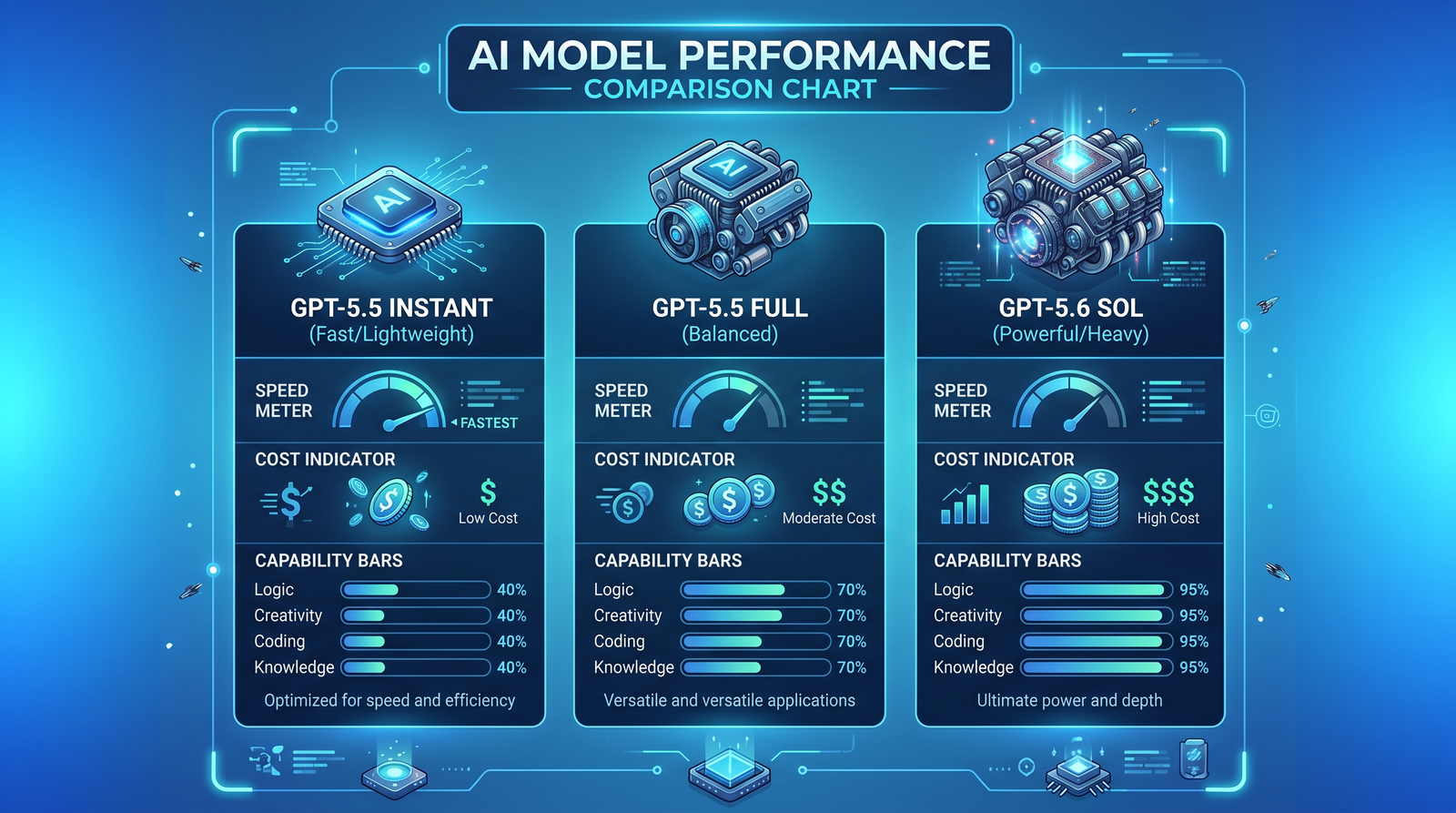
The three model families can be understood along a continuum of speed, cost, and capability. The exact model identifiers and SKUs can change, so consider the following as a stable conceptual framework you can adapt to the current product catalog.
At-a-Glance Comparison
| Dimension | GPT-5.5 Instant | Full GPT-5.5 | GPT-5.6 Sol |
|---|---|---|---|
| Primary Goal | Fast, affordable, high-throughput assistance | Balanced depth and breadth; strong generalist | Frontier capability; hardest reasoning tasks |
| Typical Latency | Lowest of the three (optimized for first-token) | Moderate; acceptable for complex tasks | Highest; may trade speed for depth |
| Cost per Token | Lowest | Moderate | Highest |
| Best For | Chat UX, classification, short transforms, tool orchestration | Longer composition, nuanced tasks, robust coding | Multi-hop reasoning, advanced analysis, hardest coding problems |
| Context Management | Improved but optimized for concise prompts | Large contexts; steady recall | Largest contexts; strongest long-chain stability |
| Failure Modes | Overconfidence on edge cases if not constrained | Slower and costlier than Instant for routine queries | Latency spikes and overkill for simple tasks |
Speed and Streaming
GPT-5.5 Instant aims to minimize time-to-first-token and maintain a steady token-per-second rate under concurrency. In practice, production results depend on your networking conditions, streaming configuration, and prompt length. Short system prompts, structured outputs, and keeping few-shot examples minimal can have more impact on speed than model choice alone.
Cost and Token Efficiency
Instant-class models are priced to make “always-on” AI affordable. To capitalize, keep prompts compact, move boilerplate into a system prompt or server-side template, and store frequently used instructions in your application rather than repeating them in every request. Adopt JSON outputs for cheaper parsing and avoid verbose narratives when a structured schema is sufficient. For broader cost-control strategies, see
For teams exploring related capabilities, our comprehensive guide on The Codex API Development Playbook provides detailed workflows and implementation strategies for 15 prompts for building production REST APIs. The techniques covered there complement the approaches discussed in this article and offer additional depth for practitioners ready to expand their AI toolkit.
.
Capability Considerations
- Instruction Following: Comparable across families with careful prompting; Instant benefits from concise, unambiguous directives.
- Reasoning Depth: Full 5.5 and 5.6 Sol generally excel on multi-hop logic; Instant works best when you incorporate tools and constraints.
- Coding: Instant handles small patches and explanations well; for full modules or complex refactors, consider escalation.
- Multimodality: If supported, Instant handles simple perception tasks; heavy visual reasoning often does better on flagship variants.
The June 24, 2026 Upgrade: Focus Areas and Practical Implications
Industry discussions around mid-2026 updates to Instant-class models emphasize five areas: decision support, practical advice, multi-step planning, research-style workflows, and shopping assistance. While you should confirm exact release notes and metrics in official docs, the following patterns map closely to how teams upgrade their prompts, tools, and evaluation to benefit from such improvements.
1) Better at Decisions
Decision support differs from open-ended chat: the objective is a defensible recommendation constrained by user criteria, available options, and known tradeoffs. To exploit decision-focused improvements:
- Collect requirements explicitly: budget, constraints, must-haves, nice-to-haves, risk tolerance.
- Surface a compact rationale: 2–4 bullet tradeoffs, not long essays.
- Show alternatives and conditions that would change the recommendation.
- Bind outputs to a JSON schema for downstream logging/auditing.
{
  "task": "laptop_recommendation",
  "constraints": {"budget": 1500, "workload": "data analysis + light ML", "portability": "high"},
  "required_fields": ["primary_pick", "alternatives", "tradeoffs", "assumptions"]
}
In production, add tool calls to verify availability and prices, and use a policy engine for compliance-sensitive advice (e.g., healthcare or finance).
2) Better at Advice
Practical advice should be safe, scoped, and aligned to user goals. Improvements typically include better extraction of user context and more precise guardrail adherence. Recommended patterns:
- Ask clarifying questions only when needed; otherwise produce a short, actionable plan.
- Use tone conditioning (“concise, non-judgmental, actionable”).
- Include checklists and resources the user can follow within 5–10 minutes.
- Gate sensitive domains behind a domain-specific tool that adds disclaimers and policy filters.
System: You give practical, safe, step-by-step advice aligned to the user's constraints.
User: I have 30 minutes nightly to start learning SQL from scratch. What's a plan for the first 2 weeks?
Assistant: (Outputs a 14-day schedule with 3–5 bullet points per day, links, and a short progress check.)
3) Better at Planning
Planning quality rises when the model decomposes goals into milestones and checkpoints tied to observable criteria. Even faster models can produce strong plans if the structure is clear:
- Force hierarchical outputs: goals → milestones → tasks → success criteria.
- Timebox: avoid infinite or vague plans; commit to scopes and deadlines.
- Include review points and “exit ramps” if assumptions fail.
{
  "project": "Launch email onboarding revamp",
  "horizon_weeks": 6,
  "plan": [
    {"milestone": "Audit", "duration_days": 5, "tasks": ["Map flows", "Collect metrics"], "exit_criteria": ["Coverage > 95%"]},
    {"milestone": "Design", "duration_days": 7, "tasks": ["Templates", "Copy"], "exit_criteria": ["Stakeholder signoff"]},
    {"milestone": "Implement", "duration_days": 14, "tasks": ["ESP setup", "Tracking"], "exit_criteria": ["QA pass"]}
  ]
}
4) Better at Research-Style Tasks
By “research,” practitioners usually mean structured reading and synthesis with citations rather than original scholarly contribution. Best practices:
- Use retrieval tools; do not rely solely on model memory.
- Demand citation bundling: each claim maps to a source.
- Limit synthesis to concise bullets and an executive summary.
- Track coverage: what was not found or remains uncertain.
System: Use the 'web_search' and 'doc_fetch' tools. Bundle claims with citations. Return JSON.
User: Summarize current approaches to lithium battery recycling and identify 3 open problems.
# Assistant calls web_search, then doc_fetch on selected links, then returns structured synthesis with sources.
5) Better at Shopping Assistance
Shopping is a prime domain for Instant models because the decision loops are frequent and preference-driven. Elevate conversions by:
- Capturing hard constraints early (budget, size, platform).
- Normalizing user language to catalog attributes (e.g., “travel-friendly” → weight and battery life ranges).
- Explaining tradeoffs succinctly and offering 1–2 viable alternatives.
- Pulling live data from inventory, prices, and reviews via tools.
{
  "intent": "shopping_assistance",
  "category": "headphones",
  "constraints": {"budget": 250, "use": "office + commute", "noise_cancelling": true},
  "outputs": ["primary_pick", "why", "two_alternatives", "if_you_can_spend_more"]
}When to Use Instant vs Full 5.5 vs 5.6 Sol
A pragmatic strategy is to route by difficulty and risk. Instantiate GPT-5.5 Instant as your default. Promote to full GPT-5.5 or GPT-5.6 Sol when signals indicate complexity, ambiguity, or high stakes. This hybrid approach usually delivers the best user experience per dollar.
Routing Heuristics (Simple, Actionable)
- Use Instant When the task is routine, templated, or bounded (rewrite, extract, classify, short QA, snippet coding).
- Use Instant + Tools When you can replace deep reasoning with retrieval, calculators, or policy engines.
- Escalate to full 5.5 When you see multi-hop reasoning, long context, nuanced tradeoffs, or large code edits.
- Escalate to 5.6 Sol When correctness is paramount and failure costs are high (safety-critical, heavy logic, hard debugging).
- Backoff strategy If heavier models breach latency SLOs, fall back to Instant with reduced scope or staged outputs.
Decision Matrix
| Scenario | Signals | Recommendation |
|---|---|---|
| Customer support triage | Short tickets, classification, policy templates | GPT-5.5 Instant with JSON outputs and policy tool |
| Long-form technical write-up | Multiple sources, precise terminology, long context | Start Instant + RAG; escalate to full 5.5 for drafting |
| Complex refactor in codebase | Cross-file reasoning, deep language features | Full 5.5 for design; 5.6 Sol for correctness-critical diffs |
| Shopping assistant chat | Preference capture, comparisons, live prices | Instant with catalog and price tools; escalate if ambiguous |
| Executive decision memo | Ambiguity, tradeoffs, high impact | Draft with Instant; refine with full 5.5 or 5.6 Sol |
Service-Level Objectives (SLO)-Aware Strategy
Define per-route SLOs (TTFT, P95 latency, error budgets). If a heavy-model route threatens SLOs during traffic spikes, downgrade gracefully to Instant with a reduced scope output (e.g., quick summary now, full report later). Log both outputs and perform reconciliation once the heavier route completes.
API Parameters and Best Practices
The exact API surface evolves; always verify the latest endpoints, model IDs, and options in official docs. Below are widely used patterns that transfer well to GPT-5.5 Instant. Substitute the current model identifiers (e.g., “gpt-5.5-instant”, “gpt-5.5”, “gpt-5.6-sol”) with the actual IDs from your provider.
Core Parameters
- model: Set to the specific Instant identifier (e.g., “gpt-5.5-instant”).
- messages: Use role-tagged messages (system, user, assistant) to structure context.
- temperature: 0.2–0.7 typical. Lower for determinism; higher for creativity.
- top_p: Alternative to temperature; keep defaults unless you measure improvements.
- max_tokens: Cap output length; short caps speed returns and reduce cost.
- response_format: “json” or “json_object” to enforce well-formed JSON.
- tools/functions: Register tool schemas; the model chooses to call them.
- seed: If available, makes outputs repeatable for testing.
- stream: Streaming true for fast first tokens and better UX.
Python Example: JSON Mode with Tool Calling
from openai import OpenAI
import json

client = OpenAI()

model_id = "gpt-5.5-instant"  # Confirm the current identifier in docs

tools = [
    {
        "type": "function",
        "function": {
            "name": "search_catalog",
            "description": "Search product catalog by filters",
            "parameters": {
                "type": "object",
                "properties": {
                    "category": {"type": "string"},
                    "filters": {"type": "object"},
                    "limit": {"type": "integer", "minimum": 1, "maximum": 20}
                },
                "required": ["category", "filters"]
            }
        }
    }
]

system_prompt = "You are a fast, helpful shopping assistant. Prefer concise bullet points. Return JSON only."

messages = [
    {"role": "system", "content": system_prompt},
    {"role": "user", "content": "Find a lightweight laptop under $1200 for travel and web dev."}
]

resp = client.chat.completions.create(
    model=model_id,
    messages=messages,
    tools=tools,
    temperature=0.2,
    response_format={"type": "json_object"},
    max_tokens=500
)

# If the model requests a tool call:
choice = resp.choices[0]
if choice.finish_reason == "tool_calls" or getattr(choice, "tool_calls", None):
    for call in choice.message.tool_calls:
        if call.function.name == "search_catalog":
            args = json.loads(call.function.arguments)
            results = search_catalog_impl(**args)  # Your backend implementation
            # Send tool result back to the model
            tool_response = client.chat.completions.create(
                model=model_id,
                messages=messages + [
                    choice.message,
                    {"role": "tool", "tool_call_id": call.id, "name": "search_catalog", "content": json.dumps(results)}
                ],
                temperature=0.2,
                response_format={"type": "json_object"},
                max_tokens=600
            )
            print(tool_response.choices[0].message.content)
JavaScript (Node) Example: Streaming for Fast TTFT
import OpenAI from "openai";

const client = new OpenAI();
const modelId = "gpt-5.5-instant"; // Verify latest ID

const stream = await client.chat.completions.create({
  model: modelId,
  stream: true,
  temperature: 0.3,
  response_format: { type: "json_object" },
  messages: [
    { role: "system", content: "You write short, structured answers. JSON only." },
    { role: "user", content: "Summarize this in 3 bullets: https://example.com/doc" }
  ]
});

for await (const chunk of stream) {
  const delta = chunk.choices?.[0]?.delta?.content;
  if (delta) process.stdout.write(delta);
}
Best Practices That Boost Instant
- Prefer JSON schemas over prose. Fail fast if the payload is invalid; request a retry.
- Keep system prompts short and specific. Push policy text into a tool if it’s long.
- Use streaming in UX. Show skeleton UI and expand as tokens arrive.
- Cap max_tokens relative to the task. Large caps inflate latency and cost.
- Instrument everything: TTFT, tokens, errors, tool-call counts, retry rates.
- Enable retries with idempotency keys. Distinguish user-aborted vs. server-aborted sessions.

Latency Benchmarks and Performance Engineering
Latency is end-to-end: networking, TLS handshakes, model queueing, decoding, and your own post-processing all contribute. For GPT-5.5 Instant, the largest wins usually come from (a) prompt minimization, (b) streaming, (c) connection reuse, and (d) avoiding unnecessary few-shot examples.
Measuring TTFT and TPST Accurately
- TTFT (time to first token): from request send to the first streamed token.
- TPST (tokens per second throughput): rate of streamed tokens after the first byte arrives.
- P95/P99: measure tail latencies under realistic concurrency.
# Python: quick TTFT/TPST probe (illustrative)
import time
from openai import OpenAI

client = OpenAI()
model = "gpt-5.5-instant"  # confirm ID

def measure(prompt: str):
    start = time.perf_counter()
    stream = client.chat.completions.create(
        model=model, stream=True, temperature=0.2,
        messages=[{"role":"user","content":prompt}]
    )
    first = None
    tok_count = 0
    for chunk in stream:
        now = time.perf_counter()
        if first is None:
            first = now
            print(f"TTFT: {(first - start)*1000:.1f} ms")
        content = chunk.choices[0].delta.content or ""
        tok_count += len(content.split())
    end = time.perf_counter()
    duration = end - first if first else 0
    print(f"TPST (~word/s): {tok_count/duration:.1f}")
Illustrative Latency Table
The following illustrates how choices affect latency. Treat as a planning template—validate with your own measurements.
| Scenario | Prompt Size | Streaming | Concurrency | TTFT (illustrative) | P95 Latency (illustrative) |
|---|---|---|---|---|---|
| Short Q&A | < 500 tokens | On | Low | 200–500 ms | 0.8–1.5 s |
| JSON extraction | < 1k tokens | On | Medium | 300–700 ms | 1.2–2.2 s |
| RAG synthesis | 2–4k tokens | On | Medium | 500–900 ms | 2.5–4.0 s |
| Long-form draft | 6–8k tokens | Off | High | — | 8–15 s |
Performance Tips That Consistently Help
- Connection reuse: enable HTTP keep-alive and client pooling.
- Prompt compaction: dedupe instructions; avoid large few-shot blocks—use 1–2 minimal examples or none.
- Streaming by default: reveal partial content quickly and use progressive disclosures in the UI.
- Schema constraints: JSON mode can shorten wandering outputs; short, deterministic payloads speed up completion.
- Tool accuracy: do not ask the model to “think aloud”; call deterministic tools for fact lookup and calculations.
- Batch small jobs where possible; but avoid over-batching, which can increase queueing delay.
Async Concurrency Example (Node)
import OpenAI from "openai";
const client = new OpenAI();
const model = "gpt-5.5-instant";

const prompts = [
  "Summarize: https://example.com/a",
  "Summarize: https://example.com/b",
  "Summarize: https://example.com/c",
  // ...
];

const limiter = (limit) => {
  let active = 0, queue = [];
  const next = () => {
    if (active < limit && queue.length) {
      active++;
      const {fn, resolve} = queue.shift();
      fn().finally(() => { active--; resolve(); next(); });
    }
  };
  return (fn) => new Promise((res) => { queue.push({fn, resolve: res}); next(); });
};

const gate = limiter(8); // cap concurrency

await Promise.all(prompts.map((p) => gate(async () => {
  const start = Date.now();
  const stream = await client.chat.completions.create({
    model, stream: true,
    messages: [{role:"user", content: p}]
  });
  let first = null;
  for await (const chunk of stream) {
    if (!first) { first = Date.now(); console.log("TTFT", first - start, "ms"); }
  }
  console.log("Done in", Date.now() - start, "ms");
})));
Token Economics and Cost Control
Token economics determine whether your AI product scales profitably. Instant-class models make interactive use viable at volume, but careless prompt design can erase savings. Establish a per-request token budget and enforce it with programmatic caps and linting.
Cost Formula
At a high level, your per-request cost is:
cost = (input_tokens * rate_in_per_token) + (output_tokens * rate_out_per_token)Rates differ by model. Many providers price input cheaper than output. To plan, use a calculator where you can plug in rates for Instant vs full 5.5 vs 5.6 Sol.
Illustrative Calculator
// Fill in your current prices
const price = {
  instant: { in: 0.00000012, out: 0.00000048 }, // $/token (example placeholders)
  gpt55:   { in: 0.00000024, out: 0.00000096 },
  gpt56:   { in: 0.00000060, out: 0.00000240 }
};

function estimate(model, inTok, outTok) {
  const r = price[model];
  return inTok * r.in + outTok * r.out;
}

console.log({
  instant: "$" + estimate("instant", 800, 300).toFixed(5),
  gpt55:   "$" + estimate("gpt55",   800, 300).toFixed(5),
  gpt56:   "$" + estimate("gpt56",   800, 300).toFixed(5)
});Token Budgeting Table (Illustrative)
| Use Case | Input Tokens | Output Tokens | Budget Notes |
|---|---|---|---|
| Support triage classification | 400–800 | 60–120 | JSON schema with fixed fields; tight caps |
| Shopping recommendation | 600–1200 | 150–300 | Short rationale; show 1–2 alternatives |
| RAG synthesis (short) | 1.5k–3k | 250–600 | Bundle citations; compress passages |
| Planning outline | 500–900 | 200–400 | Hierarchical bullets; avoid prose |
Seven Reliable Cost Savers
- Shorten system prompts and reuse them; avoid repeating long boilerplate each call.
- Prefer JSON outputs with fixed keys; reduce verbose narrative.
- Extract before you generate: get structured facts first, then produce a compact summary.
- Use Instant for pre-processing, then escalate only select cases to heavier models.
- Cache stable sub-results (e.g., product attribute normalizations) across sessions.
- Use retrieval to compress context instead of pasting long documents verbatim.
- Set max_tokens strictly and monitor outliers; investigate runaway generations.
Real-World Use Cases Where Instant Outperforms Heavier Models
GPT-5.5 Instant can beat heavier models not by being “smarter” but by being the right tool: faster, cheaper, and sufficient when tasks are bounded or tool-augmented. Below are categories where Instant typically wins.
1) Customer Support Triage and Macro Expansion
Tasks: classify ticket intent, detect sentiment, fill routing fields, and produce a draft reply using approved macros. With JSON mode, you get deterministic payloads that back-office systems can ingest immediately.
{
  "ticket_id": "TCK-12345",
  "intent": "billing_refund",
  "priority": "high",
  "macros": ["refund_policy", "sla_24h"],
  "reply_draft": "Thanks for reaching out... (short, policy-compliant)"
}
Outcome: near-instant replies, consistent tone, and agents focusing only on exceptions requiring judgment. See also
To deepen your understanding of adjacent AI capabilities, explore our detailed analysis in How to Use ChatGPT-5.5 for Automated Testing, which examines using ChatGPT-5.5 for unit, integration, and E2E test generation. The frameworks and prompt patterns discussed there integrate seamlessly with the strategies outlined in this article.
for knowledge-base integration.
2) Catalog Normalization and Attribute Extraction
Tasks: map free-text product descriptions to canonical attributes, deduplicate SKUs, and validate units. Instant handles this in bulk with lower cost per item.
{
  "sku": "HX-9912",
  "normalized": {
    "weight_g": 1280,
    "dimensions_mm": [320, 210, 22],
    "battery_life_h": 12,
    "category": "ultrabook"
  },
  "quality_flags": ["unit_inferred", "dimensions_approx"]
}
3) Shopping Assistants and Guided Discovery
Tasks: capture constraints, explain tradeoffs succinctly, and present primary pick + alternatives with live price and availability from tools. Instant keeps the experience conversational without lag.
4) Lightweight Analytics Commentary
Tasks: convert simple metrics into one paragraph of commentary with bullet takeaways. Offload all calculations to your analytics engine; feed only sanitized figures to the model.
{
  "kpis": {"revenue_qoq": 0.12, "churn_rate": 0.031, "arpu_change": -0.02},
  "commentary": ["Revenue up 12% QoQ, led by ...", "Churn rose to 3.1% due to ...", "ARPU dipped 2% following ..."],
  "alerts": [{"name": "churn_spike", "severity": "medium"}]
}
5) Content Transformation at Scale
Tasks: rewrite, paraphrase, translate, style-shift, and redact PII using consistent templates. Instant is ideal because outputs are short and format-bound.
6) Code Snippet Generation and Patch Suggestions
Tasks: produce small code blocks, suggest diffs, explain errors. For significant refactors or multi-file reasoning, escalate to full 5.5 or 5.6 Sol.
7) Real-Time In-Product Help
Tasks: context-aware tooltips, inline explanations, onboarding coaches. Latency is crucial; Instant’s TTFT makes these feel native.
8) Moderation and Policy Drafting
Tasks: multi-label classification, rationale snippets, and policy-constrained suggestions. Use deterministic policies for final enforcement; Instant proposes actionable text quickly.
Prompting Patterns That Elevate GPT-5.5 Instant
Prompt engineering for Instant aims to reduce ambiguity, constrain outputs, and delegate complex steps. These patterns lengthen the ceiling of what a fast model can do without escalation.
Instruction Pinning
Keep a short system prompt that fixes role, tone, and format. Avoid sprawling guidelines; create a policy tool for long text. Example:
System: You are a concise assistant that returns JSON only.
- Be brief; omit non-essential prose.
- If missing info blocks a safe answer, ask 1 targeted question.
- Otherwise, proceed with best effort given constraints.
Schema-First Outputs
Provide a JSON schema or exemplar payload with required keys, value types, and bounds. Validate client-side and request a retry if invalid. Consider adding explicit “unknown” values rather than allowing hallucinated fields.
Decompose and Tool
Convert hard reasoning into tool calls. For instance, instead of asking the model to recall facts, create a search or database function. Provide brief, structured results, then ask the model to synthesize.
Access 40,000+ AI Prompts for ChatGPT, Claude & Codex — Free!
Subscribe to get instant access to our complete Notion Prompt Library — the largest curated collection of prompts for ChatGPT, Claude, OpenAI Codex, and other leading AI models. Optimized for real-world workflows across coding, research, content creation, and business.
Preference Elicitation
For shopping and decision support, encode a brief question block to extract must-haves and nice-to-haves if absent. Cache the result in session state to avoid re-asking.
Progressive Disclosure
For large tasks under strict latency, ask Instant for a short outline first. Render it immediately, then request details asynchronously, potentially escalating for depth if needed.
Guardrails via Policies
Do not paste your entire policy manual into the prompt. Instead, implement a policy tool that answers “allow/deny/clarify” queries or returns templated disclaimers. This reduces tokens and improves consistency.
Evaluation, QA, and Governance
Even with improved Instant models, quality varies by task. Establish defensible measurement and guardrail strategies to maintain trust at scale.
Grounded Metrics
- Task success rate: binary completion judged by rules or human annotators.
- Constraint adherence: JSON validity, required fields present, schema fit.
- Factuality (with retrieval): citation coverage and claim-source alignment.
- Safety metrics: policy violations per 1k responses; escalation frequency.
- Latency SLOs: TTFT and P95 across key routes.
- Cost per successful task: tokens/request divided by success rate.
AB Testing and Canarying
Roll out changes gradually. Start with 5–10% traffic in canary groups, observe metrics for a week, and promote if results meet targets. Keep rollback levers: feature flags, traffic routers, and version pinning.
Human-in-the-Loop (HITL)
For high-stakes outputs, include human review. Use Instant to produce structured drafts that are faster to assess. Track disagreement rates and set thresholds for automatic escalation to heavier models.
Content Controls and Safety
Implement layered safety: input filtering, model policy tools, and output validators. In sensitive domains (health, finance, legal), enforce disclaimers and route to experts when required.
Migration Playbooks and Rollout Strategy
Many teams migrate from earlier “mini” and “instant” variants to GPT-5.5 Instant to gain cost and latency improvements while retaining quality. Plan the migration to minimize regressions and catch edge cases early.
Pre-Migration Checklist
- Inventory prompts and categorize by task type and risk.
- Define success metrics per task (quality, latency, cost).
- Create a synthetic test bench with representative inputs.
- Build a replay harness to run old vs. new models side-by-side.
- Deduplicate prompts and convert to schema-first where applicable.
Phased Rollout
- Phase 1: Shadow mode—run GPT-5.5 Instant in parallel without user impact; compare logs.
- Phase 2: Canary—send 5–10% traffic; monitor SLOs and quality.
- Phase 3: Ramp—gradually increase to 50–100% if stable; maintain rollback switch.
Post-Migration Hardening
- Instrument schema errors and retry logic; reduce invalid payloads.
- Add escalation routes for failure cases identified during ramp.
- Refactor prompts to cut tokens while preserving quality.
- Review cost reports to validate savings align with expectations.
FAQ
Is GPT-5.5 Instant a drop-in replacement for full GPT-5.5?
It can be for many tasks, especially short-form and constrained outputs. For complex, long-form, or high-stakes use, consider full GPT-5.5 or GPT-5.6 Sol, or use escalation on-demand.
What changed in the June 24, 2026 upgrade?
Teams reported a focus on decision support, advice, planning, research-style synthesis, and shopping assistance. Validate specifics—version identifiers, pricing, and benchmark deltas—against current release notes to ensure accuracy for your deployment.
How should I structure prompts for Instant?
Prefer short system prompts, schema-first outputs, and minimal few-shot examples. Use tools for facts and calculations. Keep temperature modest for determinism in transactional flows.
What are good latency targets?
For conversational UX, aim for TTFT under 1s and P95 under 3s for short tasks. Provide streaming and progressive disclosure to maintain perceived responsiveness.
How do I keep costs predictable?
Enforce strict max_tokens, monitor token usage, avoid verbose narratives when JSON suffices, and route only hard tasks to heavier models. Cache stable intermediate results.
Conclusion
GPT-5.5 Instant exemplifies the modern default for high-traffic AI applications: quick, capable, and inexpensive enough to sit in the critical path of user experiences. With structured prompting, judicious tool use, and guarded escalation to full GPT-5.5 or GPT-5.6 Sol, teams can achieve high quality per dollar while hitting tight latency SLOs. The mid-2026 focus areas—decisions, advice, planning, research synthesis, and shopping—align with how most production systems already harness Instant-class models: translate ambiguous user intents into clear, auditable, and compact outputs backed by deterministic services.
The best results come from disciplined engineering: define metrics, measure continuously, and iterate prompts and routing policies. Keep this guide as a living reference alongside your internal benchmarks and the latest provider documentation. For deeper dives and ready-to-use patterns, see
Organizations implementing these workflows will also benefit from understanding The Complete Guide to OpenAI Codex Modes, which covers understanding Codex Plan, Execute, and Review modes in detail. The methodologies presented there provide a natural extension of the concepts explored above, particularly for teams scaling their AI-assisted processes.
and
For teams exploring related capabilities, our comprehensive guide on The Codex API Development Playbook provides detailed workflows and implementation strategies for 15 prompts for building production REST APIs. The techniques covered there complement the approaches discussed in this article and offer additional depth for practitioners ready to expand their AI toolkit.
.
