
The Codex API Development Playbook: 15 Prompts for Building Production REST APIs, Authentication Systems, and Database Schemas

Production-grade APIs are more than HTTP endpoints. They are carefully modeled contracts with explicit behavior, backed by resilient storage, enforced by authentication and authorization, validated with automated tests, observable in real time, and shipped through repeatable pipelines. This playbook is a practical, technical walkthrough for building RESTful APIs that hold up under the uncompromising realities of production: ambiguous product requirements, evolving schemas, multi-team collaboration, compliance, performance constraints, and SLAs. It is structured around 15 concrete prompt templates you can use with your team or tools to drive clarity, consistency, and delivery speed.
Each prompt is accompanied by rationale, acceptance criteria, and working code examples. The examples span multiple stacks so you can pattern-match to your preferred runtime: Node.js/Express, Python/FastAPI, Go (net/http and chi), and Java/Spring Boot. Schemas and contracts are captured with OpenAPI and SQL. Where the article asks for “tables,” we render them as fixed-width ASCII tables you can paste into issues, wikis, or code comments.
This is not a “toy” set of snippets. We cover edge cases like idempotency for POSTs, optimistic locking, OAuth2 and short-lived tokens, structured logging with trace propagation, distributed pagination guarantees, migration rollbacks, and blue/green deployments for stateful changes. By the end, you’ll have a prompt-driven, end-to-end blueprint to plan, scaffold, implement, test, ship, and observe a real API system.
For a deeper exploration of related concepts, our comprehensive guide on 7 Best AI Coding Agents Compared in 2026 — Features, Pricing, Use Cases provides detailed strategies and practical frameworks that complement the approaches discussed in this section.
How to use this playbook
Copy each prompt into your team’s issue tracker, architectural decision record (ADR), or your AI assistant. Fill in the context brackets to adapt to your domain. The prompts assume you want crisp deliverables: OpenAPI specs, runnable services, schema migration files, and CI pipelines. Pair each prompt with the acceptance criteria checklists and the code templates to accelerate implementation.
To keep the document self-contained, we establish a running example: a minimal “Orders” domain comprising Users, Products, Carts, and Orders. We’ll demonstrate consistent naming, secure token-based authentication, robust error handling, pagination, and rollout strategies. Adapt as needed.
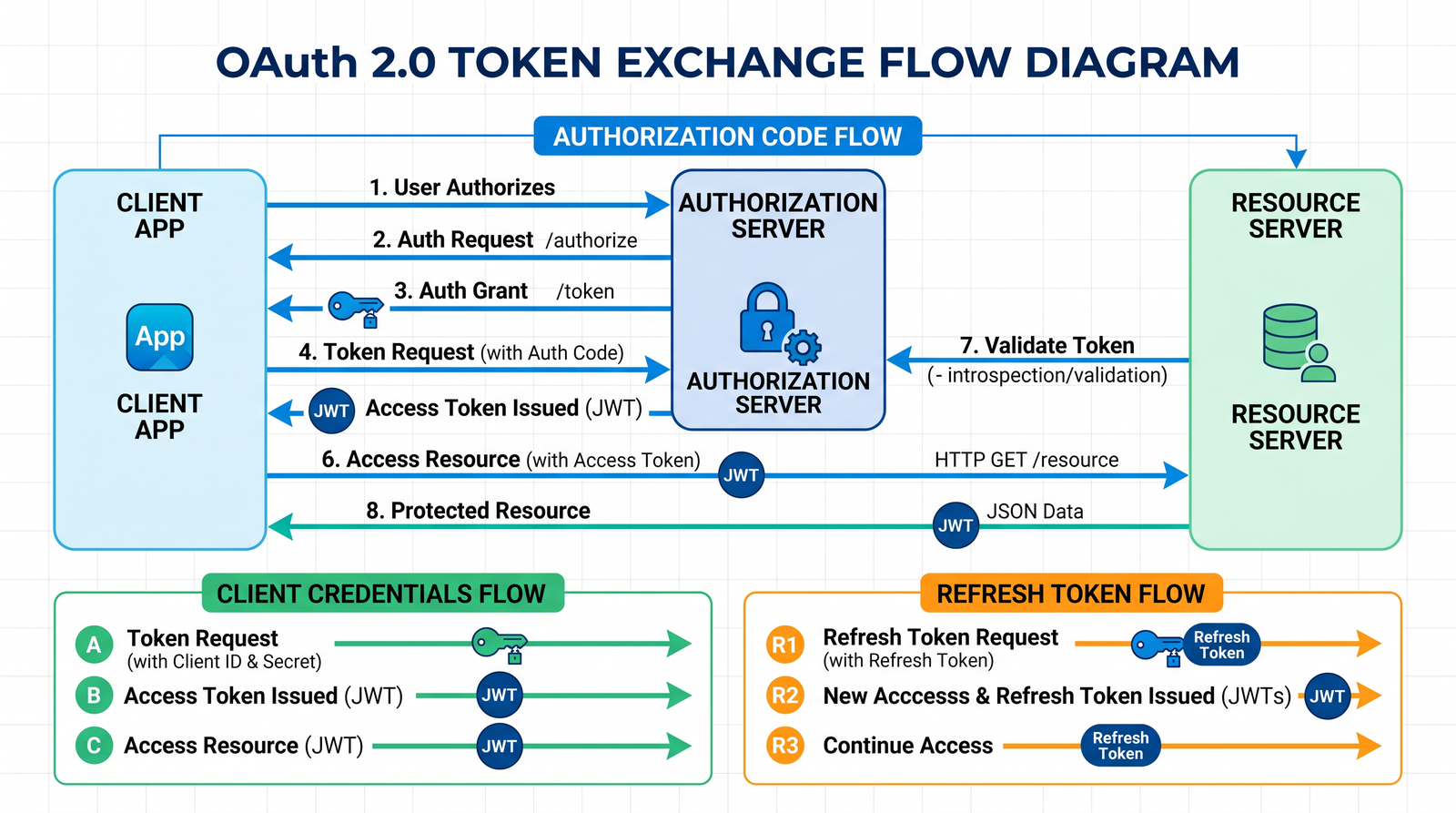
Reference map of the 15 prompts
+----+-----------------------------------------------+-----------------------------------------------+
| #  | Prompt Title                                  | Primary Deliverable                           |
+----+-----------------------------------------------+-----------------------------------------------+
|  1 | Define API Vision & Constraints               | Non-Functional Req (NFR) table, SLAs          |
|  2 | Establish OpenAPI Contract Baseline           | Minimal OAS 3.1 file with paths/components     |
|  3 | Resource Modeling & Naming Conventions        | Resource matrix + REST patterns                |
|  4 | Database Schema & Normalization               | ERD outline, SQL DDL                          |
|  5 | Migration Strategy & Rollbacks                | Versioned migration plan + scripts            |
|  6 | Authentication: Tokens & Flows                | Auth sequence, JWT/JWS config                 |
|  7 | Authorization: RBAC/ABAC                      | Policy matrix, middleware hooks               |
|  8 | Validation & Error Modeling                   | Problem+JSON schema, error codes              |
|  9 | Pagination, Filtering, Sorting                | Cursor/page strategy + guarantees             |
| 10 | Idempotency & Concurrency Control             | Idempotency-key and ETag flows                |
| 11 | Testing: Unit, Contract, E2E                  | Test pyramid, contract tests, fixtures        |
| 12 | CI/CD & Quality Gates                         | Pipeline stages, SAST/DAST, linting           |
| 13 | Observability: Logs, Traces, Metrics          | Log spec, trace propagation, RED metrics      |
| 14 | Performance, Caching, Rate Limits             | Caching headers, quotas, backpressure         |
| 15 | Security Hardening & Threat Modeling          | STRIDE table, secrets policy, supply chain    |
+----+-----------------------------------------------+-----------------------------------------------+
Running example: Orders API surface
Resources:
- /v1/users
- /v1/products
- /v1/carts
- /v1/orders

Non-functional baselines:
- p95 latency: < 120ms (read), < 250ms (write)
- Uptime SLO: 99.9%
- Consistency: Read-after-write for same session; eventual otherwise
- Data residency: Region-specific (us-east-1, eu-central-1)
- Auditability: Authenticated actions are auditable (who/when/what)
Prompt 1: Define API Vision & Constraints
Everything downstream depends on the clarity of the upstream constraints. Establish success criteria upfront to avoid costly reversals later. Capture high-level business outcomes, target audiences, and non-functional requirements with crisp thresholds and measurable SLIs.
Prompt:
"You are the lead API architect. Given the product context:
- Domain: {Orders and payments for a commerce platform}
- Consumers: {Mobile app, internal Ops UI, third-party partners}
- Constraints: {99.9% SLO, data residency in EU/US, PCI scope segregation}
- Traffic: {p95 = 120ms read, 250ms write; 2k RPS peak; 5TB data/year}
- Compliance: {GDPR, PCI-DSS partial}

Produce:
1) a 1-paragraph API vision,
2) a table of NFRs (latency, availability, integrity, security, observability),
3) key risks and mitigation strategies,
4) explicit out-of-scope items for v1."

Acceptance Criteria:
- SLIs and SLOs are numeric and testable.
- Risks have at least one measurable mitigation.
- Out-of-scope items reduce ambiguity (e.g., "No batch orders in v1").
ASCII Table: NFRs (example)
+------------------+-------------------------+-----------------------------------------------+
| Category         | Target                  | Notes                                         |
+------------------+-------------------------+-----------------------------------------------+
| Latency          | p95 read < 120ms        | From API gateway edge                         |
|                  | p95 write < 250ms       | Includes validation and DB write              |
| Availability     | 99.9%                   | Regionally isolated blasts tolerated          |
| Data Integrity   | ACID within partition   | Idempotent create; optimistic locking update  |
| Security         | OAuth2 + mTLS internal  | JWT exp <= 15m; refresh flow for mobile       |
| Observability    | Traces 100%; logs JSON  | RED metrics; error budget policies            |
+------------------+-------------------------+-----------------------------------------------+
Prompt 2: Establish OpenAPI Contract Baseline
Locking the contract early enables mock servers, SDK generation, and contract tests. Start small but complete: include security schemes, reusable components, and at least one resource with a full CRUD slice.
Prompt:
"You are an API designer. Create a minimal but production-ready OpenAPI 3.1 YAML for the Orders API with:
- Global info, servers, and versioning (/v1)
- Components: securitySchemes (bearer JWT), schemas (User, Product, Cart, Order, Problem)
- Paths: /v1/products (GET list with pagination, POST create), /v1/products/{id} (GET, PATCH, DELETE)
- Error model using application/problem+json
- Examples for success and error responses
- Tags: products, orders, health
Return only YAML."

Acceptance Criteria:
- Must validate with spectral/openapi linter.
- Must include 429, 401, 403 standard errors.
- Must define pagination parameters consistently (limit, cursor).
# Example OpenAPI fragment (YAML)
openapi: 3.1.0
info:
  title: Orders API
  version: 1.0.0
servers:
  - url: https://api.example.com
    description: Production
security:
  - bearerAuth: []
components:
  securitySchemes:
    bearerAuth:
      type: http
      scheme: bearer
      bearerFormat: JWT
  schemas:
    Problem:
      type: object
      required: [type, title, status]
      properties:
        type: { type: string, format: uri }
        title: { type: string }
        status: { type: integer, format: int32 }
        detail: { type: string }
        instance: { type: string, format: uri }
    Product:
      type: object
      required: [id, name, price]
      properties:
        id: { type: string, format: uuid }
        name: { type: string, minLength: 1 }
        price: { type: number, format: float, minimum: 0 }
        currency: { type: string, minLength: 3, maxLength: 3 }
        createdAt: { type: string, format: date-time }
paths:
  /v1/products:
    get:
      tags: [products]
      operationId: listProducts
      parameters:
        - in: query
          name: limit
          schema: { type: integer, minimum: 1, maximum: 200, default: 50 }
        - in: query
          name: cursor
          schema: { type: string }
      responses:
        "200":
          description: OK
          content:
            application/json:
              schema:
                type: object
                required: [items]
                properties:
                  items:
                    type: array
                    items: { $ref: "#/components/schemas/Product" }
                  nextCursor: { type: string, nullable: true }
        "401": { description: Unauthorized, content: { application/problem+json: { schema: { $ref: "#/components/schemas/Problem" } } } }
        "429": { description: Too Many Requests, content: { application/problem+json: { schema: { $ref: "#/components/schemas/Problem" } } } }
    post:
      tags: [products]
      operationId: createProduct
      requestBody:
        required: true
        content:
          application/json:
            schema:
              type: object
              required: [name, price, currency]
              properties:
                name: { type: string, minLength: 1 }
                price: { type: number, minimum: 0 }
                currency: { type: string, minLength: 3, maxLength: 3 }
      responses:
        "201": { description: Created }
        "400": { description: Bad Request, content: { application/problem+json: { schema: { $ref: "#/components/schemas/Problem" } } } }
        "401": { description: Unauthorized, content: { application/problem+json: { schema: { $ref: "#/components/schemas/Problem" } } } }
Prompt 3: Resource Modeling & Naming Conventions
Consistent resource design simplifies discoverability and SDK ergonomics. Emphasize nouns for collections and singular IDs, uniform query parameters, and separate sub-resources when relationships have their own lifecycle or ACLs.
Prompt:
"You are a REST modeling coach. For the Orders API, provide:
1) a resource matrix with canonical paths,
2) naming conventions (snake_case vs camelCase for fields; kebab-case for URIs),
3) guidance on sub-resources (e.g., /orders/{id}/items),
4) versioning strategy (/v1 in path vs header) and deprecation policy."

Acceptance Criteria:
- Disallows verbs in path segments.
- Singular resource by ID; plural for collections.
- Consistent field casing and error property names.
ASCII Table: Resource Matrix
+------------------+-----------------------------------------------+--------------------------+
| Entity           | Collection Path                                | Item Path                |
+------------------+-----------------------------------------------+--------------------------+
| User             | /v1/users                                      | /v1/users/{userId}       |
| Product          | /v1/products                                   | /v1/products/{productId} |
| Cart             | /v1/carts                                      | /v1/carts/{cartId}       |
| CartItem         | /v1/carts/{cartId}/items                       | /v1/carts/{cartId}/items/{itemId} |
| Order            | /v1/orders                                     | /v1/orders/{orderId}     |
| OrderEvent       | /v1/orders/{orderId}/events                    | /v1/orders/{orderId}/events/{eventId} |
+------------------+-----------------------------------------------+--------------------------+
Field naming:
- JSON fields: camelCase (e.g., createdAt, unitPrice)
- Query params: snake_case or lowerCamel? Choose one: lowerCamel for consistency with JSON
- Headers: Title-Case per HTTP conventions
- Enums: UPPER_SNAKE in code; lower-case strings in JSON ("pending", "paid", "shipped")
Prompt 4: Database Schema & Normalization
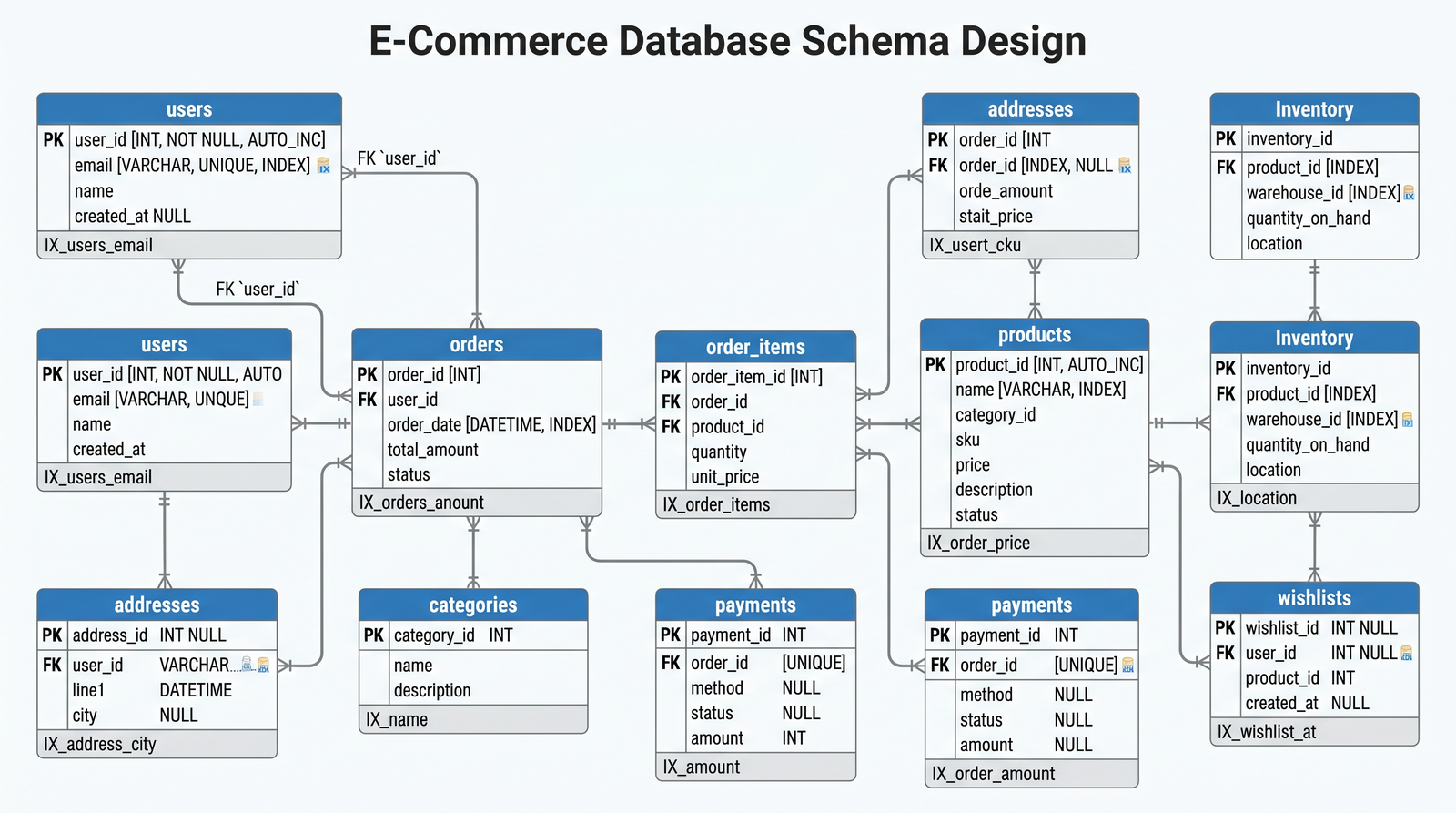
Design a normalized schema that balances integrity with query performance. Consider write-amplification from high-churn entities like carts and order events. Use strong types and constraints, and plan for future sharding by embedding clear tenant/region keys.
Prompt:
"You are a database architect. Design a Postgres schema for Users, Products, Carts, Orders:
- Normalized to 3NF where practical
- Foreign keys with ON UPDATE/ON DELETE policies
- Unique constraints and indexes for lookup paths
- Audit columns (created_at, updated_at)
- Soft delete policy (deleted_at nullable timestamp) where appropriate

Deliver:
1) SQL DDL (CREATE TABLE),
2) recommended indexes,
3) sample ERD relationships in ASCII."

Acceptance Criteria:
- All PKs are UUID (gen_random_uuid()).
- Monetary values use NUMERIC(12,2) with currency code.
- Composite unique constraints for business keys (e.g., SKU).
-- Example Postgres DDL
CREATE EXTENSION IF NOT EXISTS pgcrypto;

CREATE TABLE users (
  id UUID PRIMARY KEY DEFAULT gen_random_uuid(),
  email TEXT NOT NULL UNIQUE,
  password_hash TEXT NOT NULL,
  created_at TIMESTAMPTZ NOT NULL DEFAULT now(),
  updated_at TIMESTAMPTZ NOT NULL DEFAULT now(),
  deleted_at TIMESTAMPTZ
);

CREATE TABLE products (
  id UUID PRIMARY KEY DEFAULT gen_random_uuid(),
  sku TEXT NOT NULL,
  name TEXT NOT NULL,
  price NUMERIC(12,2) NOT NULL,
  currency CHAR(3) NOT NULL,
  created_at TIMESTAMPTZ NOT NULL DEFAULT now(),
  updated_at TIMESTAMPTZ NOT NULL DEFAULT now(),
  deleted_at TIMESTAMPTZ,
  UNIQUE (sku)
);

CREATE TABLE carts (
  id UUID PRIMARY KEY DEFAULT gen_random_uuid(),
  user_id UUID NOT NULL REFERENCES users(id) ON DELETE CASCADE,
  created_at TIMESTAMPTZ NOT NULL DEFAULT now(),
  updated_at TIMESTAMPTZ NOT NULL DEFAULT now(),
  checked_out_at TIMESTAMPTZ,
  deleted_at TIMESTAMPTZ
);

CREATE TABLE cart_items (
  id UUID PRIMARY KEY DEFAULT gen_random_uuid(),
  cart_id UUID NOT NULL REFERENCES carts(id) ON DELETE CASCADE,
  product_id UUID NOT NULL REFERENCES products(id),
  quantity INT NOT NULL CHECK (quantity > 0),
  unit_price NUMERIC(12,2) NOT NULL,
  currency CHAR(3) NOT NULL,
  created_at TIMESTAMPTZ NOT NULL DEFAULT now(),
  updated_at TIMESTAMPTZ NOT NULL DEFAULT now(),
  UNIQUE (cart_id, product_id)
);

CREATE TABLE orders (
  id UUID PRIMARY KEY DEFAULT gen_random_uuid(),
  user_id UUID NOT NULL REFERENCES users(id),
  total_amount NUMERIC(12,2) NOT NULL,
  currency CHAR(3) NOT NULL,
  status TEXT NOT NULL CHECK (status IN ('pending','paid','shipped','cancelled')),
  version INT NOT NULL DEFAULT 1,
  created_at TIMESTAMPTZ NOT NULL DEFAULT now(),
  updated_at TIMESTAMPTZ NOT NULL DEFAULT now()
);

CREATE TABLE order_items (
  id UUID PRIMARY KEY DEFAULT gen_random_uuid(),
  order_id UUID NOT NULL REFERENCES orders(id) ON DELETE CASCADE,
  product_id UUID NOT NULL REFERENCES products(id),
  quantity INT NOT NULL CHECK (quantity > 0),
  unit_price NUMERIC(12,2) NOT NULL,
  currency CHAR(3) NOT NULL,
  created_at TIMESTAMPTZ NOT NULL DEFAULT now()
);

-- Indexes
CREATE INDEX idx_products_sku ON products(sku);
CREATE INDEX idx_carts_user ON carts(user_id);
CREATE INDEX idx_order_user ON orders(user_id);
CREATE INDEX idx_order_status ON orders(status);
CREATE INDEX idx_cart_items_cart ON cart_items(cart_id);
CREATE INDEX idx_order_items_order ON order_items(order_id);

-- ASCII ERD
-- users 1---* carts 1---* cart_items
-- users 1---* orders 1---* order_items
-- products 1---* cart_items
-- products 1---* order_items
Prompt 5: Migration Strategy & Rollbacks
Migrations must be safe, repeatable, and observable. Favor forward-only migrations with explicit down plans only for non-destructive changes; use blue/green or expand/contract for destructive ones. Integrate with CI to prevent drift.
Prompt:
"You are a data reliability engineer. Propose a migration strategy for Postgres with:
- Versioned migration folders (YYYYMMDDHHMM_{name}.sql)
- Expand/contract steps for breaking changes
- Backfill scripts with batching and retry
- Feature flags to gate new columns/paths
- Rollback procedures and RPO/RTO estimates

Produce:
1) migration policy doc (bullets),
2) example up/down SQL for adding NOT NULL column with default via expand/contract,
3) operational runbook snippet."

Acceptance Criteria:
- Backfills run in chunks with index support.
- Rollbacks avoid data loss; when impossible, document blast radius.
- Git pre-commit hook validates migration ordering.
Example expand/contract (add column orders.source NOT NULL DEFAULT 'web')
-- Expand
ALTER TABLE orders ADD COLUMN source TEXT;
UPDATE orders SET source = 'web' WHERE source IS NULL;
ALTER TABLE orders ALTER COLUMN source SET DEFAULT 'web';
-- Deploy app reading/writing 'source' but not assuming NOT NULL
-- Contract
ALTER TABLE orders ALTER COLUMN source SET NOT NULL;
Prompt 6: Authentication: Tokens & Flows
Authentication defines how clients obtain and present credentials. For public mobile apps, prefer short-lived access tokens with refresh tokens. Server-to-server traffic can use mTLS or client credentials. Sign tokens with strong algorithms (ES256 or RS256) and publish a JWKS. Include clock skew tolerances and revocation patterns.
Prompt:
"You are an identity architect. Design auth for the Orders API:
- Flows: Authorization Code + PKCE for mobile; Client Credentials for partners
- Token: JWT access (15m), opaque refresh (7d), scopes and audience
- Key management: JWKS rotate every 30 days, kid pinning
- Session: sliding refresh with device binding
- Security: detect replay, store refresh securely

Deliver:
1) sequence diagrams in ASCII,
2) JWT claim set definition,
3) HTTP examples for token acquisition and API call,
4) failure cases (expired, invalid scope)."

Acceptance Criteria:
- JWT includes sub, iss, aud, iat, exp, jti, scope.
- API enforces aud and scope checks.
- Graceful 401 with WWW-Authenticate header.
ASCII Sequence: Auth Code + PKCE
App --(code challenge)--> AuthZ Server
App <--(login + consent)-- AuthZ Server
App --(code + verifier)--> Token Endpoint
App <--(access_jwt, refresh)--- Token Endpoint
App --(Authorization: Bearer <jwt>)--> Orders API
Example JWT claims (ES256)
{
  "iss": "https://auth.example.com",
  "sub": "user-123",
  "aud": "orders-api",
  "scope": "orders:read orders:write",
  "iat": 1710000000,
  "exp": 1710000900,
  "jti": "4b2f8a40-...-a9f3"
}
HTTP
POST /oauth/token
Content-Type: application/x-www-form-urlencoded

grant_type=authorization_code&code=abc&code_verifier=xyz&redirect_uri=app://callback&client_id=mobile-app

GET /v1/orders
Authorization: Bearer eyJhbGciOiJFUzI1NiIsInR5cCI6IkpXVCIsImtpZCI6...
Accept: application/json
For a deeper exploration of related concepts, our comprehensive guide on 30 ChatGPT-5.5 Prompts for Product Managers: Roadmap Planning, User Research Syn provides detailed strategies and practical frameworks that complement the approaches discussed in this section.
Prompt 7: Authorization: RBAC/ABAC
Authorization answers “what can this principal do?” Model scopes and roles that map cleanly to endpoints and business actions. When role-based control is insufficient, add attribute-based checks (ownership, region, data classification). Place authorization as close to the resource as possible, with consistent denial reasons.
Prompt:
"You are a security engineer. Define authorization for Orders:
- Scopes: products:read, products:write, orders:read, orders:write
- Roles: admin (all), support (read + refund), user (self-owned)
- ABAC: user can only access own carts/orders
- Admin break-glass: time-bound with audit trail

Deliver:
1) policy matrix (ASCII),
2) pseudo-code for middleware,
3) mapping from scopes to routes."

Acceptance Criteria:
- Deny by default; explicit allow.
- 403 for authenticated-but-not-authorized; 404 for non-owned resources if policy requires cloaking.
- Policies are testable via fixtures.
Policy Matrix
+-----------+-------------------------------+---------------------------------------------+
| Role      | Scopes                        | Allowed                                     |
+-----------+-------------------------------+---------------------------------------------+
| admin     | *                             | All endpoints                               |
| support   | orders:read, orders:write?    | Read any order; refund within policy        |
| user      | orders:read, carts:write      | Read/write own resources only               |
+-----------+-------------------------------+---------------------------------------------+
// Pseudo-code middleware
function authorize(request, requiredScopes, ownershipCheck) {
  const token = parseJWT(request.headers.authorization);
  if (!token) return 401;
  if (!hasAllScopes(token.scope, requiredScopes)) return 403;

  if (ownershipCheck) {
    const ownerId = ownershipCheck.extractOwnerId(request);
    if (token.sub !== ownerId && !isAdmin(token)) {
      // Return 404 to avoid leaking resource existence
      return 404;
    }
  }
  return next();
}
Prompt 8: Validation & Error Modeling
Validation lives in three places: at the edge (request shape), in business rules (domain invariants), and in the persistence layer (constraints). Expose a single, coherent error model to clients using application/problem+json with stable error codes.
Prompt:
"You are an API ergonomics specialist. Define the error model:
- Use RFC 9457 problem+json with type URIs
- Include 'code' (stable, machine-readable) and 'errors' (field-level)
- Map from exception types to HTTP status and problem.type
- Provide examples for 400, 401, 403, 404, 409, 422, 429, 500"

Acceptance Criteria:
- Code values stable across versions.
- Detailed 'errors' array for validation failures.
- Include correlation/trace id."
Example Problem JSON
{
  "type": "https://errors.example.com/validation",
  "title": "Validation Failed",
  "status": 422,
  "code": "VALIDATION_ERROR",
  "detail": "One or more fields failed validation.",
  "traceId": "01H8K7X4S...",
  "errors": [
    { "field": "price", "message": "must be >= 0", "code": "MIN_VALUE" },
    { "field": "currency", "message": "must be ISO-4217", "code": "INVALID_ENUM" }
  ]
}
Prompt 9: Pagination, Filtering, Sorting
Pagination must be predictable and resilient to concurrent writes. Cursor pagination is generally superior to offset for large, changing datasets. Use stable sort keys and include nextCursor tokens. Filtering and sorting should be validated and whitelisted to prevent unbounded query costs.
Prompt:
"You are a performance-minded API designer. Specify pagination/filtering:
- Cursor-based for list endpoints, with stable tie-breakers (createdAt, id)
- Query params: limit, cursor, filter[field], sort
- Define guarantees (no duplicates across pages, at-least-once coverage)
- Provide examples and test vectors

Deliver:
1) algorithm for generating/decoding cursors,
2) HTTP examples for list products and list orders,
3) SQL patterns with indexed where/sort."

Acceptance Criteria:
- limit capped (e.g., max=200).
- Cursors signed/encoded (base64url).
- Sorting fields are whitelisted and indexed.
ASCII Table: Cursor Structure
+-----------+---------------------------+
| Field     | Meaning                   |
+-----------+---------------------------+
| ts        | last seen timestamp       |
| id        | last seen id              |
| sig       | HMAC for tamper-evidence  |
+-----------+---------------------------+
SQL pattern (Postgres)
-- For createdAt DESC, id DESC tie-breakers
SELECT * FROM products
WHERE (created_at, id) < (cursor_ts, cursor_id)
ORDER BY created_at DESC, id DESC
LIMIT $limit;
HTTP
GET /v1/products?limit=50
GET /v1/products?limit=50&cursor=eyJ0cyI6IjIwMjQtMDgtMDEuLiIsImlkIjoiLi4iLCJzaWciOiIuLi4ifQ
Guarantees: no duplicates within a single traversal; clients should treat items as an append-only stream for reconciliation. Document behavior under deletions and insertions between page fetches.
Prompt 10: Idempotency & Concurrency Control
Idempotency gives clients a safe retry path for non-idempotent operations (POST). Concurrency control prevents lost updates. Implement both: Idempotency-Key on POSTs, ETag with If-Match for PATCH/PUT, and optionally optimistic locking fields in the payload (e.g., version).
Prompt:
"You are a reliability engineer. Specify idempotency and concurrency:
- Require Idempotency-Key for POST /orders
- Persist request hash keyed by (Idempotency-Key, principal, route)
- Return the same 201 body on retry within TTL (24h)
- Use ETag/If-Match and/or version for updates
- Define 409 Conflict semantics

Deliver:
1) storage model for idempotency records,
2) middleware pseudo-code,
3) examples of success, duplicate, conflict."

Acceptance Criteria:
- Keys are case-insensitive, canonicalized.
- Idempotency records include status code and response body hash.
- ETag derives from stable resource version.
ASCII Table: Idempotency Record
+-------------------+----------------------------------------------+
| Field             | Value                                        |
+-------------------+----------------------------------------------+
| key               | UUID or client-provided string               |
| principal         | sub / client_id                              |
| route             | POST /v1/orders                              |
| request_hash      | SHA-256(payload + headers subset)            |
| response_status   | 201                                          |
| response_body     | JSON blob                                    |
| created_at        | timestamp                                    |
| ttl               | 24h                                          |
+-------------------+----------------------------------------------+
// Node/Express middleware (simplified)
app.post('/v1/orders', requireAuth, withIdempotency, createOrder);

async function withIdempotency(req, res, next) {
  const key = (req.get('Idempotency-Key') || '').toLowerCase().trim();
  if (!key) return res.status(400).json(problem('missing-idempotency-key'));

  const entry = await store.find(key, req.user.sub, req.path);
  const hash = sha256(JSON.stringify(req.body));
  if (entry) {
    if (entry.request_hash !== hash) return res.status(409).json(problem('idem-key-reuse'));
    res.set('Idempotency-Key', key);
    res.status(entry.response_status).send(entry.response_body);
    return;
  }
  res.locals.idem = { key, principal: req.user.sub, route: req.path, hash };
  next();
}

async function createOrder(req, res) {
  const order = await insertOrder(...);
  const body = serialize(order);
  await store.save({ ...res.locals.idem, response_status: 201, response_body: body });
  res.set('Idempotency-Key', res.locals.idem.key);
  res.status(201).json(body);
}
Prompt 11: Testing Strategy: Unit, Contract, E2E
Testing keeps your contract honest and your refactors safe. Create a layered test strategy: fast, isolated unit tests for business logic; contract tests validated against OpenAPI; and end-to-end tests through the HTTP stack with ephemeral databases and seeded fixtures.
Prompt:
"You are a test architect. Define the test strategy:
- Unit tests: pure functions and edge cases
- Contract tests: request/response validation with generated clients and mock servers
- E2E: spin up service + DB in containers; seed fixtures; teardown cleanly
- Data builders and golden files for fixtures
- Flake mitigation: retries for known transient steps only

Deliver:
1) test pyramid ratios,
2) sample test code in Node and Python,
3) Makefile targets and CI steps (text)."

Acceptance Criteria:
- Contract tests fail on OAS drift.
- E2E uses production-like config (feature flags on).
- Parallelizable with isolated schemas or DB containers.
// Node (Jest) unit example
test('computeOrderTotal sums items', () => {
  const items = [{ qty: 2, price: 5 }, { qty: 1, price: 10 }];
  expect(computeOrderTotal(items)).toBe(20);
});

// Python (pytest) contract-like example with openapi-core
def test_products_schema(openapi_document, client):
    resp = client.get('/v1/products?limit=10')
    assert resp.status_code == 200
    validate_response(openapi_document, '/v1/products', 'get', resp)
Makefile (excerpt)
test:
\tnpm test --workspaces
\tpytest -q

e2e:
\tdocker compose up -d db
\tnpx prisma migrate deploy || alembic upgrade head
\tnpm run start:test &
\twait-on http://localhost:8080/health
\tpytest tests/e2e -q
\tdocker compose down -v
Prompt 12: CI/CD & Quality Gates
Automate everything that can fail silently: linting, static analysis, license scanning, image signing, SBOM generation, and deployment health checks. Gates should block merges when the API contract drifts, the schema diverges, or tests fail non-deterministically.
Prompt:
"You are a platform engineer. Build CI/CD for the Orders API:
- Jobs: lint (ESLint, flake8), test (unit, contract, e2e), security (SAST, dependency scan)
- Build: container images with reproducible tags (git sha), SBOM, attestations
- Deploy: blue/green or rolling with health checks; database migrations gated
- Quality gates: coverage threshold, openapi-diff must be 'compatible'

Deliver:
1) pipeline stages (ASCII),
2) sample commands,
3) deployment policy for canaries and rollbacks."

Acceptance Criteria:
- Fail build on open vulnerabilities above threshold.
- Require approval for schema-changing releases.
- Rollback playbook documented with RTO/RPO.
ASCII: Pipeline
[lint] -> [unit] -> [contract] -> [e2e] -> [build image + sbom] -> [deploy canary] -> [promote]
Key commands
- spectral lint openapi.yaml
- oasdiff --fail-on-incompatible base.yaml openapi.yaml
- snyk test --severity-threshold=high
- trivy image --exit-code 1 registry/orders-api:sha
- cosign sign registry/orders-api:sha
Prompt 13: Observability: Logs, Traces, Metrics
Production APIs need actionable telemetry. Embrace structured logging, distributed tracing with context propagation, and standard RED metrics (Rate, Errors, Duration). Correlate everything with a trace ID. Collect “business” metrics (orders created) alongside system metrics (latency).
Prompt:
"You are an SRE. Instrument the Orders API:
- Logging: JSON; include traceId, spanId, userId (if authenticated), http.path, status
- Tracing: W3C Trace Context; sample 10% of traffic; record DB spans
- Metrics: RED, plus domain counters (orders_created_total)
- Dashboards: p50/p95 latency, error budgets, saturation
- Alerts: multi-window burn rate for error budget

Deliver:
1) log schema (ASCII),
2) example logs,
3) tracing middleware code samples in Node/Go,
4) metrics names and types."

Acceptance Criteria:
- No PII in logs; redact secrets.
- Trace context propagated to downstream calls.
- Metrics have labels bounded in cardinality.
Log schema
+-------------+-----------------------+
| Field       | Example               |
+-------------+-----------------------+
| ts          | 2026-07-01T12:00:00Z  |
| level       | INFO                  |
| traceId     | 4f9c...               |
| spanId      | 00ab...               |
| userId      | user-123              |
| http.method | GET                   |
| http.path   | /v1/orders            |
| status      | 200                   |
| dur_ms      | 42                    |
| msg         | "request completed"   |
+-------------+-----------------------+
// Node tracing middleware (OpenTelemetry-like pseudo)
app.use(traceMiddleware);

function traceMiddleware(req, res, next) {
  const ctx = extractTraceContext(req.headers);
  const span = tracer.startSpan('http.server', { kind: 'SERVER', context: ctx, attributes: {
    'http.method': req.method, 'http.target': req.originalUrl
  }});
  res.on('finish', () => {
    span.setAttribute('http.status_code', res.statusCode);
    span.end();
  });
  next();
}
// Go tracing (chi + otel)
r := chi.NewRouter()
r.Use(otelhttp.NewMiddleware("orders-api"))
r.Get("/v1/orders", func(w http.ResponseWriter, r *http.Request) {
  // handler
})
For a deeper exploration of related concepts, our comprehensive guide on How to Set Up ChatGPT Enterprise for Your Team: Admin Console, SSO, Data Control provides detailed strategies and practical frameworks that complement the approaches discussed in this section.
Prompt 14: Performance, Caching, Rate Limits
Performance is a product feature. Embrace HTTP caching semantics for read-heavy routes, cache stampede mitigation for hot keys, and fair rate limits. Document cacheability with explicit Cache-Control and ETag headers. Prefer server-managed caches with bounded TTLs over client guesses.
Prompt:
"You are a performance engineer. Define caching and limits:
- Cache-Control for GET /products (public, max-age=60, ETag)
- 304 handling with If-None-Match
- Server-side cache with background refresh (stale-while-revalidate pattern)
- Rate limit: 100 req/min per token + burst; 429 with Retry-After
- Backpressure: shed load with token bucket and queue limits

Deliver:
1) header policy matrix (ASCII),
2) sample code to compute ETag,
3) 429 response example."

Acceptance Criteria:
- ETag is a stable hash of response representation.
- No caching on personalized responses unless Vary is set.
- Rate limiting and quota keys well-defined."
Header policy
+--------------------+---------------------------------------------+
| Route              | Cache Policy                                |
+--------------------+---------------------------------------------+
| GET /v1/products   | Cache-Control: public, max-age=60           |
|                    | ETag: "W/<hash>"                            |
| GET /v1/orders     | Cache-Control: private, no-store            |
| POST /v1/orders    | Cache-Control: no-store                     |
+--------------------+---------------------------------------------+
// Node: ETag computation
const crypto = require('crypto');
function computeEtag(body) {
  const hash = crypto.createHash('sha1').update(body).digest('hex').slice(0, 16);
  return `W/"${hash}"`;
}
429 Example
HTTP/1.1 429 Too Many Requests
Content-Type: application/problem+json
Retry-After: 30

{
  "type": "https://errors.example.com/rate-limit",
  "title": "Rate limit exceeded",
  "status": 429,
  "code": "RATE_LIMIT",
  "detail": "Try again in 30 seconds."
}
Prompt 15: Security Hardening & Threat Modeling
Security is continuous. Combine secure defaults in code and infra with a living threat model. Address supply chain risks, secret management, dependency health, and runtime protections. Bake security checks into CI/CD and re-run on every merge.
Prompt:
"You are a security lead. Produce a hardening guide:
- Threat model using STRIDE for Orders API
- Secrets: stored in vault, rotated, never in repo
- Dependency policy: pin versions, SBOM, trusted registries
- Headers: HSTS, Content-Security-Policy for web front-ends, frame-ancestors
- Input handling: size limits, timeouts, request body parsing safety
- SSRF protection and outbound egress controls

Deliver:
1) STRIDE table (ASCII),
2) checklist for PR reviews,
3) runtime security hooks (rate limit, WAF, anomaly detection)."

Acceptance Criteria:
- Clear owner per control.
- Auditability: changes to security config tracked.
- Recovery: documented key compromise response."
STRIDE Table (excerpt)
+-------------+--------------------------------------+---------------------------------------------+
| Threat      | Example                              | Mitigation                                  |
+-------------+--------------------------------------+---------------------------------------------+
| Spoofing    | Fake tokens                          | Verify JWT sig, aud, exp; mTLS internal     |
| Tampering   | Payload manipulation                 | TLS 1.3, HMAC on cursors                    |
| Repudiation | "I didn't do it"                     | Audit logs with userId, traceId, integrity  |
| Information | Excessive data in responses          | Field-level filtering, least privilege      |
| Disclosure  |                                      |                                             |
| DoS         | Flood of requests                    | Rate limits, circuit breakers, autoscaling  |
| Elevation   | Role abuse                            | RBAC + ABAC, break-glass with approvals     |
+-------------+--------------------------------------+---------------------------------------------+
Cross-language server scaffolds
Below are minimal but production-aware scaffolds for the same endpoints. They include security middleware, validation, problem+json responses, and clean shutdown hooks. Use them as references to bootstrap your service.
Access 40,000+ AI Prompts for ChatGPT, Claude & Codex — Free!
Subscribe to get instant access to our complete Notion Prompt Library — the largest curated collection of prompts for ChatGPT, Claude, OpenAI Codex, and other leading AI models. Optimized for real-world workflows across coding, research, content creation, and business.
// Node.js + Express
const express = require('express');
const crypto = require('crypto');
const app = express();
app.use(express.json({ limit: '1mb' }));

function problem(type, status, title, detail) {
  return { type, status, title, detail, code: title.toUpperCase().replace(/ /g,'_') };
}
function auth(req, res, next) {
  const hdr = req.get('Authorization') || '';
  if (!hdr.startsWith('Bearer ')) {
    res.set('WWW-Authenticate', 'Bearer realm="orders"');
    return res.status(401).json(problem('https://errors.example.com/auth', 401, 'Unauthorized', 'Missing token'));
  }
  // TODO: verify JWT, scope, audience
  req.user = { sub: 'user-123', scope: 'orders:read orders:write' };
  next();
}
function validateProduct(body) {
  if (!body.name || typeof body.name !== 'string') return 'invalid name';
  if (typeof body.price !== 'number' || body.price < 0) return 'invalid price';
  if (!/^[A-Z]{3}$/.test(body.currency)) return 'invalid currency';
  return null;
}
app.get('/v1/products', auth, async (req, res) => {
  const limit = Math.min(parseInt(req.query.limit || '50', 10), 200);
  const items = []; // fetch from DB
  res.json({ items, nextCursor: null });
});
app.post('/v1/products', auth, async (req, res) => {
  const err = validateProduct(req.body);
  if (err) return res.status(422).json(problem('https://errors.example.com/validation', 422, 'Validation Failed', err));
  const product = { id: crypto.randomUUID(), ...req.body, createdAt: new Date().toISOString() };
  res.status(201).json(product);
});
process.on('SIGTERM', () => { /* graceful shutdown */ });
app.listen(8080);
# Python + FastAPI
from fastapi import FastAPI, Header, HTTPException, Request
from pydantic import BaseModel, Field, condecimal
from typing import List, Optional
import uuid, time

app = FastAPI()

class ProductIn(BaseModel):
  name: str = Field(..., min_length=1)
  price: condecimal(ge=0)
  currency: str = Field(..., min_length=3, max_length=3)

class Product(ProductIn):
  id: str
  createdAt: str

def auth(auth_header: Optional[str]):
  if not auth_header or not auth_header.startswith("Bearer "):
    raise HTTPException(status_code=401, detail="Unauthorized")

@app.get("/v1/products")
def list_products(authorization: Optional[str] = Header(None), limit: int = 50, cursor: Optional[str] = None):
  auth(authorization)
  limit = min(limit, 200)
  return { "items": [], "nextCursor": None }

@app.post("/v1/products", response_model=Product, status_code=201)
def create_product(p: ProductIn, authorization: Optional[str] = Header(None)):
  auth(authorization)
  return { "id": str(uuid.uuid4()), "name": p.name, "price": float(p.price), "currency": p.currency, "createdAt": time.strftime("%Y-%m-%dT%H:%M:%SZ") }
// Go + chi
package main

import (
  "encoding/json"
  "net/http"
  "github.com/go-chi/chi/v5"
)

type Product struct {
  ID        string  `json:"id"`
  Name      string  `json:"name"`
  Price     float64 `json:"price"`
  Currency  string  `json:"currency"`
  CreatedAt string  `json:"createdAt"`
}

func auth(next http.Handler) http.Handler {
  return http.HandlerFunc(func(w http.ResponseWriter, r *http.Request) {
    if h := r.Header.Get("Authorization"); h == "" {
      w.Header().Set("WWW-Authenticate", "Bearer realm=\"orders\"")
      http.Error(w, "Unauthorized", http.StatusUnauthorized)
      return
    }
    next.ServeHTTP(w, r)
  })
}

func listProducts(w http.ResponseWriter, r *http.Request) {
  w.Header().Set("Content-Type", "application/json")
  json.NewEncoder(w).Encode(map[string]any{"items": []Product{}, "nextCursor": nil})
}

func main() {
  r := chi.NewRouter()
  r.With(auth).Get("/v1/products", listProducts)
  http.ListenAndServe(":8080", r)
}
OpenAPI, SDKs, and compatibility
Automate client generation from your OpenAPI spec. Enforce compatibility by diffing proposed changes against the released baseline. Breaking changes should prompt a major version or a careful expand/contract. For example, adding required fields in responses is generally safe if you mark them nullable or provide defaults.
Compatibility rules (examples)
- Non-breaking:
  - Add optional response fields
  - Add new endpoints
  - Add new enum values if clients ignore unknown values
- Breaking:
  - Remove fields or endpoints
  - Tighten validation (min/max) without version bump
  - Change response types or status codes
End-to-end example: Create Order flow
Putting many concepts together: a client creates an order with an Idempotency-Key and then fetches it with ETag-based caching. The API enforces auth, authorization, validation, and writes to the database with optimistic locking.
Client
POST /v1/orders
Idempotency-Key: 8573b1c0-6d74-4a6c-96b1-6efc876f7e44
Authorization: Bearer <jwt>
Content-Type: application/json

{
  "items": [
    { "productId": "a1b2...", "quantity": 2 },
    { "productId": "c3d4...", "quantity": 1 }
  ],
  "currency": "USD"
}

Server
- Validate token (aud, exp, scope)
- Validate body (quantity > 0, products exist)
- Price lookup (unit_price, currency)
- Compute totals
- Persist order (version=1)
- Return 201 with representation and ETag
201 Created
ETag: W/"c0ffee1234"
Content-Type: application/json

{
  "id": "o-123",
  "userId": "user-123",
  "items": [
    { "productId": "a1b2", "quantity": 2, "unitPrice": 5.00 },
    { "productId": "c3d4", "quantity": 1, "unitPrice": 10.00 }
  ],
  "totalAmount": 20.00,
  "currency": "USD",
  "status": "pending",
  "version": 1,
  "createdAt": "2026-07-01T12:00:00Z"
}
GET /v1/orders/o-123
If-None-Match: W/"c0ffee1234"
Authorization: Bearer <jwt>

304 Not Modified
API Gateways and Edge concerns
An API gateway can provide cross-cutting concerns like authentication offload, rate limits, header normalization, request/response transformations, and mutual TLS for service-to-service calls. Choose a minimal, transparent configuration first; push domain logic down to the services, not the gateway. Ensure that gateways propagate trace headers and do not hide latency or error spikes.
Edge practices
- Normalize headers (strip duplicates, enforce casing)
- Enforce size/time limits (max body size, request timeout)
- Terminate TLS and validate client certs for mTLS partners
- Add security headers for browser clients (CORS, CSP)
- Propagate traceparent and tracestate
Data lifecycle, retention, and privacy
APIs often outlive their initial data model. Plan how data is created, updated, archived, and deleted. For privacy regulations, support subject access requests (export data) and deletion/erasure flows. For analytics, consider anonymization and aggregation. Ensure that backups and replicas honor data residency.
Lifecycle matrix
+----------------+-------------------------+---------------------------+
| Entity         | Retention               | Deletion Policy           |
+----------------+-------------------------+---------------------------+
| Orders         | 7 years (finance)       | Soft delete; purge logs   |
| Products       | Forever (catalog)       | Soft delete               |
| Users          | As per policy           | Erasure upon request      |
+----------------+-------------------------+---------------------------+
Drift, compatibility, and evolution
Schema drift and contract drift are inevitable. Detect them early with contract tests and schema diffs; manage them with migration playbooks and expand/contract. Communicate changes: publish deprecation schedules and offer compatibility layers where feasible. Avoid surprise breaks for partners; version intentionally and conservatively.
Evolution guidelines
- Prefer additive changes
- Hide new fields behind feature flags until stable
- Announce deprecations with sunset headers and timelines
- Keep old behavior available until most traffic migrates
- Avoid recycling error codes with different semantics
Runtime configuration and feature flags
Roll out risky changes behind flags. Store flags in a central, auditable system. Evaluate flags at the edge of a request and cache flag state per request to avoid inconsistent behavior within a single operation. Design your code to support partial rollouts (percentage-based, per-tenant, per-region).
Flag design
- Boolean gate for new validation rules
- Percentage rollout for new index usage
- Kill switch for hot paths (disable heavy features)
- Sticky flags by user or tenant for A/B
Blueprint: Problem+JSON and error code registry
Create a registry of error codes and their mapping to HTTP statuses and problem types. Treat it as an API of its own: stable, documented, and versioned. Instrument error rates per code to detect regressions and feature fallout.
Error Registry (excerpt)
+---------------------+-------+-----------------------------------------------+
| Code                | HTTP  | Description                                   |
+---------------------+-------+-----------------------------------------------+
| UNAUTHORIZED        | 401   | Missing/invalid credentials                   |
| FORBIDDEN           | 403   | Insufficient privileges                       |
| NOT_FOUND           | 404   | Resource not found or cloaked                 |
| CONFLICT            | 409   | Version or key conflict                       |
| VALIDATION_ERROR    | 422   | Schema or business rule violation             |
| RATE_LIMIT          | 429   | Too many requests                             |
| INTERNAL_ERROR      | 500   | Unhandled server error                        |
+---------------------+-------+-----------------------------------------------+
Blueprint: Health checks and readiness
Separate liveness (is the process responsive) from readiness (can it serve traffic). Liveness should be lightweight and never block; readiness can perform dependency checks with short timeouts. Do not include heavy health logic that could cascade failures under load.
Health endpoints
- /health/live: returns 200 if event loop responding
- /health/ready: checks DB ping (<100ms), cache connectivity, migration version
- /health/metrics: Prometheus scrape
Blueprint: Maintaining SDKs and docs
Good docs reduce support tickets and integration time. Generate SDKs for popular languages from your OpenAPI spec and host examples that mirror real-world flows, including error cases. Keep docs versioned with your API; provide a changelog and deprecation notes.
Docs checklist
- Quickstart using API key/JWT
- Examples for all CRUD on each resource
- Error handling guide with problem+json
- Pagination recipes with cursors
- Rate limit and retry policies
Domain-specific considerations for commerce
Commerce APIs often require particular care around money and inventory. Always use decimal types for amounts and avoid floating-point arithmetic. Tie currency to amounts explicitly. Double-write inventory reservations to a durable log for auditability. Consider eventual consistency and conflict resolution strategies for concurrent inventory updates.
Money handling
- Use NUMERIC(12,2) for storage; Decimal in app code
- Store currency per line item and order
- Round only at display boundaries; preserve base units internally
Failure modes and graceful degradation
When dependencies fail, degrade gracefully. Circuit breakers trip quickly and recover cautiously. Prefer to fail closed on security-sensitive paths, and fail open on user experience paths where safe. Cache stale data briefly when a backend is down if the data is non-sensitive and correctness impact is small.
Degradation tactics
- Circuit Breakers: open after 5 failures in 10s; half-open probe after 30s
- Bulkheads: isolate pools per downstream
- Timeouts: set per-call budgets (e.g., 80ms DB, 50ms cache)
- Retries: jittered exponential backoff; max 2 for idempotent calls only
API review checklist
Before merging any endpoint, run through a lightweight but thorough review. This ensures consistency, safety, and supportability from day one. Keep the checklist short enough that teams will actually use it.
Review checklist
- Contract: OpenAPI path/schemas updated and linted
- Security: AuthN/Z enforced; scopes mapped; sensitive fields redacted
- Errors: problem+json used; codes mapped; examples added
- Perf: pagination bounded; N+1 avoided; proper indexes
- Ops: logs/traces/metrics; health checks; dashboards updated
- Tests: unit/contract/E2E added; coverage meets bar
- Docs: examples and changelog entries present
Sample repository layout
A predictable, well-structured repository accelerates onboarding and reduces friction across teams. Organize by function, not framework. Co-locate tests with code when it helps readability, or in parallel trees when cross-cutting.
repo/
  api/
    openapi.yaml
    examples/
  cmd/
    orders-api/          # main entrypoint
  internal/
    auth/
    orders/
    products/
    db/
  migrations/
    202607011200_init.sql
  scripts/
    dev.sh
    generate-sdks.sh
  tests/
    unit/
    contract/
    e2e/
  Makefile
  Dockerfile
  README.md
From prompts to delivery: how to operationalize
The 15 prompts above are more than checklists: they are contracts for what “done” means in an API-centric team. Adopt them as templates in your issue tracker, ensure that each produces concrete artifacts (OpenAPI, SQL, code, dashboards), and automate review gates so subjective debates become objective checks. Iterate: your first pass will surface unknowns; refine the prompts and acceptance criteria as your domain clarifies.
Appendix A: End-to-end minimal OpenAPI for Orders (extended fragment)
paths:
  /v1/orders:
    get:
      tags: [orders]
      operationId: listOrders
      parameters:
        - in: query
          name: limit
          schema: { type: integer, minimum: 1, maximum: 200, default: 50 }
        - in: query
          name: cursor
          schema: { type: string }
      responses:
        "200":
          description: OK
          content:
            application/json:
              schema:
                type: object
                properties:
                  items:
                    type: array
                    items:
                      type: object
                      properties:
                        id: { type: string, format: uuid }
                        totalAmount: { type: number }
                        currency: { type: string }
                        status: { type: string, enum: [pending, paid, shipped, cancelled] }
                        createdAt: { type: string, format: date-time }
                  nextCursor: { type: string, nullable: true }
        "401": { description: Unauthorized }
    post:
      tags: [orders]
      operationId: createOrder
      security:
        - bearerAuth: [orders:write]
      requestBody:
        required: true
        content:
          application/json:
            schema:
              type: object
              required: [items, currency]
              properties:
                items:
                  type: array
                  items:
                    type: object
                    required: [productId, quantity]
                    properties:
                      productId: { type: string, format: uuid }
                      quantity: { type: integer, minimum: 1 }
                currency: { type: string, minLength: 3, maxLength: 3 }
      responses:
        "201": { description: Created }
        "400": { description: Bad Request }
        "401": { description: Unauthorized }
        "409": { description: Conflict }
Appendix B: Example SQL queries and indexes
-- Top products (last 30 days)
SELECT p.id, p.name, SUM(oi.quantity) AS units, SUM(oi.quantity * oi.unit_price) AS revenue
FROM order_items oi
JOIN orders o ON o.id = oi.order_id
JOIN products p ON p.id = oi.product_id
WHERE o.created_at > now() - interval '30 days'
GROUP BY p.id, p.name
ORDER BY revenue DESC
LIMIT 50;

-- Index to support order listing by user and recency
CREATE INDEX IF NOT EXISTS idx_orders_user_created ON orders(user_id, created_at DESC, id DESC);
Appendix C: Error examples and troubleshooting
401 Unauthorized
WWW-Authenticate: Bearer realm="orders", error="invalid_token"

403 Forbidden
{
  "type":"https://errors.example.com/forbidden",
  "title":"Forbidden",
  "status":403,
  "code":"FORBIDDEN",
  "detail":"Missing scope orders:write"
}

409 Conflict (ETag/If-Match)
{
  "type":"https://errors.example.com/conflict",
  "title":"Conflict",
  "status":409,
  "code":"CONFLICT",
  "detail":"Version mismatch; retry with latest ETag"
}
Appendix D: Implementation notes for resilience
Pay attention to operational details that often cause outages: connection pool sizing, slow query logs, GC pauses, and misconfigured timeouts. Validate every external assumption with synthetic checks and chaos experiments. Build a culture where incidents fuel learning and prompt improvements to this playbook.
Resilience defaults
- DB pool: cap per-instance and per-tenant; avoid stampedes
- Timeouts: no call waits longer than your SLO budget per hop
- Retries: only for idempotent ops; jitter; cap total attempts
- Deadlines: pass a request-scoped deadline to all downstreams
- GC: monitor latency spikes; tune heap and pause settings
- Chaos: inject failures in staging; verify circuit and fallback
Conclusion
Building a production REST API is a systems problem, not a framework problem. Contracts, schemas, authentication, authorization, validation, reliability, and observability all work together or fail together. With this 15-prompt playbook, you have a repeatable path to specify, implement, and ship APIs that scale, survive change, and delight consumers. Start with the vision, lock the contract, model the data carefully, secure the edge, defend against failures, test relentlessly, observe in real time, and evolve with empathy for your clients. Your future on-call self will thank you.
For a deeper exploration of related concepts, our comprehensive guide on OpenAI’s Shift from Chat to Agents: How 97.9% Internal Codex Adoption Is R provides detailed strategies and practical frameworks that complement the approaches discussed in this section.
