
Why Anthropic’s Claude Fable 5 Redeployment Signals a New Era of AI Export Controls — And How OpenAI Is Responding
Why Anthropic’s Claude Fable 5 Redeployment Signals a New Era of AI Export Controls — And How OpenAI Is Responding
Executive Summary
On July 1, 2026, restricted AI export controls that had held up certain advanced frontier model deployments were partially lifted, enabling Anthropic to redeploy its previously paused model, Claude Fable 5, with a fortified compliance posture. In parallel, OpenAI is advancing a complementary but distinct strategy: “government‑gated” releases, piloted with GPT‑5.6 Sol, in which access to sensitive capabilities is mediated through national or regional review programs and secure enclaves. The two moves crystallize a new reality for AI distribution: releases will increasingly be orchestrated through both corporate stewardship and state frameworks, with a premium on in‑region compute, auditable controls, and role‑based capability gating.
For developers, this new world means updated onboarding flows (KYC/KYB), region-aware endpoints, and auditable usage patterns. For enterprises, it portends board-level policies, multinational data-mapping, and standardized compliance attestations. And for geopolitics, the shift reveals a gradual normalization of “compute and capability sovereignty” as governments seek assurance that frontier models remain aligned with domestic security norms.
Below, we unpack what changed for Anthropic, how AI export controls function in practice, how OpenAI’s government‑gated approach differs, and how to prepare for increasingly regulated AI releases in the years ahead.
What Happened: Anthropic’s Claude Fable 5 Redeployment
Anthropic’s decision to redeploy Claude Fable 5 shortly after targeted export restrictions were eased marks the end of a voluntary pause and the beginning of a new compliance chapter. The pause, originally instituted amid uncertainties around cross‑border access to certain model capabilities and endpoints, became a fulcrum for a more comprehensive safety and auditing framework. With the July 1, 2026 adjustment in export controls, Anthropic resumed access, but only after threading a needle between technical excellence, global demand, and an evolving lattice of regulatory obligations.
Why the pause mattered
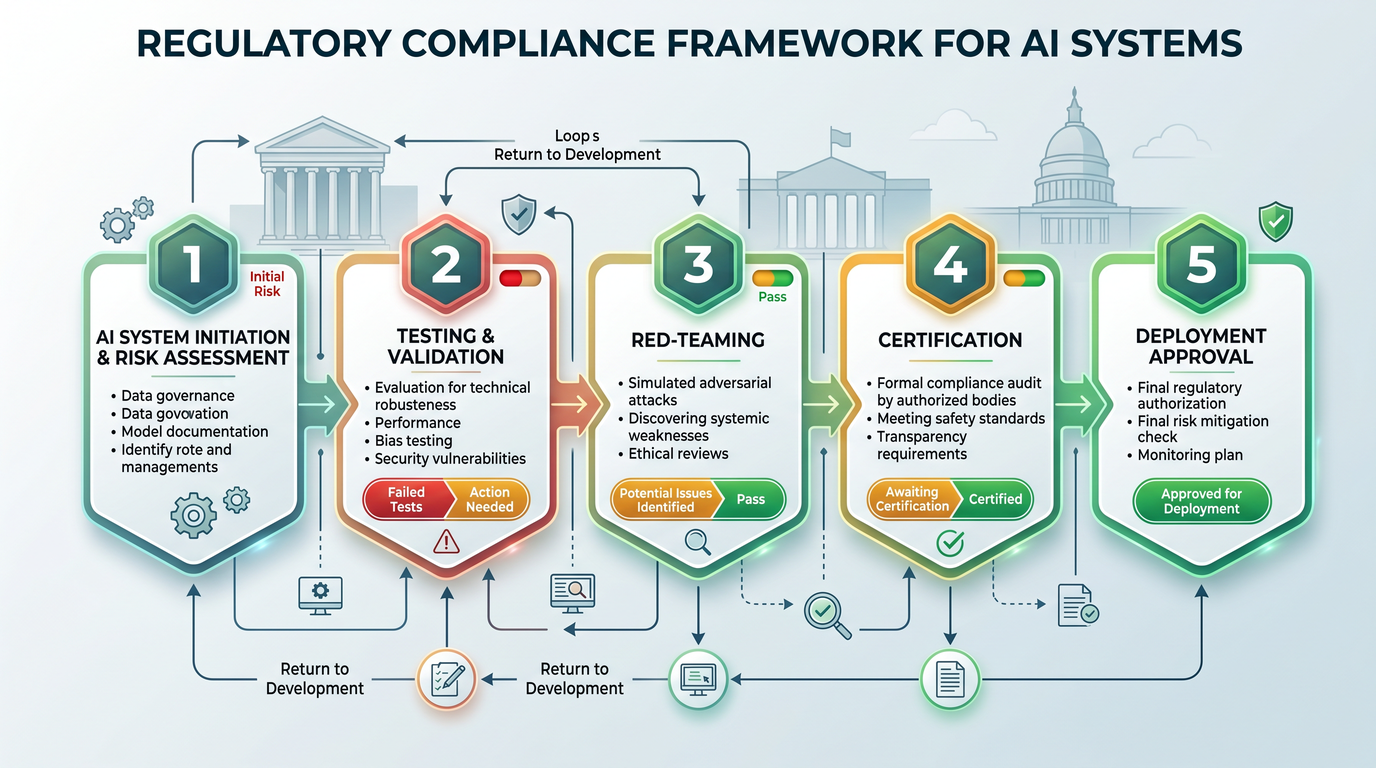
Voluntary pauses are rare in the high‑velocity AI market, where shipping features can decide category leadership. Yet with Fable 5, Anthropic opted to halt and harden. The specific concern: certain regions where export regimes and designation lists created ambiguity about permissible capability thresholds. Rather than risk inadvertent non‑compliance, Anthropic constrained exposure, effectively turning off or limiting features in sensitive jurisdictions while it re‑architected controls.
This approach stood in contrast with the industry’s historical norm of global-by-default rollouts. It signaled that frontier labs will increasingly gate by geography, use case, and identity—three axes that reflect the maturing discipline of AI risk management. It also helped set the stage for a layered compliance model in which model weights, inference routing, and telemetry policy become first‑class product surfaces.
What changed on July 1, 2026
The lifting of specific export constraints re‑opened pathways for controlled deployment of Fable 5. But the reopening did not revert the model to a late‑2025 status quo. Instead, Anthropic used the window to re‑launch with a suite of new technical and policy safeguards (detailed below). The result: Fable 5 is back, but the operational blueprint around it looks more like a regulated SaaS platform than a mere API endpoint. Expect regionally localized inference, explicit capability tiers, and verifiable provenance signals on model‑generated artifacts.
Importantly, Anthropic framed the redeployment not simply as compliance, but as a durability guarantee for developers and enterprises: by over‑investing in controls up front, it aims to reduce whiplash from future regulatory shifts. For customers integrating Fable 5 into strategic workflows, that reliability—knowing access won’t disappear overnight—may be as valuable as raw capability scores.
AI Export Controls Explained: How They Work in Practice
AI export controls sit at the intersection of national security and commercial innovation. They are legal and administrative mechanisms—implemented via statutes, regulations, and agency rules—that restrict the transfer of specific items, services, or knowledge to designated jurisdictions or entities. In the AI era, those “items” include not just chips or servers but also model weights, proprietary training data, and high‑risk capabilities reachable through APIs.
The competitive dynamics between AI safety approaches are reshaping how governments regulate the industry. OpenAI’s recent $40 billion government stake introduces a new dimension to AI governance, with the US government now having direct financial interest in responsible AI development. Our analysis examines what OpenAI’s $40 billion government stake and the US government’s 5% ownership means for AI policy and developers.
How enforcement and compliance work day‑to‑day
- Pre‑clearance: Vendors classify capabilities and map them to internal export categories, often mirroring agency lists.
- Onboarding checks: KYC/KYB screening, sanctions and denied‑party lists, and documentary evidence for end‑use.
- Runtime controls: Geofencing, IP reputation, device and hardware attestation, and feature toggles by region.
- Telemetry and audits: Immutable logs of inference requests, admin actions, and policy overrides, retained for regulators.
- Kill switches: Rapid capability suspension if a customer or region is newly restricted.
As controls mature, the line between “product features” and “compliance features” blurs. Identity, provenance, and evidence capture now sit at the heart of how next‑gen AI is built and shipped.
Inside Anthropic’s New Safeguards for Fable 5
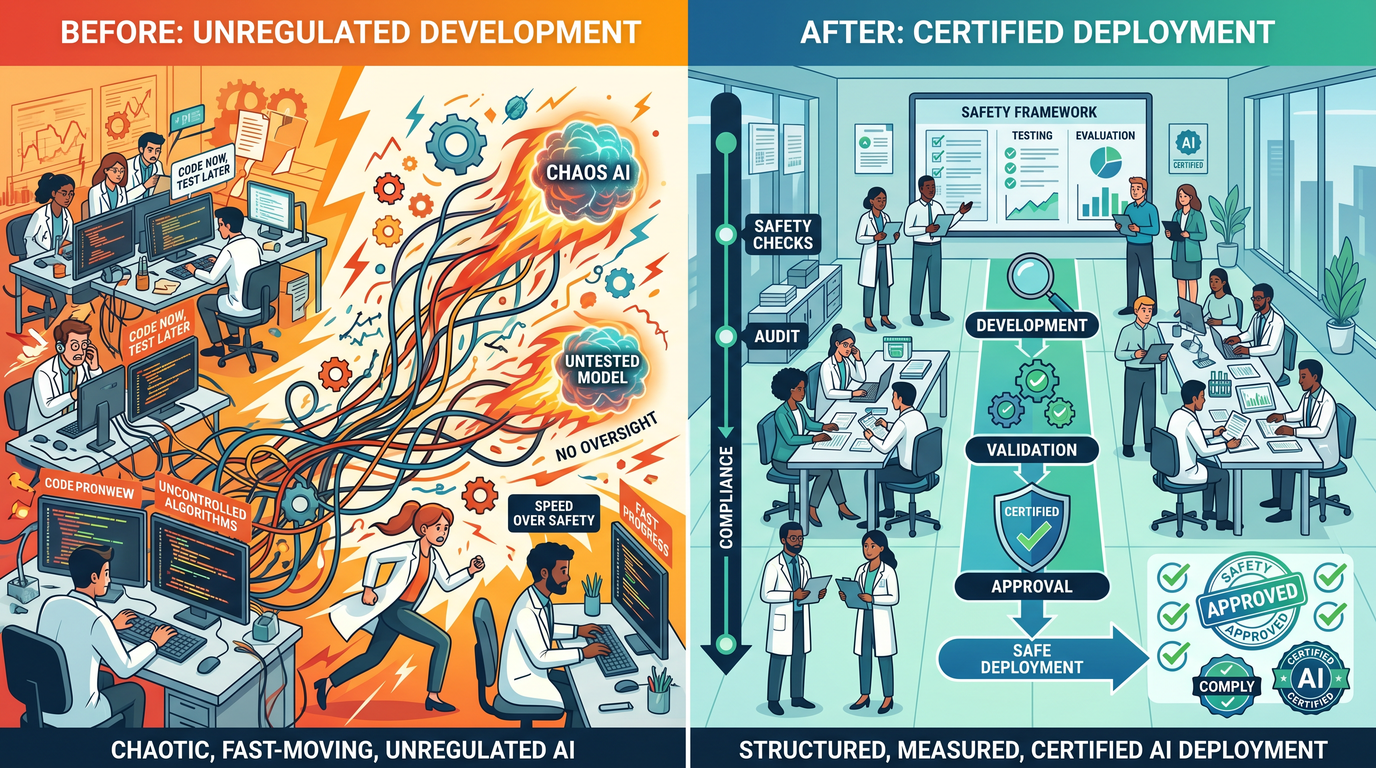
Anthropic’s Fable 5 redeployment is not just a flip of a switch—it’s a demonstration of how a frontier lab can retrofit a model with enterprise‑grade export and safety controls. Although the company has long advocated for rigorous alignment, the new release introduces a more formal compliance posture designed for cross‑border resilience. Below we synthesize the core elements developers and security teams should expect to encounter.
1) Region‑aware inference and routing
Fable 5 requests now traverse a routing fabric that evaluates the origin region, the developer’s verified entity location, and the designated data residency. Sensitive capabilities can be processed only in approved regions using trusted compute, with audible proof (e.g., hardware attestation, signed execution manifests). If a request originates from, or would serve, an embargoed jurisdiction, the router degrades capability or denies the call with a machine‑readable error code.
2) Identity, KYC/KYB, and delegated auth
Anthropic tightened onboarding to require verifiable organizational identity (KYB for companies, KYC for individuals), granular role‑based access control (RBAC), and delegated authorization for third‑party developers acting on behalf of enterprises. The goal is to ensure access maps to a legal entity that can be audited and that roles enforce least privilege. Expect tighter alignment of API keys to specific user or service accounts, not just project‑level tokens.
3) Capability tiering and interlocks
Not all Fable 5 features are equal from a regulatory standpoint. Anthropic has introduced capability tiers—low, medium, and high‑risk features—each with preconditions. For high‑risk categories (e.g., code synthesis with system access, dual‑use scientific reasoning, or agentic actions), the system employs interlocks: human‑in‑the‑loop confirmations, additional identity checks, or environment sandboxes before activation. These interlocks can be triggered by a combination of the prompt semantics, the account’s compliance posture, and the inferred end‑use.
4) Safety filters with regional profiles
Safety filters have matured from global heuristics to region‑sensitive policies. That means certain content or actions may be permitted in one jurisdiction but restricted in another, in line with law. For developers, the practical upshot is that inputs and outputs can be scored against both baseline safety rules and local risk libraries, producing standardized denial reasons and appeal paths. Anthropic exposes structured error objects so apps can react gracefully.
5) Provenance, watermarking, and attestation
To make downstream auditing viable, Fable 5 outputs carry provenance metadata—cryptographic signatures that attest to which model produced the content and under what policy envelope. For media outputs, robust watermarking flags AI generation. For code and text, signed receipts embed traceable attribution. This is less about content policing and more about giving enterprises and regulators a forensics trail that links usage to policies in force at the time.
6) Abuse response and kill switches
Rapid response is central to compliance. Anthropic has operationalized per‑region kill switches and account‑level suspensions that can be enacted quickly upon government notice or internal risk detection. The supporting machinery includes privacy‑respecting anomaly detection, clear escalation paths to customers, and a “containment” mode that limits accounts to low‑risk tiers while investigations proceed.
7) Developer‑facing transparency
Developers need visibility when their apps bump into controls. To that end, Anthropic surfaces policy reason codes, region‑specific documentation, and dashboards that reveal capability tiers, active region profiles, and upcoming policy dates. For many teams, this reduces costly guesswork and avoids silent failures in production. It also creates a new norm: product managers and compliance officers co‑own release management.
None of these measures are static. As jurisdictions revise lists and definitions, Anthropic can update policies without retraining the base model, thanks to decoupled policy layers and dynamic routing. That modularity is what makes Fable 5’s redeployment viable and maintainable under shifting national rules.
OpenAI’s Parallel Approach: Government‑Gated GPT‑5.6 Sol
While Anthropic opted for a voluntary pause and technical hardening before redeploying Fable 5, OpenAI is plowing a parallel path that formalizes state partnership at the distribution layer. With GPT‑5.6 Sol, OpenAI is piloting what it calls “government‑gated releases”—packages of model capabilities provisioned behind security boundaries jointly overseen by national or regional authorities. The idea is straightforward: instead of the vendor independently attesting to safety and export compliance, a recognized public body co‑evaluates and authorizes a defined capability tier for specific sectors or agencies, sometimes operating within dedicated compute enclaves.
Practically, this can look like a sovereign cloud or secure enclave with attested hardware, audited telemetry, and in‑region staff oversight. Civilian agencies may gain access to powerful reasoning or agentic features that are otherwise throttled on the public API. Private sector customers can then request access through these gated programs if their work is regulated or strategic, often undergoing more stringent checks.
How a gated release works
- OpenAI aligns with a government partner on risk categories and evaluation protocols.
- Authorities run red‑team assessments within an enclave, validating controls and logging standards.
- Specific capability tiers are authorized for defined user populations and use cases.
- Provisioning occurs via dedicated endpoints or private gateways, with separate SLAs, billing, and audits.
There is a philosophical and architectural distinction here. Whereas Anthropic emphasizes vendor‑led compliance with transparent controls that apply uniformly across the commercial product, OpenAI’s approach co‑locates compliance and capability calibration inside the state’s perimeter. The benefit is legitimacy and access for high‑stakes users; the trade‑off is a more complex supply chain and potentially divergent experiences across regions.
Why this matters for the ecosystem
If government‑gated releases become a template, we could see a bifurcation of the AI market: a public cloud of general‑purpose capabilities and a mosaic of sovereign enclaves where higher‑risk features live. For developers, this raises questions: Will vendors keep parity across these tracks? How do you test and ship products that straddle both? For policymakers, it offers a lever to sanction and supervise sensitive AI without bluntly banning models wholesale.
Comparing Strategies: Voluntary Pause vs. Government Partnership
Enterprise customers evaluating AI providers must now consider safety certifications alongside performance benchmarks. The GPT-5.6 Sol model represents OpenAI’s response to the safety-first approach, combining frontier capabilities with built-in guardrails. Our benchmark analysis compares GPT-5.6 Sol benchmarks and how OpenAI’s new flagship compares to GPT-5.5, Claude 4.5, and Gemini 3.1 on real-world tasks.
Developer Impact: API Access by Region and What Changes
A key question for builders is straightforward: Can I still call these models from my app, and will my users get a consistent experience? The answer now depends on where you and your users are, what you’re building, and how your account is verified. Below we outline the most common changes you’ll encounter as Fable 5 returns and GPT‑5.6 Sol’s gated tracks expand.
Onboarding and verification
- Expect stricter KYC/KYB flows. Individual developers may need government‑issued ID verification; organizations will be asked foinformation.
- End‑use declarations become standard. Simple attestations for low‑risk use; detailed review for high‑risk domains (e.g., biotech research tools, cyber tooling with system access).
- Capability requests may require justification. To unlock higher tiers, you’ll likely submit a case describing your safeguards and user base.
Region awareness in code
SDKs and REST calls will include region hints, capability flags, and policy metadata. If you deploy globally, you will need logic paths for capability fallbacks, down‑tiering, or alternate providers when a user’s region changes the rules. This increases the importance of feature flags and server‑side routing that can adapt in real time.
Latency and residency trade‑offs
In‑region inference improves compliance but can increase latency if capacity is constrained or if the closest approved region changes under new rules. Plan for dynamic latency budgeting and explicit user messaging when features are degraded. Caches, partial results, and progressive enhancement matter more in a region‑aware world.
API behavior matrix (illustrative)
| Region | Fable 5 Access | GPT‑5.6 Sol Access | KYC/KYB Level | Notable Constraints |
|---|---|---|---|---|
| United States | Full, tiered by capability | Public + gated tracks for regulated sectors | Medium–High | End‑use checks for dual‑use features; enclave for high‑risk tiers |
| European Union | Full, with EU data residency options | Public + potential sovereign enclave pilots | High for regulated industries | Stronger provenance and audit requirements; region‑specific safety filters |
| Allied Asia‑Pacific | Full or partial by country | Public; gated access varies by MOUs | Medium–High | Local moderation profiles; occasional capability down‑tiering |
| Restricted Jurisdictions | Limited or no access | Not available | Not applicable | Requests blocked or degraded; explicit error codes |
The above is a generalized depiction to help developers plan. Always consult your vendor’s current region lists and APIs for authoritative rules and availability.
Billing and SLAs
Compliance endpoints may carry different SLAs and pricing to fund enclave operations, attestation, and elevated support. Watch for separate SKUs and credits for public vs. gated use. Budgeting teams should track these as distinct cost centers.
Enterprise Implications: Compliance for Multinationals
For multinational enterprises, Fable 5’s redeployment and GPT‑5.6 Sol’s gated strategy converge on one message: AI now lives in a compliance perimeter that is as complex as payments or privacy. Security and legal teams must collaborate earlier and more deeply with product and data science to ensure business continuity. Here are the practical adjustments most organizations will need.
1) Centralize AI vendor governance
Create a vendor governance program specifically for AI capabilities. It should cover due diligence (KYC/KYB expectations, audit rights, data residency options), standardized clauses (export compliance, kill switch notifications), and inventory management (which teams use which capabilities under what licenses). Treat AI vendors like critical infrastructure providers, not just SaaS tools.
2) Map AI data flows and inference geography
Update your data maps to include inference geography—where requests are processed, where telemetry is stored, and which regions are used for failover. For every model endpoint, record the jurisdictional footprint and the applicable export rules. This becomes essential evidence if a regulator asks why a particular capability was accessible in a given location.
3) Implement role‑based capability catalogs
Not every employee needs agentic access or code execution support. Publish internal capability catalogs aligned to job roles and countries of operation, with automated provisioning and de‑provisioning. Use identity providers and policy engines to enforce these controls in real time, including in developer sandboxes and staging environments.
4) Build audit‑ready telemetry
Retain signed receipts of AI interactions that capture the model version, region, policy profile, and user identity. Ensure chain‑of‑custody for sensitive work and be able to reconstruct events for 24–36 months. Consider third‑party attestation services that co‑sign logs and detect tampering.
5) Prepare for sovereign enclaves
If you operate in regulated sectors or sell to the public sector, expect to integrate with sovereign or gated enclaves. Secure network paths, capacity planning, enrollment workflows, and incident response must be established. Build internal runbooks for switching between public and gated tracks when a project escalates from prototype to production in a sensitive context.
6) Budget for compliance operations
Compliance with export controls and gated tracks is not a one‑off project. It incurs ongoing costs: training, audits, legal reviews, attestation services, and engineering for feature flags and routing. Anchor these in your AI TCO models and present them to the board as risk‑adjusted investments.
7) Harmonize across privacy, security, and export regimes
Your privacy team cares about data minimization; your security team about access control; your legal team about export rules. Unify these in a single policy architecture for AI. Align data retention with both privacy regulations and audit needs. Build “compliance as code” to validate infra and application states continuously.
Geopolitics: The US‑China AI Competition Reframed
The Fable 5 redeployment and GPT‑5.6 Sol’s government‑gated track are not just product stories—they are artifacts of a broader geopolitical alignment where AI capability, compute, and data are instruments of national policy. The United States and its allies are refining export controls to manage strategic risk without extinguishing innovation; China is pursuing self‑reliance and alternative routes to capability growth. In between lie multinational companies, developers, and researchers trying to navigate a space where technical excellence and policy compliance are co‑determinants of success.
Compute as a policy lever
Restrictions on advanced chips and cloud compute access have elevated the importance of where training and inference occur. In practice, this is driving regional data centers with attested hardware, national cloud programs, and mutual recognition of certifications. Vendors increasingly publish “where your token ran” facts as part of their transparency dashboards.
Model capability as regulated surface
The debate has shifted from “Should models be open or closed?” to “Which capabilities should be universally accessible, which should require higher assurance, and which should be prohibited?” This reframing influences benchmark design, release notes, and even UI metaphors—capabilities are now badges and locks, not just version numbers. It also opens space for state‑industry co‑design of safety tests and red‑team protocols.
Alliances and interoperability
Expect more intergovernmental MOUs around AI assurance, and potentially, mutual access arrangements where vetted companies can operate in each other’s gated environments. Standardization bodies may formalize capability tiers, attestation formats, and watermarking schemes. If successful, this reduces friction for enterprises and provides clear thresholds for compliance across borders.
Fragmentation risks
The countervailing risk is fragmentation: a world of incompatible enclaves, divergent rules, and vendor‑specific SDKs. If left unchecked, innovation could slow and costs rise as teams support multiple backends and pass duplicative audits. The market will reward vendors and governments that pursue interoperability without compromising legitimate security aims.
The Future of AI Model Distribution
Fable 5’s redeployment and GPT‑5.6 Sol’s gated track are early signals of a distribution pattern that will likely dominate the next decade. The notion of a single, global endpoint for a frontier model may persist for low‑risk capabilities; everything else will be parceled into policy‑aware tiers and enclaves with auditable edges. Several shifts look durable.
1) Capability passports
Expect to see “capability passports” for organizations: machine‑readable attestations that indicate what tiers a company is authorized to use, in which regions, and for what end uses. These passports will integrate with vendor SDKs and cloud IAM, enabling auto‑negotiation of features and frictionless audits. Passport revocation or suspension will become the fast lane for risk mitigation.
2) Compliance‑native SDKs
SDKs will surface region selection, evidence collection, policy reason codes, and attestation verification as first‑class methods. Developers will write tests that simulate cross‑border prompts and assert expected denials. Build pipelines will include compliance checks before deploying features to new markets.
3) In‑region fine‑tuning and retrieval
Fine‑tuning and RAG stacks will increasingly operate in‑region to preserve data locality and simplify export analysis. Model providers will offer managed fine‑tuning in sovereign clouds with automatic provenance capture. Companies will weigh slightly lower capability against much higher compliance certainty.
4) Agentic systems with interlocks
As agentic capabilities grow, so too will interlocks and oversight. Actions that touch code, infrastructure, or operational technology will require graduated confirmations, audits, and sometimes human approval. In certain regions, agent actions will be disabled by default unless in a controlled environment. This will drive a market for standardized “agent control planes.”
5) Modular policy engines
Vendors will decouple base model behavior from policy engines that can be updated without retraining. Enterprises may even bring their own policy modules adhering to standard APIs, much like bring‑your‑own‑KMS models. Over time, these policy engines could become a competitive moat—how elegantly a vendor translates shifting laws into real‑time, developer‑friendly controls.
12–24 Month Scenarios: What to Watch
Optimistic scenario
Interoperable standards emerge for capability tiers, provenance, and attestation. Vendors align on baseline region profiles and reusable evidence artifacts, dramatically reducing enterprise overhead. OpenAI, Anthropic, and others offer compatible SDK hooks for compliance metadata. Developers experience fewer breaking changes; innovation rebounds under stable rules.
Baseline scenario
Mixed progress. Anthropic and OpenAI continue to iterate their distinct approaches; more regions join gated pilots. Enterprises absorb the cost of dual‑track integrations (public + gated). Developer tooling gets better but still requires conditional logic and feature flags for region and tier variability. Export lists and rules adjust periodically, but the modular control stacks make changes manageable.
Hardening scenario
Geopolitical shocks trigger tighter controls. Certain capability tiers face moratoriums in select regions; gated enclaves become the only route for advanced features in major markets. Vendor backlogs grow as licensing reviews slow releases. Developers pivot to edge‑constrained AI and classical ML for some applications, reserving frontier AI for enclaves and strategic use cases.
Developer Action Items
Preparing for a regulated AI world is largely about engineering for variability, observability, and auditability. Here’s a concrete checklist you can start today.
- Instrument region‑aware logic: Add region hints and capability negotiation to your API calls. Implement graceful degradation paths.
- Capture evidence: Store signed receipts and policy reason codes from model responses. Hash and timestamp artifacts.
- Build a capability matrix: For each feature, define required capability tier and supported regions. Automate enforcement with feature flags.
- Upgrade onboarding: Integrate with identity providers and add KYB/KYC documentation capture in your dev portal.
- Sandbox agent actions: Introduce approval gates for high‑risk agent behaviors and maintain a replayable audit trail.
- Test for denials: Write integration tests that expect policy denials and verify your app’s fallback experiences are clear.
- Plan for enclaves: Abstract your provider layer so you can switch endpoints (public vs. gated) without app rewrites.
- Document end‑use: Maintain internal records of use cases and mitigations; prepare a compliance pack for vendor reviews.
- Monitor vendor advisories: Subscribe to policy change feeds; assign an owner for rapid dependency updates.
- Budget for compliance ops: Set aside resources for audits, attestations, and engineering time for policy updates.
These measures don’t just protect you from outages—they can become a competitive advantage as customers and regulators increasingly ask “how” you use AI, not just “which” model you call.
Quick FAQ
Does Fable 5 now have global availability?
Availability is broader than during the pause, but not global by default. Access depends on region, identity verification, and capability tier. Some jurisdictions remain restricted or require additional review.
Will I need to rewrite my integration?
Probably not, but you will need to add region and capability metadata and handle structured denials. Most vendors aim to preserve core endpoints while adding policy layers and dashboards.
How is OpenAI’s gated approach different in code?
You may target separate endpoints or SDK namespaces for gated tracks, with different SLAs and telemetry requirements. Expect extra configuration for attestation, tenancy, and logging when working with sovereign enclaves.
What about self‑hosting model weights?
Some vendors may license on‑prem or private cloud deployments under strict terms. Export rules still apply, and you will shoulder more of the compliance and audit responsibility—especially for access controls and telemetry.
Can startups compete under these constraints?
Yes, with the right abstractions. Startups that design for policy variability—using provider‑agnostic SDKs, robust logging, and capability flags—can move quickly while staying compliant. This is an opportunity for new tooling and infrastructure players.
Access 40,000+ AI Prompts for ChatGPT, Claude & Codex — Free!
Subscribe to get instant access to our complete Notion Prompt Library — the largest curated collection of prompts for ChatGPT, Claude, OpenAI Codex, and other leading AI models. Optimized for real-world workflows across coding, research, content creation, and business.
Key Takeaways
- Anthropic’s Fable 5 redeployment, following the July 1, 2026 easing of specific export controls, showcases a maturing compliance stack: region‑aware routing, identity verification, capability tiering, provenance, and kill switches.
- OpenAI’s GPT‑5.6 Sol illustrates a complementary path: government‑gated releases that embed state co‑evaluation and sovereign enclaves into the distribution model.
- For developers, the future is region‑ and capability‑aware coding with clear fallbacks, structured denials, and audit‑ready telemetry.
- For enterprises, AI governance must level up: vendor programs, inference geography mapping, role‑based capability catalogs, and enclave readiness.
- Geopolitically, AI export controls are reshaping how model capabilities move across borders, driving interoperability efforts while risking fragmentation.
- The distribution substrate of AI is becoming compliance‑native. Those who build abstractions that honor policy without crushing usability will define the next wave.
Explore related topics: · ·
