
45 ChatGPT-5.5 Prompts for Technical Writers: API Documentation, SDK Guides, Release Notes, and Developer Tutorials
45 ChatGPT-5.5 Prompts for Technical Writers: API Documentation, SDK Guides, Release Notes, and Developer Tutorials

This masterclass provides 45 production-ready ChatGPT-5.5 prompts crafted specifically for technical writers and developer experience teams. Each prompt is detailed, contextualized, and accompanied by usage tips to generate high-quality API docs, SDK guides, release notes, and developer tutorials. Use these prompts as templates and adapt variables to your product specifics.
API Documentation Prompts (12)
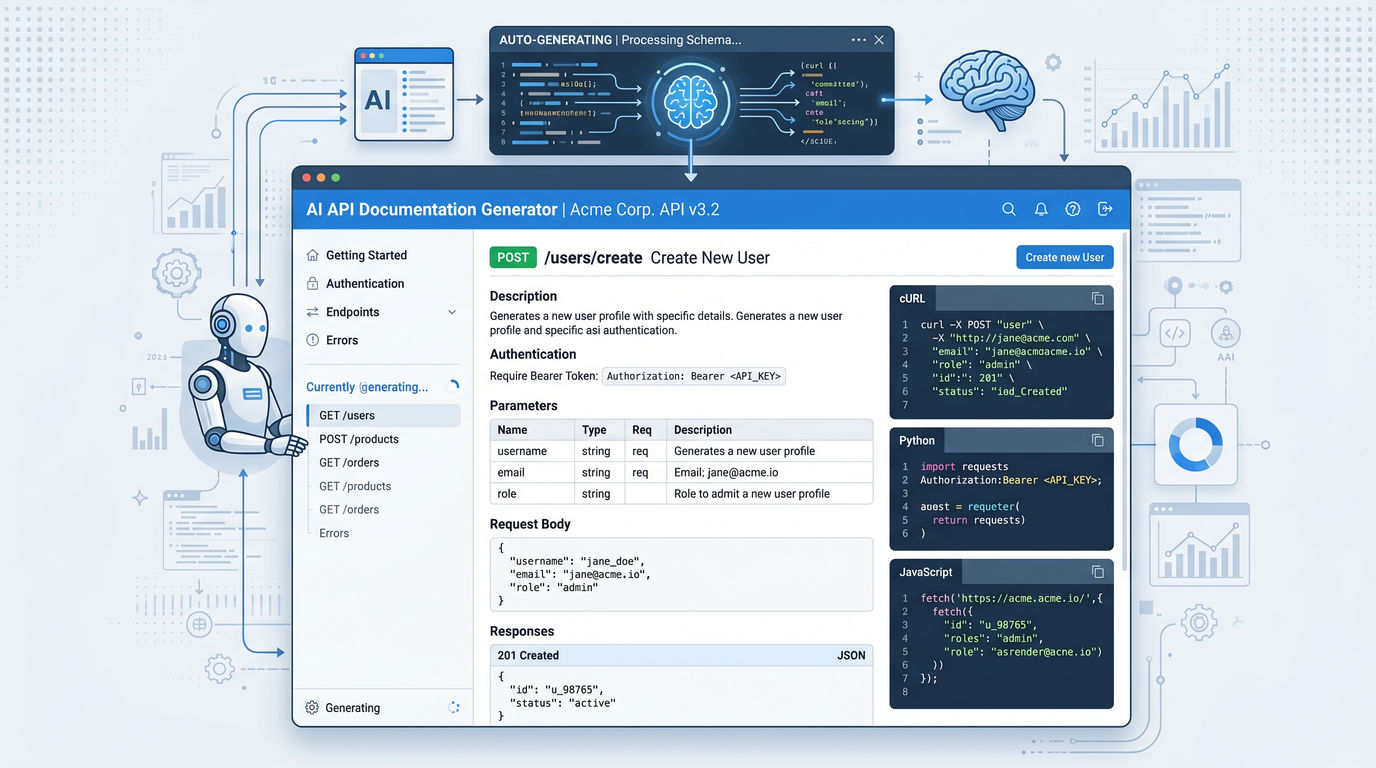
Use these prompts to create precise, machine-readable, and human-friendly API documentation: reference pages, endpoint explanations, request/response schemas, error catalogues, authentication flows, and example-driven quickstarts. Each prompt includes fields you should substitute and tips to refine outputs for publication.
Prompt 1 — Endpoint Reference Page Generator (REST)
Prompt:
You are ChatGPT-5.5, an expert technical writer. Generate a complete endpoint reference page for the REST endpoint:
- HTTP Method: GET
- Path: /v2/projects/{project_id}/builds
- Purpose: List builds for a project with optional filtering by status and tag.
- Query parameters: status (enum: pending, running, succeeded, failed), tag (string), page (int), per_page (int)
- Authentication: Bearer token via Authorization header
- Rate limits: 120 requests/minute per token

Output format:
1. Title and short summary
2. Endpoint signature (method + path)
3. Path parameter table
4. Query parameter table with default values and examples
5. Request headers example
6. Curl example request
7. 200 response schema in JSON Schema format, and a sample JSON body
8. Common error responses with codes and descriptions
9. Pagination details and example
10. Usage notes and best practices for pagination and filtering

Include brief code examples for JavaScript (fetch) and Python (requests).
Purpose: Produce a full, publication-ready endpoint reference for an API listing builds.
Context variables to substitute: {project_id}, exact schema fields, organizational naming.
Usage tips:
- Provide explicit JSON Schema types (string, integer, object, array) for response fields.
- When including examples, use realistic values for timestamps, UUIDs, and URLs.
- Adjust rate limit and auth details to match platform policy.
Access 40,000+ AI Prompts for ChatGPT, Claude & Codex — Free!
Subscribe to get instant access to our complete Notion Prompt Library — the largest curated collection of prompts for ChatGPT, Claude, OpenAI Codex, and other leading AI models. Optimized for real-world workflows across coding, research, content creation, and business.
Prompt 2 — POST Request Body and Validation Rules
Prompt:
You are ChatGPT-5.5, an advanced technical writer and API design reviewer. Produce:
- A validated JSON request body specification for a POST endpoint that creates a "dataset".
- Required properties: name (string, 3–100 chars), description (string, optional, max 1000 chars), visibility (enum: private, internal, public), schema_version (semver), data_sources (array of objects {type, uri, credentials_id}).
- Validation rules with both server-side and client-side suggestions (regex, length checks, semantic checks).
- Example invalid payloads and the corresponding error responses with HTTP status codes and JSON error body.
- Recommendations for safe defaults and idempotency (e.g., client-provided idempotency key header).

Output format:
- JSON Schema for the request body
- A short paragraph for each validation rule
- Three example valid payloads and three invalid payloads with suggested server responses
Purpose: Define request validation and produce clear error messages to reduce client troubleshooting.
Usage tips:
- Include regex for semver and URI validation when appropriate.
- Provide examples of helpful error codes (e.g., 400 Bad Request, 422 Unprocessable Entity, 409 Conflict).
- Add advice for client libraries: perform the same validations before making the API call to reduce round trips.
Access 40,000+ AI Prompts for ChatGPT, Claude & Codex — Free!
Subscribe to get instant access to our complete Notion Prompt Library — the largest curated collection of prompts for ChatGPT, Claude, OpenAI Codex, and other leading AI models. Optimized for real-world workflows across coding, research, content creation, and business.
Prompt 3 — Authentication & Authorization Flow
Prompt:
You are ChatGPT-5.5. Create a comprehensive guide for authentication and authorization for an API that supports:
- OAuth 2.0 Authorization Code Flow with PKCE for single-page apps
- Service account JWT exchange for server-to-server
- Personal access tokens (PATs) for CLI users
Include:
1. Sequence diagrams described in plain text for each flow (steps, endpoints, tokens)
2. Example HTTP requests and responses for token exchange steps
3. Security best practices, token rotation recommendations, and revocation procedures
4. Scopes and permission model mapping to API endpoints (a table mapping scope names to permitted actions)
5. Troubleshooting checklist for common auth failures (invalid_grant, invalid_client, expired_token)
Deliverables in sections labeled clearly.
Purpose: Provide a single authoritative page describing all supported authentication methods and how to use them.
Usage tips:
- Request explicit examples for both native and browser contexts to avoid ambiguity.
- Ask ChatGPT to produce an access token lifetime recommendation (e.g., short-lived access + refresh tokens) tailored to your security posture.
Access 40,000+ AI Prompts for ChatGPT, Claude & Codex — Free!
Subscribe to get instant access to our complete Notion Prompt Library — the largest curated collection of prompts for ChatGPT, Claude, OpenAI Codex, and other leading AI models. Optimized for real-world workflows across coding, research, content creation, and business.
Prompt 4 — Error Catalog & Troubleshooting Guide
Prompt:
You are ChatGPT-5.5. Generate an exhaustive error catalog for an API product with these properties:
- Error model: {code: string, message: string, http_status: int, retryable: boolean, details: object}
- Provide at least 40 unique error entries covering authentication, authorization, validation, rate limiting, quota, dependency failures, and resource conflicts.
- For each entry, include: error code, HTTP status, brief English description, possible causes, suggested remediation steps for clients, and whether the error is retryable (with recommended backoff strategy).
- Provide a machine-friendly YAML snippet for programmatic consumption that maps error codes to categories and retry policies.

Format:
- Human-readable catalog
- YAML mapping for consumption
Purpose: Equip support engineers, SDKs, and docs with a definitive error reference.
Usage tips:
- Tailor remediation steps to the client type (web, mobile, server) where useful.
- For retryable errors, specify exponential backoff windows and max retries.
Access 40,000+ AI Prompts for ChatGPT, Claude & Codex — Free!
Subscribe to get instant access to our complete Notion Prompt Library — the largest curated collection of prompts for ChatGPT, Claude, OpenAI Codex, and other leading AI models. Optimized for real-world workflows across coding, research, content creation, and business.
Prompt 5 — OpenAPI / AsyncAPI Draft from Natural Language
Prompt:
You are ChatGPT-5.5, an OpenAPI expert. Convert the following natural language description into an OpenAPI 3.1 YAML snippet focusing just on the /v2/users/{user_id}/sessions endpoint:
- Method: POST
- Purpose: Create a session for a user; returns tokens
- Request body: {device_name: string, device_type: enum(web, mobile, desktop), scopes: array[string]}
- Response 201: {session_id: uuid, access_token: string, refresh_token: string, expires_in: int}
- Possible 400 and 401 errors
- Security: bearerAuth

Produce:
1. A valid OpenAPI 3.1 YAML fragment for this endpoint, including components.schemas and securitySchemes entries necessary to validate the snippet.
2. Simple examples for the request and response bodies.
Purpose: Quickly translate product requirements into an OpenAPI fragment for review or generation tools.
Usage tips:
- Validate the generated YAML using an OpenAPI linter (e.g., Spectral) and ask ChatGPT to fix any validation errors.
- For event-driven APIs, swap to AsyncAPI syntax with a tailored prompt.
Access 40,000+ AI Prompts for ChatGPT, Claude & Codex — Free!
Subscribe to get instant access to our complete Notion Prompt Library — the largest curated collection of prompts for ChatGPT, Claude, OpenAI Codex, and other leading AI models. Optimized for real-world workflows across coding, research, content creation, and business.
Prompt 6 — Field-Level Documentation with Examples
Prompt:
You are ChatGPT-5.5. For the resource "invoice", produce field-level documentation for these properties:
- invoice_id (uuid)
- issued_at (ISO 8601 timestamp)
- due_at (ISO 8601 timestamp)
- currency (ISO 4217)
- line_items (array of objects {description, quantity, unit_price, tax_rate})
- total_amount (decimal)
For each field, provide:
1. Type and format
2. Example values
3. Validation rules and calculation guidance (e.g., how total_amount is computed)
4. Edge cases and rounding rules
5. Display formatting recommendations for UI (locale, thousand separators)
Output as a table-like plain-text structure suitable for inclusion in docs.
Purpose: Create clear, actionable field definitions so integrators compute and display monetary fields correctly.
Usage tips:
- Ask for currency-specific rounding rules and provide language for multi-currency systems (e.g., smallest unit handling).
- Request unit tests or example calculations for validation in SDKs.
Access 40,000+ AI Prompts for ChatGPT, Claude & Codex — Free!
Subscribe to get instant access to our complete Notion Prompt Library — the largest curated collection of prompts for ChatGPT, Claude, OpenAI Codex, and other leading AI models. Optimized for real-world workflows across coding, research, content creation, and business.
Prompt 7 — Rate Limiting Policy Page
Prompt:
You are ChatGPT-5.5. Draft a rate limiting policy page describing:
- Global rate limits and per-endpoint limits
- Burst behavior and leaky bucket model
- Headers returned (X-RateLimit-Limit, X-RateLimit-Remaining, X-RateLimit-Reset)
- Behavior when a client exceeds limits (HTTP 429 body example and Retry-After semantics)
- Best practices to handle retries and backoff
- Recommendations for SDKs to expose quota-awareness APIs

Structure:
- Overview
- Examples for header parsing in Python and JavaScript
- Troubleshooting scenarios and diagnostics (how to check which key hit limit)
Purpose: Help integrators write robust clients that gracefully handle quota ceilings.
Usage tips:
- Request code snippets that show parsing X-RateLimit headers and implementing exponential backoff with jitter.
- Consider including monitoring guidance (metric names to track in client telemetry).
Access 40,000+ AI Prompts for ChatGPT, Claude & Codex — Free!
Subscribe to get instant access to our complete Notion Prompt Library — the largest curated collection of prompts for ChatGPT, Claude, OpenAI Codex, and other leading AI models. Optimized for real-world workflows across coding, research, content creation, and business.
Prompt 8 — Pagination Strategies Comparison
Prompt:
You are ChatGPT-5.5. Produce a technical comparison page that contrasts pagination strategies: offset-based, cursor-based, keyset pagination, and time-based windowing. For each strategy, include:
- How it works (algorithmic description)
- Advantages and disadvantages
- Suitable use cases (e.g., immutable logs vs. mutable lists)
- Examples of request/response formats
- Migration guidance from offset to cursor for large result sets
Finish with a recommended default strategy for CRUD-style resources with justification.
Purpose: Provide product and API architects justification and guidance for choosing pagination implementations.
Usage tips:
- Include performance considerations for databases and caching layers when using keyset pagination.
- Ask for real-world examples with sample query time improvements where relevant.
Access 40,000+ AI Prompts for ChatGPT, Claude & Codex — Free!
Subscribe to get instant access to our complete Notion Prompt Library — the largest curated collection of prompts for ChatGPT, Claude, OpenAI Codex, and other leading AI models. Optimized for real-world workflows across coding, research, content creation, and business.
Prompt 9 — Webhook Delivery & Verification Guide
Prompt:
You are ChatGPT-5.5. Write a production-ready guide for handling webhooks:
- Delivery semantics (at-least-once, retry schedule)
- Signing scheme (HMAC SHA-256 with a per-subscriber secret)
- How to verify signatures with code samples (Node.js and Go)
- Idempotency recommendations (idempotency key header or event ID handling)
- Security considerations (replay protection, TLS requirements)
- Example JSON payload and recommended response codes

Include sample pseudo-diagram steps for the subscriber to validate signature and deduplicate events.
Purpose: Enable both producers and consumers to build secure and reliable webhook integrations.
Usage tips:
- Ask ChatGPT to generate subscriber SDK helper functions for signature verification.
- Recommend pragmatic TTL for delivered webhooks and a bounded retry policy.
Access 40,000+ AI Prompts for ChatGPT, Claude & Codex — Free!
Subscribe to get instant access to our complete Notion Prompt Library — the largest curated collection of prompts for ChatGPT, Claude, OpenAI Codex, and other leading AI models. Optimized for real-world workflows across coding, research, content creation, and business.
Prompt 10 — Versioning and Deprecation Policy
Prompt:
You are ChatGPT-5.5. Produce a clear API versioning and deprecation policy document that covers:
- Semantic versioning vs. URL versioning
- Backwards incompatible change classification and required notice periods
- Deprecation announcement templates for release notes and email
- Automated tooling recommendations to detect breaking changes (OpenAPI diffing)
- Migration plan template for major version upgrade including example client migration steps

Output must include sample timeline text for a deprecation notice (90 days, 180 days, etc.) and a checklist for releasing a breaking change.
Purpose: Create a reproducible deprecation workflow that reduces user disruption and support churn.
Usage tips:
- Customize the timeline to your SLA and contract rules; ChatGPT can produce alternate timelines (short, standard, extended).
- Ask for a pre-release checklist for internal stakeholders (SDK owners, docs, support).
Access 40,000+ AI Prompts for ChatGPT, Claude & Codex — Free!
Subscribe to get instant access to our complete Notion Prompt Library — the largest curated collection of prompts for ChatGPT, Claude, OpenAI Codex, and other leading AI models. Optimized for real-world workflows across coding, research, content creation, and business.
Prompt 11 — SDK Compatibility Matrix and Support Policy (API-centric)
Prompt:
You are ChatGPT-5.5. Generate a compatibility matrix and support policy page mapping API versions to supported SDK versions across languages (e.g., JavaScript, Python, Java, Go). Include:
- A matrix table (API versions x SDK versions) showing compatibility status
- Minimum runtime and platform requirements for each SDK
- Support lifecycle policies (LTS, maintenance, deprecated)
- Guidance for CI tests that ensure SDKs remain compatible with the latest API (test suites, contract testing)
Produce YAML and markdown-friendly table representation.
Purpose: Clarify supported client configurations for integrators and reduce version mismatch incidents.
Usage tips:
- Provide automated test examples such as contract tests driven by OpenAPI specs.
- Track major version compatibility separately from patch-level compatibility.
Access 40,000+ AI Prompts for ChatGPT, Claude & Codex — Free!
Subscribe to get instant access to our complete Notion Prompt Library — the largest curated collection of prompts for ChatGPT, Claude, OpenAI Codex, and other leading AI models. Optimized for real-world workflows across coding, research, content creation, and business.
Prompt 12 — Integration Checklist for New Developers
Prompt:
You are ChatGPT-5.5. Produce a step-by-step integration checklist that a new developer follows to connect to the API:
1. Create account and obtain credentials
2. Set up environment variables and secrets manager examples
3. Obtain an access token (include both CLI and SDK examples)
4. Make a smoke test call to verify connectivity (endpoint, expected response)
5. Setup webhooks or callbacks if applicable
6. Implement retry and error handling
7. Add monitoring and alerting examples (what metrics to collect)
For each step, include specific command-line examples, expected responses, and a brief troubleshooting tip.
Purpose: Provide a practical runbook to remove ambiguity during initial integration efforts.
Usage tips:
- Create a “smoke test” script that engineers can run locally and in CI; include its content in the checklist.
- Ask ChatGPT to tailor the checklist to a specific platform (cloud provider or on-prem) to produce concrete environment setup steps.
Access 40,000+ AI Prompts for ChatGPT, Claude & Codex — Free!
Subscribe to get instant access to our complete Notion Prompt Library — the largest curated collection of prompts for ChatGPT, Claude, OpenAI Codex, and other leading AI models. Optimized for real-world workflows across coding, research, content creation, and business.
SDK Guide Prompts (11)
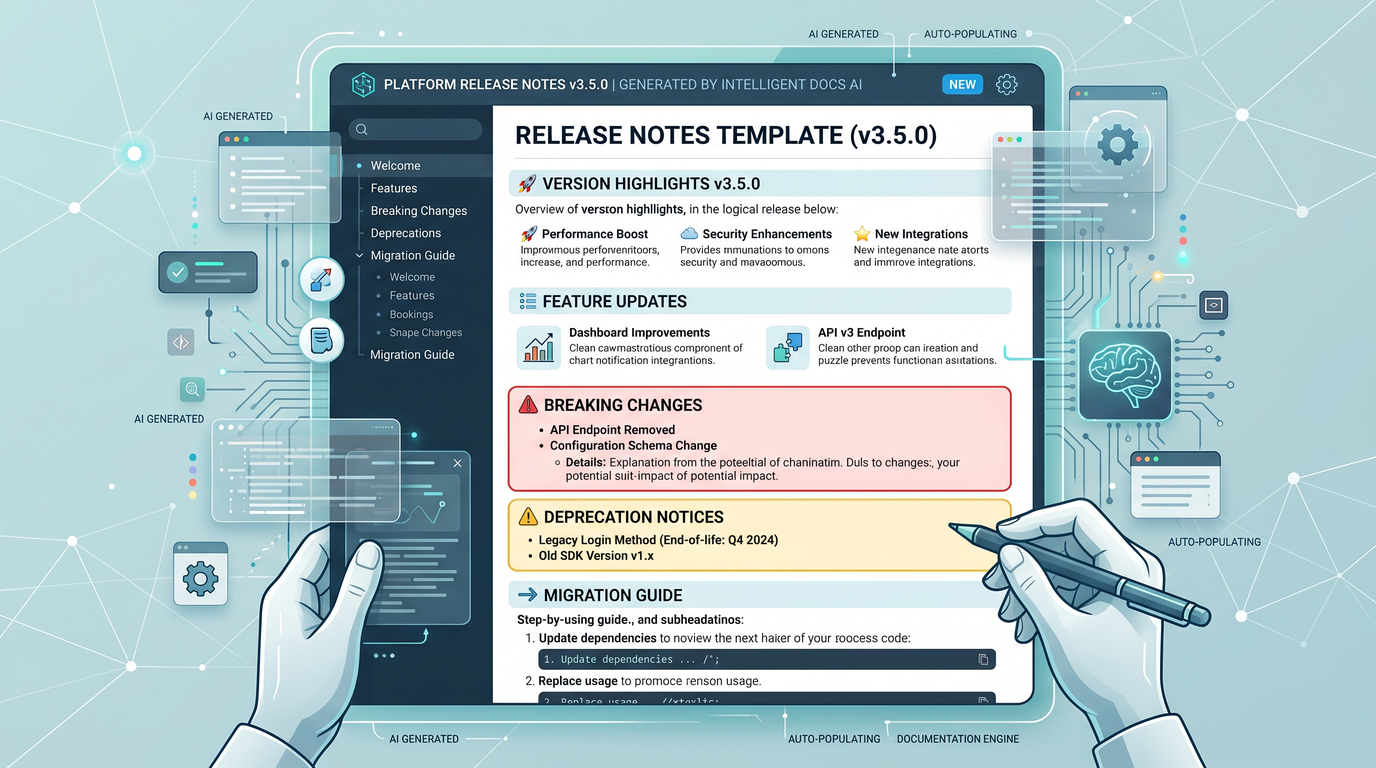
These prompts are focused on creating SDK documentation: usage guides, idiomatic examples, initialization patterns, error handling wrappers, and advanced integration patterns for different languages. Each prompt includes explicit deliverables: code samples, API reference entries, and packaging/release notes for SDK maintainers.
Prompt 13 — Getting Started Guide for JavaScript SDK
Prompt:
You are ChatGPT-5.5, an SDK documentation specialist. Write a "Getting Started" guide for a JavaScript SDK named "cloudx-sdk" that covers:
- Installation via npm and yarn
- Initialization with environment variable and explicit config options (apiKey, baseUrl, timeout)
- Example: create and list "tasks" with error handling
- Browser vs Node differences, bundling advice, and tree-shaking tips
- How to configure logging and telemetry in the SDK
Return content suitable for the top of a README.md including code blocks with inline comments.
Purpose: Produce an approachable onboarding readme for JS developers.
Usage tips:
- Request both promise-based and async/await examples.
- Ask for smaller code snippets that can be embedded in a docs site with copy-to-clipboard buttons.
Access 40,000+ AI Prompts for ChatGPT, Claude & Codex — Free!
Subscribe to get instant access to our complete Notion Prompt Library — the largest curated collection of prompts for ChatGPT, Claude, OpenAI Codex, and other leading AI models. Optimized for real-world workflows across coding, research, content creation, and business.
Prompt 14 — Idiomatic Python SDK Patterns
Prompt:
You are ChatGPT-5.5, focused on Python API ergonomics. Create a style and usage guide for a Python SDK that includes:
- Context manager pattern (with client as ctx)
- Synchronous and asynchronous examples (requests vs aiohttp style)
- Retry and backoff wrappers using urllib3 Retry or tenacity examples
- Best practices for typing with typing.TypedDict and dataclasses
- How to surface pagination in iterator/generator form
Produce code examples that can be copy-pasted to docs.
Purpose: Help Python SDK maintainers provide idiomatic interfaces that match Python developer expectations.
Usage tips:
- Encourage adding mypy and pydantic usage examples when the organization uses type enforcement.
- Provide guidance for exposing low-level HTTP APIs for advanced users and high-level convenience methods for common tasks.
Access 40,000+ AI Prompts for ChatGPT, Claude & Codex — Free!
Subscribe to get instant access to our complete Notion Prompt Library — the largest curated collection of prompts for ChatGPT, Claude, OpenAI Codex, and other leading AI models. Optimized for real-world workflows across coding, research, content creation, and business.
Prompt 15 — Creating a Multi-language Code Sample Matrix
Prompt:
You are ChatGPT-5.5. Generate a matrix of identical examples for these languages: JavaScript, Python, Java, Go, and C#. Each example should demonstrate:
- Instantiating the SDK client
- Authenticating with an API key
- Creating a resource "widget" with fields {name, config}
- Handling a 4xx error and printing the message
Format output as separate labeled codeblocks for each language and include brief notes on package names and install commands.
Purpose: Ensure consistent developer experience across language docs and reduce divergence between examples.
Usage tips:
- Ask for both synchronous and asynchronous patterns when the language supports them (JS, Python).
- Request verbose comments that explain SDK internals for maintainers.
Access 40,000+ AI Prompts for ChatGPT, Claude & Codex — Free!
Subscribe to get instant access to our complete Notion Prompt Library — the largest curated collection of prompts for ChatGPT, Claude, OpenAI Codex, and other leading AI models. Optimized for real-world workflows across coding, research, content creation, and business.
Prompt 16 — Initialization and Configuration API Reference
Prompt:
You are ChatGPT-5.5. Produce a reference spec for the SDK configuration object with these fields:
- apiKey (string, required)
- baseUrl (string, optional, default)
- timeoutMs (int, default 30000)
- retryPolicy (object: {maxRetries, initialBackoffMs, maxBackoffMs, jitter})
- logger (interface example)
For each field, provide explanation, default values, example code to construct the config, and validation guidance. Provide a TypeScript interface and a Python TypedDict equivalent.
Purpose: Standardize configuration across SDKs and provide language-specific type hints for integrators.
Usage tips:
- Include examples of overriding defaults for high-latency environments and for serverless contexts with short runtimes.
- Offer guidance about picking reasonable default retry settings to avoid thundering herds.
Access 40,000+ AI Prompts for ChatGPT, Claude & Codex — Free!
Subscribe to get instant access to our complete Notion Prompt Library — the largest curated collection of prompts for ChatGPT, Claude, OpenAI Codex, and other leading AI models. Optimized for real-world workflows across coding, research, content creation, and business.
Prompt 17 — Error Handling Wrappers for SDKs
Prompt:
You are ChatGPT-5.5. Create a guide and code examples for implementing a centralized error handling layer in an SDK:
- Map HTTP errors to typed exceptions (e.g., AuthenticationError, RateLimitError, ValidationError)
- Include stack traces and safe logging strategies (redaction of sensitive fields)
- Provide a sample middleware or interceptor implementation for JavaScript (Axios interceptor or fetch wrapper) and for Java (OkHttp Interceptor)
- Document the public error API for SDK consumers (what exceptions to catch and how to inspect metadata fields like request_id and retry_after)
Purpose: Encourage predictable error models across SDKs making it easier for client apps to respond programmatically.
Usage tips:
- Ensure error classes expose structured fields like status_code and body to enable automated handling in apps.
- Document how to log errors without exposing secrets (mask tokens and credentials).
Access 40,000+ AI Prompts for ChatGPT, Claude & Codex — Free!
Subscribe to get instant access to our complete Notion Prompt Library — the largest curated collection of prompts for ChatGPT, Claude, OpenAI Codex, and other leading AI models. Optimized for real-world workflows across coding, research, content creation, and business.
Prompt 18 — Packaging and Release Notes Template for SDK Maintainers
Prompt:
You are ChatGPT-5.5. Provide a packaging and release checklist for SDK maintainers including:
- Versioning scheme and changelog generation (conventional commits)
- CI steps to run tests, linters, and publish artifacts (npm, PyPI, Maven)
- A template release notes document that includes breaking changes, migration steps, and examples of code changes for deprecations
- Post-release tasks (update compatibility matrix and API docs)
Return the release notes template and a checklist formatted as ordered steps.
Purpose: Streamline SDK releases and ensure consistent communication about changes and migrations.
Usage tips:
- Integrate the changelog generation with automated tools like semantic-release or release-drafter.
- Include sample CI job YAML for GitHub Actions to demonstrate a reproducible pipeline.
Access 40,000+ AI Prompts for ChatGPT, Claude & Codex — Free!
Subscribe to get instant access to our complete Notion Prompt Library — the largest curated collection of prompts for ChatGPT, Claude, OpenAI Codex, and other leading AI models. Optimized for real-world workflows across coding, research, content creation, and business.
Prompt 19 — Advanced Configuration Patterns: Connection Pools and Timeouts
Prompt:
You are ChatGPT-5.5. Create a guide for advanced SDK configuration focusing on:
- HTTP connection pool sizing and keep-alive settings
- Timeouts segmentation (connection timeout, read timeout, overall operation timeout)
- Config examples for Node.js HTTP Agent, Python requests.Session, and Java's HttpClient
- How these settings affect server resource usage and cold-starts in serverless environments

Deliver configuration snippets and performance tradeoffs for each runtime.
Purpose: Help backend developers tune SDKs for performance and resource efficiency.
Usage tips:
- Provide recommended defaults and knobs to expose for high-throughput clients.
- Explain how connection pooling impacts DNS changes and long-lived connections.
Access 40,000+ AI Prompts for ChatGPT, Claude & Codex — Free!
Subscribe to get instant access to our complete Notion Prompt Library — the largest curated collection of prompts for ChatGPT, Claude, OpenAI Codex, and other leading AI models. Optimized for real-world workflows across coding, research, content creation, and business.
Prompt 20 — Observability and Telemetry Integration
Prompt:
You are ChatGPT-5.5. Draft documentation on how the SDK integrates with observability systems:
- Which telemetry fields the SDK emits (request_id, latency_ms, status_code)
- Example instrumentation code for OpenTelemetry for JS and Python
- How to correlate SDK traces with backend traces using traceparent or custom headers
- A sample dashboard and alert rules (error rate threshold, p50/p95 latency thresholds)

Output a step-by-step integration guide and sample Grafana/Prometheus queries.
Purpose: Make it easy for customers to surface SDK behavior and troubleshoot production issues.
Usage tips:
- Include sample OTLP exporter configuration for common cloud providers.
- Document privacy considerations for telemetry (PII avoidance).
Access 40,000+ AI Prompts for ChatGPT, Claude & Codex — Free!
Subscribe to get instant access to our complete Notion Prompt Library — the largest curated collection of prompts for ChatGPT, Claude, OpenAI Codex, and other leading AI models. Optimized for real-world workflows across coding, research, content creation, and business.
Prompt 21 — Security Hardening Checklist for SDKs
Prompt:
You are ChatGPT-5.5. Assemble a security hardening checklist tailored to SDK libraries:
- Secret handling (avoid logging secrets, support secret providers)
- TLS enforcement and certificate pinning options
- Dependency audit process and suggested tooling
- Techniques to avoid SSRF/XXE when SDK accepts URL inputs
- Guidance for signing requests and HMAC generation

Include sample code for safe secret redaction and a recommended dependency update cadence.
Purpose: Ensure SDKs do not introduce security vulnerabilities into client applications.
Usage tips:
- Link to secure coding standards in your organization via For a deeper exploration of this topic, our comprehensive guide on Codex Record and Replay: How OpenAI’s Screen Recording Feature Turns Workflows Into Reusable AI Automation Skills provides detailed strategies and implementation frameworks that complement the approaches discussed in this section. to provide cross-references.
- Ask for a minimal runtime audit checklist for maintainers to run before each release.
Access 40,000+ AI Prompts for ChatGPT, Claude & Codex — Free!
Subscribe to get instant access to our complete Notion Prompt Library — the largest curated collection of prompts for ChatGPT, Claude, OpenAI Codex, and other leading AI models. Optimized for real-world workflows across coding, research, content creation, and business.
Prompt 22 — Testing Strategy: Unit, Integration, Contract Tests
Prompt:
You are ChatGPT-5.5. Produce a comprehensive testing strategy for SDKs:
- Unit-testable components and mocking strategies
- Integration tests against a staging API (setup steps, test fixtures)
- Contract testing approach using OpenAPI specs and tools like Pact or Dredd
- CI matrix suggestions to run tests across multiple runtime versions and OSes
- Examples of flaky test mitigation and test data management

Produce test examples and a recommended CI workflow for GitHub Actions with caching and parallelization.
Purpose: Provide maintainers a blueprint to keep SDK quality high and cross-platform compatibility consistent.
Usage tips:
- Include idempotent fixture patterns and ephemeral resource cleanup strategies.
- Consider using service virtualization for costly external integrations.
Access 40,000+ AI Prompts for ChatGPT, Claude & Codex — Free!
Subscribe to get instant access to our complete Notion Prompt Library — the largest curated collection of prompts for ChatGPT, Claude, OpenAI Codex, and other leading AI models. Optimized for real-world workflows across coding, research, content creation, and business.
Prompt 23 — Developer Experience (DX) Playbook for SDKs
Prompt:
You are ChatGPT-5.5. Create a DX playbook for SDK teams covering:
- Onboarding docs flow (quickstart, recipes, API reference)
- How to collect and prioritize developer feedback (issue templates, telemetry)
- Sample in-README snippets that demonstrate single-file "hello world" usage
- Creating and maintaining samples repo with runnable examples
- Accessibility and internationalization considerations for docs

Include a sample feedback triage process and README templates for sample projects.
Purpose: Help SDK teams build delightful, low-friction experiences for developers.
Usage tips:
- Recommend measurable DX goals such as “time to first successful API call” and how to track them.
- Include an example template for capturing reproduction steps in GitHub issues.
Access 40,000+ AI Prompts for ChatGPT, Claude & Codex — Free!
Subscribe to get instant access to our complete Notion Prompt Library — the largest curated collection of prompts for ChatGPT, Claude, OpenAI Codex, and other leading AI models. Optimized for real-world workflows across coding, research, content creation, and business.
Release Notes Prompts (11)
These prompts enable technical writers and release managers to generate clear, actionable release notes: summaries, breaking changes, migration guidance, per-component changelogs, and targeted communication artifacts for different audiences (developers, managers, support).
Prompt 24 — Draft Release Notes for a Platform Patch
Prompt:
You are ChatGPT-5.5. Draft release notes for version 2.3.1 (patch) of a platform with:
- Bug fixes: fixed pagination bug on /users endpoint, corrected timestamp timezone handling in export jobs
- Non-breaking improvements: improved error messages for auth failures, faster asset upload throughput
- Internal changes: upgraded dependency X to Y (security fix)
Structure:
1. Summary for developers (bullet list)
2. "What’s Changed" section with categorized entries (Bug Fixes, Improvements, Security)
3. Upgrade instructions (none required) and verification steps
4. Short email blurb for the developer mailing list and a Slack-ready message for ops

Keep language concise and include sample commands to verify the patch.
Purpose: Produce a succinct release note that communicates risk and remediation steps for a minor patch.
Usage tips:
- Ask ChatGPT to produce alternative wordings for customer-facing vs internal release posts.
- Always include verification steps to empower SREs to validate the deployment.
Access 40,000+ AI Prompts for ChatGPT, Claude & Codex — Free!
Subscribe to get instant access to our complete Notion Prompt Library — the largest curated collection of prompts for ChatGPT, Claude, OpenAI Codex, and other leading AI models. Optimized for real-world workflows across coding, research, content creation, and business.
Prompt 25 — Major Release Notes with Migration Guide
Prompt:
You are ChatGPT-5.5. Create release notes for version 3.0.0 of an API platform introducing breaking changes:
- Deprecation: remove support for legacy 'v1' header authentication; replace with bearer tokens
- Behavioral changes: default sort order changed for /items to last_modified desc
- New features: batch import endpoint /v3/import with streaming support
Deliverables:
1. Executive summary highlighting risk and recommended upgrade window
2. Detailed "Breaking Changes" section with code migration examples (before and after)
3. Upgrade steps with CLI or SDK commands where applicable
4. Rollback plan and compatibility tips for hybrid environments

Make the migration instructions prescriptive and include sanity-check commands.
Purpose: Give users a clear path to upgrade and minimize disruption due to breaking changes.
Usage tips:
- Include a compatibility shim example if your platform provides one, to ease migration.
- Provide timing recommendations and automation snippets to apply changes in CI pipelines.
Access 40,000+ AI Prompts for ChatGPT, Claude & Codex — Free!
Subscribe to get instant access to our complete Notion Prompt Library — the largest curated collection of prompts for ChatGPT, Claude, OpenAI Codex, and other leading AI models. Optimized for real-world workflows across coding, research, content creation, and business.
Prompt 26 — Component-Level Changelog Extraction
Prompt:
You are ChatGPT-5.5. Given a git commit list (include commit messages, PR numbers, and author names), synthesize a component-level changelog where commits are grouped by component (api, sdk-js, sdk-python, ui, infra). For each group, output:
- High-level summary sentence
- Bullet list of notable changes with links to PRs formatted for markdown
- Suggested audience label (Developer, Admin, End-user)
If a commit is a security fix, mark it with [SECURITY] and advise immediate upgrade.
Purpose: Automate transforming raw git change history into curated changelog sections for release notes.
Usage tips:
- Pass the actual commit list to ChatGPT in the prompt; ask it to ignore trivial commits (typos, formatting) unless flagged.
- Use conventional commits or commit tagging to improve automated grouping accuracy.
Access 40,000+ AI Prompts for ChatGPT, Claude & Codex — Free!
Subscribe to get instant access to our complete Notion Prompt Library — the largest curated collection of prompts for ChatGPT, Claude, OpenAI Codex, and other leading AI models. Optimized for real-world workflows across coding, research, content creation, and business.
Prompt 27 — Customer-Focused Release Announcement
Prompt:
You are ChatGPT-5.5. Write a customer-facing release announcement for a new feature "Real-time Analytics" that includes:
- Short headline and 2-sentence elevator pitch
- Three key benefits with one-line descriptions each
- Simple "How to get started" steps (enable feature in dashboard or call API)
- Known limitations and recommended workarounds
- A short "If you need help" section with links to support and docs

Produce polished marketing-friendly language suitable for a product update blog.
Purpose: Communicate value to customers while setting correct expectations about limitations.
Usage tips:
- Request multiple tone options (formal, friendly, technical) to match different channels.
- Include an anchor to a technical deep dive in the docs via For a deeper exploration of this topic, our comprehensive guide on Codex Record and Replay: How OpenAI’s Screen Recording Feature Turns Workflows Into Reusable AI Automation Skills provides detailed strategies and implementation frameworks that complement the approaches discussed in this section. for readers that need implementation details.
Access 40,000+ AI Prompts for ChatGPT, Claude & Codex — Free!
Subscribe to get instant access to our complete Notion Prompt Library — the largest curated collection of prompts for ChatGPT, Claude, OpenAI Codex, and other leading AI models. Optimized for real-world workflows across coding, research, content creation, and business.
Prompt 28 — Security Advisory Draft
Prompt:
You are ChatGPT-5.5. Draft a security advisory for a vulnerability identified in a third-party dependency leading to privilege escalation risk. Include:
- CVE-equivalent summary and severity rating (e.g., CVSS)
- Affected versions and quick detection steps (log grep, API calls)
- Mitigation steps and recommended upgrades with exact package versions
- Disclosure timeline template and contact details for incident response
- Sample security bulletin text for publication

Ensure language is factual, non-alarming, and provides a clear remediation path.
Purpose: Provide a concise, responsible disclosure notice for engineers and customers.
Usage tips:
- Coordinate with your security team to include classification and embargo details before publishing.
- Keep advisory action items prescriptive—include exact commands to update dependencies.
Access 40,000+ AI Prompts for ChatGPT, Claude & Codex — Free!
Subscribe to get instant access to our complete Notion Prompt Library — the largest curated collection of prompts for ChatGPT, Claude, OpenAI Codex, and other leading AI models. Optimized for real-world workflows across coding, research, content creation, and business.
Prompt 29 — Internal Release Brief for SRE and Support
Prompt:
You are ChatGPT-5.5. Produce an internal release brief for SRE and support teams with:
- High-level summary of new features and potential impact areas
- List of endpoints and components with significant changes and suggested runbook updates
- Known issues and anticipated support tickets with triage suggestions
- Observability items to add to dashboards and alerts to adjust
- Post-release monitoring checklist for the first 72 hours

Format as an internal playbook with explicit action items and owners.
Purpose: Ensure cross-functional readiness and rapid response to post-release incidents.
Usage tips:
- Assign owners for each checklist item and include Slack channel or pager references.
- Embed verification commands and sample logs to help on-call quickly validate system health.
Access 40,000+ AI Prompts for ChatGPT, Claude & Codex — Free!
Subscribe to get instant access to our complete Notion Prompt Library — the largest curated collection of prompts for ChatGPT, Claude, OpenAI Codex, and other leading AI models. Optimized for real-world workflows across coding, research, content creation, and business.
Prompt 30 — Patch Notes for Hotfix Release
Prompt:
You are ChatGPT-5.5. Write concise hotfix notes for an emergency release that reverted a problematic migration. Include:
- Problem description and impact window
- What was rolled back and why
- Immediate mitigations applied
- Verification steps to confirm rollback success
- Communication to customers and internal stakeholders

Keep the text short and appropriately apologetic but factual.
Purpose: Communicate emergency fixes quickly while documenting cause and remediation.
Usage tips:
- Include timestamps and the release identifier to correlate with deployment logs.
- Provide short commands that SREs can run to validate that services are back to expected state.
Access 40,000+ AI Prompts for ChatGPT, Claude & Codex — Free!
Subscribe to get instant access to our complete Notion Prompt Library — the largest curated collection of prompts for ChatGPT, Claude, OpenAI Codex, and other leading AI models. Optimized for real-world workflows across coding, research, content creation, and business.
Prompt 31 — API Deprecation Announcement with Alternatives
Prompt:
You are ChatGPT-5.5. Draft a deprecation announcement for an API endpoint /v1/send_email that will be removed in 6 months. Include:
- Reason for deprecation
- Migration path to /v2/notifications with example requests (before and after)
- Tools to help migration (compatibility shim, SDK updates)
- Repercussions if not migrated and timeline with explicit dates

Include a migration checklist and sample scripts to automate the transition.
Purpose: Minimize friction and confusion during planned removals by providing clear alternatives and timelines.
Usage tips:
- Attach a small code sample repository to the announcement to reduce time-to-migrate for customers.
- Offer a contact window for migration assistance and policy for extended support on a case-by-case basis.
Access 40,000+ AI Prompts for ChatGPT, Claude & Codex — Free!
Subscribe to get instant access to our complete Notion Prompt Library — the largest curated collection of prompts for ChatGPT, Claude, OpenAI Codex, and other leading AI models. Optimized for real-world workflows across coding, research, content creation, and business.
Prompt 32 — Release Notes with Backward-Incompatible Behavior Detection
Prompt:
You are ChatGPT-5.5. Generate release notes for a release that includes minor behavioral changes that could be backward-incompatible (e.g., default timeout reduced from 30s to 10s). The notes should:
- Call out the behavioral change in a "Potential Breaking Changes" section
- Provide examples of tests and monitoring checks to detect regressions in customer integrations
- Prescribe configuration flags or environment variables to temporarily restore legacy behavior
- Include a risk assessment summary (low/medium/high) and mitigation timeline

Deliver a clear remediation path for customers affected by the change.
Purpose: Transparently inform customers about subtle changes that might affect their systems.
Usage tips:
- Consider including a snippet demonstrating how to set the legacy timeout via environment variable for immediate rollback.
- Recommend automatic detection scripts customers can run to detect timeouts in their test suites.
Access 40,000+ AI Prompts for ChatGPT, Claude & Codex — Free!
Subscribe to get instant access to our complete Notion Prompt Library — the largest curated collection of prompts for ChatGPT, Claude, OpenAI Codex, and other leading AI models. Optimized for real-world workflows across coding, research, content creation, and business.
Prompt 33 — End-of-Life (EOL) Announcement Template
Prompt:
You are ChatGPT-5.5. Produce an EOL announcement template for a product component scheduled to be retired. Include:
- EOL date and sunsetting schedule
- Impact scope and recommended alternatives
- Steps for customers to export their data or migrate
- Legal and contractual notes if applicable
- Contact path for migration assistance and SLA changes

Format as a formal notice suitable for public posting and for account managers to send to key customers.
Purpose: Provide a legally and operationally clear EOL communication to protect customers and vendors.
Usage tips:
- Coordinate EOL messaging with legal and account teams to ensure compliance with contractual commitments.
- Provide migration tooling links and a timeline to avoid last-minute escalations.
Access 40,000+ AI Prompts for ChatGPT, Claude & Codex — Free!
Subscribe to get instant access to our complete Notion Prompt Library — the largest curated collection of prompts for ChatGPT, Claude, OpenAI Codex, and other leading AI models. Optimized for real-world workflows across coding, research, content creation, and business.
Prompt 34 — Release Communications Matrix
Prompt:
You are ChatGPT-5.5. Create a communications matrix for a release covering channels (docs, blog, email, in-app notification, support portal), target audiences (developers, admins, executives), message variants, and timing. For each channel produce:
- Message headline
- 2–3 sentence body
- Call to action
- Preferred send time (relative to release)
Include a short checklist to ensure alignment across channels before publishing.
Purpose: Coordinate multi-channel release communications with consistent messaging and timing.
Usage tips:
- Use the matrix to schedule communications in your marketing automation and product notification tools.
- Include A/B testing suggestions for subject lines and headlines where appropriate.
Access 40,000+ AI Prompts for ChatGPT, Claude & Codex — Free!
Subscribe to get instant access to our complete Notion Prompt Library — the largest curated collection of prompts for ChatGPT, Claude, OpenAI Codex, and other leading AI models. Optimized for real-world workflows across coding, research, content creation, and business.
Developer Tutorial Prompts (11)
This set focuses on multi-part tutorials: guided walkthroughs, end-to-end integrations, performance tuning guides, and troubleshooting labs. Each prompt asks ChatGPT-5.5 to produce a structured tutorial with prerequisites, step-by-step code, tests, and expected outputs to enable hands-on learning.
Prompt 35 — End-to-End Integration Tutorial (Web App + API)
Prompt:
You are ChatGPT-5.5. Create a comprehensive end-to-end tutorial titled "Build a Task Manager Web App with CloudX API" that includes:
- Objective and prerequisites (accounts, API keys, runtime)
- Architecture diagram described in plain text (frontend SPA, backend proxy, API)
- Step-by-step guide: create tasks via API, display task list with polling/websockets, update and delete tasks
- Full code for both backend (Node.js/Express) and frontend (React) files minimal but runnable
- Tests: simple integration tests using Jest or Mocha and a smoke test checklist
- Expected outputs at each step and debugging tips

Make the tutorial modular so readers can skip to segments (authentication, CRUD, real-time updates).
Purpose: Provide a reproducible hands-on example that developers can clone, run, and expand.
Usage tips:
- Include a link to a starter repo scaffold and instructions for running locally and in a container.
- Ask ChatGPT for smaller diffs if the initial code snippets are too long to embed directly in docs.
Access 40,000+ AI Prompts for ChatGPT, Claude & Codex — Free!
Subscribe to get instant access to our complete Notion Prompt Library — the largest curated collection of prompts for ChatGPT, Claude, OpenAI Codex, and other leading AI models. Optimized for real-world workflows across coding, research, content creation, and business.
Prompt 36 — Performance Optimization Lab
Prompt:
You are ChatGPT-5.5. Author a tutorial titled "Optimize Bulk Data Uploads to Cloud Storage API" that covers:
- Problem statement and measurable objective (e.g., reduce upload time by 50% on 10GB dataset)
- Strategies: parallel uploads, multipart upload, adaptive chunk sizing, client-side compression
- Code examples for Python and Java demonstrating each optimization step
- Benchmarking harness: how to measure throughput and latency before and after
- Expected improvements and bottleneck diagnostics

Include sample scripts to run benchmarks and commands to collect system metrics during tests.
Purpose: Teach developers practical optimization techniques with reproducible metrics.
Usage tips:
- Recommend realistic sample datasets and provide an automation script to generate test files.
- Advise on limits to parallelism based on API rate limits and network bandwidth.
Access 40,000+ AI Prompts for ChatGPT, Claude & Codex — Free!
Subscribe to get instant access to our complete Notion Prompt Library — the largest curated collection of prompts for ChatGPT, Claude, OpenAI Codex, and other leading AI models. Optimized for real-world workflows across coding, research, content creation, and business.
Prompt 37 — Interactive Debugging Workshop
Prompt:
You are ChatGPT-5.5. Produce an interactive debugging workshop titled "Diagnose and Fix 500 Errors in the API Pipeline". Include:
- Setup instructions to reproduce a controlled failure in a local environment
- Guided steps to use logs, request tracing, and metrics to locate the root cause
- Patches for the issue (code diffs) and tests to validate the fix
- A postmortem template for documenting the incident and lessons learned
- Trainer notes and expected time-to-complete for a 60–90 minute workshop

Make steps clear for participants to follow in a workshop setting.
Purpose: Teach incident diagnosis skills and promote postmortem culture by giving a hands-on lab.
Usage tips:
- Provide multiple failure scenarios with increasing complexity to train different skill levels.
- Include remediation scripts to restore environments between runs.
Access 40,000+ AI Prompts for ChatGPT, Claude & Codex — Free!
Subscribe to get instant access to our complete Notion Prompt Library — the largest curated collection of prompts for ChatGPT, Claude, OpenAI Codex, and other leading AI models. Optimized for real-world workflows across coding, research, content creation, and business.
Prompt 38 — Migrating From Legacy API Tutorial
Prompt:
You are ChatGPT-5.5. Write a practical migration tutorial "Migrate from Legacy v1 API to v2" that includes:
- Migration checklist and impact analysis
- Mapping table of old endpoints and parameters to new endpoints
- Code diffs for a sample Node.js app to switch clients
- Tests to assert parity (integration tests that compare responses from v1 and v2)
- Rollout strategy for staged migration (feature flags, traffic split)

Provide CLI scripts and verification queries for each migration stage.
Purpose: Reduce migration friction by delivering prescriptive change recipes and verification steps.
Usage tips:
- Offer both big-bang and incremental migration approaches and weigh pros/cons for each.
- Include fallback patterns so clients can revert quickly if a post-migration issue arises.
Access 40,000+ AI Prompts for ChatGPT, Claude & Codex — Free!
Subscribe to get instant access to our complete Notion Prompt Library — the largest curated collection of prompts for ChatGPT, Claude, OpenAI Codex, and other leading AI models. Optimized for real-world workflows across coding, research, content creation, and business.
Prompt 39 — Authentication Implementation Tutorial
Prompt:
You are ChatGPT-5.5. Create a tutorial "Implement OAuth 2.0 Authorization Code Flow with PKCE for SPA" that contains:
- Step-by-step setup for the OAuth client in the identity provider console
- PKCE generation and storage guidance (code challenge and verifier)
- Frontend example in React showing the redirect flow and token exchange via a backend proxy
- Token refresh strategy and secure storage recommendations
- End-to-end tests (Cypress or Playwright) to validate the auth flow

Include explicit caveats for CORS, token leakage, and single-page app security best practices.
Purpose: Help developers implement secure authentication in single-page applications without common pitfalls.
Usage tips:
- Provide minimal backend proxy snippets if direct token exchange in the browser is disallowed by the IdP.
- Emphasize storing only short-lived access tokens in-memory while using refresh tokens in secure, httpOnly cookies via the backend.
Access 40,000+ AI Prompts for ChatGPT, Claude & Codex — Free!
Subscribe to get instant access to our complete Notion Prompt Library — the largest curated collection of prompts for ChatGPT, Claude, OpenAI Codex, and other leading AI models. Optimized for real-world workflows across coding, research, content creation, and business.
Prompt 40 — Data Modeling & Schema Evolution Tutorial
Prompt:
You are ChatGPT-5.5. Draft a tutorial titled "Designing Resilient API Payloads and Evolving Schemas" that includes:
- Principles for forward and backward compatibility
- Concrete examples of additive vs breaking changes and how to version them
- Strategies for deprecation of fields and default value handling
- Sample code for validating incoming payloads with schema migration helpers
- Tools and workflow for rolling out schema changes with no downtime

Include best practices for nullable vs. optional fields and enum evolution.
Purpose: Teach practical schema evolution approaches to maintain resilience across client versions.
Usage tips:
- Request code examples using JSON Schema validation libraries popular in your ecosystem.
- Include a sample gating checklist to prevent accidental breaking changes from being merged.
Access 40,000+ AI Prompts for ChatGPT, Claude & Codex — Free!
Subscribe to get instant access to our complete Notion Prompt Library — the largest curated collection of prompts for ChatGPT, Claude, OpenAI Codex, and other leading AI models. Optimized for real-world workflows across coding, research, content creation, and business.
Prompt 41 — Local Development Environments and Mock Servers
Prompt:
You are ChatGPT-5.5. Produce a tutorial "Set Up a Local Development Environment with Mock API" that teaches:
- How to run a lightweight mock server (WireMock, JSON Server, or Node Express) that simulates the API
- How to seed realistic test fixtures and vary responses for negative testing
- Integrating mock server into developer toolchains (VSCode launch configs, Docker compose)
- How to switch between mocks and real staging endpoints safely
- Example tests that run against the mock server in CI

Provide configuration files and sample fixture data.
Purpose: Reduce friction for local development and enable offline feature work and CI test determinism.
Usage tips:
- Provide short scripts to generate fixture data from real staging samples with PII redaction.
- Document common pitfalls like inconsistent response headers and rate limiting in mock servers.
Access 40,000+ AI Prompts for ChatGPT, Claude & Codex — Free!
Subscribe to get instant access to our complete Notion Prompt Library — the largest curated collection of prompts for ChatGPT, Claude, OpenAI Codex, and other leading AI models. Optimized for real-world workflows across coding, research, content creation, and business.
Prompt 42 — Observability-First App Patterns
Prompt:
You are ChatGPT-5.5. Write a tutorial "Build an Observability-First App Using the SDK" that includes:
- Instrumentation steps for traces, metrics, and logs using OpenTelemetry
- Code examples to add correlation IDs to requests and responses
- How to add custom metrics for business KPIs and export them to Prometheus
- Examples of dashboards and alert rules for common failure modes
- Hands-on lab exercises to simulate and detect an outage using synthetic traffic

Deliver step-by-step exercises with expected verification outputs.
Purpose: Teach developers to bake monitoring into app design from the start, facilitating faster diagnosis and recovery.
Usage tips:
- Encourage including correlation IDs in SDK responses and propagation instructions for downstream services.
- Offer small sample Grafana dashboards for copy-paste to accelerate adoption.
Access 40,000+ AI Prompts for ChatGPT, Claude & Codex — Free!
Subscribe to get instant access to our complete Notion Prompt Library — the largest curated collection of prompts for ChatGPT, Claude, OpenAI Codex, and other leading AI models. Optimized for real-world workflows across coding, research, content creation, and business.
Prompt 43 — CI/CD Integration for API Clients
Prompt:
You are ChatGPT-5.5. Create a tutorial "Continuous Integration & Delivery for Client Apps Using the API" that covers:
- Automating API contract checks in CI using OpenAPI validation
- Running integration tests against a staging environment in pull requests
- Canary deployment strategies for client features that depend on new API versions
- Rollback automation and feature flagging patterns
- Sample GitHub Actions pipeline YAML that runs linters, contract tests, and deploys artifacts

Include best practices for secrets management in CI and staging promotion steps.
Purpose: Help developers integrate automated quality gates that reduce regressions in client applications.
Usage tips:
- Provide secrets scanning and rotation recommendations for CI to avoid accidental leaks.
- Describe how to use ephemeral test accounts and feature toggles for safe testing.
Access 40,000+ AI Prompts for ChatGPT, Claude & Codex — Free!
Subscribe to get instant access to our complete Notion Prompt Library — the largest curated collection of prompts for ChatGPT, Claude, OpenAI Codex, and other leading AI models. Optimized for real-world workflows across coding, research, content creation, and business.
Prompt 44 — Building a Reproducible Sample App with Tests
Prompt:
You are ChatGPT-5.5. Produce a step-by-step guide to create a minimal reproducible sample app repository that:
- Includes a README with build and run instructions
- Has unit tests, integration tests, and a simple e2e test
- Uses Docker for local reproducibility and GitHub Actions for CI
- Demonstrates how to mock external dependencies in tests
- Contains a release script to publish a tagged sample package

Output a file-level tree and essential files content (Dockerfile, CI YAML, package manifest, test examples).
Purpose: Provide a template repository that technical writers and developer advocates can clone and customize for demos.
Usage tips:
- Keep examples minimal but complete; ensure CI runs quickly by caching dependencies and using small test fixtures.
- Include a CONTRIBUTING.md to make it easy for external contributors to improve samples.
Access 40,000+ AI Prompts for ChatGPT, Claude & Codex — Free!
Subscribe to get instant access to our complete Notion Prompt Library — the largest curated collection of prompts for ChatGPT, Claude, OpenAI Codex, and other leading AI models. Optimized for real-world workflows across coding, research, content creation, and business.
Prompt 45 — Troubleshooting Common Integration Failures
Prompt:
You are ChatGPT-5.5. Generate a troubleshooting guide covering the top 20 integration issues developers face with the API (authentication failures, CORS, schema mismatch, rate limits, incorrect timezones, webhook signing failures, etc.). For each issue include:
- Symptom and how to detect it (logs, error codes)
- Root cause analysis checklist
- Step-by-step remediation steps
- Defensive coding patterns to avoid the issue in the future

Present the guide as a searchable FAQ with short reproducible diagnostic commands for each problem.
Purpose: Empower customer engineering and integrators to self-diagnose and fix common problems rapidly.
Usage tips:
- Include “safest next action” guidance for non-technical stakeholders (e.g., how to gather logs and escalate).
- Link to more detailed docs and runbooks where appropriate.
Access 40,000+ AI Prompts for ChatGPT, Claude & Codex — Free!
Subscribe to get instant access to our complete Notion Prompt Library — the largest curated collection of prompts for ChatGPT, Claude, OpenAI Codex, and other leading AI models. Optimized for real-world workflows across coding, research, content creation, and business.
Closing Notes & Best Practices
This masterclass of 45 prompts is designed to accelerate documentation and developer experience work using ChatGPT-5.5. Use these prompts as starting points and customize variables, naming conventions, and organizational policies. A few cross-cutting best practices:
- Iterate: Start with the generated draft, then ask ChatGPT to condense, expand, or reformat sections for the intended audience.
- Lint and validate: For any machine-readable output (OpenAPI, JSON Schema, YAML), run automated linters and validators.
- Include runnable examples: Provide minimal, copy-pasteable examples and ensure they run in clean environments (document required dependencies and versions).
- Use templates: Standardize prompts for similar deliverables to get consistent outputs across pages and releases.
- Integrate with your workflow: Automate prompt generation in content pipelines where appropriate (e.g., convert PR descriptions into draft changelog items).
Suggested next steps:
- Pick 3 high-impact prompts from this collection and run them with your product-specific variables to create draft docs.
- Validate generated specs with linters and run sample code to verify outputs.
- Incorporate the resulting artifacts into your docs site, SDK README files, and release processes.
Resources and cross-references: consult internal standards and style guides when adapting generated outputs to your corporate templates. See For a deeper exploration of this topic, our comprehensive guide on Codex Record and Replay: How OpenAI’s Screen Recording Feature Turns Workflows Into Reusable AI Automation Skills provides detailed strategies and implementation frameworks that complement the approaches discussed in this section. for the voice and tone guidelines used by docs teams.
For more advanced automation, consider integrating these prompts into a documentation-as-code pipeline so outputs can be revised and re-generated as APIs evolve.
Access 40,000+ AI Prompts for ChatGPT, Claude & Codex — Free!
Subscribe to get instant access to our complete Notion Prompt Library — the largest curated collection of prompts for ChatGPT, Claude, OpenAI Codex, and other leading AI models. Optimized for real-world workflows across coding, research, content creation, and business.
