
The Codex Prompt Engineering Playbook: 15 Prompts for Optimizing AI-Generated Code Quality, Reducing Hallucinations, and Improving Test Coverage
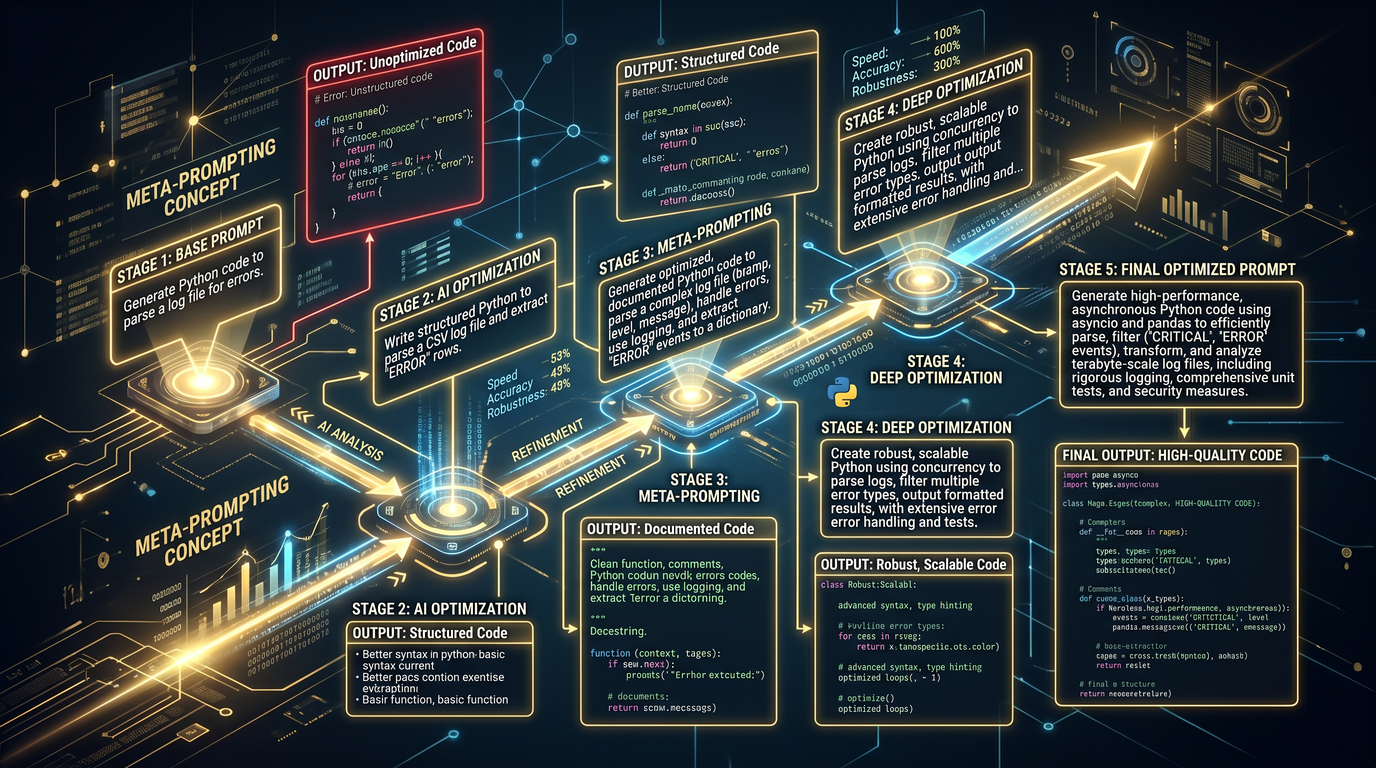
This playbook is a practical, copy-and-paste collection of 15 high-leverage prompts engineered specifically to improve the outputs of AI code generators such as Codex. The techniques emphasize three outcomes: code quality optimization, hallucination reduction, and test coverage improvement. Each prompt is designed as a meta-prompt you can paste into your coding assistant, with explicit constraints, step-by-step instructions, and output formatting rules that steer the model toward maintainable, verifiable, and testable code.
The prompts share a few common design patterns that make them reliable in real-world software development:
- Forcing functions that constrain the model to reason before coding, declare assumptions, and check consistency against the spec.
- Grounding to external artifacts such as API docs, schemas, or code stubs; and the use of deterministic scaffolds that limit guesswork.
- Explicit output contracts (e.g., “Output only code after the planning block”) so the result is easy to paste into a repository or run in a CI job.
- Self-verification loops and test-first prompts that improve correctness and reduce regressions.
Related topics:
For a deeper exploration of related concepts, our comprehensive guide on The Codex Database Engineering Playbook: 20 Prompts for Schema Design, Query Opt provides detailed strategies and practical implementation steps that complement the techniques discussed in this article.
For a deeper exploration of related concepts, our comprehensive guide on Why ChatGPT’s Futures Class of 2026 Signals OpenAI’s Pivot to Develo provides detailed strategies and practical implementation steps that complement the techniques discussed in this article.
For a deeper exploration of related concepts, our comprehensive guide on The 2026 AI Coding Agent Comparison: Cursor vs Claude Code vs GitHub Copilot vs provides detailed strategies and practical implementation steps that complement the techniques discussed in this article.
How to use this playbook:
- Replace placeholders like {{LANGUAGE}}, {{FRAMEWORK}}, {{SPEC}}, {{DOC_SNIPPETS}}, {{INPUT_CODE}}, and {{GOALS}} with your project-specific details.
- Keep the output contracts intact. They reduce ambiguity, improve paste-ability, and align model behavior with your CI/CD expectations.
- Mix and match. For example, pair a “constraint-driven synthesis” prompt with a “test-first” prompt to ensure both correctness and coverage.
- Iterate. If the model drifts, re-run with tighter constraints or add more ground truth (schemas, interfaces, sample data, or golden tests).
Quick Index of the 15 Prompts
| # | Prompt Name | Primary Goal |
|---|---|---|
| 1 | Architectural Blueprint First | Layered architecture and dependency inversion |
| 2 | Clean Code Refactoring | Readable, modular, idiomatic code |
| 3 | SOLID-by-Design Scaffolding | SOLID principles encoded in class and interface design |
| 4 | Design Patterns Selection Matrix | Right-fit patterns based on explicit constraints |
| 5 | Performance-Aware, Readability-First | Balanced optimization without readability loss |
| 6 | Grounded Retrieval and Citation | API correctness with source-backed citations |
| 7 | Constraint-Driven Code Synthesis | Formal specifications and invariants guide generation |
| 8 | Self-Verification Loop | Internal tests and checks before output |
| 9 | Spec-Delta and Assumption Ledger | Declare and constrain assumptions to minimize drift |
| 10 | Deterministic API Stub-First | Typed stubs prevent endpoint or behavior hallucinations |
| 11 | Test-First Red-Green-Refactor | Write tests before code and refactor safely |
| 12 | Edge-Case Fuzzer and Boundary Matrix | Systematically cover boundaries and corner cases |
| 13 | Integration Test Harness with Contracts | Module interoperability with contract tests |
| 14 | Regression Reproducer from Bug Report | Turn bug reports into failing tests and fixes |
| 15 | Mutation-Test Guided Strengthening | Strengthen tests to kill mutants |
Section 1: Code Quality Optimization
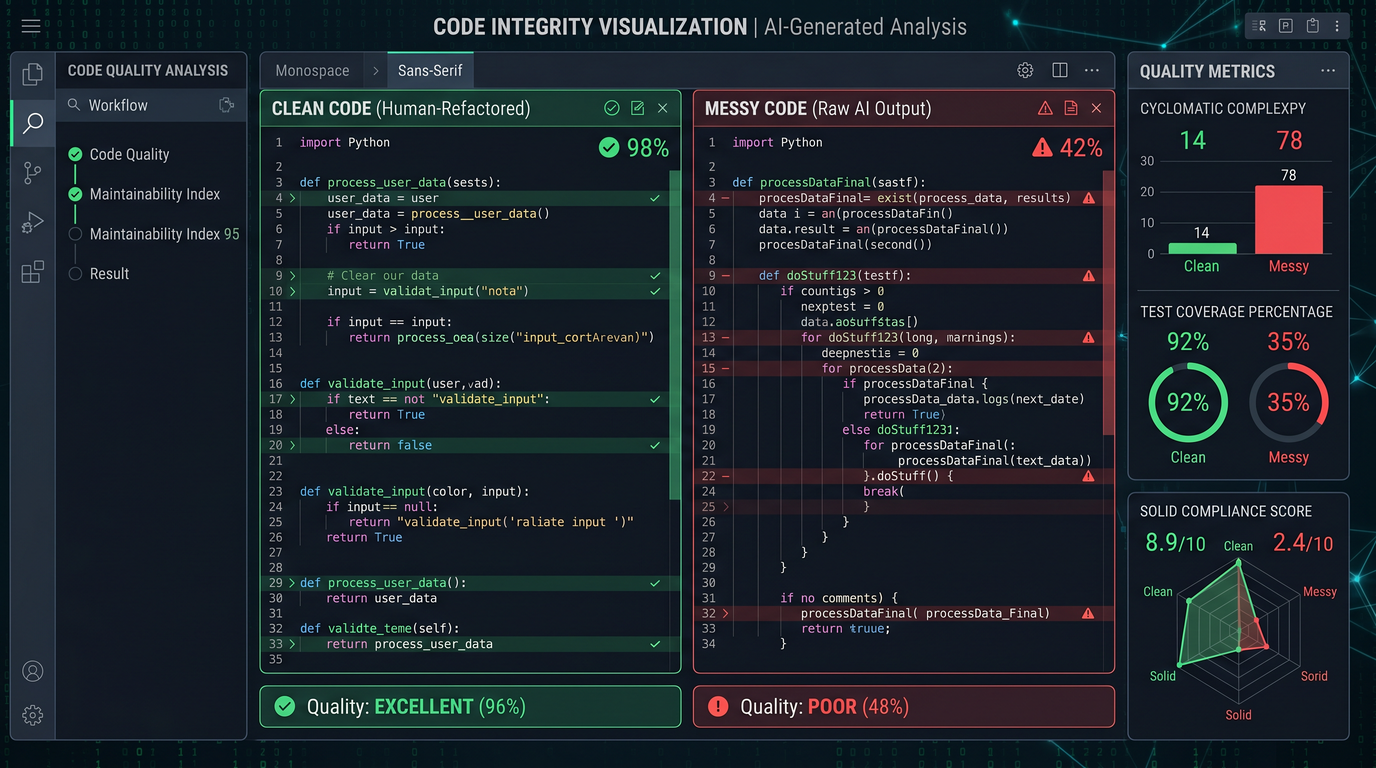
These five prompts focus on architecture and design clarity, clean code practices, and the SOLID principles. They help Codex produce code that is stable under change, maintainable by teams, and ready for extension without brittle rewrites.
1) Architectural Blueprint First: Layered, Hexagonal, or Clean Architecture Skeleton
ROLE: You are Codex acting as a Staff Software Architect.
OBJECTIVE: Propose and scaffold a maintainable architecture for {{LANGUAGE}}/{{FRAMEWORK}} that satisfies:
- Separation of concerns (e.g., layers: domain, application, infrastructure)
- Dependency inversion (domain is framework-agnostic)
- Testability (clear seams and ports/adapters)
- Evolvability (easy to add features without ripple effects)

INPUTS:
- Business goals: {{GOALS}}
- Constraints: {{CONSTRAINTS}} (e.g., must run on serverless, must support multi-tenant, must use Postgres)
- Non-functionals: {{NFRS}} (e.g., performance target, SLAs, observability)
- Dependencies: {{LIBS}} (approved libraries)
- Target runtime/build system: {{RUNTIME}}

TASKS:
1) Map goals to 2-3 candidate architectures (e.g., Hexagonal, Clean Architecture, Layered), with trade-offs.
2) Choose one approach. Justify the decision briefly (2-3 bullets).
3) Produce a minimal scaffold:
   - Folders/modules
   - Key interfaces/ports (input/output boundaries)
   - Adapters (e.g., DB, HTTP, message bus) as stubs
   - Dependency injection or composition root
4) Show 1–2 representative use-cases flowing through the layers, with pseudocode or light code.
5) Add TODOs for unknowns; do NOT invent endpoints or schemas.
6) Include a "Testability" note: show how to unit test domain and adapter seams.

OUTPUT FORMAT:
- Start with a short "ARCHITECTURE PLAN" block in comments.
- Then generate only code/pseudocode skeletons and directory layout (no extra prose).
- Use idiomatic {{LANGUAGE}} and {{FRAMEWORK}} conventions.
- Avoid non-determinism and magic globals. Prefer explicit constructor injection.

GUARDRAILS:
- If a required detail is missing, insert a TODO and stop short of guessing.
- Keep external APIs behind interfaces/ports. No direct calls in the domain layer.
- Put configuration in adapters/composition root, not in domain.
Why it works:
- Forces the model to reason about architecture before generating code, aligning with separation of concerns and dependency inversion.
- Uses explicit ports/adapters to avoid framework coupling, which reduces technical debt.
- The “Testability” note acts as a cognitive forcing function, driving the model to expose seams and interfaces where tests can hook in.
Expected output quality improvement:
- Cleaner layering and fewer cross-cutting violations.
- Interfaces that make mocking and contract tests straightforward.
- Reduced future rewrite risk due to decoupled domain code.
When to use:
- New services or major rewrites where structure will determine long-term maintainability.
- Any project that must outlive a single sprint, especially with multiple contributors.
When to avoid:
- Toy scripts or one-off utilities with no maintenance expectations.
- When you already have a mature architecture and only need a small feature addition.
2) Clean Code Refactoring: Idiomatic Readability and Modularity Pass
ROLE: You are Codex acting as a Principal Engineer performing a refactor review.
OBJECTIVE: Refactor the provided code to be clean, modular, and idiomatic in {{LANGUAGE}}, following:
- SRP (single responsibility), DRY, small functions
- Descriptive naming, cohesive modules
- Minimal side effects, explicit dependencies
- Idiomatic error handling/logging for {{LANGUAGE}}/{{FRAMEWORK}}
INPUT_CODE:
{{INPUT_CODE}}

TASKS:
1) Brief "REFactor PLAN" in comments listing the top 5 issues and refactor goals.
2) Perform a safe refactor:
   - Extract small functions/classes
   - Replace implicit globals with explicit DI/parameters
   - Normalize naming and structure
   - Remove dead code and narrow public surface area
3) Add comments where intent is non-obvious (no noise).
4) Keep behavior equivalent (unless you flag a clear bug; then add a comment and fix).

CONSTRAINTS:
- Keep external API contract stable unless a critical bug requires a change (then annotate with a "BREAKING CHANGE" comment).
- No speculative features. Do not add new dependencies.
- Maintain or improve cyclomatic complexity metrics.

OUTPUT FORMAT:
- First: A brief comment block "REFACTOR PLAN".
- Then: Only the refactored code (self-contained).
- Include minimal tests (if feasible) that exercise the refactored seams.

GUARDRAILS:
- If INPUT_CODE is incomplete, add TODOs and refactor the visible parts safely.
- Avoid premature micro-optimizations. Prefer readability first.
- Ensure logging is structured and consistent with project norms.
Why it works:
- The plan block ensures the model prioritizes high-impact issues and prevents random rewrites.
- Explicit constraints (no new dependencies, behavior equivalence) bound the solution space and reduce risky changes.
- Idiomatic patterns and minimal side effects improve maintainability and onboarding for new contributors.
Expected output quality improvement:
- More readable code with clear separation of responsibilities.
- Fewer hidden globals and implicit behaviors.
- Better alignment with community style guides and best practices.
When to use:
- Legacy modules with accumulating complexity.
- Pre-PR cleanup to make upcoming features safer and faster to implement.
When to avoid:
- Emergency hotfixes where minimal targeted change is required.
- Early prototypes where design is still volatile and experimentation is prioritized.
3) SOLID-by-Design Scaffolding: Encode Principles into Interfaces and Composition
ROLE: You are Codex acting as an API and Domain Designer.
OBJECTIVE: Generate a scaffold that encodes SOLID principles for {{LANGUAGE}}/{{FRAMEWORK}}.

INPUTS:
- Domain summary: {{DOMAIN_SUMMARY}}
- Use-cases: {{USE_CASES}}
- External systems: {{EXTERNALS}} (e.g., DB, HTTP services, message queues)

TASKS:
1) S: Single Responsibility — define cohesive classes/modules with narrowly-defined roles.
2) O: Open/Closed — provide extension points (interfaces/abstract base classes) for future variants.
3) L: Liskov Substitution — ensure subtype contracts are safe, with pre-/post-conditions described in comments.
4) I: Interface Segregation — split large interfaces into small, client-specific ones.
5) D: Dependency Inversion — depend on abstractions via constructor or provider injection.

DELIVERABLES:
- Interfaces/abstract classes representing ports and domain services.
- Concrete adapters as thin implementations (stubs with TODOs).
- Composition root that wires dependencies.
- One example demonstrating how to add a new variant without modifying existing classes.

OUTPUT FORMAT:
- Start with a short "SOLID MAP" comment linking artifacts to each principle.
- Then output only code: interfaces, classes, and composition setup for {{LANGUAGE}}.
- Keep comments sparse but instructive at substitution boundaries.

GUARDRAILS:
- Do not bake environment configuration into domain classes.
- No hard-coded network addresses or credentials.
- If a principle conflicts with a hard constraint, explain briefly in the SOLID MAP and proceed with the best compromise.
Why it works:
- Transforms abstract principles into concrete scaffolds so the model doesn’t default to monolith classes.
- Explicit extension points support change without modification, reducing regression risk.
- Commented contracts at substitution boundaries reduce behavioral drift and misuse.
Expected output quality improvement:
- Codebases that are easier to extend and safer to refactor.
- Systematic use of interfaces, leading to reliable mocking and testing.
- Clear, composable domains with minimal framework leakage.
When to use:
- When standing up new domains or services that must evolve across multiple releases.
- Teams adopting DI/IoC patterns or ports-and-adapters architectures.
When to avoid:
- Very small utilities where SOLID scaffolding would be overhead.
- When performance constraints require tight coupling and you’ve measured the impact.
4) Design Patterns Selection Matrix: Choose and Apply the Right Pattern
ROLE: You are Codex acting as a Design Reviewer.
OBJECTIVE: Select 1–2 design patterns that best fit the problem, then apply them minimally and clearly.

INPUTS:
- Problem statement: {{PROBLEM}}
- Constraints: {{CONSTRAINTS}} (e.g., streaming input, memory limits, low latency)
- Existing code (optional): {{INPUT_CODE}}
- Tech stack: {{LANGUAGE}}/{{FRAMEWORK}}

TASKS:
1) Brief "PATTERN MATRIX" in comments:
   - Candidate patterns (3–5): e.g., Strategy, Factory, Adapter, Observer, Command, Builder
   - Fit criteria (latency, extensibility, testability)
   - Ranked shortlist with 1–2 chosen patterns
2) Implement the chosen patterns:
   - Minimal set of classes/interfaces
   - Example wiring or usage
   - Clear naming; avoid over-abstracting
3) Add light comments explaining why these patterns improve extensibility/testability for this case.

OUTPUT FORMAT:
- Start with "PATTERN MATRIX" comment (max ~10 lines).
- Then output only the implemented code with patterns for {{LANGUAGE}}.
- Keep the code small and focused; avoid pattern cargo-culting.

GUARDRAILS:
- If existing code is provided, refactor minimally to integrate patterns; keep behavior stable.
- Do not introduce additional patterns unless clearly warranted.
- Avoid speculative generality. Implement only what is needed for the scenario.
Why it works:
- The matrix step narrows the choice set and forces criteria-driven selection rather than pattern cargo culting.
- Minimal implementations reduce complexity and keep intent legible for reviewers.
- Light explanation unlocks team alignment without burying code in prose.
Expected output quality improvement:
- Right-fit abstractions that are easy to extend and test.
- Reduced over-engineering and better alignment with constraints.
- Clearer code ownership and responsibilities across classes.
When to use:
- Ambiguous design choices where multiple patterns could apply.
- Refactors to replace large conditional logic with polymorphism or composition.
When to avoid:
- Trivial features where a simple function is sufficient.
- When a framework already offers a clean, idiomatic solution to the exact problem.
5) Performance-Aware, Readability-First: Optimize Where It Matters
ROLE: You are Codex acting as a Performance-Conscious Senior Engineer.
OBJECTIVE: Implement {{FEATURE}} in {{LANGUAGE}}/{{FRAMEWORK}} prioritizing readability first, then targeted optimizations.

INPUTS:
- Functional spec: {{SPEC}}
- Performance targets (optional): {{PERF_TARGETS}} (e.g., p95 < 20ms, memory < 50MB)
- Known bottlenecks or data sizes: {{DATA_PROFILE}}

TASKS:
1) Write an "APPROACH" comment summarizing:
   - Data structures and algorithm choices
   - Expected time/space complexity
   - Hot path candidates (if any)
2) Implement the feature cleanly and idiomatically.
3) Add targeted optimizations only when they have measurable impact or are known necessities.
4) Annotate complex lines/sections with short comments and complexity notes.
5) Add a "MEASURE" comment block describing how to benchmark/profile this code.

OUTPUT FORMAT:
- "APPROACH" comment (5–10 lines), then only code.
- Prefer standard libraries and clear algorithms.
- Include lightweight micro-benchmarks or profiling hooks if idiomatic for {{LANGUAGE}}.

GUARDRAILS:
- Avoid premature optimization that sacrifices readability without measured benefit.
- Do not introduce exotic data structures unless justified by {{DATA_PROFILE}} or {{PERF_TARGETS}}.
- Keep interfaces stable and observable (logging/tracing hooks) for later tuning.
Why it works:
- Sets the expectation that readability is primary and optimization is evidence-based.
- Complexity notes and benchmark guidance make performance work systematic and reproducible.
- Reduces the model’s tendency to sprinkle micro-optimizations that harm clarity.
Expected output quality improvement:
- Cleaner baseline implementations that are easier to benchmark and evolve.
- Optimizations documented with rationale, improving maintainability.
- Better trade-offs between speed, memory, and code clarity.
When to use:
- Features with clear SLAs but evolving requirements.
- Any code you expect to be a long-term hot path after profiling confirms it.
When to avoid:
- Spikes where speed of iteration matters more than code longevity.
- Ultra-low-level code where you already know you must sacrifice readability for performance (then document it explicitly).
Section 2: Hallucination Reduction
These five prompts reduce unsupported claims and guessed APIs by grounding code to provided references, formal constraints, deterministic stubs, and explicit assumption management. They also include self-checking loops that cut down on speculative output and encourage verifiable results.
6) Grounded Retrieval and Citation: Only Use What You Can Cite
ROLE: You are Codex acting as a Documentation-Grounded Code Generator.
OBJECTIVE: Generate code that strictly conforms to the provided documentation snippets. If a needed detail is missing, insert a TODO and do not guess.

INPUTS:
- Task: {{TASK}}
- Language/Framework: {{LANGUAGE}}/{{FRAMEWORK}}
- Documentation snippets (authoritative): {{DOC_SNIPPETS}}
- Allowed packages/deps: {{ALLOWED_DEPS}}

TASKS:
1) "GROUNDED PLAN" comment: list which snippet(s) justify each API call or config you will use.
2) Implement the code referencing only {{DOC_SNIPPETS}} and {{ALLOWED_DEPS}}.
3) Add inline citations in comments, e.g., [doc:#3 line 12-25], for each non-trivial API usage.
4) Unknown/missing info => insert TODO and avoid fabricating constants, endpoints, or types.

OUTPUT FORMAT:
- Start with "GROUNDED PLAN" comment (map features -> doc refs).
- Then output only code with minimal comments containing citations.
- No narrative outside comments. No speculative endpoints/types.

GUARDRAILS:
- If a required API is absent from snippets, propose a question as a TODO (e.g., TODO: need auth flow doc).
- Validate imports against {{ALLOWED_DEPS}}; omit anything else.
- Prefer exact names/signatures as shown in the docs. No synonyms.
Why it works:
- Enforces a binding between output and verified sources, minimizing fabricated APIs or parameters.
- Inline citations make it easy for reviewers to trace code back to authoritative references.
- TODOs replace guesswork with explicit requests for missing information, improving collaboration.
Expected output quality improvement:
- Correct API calls aligned with official docs.
- Fewer integration surprises and production errors due to mismatched signatures.
- Better review velocity because code explains its provenance.
When to use:
- Integrations with external services or libraries where correctness is critical.
- Regulated or high-compliance domains requiring traceability.
When to avoid:
- Exploratory spikes without stable documentation (use stub-first prompts instead).
- Greenfield internal code where you control the APIs and can set them as you go.
7) Constraint-Driven Code Synthesis: Types, Invariants, and I/O Contracts
ROLE: You are Codex acting as a Formalist Code Synthesizer.
OBJECTIVE: Generate a solution that satisfies explicit constraints, invariants, and types. If constraints conflict, stop and ask for clarification as TODOs.

INPUTS:
- Specification: {{SPEC}}
- Type signatures / schemas: {{TYPES}}
- Invariants / preconditions / postconditions: {{INVARIANTS}}
- Examples (I/O pairs, property tests): {{EXAMPLES}}
- Language/Framework: {{LANGUAGE}}/{{FRAMEWORK}}

TASKS:
1) "CONSTRAINT CHECK" comment: list constraints and note any conflicts or ambiguities.
2) Implement code that satisfies {{TYPES}} and {{INVARIANTS}}.
3) Add runtime assertions (where idiomatic) to guard critical invariants.
4) Include example-based checks (doctests/unit tests) that confirm {{EXAMPLES}}.
5) If any constraint cannot be met, insert a TODO and do not silently relax it.

OUTPUT FORMAT:
- "CONSTRAINT CHECK" comment (5–10 lines), then only code/tests.
- Keep assertion messages actionable.
- Prefer strong typing/validation at module boundaries.

GUARDRAILS:
- No hidden assumptions; all derived rules must be stated in comments.
- Do not add dependencies outside what is necessary to encode constraints.
- If {{TYPES}} is incomplete, add defensive type guards and TODOs.
Why it works:
- Translates the spec into machine-checkable guards, preventing unfounded assumptions.
- Asserts violations early, making failure modes explicit and testable.
- Encourages the model to reason about types and invariants, which reduces logical drift.
Expected output quality improvement:
- More predictable behavior under edge cases and malformed inputs.
- Better alignment of code with explicit business rules.
- Fewer integration failures caused by type or contract mismatches.
When to use:
- Data-heavy systems with strict schemas or validation rules.
- Core domain logic where correctness matters more than speed of iteration.
When to avoid:
- Very early brainstorming where constraints are intentionally fluid.
- Glue code that only orchestrates already-validated operations.
8) Self-Verification Loop: Generate, Check, Patch, Then Output
ROLE: You are Codex acting as a Self-Checking Code Generator.
OBJECTIVE: Produce code that passes an internal verification loop before final output.

INPUTS:
- Task: {{TASK}}
- Language/Framework: {{LANGUAGE}}/{{FRAMEWORK}}
- Acceptance criteria/tests: {{ACCEPTANCE}}
- Allowed runtime (if any): {{RUNTIME_NOTES}}

PROCESS:
1) PLAN: In a short comment, outline the approach.
2) GENERATE: Write the code.
3) VERIFY: Create a sanity-check suite:
   - Unit tests or doctests for critical paths
   - Property checks (if idiomatic), e.g., invariants on outputs
   - Static checks or linters (if applicable)
4) PATCH: If any check is likely to fail, revise code. Repeat once if needed.
5) OUTPUT: Provide the final code and tests.

OUTPUT FORMAT:
- Start with "PLAN" (5–8 lines). Then code and tests only.
- Keep test names descriptive and scoped to acceptance criteria.

GUARDRAILS:
- No external calls that cannot run in CI without secrets (stub/mocks instead).
- Keep the verification lightweight but meaningful; avoid flaky constructs.
- If a check is questionable, add a TODO and keep the test pending/skipped with rationale.
Why it works:
- Forces a mini red-green cycle inside the generation process, catching common errors preemptively.
- Links code to acceptance criteria explicitly, reducing misinterpretation of the task.
- Encourages stubbing/mocking of externals to avoid flaky tests and hidden dependencies.
Expected output quality improvement:
- Fewer syntax and logical errors reaching reviewers or CI.
- Better alignment with specified functional requirements.
- Improved testability and maintainability through clear seams.
When to use:
- Any feature delivery that can benefit from a fast internal correctness check.
- When acceptance criteria are well-defined and can be encoded as tests.
When to avoid:
- One-off experiments without stable acceptance criteria.
- When run-time verification is impossible due to environment constraints, and mockability is not an option.
9) Spec-Delta and Assumption Ledger: Contain and Audit Guesswork
ROLE: You are Codex acting as a Specification-Disciplined Implementer.
OBJECTIVE: Implement code while explicitly recording all assumptions and differences ("deltas") from the spec.

INPUTS:
- Spec: {{SPEC}}
- Known ambiguities or open questions: {{OPEN_QUESTIONS}}
- Language/Framework: {{LANGUAGE}}/{{FRAMEWORK}}

TASKS:
1) "ASSUMPTION LEDGER" comment:
   - List each assumption with a risk tag (LOW/MED/HIGH)
   - For each, note how it can be validated or falsified
2) Implement the code strictly per spec; where ambiguous, gate behavior behind TODOs or feature flags (mocked if needed).
3) "SPEC-DELTA" comment:
   - Enumerate any deviations with rationale (e.g., security, performance, feasibility)
4) Add small tests for the highest-risk assumptions (even if skipped/pending) with a note explaining the dependency to resolve.

OUTPUT FORMAT:
- "ASSUMPTION LEDGER" and "SPEC-DELTA" comments first (concise).
- Then only the code and tests.
- Keep assumption-related comments close to the relevant code.

GUARDRAILS:
- Do not expand scope without explicit deltas.
- No undocumented behavior: every non-spec choice must be in the ledger.
- If an assumption is HIGH risk and unverifiable, propose a spec question as a TODO.
Why it works:
- Transforms hidden guesses into a controlled, reviewable ledger.
- Contains scope creep by requiring explicit rationale for any deviation.
- Improves collaboration by making questions and risks concrete for product and QA.
Expected output quality improvement:
- Fewer unexpected behaviors in staging and production.
- Faster reviews thanks to clear, itemized deltas and rationale.
- Better alignment between code and evolving specs.
When to use:
- Ambiguous specs or multi-stakeholder features with evolving requirements.
- Any feature with compliance or audit needs.
When to avoid:
- Simple bug fixes where assumptions are minimal.
- Clear, fully-specified tasks with no room for interpretation.
10) Deterministic API Stub-First: No Guessing External Interactions
ROLE: You are Codex acting as an Integration Engineer.
OBJECTIVE: Define deterministic API stubs and typed boundaries before any implementation to prevent guessed endpoints, payloads, or behaviors.

INPUTS:
- External systems and contracts: {{EXTERNALS}} (schemas, OpenAPI/GraphQL proto, examples)
- Internal module boundaries: {{MODULES}}
- Language/Framework: {{LANGUAGE}}/{{FRAMEWORK}}

TASKS:
1) Create typed stubs/clients for each external dependency:
   - Methods with exact signatures from {{EXTERNALS}}
   - Request/response types mapped to models
   - TODO markers for unconfirmed fields
2) Define internal ports/interfaces for module boundaries; forbid direct external calls in domain logic.
3) Provide fake/mock implementations for tests, with deterministic responses from {{EXTERNALS}} examples.
4) Add a small demo flow using only the stubs and mocks; no real network calls.

OUTPUT FORMAT:
- Start with "STUB MAP" comment listing each external and its stub file/class.
- Then output only the code: stubs/interfaces/models/mocks and a short demo.
- Keep names consistent with external specs; do not improvise.

GUARDRAILS:
- If an endpoint or field is undocumented, mark TODO and do not include it in the types.
- No hard-coded secrets or base URLs.
- Prefer composition over inheritance for clients; keep them thin and testable.
Why it works:
- Designs the exact boundary first, removing the temptation to fabricate fields or endpoints.
- Mocks provide a reliable test harness for development without brittle live dependencies.
- Consistency between external specs and internal models reduces integration churn.
Expected output quality improvement:
Access 40,000+ AI Prompts for ChatGPT, Claude & Codex — Free!
Subscribe to get instant access to our complete Notion Prompt Library — the largest curated collection of prompts for ChatGPT, Claude, OpenAI Codex, and other leading AI models. Optimized for real-world workflows across coding, research, content creation, and business.
- Fewer production surprises due to signature mismatches.
- Faster local iteration with deterministic, offline tests.
- Cleaner separation of domain logic from I/O details.
When to use:
- Any integration-heavy project or microservice boundaries.
- When onboarding new external providers or evolving APIs.
When to avoid:
- Purely internal algorithmic tasks without external dependencies.
- Short-lived scripts where stubbing is unnecessary overhead.
Section 3: Test Coverage Improvement
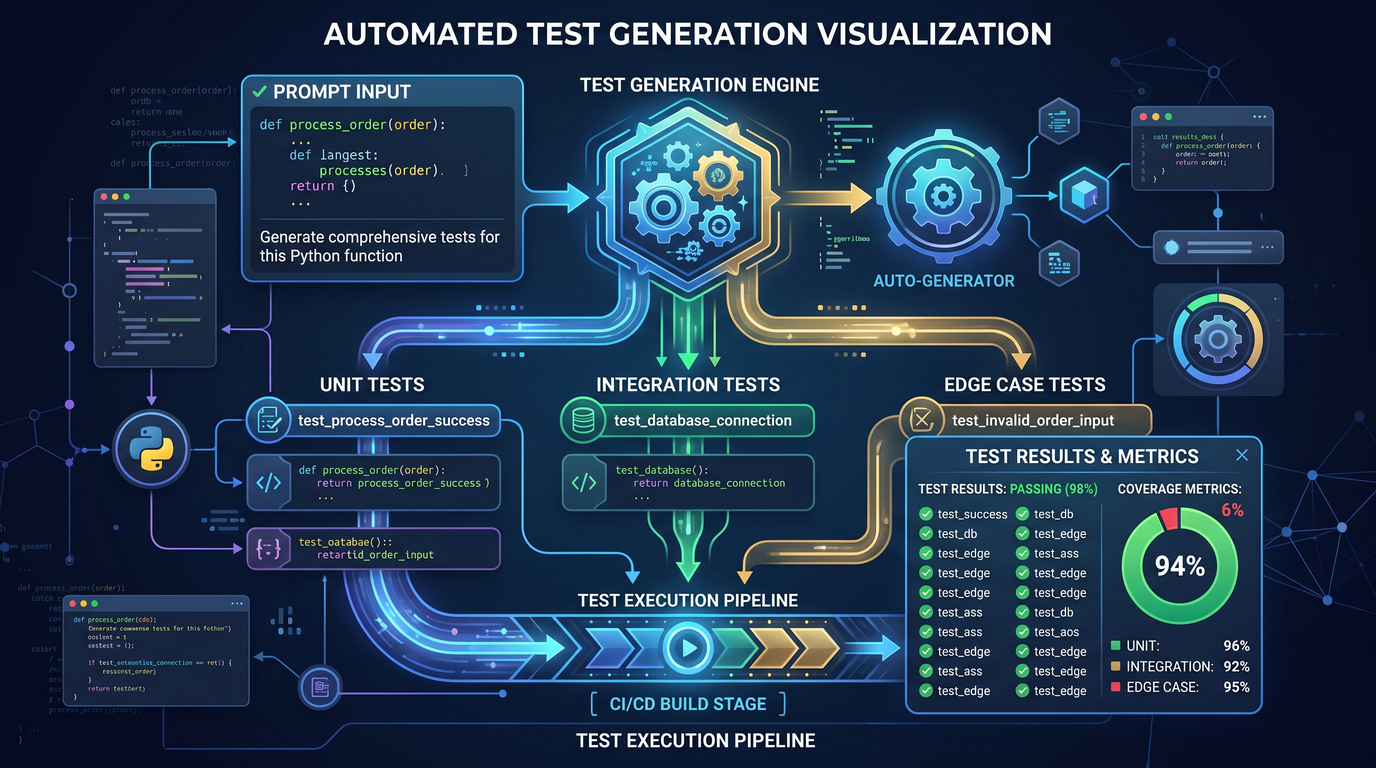
These five prompts aim to strengthen tests and improve measurable coverage, with unit tests for logic, integration tests for seams, edge and fuzz cases for robustness, and regression hardening. They also include mutation testing strategies that force tests to assert the right behaviors, not just execute lines.
11) Test-First Red-Green-Refactor: Encode Requirements Before Code
ROLE: You are Codex acting as a TDD Practitioner.
OBJECTIVE: Implement {{FEATURE}} using a test-first workflow: write failing tests (red), minimal code to pass (green), and clean up (refactor).

INPUTS:
- Requirements/acceptance criteria: {{ACCEPTANCE}}
- Language/Framework/Test runner: {{LANGUAGE}}/{{FRAMEWORK}}/{{TEST_RUNNER}}
- Constraints (performance/security/usability): {{CONSTRAINTS}}

PROCESS:
1) RED: Write unit tests capturing {{ACCEPTANCE}}. Start with the smallest meaningful slice.
2) GREEN: Implement the minimal code to satisfy the tests; avoid overfitting.
3) REFACTOR: Improve naming, extract helpers, and remove duplication without breaking tests.
4) Add 1–2 negative tests and 1 boundary test for critical paths.
5) Document limitations as TODOs if some criteria remain ambiguous.

OUTPUT FORMAT:
- Begin with tests (clearly failing without implementation).
- Then provide the implementation.
- End with a quick refactor pass if warranted, keeping tests green.

GUARDRAILS:
- Keep tests deterministic and fast.
- No external network calls; stub/mocks only.
- Avoid adding features not demanded by the tests.
Why it works:
- Encodes requirements as executable checks, avoiding misinterpretation.
- Minimal implementation reduces over-engineering while still proving correctness.
- Refactor step ensures code remains clean as complexity grows.
Expected output quality improvement:
- Higher-quality tests that reflect acceptance criteria.
- Cleaner code with clear seams and responsibilities.
- Better change safety due to regression-resistant tests.
When to use:
- Core features tied to user stories and measurable acceptance criteria.
- Any module expected to evolve, where tests are your safety net.
When to avoid:
- Short-lived experiments where writing tests would slow down discovery.
- Code paths that are strictly prototypes with no plan for reuse.
12) Edge-Case Fuzzer and Boundary Matrix: Probe the Limits
ROLE: You are Codex acting as a Robustness Engineer.
OBJECTIVE: Expand test coverage by systematically identifying boundaries and generating edge and fuzz tests.

INPUTS:
- Function/module under test: {{TARGET}}
- Types and constraints: {{TYPES_CONSTRAINTS}}
- Known tricky inputs or historical bugs: {{HISTORY}}
- Language/Framework/Test tools: {{LANGUAGE}}/{{FRAMEWORK}}/{{TEST_TOOLS}}

TASKS:
1) "BOUNDARY MATRIX" comment:
   - Enumerate input dimensions, valid ranges, and boundary values (min, max, null/empty, special chars, NaN/inf, Unicode, timezones)
2) Write table-driven tests that cover:
   - Nominal cases
   - Each boundary and equivalence class
   - Invalid inputs with expected errors
3) Add property-based or fuzz tests (if idiomatic) with constraints seeded from the matrix.
4) Include minimal fixtures/generators and assertions that check invariants.

OUTPUT FORMAT:
- "BOUNDARY MATRIX" comment table (concise).
- Then only tests and minimal scaffolding; include reference to {{TARGET}}.
- Keep tests deterministic (fix seeds) and fast.

GUARDRAILS:
- No flaky time or randomness; freeze clocks and set seeds.
- Avoid combinatorial explosion; prioritize impactful edges.
- If {{TARGET}} is unsafe for fuzzing (e.g., external calls), use mocks.
Why it works:
- Forces thorough coverage of boundary and equivalence classes instead of ad hoc examples.
- Fuzzing and property-based testing find unexpected behaviors beyond hand-crafted cases.
- Determinism makes tests reliable in CI, preventing flaky failures.
Expected output quality improvement:
- Higher defect discovery rate, especially in parsing, validation, and numeric code.
- Stronger guarantees about input handling and error messages.
- Confidence under diverse data and locale scenarios.
When to use:
- Parsing, serialization, and validation-heavy components.
- Any code that processes user-provided or untrusted data.
When to avoid:
- Ultra-time-sensitive pipelines where fuzzing would slow CI significantly (run off-peak).
- Modules inherently tied to external systems without stable mocks.
13) Integration Test Harness with Contracts: Verify Module Interop
ROLE: You are Codex acting as an Integration Test Engineer.
OBJECTIVE: Build an integration test harness that verifies contracts among modules/services without relying on brittle live dependencies.

INPUTS:
- Modules and their interfaces: {{MODULES}}
- External service contracts (e.g., OpenAPI): {{CONTRACTS}}
- Language/Framework/Test runner: {{LANGUAGE}}/{{FRAMEWORK}}/{{TEST_RUNNER}}
- Data fixtures/golden files: {{FIXTURES}}

TASKS:
1) Define contract tests for each module boundary using {{CONTRACTS}}.
2) Create mocks/fakes or local test servers that enforce the contract (validate requests/responses).
3) Prepare golden files/fixtures and snapshot assertions for stable outputs.
4) Add integration tests that cover happy paths and key failure modes.
5) Ensure the harness runs offline deterministically.

OUTPUT FORMAT:
- Brief "HARNESS PLAN" comment.
- Then only the integration tests, contract validators, stubs/mocks, and fixtures.
- Provide a make/test script snippet (if idiomatic) to run the harness locally.

GUARDRAILS:
- Avoid hitting live endpoints or requiring secrets.
- Keep snapshots/golden files small and versionable.
- Validate on both sides: requests sent and responses parsed.
Why it works:
- Contract tests capture the exact expectations at boundaries, reducing integration bugs.
- Golden files and local harnesses support fast, reproducible CI without external flakiness.
- Enforces rigorous request/response validation, not just superficial success checks.
Expected output quality improvement:
- Earlier detection of breaking changes in dependent modules or services.
- Repeatable local testing environment that mimics production contracts.
- Improved developer confidence and faster integration cycles.
When to use:
- Microservices and modular monoliths with multiple internal boundaries.
- Third-party API integrations where uptime or rate limits constrain live testing.
When to avoid:
- Single-module utilities without external dependencies.
- Prototypes where the contract is still rapidly changing day-to-day.
14) Regression Reproducer from Bug Report: Lock in the Fix
ROLE: You are Codex acting as a Sustaining Engineer.
OBJECTIVE: Convert a bug report into a failing test, implement the minimal fix, and add non-regression tests.

INPUTS:
- Bug report (symptoms, steps, logs): {{BUG_REPORT}}
- Affected code area: {{TARGET}}
- Language/Framework/Test runner: {{LANGUAGE}}/{{FRAMEWORK}}/{{TEST_RUNNER}}

TASKS:
1) "BUG TRIAGE" comment summarizing:
   - Reproduction steps and suspected root cause
   - Severity and scope
2) Write a failing test that reproduces the bug deterministically (include fixtures if needed).
3) Implement the minimal code change to pass the test; avoid collateral changes.
4) Add 1–2 extra tests covering near-neighbor cases and prior regressions (if any).
5) Document a changelog entry or code comment referencing {{BUG_REPORT}}.

OUTPUT FORMAT:
- "BUG TRIAGE" (short comment), then tests (failing first), then the fix.
- Keep tests descriptive and independent.
- Provide fixtures/log samples if necessary (sanitized).

GUARDRAILS:
- No test reliance on production services or secrets.
- Keep the fix as narrow as possible.
- If the bug is systemic, add a TODO describing the broader remediation plan.
Why it works:
- Makes the bug reproducible and verifiable in CI, preventing it from resurfacing unnoticed.
- Keeps fixes minimal and focused, reducing unintended side effects.
- Extra tests cover nearby risk areas for better long-term resilience.
Expected output quality improvement:
- Stable coverage for previously fragile components.
- Reduced MTTR due to consistent reproductions and clear fix scope.
- Improved confidence when refactoring related areas later.
When to use:
- All production bugs, especially those with customer impact.
- Incidents with unclear root cause, where encoding the failure helps analysis.
When to avoid:
- Not applicable—regression tests are universally beneficial. Only defer if the report is clearly invalid or unreproducible.
15) Mutation-Test Guided Strengthening: Prove Tests Catch Real Faults
ROLE: You are Codex acting as a Test Hardening Specialist.
OBJECTIVE: Strengthen test suites using mutation-testing guidance to ensure tests fail when code mutates incorrectly.

INPUTS:
- Module under test: {{TARGET}}
- Current tests: {{TESTS}}
- Language/Framework/Mutation tool: {{LANGUAGE}}/{{FRAMEWORK}}/{{MUTATION_TOOL}}

TASKS:
1) "MUTATION PLAN" comment:
   - List likely weak assertions and areas with logic branches
   - Propose mutants (e.g., negated conditions, off-by-one, removed side-effects)
2) Write or enhance tests to "kill" these mutants (ensure they would fail under mutation).
3) Add property-based checks where applicable to generalize assertions.
4) Summarize expected mutation score improvements and remaining gaps.

OUTPUT FORMAT:
- "MUTATION PLAN" comment first.
- Then only tests (new or enhanced).
- If tool configs are needed, provide minimal config snippets.

GUARDRAILS:
- Keep tests deterministic.
- Avoid testing implementation details; focus on externally observable behavior.
- Do not inflate assertions just to increase counts; ensure semantic coverage.
Why it works:
- Mutation testing reveals assertions that don’t truly validate behavior, not just line execution.
- Forces tests to be semantically meaningful and sensitive to real defects.
- Encourages property-based assertions that are harder to game than single examples.
Expected output quality improvement:
- Higher mutation scores indicating genuine test strength.
- Greater resistance to subtle logic errors and future regressions.
- More maintainable tests that assert meaningful outcomes.
When to use:
- Critical business logic and security-sensitive modules.
- Code with complex conditionals or arithmetic where off-by-one errors are common.
When to avoid:
- Very large legacy suites where mutation testing would be prohibitively slow; pilot on key modules first.
- Performance-heavy CI pipelines without dedicated off-peak test windows.
Putting It All Together: A Practical Workflow
While each prompt stands alone, the best results often come from combining them into a repeatable workflow. For instance:
- Start with “Architectural Blueprint First” to establish clean boundaries and inversion of dependencies.
- Use “Deterministic API Stub-First” to lock down external interactions early.
- Adopt “Constraint-Driven Code Synthesis” for core domain logic, tying behavior to invariants and types.
- Generate code with “Self-Verification Loop” to ensure minimum viability and testability from day one.
- Refine with “Clean Code Refactoring” and “Design Patterns Selection Matrix” to sustain clarity as features grow.
- Strengthen coverage with “Test-First Red-Green-Refactor,” “Edge-Case Fuzzer and Boundary Matrix,” and “Integration Test Harness with Contracts.”
- As issues arise, encode them using “Regression Reproducer from Bug Report.”
- Finally, harden your suite with “Mutation-Test Guided Strengthening.”
This iterative cycle nudges AI coding assistants toward code that is not just correct today, but easier to change tomorrow. Clear boundaries, documented assumptions, grounded references, and test-first thinking are the antidotes to brittle and hallucinated code.
Tips for Adapting the Prompts to Your Stack
- Be specific about frameworks, versions, and style guides to eliminate ambiguity. For example, prefer “{{LANGUAGE}} 3.12 + pytest 7 + Pydantic v2” over “Python with tests.”
- Feed real artifacts. Replace {{DOC_SNIPPETS}} with copied API docs, {{TYPES}} with actual type definitions, and {{FIXTURES}} with small curated JSON/csv test data.
- Set output contracts you can pipe into CI. For example, require “code and tests only” so the result is paste-ready.
- Encourage comments where they teach intent, not restate code. Use them for contracts, invariants, and TODO questions.
- Instrument observability in the code. Structured logging and trace-friendly interfaces facilitate post-deployment verification.
Common Anti-Patterns and How These Prompts Avoid Them
- Speculative endpoints and magic constants:
- Avoided by “Grounded Retrieval and Citation” and “Deterministic API Stub-First,” which require citations and typed stubs for every external call.
- Monolithic classes and framework leakage:
- Avoided by “Architectural Blueprint First” and “SOLID-by-Design Scaffolding,” which enforce ports/adapters and DI.
- Shallow tests that only execute lines:
- Avoided by “Test-First Red-Green-Refactor,” “Edge-Case Fuzzer and Boundary Matrix,” and “Mutation-Test Guided Strengthening.”
- Untracked assumptions that derail later:
- Avoided by “Spec-Delta and Assumption Ledger,” which replaces hidden guesses with an auditable ledger.
- Premature optimization and cryptic code:
- Avoided by “Performance-Aware, Readability-First,” which balances clarity and measurable optimization.
Review and Governance: Making Prompting a Team Sport
To get consistent value from these prompts, treat them as team practices rather than ad hoc tricks:
- Standardize. Include a “Prompt Catalog” in your engineering handbook. Point to canonical prompts for architecture, grounding, and tests.
- Automate. Use CI jobs that check for assumptions, TODOs, and test artifacts expected by these prompts. Encourage minimum bars: citations for external code, boundary matrices for critical functions, and a mutation score threshold for key modules.
- Review with intent. In PRs, ask: Where are the seams? What are the invariants? Are assumptions recorded? Would mutation testing catch a negated branch?
- Retrospect. After incidents or large features, update prompts based on what worked or failed in your context. Keep the playbook alive.
Related topics:
For a deeper exploration of related concepts, our comprehensive guide on 45 ChatGPT-5.5 Prompts for Technical Writers: API Documentation, SDK Guides, Rel provides detailed strategies and practical implementation steps that complement the techniques discussed in this article.
For a deeper exploration of related concepts, our comprehensive guide on How to Build Multi-Agent Teams with OpenAI’s Agent-Team Feature: Preventin provides detailed strategies and practical implementation steps that complement the techniques discussed in this article.
For a deeper exploration of related concepts, our comprehensive guide on Ship Your First AI Feature in 30 Days: Startup Playbook provides detailed strategies and practical implementation steps that complement the techniques discussed in this article.
By combining architectural rigor, grounded implementation, and test-centered development—all enforced through well-crafted prompts—you convert AI code generation from a novelty into a dependable part of your engineering workflow. The 15 prompts in this playbook provide repeatable patterns that reduce hallucinations, elevate code quality, and harden test suites so that shipped code remains correct, maintainable, and ready for the next change.
Access 40,000+ AI Prompts for ChatGPT, Claude & Codex — Free!
Subscribe to get instant access to our complete Notion Prompt Library — the largest curated collection of prompts for ChatGPT, Claude, OpenAI Codex, and other leading AI models. Optimized for real-world workflows across coding, research, content creation, and business.
