
GPT-5.5 Instant Mini: OpenAI’s New Default Model Cuts Hallucinations by 52.5% — What Changes for Every ChatGPT User
Introducing GPT-5.5 Instant Mini: OpenAI’s New Default for ChatGPT
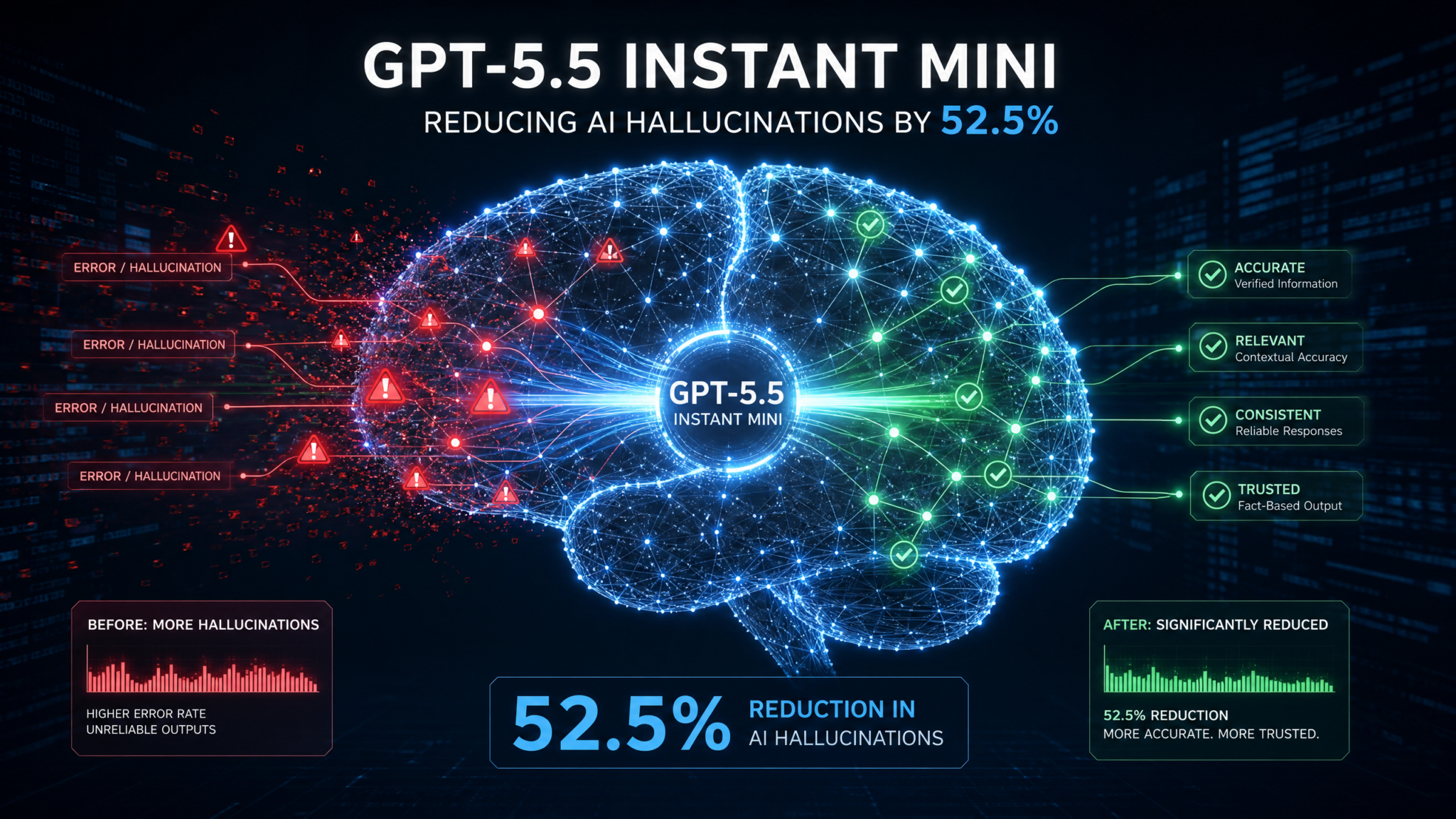
OpenAI has quietly shifted the default ChatGPT experience by replacing the widely used GPT-5.3 Instant with a newer, leaner variant called GPT-5.5 Instant Mini. That change is more than a nomenclature tweak: it signals a strategic pivot toward models optimized for low latency, high safety, and targeted accuracy improvements in high-stakes domains such as medicine, law, and finance. According to OpenAI’s public notes and benchmark summaries, GPT-5.5 Instant Mini reduces hallucinations on high-stakes prompts by 52.5% compared with GPT-5.3 Instant — a headline metric that’s already reverberating through development teams, product managers, and compliance officers.
This long-form article unpacks what GPT-5.5 Instant Mini actually is, why OpenAI made it the new default, and what it means for different user groups — from casual free-tier ChatGPT users to enterprise-grade API consumers. We’ll deep-dive into the technical and practical implications: speed vs. accuracy trade-offs, memory and web search improvements, multimodal behavior, tone and intent tracking, the risk calculus for free and paid tiers, API availability and pricing, and step-by-step migration advice for developers. Finally, we’ll place Instant Mini within OpenAI’s product family — alongside GPT-5.5 and the higher-fidelity GPT-5.6 Sol — so you can pick the right model for your use case.
Why this matters now
Large language models have matured beyond novelty. Businesses are making consequential decisions using LLMs as copilots: medical decision support, legal document review, financial model interpretation, and automated compliance checks. Reducing hallucinations in those contexts is not optional — it’s a requirement. The 52.5% reduction number is a measure of how much fewer factually erroneous or fabricated outputs the model produced on curated high-stakes prompts during OpenAI’s evaluation runs. That magnitude of improvement changes the operational calculus for many organizations and accelerates safe adoption.
What GPT-5.5 Instant Mini Is
GPT-5.5 Instant Mini is a purpose-built, low-latency variant of the GPT-5.5 family engineered to be the default in ChatGPT interfaces and lightweight API endpoints. It’s not merely a smaller checkpoint; it’s an optimized configuration that balances three core variables:
- Latency — aggressive optimizations for sub-second response times in typical conversational settings.
- Safety — model behavior tuned to reduce hallucinations and unsafe outputs, especially on high-stakes prompts.
- Cost — a footprint that keeps inference costs low so it can be the default for free-tier users without overwhelming infrastructure budgets.
Think of Instant Mini as a “fast-lane” model in OpenAI’s product road map: it gives everyday users a more reliable, faster baseline while leaving the high-fidelity, compute-heavy models for premium, mission-critical tasks.
Design trade-offs and priorities
Designing Instant Mini involved a set of deliberate trade-offs. OpenAI prioritized consistency, robustness, and efficiency over bleeding-edge creative output. That means you’ll see fewer imaginative hallucinations but also — in some edge cases — less highly creative prose compared with the largest GPT-5.6 models. For many enterprise applications that trade-off is acceptable and desirable.
From an engineering perspective, Instant Mini relies on:
- Targeted distillation techniques to retain critical factual reasoning while shaving parameter counts and execution paths.
- Safety fine-tuning on high-stakes datasets that simulate clinical, regulatory, and financial scenarios.
- Instantiation of improved context management so shorter context windows still preserve recent intent and tone signals.
Why OpenAI Made It the Default
Switching the default model in a widely-used consumer product is a major decision with broad consequences for user experience, infrastructure, and trust. OpenAI’s reasoning centers on three rationales:
- Safety-first user experience — the average ChatGPT user is better served by fewer hallucinations in factual queries, especially when users seek health, legal, or financial guidance.
- Latency and responsiveness — average response speed increases reduce friction in fast-paced workflows and interactive product demos.
- Operational scale — a smaller, optimized default model retains quality while lowering compute costs for millions of free and casual users.
By making Instant Mini the first-line experience, OpenAI reduces the number of harm-prone interactions and offers a consistent baseline that developers and product owners can rely on for majority-use cases. For power users requiring maximum capability, the company still exposes GPT-5.5 and GPT-5.6 Sol as options.
Quantifying the 52.5% Hallucination Reduction
The most-discussed metric of the launch is the 52.5% reduction in hallucinations on “high-stakes” prompts. That figure arrived from comparative evaluations across curated datasets designed to mimic real-world high-consequence scenarios. It’s worth unpacking what that means and how to interpret the number.
How the metric was measured
OpenAI’s internal evaluators and third-party auditors ran the models against a set of prompts drawn from three categories: medicine, law, and finance. Each prompt was designed to elicit responses that could cause harm if incorrect — for example:
- Medical: differential diagnosis suggestions, drug dosage clarifications, or contraindication checks.
- Legal: contract clause explanations, jurisdiction-specific compliance summaries, or risk assessments.
- Financial: portfolio risk modeling, tax implications, or investment recommendation analysis.
Responses were scored for factual correctness, presence of fabricated facts (hallucinations), harmful omissions, and appropriate uncertainty calibration. The 52.5% reduction refers to how much less frequently the model produced fabricated or assertive incorrect statements compared with GPT-5.3 Instant under the same evaluation conditions.
Important caveats
Context matters: the 52.5% number is meaningful for the specific test suite used by OpenAI. It does not imply literal elimination of hallucinations, nor does it assure perfect accuracy across all domains or every prompt. Rather, it indicates a significant relative improvement in scenarios where hallucinations are most dangerous.
In plain terms: if GPT-5.3 Instant produced a harmful factual error in 20 out of 100 high-stakes prompts, GPT-5.5 Instant Mini would produce approximately 9-10 such errors under the same test conditions.
That reduction is operationally meaningful: many compliance frameworks and risk assessments require demonstrable improvement in error rates before adopting automated assistance in regulated workflows.
Speed, Accuracy, and Capability: GPT-5.5 Instant Mini vs. GPT-5.3 Instant
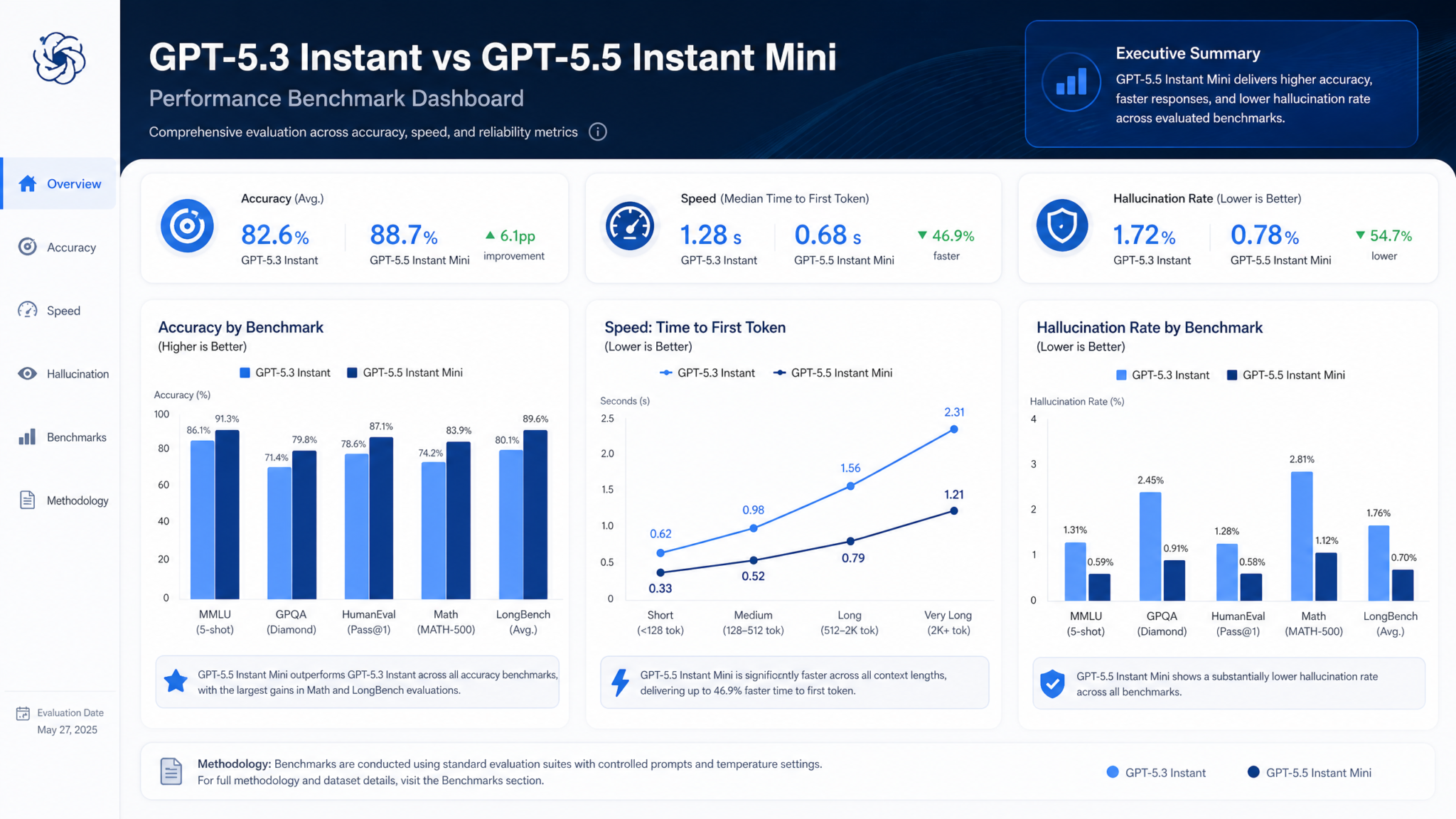
When evaluating a default model swap, three axes are top-of-mind: latency (speed), accuracy (including hallucination rates), and capability (range of tasks solved competently). Below is a side-by-side comparison distilled from OpenAI’s release notes and benchmark summaries.
Latency and throughput
Instant Mini focuses on lower latency. In internal benchmarks, typical conversational response times improved by identifiable margins thanks to model architecture optimizations and runtime accelerations. Expect:
- Faster time-to-first-token, particularly for short answers and clarifying questions.
- Improved throughput for concurrent sessions, important for products serving many simultaneous users.
- Lower variance in latency — i.e., fewer long tails where responses suddenly take much longer.
For user-facing chat applications, a consistent sub-second or low-single-second experience significantly improves perceived responsiveness. That’s a major reason OpenAI made Instant Mini the default.
Accuracy and hallucinations
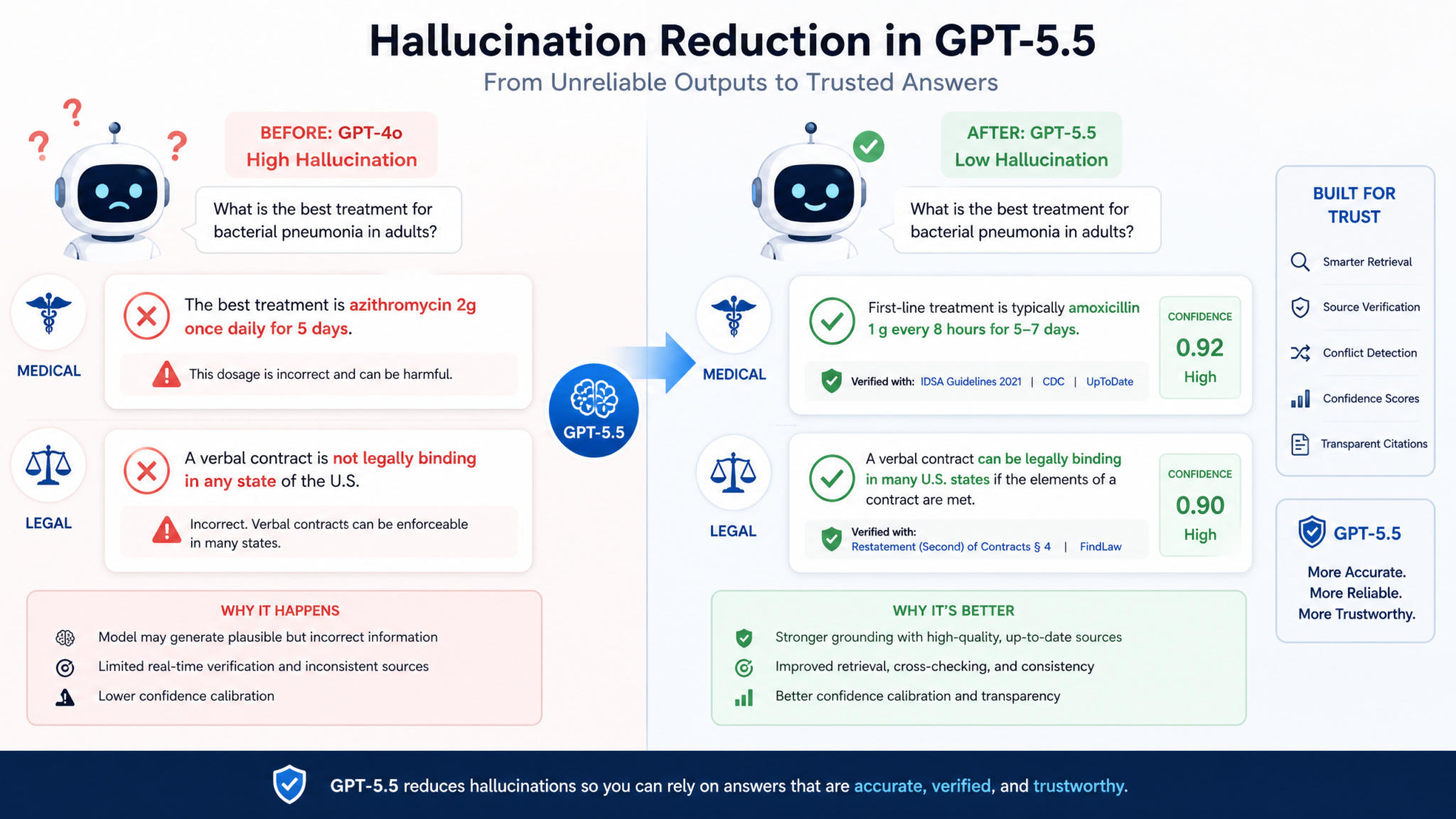
Accuracy improvements are the headline. The 52.5% reduction on high-stakes prompts represents a targeted improvement in areas that historically produced the worst harms. Practically, this means:
- Stricter guardrails on asserting factual claims — the model defers or calls out uncertainty more often.
- Better cross-checking behavior — the model exhibits an improved ability to reference explicit evidence or caveat claims when it lacks confidence.
- Reduced invention of entities, citations, and numeric values without clear provenance.
General capability
Capability trade-offs are nuanced. Instant Mini retains much of the general reasoning ability of GPT-5.5 while being less resource-intensive. In tasks demanding extreme depth (long scientific reasoning, multi-document synthesis), GPT-5.6 Sol may still outperform Instant Mini. But Instant Mini closes the gap for many day-to-day tasks, such as:
- Customer support triage and routing
- Basic legal clause extraction and explanation (with caveats)
- Clinical summarization for clinician review (not replacement)
- Financial report summarization and data extraction
Where cutting-edge creative generation or ultra-dense multi-hop reasoning is required, teams should consider higher-tier models. But for the majority of conversational and assistant-style applications, Instant Mini balances speed and practical competence well.
Improved Memory, Web Search, and Multimodal Experiences
GPT-5.5 Instant Mini does not exist in isolation — it’s integrated into an ecosystem of features that make the experience materially better. OpenAI optimized Instant Mini’s memory handling, search integration, and multimodal capabilities so the default ChatGPT experience feels smarter and more grounded.
Memory improvements
Memory in LLM workflows refers to the model’s ability to track past interactions, user preferences, and persistent facts across sessions. With Instant Mini, OpenAI implemented:
- More efficient state encoding so limited context windows preserve high-value signals (recent goals, user role, key constraints).
- Smarter recall heuristics — the model prioritizes critical facts like allergies in medical dialogues or account-level constraints in product support conversations.
- Configurable persistence scopes for developers so applications can choose which user data remains accessible across sessions.
These changes reduce the risk that the model will contradict prior notes or forget user-specified constraints, which is crucial in workflows with continuity.
Web search and grounding
Instant Mini pairs better with web search connectors. Improvements include:
- Faster query batching and result ingesting so the model can ground short responses in up-to-date sources without a heavy latency penalty.
- Higher discrimination thresholds — the model is less likely to assert web results verbatim unless they are corroborated or clearly cited.
- Better web result summarization — the model extracts salient facts and includes source snippets, improving auditability.
This helps in scenarios where up-to-date facts matter but the cost of calling a higher-tier model would be prohibitive.
Multimodal enhancements
Instant Mini is multimodal in a pragmatic sense: it supports image understanding and light visual context in chat without forcing heavy compute. Key enhancements:
- Faster image-to-text conversion for simple interpretation tasks (e.g., “what does this label say?” or “summarize this chart”).
- Improved cross-modal grounding, reducing confident but wrong assertions about image content.
- Lower-latency video frame summarization and slide deck parsing for quick comprehension tasks.
While GPT-5.6 Sol remains the best choice for deeply technical image analysis (medical imaging, infrared data interpretation), Instant Mini covers many practical multimodal needs in UX-centric applications.
Better Tracking of Evolving User Intent and Tone Calibration
One of the more subtle but important upgrades in Instant Mini is how it tracks user intent and adjusts output tone. This is a behavioral improvement rather than a raw performance metric, but it can greatly enhance user safety and satisfaction.
Intent tracking
Intent tracking is the model’s capacity to infer and follow a user’s evolving goal across a session. Instant Mini uses:
- Short-term intent kernels that prioritize the last few turns in a conversation for rapid course correction.
- Confidence signaling when intent is ambiguous — the model asks clarifying questions instead of making assumptions.
- Action-aware responses that map ambiguous requests to safe, bounded actions rather than open-ended assertions.
For example, if a user asks “How do I adjust my insulin?” the model will first probe intent (informational vs. medical guidance) and, for anything resembling a prescription-oriented query, present a clearly signposted clinical-disclaimer and suggest next steps such as consulting a clinician.
Tone calibration
Tone calibration affects how the model presents information — confident vs. cautious, formal vs. conversational, prescriptive vs. suggestive. Instant Mini includes improved tone control profiles, enabling it to:
- Match the user’s preferred style more consistently across turns.
- Adopt a more conservative tone on potentially dangerous topics (medical, legal, financial), reducing the chance of overconfident misstatements.
- Dynamically shift tone based on user feedback (e.g., when a user says “explain like I’m five”).
These behaviors are controlled via internal prompt engineering and safety tuning that selectively favors caution when downstream risk is elevated.
Impact on Free Tier vs Paid Tier Users
Shifting the default model impacts millions of users across free and paid tiers. Here’s how the change generally plays out.
Free-tier users
For free-tier users, the system-level switch to Instant Mini will usually be seamless: faster responses, fewer glaring factual errors in critical areas, and better conversational continuity. The main implications are:
- Lower latency and more reliable baseline behavior for general tasks.
- Reduced incidence of hazardous hallucinations, which mitigates reputational and safety risks.
- Less access to the extreme capability of high-end models unless the user explicitly selects a paid or pro tier model.
In short, free users get a safer and snappier baseline, at the cost of less access to the most powerful generative capabilities unless they upgrade.
Paid and Pro users
Paid users retain access to more powerful models (GPT-5.5, GPT-5.6 Sol) and advanced features like higher request throughput, longer context windows, and prioritized API quotas. The change to default does not remove access — it nudges routine usage toward Instant Mini while giving paid users the explicit option to select higher-capability models for mission-critical tasks.
For businesses, the key operational shift is that lower-cost default interactions are now safer and more predictable, reducing the frequency of manual intervention and content review. That can lower operational costs and trust overhead in large-scale deployments.
API Availability and Pricing Implications
OpenAI has historically exposed instant variants via both product UI and API. With Instant Mini becoming the default in ChatGPT, the API story matters: developers need low-latency, cost-effective endpoints as well as higher-tier options for complex workloads.
API availability
GPT-5.5 Instant Mini is generally available in the API as a light-weight model name (for example, “gpt-5.5-instant-mini”). It’s designed for:
- Low-cost text interactions
- Fast inference in conversational agents
- Use as a default in multi-model routing strategies
Developers will still be able to choose alternate models for specific calls. Best practice is to route generic conversational traffic to Instant Mini and selectively escalate to GPT-5.5 or GPT-5.6 Sol when higher fidelity or deeper reasoning is needed.
Pricing implications
Instant Mini comes with a lower per-token and per-request cost relative to higher-capability models. That encourages cost-efficient deployments and reduces the marginal cost of offering high-quality free-tier experiences. However, organizations should be aware that:
- Using multi-model strategies (e.g., Instant Mini for initial responses and Sol for verification) increases architectural complexity and may introduce additional latency and cost if not optimized.
- Regulatory or compliance needs may still necessitate using the higher-tier models for certain tasks that require traceability, explainability, or certified performance.
- Volume pricing and committed-use discounts will apply differently to the Instant Mini tier, and businesses should model their usage to select the most economical plan.
For price-sensitive applications, Instant Mini can dramatically reduce operational expense while delivering much of the practical everyday value of larger models.
What Developers Need to Know About Migration
Migrating from GPT-5.3 Instant to GPT-5.5 Instant Mini is typically straightforward, but there are important considerations to ensure behavior parity and maintain safety and user expectations. Below are practical steps and code-level examples.
High-level migration checklist
- Inventory model calls: find all spots where the app explicitly referenced GPT-5.3 Instant.
- Run A/B tests: validate parity on representative prompts, with a focus on high-stakes workflows.
- Update prompt engineering: refine system messages and safety filters to align with Instant Mini’s tone and intent handling.
- Audit hallucination-sensitive endpoints: increase verification, add citation requirements, or route to higher-tier models as needed.
- Monitor user feedback and telemetry: track changes in error rates, latency, and user satisfaction.
Code example: model replacement in API requests
// Old request targeting GPT-5.3 Instant
const response = await openai.chat.completions.create({
  model: "gpt-5.3-instant",
  messages: [{role: "user", content: "Explain the contraindications of aspirin."}],
  temperature: 0.2
});

// Updated request targeting GPT-5.5 Instant Mini
const response = await openai.chat.completions.create({
  model: "gpt-5.5-instant-mini",
  messages: [{role: "user", content: "Explain the contraindications of aspirin."}],
  temperature: 0.2
});
The snippet illustrates the minimal code change required to point an API call to the new model. However, simply changing the model name is only the start.
Prompt and safety tuning recommendations
Because Instant Mini is more conservative by design, existing system messages that relied on a bolder style might become overly cautious. Conversely, if you relied on GPT-5.3’s creative extrapolations, you may need to explicitly allow for more exploratory outputs in your system message. Recommended changes include:
- Use explicit citation prompts for factual claims: “When you present a factual claim, include a source or say ‘I may be mistaken’.”
- Adjust temperature and top-p to match the desired creativity level — Instant Mini responds well to lower temperature for factual outputs.
- Implement a verification layer for responses touching regulated domains. This may include automated cross-checks against a curated knowledge base or escalation to human review.
These practices improve reliability and keep hallucination-sensitive flows safe.
Monitoring and rollout strategy
Use a staged rollout:
- Internal beta with synthetic and historical prompts to validate behavior.
- Canary group of real users with telemetry and feedback capture.
- Full rollout with continuous monitoring and automated rollback triggers for unacceptable error rates.
Key metrics to track: hallucination rate, latency, user satisfaction, session abandonment, and escalation frequency to human operators.
OpenAI Retires o3 and GPT-4.5: Complete Model Deprecation Timeline and Migration Guide
Real-World Use Cases Where Hallucination Reduction Matters Most
The 52.5% reduction in hallucinations on high-stakes prompts is not merely an academic improvement — it changes what you can safely automate. Below are concrete domains and examples where the reduction makes a difference.
Clinical decision support and triage
Use case: A telehealth company uses an LLM to triage patient-reported symptoms and provide differential diagnosis suggestions for clinicians to review.
Why it matters: Inaccurate suggestions could lead to harmful triage outcomes, missed red flags, or incorrect medication advice. With Instant Mini, the model is less likely to invent diagnostic criteria or wrongly assert drug dosing. That reduces the frequency of clinician overrides and supports faster, safer teletriage.
Legal intake and preliminary drafting
Use case: A legal tech platform automates client intake and produces preliminary contract drafts and risk summaries.
Why it matters: Hallucinated legal citations or misinterpreted jurisdictional rules could produce materially incorrect advice that leads to liability. A lower hallucination rate reduces the risk of creating false precedent or misquoting statutes in initial drafts, though final human legal review remains required.
Financial analysis and reporting
Use case: An investment research tool summarizes earnings calls and produces investment memos that feed analyst workflows.
Why it matters: Inaccurate numeric claims or invented company facts can mislead analysts and traders. Better grounding and conservative assertions mean the output is less likely to contain invented KPIs or earnings figures and more likely to include appropriate uncertainty statements.
Knowledge bases, onboarding, and compliance FAQs
Use case: Internal knowledge assistants that answer employee policy or benefits questions.
Why it matters: False claims about eligibility or policy could cause compliance violations. A model that reduces hallucinations provides safer single-source-of-truth answers and fewer erroneous interpretations of policy documents, especially when paired with explicit document citations.
Access 40,000+ AI Prompts for ChatGPT, Claude & Codex — Free!
Subscribe to get instant access to our complete Notion Prompt Library — the largest curated collection of prompts for ChatGPT, Claude, OpenAI Codex, and other leading AI models. Optimized for real-world workflows across coding, research, content creation, and business.
Customer support escalation
Use case: Automated chat agents handle first-line customer inquiries and escalate high-risk cases to humans.
Why it matters: Hallucinations in support answers — such as fabricating order statuses or warranty terms — can damage brand trust and incur legal exposure. Instant Mini’s conservative behavior reduces these incidents, resulting in fewer complaint escalations.
How to Architect for Minimal Risk: Multi-Model Strategies
Even with a 52.5% improvement, some hallucinations will remain. The recommended operational approach is a multi-tier verification pipeline:
- Route initial conversational traffic to Instant Mini for responsiveness and baseline safety.
- Identify high-risk responses (medical, legal, monetary) via classification or intent-detection triggers.
- Escalate those responses to GPT-5.5 or GPT-5.6 Sol for deeper reasoning and evidence synthesis with more compute and longer contexts.
- Optionally run an automated verifier that checks generated claims against authoritative data sources and flags mismatches for human review.
This architecture balances cost and safety. Instant Mini reduces the load on expensive models while preserving a path to high-fidelity verification when the stakes demand it.
Migration Examples and Patterns
Below are example patterns and code snippets for common migration tasks and multi-model routing. These are practical templates you can adapt to your infrastructure.
Pattern: Canary routing with telemetry
// Pseudocode for routing a percentage of traffic to the new model and collecting metrics

function handleMessage(request) {
  const routeToMini = Math.random() < 0.9; // 90% to Instant Mini by default
  const model = routeToMini ? "gpt-5.5-instant-mini" : "gpt-5.3-instant";
  const start = Date.now();
  const response = openai.chat.completions.create({ model, messages: request.messages });
  const latency = Date.now() - start;
  metrics.record({
    model,
    latency,
    userId: request.userId,
    promptType: classifyPrompt(request.messages)
  });
  return response;
}
Run this pattern while tracking hallucination and error rates. Escalate or roll back based on thresholds you define.
Pattern: Escalation to verification model
// Pseudocode pattern for escalating sensitive prompts to a higher-tier model

async function generateVerifiedAnswer(messages) {
  const initial = await openai.chat.completions.create({ model: "gpt-5.5-instant-mini", messages, temperature: 0.1 });
  const isSensitive = detectSensitiveContent(initial.content);
  if (!isSensitive) return initial;

  // Escalate to a verification model for deeper reasoning
  const verificationPrompt = [
    {role: "system", content: "Verify the factual claims in the following assistant response. Provide citations or mark as unsupported."},
    {role: "user", content: initial.content }
  ];
  const verified = await openai.chat.completions.create({ model: "gpt-5.6-sol", messages: verificationPrompt, temperature: 0.0 });
  return { initial, verified };
}
This pattern keeps default costs low while delivering a path to higher fidelity when necessary.
How GPT-5.5 Instant Mini Fits into OpenAI’s Model Lineup
Understanding Instant Mini requires seeing it as part of a family of models, each optimized for different trade-offs. A practical way to categorize OpenAI’s lineup now:
- GPT-5.6 Sol — Top-tier capability, best for complex reasoning, long-context synthesis, and high-stakes verification tasks. Highest cost and latency, best accuracy.
- GPT-5.5 — Balanced model: excellent capability for most enterprise tasks, good for when you need a mix of creativity and factual rigor.
- GPT-5.5 Instant Mini — Default, low-latency, safety-tuned variant optimized for conversational experiences and scaled deployment.
Think of these as a pyramid: Instant Mini is the base for broad daily interactions; GPT-5.5 is the middle ground for higher complexity; GPT-5.6 Sol is the summit reserved for the most demanding, high-consequence tasks. Many organizations will find the most efficient architecture is to route to Instant Mini by default and only escalate to GPT-5.5 or Sol when the prompt or context requires it.
Governance, Compliance, and Auditing Considerations
Reduced hallucinations help, but governance remains critical. Here are specific governance practices to pair with Instant Mini deployments:
- Logging and provenance: capture model responses, model versions, inputs, and any verification steps. This supports auditability and post-hoc analysis.
- Human-in-the-loop (HITL): for regulated outputs (diagnoses, legal advice, contract signatures), require human sign-off before finalizing user-facing artifacts.
- Transparency and disclaimers: surface the model type and its limits to end users, especially when the model answers about regulated domains.
- Continuous evaluation: implement automated tests leveraging domain-specific test suites to detect regressions in hallucination rates or new failure modes over time.
These governance controls ensure that Instant Mini reduces risk but does not become a substitute for due diligence in regulated contexts.
Adoption Roadmap for Organizations
If you’re evaluating Instant Mini for your product or service, a pragmatic rollout roadmap helps minimize disruption and maximize benefits:
- Assessment: identify workflows that will benefit most from lower latency and reduced hallucinations. Prioritize user-facing conversational flows and high-volume interactions.
- Experimentation: run A/B tests comparing GPT-5.3, GPT-5.5 Instant Mini, and GPT-5.5/GPT-5.6 for a battery of representative prompts.
- Integration: migrate safe endpoints to Instant Mini and implement escalation paths to higher-tier models for risky queries.
- Governance: implement logging, monitoring, and HITL procedures for regulated outputs; define SLAs for response correctness and escalation timing.
- Optimization: tune prompt templates, temperature, and verification flows based on feedback and telemetry.
This staged approach lets teams capture the cost and speed benefits of Instant Mini while preserving access to higher-fidelity capabilities where needed.
Potential Limitations and Where to Be Cautious
No model swap is a silver bullet. Here are realistic limitations and risk areas to consider:
- Remaining hallucinations: a 52.5% reduction is significant, but not absolute. Critical systems still require verification and human oversight.
- Edge-case capability gaps: for ultra-deep reasoning or creative generation, Instant Mini may underperform compared with larger siblings.
- Overconfidence when wrong: while the model is tuned to be more cautious, when it does assert an incorrect fact it may still do so confidently, so mitigation remains necessary.
- Data privacy and persistence: make deliberate choices about memory and stored context, especially for regulated data.
Approaching Instant Mini with measured expectations and robust engineering controls is the optimal way to benefit from its improvements without exposing your product to avoidable risk.
Practical Examples and Templates
Below are two practical templates you can adopt immediately — a safety-first prompt template and a citation-enforced template for factual claims.
Safety-first assistant system message
{
  "role": "system",
  "content": "You are an assistant that prioritizes user safety. For medical, legal, or financial questions, do not provide definitive advice. Instead: 1) Ask clarifying questions, 2) Offer general information with citations when available, and 3) Recommend consulting a qualified professional. When uncertain, explicitly say 'I may be mistaken' and suggest verification steps."
}
Citation-enforced factual reply template
{
  "role": "user",
  "content": "Answer succinctly. For every factual claim, include a source citation in brackets. If you cannot find a reliable citation, state 'No reliable source found' and do not present the claim as fact."
}
Templates like these work particularly well with Instant Mini’s conservative style, improving safety and user trust.
Conclusions: What GPT-5.5 Instant Mini Means for You
GPT-5.5 Instant Mini represents a pragmatic engineering direction: make the baseline safer, faster, and cheaper so the majority of users and use cases benefit immediately. The headline 52.5% reduction in hallucinations on high-stakes prompts is an important milestone — it materially reduces the risk of automated assistants producing dangerous or factually incorrect claims in medicine, law, and finance. But it’s not a replacement for human oversight, especially in regulated contexts.
For developers and product leaders, the immediate actions are clear:
- Run controlled experiments to validate Instant Mini for your core workflows.
- Adopt a multi-model architecture so you can combine low-cost responsiveness with high-fidelity verification.
- Implement governance controls — logging, HITL, automated verification — to manage residual risk.
- Update prompts and system messages to align with the model’s tone and intent behavior.
Ultimately, Instant Mini lets organizations scale conversational AI with less risk and lower cost. When combined with higher-tier models for verification, the result is a pragmatic, reliable AI stack that advances usefulness without sacrificing safety.
Next Steps and Practical Resources
If you’re planning a migration or pilot, consider these practical next steps:
- Build a test harness with representative high-stakes prompts and measure hallucination and accuracy baselines across GPT-5.3, GPT-5.5 Instant Mini, GPT-5.5, and GPT-5.6 Sol.
- Define escalation policies and threshold metrics that trigger verification or human review.
- Establish telemetry and alerting for sudden regressions in hallucination rates or latency spikes.
- Consult internal legal and compliance teams before automating regulated workflows.
For developer-specific migrations, check internal integration documents and OpenAI Retires o3 and GPT-4.5: Complete Model Deprecation Timeline and Migration Guide and align pricing decisions with 25 ChatGPT-5.5 Prompts for Technical Writing — API Documentation, Architecture Decision Records, Runbooks, and Developer Guides analysis. If you want to tune model behavior further, look at The Enterprise Guide to GPT-5.5 Instant for Healthcare: Clinical Applications, Safety Protocols, and Implementation Strategies for best practices.
Final Thoughts
GPT-5.5 Instant Mini is an important step in the practical deployment of large language models at scale. By making a conscious choice to prioritize speed, cost-efficiency, and safety as the default, OpenAI has lowered the barrier for everyday users and enterprises to adopt conversational AI responsibly. The 52.5% reduction in hallucinations is a measurable and meaningful improvement in domains where mistakes have real consequences. Combined with multi-model strategies and robust governance, Instant Mini enables safer automation and a smoother path toward wider, more responsible AI adoption.
As with all model upgrades, the safest course is iterative: evaluate, experiment, and instrument. The new default is better, but it is one tool among many in a responsible developer’s toolkit.
