
ChatGPT Hits 1 Billion Users: What This Milestone Means for the AI Industry and Why It Matters to You

ChatGPT Reaches 1 Billion Users: The Milestone That Reshapes the AI Landscape
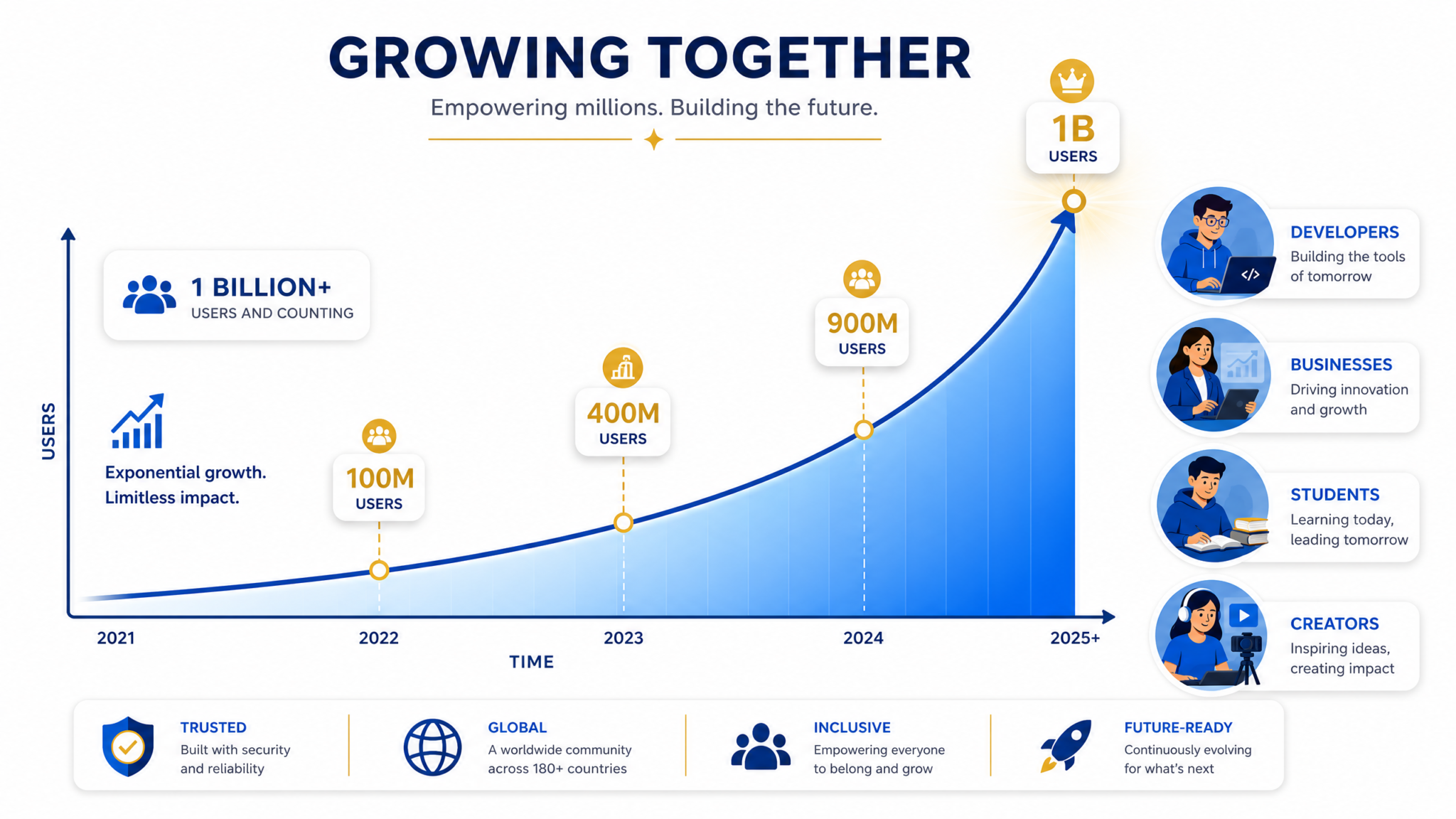
On July 31, 2026, OpenAI CEO Sam Altman posted a single announcement that sent shockwaves through the technology industry: ChatGPT had crossed the threshold of 1 billion active users. The number is not a vanity metric or a cumulative registration count — it represents one billion people actively engaging with the platform on a regular basis. To put that in context, it took Facebook over eight years to reach the same milestone. ChatGPT did it in under four.
This achievement is not merely a story about one product’s popularity. It signals a fundamental rewiring of how humanity interacts with software, how businesses deploy intelligence, and how the global AI industry will be structured for the decade ahead. The path to one billion was paved with aggressive pricing strategy, relentless model iteration, and a series of competitive moves that left rivals scrambling to respond. Understanding what drove this growth — and what it means for developers, businesses, and everyday users — requires looking carefully at the numbers, the decisions, and the broader market forces at play.
The Growth Trajectory: From 100 Million to 1 Billion in Three and a Half Years
ChatGPT launched publicly on November 30, 2022, and reached 100 million monthly active users by January 2023 — a pace that shattered every prior record for consumer internet adoption. For comparison, TikTok took nine months to reach the same figure, Instagram took two and a half years, and Spotify took more than four years. The speed of ChatGPT’s initial adoption became the benchmark against which all subsequent AI product launches would be measured.
But the first hundred million was, in retrospect, just the ignition. The platform’s growth between January 2023 and early 2026 was characterized by a series of step-changes rather than linear progression. Each major model release — GPT-4 in March 2023, the GPT-4o multimodal rollout in May 2024, GPT-5 in early 2025 — brought a measurable surge in both new user acquisition and engagement depth among existing users. By the time OpenAI reported 400 million weekly active users in February 2026, the platform had already established itself as the dominant general-purpose AI interface globally.
The Acceleration Phase: 2025 to 2026
The jump from 400 million weekly active users in February 2026 to 1 billion by July 2026 — just five months — is arguably more remarkable than any prior growth phase. It represents an addition of roughly 600 million active users in less than half a year. Several forces converged to produce this acceleration, but the single most impactful catalyst was OpenAI’s decision to dramatically cut the pricing of its most capable models, particularly within the GPT-5 series.
The GPT-5.6 Luna pricing cut of approximately 80 percent made the model economically viable for use cases — particularly in enterprise automation, consumer applications, and emerging market deployments — that had previously been priced out. The simultaneous Terra model reduction of around 20 percent brought OpenAI’s most capable reasoning tier into competitive alignment with alternatives that had been gaining ground. These were not marginal adjustments. An 80 percent reduction in API pricing fundamentally changes the calculus for every developer building on the platform, every startup evaluating infrastructure costs, and every enterprise CFO signing off on AI budget allocations. GPT-5.6 Luna Pricing and Model Comparison
Comparative Technology Adoption Rates
| Product / Platform | Launch Year | Time to 100M Users | Time to 1B Users | Growth Category |
|---|---|---|---|---|
| 2004 | ~4.5 years | ~8.5 years | Social Network | |
| YouTube | 2005 | ~2 years | ~8 years | Video Platform |
| 2009 | ~3.5 years | ~7 years | Messaging App | |
| 2010 | ~2.5 years | ~6 years | Photo Sharing | |
| TikTok | 2016 | ~9 months | ~5 years | Short-form Video |
| ChatGPT | 2022 | ~2 months | ~3.7 years | AI Assistant |
The table above illustrates that while ChatGPT’s overall time to 1 billion users is not the fastest ever recorded, its initial adoption velocity remains unmatched. The platform set the record for reaching 100 million users and, critically, it sustained growth across a far more technically complex and computationally expensive product than any prior consumer internet service at comparable scale.
The Pricing Strategy That Unlocked Mass Adoption
OpenAI’s pricing decisions in the first half of 2026 were not reactive concessions to competitive pressure — they were aggressive offensive moves designed to eliminate the economic friction that had kept AI adoption confined to early adopters, well-funded enterprises, and technology-adjacent users in high-income markets.
GPT-5.6 Luna: The 80 Percent Cut That Changed Everything
The GPT-5.6 Luna pricing reduction deserves particular analysis because 80 percent is not a rounding error — it is a deliberate market-capture strategy. When OpenAI reduced Luna’s input token price from its launch pricing to approximately one-fifth of the original cost, it accomplished several things simultaneously. First, it made Luna economically indistinguishable from much less capable models that had previously competed on price alone. Second, it enabled a class of high-volume applications — customer service automation, educational tutoring platforms, healthcare information tools, logistics query systems — that require millions of daily interactions and had been economically unsustainable at higher per-token costs.
In emerging markets, this price reduction was transformative. India, Brazil, Indonesia, Nigeria, and the Philippines collectively added tens of millions of new users following the Luna price cut, both through direct ChatGPT subscriptions and through third-party applications built on the API. The $20-per-month Plus subscription remained the primary consumer offering in high-income markets, but the underlying inference cost reduction meant OpenAI could now profitably serve users across a much wider global income distribution. ChatGPT Pricing Plans Compared
Terra Model: Defending the Premium Tier
The Terra model’s 20 percent price reduction served a different strategic purpose. Terra sits at the top of OpenAI’s capability hierarchy — the model enterprises deploy for complex reasoning, scientific research assistance, advanced code generation, and legal document analysis. At its original price point, some customers were actively evaluating Anthropic’s Claude 4 Opus and Google’s Gemini Ultra as alternatives. The 20 percent reduction was calibrated to close that gap without sacrificing the positioning of Terra as a premium product. It was a defensive move that doubled as a signal to the enterprise sales channel: OpenAI intended to compete on both capability and economics simultaneously.
The Freemium Expansion
Alongside the API pricing changes, OpenAI substantially expanded the capabilities available on the free tier of ChatGPT throughout early 2026. Free users gained access to features that had previously been Plus-only, including extended context windows, basic image generation, and limited access to real-time web search. This deliberate capability cascade — moving yesterday’s premium features into the free tier — is a classic consumer technology playbook, but OpenAI executed it with particular timing precision, ensuring that the free tier expansion coincided with the Luna pricing cut to maximize the network effect of simultaneous consumer and developer adoption growth.
Competitive Implications: Where Does This Leave Google, Anthropic, and Meta?
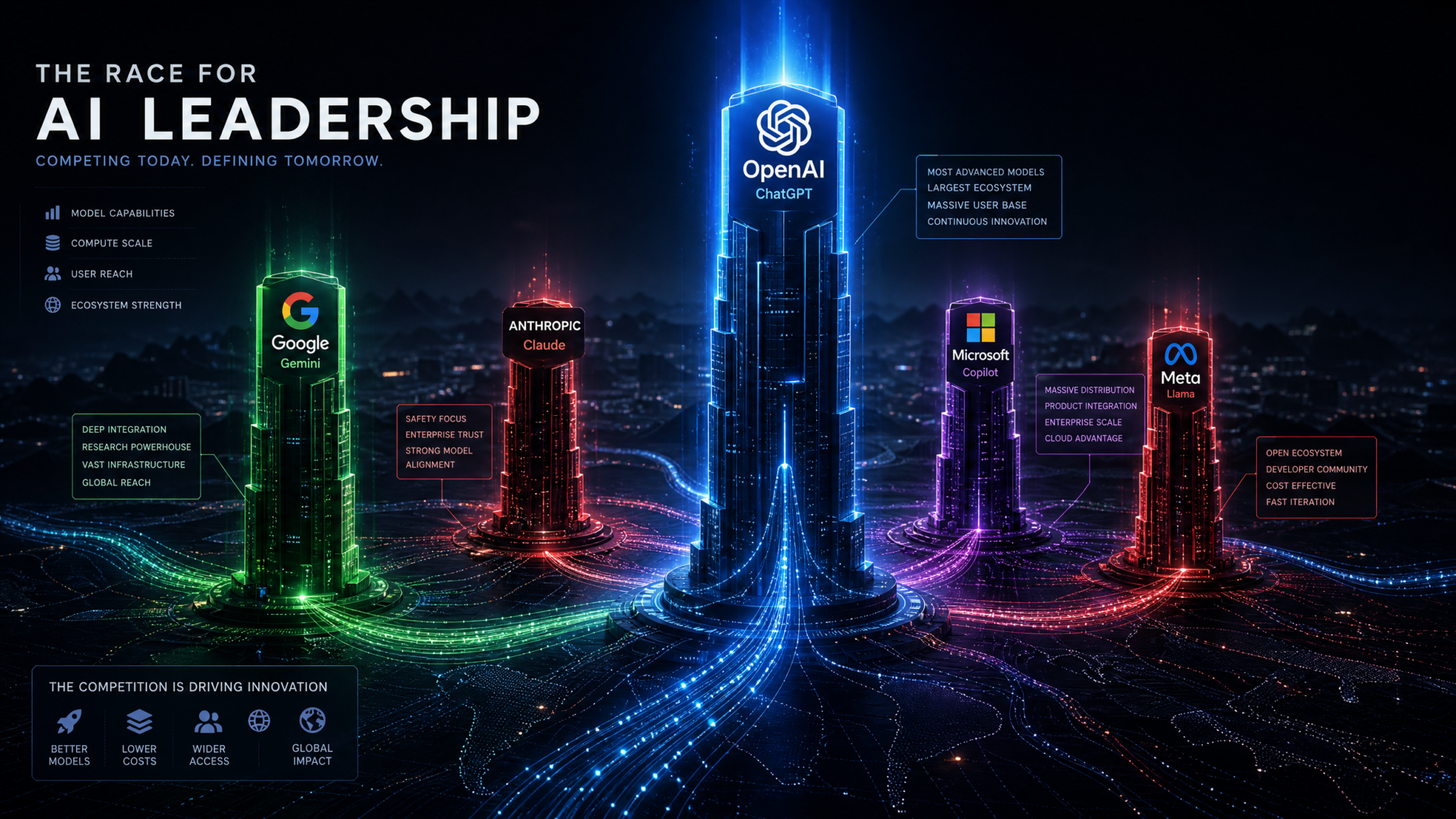
The competitive landscape for AI assistants has never been more consequential, and ChatGPT’s 1 billion user milestone forces every competitor to confront an uncomfortable reality: network effects in AI are real, compounding, and increasingly difficult to disrupt.
Google Gemini: The Search Giant’s Existential Calculus
Google’s position is the most complicated of any ChatGPT competitor. Gemini has achieved impressive technical benchmarks, and the integration of Gemini capabilities directly into Google Search — with AI Overviews appearing for a significant fraction of all search queries — means Google’s AI reach in terms of raw query volume likely exceeds ChatGPT’s. However, reach and active user engagement are different metrics. Millions of people encounter Gemini-powered AI Overviews without thinking of themselves as AI users. ChatGPT’s 1 billion represents people who consciously chose to engage with an AI assistant as a primary tool.
This distinction matters for the monetization trajectories of both companies. Google’s challenge is converting passive Gemini exposure into the kind of deep, habituated engagement that generates subscription revenue and defensible switching costs. OpenAI’s advantage is that its users already think of ChatGPT as a distinct, intentionally chosen product — something closer to how people relate to their email client than to a feature within a search page. The fact that Google has not publicly disclosed Gemini’s active user count as a standalone metric is itself revealing.
Anthropic Claude: The Quality-First Challenger
Anthropic’s strategy has consistently prioritized capability and safety over raw user count, and Claude has built a genuinely loyal enterprise customer base on the strength of its reasoning performance and the Constitutional AI approach that differentiates its output character. Claude 4 Opus remains competitive with OpenAI’s Terra on several professional benchmarks, and Anthropic’s API business continues to grow.
But the gap in consumer mindshare between Claude and ChatGPT has widened, not narrowed, over the past 18 months. Without a mass-market consumer product that generates the daily habituation loop ChatGPT has established, Anthropic faces the risk of being positioned as an excellent enterprise API provider — valuable and profitable, but structurally capped in its growth ceiling compared to a platform with a billion active users generating daily training signal, feature demand data, and word-of-mouth growth. Anthropic Claude vs ChatGPT Comparison
Meta AI: Scale Without Stickiness
Meta’s approach to AI distribution is arguably the most aggressive of any competitor: embedding Meta AI directly into WhatsApp, Instagram, Facebook Messenger, and the Meta Ray-Ban glasses has given the product access to billions of existing users with zero acquisition cost. Meta CEO Mark Zuckerberg announced in mid-2025 that Meta AI had surpassed 500 million monthly active users, a figure that was widely cited as evidence of ChatGPT’s vulnerability.
The 1 billion ChatGPT announcement reframes that narrative significantly. Meta AI’s distribution advantage — riding on top of existing social platforms — has proven less decisive than many analysts predicted, precisely because users who encounter AI within their social feed have a different intent and engagement depth than users who navigate directly to an AI assistant. OpenAI has effectively demonstrated that building a standalone destination product generates more durable engagement than embedding AI as a feature within a larger platform, at least at the current stage of the technology’s maturity.
Competitive User Base Comparison: Mid-2026
| AI Platform | Company | Reported Active Users (2026) | Primary Distribution | Primary Revenue Model |
|---|---|---|---|---|
| ChatGPT | OpenAI | 1B+ (monthly active) | Direct / API / Partners | Subscriptions + API |
| Meta AI | Meta | ~500M+ (monthly active) | Embedded in Meta apps | Advertising (indirect) |
| Gemini | Google / Alphabet | Not disclosed (billions of exposures via Search) | Google Search + Workspace | Subscriptions + Search |
| Claude | Anthropic | ~50-80M (estimated active) | Direct + API + Partners | Subscriptions + API |
| Copilot | Microsoft | ~300M+ (via Microsoft 365) | Embedded in Microsoft suite | Enterprise licensing |
| Perplexity | Perplexity AI | ~100M+ (estimated) | Direct / App | Subscriptions + Advertising |
What 1 Billion Users Means for Developers and Businesses
For the developer and business communities, ChatGPT’s milestone is less a cause for celebration and more a signal to recalibrate strategic assumptions. A platform with a billion active users is not just a large API provider — it is infrastructure. And infrastructure, once embedded into production workflows at scale, generates switching costs that compound over time.
The Platform Network Effect Matures
OpenAI’s Custom GPTs, the GPT Store, and the broader ecosystem of third-party integrations built on the ChatGPT interface have benefited directly from user base growth in ways that are not immediately visible in headline user counts. When a billion people use ChatGPT, the incentive for businesses to build ChatGPT plugins, integrations, and specialized assistants increases dramatically. This creates a flywheel: more users attract more developers, more developers create more use cases, more use cases attract more users. The platform effect that made Apple’s App Store and Google Play largely unassailable is beginning to manifest in the AI assistant space with ChatGPT at its center.
For developers building AI-native applications, the implications are practical. Distribution within or alongside ChatGPT — whether through the GPT Store, API-powered integrations, or the operator API that allows companies to build branded ChatGPT interfaces — now represents one of the most efficient paths to reaching end users at scale. Competing distribution channels exist, but none currently offer access to a billion active users who have already demonstrated willingness to engage with AI assistants as a primary productivity and information tool.
Enterprise Adoption: From Pilot to Production
The story of enterprise AI adoption in 2025 and 2026 has been one of conversion — moving from the cautious pilots and proof-of-concept projects that characterized 2023 and 2024 into genuine production deployments at organizational scale. The price cuts that drove consumer adoption also accelerated enterprise procurement decisions. When the cost of running AI-assisted workflows drops by 80 percent, the ROI calculation for deployment changes fundamentally, and budget holders who had been waiting for clearer economics received their answer.
OpenAI’s enterprise customer count has grown in parallel with its consumer user base. The company has disclosed partnerships with a significant portion of the Fortune 500, and the ChatGPT Enterprise and ChatGPT Team tiers have become standard line items in corporate software budgets. The combination of user familiarity — employees who already use ChatGPT personally are dramatically easier to onboard to enterprise deployments — and the security, compliance, and administrative controls built into the enterprise tier has given OpenAI a structural advantage in converting consumer adoption into enterprise revenue. ChatGPT Enterprise Features and Use Cases
The API Business: Pricing Power and Volume Trade-offs
OpenAI’s API business presents an interesting economic tension at the 1 billion user scale. The dramatic price cuts on Luna and the moderate reduction on Terra demonstrate that OpenAI is prioritizing volume and ecosystem growth over near-term API margin maximization. This is a bet that the long-term value of becoming the dominant AI infrastructure layer — with billions of dependent applications, services, and workflows — outweighs the short-term revenue foregone by cutting prices before being forced to do so by competition.
The bet is not without risk. Every price cut reduces the revenue per API call while increasing volume. If the volume increase does not fully compensate for the margin compression — and at 80 percent cuts, the arithmetic requires massive volume expansion to break even on revenue — OpenAI must rely on subscription growth and enterprise contracts to cover the gap. The good news for OpenAI is that its subscription base has grown commensurately with its total user base, and the enterprise pipeline has never been larger. The 1 billion milestone is itself a sales argument: no procurement committee can easily justify choosing a smaller platform when the largest one has become the industry standard.
The Path to Profitability: Revenue Architecture at Billion-User Scale
OpenAI’s financial journey has been one of the most closely watched stories in technology. The company raised capital at valuations that implied eventual profitability at massive scale, spent aggressively on research and compute, and operated at substantial losses for much of its history. The path to profitability at 1 billion users looks meaningfully different from what it did at 100 million.
Revenue Streams at Scale
OpenAI’s revenue architecture has diversified significantly from its early days as primarily an API business. By mid-2026, the company’s revenue is understood to come from several distinct streams, each with different margin profiles and growth trajectories.
Consumer subscriptions — ChatGPT Plus at $20 per month and ChatGPT Pro at $200 per month — represent a high-margin, recurring revenue stream that scales directly with active user conversion rates. If even 5 percent of ChatGPT’s 1 billion active users convert to a paid plan averaging $25 per month, that represents $1.5 billion in monthly subscription revenue, or approximately $18 billion annualized from subscriptions alone. The actual conversion rate OpenAI achieves is not publicly disclosed, but the company has reported annual revenue run rates exceeding $10 billion in early 2026, suggesting that the combined revenue from subscriptions and API is substantial.
Enterprise contracts, while smaller in customer count, carry higher average contract values and typically include multi-year commitments that improve revenue predictability. The ChatGPT Enterprise tier’s pricing is negotiated individually, but industry estimates suggest average annual contract values in the range of hundreds of thousands to millions of dollars for larger deployments.
The Compute Cost Equation
The reason profitability has remained elusive despite growing revenue is the sheer cost of inference at billion-user scale. Running a model as capable as GPT-5.6 Luna for a billion users requires a compute infrastructure that dwarfs anything previously built for consumer internet services. Unlike a social network, where serving a user means storing and transmitting relatively simple data, serving an AI query involves substantial real-time computation for every interaction.
OpenAI’s investments in custom inference chips, purpose-built data centers, and the broader push to reduce inference cost through architectural innovation — including the distillation approaches that made the smaller, cheaper Luna model possible without sacrificing the quality of larger predecessors — are central to the profitability path. As inference costs decline through a combination of hardware improvement, software optimization, and model architecture refinement, the economics of serving a billion users shift from loss-generating to profitable. The 80 percent price cut on Luna was only possible because OpenAI’s internal inference cost had already fallen far enough to preserve margin at the new price point.
Revenue and Growth Milestones Timeline
| Date | Milestone | Key Driver | Estimated ARR |
|---|---|---|---|
| Jan 2023 | 100M monthly active users | Organic viral growth post-launch | ~$200M |
| Nov 2023 | 100M+ weekly active users | GPT-4 adoption, plugins launch | ~$1.6B |
| Aug 2024 | 200M weekly active users | GPT-4o multimodal, free tier expansion | ~$3.4B |
| Feb 2026 | 400M weekly active users | GPT-5 launch, operator API growth | ~$8B+ |
| Jul 2026 | 1B monthly active users | Luna/Terra price cuts, global expansion | ~$12-15B (est.) |
The Advertising Question
One revenue stream that OpenAI has conspicuously not activated — despite the obvious logic at billion-user scale — is advertising. A platform with a billion active users who provide detailed signals of their interests, needs, and intent through their queries represents an advertising inventory that would be extraordinarily valuable. The company has acknowledged internally evaluating advertising models while consistently declining to commit to a timeline.
Access 40,000+ AI Prompts for ChatGPT, Claude & Codex — Free!
Subscribe to get instant access to our complete Notion Prompt Library — the largest curated collection of prompts for ChatGPT, Claude, OpenAI Codex, and other leading AI models. Optimized for real-world workflows across coding, research, content creation, and business.
The reluctance is likely a combination of strategic caution and competitive differentiation. Users who pay for ChatGPT have an explicit expectation of an ad-free, uncompromised experience. Introducing advertising into the premium tiers would damage the trust relationship that underlies subscription willingness. An advertising tier for free users is more plausible, but OpenAI appears to be prioritizing converting free users to paid subscriptions rather than monetizing them through advertising — at least in the near term. At billion-user scale, the eventual decision on advertising will represent one of the most consequential monetization choices in technology history.
Global Impact: Democratization at Scale and the Digital Divide
The political and social dimensions of ChatGPT’s 1 billion milestone are as important as the commercial ones. Reaching a billion users means ChatGPT is no longer primarily a product used by technology professionals, affluent consumers in high-income countries, or academic researchers. It has become a tool used by farmers seeking agricultural advice, students in under-resourced schools accessing tutoring, small business owners in developing markets writing their first marketing copy, and healthcare workers in rural areas checking clinical references.
Language and Accessibility
A significant portion of ChatGPT’s growth in the 2025-2026 period has come from non-English-speaking markets. OpenAI’s investments in multilingual model performance — particularly in languages historically underserved by AI tools — have been a meaningful driver of adoption in markets like India, Brazil, Indonesia, and across Sub-Saharan Africa. The ability to interact with a capable AI assistant in Hindi, Portuguese, Bahasa Indonesia, or Yoruba is not a marginal product improvement for users in those markets; it is the difference between the product being accessible at all.
Voice interface improvements have further expanded accessibility for users who find text-based interaction with a keyboard less natural — either because of literacy constraints, physical disability, or cultural preference for voice communication. ChatGPT’s Advanced Voice Mode, which has become significantly more capable and natural-sounding across a wider range of languages and accents throughout 2025 and 2026, has been disproportionately adopted in markets where mobile-first, voice-first usage patterns are dominant.
The Regulatory Dimension
Reaching 1 billion users also transforms OpenAI’s relationship with governments and regulators worldwide. A product used by one in eight people on Earth is infrastructure in the most meaningful political sense of the word. Regulatory scrutiny has intensified in parallel with growth: the European Union’s AI Act imposes compliance requirements that scale with system capability and reach; the United States has implemented a series of executive orders and proposed legislation that directly affects how AI companies of OpenAI’s scale must operate; and countries from India to Brazil have introduced or are actively developing domestic AI governance frameworks.
OpenAI’s investments in policy and regulatory affairs have grown in proportion to its user base, and the company’s decisions about model behavior, safety guardrails, content moderation, and data handling now have policy implications at a national level for dozens of countries. The billion-user milestone is not just a commercial achievement — it is an accession to a category of technological infrastructure that carries obligations and scrutiny comparable to telecommunications networks and financial systems.
What This Means for You: Individual Users and Small Businesses
Beyond the macro-level analysis of competitive dynamics and revenue architecture, the 1 billion milestone has direct, practical implications for people who use ChatGPT as a daily tool — and for those who have not yet started.
Product Investment Commitment
At 1 billion users, OpenAI’s incentive to continue investing in ChatGPT’s product quality, reliability, and feature breadth is stronger than at any previous point in the platform’s history. Companies with a billion active users do not abandon their core product. They invest in it obsessively, because the switching cost implications of quality degradation at that scale are catastrophic. For individual users, this represents a form of confidence: the platform they have built workflows around, learned to use effectively, and integrated into their professional and personal lives is not going anywhere. The development roadmap will be resourced and executed.
Pricing Stability and Future Cuts
The pattern of periodic price reductions that has characterized OpenAI’s strategy since late 2024 is likely to continue, though the magnitude of future cuts will depend on the rate at which inference costs continue to decline. For individual subscribers, this means the $20 Plus tier may either drop in price or see significant capability expansions at the current price point as better models become available. For small businesses using the API, the trajectory of declining per-token costs should be factored into financial projections: workloads that are marginally viable today may become clearly profitable within 12 to 18 months as costs continue to fall.
The Habituation Advantage
One underappreciated dimension of being an experienced ChatGPT user at this moment is the compound advantage of habituated skill. Using AI effectively is not a binary capability — it is a spectrum of prompting sophistication, workflow integration depth, and domain-specific application knowledge that accumulates over time. Users who have been engaging with the platform for months or years have built a practical expertise that translates into measurable productivity advantages over those just beginning. As the platform becomes standard infrastructure for professional work, the gap between sophisticated and novice users will have real economic consequences.
The Deeper Significance: A New Technological Era Arrives
Technology milestones can be deceiving in their simplicity. A number — 1 billion — doesn’t fully capture the qualitative shift it represents. But the history of technology suggests that certain quantitative thresholds mark genuine inflection points at which a technology’s social role changes in kind, not just in degree.
The internet’s first billion users, achieved around 2005, marked the transition from an early-adopter curiosity to a genuine infrastructure of modern life. The smartphone’s first billion active devices, reached around 2012, marked the beginning of mobile-first computing as the dominant paradigm. In each case, the milestone was a marker for something that had already been happening — a technology had crossed the threshold from “used by people interested in technology” to “used by people who just need to get things done.”
ChatGPT’s 1 billion users represents exactly that transition for AI. The majority of people using ChatGPT today are not AI enthusiasts or technology early adopters. They are students, teachers, writers, coders, small business owners, healthcare workers, and professionals across every industry who have found that the tool helps them do their work better, faster, or more affordably than before. AI has, in the most meaningful sense of the word, gone mainstream.
The implications of this transition will unfold over the next decade in ways that are difficult to fully anticipate. But the foundation is now clear: a billion-user AI platform represents a new category of technology infrastructure — as foundational as search, as personal as the smartphone, and arguably more transformative than either, because it doesn’t just help people find information or communicate. It helps them think.
Looking Ahead: The Road to 2 Billion and Beyond
OpenAI has not publicly stated a target for its next user milestone, but the trajectory suggests that the path from 1 billion to 2 billion will be faster than any prior growth phase, for several reasons. First, the network effects that come with billion-user platforms are self-reinforcing in ways that accelerate growth rather than slow it. Second, the remaining potential user base — estimated at approximately 4.5 billion smartphone users who have not yet actively used ChatGPT — includes populations where internet penetration and smartphone ownership are growing rapidly, meaning the addressable market is expanding even as ChatGPT’s market share within it increases. Third, the pricing and product decisions OpenAI has made in 2026 have removed the most significant barriers to adoption that existed at the 400 million user stage.
The competitive response will be fierce. Google will continue integrating Gemini more deeply into the products used by billions of existing users. Anthropic will deepen its enterprise relationships and pursue distribution partnerships that expand Claude’s consumer reach. Meta will leverage its social graph to create AI experiences that are more contextually personalized than anything a standalone assistant can currently offer. New entrants — domestic AI champions in China, India, and Europe — will compete aggressively in their home markets.
None of these competitive responses, however, changes the fundamental reality that OpenAI enters the second half of 2026 with a platform used by 1 billion people, a cost structure that is rapidly improving, a developer ecosystem of unmatched scale, and a brand recognition in the AI space that no competitor has yet come close to matching. The race is not over — in many ways, it has just reached its most consequential phase. But the terms on which it will be contested have been fundamentally set by a number that arrived, with unusual clarity, on July 31, 2026.
“We built ChatGPT to be useful to as many people as possible. A billion people finding it useful is humbling and motivating in equal measure. It means the responsibility we carry has grown, not just the opportunity.”
— Sam Altman, OpenAI CEO, July 31, 2026
The milestone is real, the implications are significant, and the moment demands more than passive observation from anyone whose professional or personal life involves knowledge work. Whether you are a developer building the next AI-native application, an enterprise leader evaluating AI strategy, or an individual professional assessing how to remain competitive in a changing labor market, the arrival of AI’s first billion-user platform is a signal that demands a clear-eyed response. The question is no longer whether AI will transform your industry. It is whether you will be positioned to benefit when it does.
Article by Markos Symeonides, Senior Content Writer, ChatGPT AI Hub. Published July 31, 2026.
