
Cisco Deploys Personalized AI Agents to All 90,000 Employees: What Enterprise-Wide Agent Rollouts Mean for the Industry
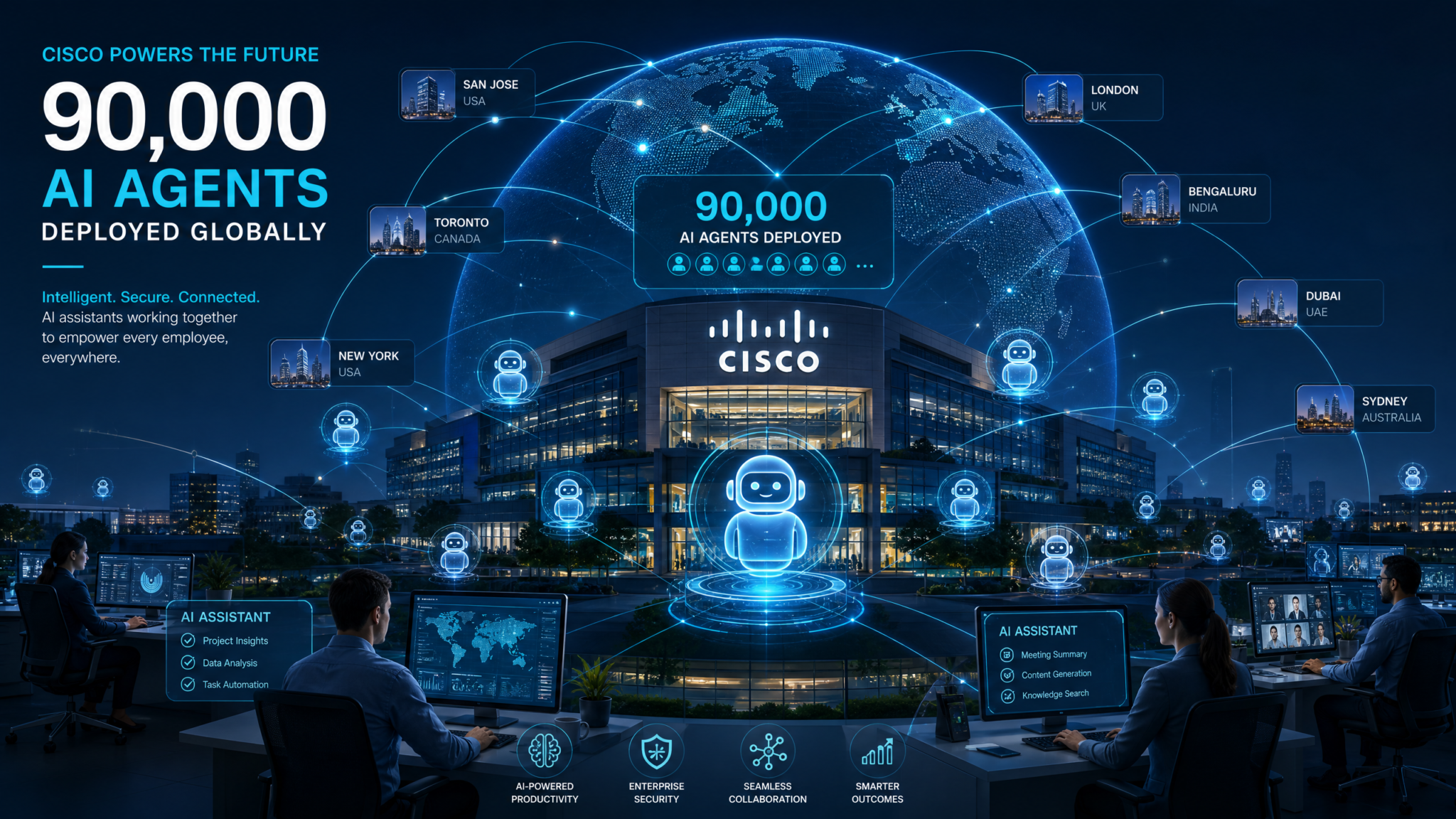
In what analysts are already calling the most ambitious corporate AI deployment in history, Cisco Systems has rolled out personalized AI agents to every single one of its approximately 90,000 employees — a move that marks a defining inflection point in the enterprise technology landscape. Announced across July and August 2026, the program places a dedicated, learning AI agent in the hands of every Cisco worker, from software engineers in San Jose to sales representatives in Singapore. The agents are not generic assistants; they are architected to adapt to individual workflows, accumulate context over time, and progressively take on tasks that previously consumed hours of skilled human labor. This is not a pilot. This is not a phased rollout with a waiting list. This is the entire company, all at once — and the industry is watching with a mixture of awe and anxiety.
Cisco’s Deployment: Scale, Timeline, and Ambition
When Cisco’s Chief People Officer and Chief Information Officer jointly presented the AI agent initiative internally in early July 2026, the reaction from employees ranged from enthusiasm to nervous curiosity. The program, developed over approximately eighteen months, represents not only the largest single-company AI agent deployment ever attempted but also a fundamental philosophical shift in how Cisco views the relationship between human workers and intelligent software systems.
The deployment operates on a tiered rollout schedule. Engineering and product teams received access first, beginning in early July 2026, given that their workflow data — code repositories, ticketing systems, documentation libraries — was most structured and therefore most immediately useful for agent training. Customer success, sales, and operations teams followed in the second week of July. By mid-August 2026, every remaining employee globally, including those in legal, finance, HR, and executive functions, had an active personalized agent provisioned to their Cisco identity credentials.
Each employee receives what Cisco internally calls a “Personal Workforce Agent” or PWA. The naming is deliberate: Cisco’s leadership has consistently framed these agents not as tools or software but as professional collaborators — a positioning choice that carries enormous implications for how workers are expected to interact with them. Rather than opening an application and typing commands, employees are encouraged to treat PWAs as a continuous presence that observes, learns, and proposes.
“We are not giving employees a smarter search bar. We are giving every person at Cisco a colleague that never forgets their preferences, never loses context between meetings, and continuously gets better at anticipating what they need.” — Chuck Robbins, Cisco CEO, July 2026 internal all-hands address
The scope of what these agents can do from day one is significant. Cisco’s PWAs can autonomously draft and send internal communications pending approval, synthesize information from across Webex, Confluence, Jira, and Salesforce CRM environments, schedule and prepare agendas for meetings, write and debug code snippets for engineering staff, generate customer-facing proposals for sales teams, and flag compliance anomalies for legal and finance functions. Over time — and this is the genuinely novel part of the architecture — they are designed to reduce the need for approval on routine tasks as trust is established through demonstrated accuracy.
For context, Cisco’s fiscal year 2025 revenue was approximately $53.8 billion, making it one of the largest enterprise technology companies in the world. The company’s decision to commit to full-scale agentic AI deployment carries an implicit endorsement that will almost certainly accelerate adoption among its own customer base, which includes a significant portion of the Fortune 500. Cisco is, in effect, its own most visible case study.
| Phase | Timeline | Employee Groups | Estimated Headcount | Primary Use Cases |
|---|---|---|---|---|
| Phase 1 | July 1–7, 2026 | Engineering, Product, Research | ~22,000 | Code assistance, documentation, bug triage |
| Phase 2 | July 8–14, 2026 | Sales, Customer Success, Partnerships | ~28,000 | CRM updates, proposal drafting, pipeline analysis |
| Phase 3 | July 15–31, 2026 | Operations, Marketing, IT Support | ~25,000 | Workflow automation, campaign drafting, ticket resolution |
| Phase 4 | August 1–15, 2026 | Legal, Finance, HR, Executive | ~15,000 | Compliance review, financial modeling, HR queries |
Technical Architecture: How Personalized AI Agents Actually Work at Scale
Building a system that delivers genuinely personalized AI agents to 90,000 employees simultaneously is a substantially harder problem than deploying a single enterprise chatbot. The distinction lies in the word “personalized” — and understanding what Cisco actually means by it requires unpacking a layered technical architecture that combines foundation model capabilities with employee-specific context graphs.
At the foundation layer, Cisco’s PWAs run on a multi-model infrastructure. According to technical documentation shared with enterprise partners and confirmed by Cisco’s developer relations team in August 2026, the system uses a combination of OpenAI’s GPT-4o-series models for general reasoning and conversational tasks, Anthropic Claude 3.5 for document summarization and legal-adjacent analysis, and Cisco’s own fine-tuned models for network infrastructure and cybersecurity domain tasks. The orchestration layer — which decides which model to invoke for which task — runs on Cisco’s internal AI Platform, integrated with its existing Webex AI and Meraki infrastructure.
The personalization layer is where the architecture becomes genuinely innovative. Each employee has a persistent context graph maintained in a dedicated vector store. This graph is continuously updated with information derived from: calendar data and meeting outcomes, communication patterns and response tendencies, document editing history, code commit patterns for engineering staff, CRM interaction history for customer-facing roles, and explicit preferences that employees set through a preferences interface called the “Agent Profile.” Critically, the system uses differential privacy techniques to ensure that personal context data cannot be extracted or used to cross-contaminate the agents of other employees — a design requirement that Cisco’s security team made non-negotiable during development.
The agent action layer determines what the PWA can actually do autonomously versus what requires employee confirmation. Cisco has implemented a “trust tier” framework with four levels:
- Tier 1 (Observe): The agent watches, learns, and makes suggestions but takes no action. All new employees begin here during a two-week onboarding period.
- Tier 2 (Assist): The agent drafts content, prepares materials, and queues actions for one-click approval. Most employees operate at this level by default.
- Tier 3 (Act with Notification): The agent executes defined routine tasks autonomously and notifies the employee after completion. This tier requires explicit opt-in and manager acknowledgment.
- Tier 4 (Full Delegation): Reserved for specific, pre-approved workflow categories. Currently limited to internal scheduling, calendar management, and certain code deployment pipelines. Requires CIO-office approval on a per-role basis.
This tiered autonomy model is significant from a governance perspective and directly addresses one of the most loudly voiced concerns in enterprise AI circles: the risk of agents taking consequential actions without appropriate human oversight. Cisco’s architects have embedded the principle that autonomy is earned through demonstrated reliability rather than granted at deployment. The system logs all Tier 3 and Tier 4 actions with full chain-of-reasoning documentation — a feature that serves both audit and accountability purposes.
Integration depth is another differentiating factor. The PWA connects to over forty enterprise systems through a combination of native API integrations and an MCP (Model Context Protocol) gateway that Cisco has standardized on for third-party connections. This includes Salesforce Sales Cloud, ServiceNow, GitHub Enterprise, Confluence, Jira, Workday, SAP Concur, and Cisco’s own Webex platform. The breadth of integration means the agent has a genuinely holistic view of an employee’s work context rather than operating in the siloed fashion that has historically undermined enterprise AI assistant effectiveness.
From a computational cost standpoint, Cisco has disclosed that the program operates at significantly lower per-employee cost than initial estimates predicted, primarily because the vast majority of agent interactions at steady state involve relatively short-context reasoning tasks — drafting a reply, summarizing a document, flagging a meeting conflict — rather than the deep reasoning calls that drive up token costs. The company reports average daily costs per active agent in the range of $3–$8, though this varies considerably by role type, with engineering heavy users sitting closer to $15–$22 per day.
Enterprise AI Agent Architecture Patterns and Best Practices
Market Context: The Agentic AI Explosion
Cisco’s deployment did not occur in a vacuum. It is the most dramatic expression of a broader enterprise technology trend that has been accelerating consistently since late 2024 and reached a critical velocity point in the first half of 2026. To understand why this moment feels different from previous cycles of enterprise AI enthusiasm, it is necessary to examine the market data that surrounds it.
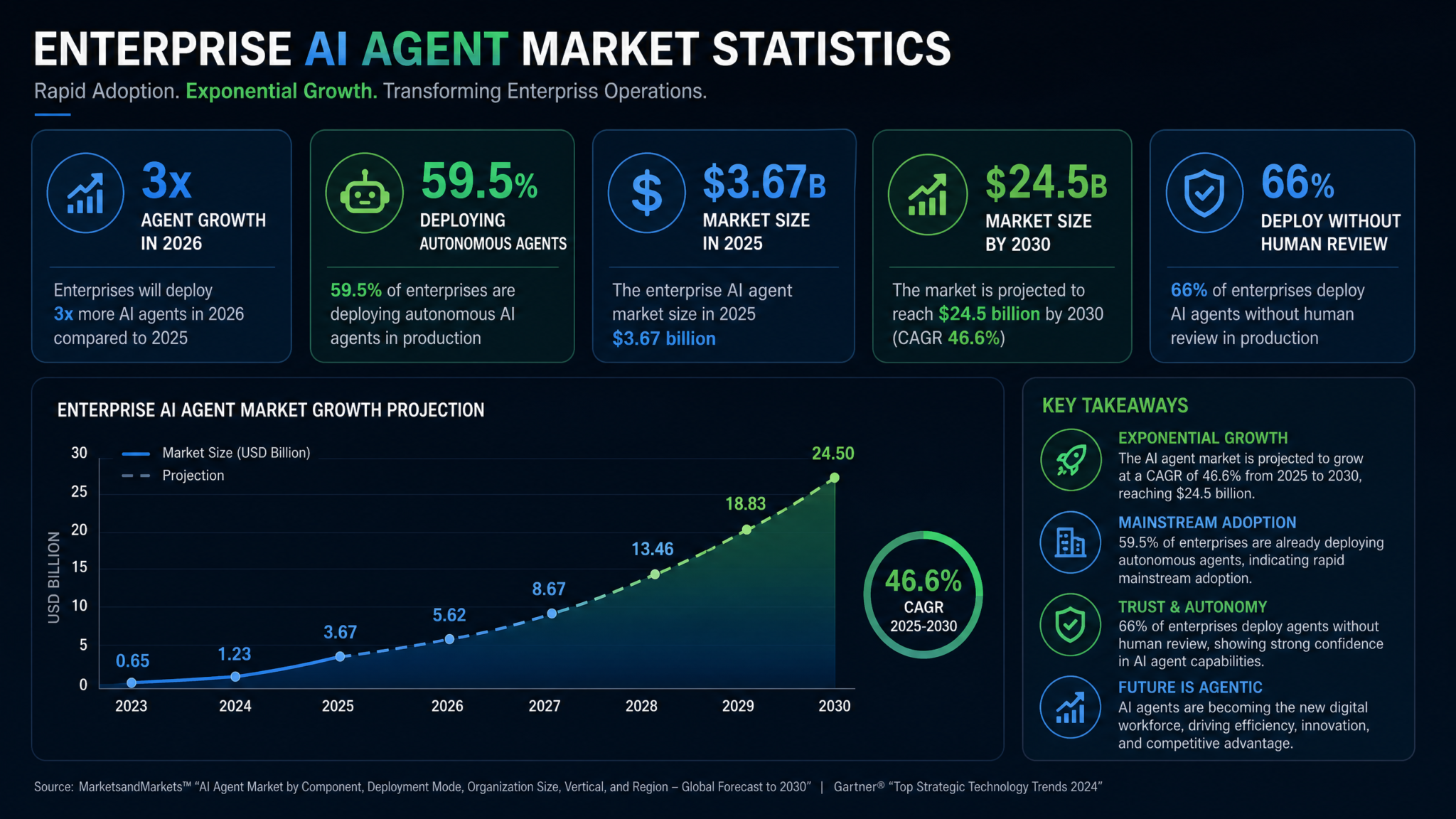
According to analysis compiled from multiple research firms including Grand View Research, MarketsandMarkets, and IDC as of mid-2026, the enterprise agentic AI market — specifically the segment covering autonomous and semi-autonomous AI agents used in business workflows — was valued at approximately $3.67 billion in 2025. Current projections have this market reaching $24.5 billion by 2030, representing a compound annual growth rate of approximately 44.8%. That growth rate is not exceptional by early-stage AI market standards, but what distinguishes agentic AI from previous enterprise AI waves is the breadth of industries and functions involved. This is not a developer tool or a specialized analytics application — agentic AI is being deployed across sales, HR, finance, legal, customer service, IT operations, and supply chain management simultaneously.
| Year | Market Size (USD Billions) | YoY Growth | Key Driver |
|---|---|---|---|
| 2023 | $0.84B | — | Early adopter pilots, LLM API availability |
| 2024 | $1.73B | +106% | GPT-4 enterprise adoption, first agentic frameworks |
| 2025 | $3.67B | +112% | Model reliability improvements, enterprise tooling maturity |
| 2026 (est.) | $6.4B | +74% | Hyperscaler bundling, Cisco/Salesforce mega-deployments |
| 2028 (proj.) | $13.2B | ~44% | Regulated industry expansion, multi-agent orchestration |
| 2030 (proj.) | $24.5B | ~36% | Autonomous enterprise workflows, agent-to-agent commerce |
What is driving the sudden shift from cautious AI experimentation to aggressive agentic deployment? Several converging factors are at play. First, the reliability threshold has crossed a critical point. In 2023 and 2024, enterprise AI pilots frequently foundered on hallucination rates, inconsistent reasoning quality, and inability to handle multi-step tasks reliably. By mid-2026, the leading foundation models have improved to a point where agentic task completion rates in well-defined domains routinely exceed 92–95%, making the business case for automation genuinely compelling rather than aspirational.
Second, the tooling ecosystem has matured dramatically. Frameworks for building, deploying, and monitoring agents — including LangChain, AutoGen, CrewAI, and purpose-built enterprise platforms from Salesforce (Agentforce), ServiceNow, and SAP — have reached production-grade stability. IT departments no longer need to build agent infrastructure from scratch. They can configure, customize, and deploy agents on top of established platforms, dramatically lowering the barrier to enterprise-wide rollout.
Third, competitive pressure has become acute. When an organization’s largest competitors announce meaningful productivity gains from AI agent deployments — and the gains being reported are substantial, ranging from 20–45% reduction in time spent on routine tasks in multiple published case studies — the cost of non-adoption becomes visible in a way it simply was not two years ago.
Salesforce’s 2026 Agentic Enterprise Index: The Data Behind the Surge
The single most comprehensive data source documenting the enterprise agentic AI surge is Salesforce’s 2026 Agentic Enterprise Index, published in June 2026 based on survey data collected from over 5,500 enterprise decision-makers across 17 countries. The report’s findings are striking not just for the headline numbers but for what they reveal about the pace of change.
The most-cited statistic from the Index is the agent count data: organizations that participated in the survey reported that they had, on average, tripled their number of active AI agents between January 2025 and January 2026. This is not marginal growth. It means that a company that entered 2025 running fifteen discrete AI agents across its operations had approximately forty-five by the start of 2026 — and the growth curve was still accelerating at time of publication.
59.5% of enterprise leaders surveyed in the Index reported that they were already actively deploying autonomous AI agents as of the survey date — meaning agents with at least some capacity to take actions without requiring human approval for every step. This is a remarkable figure because it suggests that agentic AI has already crossed the majority threshold among enterprise technology leaders within approximately eighteen months of the first production-grade agentic frameworks becoming widely available.
The Index breaks down deployment by function in ways that are instructive:
| Business Function | % Organizations with Active Agents | Most Common Use Cases | Avg. Agent Count per Org |
|---|---|---|---|
| Customer Service | 71.3% | Tier-1 resolution, case routing, follow-up | 8.4 |
| IT Operations | 68.7% | Incident response, provisioning, monitoring | 12.1 |
| Sales & Revenue | 63.2% | Pipeline updates, outreach drafting, forecasting | 6.8 |
| Software Development | 61.9% | Code generation, review, testing | 9.3 |
| Finance & Accounting | 44.6% | Reconciliation, reporting, anomaly detection | 4.2 |
| HR & Talent | 41.8% | Candidate screening, onboarding, queries | 3.7 |
| Legal & Compliance | 29.4% | Contract review, regulatory monitoring | 2.9 |
| Supply Chain | 38.1% | Inventory optimization, supplier communication | 5.6 |
The Index also identifies a clear demographic divide in adoption patterns. Organizations with more than 10,000 employees are significantly more likely to have crossed into agentic deployment than mid-market firms, which Salesforce researchers attribute primarily to infrastructure availability and the presence of dedicated AI platform teams rather than to any difference in appetite for adoption. Smaller organizations often want to deploy agents but lack the integration engineering resources to connect agents to the breadth of systems necessary for them to be genuinely useful.
One of the Index’s most provocative findings concerns perceived outcomes. Among organizations that had deployed autonomous agents for at least six months, 78% reported measurable productivity improvements, with the average reported improvement in time-to-completion for targeted tasks sitting at 34%. However, the same group reported a notable increase in error correction workload — 41% said they had experienced at least one significant agent-caused error event requiring manual remediation, and 17% described at least one error that had customer-facing consequences. This data point is crucial context for understanding why governance frameworks are not optional luxuries but operational necessities.
Salesforce Agentforce vs. Microsoft Copilot Studio Enterprise Agent Comparison
Governance Failures and the 66% Problem: Deploying Without Human Review
Perhaps the most alarming finding embedded within the broader 2026 enterprise AI data landscape is not the scale of agent deployment — it is the governance vacuum surrounding it. Multiple independent surveys conducted between March and July 2026 converge on a figure that has become a recurring talking point among enterprise technology risk professionals: approximately 66% of organizations deploying autonomous AI agents are doing so without systematic human review processes for agent-generated actions or outputs.
This does not mean that every action these agents take is completely unsupervised — most agents operate within bounded task domains where human review is implicitly embedded (a customer service agent that drafts responses still sends them through a human support representative’s queue, for instance). Rather, it means that organizations have not implemented formal governance frameworks defining which agent actions require review, who is responsible for reviewing them, how errors are logged and escalated, and what criteria trigger a review or audit of agent behavior patterns.
The implications of this governance deficit are significant and multi-dimensional:
Liability and Accountability Gaps
When an AI agent sends a legally binding commitment to a vendor, submits a regulatory filing with an error, or communicates a materially inaccurate claim to a customer, the question of accountability becomes immediately complex. Most enterprise organizations have not updated their liability frameworks, contractual templates, or employee responsibility documentation to address AI agent-initiated actions. This creates scenarios where no clear human is accountable for an agent’s consequential mistake — a situation that is already generating early case law in several jurisdictions.
Auditability Deficits
Regulated industries — financial services, healthcare, pharmaceuticals, government contractors — operate under compliance regimes that require demonstrable human decision-making accountability for a wide range of actions. Deploying autonomous agents that take actions on behalf of employees without logging the full reasoning chain and human authorization trail creates direct compliance exposure under frameworks including SOX, HIPAA, GDPR, and the EU AI Act’s provisions around high-risk AI systems in professional contexts.
Cascading Error Propagation
One of the least discussed risks in enterprise agentic AI is the multi-agent error cascade. As organizations deploy multiple agents that interact with shared data systems and, increasingly, with each other, an error made by one agent can propagate through downstream agents before any human has an opportunity to observe and correct it. In a world where 66% of organizations lack formal review processes, these cascades can run for hours or days before detection.
“We are in a governance lag that is structurally identical to what we saw with cloud security in 2011 and 2012. Organizations moved fast, captured value, and then discovered the exposure profile they had created. The difference with agents is that the actions are harder to roll back than a misconfigured S3 bucket.” — Dr. Elena Vasquez, Enterprise AI Risk Research, MIT Sloan, July 2026
Cisco’s tiered autonomy framework, described in the technical architecture section above, represents an explicit attempt to avoid this governance deficit. The company’s insistence on logging every Tier 3 and Tier 4 action with full reasoning documentation, and its limitation of full autonomous action to a small set of pre-approved task categories, stands in notable contrast to the broader industry pattern. Whether Cisco’s model becomes a governance template that other enterprises adopt — or whether competitive pressure pushes peers to deploy more aggressively and accept governance gaps as a calculated risk — is one of the defining questions of the next twelve months.
Enterprise AI Governance Frameworks for Autonomous Agent Deployments
Enterprise Comparisons: Pentagon, Salesforce, and Hyperscaler Deployments
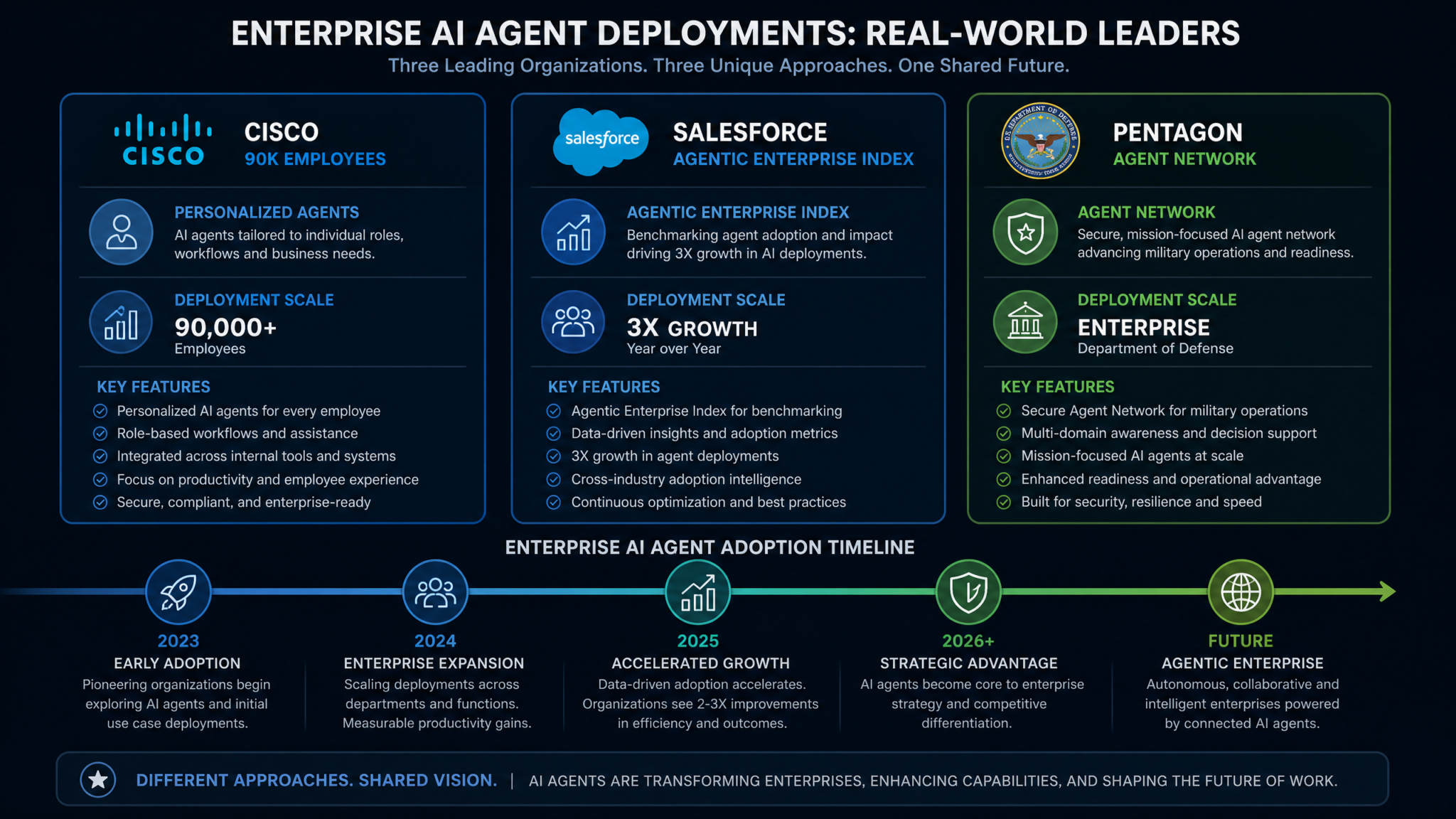
Cisco’s deployment is the largest by headcount, but it is not the only landmark enterprise agent rollout occurring in the 2025–2026 window. A comparative analysis reveals a diverse set of approaches that collectively illuminate the range of architectural choices and governance philosophies being applied to large-scale agentic AI.
The Pentagon’s Agent Network
The U.S. Department of Defense’s enterprise AI initiative, operating under the Defense Digital Service’s expanded mandate, has deployed what officials describe as an interconnected network of specialized AI agents across logistics, intelligence synthesis, procurement, and personnel operations. Unlike Cisco’s employee-facing personalized agent model, the Pentagon’s architecture focuses on role-specific agents — each agent is built for a specific institutional function rather than tailored to an individual user. The network reportedly encompasses over 340 distinct agent types running across approximately 1.2 million DoD personnel endpoints, though the degree of actual autonomous action enabled varies dramatically by security classification level and function. The DoD’s approach prioritizes compartmentalization and adversarial robustness over personalization efficiency, reflecting its unique threat model.
Salesforce’s Internal Agentforce Deployment
Salesforce presents an interesting case because the company is simultaneously a major enterprise AI agent platform vendor and an aggressive internal deployer of its own Agentforce technology. Salesforce has deployed AI agents across its own sales, service, and operations functions affecting approximately 72,000 employees. What distinguishes Salesforce’s approach is the depth of integration with its own CRM platform and the public commitment to transparency about results. The company published internal metrics showing a 27% reduction in average deal-close cycle time for sales teams using agents, a 41% decrease in tier-1 support ticket volume reaching human agents, and a $1.2 billion estimated annual productivity equivalent — figures that serve dual commercial and operational purposes.
JPMorgan Chase’s COiN Evolution
JPMorgan Chase, which made early headlines with its Contract Intelligence (COiN) platform, has significantly expanded its agentic AI footprint across investment banking, risk management, and private banking functions. The bank’s approach is notable for its regulatory caution — human review requirements remain mandatory for any agent-generated output that influences a financial product decision, counterparty communication, or regulatory filing. JPMorgan’s model represents the “high-governance, selective automation” end of the spectrum, in deliberate contrast to the move-fast tendencies of technology sector deployments.
Microsoft’s Internal Copilot Agent Ecosystem
Microsoft has deployed Copilot Studio-built agents internally across its approximately 221,000 employees, though unlike Cisco, Microsoft’s approach is primarily department-driven rather than centrally architected. Business units build and deploy their own agents using the Microsoft platform, resulting in a highly heterogeneous internal agent ecosystem. This model accelerates innovation within business units but creates exactly the kind of fragmented governance landscape that risk professionals warn about — different agents with different oversight levels, different data access permissions, and different logging standards operating in the same corporate environment.
| Organization | Employee Reach | Architecture Model | Personalization Level | Governance Approach | Reported Outcome |
|---|---|---|---|---|---|
| Cisco | ~90,000 (100%) | Centralized, personalized | Individual (context graph) | Tiered trust model, mandatory logging | In progress (ongoing) |
| Salesforce | ~72,000 | Platform-integrated | Role-level | CRM-native review workflows | 27% deal cycle reduction |
| DoD/Pentagon | ~1.2M endpoints | Distributed, function-specific | Role-specific (340+ types) | Classification-gated autonomy | Classified / Limited disclosure |
| JPMorgan Chase | ~300,000 (partial) | Centralized, high-governance | Department-level | Mandatory human review for decisions | Compliance-safe, selective gains |
| Microsoft | ~221,000 | Decentralized (unit-driven) | Team/unit-level | Heterogeneous, platform-default | Mixed; high innovation, fragmented governance |
What This Means for IT Departments and Enterprise Architecture
For enterprise IT leaders, Cisco’s 90,000-employee deployment represents both an inspiration and a substantial challenge. The inspiration is obvious: a credible proof point that full-organization agentic AI deployment is technically feasible. The challenge is equally obvious: most organizations do not have Cisco’s engineering resources, its platform expertise, or its ability to custom-build an agent orchestration layer on top of a multi-model foundation.
The IT implications of enterprise-wide agent deployment are pervasive and deserve detailed examination across several dimensions:
Access 40,000+ AI Prompts for ChatGPT, Claude & Codex — Free!
Subscribe to get instant access to our complete Notion Prompt Library — the largest curated collection of prompts for ChatGPT, Claude, OpenAI Codex, and other leading AI models. Optimized for real-world workflows across coding, research, content creation, and business.
Identity and Access Management Complexity
When AI agents act on behalf of employees, they require the same — and in some cases expanded — access to enterprise systems that those employees have. This creates an identity and access management challenge of the first order. Each agent needs to be treated as a non-human identity with its own credential set, access scope, and audit trail. Organizations that have not modernized their IAM infrastructure to accommodate non-human identities at scale will encounter immediate blockers when attempting to replicate Cisco-style deployments. The concept of a “digital twin” identity — where an employee’s agent has a formally defined, permission-bounded identity separate from the employee’s own credentials — is rapidly becoming a foundational enterprise architecture requirement rather than a theoretical concept.
Data Governance and the Context Graph Problem
Personalized agents that accumulate context over time create new data governance requirements. The context accumulated in an employee’s agent — meeting summaries, communication patterns, decision history — is a sensitive data asset that must be classified, stored, retained, and potentially deleted according to applicable policies. When an employee leaves the organization, what happens to their agent’s context graph? Can that data be used to train successor agents? Does it constitute personal data subject to deletion rights under GDPR or CCPA? These are not theoretical questions — they are data governance requirements that IT and legal teams must resolve before deployment, not after.
Integration Engineering Load
Cisco’s PWA integrates with over forty enterprise systems. For most organizations, achieving even a fraction of that integration breadth will require significant integration engineering investment. The Model Context Protocol is helping to standardize agent-to-system connections, but the actual work of mapping data schemas, handling authentication, and managing API rate limits across a portfolio of enterprise systems is still substantial. IT departments should anticipate 6–18 months of integration engineering effort for a comprehensive deployment, depending on the age and diversity of their application portfolio.
Monitoring and Observability
Traditional application performance monitoring tools are not designed to observe AI agent behavior. Understanding whether an agent is performing correctly requires new observability dimensions: task completion rates, reasoning quality metrics, human override rates, hallucination frequency, and contextual drift indicators. Organizations need AI-specific observability platforms — a rapidly growing segment that includes offerings from Datadog, Dynatrace, and specialist vendors like Weights & Biases and Arize AI — before they can responsibly operate agent fleets at scale.
The Human Side: Employees, Autonomy, and Workforce Transformation
The question that generates the most employee anxiety around enterprise-wide AI agent deployment is the obvious one: does giving every employee an AI agent that handles an increasing share of their workload create a path toward reducing the number of employees? Cisco’s public position is unambiguous — the company has explicitly stated that its agent deployment is not and will not be used as justification for headcount reduction in the near term, framing it instead as a capacity expansion play: the same workforce being able to do significantly more.
The workforce economics of large-scale agentic AI deployment are genuinely complex. The near-term evidence from early adopters suggests that productivity gains primarily manifest as increased output rather than workforce reduction — teams using AI agents complete more projects, serve more customers, and produce more code than equivalent teams without agents, rather than the same amount with fewer people. This is consistent with historical patterns of productivity-enhancing technology adoption. However, the medium-term trajectory is more uncertain, and the degree to which organizations will resist the temptation to harvest headcount savings as agent capabilities expand remains an open question.
Employee reception to Cisco’s rollout has been, by most accounts, more positive than company leadership expected. Internal surveys conducted by Cisco’s people analytics team in late July 2026 — after Phase 1 and Phase 2 employees had been using their agents for two to three weeks — found:
- 74% of Phase 1/2 employees reported that their agent had already saved them meaningful time in the first two weeks of use
- 68% described their agent as “useful or very useful” in daily work
- 58% reported some level of initial discomfort with the agent observing their work patterns, though this declined significantly after the first week
- 31% expressed concern about the agent making mistakes that reflect poorly on them — a finding that Cisco’s leadership has used to reinforce the importance of the tiered autonomy model
- 22% reported feeling that the agent had already meaningfully improved the quality of their output, not just its speed
The 58% initial discomfort figure around behavioral observation deserves particular attention. It reflects a genuine and legitimate employee concern about surveillance — the sense that an AI system watching your work patterns, communication habits, and decision-making tendencies is a form of monitoring that changes the nature of the employment relationship. Cisco has attempted to address this through architectural transparency, providing employees with a full audit view of what their agent knows about them and giving them the ability to restrict context collection in specific domains (for instance, excluding personal calendar items from agent visibility). Whether these controls are sufficient to genuinely address employee surveillance concerns, or whether they are primarily communications framing, is a debate that will continue as the deployment matures.
AI Agent Adoption Strategies for Enterprise Teams: Managing Change and Resistance
Security, Data Privacy, and Compliance Considerations
Deploying AI agents that have broad access to enterprise systems, that accumulate sensitive employee and business context, and that take autonomous actions on behalf of users introduces a security attack surface that is qualitatively different from traditional enterprise software. The security community has identified several agent-specific threat vectors that enterprise security teams must address in any large-scale deployment:
Prompt Injection at Enterprise Scale
Prompt injection — where malicious content embedded in data sources manipulates an AI agent into performing unintended actions — is the most immediately serious agent-specific security threat. When an agent is processing emails, documents, web content, or any external data as part of its workflow, a carefully crafted injection payload embedded in that content can override the agent’s instructions and cause it to exfiltrate data, send unauthorized communications, or modify records. At the scale of 90,000 deployed agents, each processing dozens of external inputs daily, the attack surface for prompt injection is enormous. Cisco’s security team has implemented multi-layer injection defenses including input sanitization, instruction anchoring, and behavioral anomaly detection — but prompt injection remains an unsolved problem across the industry, and defenses are imperfect.
Agent Credential Theft
Agents operating with delegated credentials represent a high-value target for attackers. Compromising an agent’s credentials can provide the attacker with broad, systematic access to enterprise systems that looks, from an access log perspective, like normal employee activity — making detection substantially harder than a traditional credential compromise. The use of short-lived, scope-limited credentials and hardware-backed key storage for agent identity management is best practice but not universally implemented.
Data Residency and Cross-Border Transfer
Enterprise organizations operating globally must navigate the data residency requirements of multiple jurisdictions. An agent processing data about a French employee on behalf of that employee must comply with GDPR requirements regarding where that data is processed and stored. Cisco’s architecture addresses this through regional deployment of context graph storage — European employees’ context data remains within EU data centers — but organizations building their own agent infrastructure on top of cloud AI APIs must be deliberate about these configurations rather than accepting platform defaults.
Model Inversion and Context Extraction
The accumulated context graphs that power personalized agents contain sensitive business information — executive decision patterns, deal strategies, product roadmaps, personnel assessments. The risk of this context being extracted through carefully crafted queries to the agent itself (effectively using the agent as an API to its own memory) is a security concern that requires explicit mitigation through context access controls and query monitoring.
Implications for ChatGPT Enterprise and Codex Adoption
The wave of enterprise-wide agentic AI deployments — of which Cisco’s is the most visible but not the only instance — has profound implications for OpenAI’s enterprise product strategy and, specifically, for the trajectory of ChatGPT Enterprise and OpenAI Codex as organizational-scale tools.
ChatGPT Enterprise, which provides organizations with a managed, private deployment of ChatGPT with organizational data protections and admin controls, is well-positioned to benefit from the enterprise agentic wave but faces both opportunities and structural challenges as the market evolves toward full-stack agent infrastructure.
The Shift from Tool to Platform
The fundamental challenge for ChatGPT Enterprise in the current environment is the market’s growing expectation that enterprise AI should not be a tool that employees visit — it should be infrastructure that is woven into every workflow. Cisco’s deployment model, where the AI agent is persistent, always-on, and deeply integrated with every system an employee touches, represents the direction of enterprise AI architecture. ChatGPT Enterprise, in its current form, operates closer to the “visit and query” model than the “persistent agent” model. OpenAI’s development of agent-oriented capabilities — including the Responses API, tool use, and the emerging operator framework — is clearly oriented toward closing this gap, but the integration engineering required to convert ChatGPT Enterprise into the kind of deep-stack agent infrastructure that Cisco has built is substantial.
Codex and the Engineering Agent Market
For software engineering specifically, OpenAI’s Codex (in its evolved 2026 form, supporting multi-step autonomous code tasks) is competing in the segment most amenable to agentic AI deployment. Cisco’s engineering team — approximately 22,000 strong — represents exactly the kind of high-volume, high-value engineering workforce that Codex is designed to serve. The degree to which Cisco’s PWA relies on Codex-class capabilities versus Cisco’s own fine-tuned engineering models is not publicly disclosed, but given that Cisco’s architecture uses a multi-model approach including OpenAI’s GPT-4o series, it is reasonable to infer significant OpenAI API utilization in the engineering agent use cases.
The broader implications for Codex adoption are positive: as engineering teams in organizations like Cisco demonstrate that AI coding agents can produce productivity improvements of 30–50% in targeted tasks — a figure consistent with GitHub Copilot’s published research and multiple independent assessments — the business case for Codex integration becomes increasingly straightforward. The question for Codex is whether it evolves quickly enough into a full autonomous engineering agent — one that can plan, execute, test, and deploy code changes across a complete development workflow — to remain competitive with GitHub Copilot Workspace, Google’s Gemini Code Assist, and Anthropic’s Claude-powered development tools.
The Context Window and Organizational Memory Problem
One of the structural limitations that ChatGPT Enterprise must address to compete in the personalized agent market is the organizational memory problem. Cisco’s PWA is valuable precisely because it accumulates persistent context about individual employees over weeks and months. Current ChatGPT Enterprise deployments, while offering long context windows within individual sessions, do not natively provide the kind of persistent, employee-specific context graphs that make Cisco’s agents genuinely personalized. OpenAI’s memory features, being extended to enterprise contexts, are a step toward addressing this — but the depth of personalization achieved through Cisco’s purpose-built context architecture is a benchmark that generic enterprise AI products will need to approach.
| Feature | ChatGPT Enterprise | Cisco PWA (Purpose-Built) | Salesforce Agentforce |
|---|---|---|---|
| Persistent Employee Context | Limited (session + memory snippets) | Full context graph, continuous | Role-level, CRM-anchored |
| Enterprise System Integration | Plugins / API (requires config) | 40+ native integrations | Deep Salesforce ecosystem |
| Autonomous Action Capability | Emerging (operator framework) | Full tiered autonomy model | Workflow-scoped autonomy |
| Governance Framework | Admin controls, basic audit | Tiered trust, full logging | CRM-native review workflow |
| Multi-Model Orchestration | GPT-series only | GPT + Claude + proprietary | Salesforce + partner models |
| Deployment Complexity | Low-Medium | Very High | Medium (within Salesforce ecosystem) |
| Cost per Active User/Day | ~$5–$15 | ~$3–$22 (role-dependent) | ~$4–$18 (usage-dependent) |
ChatGPT Enterprise Setup Guide for Large Organizations: Features, Pricing, and Integration
Industry Outlook and What Comes Next
Cisco’s deployment is a landmark, but it is better understood as the beginning of an industry transformation than as its culmination. The next twelve to twenty-four months will be defined by several parallel developments that will collectively determine whether the current agentic AI wave delivers on its substantial promise or is tempered by governance failures, security incidents, or productivity disappointments.
The Governance Infrastructure Race
The 66% deployment-without-review-framework figure is unsustainable. It is not that organizations are indifferent to governance — most enterprise technology leaders understand the risks — it is that the governance frameworks, tooling, and regulatory guidance needed to govern agent behavior have lagged behind deployment velocity. The next eighteen months will see significant investment in agent governance infrastructure: audit logging platforms, behavioral monitoring tools, organizational policy frameworks, and regulatory guidance from bodies including the EU AI Office under the AI Act, the NIST AI Risk Management Framework updates, and sector-specific regulators in financial services and healthcare. Organizations that invest in governance infrastructure proactively will be able to expand agent autonomy more quickly and safely than those who treat governance as an afterthought.
Multi-Agent Coordination and the Agentic Supply Chain
The next frontier beyond single-agent-per-employee deployment is coordinated multi-agent workflows where networks of specialized agents collaborate on complex tasks. Cisco’s architecture already has internal multi-agent capabilities in specific technical domains, but the broader opportunity — and challenge — of agents coordinating across organizational boundaries, vendors, and customer relationships is still in its early stages. The concept of an “agentic supply chain,” where agents from different organizations communicate and transact to execute business processes, is being explored by early adopters but will require significant work on inter-organization agent identity, trust frameworks, and communication standards before it becomes mainstream.
Regulatory Response
Regulators in multiple jurisdictions are actively developing guidance on autonomous AI agents in business contexts. The EU AI Act’s provisions on high-risk AI systems are being interpreted to cover certain categories of autonomous business agents, and sector regulators in financial services (FCA in the UK, SEC and FINRA in the US) are developing specific guidance on AI agent use in regulated activities. Organizations in regulated industries should anticipate that the relatively liberal current environment for agent deployment will tighten, and should build governance infrastructure that exceeds current requirements rather than merely meeting them.
The Measurement Imperative
One of the most significant gaps in the current enterprise agentic AI landscape is the lack of standardized measurement frameworks for agent productivity and quality. Organizations are deploying agents at scale without consistent methodologies for measuring whether agents are actually improving outcomes — or, in some cases, degrading quality in ways that are not immediately visible. The development of standardized agent performance measurement frameworks, analogous to the software engineering DORA metrics, is an emerging area that will receive increasing attention as deployments mature and executive boards begin asking for rigorous ROI accountability.
Cisco’s deployment will itself become one of the most closely watched longitudinal studies in enterprise AI history. Over the next twelve to twenty-four months, the company will accumulate data on how personalized agents affect productivity, quality, employee satisfaction, and organizational capability at a scale and depth that no previous deployment has matched. The lessons Cisco shares — and given the company’s dual role as an enterprise technology vendor with customers making the same decisions, sharing those lessons is commercially rational — will help shape the industry’s approach to enterprise-wide agent rollout for years to come.
What is already clear, even before Cisco’s deployment has completed its first full quarter, is that the question for enterprise organizations is no longer “should we deploy AI agents?” The question is “how do we deploy them well?” The organizations that get the architecture, governance, integration engineering, and employee change management right will gain durable competitive advantages. Those that rush deployment without addressing the foundational requirements will face the consequences — security incidents, compliance failures, and productivity losses from agent errors — that have already begun appearing in the first cohort of underprepared adopters.
The enterprise AI agent era has arrived. Cisco has just staked its claim to leading it. The rest of the industry is deciding how fast to follow.
Key Takeaways
- Cisco’s deployment of personalized AI agents to all ~90,000 employees in July–August 2026 represents the largest single-company AI agent rollout in history
- The enterprise agentic AI market is growing from $3.67B in 2025 to a projected $24.5B by 2030 at a ~44.8% CAGR
- Salesforce’s 2026 Agentic Enterprise Index shows organizations have tripled active agent counts year-over-year, with 59.5% of enterprise leaders already in autonomous agent deployment
- 66% of organizations are deploying autonomous agents without formal human review frameworks, creating significant governance, compliance, and security exposure
- Cisco’s tiered autonomy model — where agents earn expanded autonomy through demonstrated reliability — offers a governance template that the broader industry should examine carefully
- ChatGPT Enterprise and Codex face both significant opportunity and structural challenges in competing with purpose-built enterprise agent infrastructure
- IT departments face new requirements around non-human identity management, agent observability, integration engineering, and data governance that must be addressed for responsible deployment at scale
