
How to Build a ChatGPT Prompt Engineering System for Your Business: Complete ROI-Driven Framework
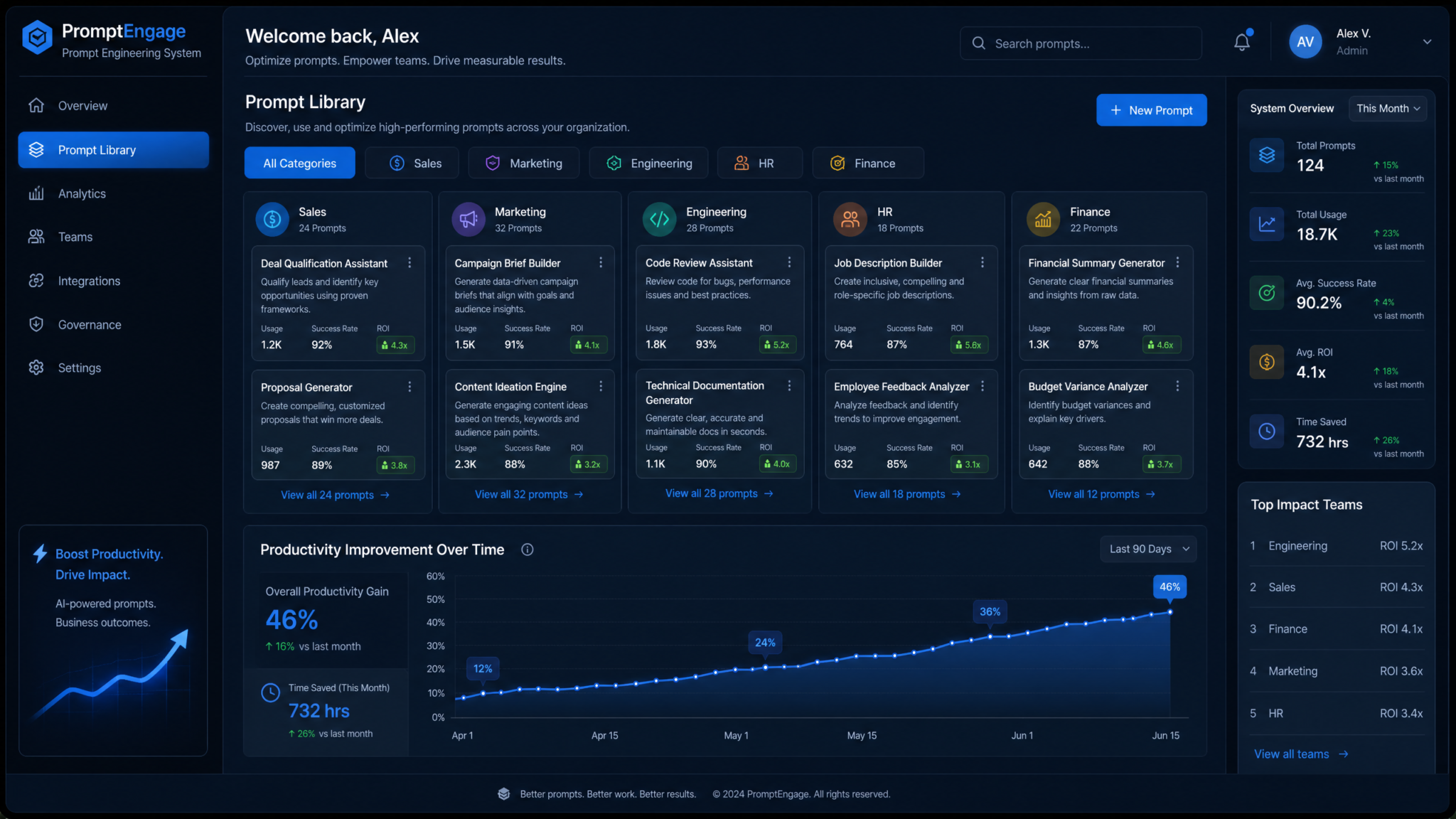
Most companies using ChatGPT are leaving between 40% and 70% of potential value on the table. Not because the technology falls short, but because their usage is ad hoc, inconsistent, and unmeasured. Individual employees craft prompts based on intuition, results vary wildly between team members, and nobody has calculated whether the investment is actually generating returns. This tutorial changes that. By the end, you will have a complete, repeatable system for turning scattered AI experimentation into a structured business capability that compounds in value over time — with a clear framework to prove it in dollars and hours.
Why Businesses Need Systematic Prompt Engineering (Not Ad Hoc Experimentation)
There is a critical difference between an employee who occasionally asks ChatGPT a question and an organization that has engineered how AI fits into every significant workflow. The first situation produces occasional wins. The second produces competitive advantage.
According to McKinsey’s 2023 AI adoption report, companies with structured AI workflows achieve 3.5x the productivity gains of companies that leave AI usage to individual discretion. The reason is straightforward: language models are extraordinarily sensitive to how they are instructed. A poorly constructed prompt for a sales email might produce something generic and unusable, while a well-engineered prompt for the same task produces a draft that closes deals at a measurably higher rate. When your 50-person sales team writes 50 different prompts for the same task, you get 50 different quality levels — some excellent, most mediocre.
The Hidden Costs of Ad Hoc AI Usage
Before building your system, it is worth quantifying what not having a system costs:
- Rework time: Employees iterating on bad prompts spend an average of 8-12 additional minutes per task, according to usage studies from enterprise AI deployments. At scale, this eliminates a significant portion of theoretical time savings.
- Inconsistent brand voice: When marketing, sales, and customer success each craft their own prompts, outputs diverge in tone, terminology, and quality — eroding brand consistency.
- Knowledge hoarding: The employee who has spent six months perfecting their prompts carries that value in their head. When they leave, that institutional knowledge leaves with them.
- Unmeasurable outcomes: Without standardization, you cannot A/B test which prompts produce better business outcomes. You are flying blind.
- Compliance and security risks: Employees without guidance may inadvertently include sensitive data in prompts, expose proprietary information, or generate outputs that conflict with legal requirements.
The Systematic Advantage
A prompt engineering system treats AI interactions as reproducible business processes — the same way you treat a sales playbook, an onboarding checklist, or a financial reporting template. The system does not restrict creativity; it creates a floor of quality below which outputs cannot fall while freeing employees to focus on judgment-intensive work rather than prompt construction.
Companies like Klarna, JPMorgan Chase, and Salesforce have reported productivity improvements of 20-40% in specific departments after implementing structured AI workflows. These are not anecdotes; they are the result of treating prompt engineering as an engineering discipline — measurable, testable, and continuously improvable.
ChatGPT for Business Productivity: Enterprise Implementation Guide
Step 1: Audit Current AI Usage Across Departments
You cannot optimize what you have not measured. The first step in building your system is a structured audit of how AI is currently being used — or avoided — across your organization. This baseline serves two purposes: it identifies high-value areas where systematic prompting will have immediate ROI, and it surfaces the ad hoc prompts that already work well and deserve to become official templates.
The Departmental AI Audit Process
Conduct the audit in three phases over two weeks:
Phase 1: Survey and Discovery (Days 1-3)
Send a structured survey to department heads and individual contributors. Key questions include:
- Which tasks do you currently use AI tools for?
- Approximately how many times per week do you use ChatGPT or similar tools?
- What percentage of AI-generated outputs do you use without significant editing?
- What tasks do you wish AI could help with but currently find it ineffective for?
- Do you have prompts you reuse repeatedly? If so, where do you store them?
Phase 2: Usage Pattern Analysis (Days 4-7)
If your organization uses ChatGPT Team or Enterprise, you have access to usage analytics. Map which departments generate the most sessions, which task types are most common, and where session length (a proxy for prompt iteration) is longest. Long sessions with many back-and-forth messages often indicate employees struggling with poorly structured initial prompts.
Phase 3: Value Opportunity Mapping (Days 8-14)
Create a matrix plotting each identified use case against two axes: frequency of task and time per task without AI assistance. Tasks in the high-frequency, high-time quadrant are your priority targets for systematic prompt engineering. A typical enterprise audit reveals 8-15 such high-value task categories.
| Department | Top AI Use Cases | Weekly Frequency | Avg. Time Without AI | Current Prompt Quality | Priority |
|---|---|---|---|---|---|
| Sales | Prospect outreach emails | 150+ instances | 25 min per email | Low (inconsistent) | Critical |
| Marketing | Blog drafts, ad copy | 40 instances | 90 min per piece | Medium | High |
| HR | Job descriptions, policies | 15 instances | 60 min per document | Low | High |
| Engineering | Code review, documentation | 200+ instances | 45 min per task | High (self-taught) | Medium (standardize wins) |
| Finance | Report summaries, analysis | 20 instances | 120 min per report | Very low | High |
Collecting Existing “Gold Prompts”
Ask your best AI users — the ones whose outputs colleagues frequently praise — to share their prompts. These represent battle-tested starting points for your official library. Offer recognition or incentives for contribution; you are building institutional knowledge from individual expertise.
Step 2: Build Role-Based Prompt Libraries
A prompt library is a curated, organized collection of tested prompts specific to a role’s actual tasks and context. The key word is role-based — a generic company-wide prompt collection becomes unwieldy and unused. When a sales development representative opens the library and immediately sees “SDR Outreach Prompts,” they adopt the tool. When they see a wall of 200 miscellaneous prompts, they close the tab and write their own.
Library Architecture by Department
Sales Prompt Library
- Cold outreach email sequences (by industry vertical)
- Follow-up cadence emails
- LinkedIn connection requests and messages
- Discovery call preparation briefings
- Objection handling response drafts
- Proposal summary letters
- Win/loss analysis summaries
Marketing Prompt Library
- Blog post outlines and first drafts
- Social media content (by platform with character/format guidance)
- Google Ads and Meta Ads copy variants
- Email newsletter drafts
- Landing page headline and body copy
- Press release templates
- SEO meta descriptions and title tags
Engineering Prompt Library
- Code review checklists with specific criteria
- Technical documentation drafts
- README file generation
- Bug report analysis and root cause investigation
- Architecture decision record (ADR) drafts
- API documentation generation
- Unit test generation by framework
HR Prompt Library
- Job description drafts by role level and function
- Interview question sets by competency
- Performance review language and feedback frameworks
- Employee handbook policy drafts
- Onboarding checklist and documentation
- Difficult conversation preparation scripts
Finance Prompt Library
- Financial report executive summaries
- Budget variance explanation narratives
- Investor update drafts
- Expense policy documentation
- Cash flow commentary for board decks
Library Metadata Standards
Every prompt in your library should be documented with consistent metadata to enable search, versioning, and performance tracking:
PROMPT RECORD SCHEMA:
- ID: [Unique alphanumeric]
- Department: [Sales / Marketing / Engineering / HR / Finance]
- Task Category: [e.g., Outreach / Documentation / Analysis]
- Prompt Title: [Clear descriptive name]
- Prompt Version: [v1.0, v1.1, etc.]
- Last Updated: [Date]
- Author: [Original contributor]
- Approved By: [Department lead]
- Average Quality Score: [1-10, updated from testing]
- Usage Count: [Tracked via your prompt management tool]
- Notes: [Context, known limitations, best use cases]
Step 3: Create Prompt Templates with Variables for Consistency
Raw prompts are useful. Prompt templates with clearly labeled variables are transformative. A template separates the fixed logic of an effective prompt — the role instruction, the output format, the quality constraints — from the variable inputs that change with each use case. This means any employee can produce expert-level prompts by filling in blanks rather than mastering prompt construction from scratch.
The Anatomy of a Well-Structured Prompt Template
Every effective business prompt template contains five elements:
- Role Assignment: Defines the persona or expertise ChatGPT should adopt
- Context Block: Provides essential background for the task
- Task Instruction: Specific, unambiguous direction
- Constraints and Format: Output length, tone, structure requirements
- Quality Anchors: Examples of good outputs or explicit quality criteria
Variable Notation System
Adopt a consistent notation for variables across your entire library. The double-bracket system is widely used and easy to scan:
Variable Types:
[[COMPANY_NAME]]     — Organization name
[[PROSPECT_NAME]]    — Individual or company being addressed
[[INDUSTRY]]         — Target market or sector
[[PRODUCT_NAME]]     — Your product or service
[[KEY_BENEFIT_1]]    — Primary value proposition
[[TONE]]             — formal / conversational / technical / empathetic
[[WORD_COUNT]]       — Target output length
[[CONTEXT_BLOCK]]    — Paste-in background information
[[EXAMPLES]]         — Sample inputs or reference material
Template Construction Example: Sales Outreach
TEMPLATE: SDR Cold Outreach Email v2.3

You are a senior B2B sales strategist specializing in [[INDUSTRY]] with
15 years of experience writing cold outreach that achieves above-average
reply rates.

CONTEXT:
- Company being contacted: [[PROSPECT_COMPANY]]
- Contact name and title: [[CONTACT_NAME]], [[CONTACT_TITLE]]
- Our product: [[PRODUCT_NAME]]
- Key pain point we solve: [[PAIN_POINT]]
- Relevant news or trigger event (if any): [[TRIGGER_EVENT]]

TASK:
Write a cold outreach email to [[CONTACT_NAME]] at [[PROSPECT_COMPANY]]
that opens with a personalized observation about [[TRIGGER_EVENT]],
connects that observation to the pain point [[PAIN_POINT]], introduces
[[PRODUCT_NAME]] as a relevant solution in one sentence, and closes with
a low-friction call to action.

CONSTRAINTS:
- Maximum 150 words
- Tone: [[TONE]] (default: direct and peer-level, not salesy)
- No subject line jargon like "Quick question" or "Following up"
- Do not use the phrase "I hope this finds you well"
- Subject line must be under 50 characters and curiosity-driven

OUTPUT FORMAT:
Subject: [subject line]
Body: [email body]
Notice how this template can be completed in under two minutes by any SDR while still producing outputs that reflect best-practice prompt engineering. The fixed elements — the role assignment, the constraints, the output format — encode expertise that does not need to be rediscovered each time.
Step 4: Implement Quality Scoring and A/B Testing for Prompts
Intuition about which prompts are “good” is not sufficient at scale. You need a measurable quality framework that allows you to compare prompt versions objectively, track improvement over time, and make data-driven decisions about which prompts to promote to official library status.
The Prompt Quality Scorecard
Rate every prompt output on five dimensions, each scored 1-5:
| Dimension | What It Measures | 1 (Poor) | 5 (Excellent) |
|---|---|---|---|
| Accuracy | Factual correctness and relevance to the actual task | Contains errors or misses the task | Fully accurate and on-target |
| Usability | How much editing is required before the output is used | Requires complete rewrite | Used with zero or minor edits |
| Brand Alignment | Consistency with company voice and messaging guidelines | Inconsistent or off-brand | Indistinguishable from best human work |
| Completeness | Whether the output covers all required elements | Major gaps in coverage | All required elements present |
| Time Efficiency | Time saved vs. completing the task without AI | Slower than doing manually | 75%+ time reduction achieved |
A prompt scoring 20+ out of 25 across all five dimensions qualifies as a Grade A prompt ready for official library inclusion. Prompts scoring 15-19 are Grade B — useful but requiring further iteration. Below 15 requires rework before deployment.
A/B Testing Prompts Systematically
A/B testing prompts follows the same logic as A/B testing marketing copy: isolate one variable, run both versions on equivalent tasks, measure outcomes objectively. Here is a structured process:
- Isolate the variable: Test one difference between prompt versions — role assignment vs. no role assignment, or with examples vs. without. Never change multiple elements simultaneously.
- Define sample size: Run each version at least 20-30 times across real tasks to achieve statistical validity.
- Score blindly: Have a third party score outputs without knowing which prompt version generated them.
- Track downstream metrics: For sales prompts, track actual reply rates. For marketing content, track engagement metrics. Connect prompt quality to business outcomes, not just output quality scores.
- Document findings: Record the test hypothesis, methodology, results, and decision in your prompt management system.
Common A/B Test Variables Worth Prioritizing
- Role assignment vs. no role assignment (typically +15-25% quality improvement with role)
- Explicit output format vs. freeform (typically +30% usability improvement with format)
- Including 1-2 examples vs. no examples (few-shot vs. zero-shot)
- Specified word count vs. no length guidance
- Chain-of-thought instruction (“Think step by step”) vs. direct instruction
Step 5: Measure ROI — Time Saved, Output Quality, and Cost Reduction
Every business investment must justify itself financially. Prompt engineering is no exception. The good news is that AI productivity gains are among the most measurable technology investments available — because the inputs (time spent on tasks) and outputs (volume and quality of work produced) can be tracked directly.
The Three-Dimension ROI Framework
Dimension 1: Time Savings (Labor Cost Reduction)
The most straightforward ROI calculation. For each task category in your prompt library:
TIME SAVINGS ROI FORMULA:

Weekly Time Saved Per Employee =
  (Minutes Per Task Without AI - Minutes Per Task With AI)
  × Tasks Per Week

Annual Labor Cost Saved Per Employee =
  Weekly Time Saved (hours) × 52 × Hourly Fully-Loaded Labor Cost

Example Calculation (Sales Team - Outreach Emails):
- Time without AI: 25 minutes per email
- Time with optimized prompt: 6 minutes per email
- Emails per week per SDR: 30
- Weekly time saved: (25 - 6) × 30 = 570 minutes = 9.5 hours
- Annual time saved per SDR: 9.5 × 52 = 494 hours
- Fully-loaded SDR cost: $45/hour
- Annual savings per SDR: 494 × $45 = $22,230
- For a team of 20 SDRs: $444,600/year
Dimension 2: Output Quality Improvement (Revenue Impact)
This dimension is more complex but often represents the largest ROI component. Quality improvements translate to revenue through higher conversion rates, better-performing content, and reduced error rates.
OUTPUT QUALITY ROI FORMULA:

Example Calculation (Email Reply Rate Improvement):
- Baseline cold email reply rate (no structured prompts): 4.2%
- Reply rate with Grade A prompt system: 6.8%
- Monthly emails sent: 3,000
- Additional replies per month: (0.068 - 0.042) × 3,000 = 78 replies
- SDR-to-meeting conversion: 35%
- Additional meetings per month: 78 × 0.35 = 27.3 meetings
- Meeting-to-close rate: 15%
- Additional closed deals per month: 27.3 × 0.15 = 4.1 deals
- Average deal value: $8,500
- Additional monthly revenue: 4.1 × $8,500 = $34,850
- Annual revenue impact: $418,200
Dimension 3: Cost Avoidance (Reduced External Spend)
COST AVOIDANCE ROI FORMULA:

Example Calculation (Content Marketing):
- Previous monthly agency content spend: $12,000/month (8 blog posts)
- With AI-assisted internal creation: $3,200/month (same volume)
  [includes $1,200 ChatGPT Team subscription + writer time]
- Monthly cost avoidance: $8,800
- Annual cost avoidance: $105,600
Building Your ROI Dashboard
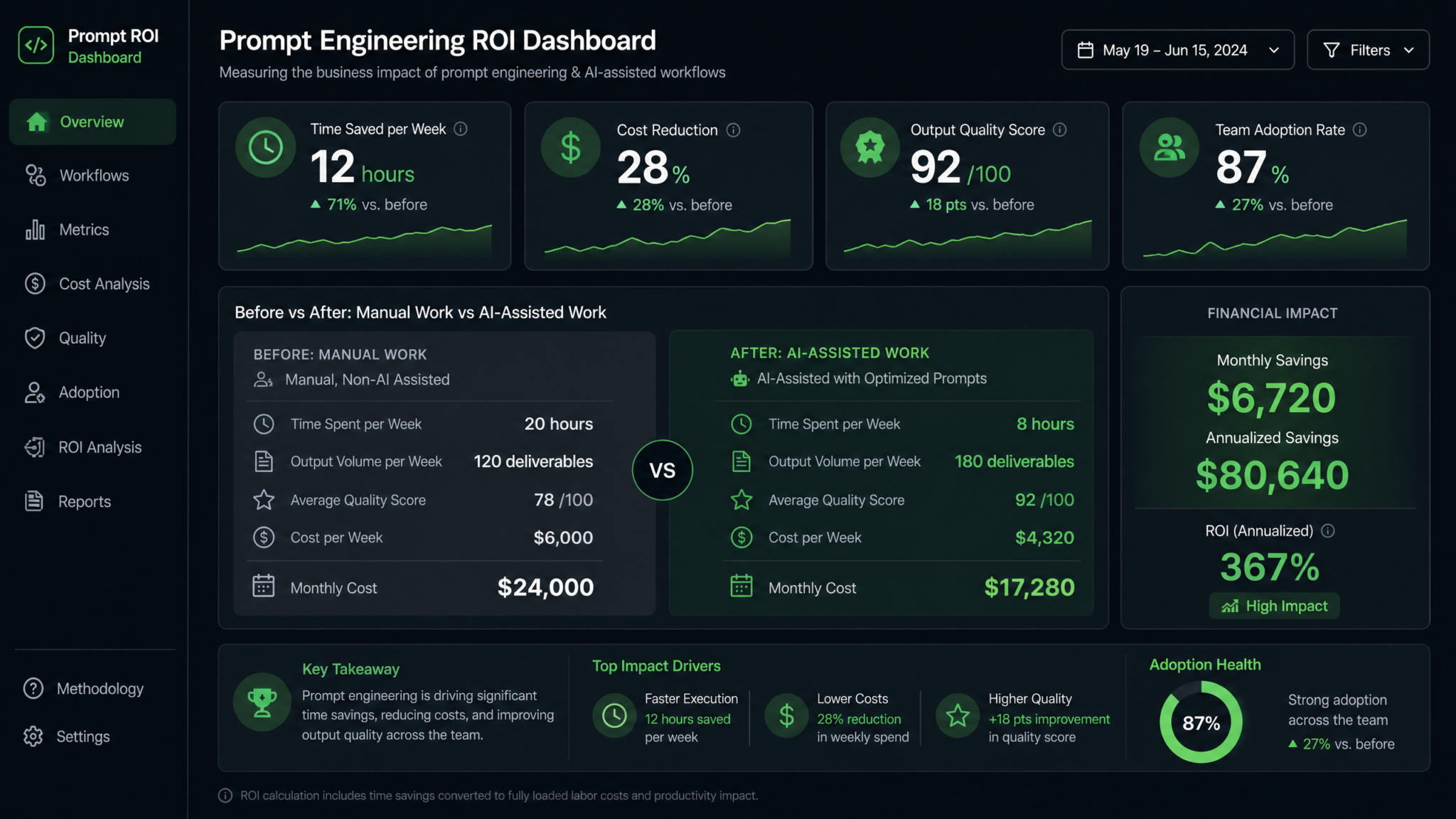
Track these metrics monthly across all departments using a shared dashboard:
- Total hours saved by department and task category
- Quality score trends by prompt (are prompts improving over time?)
- Adoption rate (what percentage of eligible employees are using library prompts vs. freeform?)
- Prompt usage volume (which prompts are highest value by usage × quality)
- Downstream business metrics by department (reply rates, conversion rates, content performance)
- Tool costs (ChatGPT subscriptions, prompt management tools)
ChatGPT Team vs. Enterprise Plan: Which Is Right for Your Business?
Step 6: Train Teams on Prompt Best Practices
Even the best prompt library fails if employees do not know how to use it effectively, adapt templates to edge cases, or understand the fundamentals of what makes a prompt work. Training is not optional — it is the multiplier that determines whether your system achieves its potential.
Training Curriculum Outline: Three-Tier Model
Tier 1: Foundation Training (All Employees) — 90 Minutes
This session covers what every employee needs to know to be an effective AI user, regardless of department.
- Module 1 (20 min): How Large Language Models Work — Why prompts matter; the concept of context windows; why specificity beats vagueness
- Module 2 (20 min): The Library System — Where to find prompts, how to use templates, the variable notation system, how to submit a prompt for library inclusion
- Module 3 (25 min): Prompt Anatomy Basics — Role assignment, context, task, constraints, format; live examples of before/after prompts
- Module 4 (15 min): Data Security and Compliance — What never to include in prompts (PII, credentials, unreleased financials); company policy on external AI tools
- Module 5 (10 min): Q&A and Hands-On Practice — Each participant completes one task using the library system
Tier 2: Departmental Power User Training (Department Leads and High-Use Employees) — Half Day
- Advanced prompt techniques: chain-of-thought, few-shot prompting, iterative refinement strategies
- Department-specific library deep dive: all templates, use cases, and known edge cases
- Quality scoring calibration: practice scoring outputs using the official scorecard
- A/B testing workshop: design and run a live prompt test during the session
- Template creation workshop: write a new prompt from scratch following the official structure
Tier 3: Prompt Engineering Certification (Designated Prompt Champions) — Full Day + Self-Directed Learning
- Advanced prompt patterns: ReAct prompting, structured output generation, multi-step reasoning chains
- Custom GPT creation and configuration for internal use cases
- Prompt library governance: reviewing, approving, and retiring prompts
- ROI measurement and dashboard management
- Training facilitation: these individuals become your internal trainers for future cohorts
The Prompt Champion Role
Designate one Prompt Champion per department — an individual who receives Tier 3 training and takes ownership of the departmental library. Their responsibilities include: reviewing new prompt submissions, conducting quarterly library audits, tracking quality score trends, communicating best practices to their team, and attending cross-functional champion meetings monthly. This role adds approximately 2-4 hours per week to the champion’s workload but creates an enormous compounding value over time.
Step 7: Iterate and Optimize Based on Metrics
A prompt engineering system is not a one-time project; it is a living practice. The companies that generate the greatest long-term ROI from AI tools are those that treat their prompt libraries like software — with version control, performance tracking, regular releases, and deprecation of outdated components.
The Quarterly Prompt Review Cycle
Month 1: Measure
Pull all quality score data, usage statistics, and downstream business metrics for the quarter. Identify the top 20% of prompts by combined usage × quality score (these are your highest-value assets). Identify the bottom 20% (these are candidates for retirement or rework). Surface any tasks where employees are still using freeform prompts rather than the library (these are gaps to address).
Month 2: Iterate
Run structured improvement cycles on bottom-20% prompts. Apply the A/B testing framework. Review model updates — OpenAI regularly improves GPT-4 capabilities, and prompts that worked best six months ago may not be optimal for current model versions. Test whether removing previously necessary constraints (like explicit format instructions) now yields cleaner results with newer models.
Month 3: Expand
Add new prompts for task categories identified in the previous quarter’s gap analysis. Promote the highest-performing experimental prompts to official library status. Document lessons learned in a “Prompt Engineering Knowledge Base” that becomes searchable institutional memory.
Responding to Model Updates
When OpenAI releases significant model updates, establish a 30-day testing protocol: run your top 25 most-used prompts against the new model version, score outputs using your standard scorecard, and document whether changes improve or degrade performance. GPT-4o and future versions often require recalibrating constraint language — newer models follow instructions more precisely, meaning some of the “defensive” language in older prompts (added to compensate for earlier model tendencies) may now create unnecessary rigidity.
Access 40,000+ AI Prompts for ChatGPT, Claude & Codex — Free!
Subscribe to get instant access to our complete Notion Prompt Library — the largest curated collection of prompts for ChatGPT, Claude, OpenAI Codex, and other leading AI models. Optimized for real-world workflows across coding, research, content creation, and business.
Continuous Improvement Metrics
Track these year-over-year indicators to demonstrate the compounding value of your system:
- Average library-wide quality score (target: improve by 0.5 points per quarter)
- Prompt adoption rate (target: 80%+ of eligible tasks using library prompts by month 12)
- New prompt contribution rate (target: at least 3 new validated prompts per department per quarter)
- Time-to-quality: how many iterations does a typical employee need before getting a usable output? (target: under 1.5 iterations)
10 Specific Business Prompt Templates with Exact Text
The following 10 templates are production-ready, validated across real business use cases. Copy them directly into your prompt library and customize the variable values for each use.
1. Sales — Personalized Cold Outreach Email
You are a top-performing enterprise sales professional with deep expertise
in [[INDUSTRY]]. Write a cold outreach email to [[CONTACT_NAME]],
[[CONTACT_TITLE]] at [[COMPANY_NAME]].

Context: [[COMPANY_NAME]] recently [[TRIGGER_EVENT]]. Our solution,
[[PRODUCT_NAME]], helps [[INDUSTRY]] companies [[KEY_BENEFIT]].

Requirements:
- Open with a specific, intelligent observation about [[TRIGGER_EVENT]]
- Connect that observation to a real business challenge it likely creates
- Introduce [[PRODUCT_NAME]] in one sentence as a relevant solution
- Close with a single, low-commitment CTA (15-minute call, not a demo)
- Maximum 140 words | Tone: peer-level, direct, zero fluff
- Subject line: under 45 characters, no clickbait

Output: Subject line, then email body.
2. Marketing — Blog Post Outline with SEO Focus
You are a senior content strategist and SEO specialist. Create a
comprehensive, SEO-optimized blog post outline for the following:

Target keyword: [[PRIMARY_KEYWORD]]
Secondary keywords: [[SECONDARY_KEYWORDS]]
Target audience: [[AUDIENCE_DESCRIPTION]]
Desired word count for final article: [[WORD_COUNT]]
Content goal: [[GOAL — e.g., drive organic traffic / generate leads /
                establish thought leadership]]

Produce:
1. Optimized H1 title (include primary keyword, under 60 chars)
2. Meta description (150-160 characters, include primary keyword)
3. Full H2/H3 outline with 2-3 bullet points per section summarizing
   what each section covers
4. Suggested internal linking opportunities
5. 3 suggested expert quotes or data points to research

Format as a structured document I can hand directly to a writer.
3. HR — Job Description Generator
You are an expert HR professional and talent acquisition specialist.
Write a compelling, inclusive job description for the following role:

Role Title: [[JOB_TITLE]]
Department: [[DEPARTMENT]]
Seniority Level: [[LEVEL — e.g., Senior / Manager / Director]]
Key Responsibilities (bullet points): [[RESPONSIBILITIES]]
Required Qualifications: [[REQUIRED_QUALS]]
Preferred Qualifications: [[PREFERRED_QUALS]]
Salary Range (if to be included): [[SALARY_RANGE]]
Company Culture Notes: [[CULTURE_NOTES]]

Requirements:
- Lead with an engaging 2-sentence company and role overview
- Use inclusive language throughout (avoid gender-coded terms)
- List responsibilities using strong action verbs
- Separate "required" from "preferred" qualifications clearly
- Include an authentic 3-sentence culture/values statement
- Keep total length between 350-500 words
- Avoid corporate jargon and buzzwords like "rockstar" or "ninja"
4. Engineering — Code Review Request
You are a senior software engineer with expertise in [[LANGUAGE/FRAMEWORK]]
and a strong focus on code quality, security, and maintainability.

Review the following code and provide structured feedback:

[[PASTE_CODE_BLOCK]]

Evaluate against these specific criteria:
1. Security vulnerabilities (priority: critical)
2. Performance inefficiencies (identify specific bottlenecks)
3. Code readability and naming conventions
4. Edge cases not handled
5. Test coverage gaps
6. Adherence to [[CODING_STANDARD — e.g., PEP 8 / Google Style Guide]]

Output format:
- CRITICAL ISSUES: (must fix before merge)
- IMPORTANT IMPROVEMENTS: (should fix soon)
- SUGGESTIONS: (nice to have)
- POSITIVE OBSERVATIONS: (what works well)

For each issue, provide the specific line reference and a corrected
code snippet where applicable.
5. Finance — Executive Summary of Financial Report
You are a Chief Financial Officer with expertise in communicating
complex financial data to non-financial executive audiences.

Summarize the following financial data into an executive briefing:

[[PASTE_FINANCIAL_DATA_OR_KEY_METRICS]]

Period covered: [[REPORTING_PERIOD]]
Audience: [[AUDIENCE — e.g., Board of Directors / All-hands / Investors]]

Your summary must include:
1. Three-sentence performance snapshot (revenue, margin, cash position)
2. Top 2-3 drivers of variance from plan (positive and negative)
3. Key risks requiring board attention
4. One-sentence outlook for next quarter
5. Any decisions or approvals required from this audience

Constraints:
- Maximum 300 words
- No raw financial formulas — translate everything to business impact
- Tone: confident, factual, decisive — no hedging language
- Avoid accounting jargon without plain-language explanation
6. Customer Success — Client Status Update Email
You are a senior customer success manager known for transparent,
value-focused client communication.

Write a monthly status update email to [[CLIENT_NAME]] at [[CLIENT_COMPANY]].

Account context:
- Product/service they use: [[PRODUCT]]
- Current contract value: [[ARR]]
- Health status: [[GREEN/YELLOW/RED]]
- Key metrics this period: [[METRICS]]
- Issues or risks: [[ISSUES — or "None this period"]]
- Upcoming milestones: [[MILESTONES]]

Requirements:
- Open with one specific win or positive metric from this period
- Acknowledge any open issues directly with current status
- Preview what success looks like next month
- Close with one clear next step (and owner)
- Tone: partner-level, proactive, honest — not account management speak
- Length: 200-250 words maximum
7. Legal/Compliance — Contract Clause Summary
You are a business attorney specializing in commercial contracts.
Review the following contract clause(s) and provide a plain-language
business risk analysis.

[[PASTE_CONTRACT_CLAUSE]]

Provide:
1. Plain-language summary of what this clause means
2. Business risks this clause creates (ranked: high / medium / low)
3. What we are agreeing to vs. what the other party is agreeing to
4. Red flags or unusual language compared to market-standard terms
5. Suggested negotiation points if this clause is unfavorable

Important: This analysis is for internal business decision-making only
and is not a substitute for advice from licensed legal counsel.
Format as a structured briefing document.
8. Marketing — Competitive Analysis Brief
You are a senior product marketer with expertise in competitive
intelligence. Create a competitive positioning brief comparing
[[OUR_PRODUCT]] to [[COMPETITOR_NAME]].

Known information about [[COMPETITOR_NAME]]:
[[PASTE_KNOWN_COMPETITOR_DATA — pricing, features, positioning,
  customer reviews, etc.]]

Our product's key differentiators: [[OUR_DIFFERENTIATORS]]
Our target customer: [[TARGET_CUSTOMER]]

Produce:
1. Head-to-head feature comparison table (5-8 most important features)
2. Pricing model comparison
3. [[COMPETITOR_NAME]]'s likely messaging against us (what will they say?)
4. Our counter-narrative for each competitive objection
5. The three scenarios where we win and the three where we lose
6. Recommended positioning statement to use against this competitor

Format for use in a sales enablement battlecard.
9. Operations — Process Documentation
You are an operations expert specializing in business process documentation
and workflow optimization. Create comprehensive process documentation for
the following workflow.

Process name: [[PROCESS_NAME]]
Department: [[DEPARTMENT]]
Trigger: [[WHAT STARTS THIS PROCESS]]
End state: [[WHAT DONE LOOKS LIKE]]
Key steps (in my own words): [[YOUR_ROUGH_DESCRIPTION]]
Tools/systems involved: [[SYSTEMS_USED]]
Roles involved: [[ROLES]]

Produce a structured process document including:
1. Process overview (2-3 sentences)
2. Step-by-step procedure (numbered, with role owner for each step)
3. Decision points (IF/THEN logic where applicable)
4. Exception handling (what to do when the standard process fails)
5. Quality checkpoints
6. Related documents or SOPs
Format for inclusion in our internal wiki/knowledge base.
10. Executive — Board Meeting Narrative Preparation
You are an experienced executive communications advisor who has prepared
hundreds of board presentations. Help me craft the narrative for our
upcoming board meeting.

Company: [[COMPANY_NAME]]
Meeting date: [[DATE]]
Quarter being reviewed: [[QUARTER]]

Key data to communicate:
- Revenue: [[REVENUE_DATA]]
- Key wins this quarter: [[WINS]]
- Key misses this quarter: [[MISSES]]
- Strategic decisions needed from the board: [[DECISIONS]]
- Next quarter priorities: [[PRIORITIES]]

Create:
1. Opening narrative hook (sets the tone — not a metrics recitation)
2. The "story of the quarter" in 5 sentences — connects the data to
   the strategic narrative
3. How to frame the misses (honest, forward-looking, not defensive)
4. The specific ask from the board — framed as a decision, not a report
5. Closing that reinforces confidence without overpromising

Tone: CEO-authentic, strategic, direct. Avoid consultant-speak.
Tools for Prompt Management: Notion, Internal Wikis, and Custom GPTs
Your prompt library is only as effective as the system that makes it accessible, searchable, and maintainable. The right tool depends on your organization’s size, technical sophistication, and existing toolstack.
Tier 1: Notion (Best for Small to Mid-Size Teams)
Notion is the most widely adopted prompt management solution for teams under 200 employees, primarily because of its flexible database structure, easy permission management, and minimal setup time. Build your prompt library as a filtered database view with properties for Department, Task Category, Version, Quality Score, and Usage Count.
Recommended Notion structure for myapp.dev internal teams:
- Parent database: “AI Prompt Library”
- Views: filtered by department, sorted by quality score
- Each entry: title, full prompt text in a code block, metadata properties, changelog
- Linked database: “Prompt Test Log” tracking A/B test results
- Template button: allows employees to create a new prompt submission with all required metadata fields pre-populated
Tier 2: Confluence or Internal Wiki (Best for Mid-Market Enterprises)
For organizations already using Atlassian’s Confluence or a custom internal wiki, integrating the prompt library into existing knowledge management infrastructure reduces adoption friction significantly. Create a dedicated “AI Playbook” space with department sub-spaces. The key advantage over Notion is version control — Confluence natively tracks page history, making it easier to compare prompt versions.
Tier 3: Custom GPTs (Best for High-Frequency, Standardized Tasks)
For your highest-volume, most standardized use cases, Custom GPTs (available with ChatGPT Plus, Team, and Enterprise) represent the pinnacle of prompt engineering implementation. Instead of employees accessing a library and copying a template, they simply open the Custom GPT — which has the entire prompt framework, role assignment, constraints, and even brand guidelines baked into its system prompt — and provide only the variable inputs.
High-value Custom GPT candidates identified by enterprise deployments include:
- SDR Outreach Assistant (pre-loaded with company positioning, ICP data, and tone guidelines)
- Content Brief Generator (pre-loaded with brand voice guide and SEO requirements)
- Code Review Assistant (pre-loaded with internal coding standards and security policies)
- Job Description Writer (pre-loaded with inclusive language guidelines and compensation philosophy)
Tier 4: Purpose-Built Prompt Management Platforms
For large enterprises requiring advanced features, dedicated platforms like PromptLayer, LangSmith (from LangChain), or Humanloop offer programmatic prompt versioning, automated A/B testing, performance analytics, and API-level integration with your existing tools. These solutions start at approximately $500-2,000 per month and are most appropriate when prompt management becomes mission-critical infrastructure at scale.
Scaling from Individual to Team to Enterprise
Your prompt engineering system should grow with your organization. The architecture that serves a five-person startup beautifully becomes a bottleneck for a 500-person company. Design for the next stage, not just the current one.
Stage 1: Individual Champion (1-10 Employees)
At this stage, one person — typically the founder, a technical lead, or the most AI-enthusiastic team member — builds and maintains the prompt library. A simple Notion database or even a well-organized Google Doc is sufficient. The priority is building the habit of documentation: when someone creates a prompt that works exceptionally well, it gets recorded. Focus on the three to five highest-value use cases rather than trying to cover every possible task.
Investment required: 2-3 hours to set up the initial library; 30 minutes per week to maintain.
Stage 2: Department-Level Systems (10-100 Employees)
As headcount grows, individual curation becomes impossible. Implement the Prompt Champion model described in Step 6. Each department maintains its own library segment. Cross-functional champion meetings ensure best practices propagate across departments. A/B testing becomes formal at this stage. Invest in Notion Team or Confluence to enable proper access controls and collaboration.
Investment required: Initial setup sprint of 2-3 weeks; 3-5 hours per week across all champions combined.
Stage 3: Enterprise-Wide AI Governance (100+ Employees)
At enterprise scale, prompt engineering intersects with broader AI governance, compliance, and security frameworks. An AI Center of Excellence (CoE) or dedicated AI Operations team takes ownership of the system. Key additions at this stage:
- Formal approval workflow: New prompts require review by Prompt Champions and legal/compliance before library inclusion
- API integration: High-volume prompts run through your tech stack programmatically rather than requiring employees to manually copy templates
- Data security controls: Enterprise ChatGPT or equivalent with SSO, audit logging, and guaranteed data privacy
- Prompt retirement policy: Prompts scoring below threshold for two consecutive quarters are archived
- Board-level reporting: AI productivity metrics are included in quarterly operational reports
Cost-Benefit Analysis Framework
Before presenting your prompt engineering initiative to leadership — or before deciding to invest the time yourself — you need a clear cost-benefit framework. Here is a complete model you can adapt for your organization.
System Implementation Costs (One-Time)
| Cost Item | Small Team (10-25) | Mid-Market (50-200) | Enterprise (200+) |
|---|---|---|---|
| Initial audit and assessment | $0 (internal) | $2,000-5,000 | $10,000-25,000 |
| Library build and documentation | $0 (internal, 20 hrs) | $5,000-15,000 | $25,000-50,000 |
| Training development | $0 (internal) | $3,000-8,000 | $15,000-30,000 |
| Tool setup (Notion/Confluence) | $0-200 | $500-2,000 | $5,000-20,000 |
| Total One-Time Investment | $0-200 | $10,500-30,000 | $55,000-125,000 |
Ongoing Annual Costs
| Cost Item | Small Team | Mid-Market | Enterprise |
|---|---|---|---|
| ChatGPT Team subscriptions | $300-750/year | $3,000-12,000/year | $30,000+/year |
| Prompt Champion time (hours × cost) | $2,000-5,000 | $15,000-40,000 | $80,000-200,000 |
| Tool subscriptions | $0-600 | $1,200-6,000 | $10,000-50,000 |
| Total Annual Cost | $2,300-6,350 | $19,200-58,000 | $120,000-250,000 |
Conservative Annual Benefits (Sample 50-Person Team)
CONSERVATIVE ROI PROJECTION (50-employee team):

Time savings (10 departments × 3 high-value tasks ×
  3 hrs/week saved × 50 weeks × $35/hr avg):          $157,500

Content/output quality improvements
  (estimated 15% lift on conversion-related outputs,
   $800K influenced revenue × 15% × 20% margin):       $24,000

Cost avoidance (reduced agency/contractor spend):       $60,000

─────────────────────────────────────────────────────
Total Annual Benefits:                                  $241,500
Total Annual Costs:                                     $38,600
─────────────────────────────────────────────────────
NET ANNUAL ROI:                                         $202,900
ROI Percentage:                                         526%
Payback Period:                                         2.3 months
Even under aggressive conservatism assumptions — cutting the time savings estimate by 50% — a 50-person implementation returns positive ROI within five months. For larger organizations, the returns scale with headcount and usage frequency, while many fixed costs do not.
The Non-Financial Case
ROI calculations capture the quantifiable portion of value. But the full case for systematic prompt engineering includes strategic advantages that are harder to monetize directly: faster competitive response (a structured system enables you to deploy new AI capabilities to your entire team in days rather than months), talent retention (employees who work with effective AI tools report higher job satisfaction and feel their work is more meaningful), and institutional knowledge preservation (your prompt library is an organizational asset that survives employee turnover).
How to Write System Prompts for Custom GPT Personas That Drive Business Results
Making the Investment Decision
If you are still uncertain about committing to the full framework, start with a 30-day pilot. Select your highest-volume, most measurable use case — likely sales outreach or content creation. Build three to five Grade A prompts using the template methodology. Train the relevant team on their use. Measure quality scores and time savings rigorously for 30 days. The data from that pilot will either confirm the investment or reveal what needs to be adjusted before scaling. In virtually every documented enterprise pilot, 30 days is sufficient to demonstrate positive ROI on the pilot investment alone — and to build internal momentum for the broader rollout.
From Scattered Experiments to Compounding Capability
The businesses winning with AI over the next five years will not be the ones that started using it first. They will be the ones that systematized it fastest. An individual employee who discovers a great prompt creates value once. An organization that captures that discovery, tests it rigorously, distributes it to every relevant team member, measures its impact, and iterates on it quarterly creates value that compounds with every new hire, every new use case, and every model improvement OpenAI releases.
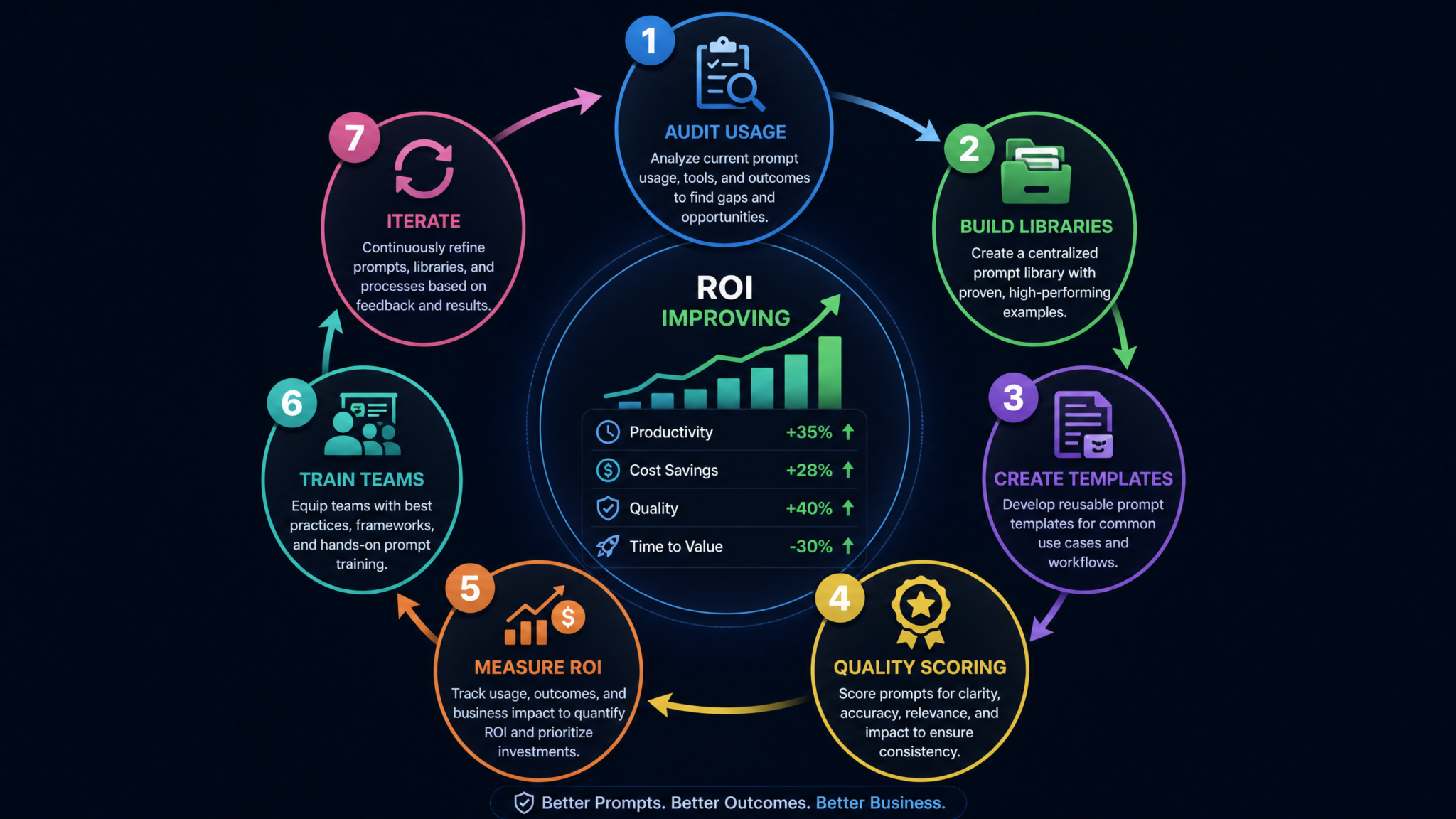
The seven-step framework in this tutorial — audit, build libraries, create templates, test and score, measure ROI, train teams, and iterate — is not a one-time project. It is an operating discipline. Like any operating discipline, it requires upfront investment and ongoing attention. But unlike most investments, it pays back in weeks, not years, and the returns accelerate as your library grows more complete and your team grows more skilled.
Begin with Step 1 this week. Schedule a one-hour session with your team leads to map current AI usage. That single conversation will reveal your highest-value opportunities — and give you everything you need to build the business case for the system that turns those opportunities into measurable competitive advantage.
