
ChatGPT and Gemini Both Hit 1 Billion Users: What the AI Platform War Looks Like at Scale in August 2026
The Billion-User Threshold: A Landmark Moment for AI
In August 2026, the artificial intelligence industry crossed a threshold that, just four years ago, would have seemed like science fiction. Within the same calendar month, both ChatGPT and Google Gemini officially reported crossing 1 billion weekly active users — a milestone that places generative AI platforms in the same rarefied company as Facebook, YouTube, and WhatsApp. For the first time in the history of computing, two distinct AI platforms from two competing companies simultaneously achieved what analysts had long called “mass-scale adoption,” meaning penetration of the global internet-connected population deep enough to reshape how human beings communicate, create, learn, and work on a daily basis. The AI platform war is no longer a battle of demos and benchmarks. It is now a battle for human attention, human trust, and human habit — fought at a scale that rivals the social media revolutions of the 2010s and the smartphone revolution of the 2000s.
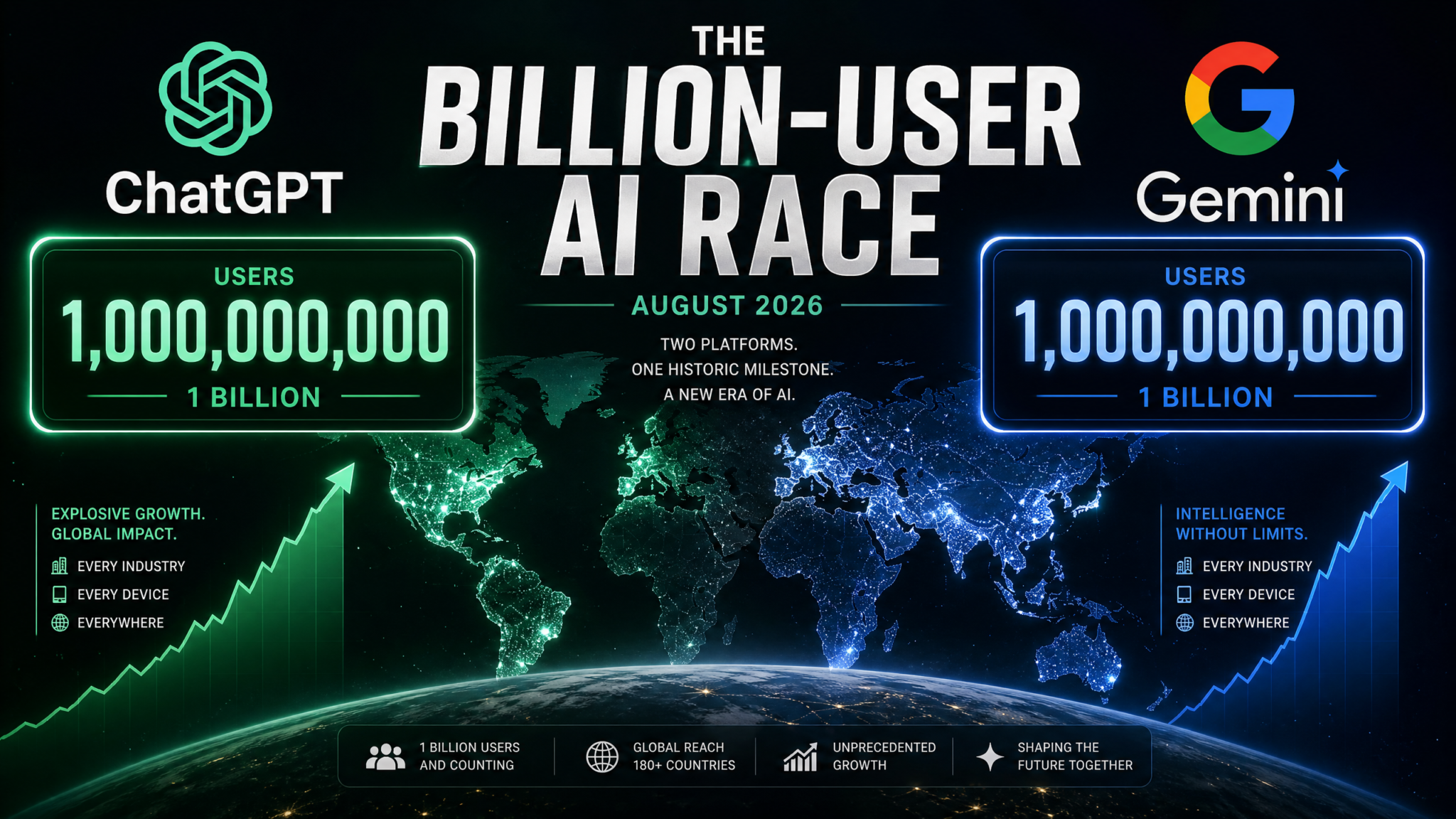
This moment demands a serious, data-driven analysis. How did two companies, each with radically different business models, distribution strategies, and technical architectures, arrive at the same population milestone in the same month? What does the user base of each platform actually look like — demographically, geographically, behaviorally? Are these billion users genuinely engaged, or are casual counts inflating the narrative? And perhaps most critically: what happens to AI safety, AI governance, and global information infrastructure when a single conversational AI platform is used by one in eight people on Earth every single week? This article examines every dimension of the billion-user milestone and attempts to map what the AI platform landscape looks like from the peak of this extraordinary mountain.
How ChatGPT Reached 1 Billion: The OpenAI Growth Playbook
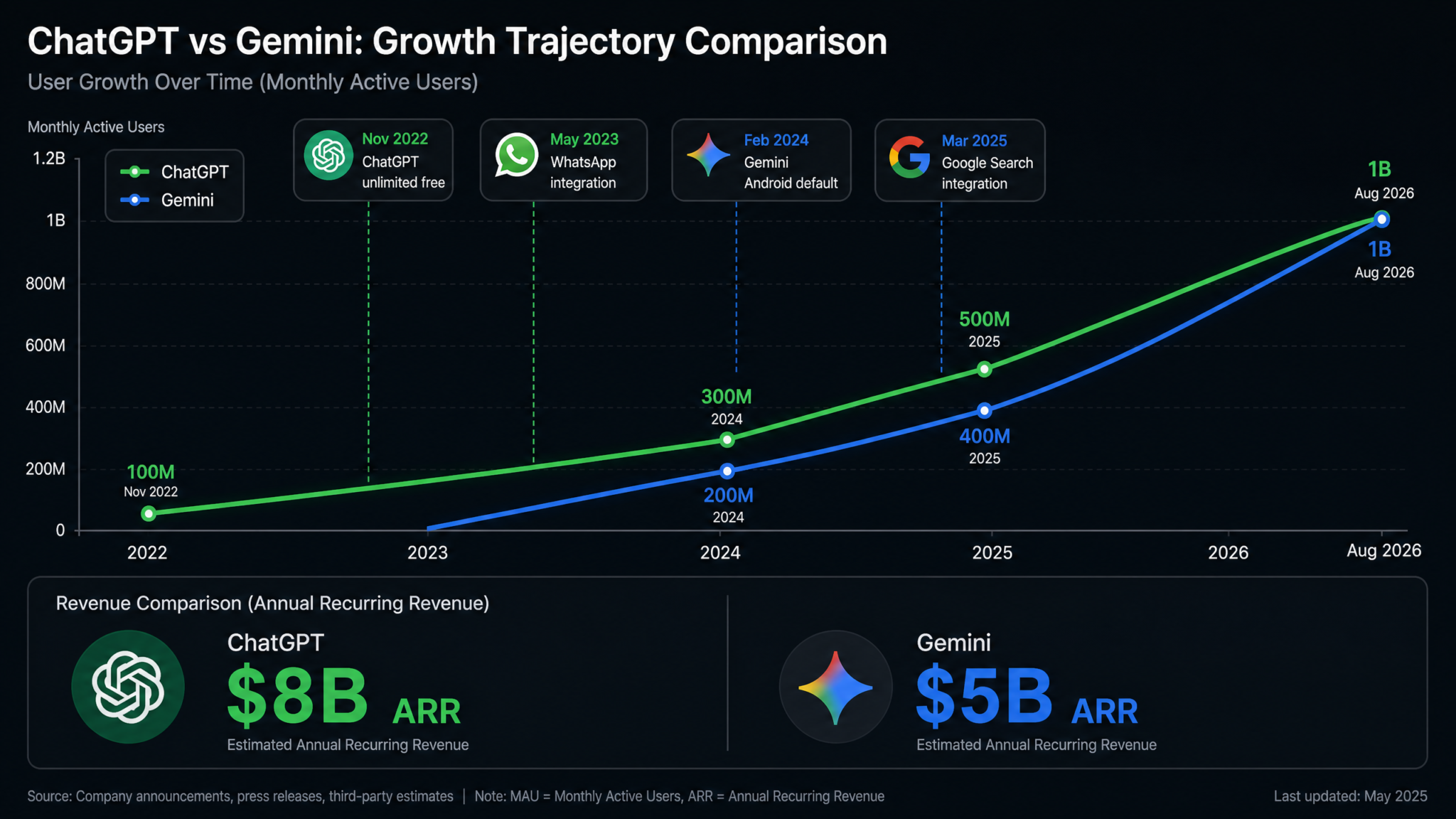
ChatGPT’s journey from its November 2022 launch to 1 billion weekly active users in August 2026 is a 45-month growth story that moved through at least four distinct phases, each defined by a different distribution breakthrough. Understanding these phases is essential to understanding why ChatGPT’s user base looks the way it does today.
Phase One: The Organic Explosion (November 2022 – June 2023)
ChatGPT reached 100 million users in just two months after launch — a record that stood for nearly three years in consumer technology. But this initial phase was almost entirely driven by organic word-of-mouth, media coverage, and a genuine novelty effect. Users were researchers, developers, tech enthusiasts, and early adopters who discovered the product through Twitter threads, Reddit forums, and breathless news coverage. The free tier was already generous by industry standards, but access was rate-limited and occasionally gated behind waitlists. OpenAI’s infrastructure was under constant strain. This phase produced passionate early adopters but did not yet produce mass-market penetration.
Phase Two: Enterprise and API Adoption (June 2023 – March 2025)
The launch of the GPT-4 API, the explosion of the Custom GPT ecosystem, and OpenAI’s aggressive enterprise sales push defined the second phase of growth. By mid-2024, more than 100,000 organizations — from Fortune 500 companies to mid-market software businesses — had integrated OpenAI’s API into their products. Enterprise ChatGPT adoption accelerated particularly in legal services, financial analysis, software development, and customer support. The introduction of ChatGPT Team and ChatGPT Enterprise tiers gave organizations a compliance-ready, SOC 2-certified deployment option. By Q4 2024, enterprise revenue had become a meaningful portion of OpenAI’s overall ARR, and the professional user base was growing at roughly 22% quarter-over-quarter. ChatGPT Enterprise Features and Deployment Guide
Phase Three: The Luna Upgrade and the Unlimited Free Tier (March 2025 – January 2026)
The single most consequential decision OpenAI made on the road to 1 billion users was the March 2025 launch of an unlimited free tier powered by Luna — a significantly more efficient, distilled model architecture that allowed OpenAI to serve vastly more users at a dramatically lower cost per query. Where the previous free tier limited users to 20-40 messages per day with GPT-3.5, the Luna-powered free tier removed message caps entirely for standard conversations, introduced multi-turn memory for all users, and made voice interaction available without a subscription. The economic logic was brutal and deliberate: OpenAI had determined, based on internal cohort analysis, that users who experienced high-quality AI assistance without artificial friction were converting to paid tiers at three times the rate of users who hit message limits. Remove the limits, and you grow the funnel. The Luna tier also dramatically improved OpenAI’s competitive position against Gemini’s Android-native distribution advantage, because suddenly any browser user anywhere in the world had access to a genuinely capable AI without a credit card.
Phase Four: WhatsApp Integration, Phone Access, and the Final Push (January 2026 – August 2026)
The two distribution moves that almost certainly pushed ChatGPT over the billion-user line in 2026 were the WhatsApp integration and the 1-800-CHATGPT phone number service. The WhatsApp integration, announced in partnership with Meta in January 2026, opened ChatGPT to a potential addressable audience of more than 2 billion WhatsApp users — including hundreds of millions in Brazil, India, Indonesia, Nigeria, and Mexico who had not previously engaged with chatgpt.com because they primarily experienced the internet through messaging apps. Users could now invoke ChatGPT in any WhatsApp conversation, either in personal chats or group threads, without downloading a separate app or creating an OpenAI account. Verification was handled through the existing WhatsApp phone number. Within 90 days of launch, the WhatsApp integration had added an estimated 180 million new monthly active users to the ChatGPT ecosystem, according to third-party analytics estimates from Sensor Tower and Data.ai.
The 1-800-CHATGPT phone line, initially launched as a marketing experiment, evolved into a genuine access channel for users without smartphones or reliable internet connectivity. By August 2026, the service was handling an estimated 12 million calls per month across North America and had been replicated through local partnerships in 14 additional countries. It remains a minor contributor to raw user counts but is symbolically important: it signals OpenAI’s commitment to making ChatGPT accessible to every human being regardless of their technology stack.
| Milestone | Date Achieved | Key Driver | Months from Previous Milestone |
|---|---|---|---|
| 100 Million MAU | January 2023 | Organic viral adoption | 2 (from launch) |
| 200 Million WAU | August 2024 | GPT-4o launch, free voice | 19 |
| 500 Million WAU | July 2025 | Luna tier, Enterprise growth | 11 |
| 750 Million WAU | March 2026 | WhatsApp integration | 8 |
| 1 Billion WAU | August 2026 | Global expansion, phone access | 5 |
How Gemini Reached 1 Billion: Google’s Ecosystem Advantage
Google’s path to 1 billion users with Gemini was fundamentally different from OpenAI’s. Where OpenAI built a destination product and then worked to distribute it, Google had the inverse problem: it possessed the most powerful distribution infrastructure in the history of consumer technology and needed to build a product worthy of that infrastructure. By 2026, it had succeeded — but the nature of Gemini’s billion users reflects its origins.
Android Integration: 3 Billion Devices as a Distribution Channel
The most significant structural advantage Gemini has over every competitor on the planet is Android. With more than 3.2 billion active Android devices as of Q2 2026, Google had a preinstalled footprint that no competitor could match. The decision to replace Google Assistant with Gemini as the default Android AI assistant, rolled out globally between late 2024 and early 2025, effectively enrolled hundreds of millions of Android users into the Gemini ecosystem the moment they invoked their phone’s AI features. Voice queries, on-screen assistance, camera interpretation, and app-to-app AI actions all flow through the Gemini infrastructure. Critically, many of these users may not consciously identify themselves as “Gemini users” — they simply use their phone’s AI features — but they are counted in Google’s weekly active user metrics because their interactions generate Gemini API calls.
Google Search: The 8.5 Billion Daily Query Machine
Google Search processes approximately 8.5 billion queries per day as of August 2026. The deep integration of Gemini’s AI Overviews and conversational follow-up features into Search results means that a significant fraction of every day’s global search traffic now routes through Gemini inference. Users who conduct a complex informational search and receive an AI-generated overview are Gemini users, even if they never navigated to gemini.google.com. This ambient integration model is Google’s most powerful and most controversial distribution mechanism — critics argue it inflates the Gemini user count by bundling passive Search users with active conversational AI users, while Google maintains that any interaction with AI-generated content constitutes meaningful AI platform usage. Google Gemini vs ChatGPT Feature Comparison 2026
Workspace Embedding: 3 Billion Professional Interactions Per Week
Google Workspace — encompassing Gmail, Google Docs, Sheets, Slides, Drive, and Meet — had approximately 3 billion users globally as of mid-2026. The embedding of Gemini’s “Help Me Write,” “Help Me Organize,” and real-time meeting transcription features directly into Workspace applications created a massive passive user base of professionals who interact with Gemini during their normal work routines without making a deliberate choice to use an AI platform. Enterprise Workspace deployments, particularly in education, government, and healthcare sectors where Google’s competitive pricing has been aggressive, contributed significantly to the growth in Gemini’s enterprise user counts.
YouTube: 2.7 Billion Users and AI-Native Content Features
YouTube’s integration of Gemini for video chapter summarization, comment synthesis, and the AI-powered learning mode represented a quieter but cumulatively substantial contribution to Gemini’s user base. With 2.7 billion logged-in monthly users, YouTube provided a natural on-ramp for users in markets where ChatGPT had relatively lower penetration, particularly in Southeast Asia, South Asia, and sub-Saharan Africa, where YouTube often functions as a primary educational and entertainment resource.
User Engagement Deep Dive: Who Is Actually Using These Platforms?
Raw user counts tell only part of the story. When you examine engagement metrics — the behavioral data that reveals how deeply and consistently users are integrating these platforms into their lives — a more nuanced and in some ways surprising picture emerges.
Daily Active vs. Weekly Active: The Retention Gap
Both platforms report 1 billion weekly active users, but the daily active user figures reveal a significant difference in engagement intensity. According to estimates from independent analytics firms Sensor Tower, Apptopia, and Bloomberg Intelligence’s AI Platform Tracker, ChatGPT’s daily active user count sits at approximately 640 million in August 2026, representing a DAU/WAU ratio of approximately 64%. Gemini’s estimated daily active users are approximately 480 million, representing a DAU/WAU ratio of roughly 48%. This gap suggests that ChatGPT users are forming stronger daily habits around the platform, while a larger portion of Gemini’s weekly user base consists of occasional or incidental users who interact with Gemini features embedded in other Google products without necessarily returning to a dedicated AI interface every day.
| Metric | ChatGPT | Gemini | Advantage |
|---|---|---|---|
| Weekly Active Users | 1.02 Billion | 1.01 Billion | Tied |
| Daily Active Users (est.) | 640 Million | 480 Million | ChatGPT (+33%) |
| DAU/WAU Ratio | ~64% | ~48% | ChatGPT |
| Average Session Length | 18.4 minutes | 9.2 minutes | ChatGPT (+100%) |
| Messages Per Active User Per Day | 14.7 | 7.3 | ChatGPT (+101%) |
| 30-Day Retention Rate | 71% | 62% | ChatGPT |
| Paid Subscription Rate | ~9.4% | ~6.1% | ChatGPT |
| Enterprise Users (est.) | 95 Million | 140 Million | Gemini |
Session Length: The Depth Metric
Perhaps the most telling engagement data point is average session length. ChatGPT users spend an average of 18.4 minutes per session, compared to Gemini’s 9.2 minutes. This gap is partially explained by the nature of how each platform is used: ChatGPT is predominantly a destination application where users arrive with an intention and engage in extended conversations, while Gemini is frequently accessed through ambient integrations that involve brief interactions — a single AI Overview in Search, a one-sentence help-me-write suggestion in Gmail — that register as sessions but conclude in seconds. The long-tail of ChatGPT’s session distribution is also remarkable: an estimated 12% of ChatGPT daily active users engage in sessions exceeding one hour, a figure that reflects the platform’s deepening role in extended cognitive work such as code development, research synthesis, writing, and creative projects.
Use Case Distribution
Based on available survey data from OpenAI’s transparency reports, Google’s Gemini product blog, and independent research from Stanford HAI’s 2026 AI Index, the use case distribution of the two platforms looks substantially different. ChatGPT’s usage skews heavily toward creative and professional productivity: coding assistance (31% of sessions), writing and editing (26%), learning and research (19%), and data analysis (12%). Gemini’s usage is more evenly distributed across search enhancement and information retrieval (38%), professional document assistance in Workspace (27%), mobile assistant tasks such as scheduling and navigation (18%), and learning (11%). These distributions reflect the different origin stories of the two platforms: ChatGPT was built as a thinking tool, while Gemini was built as an information and productivity interface.
Revenue and Monetization: ChatGPT’s $8B ARR vs Gemini’s $5B ARR
User count parity masks a significant revenue gap. OpenAI’s ChatGPT ecosystem is estimated to be generating approximately $8 billion in annual recurring revenue as of mid-2026, while Google’s Gemini-related subscription and premium revenue is estimated at approximately $5 billion ARR. Understanding why requires examining each company’s monetization architecture.
OpenAI’s Revenue Architecture
OpenAI’s revenue breaks down across four primary streams. ChatGPT Plus subscriptions at $20/month and ChatGPT Pro subscriptions at $200/month collectively represent the largest consumer revenue source, with an estimated 96 million paying subscribers as of August 2026. ChatGPT Team (approximately $25/user/month) and ChatGPT Enterprise (custom pricing, averaging an estimated $35-55/user/month) represent the fastest-growing segment, having roughly tripled since early 2025. The API business, serving the developer ecosystem and embedded deployments, contributes approximately $2.1 billion ARR and benefits from significant volume on models ranging from the efficient GPT-4o Mini to the most capable frontier reasoning models. The Custom GPT marketplace, where developers can monetize GPTs through usage-based revenue sharing, is a nascent but growing fourth stream. OpenAI Pricing Tiers and API Cost Calculator 2026
Google’s Gemini Revenue Architecture
Google’s Gemini revenue picture is more complicated because Gemini’s value often manifests in preserving Google’s existing revenue streams rather than creating new ones. Gemini Advanced subscriptions, offered at $19.99/month as part of the Google One AI Premium bundle, have attracted an estimated 61 million subscribers globally — a meaningful number but lower than ChatGPT’s subscriber base despite Gemini’s equivalent total user count. Google also generates AI-incremental revenue from enhanced Workspace Business and Enterprise subscriptions that include Gemini features, from Search advertising impressions that benefit from higher engagement when AI Overviews are included, and from Google Cloud’s Vertex AI platform, which serves enterprise customers deploying Gemini models in their own infrastructure. Google has been deliberately conservative about attributing specific Gemini-generated revenue in its public disclosures, making precise estimates challenging.
| Revenue Stream | ChatGPT / OpenAI | Gemini / Google |
|---|---|---|
| Consumer Subscriptions | ~$3.8B ARR | ~$1.5B ARR |
| Enterprise Subscriptions | ~$2.1B ARR | ~$2.2B ARR |
| API / Developer Platform | ~$2.1B ARR | ~$0.8B ARR (Vertex AI Gemini) |
| Marketplace / Ecosystem | ~$0.3B ARR | ~$0.2B ARR |
| Advertising-Incremental (est.) | N/A | ~$0.3B ARR |
| Total Estimated ARR | ~$8.3B | ~$5.0B |
The revenue gap matters for a reason that goes beyond profit: it directly funds the research and infrastructure investment that will determine which platform reaches the next capability threshold first. OpenAI’s higher ARPU (average revenue per user) — estimated at $8.15/WAU/year vs Gemini’s $4.95/WAU/year — gives it a structural advantage in funding next-generation model training, inference infrastructure expansion, and safety research. Google, however, has a substantial advantage in total compute resources and can cross-subsidize Gemini investment from its $280+ billion annual advertising revenue base, meaning that revenue-per-user comparisons don’t fully capture the capital available to each side.
Feature Differentiation at Scale: What Each Platform Does Best
At 1 billion users, both platforms have been forced to evolve from experimental products into mature platforms with coherent product strategies. The feature differentiation that has emerged reflects each company’s core competencies, user base demands, and strategic priorities.
ChatGPT’s Differentiating Features: Depth of Cognition
Codex and Advanced Code Reasoning: ChatGPT’s integration of the Codex reasoning engine has made it the dominant AI platform for serious software development. The ability to maintain context across entire codebases — not just individual files — and to perform multi-step debugging with genuine causal reasoning has made ChatGPT the default AI layer for an estimated 38% of professional software developers globally, according to Stack Overflow’s 2026 Developer Survey. The agent-based coding features that allow ChatGPT to run code, observe outputs, and iteratively revise in a persistent environment represent a qualitative leap beyond simple code completion.
Custom GPTs and the Application Layer: The Custom GPT ecosystem has grown to more than 4.8 million published GPTs as of August 2026, creating what amounts to a de facto AI application store. Users can access specialized AI configurations for everything from legal research and tax preparation to language tutoring and creative writing coaching. The GPT Builder tool has democratized AI application creation in a way that remains unmatched in Gemini’s ecosystem, and the most popular Custom GPTs are generating meaningful passive income for their creators through OpenAI’s revenue-sharing program.
Work Mode and Persistent Projects: The Work Mode feature, launched in Q3 2025, allows ChatGPT to maintain persistent project context across sessions — essentially a long-term memory architecture that treats each user’s professional work as an ongoing collaborative project rather than a series of isolated conversations. For knowledge workers, this feature has been transformative: ChatGPT now understands a user’s writing style, their current projects, their organization’s terminology, and their previous research, making each new interaction significantly more valuable than a cold-start conversation.
Gemini’s Differentiating Features: Breadth of Integration
Native Multimodality: Gemini’s architecture was designed from the ground up as a multimodal system, and this structural advantage remains visible in the quality of its image, video, and audio understanding. While ChatGPT has added excellent multimodal capabilities, Gemini’s ability to reason across different modalities simultaneously — analyzing a video while cross-referencing audio content and on-screen text in a single unified inference pass — gives it an edge in complex multimedia analysis tasks that are becoming increasingly important in professional workflows.
Google Ecosystem Integration: No honest feature comparison can ignore the depth and breadth of Gemini’s integration with Google’s product ecosystem. The ability to seamlessly pull real-time information from Google Search, analyze documents from Google Drive, summarize Gmail threads, create Google Slides from a Docs outline, and cross-reference Google Calendar in a unified conversational interface represents a genuine functional advantage for users embedded in the Google ecosystem — which, given Gmail’s 1.8 billion users and Drive’s 3 billion users, is most of the world’s professional population.
Workspace Collaborative Intelligence: Gemini’s ability to function as a shared AI collaborator in Google Meet calls — providing real-time summaries, action item extraction, and follow-up draft generation simultaneously visible to all meeting participants — has made it the default choice for organizations that run their operations primarily through Google Workspace. Gemini for Google Workspace Setup and Best Practices Guide
Developer Ecosystems: The API War Beneath the Consumer War
The consumer-facing competition between ChatGPT and Gemini is visible and frequently discussed. Beneath it runs a parallel competition that may ultimately be more consequential: the battle for developer loyalty and the establishment of the dominant AI development platform for the next decade.
The OpenAI API Ecosystem
OpenAI’s API platform is currently the dominant AI infrastructure layer for software development globally. By August 2026, more than 2.3 million developers have active API integrations with OpenAI services, spanning applications on myapp.dev-scale personal projects to enterprise deployments at thousands of organizations. The introduction of the Realtime API, the Assistants API with its native code interpreter and file search capabilities, and the function-calling architecture has made OpenAI’s API platform a comprehensive toolkit for building AI-native applications. The model marketplace allows third-party fine-tuned models to be offered through OpenAI’s infrastructure, creating an emerging ecosystem of specialized AI models serving specific industry verticals.
OpenAI’s API pricing strategy has been notable for its aggressive cost reduction: the price per million tokens for GPT-4o Mini has dropped by approximately 94% since its launch, driven by inference efficiency improvements and scale economics. This pricing aggression has made it economically viable to embed AI capabilities in applications that previously couldn’t justify the cost, substantially expanding the total addressable market for AI API consumption.
Google AI Studio and Vertex AI
Google AI Studio, the browser-based prototyping environment for Gemini models, has attracted a substantial developer community — approximately 1.8 million registered developers as of mid-2026 — but trails OpenAI in active API integration deployments. However, Google holds a significant advantage in the enterprise infrastructure segment through Vertex AI, which provides the compliance, security, and data governance features that large regulated industries require. For enterprises in healthcare, financial services, and government where data sovereignty and model governance are non-negotiable, Vertex AI’s integration with Google Cloud’s compliance certifications (HIPAA, FedRAMP, SOC 2 Type II, ISO 27001) provides a compelling alternative to OpenAI’s API platform.
The launch of Google’s AI Application Marketplace in early 2026, allowing developers to publish and monetize Gemini-powered applications directly within the Google ecosystem, represents Google’s attempt to close the Custom GPT ecosystem gap. Early results are promising, with approximately 890,000 published applications as of August 2026, though depth of usage metrics lag the OpenAI ecosystem significantly. Building Production Apps with the OpenAI Assistants API
| Metric | OpenAI | Google AI Studio / Vertex AI |
|---|---|---|
| Registered API Developers | 2.3 Million | 1.8 Million |
| Published Applications/GPTs | 4.8 Million | 890,000 |
| Enterprise API Customers | ~45,000 | ~38,000 |
| Average API Cost per 1M Tokens (standard) | $0.15 (4o Mini) | $0.075 (Flash) |
| Available Model Variants | 12+ | 14+ |
| Enterprise Compliance Certifications | SOC 2, HIPAA, ISO 27001 | SOC 2, HIPAA, FedRAMP, ISO 27001, PCI DSS |
Geographic Distribution: Two Platforms, Two Different Worlds
One of the most significant and underappreciated dimensions of the ChatGPT vs. Gemini competition is its geographic character. The two platforms have strikingly different geographic footprints, and those differences have profound implications for regulatory exposure, future growth trajectories, and the global governance of AI.
ChatGPT’s Geographic Strongholds
ChatGPT’s user base is disproportionately concentrated in North America, Western Europe, and Latin America. The United States remains by far the single largest national market, with approximately 145 million weekly active users — roughly 14% of global ChatGPT WAU from a country representing approximately 4.2% of world population. Canada, the United Kingdom, Germany, France, Brazil, and Mexico round out the top markets. In Latin America, ChatGPT’s WhatsApp integration has been transformative, driving enormous growth in Brazil and Mexico where WhatsApp is the primary communication platform for both personal and business use. Japan, South Korea, and Australia also represent significant ChatGPT markets where penetration is high and engagement metrics are comparable to North American norms.
ChatGPT’s geographic weakness is in South Asia and Southeast Asia, where Google’s Android dominance and the price sensitivity of the consumer market have made Gemini’s embedded distribution more effective than ChatGPT’s destination-product model. India is a particularly notable case: despite being the world’s most populous country and a significant English-language market, ChatGPT’s Indian user base is estimated at approximately 65 million WAU — substantial in absolute terms but representing lower per-capita penetration than markets with comparable internet infrastructure.
Gemini’s Geographic Strongholds
Gemini’s geographic distribution reflects Android’s global footprint and Google Search’s dominant market share. In India, Indonesia, the Philippines, Bangladesh, Vietnam, and across sub-Saharan Africa, Android’s market share often exceeds 90% of smartphones, and the default installation of Gemini as the Android AI assistant gives Google a structural advantage that is extremely difficult for any competitor to overcome without a comparable hardware distribution channel.
Access 40,000+ AI Prompts for ChatGPT, Claude & Codex — Free!
Subscribe to get instant access to our complete Notion Prompt Library — the largest curated collection of prompts for ChatGPT, Claude, OpenAI Codex, and other leading AI models. Optimized for real-world workflows across coding, research, content creation, and business.
In China, both ChatGPT and Gemini operate under significant regulatory restrictions, with local alternatives — particularly from Baidu, ByteDance, and Alibaba — dominating the market. Russia similarly restricts access to both platforms. The combined population of these two markets — approximately 1.6 billion people — represents a substantial excluded audience from both platforms’ user counts, which makes the 1 billion WAU milestone even more remarkable as a fraction of the accessible global internet population.
| Region | ChatGPT WAU (est.) | Gemini WAU (est.) | Dominant Platform |
|---|---|---|---|
| North America | 185M | 95M | ChatGPT |
| Western Europe | 165M | 120M | ChatGPT |
| Latin America | 145M | 105M | ChatGPT |
| South Asia (incl. India) | 110M | 210M | Gemini |
| Southeast Asia | 95M | 175M | Gemini |
| East Asia (ex-China) | 110M | 95M | ChatGPT (slight) |
| Sub-Saharan Africa | 55M | 110M | Gemini |
| Middle East & North Africa | 80M | 55M | ChatGPT (slight) |
| Eastern Europe & Central Asia | 75M | 50M | ChatGPT |
What 1 Billion Users Means for AI Safety and Governance
The billion-user milestone is not merely a commercial achievement. It is a civilizational event with safety, governance, and geopolitical implications that the AI industry is only beginning to reckon with seriously. When a single conversational AI platform is used by one in eight people on Earth every week, the decisions made by that platform’s operators — about what content to generate, what to refuse, how to handle disinformation, how to respond to government requests, how to manage the psychological effects of AI dependency — have consequences on a scale comparable to national regulatory frameworks and international media institutions.
The Scale of Potential Harm Has Changed Qualitatively
At 1 billion users, a failure mode that affects even 0.1% of the user population affects 1 million people. A systematic bias in how an AI platform answers political questions — whether inadvertent or deliberately engineered — can influence the information environment of millions of users across dozens of countries simultaneously. A vulnerability in content filtering that allows harmful content to reach 0.01% of users in a given week still affects 100,000 people. The scale transforms what might have been an acceptable error rate at 10 million users into a public health and public safety concern at 1 billion.
Both OpenAI and Google have responded to the scale challenge by significantly expanding their trust and safety operations. OpenAI’s safety team, which numbered fewer than 30 people at ChatGPT’s launch, is reported to have grown to more than 400 safety researchers, policy analysts, and trust and safety engineers as of 2026. Google’s Gemini safety infrastructure benefits from being embedded within a company that has operated at internet scale for 25 years and has well-developed content moderation systems, though critics argue that Google’s safety culture is primarily reactive rather than proactive.
Regulatory Pressure Is Intensifying
The European Union’s AI Act, fully in force as of August 2026, classifies general-purpose AI systems with more than 100 million users as high-impact AI systems subject to enhanced transparency, safety testing, and incident reporting requirements. Both ChatGPT and Gemini are now subject to mandatory annual conformity assessments, real-time incident reporting to the EU AI Office, and obligations to publish summaries of training data used for models accessed by EU users. Compliance costs are substantial — OpenAI has disclosed EU compliance expenditures of approximately $140 million for 2025, with estimates for 2026 running higher — but the regulatory framework is broadly accepted by both companies as preferable to a fragmented national regulatory landscape.
In the United States, the federal AI governance framework remains fragmented between executive orders, sector-specific agency guidance, and voluntary commitments, but the FTC has opened investigations into both ChatGPT’s and Gemini’s data practices and the potential competitive effects of their distribution arrangements. India’s Personal Data Protection Act creates additional compliance requirements for both platforms’ handling of Indian user data. Brazil’s LGPD, Canada’s AIDA, and the UK’s emerging AI regulatory framework each add additional jurisdictional complexity to platforms operating at genuinely global scale.
Mental Health and Dependency: The Emerging Frontier
Perhaps the most complex and least well-understood safety dimension of billion-user AI platforms is the psychological impact of widespread, deep, daily AI interaction. Early longitudinal research from MIT’s Center for AI and Society and the Oxford Internet Institute suggests that heavy ChatGPT users — defined as those interacting for more than 2 hours daily — show measurable changes in metacognitive habits, with some studies suggesting reduced tolerance for ambiguity and a decreased tendency to engage in independent problem-solving before consulting the AI. Other research finds significant positive effects on learning outcomes, productivity, and access to expertise for users who would otherwise lack access to professional advice in legal, medical, and financial domains.
The truth is almost certainly more nuanced than either the alarming or celebratory narrative allows. At 1 billion users, the responsibility of both OpenAI and Google to conduct and publish honest research on the effects of their platforms on human cognition, mental health, and social behavior is immense — and currently, neither company is meeting that responsibility with the rigor that the scale of their platforms demands.
The Road to 2 Billion: Predictions and Trajectories
The question every analyst is now asking is when — and whether — either ChatGPT or Gemini will reach 2 billion weekly active users. The answer depends on forces that are partly technical, partly regulatory, partly economic, and partly cultural.
The Arithmetic of the Next Billion
The global internet population in August 2026 is approximately 5.7 billion people, with roughly 4.2 billion accessing the internet regularly via smartphone or computer. After excluding the approximately 1.6 billion in markets where both platforms are effectively inaccessible (China, Russia, and a handful of other restrictive jurisdictions), the accessible global internet population is approximately 2.6 billion people. Each platform has now reached approximately 38-39% of that accessible population. The next billion users must come predominantly from users who are currently using the internet but not yet engaging with AI platforms — a population that skews toward lower-income countries, lower-digital-literacy users, older demographics, and users in languages that AI platforms currently serve less well than English.
This demographic profile suggests that the second billion users will be harder and more expensive to acquire than the first, will have higher churn rates due to less habitual digital service adoption, and will generate lower average revenue per user. The platforms that reach 2 billion first will likely be those that most successfully solve the localization problem — providing genuinely high-quality AI interaction in languages like Hindi, Swahili, Tagalog, Amharic, and Hausa, not merely offering English-centric models with rough translation layers.
Gemini’s 2 Billion Scenario
Google’s Android distribution advantage becomes even more decisive in the sub-1-billion-to-2-billion user expansion phase, because the users remaining in the accessible-but-not-yet-reached population are overwhelmingly Android users in emerging markets. If Google successfully deepens Gemini’s language capabilities in South Asian and African languages — a stated priority in Google’s 2025 and 2026 product roadmaps — and continues the default Android integration strategy, reaching 2 billion WAU by late 2027 or early 2028 is a realistic scenario. The key risk is engagement quality: the ambient integration model that helped Gemini reach 1 billion relatively quickly may produce a 2 billion figure that consists of billions of extremely lightweight interactions rather than the deep engagement that defines ChatGPT’s current user base.
ChatGPT’s 2 Billion Scenario
For ChatGPT, the 2 billion path runs through a combination of continued emerging market expansion via messaging platform integrations (following the WhatsApp model with Telegram, Line, KakaoTalk, and potential integrations with regional messaging platforms), improved multilingual capabilities, and the conversion of currently light users into habitual daily users through better personalization. OpenAI’s reported partnerships with telecommunications companies in Brazil, Nigeria, Indonesia, and South Africa — offering ChatGPT access bundled with mobile data plans — represent a potentially powerful distribution mechanism for reaching lower-income users who cannot afford a subscription but can access a subsidized version through their mobile carrier.
The 5 Billion Question
Five billion weekly active users — effectively universal adoption among the entire internet-connected world — is a milestone that requires a different analytical lens entirely. It would require not just reaching current internet users but participating in the expansion of internet access itself. Starlink, Google’s Project Taara, and various national broadband expansion initiatives are projected to bring internet access to an additional 800 million to 1.2 billion people over the next five years. An AI platform that positions itself as a primary interface for this newly connected population — offering not just chatbot functionality but navigation, translation, education, and basic services — could achieve the kind of embedded necessity that pushes toward universal adoption. Neither OpenAI nor Google is clearly pursuing this vision today, but the platform that does may find the 5 billion threshold achievable within a decade.
The Third Player Question: Claude, Meta AI, and DeepSeek
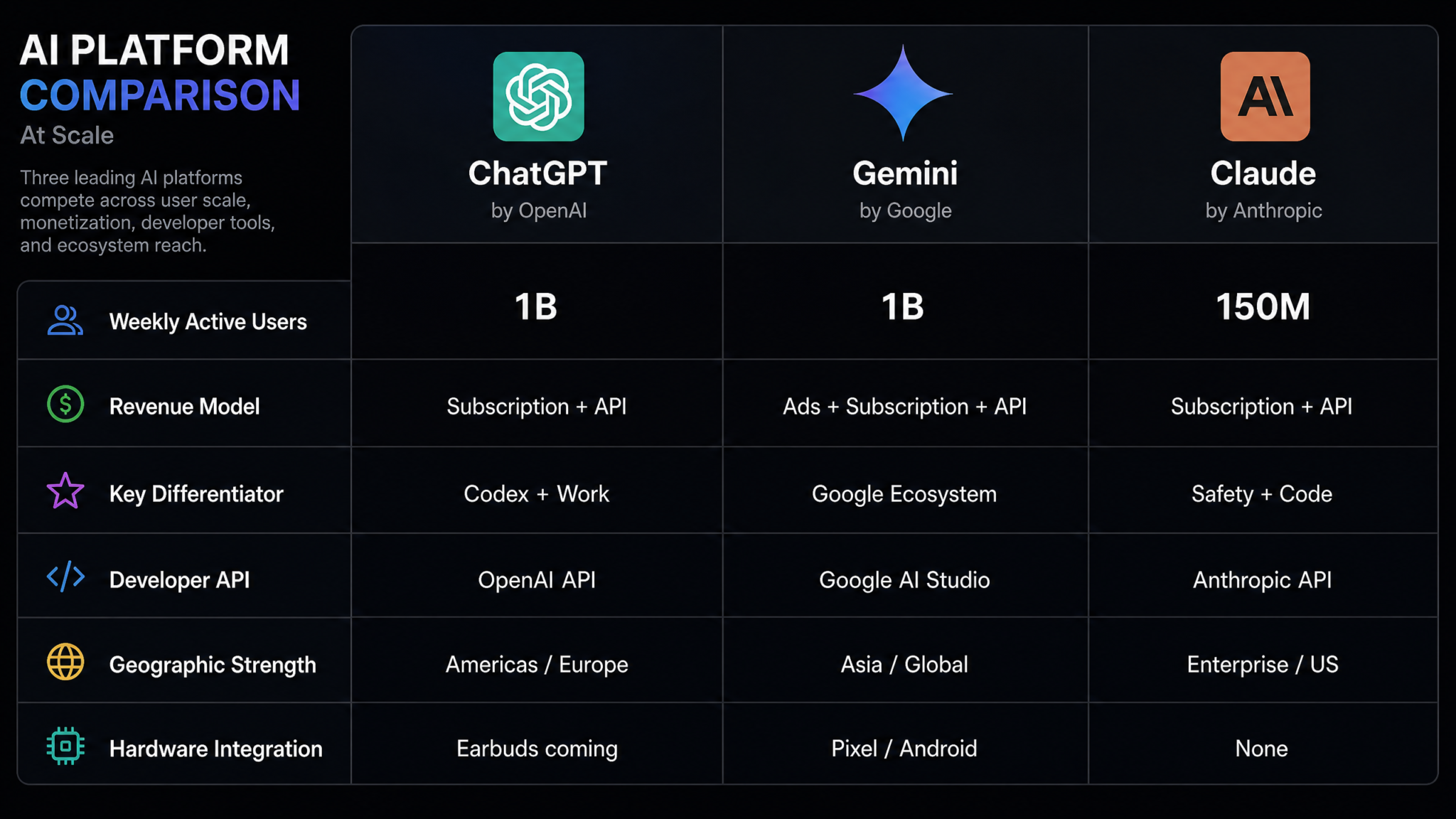
Any honest analysis of the AI platform landscape at 1 billion users must address the uncomfortable reality that the war may not remain a two-player competition. Three challengers — Anthropic’s Claude, Meta AI, and China’s DeepSeek — each represent a genuine, if currently asymmetric, threat to the ChatGPT/Gemini duopoly.
Claude: The Quality Play
Anthropic’s Claude sits at approximately 180 million weekly active users as of August 2026 — substantial by any pre-AI standard but representing less than 20% of either leading platform’s scale. Claude’s differentiation strategy has been consistently built around safety, reliability, and nuanced reasoning rather than feature breadth or distribution scale. Claude consistently outperforms both ChatGPT and Gemini in third-party evaluations of complex reasoning tasks, factual accuracy, and resistance to manipulation — metrics that matter enormously to enterprise customers in high-stakes domains. Claude’s enterprise penetration in legal services, pharmaceutical research, and financial analysis is disproportionately high relative to its overall user count, suggesting a user base that punches above its weight in terms of revenue and strategic influence. Anthropic’s partnership with Amazon Web Services, which has committed $4 billion in investment and made Claude the default AI available through AWS Bedrock, gives Anthropic a credible path to enterprise scale without needing to win the consumer distribution battle. Claude vs ChatGPT for Enterprise Use Cases: Detailed Comparison
Meta AI: The Social Distribution Wildcard
Meta AI is perhaps the most underestimated player in the AI platform war. With native integrations across Facebook (3.2 billion MAU), Instagram (2.4 billion MAU), WhatsApp (2.4 billion MAU), and Messenger (1 billion MAU), Meta possesses a distribution infrastructure comparable to Google’s in sheer reach. The challenge Meta AI has faced is product quality and user trust: early versions of Meta AI were significantly less capable than ChatGPT and Gemini, and the association with Facebook’s privacy controversies has made users in certain demographics particularly reluctant to share conversational data with Meta’s AI systems. By mid-2026, Meta AI’s capabilities have closed the gap substantially — the Llama-4 family of models is genuinely competitive with the leading offerings from OpenAI and Google — but the product still lacks the deep professional utility features that drive the high engagement rates seen in ChatGPT’s core user base. Meta AI’s estimated 350 million WAU represents a massive footprint achieved almost entirely through default integration in social apps, but the engagement quality metrics lag significantly behind both ChatGPT and Gemini.
DeepSeek: The Efficiency Insurgent
DeepSeek’s emergence in late 2024 and throughout 2025 as a world-class AI laboratory producing frontier models at a fraction of the compute cost of OpenAI and Google sent shock waves through the AI investment community — and for good reason. DeepSeek’s R2 and V4 model families demonstrated that the compute scaling assumptions underlying the US AI industry’s capital expenditure plans were subject to fundamental challenge from architectural innovation. In China’s domestic market, where both ChatGPT and Gemini are effectively blocked, DeepSeek-powered applications have achieved massive scale: Ernie Bot (Baidu), Tongyi (Alibaba), and native DeepSeek deployments collectively serve well over 500 million weekly active users in China alone, a market that the Western AI platforms cannot currently access.
The question for DeepSeek and its ecosystem is whether Chinese AI platforms can achieve meaningful global penetration in markets outside China. Geopolitical tensions, data sovereignty concerns, regulatory barriers in the EU and US, and the reputational headwinds associated with the Chinese government’s influence over Chinese technology companies all create substantial friction. Nevertheless, in markets across Southeast Asia, the Middle East, and parts of Africa where both the US government’s export controls and the Chinese government’s ambitions are less determinative than local price competition, DeepSeek-based applications are gaining users at a pace that Western analysts have been slow to acknowledge.
| Platform | Estimated WAU | Primary Strength | Key Geographic Market |
|---|---|---|---|
| ChatGPT (OpenAI) | 1.02 Billion | Engagement depth, developer ecosystem | Americas, Europe |
| Gemini (Google) | 1.01 Billion | Distribution, ecosystem breadth | Asia, Emerging Markets |
| Meta AI | ~350 Million | Social media distribution | Global (social native) |
| Claude (Anthropic) | ~180 Million | Quality, safety, enterprise | Americas, Europe (enterprise) |
| DeepSeek + Chinese Ecosystem | ~500 Million (China-focused) | Cost efficiency, domestic scale | China, parts of Southeast Asia |
| Copilot (Microsoft) | ~220 Million | Microsoft 365 integration | Enterprise globally |
| Other (regional + specialized) | ~300 Million | Varied | Fragmented |
It is worth noting Microsoft’s Copilot in this landscape. Powered by OpenAI technology under a long-term exclusive licensing arrangement, Copilot is embedded across the Microsoft 365 suite used by approximately 400 million commercial users globally. Copilot’s WAU figure of approximately 220 million active users reflects lower AI engagement rates within the Microsoft user base than either ChatGPT or Gemini have achieved, but Microsoft’s enterprise positioning means that Copilot users tend to be high-value professionals whose AI adoption has major downstream consequences for organizational productivity. The competitive relationship between ChatGPT and Copilot is unusually complex: Microsoft is simultaneously OpenAI’s largest investor and its most important enterprise channel partner and a potential competitor for the enterprise AI assistant market.
Final Analysis: The AI Platform War Has No Easy Winner
The simultaneous arrival of ChatGPT and Gemini at 1 billion weekly active users in August 2026 is one of those rare moments where a genuinely new chapter in technological history announces itself clearly enough to be recognized in real time. The age of experimental AI products is over. The age of AI infrastructure — of AI systems as fundamental to daily human life as the internet itself — has arrived.
What makes the current competitive landscape so analytically fascinating is that neither platform is clearly winning. ChatGPT leads on the metrics that define genuine AI adoption: session depth, daily engagement rates, ARPU, developer ecosystem breadth, and the high-retention professional user base that drives word-of-mouth growth. Gemini leads on the metrics that define potential future growth: geographic reach in high-growth emerging markets, ambient integration with the world’s dominant mobile operating system, and enterprise embedding in the world’s most widely used productivity suite.
The deeper story, however, is not about which platform wins — it is about what both platforms becoming essential infrastructure simultaneously means for the world. AI assistance at billion-user scale is now a basic feature of how human beings access information, solve problems, create content, and make decisions. The companies that control these platforms have become, in a functional sense, part of the cognitive infrastructure of civilization. This reality demands a level of governance sophistication, safety rigor, and public accountability that neither OpenAI nor Google has yet fully demonstrated, even as both companies are making genuine progress on each of these fronts.
The next milestones will be watched with enormous attention. But perhaps the most important question is not when either platform reaches 2 billion users — it is whether the AI industry will develop the governance frameworks, safety practices, and public oversight mechanisms needed to manage the extraordinary responsibility that comes with platforms this large. At 1 billion users, the stakes are no longer primarily commercial. They are civilizational. And the decisions made in the next few years by the people building and regulating these systems will shape not just the technology industry but the cognitive and social landscape of the 21st century.
For users, developers, enterprise decision-makers, and policymakers trying to navigate this landscape, the practical guidance is clear: both platforms are now essential infrastructure deserving serious strategic attention. The question is not whether to engage with billion-user AI platforms, but how to engage with them in ways that maximize genuine value while maintaining the critical perspective that any technology at this scale demands. The AI platform war at 1 billion users is a story with many chapters still unwritten — and every one of its billion users is, in some small way, an author of what comes next.
