
OpenAI Ends Custom GPTs on Personal Plans: What This Means for Plus, Pro, and Free Users in August 2026
In one of the most consequential policy shifts since the GPT Store launched in January 2024, OpenAI has officially announced that the ability to create new Custom GPTs will no longer be available on personal subscription tiers — including Free, Go, Plus, and Pro plans — effective August 2026. The announcement, delivered via a developer blog post and a simultaneous email blast to affected users, has sent shockwaves through a creator community that has spent years building, monetizing, and evangelizing custom AI assistants as one of ChatGPT’s most distinctive features. With tens of thousands of published GPTs now facing an uncertain future and millions of casual creators suddenly locked out of a tool they’ve relied on, the fallout is only beginning to take shape.
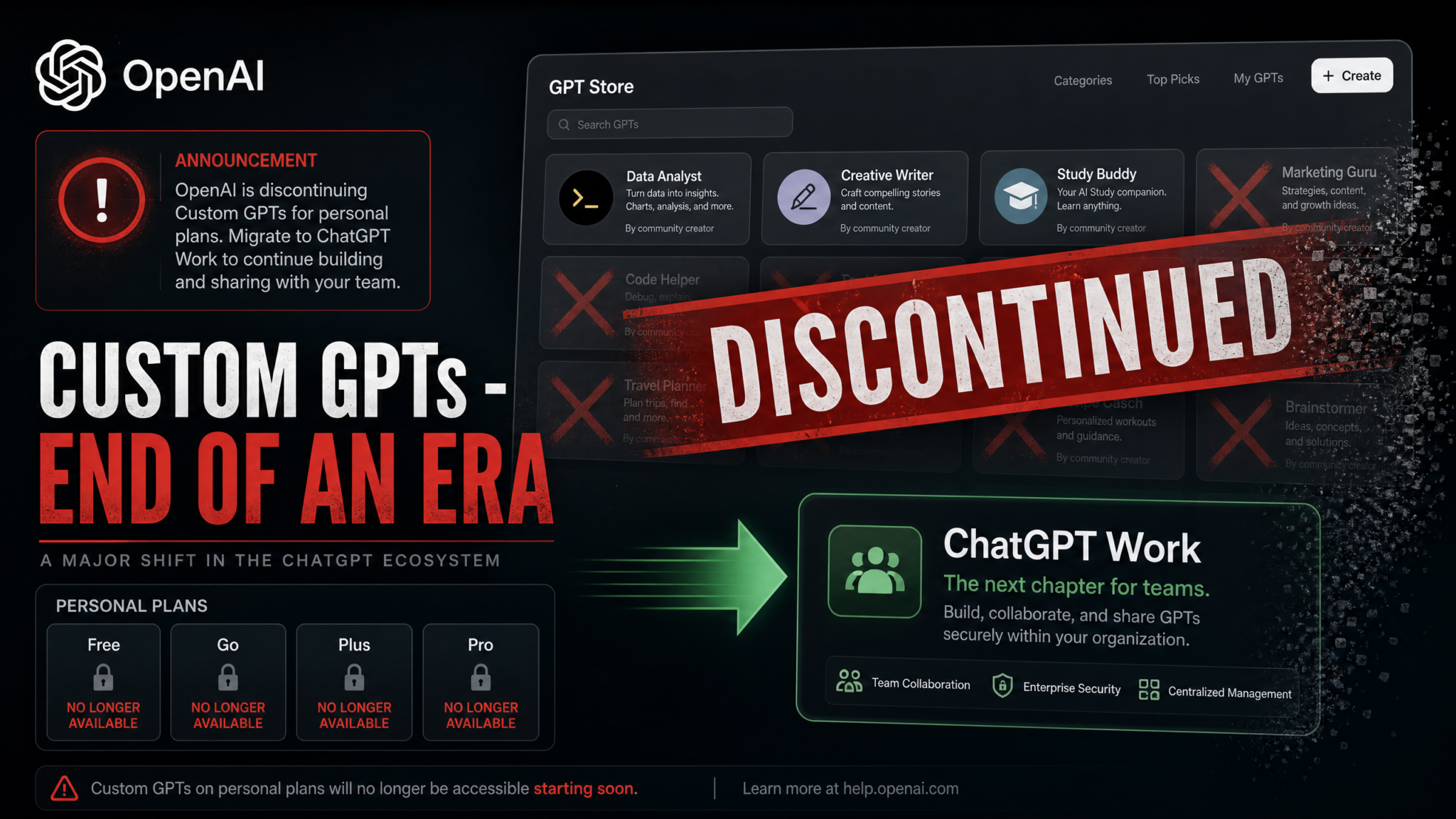
The Official Announcement: What OpenAI Said
On August 5, 2026, OpenAI published a 1,200-word blog post titled “Evolving the GPT Ecosystem: Focusing Custom AI on Professional Workflows.” The post was authored by product leadership and signed off by OpenAI’s head of platform partnerships. The language was characteristically measured — OpenAI called the change a “strategic realignment” and emphasized that the vast majority of ChatGPT’s user base, which they pegged at over 500 million monthly active users as of mid-2026, “primarily engages with ChatGPT through its core conversational interface rather than through custom configurations.”
The core policy change, stated plainly: starting August 5, 2026, users on Free, Go, Plus, and Pro subscription tiers can no longer create new Custom GPTs. The ability to edit or update existing Custom GPTs is also disabled from the same date. Users who previously created GPTs will retain read-only access to their published GPTs — meaning they can still use them and share links to them — for a transition period of 60 days, until October 4, 2026. After that point, existing personal-tier Custom GPTs will be fully removed from the GPT Store and deactivated, unless the creator has migrated to an eligible plan.
OpenAI was careful to frame the move as a positive evolution rather than a removal of features. The blog post highlighted ChatGPT Work — the $25-per-user-per-month tier introduced in early 2026 — as the designated home for Custom GPT creation going forward, alongside the existing ChatGPT Teams and Enterprise plans. “Custom GPTs represent a powerful capability that delivers the most value in professional, collaborative settings,” the post read. “By focusing this feature set on our work-oriented offerings, we can invest more deeply in the tools, security, and compliance infrastructure that professional GPT builders need.”
The announcement email that landed in affected users’ inboxes simultaneously was shorter and more direct, containing the key dates, a link to the migration FAQ, and a 25 percent discount offer on the first three months of ChatGPT Work — a promotional gesture that several vocal creators immediately dismissed as inadequate.
“This isn’t an evolution. This is a feature removal dressed in product language. Thousands of independent creators built real businesses on the GPT Store, and OpenAI is essentially telling us to pay $25 a month or lose everything we built.” — Developer and GPT Store creator, posting on the OpenAI Developer Forum, August 5, 2026
The announcement came without a developer preview period, without a public RFC (Request for Comments), and with what many in the community described as insufficient advance notice — particularly for GPT creators who had built revenue-generating assistants under the assumption that the platform would remain accessible on the Plus tier, which at $20 per month had been the de facto entry point for serious GPT builders since the Store’s launch.
What Exactly Is Changing: A Feature-by-Feature Breakdown
To understand the full scope of this policy change, it’s worth mapping precisely which capabilities are being restricted and which remain available on personal plans. Not everything is going away — but the losses are significant enough that the GPT builder experience on personal tiers is effectively ending.
Features Being Removed from Free, Go, Plus, and Pro Plans
- GPT Builder access: The visual and guided interface at chatgpt.com/create is no longer accessible for users on personal plans. Attempting to navigate to it returns a paywall prompt directing users to ChatGPT Work.
- New Custom GPT creation: Users cannot create new GPTs, even private ones that are never published to the Store.
- Custom GPT editing: Existing GPTs cannot be modified, updated, or have their instructions, knowledge files, or actions changed.
- Knowledge file uploads to GPTs: The ability to attach custom documents and data sources to a GPT configuration is removed.
- Custom Actions (API integrations): GPTs that relied on OpenAI Actions — essentially plugin-style API calls configured through the GPT builder — are becoming non-editable and will be deactivated at the 90-day mark if not migrated.
- GPT Store publishing: Personal-tier users can no longer publish new GPTs to the Store, and existing published GPTs will be delisted after the 60-day read-only window closes.
- Revenue sharing from the GPT Store: Creators on personal plans will stop accruing new revenue from GPT Store usage as of August 5. Outstanding balances from July and earlier will be paid out on the normal schedule.
Features That Remain Available on Personal Plans
- Using existing Custom GPTs (read-only, until October 4): You can still chat with any Custom GPT you created or bookmarked, for the duration of the transition window.
- Accessing GPTs created by others: GPTs that were created by organizations or individuals on eligible plans and published to the Store remain accessible to all users, including Free users, subject to the creator’s sharing settings.
- Custom Instructions: The per-account Custom Instructions feature — which lets you set a persistent system prompt for your own ChatGPT sessions — is staying on all tiers.
- Projects feature: OpenAI’s Projects capability, which allows users to group conversations and set context for a specific project, remains fully available on all plans.
- Memory: The conversational memory system that lets ChatGPT remember facts across sessions is unaffected.
Plan-by-Plan Summary
| Plan | Price | Create Custom GPTs | Edit Existing GPTs | GPT Store Publishing | Revenue Sharing |
|---|---|---|---|---|---|
| Free | $0/month | ❌ Removed Aug 5 | ❌ Removed Aug 5 | ❌ Removed Aug 5 | ❌ Removed Aug 5 |
| Go | $10/month | ❌ Removed Aug 5 | ❌ Removed Aug 5 | ❌ Removed Aug 5 | ❌ Removed Aug 5 |
| Plus | $20/month | ❌ Removed Aug 5 | ❌ Removed Aug 5 | ❌ Removed Aug 5 | ❌ Removed Aug 5 |
| Pro | $200/month | ❌ Removed Aug 5 | ❌ Removed Aug 5 | ❌ Removed Aug 5 | ❌ Removed Aug 5 |
| Work | $25/user/month | ✅ Full access | ✅ Full access | ✅ Org-scoped or public | ✅ Available |
| Teams | $30/user/month | ✅ Full access | ✅ Full access | ✅ Org-scoped or public | ✅ Available |
| Enterprise | Custom pricing | ✅ Full access | ✅ Full access | ✅ Internal/external | ✅ Available |
It is worth noting that the Pro plan — which at $200 per month is OpenAI’s most expensive personal offering — is receiving exactly the same restrictions as the free tier. This detail has generated particular frustration among Pro subscribers, who argue that paying ten times the Plus price should afford them access to the platform’s most advanced customization features.
The Deprecation Timeline: 60 Days, 90 Days, and Beyond
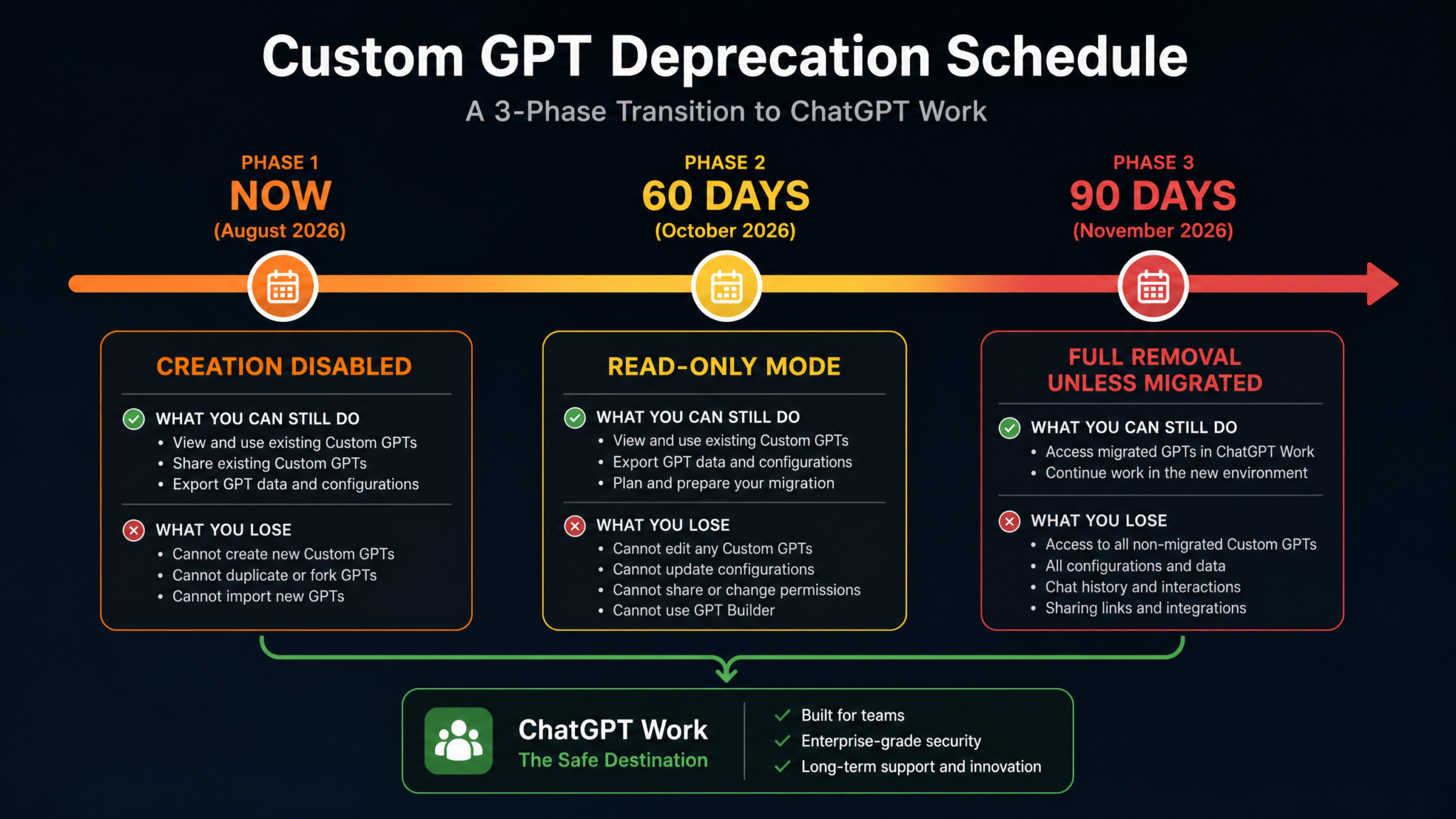
OpenAI’s rollout follows a phased deprecation schedule that gives users a structured window to export their configurations, migrate to a new plan, or wind down their GPT-based operations. Understanding this timeline is critical for anyone with active GPTs or ongoing revenue from the Store.
Phase 1: Creation Disabled (August 5, 2026 — Now)
From August 5 onward, the GPT Builder is inaccessible to personal-plan users. No new GPTs can be created. Existing GPTs remain accessible and functional but cannot be edited. Users still see their GPTs in “My GPTs” but the edit button is replaced by a migration prompt.
Phase 2: Read-Only with Store Delisting (August 5 – October 4, 2026)
During this 60-day window, your existing Custom GPTs remain usable. You can share direct links, and anyone with a link can still access them. However, new organic discovery in the GPT Store is suspended — your GPTs are removed from search results and category browsing, meaning new users can only find your GPT via a direct link. Revenue accrual from Store discovery stops immediately, though link-based sessions on personal plans may still generate some residual usage metrics. OpenAI has stated it will honor revenue sharing for usage that occurred before August 5 through normal payment cycles.
Phase 3: Full Deactivation (October 4, 2026)
On October 4, all Custom GPTs owned by personal-plan users are fully deactivated. Any attempt to access them — including via previously shared links — will return a message indicating the GPT is no longer available and prompting users to explore alternatives. Creators who have migrated to Work, Teams, or Enterprise before this date can import their GPT configurations and maintain continuity.
Phase 4: Data Retention and Export Window (October 4 – January 4, 2027)
OpenAI has committed to retaining the underlying configuration data — including system prompts, knowledge files, and action schemas — for 90 days post-deactivation. During this period, users on any tier can request a full export of their GPT data via the Settings panel, even without upgrading. After January 4, 2027, configuration data for unmigrated GPTs will be permanently deleted. OpenAI has not committed to extending this window.
“The 90-day post-deactivation data retention window is the most generous part of this policy, and I’d encourage every creator to download their configurations regardless of whether they plan to migrate. That data belongs to you.” — Independent AI developer commentary, August 2026
Why OpenAI Made This Decision: The Real Reasons Behind the Pivot
OpenAI’s stated rationale centers on directing professional tooling toward professional plans. But a closer reading of the business context, combined with reporting from several technology publications, reveals a more layered set of motivations.
Shifting Revenue Strategy Toward B2B
OpenAI’s financial profile has shifted dramatically since 2024. The company, which was reportedly burning through significant capital while revenue lagged, has progressively repositioned itself as an enterprise infrastructure provider rather than a consumer AI service. The introduction of ChatGPT Work in early 2026, the aggressive expansion of the Enterprise tier, and a series of high-profile corporate partnerships — including reported multi-billion-dollar commitments from financial services firms and healthcare networks — all point to a deliberate pivot away from consumer monetization as the primary growth vector.
Custom GPTs, paradoxically, became a liability in this context. They were originally introduced as a way to make ChatGPT Plus more compelling — a differentiating feature that justified the subscription. But as competitors began offering comparable personalization features on their own paid tiers, the competitive moat narrowed. Meanwhile, the GPT Store’s revenue sharing program, while innovative, never reached the financial scale that would justify continued infrastructure investment on the consumer side.
ChatGPT Work Plan Features and Pricing Breakdown
Abuse, Spam, and Quality Control Problems
Internal data reportedly showed that a significant percentage of published GPTs in the Store were low-quality, duplicative, or in violation of OpenAI’s usage policies. Estimates from third-party GPT Store analytics tools suggested that as many as 40 percent of the Store’s catalog by mid-2026 consisted of GPTs that had received fewer than 10 lifetime uses, and a nontrivial subset were flagged for policy violations ranging from misleading descriptions to attempts to circumvent safety filters through cleverly worded system prompts.
Moderating this long tail of low-quality content at scale proved operationally expensive. By restricting creation to paid work plans — where users have business-verified identities and billing accountability — OpenAI effectively uses economic friction as a quality filter. A $25/month minimum commitment for GPT creation is a meaningful barrier to the casual spammer or the arbitrage-seeking creator who was publishing dozens of thin-wrapper GPTs hoping to capture Store traffic.
Simplifying the Product Surface for the Mainstream User
Research consistently shows that the vast majority of ChatGPT users — even paying subscribers — never created or sought out Custom GPTs. A 2025 user behavior analysis cited in OpenAI’s developer communications suggested that fewer than 8 percent of Plus subscribers had ever accessed the GPT Builder, and fewer than 3 percent had published a GPT. From a product strategy standpoint, maintaining a complex feature used by a small minority while it generates support overhead and moderation costs is a difficult business case to sustain indefinitely.
The Projects feature, which launched to broader availability in late 2025, provides a simpler mental model for most users: instead of building a separate GPT with its own persona and knowledge base, you create a Project within your main ChatGPT interface and give it context, files, and instructions. OpenAI appears to be betting that Projects will satisfy the personalization needs of the majority, leaving Custom GPTs as a power feature for the professional tier.
Competitive Positioning Against Microsoft and Google
Microsoft’s Copilot Studio and Google’s Agentspace have both positioned themselves as enterprise-grade custom AI builder platforms, with pricing and compliance infrastructure aimed at corporate buyers. OpenAI’s decision to consolidate Custom GPT creation on Work and Enterprise plans can be read in part as a competitive alignment move — staking out territory in the enterprise customization market while ceding the consumer customization space to let Projects fill the gap.
Impact on the GPT Store Ecosystem
The GPT Store, launched with considerable fanfare in January 2024, grew to host over 3 million published GPTs by mid-2026, according to third-party catalog tracking. The creator base was diverse: some were independent developers who built sophisticated multi-action GPTs as side businesses, others were companies that built GPTs as lightweight product interfaces, and a large proportion were hobbyists and enthusiasts who created personal-use or niche-community GPTs. This announcement affects all of them, but unevenly.
Revenue Sharing: Who Was Actually Making Money?
OpenAI’s revenue sharing program for GPT creators, which distributed payments based on usage metrics, was never fully transparent in its methodology. Creators reported widely varying payouts — some claimed monthly earnings in the hundreds of dollars, others reported single-digit returns despite thousands of conversations. The most successful creators, particularly those who built GPTs in high-demand niches like coding assistance, language learning, resume writing, and legal document drafting, built meaningful revenue streams. But the program’s overall payout pool was reported to be modest by platform standards.
With the announcement, all new revenue accrual stops for personal-tier creators immediately. Creators who want to continue earning from GPT Store usage must migrate to a paid work plan — meaning the economics shift: you now pay $25/month minimum to participate in a revenue sharing program that may or may not return that investment in payouts. For high-volume GPTs, this calculation can still be favorable. For the long tail, it essentially ends GPT Store income as a viable proposition.
The Catalog Will Shrink Dramatically
Industry analysts tracking the GPT Store estimate that a large majority of the 3+ million published GPTs were created by personal-tier users. If even 70 percent of that catalog disappears — a conservative estimate given that Teams and Enterprise users represent a small fraction of the creator base — the Store will shed over 2 million entries by October 2026. The reduction will be felt most acutely in niche and hobbyist categories, while the most-used GPTs in core professional categories are more likely to be maintained by creators who upgrade or organizations already on work plans.
OpenAI has stated that it intends to “raise the quality bar” of the Store as part of this transition, implying that the reduction in catalog size is a feature, not a bug. Whether users experience the pruned Store as higher-quality or merely depleted will depend heavily on how many of the popular personal-creator GPTs survive the migration.
Best Custom GPTs for Professional Productivity in 2026
Third-Party GPT Discovery Platforms
Several independent platforms — including sites that indexed and reviewed GPTs outside of the official Store — are facing significant disruption. Services that built their audience around helping users discover and rate Custom GPTs will see their indexed catalog deprecated, and their business model, which often relied on affiliate-style referrals or advertising against GPT discovery traffic, will need to pivot. Some have already announced they will focus on covering Work and Enterprise GPTs going forward, while others are exploring whether redirecting users to Claude Projects and Gemini Gems represents a viable pivot.
Migration Paths: ChatGPT Work, Teams, and Enterprise
OpenAI has outlined three main migration paths for creators and users who want to preserve access to Custom GPT creation. The economics and practical implications of each differ substantially.
ChatGPT Work: The Primary Migration Target
At $25 per user per month, ChatGPT Work is positioned as the entry point for professional-tier GPT creation. The plan includes all Plus features, expanded context windows, GPT Builder access, the ability to publish to the GPT Store, and — notably — enhanced data privacy controls that prevent conversation data from being used in OpenAI’s training pipeline by default.
For individual creators, the math is straightforward: you’re paying $5 more per month than Plus (assuming you were on Plus) in exchange for GPT creation access. The 25 percent introductory discount brings the effective price to $18.75/month for the first quarter, slightly below Plus pricing. Whether this represents good value depends entirely on how much you use Custom GPTs and whether you generate any Store revenue.
Key Work plan features relevant to GPT creators include:
- Unlimited Custom GPT creation and editing
- GPT Store publishing with revenue sharing eligibility
- Custom Actions with OAuth support for third-party API integrations
- Knowledge base uploads up to 10GB per GPT (vs. 512MB previously on Plus)
- Analytics dashboard for GPT usage metrics
- Priority moderation review for Store submissions
ChatGPT Teams: Collaborative GPT Building
At $30 per user per month with a minimum of two users, the Teams plan adds collaborative features on top of the Work tier — including the ability for multiple team members to co-author and maintain GPTs, organization-scoped GPT publishing (share within your organization without exposing to the public Store), and shared workspaces. For small businesses and agencies that were previously managing GPTs under a single Plus account on behalf of clients, Teams offers a more appropriate infrastructure.
Enterprise: Full Control for Large Organizations
OpenAI’s Enterprise tier, priced through custom contracts typically requiring commitments from dozens to thousands of seats, provides the most extensive GPT capabilities: custom deployment domains, Single Sign-On (SSO), SAML integration, advanced audit logs, and the ability to restrict GPT access to verified internal users only. Enterprise customers are unaffected by this announcement — their Custom GPT access was never dependent on personal-plan infrastructure.
The Export and Rebuild Option
For creators who decide not to migrate — either because the cost isn’t justified or because they want to explore alternatives — the most important action is exporting GPT configuration data before the January 4, 2027 deletion date. A complete export includes the system prompt, conversation starters, knowledge file names (though not the file contents for files over a certain size), and action schemas. With this data in hand, creators can rebuild equivalent functionality using alternative platforms or by directly using the OpenAI API outside the ChatGPT interface.
// Example: Reconstructing a Custom GPT's core behavior using the OpenAI API directly
// After exporting your GPT configuration from ChatGPT Settings

const { OpenAI } = require('openai');
const client = new OpenAI({ apiKey: process.env.OPENAI_API_KEY });

// Your exported system prompt becomes the system message
const systemPrompt = `You are a specialized assistant for [your GPT's purpose].
[Paste your exported GPT instructions here]`;

async function chat(userMessage, conversationHistory = []) {
  const messages = [
    { role: 'system', content: systemPrompt },
    ...conversationHistory,
    { role: 'user', content: userMessage }
  ];

  const response = await client.chat.completions.create({
    model: 'gpt-4o',
    messages: messages,
    temperature: 0.7,
  });

  return response.choices[0].message.content;
}

// Deploy to yourproject.io or myapp.dev for continued user access
This approach puts creators back in full control of their GPT’s deployment, though it requires development resources and eliminates the built-in distribution advantages of the GPT Store.
Migration Decision Framework: Which Path Is Right for You?
With multiple migration options and a tight timeline, affected users need a clear framework for evaluating their next move. Below is a structured decision guide based on creator type, usage volume, and business context.
The Core Questions to Ask Yourself
- How actively do you use your Custom GPT(s) on a weekly basis? If you built a GPT for personal productivity and use it daily, the migration cost calculation is different from someone who published a GPT and rarely touches it.
- Do you have users or clients depending on your GPT? If you’ve shared a GPT with colleagues, a community, or paying users, the discontinuity impact is higher and migration is likely worth the investment.
- Are you currently earning revenue from the GPT Store? If yes, calculate whether that revenue exceeds the $25/month Work plan cost. If your GPT earns more than $25/month in Store revenue, migration has a clear business case.
- Can the functionality be replicated using Projects or Custom Instructions? Many simple GPTs — those that primarily customize tone, maintain a specific persona, or reference a modest set of instructions — can be approximated with Projects at no additional cost.
- Do you have the technical capability to deploy via API? For developers comfortable with Node.js, Python, or similar environments, rebuilding GPT functionality directly through the API and hosting it independently (at yourproject.io, for example) can be more cost-effective than upgrading plans.
Recommended Paths by Creator Type
| Creator Type | Recommended Path | Key Reasoning |
|---|---|---|
| Hobbyist / Personal use only | Migrate to Projects + Custom Instructions | No revenue impact; Projects covers most personal use cases |
| Solo creator with moderate Store revenue | Upgrade to ChatGPT Work (with intro discount) | Revenue likely offsets or exceeds plan cost; preserves Store position |
| Developer with technical resources | Export data, rebuild via API on own infrastructure | Greater flexibility, no platform dependency, potentially lower long-term cost |
| Small business / agency managing client GPTs | Upgrade to ChatGPT Teams | Collaborative management, org-scoped sharing, appropriate for multi-client workflows |
| Enterprise team already using Teams/Enterprise | No action required | Unaffected by this policy change |
| Creator exploring alternatives | Export data, evaluate Claude Projects or Gemini Gems | Both competitors maintain personal-tier custom AI access; viable migration |
What Happens to Your Existing Custom GPTs: A Practical Guide
If you have Custom GPTs that you’ve built and are worried about losing them, the practical steps are clear — but the window for action is narrower than it might appear given the holidays that fall near the October 4 deadline.
Step 1: Audit Your GPT Inventory
Navigate to chatgpt.com/my-gpts and catalog every GPT you’ve created. For each one, note: whether it’s published or private, what the primary use case is, whether you have active users or shared links in circulation, and whether it uses custom knowledge files or Actions (API integrations). GPTs with Actions are the most complex to migrate and the most likely to break if simply exported and rebuilt without attention to their API dependencies.
Step 2: Export Configuration Data Now
Don’t wait until October. OpenAI’s export functionality is available through Settings > Data Controls > Export GPT Configurations. The export package contains a JSON file with your system prompts, conversation starters, capability settings, and action schemas. Knowledge files need to be downloaded separately from the GPT builder while you still have read access (until October 4). After that, only configuration metadata — not file contents — will be available in the 90-day post-deactivation export window.
Step 3: Evaluate Each GPT Individually
Apply the decision framework above to each GPT separately. A complex GPT with 50MB of proprietary knowledge files and three API actions that your sales team uses daily deserves a different migration path than a simple “rewrite my emails formally” GPT that only you use occasionally. Avoid the temptation to make a single blanket decision for your entire GPT portfolio.
Step 4: Communicate With Your Users
If your GPT has an active user base — even if it’s an informal community or a shared link you distributed on social media — proactively communicate the upcoming changes. Share alternative access methods, whether that’s a migrated GPT on a new plan, a direct link to a rebuilt version on your own infrastructure, or a comparable alternative on another platform. Creators who do this will retain significantly more of their audience than those who let the service disappear without notice.
Alternatives for Personal Users: Projects, Custom Instructions, and Saved Prompts
OpenAI is pointing displaced GPT creators toward two primary in-product alternatives: Projects and Custom Instructions. Neither is a perfect substitute, but for many use cases they are genuinely functional replacements that deserve a fair evaluation rather than dismissal.
ChatGPT Projects: The Primary Replacement
Projects, which became available across all ChatGPT plans in late 2025, allows users to create named workspaces that contain: a set of uploaded files and documents that persist as context, a custom system-level instruction set for that project, and a dedicated conversation history separate from your main chat interface. The key difference between a Project and a Custom GPT is distribution — Projects are personal and cannot be shared as standalone entities with external users. For personal productivity use cases, this is often irrelevant.
What Projects can replace effectively:
Access 40,000+ AI Prompts for ChatGPT, Claude & Codex — Free!
Subscribe to get instant access to our complete Notion Prompt Library — the largest curated collection of prompts for ChatGPT, Claude, OpenAI Codex, and other leading AI models. Optimized for real-world workflows across coding, research, content creation, and business.
- Custom GPTs used for personal writing assistance with specific style guides
- Knowledge-base GPTs built around documents you own and reference regularly
- Research assistants configured for specific topics or methodologies
- Personal coding assistants configured with your preferred style conventions
What Projects cannot replace:
- GPTs shared publicly or with an audience of external users
- GPTs with API Actions that interact with external services
- GPTs designed as standalone products distributed via the Store
- GPTs with complex multi-modal workflows
Custom Instructions: System-Level Personalization
Custom Instructions — the feature that lets you set a persistent context and behavioral instruction for all ChatGPT sessions — remains available on all plans. For users who built simple GPTs primarily as a way to change ChatGPT’s baseline behavior (more formal, more concise, always respond in Spanish, always structure answers with bullet points), Custom Instructions provides the same outcome without the overhead of maintaining a separate GPT.
The limitation is that Custom Instructions apply globally to all your ChatGPT sessions unless you explicitly override them, whereas a GPT allowed you to switch personas and contexts by selecting different GPTs. Projects partially addresses this by allowing per-project instruction overrides, but the switching experience is less seamless than the GPT selector was.
Saved Prompts and Prompt Libraries
OpenAI quietly launched a Saved Prompts feature in early 2026 that allows users to save frequently used prompts and access them from a quick-access menu within the chat interface. This is a significantly simpler tool than Custom GPTs, but for users whose primary use case was “I use this same detailed prompt every week,” it provides a viable and friction-free alternative.
Community Reaction: Developer Backlash, Creator Concerns, and Enterprise Approval
The response across developer communities, social platforms, and OpenAI’s own forums has been predictably polarized along lines of who stands to lose and who stands to gain.
Developer Forum and Reddit Response
The OpenAI Developer Forum thread announcing the change accumulated over 800 replies within 48 hours of publication, making it one of the most-engaged announcements in the forum’s history. The sentiment breakdown in the first 500 replies, as tracked by several community members, skewed heavily negative: approximately 73 percent critical or strongly critical, 18 percent neutral or wait-and-see, and 9 percent supportive. The critical responses clustered around several recurring themes:
- Trust and platform reliability: Many creators expressed that they had made significant time investments — in some cases hundreds of hours — building GPTs on the assumption that the platform access level (Plus) was stable. The removal without a longer transition period felt like a betrayal of an implicit contract.
- Pro plan frustration: Pro subscribers paying $200/month were particularly vocal, arguing that their plan tier should have been grandfathered or exempted from creation restrictions.
- Revenue sharing discontinuation: Creators earning meaningful income from the Store questioned whether the 60-day wind-down was legally adequate given that OpenAI had marketed GPT Store participation as a revenue opportunity.
- Lack of consultation: Several longtime Plus subscribers and active GPT Store contributors noted that there had been no developer advisory process, no public beta of any replacement feature, and no preview period — a stark contrast to how API deprecations are typically handled.
Independent Creator Community
Several GPT creators with large followings on social media published detailed analyses of the announcement’s impact. A few notable themes emerged from this creator layer: some expressed that they saw the writing on the wall when OpenAI began pushing ChatGPT Work aggressively in early 2026, and had already begun migrating their most important GPTs to API-based deployments hosted at their own domains. Others announced they were accelerating their exploration of Claude Projects and Gemini Gems as primary platforms going forward.
Claude Projects vs ChatGPT Custom GPTs: Full Feature Comparison
“I’ve been building on the OpenAI ecosystem for three years. I’ve recommended it to clients, written guides about it, and built my consulting practice partly around Custom GPT development. This announcement is a significant credibility hit for the platform. It will take time to rebuild trust.” — Independent AI consultant and GPT Store creator, August 2026
Enterprise and Teams Users: A Different Perspective
Not all reaction has been negative. Enterprise users and organizations on the Teams plan have largely responded with approval or indifference. Several enterprise-focused commenters noted that the quality control problems in the GPT Store — the spam, the misleading GPTs, the low-effort wrappers — had been a real concern that made it difficult to recommend the Store to clients and executives. A pruned, higher-quality Store with a known accountability baseline (all creators on paid work plans) is, for this constituency, an improvement.
Some enterprise IT and security professionals also noted that the concentration of Custom GPT creation on plans with explicit data privacy controls addresses a concern they’d raised internally: that personal-tier GPTs with enterprise-uploaded knowledge files represented an uncontrolled data handling risk. Work and Teams plans include the data processing agreements and privacy defaults that enterprise security reviews require.
Legal and Consumer Protection Questions
At least two consumer advocacy groups have indicated they are examining whether the removal of features advertised as part of active paid subscriptions — particularly the Pro plan — constitutes a material change that triggers refund or termination rights under consumer protection regulations in the EU and certain US states. OpenAI’s Terms of Service include standard clauses permitting feature modifications, but the application of these clauses to significant removals from premium-tier plans is not settled law in all jurisdictions. No formal regulatory action has been announced as of the writing of this article.
Competitive Landscape: Claude Projects and Gemini Gems Still Open to Personal Users
One of the most significant immediate consequences of OpenAI’s decision is the competitive opening it creates for Anthropic and Google, both of whom maintain personal-tier access to their custom AI configuration features.
Claude Projects: Available on All Claude Plans
Anthropic’s Claude Projects feature, which allows users to create persistent, named workspaces with custom instructions, uploaded knowledge documents, and conversation history scoped to a project, remains fully available on Claude’s free tier and all paid personal plans. The Pro tier at $20/month provides expanded storage for project files and higher usage limits, but the core Projects capability is not gated behind a work or enterprise plan.
Claude Projects are not identical to Custom GPTs — they lack the external API Actions capability and the public distribution mechanism of the GPT Store — but for personal-use customization, they cover the majority of what typical Custom GPT builders actually used their GPTs for. In the 72 hours following OpenAI’s announcement, Anthropic reported that Claude sign-ups from users explicitly citing the GPT deprecation as their reason for switching were “meaningfully elevated,” though they declined to provide specific numbers.
Gemini Gems: Google’s Personal-Tier Custom AI
Google’s Gemini Gems, launched in 2024 as Google’s answer to Custom GPTs, are available to users on the Google One AI Premium plan ($19.99/month) as well as to Workspace subscribers. Unlike OpenAI’s decision, Google has explicitly maintained personal-tier access and even expanded Gems capabilities in its 2026 product updates, adding longer context windows for Gem knowledge bases and improved multi-modal input handling.
Gemini’s distribution for custom Gems remains more limited than the GPT Store was at its peak — there is no public marketplace for Gems equivalent to what the GPT Store provided — but for individual users seeking a personal AI configuration tool that isn’t restricted to enterprise plans, Gemini Gems represents a directly comparable alternative on a slightly cheaper personal plan.
Competitive Comparison Table
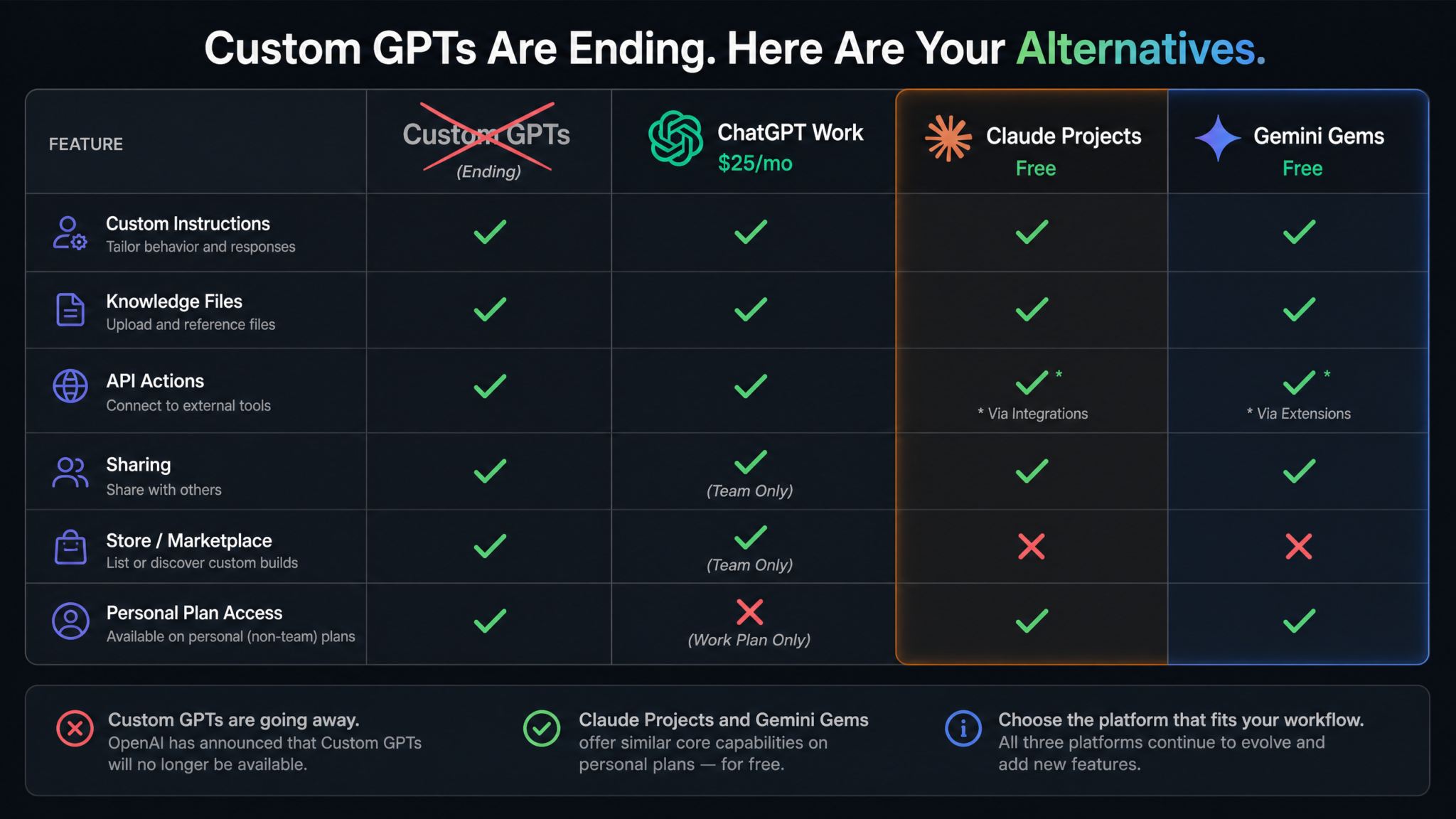
| Feature | ChatGPT Custom GPTs (Personal) | Claude Projects | Gemini Gems |
|---|---|---|---|
| Available on personal/free plans | ❌ Removed August 2026 | ✅ Yes (all tiers) | ✅ Yes ($19.99/month) |
| Custom instructions / persona | ❌ Work plan required | ✅ Full support | ✅ Full support |
| Custom knowledge base upload | ❌ Work plan required | ✅ Up to 5 files (free), more on Pro | ✅ With AI Premium |
| Public distribution / marketplace | ❌ Work plan required | ❌ Not available | ❌ Limited sharing |
| External API Actions | ❌ Work plan required | ❌ Not directly available | Limited via Workspace |
| Monthly cost for custom AI access | $25/month (Work plan) | $0–$20/month | $19.99/month |
The competitive gap this creates is stark: a user who wants to create a personalized AI assistant with a custom knowledge base and behavioral instructions can do so on Claude for free or on Gemini for $19.99/month, but the same capability now requires a $25/month minimum on ChatGPT. For users who are not already deeply embedded in the OpenAI ecosystem, the value proposition for remaining on ChatGPT for personal customization has meaningfully eroded.
Gemini Gems vs Custom GPTs: Which AI Customization Platform Wins in 2026
What This Means for the Future of AI Personalization
Zooming out from the immediate policy shock, this moment represents something larger than one company repricing one feature. It is a signal about the direction of AI personalization as an industry category — who will control it, what it will cost, and what philosophical assumptions underlie it.
The Platformization of AI is Stratifying
The early promise of consumer AI was egalitarian: everyone would have access to the same powerful model, and tools like Custom GPTs would let anyone build their own personalized AI experience without a computer science degree. That promise is being renegotiated. OpenAI’s decision is the clearest signal yet that the major AI labs view sophisticated AI customization — not just basic access — as a professional or enterprise feature, priced accordingly.
This is not inherently wrong or cynical; professional tools have always been priced above consumer tools. But it does represent a meaningful change in expectations for the millions of users who adopted Custom GPTs under the assumption that a Plus subscription was the permanent home for this kind of personalization. The shift also raises questions about whether future AI capabilities — like the ability to create autonomous agents, build multi-step workflows, or deploy custom fine-tuned models — will follow the same pattern of initial consumer availability followed by progressive migration to higher-priced tiers.
The Open-Source Alternative Gains Ground
For technically capable users, the most significant long-term consequence of this decision may be an acceleration toward self-hosted, open-weight models as a foundation for custom AI assistants. Tools like Ollama, LM Studio, and various open-source chat interfaces have matured significantly in 2025 and 2026, and the gap in raw capability between the best open-weight models and GPT-4o class models has narrowed enough that for many non-mission-critical use cases, self-hosted is now viable. Running a custom assistant built on an open-weight model at yourproject.io or myapp.dev, with a system prompt derived from your exported GPT configuration, costs the price of a VPS — often less than $10/month — and is subject to no one else’s platform decisions.
The community backlash to this announcement has already produced a measurable uptick in tutorials, open-source projects, and Discord communities focused on exactly this alternative. Whether this represents a durable shift or a temporary protest response will become clear over the next six to twelve months as users either find the migration to Work plans acceptable or genuinely migrate their workflows elsewhere.
The GPT Store’s Identity Crisis
With its catalog set to shrink dramatically and its creator base restructured around professional plans, the GPT Store will need to articulate a new value proposition. A marketplace of 500,000 high-quality, professionally maintained GPTs is potentially more compelling than a marketplace of 3 million GPTs of wildly varying quality — but only if the quality of what remains actually improves, and only if OpenAI invests in discoverability, curation, and distribution infrastructure that makes finding the right GPT a reliably good experience.
The GPT Store has always had a discoverability problem — the sheer volume of entries made it difficult to surface the genuinely excellent from the mediocre. If the reduction in catalog size is accompanied by genuine investment in search quality, editorial curation, and creator support, the post-transition Store could emerge as a more professional and trusted ecosystem. If it simply becomes a smaller version of the same experience, the case for the Store over simply using ChatGPT’s core interface becomes even weaker.
A Defining Moment for User Trust in AI Platforms
Perhaps the most lasting consequence of this announcement is what it teaches users about the terms on which they should engage with AI platform features. The implicit promise of Custom GPTs was permanence: build something once, maintain it, share it, and it will be there as long as you pay your subscription. That promise has been broken — not because OpenAI acted with malice, but because the business case for maintaining it at the consumer tier no longer aligned with the company’s strategic direction.
The lesson for power users and developers who want to build with AI going forward is that building on consumer-tier AI platform features is inherently fragile. The more durable approach is either to buy into professional or enterprise plans with explicit contractual protections, or to build on API infrastructure and open-weight models that give you genuine control over your own stack.
OpenAI is not unique in this dynamic — every major AI platform will eventually face the same pressure to rationalize features, streamline consumer products, and extract more revenue from professional and enterprise users. The difference here is scale: the Custom GPT ecosystem had grown large enough, and had attracted a committed enough creator base, that the wind-down carries real costs for real people. How the AI industry handles similar transitions in the future will determine whether the current wave of AI enthusiasts remains a supportive community or becomes a cautionary tale about the perils of building on borrowed platforms.
Final Outlook: What to Watch in the Next 90 Days
The next 90 days will be decisive. Key indicators to monitor include: the migration conversion rate (what percentage of active personal-tier GPT creators upgrade to Work plans versus abandon or migrate to competitors), the trajectory of Claude and Gemini user sign-ups attributed to displaced GPT creators, whether OpenAI makes any modifications to the policy in response to community pressure (Pro plan grandfathering has been repeatedly requested and is not entirely implausible), the quality trajectory of the post-transition GPT Store, and whether any regulatory action emerges from the EU or consumer protection bodies regarding mid-subscription feature removal.
What is already clear is that August 2026 marks a meaningful inflection point in the relationship between OpenAI and the independent creator community that helped build the GPT Store into one of the largest AI application marketplaces in the world. The full consequences of that shift — competitive, commercial, and cultural — are still unfolding.
