
25 ChatGPT Prompts for Interactive Learning and Study: Quizzes, Flashcards, Spaced Repetition, and Adaptive Study Plans
Introduction: The AI Study Revolution Is Here — And It’s Changing Everything
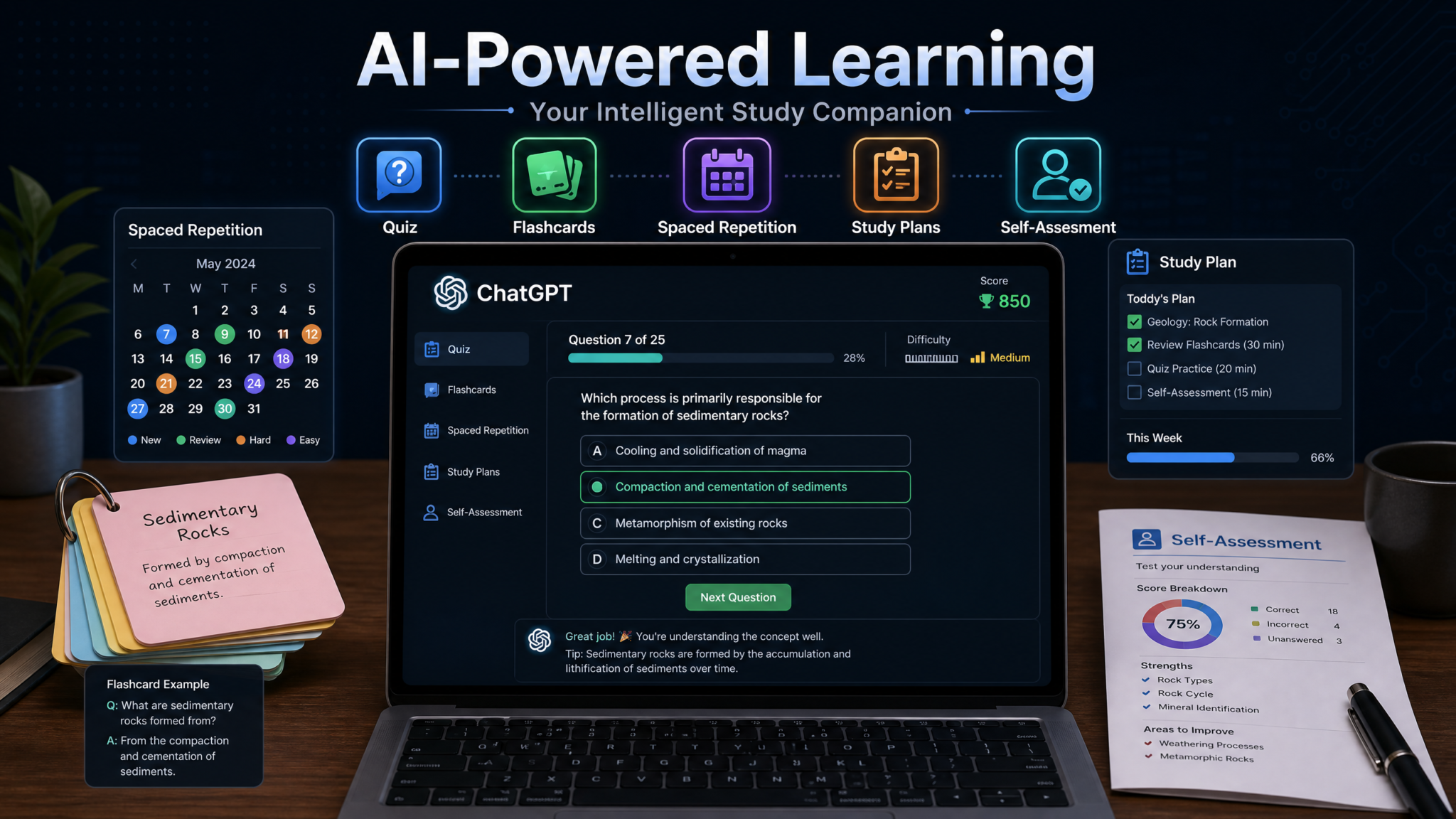
On August 14, 2026, OpenAI rolled out one of the most significant updates to ChatGPT since the introduction of GPT-4. The update, which went live across all paid tiers simultaneously, introduced native interactive quiz features directly within the chat interface — including inline multiple-choice rendering, auto-scored fill-in-the-blank responses, and a persistent flashcard deck system that syncs across sessions. For the millions of students, self-directed learners, and corporate training professionals already using ChatGPT as a study partner, this update wasn’t just incremental. It was transformative. Suddenly, the prompts they had been carefully engineering for months became supercharged — producing formatted, interactive, session-aware study content that rivals dedicated apps like Anki, Quizlet, and Khan Academy in depth, while surpassing all of them in flexibility and personalization.
But here’s what matters most: whether you’re using the updated interactive features or the baseline ChatGPT interface, the prompts themselves are the real engine of transformation. The August 2026 update enhanced the output format — the prompt engineering community had already been producing extraordinary study content for years. This masterclass documents the 25 most effective, battle-tested prompts across five essential study disciplines: quiz generation, flashcard creation, spaced repetition scheduling, adaptive study planning, and self-assessment with expert feedback.
The data behind AI-assisted studying is increasingly compelling. Research published in the Journal of Educational Technology & Society in early 2026 found that students who used structured AI study tools — particularly those involving active recall and spaced repetition — demonstrated 34% better long-term retention compared to control groups using traditional passive review methods. A separate meta-analysis of 47 studies on AI tutoring systems found that personalized AI-generated practice questions improved exam performance by an average of 0.42 standard deviations — a statistically significant and practically meaningful effect size.
This isn’t about replacing teachers, professors, or textbooks. It’s about filling the enormous gap between classroom instruction and independent study — that critical, often wasted, self-directed learning time where most forgetting occurs. ChatGPT, when prompted correctly, becomes a 24/7 Socratic tutor, an infinitely patient quiz master, a precision-calibrated study schedule architect, and an honest, rubric-based evaluator. All of these roles are unlocked through prompting strategy, and that’s exactly what you’ll master in this guide.
Each of the 25 prompts below includes the full prompt text in a copyable code block, the cognitive science context explaining why it works, customization parameters you can adjust, and pro tips for getting the most sophisticated output from ChatGPT’s updated capabilities. Whether you’re a pre-med student preparing for board exams, a software developer pursuing certifications, a language learner building vocabulary, or a corporate trainer designing onboarding curricula, these prompts will fundamentally upgrade your study system.
For additional context on how ChatGPT’s reasoning capabilities enhance educational applications, see ChatGPT Advanced Reasoning for Complex Problem-Solving.
Category 1: Quiz Generation Prompts
Active recall — the act of retrieving information from memory rather than passively reviewing it — is one of the most empirically supported learning strategies in cognitive psychology. The “testing effect,” documented in hundreds of studies since the early 20th century, demonstrates that taking a test on material produces significantly greater long-term retention than re-reading the same material an equivalent number of times. ChatGPT excels at generating highly contextual, difficulty-calibrated quiz questions from virtually any source material. These five prompts unlock the full spectrum of quiz formats and pedagogical approaches.
Prompt 1: Multiple-Choice Quiz Generator from Any Text
Learning Science Context: Multiple-choice questions, when well-constructed, force discriminative learning — the ability to distinguish the correct answer from plausible distractors. The quality of the distractors determines the cognitive load and learning value. ChatGPT can generate expert-quality distractors based on common misconceptions within a domain, which is something most automated quiz tools cannot do.
You are an expert educational assessment designer with deep knowledge of learning science and cognitive psychology. I am going to provide you with a block of text [PASTE YOUR TEXT HERE]. Your task is to generate a 10-question multiple-choice quiz based strictly on the content provided.

Requirements:
- Each question must have exactly 4 answer options labeled A, B, C, D
- Distractors must reflect common misconceptions or plausible confusions, NOT obvious wrong answers
- Questions should test understanding and application, not just recall
- Vary the cognitive level: include 3 knowledge, 4 comprehension, 2 application, and 1 analysis question (Bloom's Taxonomy)
- After all 10 questions, provide an answer key with a one-sentence explanation for each correct answer explaining WHY it is correct
- Format each question clearly with a blank line between questions
- Do NOT include the answer in the question text

Topic area: [SPECIFY SUBJECT]
Target level: [beginner / intermediate / advanced]
Text to quiz: [PASTE TEXT]
Customization Tips: Increase to 20 questions for a full practice exam. Change the Bloom’s Taxonomy distribution to heavily weight “application” and “analysis” questions for professional certification preparation. Add “Include one trick question per five questions” for advanced challenge.
Prompt 2: Fill-in-the-Blank Generator from Lecture Notes
Learning Science Context: Cloze deletion — removing key terms from sentences and requiring the learner to supply them — is a particularly effective active recall format because it forces retrieval within the exact context in which the knowledge will be used. This is the format used in Anki’s most effective medical school decks worldwide.
Act as a professional curriculum designer specializing in cloze-deletion study materials. Take the following lecture notes and transform them into a comprehensive fill-in-the-blank study worksheet.

Rules:
- Remove key terms, definitions, numbers, formulas, or conceptually critical phrases and replace them with [BLANK]
- Each blank should represent one discrete piece of information (not entire sentences)
- Generate between 15–25 blanks depending on the density of the notes
- After the worksheet, provide a numbered answer key
- Also provide a "Hint Bank" — a scrambled list of all answers at the top of the document so students can use it as a word bank if needed
- For every 5 blanks, add one bonus challenge blank marked [CHALLENGE BLANK] that removes a more inferential or connective concept

Difficulty setting: [easy / medium / hard]
Subject: [YOUR SUBJECT]
Lecture notes: [PASTE NOTES]
Customization Tips: Remove the Hint Bank entirely for maximum difficulty. Ask ChatGPT to generate a “pure recall version” and a “word bank version” simultaneously for differentiated study sessions.
Prompt 3: Scenario-Based Application Questions
Learning Science Context: Transfer learning — the ability to apply knowledge in novel contexts — is the ultimate goal of education, and it is woefully undertested by standard fact-recall questions. Scenario-based questions simulate the messy, contextual nature of real-world application, dramatically improving the transferability of learned knowledge.
You are a scenario-based assessment expert. Create 5 detailed scenario-based questions for the topic below. Each scenario should:

1. Present a realistic, specific situation (3–5 sentences of context)
2. Ask 2–3 sub-questions that require the learner to apply concepts from the subject area to solve the problem
3. Include a "What would change if..." follow-up question that tests adaptable thinking
4. Provide a model answer after each scenario that explains the reasoning process step-by-step, not just the final answer
5. Include common mistakes a learner might make and why those mistakes are wrong

The scenarios should feel authentic to the professional or academic context where this knowledge would actually be used.

Subject/Topic: [YOUR TOPIC]
Professional context: [e.g., nursing clinical setting / software engineering / financial analysis]
Difficulty level: [intermediate / advanced / expert]
Specific concepts to target: [LIST 3–5 KEY CONCEPTS]
Customization Tips: Add “Base each scenario on a different sub-topic so that all 5 scenarios collectively cover the full topic area” for comprehensive coverage. Ideal for law, medicine, engineering, and business case-study preparation.
Prompt 4: Progressive Difficulty Quiz (Scaffolded Challenge)
Learning Science Context: Desirable difficulty theory (Bjork, 1994) suggests that learning is deepest when tasks are challenging but achievable. A progressive quiz that begins at foundation level and escalates creates a scaffolded challenge structure that maintains engagement while pushing learners to the edge of their competence — the zone of proximal development.
Design a 15-question progressive difficulty quiz on [TOPIC]. Structure the quiz in three tiers:

TIER 1 — Foundation (Questions 1–5):
- Pure knowledge and comprehension questions
- Straightforward recall of definitions, formulas, or key facts
- Single correct answer, no ambiguity

TIER 2 — Application (Questions 6–10):
- Require applying concepts to solve problems or interpret scenarios
- May involve multi-step reasoning
- One question in this tier should involve a common misconception as a distractor

TIER 3 — Analysis & Synthesis (Questions 11–15):
- Require comparing concepts, evaluating arguments, or constructing explanations
- At least two questions should have multiple defensible answers — for these, accept any answer that demonstrates correct reasoning and explain the nuance in the answer key
- One question should require the learner to identify an error in a provided worked example

Format: Provide all questions first, then a separate answer key with detailed explanations.
Topic: [YOUR TOPIC]
Target learner: [e.g., second-year undergraduate / self-taught developer / medical student]
Prompt 5: Timed Exam Simulation
Learning Science Context: Practice testing under exam-like conditions — including time pressure — activates retrieval processes that mirror those required during actual assessment. The psychological principle of “encoding specificity” suggests that memory retrieval is most efficient when the conditions of retrieval match the conditions of encoding.
Create a realistic timed exam simulation for [SUBJECT/CERTIFICATION/COURSE]. This should mirror the actual format of the [SPECIFIC EXAM NAME OR STYLE, e.g., AP Biology / AWS Solutions Architect Associate / USMLE Step 1].

Include:
- An exam header with instructions, total time, point values, and rules
- Section 1: 20 multiple-choice questions (1 point each, suggested time: 30 minutes)
- Section 2: 5 short answer questions (4 points each, suggested time: 25 minutes)
- Section 3: 2 extended response / case analysis questions (10 points each, suggested time: 25 minutes)
- A time management guide showing recommended minutes per section
- A separate answer guide with full model answers and partial credit criteria for Sections 2 and 3
- A score interpretation table: 0–49% (Needs significant review), 50–69% (Core concepts understood, application needs work), 70–84% (Exam-ready with targeted review), 85–100% (Mastery level)

Topic coverage: [LIST SPECIFIC TOPICS/UNITS TO INCLUDE]
Difficulty: Calibrated to actual [EXAM NAME] difficulty level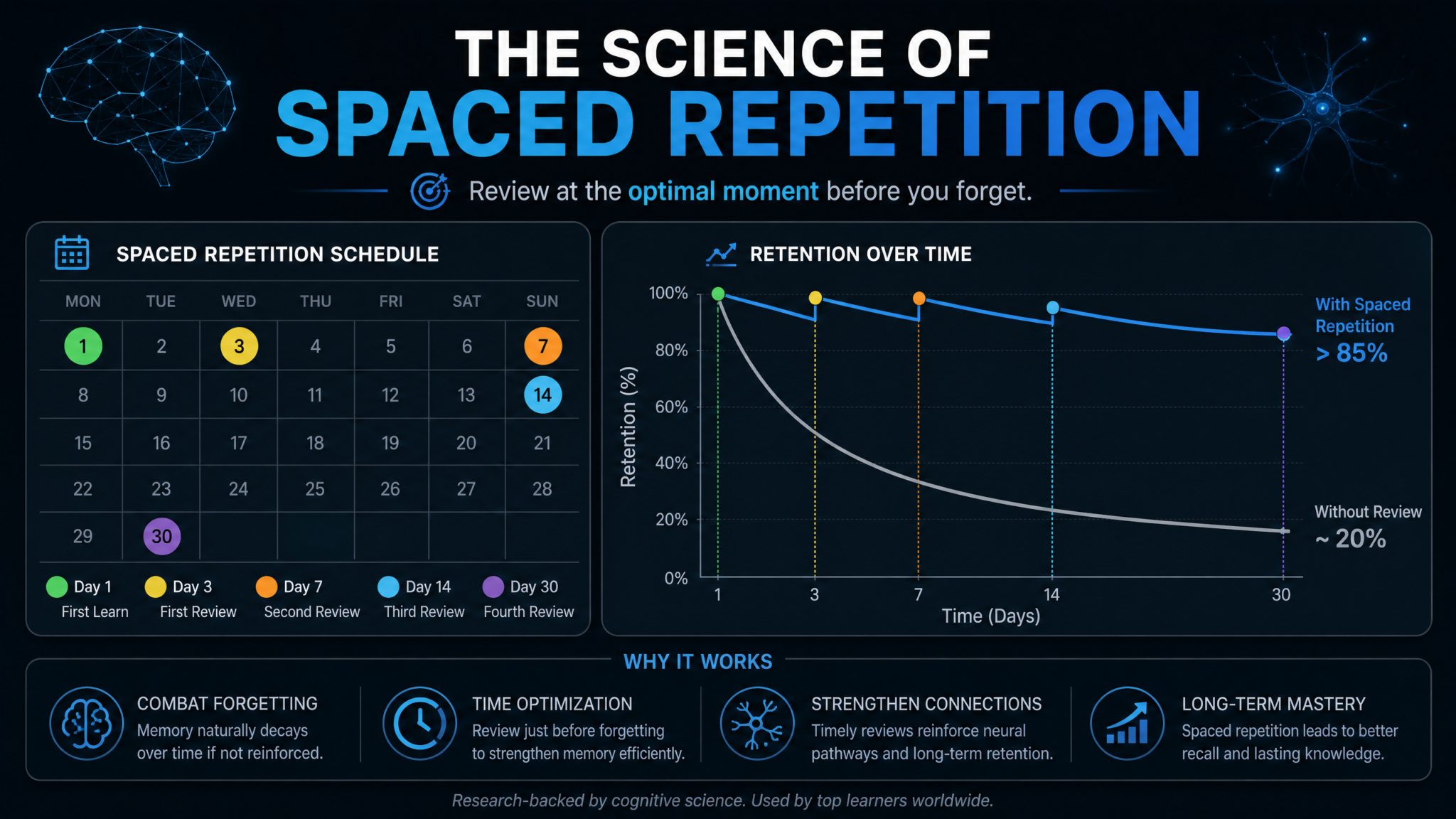
Category 2: Flashcard System Prompts
Flashcards remain one of the most researched and validated learning tools available. When combined with AI-generated content that includes rich context, worked examples, and deliberate encoding cues, digital flashcard decks produced by ChatGPT can rival professionally designed study materials in effectiveness. The following five prompts cover every major flashcard format and learning style.
For deeper exploration of how ChatGPT handles structured output formatting for study tools, see ChatGPT Structured Output Formatting for Productivity Systems.
Prompt 6: Automatic Flashcard Creation from Textbook Passages
You are an expert study materials designer. Convert the following textbook passage into a structured flashcard deck.

For each flashcard:
- FRONT: A question, prompt, or incomplete statement that requires active recall
- BACK: A concise but complete answer (2–4 sentences maximum)
- MEMORY TAG: One 2–3 word mnemonic, acronym, or vivid association to aid encoding
- DIFFICULTY RATING: [1-Easy / 2-Medium / 3-Hard] based on conceptual complexity

Generate exactly 20 flashcards. Prioritize:
- Core definitions and their distinctions from related terms
- Cause-and-effect relationships
- Procedural steps where applicable
- Exception cases and edge cases (often the most tested material)

After the deck, provide a "Deck Summary" — a 3-sentence overview of the most critical concepts covered across all 20 cards.

Subject: [SUBJECT]
Chapter/Section: [CHAPTER OR SECTION TITLE]
Textbook passage: [PASTE TEXT]
Prompt 7: Two-Sided Cards with Deep Explanations
Create an enhanced two-sided flashcard deck on [TOPIC] that goes beyond simple Q&A.

Each card should have FOUR layers:
1. FRONT (The Prompt): A question or term — keep it under 15 words
2. SHORT ANSWER (Back, Side A): The direct answer in 1–2 sentences
3. DEEP EXPLANATION (Back, Side B): A 3–5 sentence explanation covering WHY this is true, how it connects to related concepts, and one real-world application or example
4. COMMON CONFUSION: One common mistake or misconception learners have about this concept, and a clear statement of why it's wrong

Generate 15 cards on: [SPECIFIC TOPIC OR SUBTOPICS]
Format them clearly with labels for each layer.
After the deck, identify the 3 cards that are most critical — the "cornerstone concepts" — and explain why mastering them unlocks understanding of the others.
Prompt 8: Image-Description Flashcards for Visual Learners
Create a set of 12 visual-concept flashcards for visual and spatial learners studying [TOPIC].

Since you cannot embed images, each card should:
- FRONT: A precise description of a diagram, chart, graph, or visual representation the learner should mentally construct or draw. Be specific enough that the learner could accurately sketch it (e.g., "Draw the structure of a neuron with all major components labeled")
- VISUAL CUE DESCRIPTION: Describe what the mental image should look like in vivid, specific terms — colors, spatial relationships, directions of arrows, relative sizes
- BACK: The full conceptual explanation of what the visual represents
- DRAW IT CHALLENGE: A specific drawing prompt the learner can use to encode the concept kinesthetically
- SPATIAL MEMORY HOOK: A tip for using the visual as a memory anchor (e.g., "The mitochondria's inner membrane folds look like a crumpled piece of paper — visualize squeezing it")

Subject: [YOUR SUBJECT — works especially well for biology, chemistry, anatomy, physics, engineering]
Specific visuals to cover: [LIST KEY DIAGRAMS OR PROCESSES IN YOUR SYLLABUS]
Prompt 9: Vocabulary Cards with Context Sentences
Build a comprehensive vocabulary flashcard deck for [SUBJECT / LANGUAGE] containing 25 cards.

For each vocabulary term:
- TERM: The word, phrase, or concept
- PRONUNCIATION GUIDE: [For foreign language learning: include IPA or phonetic approximation]
- DEFINITION: Precise, field-specific definition (not dictionary-generic)
- ETYMOLOGY OR WORD ORIGIN: Brief note on the root words, prefixes, or suffixes and what they mean (powerful for medical/legal/scientific vocabulary)
- CONTEXT SENTENCE 1: A sentence from an academic or professional context showing the term used correctly
- CONTEXT SENTENCE 2: A sentence showing a slightly different usage, edge case, or colloquial variant
- RELATED TERMS: 2–3 synonyms, antonyms, or conceptually adjacent terms with brief notes on how they differ
- MEMORY PEG: A vivid, concrete image or story that connects the sound/look of the word to its meaning

Term list to cover: [PASTE YOUR VOCABULARY LIST OR SPECIFY A TOPIC FOR AI-GENERATED TERMS]
Field: [e.g., organic chemistry / contract law / academic English / medical terminology / JavaScript concepts]
Prompt 10: Formula Cards with Worked Examples
Create a formula mastery flashcard deck for [SUBJECT — e.g., physics, statistics, calculus, finance].

Generate 15 formula cards. Each card must include:

FRONT:
- Formula name and symbol notation
- "What does this formula calculate?" (one sentence)

BACK:
- Full formula written clearly
- Variable key: Define every variable, its units, and typical value ranges
- Derivation hint: A 2–3 sentence intuitive explanation of WHERE this formula comes from (conceptual, not just mathematical)
- Worked Example 1 (Simple): A step-by-step solution with numbers, showing each substitution clearly
- Worked Example 2 (Complex): A multi-step problem that requires combining this formula with at least one other concept
- Common Errors: The two most frequent mistakes students make when applying this formula
- Exam Alert: A note on how this formula typically appears in assessments (e.g., "Often tested with unit conversion traps" or "Frequently tested in combined systems problems")

Formulas to cover: [LIST YOUR FORMULAS OR SPECIFY A TOPIC AREA]
Course level: [high school / undergraduate / graduate / professional exam]
Category 3: Spaced Repetition Prompts
Spaced repetition is arguably the most empirically validated learning technique in all of cognitive psychology. The spacing effect — first documented by Hermann Ebbinghaus in his 1885 forgetting curve research — demonstrates that distributing review sessions over increasing time intervals produces dramatically superior long-term retention compared to massed practice. The SM-2 algorithm, developed by Piotr Wozniak and the basis for Anki’s scheduling system, provides a mathematical framework for calculating optimal review intervals. ChatGPT can now implement variations of this algorithm directly through conversation, creating personalized, adaptive review systems that respond to your actual performance data.
Prompt 11: SM-2 Algorithm Scheduling System
Act as a spaced repetition scheduling engine implementing the SM-2 algorithm. I will provide you with a list of study topics and my self-assessed performance scores for each. Generate a structured review schedule.

SM-2 Algorithm Parameters:
- Score 0 (Complete blackout): Review in 1 day
- Score 1 (Incorrect, but recognized after seeing answer): Review in 1 day
- Score 2 (Incorrect, but answer felt easy): Review in 1 day
- Score 3 (Correct with significant difficulty): Review in 1 day (interval resets)
- Score 4 (Correct with some hesitation): Continue interval progression
- Score 5 (Perfect recall): Extend interval by easiness factor (default EF = 2.5)

Interval progression for scores 4–5: 1 day → 6 days → EF × previous interval (rounded to nearest day)

My topics and current performance scores:
[LIST EACH TOPIC WITH SCORE 0–5, e.g.:]
- Krebs Cycle: 3
- Oxidative Phosphorylation: 2
- Glycolysis: 5
- Electron Transport Chain: 1
- Fatty Acid Beta Oxidation: 4

Today's date: [DATE]
Target exam date: [DATE]

Generate:
1. A day-by-day review calendar for the next 30 days
2. Which topics need immediate attention (scores 0–2)
3. Which topics are on track (scores 3–4)
4. Which topics may be over-reviewed given the exam timeline (score 5 with time to spare)
5. A weekly review load estimate (hours per week)
Prompt 12: Difficulty-Based Review Interval System
Create a personalized review interval system for my study materials based on difficulty ratings.

I'll rate each topic from 1–5 where:
1 = Very easy (already know well)
2 = Easy (minor gaps)
3 = Medium (understand basics, need reinforcement)
4 = Hard (significant gaps in understanding)
5 = Very hard (nearly no retention)

My topics and difficulty ratings:
[YOUR LIST]

Study session frequency I can commit to: [e.g., 45 minutes per day, 6 days per week]
Exam date: [DATE]
Today's date: [DATE]

Design:
1. A color-coded priority matrix (Critical / High / Medium / Low)
2. Specific review intervals for each difficulty level
3. A daily session allocation: what percentage of each session should go to each priority tier
4. A "booster review" protocol for the week before the exam
5. Warning flags for topics rated 4–5 that cannot achieve sufficient review repetitions before the exam date given the available time
Prompt 13: Weak Topic Identification and Drill Protocol
I've just completed a practice exam and received scores on individual topic areas. Analyze my performance data and generate a targeted weak-topic intervention plan.

My practice exam results:
[PASTE YOUR TOPIC SCORES, e.g.:]
- Topic A: 45% correct
- Topic B: 78% correct
- Topic C: 60% correct
- Topic D: 32% correct
[etc.]

Passing threshold for the real exam: [e.g., 70%]
Time remaining until exam: [e.g., 3 weeks]

Provide:
1. A weakness analysis identifying Critical Gaps (below 50%), Improvement Zones (50–65%), and Solid Foundations (above 65%)
2. For each Critical Gap topic: a 5-day intensive drill protocol specifying exactly what to study each day
3. A theory — based on my score patterns — about the underlying conceptual misunderstanding that might explain the weakness (e.g., "Your 32% score on Topic D suggests you may be confusing X with Y, which is a common foundational gap that cascades into errors across multiple sub-questions")
4. 10 targeted practice questions for each Critical Gap topic
5. A recommendation for whether to attempt all topics or strategically de-prioritize any topics given the time constraint
Prompt 14: Adaptive Review Session Generator
Generate a structured 45-minute adaptive review session for the following subject: [SUBJECT]

Session parameters:
- Topics covered in this course/curriculum: [LIST TOPICS]
- My weakest areas: [LIST 2–3 WEAK TOPICS]
- My strongest areas: [LIST 2–3 STRONG TOPICS]
- Time since I last reviewed each topic: [e.g., Topic A: 3 days ago, Topic B: 1 week ago]
- Session goal: [e.g., pre-exam review / new material consolidation / error correction]

Structure this 45-minute session as follows:
- Minutes 0–5: Warm-up recall (easy questions from strong topics to activate prior knowledge)
- Minutes 5–20: Core practice (highest-priority weak topics — 80% of questions from here)
- Minutes 20–35: Interleaved practice (mix weak and medium topics randomly — this is the most learning-effective format)
- Minutes 35–42: Challenge stretch (one hard synthesis question combining 2+ topics)
- Minutes 42–45: Session consolidation (3 key takeaways the learner should write down)

Generate actual questions for each time block, not just descriptions. Include answers at the end.
Prompt 15: Progress Tracking and Schedule Adjustment
I've been following a study schedule for [X weeks] and want to assess my progress and recalibrate my plan.

Here is my original study plan: [PASTE YOUR ORIGINAL SCHEDULE]

Here is my actual study log for the past [X] weeks:
[PASTE LOG — include what you studied, when, and your self-assessed performance 1–5]

Please provide:
1. Adherence analysis: What percentage of the planned sessions did I complete? Which days/topics were consistently skipped?
2. Progress assessment: Based on my performance scores, which topics have improved, plateaued, or regressed?
3. Recalibrated schedule: Adjust my remaining study plan to account for actual progress, missed sessions, and current weak areas
4. Behavioral pattern analysis: Based on my log, identify any patterns (e.g., consistently lower performance in evening sessions, specific topic categories where I underperform) and recommend adjustments
5. Motivational reality check: An honest assessment of whether I'm on track to reach my target score given current progress rate, and what would need to change if I'm not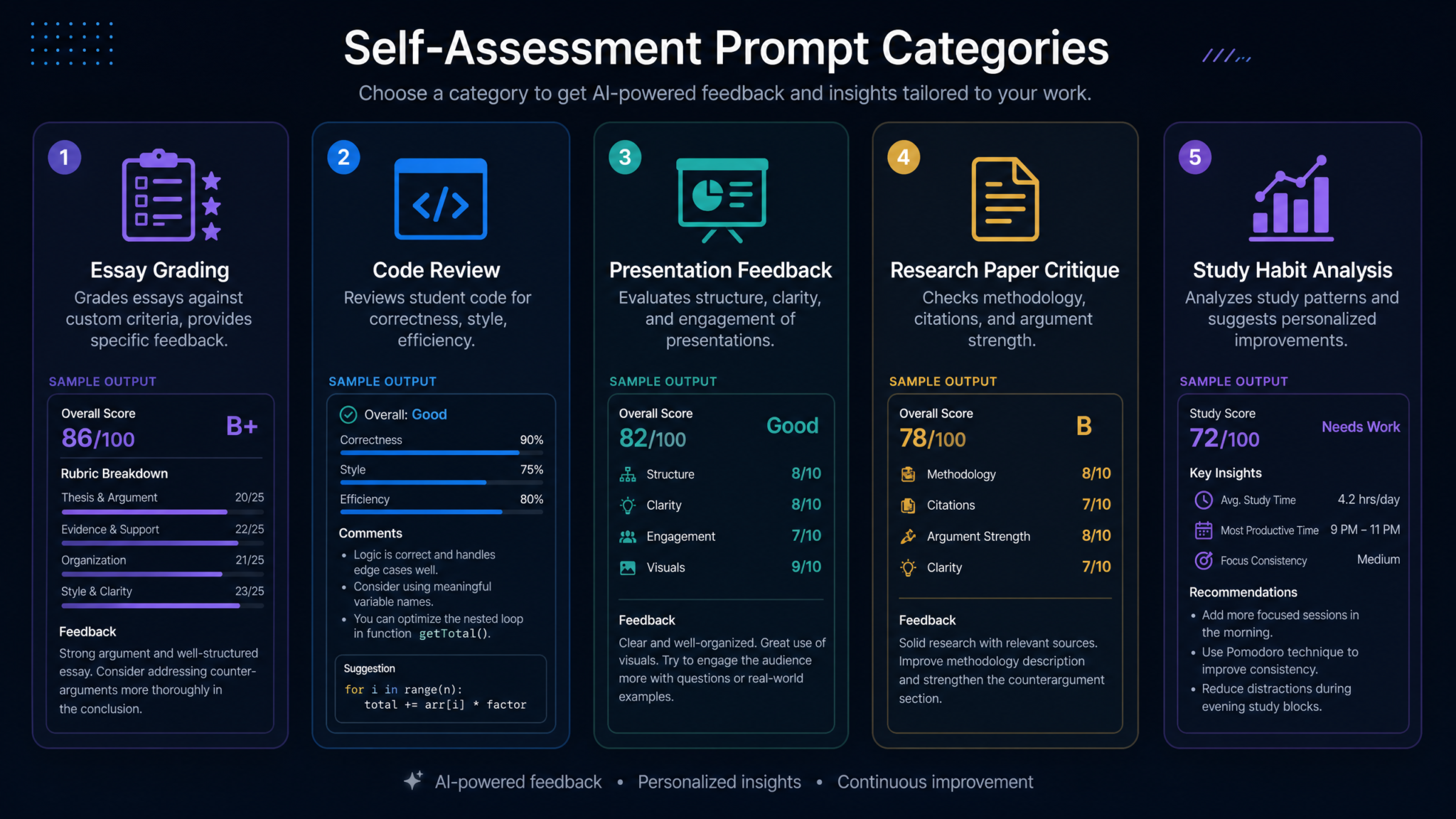
Category 4: Adaptive Study Plan Prompts
A study plan is only as good as its fidelity to your actual life constraints, cognitive patterns, and subject-specific demands. Generic study schedules fail because they don’t account for individual variation in learning speed, subject difficulty, prior knowledge, and real-world time constraints. These five prompts generate study plans with surgical precision — adapting to syllabi, countdown timelines, energy levels, and multi-subject demands simultaneously.
Understanding how to effectively prompt ChatGPT for planning and scheduling tasks connects directly to broader prompt engineering principles covered in Advanced ChatGPT Prompt Engineering Techniques for Complex Tasks.
Prompt 16: Personalized Study Schedule from Syllabus
You are an expert academic coach and learning strategist. Create a personalized study schedule based on my course syllabus and personal constraints.

My syllabus/curriculum:
[PASTE YOUR SYLLABUS OR LIST OF TOPICS WITH ESTIMATED COMPLEXITY]

Personal constraints:
- Available study hours per day: [e.g., Monday–Thursday: 2 hours, Friday: 1 hour, Saturday: 3 hours, Sunday: off]
- Known difficult topics (based on past experience): [LIST]
- Prior knowledge baseline: [e.g., strong in X, weak in Y, no background in Z]
- Learning style preference: [visual / reading-intensive / practice-heavy / discussion-based]
- Exam date(s): [LIST ALL ASSESSMENT DATES]
- Other commitments during this period: [e.g., part-time work, family commitments, other courses]

Build a week-by-week study schedule that:
1. Allocates more time to harder topics proportionally
2. Schedules review sessions 1 week, 3 days, and 1 day before each assessment
3. Builds in one "catch-up buffer" day per week for sessions that fell behind
4. Avoids scheduling the hardest topics immediately before known high-stress days
5. Includes specific resources or activity types for each session (not just "study Topic X")
6. Provides a one-paragraph weekly briefing explaining the logic behind that week's schedule
Prompt 17: Exam Countdown Planner
Create a precision exam countdown study plan. My exam is in exactly [X] days.

Exam details:
- Subject: [SUBJECT]
- Exam format: [e.g., 100 MCQ / 3 essays / mixed format]
- Topics covered: [LIST ALL TOPICS]
- My current estimated readiness per topic (1–10):
  [LIST EACH TOPIC WITH READINESS SCORE]

Time available each day: [HOURS PER DAY]

Structure the countdown plan in three phases:

PHASE 1 — Content Consolidation (Days [X] to [X]):
Focus: Cover all topics with significant gaps; heavy content review

PHASE 2 — Active Recall and Practice Testing (Days [X] to [X]):
Focus: Shift from passive review to active recall; daily practice questions; timed mini-tests

PHASE 3 — Final Sharpening (Final 7 days):
Day 7: Full-length practice exam + error analysis
Day 6: Targeted review of exam errors
Day 5: Comprehensive flashcard review — all topics
Day 4: Weak topic intensive (2 lowest readiness scores)
Day 3: Mixed practice questions — full topic range
Day 2: Light review only — no new material; mental rest
Day 1: Morning review of key formulas/definitions only; afternoon rest

Generate the specific daily activities, not just category labels. Include a readiness milestone check for the end of each phase.
Prompt 18: Weakness-Targeted Study Sessions
Design 5 targeted study sessions specifically aimed at eliminating my knowledge gaps in [SUBJECT].

My identified weaknesses (from practice tests, self-assessment, or instructor feedback):
[LIST YOUR SPECIFIC WEAK AREAS WITH AS MUCH DETAIL AS POSSIBLE]

For each of the 5 sessions (90 minutes each):

Session structure:
- Session title and focus area
- Pre-session diagnostic: 3 quick questions to establish baseline before the session
- Core learning block (60 minutes): Specific activities, in order, with time allocated to each
  - Conceptual review: Which specific concepts to revisit and in what sequence
  - Worked examples to study: Describe the type of example that will most efficiently address the gap
  - Practice problems: Provide 5 actual practice problems with solutions
  - Connection mapping: An activity to connect the weak area to topics the learner already knows well
- Consolidation block (20 minutes): 3 retention exercises to cement the session's learning
- Post-session check: 3 questions to verify the gap has closed
- If post-session check score < 60%: Suggested follow-up micro-session (15 minutes)

Make sessions progressive: each session should build on the previous one, not repeat the same approach.
Prompt 19: Multi-Subject Balancing Strategy
I am studying for multiple subjects/exams simultaneously and need a balanced study strategy that prevents neglect of any subject while prioritizing appropriately.

My subjects:
[LIST EACH SUBJECT WITH:]
- Exam date
- Current readiness (1–10)
- Weekly contact hours (class time)
- Difficulty level (1–5)
- Weight/importance (e.g., 30% of GPA / professional certification / elective)

Available study time: [X hours per week total]

Create:
1. A priority ranking of subjects using a weighted formula that accounts for: urgency (days until exam), current gap (10 minus readiness score), stakes (weight/importance), and difficulty
2. A weekly time allocation table showing how many study hours per week each subject receives and the justification
3. An interleaving strategy: Rather than blocking entire days for one subject, recommend a specific daily interleaving schedule that research shows improves both retention and transfer
4. A "subject neglect alert system": Define specific threshold conditions (e.g., "If I haven't studied Subject X for more than [X] days, trigger a catch-up session")
5. A 4-week rolling schedule showing how allocations should shift as exam dates approach
Prompt 20: Energy-Level-Aware Scheduling
Design a cognitively optimized study schedule that accounts for natural energy and focus cycles throughout the day.

My energy profile:
- Peak focus window: [e.g., 9am–12pm]
- Secondary focus window: [e.g., 3pm–5pm]
- Low energy periods: [e.g., 1pm–3pm, after 9pm]
- Sleep schedule: [e.g., sleep at 11pm, wake at 7am]
- Days with external commitments that reduce cognitive availability: [LIST]

My study tasks by cognitive demand:
HIGH DEMAND (requires deep focus and working memory):
[LIST YOUR HARDEST TOPICS OR MOST COGNITIVELY INTENSIVE TASKS]

MEDIUM DEMAND (requires attention but not peak performance):
[LIST MODERATE-DIFFICULTY TASKS]

LOW DEMAND (can be done in lower-focus states):
[LIST REVIEW, FLASHCARD, LISTENING, OR PASSIVE ACTIVITIES]

Create a week-long optimized schedule that:
1. Slots high-demand tasks exclusively in peak focus windows
2. Reserves medium-demand tasks for secondary focus windows
3. Places low-demand tasks in low-energy periods (making those periods productive rather than wasted)
4. Builds in 10-minute breaks using the Pomodoro structure for high-demand sessions
5. Includes a Sunday planning ritual (15 minutes) to review the coming week's priorities
6. Flags any scheduling conflicts where cognitive demand exceeds available energy state
Category 5: Self-Assessment and Feedback Prompts
Formative feedback — the kind you receive during learning rather than just at the end — is one of the most powerful levers for academic improvement. Studies by educational researcher John Hattie, whose meta-analysis of over 800 educational interventions ranks feedback with an effect size of 0.70 (among the highest of any single intervention), demonstrate that high-quality, specific feedback dramatically accelerates learning. ChatGPT's ability to apply expert rubrics to student work across domains — from essays to code to research papers — makes it an unprecedented formative assessment tool.
For students using ChatGPT across multiple academic tasks, understanding the full scope of academic use cases is covered in Complete Student Guide to ChatGPT for Academic Excellence.
Prompt 21: Essay Grading with Academic Rubrics
Act as an experienced academic writing evaluator. Grade the following essay using a rigorous rubric and provide detailed developmental feedback.

Grading Rubric (100 points total):
- Thesis and Argument Clarity (20 points): Is the central argument clearly stated, original, and consistently maintained?
- Evidence and Support (20 points): Is evidence relevant, accurate, sufficient, and properly cited?
- Analysis and Critical Thinking (25 points): Does the writer analyze rather than merely summarize? Is reasoning logical?
- Structure and Organization (15 points): Is the essay logically structured with effective transitions?
- Writing Quality (10 points): Clarity, precision, vocabulary, and grammatical correctness
- Engagement with Counterarguments (10 points): Does the essay acknowledge and respond to opposing views?

For each rubric category:
1. Assign a numerical score with justification
2. Quote 1–2 specific sentences from the essay that exemplify the strength or weakness
3. Provide one specific, actionable improvement recommendation

After the rubric scores:
- Overall grade and letter equivalent
- Top 3 strengths of the essay
- Top 3 priority improvements (ranked by impact on overall quality)
- Estimated revised score if all priority improvements were implemented
- One model paragraph showing how a specific weak section could be rewritten

Course level: [high school / undergraduate / graduate]
Assignment type: [argumentative / analytical / research / reflective]
Essay: [PASTE ESSAY]
Prompt 22: Code Review for Computer Science Students
Act as a senior software engineer and CS educator reviewing a student's code submission. Provide thorough educational feedback that teaches, not just corrects.

Review dimensions:
1. Correctness (Does the code do what it's supposed to do? Are there bugs or edge cases it fails?)
2. Time Complexity (Analyze Big-O for each function and identify optimization opportunities)
3. Space Complexity (Assess memory usage and potential improvements)
4. Code Quality (Naming conventions, readability, modularity, comments)
5. Best Practices (Idiomatic usage of the language, design patterns, error handling)
6. Test Coverage (Are there test cases? Are edge cases handled? What tests are missing?)

For each dimension:
- Score out of 10 with justification
- Specific line-by-line comments on problematic code (quote the line number and code)
- Rewritten version of the most critical improvement
- Learning resource recommendation (not a specific URL, but the type of resource: e.g., "Review dynamic programming memoization patterns in your algorithms textbook")

Additional analysis:
- What common beginner misconception does this code reveal?
- What would this code look like if written by a senior engineer? (Show the optimized version)
- What one concept, if mastered, would most improve this student's code quality overall?

Language: [Python / JavaScript / Java / C++ / etc.]
Assignment description: [DESCRIBE WHAT THE CODE IS SUPPOSED TO DO]
Student code: [PASTE CODE]
Prompt 23: Presentation and Public Speaking Feedback
Act as a professional speech coach and presentation skills evaluator. Analyze my presentation script/outline and provide developmental feedback.

Evaluation Framework:
1. Opening Hook (10 points): Does it capture attention within the first 30 seconds?
2. Message Clarity (20 points): Is the core message clear and memorable? Could an audience member state it in one sentence after the talk?
3. Structure and Flow (15 points): Is there a logical progression with clear signposting?
4. Evidence and Credibility (15 points): Are claims supported with data, stories, or expert authority?
5. Audience Engagement Techniques (15 points): Questions, pauses, callbacks, humor, storytelling?
6. Closing and Call to Clarity (10 points): Does it end with a memorable statement and clear takeaway?
7. Language and Delivery Cues (15 points): Are there overused filler phrases, overly complex sentences, or delivery notes that should be added?

For each dimension: score + specific feedback + revised example sentence

Additional deliverables:
- Identify the single strongest 30-second segment that the speaker should amplify
- Identify the single weakest 30-second segment and explain how to fix it
- Create 3 alternative opening hooks they could test
- Suggest 2 story or analogy insertions that would make abstract concepts concrete
- Estimated delivery time at a natural speaking pace (130–150 WPM)

Presentation context: [e.g., 10-minute class presentation / 20-minute conference talk / elevator pitch]
Audience: [e.g., professors / industry professionals / general audience]
Topic: [TOPIC]
Script/Outline: [PASTE CONTENT]
Prompt 24: Research Paper Critique
Act as a peer reviewer for an academic journal in [FIELD]. Provide a thorough, constructive critique of the following research paper draft.

Review it across these dimensions:

SUBSTANTIVE CRITIQUE:
1. Research Question: Is it clearly stated, significant, and appropriately scoped?
2. Literature Review: Is prior work adequately covered? Are key foundational papers likely missing?
3. Methodology: Is the research design appropriate for the question? Are there threats to validity?
4. Data and Analysis: Is the evidence sufficient? Are statistical or analytical methods appropriate?
5. Discussion: Do the conclusions follow from the findings? Is there overgeneralization?
6. Contribution: What does this paper add that wasn't known before? Is the contribution clearly articulated?

STRUCTURAL CRITIQUE:
7. Abstract: Does it accurately summarize all sections?
8. Introduction: Does it establish context, gap, and purpose?
9. Conclusion: Does it synthesize rather than just summarize?

WRITING QUALITY:
10. Academic Voice, Precision, and Clarity

For each dimension:
- Assessment (Strong / Adequate / Needs Revision / Major Weakness)
- Specific feedback with page/section references
- Recommended revision

Final summary:
- Overall recommendation: [Accept / Minor Revision / Major Revision / Reject with guidance]
- Top 3 strengths
- Top 3 required changes for publication readiness
- One question the paper raises that future research should address

Field: [YOUR ACADEMIC FIELD]
Paper draft: [PASTE PAPER OR ABSTRACT + KEY SECTIONS]
Prompt 25: Study Habit Analysis and Optimization
Act as a learning coach and behavioral analyst. Analyze my study habits from the log below and provide a comprehensive optimization report.

My study log for the past [X] weeks:
[PASTE YOUR LOG — include: dates, times, subjects, duration, methods used (reading/practice/flashcards/etc.), self-rated focus level 1–5, self-rated retention immediately after 1–5]

Also provide the following context:
- My sleep schedule during this period: [DESCRIBE]
- Exercise and physical activity: [DESCRIBE]
- Nutrition/caffeine patterns during study: [DESCRIBE]
- Stress level (1–10 average): [SCORE]
- Exam performance during this period: [ANY SCORES]

Analyze:
1. SESSION EFFECTIVENESS PATTERNS: Which study sessions had the highest retention-to-time ratio? What variables predicted high-effectiveness sessions?
2. DIMINISHING RETURNS DETECTION: At what study duration do my sessions start losing effectiveness? (Look for correlation between session length and retention scores)
3. SUBJECT-TIME CORRELATIONS: Which subjects do I study most effectively at which times of day?
4. METHOD EFFECTIVENESS: Which study methods (reading vs. practice vs. flashcards) correlate with highest retention scores for me?
5. CONSISTENCY ANALYSIS: Am I front-loading study, studying consistently, or cramming? How does each pattern affect my retention scores?
6. BEHAVIORAL RECOMMENDATIONS: Based purely on my data, provide 5 specific habit changes ranked by estimated impact on outcomes
7. EXPERIMENTAL INTERVENTIONS: Suggest 2 study protocol experiments I could run for the next 2 weeks, with specific metrics to track, to test whether proposed changes actually improve my performance

Format the analysis as a professional learning audit report with an executive summary at the top.
Prompt Category Comparison Table
The following table provides a quick-reference overview of all 25 prompts, their primary cognitive mechanism, ideal use timing, and estimated setup time for first use.
| Category | Prompts | Core Learning Mechanism | Best Used | Setup Time | Difficulty Level |
|---|---|---|---|---|---|
| Quiz Generation | 1–5 | Active Recall / Testing Effect | After initial content review | 5–10 min | Beginner–Advanced |
| Flashcard Systems | 6–10 | Encoding and Retrieval Practice | During and after learning | 10–15 min | Beginner–Intermediate |
| Spaced Repetition | 11–15 | Spacing Effect / Forgetting Curve | Ongoing — throughout study period | 15–20 min | Intermediate–Advanced |
| Adaptive Study Plans | 16–20 | Deliberate Practice / Personalization | Beginning of study period | 20–30 min | Intermediate–Advanced |
| Self-Assessment | 21–25 | Formative Feedback / Metacognition | After producing work product | 10–15 min | All levels |
Implementation Guide: Building Your Complete AI Study System
Having 25 powerful prompts is valuable, but the true leverage comes from integrating them into a cohesive, sequential study system. The following framework shows how these prompt categories interact and reinforce each other across a typical academic term or certification study period.
Access 40,000+ AI Prompts for ChatGPT, Claude & Codex — Free!
Subscribe to get instant access to our complete Notion Prompt Library — the largest curated collection of prompts for ChatGPT, Claude, OpenAI Codex, and other leading AI models. Optimized for real-world workflows across coding, research, content creation, and business.
Week 1–2: System Architecture (Study Plans + Flashcards)
Begin with Prompt 16 (Personalized Study Schedule from Syllabus) to establish your foundational study architecture. Simultaneously, run Prompt 6 (Automatic Flashcard Creation) on all chapter summaries or key readings from your first two weeks of content. This gives you an immediate, structured flashcard base from which the spaced repetition system will operate. Use Prompt 9 (Vocabulary Cards) for any subject with specialized terminology — this is particularly high-leverage for medical, legal, scientific, and language learning contexts where vocabulary mastery is a prerequisite for understanding higher-level content.
Week 2–4: Active Recall Integration (Quizzes + Spaced Repetition)
Once you've completed initial content review, shift the majority of your study time from passive reading to active recall. Run Prompt 1 (Multiple-Choice Generator) on each major topic immediately after studying it. Your first quiz score establishes your baseline. Use Prompt 11 (SM-2 Scheduling) with those initial scores to generate your first spaced repetition schedule. The critical discipline here is honest self-scoring — the algorithm only works if you accurately report your actual recall performance rather than optimistically inflating scores.
This integration of quiz results with spaced repetition scheduling is where AI-assisted studying truly outperforms traditional methods. The typical self-directed learner has no systematic way to track which topics they're forgetting and at what rate. ChatGPT, used with these prompts, makes the invisible forgetting curve visible and actionable.
Mid-Period: Adaptive Recalibration (Weak Topics + Progress Tracking)
At the midpoint of your study period, run a full diagnostic using Prompt 5 (Timed Exam Simulation) across all topics covered to date. Use those scores to run Prompt 13 (Weak Topic Identification) and Prompt 15 (Progress Tracking and Adjustment). This recalibration step is often skipped by students who assume their initial plan is still valid — it rarely is. Topics that seemed manageable in week one often reveal themselves as deeper gaps under exam conditions, while other topics prove easier than anticipated and can be de-prioritized.
Final Phase: Integration and Self-Assessment
The final two weeks before any major assessment should emphasize synthesis, error analysis, and formative feedback. Use Prompt 4 (Progressive Difficulty Quiz) to push yourself to analysis-level thinking across all topics. Use Prompt 21 or 22 (Essay or Code Review) on any submitted or draft work to get immediate rubric-based feedback. Run Prompt 17 (Exam Countdown Planner) for the final 14-day sprint.
Maximizing Output Quality: The Three-Layer Prompt Principle
Every prompt in this guide can be further enhanced using what practitioners call the three-layer principle: Role + Context + Constraints. The most effective study prompts assign a specific expert role to ChatGPT ("Act as a medical board exam specialist"), provide rich context about the learner's current state ("I have 3 weeks until my exam and am currently at 58% on practice tests"), and apply explicit constraints ("Generate questions at the analysis level of Bloom's Taxonomy only; avoid pure memorization questions"). All 25 prompts above are constructed using this principle, but you can amplify any of them by adding more specific context from your actual study situation.
Session Continuity and Memory Management
One significant practical consideration for AI-assisted studying is session continuity. ChatGPT's memory functions have improved substantially with the August 2026 update, but for extended study projects, it remains best practice to maintain a "study state document" — a brief text file you keep locally that summarizes your current readiness scores by topic, your scheduled review dates, and your study plan phase. Beginning each ChatGPT study session by pasting this context document takes under two minutes and dramatically improves the personalization and continuity of the AI's outputs across sessions.
For students managing multiple AI tools alongside ChatGPT, including AI note-taking and synthesis tools, the integration strategies discussed in Building a Complete AI-Powered Academic Workflow provide a broader systems view of how these tools connect.
Ethical Considerations and Academic Integrity
Every tool in this guide is designed for legitimate study support — generating practice materials, building review systems, and receiving developmental feedback on your own work. The distinction between using AI to generate practice questions for self-study and using AI to complete graded assessments for submission is clear, and students should understand their institution's specific policies regarding AI tool usage. The prompts in this guide are engineered to maximize learning, not to shortcut it — their value comes from the cognitive effort you apply to the AI-generated material, not from the material itself.
Tracking Return on Investment
Prompt 25 (Study Habit Analysis) provides the most direct way to measure whether your AI-assisted study system is actually improving your outcomes. Run a habit analysis at the beginning of your study period to establish a baseline, then again at the four-week mark. The objective comparison between session effectiveness, retention scores, and exam performance before and after implementing these prompts will provide concrete data on what's working for your individual learning profile — because even within an empirically validated framework, individual variation in response to different techniques is significant.
Conclusion: The Learner Who Prompts Well, Learns Well
The August 14, 2026 ChatGPT update accelerated an already-profound transformation in self-directed learning. But as this masterclass demonstrates, the update was an enhancement to a capability that had been building for years through the work of educators, students, and prompt engineers who understood that AI's greatest educational contribution was not in delivering information — it was in generating the conditions for active, structured, feedback-rich learning that cognitive science has long identified as optimal but that traditional educational systems rarely provide at scale.
The 25 prompts in this guide cover the full cognitive spectrum of effective studying: from the initial encoding of new material through flashcards and scenario questions, to the deliberate practice of active recall through progressive quizzes, to the precision scheduling of spaced repetition, to the architectural intelligence of personalized study planning, to the formative feedback loop of self-assessment. Each layer reinforces the others. A student using all five categories in an integrated system has, in effect, built a personalized learning environment that rivals what once required a dedicated tutor, a study skills coach, a curriculum designer, and a subject matter expert working together.
That said, the prompts themselves are starting points, not endpoints. The best results will come from learners who treat each prompt as a template to customize, experiment with, and evolve based on their own performance data. Add your specific constraints. Paste your actual notes. Report your honest self-assessment scores. The more context you provide, the more precisely ChatGPT's outputs will serve your actual learning needs.
The 34% retention advantage documented in AI-assisted study research is not automatic. It accrues to learners who use these tools actively and strategically — who use AI to work harder and smarter, not to avoid working at all. Every quiz question in this guide, every flashcard deck, every spaced repetition schedule, every adaptive study plan, is only as powerful as the cognitive effort you invest in engaging with it. The prompts open the door. You still have to walk through it.
Master these 25 prompts, integrate them into a coherent study system, iterate based on your performance data, and you will have built something genuinely rare: a personalized learning machine calibrated to your specific knowledge gaps, cognitive rhythms, and academic goals. That's not a feature update. That's a transformation in how learning works.
