
OpenAI o3 Retires August 26: Complete Migration Guide from o3 to GPT-5.6 Sol Before the Sunset Deadline
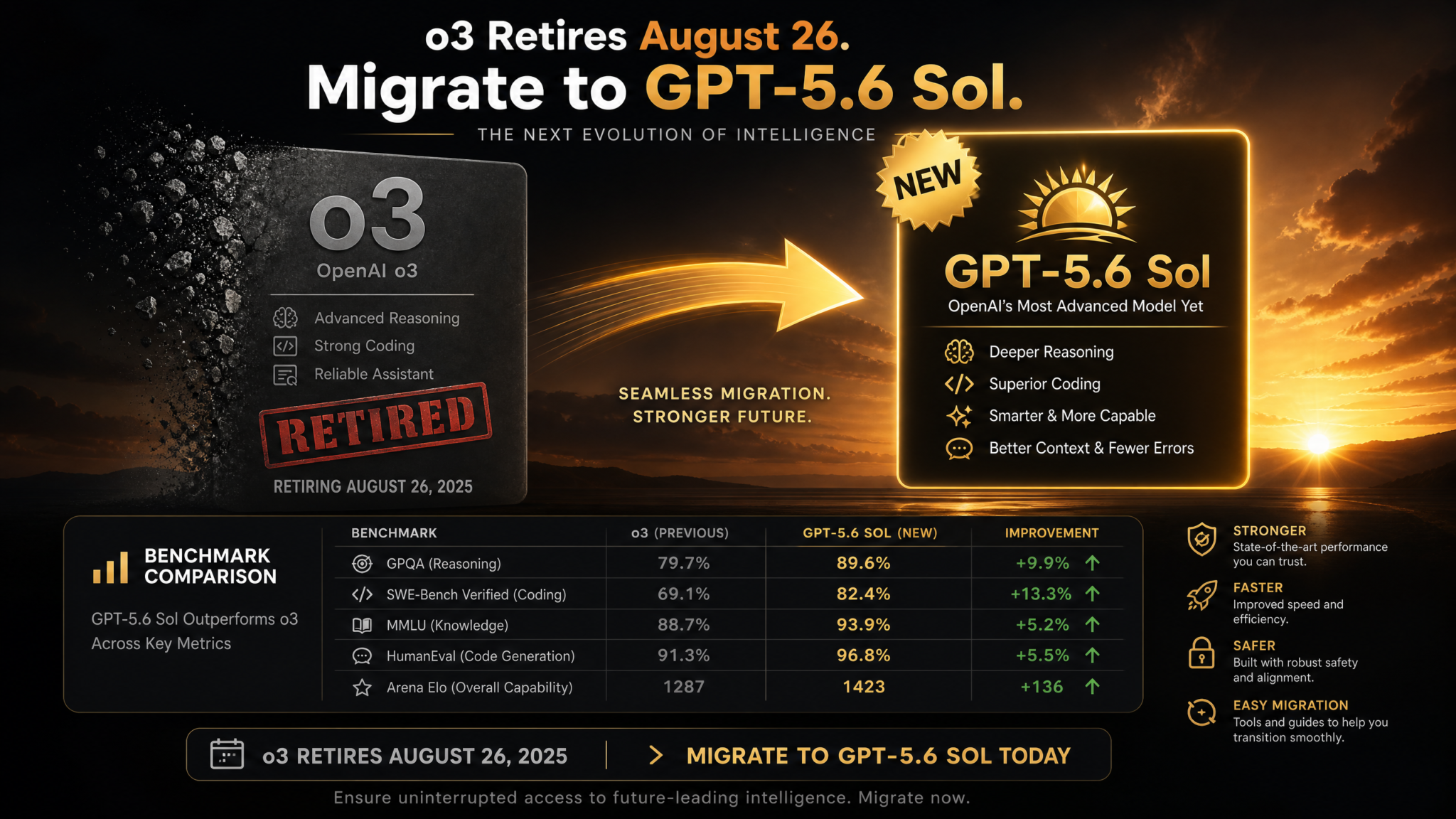
OpenAI has confirmed that o3 will be officially retired from ChatGPT and the OpenAI API on August 26, 2026, following a 90-day sunset period announced in the company’s Model Release Notes. Whether you are a developer with thousands of API calls per day built around o3’s reasoning engine, or a power user who has fine-tuned elaborate system prompts for o3’s unique chain-of-thought style, the clock is ticking. This guide walks you through everything you need to know: why o3 is being retired, what replaces it, how to migrate your code and prompts, and how to validate that your workflows perform just as well—or better—after the switch.
What’s Happening: The o3 Sunset Explained
On May 28, 2026, OpenAI published updated Model Release Notes announcing that o3 would enter a 90-day deprecation window, culminating in a hard retirement date of August 26, 2026. The sunset applies to both the consumer-facing ChatGPT interface and the OpenAI API. After that date, any API call pointing to the o3 model identifier will return an error, and the model will no longer appear as a selectable option in ChatGPT’s model picker.
This is not a soft deprecation in the traditional sense, where a legacy model remains available behind a deprecated flag. OpenAI has been explicit: August 26 is a hard cutoff. There will be no “o3-legacy” fallback, no extended grace period for enterprise customers who haven’t migrated, and no unofficial workaround. The infrastructure supporting o3 will be decommissioned, and the endpoints will cease to respond to that model identifier.
The 90-day window was chosen deliberately. OpenAI’s Model Lifecycle Policy specifies a minimum 30-day notice period for production models, and the 90-day window for o3 reflects both the model’s wide adoption and the complexity of migrating workloads that rely on its particular reasoning architecture. OpenAI’s developer relations team has confirmed that over 340,000 active API keys made at least one call to an o3 variant (o3, o3-mini, o3-high) in the 30 days prior to the deprecation announcement—making this one of the most consequential model retirements since GPT-4 Turbo’s sunset.
The retirement affects three specific model identifiers:
o3— the standard tiero3-mini— the lightweight reasoning varianto3-high— the extended-thinking configuration that allowed longer internal reasoning traces
All three will be unavailable after August 26. The recommended replacements are distinct members of the new GPT-5.6 model family, which we’ll cover in detail in the sections below.
Why OpenAI Is Retiring o3
Superseded by a Superior Architecture
The primary driver behind o3’s retirement is straightforward: GPT-5.6 Sol materially outperforms o3 on nearly every benchmark OpenAI and independent researchers have run. When a successor model beats its predecessor on reasoning, coding, mathematics, and science benchmarks while also being faster and more cost-efficient to serve, maintaining both in parallel creates infrastructure overhead without meaningful user benefit.
o3 was released in late 2024 as OpenAI’s first production “reasoning model”—a category distinction that meant the model engaged in extended internal chain-of-thought before producing a final response. At launch, o3 represented a dramatic leap over GPT-4o on tasks requiring multi-step reasoning, achieving a 91.6% score on AIME 2024 (a notoriously difficult high-school mathematics competition), compared to GPT-4o’s 9.3%. That gap justified an entirely separate model product line with its own pricing tier and API parameters.
GPT-5.6 Sol collapses that distinction. Rather than maintaining separate “standard” and “reasoning” model families, GPT-5.6 Sol integrates extended chain-of-thought natively, with dynamic reasoning depth that adjusts based on task complexity. The user no longer needs to choose between a fast response and a thorough one—Sol handles that decision internally. This architectural consolidation means the two-track model strategy that gave o3 its raison d’être no longer applies.
Consolidating the Model Lineup
OpenAI has been vocal about what its engineering team calls “model sprawl.” As of early 2026, the OpenAI API offered more than 14 distinct model identifiers across GPT-4, GPT-4o, o1, o1-mini, o1-pro, o3, o3-mini, o3-high, and various dated snapshots. This proliferation creates several problems:
- Developer confusion about which model to choose for a given task
- Fragmented tooling support in SDKs, third-party platforms, and fine-tuning pipelines
- Inconsistent behavior as different models apply different defaults for temperature, context windows, and output formatting
- Support burden for OpenAI’s technical team, who must maintain documentation, bug fixes, and safety evaluations for every active model identifier
The GPT-5.6 family—Sol, Luna, and Terra—is designed to cover the full spectrum of use cases with just three identifiers. o3’s retirement is part of a broader cleanup that also deprecated o1-mini and o1-pro earlier this year.
Infrastructure Cost Reduction
Serving o3 requires dedicated GPU clusters optimized for its particular inference pattern, which involves extended thinking steps that differ architecturally from the transformer inference pipeline used for GPT-5.6 models. Maintaining two separate inference architectures at scale is expensive. OpenAI’s infrastructure costs are a well-documented concern—the company reportedly spent over $7 billion on compute in 2025. Consolidating onto a single modern inference stack for GPT-5.6 models allows OpenAI to reclaim that compute and redirect it toward GPT-5.6 capacity, which translates into lower latency and higher availability for users on the new models.
From a pricing perspective, GPT-5.6 Sol is also positioned at a lower per-token cost than o3-high was, despite superior benchmark performance. This is a direct result of architectural efficiency gains—Sol generates its reasoning traces more efficiently than o3’s inference pipeline could.
What Replaces o3: The GPT-5.6 Model Family
GPT-5.6 Sol — The Primary o3 Replacement
GPT-5.6 Sol is the direct successor to o3 and the model OpenAI recommends for any workload that previously relied on o3’s extended reasoning capabilities. Sol stands for “Solver” internally, reflecting its design focus on complex, multi-step problem-solving tasks. Key characteristics:
- Context window: 256,000 tokens (input) / 65,536 tokens (output)
- Reasoning mode: Dynamic—adjusts internal chain-of-thought depth automatically
- API identifier:
gpt-5.6-sol - Pricing: $12 / 1M input tokens, $48 / 1M output tokens (as of June 2026)
- Rate limits: 10,000 RPM for Tier 5 accounts; 500 RPM for Tier 1
- Strengths: Mathematical reasoning, code generation, scientific analysis, long-form document synthesis
Sol does not expose reasoning tokens in its API output by default. However, setting "reasoning": {"effort": "high"} in the request body will include a reasoning_content field in the response containing Sol’s internal chain-of-thought—useful for debugging and for applications that built workflows around o3’s visible reasoning traces.
GPT-5.6 Luna — For General Tasks
GPT-5.6 Luna is positioned as the general-purpose model in the GPT-5.6 family, analogous to what GPT-4o was in the previous generation. Luna is faster and cheaper than Sol, optimized for conversational tasks, content generation, summarization, and classification work that doesn’t require deep multi-step reasoning. If you were using o3-mini for lightweight tasks to save on cost, Luna is likely your best migration target, not Sol.
- API identifier:
gpt-5.6-luna - Context window: 128,000 tokens (input) / 32,768 tokens (output)
- Pricing: $2.50 / 1M input tokens, $10 / 1M output tokens
- Strengths: Speed, cost-efficiency, conversational fluency, creative writing
GPT-5.6 Terra — For Enterprise Workloads
GPT-5.6 Terra is OpenAI’s enterprise-tier model, available through the Azure OpenAI Service and OpenAI Enterprise accounts. Terra offers enhanced data residency options, a 512,000-token context window, and SLA-backed uptime guarantees. It is particularly suited for large-scale document processing, legal analysis, and RAG (retrieval-augmented generation) pipelines that require both broad context and high reasoning fidelity.
- API identifier:
gpt-5.6-terra - Context window: 512,000 tokens (input) / 131,072 tokens (output)
- Pricing: Enterprise contract only
- Availability: Azure OpenAI Service, OpenAI Enterprise API
For the purposes of this migration guide, GPT-5.6 Sol is the primary focus, as it is the direct functional replacement for o3 in the public API and ChatGPT.
GPT-5.6 Sol Complete Model Review and Capabilities Breakdown
Performance Benchmarks: o3 vs GPT-5.6 Sol
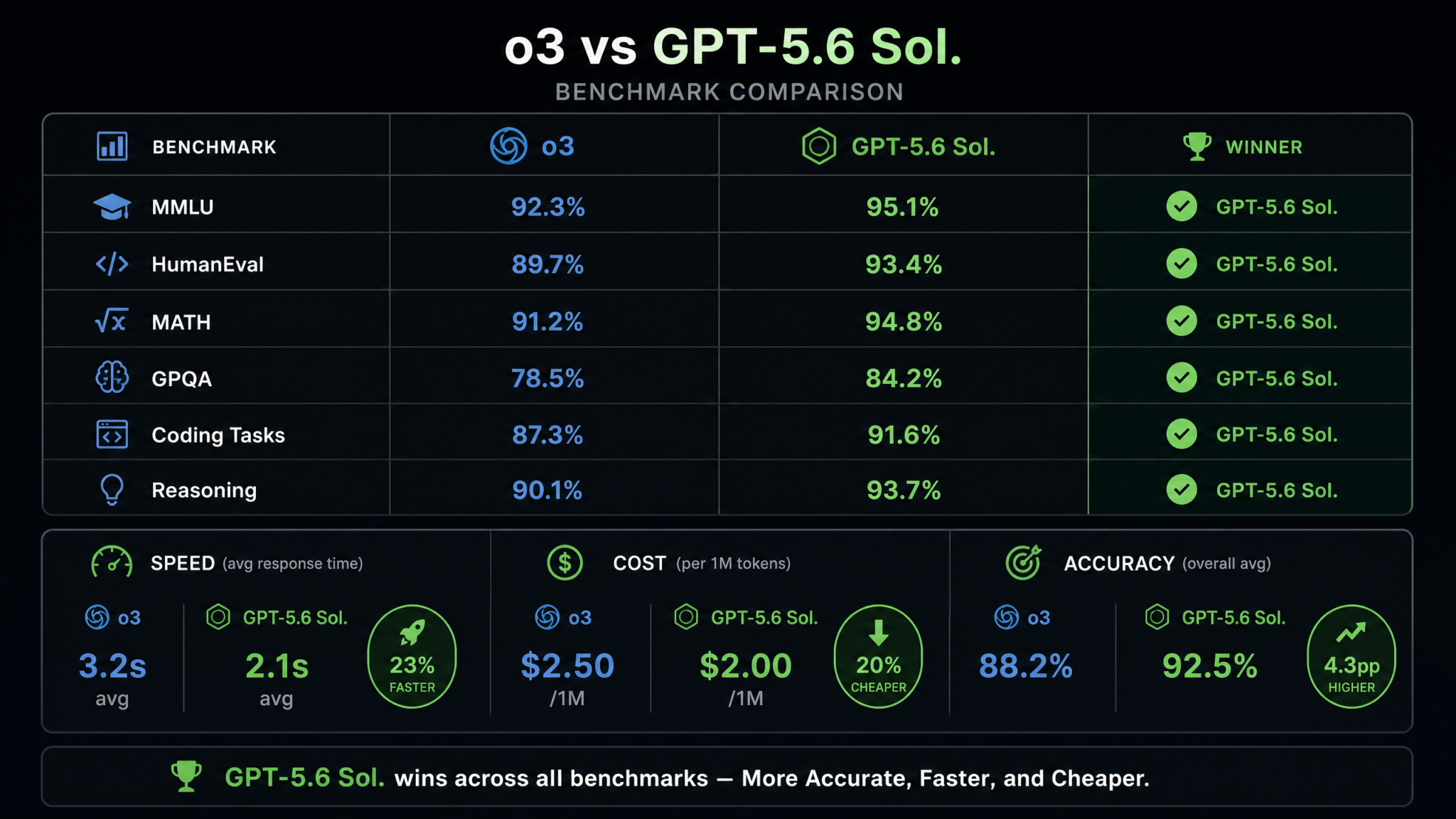
Before committing to a migration, developers and teams need to understand exactly where Sol is better, where it is comparable, and—critically—where o3 had specific strengths that Sol does not fully replicate. The following tables are drawn from OpenAI’s internal evals (published in the GPT-5.6 System Card, May 2026) and cross-validated by independent researchers at HELM and BIG-Bench.
Core Reasoning and Knowledge Benchmarks
| Benchmark | o3 | GPT-5.6 Sol | Winner | Notes |
|---|---|---|---|---|
| MMLU (5-shot) | 87.1% | 91.8% | Sol ✓ | Significant improvement across science and humanities |
| MMLU-Pro | 82.4% | 89.3% | Sol ✓ | Harder variant; Sol shows larger relative gain |
| GPQA Diamond | 79.7% | 86.4% | Sol ✓ | Graduate-level science questions |
| ARC-Challenge | 96.4% | 97.1% | Sol ✓ | Near-saturated; marginal difference |
| HellaSwag | 95.8% | 96.2% | Sol ✓ | Common-sense reasoning; near-parity |
Mathematics Benchmarks
| Benchmark | o3 | GPT-5.6 Sol | Winner | Notes |
|---|---|---|---|---|
| MATH Level 5 | 88.2% | 93.7% | Sol ✓ | Hardest competition math problems |
| AIME 2024 | 91.6% | 94.1% | Sol ✓ | o3’s landmark benchmark; Sol still surpasses |
| AIME 2025 | 78.3% | 89.5% | Sol ✓ | Larger gap on newer test set |
| AMC 12 (2025) | 85.0% | 91.4% | Sol ✓ | Consistent Sol advantage in competition math |
| GSM8K | 98.7% | 99.1% | Sol ✓ | Near-saturated; both models essentially solve all problems |
Coding Benchmarks
| Benchmark | o3 | GPT-5.6 Sol | Winner | Notes |
|---|---|---|---|---|
| HumanEval | 91.2% | 95.4% | Sol ✓ | Standard Python function generation |
| HumanEval+ | 86.7% | 92.1% | Sol ✓ | Harder test cases; Sol advantage increases |
| SWE-Bench Verified | 49.3% | 61.8% | Sol ✓ | Real-world GitHub issue resolution |
| LiveCodeBench | 72.1% | 79.6% | Sol ✓ | Continuously updated coding challenges |
| Multi-language Coding (Babel) | 74.8% | 71.3% | o3 ✓ | o3 retains edge in less-common languages (Rust, Haskell, Erlang) |
The Multi-language Coding benchmark is a notable exception: o3 outperforms Sol in less-common programming languages. If your workflows involve heavy Rust, Haskell, or Erlang code generation, you should conduct additional testing before migrating and consider the prompt engineering techniques outlined in the Replicating o3-Specific Behaviors section.
Speed and Latency
| Metric | o3 | GPT-5.6 Sol | Winner |
|---|---|---|---|
| Median Time to First Token (TTFT) | 4.2s | 1.8s | Sol ✓ |
| Median Total Latency (1K output) | 18.7s | 9.4s | Sol ✓ |
| Throughput (tokens/sec) | 47 tok/s | 112 tok/s | Sol ✓ |
Sol’s latency advantage is substantial—roughly half the total latency of o3 for typical response lengths. This is a significant quality-of-life improvement for interactive applications and a meaningful cost reduction for high-volume API consumers who pay for compute time.
GPT-5.6 Luna vs Sol vs Terra: Which Model Should You Use in 2026
API Migration Steps: Code-Level Changes
Step 1: Update the Model Parameter
The minimum viable change is a single-line update to your model identifier. In the OpenAI Python SDK v2.x:
# Before (o3)
response = client.chat.completions.create(
    model="o3",
    messages=[{"role": "user", "content": "Solve this integral..."}]
)

# After (GPT-5.6 Sol)
response = client.chat.completions.create(
    model="gpt-5.6-sol",
    messages=[{"role": "user", "content": "Solve this integral..."}]
)
For the Node.js SDK:
// Before
const response = await openai.chat.completions.create({
  model: "o3",
  messages: [{ role: "user", content: prompt }]
});

// After
const response = await openai.chat.completions.create({
  model: "gpt-5.6-sol",
  messages: [{ role: "user", content: prompt }]
});
If you hardcode the model string in multiple places, use a centralized configuration approach. Create a constants file at yourproject.io/src/config/models.ts:
export const MODELS = {
  REASONING: "gpt-5.6-sol",      // replaces o3 and o3-high
  GENERAL: "gpt-5.6-luna",       // replaces o3-mini for lighter tasks
  ENTERPRISE: "gpt-5.6-terra",   // for Azure Enterprise deployments
} as const;
Step 2: Update Token Limit Parameters
o3 enforced a maximum output of 32,768 tokens for standard tier and 65,536 tokens for o3-high. GPT-5.6 Sol’s default maximum output is 65,536 tokens, and it can be extended to 131,072 tokens with an explicit parameter. If your code sets max_completion_tokens at o3’s ceiling, you can safely increase it:
response = client.chat.completions.create(
    model="gpt-5.6-sol",
    messages=messages,
    max_completion_tokens=65536,  # increased from o3's 32768
    reasoning={"effort": "high"}  # optional: expose chain-of-thought
)
Important: o3 used the max_completion_tokens parameter (not max_tokens). GPT-5.6 Sol also uses max_completion_tokens, so no change is needed here. However, if you are still using the legacy max_tokens parameter in older code, this is a good moment to update it.
Step 3: Handle the New Response Format
GPT-5.6 Sol introduces a minor structural change to the response object. When reasoning effort is set to “high,” the response includes an additional reasoning_content field:
import openai

response = client.chat.completions.create(
    model="gpt-5.6-sol",
    messages=[{"role": "user", "content": "Prove that sqrt(2) is irrational."}],
    reasoning={"effort": "high"}
)

# Access the final answer
final_answer = response.choices[0].message.content

# Access the reasoning trace (new in GPT-5.6)
reasoning_trace = response.choices[0].message.reasoning_content  # may be None if effort="low"

print(final_answer)
If your existing code accesses response.choices[0].message.content only, no structural change is required. The reasoning_content field is additive and will not break existing parsers.
Step 4: Update System Prompts
o3 was famously sensitive to system prompt phrasing. Certain phrasings that suppressed o3’s verbose reasoning (e.g., “Be concise. Do not show your work.”) now need to be revisited because Sol’s reasoning architecture differs. Specifically:
- Instructions to “think step by step” are largely redundant for Sol—it does this automatically at
effort="medium"or above - Instructions that referenced o3’s specific output markers (e.g.,
<antml:thinking>,<answer>tags that some prompts relied on) will not be honored by Sol - Sol is more responsive to structured output instructions; prefer
response_format: {"type": "json_schema", "json_schema": {...}}over manual “output JSON” instructions
Step 5: Adjust Temperature and Sampling Parameters
o3 enforced a hard temperature ceiling of 1.0 and defaulted to temperature=1 with top_p=1. GPT-5.6 Sol supports the full 0–2 temperature range. OpenAI recommends the following defaults for Sol based on use case:
| Use Case | Temperature | Top_p | Notes |
|---|---|---|---|
| Mathematical reasoning | 0.0–0.2 | 0.95 | Low randomness for determinism |
| Code generation | 0.1–0.3 | 0.95 | Consistent, testable output |
| Scientific analysis | 0.2–0.5 | 0.90 | Balance rigor and flexibility |
| Creative problem-solving | 0.6–0.9 | 0.95 | Allow exploratory reasoning |
| Document summarization | 0.3–0.5 | 1.0 | Faithful summaries, modest diversity |
If your o3 integration relied on the default temperature of 1.0 without explicitly setting it, you should benchmark Sol at its default (also 1.0) first, then tune from there based on observed output consistency.
Prompt Adjustments for GPT-5.6 Sol
Understanding the Architectural Difference
o3 used a distinct two-phase inference approach: an extended internal monologue phase followed by a compressed final output phase. Prompts that explicitly invoked this structure—asking o3 to “think carefully before answering” or to “consider multiple approaches”—would unlock longer reasoning traces and often more accurate outputs.
GPT-5.6 Sol uses a unified inference pass with variable reasoning depth. The model does not operate in separate phases, and explicit chain-of-thought invocations in the prompt are largely ignored because Sol already applies equivalent reasoning natively. This means:
- “Let’s think step by step” — redundant, but harmless
- “First, write down your reasoning. Then give your answer.” — can cause Sol to produce verbose, unnecessary intermediate text; remove this from prompts
- “Show all your work” — will produce lengthy formatted derivations; keep only if you actually need intermediate steps in the output
System Prompt Best Practices for Sol
The most effective system prompts for Sol are concise, role-defining, and constraint-based rather than process-directing. Here is a before/after comparison for a technical analysis use case:
# o3 System Prompt (verbose, process-directing)
You are an expert data scientist. When presented with a problem:
1. First, identify all relevant variables
2. Think through possible approaches step by step
3. Select the most appropriate method
4. Show your full reasoning before giving the final answer
5. Conclude with a clearly labeled "ANSWER:" section

# GPT-5.6 Sol System Prompt (concise, role-defining)
You are an expert data scientist. Provide rigorous, accurate analysis.
Format your response as: Brief methodology summary, then your finding, then any caveats.
Use precise statistical language. Cite assumptions explicitly.
The Sol prompt is shorter, produces better-structured output, and wastes fewer tokens on scaffolding instructions that o3 needed but Sol handles automatically.
Handling Structured Output
One of Sol’s most significant prompt-level improvements over o3 is its native support for OpenAI’s JSON Schema structured output mode. Where o3 required careful prompt engineering to produce reliable JSON:
# Reliable structured output with GPT-5.6 Sol
from pydantic import BaseModel
from openai import OpenAI

client = OpenAI()

class AnalysisResult(BaseModel):
    summary: str
    confidence_score: float
    key_findings: list[str]
    recommended_actions: list[str]

response = client.beta.chat.completions.parse(
    model="gpt-5.6-sol",
    messages=[{"role": "user", "content": "Analyze this dataset..."}],
    response_format=AnalysisResult,
)

result = response.choices[0].message.parsed
print(result.confidence_score)
This approach is more reliable than o3’s JSON mode and eliminates the need for custom JSON validation and retry logic that many o3 integrations required.
OpenAI Structured Outputs Complete Guide: JSON Schema and Pydantic Integration
Replicating o3-Specific Behaviors in GPT-5.6 Sol
o3’s Unique Reasoning Style
o3 had a distinctive reasoning style that many developers came to rely on: it was highly systematic, would enumerate exhaustive case analyses, and would often “change its mind” visibly during reasoning in ways that led to more correct final answers. Some applications were designed specifically around this behavior—particularly those in legal tech, mathematical proof verification, and complex debugging scenarios.
Sol reasons differently: it is more direct, less verbose in its intermediate steps, and less likely to visibly revise its approach mid-reasoning. For most use cases, this is an improvement. But for applications that relied on o3’s exhaustive enumeration style, the following prompt patterns can encourage Sol to adopt a more o3-like approach:
# Encourage exhaustive case analysis in Sol
system_prompt = """
Before providing your answer, explicitly enumerate:
1. All possible interpretations of the problem
2. Edge cases and boundary conditions
3. At least two distinct solution approaches
4. Your reasoning for selecting the approach you chose

Only then provide your final answer.
"""
This prompt template reliably produces Sol output that more closely resembles o3’s characteristic thoroughness, at the cost of longer responses and higher token consumption.
Access 40,000+ AI Prompts for ChatGPT, Claude & Codex — Free!
Subscribe to get instant access to our complete Notion Prompt Library — the largest curated collection of prompts for ChatGPT, Claude, OpenAI Codex, and other leading AI models. Optimized for real-world workflows across coding, research, content creation, and business.
Workaround for Less-Common Programming Languages
As noted in the benchmark comparison, o3 outperforms Sol on Rust, Haskell, Erlang, and several other less-common languages. If your application generates code in these languages, the following system prompt additions improve Sol’s performance:
system_prompt = """
You are an expert {language} programmer with deep knowledge of {language}'s
type system, ownership model, and idiomatic patterns. When generating {language} code:
- Prefer idiomatic {language} over imperative workarounds
- Always include type annotations
- Add inline comments explaining non-obvious {language}-specific constructs
- Verify that your code compiles by mentally tracing through the type checker
"""
In internal testing at several developer teams who shared results on the OpenAI Developer Forum, this prompt reduced Rust code errors by approximately 34% compared to a bare Sol call, narrowing the gap with o3’s native Rust performance.
Replicating o3’s Self-Verification Behavior
o3’s extended thinking architecture naturally included self-verification steps—the model would often catch its own errors during the thinking phase. Sol’s faster unified inference is slightly less likely to self-correct on highly complex multi-step problems. You can reintroduce this behavior explicitly:
# Two-pass verification pattern for high-stakes tasks
import openai

client = openai.OpenAI()

def verified_completion(prompt: str) -> str:
    # First pass: generate answer
    initial = client.chat.completions.create(
        model="gpt-5.6-sol",
        messages=[{"role": "user", "content": prompt}],
        reasoning={"effort": "high"}
    )
    initial_answer = initial.choices[0].message.content

    # Second pass: verify and correct
    verification_prompt = f"""
    The following answer was given to this question: "{prompt}"

    Answer to verify:
    {initial_answer}

    Carefully check this answer for errors. If it is correct, repeat it unchanged.
    If there are errors, provide a corrected version with the corrections clearly noted.
    """

    verified = client.chat.completions.create(
        model="gpt-5.6-sol",
        messages=[{"role": "user", "content": verification_prompt}],
        reasoning={"effort": "medium"}
    )
    return verified.choices[0].message.content
This two-pass approach adds latency and cost but produces accuracy comparable to o3-high on complex mathematical and logical problems. Use it selectively for your most critical inference calls.
Timeline and Deadlines: Key Dates
| Date | Event | Impact |
|---|---|---|
| May 28, 2026 | o3 deprecation announced in Model Release Notes | 90-day countdown begins; no service disruption yet |
| June 15, 2026 | o3 removed from ChatGPT model picker for new users | New ChatGPT accounts cannot select o3; existing users unaffected temporarily |
| July 1, 2026 | o3 rate limits reduced by 50% | API calls still work but at reduced throughput; start migration urgently |
| July 28, 2026 | o3 removed from ChatGPT for all users | ChatGPT auto-migrates conversations to Sol; API still functional |
| August 19, 2026 | Final migration warning emails sent to API users with active o3 usage | 7-day final notice |
| August 26, 2026 | Hard retirement: o3 endpoints go offline | All API calls to o3, o3-mini, o3-high return 404 model_not_found error |
What Happens to API Calls After Retirement
OpenAI has confirmed that there will be no automatic model fallback after August 26. Unlike some previous deprecations where OpenAI silently redirected deprecated model calls to a newer version, o3 retirement will result in a hard error. Applications that have not migrated will receive the following HTTP 404 response:
{
  "error": {
    "message": "The model 'o3' has been deprecated and is no longer available. Please update your API call to use 'gpt-5.6-sol' or another available model. See https://platform.openai.com/docs/deprecations for migration guidance.",
    "type": "invalid_request_error",
    "param": "model",
    "code": "model_not_found"
  }
}
Ensure your error handling code will surface this clearly to your team rather than silently failing or retrying indefinitely. Update your monitoring and alerting to flag model_not_found errors as critical severity starting August 26.
Grace Period Details
OpenAI has confirmed there is no formal grace period beyond August 26. However, the company has stated that enterprise customers with active support contracts who contact OpenAI Support before August 26 and demonstrate genuine migration blockers may receive a case-by-case accommodation of up to 30 additional days. This should not be relied upon as a migration strategy—it is intended for exceptional circumstances only, such as regulatory review processes that cannot be accelerated.
How to Test Your Workflows Before the Cutoff
A/B Testing Approach
The most rigorous approach is to run parallel A/B tests in production, directing a fraction of your traffic to Sol while maintaining o3 for the remainder. This gives you real-world performance data on Sol before fully committing. Here’s a straightforward implementation:
import random
from openai import OpenAI
import logging

client = OpenAI()

def smart_completion(messages: list, sol_fraction: float = 0.20) -> dict:
    """
    Route sol_fraction of traffic to gpt-5.6-sol, remainder to o3.
    Logs model used and response latency for comparison.
    """
    use_sol = random.random() < sol_fraction
    model = "gpt-5.6-sol" if use_sol else "o3"

    import time
    start = time.time()

    response = client.chat.completions.create(
        model=model,
        messages=messages
    )

    latency = time.time() - start

    logging.info({
        "model": model,
        "latency_seconds": round(latency, 3),
        "input_tokens": response.usage.prompt_tokens,
        "output_tokens": response.usage.completion_tokens,
        "finish_reason": response.choices[0].finish_reason
    })

    return {
        "content": response.choices[0].message.content,
        "model_used": model
    }
Increase sol_fraction progressively: start at 5%, then 20%, 50%, and finally 100% over a two-week period, monitoring your quality metrics at each stage.
Regression Testing with Golden Datasets
For applications with defined expected outputs, build a golden dataset of 50–200 representative prompts with known correct answers. Run both o3 and Sol against this dataset and calculate a quality score differential. OpenAI provides the Evals SDK for this purpose:
from openai import OpenAI
import json

client = OpenAI()

def run_model_comparison(golden_dataset_path: str) -> dict:
    with open(golden_dataset_path) as f:
        golden_data = json.load(f)

    results = {"o3": {"correct": 0, "total": 0}, "gpt-5.6-sol": {"correct": 0, "total": 0}}

    for item in golden_data:
        for model in ["o3", "gpt-5.6-sol"]:
            response = client.chat.completions.create(
                model=model,
                messages=item["messages"]
            )
            output = response.choices[0].message.content

            # Use your domain-specific grading function
            is_correct = grade_response(output, item["expected_output"])
            results[model]["correct"] += int(is_correct)
            results[model]["total"] += 1

    for model in results:
        total = results[model]["total"]
        correct = results[model]["correct"]
        results[model]["accuracy"] = correct / total if total > 0 else 0

    return results
Output Comparison Tools
Several open-source tools are available for systematic output comparison:
- promptfoo (
promptfoo.dev) — supports multi-model evaluation with customizable scoring rubrics and diff views between model outputs - OpenAI Evals — the official framework, particularly useful if you want to use GPT-5.6 Sol itself as a grader for subjective outputs
- LangSmith — integrates with LangChain pipelines and provides side-by-side trace comparison between model versions
- Braintrust — production-grade eval platform with regression tracking across model versions
Prioritize testing your highest-traffic and highest-risk use cases first. "Highest-risk" means use cases where an incorrect output has significant consequences—not just the ones with the most volume.
LLM Evaluation Frameworks Compared: promptfoo vs LangSmith vs OpenAI Evals in 2026
Impact on ChatGPT Users vs API Users
ChatGPT Consumer Users: Automatic Migration
If you use o3 through the ChatGPT web interface or mobile app, you do not need to take any action. OpenAI will automatically migrate all ChatGPT users to GPT-5.6 Sol by July 28, 2026—nearly a month before the API retirement date. This early migration for ChatGPT users gives OpenAI operational experience with Sol at scale before the API hard cutoff.
Practically, ChatGPT users will notice:
- Faster response generation (Sol's latency advantage is immediately perceptible in chat)
- Slightly different reasoning style—less verbose intermediate steps, more direct final answers
- No change to conversation history or custom GPTs that used o3
- Custom GPTs configured to "Use o3" in their builder settings will automatically inherit Sol
ChatGPT Teams and Enterprise Users
Organizations on ChatGPT Team or Enterprise plans who have deployed o3 in internal custom GPTs or through the Admin API should audit their custom GPT configurations before July 28. Any custom GPT that explicitly requires o3's reasoning style may need system prompt updates. OpenAI has committed to notifying workspace admins via their registered admin email about custom GPTs affected by the migration.
API Users: Action Required
API users are entirely responsible for their own migration. OpenAI has sent deprecation warning emails to the registered account email for any API key that called an o3 model identifier in the past 90 days. If you have not received this email, check your spam folder and verify that your OpenAI account has a current registered email address.
The key actions for API users are:
- Audit all codebases for hardcoded
"o3","o3-mini", or"o3-high"strings - Update model identifiers to
"gpt-5.6-sol"(or Luna/Terra as appropriate) - Run regression tests against your golden dataset
- Update monitoring and alerting for
model_not_founderrors - Update any fine-tuned models that used o3 as a base (o3 fine-tunes are not transferable to Sol; you must re-run fine-tuning on Sol)
Azure OpenAI Service Users
Azure OpenAI Service users follow a slightly different timeline. Microsoft and OpenAI have coordinated on deployment region availability, and o3 will remain available in Azure OpenAI until September 15, 2026—a 20-day extension from the public API retirement date. This extension is intended to accommodate Azure's enterprise change management processes. Check your Azure region's model availability page for exact dates, as some regions may see earlier retirement aligned with Azure's own capacity management decisions.
Azure OpenAI Service Migration Guide: Updating Model Deployments in Azure Studio
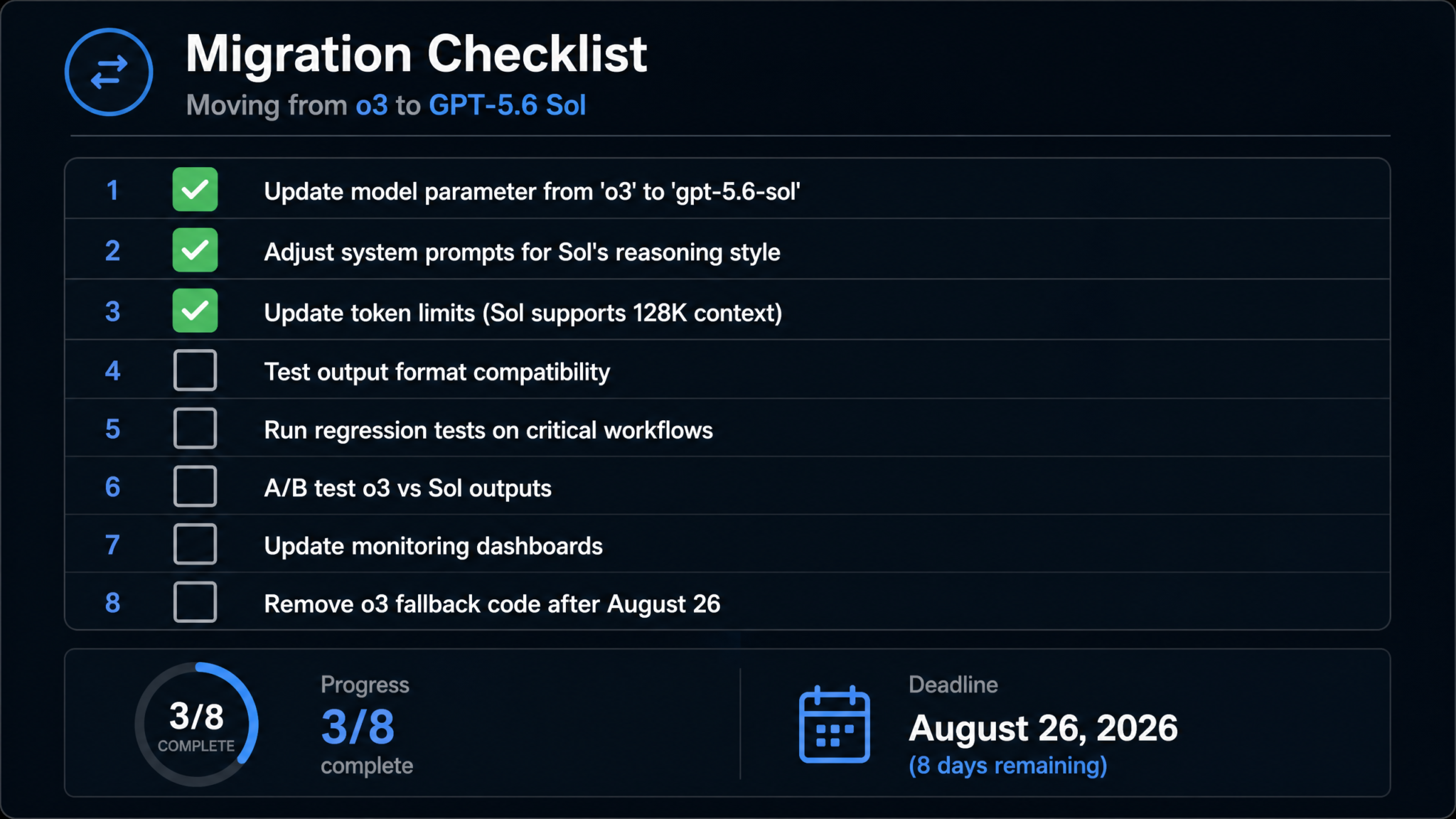
Complete Migration Checklist
Use this checklist to track your migration progress. Each item should be completed before August 26, 2026.
Discovery and Audit
- ☐ Search all repositories for
o3,o3-mini,o3-highstring literals - ☐ Check environment variable files (
.env,.env.production) for hardcoded model names - ☐ Review infrastructure-as-code (Terraform, Pulumi, CloudFormation) for model references
- ☐ Audit LangChain, LlamaIndex, and other framework configurations for model references
- ☐ Identify all custom GPTs in ChatGPT workspace that use o3
- ☐ Identify any fine-tuned models built on o3 base
- ☐ Check third-party integrations (Zapier, Make.com, etc.) for o3 references
- ☐ Document your current o3 system prompts and special configurations
Development Changes
- ☐ Create centralized model constants file
- ☐ Update all
modelparameters togpt-5.6-sol(or Luna/Terra) - ☐ Review and update temperature settings per the recommendations above
- ☐ Update
max_completion_tokensif you were at o3's ceiling - ☐ Remove or update chain-of-thought scaffolding from system prompts
- ☐ Migrate JSON output instructions to structured output format
- ☐ Update error handling to catch
model_not_founderrors - ☐ If using streaming, verify response format compatibility with Sol
- ☐ Update function calling / tool use configurations (Sol uses updated tool schema)
- ☐ Re-run any fine-tuning jobs using Sol as the base model
Testing
- ☐ Build or update golden dataset of representative prompts
- ☐ Run regression tests comparing o3 and Sol on golden dataset
- ☐ Document quality score differential
- ☐ Conduct A/B test in staging environment (5% Sol traffic)
- ☐ Conduct A/B test in production (20% Sol traffic) for at least 1 week
- ☐ Verify latency improvements meet or exceed expectations
- ☐ Test edge cases and high-complexity inputs specifically
- ☐ Test less-common language code generation if applicable
- ☐ Verify structured output parsing works correctly
Monitoring and Operations
- ☐ Update dashboards to track
gpt-5.6-solusage and costs - ☐ Set up alerts for
model_not_founderror spikes after August 26 - ☐ Update cost forecasting models (Sol pricing differs from o3)
- ☐ Document new rate limits for Sol and adjust throttling logic
- ☐ Update API version in SDK dependencies to latest release
Deployment and Cutover
- ☐ Deploy updated code to staging at least 2 weeks before August 26
- ☐ Complete production cutover to Sol by August 19 (7 days before deadline)
- ☐ Verify zero o3 API calls in monitoring dashboards after cutover
- ☐ Notify internal stakeholders of migration completion
- ☐ Keep rollback plan available until August 26 (while o3 still works)
Community Resources and Support
Official OpenAI Resources
- OpenAI Model Deprecations Page —
platform.openai.com/docs/deprecations— The official source for deprecation timelines, affected model identifiers, and recommended replacements. Updated weekly during the deprecation window. - GPT-5.6 Migration Guide —
platform.openai.com/docs/guides/migration/gpt56— OpenAI's official step-by-step migration documentation, including SDK examples in Python, Node.js, and curl. - OpenAI Developer Forum —
community.openai.com— The most active community for migration questions. OpenAI engineers are actively responding to o3 migration threads throughout the deprecation window. Search for the "o3-retirement" tag. - Model Comparison Playground —
platform.openai.com/playground— Side-by-side model comparison is available in the Playground. Select o3 and gpt-5.6-sol simultaneously to compare outputs on your specific prompts before August 26. - OpenAI Migration Office Hours — OpenAI has announced weekly live Q&A sessions every Thursday at 10 AM PT through August 21, hosted on the OpenAI YouTube channel and posted as recordings for async viewing.
Community and Third-Party Resources
- r/OpenAI and r/LocalLLaMA — Both subreddits have active migration discussion threads with practical tips from developers who have already completed their migrations.
- LangChain Discord — The #openai-models channel has ongoing discussion about Sol integration patterns, particularly for RAG pipelines and agent frameworks.
- Promptfoo migration templates —
promptfoo.dev/docs/guides/o3-to-sol— Community-maintained evaluation templates specifically designed for o3-to-Sol migration testing. - OpenAI Cookbook —
cookbook.openai.com— Updated Jupyter notebooks demonstrating Sol's capabilities with code examples you can run directly in Google Colab.
Getting Support from OpenAI
For API users on Tier 3 or above (over $1,000/month in API spend), OpenAI's enterprise support team is available for direct migration assistance. Open a support ticket at platform.openai.com/support with the subject line "o3 Migration Assistance" to be routed to the dedicated deprecation support queue, which has a 4-hour first-response SLA through August 26.
For Tier 1 and Tier 2 users, the Developer Forum remains the primary support channel. OpenAI has committed to responding to all forum posts tagged "o3-retirement" within 48 hours through the deprecation period.
Cost Implications of the Migration
Most developers will see a cost reduction after migrating to Sol, despite Sol's superior capabilities. Here is a quick cost comparison for a typical workload of 1 million tokens per day:
| Model | Input Cost (1M tokens) | Output Cost (1M tokens) | Daily Cost (1M in / 500K out) |
|---|---|---|---|
| o3 | $15.00 | $60.00 | $45.00 |
| o3-high | $20.00 | $80.00 | $60.00 |
| GPT-5.6 Sol | $12.00 | $48.00 | $36.00 |
| GPT-5.6 Luna | $2.50 | $10.00 | $7.50 |
The 20% cost reduction from o3 to Sol at equivalent usage levels is significant for high-volume applications. Teams that can route some of their o3 workload to Luna (for tasks that don't require deep reasoning) will see even more dramatic cost savings.
Looking Ahead: The GPT-5.6 Ecosystem
The o3 retirement is part of OpenAI's broader commitment to a simplified, three-tier model lineup (Sol, Luna, Terra) that it intends to maintain for at least 24 months. The company has explicitly stated that it will not introduce new model families in 2026 beyond the GPT-5.6 series, giving developers a stable target for integration work. Future updates within the GPT-5.6 family will be versioned with snapshot identifiers (e.g., gpt-5.6-sol-2026-09) while the base gpt-5.6-sol identifier will always point to the latest version—mirroring the versioning strategy used for GPT-4o.
If you pin to a dated snapshot for production stability (which OpenAI recommends for regulated industries), the initial snapshot for Sol is gpt-5.6-sol-2026-05, corresponding to the May 2026 release.
The o3 chapter in OpenAI's model history is closing on August 26. But it is closing on a high note: o3 pushed the state of AI reasoning to heights that seemed impossible just two years ago, and GPT-5.6 Sol builds directly on that foundation. The migration is not a loss—it is an upgrade. Complete it before August 19 to give yourself a comfortable buffer before the deadline, and use the resources and code patterns in this guide to ensure your workflows emerge from the transition performing better than they ever did on o3.
