
Nvidia Backs OpenAI’s Ohio Data Center with $105 Billion: Complete Guide to the Largest AI Infrastructure Investment in History
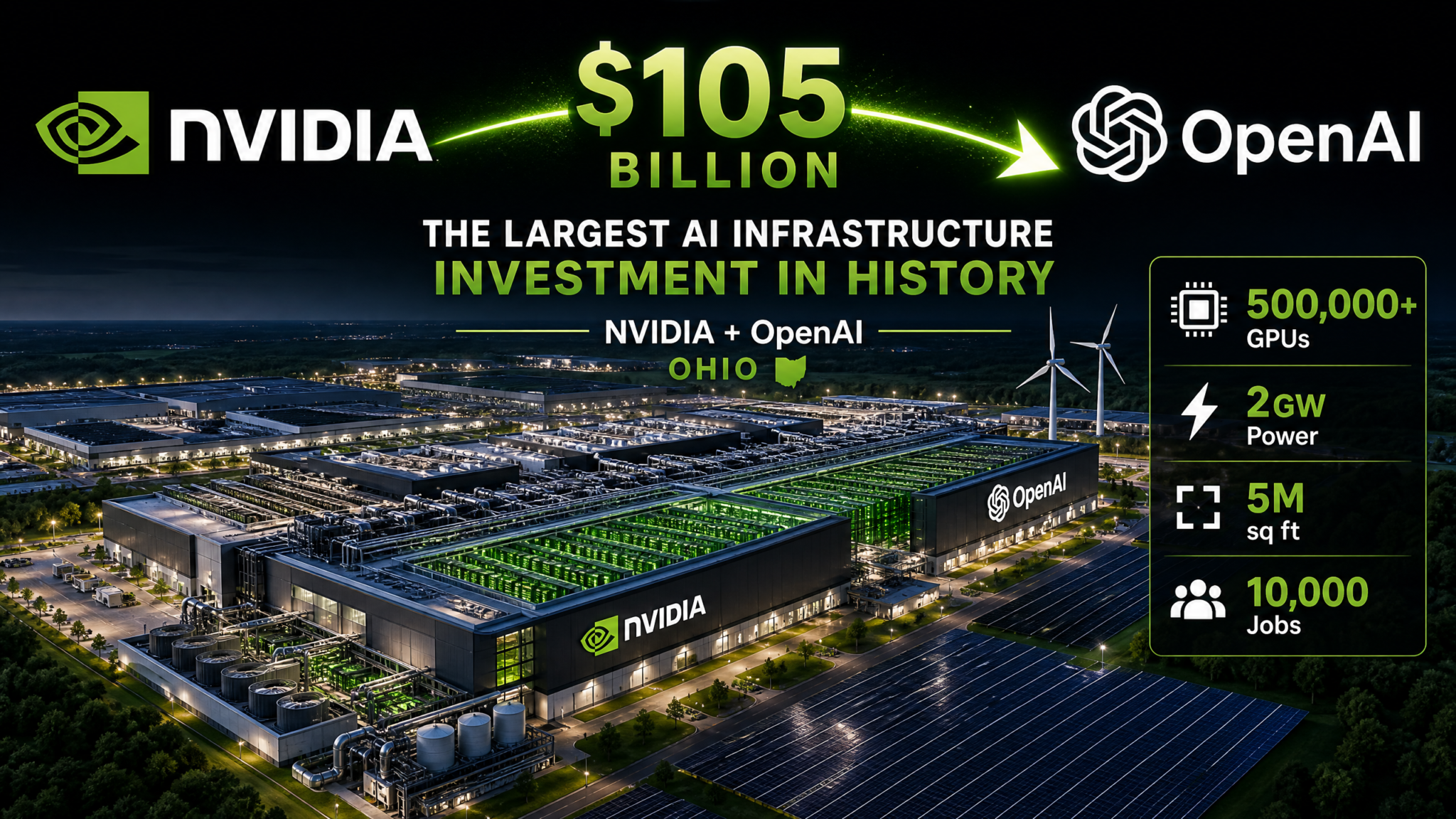
On August 20, 2026, the artificial intelligence industry crossed a threshold that few analysts had predicted would arrive this soon. Nvidia confirmed a landmark $105 billion commitment to support OpenAI’s flagship Ohio data center campus — a single infrastructure investment larger than the GDP of most nations and unprecedented in the history of computing. This is not simply a hardware order. It represents a fundamental restructuring of how AI compute is financed, built, and operated, with cascading consequences for every developer, researcher, enterprise, and end user who interacts with AI systems. Understanding what is being built, why it matters, and what it means for the next decade of artificial intelligence requires unpacking one of the most complex capital deployments the technology industry has ever attempted.
The Deal: Breaking Down Nvidia’s $105 Billion Commitment
The announcement that landed on August 20, 2026 was, in its surface form, a hardware supply agreement. But calling the Nvidia–OpenAI Ohio commitment a hardware deal is like calling the Interstate Highway System a road construction project — technically accurate and profoundly insufficient. Nvidia’s $105 billion figure encompasses GPU hardware, advanced networking infrastructure, system integration services, multi-year maintenance contracts, software optimization agreements, and a co-investment structure that gives Nvidia a degree of shared interest in the facility’s operational performance that has no precedent in the chip industry.
According to reporting from the Wall Street Journal and corroborated by Nvidia’s own investor communications, the deal is structured across three phases aligned with the construction timeline running from mid-2026 through late 2029. Phase one, valued at approximately $38 billion, covers the initial hardware deployment and infrastructure buildout for the first campus quadrant. Phase two ($41 billion) addresses the main GPU cluster expansion and networking fabric installation. Phase three ($26 billion) covers the final build-out, next-generation architecture upgrades, and a five-year operational support agreement.
The financing mechanics are equally novel. Rather than a straightforward purchase order, Nvidia and OpenAI have structured portions of the agreement as a compute revenue share arrangement. Nvidia provides hardware at favorable pricing in exchange for a small percentage of API compute revenue generated from the facility over a ten-year window. This gives Nvidia direct economic exposure to the success of OpenAI’s commercial products — an alignment of incentives that analysts at Morgan Stanley described as “transformative for how chipmakers will think about their business model in the AI era.”
Why $105 Billion and Not Less
To understand why this number is what it is, consider the underlying economics. A single Nvidia Blackwell Ultra B300 GPU currently carries an estimated market price in the range of $70,000 to $90,000 per unit depending on configuration and volume discount. Rubin architecture GPUs, expected to begin shipping in volume through 2027, are projected to command prices between $100,000 and $130,000 per unit. At 500,000 GPU units — the lower bound of current estimates — hardware alone accounts for roughly $45 to $55 billion. Networking, storage, cooling infrastructure, power systems, and facility construction account for the remainder, alongside the software and services components of the contract.
The $105 billion figure also reflects a deliberate strategic choice by both companies. OpenAI needed a single committed partner who could guarantee chip supply across a multi-year build at a time when GPU availability remains constrained globally. Nvidia needed a flagship customer whose scale would justify continued investment in Blackwell Ultra and Rubin production ramp. The deal, in this sense, is mutually constitutive: each company’s next chapter is partially written by the other’s commitment.
OpenAI GPT-5 Architecture and Training Infrastructure Analysis
| Phase | Timeline | Value | Key Deliverables |
|---|---|---|---|
| Phase 1 | Q3 2026 – Q2 2027 | $38 billion | Initial Blackwell Ultra cluster, networking fabric, power infrastructure |
| Phase 2 | Q3 2027 – Q2 2028 | $41 billion | Main GPU cluster expansion, Rubin architecture deployment, cooling systems |
| Phase 3 | Q3 2028 – Q4 2029 | $26 billion | Final build-out, next-gen architecture upgrades, 5-year operational support |
| Total | 2026–2029 + 10yr support | $105 billion | Fully operational 2GW campus |
What Is Being Built: Infrastructure Specifications
The Ohio facility is not a single data center in the conventional sense. It is a purpose-built AI compute campus — a collection of interconnected buildings, power substations, cooling plants, fiber aggregation points, and support facilities designed from the ground up for the specific demands of large-scale AI model training and inference. The engineering choices made here reflect lessons learned from a decade of GPU cluster operation at Google, Meta, Microsoft, and OpenAI’s existing facilities, applied at a scale that makes all previous deployments look like proof-of-concept experiments.
GPU Architecture: Blackwell Ultra and Rubin
The initial deployment centers on Nvidia’s Blackwell Ultra B300 and B300X GPU configurations. The B300 represents the most powerful training-optimized processor Nvidia has ever shipped at volume, offering approximately 20 petaFLOPS of FP8 performance per chip — roughly 2.5 times the throughput of the H100 that powered the previous generation of frontier model training. The B300X variant, optimized for inference, trades some training throughput for improved memory bandwidth and lower latency, making it suitable for serving models to millions of concurrent API users.
Beginning in Phase 2, the facility will begin integrating Nvidia’s Rubin architecture GPUs. Rubin, named after astronomer Vera Rubin and announced at GTC 2025 before beginning volume shipment in 2027, represents the first Nvidia architecture designed explicitly with the compute demands of 100-trillion-parameter models in mind. Early benchmarks suggest Rubin GPUs deliver approximately 3x the FP4 training throughput of Blackwell Ultra while consuming only 1.4x the power — a dramatic improvement in compute efficiency that will allow the Ohio campus to exceed its initial compute targets without requiring additional power capacity.
Networking: NVLink Fusion and InfiniBand Quantum-3
At the scale of 500,000 GPUs, networking is not a supporting character — it is a co-equal determinant of system performance. Communication overhead between GPUs during distributed training can consume 30 to 60 percent of available time if the interconnect fabric is not carefully designed. The Ohio campus will deploy Nvidia’s NVLink Fusion technology at the rack level, connecting groups of 72 GPUs into unified compute pods with 1.8 terabits per second of bidirectional bandwidth per GPU. Between pods, Nvidia’s InfiniBand Quantum-3 switches provide 800 Gbps per port connectivity across a fat-tree topology designed to minimize hop count and maximize bisection bandwidth.
The full networking fabric — approximately 7,000 InfiniBand switch units and several million meters of fiber and copper cabling — represents one of the largest private networking deployments in history. Network latency within the facility is engineered to remain below 1 microsecond end-to-end for the vast majority of inter-GPU communications, a specification that makes it possible to treat all 500,000 GPUs as a single logical compute resource rather than a collection of separate clusters.
Liquid Cooling: Direct-to-Chip and Immersion Systems
Air cooling at the power densities required by Blackwell Ultra and Rubin GPUs is physically impractical. A single Blackwell Ultra B300 GPU has a thermal design power of approximately 1,000 watts, meaning a rack of 72 such GPUs generates 72 kilowatts of heat — far beyond what air handling systems can economically remove. The Ohio campus will deploy two complementary cooling approaches across different facility zones.
Direct-to-chip liquid cooling, in which coolant-carrying copper cold plates are mounted directly against GPU die surfaces, is the primary approach for the Blackwell Ultra deployment. This system, supplied by a consortium of thermal management companies including Vertiv and CoolIT Systems, uses a mixture of deionized water and corrosion inhibitors flowing through facility-wide distribution loops connected to outdoor cooling towers. For the Rubin architecture deployment in Phase 2, selected pods will use single-phase immersion cooling — submerging entire server boards in a dielectric fluid — which offers even greater thermal efficiency and enables tighter physical packing of compute nodes.
Power Infrastructure
Delivering 2 gigawatts of electrical power to a single facility is an engineering challenge that rivals the construction complexity of a mid-sized power plant. The Ohio campus requires a dedicated high-voltage transmission line from the regional grid, operated by American Electric Power (AEP), connecting to three on-site substations each rated for approximately 700 megawatts. A fourth substation is planned for the Phase 3 expansion. On-site backup power consists of approximately 400 megawatt-hours of utility-scale battery storage, sufficient to maintain operations through brief grid disturbances without requiring generator startup.
For extended outages, the facility maintains diesel generator capacity sufficient to power critical systems — cooling, networking, and a subset of compute nodes — for up to 72 hours. The engineering philosophy prioritizes cooling continuity above compute continuity: losing a GPU job is recoverable; losing cooling on 500,000 active GPUs is a catastrophic hardware failure event.
Fiber Connectivity Hub
A compute campus of this scale requires internet connectivity measured in terabits per second, not gigabits. The Ohio facility’s fiber strategy takes advantage of the state’s position at the intersection of multiple long-haul fiber routes. The campus will serve as a Tier 1 interconnection hub, with direct fiber connections to the Chicago Internet Exchange (ChIX), the Pittsburgh NAP, and a dedicated dark fiber ring connecting to OpenAI’s existing facilities in San Francisco and planned expansion sites in Texas and Virginia. Total external bandwidth capacity at full build-out is designed to exceed 40 terabits per second — enough to simultaneously serve tens of millions of concurrent API requests at current throughput profiles.
Why Ohio: The Strategic Geography of AI Compute
Site selection for a facility of this scale and duration is not a decision made lightly or quickly. OpenAI’s site selection process, which ran for approximately 18 months before the Ohio announcement, evaluated locations across 14 U.S. states and three international jurisdictions. Ohio won for a combination of reasons that, taken individually, appear in several competing states but, taken together, are nearly impossible to replicate elsewhere in the continental United States.
Energy Costs: $0.06 Per Kilowatt-Hour
At 2 gigawatts of continuous power consumption, a one-cent difference in electricity cost per kilowatt-hour translates to $175 million per year in operating expense. Ohio’s commercial and industrial electricity rates, driven by a combination of abundant coal and natural gas generation and significant regional transmission infrastructure, average approximately $0.06 per kilowatt-hour for large industrial consumers with dedicated substation agreements — among the lowest rates available to hyperscale buyers east of the Mississippi. By comparison, data center operators in California face rates averaging $0.12 to $0.16 per kilowatt-hour, Virginia hovers around $0.07 to $0.09, and Texas, while competitive at $0.05 to $0.07, introduces significant weather-related reliability risk following the 2021 grid failures.
State Tax Incentives: $2 Billion and Counting
The state of Ohio has offered one of the most aggressive technology infrastructure incentive packages in U.S. history to secure the OpenAI campus. The total incentive package, valued at approximately $2.1 billion over fifteen years, includes sales tax exemptions on equipment purchases (estimated value: $800 million over the build-out period), property tax abatements for the facility grounds (estimated value: $450 million over fifteen years), job creation tax credits tied to hiring milestones (estimated value: $320 million), and a $530 million direct infrastructure grant covering road improvements, utility extension, and broadband infrastructure serving the campus. The incentive package was negotiated under Ohio’s JobsOhio program, the state’s private economic development corporation, which has a track record of securing major technology investments including Intel’s $28 billion semiconductor fabrication facility announced in 2022.
Workforce Pipeline: Ohio State and Case Western
A facility requiring 3,000 permanent technical positions — including data center engineers, power systems specialists, network operations staff, and AI infrastructure software engineers — needs a local talent pipeline that can sustain recruiting for years. Central Ohio, anchored by Ohio State University (enrollment: 61,000+), Case Western Reserve University in Cleveland, and a constellation of technical colleges, produces approximately 8,000 engineering and computer science graduates annually. Ohio State’s Department of Electrical and Computer Engineering has already announced a collaborative curriculum initiative with OpenAI focused on AI infrastructure specializations, designed to begin producing specialized graduates by 2028 — timed to align with the campus’s peak hiring phase.
Climate Advantages for Cooling
Ohio’s climate provides a meaningful cooling efficiency advantage over warmer alternatives. The state averages approximately 5,800 cooling degree hours per year, compared to 9,200 in Texas and 7,100 in Arizona. This difference matters because data centers can operate in “free cooling” mode — using outdoor air or water-side economization to cool facilities without mechanical refrigeration — for a larger fraction of the year in cooler climates. For a 2-gigawatt facility, an additional 1,000 hours per year of free cooling operation translates to approximately $12 million in annual energy savings and a meaningful reduction in mechanical cooling equipment wear.
Best US States for AI Data Center Investment and Infrastructure Expansion
The Scale: Numbers That Redefine Possibility
Abstract financial figures are difficult to contextualize. The following specifications and comparisons are designed to make the Ohio campus’s scale tangible.
| Specification | Ohio Campus (Full Build-Out) | Comparison Reference |
|---|---|---|
| GPU Count | 500,000+ units | ~10x the H100 cluster used to train GPT-4 |
| Power Capacity | 2,000 MW (2 GW) | Equal to ~2 nuclear reactor outputs |
| Facility Size | 5,000,000 sq ft (465,000 m²) | ~87 football fields |
| Total FP8 Compute | ~10 exaFLOPS | ~3x the entire U.S. supercomputing fleet (2024) |
| Networking Bandwidth | 40+ Tbps external | ~8x the bandwidth of the Chicago Internet Exchange (2024) |
| On-Site Battery Storage | 400 MWh | Largest private battery installation in U.S. history |
| Water Usage (Cooling) | ~50 million gallons/day at peak | Equivalent to a city of ~200,000 people |
| Construction Investment (Total) | $105 billion (Nvidia) + ~$35 billion (facility) | Largest single technology infrastructure investment in history |
The 5 million square foot campus footprint deserves particular attention. For context, Amazon’s largest fulfillment center — a category of building known for its sheer physical enormity — occupies approximately 3.5 million square feet. The Ohio AI campus will be larger than the Pentagon (6.5 million square feet including exterior areas, 3.7 million of interior space) in usable floor area, though configured across multiple interconnected buildings rather than as a single structure. The multi-building design is not simply a concession to land availability; it is a deliberate risk management choice that prevents a single structural failure, fire, or flooding event from taking down the entire facility.
Impact on AI Model Training: GPT-7 and Beyond
The most consequential dimension of the Ohio investment is not logistical or financial — it is scientific. The compute available at this facility will fundamentally change what kinds of AI models can be trained, at what speed, and with what capabilities. To understand why, it is necessary to briefly engage with the mathematics of scaling laws in large language model development.
Scaling Laws: Why 10x Compute Per Generation Matters
Since the publication of Kaplan et al.’s landmark 2020 scaling laws paper from OpenAI, the AI research community has understood that model performance (measured as loss on prediction tasks) scales as a predictable power law function of three quantities: model parameters, training data tokens, and compute FLOPs. The Chinchilla scaling laws refined by DeepMind in 2022 further established that optimal performance requires scaling parameters and data in roughly equal proportion as compute increases.
Empirically, each generation of frontier model has required approximately 10 times the compute of its predecessor to achieve meaningfully differentiated capabilities. GPT-3 consumed approximately 3.14 × 10²³ FLOPs to train. GPT-4 is estimated (based on infrastructure reporting) to have consumed roughly 2 × 10²⁴ FLOPs. Models at the frontier in 2025 and 2026 are estimated in the range of 2 × 10²⁵ FLOPs. GPT-7, the model that the Ohio compute infrastructure is primarily designed to enable, will likely require training runs in the range of 10²⁶ to 10²⁷ FLOPs — a scale that is simply not achievable in any currently existing AI facility in the world.
Multi-Modal Training at Unprecedented Scale
Beyond sheer scale, the Ohio facility enables qualitatively new training approaches. Current multi-modal models — systems that process text, images, audio, and video simultaneously — face a fundamental bottleneck: multi-modal training data is orders of magnitude larger than text-only data. A single hour of high-resolution video, when tokenized at the density required for effective visual learning, represents more tokens than several full text books. Training a truly capable video-understanding model at the quality level of GPT-4’s text comprehension requires processing video data volumes that cannot be economically ingested on smaller GPU clusters.
The Ohio facility’s combination of compute throughput, network bandwidth, and storage infrastructure (expected to include several exabytes of high-speed NVMe storage distributed across the campus) makes it possible to sustain multi-modal training runs at a scale where video, audio, code execution traces, scientific instrument data, and natural language can all be trained together in a single unified model — the kind of comprehensive world-model that researchers have theorized would exhibit qualitatively different generalization capabilities than the text-primary models of the current generation.
Multi-Modal AI Model Training Methods and Large-Scale Dataset Architecture
Inference at Scale: Serving Billions of Users
Training is only half the story. The Ohio facility is also designed to serve inference — the process of running trained models to generate responses for end users. As OpenAI’s user base has grown past 500 million weekly active users globally (a figure reported in early 2026), inference compute has become a binding constraint on product capabilities. Models that could theoretically reason more deeply or process longer contexts are, in practice, constrained to faster, cheaper inference configurations to maintain acceptable response latency at global scale. The Ohio facility’s Blackwell B300X inference-optimized GPUs and the low-latency networking fabric will allow OpenAI to serve substantially more capable model configurations to a substantially larger user base simultaneously.
The Competitive Landscape: How Rivals Compare
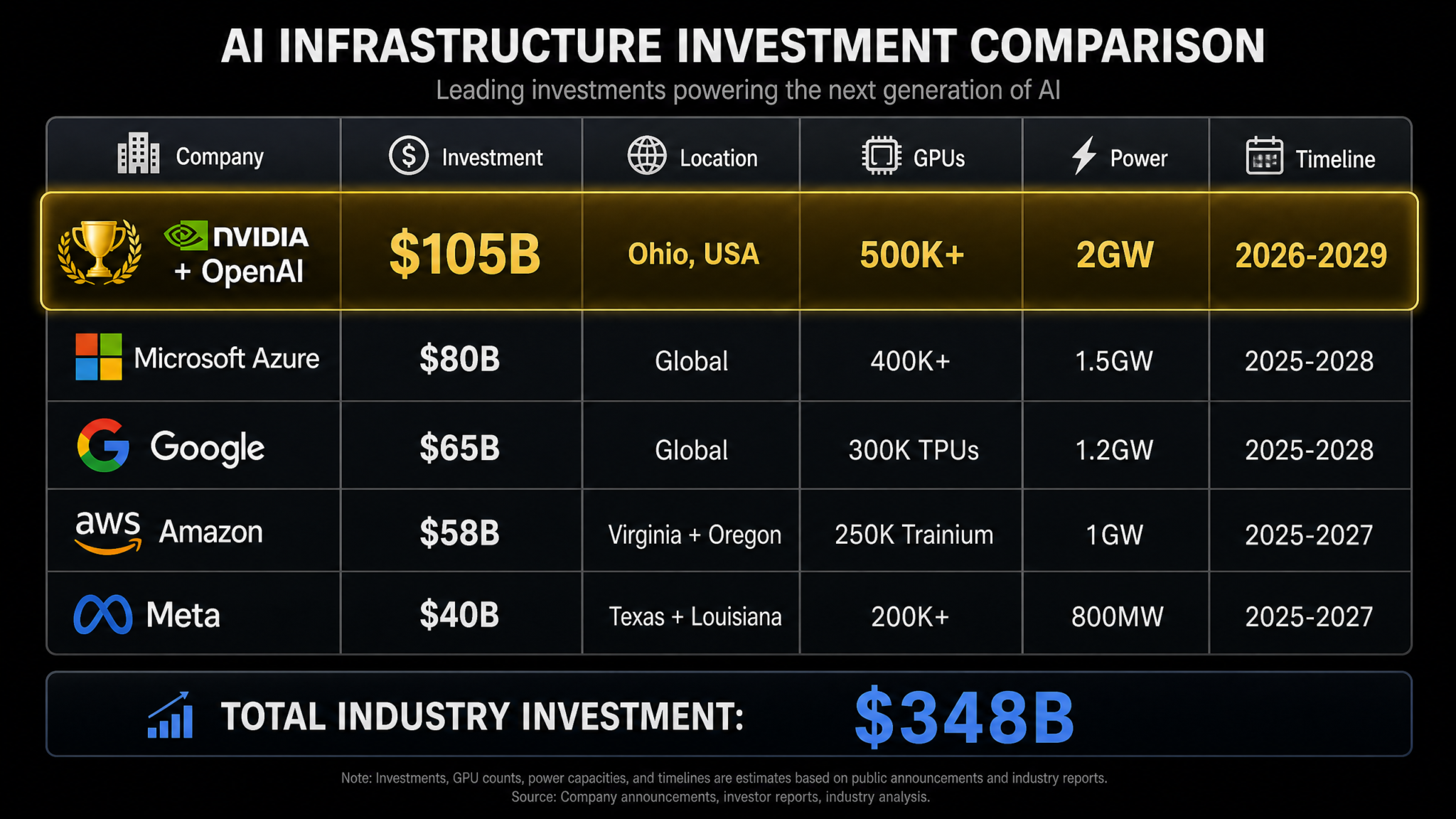
The Ohio investment does not exist in isolation. It is the largest single commitment in an industry-wide capital expenditure race that has accelerated dramatically since 2023. Understanding where OpenAI and Nvidia’s bet sits relative to competitors illuminates both the urgency driving these investments and the structural advantages that scale confers.
| Company | Investment / Program | Value | Key Technology | Power Capacity |
|---|---|---|---|---|
| OpenAI + Nvidia | Ohio Data Center Campus | $140B+ (total) | Blackwell Ultra, Rubin GPUs | 2,000 MW |
| Microsoft Azure | Global AI Infrastructure Expansion | $80B (FY2025) | Maia 100/200 AI accelerators + Nvidia GPUs | ~1,400 MW new capacity |
| Google / Alphabet | TPU v6 “Trillium” Farms | ~$60B (2025-2026) | TPU v6 Trillium, TPU v7 (in development) | ~1,200 MW new capacity |
| Amazon AWS | Trainium3 Cluster Expansion | ~$55B (2025-2026) | AWS Trainium3, Inferentia3 | ~1,000 MW new capacity |
| Meta | AI Data Center Expansion | ~$65B (2025) | MTIA v2, Nvidia H100/B200 | ~800 MW new capacity |
| xAI (Elon Musk) | Memphis “Colossus” + Expansion | ~$10B | Nvidia H100/H200 | ~300 MW |
Microsoft Azure’s $80 Billion Strategy
Microsoft’s $80 billion AI infrastructure commitment, announced for fiscal year 2025, represents the most directly comparable investment to the Ohio campus. However, there is a structural difference that matters: Microsoft’s investment is distributed across dozens of global data center expansions in the United States, Europe, Asia-Pacific, and the Middle East. The geographic and technical diversity is a strategic choice — it serves Azure’s need for global low-latency service delivery — but it means no single Microsoft facility will approach the concentrated compute density of Ohio. Microsoft also operates its own custom AI accelerator program (the Maia chip family), giving it some independence from Nvidia’s supply chain, though Nvidia GPUs remain central to Azure’s AI portfolio.
Google’s TPU v6 Trillium Advantage
Google occupies a unique position in the AI infrastructure landscape because it has the most mature custom silicon program of any major player. TPU v6 “Trillium,” deployed at scale across Google’s global data center network through 2025 and 2026, offers performance-per-dollar advantages for certain workloads — particularly those running at Google’s own operational scale where the fixed costs of custom chip design are amortized across enormous usage volumes. TPU architecture is optimized for Google’s specific model families (Gemini, in particular) and remains less accessible to external researchers, limiting its industry influence even as it gives Google significant internal training efficiency advantages.
Amazon Trainium3 and the AWS Ecosystem
Amazon’s Trainium3 chips, shipping in volume through 2026, represent AWS’s most determined effort yet to reduce dependence on Nvidia silicon for AI training. Trainium3 reportedly delivers performance competitive with Nvidia’s H100 at significantly lower cost for specific transformer architecture workloads. Amazon’s strategy is less about building the world’s largest individual AI cluster and more about making high-performance AI training economically accessible to the millions of enterprises that run on AWS — a broader market approach that sacrifices headline compute numbers for commercial reach.
Industry Implications: Compute Abundance Changes Everything
For the first eight years of the deep learning revolution (approximately 2012 to 2020), compute scarcity was the dominant constraint on AI progress. Researchers had ideas they could not test, models they could not afford to train, and hypotheses that sat uninvestigated because the GPU time required to evaluate them was prohibitively expensive. The period from 2020 to 2025 saw compute expand dramatically but remain tightly controlled by a small number of hyperscalers. The Ohio facility, combined with the broader infrastructure buildout across the industry, begins to shift the balance toward compute abundance — and that transition has non-obvious consequences.
Pricing Pressure on API Access
When training a frontier model costs $1 billion in compute and serving it requires $500 million per year in GPU time, API pricing must reflect those costs to sustain a viable business. As compute capacity expands and operational efficiency improves with newer GPU architectures, the marginal cost of serving each API token declines substantially. Since 2023, OpenAI’s GPT-4 API prices have already fallen by more than 90 percent (from $0.03 per 1,000 output tokens to under $0.002 for equivalent capability). The Ohio capacity expansion, combined with the efficiency gains of Rubin architecture, will likely accelerate this trend further — potentially making frontier model API access essentially free for casual use cases within the 2028 to 2030 timeframe.
Startup Access and the Democratization Question
The concentration of frontier compute in a small number of hyperscale facilities cuts both ways for startups. On one hand, cheap and abundant API access means that building AI-powered applications requires less capital than ever — a startup can access GPT-7-class capabilities for a few dollars per million tokens rather than needing to train or operate their own models. On the other hand, the compute required to train genuinely new frontier models — to compete at the research frontier rather than build on top of it — is increasingly accessible only to entities with tens of billions in capital. This bifurcation between “application layer” startups (low barrier) and “foundation model” developers (extremely high barrier) is likely to intensify as the Ohio facility and its competitors come online.
Access 40,000+ AI Prompts for ChatGPT, Claude & Codex — Free!
Subscribe to get instant access to our complete Notion Prompt Library — the largest curated collection of prompts for ChatGPT, Claude, OpenAI Codex, and other leading AI models. Optimized for real-world workflows across coding, research, content creation, and business.
Research Acceleration: Faster Scientific Progress
The impact on scientific research beyond AI itself deserves attention. Large language models are already being applied to drug discovery (protein structure prediction, small molecule design), materials science (battery electrolyte optimization, semiconductor dopant discovery), climate modeling, and fundamental physics simulation. Each of these applications benefits from more capable models — and more capable models require the kind of compute that only exists at the Ohio campus scale. The facility is expected to support dedicated research partnerships with academic and government institutions, allocating a fraction of its capacity to non-commercial scientific computing through agreements with the National Science Foundation and the Department of Energy’s Office of Science.
AI Compute Access Programs for Academic and Research Institutions in 2026
Job Creation and Local Economic Impact
Mega-infrastructure projects of this scale generate employment across multiple categories and time horizons, and the Ohio campus is no exception. The economic impact analysis commissioned by the Ohio Department of Development estimates total job creation — direct, indirect, and induced — of approximately 47,000 jobs over the construction and operational phases, with an annual recurring economic impact to the state of roughly $4.2 billion once the campus reaches full operational status.
Construction Phase Employment: 10,000 Peak Jobs
The construction phase, running from mid-2026 through late 2029, is expected to peak at approximately 10,000 simultaneous construction workers on site during the most intensive build periods in 2027 and 2028. These positions span a wide range of trades: electrical workers (the largest single category, given the extraordinary power infrastructure demands), HVAC and mechanical contractors for the cooling systems, structural steel workers, civil engineers, telecommunications infrastructure specialists for the fiber builds, and logistics personnel managing the delivery and installation of hundreds of thousands of precision hardware components.
The construction labor requirement has created immediate pressure on central Ohio’s skilled trades workforce. The Laborers’ International Union of North America (LiUNA) and the International Brotherhood of Electrical Workers (IBEW) have both announced apprenticeship expansion programs in Ohio timed to the campus construction schedule, with a combined commitment to train an additional 2,400 apprentices over the next three years specifically to meet demand from the OpenAI project and concurrent large-scale construction activity in the region.
Permanent Positions: 3,000 Technical Roles
At full operation, the campus will employ approximately 3,000 permanent staff across several functional categories. Data center operations technicians will constitute the largest group (~800 positions), responsible for hardware maintenance, replacement, and physical security. Network operations engineers (~350 positions) will manage the facility’s internal and external networking infrastructure around the clock. Power systems engineers and electricians (~250 positions) will oversee the substation operations, UPS systems, and battery storage infrastructure. AI infrastructure software engineers (~600 positions) will handle the software layer — job scheduling, distributed training frameworks, performance optimization, and system monitoring. Administrative, security, facilities management, and logistics personnel account for the remaining approximately 1,000 positions.
Average compensation for permanent technical positions at the facility is projected to exceed $95,000 per year, well above the Ohio median household income of approximately $61,000. The multiplier effect of these wages — spent in local housing, retail, and services — accounts for a significant portion of the broader $4.2 billion annual economic impact estimate.
Indirect Economic Impact
Beyond direct employment, the campus creates substantial demand for local supply chain services. The power infrastructure alone will require ongoing transformer maintenance contracts, coolant chemical supply agreements, and spare parts logistics partnerships that represent tens of millions of dollars annually in local business revenue. The facility’s food service, transportation, and security contracting will support an estimated 1,200 additional indirect jobs in the Columbus metropolitan area. Property values in the surrounding industrial corridors have already begun reflecting anticipated demand, with commercial real estate transactions in the designated development zone up approximately 34 percent in the six months following the announcement.
Environmental Impact: Power, Water, and Carbon
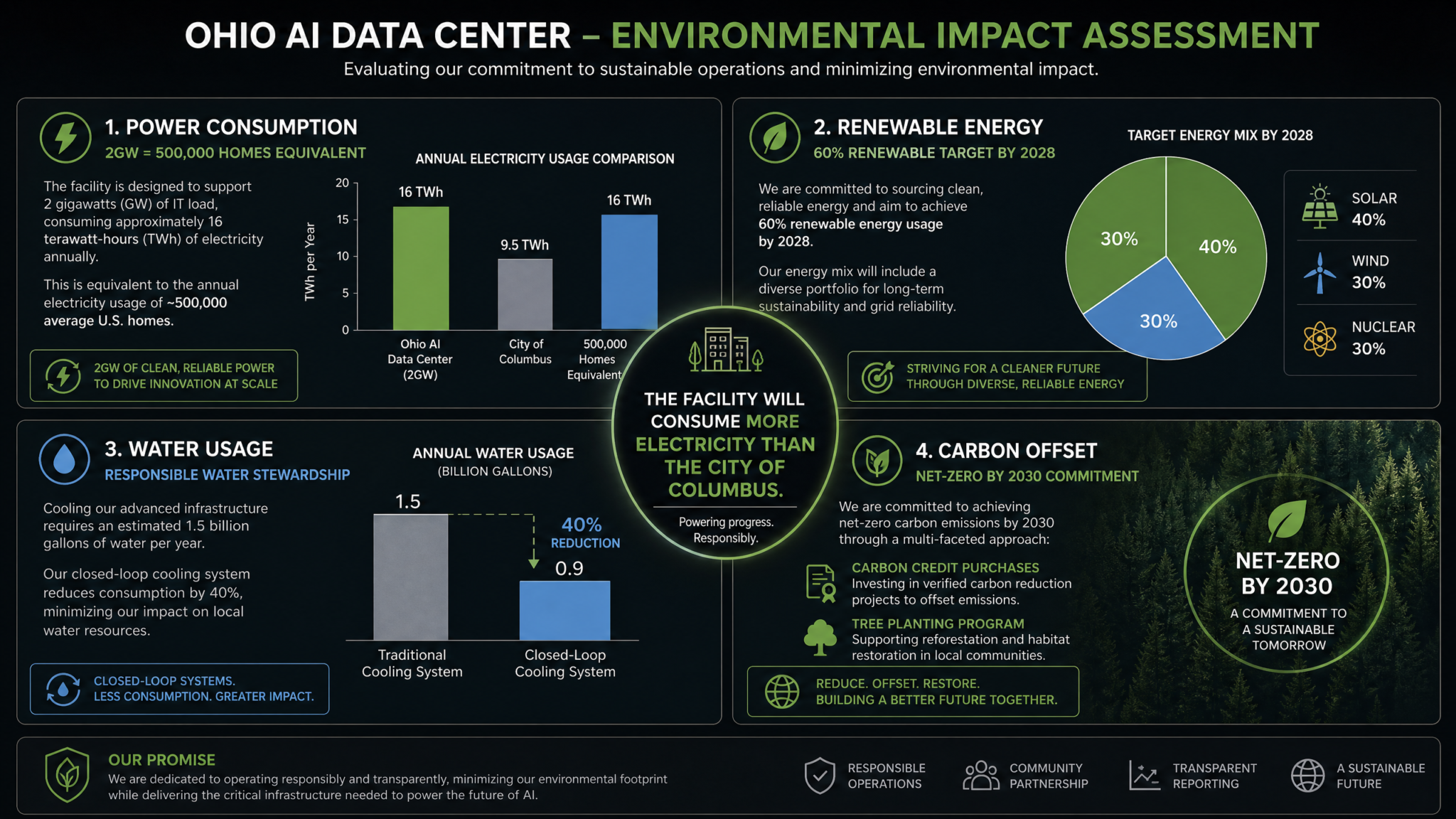
A facility consuming 2 gigawatts of power and tens of millions of gallons of water daily cannot be assessed honestly without confronting its environmental footprint. The Ohio campus will be, by a wide margin, the largest individual consumer of electrical power in Ohio history and one of the largest in the United States. The environmental commitments associated with the facility are significant — and genuinely contested in terms of their sufficiency.
Power Consumption: Equivalent to 500,000 Homes
At 2 gigawatts continuous draw, the Ohio campus will consume approximately 17.5 terawatt-hours of electricity per year at full operational capacity. The U.S. Energy Information Administration estimates average American residential electricity consumption at approximately 10,500 kilowatt-hours per year. The campus’s annual consumption therefore equals the combined residential electricity use of approximately 1.67 million homes — or, more commonly cited in press coverage, peak draw equivalent to 500,000 homes simultaneously. To put this in statewide context, Ohio’s total residential electricity consumption in 2024 was approximately 62 terawatt-hours — meaning the OpenAI campus alone will add roughly 28 percent to Ohio’s industrial electricity demand when fully operational.
Renewable Energy Commitments
OpenAI and Nvidia have jointly committed to matching 100 percent of the campus’s electricity consumption with renewable energy purchases by 2028. The mechanism for this commitment is a combination of long-term power purchase agreements (PPAs) for solar and wind generation, direct investment in new renewable capacity (including a $1.2 billion equity stake in a 1.4 gigawatt offshore Lake Erie wind project currently in permitting), and Renewable Energy Certificate (REC) purchases to cover any gap between direct renewable procurement and actual consumption. Critics — including several environmental organizations — have noted that REC purchases do not represent additionality (the development of new renewable generation) and that the 100 percent matching commitment does not require the campus to consume renewable electrons at the moment of generation, only to purchase equivalent certificates over an annual period. OpenAI has responded that its direct investment in new renewable projects is the more meaningful commitment and has pledged to publish annual Scope 1, 2, and 3 emissions disclosures audited by an independent third party.
Water Usage and Conservation
The direct-to-chip liquid cooling system and cooling towers serving the Ohio campus will consume approximately 50 million gallons of water per day at peak summer operation — a figure that has drawn scrutiny from local water utilities and environmental groups. OpenAI has committed to sourcing campus water from treated industrial wastewater and from a dedicated aquifer recharge program that aims to return 80 percent of withdrawn water to local groundwater systems through engineered recharge basins on the campus grounds. The facility’s water use effectiveness (WUE) target — a standard industry metric measuring liters of water used per kilowatt-hour of IT load — is set at 0.5 liters per kWh, compared to an industry average of approximately 1.8 liters per kWh, enabled by the efficiency of liquid cooling relative to evaporative cooling towers.
Carbon Offset and Net-Zero Plans
OpenAI has committed to achieving net-zero operational carbon emissions from the Ohio facility by 2030, defined as zero Scope 1 and 2 emissions after renewable energy matching, and a 50 percent reduction in Scope 3 emissions (including hardware manufacturing) by 2035. The Scope 3 commitment is particularly challenging: manufacturing 500,000 advanced GPUs using semiconductor fabs that run on a combination of renewable and conventional energy sources generates substantial embodied carbon that is difficult to avoid entirely with current manufacturing geography. OpenAI is working with TSMC (the primary manufacturer for Nvidia’s chips) on a semiconductor fab renewable energy procurement initiative that, if fully implemented, would reduce the embodied carbon per GPU by an estimated 40 percent relative to current manufacturing practices.
What This Means for Developers and Users
Abstract infrastructure is ultimately meaningful only insofar as it changes what people can build, use, and experience. The Ohio campus’s impact on the developer and end-user experience will unfold in several distinct ways, at different time horizons, with effects that range from the immediately practical to the genuinely transformative.
Faster Model Iteration and Release Cadence
One of the less-discussed bottlenecks in frontier AI development is the time between identifying a promising research direction and being able to test it at scale. When a large training run costs $50 to $100 million and requires six months of cluster time, research teams are understandably conservative about what they commit to training. The abundance of compute at the Ohio facility will allow OpenAI to run more parallel training experiments, test more architectural variations, and iterate more rapidly on data mixture strategies. The practical consequence for end users is a faster release cadence for meaningfully improved model versions — possibly compressed from the current 12 to 18 month cycle to something closer to 6 to 9 months for major capability jumps.
Lower API Prices
As noted in the competitive dynamics section, the economics of compute abundance should continue driving API prices toward zero for standard use cases. Developers building on OpenAI’s API should expect token prices to fall by at least another 80 to 90 percent from 2026 levels by the time the Ohio facility reaches full operational capacity in 2029. This price decline will eliminate cost as a barrier for an enormous class of AI applications that are currently viable at small scale but cost-prohibitive at production volume — enabling commercial products that cannot be built today.
Longer Context Windows and Richer Reasoning
Context window length — how much text, code, or data a model can process in a single interaction — is constrained by both memory capacity and inference compute. The memory bandwidth and capacity of Blackwell Ultra and Rubin GPUs, combined with architectural improvements in attention efficiency, will enable models served from Ohio to operate with context windows of several million tokens as a standard configuration, compared to the 128,000 to 200,000 tokens that represent the current frontier. A million-token context window means a model can read and reason about an entire software codebase, a year’s worth of corporate communications, or the complete research literature of a scientific subfield in a single interaction.
New Modalities and Real-Time Capabilities
The inference capacity of the Ohio facility makes it economically viable to serve computationally expensive new modalities at consumer prices. Real-time video understanding — where a model watches and reasons about live video streams at 30 frames per second — is technically possible today but economically viable only for very high-value enterprise applications. At Ohio-scale inference capacity and Rubin-architecture efficiency, real-time video AI becomes viable as a general consumer capability. Similarly, extended real-time voice conversations with models capable of genuine multi-turn reasoning (rather than fast text-to-speech systems layered over a slow reasoner) become economically sustainable at consumer price points.
OpenAI API Pricing History and Future Cost Projections for AI Application Developers
Construction Timeline: 2026 to 2029
The Ohio campus construction unfolds across a carefully sequenced three-year program designed to bring compute online as quickly as possible while managing the technical risks of building at unprecedented scale. The first GPUs are expected to be energized and begin contributing to training runs in Q2 2027, less than a year after ground was broken — an extraordinarily compressed timeline for a facility of this complexity, made possible by parallel construction of the power infrastructure and facility shell while hardware production and supply chain logistics are finalized.
| Timeline | Milestone | Compute Online |
|---|---|---|
| Q3 2026 | Ground-breaking; foundation and civil works begin | 0% |
| Q4 2026 | Substation 1 energized; first building shell completed | 0% |
| Q1 2027 | First Blackwell Ultra rack installations begin | ~5% |
| Q2 2027 | Phase 1 compute cluster operational; first training runs | ~25% |
| Q4 2027 | Phase 1 complete; Phase 2 construction begins | ~35% |
| Q2 2028 | Rubin architecture GPU deployment begins | ~55% |
| Q4 2028 | Phase 2 complete; third substation energized | ~75% |
| Q2 2029 | Phase 3 hardware installation complete | ~95% |
| Q4 2029 | Full campus operational; 2GW capacity achieved | 100% |
The sequenced bring-up strategy means that revenue-generating compute comes online well before construction is complete. OpenAI expects to begin training GPT-7 precursor runs on Phase 1 hardware by mid-2027 and to have commercially deployed GPT-7 serving users before Phase 3 construction is finished in late 2029. This compressed timeline — from investment commitment to frontier model deployment in approximately three years — is itself a statement about the pace at which the industry is moving and the urgency that both Nvidia and OpenAI attach to establishing compute leadership before competitors can match the investment.
Conclusion: The Infrastructure Decade Has Begun
The Nvidia–OpenAI Ohio data center investment is, in the most literal sense, the largest single infrastructure bet in the history of artificial intelligence. It is also something more than that: it is a declaration that the companies at the frontier of AI development believe the next decisive competitive advantage is not algorithmic sophistication, data quality, or even talent concentration — it is raw, concentrated, purpose-built compute at a scale that only the wealthiest institutions in human history have ever been able to deploy.
That belief may prove correct or it may eventually be complicated by algorithmic efficiency improvements that allow smaller clusters to match the capabilities of brute-force scale. The history of computing is full of moments where raw hardware investment was eventually outflanked by clever software — the minicomputer disrupting the mainframe, the microprocessor disrupting the minicomputer. But the history of AI in the deep learning era has, so far, been remarkably unkind to those who bet against scale. Every time researchers have hoped that algorithmic improvements would reduce the need for more compute, more compute has arrived first and delivered the capability jumps that algorithms alone could not.
For developers, the Ohio campus promises cheaper, faster, more capable AI tools. For Ohio, it represents an economic transformation comparable in scale to the automotive manufacturing investments of the mid-20th century. For the environment, it poses challenges that the renewable energy commitments, however sincere, will take years to fully address. For the competitive dynamics of the AI industry, it raises the entry price for frontier model development to a level that effectively limits that competition to a handful of globally capitalized players.
What gets built in that 5 million square feet of Ohio real estate, over those three years of construction and a decade of operation, will shape the trajectory of artificial intelligence in ways that none of us can fully anticipate. The one certainty is that the infrastructure decade has begun — and the Ohio campus is its most emphatic opening statement.
