
Anthropic Extends Claude Code 50% Usage Boost Through August 31: What the Extended Promotion Means for Developer Workflows

Anthropic has officially extended its Claude Code 50 percent weekly usage boost through August 31, 2026, giving developers on Pro, Max, Team, and Enterprise plans significantly more runway to build, refactor, test, and ship code. What began as a limited promotional period designed to encourage adoption has now been stretched into a multi-month extension that is reshaping how engineering teams approach their weekly development cycles. For the hundreds of thousands of developers who have integrated Claude Code into their daily workflow, this announcement is more than a nice-to-have — it represents a genuine shift in capacity planning, project scoping, and competitive tool evaluation.
The Official Announcement: What Anthropic Actually Said
Anthropic’s communication around the extension was characteristically understated. Rather than a splashy marketing campaign, the company posted an update to its Claude Code documentation and sent email notifications to existing subscribers, confirming that the 50 percent weekly usage boost — originally set to expire — would now remain active through August 31, 2026. The update confirmed coverage across all four major subscription tiers: Pro, Max, Team, and Enterprise.
The timing of the announcement is telling. It arrived during a period of intense activity in the AI coding assistant space, coming just weeks after OpenAI’s rollout of Codex to ChatGPT Plus and Pro subscribers and amid growing reports that developers were actively running parallel evaluations between Claude Code and competing tools. Anthropic’s decision to extend rather than let the promotion expire signals a calculated read of the current market: the adoption window is still open, and usage limits remain one of the most friction-generating factors in whether developers commit fully to a tool or treat it as a secondary fallback.
For existing subscribers, no action is required. The extended boost applies automatically. New subscribers who join any qualifying plan before August 31 will receive the boosted limits from day one of their subscription. Anthropic has not announced whether the extension will be renewed again after the August 31 deadline, and the company’s official documentation stops short of making any forward-looking commitments on that question.
What the announcement does make explicit is the scope: this is not a partial boost, not a trial tier, and not limited to certain feature sets within Claude Code. Every token interaction — from inline code completions and multi-file edits to terminal command execution and autonomous agent loops — counts against the boosted weekly allowance rather than the standard one.
“We want developers to have the space to build ambitious things with Claude Code without constantly watching the meter. The extension gives teams the room to really discover what’s possible.”
— Anthropic spokesperson, developer documentation update
What the 50 Percent Boost Means in Practice
A 50 percent usage boost sounds straightforward on paper, but the practical implications are more nuanced than a simple percentage increase. Claude Code’s usage model operates on weekly resets rather than monthly aggregates, which means the compounding effect of 50 percent more capacity manifests differently depending on how a developer actually works.
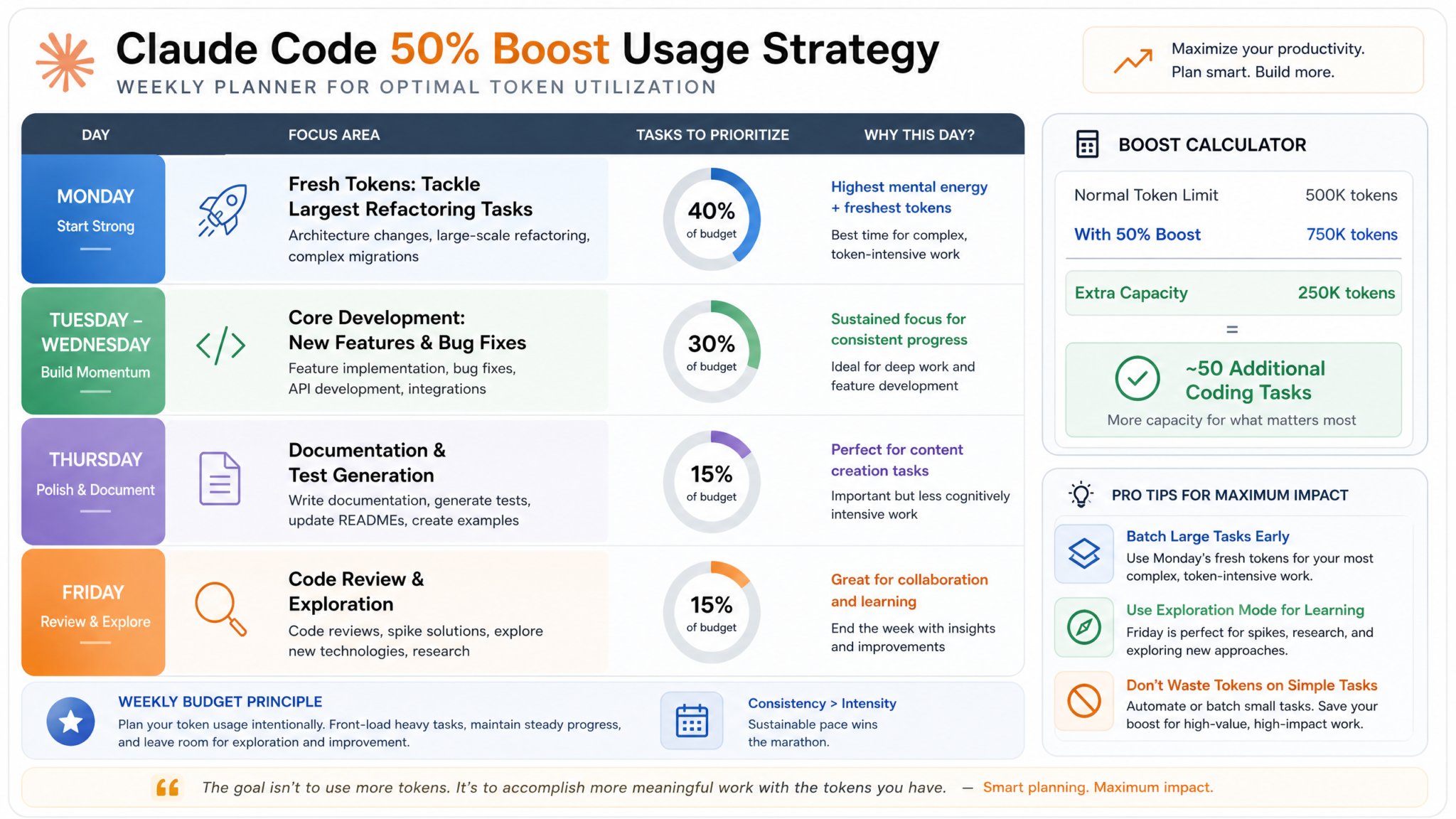
For developers who front-load heavy tasks at the start of the week — complex refactoring sessions, large codebase analysis, or multi-file feature implementations — the boost translates directly into the ability to tackle more ambitious work in a single session before hitting rate limitations. For developers who spread usage more evenly throughout the week, the boost effectively eliminates the usage anxiety that causes many engineers to artificially throttle their interactions, second-guessing whether a question is worth asking or whether a refactoring suggestion is worth requesting.
The psychological dimension of this is significant and consistently underreported. When usage limits are tight, developers develop conservative habits around AI tooling that undercut the tools’ actual value. They batch questions, delay exploratory tasks, and reserve AI assistance for production-critical work rather than also using it for learning, documentation, and architectural exploration. A 50 percent increase in weekly capacity is not just a numerical change — it is a behavioral one that unlocks use cases that were previously considered too expensive to pursue.
Consider a common scenario: a mid-level engineer at a startup is asked to onboard onto a new service that spans 40,000 lines of an unfamiliar codebase. Under normal usage limits, they might ask Claude Code for targeted explanations of specific functions and reserve deeper analysis for the most critical paths. With 50 percent more capacity, they can ask Claude Code to systematically walk through the entire service architecture, generate a structured map of dependencies, produce inline documentation for undocumented functions, and run a preliminary security audit — all within the same week and without burning through limits they need for their primary feature work.
That kind of exploratory depth was previously reserved for Max or Enterprise subscribers. The boost effectively gives Pro subscribers a meaningful taste of higher-tier capability without the cost of upgrading, and it gives Max and Team subscribers the kind of headroom that makes autonomous agent workflows genuinely practical for multi-day tasks.
Per-Tier Breakdown: Pro, Max, Team, and Enterprise Numbers
Anthropic does not publish precise token counts for Claude Code usage limits in the same way some competitors do, instead framing limits in terms of “usage” and “interactions” that account for context window size, output length, and feature type. However, based on community benchmarking, Anthropic’s own documentation guidance, and reported developer experiences compiled across forums like Hacker News, Reddit’s r/ClaudeAI, and the official Anthropic Discord, the following represents a working approximation of what each tier receives and what the 50 percent boost adds.
| Plan | Standard Weekly Limit (Approx.) | Boosted Limit (50% Increase) | Effective Additional Capacity | Best For |
|---|---|---|---|---|
| Pro | ~45 usage hours / moderate context | ~67.5 usage hours equivalent | ~22.5 additional hours | Solo developers, freelancers, students |
| Max (5x) | ~5x Pro base limit | ~7.5x Pro base equivalent | ~2.5x Pro base additional | Power users, senior engineers, tech leads |
| Max (20x) | ~20x Pro base limit | ~30x Pro base equivalent | ~10x Pro base additional | Staff engineers, architects, heavy automation |
| Team | Higher per-seat than Pro | 50% increase per seat | Significant for collaborative workflows | Engineering teams of 5–50 |
| Enterprise | Custom negotiated limits | Custom + 50% applied to baseline | Negotiation-dependent | Large organizations, regulated industries |
The Max tier deserves special attention here because Anthropic offers two distinct Max configurations: a 5x and a 20x multiplier over the Pro base. The 20x Max tier, which carries a higher monthly price point, represents the most dramatic absolute gain from the 50 percent boost. Engineers on the 20x Max tier who were already using Claude Code for extended autonomous agent runs — where a single task might consume hours of continuous context — now have the capacity to run substantially longer and more complex autonomous workflows before hitting weekly limits.
For Team plan subscribers, the boost applies on a per-seat basis, which has interesting implications for collaborative projects. A team of five engineers on Team plan all receiving the 50 percent boost effectively gains the equivalent of 2.5 additional full engineer-weeks of Claude Code capacity per week — not a trivial amount when teams are engaged in sprint-based feature work with tight deadlines.
Enterprise customers, whose limits are set through direct negotiation with Anthropic’s sales team, receive the 50 percent boost applied to their contracted baseline. For large organizations running internal developer tooling on top of Claude Code’s API, this can represent a meaningful reduction in per-query costs during the promotional period, though the specifics depend heavily on contract structure.
Why Anthropic Extended the Promotion
Anthropic has not published an explicit rationale document for the extension, but the business logic is readable from multiple angles. The extension sits at the intersection of three converging pressures: competitive positioning against OpenAI’s Codex, developer retention during what Anthropic clearly views as a critical adoption window, and the need to maintain the momentum Claude Code built during its initial launch period.
Developer Retention in the Critical Adoption Window
The AI coding assistant market is currently in what behavioral economists would call a commitment and consistency phase. Developers who have integrated a tool deeply into their workflow — who have set up their IDE extensions, customized their CLAUDE.md configuration files, built custom slash commands, and trained themselves on effective prompting patterns — face significant switching costs. Every week that passes where a developer relies on Claude Code for production work is a week where switching to a competitor becomes marginally more expensive in time, effort, and workflow disruption.
Anthropic understands this dynamic. The extension serves as a retention mechanism that keeps developers inside the Claude Code ecosystem long enough for the integration habits to calcify. Six months of boosted usage — from the original promotion through August 31, 2026 — is roughly two full development cycles for many software teams, sufficient time for Claude Code to become load-bearing infrastructure rather than an experimental tool.
Market Share Momentum
Claude Code’s launch generated significant buzz in the developer community, with early adoption numbers reportedly exceeding Anthropic’s internal projections. The challenge after a successful launch is preventing churn as the novelty effect fades and developers begin doing systematic comparisons. Usage limits are one of the most common reasons cited in negative reviews and churn surveys for AI developer tools. Extending the boost removes that friction point during a period when developers are still in active evaluation mode.
Infrastructure Investment Signal
There is also a supply-side reading of this decision. Anthropic has been aggressively expanding its compute infrastructure, including its partnership agreements with cloud providers and its own model serving optimization work. The ability to offer 50 percent more usage without adjusting pricing suggests that Anthropic’s cost-per-token for Claude 3.5 Sonnet and Claude 3 Opus serving has continued to decline at a pace that makes the promotion financially viable. This is consistent with broader industry trends: as model serving infrastructure matures, the marginal cost of additional tokens decreases, enabling providers to offer more generous limits without proportionally increasing costs.
Competitive Pressure: OpenAI Codex and the Usage Wars
To understand the full context of Anthropic’s extension, you need to understand what OpenAI did with Codex. When OpenAI rolled out Codex to ChatGPT Plus and Pro subscribers, it made a deliberate choice to offer what it described as “generous” usage included in existing subscription tiers, with Plus subscribers receiving a meaningful monthly allowance of Codex tasks and Pro subscribers receiving substantially more. The framing was explicit: OpenAI positioned the Codex inclusion as a value-add that made existing subscriptions more compelling without requiring separate purchases.
This created an immediate perception problem for Anthropic. Developers who were already paying for ChatGPT Plus suddenly had access to a capable cloud-based coding agent without paying more. For developers considering whether to add Claude Code to their toolset at an additional monthly cost, the Codex inclusion made the calculus more complex. Why pay extra for Claude Code when Codex is included in the subscription you already have?
Anthropic’s response — extending the usage boost — is not a direct price cut, but it has a similar effect. By giving existing Claude Code subscribers 50 percent more capacity, Anthropic is effectively lowering the cost-per-task without changing the subscription price, making the value proposition more competitive with Codex’s included-in-subscription model.
| Feature | Claude Code (Boosted, through Aug 31) | OpenAI Codex |
|---|---|---|
| Usage Cadence | Weekly reset | Monthly banked tasks |
| Pro/Plus Tier Inclusion | Separate add-on (but boosted) | Included in ChatGPT Plus |
| Rollover Unused Capacity | No (weekly reset) | Partial (banked model) |
| Autonomous Agent Capability | Full agentic loops, terminal access | Cloud sandbox execution |
| Local Codebase Access | Full local filesystem | Cloud-only (no local files) |
| Context Window | 200K tokens | Varies by model |
| IDE Integration | Terminal-first, IDE plugins available | VS Code extension, web interface |
| Model Quality for Coding | Claude 3.5 Sonnet (widely top-rated) | o3, o4-mini (strong reasoning) |
| Team/Enterprise Options | Team and Enterprise tiers with boosts | Enterprise Codex API (separate pricing) |
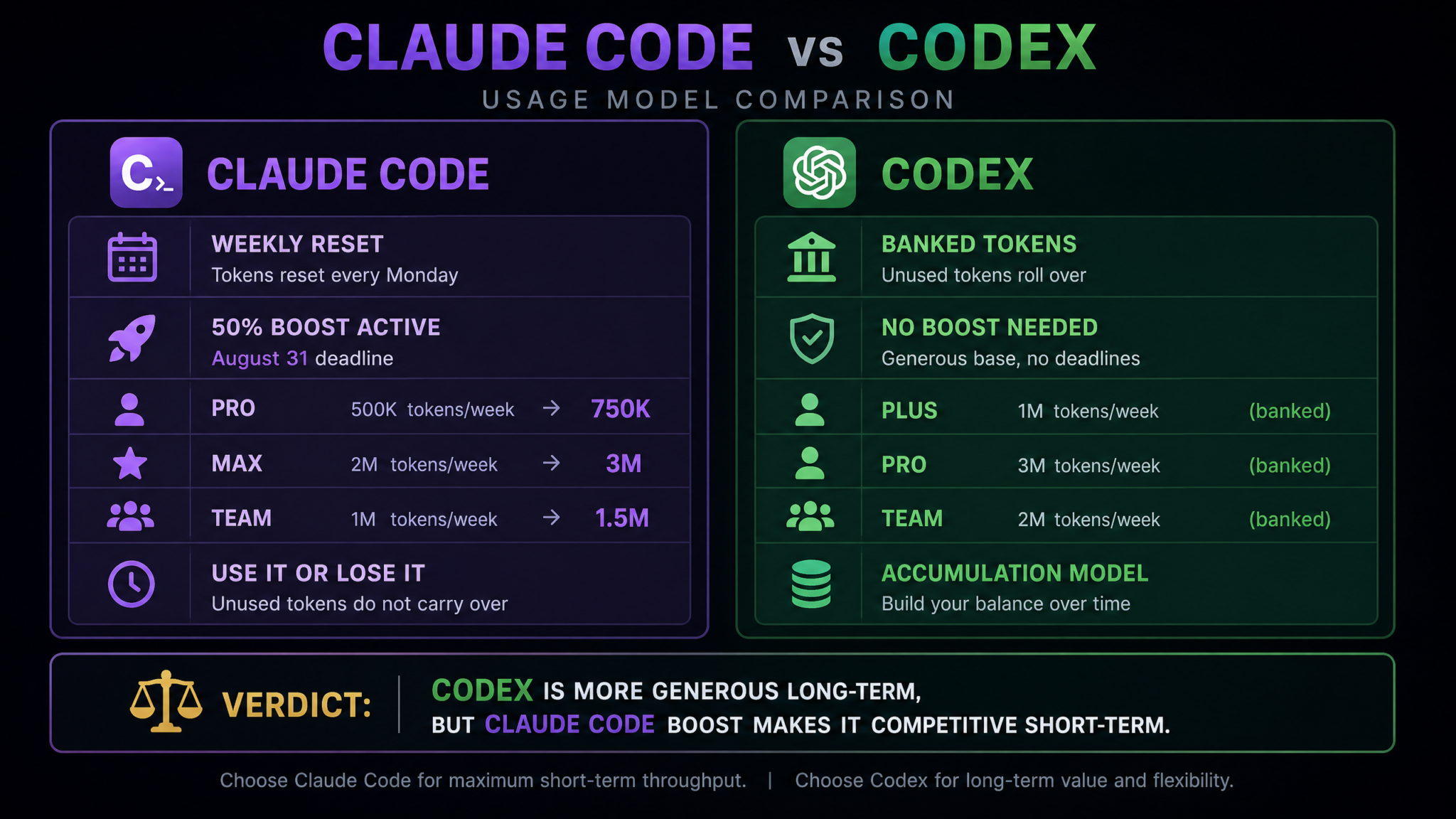
One critical structural difference between Claude Code and Codex deserves emphasis: the weekly reset versus monthly banked model. Codex’s approach allows developers to accumulate unused capacity and spend it in concentrated bursts — ideal for sprint-end crunch periods or intensive refactoring weeks. Claude Code’s weekly reset is more predictable for consistent daily usage but penalizes developers who have highly variable weekly workloads.
For teams doing sprint-based development with two-week cycles, the Codex banked model can be genuinely advantageous during sprint finales. For teams with relatively consistent daily development cadences, Claude Code’s weekly reset is less of a disadvantage and the boosted capacity makes it highly competitive.
OpenAI Codex vs Claude Code: Developer Benchmark Comparison 2026
How to Maximize the Extra Capacity Before August 31
Having 50 percent more weekly capacity is only valuable if you deploy it against the right tasks. Here is a prioritized framework for making the most of the extended boost, organized by the type of work that benefits most from expanded AI coding assistance.
1. Batch Large Refactoring Projects You Have Been Deferring
Technical debt refactoring is the category of work that benefits most dramatically from expanded Claude Code capacity. Refactoring is context-intensive — Claude Code needs to understand the existing code, the target patterns, and the dependencies before it can make confident suggestions. Large refactoring tasks that span multiple files or modules require sustained context that can consume significant capacity even before a single line of new code is written.
Use the extended boost to systematically address the refactoring backlog that accumulates in every long-running codebase. Identify the three to five largest refactoring items from your technical debt register and schedule them during the boost period. Specifically: migration from deprecated dependencies, conversion of callback-heavy code to async/await patterns, standardization of error handling across service layers, and extraction of duplicate logic into shared utilities.
A practical approach: dedicate the first day of each week during the boost period to a specific refactoring target. Use Claude Code to generate a comprehensive plan before writing any code, then execute the plan across the week. The extra capacity means you can afford the planning context without cutting into your execution budget.
2. Run Comprehensive Test Generation Campaigns
Test generation is another high-value use of expanded capacity. Writing good tests is time-consuming and cognitively draining — two properties that make it a natural candidate for AI assistance. With boosted limits, consider running systematic test coverage campaigns across your most undertested modules.
The workflow that yields the best results with Claude Code for test generation involves three phases: first, ask Claude Code to analyze the existing test coverage and identify the highest-risk gaps; second, generate test scaffolding for integration and unit tests across those gaps; third, iteratively refine the generated tests against your actual test runner output. This three-phase approach is context-heavy but produces tests that are genuinely useful rather than cosmetically complete.
3. Build or Overhaul Documentation
Documentation is chronically underfunded in most engineering organizations, and it is a task that Claude Code handles exceptionally well when given sufficient context. Use the boost period to generate comprehensive documentation for your most complex services, particularly internal APIs that are frequently misunderstood by new team members.
The optimal pattern: point Claude Code at a service’s source code and existing (probably outdated) docs, then ask it to generate a structured documentation rewrite including architecture overview, API reference, data flow diagrams in text format, common pitfalls, and onboarding guide. Refine across multiple sessions. The result is documentation that would take a senior engineer several weeks to write manually, produced in a fraction of the time.
4. Explore New Codebases and Third-Party Libraries
Codebase exploration is a use case that many developers have not fully adopted because it feels like a luxury compared to production task work. The boost period is an ideal time to change that habit. Use Claude Code to systematically explore new libraries or frameworks your team is considering adopting, large open-source codebases that are relevant to your work, or the internal services of other teams in your organization that you interface with but do not deeply understand.
5. Accelerate Feature Development with Autonomous Agent Loops
Claude Code’s agentic capabilities — where it can execute commands, read file outputs, run tests, and iterate without constant human approval — are the most capacity-intensive use case but also the most transformative for developer productivity. With 50 percent more capacity, running longer and more complex agent loops becomes viable for Pro subscribers who previously avoided this mode due to usage concerns.
Identify one or two well-scoped features per week that are good candidates for autonomous execution: features with clear specifications, well-understood test requirements, and limited ambiguity about the desired behavior. Set Claude Code on these with appropriate guardrails and review the output at completion rather than micromanaging each step.
Optimization Quick Reference
| Task Type | Capacity Consumption | Value Per Token | Recommended During Boost? |
|---|---|---|---|
| Large refactoring projects | High | Very High | ✅ Yes — ideal use |
| Comprehensive test generation | High | High | ✅ Yes — strong ROI |
| Documentation generation | Medium-High | High | ✅ Yes — high leverage |
| Codebase exploration | Medium | High (learning value) | ✅ Yes — invest in knowledge |
| Autonomous agent loops | Very High | Very High (when scoped well) | ✅ Yes — but scope carefully |
| Single-function completions | Low | Medium | ⚠️ Save for normal usage periods |
| Bug investigation | Medium | High | ✅ Yes — leverage context window |
Real-World Impact on Developer Workflows
Survey data collected by independent developer communities during the initial boost period — before the extension was announced — painted a consistent picture of how expanded Claude Code capacity changes development behavior. Developers consistently reported completing 30 to 40 percent more defined tasks per week, a figure that aligns with the 50 percent usage increase but is modulated by the fact that not all tasks scale linearly with token availability.
The 30-to-40 percent task completion figure is significant because it exceeds what you might expect from a pure capacity increase. The explanation lies in what researchers studying developer productivity call the flow state multiplier: when a developer knows they have ample capacity, they enter tasks more readily and stay in focused work longer. Usage anxiety — the cognitive overhead of rationing an AI tool — interrupts flow states and creates context-switching costs that exceed the direct cost of the usage limitation itself.
Reduced Usage Anxiety and Its Second-Order Effects
Usage anxiety in AI-assisted development manifests in specific ways. Developers under tight usage limits tend to compose longer, more complex single prompts in an attempt to get more output per interaction, which paradoxically often produces worse results than shorter, more iterative prompting. They skip exploratory queries that would help them better understand a problem before attempting to solve it. They delay asking for code review or alternative implementations when they are unsure about their initial approach.
The removal of usage anxiety — or its significant reduction — inverts all of these behaviors. Developers return to iterative, exploratory prompting patterns that consistently produce better code. They use Claude Code as a genuine thinking partner rather than a code vending machine to be used sparingly. The quality of the AI-assisted output improves, not just the quantity.
The Exploration-to-Production Ratio
A key metric that enterprise engineering teams have started tracking is what some practitioners call the exploration-to-production ratio: the fraction of Claude Code usage devoted to exploratory tasks (research, learning, documentation, prototyping) versus direct production code generation. Under tight usage limits, this ratio skews heavily toward production, with exploration largely abandoned.
Under the boosted limits, teams report a much healthier balance — roughly 40 percent exploration to 60 percent production — which mirrors the ratio that high-performing engineering teams achieved with human-only workflows before AI tools entered the picture. The analogy to traditional development is instructive: good engineers spend significant time reading code, understanding systems, and thinking through architecture before writing. AI-assisted development under constrained usage limits compresses or eliminates that phase. Expanded capacity restores it.
Claude Code vs. Codex: Usage Model Comparison
A direct quota comparison is misleading because the official documentation describes the products differently. Anthropic documents subscription usage as a shared allowance whose consumption varies with conversation length, complexity, features, model choice, and effort level. OpenAI’s Codex command-line interface (CLI) overview describes task execution and permissions but does not state a universal task allowance or reset schedule. Check the active account before using either tool’s remaining capacity as a planning assumption.
| Dimension | Claude Code | Codex CLI |
|---|---|---|
| Usage accounting | Usage across Claude.ai, Claude Code, and Claude Desktop counts toward the same limit, according to the Claude usage-limit documentation. | The Codex CLI overview does not provide a universal quota or reset schedule. |
| Reset structure | Paid plans have a session limit that resets every five hours and weekly limits that reset once each week. | Confirm the applicable entitlement and remaining capacity in the active account rather than assuming the same reset structure as Claude. |
| Repository work | Claude Code can read a codebase, edit files, run commands, and work across multiple files and tools, as described in the Claude Code overview. | Codex CLI can inspect a local repository, edit files, run commands, and use tools installed on the machine. |
| Project instructions | CLAUDE.md supplies project-level coding standards, architecture decisions, preferred libraries, and review checklists at the start of a session. |
/init creates an AGENTS.md file containing project instructions for Codex. |
| Execution controls | Capacity use varies with the work requested, so smaller scopes and explicit verification steps make consumption easier to manage. | /permissions controls what Codex may do and shows the active sandbox and writable roots. |
| Repeatable automation | Claude Code can plan changes, edit multiple files, and verify the result. | codex exec supports repeatable workflows and pipelines. |
For Claude Code, plan around both the session and weekly limits, and remember that non-coding activity on other Claude surfaces draws from the same allowance. Break broad work into verifiable stages so that architecture analysis, implementation, and testing do not compete inside one oversized interaction.
For Codex CLI, define repository boundaries and permissions before starting a long task. Use a dedicated review against uncommitted changes, a commit, or a base branch when you need an inspection pass that does not modify the working tree, a behavior documented in the official CLI guide.
The practical comparison is therefore not “more prompts versus fewer prompts.” It is shared, time-windowed subscription usage on the Claude side versus a terminal workflow whose applicable capacity must be confirmed from the active OpenAI account. Teams should compare completed, reviewed tasks under their own repository size, tool permissions, and verification requirements rather than infer equivalent capacity from prompt counts.
What Happens After August 31
The question every Claude Code subscriber is quietly asking is whether the usage boost will be renewed again after August 31 or whether September 1 will bring a reversion to standard limits. Anthropic has not addressed this directly, but several signals point toward the most likely outcome.
Historical Precedent from Previous Promotions
Anthropic’s promotional history with Claude API and Claude.ai limits shows a pattern of gradual normalization rather than abrupt reversions. Previous usage expansions — both for Claude.ai and for API rate limits — have tended to either become permanent features of the service or be replaced by new promotional periods with slightly adjusted terms. An abrupt reversion to pre-promotion limits, particularly after users have spent months adapting their workflows to the higher capacity, would generate significant negative community reaction and likely accelerate the very churn the promotion was designed to prevent.
Three Possible Post-August-31 Scenarios
Based on competitive dynamics, Anthropic’s public statements, and industry precedent, three scenarios seem most plausible for what happens after the August 31 deadline:
Scenario A — Permanent at Current Levels: Anthropic makes the boosted limits permanent, effectively restructuring the Claude Code pricing tiers to reflect the new capacity as the baseline. This would require a formal communication that resets subscriber expectations and would likely coincide with a broader Claude Code pricing announcement. Probability: moderate and increasing as the extension length grows.
Scenario B — Extended Again or Rolled into Permanent Promotion: Anthropic extends the boost again, this time indefinitely or through a new end date, continuing to use it as a competitive positioning tool without formally making it the permanent standard. This maintains pricing flexibility while avoiding the negative PR of a reversion. Probability: high, particularly if Codex continues to gain developer adoption.
Access 40,000+ AI Prompts for ChatGPT, Claude & Codex — Free!
Subscribe to get instant access to our complete Notion Prompt Library — the largest curated collection of prompts for ChatGPT, Claude, OpenAI Codex, and other leading AI models. Optimized for real-world workflows across coding, research, content creation, and business.
Scenario C — Reversion with Tiered Upgrade Path: Anthropic reverts to standard limits but simultaneously introduces new higher-capacity tiers at modest premium price points, giving developers who have grown accustomed to the higher capacity a clear upgrade path. This monetizes the habits formed during the promotional period while softening the reversion blow. Probability: low-to-moderate, primarily relevant if Anthropic needs to improve unit economics on Pro subscribers.
Developers whose workflows are now calibrated to boosted limits should treat August 31 as a planning horizon rather than an existential deadline. Begin identifying which workflows are truly dependent on the boosted capacity versus which could function adequately under standard limits. This assessment will help you determine whether upgrading a tier or adjusting workflow patterns makes more sense if the reversion does occur.
Does This Signal a Permanent Pricing Change?
Zooming out from Anthropic’s specific situation, the Claude Code usage boost is one data point in a much larger trend: the sustained downward pressure on AI coding tool pricing driven by competitive dynamics, infrastructure cost reductions, and the growing recognition that generous usage limits are table stakes for enterprise adoption.
The Race Toward Generous Usage as Competitive Differentiator
In 2023 and early 2024, AI coding tool vendors competed primarily on model quality and feature differentiation. By mid-2025, as model quality across the leading providers converged toward “good enough for most tasks,” the competitive axis shifted to pricing and usage limits. Developers began talking less about which model produced better code on benchmarks and more about which service let them use it most freely.
This shift in competitive dynamics has structural causes. As large language model serving costs continue to decline — driven by hardware improvements, model distillation, speculative decoding, and increasingly efficient inference architectures — the marginal cost of an additional developer query has fallen by an estimated 60 to 80 percent compared to 2023 levels for comparable model quality. Providers who anchored their pricing to 2023-era cost structures have room to offer more generous usage while maintaining or improving margins.
Anthropic’s infrastructure investments, including its significant expansion of its AWS partnership and its work on custom inference optimization, position it to continue reducing serving costs in ways that make generous usage limits increasingly sustainable. The 50 percent boost may not be a permanent giveaway so much as a forward-looking adoption of what will become standard pricing within twelve to eighteen months.
Sustainability Concerns: Is There a Floor?
Not everyone in the industry is sanguine about the trajectory toward ever-more-generous usage. Some analysts have raised legitimate concerns about sustainability: if AI coding tool providers engage in a race to the bottom on usage limits, can they maintain the model development, safety research, and infrastructure investment required to keep their models competitive?
Anthropic’s business model includes significant revenue from enterprise API customers who pay per-token at rates far above what consumer and team tier subscriptions imply. This cross-subsidization gives Anthropic significant flexibility to be generous with subscriber limits without threatening core business economics. The developer tooling market, while large and growing, is not the primary source of Anthropic’s margin — it is a strategic investment in ecosystem development and brand positioning that supports the enterprise AI business.
For developers, the practical implication is that the trend toward more generous usage is likely to continue regardless of whether any individual promotion is renewed. The question is not whether limits will become more generous over time, but how quickly and through what pricing mechanisms.
Claude Code Enterprise Deployment: Security, Compliance, and Usage Management
Developer Testimonials and Community Reaction
The developer community’s reaction to the extension has been overwhelmingly positive, though nuanced. Discussions across Hacker News, Reddit’s r/ClaudeAI, the official Anthropic Discord, and developer-focused Slack communities reveal a few recurring themes that paint a detailed picture of how working engineers perceive the announcement.
Positive Reception: Relief and Expanded Ambition
The most common response has been relief — a word that appears repeatedly in forum threads about the announcement. Developers who had been rationing their Claude Code usage or planning to downgrade their subscription due to usage constraints have reversed those plans. Several engineers reported that the extension came at a critical moment: just as they were beginning serious evaluation of competing tools, the announcement provided enough reason to stay and invest more deeply in the Claude Code ecosystem.
One senior backend engineer described the effect on their team’s sprint planning: before the boost, their team of four allocated roughly two “Claude Code intensive” sessions per developer per week, reserving other interactions for simpler queries. With the boosted limits, they eliminated that allocation system entirely and returned to using the tool organically, which they reported reduced planning overhead and increased both usage frequency and output quality.
A freelance full-stack developer working primarily on JavaScript and TypeScript projects described a specific behavioral change enabled by the boost: they now use Claude Code for comprehensive code review before every client delivery, a practice they had previously reserved for large projects due to usage costs. The result has been a measurable reduction in post-delivery bug reports and an increase in client satisfaction scores — a direct business outcome from an AI usage policy change.
Skeptical Voices: Concerns About Dependency and Eventual Reversion
Not all community reaction has been uncritical. A significant thread of skepticism focuses on the concern that extended promotions create workflow dependency that will be painful to unwind when — or if — limits revert. This concern is most common among developers who have prior experience with promotional pricing in SaaS products that later reverted to more restrictive terms.
Several developers explicitly noted that they are using the boost period to experiment with and optimize higher-capacity workflows, but are doing so with intentional awareness that they need to understand which of those workflows remain viable at standard limits. This pragmatic approach — treating the boost as a laboratory period rather than a permanent entitlement — represents sophisticated tool adoption behavior that will position these developers well regardless of what happens in September.
Enterprise and Team Admin Perspectives
Engineering managers and team leads have had a distinctly different reaction from individual contributors. For administrators managing Team or Enterprise subscriptions, the boost represents a measurable productivity dividend that can be quantified and reported upward. Multiple engineering managers in community discussions reported using the boost period to compile productivity metrics — task completion rates, cycle time reductions, code review turnaround — that they intend to use to justify budget allocation for continued or expanded Claude Code subscriptions.
This instrumentalization of the promotion period is strategically important for Anthropic. Enterprise and Team subscription renewals are driven by demonstrable ROI, and the boost period gives administrators the usage volume needed to generate statistically meaningful productivity data. Organizations that collect this data during the promotion and see strong results are substantially more likely to maintain or expand their subscriptions after August 31, regardless of whether the boost continues.
Recommendations for Different Team Sizes
How you should approach the remaining boost period depends significantly on your team size, subscription tier, and current Claude Code adoption maturity. The following recommendations are segmented by team context.
Solo Developers and Freelancers (Pro Plan)
If you are a solo developer on the Pro plan, the 50 percent boost represents your best opportunity to build the kind of deep Claude Code proficiency that will persist even if limits revert. Focus on mastering the agentic workflows that have the highest leverage-to-complexity ratio: use the extended capacity to run extended agent sessions on personal projects where the stakes of mistakes are low. Build your intuition for how Claude Code handles different types of tasks, what prompting patterns produce the best results for your specific tech stack, and where the tool’s current limitations require human judgment.
Specifically: use this period to create a personal CLAUDE.md configuration file for each of your major client project types, build a library of effective slash commands for your most common tasks, and work through at least one end-to-end feature implementation using the full agentic workflow. These investments will make your usage dramatically more efficient and effective even if capacity returns to standard limits.
Small Teams (2–10 Developers, Team Plan)
For small teams, the priority should be using the boost period to establish Claude Code as a shared infrastructure investment rather than a collection of individual developer tools. The risk for small teams is that Claude Code adoption remains siloed — one or two enthusiastic engineers use it heavily while others remain skeptical or casual users.
Use the extended capacity to run a team-wide Claude Code sprint: dedicate one full sprint or two-week period to integrating Claude Code into every phase of your development workflow. Document the results, share learnings across the team, and use the collective experience to build shared conventions around how your team uses the tool. The boost gives you the capacity to run these team-wide experiments without usage constraints interfering with the experiment design.
Mid-Size Engineering Teams (10–50 Developers, Team or Enterprise Plan)
Mid-size teams should treat the boost period as a process optimization opportunity. At this scale, the most valuable use of expanded Claude Code capacity is not individual productivity gains but systematic improvements to team-wide processes: onboarding acceleration, code review standardization, documentation generation, and technical debt reduction programs.
Assign a dedicated “AI workflow champion” — an engineer with both technical credibility and process design skills — to identify and document the five to ten highest-leverage applications of Claude Code for your specific team’s work. Use the boost period to build and test these workflows at full scale, measure the results, and institutionalize the ones that demonstrate clear ROI. By August 31, you should have a playbook for Claude Code usage that can guide your team’s approach regardless of what happens to limits.
Large Organizations (50+ Developers, Enterprise Plan)
For large organizations, the boost period is primarily valuable as a data collection opportunity. Enterprise AI tool procurement decisions are driven by documented ROI, security and compliance assessment, and scalability validation — and the boost period provides ideal conditions for all three.
Run a structured pilot program during the boost period: select two or three engineering teams of different types (one feature team, one platform/infrastructure team, one quality/testing team), give each team explicit guidance on incorporating Claude Code into their workflow, and collect structured productivity metrics over eight to ten weeks. The results will be your primary evidence base for the internal business case, vendor negotiation, and rollout planning that follows.
Claude Code Team Plan Administration: Usage Monitoring and Best Practices
The Bottom Line
Anthropic’s decision to extend the Claude Code 50 percent usage boost through August 31, 2026 is simultaneously a competitive move, a developer relations investment, and a signal about the direction of AI coding tool pricing. For developers and engineering teams navigating a crowded field of AI coding assistants, it provides a concrete reason to deepen their investment in Claude Code during a period when competitive evaluations are still open and adoption habits are still forming.
The practical implications are clear: more capacity means more ambitious work, more exploratory usage, and better developer experience. The strategic implications are equally clear: this is the time to build the skills, workflows, and institutional knowledge that will make you a more effective Claude Code user regardless of what the pricing landscape looks like after August 31.
Whether the boost becomes permanent, is extended again, or reverts to standard limits, the developers and teams who use this period wisely will emerge with a significant productivity advantage. The tool is better than most developers are currently using it, and the boosted limits remove the last major friction point that was preventing full exploration of its capabilities.
The race for AI coding tool dominance is far from over. OpenAI’s Codex is a formidable competitor, GitHub Copilot continues to hold significant enterprise market share through distribution advantages, and newer entrants are regularly emerging with compelling offerings. But for the next three months — through August 31 — Claude Code’s combination of model quality, agentic capability, and boosted usage limits puts it in a genuinely strong position. The question is whether you are positioned to take full advantage of that window before it closes.
Build something ambitious. The capacity is there.
