
The Rise of AI Coding Agents: Comparing OpenAI Codex, Claude Code, and Gemini in 2026
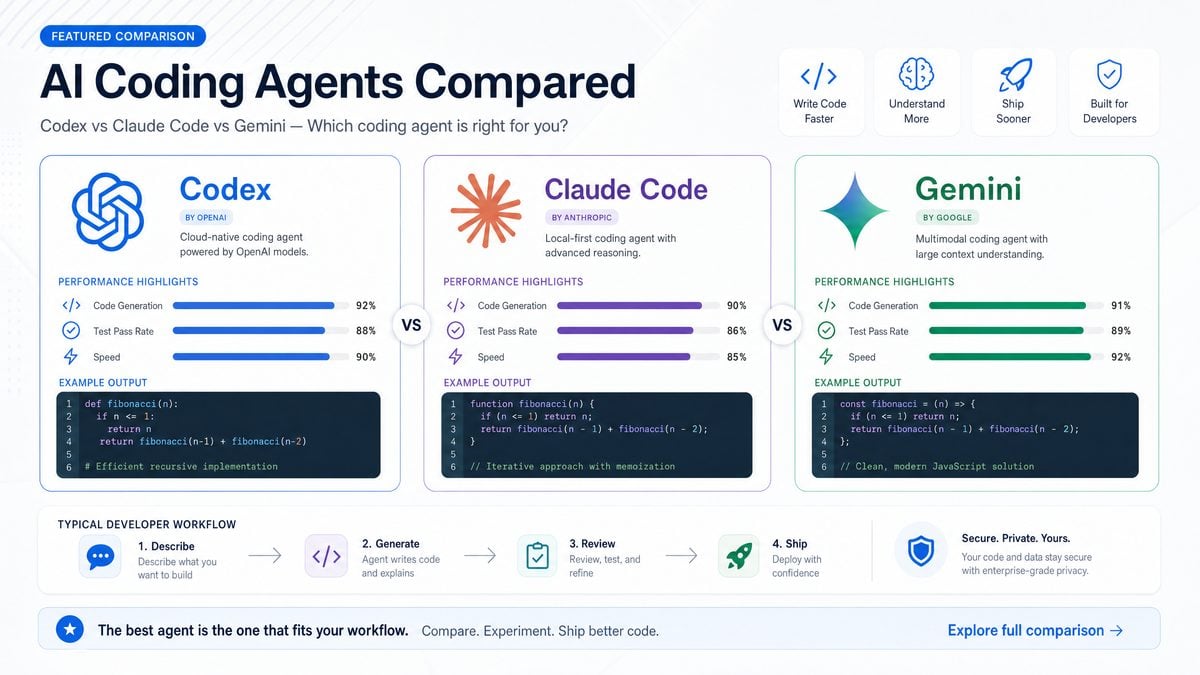
The landscape of software development is undergoing a profound transformation, driven by the relentless advancement of artificial intelligence. What was once the exclusive domain of human programmers is increasingly being augmented, and in some cases, even automated, by sophisticated AI coding agents. These intelligent systems are not merely autocomplete tools; they are capable of understanding context, generating complex code, debugging, and even refactoring, promising to revolutionize productivity and accessibility in software engineering. As we delve into 2026, the competition among these AI powerhouses has intensified, with OpenAI’s Codex, Anthropic’s Claude Code, and Google’s Gemini emerging as the dominant players. This article will provide a comprehensive, professional comparison of these leading AI coding agents, examining their architectures, capabilities, limitations, and future implications for the software development industry.
The journey from simple code suggestions to truly intelligent coding assistants has been rapid. Early iterations, while impressive, often struggled with nuanced requirements, large codebases, and maintaining stylistic consistency. However, with breakthroughs in transformer architectures, larger training datasets, and more sophisticated fine-tuning techniques, today’s AI coding agents are demonstrating unprecedented levels of proficiency. They are becoming indispensable tools for developers, from assisting with boilerplate generation to tackling complex algorithmic challenges. Understanding the strengths and weaknesses of each major player — Codex, Claude Code, and Gemini — is crucial for developers and organizations looking to harness the full potential of AI in their development workflows.
This deep dive will explore the architectural underpinnings that give each agent its unique characteristics, analyze their performance across various coding tasks and programming languages, discuss their integration capabilities within existing development environments, and project their potential impact on the future of coding. We will also touch upon ethical considerations, security implications, and the evolving role of human developers in an increasingly AI-augmented world. By the end of this comprehensive comparison, readers will have a clear understanding of the current state-of-the-art in AI coding agents and be better equipped to navigate the exciting, yet challenging, future of software development.
Architectural Foundations and Training Paradigms
The core capabilities of any AI coding agent are deeply rooted in its underlying architecture and the methodology used for its training. While all three contenders—OpenAI Codex, Claude Code, and Google Gemini—leverage transformer-based models, their specific implementations, training data, and fine-tuning strategies contribute to distinct performance profiles and characteristic strengths. Understanding these foundational differences is key to appreciating their nuanced behaviors and suitability for various coding tasks.
OpenAI Codex: The Pioneer in Code Generation
OpenAI Codex, a descendant of the GPT-3 series, was one of the first widely recognized AI models specifically fine-tuned for code generation. Its architecture is based on the transformer model, renowned for its ability to process sequential data, making it highly effective for understanding and generating code, which is inherently sequential and structured. Codex was initially trained on a massive dataset of text and publicly available code from sources like GitHub. This extensive pre-training on a diverse corpus of code in numerous programming languages, coupled with natural language descriptions, allows Codex to excel at translating natural language prompts into functional code.
- Architecture: Decoder-only transformer architecture, similar to GPT-3, but with specific optimizations for code.
- Training Data: A vast dataset comprising natural language text and billions of lines of publicly available source code (e.g., GitHub repositories, Stack Overflow, documentation). The emphasis on diverse code examples across many languages and paradigms is a significant factor in its versatility.
- Training Paradigm: Primarily unsupervised pre-training on code and text, followed by supervised fine-tuning on specific coding tasks and prompt-completion pairs. Reinforcement learning from human feedback (RLHF) has also been employed in subsequent iterations (e.g., in models like GPT-3.5 and GPT-4, which inform Codex’s evolution) to align its outputs more closely with human preferences and coding best practices.
- Strengths: Exceptional at generating boilerplate code, translating natural language to code, completing functions, and suggesting complex algorithms. Its broad exposure to diverse codebases gives it a wide breadth of knowledge across many programming languages and frameworks.
- Evolution: While “Codex” as a standalone product has evolved into features within ChatGPT and other OpenAI offerings, the underlying principles and continuous improvements in models like GPT-4 are directly applied to its code generation capabilities. This means newer iterations benefit from larger context windows, improved reasoning, and better adherence to coding standards.
Claude Code: Anthropic’s Safety-First Approach
Anthropic’s Claude series, including its code-focused variants, represents a different philosophy, prioritizing safety, steerability, and interpretability. While also built upon transformer architectures, Claude Code emphasizes “Constitutional AI” principles during its training. This involves training the AI to adhere to a set of guiding principles, often expressed in natural language, which helps it generate code that is not only functional but also secure, ethical, and aligned with best practices, reducing the likelihood of generating insecure or problematic code.
- Architecture: Advanced transformer architecture, potentially incorporating novel techniques to enhance safety and reasoning capabilities. Anthropic often emphasizes interpretability and the ability to “steer” the model’s behavior.
- Training Data: A significant portion of its training data includes a curated dataset of code, documentation, and natural language. However, a key differentiator is the emphasis on filtering and refining this data to align with safety principles and to avoid biases or insecure patterns.
- Training Paradigm: Combines extensive pre-training with a unique multi-stage fine-tuning process. This includes supervised learning on a vast dataset, followed by self-correction and reinforcement learning guided by a “constitution” of principles. This “Constitutional AI” approach aims to reduce harmful outputs and improve helpfulness without relying solely on extensive human feedback for every scenario.
- Strengths: Known for generating more secure and robust code, providing well-reasoned explanations, and being more resistant to prompt injection attacks or generating malicious code. It often excels in code review, vulnerability detection, and adherence to specific coding guidelines. Its ability to handle long contexts is also a significant advantage for larger codebases.
- Distinguishing Feature: The “Constitutional AI” approach is a major differentiator, aiming to imbue the model with a higher degree of ethical and safety awareness directly through its training process, rather than solely through external guardrails.
Google Gemini: The Multimodal Powerhouse
Google Gemini represents a significant leap in AI model design, distinguishing itself through its inherent multimodal capabilities. Unlike models primarily focused on text or code, Gemini was designed from the ground up to understand and operate across various modalities—text, code, images, audio, and video. This multimodal foundation has profound implications for its coding abilities, allowing it to interpret visual diagrams, understand spoken requirements, and even generate code from screenshots or design mockups, making it a truly versatile coding agent.
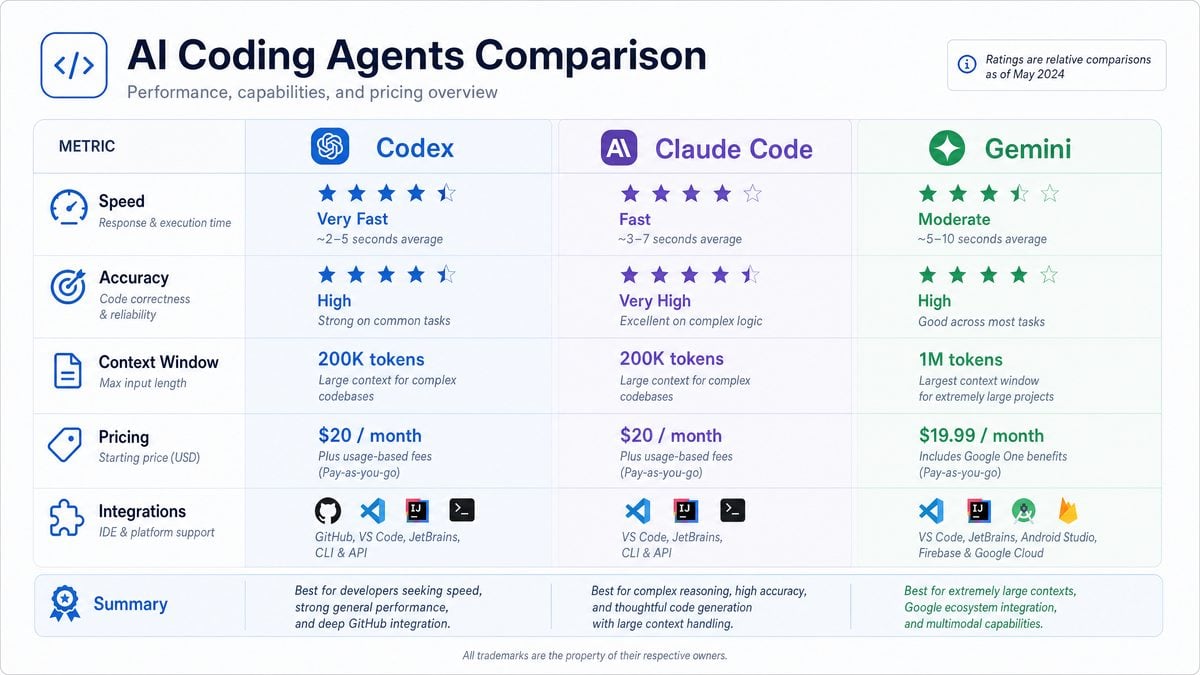
- Architecture: A highly sophisticated, natively multimodal transformer architecture. This means it processes different types of data (text, code, images, etc.) within a single, unified framework, rather than relying on separate models for each modality.
- Training Data: Trained on an unprecedented scale, encompassing vast amounts of text, code (from public and proprietary sources), images, audio, and video. The integration of diverse data types from the outset allows Gemini to build a more holistic understanding of information, which is particularly beneficial for coding tasks that involve UI/UX design, visual specifications, or complex data structures.
- Training Paradigm: Combines massive unsupervised pre-training across modalities with extensive fine-tuning for specific tasks. Google’s expertise in large-scale data processing and machine learning research is evident in its training methodologies. Reinforcement learning and human feedback play a crucial role in refining its outputs and aligning them with user intent and quality standards.
- Strengths: Its multimodal nature is a game-changer. Gemini can generate code from wireframes or mockups, describe code snippets in natural language while referencing visual components, and potentially debug issues by analyzing error logs alongside UI screenshots. It excels at tasks requiring cross-modal understanding, such as generating front-end code from design specifications or creating data visualization scripts based on data context and desired output appearance. Its strong mathematical reasoning and problem-solving abilities also make it adept at algorithmic challenges.
- Scalability: Designed to be highly scalable, available in various sizes (Ultra, Pro, Nano) to cater to different deployment scenarios, from powerful cloud-based applications to on-device mobile solutions.
In summary, while all three leverage the power of transformers, their distinct architectural choices and training philosophies carve out unique niches. Codex (or its modern OpenAI equivalents) provides broad, general-purpose code generation. Claude Code emphasizes safety, interpretability, and robust code. Gemini, with its multimodal foundation, offers unparalleled versatility, particularly for tasks bridging the gap between visual design, natural language, and code. The choice among them will often depend on the specific requirements of the development task and the priorities of the development team.
Capabilities and Performance Benchmarks in 2026
By 2026, AI coding agents have moved far beyond simple code completion. They are now integral tools capable of tackling complex development challenges. This section delves into the specific capabilities of OpenAI Codex (as represented by its successors like GPT-4 and beyond), Claude Code, and Google Gemini, examining their performance across critical metrics relevant to software development.
Code Generation and Completion
This is the bread and butter of AI coding agents. Their ability to translate natural language into functional code, complete partial code snippets, and generate entire functions or classes is paramount.
- OpenAI Codex (GPT-4+): Continues to be a leader in raw code generation. Its vast training data enables it to generate highly idiomatic code across a wide range of programming languages (Python, JavaScript, Java, C++, Go, etc.) and frameworks. It excels at generating boilerplate, implementing algorithms from natural language descriptions, and suggesting complex data structures. Its strength lies in its creativity and breadth of knowledge, often producing multiple viable solutions for a given prompt. Performance benchmarks like HumanEval and MBPP show it consistently ranking high, demonstrating strong logical coherence and correctness.
- Claude Code: While also proficient in code generation, Claude Code often prioritizes safety and clarity. It tends to generate more conservative, robust, and well-commented code, adhering closely to best practices and security guidelines. Its explanations for generated code are often more detailed and easier to understand, which is valuable for learning and code review. It might sometimes be less “creative” than Codex in generating novel approaches but compensates with reliability and adherence to established patterns. Its performance on security-focused code generation tasks is often superior.
- Google Gemini: Leveraging its multimodal understanding, Gemini excels at code generation from diverse inputs. For example, it can generate front-end code (HTML, CSS, JavaScript, React components) directly from design mockups, wireframes, or even hand-drawn sketches. Its ability to understand visual context alongside natural language prompts makes it uniquely powerful for UI/UX development and data visualization. For traditional code generation from text, it performs comparably to Codex, demonstrating strong algorithmic problem-solving and efficiency. Its strength is in bridging the gap between design and implementation.
Debugging, Refactoring, and Code Review
Beyond generating new code, AI agents are increasingly valuable in maintaining and improving existing codebases.
- OpenAI Codex (GPT-4+): Strong at identifying logical errors and suggesting fixes, especially for common programming mistakes or off-by-one errors. Its refactoring suggestions are often efficient and aim to improve code readability or performance. For code review, it can highlight potential bugs, performance bottlenecks, and areas for simplification, though it might sometimes miss subtle architectural issues.
- Claude Code: Particularly strong in code review and identifying security vulnerabilities. Its “Constitutional AI” principles guide it to scrutinize code for potential exploits, insecure patterns, and non-compliance with coding standards. It provides detailed explanations for its suggestions, making it an excellent tool for security audits and maintaining high code quality. Its refactoring suggestions often focus on improving maintainability and reducing technical debt, with a strong emphasis on clarity and robustness.
- Google Gemini: Its multimodal capabilities offer a unique edge here. Gemini can analyze error logs alongside screenshots of the application’s state, providing more contextual debugging insights. For refactoring, it can suggest changes that not only optimize code but also align with updated design specifications. In code review, it can assess the impact of code changes on both functionality and visual presentation, a capability unmatched by text-only models.
Multilingual and Multi-paradigm Support
Modern development often involves multiple languages and programming paradigms.
- OpenAI Codex (GPT-4+): Supports a vast array of programming languages and frameworks due to its extensive training data. It can seamlessly switch between languages and even translate code from one language to another with reasonable accuracy, though complex translations still require human oversight. Its understanding of different programming paradigms (OOP, functional, imperative) is robust.
- Claude Code: Offers strong support for popular languages, with a particular focus on those commonly used in enterprise environments where security and maintainability are critical (e.g., Java, Python, C#, TypeScript). Its multi-paradigm understanding is solid, and its adherence to best practices translates well across different language constructs.
- Google Gemini: Excellent multilingual support, especially for languages with strong ecosystem support from Google (e.g., Python, Go, Java, Kotlin, JavaScript, Dart). Its multimodal nature means it can also understand and generate domain-specific languages (DSLs) more effectively when paired with visual or contextual cues. It excels in cross-language interactions, particularly when one language is used for data processing and another for visualization.
Integration with Development Environments (IDEs) and Workflows
The utility of an AI coding agent is significantly enhanced by its seamless integration into existing development tools and workflows.
- OpenAI Codex (GPT-4+): Widely integrated across various IDEs and code editors through plugins and APIs (e.g., GitHub Copilot, which leverages OpenAI models). Its API-first approach allows for flexible integration into custom workflows, CI/CD pipelines, and internal tools. This broad accessibility makes it a popular choice for individual developers and large teams alike. The Rise of AI Coding Agents
- Claude Code: Anthropic provides APIs for Claude Code, enabling integration into IDEs, internal tools, and custom applications. While perhaps not as ubiquitous as OpenAI’s integrations in terms of sheer plugin count, its focus on safety and controlled outputs makes it attractive for enterprise environments where strict compliance and security are paramount. Custom integrations are often built to leverage its unique strengths in code review and vulnerability detection.
- Google Gemini: Tightly integrated within Google’s own developer ecosystem (e.g., Google Cloud, Android Studio, VS Code extensions developed by Google). Its multimodal APIs allow developers to build highly interactive and context-aware tools. For instance, a developer could use Gemini to generate code in an IDE while simultaneously referencing a design document in a different window, with Gemini drawing connections between the two. Its integration capabilities are particularly strong for projects within the Google ecosystem or those requiring advanced multimodal interaction.
Performance Summary Table (2026)
This table provides a high-level comparison of the key performance areas for each AI coding agent in 2026.
| Feature/Metric | OpenAI Codex (GPT-4+) | Claude Code | Google Gemini |
|---|---|---|---|
| Code Generation Accuracy | Excellent (Broad, creative, idiomatic) | Very Good (Robust, secure, well-commented) | Excellent (Multimodal context, algorithmic strength) |
| Debugging & Error Fixing | Strong (Logical errors, common bugs) | Very Strong (Security vulnerabilities, best practices) | Excellent (Contextual, multimodal diagnostics) |
| Refactoring Quality | Good (Performance, readability) | Very Strong (Maintainability, tech debt reduction) | Excellent (Design alignment, optimization) |
| Code Review Depth | Good (Bugs, performance, readability) | Excellent (Security, compliance, clarity) | Very Strong (Functionality, design impact) |
| Multilingual Support | Extensive (Broad language coverage) | Very Good (Focus on enterprise languages) | Excellent (Google ecosystem languages, DSLs) |
| Multimodal Capabilities | Limited (Primarily text-based) | Limited (Primarily text-based) | Native & Extensive (Visuals, audio, text, code) |
| Context Window Size | Very Large (Continually expanding) | Excellent (Designed for long contexts) | Very Large (Across modalities) |
| Safety & Ethics | Good (Guardrails, moderation) | Excellent (Constitutional AI, reduced bias/harm) | Very Good (Google’s ethical AI principles) |
| Integration Ease | High (Extensive API, popular plugins) | Good (API-driven, enterprise-focused) | Very High (Google ecosystem, multimodal APIs) |
| Use Case Strength | General-purpose coding, rapid prototyping, diverse language tasks | Secure development, enterprise codebases, critical systems, code auditing | Front-end development, UI/UX, data visualization, design-to-code, complex systems integration |
Ethical Considerations, Security, and the Human Element
As AI coding agents become more sophisticated and integrated into the software development lifecycle, it becomes imperative to address the profound ethical considerations, security implications, and the evolving role of human developers. The power of these tools brings both immense opportunities and significant responsibilities.

Ethical Considerations
The ethical landscape of AI-powered code generation is multifaceted, touching upon issues of bias, intellectual property, and accountability.
- Bias in Generated Code: AI models are trained on vast datasets, and if these datasets reflect historical biases (e.g., favoring certain coding styles, architectural patterns, or even demographic groups in open-source contributions), the AI can perpetuate or amplify these biases. This can lead to non-inclusive UI designs, inefficient algorithms for specific use cases, or even security vulnerabilities stemming from underrepresented edge cases. Claude Code’s “Constitutional AI” explicitly attempts to mitigate this by training against harmful or biased outputs, but it remains an ongoing challenge for all models.
- Intellectual Property and Licensing: A significant concern is the origin of the training data. If an AI model generates code that closely resembles existing proprietary or open-source code without proper attribution or adherence to licenses, it creates complex legal and ethical dilemmas. Developers using AI agents need to be acutely aware of the potential for inadvertent license violations, especially when the AI “hallucinates” code snippets from its training set. Companies like OpenAI and Google are working on provenance tracking and licensing frameworks, but the issue is far from resolved.
- Accountability and Responsibility: When an AI generates a bug or a security flaw, who is accountable? Is it the developer who used the AI, the AI provider, or the AI itself? This question becomes critical in high-stakes applications. Current legal frameworks generally place accountability on the human developer, but the increasing autonomy of AI agents may necessitate new legal precedents.
- Job Displacement vs. Augmentation: While AI coding agents clearly augment developer capabilities, there’s an underlying ethical concern about potential job displacement, particularly for entry-level or highly repetitive coding tasks. The ethical imperative for AI providers and organizations is to focus on upskilling and reskilling initiatives, ensuring that human talent can adapt to new roles that leverage AI rather than being replaced by it.
Security Implications
The introduction of AI into the coding process introduces new vectors for security risks and vulnerabilities, while also offering powerful new tools for defense.
- Vulnerability Introduction: An AI agent, if not properly guided or audited, can inadvertently introduce security vulnerabilities (e.g., SQL injection, cross-site scripting, insecure deserialization) into the generated code. This can stem from flawed training data, misinterpretations of prompts, or a lack of deep security context. This is where Claude Code’s emphasis on secure coding practices shines, attempting to proactively prevent such issues.
- Prompt Injection and Adversarial Attacks: Malicious actors could attempt to “prompt inject” AI coding agents, tricking them into generating harmful code or revealing sensitive information embedded in their training data. As AI models become more interactive, defending against such adversarial attacks is a critical security challenge.
- Supply Chain Risks: If AI-generated code becomes a significant component of software, any compromise of the AI model or its training data could have widespread supply chain implications, potentially injecting malicious code into numerous downstream applications.
- Security Enhancement Tools: On the flip side, AI coding agents are powerful tools for enhancing security. They can be trained to identify vulnerabilities, suggest secure coding patterns, perform automated security audits, and even generate secure tests. Gemini’s multimodal capabilities could, for instance, analyze a network diagram and suggest secure firewall rules or identify potential attack paths.
The Evolving Human Element: Developer Roles in an AI-Augmented World
The rise of AI coding agents does not spell the end of human developers; rather, it signifies a shift in their roles and responsibilities. The future of software development is one of human-AI collaboration.
- From Coder to Architect/Orchestrator: Developers will spend less time on boilerplate code and more time on high-level design, architectural decisions, and orchestrating AI agents. Their role will evolve to defining complex problems, validating AI outputs, and integrating various AI-generated components.
- Focus on Problem Solving and Critical Thinking: The unique human capacity for abstract reasoning, creativity, and understanding nuanced business requirements will become even more valuable. Developers will focus on defining the “what” and the “why,” leaving much of the “how” to AI, while still ensuring the AI’s implementation aligns with strategic goals.
- AI Whisperers and Prompt Engineers: A new skill set, “prompt engineering,” has emerged, where developers learn to craft precise and effective prompts to elicit the best possible code from AI agents. This involves understanding the AI’s limitations, context window, and preferred input formats. Claude Code vs OpenAI Codex CLI 2026
- Code Review and Validation: Human oversight remains crucial. Developers will need to meticulously review AI-generated code for correctness, efficiency, security, and adherence to project standards. This requires a deep understanding of the codebase and critical evaluation skills.
- Debugging and Complex Problem Solving: While AI can assist with debugging, the most complex and novel bugs, especially those arising from system interactions or emergent behavior, will still require human ingenuity and deep domain knowledge to diagnose and resolve.
- Learning and Skill Adaptation: Developers must continuously learn and adapt, embracing new AI tools and understanding their underlying mechanisms. The ability to integrate AI into personal workflows and team processes will be a key differentiator.
The synergistic relationship between human developers and AI coding agents is the future. AI handles the repetitive, pattern-based tasks, freeing humans to focus on innovation, creativity, and the complex, uniquely human aspects of software engineering. The challenge lies in building trust, establishing robust validation processes, and ensuring that AI serves as an empowering co-pilot rather than an autonomous replacement.
The Future Landscape: Predictions for 2026 and Beyond
Looking beyond the immediate capabilities, 2026 marks a pivotal point where AI coding agents are not just tools but foundational elements shaping the future of software development. Several trends and predictions emerge when considering the trajectory of OpenAI Codex, Claude Code, and Google Gemini.
Increased Specialization and Niche Agents
While the current leaders are generalists, we will see a proliferation of highly specialized AI coding agents. These might include:
- Domain-Specific Agents: AI models fine-tuned on vast datasets of medical imaging code, financial trading algorithms, or scientific computing libraries. These agents will possess deep domain knowledge, generating highly optimized and accurate code for specific industries.
- Language-Specific Masters: Beyond general multilingual support, we might see agents that are exceptionally proficient in a single, complex language or framework (e.g., a Rust safety-focused agent, a Kubernetes manifest generator, or a declarative UI specialist).
- Security-First AI: Building on Claude Code’s strengths, dedicated security AI agents will become standard, not just for code review but for proactive threat modeling, automated penetration testing, and real-time vulnerability patching.
- UI/UX-to-Code Agents: Gemini’s multimodal prowess will likely lead to a new generation of tools that can directly transform high-fidelity design mockups, user stories, and even accessibility requirements into production-ready front-end and even some back-end code, dramatically accelerating UI development cycles.
Deeper Integration and Autonomous Workflows
AI coding agents will move beyond IDE plugins to become integral parts of the entire DevOps pipeline.
- AI-Driven CI/CD: AI agents will autonomously generate tests, identify merge conflicts, suggest code improvements in pull requests, and even deploy small, verified changes to production environments, all while under human supervision.
- Self-Healing Applications: AI will monitor production systems, detect anomalies, diagnose root causes, and even generate and apply patches or configuration changes to self-heal applications, significantly reducing downtime.
- Automated Documentation and Knowledge Management: AI will not only generate code but also automatically create and update comprehensive documentation, API specifications, and knowledge base articles, ensuring that documentation keeps pace with rapid development.
The Rise of “AI-Native” Development Paradigms
Instead of just augmenting existing human-centric workflows, AI will enable entirely new ways of developing software.
- Prompt-Driven Development: The primary interface for many developers will shift from writing lines of code to crafting precise natural language prompts, effectively becoming “AI whisperers.” This will require a new set of skills focused on clear communication, logical decomposition of problems, and understanding AI capabilities.
- Collaborative AI Teams: Developers will work with teams of specialized AI agents, each handling different aspects of a project (e.g., one for front-end, one for database, one for testing), orchestrated by a human architect.
- Adaptive and Evolving Codebases: AI will continuously monitor, optimize, and refactor codebases based on performance metrics, security audits, and evolving business requirements, leading to more resilient and efficient software that adapts over time.
Ethical AI Development and Regulation
As the capabilities grow, so will the scrutiny. We predict increased focus on:
- Transparency and Explainability: Demand for AI coding agents that can explain their reasoning, justify code choices, and trace the origin of generated code snippets.
- Standardization and Certification: Industry standards and certifications for AI-generated code quality, security, and ethical compliance will emerge, similar to existing software quality standards.
- Legal Frameworks: Governments and international bodies will develop more robust legal frameworks addressing intellectual property, liability, and ethical guidelines for AI-generated content, including code.
The Convergence of AI Models
While distinct today, the lines between these models may blur. OpenAI models will likely gain more multimodal capabilities, Claude will continue to enhance its reasoning and safety, and Gemini will push the boundaries of cross-modal understanding. We might see hybrid models or meta-AI agents that can leverage the strengths of multiple underlying models for different aspects of a coding task. Teams Using AI Coding Agents to Ship 10x Faster
In conclusion, 2026 marks a significant milestone in the journey of AI coding agents. OpenAI Codex (and its successors), Claude Code, and Google Gemini are not just tools; they are harbingers of a new era in software development. They promise unprecedented productivity, accessibility, and innovation, but also demand a thoughtful approach to ethics, security, and the evolving role of the human developer. The future of coding is collaborative, intelligent, and profoundly exciting.
Try These AI Tools Today
Access the most powerful AI models from one place.
Useful Links
