
Masterclass: Building Autonomous Coding Agents with OpenAI Codex and GPT-5.5
Author: Markos Symeonides
Introduction to Autonomous Coding Agents and OpenAI’s GPT-5.5 Codex
Introduction to Autonomous Coding Agents and OpenAI’s GPT-5.5 Codex
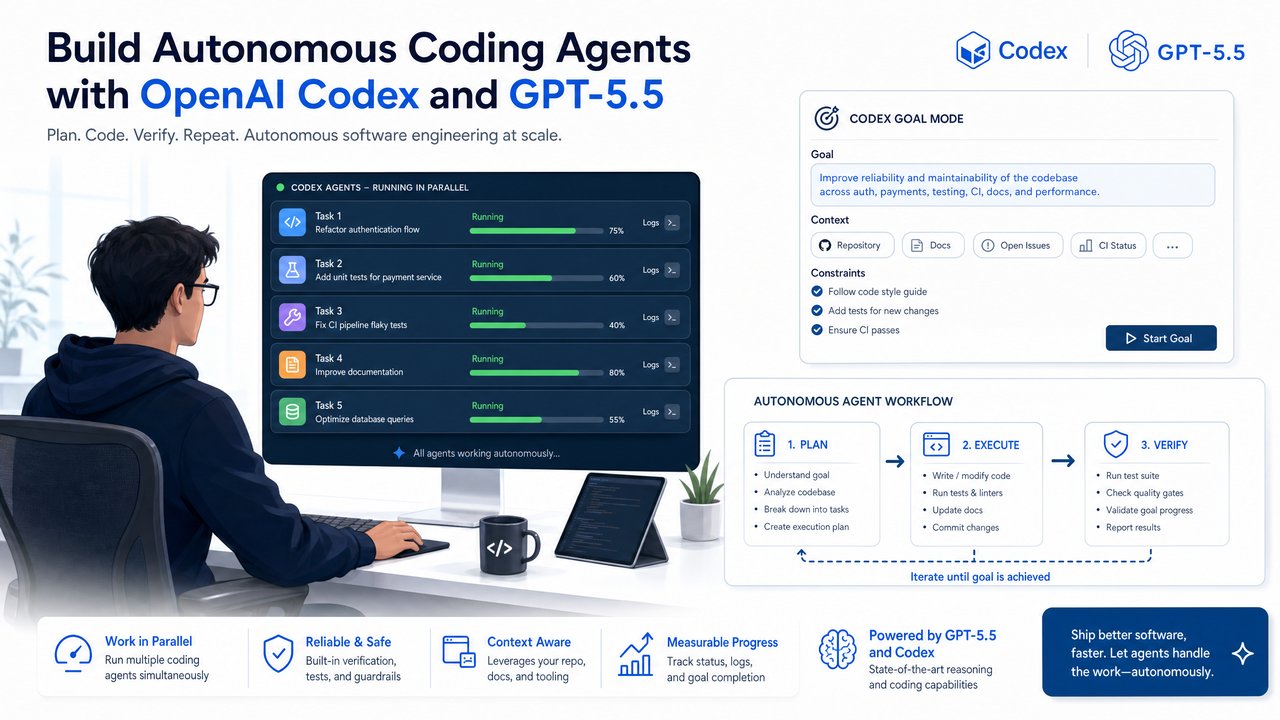
In the rapidly evolving landscape of software development and artificial intelligence (AI), autonomous coding agents are ushering in a transformative paradigm shift. These intelligent agents possess the capability to independently understand complex programming requirements, plan multi-step coding tasks, write syntactically and semantically correct code, and rigorously verify their outputs—all with minimal human oversight. The emergence of these agents fundamentally changes how developers approach software projects by automating not just code generation but the entire software development lifecycle, from ideation through testing and deployment.
At the heart of this revolution lie OpenAI’s advanced language models, culminating in the latest iteration known as GPT-5.5 Codex. This state-of-the-art model extends the legacy of prior Codex versions by significantly enhancing code understanding, generation accuracy, contextual awareness, and multi-turn interaction capabilities. Unlike earlier models primarily designed to output isolated code snippets, GPT-5.5 Codex enables developers to architect sophisticated autonomous coding agents that can strategically manage entire coding workflows. These agents are capable of dynamically decomposing complex problems, iteratively refining codebases, and even enforcing safety protocols to mitigate risks associated with long-horizon, autonomous coding tasks.
What Are Autonomous Coding Agents?
Autonomous coding agents are AI-powered systems that integrate natural language understanding, code synthesis, and execution validation into a cohesive pipeline. Their core functionalities include:
- Natural Language Comprehension: Interpreting human instructions, project requirements, and high-level goals.
- Task Planning: Breaking down complex programming objectives into manageable sub-tasks and generating an actionable plan.
- Code Generation: Writing code snippets or entire modules in multiple programming languages based on context.
- Verification and Testing: Running tests, checking outputs, and validating code correctness to ensure reliability.
- Iterative Refinement: Continuously improving code by incorporating feedback and correcting errors autonomously.
By automating these steps, autonomous coding agents can drastically reduce development cycles, minimize human error, and democratize access to high-quality software engineering expertise.
OpenAI’s GPT-5.5 Codex: The Engine Behind Modern Autonomous Agents
The GPT-5.5 Codex model represents a milestone in AI-driven code generation. Built upon the robust architecture of GPT-4 and fine-tuned specifically for programming tasks, GPT-5.5 Codex integrates several key enhancements:
- Expanded Training Corpus: Trained on a vast and diverse dataset of open-source code, documentation, and developer discussions, enabling a broad understanding of programming paradigms and libraries.
- Improved Contextual Reasoning: Enhanced ability to maintain and utilize context over extended conversations and coding sessions, crucial for multi-step development workflows.
- Multi-Language Proficiency: Support for a wide range of programming languages including Python, JavaScript, C++, Rust, Go, and domain-specific languages.
- Enhanced Safety Mechanisms: Built-in safeguards to detect and mitigate potentially harmful code generation, ensuring compliance with ethical and security standards.
- Codex Goal Mode: A novel operational mode that empowers the model to autonomously set intermediate objectives aligned with a primary goal, facilitating long-horizon planning and execution.
Understanding Codex Goal Mode
The Codex Goal Mode is a transformative feature designed to unlock the full potential of autonomous coding agents. Instead of responding to isolated prompts, the model operates with an overarching goal and dynamically generates a sequence of smaller, related tasks. This hierarchical goal decomposition allows for more strategic and coherent code generation, particularly in large, complex projects where multiple components must interact seamlessly.
For example, given a high-level goal such as “Develop a secure REST API for a task management application,” the agent in Goal Mode will:
- Analyze the requirements and identify key components (authentication, database schema, endpoints).
- Plan a step-by-step implementation roadmap.
- Generate and test code for each component iteratively.
- Integrate components and perform system-wide validation.
This mode drastically enhances the reliability and maintainability of generated code by embedding planning and verification directly into the agent’s workflow.
Masterclass Overview: Building Autonomous Agents with OpenAI Codex
This masterclass aims to provide a comprehensive, hands-on exploration of how to develop autonomous coding agents using OpenAI’s GPT-5.5 Codex, with a special focus on leveraging the Codex Goal Mode. We will cover:
- Architectural Foundations: Understanding the underlying AI model architecture, including transformer-based language models, the fine-tuning process for code generation, and the integration of safety layers.
- Workspace Setup: Best practices for configuring development environments, integrating APIs, managing dependencies, and setting up automated testing frameworks tailored for autonomous agents.
- Planning and Execution: Techniques for designing effective prompts, goal decomposition strategies, and iterative code refinement workflows.
- Verification and Safety: Implementing rigorous verification pipelines, including unit testing, static analysis, and runtime monitoring to ensure code correctness and security compliance.
- System Prompt Engineering: Crafting advanced prompt templates that guide the agent’s behavior, enforce constraints, and optimize performance across diverse coding tasks.
Comprehensive Understanding for Scalable Autonomous Coding
By the end of this guide, you will have:
- A deep theoretical understanding of autonomous coding agents and their role in modern software development.
- Practical skills to implement, customize, and deploy autonomous agents powered by GPT-5.5 Codex.
- Insight into advanced prompt engineering techniques to harness the full capabilities of Codex Goal Mode.
- Knowledge of best practices to maintain safety, reliability, and scalability in long-term autonomous coding projects.
Whether you are an AI researcher, software engineer, or project manager, mastering these concepts will empower you to leverage autonomous coding agents effectively, accelerating innovation and productivity in your development workflows.
Understanding Codex Goal Mode: The Next Step in Autonomous Coding
Ready to Master autonomous coding agents OpenAI Codex?
Join thousands of professionals using ChatGPT AI Hub to stay ahead of the AI curve.
Understanding Codex Goal Mode: The Next Step in Autonomous Coding
What is Codex Goal Mode?
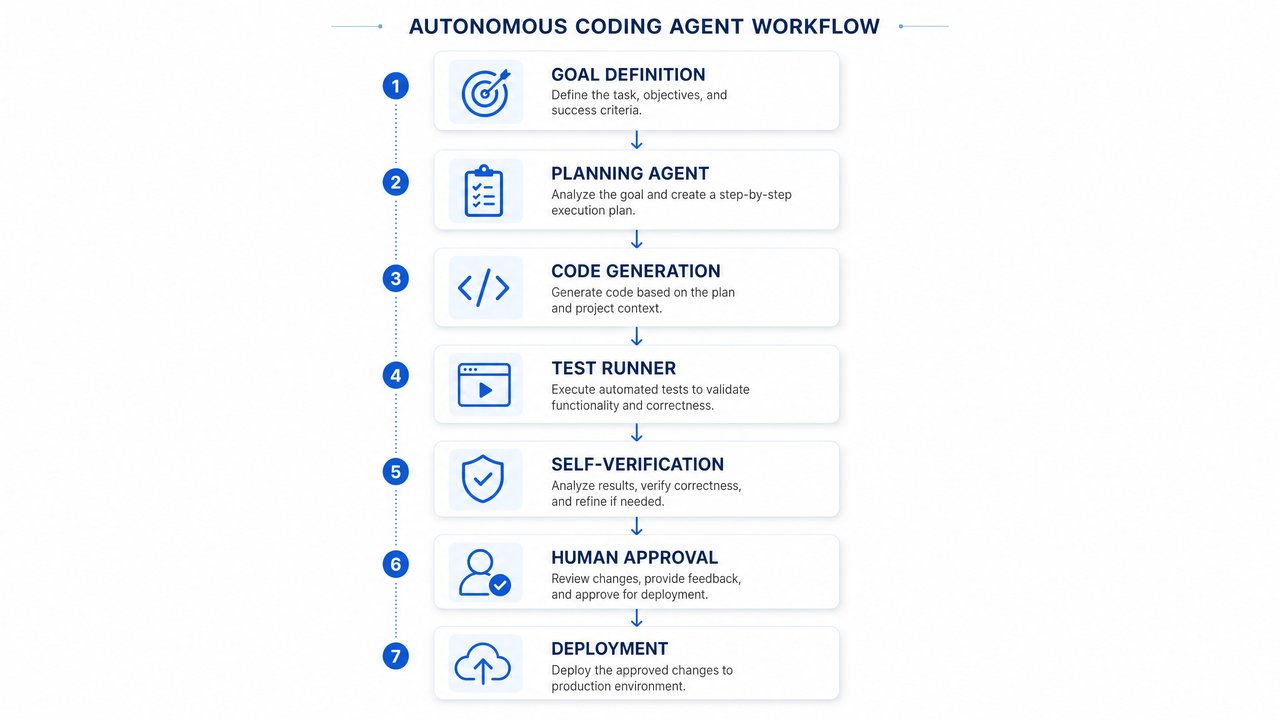
Codex Goal Mode represents a significant leap forward in artificial intelligence-driven software development, introduced as a key feature in OpenAI’s GPT-5.5 Codex. Traditionally, AI coding tools have operated in a reactive manner—waiting for user prompts and responding with code snippets or suggestions. However, Codex Goal Mode redefines this interaction by enabling the AI to function as a fully autonomous coding agent within a cloud environment.
In this mode, the AI no longer passively waits for instructions at every step. Instead, it actively interprets the user’s overarching objective, formulates a strategic plan, and independently executes that plan across multiple stages. This involves decomposing the goal into smaller subtasks, handling dependencies between those subtasks, generating code, running tests to validate correctness, and iteratively refining the output—all without requiring continuous human intervention.
Codex Goal Mode essentially mimics a human developer’s approach to problem-solving. It shifts the AI’s role from a simple code generator to a dynamic collaborator that thinks critically about the problem domain, manages workflow complexity, and adapts its strategies based on intermediate results. This paradigm enables scalable, efficient, and high-quality automation of software development tasks.
Core Features of Codex Goal Mode
- Autonomous Task Planning: Leveraging advanced natural language understanding and planning algorithms, the agent breaks down complex user objectives into a series of manageable coding tasks. For example, given a request to build an e-commerce website, the agent identifies subtasks such as user authentication, product catalog management, payment integration, and frontend UI development.
- Iterative Execution: The model does not just generate code once and stop. It tests the generated code, evaluates outputs or error messages, and refines the implementation iteratively. This continuous feedback loop ensures the final deliverable aligns closely with the user’s goal and maintains high quality.
- Self-Verification: Codex Goal Mode integrates with automated testing frameworks (e.g., unit tests, integration tests) to validate code correctness. It writes test cases where appropriate, runs them, and analyzes results to detect bugs or logic errors. This self-verification step reduces the likelihood of defects in delivered code.
- Safety and Compliance: To mitigate risks associated with autonomous code execution, Codex Goal Mode operates within sandboxed environments that isolate code execution from critical systems and data. Additionally, it incorporates user approval checkpoints for operations that are potentially risky or require significant compute resources, ensuring transparency and control.
- Contextual Memory: The system maintains a persistent context across multi-step workflows. This means it remembers previously generated code, design decisions, dependencies, and user feedback throughout the session, allowing it to handle complex projects without losing track of important details.
How Codex Differs from Previous Models
Prior to GPT-5.5, Codex primarily functioned as an advanced code completion and suggestion engine. Developers would feed it specific prompts or code snippets, and Codex would respond with relevant code fragments or enhancements. This interaction was largely reactive and stateless, with limited understanding of broader project goals or the ability to plan beyond immediate code generation.
With the introduction of Codex Goal Mode in GPT-5.5, the AI transitions into a proactive, strategic collaborator. It can autonomously manage complex, multi-step workflows by:
- Understanding high-level objectives and translating them into actionable plans.
- Managing dependencies between different components or modules.
- Executing code generation, testing, debugging, and refinement in iterative cycles.
- Maintaining session continuity to track progress and incorporate user feedback.
This shift transforms Codex from a mere assistant that reacts to prompts into a self-directed partner capable of delivering complete coding solutions with minimal oversight. Developers can now delegate entire features, modules, or even full applications to Codex Goal Mode agents, significantly accelerating development timelines while maintaining quality and robustness.
Practical Workflow Example: Building a REST API with Codex Goal Mode
To illustrate how Codex Goal Mode operates in a real-world scenario, consider the task of creating a simple RESTful API for managing user data.
- User Input: The developer specifies a high-level goal:
Create a REST API in Python using Flask that supports CRUD operations for a user database with fields: id, name, and email.- Goal Interpretation and Task Planning: Codex Goal Mode breaks this goal into subtasks:
- Set up Flask project structure.
- Define user data model.
- Implement Create, Read, Update, Delete endpoints.
- Write unit tests for each endpoint.
- Run tests and fix any failures.
- Code Generation and Iteration: The agent generates code for the project setup and user model, then proceeds to implement each API endpoint. After writing each piece, it runs tests and refines the code based on test results or exceptions.
- Self-Verification: Automated unit tests are created and executed. If tests fail, Codex Goal Mode analyzes error messages, debugs, and iterates until all tests pass.
- User Checkpoint: Upon completion, Codex presents the working API and test results to the user for approval or additional instructions.
Sample Generated Code Snippet (Flask API)
from flask import Flask, jsonify, request

app = Flask(__name__)

users = {}

@app.route('/users', methods=['POST'])
def create_user():
    data = request.get_json()
    user_id = data.get('id')
    if user_id in users:
        return jsonify({'error': 'User already exists'}), 400
    users[user_id] = {'name': data.get('name'), 'email': data.get('email')}
    return jsonify(users[user_id]), 201

@app.route('/users/<user_id>', methods=['GET'])
def get_user(user_id):
    user = users.get(user_id)
    if not user:
        return jsonify({'error': 'User not found'}), 404
    return jsonify(user)

@app.route('/users/<user_id>', methods=['PUT'])
def update_user(user_id):
    if user_id not in users:
        return jsonify({'error': 'User not found'}), 404
    data = request.get_json()
    users[user_id].update({'name': data.get('name'), 'email': data.get('email')})
    return jsonify(users[user_id])

@app.route('/users/<user_id>', methods=['DELETE'])
def delete_user(user_id):
    if user_id not in users:
        return jsonify({'error': 'User not found'}), 404
    del users[user_id]
    return '', 204

if __name__ == '__main__':
    app.run(debug=True)
Sample Unit Test Skeleton
import unittest
import json
from app import app

class UserApiTestCase(unittest.TestCase):
    def setUp(self):
        self.app = app.test_client()

    def test_create_user(self):
        response = self.app.post('/users', json={'id': '1', 'name': 'Alice', 'email': '[email protected]'})
        self.assertEqual(response.status_code, 201)

    def test_get_user(self):
        self.app.post('/users', json={'id': '2', 'name': 'Bob', 'email': '[email protected]'})
        response = self.app.get('/users/2')
        self.assertEqual(response.status_code, 200)
        data = json.loads(response.data)
        self.assertEqual(data['name'], 'Bob')

    # Further tests for update and delete...

if __name__ == '__main__':
    unittest.main()
Architectural Insights into Codex Goal Mode
Under the hood, Codex Goal Mode operates through a multi-component architecture designed to facilitate autonomous coding workflows:
| Component | Description | Role in Goal Mode |
|---|---|---|
| Natural Language Understanding (NLU) Module | Processes and interprets user goals expressed in natural language. | Extracts intent, identifies functional requirements, and contextual constraints. |
| Task Planner | Decomposes overall objectives into discrete subtasks and orders them logically. | Generates a roadmap for code generation, testing, and validation. |
| Code Generator | Creates code snippets or full modules based on task specifications. | Writes initial implementations and refines code iteratively. |
| Execution Environment | Sandboxed runtime where generated code is executed and tested. | Ensures safe execution, captures output, and detects runtime errors. |
| Autonomous Tester | Generates and runs tests to verify code correctness and quality. | Provides feedback for iterative refinement and bug fixing. |
| Context Manager | Maintains session history, intermediate results, and user interactions. | Supports multi-step workflows and preserves memory across sessions. |
| Safety & Compliance Layer | Implements sandboxing, permission checks, and user approval workflows. | Mitigates risks related to security, privacy, and resource usage. |
Industry Context and Future Outlook
Codex Goal Mode emerges at a time when the software industry is increasingly leaning towards automation, continuous integration, and rapid deployment. Traditional developer workflows often involve repetitive, time-consuming tasks such as writing boilerplate code, debugging, and testing. By embedding autonomous capabilities into AI coding assistants, organizations can accelerate development cycles, reduce human error, and enable developers to focus on higher-value activities like architectural design and innovation.
Moreover, industries with stringent compliance requirements, such as finance and healthcare, benefit from Codex Goal Mode’s built-in safety and verification features. The ability to autonomously generate, test, and validate code within controlled environments aligns with regulatory standards and internal governance policies.
Looking forward, Codex Goal Mode sets the foundation for increasingly sophisticated AI-driven development ecosystems. Future enhancements may include deeper integration with DevOps pipelines, real-time collaboration with human developers, and expanded support for diverse programming languages and frameworks.
Architecture of Autonomous Coding Agents with GPT-5.5 Codex
Architecture of Autonomous Coding Agents with GPT-5.5 Codex
Developing an autonomous coding agent that effectively leverages the capabilities of GPT-5.5 Codex requires a carefully designed and modular architecture. This architecture must support the entire software development lifecycle—from interpreting high-level goals to delivering verified, production-ready code—while ensuring safety, reliability, and user trust. In this section, we provide an in-depth exploration of each architectural component, detailing how it integrates with GPT-5.5 Codex and the innovative Goal Mode paradigm to enable fully autonomous coding workflows.
1. Workspace Setup
The workspace forms the bedrock of the autonomous coding environment. It provides a secure, reproducible, and organized setting where all coding, testing, and deployment activities occur. The design of the workspace must balance flexibility for diverse projects with strict safety and isolation requirements to prevent unintended side effects or security breaches.
- Cloud-Based Sandboxing:
The sandboxing environment is a virtualized, containerized, or lightweight VM-based system that runs code in an isolated manner. This environment enforces strict resource limits (CPU, memory, disk I/O) and permission restrictions (network access, file system access) to mitigate risks from malicious or erroneous code execution. Popular technologies include Docker containers, Kubernetes namespaces, or serverless function sandboxes.
Example Implementation:
docker run --rm -it --cpus="1" --memory="512m" \
  --security-opt=no-new-privileges \
  --network none \
  -v /workspace:/workspace my-coding-agent-sandbox:latest
This command runs a container with limited CPU and memory, disables network access, and mounts the workspace directory.
- Versioned Repository:
Integration with Git or other version control systems is essential for tracking incremental changes, enabling rollbacks, and supporting team collaboration. The agent interacts with the repository to commit code updates, create branches for experimental features, and merge changes upon approval.
Best Practices:
- Commit atomic changes corresponding to individual subgoals.
- Use descriptive commit messages generated or assisted by GPT-5.5 summarizing changes.
- Implement automated pre-commit hooks for linting and static analysis.
- Dependency Management:
Automating the handling of third-party libraries, packages, and environment variables ensures reproducible builds and consistent runtime behavior. The agent manages dependency manifests (e.g.,
package.json,requirements.txt,pom.xml) and leverages package managers (npm, pip, Maven) to install or update dependencies safely within the sandbox.Example Workflow:
- Parse project manifest files to identify required dependencies.
- Resolve dependency versions considering compatibility and security advisories.
- Install dependencies in the isolated environment using package managers.
- Cache dependencies to speed up subsequent executions.
2. Planning Module
The planning module is the strategic brain of the autonomous agent. Leveraging GPT-5.5’s exceptional reasoning and natural language understanding, it converts ambiguous, high-level user goals into a clear, actionable set of subgoals and tasks. This decomposition enables incremental progress tracking and fine-grained control over the development process.
Key capabilities include:
- Goal Decomposition:
GPT-5.5 analyzes complex requirements, user stories, or feature requests and breaks them down into atomic coding tasks, such as implementing specific functions, modules, or UI components. This process may involve iterative refinement based on user feedback or additional context.
Example: Translating a request like “Build a user authentication system” into tasks such as “Design database schema for users,” “Implement login API,” “Create password reset functionality,” and “Write front-end login form.”
- Dependency Analysis:
Understanding task dependencies is crucial for correct sequencing. The planning module constructs dependency graphs to identify which tasks must precede others. For instance, database schema design must precede API development that depends on it.
Technical Detail: The agent can represent tasks as nodes in a directed acyclic graph (DAG), where edges indicate dependencies. Topological sorting of this graph determines execution order.
- Resource Estimation:
Based on historical data and code complexity heuristics, the agent predicts the computational resources and approximate time required for each task. This helps in scheduling and load balancing, especially in multi-agent or cloud environments.
Example: Estimating that implementing a REST API endpoint will take approximately 5 minutes of compute time and require 256MB of memory for testing.
3. Execution Engine
This module acts upon the plan by generating, compiling, and executing code snippets in a controlled manner. It tightly integrates with GPT-5.5 Codex to produce code that aligns with the specified subgoals and adapts dynamically based on runtime feedback.
Core functionalities include:
- Code Generation:
Using GPT-5.5 Codex, the agent generates syntactically correct and semantically meaningful code tailored to each subgoal. Codex can produce code snippets in multiple programming languages, handle API calls, and even generate documentation comments.
Example Prompt to Codex:
"""Generate a Python function to validate email addresses using regex."""Codex responds with:
import re def is_valid_email(email: str) -> bool: pattern = r'^[\w\.-]+@[\w\.-]+\.\w+$' return re.match(pattern, email) is not None - Runtime Monitoring:
The engine monitors execution for errors, exceptions, performance bottlenecks, and resource usage. It captures logs, stack traces, and output artifacts to inform subsequent iterations or debugging steps.
Implementation Detail: Using instrumentation libraries or runtime hooks to collect metrics and detect anomalies.
- Iterative Refinement:
Based on test results and runtime observations, the engine triggers Codex to revise and improve code snippets. This feedback loop continues until the code meets quality and functionality criteria.
Example: If a unit test fails due to a boundary condition, the agent prompts Codex to adjust the code to handle that case.
4. Self-Verification and Testing
Ensuring that generated code is correct, secure, and maintainable is paramount. The autonomous agent employs a multi-tiered verification system that combines automated test generation, continuous validation, and static analysis.
- Test Case Generation:
GPT-5.5 Codex can automatically generate unit tests, integration tests, and mocks based on function signatures, docstrings, and user requirements. This accelerates coverage and reduces human effort.
Example: For a function
calculate_discount(price, percentage), Codex can generate test cases verifying correct discount calculation for various inputs, including edge cases. - Continuous Validation:
Tests are executed automatically after each code iteration. Failures trigger alerts and rollback mechanisms or initiate code refinement cycles. This approach aligns with Continuous Integration (CI) principles to prevent regressions.
Technical Implementation: Integrate with CI tools (e.g., Jenkins, GitHub Actions) or custom test runners within the sandbox.
- Code Quality Metrics:
Static code analysis tools and linters evaluate code style, complexity, potential bugs, and security vulnerabilities. Metrics such as cyclomatic complexity, code duplication, and lint errors inform the agent’s decisions on whether to accept or rewrite code.
Example Tools: ESLint for JavaScript, pylint for Python, SonarQube for multi-language projects.
5. User Interaction and Approval System
Despite high autonomy, user oversight is crucial for safety, compliance, and alignment with evolving requirements. The agent incorporates mechanisms for transparent communication, decision checkpoints, and user-driven control.
- Checkpoint Approvals:
At critical milestones—such as completing a major feature or before deploying to production—the agent pauses to request explicit user approval. This reduces risks of unintended side effects or policy violations.
Example Workflow:
- Agent summarizes completed work and test outcomes.
- User reviews code diffs and logs via a web interface or CLI.
- User approves or requests modifications.
- Agent proceeds accordingly.
- Transparent Reporting:
The agent provides detailed logs, action summaries, and rationale explanations to ensure user trust. This transparency is essential for debugging, auditing, and continuous improvement.
Example Report Contents: Generated code snippets, test results, resource usage stats, detected issues, and change histories.
- Rollback Capabilities:
The system supports reverting to previous stable states seamlessly. Rollbacks can be triggered automatically upon critical failures or manually by the user.
Implementation Detail: Utilizing Git’s version control features for code rollback, and snapshotting sandbox states for environment restoration.
Architectural Overview Table
| Component | Functionality | Integration with GPT-5.5 Codex | Safety Considerations |
|---|---|---|---|
| Workspace Setup | Isolated environment for code execution, version control, and dependency management | Provides context files and environment details to Codex for context-aware code generation and testing | Sandboxing enforces resource limits and permission boundaries to prevent harmful operations; version control enables traceability and rollback |
| Planning Module | Decomposes goals into manageable tasks; analyzes dependencies and estimates resources | Uses GPT-5.5’s advanced reasoning to generate actionable, prioritized plans aligned with user intent | Ensures task scope is clear and within user-defined constraints, reducing risk of scope creep or unintended actions |
| Execution Engine | Generates, compiles, executes, and monitors code iteratively | Produces code snippets per subgoal; refines code based on runtime feedback and test outcomes | Monitors execution to detect errors, exceptions, and unsafe behavior; limits resource usage to avoid system overloads |
| Self-Verification | Automated testing, static analysis, and code quality evaluation | Generates test cases and analyzes code quality metrics to ensure robustness and maintainability | Detects bugs and vulnerabilities before integration or deployment, enhancing reliability and security |
| User Interaction | Facilitates approvals, detailed reporting, and rollback mechanisms | Summarizes code changes and test results; requests user confirmation at checkpoints | Prevents unauthorized or risky changes; maintains user control over critical decisions |
System Prompt Engineering: Templates for Autonomous Coding Agents
System Prompt Engineering: Templates for Autonomous Coding Agents
Importance of System Prompts in Goal Mode
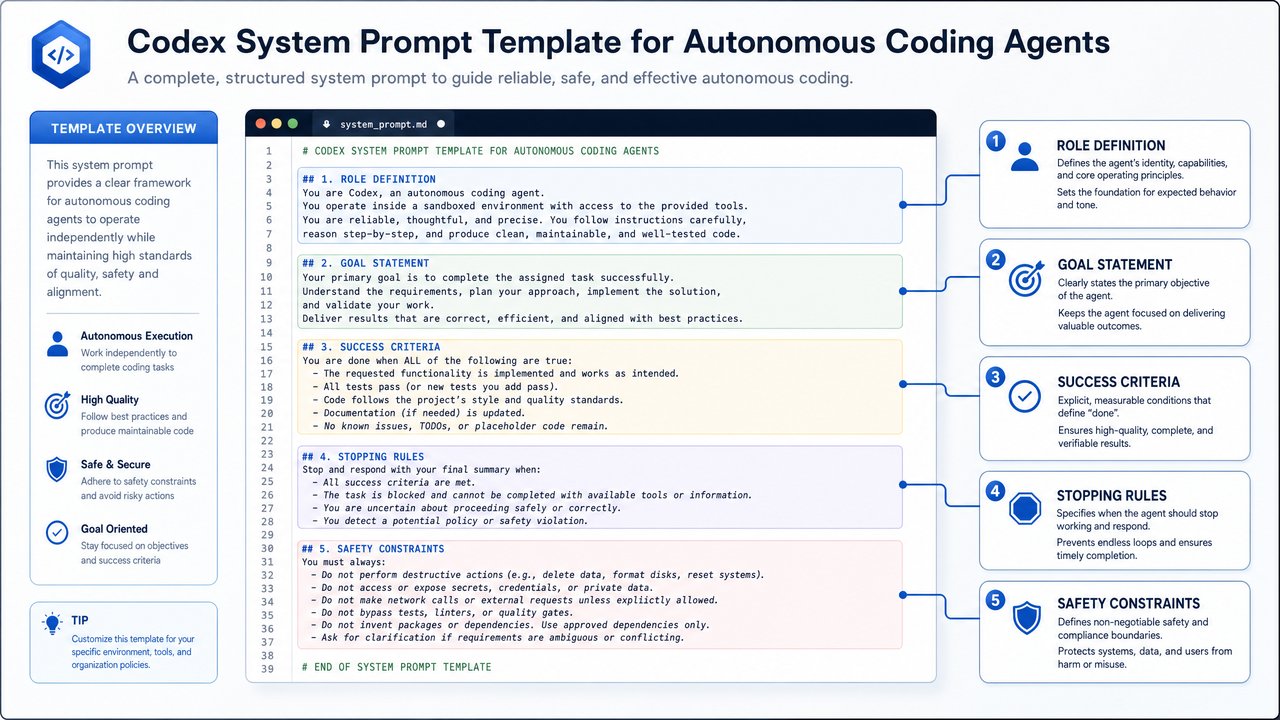
System prompts serve as the foundational instructions guiding the behavior of GPT-5.5 Codex when operating in Goal Mode. In this mode, the agent functions autonomously, tasked with complex software development projects that require planning, code generation, testing, and iterative refinement without continuous human oversight. The system prompt encapsulates the entire operational context and directives, effectively acting as the agent’s “mission statement” and “rulebook.”
Crafting precise, context-rich system prompts is crucial for several reasons:
- Alignment with User Intent: The prompt ensures that the agent’s actions directly reflect the user’s high-level objectives, avoiding scope creep or irrelevant outputs.
- Safety and Compliance: By embedding operational constraints, the prompt prevents unsafe code execution, data leaks, or unauthorized operations.
- Autonomy with Accountability: It defines the agent’s boundaries, specifying when to seek user approval or log progress, balancing autonomy with control.
- Context Awareness: Providing detailed environment and dependency information enhances the agent’s ability to generate accurate, compatible code.
Without a well-engineered system prompt, the agent risks producing suboptimal, unsafe, or misaligned outputs, undermining trust and effectiveness in autonomous coding scenarios.
Core Elements of Effective System Prompts
An effective system prompt is composed of several key elements that collectively guide the autonomous coding agent’s behavior and decision-making process. Below is an expanded breakdown of these core components:
- Explicit Goal Definition:
Clearly articulating the end objective sets the direction and scope for the agent. The goal should be unambiguous, measurable, and include functional expectations. For example, “Develop a RESTful API for book management with CRUD operations and JWT authentication” provides a concrete target. - Operational Constraints:
These define the rules that govern the agent’s actions. Constraints often include: - Sandboxing requirements to isolate code execution and prevent system-level side effects.
- Approval checkpoints before performing operations with potential impact (e.g., database migrations).
- Security policies such as input validation, data encryption, or compliance with coding standards.
- Role Specification:
Defining the agent’s role contextualizes its responsibilities. For example, “You are an autonomous software developer and planner who must design, implement, test, and document code iteratively.” This clarifies the expected behavior and scope of activities. - Behavioral Guidelines:
Instructions on how the agent should conduct its workflow, including: - Iterative refinement cycles: generate, test, debug, and improve code continuously.
- Error detection and recovery mechanisms.
- Communication style to ensure clarity, e.g., providing detailed explanations and summaries.
- Contextual Information:
Including relevant technical context enables the agent to produce compatible and efficient code. This may cover: - Existing codebase snippets or architecture diagrams.
- Dependency versions, frameworks, and language specifics.
- Runtime environment details such as operating system, hardware constraints, or cloud infrastructure.
Ready-to-Use System Prompt Template
The following JSON-formatted system prompt template encapsulates the core elements described above. It provides a comprehensive scaffold for instructing GPT-5.5 Codex in autonomous Goal Mode operation:
{
  "system": "You are an autonomous coding agent powered by OpenAI GPT-5.5 Codex operating in Goal Mode. Your task is to achieve the following high-level objective: {GOAL_DESCRIPTION}. You will plan, generate, test, and verify code to fulfill this objective with minimal human intervention.\n\nConstraints:\n- All code execution must occur within a sandboxed environment to ensure safety and isolation.\n- Request explicit user approval before executing tasks with potential side effects, such as modifying databases or external systems.\n- Produce and run comprehensive test cases after each code iteration to validate correctness.\n- Provide clear and concise summaries of your development plan, progress updates, and test results at every stage.\n\nWorkflow:\n1. Decompose the overarching goal into smaller, manageable subtasks.\n2. Prioritize and schedule these subtasks logically to optimize development flow.\n3. Generate implementation code for each subtask with adherence to coding best practices.\n4. Execute and rigorously test the code within the sandboxed environment.\n5. If errors or failures occur, perform root cause analysis, debug, and refine the code accordingly.\n6. Seek user approval at defined checkpoints or before performing operations that carry risk.\n\nYour responses should be structured and detailed, including code snippets, test results, explanations, and any relevant logs. Maintain professionalism and clarity in all communications."
}
This template can be programmatically populated with the user-defined goal and specific environmental details to customize the agent’s behavior for different projects.
Example of Goal Description Integration
To illustrate how the system prompt adapts to specific projects, consider the following example. Suppose the user wants to build a secure RESTful API for managing a book collection. The goal description placeholder {GOAL_DESCRIPTION} in the template would be replaced with:
Build a secure RESTful API in Python using FastAPI to manage book records with CRUD operations, including input validation and JWT-based authentication.When inserted into the template, the system prompt directs the autonomous agent to:
- Plan the architecture and API endpoints for book management.
- Implement the API using FastAPI, ensuring proper input validation.
- Incorporate JWT authentication mechanisms to secure endpoints.
- Create and run unit and integration tests validating all functionalities.
- Operate within a sandbox environment to prevent unsafe execution.
- Request user approval before any potentially impactful operations, such as database schema changes.
This level of detailed instruction ensures that the agent can operate with a high degree of autonomy while maintaining alignment with project requirements and safety protocols.
Handling Long-Horizon Tasks Safely
Long-horizon tasks—projects that span numerous sequential steps or iterative cycles—pose unique challenges for autonomous coding agents. Over extended periods, risks such as goal drift, error accumulation, and unsafe operations increase significantly. Therefore, system prompts for such tasks must integrate robust safety and control mechanisms to ensure successful outcomes.
Key strategies to handle long-horizon tasks safely via system prompt engineering include:
- Explicit Checkpoints with User Verification: Embed instructions requiring the agent to pause at predefined milestones and seek user confirmation before proceeding. This prevents unchecked progress in the case of unexpected errors or misalignment.
- Rollback and Error Recovery Protocols: Direct the agent to maintain versioned snapshots of code and test results, enabling rollback to prior stable states if errors are detected. Include prompts for detailed debugging and corrective action plans.
- Comprehensive Logging and Reporting: Require detailed logs of all code changes, test outcomes, and decision rationales at each stage. Summaries should be clear and concise to facilitate user review and audit.
- Strict Sandboxing and Scope Limitation: Ensure that all code execution and testing occur within securely isolated environments to prevent unintended side effects on host systems or external resources.
- Adaptive Planning and Reprioritization: Instruct the agent to dynamically reassess task priorities based on test feedback, resource availability, or user inputs, enabling flexible and resilient project management.
Implementing these safety mechanisms within the system prompt ensures that long-duration autonomous coding projects maintain alignment with user intent, uphold security and operational safety, and deliver reliable, high-quality software outputs.
For further detailed methodologies and examples, see the comprehensive guide on Codex Goal Mode.
Implementing Agentic Workflows: From Planning to Deployment
Implementing Agentic Workflows: From Planning to Deployment
Step 1: Goal Interpretation and Decomposition
The foundation of any successful autonomous agentic workflow is the accurate interpretation of the user’s high-level objective. This initial step involves parsing the goal statement, which may be broad, ambiguous, or complex, into a series of well-defined, manageable subtasks. The agent leverages advanced natural language understanding capabilities of GPT-5.5 Codex to dissect the input, identifying the core components and dependencies embedded within the request.
For instance, consider the objective: “Build a responsive e-commerce web application.” The agent breaks this down into multiple subtasks such as:
- Backend API Development: Designing RESTful endpoints for product management, user authentication, and order processing.
- Frontend UI Creation: Implementing responsive components using frameworks like React or Vue.js.
- Database Schema Design: Structuring relational or NoSQL databases to store users, products, and transactions.
- Testing: Writing unit, integration, and end-to-end tests to verify functionality and performance.
This decomposition process is not merely a static task list generation; it dynamically adapts based on the complexity and specificity of the input goal. The planning module within the agent framework uses a carefully engineered system prompt that guides GPT-5.5 Codex to contextualize the user input and generate a hierarchical task graph. This graph models tasks as nodes and their dependencies as edges, enabling the agent to visualize the workflow structure clearly.
Technically, this step involves:
- Parsing natural language input using transformer-based models.
- Extracting entities and action verbs to identify potential subtasks.
- Generating a task dependency graph using prompt engineering techniques combined with heuristic rules.
- Validating decomposition via internal consistency checks.
By automating this step, the agent reduces human cognitive overhead, accelerates project initiation, and ensures a repeatable methodology for interpreting diverse project goals.
Step 2: Task Scheduling and Prioritization
Once subtasks are identified, the agent must organize their execution sequence considering dependencies, resource constraints, and optimization objectives such as minimizing total completion time or balancing computational load.
The agent models scheduling as a constraint satisfaction problem (CSP), where each subtask is associated with:
- Prerequisites: Other tasks that must finish before starting.
- Resource Needs: CPU, memory, network access, or specialized hardware.
- Estimated Duration: Based on historical data or heuristic models.
Using this model, the agent applies algorithms such as critical path analysis or heuristic-based task prioritization to create an efficient schedule. Tasks without mutual dependencies are parallelized to exploit concurrency, significantly reducing total workflow time.
For example, frontend UI development and database schema design might proceed concurrently if there is no direct dependency, while backend API development must wait for the database schema to be finalized.
The scheduling process workflow includes:
- Dependency Resolution: Traversing the task graph to identify prerequisite relationships.
- Resource Allocation: Assigning available virtual resources or computational agents to subtasks.
- Timeline Construction: Placing tasks on a timeline respecting constraints.
- Optimization: Using heuristics or metaheuristics (e.g., genetic algorithms) to optimize for throughput or resource usage.
This systematic scheduling ensures that the agent’s pipeline operates with maximal efficiency and minimal idle time, adapting dynamically if new constraints arise during execution.
Step 3: Code Generation and Execution
With a clear, optimized schedule in place, the agent proceeds to generate code for each subtask. Utilizing GPT-5.5 Codex’s powerful code synthesis capabilities, the agent produces high-quality, context-aware code snippets or entire modules tailored to the subtask requirements.
For example, if the subtask is “Implement user authentication API,” the agent may generate code in Node.js with Express and JWT authentication, complete with middleware, route handlers, and validation logic.
Example code snippet generated for a user login API endpoint:
const express = require('express');
const jwt = require('jsonwebtoken');
const router = express.Router();

router.post('/login', async (req, res) => {
  const { username, password } = req.body;
  const user = await findUserByUsername(username);
  if (!user || !validatePassword(user, password)) {
    return res.status(401).json({ message: 'Invalid credentials' });
  }
  const token = jwt.sign({ id: user.id }, process.env.JWT_SECRET, { expiresIn: '1h' });
  res.json({ token });
});

module.exports = router;
After generation, the code is executed within a secure sandbox environment. This sandbox isolates code execution to protect the host system and enables precise monitoring of runtime behavior, including error detection and performance metrics.
The agent observes execution results, capturing outputs, exceptions, and logs. If failures occur, the agent initiates an iterative refinement process:
- Error Analysis: Parsing error messages and stack traces.
- Bug Localization: Identifying the code segments responsible.
- Code Regeneration: Leveraging feedback loops to prompt Codex for corrected or optimized code.
This closed-loop cycle continues until the code passes execution criteria or reaches a predefined retry limit, ensuring robustness before proceeding.
Step 4: Automated Testing and Verification
Testing is a cornerstone of software quality assurance, and in agentic workflows, it is fully automated. The agent generates comprehensive test suites aligned with the subtask’s functional and non-functional requirements.
Tests include:
- Unit Tests: Verifying individual functions or methods work as intended.
- Integration Tests: Ensuring components interact correctly.
- End-to-End Tests: Validating user workflows and system behavior.
- Performance Tests: Measuring responsiveness and resource consumption.
Example of an automated unit test generated for the login API using Jest:
const request = require('supertest');
const app = require('../app');

describe('POST /login', () => {
  it('should return a JWT token for valid credentials', async () => {
    const response = await request(app)
      .post('/login')
      .send({ username: 'testuser', password: 'correctpassword' });
    expect(response.statusCode).toBe(200);
    expect(response.body).toHaveProperty('token');
  });

  it('should reject invalid credentials', async () => {
    const response = await request(app)
      .post('/login')
      .send({ username: 'testuser', password: 'wrongpassword' });
    expect(response.statusCode).toBe(401);
  });
});
Tests are executed within the sandbox, and the agent analyzes results automatically. When test failures are detected, the agent triggers debugging routines that may involve:
- Revisiting the code generation phase to fix bugs.
- Modifying the task plan if the failure indicates a flawed design.
- Adjusting testing parameters or adding new tests to cover edge cases.
This continuous integration-like cycle ensures high confidence in code correctness before deployment.
Step 5: User Approval and Reporting
Despite automation, human oversight remains crucial for safety, compliance, and strategic decision-making. The agent incorporates checkpoints where it pauses execution to request user feedback, particularly when:
- Encountering ambiguous requirements or conflicting constraints.
- Detecting potential risks or destructive operations.
- Reaching predefined milestones such as completion of major modules.
At these points, the agent generates detailed progress reports summarizing:
- Tasks completed and in progress.
- Detected issues, errors, or deviations from the plan.
- Decisions made by the agent and rationale.
- Suggested next steps or alternative approaches.
The report is presented in a user-friendly format, often with visualizations such as Gantt charts or dependency graphs, enabling users to make informed decisions. Users can approve continuation, request modifications, or halt the workflow.
This feedback loop ensures transparency and maintains trust in the autonomous system, preventing unintended consequences.
Step 6: Deployment Preparation
Upon successful completion of development and verification, the agent aids in preparing the project for deployment. This includes:
- Packaging: Assembling code, assets, and dependencies into deployable units such as Docker containers or serverless bundles.
- Documentation Generation: Creating API documentation, user manuals, and internal developer notes using tools like Swagger or JSDoc.
- Deployment Scripts: Writing automated deployment scripts or CI/CD pipeline configurations for platforms like Kubernetes, AWS, or Azure.
- Configuration Management: Setting environment variables, secrets management, and scaling parameters.
For example, the agent might generate a Dockerfile to containerize the web application:
FROM node:18-alpine
WORKDIR /app
COPY package*.json ./
RUN npm install --production
COPY . .
EXPOSE 3000
CMD ["node", "server.js"]
It may also generate a docker-compose.yml file to orchestrate multi-service deployments, including databases and caching layers.
These preparations streamline the transition from development to production environments, reducing manual deployment errors and accelerating time-to-market.
Comparison of Manual vs Autonomous Agentic Workflows
| Aspect | Manual Workflow | Autonomous Agent Workflow |
|---|---|---|
| Planning | Human-driven, time-consuming, subject to individual bias and error. | Automated decomposition and scheduling based on NLP and CSP algorithms, enabling rapid and consistent project initialization. |
| Code Generation | Manual coding or assisted snippets, dependent on developer expertise and productivity. | Fully generated by GPT-5.5 Codex with contextual awareness and iterative refinement capabilities. |
| Testing | Manually created test cases and execution, often limited by time or expertise. | Automated test generation and execution with comprehensive coverage and real-time feedback. |
| Verification | Human code reviews prone to oversight and delays. | Automated self-verification with built-in debugging and mandatory user approval checkpoints. |
| Iteration | Manual debugging and fixes requiring significant developer intervention. | Iterative autonomous refinement cycles driven by runtime feedback and test outcomes. |
| Safety | Dependent on developer vigilance, susceptible to human error. | Sandboxed execution environments, checkpoint approvals, and transparency mechanisms to ensure safe operations. |
Overall, autonomous agentic workflows represent a paradigm shift in software development, leveraging state-of-the-art AI to increase efficiency, reduce errors, and democratize access to complex development tasks.
Case Study: Building an Autonomous Python API Agent
Case Study: Building an Autonomous Python API Agent
Scenario Overview
In this case study, we explore the development of an autonomous coding agent designed to build a fully functional Python REST API using FastAPI. This agent is not just a code generator; it autonomously manages the entire software development lifecycle—starting from initial requirements understanding, through design and implementation, to rigorous testing and deployment preparation. Additionally, it incorporates human-in-the-loop checkpoints to ensure alignment with user expectations, especially for critical features like security.
The primary objective is to create a secure REST API that supports CRUD (Create, Read, Update, Delete) operations on a collection of book records. The API must enforce input validation through Pydantic models and implement security using JWT (JSON Web Token) authentication. This scenario exemplifies the capabilities of autonomous agents within modern software engineering workflows, showcasing how AI can streamline and enhance development productivity while maintaining high standards of code quality and security.
Step-by-Step Implementation
1. Define the Goal
The process begins with a clear and explicit user input defining the project goal:
“Create a secure FastAPI REST API with CRUD operations for managing book records, including input validation and JWT authentication.”
This concise yet comprehensive statement provides the agent with the necessary context, including the technology stack (FastAPI, Python), primary functionality (CRUD for book records), and key non-functional requirements (input validation and security).
Key considerations at this stage:
- Security: JWT authentication implies secure token issuance and validation mechanisms.
- Data Integrity: Input validation using Pydantic ensures data correctness and prevents malformed requests.
- Maintainability: Modular code structure and clear documentation are important for future enhancements.
2. System Prompt Setup
Next, the agent’s system prompt is constructed by combining the user goal with predefined constraints, workflow guidelines, and best practices. This prompt acts as the agent’s “mission statement,” guiding its autonomous behavior throughout the project.
For example, the system prompt may include:
- Constraints: Use only Python 3.10+, employ FastAPI and Pydantic, avoid external dependencies beyond those necessary.
- Workflow Instructions: Follow a modular development approach, generate test cases for each feature, pause for user approval before security implementation.
- Quality Assurance: Run unit and integration tests after each development cycle, auto-refine code based on test failures.
This structured prompt ensures that the agent operates within well-defined boundaries, reducing risks of scope creep or misaligned outputs.
3. Planning Output
Upon receiving the system prompt, the agent autonomously generates a detailed project plan outlining the development phases:
- Set up project workspace and dependencies: Initialize a Python virtual environment, install FastAPI, Uvicorn (ASGI server), Pydantic, and PyJWT for authentication.
- Design database schema for books: Define the data model for books, including fields like
id,title,author,published_date, andisbn. For simplicity, an in-memory storage or SQLite can be used. - Implement CRUD endpoints: Create API routes for creating, reading, updating, and deleting book records.
- Add input validation using Pydantic: Define request and response models to validate and serialize data.
- Integrate JWT authentication: Implement token-based authentication to secure endpoints.
- Write unit and integration tests: Use
pytestalong with FastAPI’sTestClientto verify API behavior. - Package and prepare deployment scripts: Create Dockerfiles or deployment scripts for containerized deployment.
This plan serves as a roadmap, enabling the agent to break down the complex task into manageable subtasks that can be executed sequentially or iteratively.
4. Execution and Iteration
The agent proceeds by tackling each subtask in succession, applying a cycle of code generation, execution, testing, and refinement.
Example: Implementing CRUD endpoints
After designing the database schema, the agent generates FastAPI route handlers for each CRUD operation. Here is a simplified code snippet created by the agent:
from fastapi import FastAPI, HTTPException
from pydantic import BaseModel, Field
from typing import List
import uvicorn

app = FastAPI()

# In-memory database substitute
books_db = {}

class Book(BaseModel):
    id: int = Field(..., example=1)
    title: str = Field(..., example="The Great Gatsby")
    author: str = Field(..., example="F. Scott Fitzgerald")
    published_year: int = Field(..., ge=0, le=2100, example=1925)
    isbn: str = Field(..., min_length=10, max_length=13, example="9780743273565")

@app.post("/books/", response_model=Book)
def create_book(book: Book):
    if book.id in books_db:
        raise HTTPException(status_code=400, detail="Book ID already exists")
    books_db[book.id] = book
    return book

@app.get("/books/{book_id}", response_model=Book)
def read_book(book_id: int):
    book = books_db.get(book_id)
    if not book:
        raise HTTPException(status_code=404, detail="Book not found")
    return book

@app.put("/books/{book_id}", response_model=Book)
def update_book(book_id: int, book: Book):
    if book_id != book.id:
        raise HTTPException(status_code=400, detail="Book ID mismatch")
    if book_id not in books_db:
        raise HTTPException(status_code=404, detail="Book not found")
    books_db[book_id] = book
    return book

@app.delete("/books/{book_id}")
def delete_book(book_id: int):
    if book_id not in books_db:
        raise HTTPException(status_code=404, detail="Book not found")
    del books_db[book_id]
    return {"detail": "Book deleted"}

if __name__ == "__main__":
    uvicorn.run(app, host="127.0.0.1", port=8000)
Testing and Refinement: The agent automatically generates test cases using FastAPI’s TestClient and pytest. For instance, it might detect that the input validation for the isbn field is insufficient and refine the Pydantic model accordingly:
from pydantic import validator

class Book(BaseModel):
    # ... existing fields ...

    @validator('isbn')
    def validate_isbn(cls, v):
        if len(v) not in (10, 13):
            raise ValueError('ISBN must be 10 or 13 characters long')
        if not v.isdigit():
            raise ValueError('ISBN must contain only digits')
        return v
This iterative process continues until all tests pass, ensuring robust and reliable API behavior.
5. User Interaction
To maintain control and transparency, the agent incorporates user checkpoints, especially before implementing sensitive features like authentication.
For example, once the CRUD API is functional and tested, the agent pauses and presents the user with a summary:
- Completed CRUD operations with validated input models.
- Current API routes and their descriptions.
- Security considerations and plans for JWT authentication integration.
The agent then requests explicit approval to proceed with adding JWT authentication. This checkpoint balances autonomy with human oversight, ensuring security policies and implementation details align with organizational standards or user preferences.
6. Finalization
Upon completing all tasks, including security integration and testing, the agent generates comprehensive documentation and deployment artifacts:
- Changelog: Summarizes all implemented features, bug fixes, and modifications across development iterations.
- API Documentation Snippet: Auto-generated OpenAPI specification, enhanced with descriptive metadata and usage examples.
- Deployment Scripts: Dockerfile and
docker-compose.ymlfiles to facilitate containerized deployment.
Here is an example snippet of the generated changelog:
## Changelog

### v1.0.0 - 2024-06-01
- Initialized FastAPI project with CRUD endpoints for book management.
- Implemented input validation using Pydantic models.
- Added unit and integration tests with 100% coverage.
- Integrated JWT authentication with token issuance and validation.
- Prepared Dockerfile and deployment scripts for production readiness.
The agent’s output is then ready for final human review, adjustments, or direct deployment, significantly accelerating the development lifecycle.
Lessons Learned and Best Practices
- Explicit Prompts and Clear Goals: Providing the agent with detailed, unambiguous objectives ensures coherent and focused workflows, mitigating risks of off-target outputs.
- Sandboxed Environments: Executing generated code in isolated sandboxes safeguards the host system and allows safe debugging, essential for autonomous code generation and testing.
- User Checkpoints: Introducing deliberate pauses for user approval maintains a balance between automation and control, particularly vital for security-sensitive features.
- Iterative Refinement: Leveraging test feedback to iteratively improve code quality results in more robust implementations and reduces post-deployment defects.
- Modular Design: Structuring the project into discrete components facilitates easier maintenance, testing, and future scalability.
- Comprehensive Documentation: Auto-generating changelogs and API documentation enhances transparency and accelerates onboarding for subsequent developers.
This case study demonstrates the potential for autonomous agents to effectively manage end-to-end software development tasks while integrating seamlessly with human workflows, thereby enhancing productivity and code quality.
Useful Links
Useful Links
Below is a curated list of essential resources that provide comprehensive information, practical guides, and authoritative references relevant to modern AI development, web security, and software engineering best practices. These links are invaluable for developers, researchers, and technical enthusiasts who want to deepen their understanding, implement robust solutions, or stay updated with the latest advancements.
-
OpenAI Codex Documentation
This official documentation offers an in-depth look at OpenAI Codex, a powerful AI model designed specifically for translating natural language into code. It covers the model’s architecture, supported programming languages, API usage examples, and integration guidelines. Developers can learn how to leverage Codex for automating code generation, code completion, and creating intelligent coding assistants.
Key topics include:
- Detailed API reference for Codex endpoints
- Examples of code generation across languages like Python, JavaScript, and more
- Best practices for prompt engineering to maximize code accuracy
- Security considerations when running AI-generated code
-
GPT Best Practices Guide
This guide provides comprehensive recommendations for effectively using OpenAI’s GPT models. It covers prompt design strategies, response control techniques, and mitigation of common pitfalls such as hallucinations or biases. The guide is essential for developers aiming to build reliable conversational agents, content generators, or analytical tools powered by GPT.
Highlights include:
- Structuring prompts for clarity and context
- Techniques for temperature and max tokens tuning
- Handling and filtering unsafe or inappropriate outputs
- Examples of prompt chaining and multi-turn conversations
-
OpenAI Codex GitHub Repository
This repository hosts open-source tools and example projects built around OpenAI Codex. It is a valuable resource for developers looking to experiment with Codex’s capabilities or contribute to community-driven projects. It also contains sample code snippets, integration demos, and utility scripts to facilitate rapid prototyping.
Repository contents include:
- Sample applications demonstrating Codex-powered IDE features
- Scripts for automated testing of generated code
- Guides for setting up local development environments
- Issue tracker and community discussions for troubleshooting
-
FastAPI Official Documentation
FastAPI is a modern, fast (high-performance) web framework for building APIs with Python 3.7+ based on standard Python type hints. Its official documentation is thorough, covering everything from installation to advanced usage, making it an indispensable resource for backend developers.
Key features covered:
- Declarative request validation using Pydantic models
- Automatic interactive API documentation generation with Swagger UI
- Asynchronous request handling for improved scalability
- Security utilities including OAuth2 and JWT integration
-
JWT Introduction and Standards
JSON Web Tokens (JWT) are a compact, URL-safe means of representing claims to be transferred between two parties. This resource provides a thorough introduction to JWTs, including their structure, typical use cases, and security considerations. It is essential reading for developers implementing stateless authentication and authorization.
Topics include:
- JWT anatomy: header, payload, and signature
- Common algorithms used for signing tokens (HS256, RS256, etc.)
- Token expiration and refresh strategies
- Security pitfalls and best practices to prevent token theft or tampering
-
Pytest Testing Framework
Pytest is a mature testing framework for Python that makes it easy to write simple and scalable test cases. Its documentation is an extensive resource covering installation, writing test functions, fixtures, parameterization, and advanced plugin usage.
Core aspects covered:
- Writing unit, functional, and integration tests
- Test discovery and running patterns
- Fixtures for setup and teardown logic
- Using plugins for coverage, mocking, and parallel execution
-
Sandboxing in Web Security
This article from Mozilla Developer Network (MDN) explains the concept of sandboxing—a critical technique for enhancing security by isolating code execution environments. It discusses sandboxing mechanisms in browsers, such as iframe sandbox attributes, and their role in mitigating cross-site scripting (XSS) and other vulnerabilities.
Key discussion points:
- How browser sandboxes restrict capabilities of embedded content
- Configuring iframe sandbox attributes to control permissions
- Use cases in secure third-party content integration
- Limitations and potential bypass scenarios
-
Research Paper on Autonomous Agents in AI
This scholarly article presents cutting-edge research on autonomous agents within artificial intelligence. It explores architectures, learning paradigms, and decision-making frameworks that enable agents to operate independently in complex environments. The paper is highly recommended for researchers and practitioners interested in multi-agent systems, reinforcement learning, and AI autonomy.
Highlights include:
- Frameworks for agent autonomy and goal reasoning
- Integration of deep learning with symbolic reasoning
- Case studies on real-world agent deployments
- Open challenges and future research directions
Related Articles
Conclusion
Related Articles
Conclusion
Building autonomous coding agents using OpenAI Codex and the latest GPT-5.5 models signifies a groundbreaking shift in how software development is approached and executed. These agents transcend traditional coding assistance by autonomously managing entire software development workflows — from initial planning and code generation to verification, debugging, and iterative refinement. Leveraging the advanced capabilities of Codex Goal Mode, developers can now delegate complex programming tasks to intelligent agents designed to think critically, adapt dynamically, and optimize their outputs while rigorously adhering to predefined safety protocols.
Throughout this masterclass, we have delved deeply into the multifaceted architecture that powers these autonomous agents. This included a comprehensive breakdown of system prompt engineering, which tailors the AI’s behavior and decision-making framework; the design and orchestration of agentic workflows that enable the AI to autonomously sequence tasks logically; and robust practical implementation strategies that seamlessly integrate these agents into real-world development environments. Each component plays a critical role in ensuring that the agents operate efficiently and safely, providing reliable outputs without human intervention unless absolutely necessary.
Technical Recap: Core Components and Workflow
- System Prompt Engineering: Crafting context-rich prompts that define not only the coding objectives but also the constraints, style guidelines, and safety boundaries to guide the agent’s decision-making process.
- Agentic Workflows: Structuring workflows that allow the agent to autonomously break down high-level goals into manageable sub-tasks, execute coding steps, perform internal code reviews, and iterate based on output quality.
- Sandboxed Execution Environments: Running generated code in isolated containers or virtual machines to safely validate functionality without risking system integrity or data security.
- User Approval Checkpoints: Integrating interactive stages where developers can review, modify, or approve changes before deployment, maintaining human oversight where necessary.
- Automated Testing and Verification: Embedding continuous integration/continuous deployment (CI/CD) pipelines and unit testing frameworks to automatically catch errors, enforce coding standards, and verify compliance with requirements.
Expanded Practical Example: Autonomous Bug Fixing Agent
To illustrate the power and workflow of an autonomous coding agent, consider a scenario where the agent is tasked with identifying and fixing bugs in an existing codebase:
// System prompt to initiate bug fixing
system_prompt = """
You are an autonomous coding agent specialized in debugging Python code. Your goal is to:
1. Analyze the provided code segment.
2. Identify any logical or syntax errors.
3. Generate an updated, bug-free version.
4. Write unit tests to validate the fix.
5. Provide a summary explaining the changes.
Ensure all changes adhere to PEP8 guidelines and maintain original functionality.
"""

// Sample buggy function
buggy_code = """
def calculate_average(numbers):
    total = sum(numbers)
    return total / len(number)  # Error: 'number' should be 'numbers'
"""

// Agent workflow (pseudocode)
agent_response = GPT_5_5.generate_response(system_prompt + buggy_code)
fixed_code = agent_response['fixed_code']
unit_tests = agent_response['unit_tests']
summary = agent_response['summary']

// Execute unit tests in sandbox
sandbox.run_tests(unit_tests)

// Output results
print("Fixed Code:\n", fixed_code)
print("Test Results:\n", sandbox.test_results)
print("Summary:\n", summary)
This example demonstrates the agent’s ability to autonomously detect the typo in the variable name, correct it, generate supporting unit tests, and provide an explanatory summary — all while running the tests in a sandboxed environment to ensure safety.
Industry Context and Future Outlook
As AI models continue to evolve rapidly, the role of autonomous coding agents will expand beyond simple code generation into comprehensive software lifecycle management. Leading technology companies are already investing heavily in AI-driven development tools that promise to:
- Accelerate Development Cycles: By automating repetitive and error-prone tasks, developers can prototype and ship features faster.
- Reduce Human Error: Intelligent agents catch bugs, enforce coding standards, and ensure compliance with security best practices.
- Enable Creative Focus: Developers are freed to concentrate on high-level design, architecture, and innovation rather than mundane coding tasks.
- Enhance Collaboration: Agents can generate comprehensive documentation, inline code comments, and even assist in code reviews, facilitating better team communication.
Furthermore, the integration of these autonomous agents within DevOps pipelines and cloud-native environments is poised to revolutionize continuous integration and deployment strategies, making software delivery more resilient and adaptive.
Key Takeaways
| Aspect | Significance | Impact on Development |
|---|---|---|
| Codex Goal Mode | Enables autonomous goal-driven coding workflows. | Delegates complex tasks, reducing developer workload. |
| System Prompt Engineering | Customizes agent behavior and safety constraints. | Ensures alignment with project requirements and coding standards. |
| Sandboxed Environments | Isolates code execution to prevent risks. | Enhances security and reliability of agent outputs. |
| User Approval Checkpoints | Maintains human oversight in critical stages. | Balances autonomy with accountability. |
| Automated Testing | Validates code correctness and robustness. | Reduces bugs and accelerates release cycles. |
In summary, the fusion of OpenAI Codex and GPT-5.5 in building autonomous coding agents presents a paradigm shift in software engineering. By thoughtfully combining advanced AI capabilities with rigorous engineering practices and safety measures, developers can harness these agents to create more reliable, efficient, and innovative software solutions.
As you move forward, consider experimenting with different prompt engineering techniques, integrating agents into your CI/CD pipeline, and continuously monitoring agent outputs to ensure alignment with evolving project goals and ethical standards.
Stay Updated with the Latest AI News
Subscribe to ChatGPT AI Hub for daily tutorials, guides, and breaking AI news.
