
How to Build a Codex Signal-to-Pull-Request Workflow: From Integration Opportunity to Tested Code and Human Review


Start with Exa’s pattern, not with autonomous coding
OpenAI’s September 2026 case-study note on AI-native company workflows describes a specific Exa pattern: Codex monitors integration opportunities, gathers context, creates pull requests, runs tests, and prepares weekly updates from sources such as Slack and Notion, with human review before shipping or external communication. That sequence is the important part. The workflow is not “let an agent decide what customers need and ship it.” It is an operating loop that turns scattered integration signals into reviewable engineering artifacts: evidence, a scoped implementation plan, a branch, a pull request, test output, and a human decision.
This playbook treats Exa’s documented approach as a reference architecture for teams that receive integration demand from many places: customer conversations, partner requests, Slack threads, Notion pages, support tickets, sales notes, developer issues, and product planning documents. The goal is to reduce the manual drag between “someone asked for an integration” and “an engineer can evaluate a tested pull request.” The workflow should make hidden demand visible, preserve the source trail, and shorten the handoff from product discovery to engineering review without transferring commercial authority, release authority, or customer-commitment authority to Codex.
The critical distinction is between opportunity discovery and approval to build. Opportunity discovery is evidence collection: identify that multiple customers have requested a Salesforce export, a FHIR mapping, a warehouse sync, or a partner API connector; summarize who asked, what workflow is blocked, where the request appeared, and what repository areas may be affected. Approval to build is a business and technical decision: confirm strategic fit, sequencing, customer commitments, privacy constraints, security risk, implementation scope, and maintenance ownership. Codex can prepare the former and draft artifacts for the latter, but accountable humans must own the decision to proceed.
Teams that blur this boundary create avoidable risk. A model may find ten requests for an integration, but it cannot know whether sales has promised a different roadmap, whether legal has prohibited a data-sharing pattern, whether a partner agreement is still unsigned, whether the integration would expand regulated-data processing, or whether the affected package has been deprecated internally. The safer workflow makes Codex produce a recommendation packet and a candidate pull request, then requires named reviewers to approve scope, security, tests, customer messaging, and merge timing.
For AI-Native Engineering Workflows, From Vibe Coding to Production: How Three Teams Migrated from ChatGPT Chat to Codex Agent Workflows is the most relevant adjacent resource. The migration case study follows teams moving from ad hoc chat-based coding to governed Codex agent workflows, illustrating the organizational change required before a signal-to-PR process can be trusted.
For Codex Integration Automation, Codex Workflow Automation Masterclass: 30 Production-Ready Prompts for Building Multi-Step Pipelines, Scheduled Reports, and Cross-Platform Integrations is the most relevant adjacent resource. The Codex automation masterclass provides production-ready patterns for multi-step pipelines, scheduled reports, and cross-platform handoffs that can supply the intake and coordination layers of this playbook.
The operating model: from weak signal to reviewed pull request
A signal-to-pull-request workflow should be designed as a pipeline with gates, not as a single long prompt. Each stage has an input, an output, and a human or automated check. The pipeline starts with source monitoring, moves into deduplication and evidence gathering, scores the opportunity, drafts a plan, selects a narrow implementation path, creates a branch and pull request, runs tests, captures artifacts, and then hands the result to reviewers. If a stage lacks enough evidence, the workflow should stop and ask for clarification rather than inventing requirements.
| Stage | Codex-supported output | Human decision right that remains |
|---|---|---|
| Signal capture | Clustered integration requests with links to Slack, Notion, tickets, issues, or customer notes. | Decide whether the signals are legitimate product demand or noise from one-off conversations. |
| Context gathering | Summary of current architecture, affected repositories, existing connectors, APIs, and known constraints. | Confirm that the summary reflects the real system and that no sensitive or unauthorized source was used. |
| Opportunity scoring | Draft scorecard covering customer impact, frequency, technical complexity, testability, and maintenance burden. | Approve priority, sequencing, and whether the team should invest engineering time. |
| Implementation planning | Proposed scope, files likely to change, tests to add, rollback considerations, and unresolved questions. | Approve scope boundaries, risk posture, and acceptance criteria before code generation begins. |
| Pull request creation | Branch, code changes, test updates, PR description, evidence links, and known limitations. | Review code, request changes, run required checks, approve or reject merge. |
| External communication | Draft weekly update or customer-facing summary based on approved facts. | Decide what can be communicated, to whom, and under what commercial or legal constraints. |
The workflow should be built so that every pull request explains why it exists. A reviewer should not have to search Slack to learn that three enterprise prospects asked for the same integration, inspect Notion to find the product requirement, and grep the repository to understand why a connector utility was modified. The PR body should include source links, a concise demand summary, the approved scope, the implementation approach, test commands run, test results, and remaining risks. If the source system does not allow durable links, the workflow should preserve enough metadata for traceability, such as channel name, document title, ticket ID, author, and date.
Define opportunity discovery separately from build approval
Opportunity discovery asks, “Is there a repeated, evidence-backed integration need worth considering?” A good discovery output contains the requesting accounts or internal stakeholders if your policies allow that information to be used, the workflow they are trying to complete, the target system or API, the volume and recency of requests, and any business context already documented by product, sales, support, or partnerships. It also identifies contradictions: one Slack thread may ask for a full two-way sync while a Notion requirement may describe a read-only export. Those conflicts should be surfaced as blockers, not resolved silently.
Approval to build asks, “Should we spend engineering capacity now, and what exactly are we authorizing?” That decision requires product ownership, engineering judgment, and often security, legal, data-governance, or partnership review. A founder-led team may compress those roles into two people; an enterprise platform team may require formal approval from product management, architecture, security, and release management. Either way, the decision should be explicit. A Codex-prepared implementation plan should not be treated as authorization to change production behavior.
A practical rule is to require a human-approved opportunity brief before Codex is allowed to create non-trivial implementation changes. The brief can be short: “Build a read-only export for fields A, B, and C from product object X to partner API Y; do not implement inbound writes; do not store partner credentials outside the existing secret mechanism; add unit tests and a mocked integration test; no customer announcement until product approval.” This brief narrows the search space and prevents a broad request such as “add HubSpot support” from turning into an unreviewable, cross-cutting change.
Operational warning: do not let the workflow infer customer commitments from chat enthusiasm. A Slack message saying “this would unblock a big deal” is a signal for triage, not a contractual promise, roadmap approval, or release instruction. Preserve the evidence, route it to the accountable owner, and require an explicit build decision.
Required source systems and the evidence boundary
The workflow depends on source quality. At minimum, it needs access to the code repository that contains the integration surface, the test suite needed to validate changes, the documents that describe product requirements, and the communication systems where integration demand appears. OpenAI’s case-study language mentions Exa gathering context and weekly updates from sources such as Slack and Notion; for a real deployment, those sources should be treated as governed inputs with scoped permissions, not as an unlimited memory dump of company activity.
The repository is the system of record for implementation reality. Codex needs enough repository context to inspect existing connector patterns, shared authentication helpers, error-handling conventions, configuration files, test utilities, and contribution standards. If your organization uses multiple repositories, the workflow should map each integration family to the correct repo or package before planning changes. A common failure mode is generating a plausible connector in the wrong service because the opportunity brief named the target integration but not the owning codebase.
Slack or another chat system is useful for early signal detection, but it is noisy and conversational. The workflow should treat chat as a source of leads, examples, and stakeholder context, not as a final specification. Configure the process around known channels or threads where integration work is discussed, such as product-feedback channels, customer-escalation channels, partnerships channels, developer-relations channels, or implementation-support channels. Avoid broad access that captures unrelated employee conversations, sensitive personnel discussions, or regulated information that is not required for the engineering task.
Notion or another documentation system is useful for product requirements, partner notes, implementation runbooks, meeting summaries, and architecture decisions. The workflow should prioritize canonical pages over stale brainstorms. If the documentation source contains multiple conflicting pages, Codex should list the conflict and ask the owner to identify the governing requirement. A useful convention is to include a “source status” field in the opportunity brief: approved requirement, draft requirement, customer evidence, historical note, or unresolved discussion.
An issue tracker or product backlog helps connect discovery to accountable ownership. If your team uses tickets, the workflow should either attach evidence to an existing ticket or propose a new ticket for human approval. The ticket should contain the opportunity score, relevant source links, a proposed owner, and an explicit status such as “triage,” “approved for planning,” “approved for implementation,” or “not now.” Without a status vocabulary, pull requests can appear before the organization has agreed that the work belongs in the sprint or release train.
Optional sources can improve prioritization but also increase governance requirements. Customer relationship management records, support systems, partner portals, analytics dashboards, and incident-management tools may show account value, support burden, frequency, or operational risk. Use them only if the workflow has approved access, a clear purpose, and a policy for what may be copied into Codex outputs. The more customer and operational context you add, the more important it becomes to restrict permissions, redact unnecessary data, and maintain an audit trail of source use.
A reference workflow for the first implementation
Start with a narrow class of integrations rather than all possible product work. A good first target is a connector family with existing patterns, automated tests, clear owners, and frequent customer requests. For example, a data-export product might begin with read-only outbound connectors because they avoid write-back semantics and have predictable acceptance criteria. A developer-tools company might start with documentation-driven SDK integrations because tests can validate generated examples and type behavior. The first workflow should prove traceability and review discipline before expanding to higher-risk integrations.
- Define the monitored surface. Choose the Slack channels, Notion spaces, issue labels, and repositories that are in scope. Document excluded sources so users know where the workflow is not looking.
- Create an opportunity schema. Require target system, requester evidence, business rationale, affected workflow, source links, proposed scope, non-goals, data sensitivity, dependencies, and open questions.
- Set a scoring rubric. Score demand frequency, customer impact, strategic fit, implementation complexity, test coverage, security or compliance risk, and maintenance owner clarity.
- Require approval before code changes. Allow Codex to summarize and plan from signals, but require an approved brief before creating a substantive branch or pull request.
- Constrain implementation. Instruct Codex to follow existing connector patterns, avoid unrelated refactors, add or update tests, and document assumptions in the PR body.
- Run tests and preserve output. Capture the commands run, pass or fail status, relevant logs, and any tests that could not be executed in the available environment.
- Route to named reviewers. Assign product, code, security, and documentation reviewers according to the risk and scope of the integration.
This staged design keeps Codex in a tool-enabled execution role. It can accelerate search, synthesis, boilerplate, test updates, and PR preparation, but it should not decide that a partner API is safe, that a customer commitment is binding, that a release date is acceptable, or that a failing test is irrelevant. Those are human decision rights because they depend on accountability outside the repository.
Human decision rights to preserve from day one
Product owners retain the right to decide whether the opportunity is worth building, how it fits the roadmap, what scope is acceptable, and what customer problem the integration must solve. They should also approve non-goals, because non-goals prevent scope creep during code generation. A product-approved brief might explicitly say that version one supports export only, excludes historical backfill, and requires manual enablement. Those constraints are as important as the feature request itself.
Engineering owners retain the right to approve architecture, code quality, test sufficiency, dependency changes, and merge readiness. Codex can propose a design, but maintainers know which abstractions are stable, which modules are scheduled for replacement, and which tests are reliable indicators of production safety. If Codex modifies authentication, authorization, billing, data retention, or permissions logic, route the PR to reviewers who own those systems rather than only to the integration team.
Security, privacy, and compliance owners retain the right to approve data movement, credential handling, audit requirements, and third-party exposure. Integration work frequently changes where data flows and which external systems receive it. The workflow should require explicit review when a PR introduces a new external endpoint, expands fields sent to a partner, changes token storage, modifies webhook verification, or affects regulated data. Do not treat passing unit tests as evidence that data-governance obligations have been satisfied.
Go-to-market and customer-facing teams retain the right to approve announcements, commitments, enablement instructions, and weekly updates. OpenAI’s Exa example includes Codex preparing weekly updates from sources such as Slack and Notion, but preparation is not publication. Draft updates should be reviewed for accuracy, confidentiality, customer-specific commitments, partner constraints, and support readiness before they leave the internal workflow.
The safest opening implementation is therefore modest but complete: monitored sources, an evidence-backed opportunity brief, a human approval gate, a constrained Codex implementation, tests, preserved artifacts, and named reviewers. Once that loop works for one connector family, the organization can widen coverage deliberately instead of discovering too late that an automated workflow has been making product, security, or release decisions by default.
Reference architecture: turn noisy integration signals into reviewed code changes

OpenAI’s AI-native workflow case study describes Exa using Codex to monitor integration opportunities, gather context, create pull requests, run tests, and prepare weekly updates from sources such as Slack and Notion, with human review before shipping or external communication. The practical architecture below converts that pattern into a controlled delivery system: signals are collected as evidence, evidence is scored against an explicit rubric, approved work is converted into an implementation brief, Codex works only inside mapped repositories and isolated branches, and every pull request carries tests, artifacts, and reviewer-ready reasoning.
The most important design rule is to keep “discovery” and “authority” in separate layers. A signal may come from a customer message, a partner announcement, a support thread, a sales note, a developer forum, or an internal roadmap comment, but none of those inputs should automatically authorize code changes. The system should treat each signal as a candidate integration opportunity until a designated owner approves a build brief and assigns review responsibility.
Signal intake: normalize weak evidence before asking for code
Signal intake should convert scattered references into a durable, deduplicated opportunity record. In practice, a signal collector can watch approved internal systems such as team chat channels, issue labels, CRM notes, support tags, partner update pages, developer documentation feeds, and product planning docs. The collector should store only the minimum content needed to understand the opportunity: source location, timestamp, author or system identifier when permitted, quoted excerpt, affected customer or segment if allowed, and a short machine-generated summary that is explicitly marked as non-authoritative.
A useful intake record has three fields that prevent later confusion: the observed fact, the inferred opportunity, and the uncertainty. For example, “Partner X added webhook documentation for subscription cancellation” is an observed fact if linked to a public changelog; “we should support cancellation events” is an inferred opportunity; “unknown whether customers need it this quarter” is an uncertainty. Keeping those fields separate prevents Codex or a human reviewer from treating an inference as a requirement.
{
  "signal_id": "sig_2026_09_02_0142",
  "source_type": "partner_docs | slack | notion | issue | support | public_changelog",
  "source_uri": "approved-system-or-document-reference",
  "captured_at": "2026-09-02T15:30:00Z",
  "observed_fact": "Partner documentation now describes a subscription cancellation webhook.",
  "inferred_opportunity": "Add support for cancellation events in the existing integration.",
  "uncertainties": [
    "No confirmed customer request attached yet",
    "Unknown payload stability",
    "Unknown backward-compatibility impact"
  ],
  "sensitivity": "public | internal | confidential | regulated",
  "dedupe_key": "partner-x:webhook:subscription-cancelled"
}
Healthcare and regulated organizations need an additional intake gate. OpenAI states that Healthcare Public Data is read-only and must not receive protected health information; it searches public healthcare sources and does not access patient charts. If a signal concerns clinical, payer, provider, or patient-facing integrations, the intake system should classify whether the evidence is public documentation, internal operational context, or patient-specific information, and it should block patient names, dates of birth, medical record numbers, member numbers, or other PHI from entering any public-data workflow.
Evidence bundle: require traceability before scoring
The evidence bundle is the object a human triage owner reviews before approving implementation. It should include source excerpts, links, conflicting evidence, customer or operational impact, affected integration surfaces, prior related work, and a verification checklist. The bundle should not be a long paste of every retrieved document; it should be a structured packet that lets reviewers reproduce the reasoning and reject weak opportunities quickly.
Require at least one primary source for any integration behavior claim. A primary source can be an official partner API document, a public changelog, a signed partner communication, an internal product requirement, or an issue filed by an authorized customer-facing team with enough context to verify. Slack threads and meeting notes are useful signals, but they should not be the only evidence for payload shape, authentication behavior, deprecation dates, or contractual commitments.
| Evidence item | Required content | Acceptance rule | Common rejection reason |
|---|---|---|---|
| Primary technical source | Official docs, changelog, schema, API reference, or internal approved requirement | Reviewer can verify the claimed behavior from the linked source | Only a chat message says the API exists |
| Demand signal | Customer request, support count, sales blocker, roadmap dependency, or platform risk | Opportunity has a named business or operational reason | Interesting capability with no adoption path |
| Repository evidence | Existing integration module, tests, owners, related issues, previous PRs | Implementation path can be scoped to known code areas | No mapped owner or code surface |
| Risk evidence | Auth changes, data handling changes, migration impact, compatibility notes | Risk class is explicit before coding begins | Security or data-flow assumptions are unstated |
| Test evidence | Existing test commands, fixtures, contract tests, mock payloads, expected failure cases | Codex can run or propose tests before PR review | No deterministic way to validate behavior |
Scoring rubric: rank opportunities without letting the score deploy code
The scoring rubric should decide whether a candidate deserves a human triage meeting, not whether it should ship. Use weighted factors that reflect your company’s priorities, then require a human owner to approve any build brief. This separation keeps automation useful for prioritization while preserving human decision rights over commercial commitments, roadmap tradeoffs, and production changes.
| Criterion | Score range | What a high score means | Operational warning |
|---|---|---|---|
| Evidence strength | 0–5 | Primary source is current, specific, and reproducible | Do not score unofficial screenshots as authoritative API documentation |
| Customer or workflow impact | 0–5 | Named accounts, workflows, or internal teams are blocked without the change | Do not expose confidential customer names in PR text unless policy allows it |
| Implementation clarity | 0–5 | Repository, module, owners, and test surface are known | Low clarity should trigger investigation, not broad code edits |
| Risk containment | 0–5 | Change is additive, feature-flagged, and covered by tests | Auth, billing, clinical, or permission changes require elevated review |
| Time sensitivity | 0–5 | Deprecation, launch date, or partner deadline is documented | Urgency without evidence should not override security review |
A simple decision rule is enough for most teams: scores below a defined threshold stay in monitoring; mid-range scores receive a human clarification task; high scores receive an implementation brief only after owner approval. Do not allow the total score to create a branch automatically unless the opportunity is already approved for investigation and the branch policy prevents production deployment.
Implementation brief: give Codex bounded work, not a vague mission
The implementation brief is the contract between triage and coding. It should name the exact behavior to add or change, the files likely involved, the tests that must pass, the assumptions that must not be violated, and the human reviewers who must approve the PR. A good brief is short enough to fit in a PR description but precise enough to reject unrelated refactors.
Implementation brief template

Opportunity:
- Add support for: [specific integration event, field, endpoint, or workflow]
- Evidence bundle: [artifact ID]
- Human owner: [team or role]
- Required reviewers: [code owner, security/data reviewer if applicable]

Scope:
- In scope: [specific parser, adapter, schema, UI label, docs page, test fixture]
- Out of scope: [auth redesign, production migration, external announcement, pricing change]

Acceptance criteria:
- Existing tests pass
- New tests cover success, malformed payload, and backward-compatible behavior
- PR links to evidence bundle and states assumptions
- No secrets, PHI, or customer-confidential data in prompts, commits, logs, or artifacts

Rollback and safety:
- Additive change preferred
- Feature flag or config guard if behavior affects live customers
- Human merge approval required
The brief should include a “negative scope” section because integration work often tempts agents and humans to clean adjacent code. For example, if the task is to parse a new webhook event, the brief should explicitly exclude changing authentication flows, customer notification copy, billing behavior, or deployment configuration unless those changes have separate evidence and reviewers.
Repository mapping: teach the workflow where work is allowed
Repository mapping translates an approved brief into a safe coding environment. Maintain a registry that maps integration domains to repositories, modules, code owners, test commands, fixture locations, documentation paths, and restricted directories. The registry should be reviewed like production configuration because an incorrect mapping can send an automated coding task into the wrong service or bypass the reviewers who understand the integration.
For Codex App Server, How to Embed Codex in an Internal Operations Dashboard with App-Server, MCP Tools, Streaming, and Human Approvals is the most relevant adjacent resource. The internal-operations dashboard tutorial explains Codex app-server integration, streaming, MCP tools, and human approvals, providing the platform architecture for an observable signal-to-PR system.
{
  "integration_domain": "partner_x_events",
  "allowed_repositories": ["integrations-service"],
  "default_branch": "main",
  "branch_prefix": "codex/integration-opportunity/",
  "allowed_paths": [
    "src/integrations/partner_x/",
    "tests/integrations/partner_x/",
    "docs/integrations/partner_x.md"
  ],
  "restricted_paths": [
    "infra/",
    "secrets/",
    "billing/",
    "auth/"
  ],
  "required_reviewers": ["integration-code-owner", "security-reviewer-if-data-flow-changes"],
  "test_commands": [
    "unit tests for partner_x adapter",
    "integration contract tests using approved fixtures"
  ]
}
Branch isolation and change controls
Branch isolation prevents an exploratory coding task from becoming an unauthorized release path. Each approved implementation brief should create a branch with a deterministic name that includes the opportunity or evidence identifier, not a broad label such as “integration-updates.” The branch should target the normal development base branch, inherit repository protections, and remain unable to deploy to production without the same human-controlled gates used for any other change.
Set the default branch policy to allow Codex or the automation account to push only to branches that match the approved prefix and only after an approved brief exists. The workflow should reject direct pushes to protected branches, infrastructure directories, secret stores, release manifests, and production deployment configuration unless the task has an explicit elevated approval path. This is a control-plane decision, not a prompt preference.
Use short-lived credentials and avoid placing secrets in prompts, logs, branch names, commit messages, or generated test fixtures. If a real integration requires credentials for end-to-end validation, use your existing secret-management and CI mechanisms, and prefer mocks, recorded public fixtures, or partner-provided sandbox data for Codex-generated tests. Do not ask Codex to invent credentials or infer hidden API behavior from application logs.
Test harness: make validation reproducible before the PR is opened
The test harness should be defined before implementation begins. At minimum, include the repository’s existing fast test command, targeted tests for the changed module, lint or type checks if they are part of normal review, and new fixtures that represent the integration behavior described in the evidence bundle. If the evidence does not contain a valid sample payload, the brief should require a human or approved source to provide one before code is generated.
For integration opportunities, test cases should cover three categories: expected behavior for the new capability, compatibility with existing behavior, and failure handling for malformed or unsupported inputs. For example, a webhook parser change should test the new event type, an older event type that must continue to work, and a payload missing a required field. The PR should explain whether tests use official examples, internal fixtures, or synthetic fixtures derived from documented schemas.
- Run a repository health check before changes so failures are not misattributed to Codex-generated code.
- Apply the scoped code change on the isolated branch and record changed files.
- Run targeted tests first to catch local implementation errors quickly.
- Run the broader required suite defined in repository mapping.
- Store command names, exit statuses, timestamps, and relevant logs in the artifact store.
- If tests fail, allow a bounded repair loop only inside the approved paths and stop after the configured attempt limit.
Pull request construction: make reviewer work easier, not heavier
The PR should be constructed as a review package, not just a diff. Its description should link the evidence bundle, summarize the opportunity, list the exact implementation choices, state assumptions, show test results, disclose generated or modified fixtures, and call out review areas. A reviewer should be able to answer three questions quickly: why this change, why this implementation, and how was it validated?
PR description checklist

Summary:
- Implements [specific behavior] for [integration/domain]
- Based on evidence bundle [artifact ID]
- Human-approved brief [brief ID]

Changed areas:
- [file/module]: [reason]
- [test/fixture]: [reason]

Validation:
- [test command]: passed/failed/skipped with reason
- New tests: [names or categories]
- Known limitations: [explicit limitation]

Review focus:
- Schema compatibility
- Data handling and logging
- Error behavior
- Documentation accuracy

Not included:
- No production deployment
- No external announcement
- No pricing, contractual, or roadmap commitment
If the workflow prepares weekly updates, keep those updates separate from merge authority. A weekly summary can say that an opportunity was identified, evidence was gathered, a PR was opened, and tests passed or failed; it should not claim that the integration is available to customers until the normal release and communication process has completed.
Artifact store: preserve the reasoning trail
The artifact store is the audit trail for the workflow. Store the signal record, evidence bundle, scorecard, approval decision, implementation brief, repository mapping version, branch name, commit identifiers, test commands, test results, PR URL or identifier, review outcomes, and final disposition. This enables later debugging when a partner changes its API, a reviewer questions why a field was added, or a customer-facing team asks whether a requested integration is actually shipped.
Use append-only storage or immutable versioning for decision artifacts where possible. The system should allow corrections, but it should not silently overwrite the original evidence that justified work. When evidence changes, create a new artifact version and make the PR or follow-up issue point to the version used at the time of implementation.
| Artifact | Created by | Stored before | Retention purpose |
|---|---|---|---|
| Signal record | Collector or human submitter | Scoring | Deduplication and source traceability |
| Evidence bundle | Context-gathering workflow with human-verifiable links | Approval decision | Reproducible reasoning |
| Scorecard | Triage workflow | Build brief | Priority comparison and rejection rationale |
| Implementation brief | Human owner or approved delegate | Branch creation | Scope control and reviewer alignment |
| Test logs | CI or controlled execution environment | PR review | Validation and failure diagnosis |
| Review decision | Required reviewers | Merge or closure | Human accountability |
State machine: explicit transitions from signal to merged or closed
A state machine prevents “almost approved” work from drifting into code. Each transition should have a named actor, an input artifact, an exit criterion, and a failure path. The workflow should stop cleanly when evidence is weak, scope is unclear, tests are unavailable, or required reviewers do not approve.
| State | Entry condition | Allowed actor | Exit condition | Failure or hold state |
|---|---|---|---|---|
| Captured | Signal record created from an approved source | Collector or submitter | Dedupe key assigned and sensitivity classified | Rejected as duplicate, prohibited data, or unsupported source |
| Bundled | Primary and supporting evidence attached | Context workflow with human verification | Evidence bundle passes minimum checklist | Needs evidence |
| Scored | Rubric completed | Triage workflow | Score and rationale stored | Monitor only or request clarification |
| Approved for brief | Human owner accepts build investigation | Product, engineering, or operations owner | Implementation brief drafted with scope and reviewers | Deferred or rejected |
| Mapped | Repository registry identifies allowed paths and tests | Engineering owner or policy system | Branch policy and reviewer requirements resolved | Needs owner mapping |
| Branch opened | Approved brief and mapping exist | Automation account with scoped permission | Isolated branch created under approved prefix | Blocked by permission or policy mismatch |
| Implemented | Code changes remain inside allowed paths | Codex-assisted coding workflow | Diff, assumptions, and changed files recorded | Stopped for out-of-scope edit attempt |
| Tested | Required commands executed or documented as unavailable | CI or controlled runner | Results and logs stored | Repair loop, human help, or closed as not ready |
| PR opened | Review package assembled | Automation account | Required reviewers requested | Draft PR if validation incomplete |
| Reviewed | Human reviewers inspect diff, evidence, and tests | Required reviewers | Approved, changes requested, or rejected | Back to implemented or closed |
| Merged or closed | Review outcome complete | Authorized maintainer | Final disposition stored in artifact store | Follow-up issue if not shipped |
Recommended permissions for the first production-grade rollout
Start with narrowly scoped permissions and expand only after several reviewed PRs prove that the evidence, mapping, and test controls work. The goal is not to give Codex every tool a senior engineer has; the goal is to provide enough access to prepare high-quality, reviewable changes without granting authority over production systems, secrets, contracts, customer communications, or protected data.
| Capability | Recommended permission | Reason | Do not grant by default |
|---|---|---|---|
| Signal sources | Read access to approved channels, docs, issues, or planning spaces | Supports monitoring and evidence gathering | Unrestricted access to private messages or regulated records |
| Artifact store | Create and append workflow artifacts; read prior related artifacts | Preserves traceability and deduplication | Silent overwrite or deletion of approval records |
| Repositories | Read repository; write only to approved branch prefixes and paths where enforceable | Enables PR preparation without protected-branch access | Direct push to main, release branches, infrastructure, or secrets paths |
| CI and tests | Trigger approved test jobs and read logs for the task branch | Produces reviewer-ready validation | Permission to deploy, modify runners, or access unrelated secret logs |
| Pull requests | Create draft or normal PRs, update descriptions, respond with scoped changes | Packages the work for human review | Self-approval, bypassing required reviewers, or auto-merge |
| External communication | Prepare internal summaries only | Keeps status visible without making commitments | Posting partner promises, release notes, or customer announcements without approval |
| Healthcare or regulated plugins | Use only approved workspace configurations and source-specific policies | Maintains the boundary between public evidence and protected records | Sending PHI to public-data apps or assuming plugin access expands chart permissions |
This architecture works when every automated action produces a human-verifiable artifact and every risky transition has an owner. Codex can accelerate the path from integration signal to tested pull request, but the system should continue to treat prioritization, merge approval, production deployment, and external messaging as human-governed decisions.
Stage the rollout as a governed implementation, not a one-shot automation
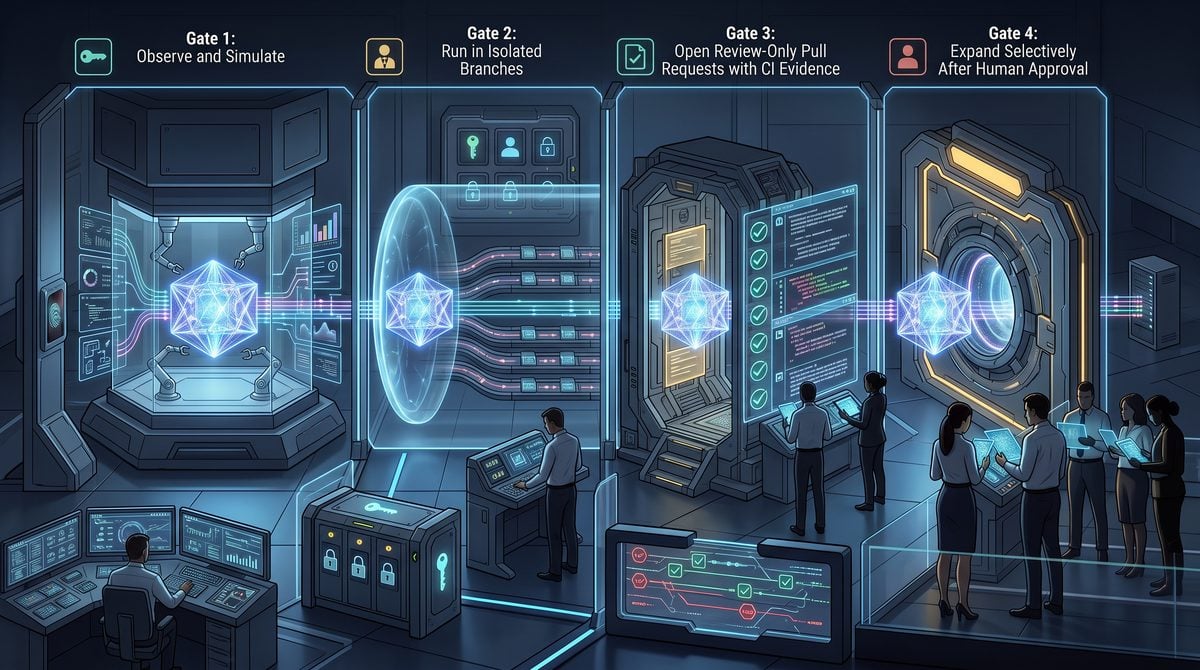
OpenAI’s published AI-native workflow examples describe Exa using Codex to monitor integration opportunities, gather context, create pull requests, run tests, and prepare weekly updates from sources such as Slack and Notion, with human review before shipping or external communication. Treat that pattern as the implementation boundary: Codex can help convert a well-evidenced integration opportunity into a tested change proposal, but humans still decide whether the opportunity matters commercially, whether the code is safe to merge, and whether anything should be announced.
The safest rollout is staged. Start with read-only signal collection and duplicate detection, then add implementation briefs, then allow branch creation, then add pull request preparation, and only then connect the workflow to recurring summaries. Each stage should have a narrow approval gate and a measurable definition of done, because the workflow’s value comes from reducing review load without weakening ownership.
Stage 1: create a task taxonomy before connecting tools
Define separate Codex task types for discovery, triage, implementation, verification, and reporting. This prevents a vague “watch for integrations and build them” instruction from crossing decision boundaries. A discovery task may summarize a customer request; a triage task may score evidence; an implementation task may modify a branch; a verification task may run tests; a reporting task may draft a weekly summary. Do not let one task type silently perform the next stage without an explicit transition.
| Task type | Allowed inputs | Allowed outputs | Required human approval |
|---|---|---|---|
| Discovery | Approved internal sources, customer notes, issue tracker excerpts, public documentation | Normalized signal record with citations and uncertainty | No build approval; only intake acceptance |
| Triage | Signal record, duplicate index, repository map, owner list | Score, duplicate decision, implementation brief candidate | Product or engineering owner confirms priority |
| Implementation | Approved brief, repository instructions, scoped branch permission | Code diff, migration notes if any, local test output | Engineer approves opening or updating a PR |
| Verification | Branch diff, test plan, CI output | Pass/fail report, failure classification, remediation proposal | Maintainer accepts residual risk before merge |
| Reporting | Closed signals, open PRs, blocked work, shipped changes | Weekly internal summary and optional draft announcement | Business owner approves external communication |
Recommended approval rule: no task that reads broad company context should also receive broad write permissions. Discovery tasks can read approved sources and write structured records. Implementation tasks can write to a scoped branch after approval but should not decide that the work is worth doing. Reporting tasks can draft status updates but must not publish external commitments.
Stage 2: register tools with minimum necessary access
List each tool by purpose, not by brand preference. Typical categories are source-of-signal tools, repository tools, test execution tools, CI status tools, artifact storage, and notification channels. For each category, document read/write mode, data sensitivity, and the approval required before Codex can use it. If a tool contains regulated, confidential, or customer-identifying information, add a redaction step before its contents become task input.
# Neutral pseudo-configuration: adapt to your own platform, permissions model, and audit requirements.
workflow:
  name: integration-signal-to-reviewed-pr
  objective: "Convert approved integration opportunities into tested pull request proposals."
  default_mode: read_only

tools:
  signal_sources:
    - name: approved_customer_feedback_index
      access: read
      allowed_task_types: [discovery, triage, reporting]
      redaction_required: true
    - name: approved_internal_notes_index
      access: read
      allowed_task_types: [discovery, triage, reporting]
      redaction_required: true

  repository:
    name: primary_application_repository
    access: branch_write_after_approval
    allowed_task_types: [implementation, verification]
    protected_paths:
      - security/
      - billing/
      - compliance/
      - infrastructure/production/

  test_runner:
    access: execute_approved_commands
    allowed_task_types: [implementation, verification]

  ci_status:
    access: read
    allowed_task_types: [verification, reporting]

  notification_channel:
    access: draft_only
    allowed_task_types: [reporting]
This pseudo-configuration is intentionally neutral: it does not assume a specific Codex endpoint, webhook, or repository-hosting API. The operational point is to make permissions reviewable. Administrators should be able to answer which tools a task can read, which branches it can modify, which commands it can execute, and which channels it can draft into before the workflow is enabled.
If the workflow is used in healthcare, life sciences, finance, or other sensitive environments, add a data-boundary check before discovery. Public evidence sources and internal customer records are not interchangeable. Do not place protected health information, patient identifiers, secrets, credentials, or regulated customer data into public-source tools or general-purpose task prompts unless the organization has approved the workspace, contract, configuration, and permitted use.
Stage 3: write repository instructions that constrain the implementation
Repository instructions should tell Codex where integration code lives, how tests are organized, which files require special review, and what counts as an acceptable diff. The instructions should not merely say “follow project conventions.” They should name the modules, command patterns, ownership boundaries, and review expectations that a new contributor would need on the first day.
# Example repository instruction file for this workflow.
purpose:
  - "Support approved integration-opportunity tasks by preparing small, reviewable pull requests."

allowed_change_patterns:
  - "Add a new integration adapter behind an existing feature flag or configuration boundary."
  - "Extend tests for parser, client, mapping, and error-handling behavior."
  - "Update internal developer documentation when setup or behavior changes."

requires_human_design_review:
  - "New authentication model"
  - "New data retention behavior"
  - "Billing, security, compliance, or production infrastructure changes"
  - "External API behavior that creates customer-visible commitments"

preferred_diff_shape:
  max_primary_modules_changed: 5
  require_tests_for_behavior_change: true
  require_error_handling_notes: true
  require_backward_compatibility_notes: true

test_commands:
  unit: "run the repository's approved unit-test command for the touched package"
  integration: "run the approved integration-test command when connector behavior changes"
  lint: "run the approved formatting and lint command"

pull_request_requirements:
  - "Link the evidence bundle and implementation brief."
  - "List commands run and results observed."
  - "Call out unsupported assumptions and unresolved questions."
  - "Request review from the owning team."
Keep the instruction file boring and enforceable. If the workflow frequently needs exceptions, the repository instructions are either too strict, too vague, or aimed at the wrong class of work. Integration workflows work best on repeatable adapter, mapping, documentation, and test changes; they are a poor first target for invasive architecture changes.
Stage 4: use sample prompts that produce auditable artifacts
Codex task prompts should require structured output and evidence links. The prompt should tell Codex what not to do, because prohibitions are often more important than objectives in semi-automated engineering workflows. The examples below are templates; replace source names, owners, paths, and commands with approved local equivalents.
Sample task prompt: discovery

Review the approved signal sources for integration requests mentioning {{integration_or_partner_category}} during {{date_range}}.
Return a normalized signal record only. Do not write code, open a branch, contact external parties, or infer commitments.

Required output:
1. Short opportunity summary.
2. Evidence table with source, date, requester type, and exact excerpt or approved paraphrase.
3. Known duplicates or related prior requests.
4. Missing information that would prevent implementation.
5. Sensitivity check: confirm whether the input contains secrets, PHI, credentials, or regulated customer data.
6. Recommendation: proceed to triage, request more evidence, or close as duplicate.
Sample task prompt: implementation
Use the approved implementation brief {{brief_id}} and repository instructions.
Create a branch only within the approved repository scope. Make the smallest practical change that satisfies the brief.
Do not modify protected paths, introduce new external commitments, change authentication behavior, or add production configuration unless explicitly approved.
Required output:
1. Branch name.
2. Files changed and why.
3. Tests added or updated.
4. Commands run and exact pass/fail result.
5. Assumptions that require reviewer confirmation.
6. Suggested pull request title and body draft.The discovery prompt prevents premature coding. The implementation prompt prevents unbounded exploration. Both prompts ask for assumptions and sensitivity checks because a reviewer needs to know not only what changed, but also where the task may have relied on incomplete evidence.
Stage 5: make duplicate detection an explicit gate
Duplicate detection should run before scoring and again before PR creation. The first pass prevents product and engineering teams from repeatedly triaging the same weak signal. The second pass catches cases where a similar implementation is already in progress, already merged behind a flag, or already rejected for a reason the new evidence did not address.
# Neutral pseudo-logic for duplicate handling.
duplicate_check:
  compare_against:
    - prior_signal_records
    - open_issues
    - open_pull_requests
    - recently_merged_pull_requests
    - rejected_opportunities
  matching_fields:
    - integration_name_or_category
    - requested_user_outcome
    - affected_product_area
    - external_system_or_standard
    - evidence_source_type
  outcomes:
    exact_duplicate: "link to existing record and close new item"
    material_overlap: "append evidence to existing record and notify owner"
    related_but_distinct: "continue triage with cross-reference"
    no_match: "create new triage candidate"
A practical duplicate rule is to close exact duplicates, merge material overlaps into the older record, and allow related-but-distinct items to proceed only when they change the user outcome, integration surface, or implementation constraints. For example, “export invoices to accounting system” and “sync invoice payment status from accounting system” may involve the same external system but are not the same integration outcome.
Stage 6: require tests before the pull request is considered ready
For Automated Software Testing, How to Validate AI-Generated Code Before It Ships: Complete Playbook Using Blacksmith, Codex, and Automated Testing Pipelines is the most relevant adjacent resource. The AI-code validation playbook shows how automated tests and quality gates catch generated defects before shipping, making it the natural companion to this workflow’s evidence-backed PR stage.
| Change type | Minimum validation | Common failure to catch |
|---|---|---|
| Parser or mapper update | Unit tests for valid, missing, malformed, and unknown fields | Silent data loss when an optional field is absent |
| External client wrapper | Mocked success, retryable failure, non-retryable failure, timeout behavior | Retry loop that amplifies an upstream outage |
| Feature flag or configuration path | Tests for default-off, enabled, disabled, and invalid configuration | Customer-visible behavior enabled unintentionally |
| Documentation-only change | Link checks or documentation build when available | Instructions that reference nonexistent settings or commands |
CI should remain authoritative. Local or task-run test output is useful evidence, but it does not replace repository CI, required checks, owner review, or merge protection. If CI fails, the workflow should classify the failure before retrying: deterministic test failure, flaky test suspicion, environment failure, merge conflict, missing secret, permission denial, or unrelated upstream breakage.
Stage 7: define failure handling before the first failed run
Failure handling should be mechanical enough that Codex does not improvise around policy. A test failure should trigger a fix attempt only when the failure is inside the approved scope and the diff remains reviewable. A permission failure should stop the task and request human intervention. A secret, credential, or sensitive-data discovery should stop the task, preserve minimal audit context, and route to the designated security or compliance owner.
# Neutral pseudo-policy for failure handling.
failure_policy:
  test_failure:
    max_fix_attempts: 2
    allowed_when: "failure is caused by touched code or touched tests"
    required_output: "root-cause hypothesis, diff summary, rerun result"

  ci_failure:
    if_unrelated_or_environmental: "do not modify code; report with evidence"
    if_related_to_change: "attempt scoped fix after recording failure"

  duplicate_found_after_branch_created:
    action: "stop implementation; summarize overlap; recommend close, rebase, or merge evidence"

  protected_path_touched:
    action: "revert protected changes and request explicit approval"

  sensitive_data_detected:
    action: "stop task; do not copy sensitive content into PR body; notify approved owner"

  external_behavior_uncertain:
    action: "open draft PR or implementation note only; require product and engineering review"
Do not reward the workflow for “green at any cost.” A small PR that honestly reports one unresolved assumption is safer than a large PR that hides uncertainty behind passing tests. Reviewers need clear stopping points, especially when the integration depends on external documentation, partner behavior, or customer configuration that Codex cannot verify independently.
Stage 8: prepare pull requests for review, not for automatic merge
For Codex Pull Request Review, The Codex Desktop Integration Playbook — 10 Prompts for Multi-Repo Projects, PR Review, and Inline Code Editing is the most relevant adjacent resource. The Codex desktop integration playbook covers multi-repository work, PR review, and inline editing, adding practical reviewer patterns once an isolated branch and test bundle are ready.
Sample pull request body structure

Summary
- Implements the approved {{integration_capability}} brief in the smallest scoped change.
- Does not enable customer-visible behavior by default unless reviewer confirms the configuration path.

Evidence and approval
- Signal record: {{record_reference}}
- Duplicate check: {{exact_duplicate/material_overlap/no_match}}
- Human build approval: {{approver_and_date}}

Implementation notes
- Files changed:
  - {{path}}: {{reason}}
- Assumptions:
  - {{assumption_requiring_review}}

Validation
- Local commands run:
  - {{command}} — {{result}}
- CI status:
  - {{pending/passed/failed with link or internal reference}}

Risk and rollback
- Main risk: {{risk}}
- Rollback approach: {{revert PR / disable flag / configuration rollback}}

Reviewer checklist
- Confirm opportunity scope.
- Confirm no protected paths or sensitive data were introduced.
- Confirm tests cover expected failure modes.
- Confirm external communication is not implied by this PR.
The reviewer checklist should explicitly separate merge approval from launch approval. A merged adapter, parser, or documentation change may still require feature-flag rollout, customer enablement, legal review, partner confirmation, or support readiness. Codex should not collapse those operational gates into a single “PR merged” state.
Stage 9: generate weekly summaries from workflow state
Weekly summaries should be produced from artifacts, not memory. The reporting task should read signal records, triage decisions, open PRs, merged PRs, closed duplicates, failed runs, and blocked items. This mirrors the OpenAI-described Exa pattern of preparing weekly updates from internal context while preserving human review before shipping or external communication.
Sample task prompt: weekly internal summary

Prepare a weekly internal summary for {{team_or_owner}} covering {{date_range}}.
Use only approved workflow artifacts, issue references, pull request metadata, CI status, and approved internal notes.
Do not announce launches, promise delivery dates, or contact external parties.

Required sections:
1. New integration signals accepted.
2. Signals closed as duplicates, with links to canonical records.
3. Opportunities approved for implementation.
4. Pull requests opened, merged, blocked, or abandoned.
5. Test and CI failures that need owner attention.
6. Decisions required next week.
7. Draft external-announcement candidates, clearly marked as not approved.
A useful weekly summary is short enough for an operator to act on but specific enough for an engineer to trace. Avoid vague statements such as “several integrations progressed.” Instead, require counts, owner names or team roles, state transitions, blockers, and the exact approval needed next.
Stage 10: optionally draft an announcement, but keep it non-public until approved
An optional draft announcement can help product marketing, developer relations, or customer success prepare, but it must be treated as a draft artifact rather than a release action. The draft should be created only after a human confirms that the integration is merged, enabled as intended, documented, supportable, and cleared for external messaging.
Sample task prompt: draft announcement

Draft an internal-only announcement candidate for {{integration_name}}.
Base it only on approved release notes, merged pull requests, product-owner comments, and support documentation.
Do not claim availability, pricing, performance, partner endorsement, security guarantees, compliance status, or customer impact unless those claims are present in approved source material.

Required output:
1. One-paragraph internal summary.
2. Developer-facing change notes.
3. Support readiness notes.
4. Claims that require legal, product, or partner approval.
5. Explicit label: "Draft only; not approved for publication."
This step is where many automation programs overreach. A passing CI run does not prove market readiness, partner approval, customer availability, or regulatory clearance. Keep announcement drafting downstream of engineering evidence and upstream of human communications approval.
Implementation readiness checklist
- Codex task types are separated into discovery, triage, implementation, verification, and reporting, with different permissions for each.
- Signal sources are approved, redacted where necessary, and traceable back to the evidence used for scoring.
- Duplicate detection runs before prioritization and again before PR creation.
- Repository instructions name allowed paths, protected paths, test commands, diff expectations, and review requirements.
- Implementation tasks can create scoped branches only after human build approval.
- Tests are added or updated for behavior changes, and CI remains a required independent gate.
- Failure handling distinguishes test failures, CI failures, duplicate discoveries, protected-path changes, and sensitive-data events.
- Pull requests contain the evidence bundle, validation output, assumptions, rollback notes, and reviewer checklist.
- Weekly summaries are generated from workflow artifacts and reviewed by a human before circulation beyond the intended internal audience.
- External announcements remain optional drafts until product, engineering, support, legal, and partner owners approve the claims they contain.
Operational rule: Codex may prepare the path from signal to reviewed pull request, but it should not own the commercial priority, production deployment, or external promise. Preserve those decision rights explicitly in configuration, prompts, repository instructions, and review checklists.
Governance controls that keep signal-to-PR automation reviewable
OpenAI describes Exa’s pattern as using Codex to monitor integration opportunities, gather context, create pull requests, run tests, and prepare updates from sources such as Slack and Notion, with human review before shipping or external communication. That last clause is the governance anchor: the workflow may accelerate discovery, planning, implementation, and summarization, but it should not own commercial prioritization, customer commitments, production deployment, or public announcements.
For AI Code Governance, How to Create Custom Code Review Rules for Codex with AGENTS.md: Complete Repository Governance Playbook is the most relevant adjacent resource. The AGENTS.md governance playbook explains repository-specific review rules and policy inheritance, giving teams a durable way to enforce standards across every Codex-generated pull request.
Permission boundaries for tools, repositories, and communication channels
Start with separate identities for source reading, repository work, and notification drafting. The source-reading identity should be able to read only the approved signal systems needed for integration discovery, such as selected project documents, support notes, or internal discussion channels. The repository identity should be limited to the repositories and paths that the workflow is allowed to inspect and modify. The notification identity should draft status updates into a private review location, not post externally or message customers directly.
Use least privilege as an implementation rule, not a policy slogan. A first rollout should not grant organization-wide repository administration, production deploy rights, secret-management administration, billing-console access, or permission to invite external collaborators. If the workflow needs more access to complete a task, the safe default is to stop, produce a permission request with justification, and wait for a human owner to approve or reject the expansion.
| Capability | Recommended initial access | Human approval required before |
|---|---|---|
| Internal signal intake | Read-only access to approved channels, documents, or tickets | Adding new source systems, private customer channels, or regulated datasets |
| Repository inspection | Read access to mapped repositories and dependency files | Expanding to unrelated repositories or security-sensitive modules |
| Branch creation | Create branches using a governed naming convention | Changing protected branch rules or bypassing code-owner review |
| Pull request creation | Open draft or review-ready PRs with evidence and test artifacts | Merging, releasing, or changing deployment configuration |
| External communication | Draft internal summaries only | Customer messages, partner commitments, changelog entries, or public posts |
Source provenance and evidence retention
Every workflow run should produce an evidence bundle that distinguishes primary evidence from interpretation. A primary item is a specific support thread, customer request, product document, public API documentation page, issue, or internal design note. An interpretation is the workflow’s summary, scoring, or implementation proposal. Reviewers need both, because a fluent summary can hide uncertainty, stale documentation, or a source that never actually requested the integration.
Store source references with stable identifiers where available: document title, owner, timestamp, ticket ID, channel name, message timestamp, URL, commit SHA, and retrieval time. Do not rely only on copied excerpts. If a source later changes, reviewers should still be able to reconstruct what the workflow saw when it created the PR. In regulated or customer-sensitive environments, retain only approved metadata and approved excerpts; do not copy secrets, patient identifiers, contract terms, or confidential customer payloads into a general artifact store.
{
  "run_id": "signal-pr-2026-09-02-014",
  "trigger": "integration_signal_review",
  "source_items": [
    {
      "type": "internal_ticket",
      "reference": "TICKET-1234",
      "retrieved_at": "2026-09-02T10:15:00Z",
      "classification": "approved_internal_product_context"
    }
  ],
  "repository_scope": ["integration-adapters/payments/*"],
  "proposed_change": "Add adapter mapping for a documented partner webhook field",
  "tests_required": ["unit", "schema_fixture", "adapter_regression"],
  "human_review_required": true
}
Secrets, regulated data, and unsafe source material
The workflow should treat secrets as data it must not read, summarize, transform, or paste into PRs. Secrets include API keys, OAuth tokens, private certificates, session cookies, database passwords, signing keys, and production credentials. Configure source systems and repositories so the workflow can use test fixtures and documented interfaces without needing access to live secrets. If a task requires a credential to validate behavior, the workflow should request a human-operated test or a controlled CI secret already approved for that repository.
Use automated secret scanning on generated branches before PR creation and again in CI. The gate should fail on both newly introduced secrets and suspicious copied values from source material. When a scanner flags a candidate secret, do not ask the workflow to “explain why it is safe” as the only control; require human security review or rotate the affected credential if exposure is plausible.
Healthcare and regulated-data teams need an additional boundary. OpenAI’s September 2026 materials distinguish read-only public healthcare-source access from Epic patient-chart access in approved healthcare workspaces, and OpenAI explicitly warns not to send protected health information to public sources. For a signal-to-PR workflow, that means integration evidence should be de-identified or synthetic unless the organization has approved the workspace, plugin configuration, access model, and Business Associate Agreement needed for the specific protected-data use case. Public-source plugins must not receive patient names, dates of birth, medical record numbers, member numbers, or similar PHI.
External communication controls
A useful workflow can draft weekly updates, partner notes, or customer-facing implementation summaries, but those drafts must remain internal until an accountable human approves them. OpenAI’s AI-native workflow example explicitly keeps human review before shipping or external communication, which is the correct pattern for integration work where a PR may imply roadmap movement, compatibility claims, support commitments, or contractual expectations.
Require the draft to label uncertainty. For example, “implemented in draft PR and awaiting maintainer review” is safer than “integration complete.” “Tests passed in CI for mocked fixtures” is safer than “production-ready.” The communication review should include product, engineering, support, and legal or compliance stakeholders when the message names a customer, partner, regulated workflow, security fix, or release date.
Quality gates before merge consideration
A PR should not become eligible for merge review merely because it exists. Require a quality-gate checklist that is evaluated before code-owner review begins. The checklist should include source provenance, repository scope compliance, duplicate-work detection, passing tests, security scan results, documentation updates where relevant, and a rollback note. These gates reduce reviewer fatigue because maintainers spend less time discovering that the workflow changed the wrong package or skipped a critical fixture.
- Evidence gate: The PR links to the evidence bundle and identifies which source items motivated the change.
- Scope gate: The diff is limited to approved repositories, directories, and file types for the task class.
- Test gate: Unit, fixture, schema, lint, and relevant regression checks run with preserved logs.
- Security gate: Secret scanning and dependency checks complete under the organization’s existing tooling.
- Review gate: Code owners and domain owners are requested; no auto-merge rule bypasses them.
- Release gate: Deployment, announcement, and customer enablement remain separate human decisions.
Rollback and containment planning
Rollback instructions belong in the PR before merge, not in the incident channel after a failure. For adapter and integration work, the rollback plan should identify the feature flag, configuration switch, package version, migration reversal, or commit revert path. If the change touches data transformation, the plan should state whether any generated data requires cleanup and who owns that cleanup.
Prefer reversible increments over broad rewrites. A small adapter behind a disabled-by-default flag is easier to contain than a global request pipeline refactor. If the workflow proposes a change that cannot be rolled back without customer-visible disruption, require a senior engineering review and a staged release plan before merge. The automation’s job is to surface the risk clearly, not to normalize irreversible changes.
Incident response for workflow failures
Define incidents for the workflow itself, not only for production systems. A workflow incident includes unauthorized repository access, source-system overreach, leaked secrets in a branch or artifact, inaccurate external draft publication, repeated generation of unsafe code, or a PR that materially misrepresents its source evidence. Each incident should have an owner, severity, containment step, evidence-retention instruction, and post-incident review.
- Contain: Disable the affected workflow identity, revoke tokens if needed, close or lock unsafe PRs, and stop scheduled runs.
- Preserve: Save run logs, source references, branch SHAs, prompts, tool calls, CI output, and reviewer comments according to retention policy.
- Assess exposure: Determine whether secrets, customer data, regulated data, or non-public roadmap information were accessed or copied.
- Notify internally: Escalate to engineering leadership, security, compliance, and product owners according to severity.
- Remediate: Rotate credentials, narrow permissions, update instructions, add tests, or remove source connectors.
- Restart deliberately: Resume only after a human owner approves the corrected control and verifies it on a low-risk run.
Metrics that measure control, not just throughput
Track whether the workflow improves engineering flow without degrading review quality. Raw PR count is a weak metric because it can reward noisy automation. Better metrics connect each run to evidence quality, reviewer effort, test reliability, and shipped outcomes. Review these metrics weekly during rollout and monthly after stabilization.
| Metric | Why it matters | Operational warning |
|---|---|---|
| Evidence-complete PR rate | Shows whether reviewers can trace work back to approved sources | A low rate means the workflow is generating code faster than it preserves context |
| Reviewer-requested rework rate | Measures whether generated changes fit repository conventions | High rework suggests repository instructions or task scope are too vague |
| Test-pass rate before first review | Indicates whether the workflow is producing reproducible validation artifacts | Passing only after human repair hides automation quality problems |
| Out-of-scope diff count | Detects permission and instruction drift | Any repeated pattern should trigger a scope rule update or connector removal |
| Merged-to-created PR ratio | Shows whether the workflow is producing useful work, not just activity | A very low ratio may indicate poor signal scoring or duplicate detection |
| Incident and near-miss count | Captures governance failures before they become production failures | Do not suppress near-miss reporting to make rollout metrics look cleaner |
30-day rollout plan
The first month should validate the operating model on low-risk integration work before expanding scope. Treat the plan as a controlled deployment of a socio-technical workflow: permissions, source quality, review behavior, and incident handling matter as much as code generation.
| Period | Primary objective | Exit criteria |
|---|---|---|
| Days 1–5 | Define approved sources, task classes, repository paths, owners, and forbidden data categories | Written scope document, reviewer roster, incident owner, and permission request approved |
| Days 6–10 | Run read-only signal discovery and evidence-bundle creation without code changes | At least several candidate opportunities reviewed by humans for source quality and duplicate risk |
| Days 11–15 | Allow branch creation in a sandbox or low-risk repository path | Generated branches stay in scope, preserve artifacts, and pass basic lint or fixture checks |
| Days 16–20 | Open draft PRs with required provenance, tests, and rollback notes | Reviewers confirm the PR template reduces, rather than increases, review burden |
| Days 21–25 | Promote selected PRs to normal code-owner review while keeping deployment manual | Quality gates pass consistently and any failures have documented remediation |
| Days 26–30 | Review metrics, incidents, reviewer feedback, and source coverage | Decision made to expand, hold, narrow, or stop with documented rationale |
Decision matrix for expansion, hold, or stop
Use a decision matrix at the end of the first month so expansion is based on evidence rather than enthusiasm. The workflow should expand only when it consistently produces traceable, scoped, tested PRs that reviewers trust. If it saves time but creates provenance gaps or security exceptions, narrow the scope before adding more tools.
| Condition | Decision | Required action |
|---|---|---|
| High evidence completeness, low out-of-scope changes, tests passing, positive reviewer feedback | Expand cautiously | Add one repository path, one task class, or one approved source category at a time |
| Useful PRs but recurring missing context or reviewer confusion | Hold scope | Improve templates, evidence bundles, and repository instructions before expansion |
| Frequent test failures or large human repair effort | Narrow scope | Limit to simpler adapters, fixtures, documentation, or planning-only runs |
| Unauthorized access, secret exposure, regulated-data handling failure, or external communication error | Stop and remediate | Disable affected connectors, complete incident response, and require leadership approval to restart |
Conclusion: make Codex a governed contributor, not an unreviewed operator
The durable version of a signal-to-pull-request workflow is not a bot that watches everything, changes anything, and ships when tests pass. It is a governed contributor that reads approved signals, preserves source provenance, proposes bounded work, creates reviewable branches, runs reproducible validation, and waits for accountable humans to approve merge, deployment, and communication.
OpenAI’s published AI-native workflow example is useful because it frames Codex as part of an operating system for integration work, not as a replacement for product judgment or engineering ownership. Teams that preserve that boundary can use the workflow to reduce triage load and accelerate well-scoped implementation while still maintaining permissions discipline, security controls, rollback readiness, and reviewer authority.
Access 40,000+ AI Prompts for ChatGPT, Claude & Codex — Free!
Subscribe to get instant access to our complete Notion Prompt Library — the largest curated collection of prompts for ChatGPT, Claude, OpenAI Codex, and other leading AI models. Optimized for real-world workflows across coding, research, content creation, and business.
Useful Links
- OpenAI: How AI-native companies turn workflows into operating capability
- OpenAI product release notes
- OpenAI: Path to Astra: critical capabilities and frontier safeguards
- OpenAI Preparedness Framework update
- OpenAI Help: Using Healthcare Public Data in ChatGPT and Codex
- OpenAI Help: Using the Epic plugin with ChatGPT and Codex
- OpenAI Help: ChatGPT for Healthcare
- OpenAI Help: ChatGPT release notes
