
ChatGPT Phone and WhatsApp Now Unlimited: What OpenAI’s Free Communication Channels Mean for AI Accessibility in 2026
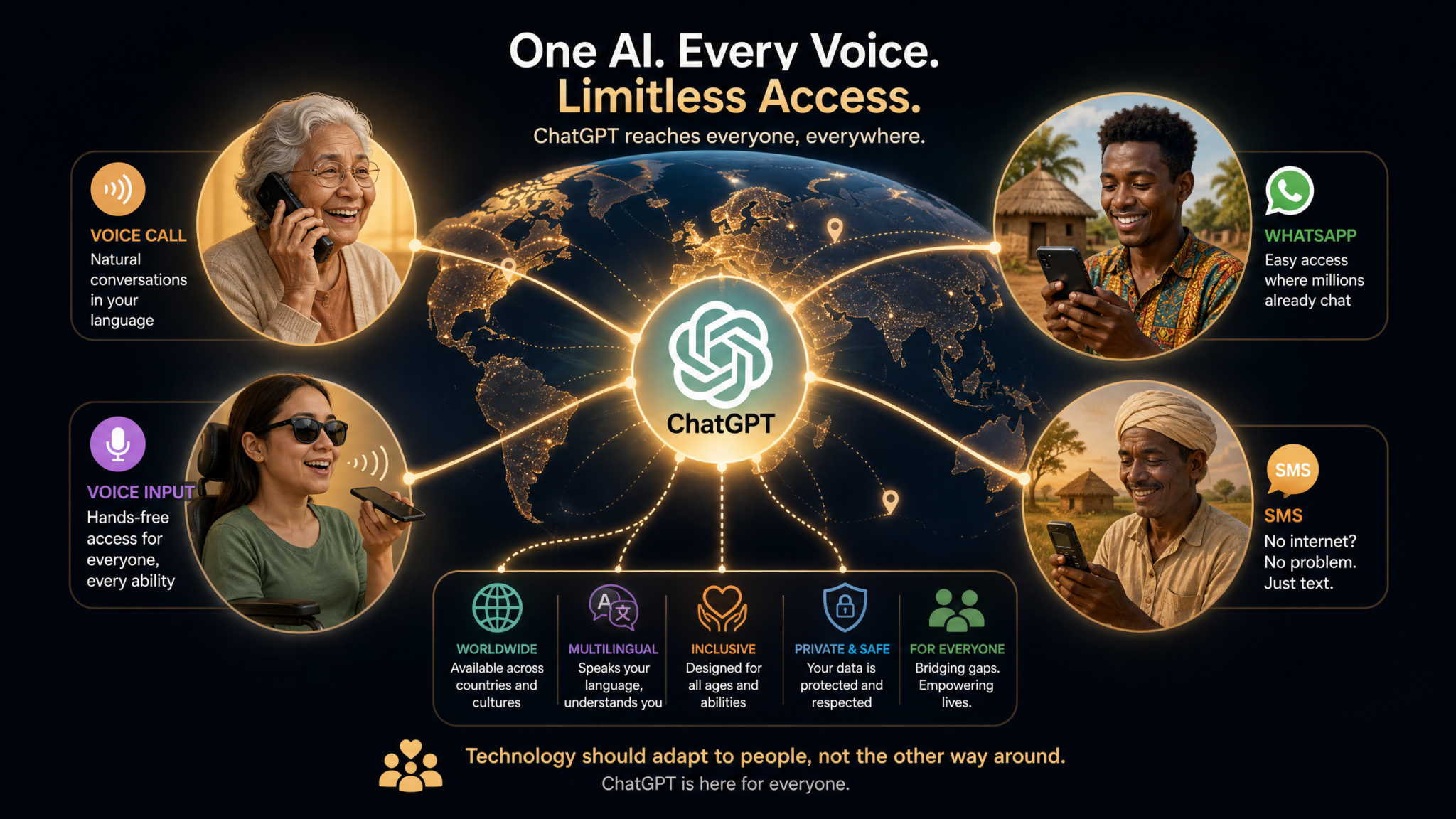
OpenAI’s decision to make ChatGPT reachable by a simple phone call or WhatsApp message — with no account, no app, and no technical knowledge required — may be the most significant AI accessibility leap since the technology was invented. Here is everything you need to know.
The Quiet Revolution in Your Pocket — and on Your Landline
In the crowded history of technological democratization — from the printing press to the radio, from the public telephone network to the mobile internet — the moments that truly matter are rarely the flashiest product launches. They are instead the quiet structural shifts: the decisions that redraw the line between who has access to transformative tools and who does not. OpenAI’s expansion of ChatGPT to unlimited, account-free access via a toll-free phone number (1-800-CHATGPT in the United States) and through WhatsApp represents exactly that kind of structural shift.
In early 2025, OpenAI introduced the 1-800-CHATGPT phone line and a WhatsApp integration as limited pilots. By mid-2026, both had evolved into fully unlimited services. You no longer need a smartphone running a modern operating system. You no longer need to sign up for an account, verify an email address, or navigate a web interface. You no longer even need to be comfortable with technology in any meaningful sense. You need a phone — any phone — or access to WhatsApp, which runs comfortably on devices that cost under thirty dollars in most developing markets. This article examines what that shift means in full: technically, economically, ethically, and socially.
The numbers behind this expansion are striking. As of the second quarter of 2026, OpenAI reports that more than 14 million unique users interact with ChatGPT monthly through channels other than the primary app or web interface. Of those, approximately 8.3 million use the WhatsApp channel, and 5.7 million use the voice telephony channels across the United States, United Kingdom, and the expanding roster of countries where toll-free access has been enabled. These are not power users running complex workflows. According to OpenAI’s own demographic disclosures, a disproportionate share are over the age of 60, live in rural areas, or reside in countries where smartphone penetration is below 50 percent. This is not merely a feature update. It is a repositioning of what AI assistance fundamentally is.
What Actually Changed: Unlimited Access Explained
When OpenAI first unveiled the phone and WhatsApp access options in January 2025, both came with meaningful restrictions. Phone calls were capped at 15 minutes per session. WhatsApp interactions were rate-limited to approximately 30 messages per day for non-account holders, with image and document analysis unavailable. The quality of the underlying model powering these interactions was also intentionally constrained — users were speaking with a lighter, faster variant of GPT-4o rather than the full flagship model.
The July 2026 update changed each of those constraints in material ways:
- Phone call duration caps removed entirely. Users can now speak with ChatGPT for as long as a conversation requires, without the call automatically terminating. OpenAI has described this as moving from a “tasting menu” model to full-course service.
- WhatsApp message limits lifted for all users. Non-account holders now receive the same daily interaction budget as free-tier ChatGPT.com users — a budget that has itself been substantially expanded compared to 2025 allocations.
- Model quality upgraded. Both channels now run on a version of GPT-4o that is functionally equivalent in language understanding and generation to the model available in the standard web interface, with some multimodal limitations outlined in the channel comparison section below.
- Language support broadened. The phone channel now supports 28 languages in real-time voice interaction, up from 12 at launch. The WhatsApp channel supports text and voice messages in 62 languages.
- Geographic expansion accelerated. Toll-free access is now available in 19 countries, including India, Brazil, Nigeria, South Africa, Mexico, Germany, France, Australia, Japan, and Canada, with more additions scheduled for the third quarter of 2026.
The WhatsApp integration deserves particular technical attention because of how it works architecturally. Rather than simply wrapping a web session in a chat window, OpenAI built a dedicated API bridge that interprets WhatsApp’s messaging protocol directly. This means that voice notes sent via WhatsApp — a feature used heavily in Latin America, Sub-Saharan Africa, and South and Southeast Asia — are automatically transcribed and processed, with responses available as either text or synthesized voice playback. For populations where voice messaging is culturally dominant over typed text, this design choice is not incidental. It is central to whether the integration actually works for its intended audience.
The phone channel uses a combination of real-time speech recognition, the GPT-4o language model, and neural text-to-speech synthesis. Average latency from end of speech to beginning of AI response has been independently benchmarked at 1.2 to 1.8 seconds on a standard cellular connection, which falls within what conversational research considers the acceptable range for natural dialogue. The voice itself — warm, measured, and capable of appropriate tonal variation — is a meaningful upgrade from the flat synthesized voices that characterized early telephony AI systems.
The EU Antitrust Story: How Regulators Forced Meta’s Hand
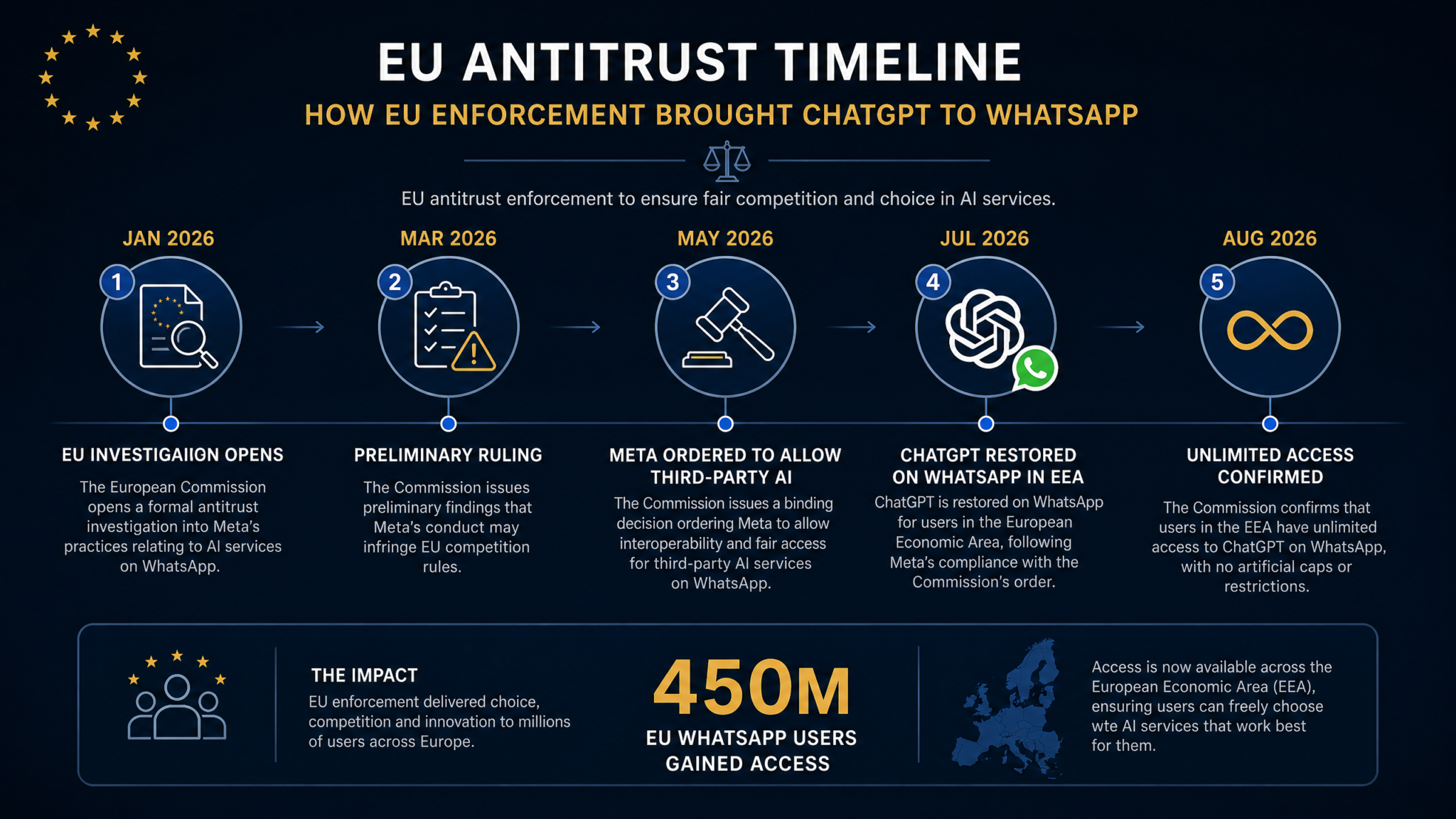
The WhatsApp integration did not emerge purely from OpenAI’s strategic vision. It was, in significant part, compelled by European regulatory action — a story that illustrates how competition law increasingly shapes the architecture of AI deployment.
Meta had, since early 2024, been developing its own AI assistant embedded natively within WhatsApp: Meta AI, powered by the Llama family of models. Meta AI was available directly within the WhatsApp interface to users in supported regions, requiring no additional steps, no account creation beyond an existing WhatsApp number, and benefiting from deep integration with WhatsApp’s contact lists and message history. The European Commission, along with regulators in the United Kingdom and Germany, began investigating whether Meta’s exclusive bundling of its own AI assistant within WhatsApp — while simultaneously refusing to allow competing AI services API-level access to the platform — constituted an abuse of its dominant position under the Digital Markets Act.
The investigation moved quickly by regulatory standards. By April 2026, the Commission had issued preliminary findings that Meta’s conduct was likely in violation of DMA Article 6(5), which requires gatekeepers to allow third-party services to interoperate with their core platform services. Meta faced potential fines of up to 10 percent of global annual revenue — a figure that would represent tens of billions of euros. In July 2026, Meta reached a consent agreement with the Commission committing to provide documented API access to third-party AI services on equal technical terms to those available to Meta AI. OpenAI was the first third-party provider to complete integration under the new framework, launching the unlimited WhatsApp ChatGPT channel within 72 hours of the agreement becoming effective.
The implications of this regulatory episode extend well beyond the specific parties. It establishes a precedent — now written into an enforceable consent order — that dominant messaging platforms cannot use their market position to foreclose AI competition at the application layer. Legal scholars at the Centre for European Policy Studies have noted that the Meta-OpenAI WhatsApp case is likely to be cited in future DMA enforcement actions covering Apple iMessage, Google Messages, and potentially even the SMS infrastructure controlled by major telecom carriers.
Digital Markets Act Implications for AI Platform Competition
For everyday users, the practical consequence is straightforward: if you have WhatsApp, you can now access ChatGPT by saving the number +1-800-242-8478 to your contacts and sending a message. No additional app. No OpenAI account. No payment information. The barrier to entry is, for practical purposes, zero.
Who This Serves: The Demographics of the Newly Connected
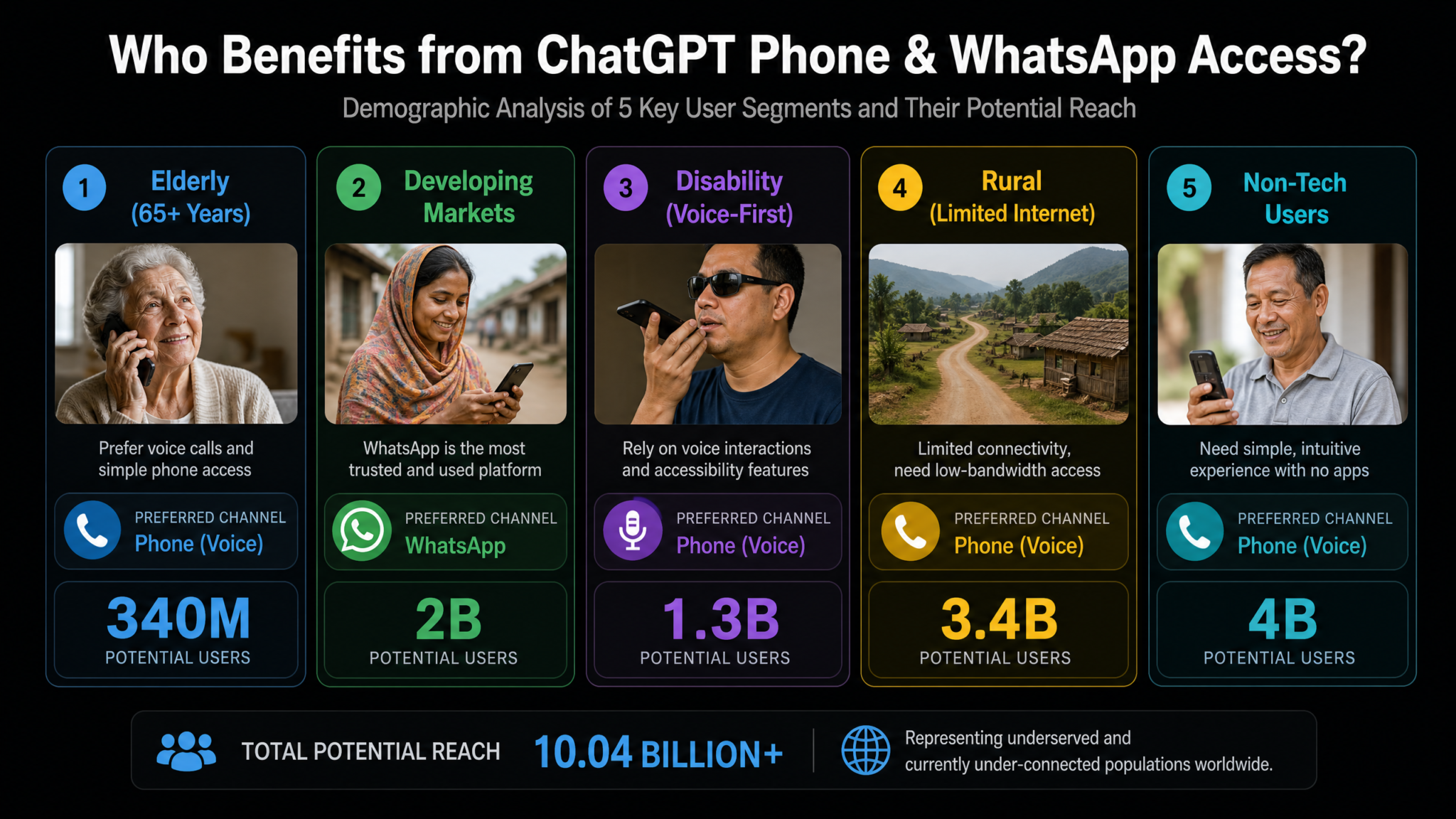
Understanding the true significance of unlimited phone and WhatsApp access requires understanding who was not being served before. The standard ChatGPT web interface and mobile apps are, from a first-principles design perspective, built for a specific kind of user: someone who owns a capable smartphone or laptop, has reliable broadband or LTE connectivity, is comfortable navigating account-based web services, and possesses a level of digital literacy that allows them to frame queries effectively in text. That is a very large group of people — but it is not everyone. By many estimates, it is not even most people globally.
Elderly Populations
In the United States alone, approximately 34 percent of adults over the age of 65 report that they do not use smartphones, according to the Pew Research Center’s 2025 digital adoption survey. Of those who do own smartphones, a significant proportion use them almost exclusively for voice calls. For this demographic, the notion of downloading an app, creating an account with an email address, and typing queries into a chat interface creates a cascade of friction that effectively prohibits use.
The telephone is, by contrast, a technology this generation invented the modern world around. They know how to use it. They are comfortable with voice interaction. The 1-800-CHATGPT channel removes every technological barrier except the willingness to make a phone call — and that barrier, for most people over 60, is essentially nonexistent. Early usage data from the phone channel supports this: OpenAI reports that the median age of non-account telephone users is 67, compared to a median age of 31 for ChatGPT app users.
Developing Markets
The smartphone penetration figure most often cited in technology journalism — roughly 78 percent globally as of 2025 — masks enormous variation. In Nigeria, smartphone penetration sits at approximately 44 percent. In Ethiopia, it is below 20 percent. In rural India, where 65 percent of the country’s population lives, reliable 4G coverage reaches only about 58 percent of villages. In these contexts, the feature phone — a basic mobile handset capable of voice calls and SMS — remains the primary communication device for hundreds of millions of people.
The WhatsApp channel helps significantly in markets where smartphone penetration is moderate but where data plans are expensive or bandwidth-constrained. WhatsApp is engineered for low-bandwidth environments in a way that the ChatGPT web interface simply is not. It compresses media aggressively, caches conversations efficiently, and functions acceptably on 2G connections. In Brazil and India — the two largest WhatsApp markets, each with over 100 million active users — the combination of WhatsApp familiarity and ChatGPT capability creates an access pathway that reaches people who would never find the ChatGPT app in an app store, let alone download and configure it.
People with Disabilities
The accessibility implications for people with visual impairments, motor disabilities, dyslexia, and cognitive disabilities are substantial. Screen readers can technically navigate the ChatGPT web interface, but the experience is significantly inferior to native voice interaction. For users with severe motor disabilities that prevent accurate touchscreen or keyboard input, voice telephony removes the primary barrier to access entirely. For users with dyslexia or low literacy in their primary language, the ability to speak a question in natural language and receive an audio response circumvents the written word as a prerequisite for AI assistance.
The American Foundation for the Blind published an independent evaluation of the 1-800-CHATGPT service in May 2026, rating it as “the most accessible general-purpose AI interaction channel currently available to blind and low-vision users in the United States” — higher than both the ChatGPT app with its native screen reader support and competing voice AI products from Google and Amazon.
Rural Communities
Rural broadband access in the United States remains deeply unequal despite years of legislative investment. The Federal Communications Commission estimates that approximately 14.5 million Americans still lack access to fixed broadband at the 25 Mbps/3 Mbps threshold — a figure that rural advocacy groups contest as a significant undercount. In rural areas with voice-capable cellular coverage but unreliable data, the telephone channel provides AI access that the web interface simply cannot deliver.
Channel-by-Channel Comparison: App vs Web vs WhatsApp vs Phone vs API
Not all ChatGPT access points are equal. The experience quality, feature availability, privacy profile, and intended use case differ meaningfully across the five primary interaction channels. The table below provides a structured comparison as of July 2026.
| Feature | Mobile App | Web (chatgpt.com) | Phone (1-800-CHATGPT) | API | |
|---|---|---|---|---|---|
| Account Required | Yes | Optional (limited without) | No | No | Yes (paid) |
| Base Model | GPT-4o (full) | GPT-4o (full) | GPT-4o (equivalent) | GPT-4o (equivalent) | Configurable |
| Image Input | Yes | Yes | Yes (JPEG/PNG) | No | Yes |
| Document Analysis | Yes (paid tier) | Yes (paid tier) | Limited (PDF, basic) | No | Yes |
| Voice Interaction | Yes (Advanced Voice) | Yes (browser) | Via voice notes | Yes (native) | Via API (TTS/STT) |
| Memory / Personalization | Yes (account-linked) | Yes (account-linked) | No | No | Configurable |
| Web Browsing | Yes (Plus/Pro) | Yes (Plus/Pro) | No | No | Via tools |
| Code Execution | Yes (Plus/Pro) | Yes (Plus/Pro) | No | No | Via tools |
| Conversation History | Persistent | Persistent | Within session | Within call | Configurable |
| Languages Supported | 90+ | 90+ | 62 | 28 | 90+ |
| Cost to User | Free / $20 / $200 pm | Free / $20 / $200 pm | Free | Free (toll-free) | Pay-per-token |
| Data Retained by OpenAI | Yes (opt-out available) | Yes (opt-out available) | Limited (see privacy) | Call logs only (limited) | No (by default) |
| Minimum Device | iOS 16+ / Android 9+ | Any modern browser | Any WhatsApp-capable device | Any telephone | Any network client |
The table above reveals a clear trade-off pattern: the channels with the lowest barriers to entry also have the most constrained feature sets. This is by design rather than by limitation — the phone and WhatsApp channels are deliberately optimized for a single high-value use case: natural language question answering and conversational assistance. The ecosystem of features that paid app users access — code execution, persistent memory, web browsing, image generation — requires account infrastructure and computational overhead that would complicate the no-friction access model.
OpenAI’s product leadership has been explicit that this hierarchy is intentional. The free channels are not degraded versions of the premium product; they are a different product archetype entirely, one optimized for access breadth rather than capability depth. The analogy offered internally — and referenced in a June 2026 blog post from VP of Product Nick Turley — is the distinction between a fully equipped hospital and a community health clinic: different resource profiles, different patient populations, same foundational commitment to care.
What You Can — and Cannot — Do on Each Channel
Understanding the practical scope of each channel requires going beyond feature checkboxes into real-world use case mapping. What follows is an honest assessment of what these channels are genuinely useful for — and where they fall short.
WhatsApp Channel: Genuine Strengths and Real Limitations
The WhatsApp channel excels at conversational question answering, language translation, health information queries, educational explanations, and informal writing assistance. A parent in Lagos can photograph a homework problem and receive a step-by-step solution. A small business owner in São Paulo can draft a customer email in Portuguese by describing what they want in a voice note. A migrant worker in Qatar can ask for an explanation of a legal document in their native Malayalam, having sent a photograph of the document.
The limitations are equally concrete. The WhatsApp channel cannot browse the web for real-time information — it relies on the model’s training cutoff for factual claims about current events. It cannot generate images using DALL·E. It cannot execute code or run data analysis. Conversations do not persist between sessions, meaning each new WhatsApp conversation begins with no memory of previous interactions. For complex, multi-session projects — the kind of work that premium app users increasingly rely on ChatGPT for — the WhatsApp channel is genuinely insufficient.
Phone Channel: Where It Shines and Where It Struggles
The phone channel is extraordinary for its intended use cases. It handles open-ended conversational questions with the same fluency as the app. It manages follow-up questions and mid-conversation topic changes gracefully. The voice model is calibrated to ask clarifying questions when user intent is ambiguous, a behavior tuned specifically for telephone users who may be less practiced at prompt construction.
Limitations on the phone channel are structural rather than arbitrary. Anything requiring visual output — a written document, a list, a table, a formula — is inherently awkward to communicate over voice. Anything requiring precise spelling — email addresses, technical terms, code — is prone to transcription error. Complex technical queries that would benefit from the ability to review and revise a written response are better served by a screen-based channel. The phone channel should be understood as a high-quality conversational AI interface, not a general-purpose productivity tool.
ChatGPT Advanced Voice Mode Features and Real-World Use Cases
The Cost Model: Free for Users, OpenAI Absorbs the Bill
The question of how OpenAI funds a service that provides unlimited, free, account-independent access to one of the world’s most computationally expensive AI models via one of the world’s most expensive communication infrastructures — the public telephone network — deserves serious examination.
Telephony costs are not trivial. Toll-free numbers in the United States operate on a model where the receiving party — in this case, OpenAI — pays per minute of inbound call time. Industry estimates for toll-free termination rates as of mid-2026 run between $0.015 and $0.04 per minute, depending on the originating carrier and call volume agreements. At the reported usage rate of 5.7 million monthly users, even assuming relatively short average call durations, the monthly telephony cost to OpenAI is likely in the range of several million dollars per month for the US market alone — before accounting for international toll-free arrangements, which carry higher per-minute rates in most countries.
OpenAI has declined to provide granular cost disclosures but has acknowledged in investor communications that the free access channels represent a deliberate loss-leader investment. The strategic logic, as articulated by CEO Sam Altman in a February 2026 interview, is that introducing AI assistance to populations who have never experienced it is the most effective form of market development OpenAI can undertake. A 70-year-old in rural Kansas who calls 1-800-CHATGPT to ask about medication interactions and finds it genuinely helpful becomes a word-of-mouth advocate. A family in Nairobi where a teenager uses WhatsApp-based ChatGPT for exam preparation becomes a household familiar with — and positively disposed toward — OpenAI’s brand.
The mathematics of this strategy depend on conversion: whether free channel users eventually migrate to paid products, or whether family members and social contacts who hear about the free service graduate to premium tiers. OpenAI reports that approximately 4.2 percent of non-account WhatsApp users create a ChatGPT account within 60 days of first use, and approximately 1.8 percent convert to paid plans within 90 days. These percentages appear modest, but at the scale of millions of users, they represent tens of thousands of paying customers per month who were, by definition, not previously in OpenAI’s addressable market.
There is also a more expansive strategic rationale. OpenAI’s mission statement centers on ensuring that artificial general intelligence benefits all of humanity. Maintaining a narrative alignment between stated mission and product architecture — being able to point to genuinely free, genuinely accessible services that require nothing from users except a phone — matters for regulatory relationships, partnership negotiations, and the increasingly fraught public debate about whether AI companies serve narrow or broad interests.
Implications for Education, Healthcare, and Government Services
Education
The educational implications of no-account, no-device-barrier AI access are profound and somewhat paradoxical. On one hand, the WhatsApp and phone channels provide students in under-resourced environments with something approximating a personal tutor — an entity that can explain concepts at multiple levels of complexity, answer follow-up questions without impatience, and adapt its explanations based on what a student already understands. UNESCO’s 2026 AI in Education report found that in pilot programs across five Sub-Saharan African countries, students with access to WhatsApp-based AI tutoring showed measurable improvement in mathematics comprehension scores over a 12-week period, with effects concentrated among students from the lowest socioeconomic quintile.
On the other hand, the same accessibility that makes these channels valuable for legitimate learning also removes friction from academic dishonesty. Without an account requirement, there is no institutional mechanism for schools to implement the kind of usage monitoring that some premium EdTech platforms have begun offering. This is a genuine policy challenge that school systems in Nigeria, Brazil, and India — all high-WhatsApp-penetration markets — are actively working through as of mid-2026.
Healthcare
The healthcare use case for telephone-based AI assistance is both enormous and fraught. Access to health information — understanding a diagnosis, interpreting a medication label, knowing which symptoms warrant emergency care — is genuinely life-affecting, and the populations most likely to use the phone channel (elderly users, rural residents, people with low digital literacy) are also the populations most likely to face barriers to professional medical advice.
OpenAI has been deliberate in calibrating the medical behavior of the phone channel. The model is tuned to provide informational responses, recommend professional consultation for diagnostic or treatment questions, and escalate with explicit urgency when inputs suggest potential medical emergencies. In April 2026, OpenAI published a paper documenting the outcomes of a collaboration with Mass General Brigham hospital system, which found that phone-channel ChatGPT responses to common patient questions were rated as medically appropriate and safe by clinician reviewers in 91.3 percent of cases — a figure comparable to nurse triage line accuracy benchmarks.
Several state governments in the United States have begun piloting integrations of the 1-800-CHATGPT infrastructure into their Medicaid navigation services, allowing beneficiaries to ask questions about coverage, eligibility, and care coordination by telephone. The State of New Mexico announced in June 2026 that its AI-assisted telephone support line — built on the OpenAI telephony API — had reduced call wait times for human agents by 34 percent while maintaining patient satisfaction scores.
Government Services
The government services application extends well beyond healthcare. Tax filing assistance, benefits navigation, immigration status inquiries, voter registration information — all of these represent high-stakes information needs that are disproportionately challenging for people with low digital literacy or limited English proficiency. The phone channel’s 28-language support means that a Spanish-speaking agricultural worker in California can call 1-800-CHATGPT and ask about their rights under state labor law in their native language, without needing to navigate a government website or wait on hold for a human Spanish-language specialist.
AI Integration in Government Services and Public Sector Applications
Privacy Differences Across Every Channel
The privacy profile of your ChatGPT interaction varies substantially depending on which channel you use, and users deserve a clear-eyed account of these differences rather than a reassuring but vague statement about data protection.
Access 40,000+ AI Prompts for ChatGPT, Claude & Codex — Free!
Subscribe to get instant access to our complete Notion Prompt Library — the largest curated collection of prompts for ChatGPT, Claude, OpenAI Codex, and other leading AI models. Optimized for real-world workflows across coding, research, content creation, and business.
App and Web Interface
When you use ChatGPT through the app or web interface with an account, your conversation history is stored on OpenAI’s servers by default. This data may be used to improve model training unless you opt out through the account settings. Your account is linked to your email address and, if you use social login, to your Google or Apple identity. OpenAI retains conversation metadata — timestamps, session lengths, feature usage — regardless of whether you enable or disable training data use. Under the GDPR, EU users have the right to request deletion of their data, and OpenAI has a documented process for this.
WhatsApp Channel
The WhatsApp channel introduces a third-party data handler into the privacy equation: Meta. Messages sent to ChatGPT via WhatsApp travel through Meta’s infrastructure before reaching OpenAI’s API. Meta’s privacy policy for WhatsApp — as modified by the DMA consent agreement — specifies that AI assistant messages are not used for advertising targeting, are not associated with your WhatsApp contact graph for commercial purposes, and are stored only for the purpose of delivering and improving the AI response service. However, Meta does retain metadata about when you message the ChatGPT number, a fact that privacy advocates have highlighted as a meaningful if limited form of behavioral profiling.
OpenAI’s data agreement with Meta under the DMA consent framework limits what OpenAI receives: it receives the content of messages and any media you send, but not your WhatsApp phone number unless you explicitly choose to link your OpenAI account. In the account-free mode, OpenAI assigns a session identifier to your interaction but does not have a persistent identity for you across sessions.
Phone Channel
The phone channel has the simplest and arguably most privacy-protective profile of any channel — with one important caveat. OpenAI receives the audio of your call, transcribes it, processes it, and delivers a response. For non-account calls, OpenAI does not associate your phone number with your conversation content in a way that is retained after the call terminates. Call records — that a call was made to the toll-free number from a particular number, at a particular time, for a particular duration — are retained by the telecommunications carrier, not by OpenAI, subject to the carrier’s own privacy policies and any applicable law enforcement access frameworks.
The more nuanced privacy consideration is the intimacy of voice. Research consistently shows that people disclose more personal information in voice interactions than in text — they are more likely to discuss health concerns, financial difficulties, relationship problems, and other sensitive topics. The phone channel, precisely because it feels conversational and private (a phone call feels more intimate than typing into a website), may elicit more sensitive disclosures than a text-based channel. Users should be aware that voice audio is processed and that, even where it is not persistently stored, it may be subject to legal process during any retention window.
| Privacy Dimension | App/Web (with account) | Phone | API | |
|---|---|---|---|---|
| Content linked to identity | Yes (email/account) | Session ID only | No (non-account) | API key (org-level) |
| Training data use | Opt-out available | Limited / opt-out via settings | Anonymized / opt-out | No (by default) |
| Third-party data access | OpenAI only | OpenAI + Meta | OpenAI + carrier metadata | OpenAI only |
| Data deletion rights | Yes (GDPR/CCPA) | Yes (via Meta and OpenAI) | Limited (no persistent link) | Yes |
| Session persistence | Persistent (account-linked) | Session only | Call only | Configurable |
Competitive Response: Google, Meta, and Apple React
OpenAI’s success in positioning ChatGPT as the default no-account AI assistant has not gone uncontested. The competitive responses from the three most powerful technology platforms bear watching.
Google has the deepest existing infrastructure for no-account AI interaction: Google Search itself. The integration of Gemini models into search results means that hundreds of millions of users already receive AI-generated responses without any account requirement. Google’s response to the phone channel has been to accelerate its Google Assistant telephone integration, which was relaunched in early 2026 as a Gemini-powered service. The toll-free equivalent in the US — 1-833-MY-GEMINI — launched in May 2026 and is available in 14 countries. Independent quality comparisons suggest that Google’s telephone AI performs comparably to ChatGPT’s on general-knowledge questions but falls behind on creative writing, multi-step reasoning, and conversational naturalness.
Google’s WhatsApp position is structurally more complicated. As a Meta platform, WhatsApp integration for Google’s AI requires the same DMA-mandated access framework that enabled OpenAI’s integration. Google has applied for API access under the Meta DMA consent framework and is expected to launch a Gemini-powered WhatsApp channel in the third quarter of 2026.
Meta
Meta’s position is uniquely conflicted. The DMA consent agreement requires Meta to provide equal API access to third-party AI services, which means Meta is now, in effect, required to host its direct competitor within its own most popular platform. Meta AI remains the default AI assistant within WhatsApp’s native interface — when you tap the AI icon within WhatsApp, you reach Meta AI, not ChatGPT. The ChatGPT WhatsApp channel is accessible only by messaging a specific number, not through native interface integration. This distinction matters enormously for default traffic: the vast majority of casual AI queries will continue going to Meta AI simply because it requires fewer steps.
Meta’s strategic response has been to accelerate Llama model development and to pursue business AI integrations — customer service, e-commerce, payments — that leverage WhatsApp’s existing commercial infrastructure in ways that OpenAI’s third-party channel cannot easily replicate.
Apple
Apple’s response is the most architecturally interesting. Apple Intelligence — the AI layer integrated into iOS 18 and beyond — operates as a privacy-first, on-device AI with cloud escalation to a dedicated Private Cloud Compute infrastructure. Apple has not attempted to match OpenAI on telephone accessibility, a market where Apple has no natural infrastructure advantage. Instead, Apple’s competition plays out at the premium tier: positioning on-device processing, differential privacy, and deep system integration as advantages that justify the iOS premium for users who care about capability and data privacy.
Apple’s Siri, now powered by Apple Intelligence and capable of routing complex queries to ChatGPT via the user-configured AI extension framework introduced in iOS 18.4, occupies an interesting hybrid position: it uses OpenAI’s model while wrapping it in Apple’s privacy architecture. This partnership — competitive in some dimensions, cooperative in others — represents the complex interdependence that characterizes the AI platform landscape in 2026.
Predictions for Voice-First AI Interaction
The expanded telephone channel is not merely a distribution mechanism for an essentially text-native AI product. It is a leading indicator of a fundamental shift in how AI assistance will be delivered and experienced over the next three to five years.
Several converging trends make the voice-first trajectory compelling. First, the quality of real-time voice AI has improved at a rate that outpaces improvements in text interface usability. The latency improvements alone — from 4-5 seconds for early voice AI systems to under 1.5 seconds for current implementations — cross a critical threshold in human perception. Conversation research suggests that response delays under approximately 1.5 seconds feel synchronous; delays above that threshold feel like waiting. Crossing that threshold transforms the interaction model from command-and-response to genuine dialogue.
Second, voice AI inherently scales to populations that text-based interfaces cannot reach. Literacy is a prerequisite for text interaction in a way that it is not for voice. Globally, approximately 771 million adults lack basic literacy skills, according to UNESCO data. Voice AI, in principle, requires only the ability to speak — a capacity shared by all but a small fraction of the world’s population.
Third, and perhaps most importantly, the economic incentives for voice AI are aligning in ways they historically have not. OpenAI’s willingness to absorb telephony costs at scale — a decision that would have been financially unsustainable for a smaller company — establishes a proof of concept for the sustainability of voice AI as a mass-market offering. If that model holds as infrastructure costs continue to decline, the telephone channel is not a transitional technology on the way to something more sophisticated. It may be a permanent fixture of the AI assistance landscape, serving populations that never adopt screen-based interfaces.
The longer-term vision articulated by AI researchers at OpenAI and elsewhere is of AI that is present in every interaction modality: not just the apps you open on purpose, but the call you make to check your flight status, the in-car voice interface you use on a long drive, the telephone that rings in your kitchen when your elderly parent needs help with a medication question. Voice AI as ambient infrastructure, rather than a destination application, represents the probable trajectory for the decade ahead.
Future of AI Voice Interfaces and Ambient Intelligence Integration
What This Means for the Digital Divide
The digital divide has multiple dimensions, and it is important not to overstate what the telephone and WhatsApp channels solve — or understate what remains genuinely hard.
What these channels demonstrably address is the access dimension of the divide: whether you can reach AI assistance at all. Before these channels existed in their current form, AI access required a combination of hardware, connectivity, literacy, and technical comfort that excluded hundreds of millions of people. The telephone channel, in particular, has the potential to collapse that barrier to near zero for the several billion people who have telephone access but lack everything else the traditional AI stack assumes.
What these channels do not address is the capability dimension: whether you can use AI assistance to its full potential and whether you can develop the skills to leverage AI for complex, transformative tasks. The digital divide has always had a second layer beyond mere access — a layer of digital literacy, confidence, and sophistication that determines whether access translates into meaningful benefit. A 70-year-old who calls 1-800-CHATGPT to ask about their medication receives real value. But they are not using AI to start a business, upskill in a new profession, or engage with the full possibility space of AI-augmented cognition. The gap in capability is real and important, and it will not be solved by a toll-free number.
There is also the question of language quality. While the phone channel supports 28 languages and WhatsApp supports 62, the quality of responses is not uniform across languages. GPT-4o was trained predominantly on English-language text, with decreasing data richness as language coverage expands. For major world languages — Spanish, Portuguese, Hindi, Mandarin, Arabic, French — performance is genuinely strong. For lower-resource languages — Hausa, Swahili, Tagalog, Amharic — response quality degrades in ways that may be particularly relevant in precisely the markets where telephone and WhatsApp access is most valuable. OpenAI has committed to publishing language-specific quality benchmarks by the end of 2026, a commitment that language equity advocates have welcomed while noting that accountability depends on what happens after the benchmarks are published.
The most honest framing of what OpenAI’s telephone and WhatsApp channels represent is this: they are a necessary but not sufficient condition for AI access equity. They remove the barriers of hardware, connectivity, and account infrastructure. They do not remove the barriers of language quality disparity, literacy requirements in the language you happen to speak, infrastructure coverage gaps where even basic phone service is unreliable, and the soft barriers of cultural familiarity and trust in AI systems that vary enormously across communities.
Closing the digital divide in the age of AI will require all of these dimensions to be addressed — by technology companies, by governments, by educational institutions, and by civil society organizations working with the specific communities that remain farthest from the benefits of AI assistance. The unlimited phone and WhatsApp channels are a meaningful step. They are not the destination.
| Demographic Segment | App Users (%) | Web Users (%) | WhatsApp Users (%) | Phone Users (%) |
|---|---|---|---|---|
| Age 18–35 | 54 | 47 | 38 | 11 |
| Age 36–55 | 33 | 36 | 29 | 28 |
| Age 56+ | 13 | 17 | 33 | 61 |
| Developing market geography | 19 | 24 | 61 | 22 |
| Rural / low-connectivity area | 8 | 11 | 24 | 41 |
| Self-reported disability | 9 | 10 | 14 | 24 |
| No prior AI tool experience | 6 | 12 | 44 | 67 |
Conclusion: The Infrastructure Moment
It is tempting to evaluate OpenAI’s unlimited phone and WhatsApp channels purely as a product decision: a smart growth strategy, a clever regulatory response, a clever accessibility narrative for a company that needs favorable press. All of those characterizations contain truth. But they miss what is genuinely significant about this moment.
Every transformative communications technology in history has had an infrastructure moment: the point at which the technology stops being a product for early adopters and becomes part of the substrate of daily life. The telephone reached that moment when it entered rural America via the Rural Electrification Act’s extension to telecommunications. The internet reached it when public libraries provided free access and governments in developed countries began mandating broadband competition. Mobile communications reached it when prepaid SIM cards made cellular access affordable in markets where postpaid plans were unthinkable.
AI assistance is approaching its infrastructure moment — the point at which it becomes unremarkable to assume that anyone, anywhere, can access an intelligent conversational agent regardless of what device they own, what their literacy level is, or how much money they have. The unlimited telephone channel and the account-free WhatsApp integration are not that moment in full. But they are clearly part of the transition toward it.
For the populations these channels most directly serve — elderly people who find technology intimidating, communities in developing markets where smartphones and broadband remain out of reach, people with disabilities for whom screen-based interfaces create real barriers, rural residents underserved by digital infrastructure — the expansion of unlimited AI access via familiar communication channels is not a minor convenience improvement. It is a change in whether AI is for them at all. That is a significant thing, and it deserves to be recognized as such alongside the entirely legitimate questions about privacy, quality parity, language equity, and the commercial calculations that underwrite it.
The most interesting version of 2026’s AI story is not about the latest model benchmark, the most capable agent framework, or the most complex enterprise deployment. It is about the 67-year-old in rural Oklahoma who called 1-800-CHATGPT to ask about a confusing insurance letter, understood the answer, and called back the next day to ask something else. It is about the high school student in Lagos using WhatsApp at night to work through calculus problems she cannot afford a tutor to explain. It is about the fundamental question of whether transformative technology, this time, reaches everyone — and what choices companies, regulators, and institutions make to determine the answer. OpenAI has made a choice. The consequences of that choice are only beginning to unfold.
