
ChatGPT Pro Family Plan Is Coming: What the Shared Pro Capacity Model Means for Households and Small Teams
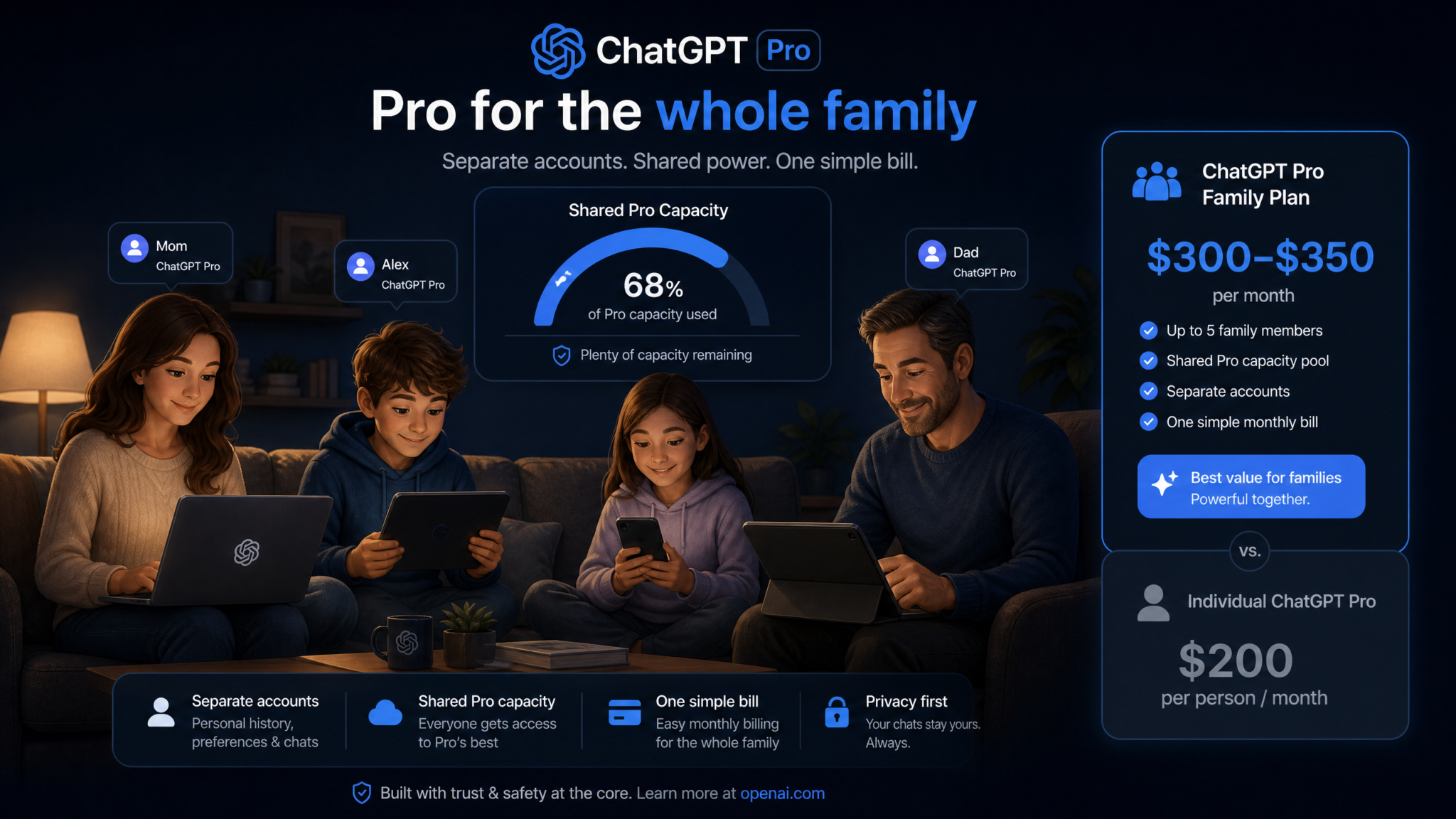
A quiet but significant conversation has been brewing in the corners of OpenAI’s community forum. Since August 12, 2026, a thread discussing a potential “Pro Family” or “Shared Pro Capacity” plan has accumulated hundreds of replies, thousands of upvotes, and the kind of passionate, detailed speculation that only emerges when users genuinely believe something is about to change their lives. The discussion isn’t just wishful thinking — it reflects a real gap in OpenAI’s current subscription architecture, one that millions of households and small creative teams feel acutely every month when they look at their bank statement and realize they’re either sharing a single Pro account (against the Terms of Service) or each paying a full $200 individually. Something, as the community has noted, has to give.
The Community Discussion That Started It All
On August 12, 2026, a user going by the handle velvetpulsar posted a thread to the OpenAI Community Forum titled “Why can’t we have a Pro Family plan yet?” The post was measured, detailed, and clearly written by someone with deep familiarity with both the product and the pricing landscape. Within 48 hours, it had become one of the most-upvoted threads in the forum’s history, gathering responses from parents of college-age students, married professionals who both rely on ChatGPT Pro for their independent consulting work, small design studios with two or three partners, and solo entrepreneurs who want to give their part-time assistants access without paying full freight for a Team workspace they don’t need.
The core argument in that original post was simple but hard to refute: the jump from $20/month (Plus) to $200/month (Pro) is enormous, and the only way to share that cost across a household or micro-team is to either violate OpenAI’s account-sharing policies or pay separately, which costs a combined $400–$600 per month for two or three Pro users. Neither option is good. The Team plan, at $25 per user per month, doesn’t solve the problem because it doesn’t include the same deep Pro-tier capabilities — it’s a workspace-collaboration product, not a shared high-capacity individual-use product.
What made the August 12 thread particularly interesting was the level of specificity in some of the replies. Several users — some claiming to be current or former OpenAI employees, though none verified — described what a “Shared Pro Capacity” architecture might look like technically. The concept they outlined isn’t a unified shared account. It’s a pooled compute model: each household member or small team member retains their own completely separate ChatGPT account with their own conversation history, memory settings, custom instructions, and GPT preferences, but they draw from a single larger pool of Pro-tier compute credits billed under one payment method.
This distinction is crucial. It addresses the single biggest objection to account sharing: privacy. When a family shares one Netflix account, they share recommendations and watch history. When a couple shares one Spotify Premium account, they hear each other’s music. But when two professionals would share one ChatGPT Pro account, they’d potentially see each other’s confidential business conversations, client data, creative drafts, and personal interactions with the model. The Shared Pro Capacity model, as the community has theorized it, solves that by keeping accounts entirely siloed while only pooling the billing and the underlying compute allocation.
“The genius of what they could build here isn’t just a cheaper price — it’s a privacy-preserving shared infrastructure model that doesn’t exist anywhere else in the AI subscription space yet.” — Community forum user northlight_dev, August 14, 2026
The thread has since expanded to include a parallel discussion about what the plan should and shouldn’t include, how OpenAI might prevent abuse (a single person spinning up five “family” accounts to get Pro access for $60/month), and how this product might be positioned relative to the existing Team and Enterprise tiers. It is, in short, exactly the kind of product-development conversation that happens in public when companies are slow to act on obvious market needs — and it signals loudly that demand exists at scale.
What the Proposed Shared Pro Capacity Model Actually Looks Like
Before diving into pricing and predictions, it’s worth constructing a detailed model of how this plan might actually function, based on the community discussion, OpenAI’s existing infrastructure patterns, and analogues from other subscription businesses. The picture that emerges is surprisingly coherent.
The Pool Architecture
At its core, the Shared Pro Capacity plan would work like a data pool on a family mobile plan. Think of the way a family of four shares 100GB of cellular data from a single carrier account: each person has their own phone number, their own apps, their own call history — but the data they consume comes from a shared reservoir. When one member uses a lot, it eats into the pool. If the family consistently stays under, they all benefit. If they consistently go over, they can upgrade the pool size.
Applied to ChatGPT, this means each family or team member would have their own email-based ChatGPT account, their own conversation history that is completely invisible to other plan members, their own memory and personalization settings, and their own Custom GPT configurations. What they’d share is a unified monthly compute allocation — likely measured in some combination of message counts, token limits, and priority inference access — and a single billing relationship with the account owner (the “plan admin”).
Separate Accounts and Conversations: The Non-Negotiable Element
The community discussion on the forum is remarkably unanimous on one point: account and conversation separation is not optional, it’s foundational. A plan that forces family members or colleagues to use the same account login simply won’t work. People use ChatGPT Pro for deeply personal things — health questions, career planning, financial modeling, creative writing with sensitive themes, confidential client work. Any plan that compromises that privacy is a plan that won’t be adopted, regardless of price.
OpenAI already has the infrastructure to support this. Their Team plan involves multiple accounts sharing a workspace, but those accounts remain individually authenticated. A Family Plan would require a similar multi-account architecture but without the workspace layer — no shared knowledge bases, no admin-visible conversation logs, no organizational admin controls beyond billing management.
The Admin and Member Structure
The likely structure would mirror what most family subscription services use:
- One Plan Owner/Admin: Holds the payment method, can add and remove members, can see aggregate usage data (total tokens used by the plan, not individual conversation content), and can upgrade or cancel the plan.
- 2–4 Additional Members: Receive an invitation to join the plan, authenticate with their own email and password, and access Pro features through their own accounts. They cannot see the admin’s conversations, and the admin cannot see theirs.
- Optional Usage Controls: The admin might have the ability to set per-member caps within the shared pool — preventing one heavy user from consuming the entire allocation in week one of the month.
Technical Challenges OpenAI Would Need to Solve
This architecture isn’t trivial to implement. OpenAI would need to build a robust account-linking system that doesn’t exist in its current consumer product line. They’d need to develop a shared billing ledger that tracks compute usage across multiple authenticated identities. They’d need rate-limiting logic that operates at the pool level rather than the individual account level. And they’d need abuse-prevention mechanisms that verify genuine household or small-team relationships — a challenge that Spotify, Netflix, and Apple have all struggled with publicly.
None of these are insurmountable engineering challenges. They are, however, meaningful product investments that explain why this tier doesn’t exist yet despite clear demand. OpenAI has been building out enterprise infrastructure, safety systems, and new model capabilities simultaneously — a Family Plan, while valuable, has understandably not been the top priority.
Pricing Predictions and What You Might Actually Pay
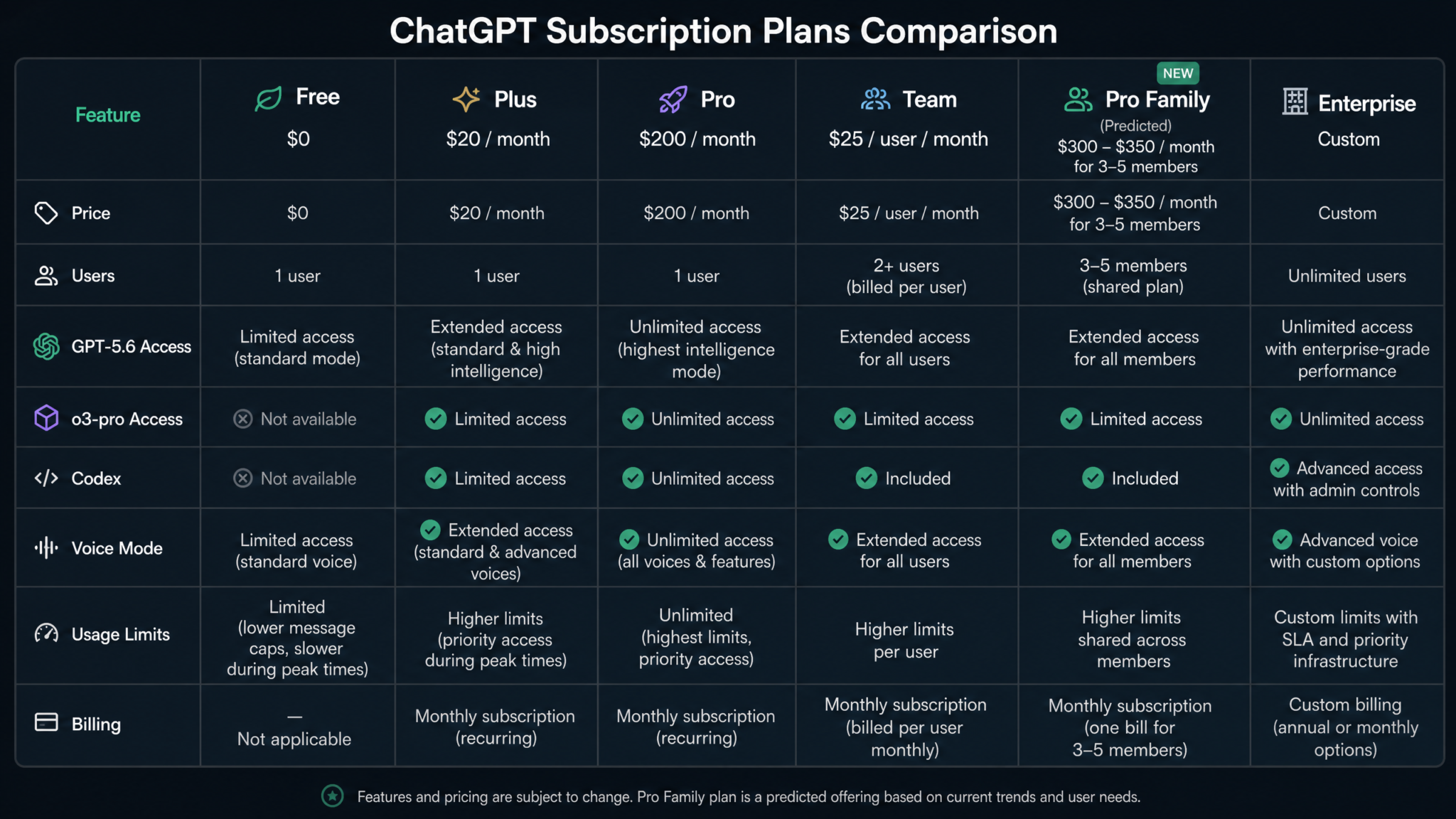
This is where speculation gets most interesting — and most consequential. The current ChatGPT Pro plan costs $200 per month per account. There’s no discounting for annual payment, no bulk pricing, no shared option. For a household with two Pro-level users, that’s $400/month or $4,800/year. For a three-person creative studio where all partners genuinely need Pro access, it’s $600/month or $7,200/year. These are serious numbers that push many qualified users toward workarounds.
The Community Consensus Range
Forum participants have coalesced around a pricing range of $300–$350 per month for a plan covering 3–5 members. Here’s the logic behind that range:
- At $300/month for 5 members, the effective per-user cost is $60 — a 70% discount from standalone Pro. That may be too steep for OpenAI’s revenue model.
- At $350/month for 3 members, the effective per-user cost is ~$117 — a 41.5% discount. More defensible, but it positions the plan attractively enough to convert account-sharers and multi-Plus subscribers.
- A tiered structure is also plausible: a base rate of $250–$280/month for two members (the “couples” case), with each additional member adding $40–$60.
| Plan Tier | Members | Predicted Monthly Cost | Effective Per-User Cost | Savings vs. Individual Pro |
|---|---|---|---|---|
| Family Duo | 2 | $270–$290 | $135–$145 | 27–32% |
| Family Standard | 3–4 | $320–$350 | $80–$117 | 41–60% |
| Family Max | 5 | $350–$400 | $70–$80 | 60–65% |
| Current Individual Pro | 1 | $200 | $200 | — |
| Current Team Plan | Per user | $25/user/month | $25 | 87.5% (but different tier) |
Why OpenAI’s Revenue Model Can Support This
A key insight from the forum discussion: OpenAI’s Pro plan is built around a worst-case usage assumption. The $200/month price is calibrated for the heaviest possible users — researchers running thousands of o3-pro queries, developers stress-testing the API equivalent, writers who spend 10+ hours per day with the model. In practice, the majority of Pro subscribers use far less than the maximum. A family plan with 4 members is unlikely to collectively exceed what a single extreme power user would consume — meaning OpenAI’s actual cost per family plan isn’t 4x the cost of an individual Pro plan.
This is the same economic logic that allows mobile carriers to offer family plans profitably. Individual users rarely max out their data. When you pool four moderate users, the average utilization stays roughly the same as one heavy user. OpenAI is selling capacity, and pooled moderate usage can be priced at a premium over individual moderate usage while still representing substantial savings for the consumer.
How a Family Plan Would Differ From the Team Plan
The most common confusion in the community discussion — and the most important thing to clarify — is how a Pro Family Plan would be meaningfully different from the existing ChatGPT Team plan. They sound similar on the surface: multiple users, one billing relationship, shared access to advanced features. But the differences are substantial, and understanding them is essential to understanding why the Family Plan addresses a genuinely unmet need.
Team Plan: Workspace-First Design
The ChatGPT Team plan, currently priced at $25 per user per month (billed annually) or $30 per user per month (billed monthly), is built around the concept of an organizational workspace. It’s designed for companies, departments, and professional groups who want to collaborate using shared GPT configurations, shared file uploads, and centralized admin controls. Key characteristics include:
- A shared workspace with visibility into team-level activity (admins can audit certain usage patterns)
- Access to GPT-4o and some advanced reasoning, but at Team-tier capacity limits rather than Pro-tier limits
- Shared custom GPTs visible to all workspace members
- Admin dashboard for user management and security controls
- Business-oriented features like SSO integration and usage analytics
Crucially, the Team plan does not include full Pro-tier capabilities. Users on Team plans do not get unlimited o3-pro access, do not get the same priority inference queuing as Pro subscribers, and face message limits that individual Pro subscribers don’t encounter. In OpenAI’s model hierarchy, Team sits above Plus but below Pro. It’s not a cheaper way to get Pro access for multiple people — it’s a fundamentally different product aimed at business collaboration rather than individual high-capacity AI usage.
Family Plan: Capacity-First Design
The proposed Family Plan would invert this priority structure. Rather than workspace collaboration features, the Family Plan’s value proposition is Pro-tier compute capacity shared across individual accounts. There would be no shared workspace. No admin visibility into conversations. No shared GPT libraries unless members individually choose to share them. No SSO, no audit logs, no organizational management features.
| Feature | Team Plan ($25/user/mo) | Pro Family Plan (Predicted) |
|---|---|---|
| o3-pro model access | Limited / Partial | Full (shared pool) |
| Shared workspace | Yes | No |
| Individual account privacy | Partial (admin visibility) | Full |
| Admin usage controls | Extensive | Billing-level only |
| Shared custom GPTs | Yes (workspace-wide) | No |
| Priority inference queuing | Team-tier | Pro-tier |
| Unlimited message caps | No | Yes (pool-managed) |
| Conversation history privacy | Individual-only | Individual-only |
| Target user | Business teams | Households, micro-teams |
| Minimum users | 2 | 2 |
| Maximum users | 149 (Enterprise threshold) | Predicted 5 |
ChatGPT Team Plan Deep Dive for Small Business Owners
The Family Plan fills a specific gap: multiple individuals who each need Pro-level capabilities for their own independent work, and who want to share the billing burden, but who have no need for collaborative workspace features and a strong interest in maintaining personal privacy. No existing OpenAI tier serves this user profile. The Plus plan is too limited. The Team plan is too workspace-centric and too limited on compute. Individual Pro is too expensive for multi-person households.
Who This Plan Is Really Built For: User Persona Analysis
Understanding the potential user base for a Pro Family Plan helps clarify both the product design requirements and the commercial opportunity. The forum discussion surfaced several distinct user types whose needs converge on this single proposed tier.
Persona 1: The Dual-Professional Household
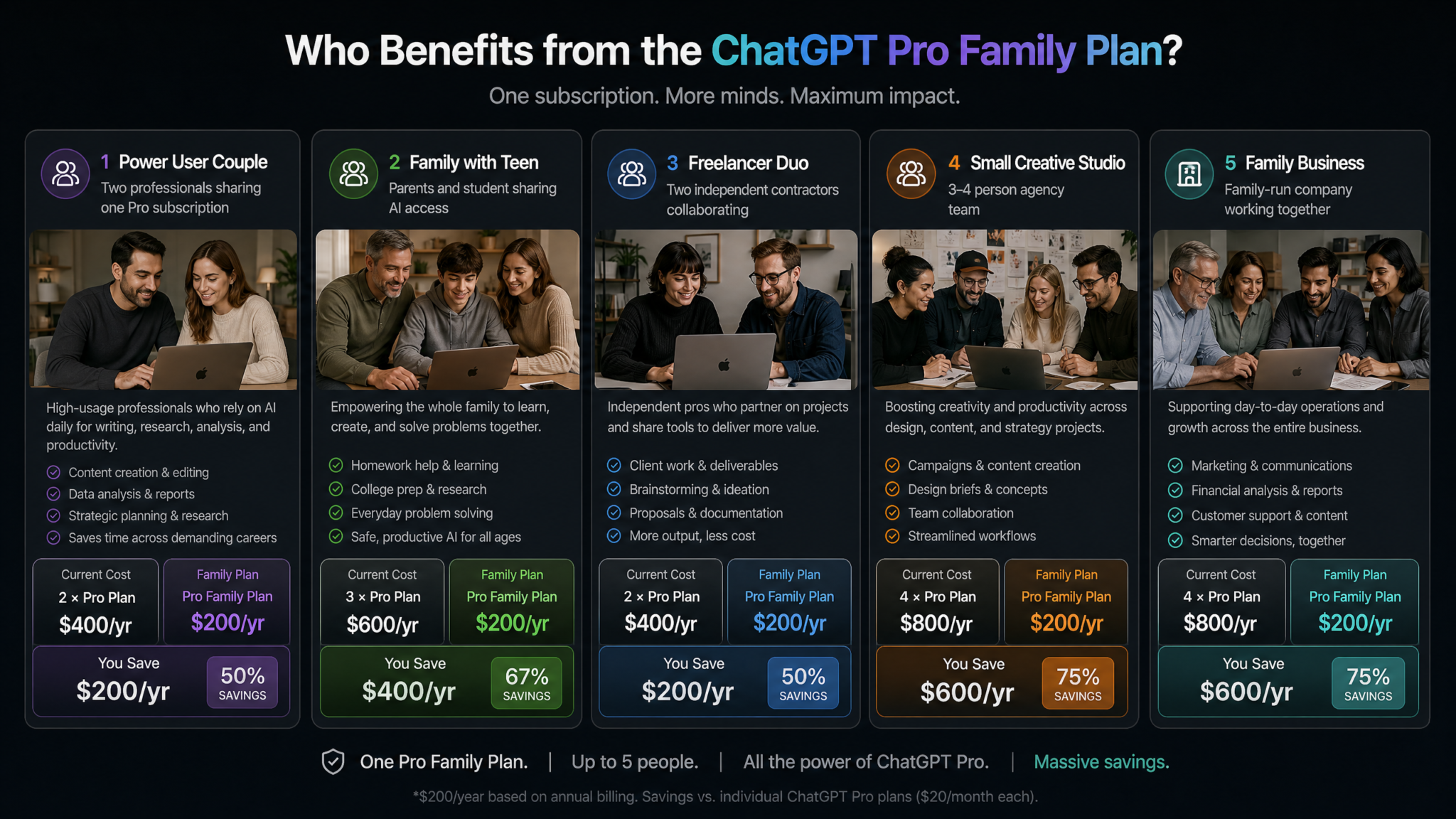
Profile: Maya, 38, is a UX research consultant. Her partner Daniel, 41, is a freelance financial analyst. Both work from home. Both use ChatGPT Pro individually for professional work — Maya for synthesizing user research, drafting reports, and analyzing competitive landscapes; Daniel for financial modeling, client memos, and regulatory research. They pay $400/month combined for two Pro accounts.
What they need: Full Pro access for both, completely separate (Maya absolutely cannot have client research data visible to Daniel, and vice versa), shared billing to simplify household finances. They don’t need collaboration tools — they work in completely different domains. They need the Family Plan.
What they’d pay: $270–$290 for a “Family Duo” tier would represent a $110–$130 monthly saving for them — real money that they’d feel immediately.
Persona 2: The Parent-Student Household
Profile: Renata, 52, is a marketing director who relies on Pro for strategy documents, competitive analysis, and presentation drafts. Her daughter Sofia, 21, is a pre-med student who uses AI heavily for research synthesis, study aids, and writing assistance. Renata pays $200/month for Pro; Sofia uses a $20/month Plus account but consistently hits message limits at critical study periods.
What they need: Renata wants to bring Sofia up to Pro-tier access, but not at an additional $200/month. Sofia needs true Pro capabilities during exam seasons. They want separate accounts — Renata’s professional work and Sofia’s academic work should be completely siloed. A Family plan at $280–$320 for both of them represents a $100–$120 saving over two individual Pro accounts.
Persona 3: The Small Creative Studio
Profile: Three-person independent video production studio: a director, a writer, and a producer/editor. All three use AI heavily — the writer for script development, the director for creative research and visual treatment writing, the producer for budgeting, logistics, and client communication. They’re not a “company” in any formal sense — they’re a collaborative group of freelancers who share project costs. They tried the Team plan but found it workspace-heavy and compute-light. They need Pro-tier capabilities without the organizational apparatus.
What they need: Three separate Pro-tier accounts under one bill, with each person’s work invisible to the others (creative draft privacy is real in this industry), at a price that makes sense for a micro-business. $320–$350 for three people beats $600 for three individual Pro accounts decisively.
Persona 4: The Family Business
Profile: A family-owned retail business: a husband-wife couple who own a specialty outdoor gear shop, plus their adult child who manages social media and marketing. All three use AI for different business functions. They’ve looked at the Team plan but don’t need the workspace features, and $600/month for three Pro accounts isn’t justifiable for a small retail operation.
What they need: Pro-tier access for business-critical AI tasks, shared billing through the business account, individual privacy (the owner’s pricing strategy conversations shouldn’t be visible to the marketing employee, even if that employee is family), and a price point that reflects their small-business reality.
Persona 5: The Researcher-Educator Household
Profile: A household with two academic researchers at different institutions. Both use Pro for literature synthesis, grant writing, data analysis, and manuscript preparation. Academic salaries make $400/month for two Pro accounts a significant budget line. They want full Pro capabilities — especially o3-pro for reasoning-intensive research tasks — at a household rate that doesn’t require institutional approval or enterprise contract.
Best ChatGPT Pro Use Cases for Academic Research and Writing
Feature Access Predictions: o3-pro, Unlimited Everything, and Individual Privacy
What features would actually be included in a Pro Family Plan? Based on the community discussion and the economics of OpenAI’s current tier structure, a reasonable prediction emerges.
o3-pro and Advanced Reasoning Models
This is the crown jewel of the Pro tier and the most critical inclusion for the Family Plan to have meaningful value over Team or Plus. o3-pro — OpenAI’s most capable reasoning model as of mid-2026 — is currently exclusive to Pro subscribers. It excels at complex multi-step reasoning, scientific analysis, code debugging, and nuanced creative work. For the user personas described above, o3-pro access is frequently the specific reason they pay $200/month for Pro rather than $20/month for Plus.
A Family Plan that excludes o3-pro is not a meaningful Pro Family Plan — it’s a rebranded Plus bundle. The community is clear on this: if the Family Plan doesn’t include o3-pro access from the shared pool, it will fail to attract the target audience. The compute cost of o3-pro is the main reason the plan would be limited to a pool structure rather than unlimited individual access — but within that pool, o3-pro capability must be present.
Unlimited Messaging Within Pool Constraints
Individual Pro subscribers currently enjoy effectively unlimited messaging — no hard caps on standard model interactions, with pro-tier priority during high-demand periods. A Family Plan would likely maintain the unlimited character of the experience but introduce pool-level management. Practically, this would mean:
- No individual message caps for standard model use (GPT-4o class interactions)
- A shared monthly allocation for high-compute tasks (o3-pro, extended thinking, complex code execution)
- Optional per-member sub-allocations that the plan admin can configure
- Soft warnings when the plan is approaching its monthly compute ceiling
- An option to purchase additional compute or upgrade the plan tier mid-cycle
Advanced Tools and Integrations
Pro subscribers currently have access to advanced tools including DALL-E image generation at high resolution, video understanding, deep research mode, advanced code execution, and expanded context windows. A Family Plan would predictably include all of these — they’re part of the Pro tier definition, and excluding them would create a confusing product that’s hard to market as a genuine Pro alternative.
Individual Memory and Personalization
One of the most important features of a privacy-preserving Family Plan is that each member’s memory, custom instructions, and personalization settings remain entirely individual. This is non-negotiable for the target audience. If Maya’s ChatGPT remembers her research methodology preferences and client communication style, that memory lives only in her account. Daniel’s account has entirely separate memory. There is no cross-contamination.
This means each Family Plan member gets the full memory and personalization experience of an individual Pro subscriber — they’re not sharing a degraded version of one account. They’re sharing billing and compute capacity while each running what is functionally their own complete Pro account.
Shared Billing and Individual Payment Management
The plan admin would hold the payment method and receive the monthly invoice. Members would not be charged individually — they’re on the admin’s plan. However, the community discussion suggests a useful optional feature: cost-splitting tools that allow the admin to see how much compute each member has consumed (in relative terms, not as a dollar amount), facilitating equitable cost-sharing conversations within households or micro-teams.
How Other Services Handle Family Plans — And What OpenAI Can Learn
OpenAI wouldn’t be inventing the family plan concept from scratch. They’d be joining a long line of subscription services that have navigated this challenge with varying degrees of success. Each offers relevant lessons.
Spotify: The Gold Standard of Simplicity
Spotify’s Premium Family plan (currently $16.99/month in the US as of mid-2026, up to 6 accounts) is frequently cited as the template that family subscription plans aspire to. Key design principles that have made it successful:
- Truly individual accounts: Each member has entirely separate listening history, playlists, recommendations, and podcast subscriptions
- Simple verification: Members must share a home address (verified through location data), which provides a reasonable abuse barrier without being onerous
- Clear value proposition: $16.99 vs. $10.99 per individual Premium account — the math is immediately obvious
- Easy management: The plan owner can add and remove members through a straightforward dashboard
What OpenAI can adopt: The account-separation architecture and the address-based household verification model. The simplicity of Spotify’s per-plan pricing (rather than per-member pricing) also makes the value calculation instant and compelling.
Access 40,000+ AI Prompts for ChatGPT, Claude & Codex — Free!
Subscribe to get instant access to our complete Notion Prompt Library — the largest curated collection of prompts for ChatGPT, Claude, OpenAI Codex, and other leading AI models. Optimized for real-world workflows across coding, research, content creation, and business.
Apple One: The Bundle Premium Approach
Apple One Family ($25/month) bundles Apple Music, Apple TV+, Apple Arcade, and iCloud storage for up to 6 family members. Key design elements:
- Family Sharing framework: Apple’s infrastructure manages account linking, age-appropriate access controls, and spend approval for younger members — a model OpenAI could adapt for households with minors
- Shared iCloud storage: The storage pool is explicitly shared, with visibility into how much each member uses — a direct analogue to OpenAI’s proposed compute pool
- Purchase approval: Parents can require approval for any purchases made by child accounts — adaptable to high-compute task approval for Family Plans
What OpenAI can adopt: The parental controls framework is particularly relevant. A ChatGPT Pro Family Plan that includes under-18 members might need age-appropriate usage controls and content filtering that don’t apply to adult accounts on the same plan. Apple has already solved this technical and UX challenge.
Netflix: The Account-Sharing Crisis and Its Lessons
Netflix’s turbulent journey with account sharing — from tolerating it, to cracking down on it with location verification, to developing a “paid sharing” model — provides the most cautionary tale for OpenAI’s Family Plan design. Netflix’s 2023 crackdown was deeply unpopular but ultimately successful in revenue terms, converting many password-sharers into paying customers. The lesson for OpenAI:
- Address account sharing proactively: OpenAI knows that Pro account sharing happens. A well-priced Family Plan converts those users from ToS violators into paying customers before enforcement becomes necessary or disruptive
- Verification matters: Netflix’s location-based verification for household members was crude but effective. OpenAI can build more sophisticated verification that doesn’t require phone location tracking
- Price the plan to convert, not to maximize per-unit revenue: Netflix left money on the table for years by not having a family plan priced to appeal to password-sharers. OpenAI should learn from this and price the Family Plan at a level that makes the decision easy
Microsoft 365 Family: The Productivity Software Parallel
Perhaps the closest product parallel to what OpenAI is building is Microsoft 365 Family ($9.99/month for up to 6 users). Each member gets their own complete Microsoft 365 account — personal OneDrive storage, personal Outlook, personal Office installs — with no sharing of files or data. The only shared elements are the billing relationship and the overall plan subscription. This is exactly the architecture that makes sense for a ChatGPT Pro Family Plan.
Microsoft 365 Family has been commercially successful precisely because it respects individual user autonomy while making the economics of the upgrade obvious. A household with two people who each need Office 365 Personal ($6.99/month) pays $13.98 combined. Microsoft 365 Family at $9.99 is a clear win. OpenAI needs to engineer a similarly obvious comparison.
| Service | Family Plan Price | Max Members | Individual Accounts? | Shared Element | Verification Method |
|---|---|---|---|---|---|
| Spotify Premium Family | $16.99/mo | 6 | Yes | Plan subscription only | Address-based |
| Apple One Family | $25/mo | 6 | Yes (Apple ID) | Storage pool, plan | Family Sharing setup |
| Netflix Standard (paid sharing) | $7.99/extra member | +2 | Yes | Plan subscription | Location-based |
| Microsoft 365 Family | $9.99/mo | 6 | Yes (Microsoft account) | Plan subscription | Email invitation |
| ChatGPT Pro Family (predicted) | $300–$350/mo | 3–5 | Yes | Compute pool, billing | TBD (email/address) |
ChatGPT Plus vs Pro vs Team — Which Plan Is Right for Your Workflow
What OpenAI Has Said Officially vs. Community Speculation
It’s important to draw a clean line between what OpenAI has actually communicated and what the community is predicting. As of the time of this writing, OpenAI has made no official announcement about a Pro Family or Shared Pro Capacity plan. There is no product page, no pricing page, no blog post, no Sam Altman tweet, no leaked screenshot of an internal product roadmap that has been verified as authentic.
What OpenAI Has Said
OpenAI has, in various forums, acknowledged the existence of demand for multi-user Pro access that doesn’t fit the Team plan mold. In a May 2026 interview with a technology publication, an OpenAI product executive — speaking broadly about pricing strategy — noted that “the gap between our individual and collaborative offerings is something we’re actively thinking about.” This is vague enough to mean almost anything, but it does suggest awareness of the issue at the product leadership level.
OpenAI’s community forum has official staff members who participate in discussions. In the August 12, 2026 thread, a staff member with the tag “OpenAI Team” responded briefly: “Thanks for the detailed feedback here — this thread has surfaced some genuinely useful perspective on the household and small-team use case. No announcements to make, but we’re reading carefully.” This response has been interpreted widely — some as confirmation that the product is in development, others as a standard corporate non-commitment. The truth is likely somewhere in between: OpenAI knows this is a wanted product, and they’re deciding whether to build it.
Signal vs. Noise in the Community Discussion
The forum thread has attracted several posts from individuals claiming insider knowledge of OpenAI’s product roadmap. None of these have been verified. The claims range from highly specific (“Family plan launching Q1 2027 at $299/month for 4 users, saw it in a product brief”) to vague (“I know people there, it’s coming, don’t worry”). Treat all of these as unverified speculation regardless of how authoritative they sound.
What is reliably true is the demand signal itself. Over 4,000 upvotes on the original thread, hundreds of detailed replies, and the clear pattern of users describing identical unmet needs represent genuine market research that OpenAI cannot ignore. Products get built when demand reaches this level of specificity and passion.
How to Prepare If You’re Currently Splitting a Pro Account
Let’s be direct: a meaningful number of people reading this article are currently sharing a single ChatGPT Pro account with a partner, family member, or colleague. This violates OpenAI’s Terms of Service, which explicitly state that accounts are for individual use. Before offering any practical advice, that needs to be said plainly.
With that caveat on the record: if you are currently sharing a Pro account, here’s how to position yourself for the transition to a legitimate Family Plan when it arrives — and how to minimize risk in the meantime.
Document Your Use Patterns Now
If a Family Plan launches and you want to ensure it meets your actual needs, start keeping informal records of how your household uses ChatGPT Pro. How many o3-pro interactions does each person do per week? How often do you hit priority queuing? Which advanced tools get used? This data will help you choose the right tier when options exist, and it gives you a clear answer if you need to justify the upgrade cost to yourself or a partner.
Consider Moving to Individual Plus Accounts Temporarily
If you’re currently sharing a Pro account primarily to avoid paying $400/month for two Pro accounts, consider whether individual Plus accounts ($20/month each, $40 total) might be a viable interim solution. You lose Pro-tier capabilities, but you gain separate accounts, separate memory, separate conversation histories, and compliance with OpenAI’s ToS. When a Family Plan launches, upgrading from two Plus accounts to one Family Plan will likely be straightforward.
Keep One Account Properly Set Up
If you do transition to separate accounts before a Family Plan launches, ensure your primary account has its memory, custom instructions, and GPT configurations well-organized. Migrating a well-configured individual Pro account into a Family Plan will be easier than migrating a minimally-configured shared account.
Watch the OpenAI Blog and Pricing Page
When a Family Plan launches, it will almost certainly be announced on the official OpenAI blog at openai.com/blog and reflected immediately on the pricing page at openai.com/pricing. Set a browser bookmark or notification for both. Early adopters may have access to introductory pricing, as OpenAI has occasionally offered launch discounts for new tiers.
Implications for OpenAI’s Broader Subscription Strategy
The Pro Family Plan isn’t just a product addition — if it launches, it represents a meaningful evolution in how OpenAI thinks about monetization, user segmentation, and competitive positioning. The implications ripple outward in several important directions.
Filling the Gap Between Consumer and Business Tiers
OpenAI’s current subscription ladder — Free, Plus ($20), Pro ($200), Team ($25/user), Enterprise (custom) — has a pronounced gap in the consumer tier. There is nothing between Plus and Pro for the individual user. A $200/month product is simply inaccessible for the majority of individual consumers globally, regardless of how much value it delivers. The Family Plan would effectively create a new price point in the $70–$145/user range for consumer-tier Pro access, filling that gap without requiring OpenAI to lower the Pro price and reduce revenue from solo heavy users who genuinely need it.
Converting Account-Sharers to Revenue
OpenAI has, to date, been relatively quiet about Pro account sharing enforcement. Unlike Netflix, which had a public and messy crackdown, OpenAI has not made headlines by locking people out of shared accounts. But the problem exists, and at $200/month, the incentive to share is strong. A well-priced Family Plan is the cleanest solution: it converts ToS violations into legitimate revenue without requiring enforcement action that damages user relationships.
Competitive Differentiation Against Anthropic, Google, and Microsoft
As of mid-2026, none of OpenAI’s major competitors — Anthropic (Claude), Google (Gemini Advanced), or Microsoft (Copilot Pro) — offer a genuine Pro-tier family plan. Anthropic’s Claude Max ($100/month) doesn’t have a family option. Google One AI Premium offers a more complex bundled approach that combines AI features with storage, but it’s not positioned as a genuine AI power-user family plan. OpenAI has a first-mover opportunity here to establish the standard for what AI family subscriptions look like, in the same way that Spotify established the standard for music family subscriptions.
Data on Household AI Adoption Patterns
A Family Plan would give OpenAI something extraordinarily valuable: granular, consent-based data on how multiple people within a single household use AI. Aggregate usage patterns (not conversation content) across household accounts would illuminate questions about complementary vs. competitive use cases, generational differences in AI adoption within the same home, and how household-level AI usage evolves over time. This data could inform future product development in ways that are difficult to replicate with individual account data alone.
A Gateway to Broader Household AI Integration
Forum discussions have speculated that a Family Plan might eventually expand beyond ChatGPT to encompass other OpenAI products — Sora for video generation, future voice assistant products, or whatever OpenAI’s consumer hardware strategy eventually produces. A Family Plan billing relationship that’s already established and trusted by a household creates an infrastructure for broader product bundling. The first family subscription might be the anchor for an eventual “OpenAI Family” bundle that competitors would struggle to replicate.
Timeline Predictions: When Could This Launch?
Predicting OpenAI’s product launch timeline is notoriously difficult. The company moves fast, ships products with limited notice, and occasionally delays products that seemed imminent. With those caveats in place, the community discussion and available evidence support a few reasonable scenarios.
Scenario 1: Q1 2027 Launch (Most Likely)
The most commonly cited timeline in the forum discussion is a Q1 2027 launch — specifically February or March, which would align with OpenAI’s apparent pattern of making significant consumer product moves in the first quarter of the year. The logic: the August 2026 thread represents the kind of public pressure that typically precedes a 6–9 month development and launch cycle. OpenAI’s product team is likely aware of the demand and has been building toward this. A Q1 2027 launch would also conveniently precede any pricing adjustments competitors might make in response.
Scenario 2: Late Q4 2026 Surprise (Possible)
OpenAI has a history of shipping significant products with limited advance notice. A surprise Q4 2026 launch — timed around the holiday season, when households are thinking about gift subscriptions and shared services — is not impossible. A “give a loved one Pro AI access for the holidays” marketing angle practically writes itself. This scenario is less likely than Q1 2027 simply because the engineering work required for a multi-account billing system isn’t trivial, and mid-2026 seems early for that work to be complete.
Scenario 3: 2027 H2 or Beyond (Possible but Disappointing)
OpenAI might also be prioritizing other product areas — safety systems, new model development, enterprise expansion in key international markets — over a Family Plan for the near term. If that’s the case, a launch could be pushed to late 2027 or beyond. This scenario becomes more likely if Anthropic or Google announces their own family plan first, paradoxically, because OpenAI might choose to observe the competitive response before committing to a specific model.
What to Watch For
The clearest leading indicators of an imminent launch would be:
- A job posting for a “Family Products” or “Consumer Subscriptions” product manager at OpenAI — staffing up specific product roles is often the first public signal
- A pricing page update that adds a new tier row, even without full details
- A developer API update that adds account-linking or plan-management endpoints, which would be required for the underlying infrastructure
- An official response to the forum thread that goes beyond “we’re reading carefully” to something more committal
- A Sam Altman or Greg Brockman social media mention of household AI usage patterns — product executives often hint at upcoming features in casual public statements
| Scenario | Predicted Launch Window | Likelihood | Key Trigger |
|---|---|---|---|
| Holiday Surprise | Q4 2026 (Nov–Dec) | Low–Medium (20%) | Holiday marketing opportunity |
| Early 2027 Launch | Q1 2027 (Feb–Mar) | High (45%) | Post-holiday subscription push, forum pressure |
| Mid-2027 Launch | Q2–Q3 2027 | Medium (25%) | Competitive response to Anthropic/Google |
| Late 2027 or Beyond | Q4 2027+ | Low (10%) | Deprioritized in favor of other products |
Conclusion: The Case for Shared Intelligence
The conversation that started on August 12, 2026 in OpenAI’s community forum is, at its heart, about something simple: AI is becoming essential infrastructure for daily life, and essential infrastructure works best when households and small teams can share it fairly, affordably, and privately. The Pro Family Plan, in whatever form it ultimately takes, represents OpenAI’s acknowledgment that intelligence, like cellular data, cloud storage, and streaming entertainment, is a household resource — one that should be priced and packaged accordingly.
The product case is clear. The user demand is documented, quantified, and passionate. The engineering challenges are real but not prohibitive. The competitive window is open. The pricing math works for both OpenAI and its users. What remains is execution — building the multi-account billing infrastructure, designing the privacy-preserving account architecture, determining the verification model, and finding the right price point that converts account-sharers and multi-Plus households without cannibalizing individual Pro revenue.
For the millions of households where two or more people are serious AI users — and that number grows with every passing month as ChatGPT becomes more capable and more embedded in professional and personal life — the Pro Family Plan cannot come soon enough. For OpenAI, it represents one of the clearest revenue opportunities sitting in plain sight on its product roadmap: a new tier that creates genuine value, addresses a genuine pain point, and builds the kind of household-level loyalty that sustains consumer software businesses for decades.
Watch the forum thread, watch the pricing page, watch the job postings. The signals are accumulating. The plan is coming.
