
Codex Plugins and the 90+ Integration Ecosystem: How Role-Specific AI Bundles Are Transforming Data Analytics, Sales, Creative Production, and Finance Workflows
Inside the Codex Plugin Ecosystem: A Practical Guide to Role-Specific Bundles and Deep Integrations
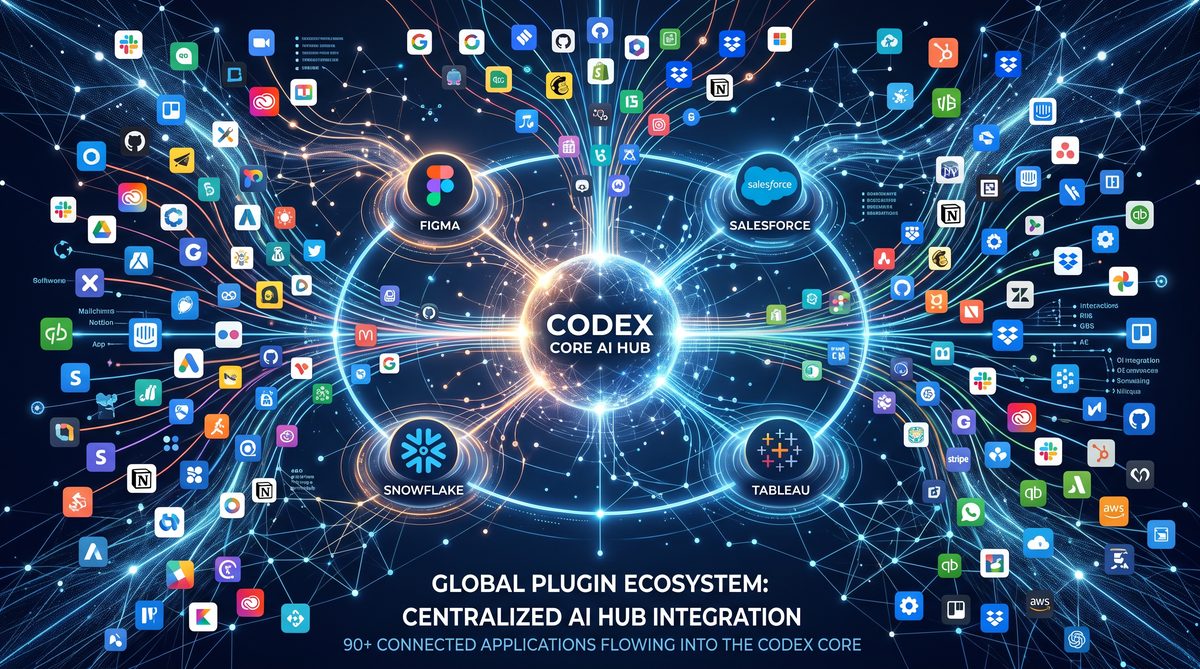
The Codex plugin ecosystem has rapidly matured into a comprehensive integration platform, offering more than 90 individual connectors and six curated, role-specific plugin bundles. These bundles — Data Analytics, Creative Production, Sales, Product Design, Equity Investing, and Investment Banking — are designed to simplify workflows by grouping complementary tools into cohesive, role-tailored experiences. This article unpacks how these bundles operate, provides deep technical dives into three core integrations (Snowflake, Figma, and Salesforce), compares the trade-offs between using individual plugins and unified bundles, and explains the measurable impact on cross-functional business productivity.
Ecosystem Overview: Scope, Goals, and Architecture
The Codex ecosystem is intentionally broad: it supports over 90 third-party integrations spanning cloud data platforms, design systems, marketing and sales automation, analytics visualization, content production, and investment tools. The goal is twofold. First, to reduce the cognitive and technical friction of switching contexts by enabling an AI-first orchestration layer that understands both user intent and tool semantics. Second, to provide enterprise-grade controls for security, privacy, and governance so that organizations can adopt AI-augmented workflows without exposing sensitive assets or violating compliance rules.
Architecturally, Codex is a hybrid platform: a central orchestration and policy layer mediates between the user-facing conversational models, plugin adapters, and downstream service APIs. Key architectural principles are modularity, least-privilege access, and observability. Each plugin implements a standardized adapter interface — typically a RESTful or GraphQL shim — that translates Codex actions and semantic requests into provider-specific API calls. The platform manages authentication tokens, handles schema transformations, and applies policy checks before executing plugin requests.
From a runtime perspective, the execution path contains several stages: intent parsing and action planning by the conversational model; plugin selection and capability negotiation; policy evaluation (including RBAC, data exfiltration checks, and query cost estimation); and finally, API execution with result normalization and optional explanation generation. This consistent pipeline ensures predictable behavior regardless of the underlying integration, which is especially important when composing multi-step workflows across diverse services.
Bundles are built on top of this shared foundation. Each role-specific bundle is a curated set of plugins with pre-configured templates, recommended capability maps, and role-focused UX affordances that enable rapid onboarding and standardized practices. Bundles also include a library of modeled prompts and guarded operations that encapsulate best practices for that role, such as canonical SQL patterns for analysts or design token synchronization flows for product designers.
In the middle of the first main section, we include an illustrative placeholder mapping this architecture to a visual diagram that would typically show the orchestration layer, adapters, and downstream services.
Role-Specific Bundles: Design, Packaging, and Behavioral Contracts
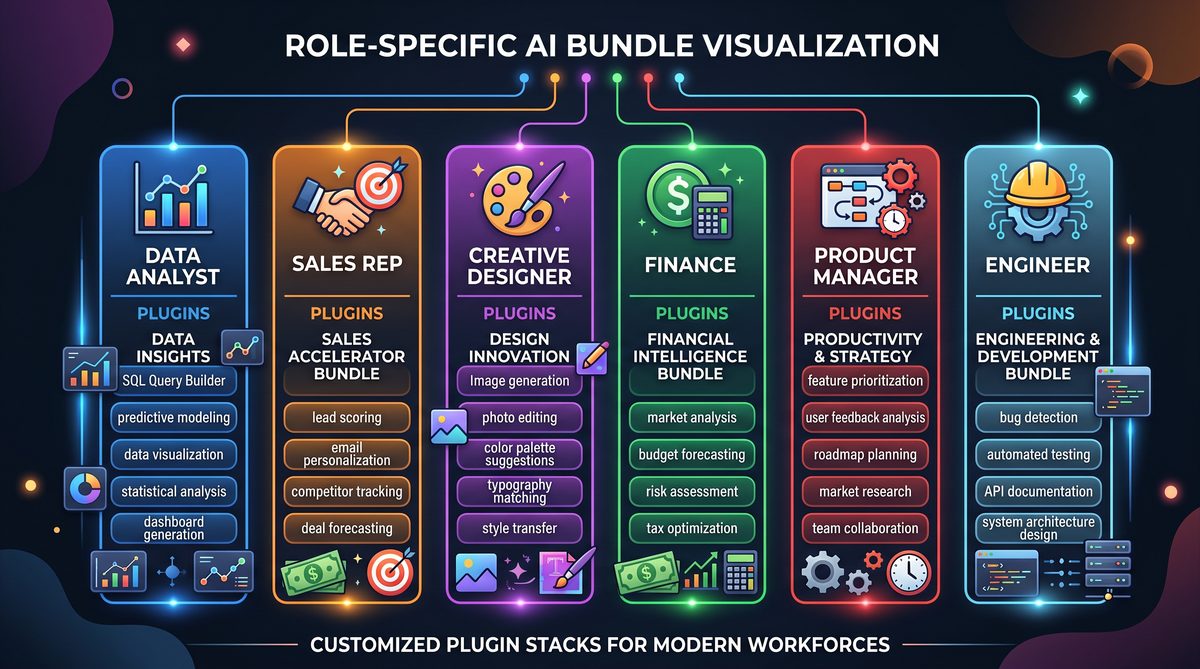
The six role-specific bundles are not simple collections of plugins. They are opinionated product experiences that combine connectors, curated prompts, UI components, and governance defaults to provide immediate value for a target persona. Each bundle includes:
- Core integrations: a set of high-value connectors (for example, Snowflake + Tableau in Data Analytics).
- Task templates: pre-built workflows mapped to common role responsibilities (e.g., monthly close analysis for analysts).
- Data and UI policies: pre-configured privacy, masking, and visibility settings tuned to the role.
- Onboarding flows: step-by-step configuration wizards and sample datasets to reduce setup friction.
- Operational telemetry: recommended KPIs and dashboards for measuring adoption and ROI.
Below is a concise description of each bundle and typical included integrations. The chosen integrations reflect common toolchains observed in enterprise environments; the bundles are adaptable and extensible to match different vendor preferences.
Data Analytics Bundle
Designed for analysts, data engineers, and analytics managers, this bundle emphasizes data access, transformation, visualization, and governance. Typical integrations: Snowflake, BigQuery, Databricks, Looker, Tableau, dbt, Airflow, and Git. It ships with SQL generation helpers, schema-aware prompt templates, cost estimation guards, and example notebooks for reproducible analysis.
Creative Production Bundle
Tailored for content creators, marketers, and brand managers, this bundle connects content systems, design tools, and asset management platforms. Typical integrations: Figma, Canva, Adobe Creative Cloud, Contentful, Grammarly, and cloud storage. It includes brand token synchronization, asset versioning flows, and AI-assisted creative briefs.
Sales Bundle
For account execs, SDRs, and revenue operations teams, the Sales bundle integrates CRM and outreach platforms with data enrichment and analytics. Typical integrations: Salesforce, HubSpot, Outreach, ZoomInfo, Gong, and Slack. It provides playbook templates, automated follow-up drafting, pipeline risk scoring, and deal synthesis reports.
Product Design Bundle
Product designers and design ops benefit from a bundle that synchronizes design systems with developer handoff tools. Typical integrations: Figma, Storybook, Zeplin, Jira, GitHub, and design token registries. The bundle supports component sync, change diffing, and automated accessibility checks.
Equity Investing Bundle
For analysts and portfolio managers, this bundle combines market data, research systems, and modeling tools. Typical integrations: Refinitiv, Bloomberg (where available), CapIQ, Snowflake, Python execution environments, and Excel/Sheets connectors. It provides templated financial models, risk analytics, and research collation workflows.
Investment Banking Bundle
Designed for coverage teams and deal desks, this bundle integrates CRM, data rooms, modeling platforms, and pitch book generators. Typical integrations: Salesforce, DocSend, iManage, PitchBook, PowerPoint automation tools, and secure file transfer systems. It includes deal materials drafting assistants, confidentiality guards, and investor outreach sequences.
The bundles are intentionally configurable: administrators can enable or disable specific plugins, adjust masking policies, and add organization-specific connectors. This allows the same role-based template to be adapted to compliance constraints or internal tool preferences.
Deep Dive: Snowflake, Figma, and Salesforce Integrations
Snowflake Integration: Semantic Querying, Cost Controls, and Governance
Snowflake is central to many analytics and data-driven workflows in the Data Analytics and Equity Investing bundles. Codex’s Snowflake integration is designed to be schema-aware, cost-conscious, and secure.
Connection and Authentication
Authentication is managed through an enterprise-oriented oauth2 or key-pair model with temporary credential rotation. The Codex platform caches short-lived tokens or uses session brokers to avoid persisting long-term credentials on the AI side. For enterprises enforcing SCIM and SSO, the integration honors federated identity so that user actions are attributable and traceable back to a corporate identity.
Semantic Layer and Query Planning
At the heart of the Snowflake integration is a semantic layer that maps natural language intents to SQL templates. This layer contains a catalog of table and column metadata, data lineage annotations, and sample value distributions. The conversational model queries the semantic layer to determine which tables and joins are appropriate for a given question, then synthesizes SQL with parameterized filters.
To limit exposure and reduce cost, Codex applies a query planner that estimates compute costs using metadata, cached histograms, and recent query profiles. The planner can rewrite queries to push down filters, recommend materialized views or sample tables, and in some cases run approximate analytics (e.g., HyperLogLog, sampled aggregates) where exactness is not required.
Access Controls and Row/Column Masking
Data governance is enforced via a combination of Snowflake grants and Codex-level policy enforcement. Codex intercepts SQL before execution to apply dynamic row-level security (RLS) and field-level masking based on user attributes and the role bundle configuration. This dual enforcement ensures that even if a policy is misconfigured in Snowflake, the Codex runtime imposes an additional guardrail.
Explainability and Result Context
Returned results are annotated with provenance metadata: the executed SQL, the tables involved, query cost, and confidence estimates for any AI-generated transformations. The platform can also produce an “explain plan” narrative that translates query plans and joins into plain language, which helps non-technical stakeholders validate the reasoning behind figures.
Operational Concerns
Operationally, the Snowflake integration supports query throttling, concurrency caps, and scheduled rehydration of cached results. Monitoring dashboards surface expensive queries, unusual access patterns, and differences between predicted and actual costs. Integration with observability tools enables centralized alerting for cost overruns or data exfiltration events.
Figma Integration: Design-Engineering Synchronization and Token Management
Figma is a cornerstone of both the Creative Production and Product Design bundles. The Codex-Figma integration emphasizes design-system fidelity, component traceability, and automated developer handoff.
Token Synchronization and Component Mapping
Design tokens — color palettes, spacing scales, typography styles — are synchronized between Figma and a central design token registry. Codex offers a mapping layer that aligns tokens in Figma with token keys in codebases. When an update is made in Figma, the plugin can generate diffs and propose pull requests to update token values in the target repository, which can include Storybook stories or CSS-in-JS modules.
Component-Level Metadata and Versioning
Every component mapped into Codex includes metadata: the Figma node ID, author, last-modified timestamp, variant properties, and accessibility annotations. This metadata is used to maintain a single source of truth for component usage across products. Versioning support means the system can reconcile breaking changes, propose migration paths, and automatically update dependent instances when safe.
Developer Handoff and Code Generation
Codex can produce developer-focused artifacts such as component prop lists, CSS snippets, or JSON manifests for design systems. More advanced flows auto-generate scaffolded component implementations in React, Vue, or native frameworks based on agreed mapping rules. Generated code is accompanied by tests and accessibility checks to reduce manual work during handoff.
Collaboration and Review Workflows
Integration features are optimized for asynchronous review: designers can request implementation suggestions, engineers can submit notes, and product managers can lock stable variants. The Codex conversational interface supports change explanations, visual diffs, and acceptance criteria generation. This reduces the back-and-forth often associated with design changes and preserves a clear audit trail of decisions.
Salesforce Integration: CRM Intelligence, Enrichment, and Action Automation
Salesforce powers critical workflows for sales teams and is a core integration in the Sales and Investment Banking bundles. The Codex-Salesforce connector is designed to be both action-capable and context-aware.
Object Modeling and Semantic Mapping
Codex ingests Salesforce object schemas — standard and custom objects — and builds a semantic map that translates conversational intents into object-level operations (e.g., update opportunity stage, create task, fetch contact timeline). Where objects are heavily customized, Codex learns mapping patterns from sample records and administrators can provide mapping overrides to ensure correct semantics.
Enrichment and Cross-System Synthesis
One of the most powerful capabilities is multi-source enrichment: combining Salesforce data with external firmographics, meeting transcripts, and product telemetry to produce a unified account profile. For example, Codex can synthesize a “deal readiness” summary that merges opportunity health metrics, recent call sentiment (from Gong), and product usage signals.
Action Automation and Playbooks
Beyond read operations, Codex can create playbook-driven automations: sequence tasks, update fields, create new records, or trigger workflows. These automations embed guardrails such as change approval for sensitive fields, rate limits to avoid API throttling, and conditional branching based on CRM data. Playbooks are versioned and auditable to meet sales compliance requirements.
Privacy, Compliance, and Audit Trails
Because CRM data is highly sensitive, all Codex-Salesforce operations are logged with full fidelity: who requested the action, the natural language prompt, the resolved action plan, and the executed API calls. Audit exports integrate with existing SIEMs and help security teams perform periodic reviews and forensic analysis.
In the middle of the second deep-dive section, insert a visual placeholder that would normally demonstrate cross-system enrichment and a playbook example for CRM-driven action automation.
Comparative Analysis: Standard Plugins Versus Unified Bundles
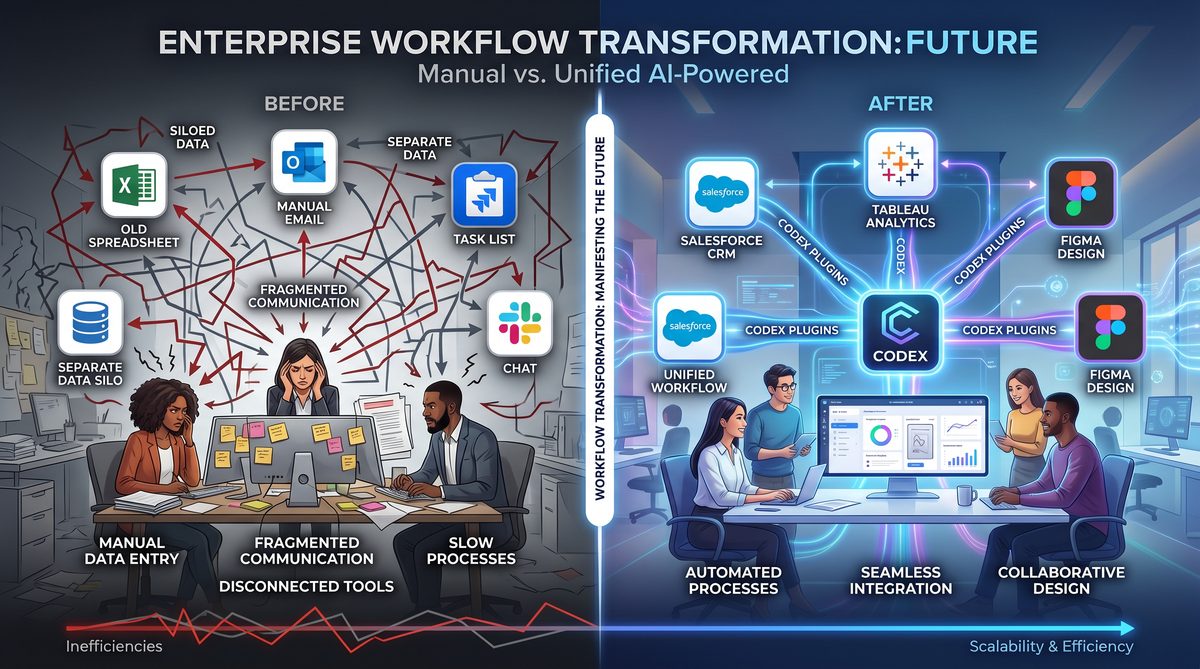
When assessing whether to adopt individual plugins or a unified role bundle, organizations should weigh technical complexity, user experience, governance, and total cost of ownership. Below is a comparative analysis that highlights trade-offs and strategic considerations.
Onboarding and Time-to-Value
Standard plugins provide flexibility: teams can pick specific connectors and tailor configurations. However, the cumulative setup time and integration testing often scale non-linearly as more plugins are added. Unified bundles, by contrast, bring pre-configured templates and guided onboarding that accelerate time-to-value. For many teams, especially smaller ones or those with constrained engineering bandwidth, bundles dramatically reduce the upfront investment required to achieve production-ready workflows.
Consistency and Best Practices
Bundles codify opinionated workflows and guardrails, which promotes consistency across teams. In decentralized environments, this can be a major advantage: bundles reduce variance in prompts, data exposure policies, and result formatting. Standard plugins give maximum flexibility but also increase the risk of inconsistent practices, fragmented knowledge, and duplicated efforts to solve the same problem.
Governance and Security
From a governance perspective, bundles simplify policy enforcement because they ship with recommended defaults for masking, logging, and RBAC. Standard plugins require organizations to build consistent governance artifacts across multiple adapters. If an organization has mature security teams and needs bespoke access controls, the flexibility of individual plugins may be preferable, but it comes with additional operational overhead.
Customization and Extensibility
Standard plugins shine when deep customization is necessary. If your workflows require complex, non-standard interactions with vendor APIs, individual plugins permit focused engineering investment. Bundles, while configurable, intentionally expose fewer degrees of freedom to ensure a coherent experience. Advanced teams may start with bundles to get baseline benefits and then incrementally customize plugins where required.
Cost and Performance
Bundles can deliver better resource utilization out of the box because they incorporate cost-conscious patterns such as query sampling, result caching, and batched API calls. Custom plugin setups sometimes suffer from inefficient patterns (e.g., unbounded queries, high-frequency polling), which drive up downstream costs. That said, bespoke implementations can be optimized for specific workloads if teams invest in performance engineering.
Developer Productivity
Bundles surface domain-specific primitives and task templates that reduce cognitive load for non-technical users. Standard plugins require more developer intervention to build user-facing templates and guardrails. In short, bundles democratize capabilities by enabling domain experts (analysts, designers, sales reps) to accomplish more without heavy engineering support.
Operational Overhead
Maintaining many independent plugins increases operational complexity — patching, credential rotation, schema migration handling, and observability. Bundles mitigate this by centralizing management and standardizing integrations. For larger organizations with dedicated SRE teams, granular control across individual plugins may still be manageable, but for many teams, the simplified lifecycle offered by bundles reduces fragility.
Impact on Cross-Functional Business Productivity
The principal organizational benefit of Codex bundles is the acceleration of cross-functional workflows. By standardizing integrations and providing shared primitives, the platform reduces latency between discovery, decision, and execution. Here are several concrete ways productivity is improved.
Faster Decision Cycles
When data access, design artifacts, and CRM records are available through a single conversational interface, teams make decisions faster. For example, a product manager can ask Codex to combine a usage cohort analysis (Snowflake) with the latest design mockups (Figma) and active pipeline impacts (Salesforce) to decide whether to proceed with a feature release. Previously, this synthesis required manual stitching of dashboards, design files, and CRM exports.
Reduced Handoff Friction
Designers and engineers often experience friction at handoff points. The Product Design bundle reduces this by automating token syncs, generating code scaffolds, and annotating design rationales. This decreases rework and shortens cycle times for feature delivery.
Improved Sales Execution and Forecasting
Sales teams benefit from integrated summaries and playbooks that combine CRM data with product usage and sentiment analysis. Codex can automatically surface at-risk deals, draft personalized outreach, and update CRM fields based on playbook execution. These capabilities translate directly into improved pipeline hygiene and more accurate forecasting.
Operational Efficiency for Analysts and Investors
For analysts and investors, the Data Analytics and Equity Investing bundles reduce the time from hypothesis to insight. Analysts can iterate on SQL queries with the conversational model, validate results against sample datasets, and generate reproducible notebooks. Portfolio teams can synthesize market, financial, and qualitative research into investment memos more quickly, improving responsiveness to market opportunities.
Knowledge Capture and Reuse
Bundles promote knowledge reuse by codifying successful prompts, playbooks, and templates. Organizations build a living repository of operational wisdom that new hires can leverage immediately, reducing onboarding time and preserving institutional knowledge.
Measurable KPIs and ROI
Operational KPIs commonly used to measure Codex bundle impact include time-to-insight, cycle time for feature launches, number of manual steps eliminated, deal conversion rate improvements, and reductions in costly support escalations. Early adopters report significant reductions in routine manual work and substantial increases in output per role after adopting role-specific bundles with governance enabled.
Implementation Best Practices and Governance
To successfully adopt Codex bundles, organizations should follow a structured implementation approach that balances rapid adoption with strong governance.
1. Start with a Pilot and Clear Use Cases
Identify 2–3 high-impact workflows for a pilot group. For example, choose an analytics use case revolving around monthly cohort analysis, a sales playbook for net-new pipeline generation, or a design-to-engineering handoff. Measure baseline metrics and define success criteria upfront.
2. Configure Policy Defaults
Enable sensible defaults: RBAC, query cost caps, data masking, and high-fidelity audit logging. These settings should be conservative initially and gradually relaxed as confidence and monitoring improve.
3. Integrate with Identity and Access Management
Use SSO and federated identity to ensure action-level attribution. Map enterprise roles to bundle roles and enforce least-privilege access to sensitive connectors like Snowflake and Salesforce.
4. Observe and Iterate
Instrument usage and operational metrics. Monitor expensive queries, high-frequency plugin calls, and anomalous behaviors. Use this data to refine query planners, caching strategies, and playbook logic.
5. Educate and Document
Provide role-tailored training, living documentation, and a shared repository of approved prompts and templates. This reduces misuse and maximizes the value captured by bundles.
6. Plan for Extensibility
Design the implementation so that custom plugins and bespoke logic can be added without undermining governance. Use the platform’s adapter interface to integrate niche services and orchestrate them within established playbooks.
7. Data Residency and Compliance
Respect data residency and regulatory constraints. If enterprise data cannot leave certain geographic boundaries, deploy localized proxying or leverage on-premise adapters to ensure compliance. Maintain a clear mapping between data flows and regulatory requirements.
Sample Workflows: From Prompt to Production
Below are several representative workflows that illustrate how users interact with bundles and how the platform coordinates multiple integrations to deliver final outcomes.
Access 40,000+ AI Prompts for ChatGPT, Claude & Codex — Free!
Subscribe to get instant access to our complete Notion Prompt Library — the largest curated collection of prompts for ChatGPT, Claude, OpenAI Codex, and other leading AI models. Optimized for real-world workflows across coding, research, content creation, and business.
Analyst Workflow: Cohort Analysis and Report Generation
- User asks Codex: “Show me 30-day retention for users acquired in Q1 by channel and generate a slide with key takeaways.”
- Codex consults the semantic catalog, plans a Snowflake query, estimates cost, and applies any RLS masks.
- Snowflake returns results; Codex annotates provenance and generates a visualization via Tableau or Plotly.
- Codex creates a slide deck with an executive summary and a download link to the query and notebook for reproducibility.
Designer Workflow: Token Update and Developer Handoff
- Designer updates a primary brand color in Figma and requests a rollout to production components.
- Codex computes impacted components, generates a token diff, and proposes pull requests to the UI repo with updated tokens and Storybook snapshots.
- Engineers receive the PR with generated tests and accessibility checks; after merge, Codex updates the production component registry.
Sales Workflow: Deal Synthesis and Outreach
- An AE asks Codex for a one-pager on a target account using Salesforce data plus recent call transcripts.
- Codex synthesizes the account history, pipeline health, and call sentiment, then drafts a tailored outreach email and playbook steps.
- The AE reviews, edits, and approves the sequence; Codex automates task creation and follow-up scheduling in Salesforce and Outreach.
Hypothetical Case Studies: Quantifying the Benefits
These case studies are illustrative composites that demonstrate likely outcomes when organizations adopt Codex bundles, and they provide concrete numbers organizations can use to estimate ROI.
Case Study 1: E-commerce Platform — Data Analytics Bundle
Situation: An e-commerce company suffers long lead times for data requests and inconsistent reporting across teams.
Action: Adopt the Data Analytics bundle with Snowflake, dbt, and Tableau integration; onboard two analytics pods.
Outcome: Time-to-insight for standard reports drops from 3 days to 2 hours. Analysts spend 40% less time on ad hoc data wrangling. Monthly cost savings are realized by reducing redundant compute and consolidating queries via caching policies.
Case Study 2: SaaS Company — Product Design Bundle
Situation: The product org struggles with handoff friction that delays releases by multiple sprints.
Action: Implement the Product Design bundle with Figma and Storybook sync, enforcing token-based style management.
Outcome: Average design handoff time shrinks by 60%, regression defects tied to UI inconsistencies drop by 30%, and developer rework decreases, accelerating release velocity.
Case Study 3: Financial Services Firm — Sales and Investment Banking Bundles
Situation: Coverage teams lack efficient ways to synthesize deal materials and track outreach impact.
Action: Deploy Sales and Investment Banking bundles that integrate Salesforce, PitchBook, and secure storage for data rooms.
Outcome: Deal preparation time is cut by half, outreach personalization improves conversion rates by 15%, and audit readiness for client interactions is significantly improved thanks to complete action logs.
Further Reading and Related Resources
If you want a broader look at how Codex supports knowledge work and how bundles fit into that vision, see the companion article
For a deeper exploration of this topic, our comprehensive analysis on Codex for Knowledge Work: How OpenAI’s Productivity Platform Is Transforming Non-Technical Roles with AI-Powered Research, Analysis, and Automation provides detailed implementation strategies, real-world case studies, and actionable frameworks that complement the concepts discussed in this section.
. That piece elaborates on how conversational AI acts as a connective tissue between tools, how knowledge graphs and context windows are managed, and practical governance patterns that teams have successfully used to scale AI-enabled workflows across knowledge domains.
For operations managers who want tangible templates and reproducible examples, the internal guide
For a deeper exploration of this topic, our comprehensive analysis on 50 GPT-5.5 Prompts for Operations Managers: Supply Chain Optimization, Process Automation, Resource Allocation, and Performance Dashboards provides detailed implementation strategies, real-world case studies, and actionable frameworks that complement the concepts discussed in this section.
is a valuable resource. It contains operationally-focused prompts tailored to common functions such as incident retrospectives, capacity planning, and cross-team coordination—many of which can be adapted out-of-the-box to the role bundles discussed in this article.
Risks, Caveats, and Mitigation Strategies
While the benefits are significant, organizations should be mindful of potential risks and plan mitigations accordingly.
Data Leakage and Over-Privileging
Risk: Conversational systems could inadvertently expose sensitive data if permissions are not carefully scoped.
Mitigation: Enforce least-privilege access, adopt row- and column-level masking, and configure exfiltration detection that flags unusual data volumes or requests outside established patterns.
Model Hallucinations and Action Safety
Risk: Models sometimes generate plausible but incorrect outputs or recommend unsafe actions (e.g., altering records incorrectly).
Mitigation: Require multi-step confirmations for destructive actions, enable dry-run modes for changes, and route high-risk operations through human-in-the-loop approvals.
Vendor Lock-In and Portability
Risk: Using a curated bundle may lead to organizational patterns that are tightly coupled to specific vendor APIs.
Mitigation: Favor abstraction layers and maintain adapter specifications so the underlying tools can be swapped with minimal disruption. Design bundles to export templates and playbooks in a vendor-agnostic format.
Operational Complexity and Cost Surprises
Risk: Misconfigured integrations or unoptimized queries can cause unexpected costs.
Mitigation: Use cost estimation plugins, enforce cost caps, and monitor usage. Leverage sampling, caching, and materialized views to reduce repeated heavy queries.
Conclusion: Strategic Considerations for Adoption
Codex’s plugin ecosystem — with its broad catalog of integrations and opinionated role bundles — provides a practical path for organizations seeking to operationalize AI across functions. Bundles accelerate onboarding, codify best practices, and reduce the friction of cross-functional work by pre-integrating complementary tools and guarding them with enterprise-grade policies. The deep integrations with Snowflake, Figma, and Salesforce demonstrate how specialized connectors can deliver high-leverage value when combined with semantic mapping, governance, and action automation.
Deciding between standard plugins and unified bundles requires weighing flexibility against consistency. Bundles suit organizations seeking rapid adoption, standardized workflows, and simplified governance. Individual plugins are better for teams that require deep, custom interactions with specific vendors. Many organizations will find a hybrid approach most practical: begin with bundles, measure impact, and extend with custom plugins where necessary.
By applying the best practices outlined in this article — pilot selection, policy defaults, identity integration, and iterative observation — teams can minimize risk and maximize the productivity gains enabled by Codex. The platform’s strengths lie in its ability to synthesize information across diverse systems, provide explainable results, and automate repeatable tasks, thereby freeing human teams to focus on higher-value decisions and creative problem-solving.
