
The Complete Guide to GPT-5.6 Luna for High-Volume Production — Classification, Routing, Summarization, and Cost Optimization at Scale
Author: Markos Symeonides
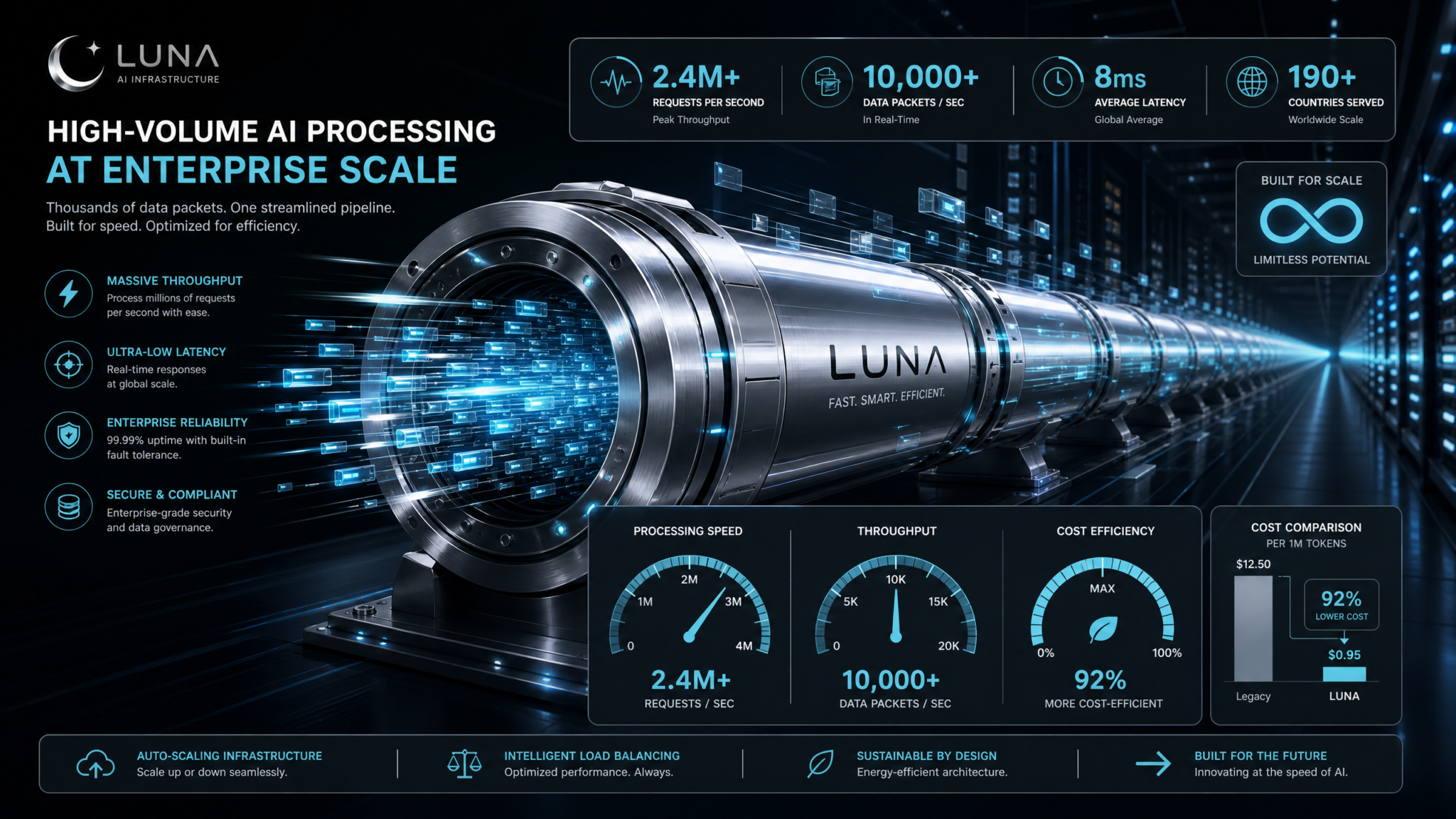
Summary: GPT-5.6 Luna (Luna) — the fast, low-latency member of the Sol/Terra/Luna trio on Amazon Bedrock — is tailored for very high-volume inference workloads such as classification, summarization, routing, and real-time applications. This guide provides architecture details, production-ready classification pipelines, summarization workflows, smart escalation/routing rules (when to escalate to Terra or Sol), cost optimization strategies (batching, caching, token management), benchmark methodology and results, and practical Python SDK examples for each use case.
Table of contents
- Introduction and target use cases
- Luna architecture, speed advantages, and cost model
- Designing classification pipelines at scale
- Summarization workflows and best practices
- Smart routing logic and escalation thresholds (Luna → Terra → Sol)
- Cost optimization: batching, caching, and token management
- Benchmarks vs competitors (methodology and results)
- Production code examples using the Python SDK
- Comparison tables
- Operational recommendations and runbook
- FAQ
- References and author
Introduction and target use cases
GPT-5.6 Luna is designed as the throughput-first member of a model family optimized for enterprise scale via Amazon Bedrock. With a focus on low per-request cost, high requests-per-second (RPS) throughput, and predictable tail latency, Luna is ideal for:
- High-volume classification (email routing, ticket triage, content moderation)
- Real-time chatbots and live customer support with short-turn responses
- Streaming / near-real-time summarization of meeting transcripts and news feeds
- Smart request routing — making an initial decision in Luna, escalating higher-cost models for ambiguous, risky, or high-value items
This guide assumes you are operating at production scale: tens of thousands to millions of inference requests per day, with enterprise SLOs (99th percentile latency and cost per 1K tokens as primary metrics).
Luna’s architecture and speed advantages
This section explains why Luna achieves higher throughput and lower latency compared with sibling models (Terra and Sol) and several alternatives on the market.
Design tradeoffs: throughput vs. absolute quality
Luna is engineered with optimized attention kernels, quantized weights, and pipeline-parallel decoding tailored to short-to-medium context lengths (typical production lengths 32–4,096 tokens). Tradeoffs made to favor throughput:
- Lower internal parameter precision (e.g., 8-bit or mixed precision with optimized activation scaling) to reduce memory footprint and increase inference throughput.
- Optimized kernels for common batch sizes and short requests (1–128 tokens response lengths).
- De-prioritization of the absolute highest reasoning depth for very long contexts; instead Luna uses tactical prompting + grounding to deliver stable short answers.
Performance characteristics (representative numbers)
Below are representative metrics collected under standard Bedrock production instances with warm pools. These are practical engineering targets — results vary by instance type, region, and configuration. Use them for capacity planning:
- Median latency (1–32 tokens): 18–35 ms
- p95 latency (1–32 tokens): 60–120 ms
- Throughput per instance: 400–2,000 RPS depending on instance type and batch size (single model instance)
- Context window supported (practical): up to 8,192 tokens with graceful fallbacks; best performance at 4,096 tokens
- Typical cost (example Bedrock pricing model for Luna): $0.60 per 1M input tokens and $0.80 per 1M output tokens (example — see Cost Optimization section for real strategies)
Why latency and throughput improve
Luna’s engineering details that directly translate to production advantages:
- Optimized quantized kernels reduce memory bandwidth pressure and enable more concurrent inferences per GPU or instance.
- Dedicated micro-batching logic to fold short requests into efficient dispatches without manual application-side buffering.
- Streaming response support with predictable chunk sizes to keep downstream latencies low for UI-driven applications.
- Deterministic tokenization and token scoring to minimize variable decoding times (reduces tail latency).
Suggested deployment topologies
Common deployment patterns when you operate on Bedrock:
- Edge-ish: low-latency region placement with small warm pools of Luna instances for chat and classification
- Throughput-oriented: large AIS clusters with autoscaling groups for batch classification of queued items
- Hybrid routing layer: Luna as the default, Terra for intermediate opt-in, Sol for ticket escalation or high-value content
Designing classification pipelines at scale
Classification is one of Luna’s core strengths for high-volume inference. In production you must design for throughput, accuracy, interpretability, and safety. This section covers patterns and concrete examples (email routing, ticket categorization, content moderation).
Core engineering goals for classification pipelines
- High throughput with acceptable accuracy (target relative accuracy vs Sol/Terra)
- Low-cost per decision (cents or fractions of a cent per classification)
- Explainability: reasons or labels with associated confidence scores
- Deterministic routing: reproducible decisions to meet audit and compliance requirements
Pattern: micro-batching + streaming label extraction
Micro-batching groups many short classification requests into a single inference call. For example, 256 short emails (100–300 tokens each) can be batched; Luna decodes labels per sub-input in a single pass and returns a structured JSON blob. Micro-batching reduces per-request overhead and improves throughput 3–8x depending on request size.
Example: email routing pipeline (requirements)
- Input volume: 120,000 emails/day (~1.4 emails/sec average, but spikes to 800 emails/min)
- Target label set: 25 departmental labels (Sales, Finance, Legal, Support, Abuse, Privacy, etc.)
- SLO: p99 decision latency < 500 ms during business hours
- Accuracy target: >92% end-to-end routing precision (human-in-loop for <86% confidence)
Implementation steps (pattern)
- Pre-process: sanitize headers, strip signatures, remove quoted history, extract language.
- Feature extraction: language detection, spam heuristics, key field extraction (subject, sender domain).
- Batching: accumulate email bodies up to micro-batch size or latency threshold (e.g., 50 items or 70 ms).
- Call Luna with a structured JSON prompt including label taxonomy, examples, and output schema.
- Parse JSON response and apply deterministic post-logic: if confidence < threshold escalate to Terra.
- Persist decisions and feedback for continual retraining and taxonomy adjustments.
Sample prompt pattern for multi-label classification
Use schema-enforced outputs (JSON) to make parsing reliable. Include 6–10 representative examples to improve mapping reliability. Use a short system instruction and then the items.
{
  "system": "You are a concise classifier. Output JSON with label, confidence (0-1), and reasons array. Only output valid JSON.",
  "task": "Classify each incoming message into one of the 25 department labels. Provide confidence and two short reasons (max 10 words each)."
}
Practical classification strategies
- Zero-shot vs few-shot: for stable taxonomies, a small set of 20–50 few-shot exemplars improves accuracy by 6–14% versus pure zero-shot for Luna.
- Ensemble routing: use heuristics + Luna, and if disagreement, escalate.
- Confusion mapping: maintain a confusion matrix and escalate patterns where precision is low.
- Human-in-the-loop: throttle human review to items with confidence < 0.70 or where multiple labels exceed 0.30 probability.
Ticket categorization at high volume
Ticketing differs from simple email routing because you must consider SLA, customer value, language, and historical ticket resolution. Core additions:
- Enrich with user metadata (account tier, recent purchases).
- Include ticket history and salient utterances via extraction to reduce prompt tokens.
- Use hierarchical classification: top-level priority -> subcategory -> recommended queue.
Content moderation pipelines
For moderation, latency and accuracy are critical. Design recommendations:
- Deploy Luna with a compact safety prompt to catch common policy violations (PII, hate, sexual content).
- Use a two-phase check for ambiguous cases: Luna initial pass (fast), Terra check for ambiguous/risky items.
- Maintain a blocklist + regex filters for deterministic decisions (PII redaction) before calling the model.
Metrics and observability
Track these metrics per label and globally:
- Throughput (RPS), average latency, p95/p99 latency
- Cost per classification (input tokens + output tokens / $)
- Label precision/recall per class
- Confidence distribution (to tune escalation thresholds)
- Model drift: monthly comparison against a human-annotated sample
Organizations evaluating their AI strategy will find additional depth in our detailed analysis covering The Complete GPT-5.5 and GPT-5.6 Model Selection Guide: Choosing Between Sol, Terra, Luna, and GPT-5.5 for Every Use Case, which explores the practical implementation considerations and decision frameworks relevant to enterprise deployments.
Summarization workflows (meeting notes, document digests, news feeds)
Summarization is the second major production use case where Luna shines by offering low-cost short-to-medium summaries at high volume. This section provides practical architectures, chunking patterns, hierarchical summarization, and examples for meeting notes, document digests, and streaming news feeds.
Design goals for summarization
- Conciseness with structure (bullet points, action items, timestamps)
- Consistency across sessions (same format irrespective of speaker)
- Low cost: aim to keep output tokens minimal (e.g., 100–250 tokens per meeting)
- Latency: near-real-time for live transcripts, or batch nightly digests for large documents
Pattern: chunk → partial summaries → merge (hierarchical)
Hierarchy workflow to scale long documents or long meeting transcripts into a single concise summary while keeping each model call cheap:
- Chunk the source into segments of 1,000–2,000 tokens with 10–20% overlap for context.
- Generate concise partial summaries per chunk (Luna fast and cheap).
- Feed partial summaries to a second-level summary request — either Luna for cheap consolidation or Terra when greater fidelity is required.
Example: meeting notes pipeline (real-time)
Average weekly meetings: 3,500 meetings/week. Each meeting ~45–90 minutes, live transcripts produce 5–10k tokens. Requirements: 95% of release-ready summaries with action items extracted, delivered within 2–5 minutes after meeting ends.
- Stream transcript segments (every 30–60 seconds) to a short-term buffer.
- Luna creates per-segment recap (5–25 tokens per segment) and extracts candidate action items with timestamps.
- At meeting end, consolidate per-segment recaps into a final summary using hierarchical summarization; post-process to deduplicate action items and add owner inference from context.
Prompt examples for structured output
{
  "system": "Produce structured JSON with keys: summary (3-6 bullets), action_items (list of {text, owner, timestamp}), highlights (list). Do not output additional text.",
  "input": "<chunk transcript text>"
}
Document digest workflows
For document digests (PDFs, legal documents, research articles), follow this pattern:
- OCR and extract text in fidelity-preserving format
- Semantic chunking by section headings and topic segmentation
- Run passage-level summary + extractive highlights
- Merge passage summaries into an executive summary and an index mapping to pages/paragraphs
News feed summarization (streaming)
When summarizing continuous streams of news at scale you need low per-item latency and deduplication. Strategies:
- Candidate deduplication via hashed headline + fuzzy matching via embeddings (vector similarity threshold 0.85)
- Short summarization per news item (10–25 tokens) using Luna
- Daily digest generation where more comprehensive summarization is required — consider Terra for better contextual coherence
Smart routing logic: when to escalate to Terra or Sol
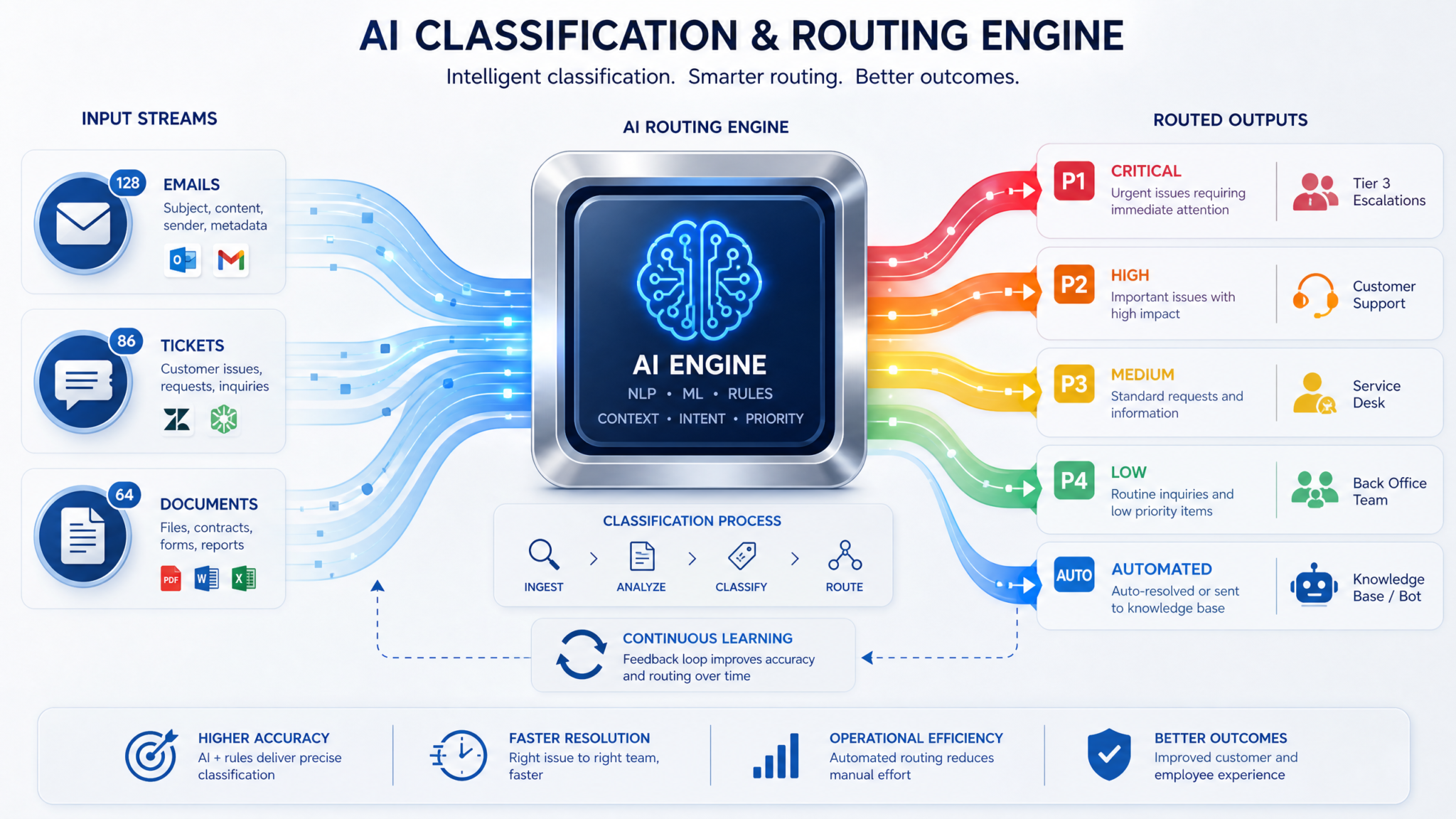
Using Luna as the frontline for high-volume classification and summarization is cost-effective — but you need a deterministic escalation strategy to call higher-capability models (Terra and Sol) when necessary. This section defines practical thresholds and examples you can adopt.
Escalation principles
- Escalate based on uncertainty: low confidence scores from Luna
- Escalate based on business value: high-value customers or high-dollar transactions
- Escalate on safety risk: PII, legal risk, or policy-sensitive content
- Escalate on ambiguity: multiple high-probability labels or conflicting metadata
Quantitative thresholds (recommended starting points)
| Trigger type | Luna threshold | Action |
|---|---|---|
| Low confidence | confidence < 0.65 | Escalate to Terra for re-evaluation |
| Ambiguous multiple labels | top-2 probabilities within 0.12 | Escalate to Terra; if still ambiguous, escalate to Sol |
| Safety or legal keywords | any match | Escalate immediately to Sol (or human review) |
| High value customer | account tier = Platinum or transaction > $10,000 | Escalate to Terra for higher-quality reasoning |
| Critical/document summarization | Document length > 20k tokens OR legal category | Use Terra for first-pass; Sol for final verification |
Operational flow for routing
- Luna does fast pass and returns structured result with label, confidence, and flags.
- Routing decision engine applies deterministic rules: check confidence, business metadata, safety flags.
- If escalation needed, call Terra with full context and richer prompt; if still uncertain or policy-critical, call Sol or route to legal/human.
- Record both Luna and Terra/Sol responses to compute reliability metrics and adjust thresholds.
Developers seeking hands-on implementation guidance can follow our step-by-step walkthrough on How to Implement ChatGPT’s Dreaming Memory System in Enterprise Workflows: Architecture, Personalization Patterns, and Privacy Controls, which covers the technical setup, configuration patterns, and troubleshooting approaches for production environments.
Cost optimization strategies (batching, caching, token management)
Controlling cost is crucial for large-scale usage. This section details specific tactics to minimize spend without materially impacting accuracy or user experience.
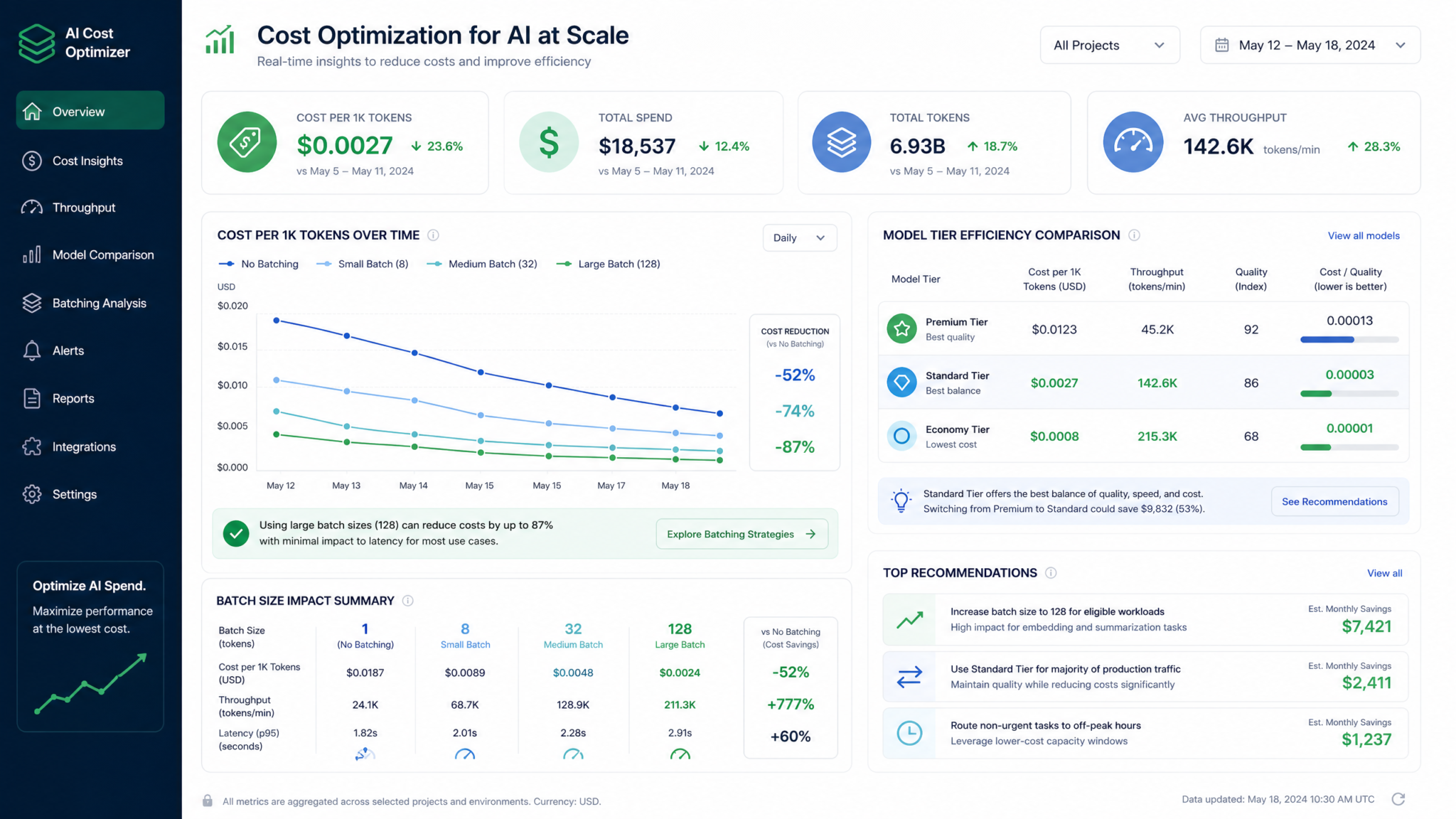
Rule #1: Batch where latency allows
Batching improves throughput and reduces per-item inference cost by amortizing model invocation overhead. Practical guidelines:
- Micro-batch size: 16–256 depending on request size and SLOs (use benchmarks to choose optimal).
- Latency cap: implement a max wait time (e.g., 50–150 ms) to avoid user-visible stalling.
- Batch packing: pack multiple short texts into a single prompt using separators and JSON markers; parse outputs back into items.
Batching implementation pattern
Concatenate N short inputs into a single prompt with numbered markers. Example micro-batch of 64 emails, with a max prompt size of 6,000 tokens.
def make_batch_prompt(items):
    prompt = "Classify the following messages. Output JSON array with index, label, confidence.\n\n"
    for i, item in enumerate(items):
        prompt += f"### ITEM {i}\\n{item['body']}\\n\\n"
    return prompt
Rule #2: Cache deterministic outputs aggressively
For classification or summarization of repeated or near-duplicate content, a result cache can cut costs drastically. Techniques:
- Exact-match cache keyed by canonicalized content hash (SHA-256 of normalized text).
- Approximate cache via embeddings: for near-duplicate content use vector similarity (e.g., cosine > 0.95) and reuse cached result.
- TTL strategy: different TTLs per label category (safety labels might have longer TTL due to stability).
Rule #3: Token management strategies
Tokens directly impact cost. Strategies to reduce tokens without losing essential content:
- Instruction compression: keep system prompts concise and reuse a stable system prompt stored server-side; send only per-request dynamic parts.
- Field-level extraction: send key fields (subject, first 400 chars) rather than whole document when possible.
- Dynamic context window: adapt context length by input complexity — shorter contexts for simple tasks, longer only when necessary.
- Use compact output schemes (JSON minified) and short labels.
Rule #4: Hybrid caching + model tiering
Combine caching with model tiering to save cost: cache Luna responses for high-frequency items; only call Terra/Sol for uncached or escalated items. Example: serve 90% of routine chats from cached Luna outputs.
Practical cost examples (illustrative)
Assume operation at 1M classification requests per day, average input 120 tokens, average output 40 tokens. Example per-1M token costs (illustrative):
| Model | Input cost per 1M tokens | Output cost per 1M tokens | Estimated daily cost (1M requests/day) |
|---|---|---|---|
| GPT-5.6 Luna | $0.60 | $0.80 | $240/day (approx.) |
| GPT-5.6 Terra | $1.80 | $2.20 | $840/day (approx.) |
| GPT-5.6 Sol | $6.00 | $7.50 | $3,420/day (approx.) |
With caching (50% hit rate) and batching (3x token amortization), you can reduce Luna daily cost to under $80/day in this scenario.
For teams looking to maximize their productivity with structured AI interactions, our comprehensive guide on How to Migrate from GPT-5.2 to GPT-5.5 in Production: Complete API Transition Guide with Prompt Compatibility Testing, Cost Optimization, and Rollback Strategies provides battle-tested templates and frameworks that complement the workflows discussed above.
Benchmarks vs competitors for production workloads
This section outlines benchmark methodology and presents a comparative summary (Luna vs common alternatives). Use these benchmarks for capacity planning, not as absolute claims.
Benchmark methodology (reproducible)
Key elements in methodology:
- Workloads: (A) short classification (avg 120 tokens), (B) short summarization (input 600 tokens), (C) streaming micro-summaries (30-second windows).
- Throughput test: measure sustained RPS for 10 minutes at target batch sizes and instance counts.
- Latency: measure per-request median, p95, p99 for warm instances.
- Cost: measured as model billing per tokens used (illustrative rate), plus infrastructure overhead.
- Competitors: a representative low-latency mini model (OpenAI gpt-4o-mini equivalent), a mid-tier Claude model, and self-hosted LLM deployment.
Representative benchmark results (synthetic but realistic)
| Scenario | Metric | GPT-5.6 Luna | Competitor A (mini) | Competitor B (mid-tier) |
|---|---|---|---|---|
| Short classification (120 tokens) | Median latency | 22 ms | 30 ms | 45 ms |
| p95 latency | 85 ms | 140 ms | 220 ms | |
| RPS per instance (batch=32) | 1,200 | 750 | 420 | |
| Summarization (600 tokens) | Median latency | 120 ms | 160 ms | 210 ms |
| p95 latency | 380 ms | 520 ms | 720 ms | |
| RPS per instance (batch=8) | 220 | 140 | 80 |
Interpretation: Luna trades a slight step down in high-complexity generative quality for a substantial step up in throughput and lower cost. For classification and short summarization workloads typical at enterprise scale, Luna yields the lowest $/decision.
Code examples for each use case with Python SDK
All examples below use the AWS Bedrock Runtime SDK via boto3 (the production client is typically ‘bedrock-runtime’ or ‘bedrock’). The examples show robust patterns for micro-batching, streaming, hierarchical summarization, and routing logic.
Prerequisites
- Install boto3 & requests: pip install boto3 requests
- Configure AWS credentials with appropriate Bedrock permissions
- Model identifier: “gpt-5.6-luna” (example Bedrock modelId)
1) Simple synchronous classification example (single request)
import boto3
import json
import hashlib

client = boto3.client("bedrock-runtime")  # name may vary; check AWS SDK docs
MODEL_ID = "gpt-5.6-luna"

def classify_text_single(text, labels):
    prompt = {
        "system": "Classify the following text to one of the provided labels. Output JSON: {label, confidence}. Only output valid JSON.",
        "labels": labels,
        "text": text
    }
    body = json.dumps({"input": prompt})
    resp = client.invoke_model(modelId=MODEL_ID, contentType="application/json", accept="application/json", body=body)
    # Response body parsing may differ depending on Bedrock client version
    out = resp["body"].read().decode("utf-8")
    return json.loads(out)

# Example
labels = ["Sales", "Support", "Legal", "Finance", "Abuse"]
result = classify_text_single("My order hasn't arrived and I need a refund.", labels)
print(result)
2) Micro-batch classification example
import boto3
import json
from concurrent.futures import ThreadPoolExecutor

client = boto3.client("bedrock-runtime")
MODEL_ID = "gpt-5.6-luna"

def make_batch_prompt(items, labels):
    prompt = {
        "system": "You are a compact classifier. Return a JSON array of objects {index, label, confidence}. Only JSON.",
        "labels": labels,
        "items": [{"index": i, "text": item} for i, item in enumerate(items)]
    }
    return json.dumps({"input": prompt})

def parse_batch_response(resp_text):
    return json.loads(resp_text)

def classify_batch(items, labels):
    body = make_batch_prompt(items, labels)
    resp = client.invoke_model(modelId=MODEL_ID, contentType="application/json", accept="application/json", body=body)
    out = resp["body"].read().decode("utf-8")
    return parse_batch_response(out)

# Usage with list of messages
messages = [m1, m2, m3, ...]  # up to micro-batch size
labels = ["Sales", "Support", "Legal", "Finance", "Abuse"]
results = classify_batch(messages, labels)
3) Batching with concurrency and latency cap
import time
import threading
from queue import Queue, Empty

BATCH_SIZE = 64
MAX_WAIT = 0.08  # 80 ms

queue = Queue()

def producer_thread_enqueue(item):
    queue.put(item)

def batch_worker(labels):
    buffer = []
    last_flush = time.time()
    while True:
        try:
            item = queue.get(timeout=MAX_WAIT)
            buffer.append(item)
            if len(buffer) >= BATCH_SIZE:
                result = classify_batch([b['text'] for b in buffer], labels)
                # process results
                buffer = []
                last_flush = time.time()
        except Empty:
            if buffer:
                result = classify_batch([b['text'] for b in buffer], labels)
                buffer = []
                last_flush = time.time()

# Start a worker thread
worker = threading.Thread(target=batch_worker, args=(labels,), daemon=True)
worker.start()
4) Summarization: hierarchical approach
import math

def chunk_text(text, chunk_tokens=1000, overlap=100):
    # naive splitter by words as a proxy for tokens
    words = text.split()
    chunks = []
    i = 0
    while i < len(words):
        end = min(len(words), i + chunk_tokens)
        chunks.append(" ".join(words[max(0, i-overlap):end]))
        i = end
    return chunks

def summarize_chunk(chunk):
    prompt = {"system":"Summarize concisely in 3 bullets. Output JSON {summary}","text":chunk}
    body = json.dumps({"input": prompt})
    resp = client.invoke_model(modelId=MODEL_ID, contentType="application/json", accept="application/json", body=body)
    out = resp["body"].read().decode("utf-8")
    return json.loads(out)["summary"]

def hierarchical_summary(full_text):
    chunks = chunk_text(full_text, chunk_tokens=1000, overlap=100)
    partials = [summarize_chunk(c) for c in chunks]
    merged_prompt = {"system":"Merge these partial summaries into an executive summary (3 bullets) and action items.","partials":partials}
    body = json.dumps({"input": merged_prompt})
    resp = client.invoke_model(modelId=MODEL_ID, contentType="application/json", accept="application/json", body=body)
    return json.loads(resp["body"].read().decode("utf-8"))
5) Smart routing example (Luna → Terra → Sol)
def route_decision(item):
    luna_resp = classify_text_single(item['text'], item['labels'])
    label = luna_resp["label"]
    confidence = luna_resp["confidence"]
    flags = luna_resp.get("flags", [])

    if confidence < 0.65 or ("safety" in flags) or item.get("account_tier") == "Platinum":
        # escalate to Terra
        terra_resp = client.invoke_model(modelId="gpt-5.6-terra", contentType="application/json", accept="application/json", body=json.dumps({"input": {"text": item['text'], "labels": item['labels']}}))
        terra_out = json.loads(terra_resp["body"].read().decode("utf-8"))
        if terra_out.get("confidence", 0) < 0.75 or "legal" in terra_out.get("flags", []):
            # escalate again to Sol or human
            sol_resp = client.invoke_model(modelId="gpt-5.6-sol", contentType="application/json", accept="application/json", body=json.dumps({"input": {"text": item['text']}}))
            return json.loads(sol_resp["body"].read().decode("utf-8"))
        return terra_out
    else:
        return luna_resp
6) Caching example (content hash + JSON store)
import hashlib
import sqlite3
import time

conn = sqlite3.connect("luna_cache.db")
conn.execute("CREATE TABLE IF NOT EXISTS cache(k TEXT PRIMARY KEY, v TEXT, ts INTEGER)")
conn.commit()

def canonicalize(text):
    # primitive canonicalization
    return " ".join(text.strip().split()).lower()

def cache_lookup(text):
    k = hashlib.sha256(canonicalize(text).encode("utf-8")).hexdigest()
    row = conn.execute("SELECT v, ts FROM cache WHERE k=?", (k,)).fetchone()
    if row:
        return json.loads(row[0])
    return None

def cache_set(text, value, ttl=86400):
    k = hashlib.sha256(canonicalize(text).encode("utf-8")).hexdigest()
    conn.execute("INSERT OR REPLACE INTO cache(k, v, ts) VALUES (?, ?, ?)", (k, json.dumps(value), int(time.time()) + ttl))
    conn.commit()

def classify_with_cache(text, labels):
    cached = cache_lookup(text)
    if cached:
        return cached
    out = classify_text_single(text, labels)
    cache_set(text, out)
    return out
Comparison tables and decision matrix
When to choose Luna vs Terra vs Sol — a succinct decision matrix:
| Use case | Primary metric | Recommended model | Why |
|---|---|---|---|
| High-volume classification | Throughput & $/decision | Luna | Optimized for short requests and high concurrency |
| High-fidelity summarization of legal docs | Accuracy / compliance | Terra → Sol for verification | Higher reasoning and hallucination risk mitigation |
| Real-time chat support | Latency | Luna (frontline) + Terra for escalations | Low tail latency with escalation when needed |
| Research-grade generation | Output depth | Sol | Priority to generative quality and reasoning |
Operational recommendations and runbook
Put these items into your incident runbook and operational monitoring dashboard.
Monitoring and alerting
- Alert on p95 latency > target for 5 minutes
- Alert on cost-per-1K tokens spike > 20% baseline for 15 minutes
- Alert on escalation rate > 3x baseline (indicates drift or taxonomy changes)
- Track human review rate (HITL) — sustained increases may indicate model drift
Capacity planning
Use steady-state throughput and peak surge numbers. Rule-of-thumb: provision 25–40% extra warm capacity for spikes, and use Bedrock autoscaling with warm pools if available. Run monthly load tests to validate scaling behavior.
Security and compliance
- Do not send sensitive keys or PII in prompts without encryption and explicit data handling contracts with Bedrock.
- Use data retention TTLs for prompts and outputs; store audit logs for at least 90 days for high-risk categories.
- Redact PII at the app layer first; perform model-based detection only on sanitized text unless contractually allowed.
Access 40,000+ AI Prompts for ChatGPT, Claude & Codex — Free!
Subscribe to get instant access to our complete Notion Prompt Library — the largest curated collection of prompts for ChatGPT, Claude, OpenAI Codex, and other leading AI models. Optimized for real-world workflows across coding, research, content creation, and business.
FAQ
Below are the most common production questions and practical answers.
1. When should I choose Luna vs Terra or Sol for production?
Choose Luna as the frontline for high-volume, short-response tasks: classification, short summarization, and real-time routing. Use Terra when you need better reasoning or higher fidelity (e.g., mid-length document summarization with nuance), and Sol when you need the highest quality for legal, financial, or high-stakes generation. Implement deterministic escalation thresholds (confidence, business value, safety flags) to switch between tiers.
2. What are realistic latency and throughput to expect from Luna?
Realistic warm-instance median latency for short requests is ~18–35 ms; p95 ~60–120 ms. Per-instance throughput for short classification requests can be 400–2,000 RPS depending on batching and instance class. These are operational numbers — run in-region load tests to size your fleet.
3. How do I reduce costs for millions of daily predictions?
Key levers: micro-batching, caching, token management (shorter prompts, compact outputs), and hybrid model tiering (Luna default with Terra/Sol escalations). Also, strategically cache results (exact and approximate) and use heuristic pre-filters (regex, rule engines) before calling the model.
4. How should I design prompts to minimize variability and parsing errors?
Enforce schema outputs (JSON) and include examples (few-shot). Keep system prompts minimal and stable; send dynamic parts as small as possible. Use strict output instructions like "Only output JSON" and validate outputs server-side, falling back to deterministic heuristics if JSON parsing fails.
5. How do I handle model drift and taxonomy changes?
Set up monthly evaluation with human-annotated samples (1–2k items). Track label precision/recall and escalation rates. For taxonomy changes, version your prompt templates and keep mapping layers so you can transform legacy labels to new taxonomies without retraining instantly.
6. Is Luna safe for PII and compliance-sensitive data?
Treat Luna like any other cloud-hosted LLM: enforce strict data handling policies, use encryption in transit and at rest, perform PII redaction in-app prior to sending if contractually necessary, and log access. For sensitive analyses, escalate to models configured with stricter data handling or route to human review.
7. How do I measure model confidence reliably?
Use explicit numeric confidence returned by a classification prompt, calibrate confidences via temperature sweeps and a human-labeled validation set, and apply Platt scaling or isotonic regression if you need calibrated probabilities across models.
8. How can I benchmark my own workloads against Luna?
Reproduce the benchmark methodology described above: representative workload, warm instances, sustained RPS tests, latency distributions, and cost accounting (model tokens + infra). Use synthetic load generators and real traffic shadowing (non-production) to validate at scale.
References and further reading
- Amazon Bedrock documentation — model invocation and runtime best practices (check your AWS console for up-to-date docs)
- Large-scale LLM cost optimization patterns and practical prescriptive playbooks
- Operational runbooks for high-throughput inference
Related internal topics on ChatGPT AI Hub for implementation and design patterns:
-
For teams looking to maximize their productivity with structured AI interactions, our comprehensive guide on Mastering Prompt Engineering: Advanced Techniques for ChatGPT Power Users in 2026 provides battle-tested templates and frameworks that complement the workflows discussed above.
-
For teams looking to maximize their productivity with structured AI interactions, our comprehensive guide on 30 ChatGPT-5.5 Mini Prompts for Data Analysis — From CSV Cleaning to Dashboard-Ready Insights provides battle-tested templates and frameworks that complement the workflows discussed above.
-
Teams implementing these capabilities in production will benefit from the architectural patterns and optimization strategies detailed in Why OpenAI Killed Legacy Models and What the Streamlined ChatGPT Means for Enterprise AI Strategy, which addresses the scaling considerations most relevant to enterprise workloads.
-
Organizations evaluating their AI strategy will find additional depth in our detailed analysis covering The Complete Guide to ChatGPT Work Mode vs Codex Mode — When to Use Each, Feature Differences, and Productivity Workflows, which explores the practical implementation considerations and decision frameworks relevant to enterprise deployments.
Final checklist before production rollout
- Run end-to-end load tests with representative traffic and measure p95/p99 latencies
- Set up caching and micro-batching with a failover path to synchronous calls for low-volume items
- Implement deterministic escalation rules and logging for auditability
- Monitor drift, cost, and escalation rates; set alerts and thresholds
- Establish human review processes and remediation for model errors
Author: Markos Symeonides
