
How to Migrate from GPT-5.2 to GPT-5.5 in Production: Complete API Transition Guide with Prompt Compatibility Testing, Cost Optimization, and Rollback Strategies
How to Migrate from GPT-5.2 to GPT-5.5 in Production: Complete API Transition Guide with Prompt Compatibility Testing, Cost Optimization, and Rollback Strategies
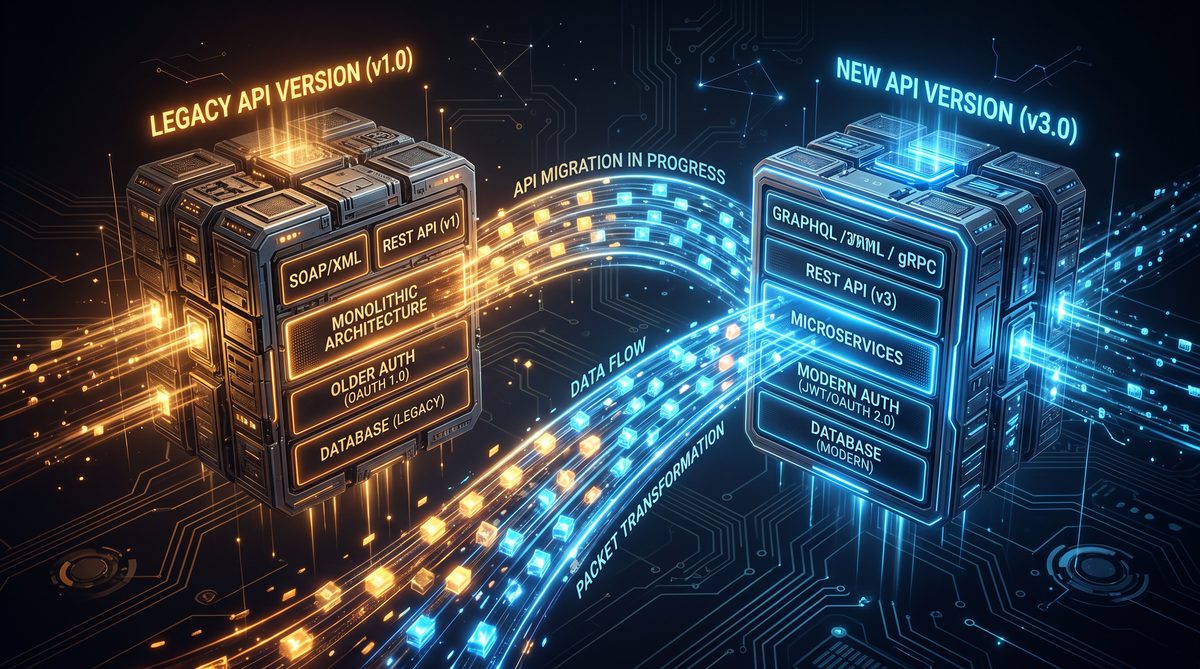
This guide provides a comprehensive, production-ready playbook for migrating from the deprecated GPT-5.2 family (deprecated June 12, 2026) to the GPT-5.5 family. It covers strategic planning, API differences, code examples for multiple runtimes, a prompt compatibility testing framework, cost optimization techniques, and robust rollback and safety patterns. The content is targeted at engineering leads, SREs, ML engineers, and platform teams responsible for running large-scale conversational or generative systems in production.
Executive summary
GPT-5.5 introduces improvements in instruction-following, multimodal capabilities, token efficiency, and safety behavior over GPT-5.2, but its different defaults and new API surface require careful validation before full migration. A successful migration follows a staged approach: inventory & audit, compatibility mapping, test harness-driven validation, cost modeling, phased rollout (canary/blue-green), monitoring and observability, and well-tested rollback controls. This guide contains concrete code examples (Python and Node.js), test harness templates, cost models, and deployment patterns you can adapt to your stack.
1. Why migrate and what changed from GPT-5.2 to GPT-5.5
Before planning migration, it is critical to know exactly what operational, functional, and financial changes you will encounter. Below is a detailed listing of differences relevant to production systems.
- Model architecture and behavior: GPT-5.5 has refined instruction-tuning, reduced hallucination rates in factual prompts, and more deterministic behavior at equivalent temperature settings.
- Tokenization and effective token length: GPT-5.5 uses a slightly different tokenizer variant delivering average token compression improvements (~3–5% depending on language), which affects token counting and cost.
- API surface: GPT-5.5 introduces new parameters (for example, finer-grained safety control flags, and new streaming metadata fields), but maintains backward compatibility for core inputs. Some deprecated GPT-5.2 parameters will be ignored or mapped to defaults.
- Pricing and throughput: Per-token pricing can differ; throughput is improved for longer context windows due to improved internal batching and memory management. However, peak latency distribution differs slightly and should be validated.
- Multimodal and tool integration: GPT-5.5 expands multimodal support and function-calling patterns (new metadata in function responses), requiring compatibility testing if you use function calling extensively.
- Safety and moderation: Stricter defaults and new flags for controlling safety tradeoffs; integration with enterprise moderation pipelines may require small changes.
Compatibility checklist
- Identify model references and pinned versions across codebases (backends, worker jobs, inference pipelines).
- Identify prompt templates including few-shot contexts, system-role hints, and temperature/top_p settings.
- Inventory function-calling usage and schemas.
- Inventory embedding and retrieval pipelines using GPT-5.2 embeddings—note embedding model changes and recalculation needs.
- Catalog logging, telemetry, and rate limit handling code reliant on GPT-5.2 behavior.
Quick feature comparison table
| Aspect | GPT-5.2 | GPT-5.5 |
|---|---|---|
| Instruction following | Strong | Stronger, fewer hallucinations |
| Tokenizer | Legacy v1 | v1.2 (3–5% token savings) |
| Function calling | Supported | Extended metadata, stricter schema validation |
| Safety defaults | Permissive | More conservative, new flags |
| Context window | Up to 256k (model variant dependent) | Up to 512k (higher effective throughput) |
| Latency | Low to medium | Lower median, slightly different tail behavior |
| Pricing | Baseline | New price tiers with option for compute-optimized variants |
2. Pre-migration audit: inventory, metrics, and risk assessment
A thorough pre-migration audit reduces surprises. Implement a discovery pass across your stack to find all uses of GPT-5.2 and gather contextual information you will need for prioritized testing.
Discovery steps
- Search repository for model identifiers (e.g., “gpt-5.2”, “gpt-5.2-x”).
- Identify environment variables, configuration YAMLs, or secrets where models are referenced.
- Enumerate endpoints, jobs, and batch processes that call the model (e.g., web API, async workers, scheduled reindexing).
- Tag each usage with metadata: owner, SLA, average tokens per request, monthly calls, latency targets, and data sensitivity.
Metric capture and baseline
Before migration, capture a robust baseline on these metrics:
- Average and p95/p99 latency.
- Average tokens in prompts and responses; monthly token consumption.
- Quality metrics specific to your application (task success rate, BLEU/ROUGE for generation tasks, classification accuracy).
- Cost per call and monthly spend.
- Failure modes: errors, warning-level content moderation flags, function-calling schema violations.
Export these to CSV/Parquet for archiving and later comparison. Automate export with scheduled jobs when feasible.
Risk profiling
Assign a migration risk level per usage (High/Medium/Low) based on:
- Customer-facing vs internal tools
- Strict SLA or compliance requirements
- Complex prompt engineering with few-shot examples
- Tight cost or throughput constraints
High-risk items will receive more targeted testing, shadowing, and canary traffic before full cutover.

3. Mapping behavioral differences and planning tests
This section explains an automated testing strategy to validate prompt compatibility, safety, and functional equivalence. We present a framework to run deterministic and statistical tests that identify regressions, and a tiered testing checklist.
Test design principles
- Deterministic tests: Fixed prompts with temperature=0 and seeds where possible to compare raw outputs or function-call structures precisely.
- Stochastic tests: Run multiple samples at production temperatures to measure distributional changes (nucleus sampling comparisons, response diversity).
- Semantic tests: Use embedding similarity or task-specific metrics to determine content-level equivalence rather than strict token equality.
- Safety and toxic content tests: Use curated lists and adversarial prompts to measure safety differences.
Testing checklist
- Unit-level prompt tests (deterministic).
- Integration tests for function-calling and tool integrations.
- Performance tests (latency, memory, p95/p99).
- Statistical tests for generation quality over a representative dataset.
- Shadow traffic and canary rollouts in production.
Automated prompt compatibility framework (design)
Design a test harness comprising:
- A test dataset repository with labeled inputs and expected outputs or quality bounds. This should include edge cases, rare prompts, and adversarial inputs.
- A runner that submits the same prompts to both GPT-5.2 and GPT-5.5 under controlled parameters, logs outputs, tokens, and metadata.
- Comparator modules:
- Exact diffing (for deterministic tests).
- Embedding-based semantic similarity using a stable embedding model to calculate cosine similarity and distributional shifts.
- Task-specific metrics (BLEU/ROUGE/SARI/F1 or custom scoring functions).
- Statistical analyzer that runs significance tests (e.g., paired t-test or bootstrap) on score deltas to determine if GPT-5.5 is significantly better/worse.
- Report generator exporting HTML/JSON with per-prompt verdicts and aggregated metrics to inform decision gating.
Example: Python harness skeleton
# test_harness.py
import csv
import json
import time
import statistics
from openai import OpenAI  # pseudo-client; replace with your client import
from embeddings import get_embedding  # stable embedding model
from typing import List, Dict

# Clients for both models (use separate API keys if necessary)
client = OpenAI(api_key="...")

MODELS = {"old": "gpt-5.2", "new": "gpt-5.5"}

def call_model(model_name: str, prompt: str, temperature: float=0.0) -> Dict:
    resp = client.responses.create(model=model_name, input=prompt, temperature=temperature, max_tokens=256)
    # normalize response
    return {"text": resp.output_text, "tokens": resp.usage.total_tokens, "meta": resp}

def semantic_similarity(a: str, b: str) -> float:
    ea = get_embedding(a)
    eb = get_embedding(b)
    # compute cosine similarity
    dot = sum(x*y for x,y in zip(ea, eb))
    norma = sum(x*x for x in ea) ** 0.5
    normb = sum(x*x for x in eb) ** 0.5
    return dot / (norma * normb)

def run_comparison(prompts: List[str]):
    results = []
    for p in prompts:
        r_old = call_model(MODELS["old"], p, temperature=0.0)
        r_new = call_model(MODELS["new"], p, temperature=0.0)
        sim = semantic_similarity(r_old["text"], r_new["text"])
        results.append({
            "prompt": p,
            "old_text": r_old["text"],
            "new_text": r_new["text"],
            "similarity": sim,
            "old_tokens": r_old["tokens"],
            "new_tokens": r_new["tokens"]
        })
        time.sleep(0.1)  # rate limiting guard
    return results

if __name__ == "__main__":
    with open("prompts.csv") as f:
        prompts = [r[0] for r in csv.reader(f)]
    out = run_comparison(prompts)
    with open("report.json", "w") as fo:
        json.dump(out, fo, indent=2)
Comparator design notes
– Semantic similarity thresholds should be tuned per task. For paraphrasing, >0.85 cosine might be expected; for factual Q&A, use structured verification (knowledge-grounded checks).
– For function-calling, compare returned JSON schemas (keys, types) and use a schema validator (e.g., jsonschema) to ensure compatibility.
– Where deterministic behavior is required, use temperature=0.0 and disable stochastic sampling. If GPT-5.5 has non-deterministic defaults, set explicit parameters.
Sanity checks and gating criteria
- Reject changes where semantic similarity falls below defined thresholds for >X% of critical prompts.
- Escalate to human-in-the-loop review for all prompts in the “High risk” bucket.
- Pass performance budgets: p95 latency must be within X% of baseline. Errors must not increase beyond a small delta.
4. API and code migration: concrete examples
API call shapes will likely be similar, but expect new parameter names, metadata, and possible behavior changes in streaming and function-calling. Below are runnable examples for common runtimes and patterns.
Model naming and parameter mapping
A conservative migration strategy is to treat the new model name as a replacement and provide a configuration layer to support either model. For instance, keep a mapping in configuration with fallbacks:
# models_config.yaml
models:
  default_generation:
    current: "gpt-5.5"
    legacy_alias: "gpt-5.2"
    fallback: "gpt-5.2"
  embedding_model:
    current: "embedding-5.5"
    legacy_alias: "embedding-5.2"
Python: standard request, function calling
# python_inference.py
from openai import OpenAI
client = OpenAI(api_key="YOUR_API_KEY")

def generate_completion(prompt: str, model="gpt-5.5", temperature=0.2, max_tokens=150):
    resp = client.responses.create(
        model=model,
        input=prompt,
        temperature=temperature,
        max_tokens=max_tokens,
        # new flags in 5.5 can be passed, e.g., safety_level
        safety_level="balanced"
    )
    return resp.output_text

def call_with_functions(prompt: str, functions: list, model="gpt-5.5"):
    resp = client.responses.create(
        model=model,
        input=prompt,
        function_definitions=functions,
        function_call="auto",
        temperature=0.0
    )
    # check for function_call in returned metadata
    for chunk in resp.output:  # pseudo-iteration if streaming
        if getattr(chunk, "function_call", None):
            return chunk.function_call
    return resp.output_text
Node.js: streaming and error handling
// node_inference.js
import OpenAI from "openai";
const client = new OpenAI({ apiKey: process.env.OPENAI_API_KEY });

async function generate(prompt) {
  const resp = await client.responses.create({
    model: "gpt-5.5",
    input: prompt,
    temperature: 0.2,
    max_tokens: 200
  });
  // resp structure: resp.output_text or resp.output[0].content[0].text
  return resp.output_text || resp.output[0].content[0].text;
}

// streaming example
async function streamGenerate(prompt, onChunk) {
  const stream = await client.responses.stream({
    model: "gpt-5.5",
    input: prompt,
    temperature: 0.2,
    max_tokens: 1024
  });
  for await (const part of stream) {
    // 'part' contains delta tokens and metadata
    onChunk(part);
  }
}
Function-calling compatibility tips
- Pin and validate your function definition schemas with jsonschema and expect new metadata fields in GPT-5.5 function responses. Update validators to allow these fields, or explicitly strip them if you require legacy payloads.
- Verify behavior of “function_call=auto” vs “function_call=name” — defaults can change. Set explicit values where behavior must be deterministic.
Embedding migration note
If GPT-5.2 embeddings are replaced by a GPT-5.5 embedding model, you must decide whether to re-embed your corpus. Partial strategies:
- Re-embed all content offline (expensive but consistent).
- Lazy re-embedding: re-embed only documents requested or recently used.
- Dual-index lookup: query both embedding indexes and merge results with weighting. This can reduce immediate cost at the expense of complexity.
5. Cost optimization and modeling
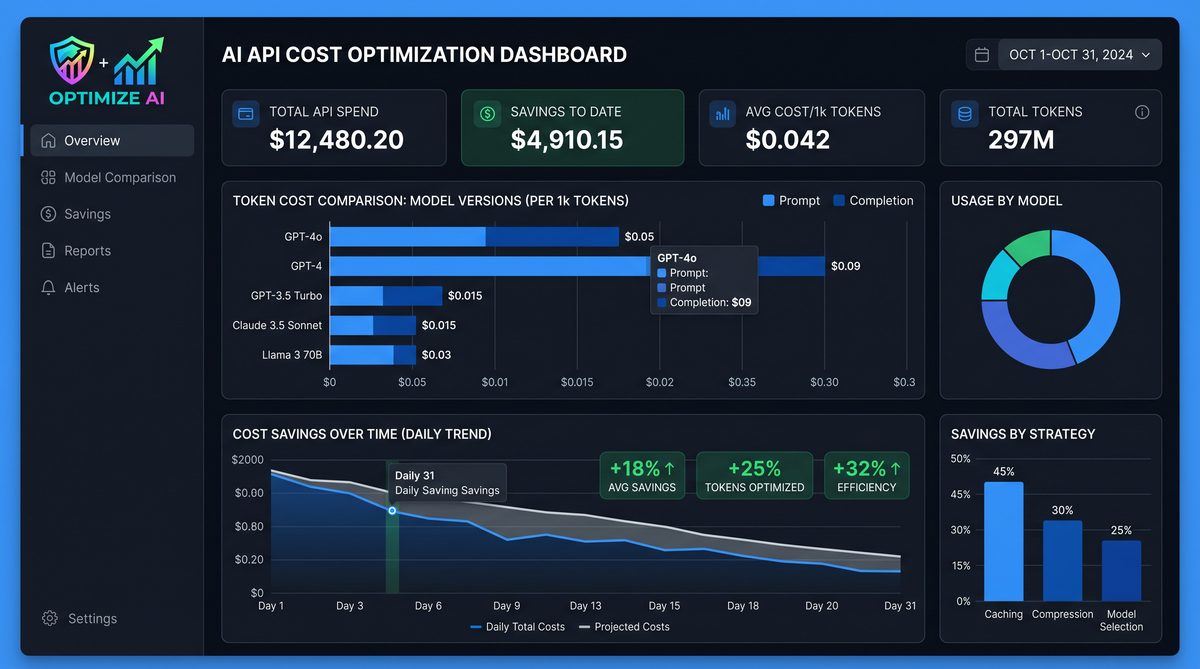
Migrating models changes token counts, pricing, and throughput. Cost optimization is multifaceted: model selection, request shaping, batching, caching, response length control, and routing policies all matter.
Understand pricing and token usage
Start by collecting accurate per-call token usage for common prompts under the new tokenizer. Token reductions (3–5%) can lead to meaningful savings at scale. Build a cost model:
# Cost calculation pseudocode
monthly_calls = 5_000_000
avg_prompt_tokens = 120
avg_response_tokens = 180
per_token_price_prompt = 0.000002  # example per token
per_token_price_response = 0.0000025
monthly_cost = monthly_calls * ((avg_prompt_tokens * per_token_price_prompt) + (avg_response_tokens * per_token_price_response))
Compare monthly_cost for GPT-5.2 vs GPT-5.5, taking into account token compression and any pricing tier differences.
Cost optimization techniques
- Prompt and template optimization:
- Shorten system and few-shot contexts where possible.
- Use dynamic context assembly: pull only the most relevant few-shot examples using retrieval augmented mechanisms.
- Use compact representations (e.g., structured JSON examples vs long natural-language examples).
- Output length control:
- Set sensible max_tokens and use stop sequences to avoid runaway responses.
- Post-process long outputs server-side to split and conditionally re-query only when required.
- Batching & multiplexing:
- Batch small requests where latency allows (e.g., in offline jobs).
- Use async workers to aggregate requests that can be answered in one multi-question prompt.
- Caching:
- Cache deterministic completions keyed by prompt + system context hash.
- Use TTLs and configurable invalidation to reduce staleness.
- Model routing:
- Route non-critical, high-volume tasks to cheaper compute-optimized variants or smaller models (GPT-5.5-lite or specialized cheaper siblings).
- Keep high-value tasks on GPT-5.5 if quality delta justifies cost.
- Adaptive temperature and sampling:
- Use higher temperature only where diversity is required; otherwise use temperature=0 or low values to reduce token count and post-processing overhead.
Example cost comparison table
| Metric | GPT-5.2 | GPT-5.5 | Notes |
|---|---|---|---|
| Avg prompt tokens | 125 | 121 | 3.2% token reduction |
| Avg response tokens | 200 | 196 | 2% reduction |
| Per token price (prompt) | $0.0000020 | $0.0000022 | New model slightly higher price |
| Per token price (response) | $0.0000025 | $0.0000026 | Example numbers |
| Monthly cost (5M calls) | $3,125 | $3,200 | Net delta influenced by token compression and price |
Practical cost optimization patterns
- Run an experiment to split traffic 80/20 between new and legacy models for one billing cycle and compare real token usage and costs.
- Introduce a cost monitoring dashboard that computes rolling 30-day cost estimates, and break down by endpoint, team, and model type. Tie automated alerts to spend thresholds.
- Combine caching and batching for repeated system prompts (for instance, common FAQ answers) to amortize cost.
Refer to internal controls best practices in
For a deeper exploration of related strategies and implementation patterns, our comprehensive guide on The Enterprise Guide to OpenAI Spend Controls and Usage Analytics: How to Monitor, Optimize, and Govern AI Costs Across Your Organization in 2026 provides detailed frameworks, step-by-step workflows, and production-ready templates that complement the approaches discussed in this section.
for governance patterns, quota management, and programmatic enforcement at the team level.
6. Phased rollout patterns: canary, shadow, and blue/green
A phased rollout minimizes customer impact. Below are practical patterns and examples you can implement in Kubernetes, Lambdas, or any orchestration system.
Canary deployment (traffic split)
– Deploy 5–10% of traffic to GPT-5.5 while the remainder uses GPT-5.2.
– Monitor error rates, latency, and quality metrics. Increase traffic incrementally to 25%, 50%, then 100% only after passing gating criteria.
– Use a feature flag service or API gateway layer capable of routing by percentage.
# Example: pseudo-feature-flag routing config
routes:
  - name: "inference_route"
    rules:
      - condition: "user.segment == 'canary'"
        upstream: "gpt-5.5-service"
      - condition: "default"
        upstream: "gpt-5.2-service"
Shadow traffic (no user impact)
– Duplicate live requests to GPT-5.5 (without sending responses to users). Log and compare outputs asynchronously.
– This provides realistic traffic without customer exposure, enabling robust A/B comparisons and detecting edge cases under full load.
Blue/green
– Deploy GPT-5.5 on the “green” environment and keep GPT-5.2 on “blue”. Switch DNS or load balancer weights at once once green validates.
– Requires rollback support to flip back quickly.
Rollback guardrails
- Define automatic rollback triggers: error rate jump >X%, p99 latency increase >Y ms, or quality metric drop >Z%.
- Automate rollback via orchestration: route traffic back to legacy environment and mark the release for investigation.
- Ensure persisted user sessions have version pinning, or design session affinity to avoid mid-session model changes causing inconsistency.
7. Rollback patterns and safety nets
Planning for rollback is as important as the migration plan. This section provides robust, tested patterns to enable safe reversal with minimal production impact.
Key rollback patterns
- Feature flags: Toggle model runtime using a feature-flag store (e.g., LaunchDarkly, Unleash). Keep the flag control path independent of the model deployment lifecycle.
- Version pinning in sessions: Store model version in session or conversation state to avoid mid-conversation switches. When rolling back, maintain backward compatibility or migrate state gracefully.
- Idempotent endpoints: Ensure that retried requests or switches do not produce duplicate side effects (e.g., billing, email sends).
- Immediate circuit breaker: Implement a circuit breaker that trips on unusual error/latency patterns and routes to fallback model or cached response.
- Shadow rollback test: Continuously test rollback path by simulating traffic to the fallback model to confirm it’s healthy and warm.
Code example: feature flag-based routing (Python)
# model_router.py
from feature_flags import get_flag
from openai import OpenAI
client = OpenAI(api_key="...")

def select_model(user_id: str):
    # flag evaluates rules; returns 'gpt-5.5' or 'gpt-5.2'
    return get_flag("inference_model", user_id, default="gpt-5.2")

def inference(user_id: str, prompt: str):
    model = select_model(user_id)
    # call inference as usual
    resp = client.responses.create(model=model, input=prompt)
    return resp.output_text
Rollback runbook (operational checklist)
- Stop the rollout and set flag to legacy model.
- Flip routing across all edge layers and ensure no stale caches hold new model responses.
- Verify that old model instances are healthy and that session affinity is honored.
- Notify stakeholders and initiate postmortem on metrics anomalies.
- Preserve logs, request IDs, and sample payloads leading to the failure for analysis.
8. Monitoring, observability, and alerting
A robust observability strategy is essential for safe migration: collect telemetry at request, model, and application levels.
Telemetry to collect
- Request ID, model name & variant, timestamp, latency (start-to-finish), and p95/p99.
- Token usage per request (prompt and response tokens).
- Quality metrics: response score, semantic similarity to expected answers, conversion or success events.
- Error types: timeouts, rate limit responses, malformed outputs (invalid JSON), and moderation flags.
- Resource metrics for inference nodes: CPU, memory, GPU utilization (if self-hosted).
Dashboards & alerts
Create dashboards with drilling capabilities for:
- Top failing prompts and owners.
- Model-level comparison (5.2 vs 5.5) with side-by-side p95 latencies and error rates.
- Token consumption by endpoint for budget enforcement.
Alerting thresholds should be defined conservatively for early detection. Example alert rules:
- Increase in error rate by >1.5x over baseline sustained for 5 minutes.
- p99 latency greater than X ms for two consecutive data points.
- Drop in average semantic similarity below threshold for top 10 high-priority prompts.
Logging and structured traces
Log payloads in structured JSON and include:
- request_id
- model
- prompt_hash
- tokens
- response_summary hash or content
- error details
Store logs in a searchable system (e.g., Elasticsearch, Splunk) and configure alerting to notify on suspicious patterns such as spikes in “invalid JSON” from function-calling.
9. Prompt engineering compatibility strategies
Prompt engineering must be handled as code. Use a set of practices to ensure prompts transition cleanly.
Prompts as code
- Store prompts in version control (Git) as templates with parameterized placeholders.
- Use a templating engine (e.g., Jinja2 or Handlebars) and include test suites for each prompt template.
- Annotate prompts with meta tags: owner, expected tokens, sensitivity flags, and test IDs.
Prompt shrinking and iterative testing
Simplify prompts where possible. For many tasks, a smaller, focused instruction often yields equal or better results. Use A/B experiments running randomized subsets to measure performance impacts.
Example: parameterized prompt template
# There should be a test suite for this template
PROMPT_TEMPLATE = """
You are a concise assistant. Given the following product description, produce a short bullet list of features emphasizing benefits.

PRODUCT: {product_name}
DESCRIPTION: {description}

Output:
-
-
-
"""

def build_prompt(params):
    return PROMPT_TEMPLATE.format(**params)
10. Test cases and QA: end-to-end examples
Below are concrete test scenarios you should implement. Each has an expected pass/fail criteria and suggested tooling.
Test scenario matrix
| Test | Tooling | Goal | Pass Criteria |
|---|---|---|---|
| Deterministic outputs on canonical prompts | pytest + harness | Ensure identical or acceptable outputs | Semantic similarity > threshold or exact match |
| Function-calling schema validation | jsonschema | Ensure functions still return valid JSON | No schema validation errors on 99% of calls |
| Latency under load | Locust | Ensure p95/p99 within SLA | p95 within baseline + X% |
| Safety and adversarial prompts | Custom test corpus | Compare moderation flagging, illicit output reduction | Safety violations do not increase |
End-to-end QA sample (Node.js)
// sample_test.js
import { runHarness } from "./test_harness.js";
import assert from "assert";

describe("GPT-5.5 migration tests", () => {
  it("deterministic response must be semantically equivalent", async () => {
    const prompt = "Summarize the following: COVID-19 vaccine efficacy data...";
    const result = await runHarness(prompt, { models: ["gpt-5.2", "gpt-5.5"], temperature: 0.0 });
    const sim = result.similarity;
    assert(sim > 0.9, "Semantic similarity below threshold");
  });

  it("function calling returns valid schema", async () => {
    const functionCallResult = await runHarnessWithFunctions(/* ... */);
    assert(functionCallResult.valid, "Function schema invalid");
  });
});
11. Regression analysis and success metrics
Define a small number of objective, measurable success criteria before migration. Examples:
- Quality: Average semantic similarity across critical prompts must be >= 0.92.
- Latency: p95 latency increase <= 10%.
- Errors: Application error rate must not exceed baseline + 0.5%.
- Safety: Moderation flags must not increase.
- Cost: Monthly spend delta must be within forecasted bounds.
Use statistical tests for analysis:
- Paired t-test or Wilcoxon signed-rank test for per-prompt score differences.
- Bootstrap for non-parametric confidence intervals on means and medians.
- Sequential testing for live canaries to detect early regressions while controlling Type I error.
12. Post-migration operations and long-term maintenance
Even after a successful cutover, you must maintain operational hygiene to ensure continued reliability.
Access 40,000+ AI Prompts for ChatGPT, Claude & Codex — Free!
Subscribe to get instant access to our complete Notion Prompt Library — the largest curated collection of prompts for ChatGPT, Claude, OpenAI Codex, and other leading AI models. Optimized for real-world workflows across coding, research, content creation, and business.
Post-migration checklist
- Lock the rollout configuration and record the model version in change logs.
- Schedule a deep quality review after 7 and 30 days to detect slow drift in correctness or user satisfaction metrics.
- Retain older model images/config for a retention period as an emergency fallback.
- Plan model retraining or prompt updates when you detect systematic deficits.
Long-term maintenance
- Automate periodic re-evaluation of prompts against the latest model versions in a sandbox.
- Version prompts and track prompt-changes as part of the CI/CD pipeline.
- Keep an index of important prompts and owners to streamline future migrations.
13. Enterprise considerations: governance, security, and compliance
Large organizations must enforce governance across departments to avoid runaway costs, inconsistent behavior, or compliance violations.
Governance and spend controls
Implement policies and automated enforcement for model usage. Tie these controls to accounting or billing centers to maintain accountability. For guidance on implementing strong governance and spend control frameworks, consult
For a deeper exploration of related strategies and implementation patterns, our comprehensive guide on The Complete Guide to OpenAI Partner Network: How to Join, Benefits, Certification, and Enterprise AI Deployment Support provides detailed frameworks, step-by-step workflows, and production-ready templates that complement the approaches discussed in this section.
.
Data handling and privacy
- Classify data sensitivity for prompts and outputs; ensure PII is flagged and redacted before sending to any external model endpoint if required by policy.
- Review retention policies for logs, model outputs, and embeddings; purge data where required by regulation.
- Use enterprise controls or VPC endpoints if processing protected information.
Security
- Rotate API keys and use automatic secret rotation.
- Use per-team or per-service API keys, with rate limits and quota enforcement.
- Use network-level controls (e.g., private link, VPC) for self-hosted or managed private deployments.
14. Sample migration timeline and checklist
An example 8-week plan for a medium-sized product with multiple endpoints:
- Week 0–1: Audit & inventory (discover model usage, owners, and risk levels).
- Week 1–2: Build test harness, collect baseline metrics.
- Week 2–3: Run offline compatibility tests (deterministic and stochastic). Triage issues.
- Week 3–4: Implement feature-flag routing and shadow traffic; integrate monitoring and dashboards.
- Week 4–5: Canary rollout (5–25% traffic) and active monitoring; escalate or roll back as required.
- Week 5–6: Expand rollout to 50–80% if metrics favorable; continue A/B/QA tests.
- Week 6–7: Full cutover; monitor for latent regressions. Keep blue environment ready for rollback.
- Week 7–8: Post-cutover review and documentation; finalize deprecation actions for legacy model.
Migration checklist (quick)
- All uses of GPT-5.2 found and annotated.
- Automated harness in place and executed.
- Feature-flag routing implemented.
- Shadow traffic executed for at least one week.
- Canary rollout metrics passed gating criteria.
- Rollback tests executed and verified.
- Cost model revalidated post-cutover.
15. Appendix: additional code snippets and utilities
Token counting utility (Python)
# token_counter.py - use the library appropriate for your tokenizer
from tiktoken import encoding_for_model

def count_tokens(text: str, model: str = "gpt-5.5") -> int:
    enc = encoding_for_model(model)
    return len(enc.encode(text))

if __name__ == "__main__":
    txt = "This is a sample prompt to test token counting."
    print(count_tokens(txt, "gpt-5.5"))
Schema validation for function-calls (Node.js)
// validate_function_response.js
import Ajv from "ajv";

const ajv = new Ajv();
const schema = {
  type: "object",
  properties: {
    action: { type: "string" },
    payload: { type: "object" }
  },
  required: ["action", "payload"]
};

export function validate(resp) {
  const validate = ajv.compile(schema);
  const valid = validate(resp);
  return { valid, errors: validate.errors };
}
Shadow traffic duplicator (architecture)
A simple shadow duplicator sits in the edge or service mesh and forwards the request to the legacy model while cloning it to the new model asynchronously. Ensure privacy policies allow duplicate calls and be mindful of quota and billing implications.
# Pseudocode for shadow duplicator
def handle_request(req):
    # synchronous call to live model
    live_resp = call_live_model(req)
    # asynchronous clone to new model for analysis
    async_task(queue_shadow, req)
    return live_resp

def queue_shadow(req):
    new_resp = call_new_model(req)
    store_comparison(req, new_resp)
16. Real-world case studies and examples
Below are anonymized examples that reflect common migration experiences observed in production deployments.
Case study: Instant answers for a search product
Scenario: A search product used GPT-5.2 to generate instant answer snippets on search results pages. Migration goals were to reduce hallucinations and improve precision while maintaining sub-200ms p95 latency.
- Audit: Found that 40% of calls used long few-shot prompts; these were a target for shrinkage.
- Test: Ran a shadow campaign for two weeks; GPT-5.5 produced fewer hallucinations with a 7% token reduction.
- Rollout: Canary of 10% traffic with immediate rollback triggers for latency spikes. After two weeks, full roll-out completed with no customer-facing incidents.
- Outcome: Improved quality score by 6%, cost increase of 2% offset by token savings from prompt shrinkage.
Case study: Customer support automation with function calls
Scenario: A customer support automation system used function-calling to generate ticket updates and trigger downstream workflows.
- Audit: Function call schemas were loosely validated in the client; GPT-5.5 added metadata that initially caused schema violations.
- Mitigation: Updated JSON schema validator to accept new metadata keys and normalized responses server-side before handing to downstream consumers.
- Rollout: Adopted feature-flag routing; executed canary, and used a shadow duplicator for 4 weeks. No regressions; full migration completed.
17. Troubleshooting common issues
Regression in factual correctness
- Run targeted tests for knowledge domains. If regressions are localized, consider using a hybrid routing approach: route domain-specific prompts to the legacy model or a specialist model while updating prompt templates for the new model.
- Use retrieval augmentation (external knowledge retrieval) to reduce model-only hallucinations.
Increased latency p99
- Investigate batching and concurrency; increase parallelism for short requests.
- Warm up inference nodes and maintain a small pool of warm containers to reduce cold start latency.
- Engage vendor support if using managed endpoints to investigate tail latency.
Function-calling / JSON mismatch
- Validate schemas strictly and add tolerant parsing to accept extra metadata fields.
- When possible, request function outputs in a strict wrapper object to simplify downstream parsing:
System prompt: "Return the function output in this exact JSON format: { "result": {...} }"
18. Conclusions and recommended best practices
Migrating from GPT-5.2 to GPT-5.5 in production is a multi-dimensional effort that touches engineering, ML, product, and operations. The recommended best practices:
- Start with a comprehensive inventory and risk profile.
- Treat prompts as code and build a test harness to compare behaviors rigorously.
- Use canary, shadow, and blue/green rollout strategies with automated rollback triggers.
- Optimize prompts and caching to control costs; monitor spend and enforce quotas via governance mechanisms.
- Update schema validators and function-calling handlers to accept new metadata fields while maintaining strict downstream contracts.
- Maintain robust observability: semantic similarity, token usage, latency, error rates, and safety flags should be visible on dashboards and actionable by alerts.
By following the procedures and examples in this guide, teams can transition safely and efficiently with a measured approach that balances quality, cost, and reliability. For deployment specifics on cloud integration options, refer to
For a deeper exploration of related strategies and implementation patterns, our comprehensive guide on How to Deploy GPT-5.5 on Amazon Bedrock for Multi-Cloud Enterprise AI: Complete Setup Guide with IAM Policies, Cost Controls, and Production Patterns provides detailed frameworks, step-by-step workflows, and production-ready templates that complement the approaches discussed in this section.
for guidance on running GPT-5.5 in managed Bedrock-like environments.
19. Migration kit: checklist and artifact templates
Below are compact artifacts to accelerate migration.
- Migration runbook (YAML): owner, start/end dates, rollback triggers.
- Prompt test suite (CSV): columns [id, owner, priority, prompt, expected_output, similarity_threshold].
- Feature flag configuration: flags per endpoint with default fallbacks.
- Monitoring dashboard template: panels for model comparison, per-endpoint spend, safety violations, SLA metrics.
- Cost calculator spreadsheet: inputs for calls, tokens, price per token, and projected monthly cost.
Example runbook YAML snippet
# migration_runbook.yaml
migration:
  name: "gpt-5.2-to-5.5"
  owners:
    - alice@company
    - ml-platform@company
  phases:
    - name: "audit"
      start: 2026-07-01
      end: 2026-07-07
    - name: "testing"
      start: 2026-07-08
      end: 2026-07-21
    - name: "canary"
      start: 2026-07-22
      end: 2026-07-29
    - name: "full_rollout"
      start: 2026-07-30
  rollback_triggers:
    error_rate_increase_pct: 50
    p99_latency_increase_ms: 200
    quality_score_drop_pct: 10
20. Final notes and recommended reading
This guide is intentionally operational and practical. Use it as a template, but adapt thresholds, tools, and timelines to your organization’s scale and risk tolerance. Continually re-evaluate models, prompts, and instrumentation—AI models and their ecosystems evolve rapidly, and successful teams are those that bake validation, observability, and governance into their core processes.
For an operational checklist on deploying GPT-5.5 in a managed cloud environment, see
For a deeper exploration of related strategies and implementation patterns, our comprehensive guide on How to Set Up GPT-5.5 and GPT-5.4 on AWS Bedrock US East: Complete Deployment Guide provides detailed frameworks, step-by-step workflows, and production-ready templates that complement the approaches discussed in this section.
. For governance controls around cost, quotas, and enterprise policy, see
For a deeper exploration of related strategies and implementation patterns, our comprehensive guide on OpenAI Frontier Platform: The Complete Enterprise Guide to Building, Deploying, and Managing AI Agents at Scale provides detailed frameworks, step-by-step workflows, and production-ready templates that complement the approaches discussed in this section.
.
Appendix: useful references and tools
- Open-source prompt testing harnesses (adapt or build): pytest, Jest, Locust.
- Embedding comparison libraries: Faiss, Annoy, Pinecone.
- Observability stacks: Prometheus + Grafana, Datadog, Splunk.
- Feature flagging services: LaunchDarkly, Unleash, internal flagging system.
