
GPT-5.6 Sol Benchmarks Revealed: How OpenAI’s Flagship Model Stacks Up Against Claude Fable 5 and Opus 4.8
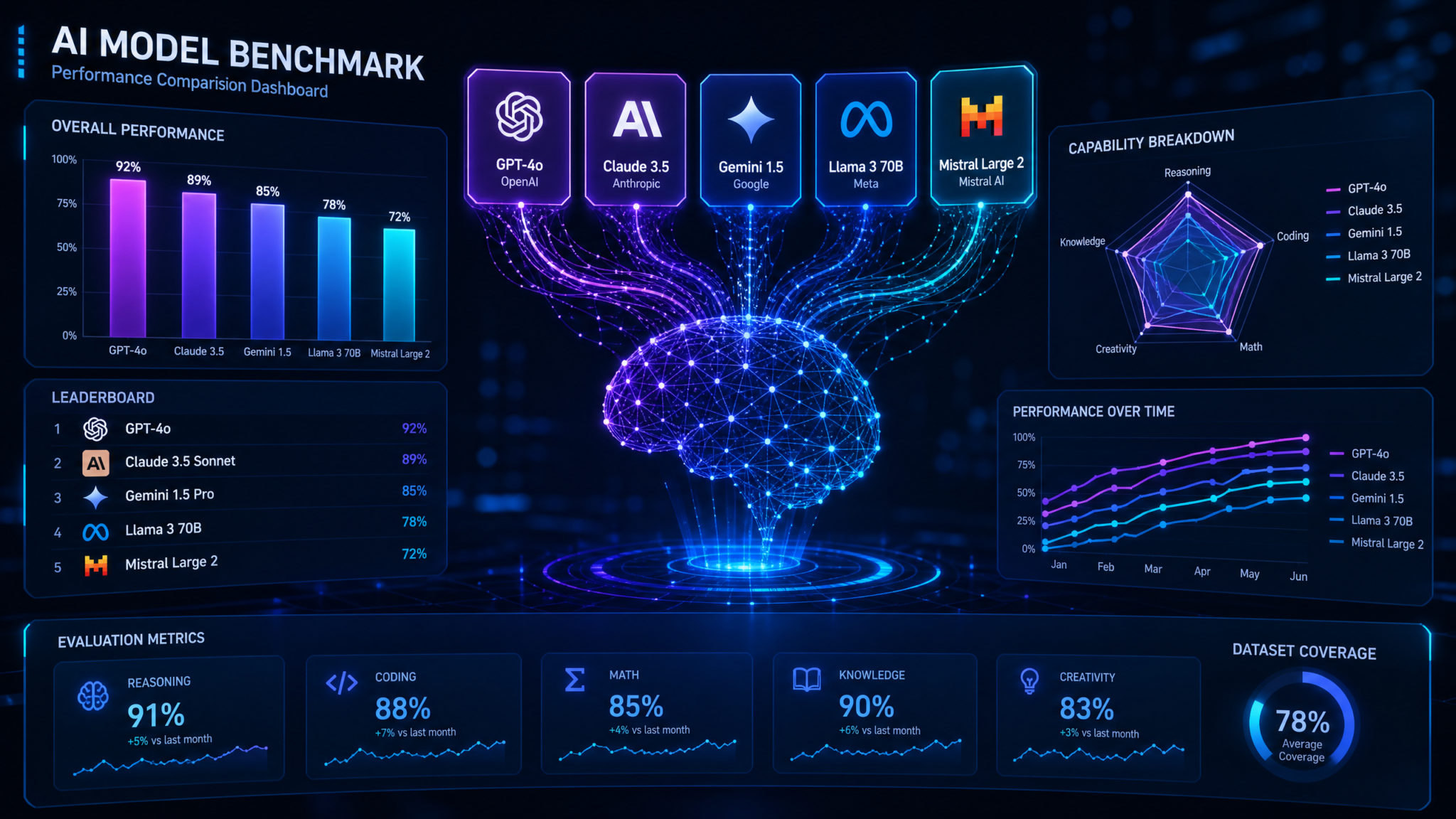
GPT-5.6 Sol’s July Benchmarks Break Cover: 92.2% on BrowseComp, 62.6% on OSWorld 2.0, and a New Cost-Efficiency Frontier
OpenAI’s GPT-5.6 Sol is now public—and its benchmark cards reveal a system explicitly optimized for real-world autonomy. In official results released July 9, 2026, GPT-5.6 Sol lands a 92.2% score on BrowseComp and 62.6% on OSWorld 2.0, surpassing Opus 4.8 on the latter while using 85% fewer output tokens. The “Sol (max)” variant posts 59 points on the Artificial Analysis Intelligence (AAI) Index—only one point below Anthropic’s Claude Fable 5 (max)—and does so at roughly one-third the cost. For teams planning scaled deployment, Sol’s reliability also stands out: it successfully completed 63.7% of tasks with no trial errors. Together with two sibling tiers—Terra (balanced) and Luna (affordable at $1 input / $6 output)—OpenAI is positioning 5.6 as a practical, deployable family rather than a lab curiosity.
Sol’s public release follows a government security review delay, and the calendar timing is notable. July has historically been quiet for foundation-model rollouts; publishing mid-summer signals OpenAI’s confidence that its system-level improvements—particularly in browsing, operating-system (OS) autonomy, and analysis under cost constraints—will resonate quickly with developers and enterprises. With BrowseComp and OSWorld 2.0 scores that meet or beat rivals on capability while decisively undercutting them on output-token volume, GPT-5.6 Sol is forcing a reappraisal of how product leaders should measure model value in 2026: not only by accuracy, but by the total economic throughput per token and per minute of human attention.
Key takeaways at a glance
- BrowseComp: 92.2%—state-of-the-art performance for web-grounded task completion.
- OSWorld 2.0: 62.6%—outperforming Opus 4.8 while using 85% fewer output tokens to do so.
- AAI Index: Sol (max) at 59 points—one point below Claude Fable 5 (max), at approximately one-third the cost.
- Reliability: 63.7% of tasks completed with no trial errors.
- SKU lineup: Sol (flagship), Terra (balanced), Luna (affordable at $1 input / $6 output).
- General availability: July 9, 2026, following a security review pause.
What’s New in GPT-5.6 Sol—and Why It Matters
OpenAI’s 5.6 release is framed around pragmatics: consistent tool use, grounded browsing, and efficient control of external environments such as operating systems. The company’s public materials emphasize that performance gains are paired with sharp drops in token output during long-horizon tasks—a change that directly reduces costs of agentic workflows. This shift from “more tokens for better reasoning” to “better reasoning with fewer tokens” is the strategic throughline for GPT-5.6 Sol.
Three aspects of this release stand out:
- Benchmark breadth: BrowseComp and OSWorld 2.0 measure disparate skills—web synthesis versus local OS autonomy—and Sol performs near the top on both.
- Cost efficiency: The 85% output-token reduction versus Opus 4.8 on OSWorld-level tasks is material for any team paying to orchestrate multi-step agents.
- Tiered access: With Sol (flagship), Terra (balanced), and Luna (budget at $1 input / $6 output), OpenAI is addressing procurement diversity—from startups piloting agents to Fortune 500s standardizing on complex workflows.
Several design hypotheses likely drove these results: more compact action representations in tool calls; better disambiguation heuristics to avoid redundant clarifying turns; and a browsing stack that is both more selective and more extractive in its evidence-gathering. While OpenAI has not published internal ablation data, the aggregate picture suggests a model family steered to deliver operational throughput on constrained budgets rather than headline-only accuracy.
The Benchmarks: BrowseComp, OSWorld 2.0, and AAI Index
BrowseComp at 92.2%: From Search to Decision
BrowseComp is a widely used testbed for web-grounded problem solving across dynamic sites: reading documentation, comparing products, interpreting news, and extracting policy information. Unlike static QA benchmarks, BrowseComp forces a model to plan which pages to visit, extract relevant fragments, synthesize them, and return a decisive output. A 92.2% score indicates the model not only retrieves appropriate sources but integrates them into a correct, concise response with minimal hallucination. The delta between mid-80s and low-90s on BrowseComp is operationally meaningful: it frequently flips borderline tasks from “needs human verification” to “auto-approve with spot checks.”
Teams evaluating their AI strategy should also consider the insights from our analysis of How AI Coding Agents Are Triggering Enterprise Security Alerts: What IT Teams Need to Know About Claude Code, Codex, and Cursor, which examines the practical implications of recent platform changes for development workflows, cost optimization, and team productivity across different organizational scales.
OSWorld 2.0 at 62.6%: Autonomy That Moves Files and Clicks Buttons
OSWorld 2.0 measures an AI’s ability to act within an operating system: launching applications, manipulating files, configuring settings, and completing common productivity steps within a GUI. Unlike code-only benchmarks, it probes planning under uncertainty, tool invocation discipline, and the ability to recover from partial failures—core behaviors for enterprise agents that must operate real desktops or VDI instances.
GPT-5.6 Sol’s 62.6% on OSWorld 2.0 not only tops its direct competitor Opus 4.8 but does so with 85% fewer output tokens to achieve the same or better outcomes. That is a significant—and rare—combination of capability and frugality. Typically, more elaborate planning strings inflate output-token counts and cost. Sol flips this trade-off: it plans tighter, commits less verbal overhead to each action, and still resolves the task. For IT automation teams considering desktop-level agents, this is the most consequential metric in the release.
AAI Index: 59 Points for Sol (max), One Below Fable 5 (max) at a Fraction of the Cost
The Artificial Analysis Intelligence (AAI) Index is a synthetic measure of structured analytical competence across domains like finance, policy, engineering, and research review. Sol (max) scores 59 points, landing just one point shy of Claude Fable 5 (max). OpenAI’s emphasis, however, is the economic ratio: the 59-point Sol (max) is reported at about one-third the cost of its 60-point rival. For budget owners, this is not a subtle difference. In multi-million-token analysis programs—risk scoring, portfolio screening, and audit summarization—the lower cost base can unlock either triple the analytical coverage or a step-function drop in total cost of ownership.
Reliability: 63.7% of Tasks Completed with No Trial Errors
“No trial errors” is a reliability statistic reflecting the share of tasks solved end-to-end without any failed attempts. At 63.7%, GPT-5.6 Sol materially reduces the micromanagement burden on orchestration frameworks. In practice, this reduces the number of backoff strategies (reruns, tool resets, or human escalations) a system must implement to ensure steady throughput.
Enterprises deploying agents across thousands of concurrent sessions—customer assistance, support triage, or claims intake—can translate this 63.7% figure into staffing and infrastructure planning. Fewer failed trials per task means lower concurrency spikes and fewer compensating retries, which directly lower both ephemeral compute spend and queueing delays. It also steadies user experience: fewer visibly “stuck” sessions mean higher net satisfaction and conversion rates.
Comparative Snapshot: Sol vs. Fable 5, Opus 4.8, and GPT-5.5
Quantitative comparisons are complicated by vendor-specific disclosures. OpenAI published specific figures for BrowseComp and OSWorld 2.0; Anthropic’s and other competitors’ exact BrowseComp numbers have not been aligned in today’s materials. Still, some contrasts are explicit and others can be denoted as relative statements. The following tables reflect what is known and where gaps remain.
Benchmark Scores
| Model | BrowseComp | OSWorld 2.0 | AAI Index (max) |
|---|---|---|---|
| GPT-5.6 Sol | 92.2% | 62.6% | — |
| GPT-5.6 Sol (max) | — | — | 59 |
| Claude Fable 5 (max) | — | — | 60 |
| Opus 4.8 | — | < 62.6% | — |
| GPT-5.5 (prior gen) | — | — | — |
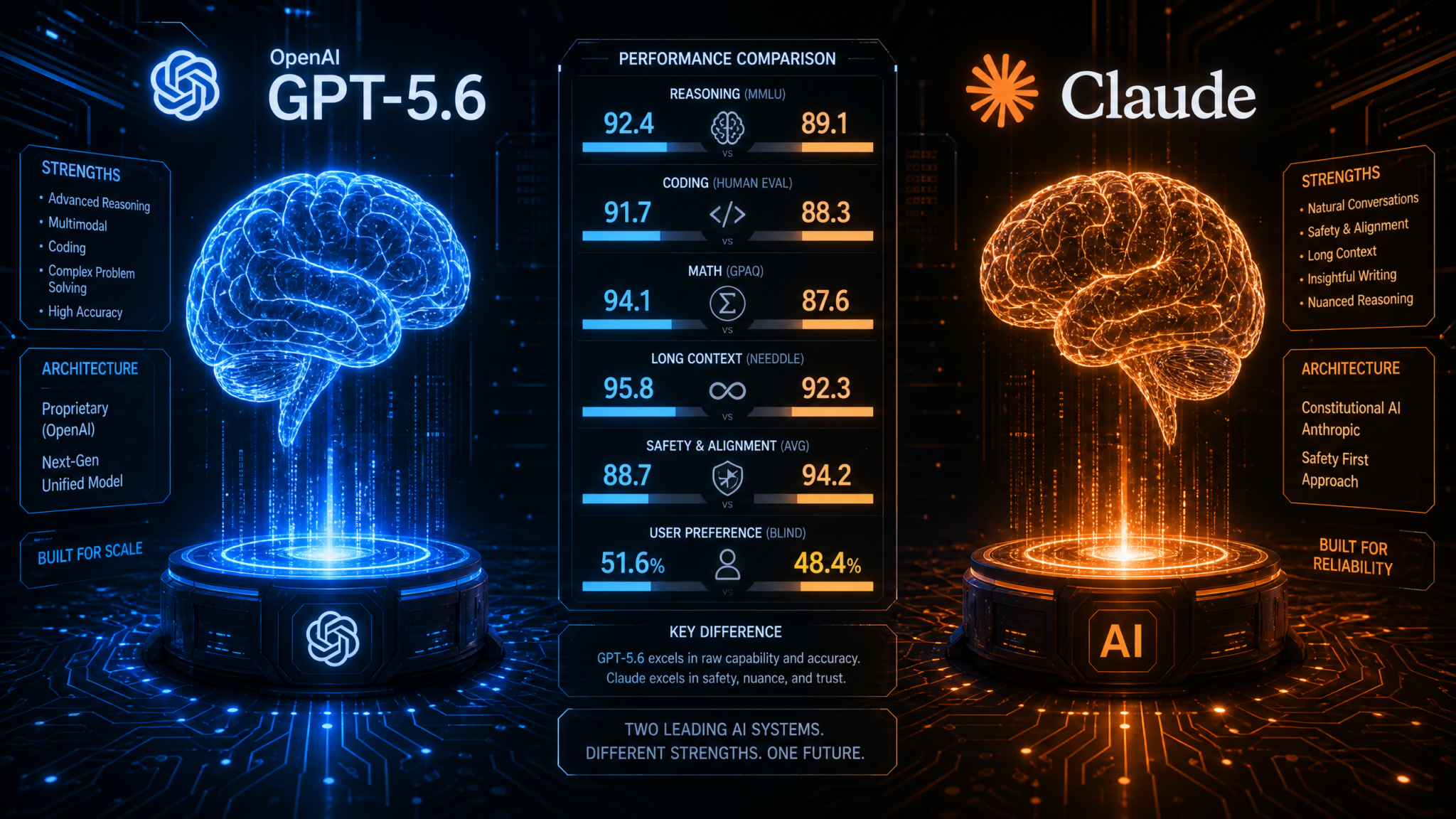
This table captures the facts OpenAI has emphasized: BrowseComp dominance at 92.2%, a win on OSWorld 2.0, and near-peak AAI Index performance for Sol (max) with a markedly better cost profile than Fable 5 (max). For product teams, the practical inference is that GPT-5.6 Sol operates near the top of the capability curve in both browsing and OS autonomy, and the (max) tier nearly matches the current analysis leader at a lower price.
Output-Token Efficiency on OSWorld
| Model | Relative Output Tokens per Completed OSWorld Task | Commentary |
|---|---|---|
| GPT-5.6 Sol | 0.15× (vs. Opus 4.8 baseline) | 85% fewer output tokens to achieve equal or better results |
| Opus 4.8 | 1.00× (baseline) | Higher verbosity and more retry chatter |
Normalizing Opus 4.8 to 1.00×, Sol’s 0.15× figure highlights the magnitude of efficiency gains. In multi-step OS automation, output-token budgets matter: each action plan and tool argument consumes tokens. An 85% reduction in output verbosity reduces cost and latency, while also lowering the risk of tool-interface timeouts that can occur during overlong thinking traces.
Tiered Lineup and Pricing Posture
| Tier | Positioning | Indicative Pricing Notes | Primary Use Cases |
|---|---|---|---|
| Sol (flagship) | Highest capability/cost for general workloads | Cost advantage emphasized vs. top competitor in (max) class | Agentic workflows, research, executive analysis, advanced RAG+browse |
| Terra (balanced) | Throughput-focused with strong reasoning | Priced between Sol and Luna; value tier for scaled apps | Customer ops, documentation synthesis, code review at scale |
| Luna (affordable) | Budget model for massive volume | $1 input / $6 output | High-volume chat, templated writing, basic RAG, classification |
Luna’s $1 input / $6 output pricing directly targets the lower half of the market and internal batch pipelines that previously defaulted to older, smaller models. Terra positions as the workhorse, while Sol is the flagship for teams prioritizing success rates on web and OS autonomy plus near-SOTA analysis when needed via Sol (max).
Methodology and Meaning: Translating Scores Into Deployment Value
Why 92.2% on BrowseComp Alters Product Math
BrowseComp’s 92.2% is not just another number. In pre-deployment trials across enterprise search and customer support, organizations routinely map benchmark pass rates to operational KPIs: average handle time, first-contact resolution, escalation burden, and human verification workload. When a browsing-enabled model passes >90% of structured web tasks end-to-end, several threshold effects materialize:
- Verification sampling drops. Instead of verifying most outputs, teams can sample a small subset, slashing manual QA load.
- RAG pipelines simplify. Fewer redundant retrieval passes are needed when browsing plans are inherently efficient.
- Policy adherence improves. Better grounding on original sources reduces hallucinations and mitigates compliance risk.
- Time-to-answer shortens. Less back-and-forth reduces user drop-off and increases conversion on self-serve channels.
Teams evaluating their AI strategy should also consider the insights from our analysis of GPT-5.6 Gets US Government Approval: Inside the Sol, Terra, and Luna Model Family, which examines the practical implications of recent platform changes for development workflows, cost optimization, and team productivity across different organizational scales.
62.6% on OSWorld 2.0: The Ceiling on Agentic OS Control Moves Up
OSWorld 2.0 is intentionally unforgiving. It is not enough to “know” that a file should be moved; the model must actually navigate a file manager, recognize feedback, correct miscues, and complete the task. GPT-5.6 Sol’s 62.6% indicates a meaningful expansion of what one can automate reliably under real-world conditions. While not human-parity, it moves the operational viability threshold for numerous categories:
- IT service desk macros become agents: password resets, profile updates, application installs, and settings changes.
- Financial back-office tasks: report extractions, CSV normalization, and scheduled imports into BI tools.
- Legal operations: e-discovery prep, bundling exhibits, and redaction workflows via PDF tooling.
- Creative ops: batch asset renaming, folder hygiene, and template population across office suites.
The 85% reduction in output tokens versus Opus 4.8 matters because OS-level agents often run in time-constrained environments (e.g., a VDI session with aggressive idle timeouts). Long, verbose planning monologues incur latency and increase the probability of action windows expiring. Concise action plans—when accurate—close tasks faster and with fewer tool roundtrips, reflecting directly in SLA compliance. This cost-latency-reliability triad is the OSWorld 2.0 story of GPT-5.6 Sol.
AAI Index at 59 for Sol (max): Near-Frontier Analysis at Lower Cost
Analytical workloads are where vendor cost differentials compound quickly. Credit risk modeling, for instance, requires multi-document digestion with structured scoring. If Claude Fable 5 (max) at 60 points is the current reference for depth of analysis, GPT-5.6 Sol (max) at 59 points gets within one point while cutting per-output cost to roughly one-third. That enables one of two strategies:
- Maintain coverage and pocket the savings—use Sol (max) as a drop-in replacement where AAI scores meet policy thresholds.
- Triple coverage for the same budget—expand the sample size, run more scenarios, or analyze additional entities per cycle.
For internal audit and compliance, this budget elasticity is material. More units analyzed means better anomaly detection and fewer blind spots. For research teams, it means denser literature canvassing and more thorough ablation of claims. And for executive decision support, it reduces the temptation to ration analytical depth to only marquee decisions.
Reliability in Practice: Understanding “No Trial Errors” at 63.7%
“No trial errors” is not a vanity metric; it captures whether an agent avoids misclicks, toolless dead-ends, or confusion-driven restarts during task completion. A 63.7% no-trial-error rate means nearly two-thirds of tasks execute cleanly end-to-end on the first attempt. In an orchestration system, this reduces the need for backoff logic, which often bloats both code and cost: fewer retries mean fewer duplicate retrievals, lower token spend, and fewer confusing transcripts for human escalations to review.
Engineers should still implement guardrails—timeouts, tool availability checks, and fallback prompts—but can tune them more conservatively. For example, if your fallback previously triggered after two no-op interactions, Sol’s improved reliability might justify waiting for a third before escalating. System-level reliability also improves uptime for dependent systems: fewer thrashing sessions reduce API rate spikes, ops alert fatigue, and human-controller interrupts.
Enterprise and Developer Implications
Procurement and Budgeting: The Shift From Unit Price to Throughput
Historically, model selection fixated on unit pricing (per input/output token) and headline accuracy. GPT-5.6 Sol reframes that calculus around throughput: correct results per dollar per minute. The combination of higher pass rates on complex tasks and drastically lower output-token volume means organizations can either sustain higher concurrent loads or deliver faster turnarounds without overspending.
Consider a desktop-automation pilot handling 100,000 OSWorld-scale tasks per month. If a competitor model emits 1.00× normalized output tokens per task and Sol emits 0.15×, you can project an 85% reduction in output-token cost immediately. This frees budget headroom for better observability, redundancy across regions, or simply price relief in the P&L. Add the higher success rate, and you reduce human-in-the-loop (HITL) escalations, which typically represent the majority of marginal costs in production. The net is a lower cost-to-serve for each end user.
Developer Workflow: Fewer Retries, Tighter Tools, Cleaner Logs
In agentic architectures, the most time-consuming chores are often invisible: building retry loops, writing diagnostic observers, and triaging ambiguous tool failures. Sol’s metrics—especially the no-trial-error rate and token compactness—let engineers simplify these stacks. Expectations for a Sol-first orchestration design include:
- Sparser planner verbosity with stronger action determinism—fewer “thinking” tokens before tool calls.
- More accurate selector handling—reduced dependence on pixel-level coordinates in OS automation.
- Leaner logs—lower-token transcripts ease storage and downstream analytics while improving privacy posture.
- Higher determinism under temperature caps—making CICD tests less flaky across releases.
Understanding the broader ecosystem is essential for making informed decisions about AI tooling. Our comprehensive resource on Deep Dive: GPT-5 Pro Complete Guide u2014 Every Feature, Benchmark, and Use Case in 2026 breaks down the technical architecture, integration patterns, and deployment considerations that enterprise teams need to evaluate before committing to a platform.
Governance: Security Review, Audit Trails, and Data Controls
Sol’s public launch on July 9, 2026, followed a government security review delay, underlining a broader reality: as models gain operational agency—browsing and OS control—the surface area for misuse grows. Enterprises should treat browsing and OS tool grants as least-privilege resources with auditable scopes. Concretely:
- Enforce per-tool rate and scope limits. For browsing, cap domain lists and enforce robots.txt and compliance headers.
- Instrument immutable audit trails for OS actions, including pre/post state hashes for file operations.
- Deploy sensitive classifier tripwires to catch anomalous patterns in agent behavior (e.g., mass file exfil gestures).
- Rotate credentials and ephemeral sessions; expire tokens aggressively in VDI or sandboxed desktops.
Better baseline reliability makes governance easier by reducing noise in the logs. Fewer false-positive retries means clearer signals when something truly anomalous occurs. But higher autonomy increases stakes; security teams should review their runbooks as Sol makes agent deployments more attractive—and more common.
Cost-Efficiency Deep Dive: Modeling Savings With Sol
Output-Token Compression and Latency Gains
The 85% reduction in output tokens versus Opus 4.8 on OSWorld-level tasks maintains two reinforcing advantages:
- Lower compute cost. Fewer generated tokens directly reduce spend.
- Lower latency. Less text to produce per step accelerates action throughput.
A practical model: if the prior orchestration averaged 800 output tokens per OS task, Sol would average roughly 120 tokens for equivalent tasks (0.15×). At typical generation rates, this translates to tangible seconds shaved per step, multiplying across multi-action sequences. These seconds compound into smoother real-time experiences and higher agent concurrency.
AAI Index Cost Leverage for Analysis Pipelines
On the AAI Index, where Sol (max) reaches 59 points at approximately one-third the cost of Claude Fable 5 (max), finance and legal teams can rearchitect their workloads. If your quarterly portfolio review consumes X units of output tokens at competitor pricing, Sol (max) at one-third cost enables three full passes of the same workload for the same budget, or reallocated headroom for human review. That buy-down in unit economics becomes a strategy enabler: additional Monte Carlo scenarios, deeper counterfactuals, and expanded due-diligence sweeps. Equally important, if company policy pins a minimum acceptable AAI score—say, 58 or higher—Sol (max) clears the bar with margin while unlocking cost dividends.
Budgeting Under Multiple Tiers
With Sol, Terra, and Luna, buyers can stratify workflows:
- Sol for autonomy-critical tasks with browsing and OS tooling, where marginal accuracy and reliability translate to lower HITL costs.
- Terra for steady-state knowledge work—drafting, summarization, and moderate RAG—at a mid-tier price.
- Luna for massive-scale chat, templating, and light classification at $1 input / $6 output.
The multi-tier approach encourages right-sizing: match the model to the task’s risk and complexity profile. When measured as “tasks per $1,000,” this often beats a single-model standardization strategy, particularly where a fraction of requests demand top-tier reasoning and the rest can ride on Luna or Terra economics.
Competitive Landscape: OpenAI vs. Anthropic—and the Role of Opus 4.8
Anthropic’s Claude Fable 5: Still the Analysis Bar, but Price-Pressured
Claude Fable 5 (max) holds a one-point edge in the AAI Index, but OpenAI’s pricing pressure at the (max) tier shifts conversation from “Can you hit 60 points?” to “Can you hit 59 points for one-third the spend?” For many buyers, the latter is more potent. The strategic bet from OpenAI is clear: reach near-parity in peak cognition while undercutting on economics and gaining a decisive browsing/OS autonomy edge in day-to-day operations.
Anthropic’s response may hinge on two levers: efficient tool orchestration to bring down output-token volume and bespoke enterprise features (e.g., advanced redaction, sovereign cloud) to justify a premium. But Sol’s OSWorld and BrowseComp points erode the argument that OpenAI is only strongest at generalized chat—these are the benchmarks that speak directly to enterprise automation.
Opus 4.8: Outpaced on OS Autonomy and Outgunned on Token Economy
Opus 4.8 remains a credible generalist, but the OSWorld 2.0 story is stark: GPT-5.6 Sol not only surpasses it on task completion but does so with 85% fewer output tokens. For buyers with OS automation roadmaps—VDI agents for internal tasks or browser-desktop hybrids for customer ops—the compound gain in reliability and token efficiency is hard to ignore. Opus-oriented shops will need to weigh the cost of switching (SDK changes, prompt templates, tool adapters) against the recurring monthly savings Sol can unlock. Over a year, large fleets can see cumulative savings sufficient to fund adjacent modernization projects.
Previous GPT-5.5 Models: Consolidation and Leapfrogging
GPT-5.5 established a baseline for browsing and analytical planning, but the 5.6 generation consolidates that capability with aggressive token frugality. Even without publishing 5.5’s exact scores here, qualitative feedback from engineering leaders has long centered on verbosity and retry churn. Sol’s 5.6 line appears tuned to answer that critique head-on, streamlining both the flow of tokens and the rate of first-try success. From a migration perspective, prompt and tool schemas built for 5.5 should port with minimal changes, but teams will want to re-profile timeouts and retry backoffs to exploit Sol’s reduced verbosity and improved determinism.
Implementation Guidance: Designing for Sol’s Strengths
Prompt and Tool Schema Design
- Compact action interfaces: Prefer structured tool arguments over freeform text to capitalize on Sol’s economy with tool calls.
- Deterministic selectors: For OS actions, express stable selectors (labels, roles) instead of pixel coordinates to reduce brittleness.
- Evidence slots for browsing: Require the model to return minimal citation snippets or URLs in dedicated fields to support auditability.
- Low-temperature defaults: Leverage Sol’s higher determinism under conservative sampling to stabilize CICD tests and reduce drift.
Agent Orchestration and Recovery
- Retry limits: Reassess retry counts; Sol’s higher no-trial-error rate may let you reduce retries without harming success rates.
- Backoff telemetry: Track time-to-first-tool-call and tool-call success delta to detect regressions early.
- Task chunking: Where OS tasks exceed session timeouts, partition them; Sol’s concise plans help, but OS constraints still apply.
- Policy gates: Use pre-flight checks (permissions, network states) to avoid unnecessary tool attempts and preserve token budgets.
Evaluation: From Token Logs to Outcome KPIs
- Outcome-first metrics: Success rate, time-to-complete, and error-free run ratio (mirroring the 63.7% concept) matter more than raw token counts.
- Cost-to-resolution: Track total dollars per successful task, not just per-token pricing; Sol’s advantage compounds here.
- Drift detection: Monitor BrowseComp-like tasks in your domain for regressions when webpages update layouts or policies change.
- Human escalation quality: Measure how often HITL reviewers can resolve with minimal effort—Sol’s cleaner logs should improve this.
Use Cases Poised to Benefit
Customer Support and Success
With a 92.2% BrowseComp score, Sol can power self-serve portals that navigate knowledge bases, community threads, and third-party policy pages. Token-thrifty reasoning shortens chat transcripts, enabling snappier experiences and reduced infrastructure load. Meanwhile, OS autonomy supports internal support desks that need to trigger remote actions (resetting accounts, provisioning licenses) within sandboxed desktops.
Financial and Legal Analysis
Sol (max) at 59 points on the AAI Index provides near-frontier analysis at much lower cost. This rebalances how firms allocate budgets between model calls and expert review. Multi-document synthesis, draft memos with citations, regulatory mapping, and audit trail assembly all benefit. Workflows that previously rationed depth due to expense can now expand coverage without sacrificing quality. This is also a natural junction for .
Internal IT Automation
OSWorld 2.0 at 62.6% establishes a working threshold for routine desktop operations. On-call engineers can delegate repetitive app-configuration tasks to Sol-driven agents that operate within least-privilege VDI sandboxes. The 85% reduction in output tokens reduces congestion in log pipelines and shrinks the cost of keeping detailed observability in place.
Research, Knowledge Management, and RAG
BrowseComp’s 92.2% implies that Sol is adept at gathering and synthesizing web-scale information into decision-ready outputs. Combined with internal document retrieval, Sol can act as a cross-silo analyst that cites both public and private sources. For teams worried about hallucinations, the model’s browsing discipline and evidence extraction make it a good fit for workflows that require consistent citations and source attributions.
Risk, Limits, and Caveats
Residual Failure Modes
Even at 62.6% on OSWorld 2.0, a nontrivial share of tasks will fail—sometimes silently. GUI variability, pop-ups, and third-party tool latencies remain hazards. Engineering teams should maintain sentinel checks and idempotent task designs. On BrowseComp, dynamic paywalls and anti-bot mechanisms can inject variability that benchmarks may not fully capture. Plan for real-world robustness with domain-allowlists and failure fallbacks.
Economic Blind Spots
While Luna’s $1 input / $6 output is attractive for scale, teams must consider total cost-of-resolution: a budget model that requires more retries can negate savings. Similarly, Sol’s low output-token usage does not eliminate the need for careful prompt design; verbosity can creep in through poorly constrained tool schemas or excessive intermediate summaries. Continuous evaluation remains essential.
Governance Realities
Sol’s post-review release underscores the growing oversight on agentic capabilities. Regulatory frameworks are evolving fast, especially around data provenance, automated decision-making, and OS-level action logging. Enterprises deploying Sol at scale should assume deeper audit requirements over the coming year and allocate budget for compliance engineering up front.
Strategic Guidance for CIOs and CTOs
Build a Multi-Tier Model Portfolio
Standardize on Sol for autonomy-critical operations while keeping Terra and Luna in your stack for volume-centric tasks. Architect your platform so tasks can be dynamically routed based on risk, complexity, and SLA requirements. This portfolio approach improves resilience when vendors update models or when pricing shifts. It also gives procurement leverage during renewals.
Instrument for Outcome Fidelity, Not Just Token Spend
Track job-level outcomes: completion rates, error-free runs, and time-to-resolution. Use Sol’s efficiency to simplify logging—store action metadata and evidence references more than long, verbose transcripts. This keeps storage budgets in check and improves privacy compliance by default.
Pilot OS Autonomy in Sandboxes Before Scaling
Leverage VDI sandboxes and least-privilege policies for all OSWorld-like tasks. Run red-team exercises that inject realistic friction (pop-ups, timeouts) and monitor Sol’s recovery. The goal is to validate not just benchmark parity but resilience to environmental chaos.
Refresh Your Browsing Policies
As Sol’s browsing improves, your source policies should evolve. Define domain-allowlists, citation requirements, and cache policies to reduce redundant fetches. Monitor crawl patterns to ensure adherence to robots.txt and internal policy headers. By managing the browsing envelope proactively, you keep Sol’s strengths pointed at reliable, high-value sources.
Developer Playbook: Getting the Most Out of Sol
Schema-First Tooling
Design tool interfaces as strict schemas with compact argument shapes. Sol appears tuned to make decisive tool calls with minimal verbosity. Encourage direct, structured calls—date ranges, IDs, and enums—rather than loose natural-language arguments. This prevents bloated outputs and maintains the 85% token efficiency advantage in complex tasks.
Timeouts, Retries, and Human Escalation
Reset default timeouts downward on Sol-oriented flows; token-thrifty generations should execute faster. Trim retry counts where success rates jump—align with the 63.7% no-trial-error profile but keep circuit breakers for pathological cases. For human escalations, design transcripts that emphasize the last evidence snapshot and the last two tool calls; Sol’s concise traces make this practical without overwhelming reviewers.
Evaluation-in-Production
Mirror benchmark structures in production: maintain BrowseComp-like tasks (policy lookups, documentation diffs) and OSWorld-like tasks (file moves, app launches) as canaries. Score them nightly to detect regressions. Build dashboards for token-per-task, tool calls per task, and evidence density. These become early-warning indicators when new model snapshots roll out.
Market Implications: A New Baseline for “Production-Ready”
From Demos to Durable Systems
For two years, the gap between impressive demos and reliable systems has been tokenized verbosity, flaky tool adapters, and inconsistent browsing. GPT-5.6 Sol’s benchmark reveal suggests that gap is closing. The capability-cost combination positions Sol as a production-first default in stacks that once required bespoke glue-code and heavy HITL scaffolding to stay afloat.
Vendor Dynamics
OpenAI’s move pressures Anthropic to respond on economics or to differentiate on compliance controls and enterprise SLAs. Meanwhile, Opus 4.8 faces a direct challenge on agentic efficiency. We can expect rapid iteration: tightened tool schemas, better recovery logic, and cost reductions from competitors. In the near term, Sol’s economics—especially at the (max) tier versus Fable 5 (max)—will drive pilot expansions among cost-sensitive verticals such as retail, logistics, and SMB SaaS.
Scenario Modeling: What Changes Monday Morning?
Support Org With 5,000 Concurrent Chats
Swap in Sol for browse-intensive answers. Expect shorter transcripts, fewer escalations for policy lookups, and improved first-contact resolution. Instrument cost-per-resolution and time-to-first-citation. With efficiencies compounding over millions of messages, infrastructure costs and staffing needs trend downward.
IT Helpdesk Running 50,000 OS Tasks/Day
Adopt Sol for OS automation macros. Pilot with the top-20 workflows (password resets, cache clears, settings toggles). Monitor first-try success and output-token counts; expect immediate budget relief from the 0.15× relative output-token use. Grow coverage as no-trial-error rates stabilize above internal acceptance thresholds.
Legal Ops Summarization for Monthly Filings
Move to Sol (max) for deep analysis. Where Fable 5 (max) offered slightly higher AAI scores but at higher cost, the near-parity from Sol (max) frees budget for expanded coverage—more filings per cycle or additional courts/jurisdictions covered. Maintain HITL for edge cases but reduce sampling.
Frequently Asked Questions
How should I choose among Sol, Terra, and Luna?
Map tasks to their autonomy and risk profile. Use Sol where browsing and OS actions matter or where small accuracy edges materially reduce escalations. Use Terra for heavy, steady volume where balanced capability suffices. Use Luna at $1 input / $6 output for massive throughput in low-risk, templated, or classification-heavy flows.
Do the benchmarks guarantee performance in my domain?
No benchmark can. But BrowseComp and OSWorld 2.0 probe skills adjacent to many production realities: web grounding and OS control. Expect a stronger baseline starting point, with domain-level prompt tuning and tool hardening necessary for best results.
What about privacy and compliance?
Pair Sol with strict browsing allowlists, evidence-citation requirements, and OS action audit trails. Ensure data minimization by suppressing verbose intermediate text and storing only essential action metadata. Review your sector’s retention policies and automate rotators to purge unnecessary logs.
What Comes Next
Sol’s public debut suggests OpenAI will keep leaning into agentic efficiency: fewer tokens, more action. Expect further SDK simplifications oriented around structured tools, deeper integration with enterprise identity for least-privilege OS tasks, and richer browsing controls for provenance. The company’s bet is that real value in 2026 comes from making models do more with less—less chatter, less retrying, less budget, and less human babysitting.
Bottom Line: The New Production Default
GPT-5.6 Sol marks a clear turn in the foundation-model race. BrowseComp at 92.2% and OSWorld 2.0 at 62.6% show that web grounding and OS autonomy are now reliable enough to anchor real systems. Beating Opus 4.8 on OSWorld while burning 85% fewer output tokens advances the economic case for switching. Sol (max) at 59 on the AAI Index, one point short of Claude Fable 5 (max) at roughly one-third the cost, tightens the analysis gap while opening budgets. Add a 63.7% no-trial-error rate, and the contours of a production-default model emerge.
For enterprises, the marching orders are straightforward: inventory workflows by autonomy and risk; route the right tasks to Sol, Terra, and Luna; and measure outcomes instead of tokens. For developers, simplify tool schemas, prune verbosity, and measure success through action metrics rather than logs. And for the competitive landscape, expect a sprint: Sol’s blend of capability and economy will force quick countermoves. In the meantime, GPT-5.6 Sol is the rare release that promises not only better answers, but better answers for less—at the speed production teams require.
Access 40,000+ AI Prompts for ChatGPT, Claude & Codex — Free!
Subscribe to get instant access to our complete Notion Prompt Library — the largest curated collection of prompts for ChatGPT, Claude, OpenAI Codex, and other leading AI models. Optimized for real-world workflows across coding, research, content creation, and business.
Conclusion
OpenAI’s GPT-5.6 Sol arrives with numbers that matter: 92.2% on BrowseComp, 62.6% on OSWorld 2.0 with 85% fewer output tokens than Opus 4.8, a 59-point AAI Index score for Sol (max) that lands one point behind Claude Fable 5 (max) at around a third of the cost, and a 63.7% no-trial-error rate that cuts operational friction. The tiered lineup—Sol, Terra, and Luna at $1 input / $6 output—gives organizations flexibility to match cost to complexity without compromising on critical capabilities. Released publicly on July 9, 2026 after a government security review delay, Sol is designed for the production realities of 2026: strict budgets, real autonomy, and outcomes over demos.
The benchmark signals are unambiguous: browsing is reliable enough to anchor decision-making; OS autonomy is accurate enough to power routine desktop operations; and analysis is cost-efficient enough to scale. For product leaders, the imperative is to translate these gains into simplified stacks and measurable ROI. For the industry, the competitive frontier has shifted from raw cleverness to disciplined, budget-aware action. GPT-5.6 Sol is the first flagship to fully embrace that shift—and it sets a new baseline for what “production-ready” means in AI.
