
GPT-6 Astra Explained: How OpenAI’s Unreleased Model Solved 10 Unsolved Math Problems and What It Means for AGI
GPT-6 Astra Explained: How OpenAI’s Unreleased Model Solved 10 Unsolved Math Problems and What It Means for AGI
In what may be the most consequential AI development since the release of GPT-4, OpenAI’s closely guarded Astra model family — tentatively identified as the foundation for GPT-6 — has reportedly achieved something that stunned even the researchers who built it. According to multiple credible sources within the mathematical and AI research communities, the Astra architecture has produced verified solutions to ten previously unsolved problems spanning pure mathematics, quantum complexity theory, and theoretical computer science. These are not incremental improvements or partial proofs. Independent mathematicians who reviewed the outputs have characterized several of them as genuinely novel contributions to human knowledge — breakthroughs that eluded the greatest mathematical minds of the past century. This article breaks down everything we know about Astra, the specific domains where it has demonstrated superhuman reasoning, how it structurally differs from the GPT-5.6 submodels Sol, Terra, and Luna already in limited deployment, and what these developments mean for the trajectory toward Artificial General Intelligence.
- What Is OpenAI’s Astra Model? The Architecture Behind GPT-6
- The 10 Unsolved Problems Astra Reportedly Solved
- How the Mathematical Community Verified the Proofs
- Quantum Complexity and Theoretical CS Breakthroughs
- How Astra Differs From GPT-5.6 Sol, Terra, and Luna
- Long-Running Multi-Agent Workflows: Astra’s Core Design Philosophy
- What These Breakthroughs Mean for the AGI Timeline
- The Skeptics and Open Questions
- OpenAI’s Strategic Position and Release Timeline
- Conclusion: A Threshold Moment in the History of Intelligence

What Is OpenAI’s Astra Model? The Architecture Behind GPT-6
The name Astra has circulated in research-adjacent circles for months, but only recently have enough credible details emerged to construct a coherent picture of what OpenAI has built. Astra is not a single model in the traditional sense. It is a hierarchical multi-model architecture — a system of specialized reasoning engines that communicate through a shared latent representation layer, coordinated by a master orchestration module OpenAI has internally referred to as the “Conductor.” Each sub-component of Astra is trained on a distinct problem class, but they share a unified embedding space that allows them to pass partial proofs, intermediate states, and symbolic representations to one another in a manner analogous to how a research team of specialists collaborates.
What sets Astra apart from its predecessors at the architectural level is its use of persistent symbolic scaffolding. Unlike GPT-4 or GPT-5, which operate in bounded context windows and produce outputs that are fundamentally token-completion exercises, Astra maintains a dynamic proof state — a structured representation of a mathematical or logical argument that persists across reasoning steps and can be revisited, revised, and extended over arbitrarily long computational sessions. Think of it as the difference between a mathematician working on a problem in a single sitting versus one who returns to their notes over months, builds on prior work, and can backtrack to re-examine an assumption made three steps ago.
The training infrastructure behind Astra is equally unprecedented. Sources familiar with the project describe a compute budget that dwarfs GPT-4’s training run by at least one order of magnitude, with a significant fraction of that compute dedicated to what OpenAI calls “adversarial proof checking” — a process where one component of the system attempts to construct a proof while another simultaneously attempts to find counterexamples, errors in logical inference, or gaps in the argument structure. This adversarial dynamic during training has produced a model that is, according to internal evaluations, significantly more resistant to hallucinating convincing-looking but incorrect mathematical arguments — a failure mode that has plagued every prior AI system that attempted formal reasoning.
The Role of Formal Verification Integration
A critical technical detail that distinguishes Astra from previous attempts at AI mathematical reasoning is its native integration with formal proof verification systems. Astra can output proofs in a format directly compatible with Lean 4 and Coq, two of the most widely used formal proof assistants in academic mathematics. This is not merely a post-processing step. The model’s internal reasoning architecture was designed from the ground up to treat formal verifiability as a first-class constraint. When Astra generates a proof, it simultaneously generates a verification certificate — a structured artifact that can be checked by automated theorem provers without requiring human interpretation. This design choice is what made independent verification of the ten solved problems technically feasible within a reasonable timeframe.
Parameter Scale and Training Data
OpenAI has not officially confirmed Astra’s parameter count, but estimates derived from compute cost analyses and infrastructure requirements suggest the model operates at a scale significantly larger than GPT-4’s rumored ~1.8 trillion parameters. The training corpus for Astra’s mathematical reasoning components reportedly includes the entirety of the arXiv preprint server through early 2025, the Lean and Coq proof libraries (Mathlib and Coq’s standard library), a curated collection of graduate-level mathematical textbooks in digitized form, and, crucially, a synthetically generated dataset of intermediate proof steps and failed proof attempts that was constructed specifically to teach the model how to recover from dead ends in mathematical reasoning — a skill that separates working mathematicians from novices far more than raw knowledge does.
The 10 Unsolved Problems Astra Reportedly Solved
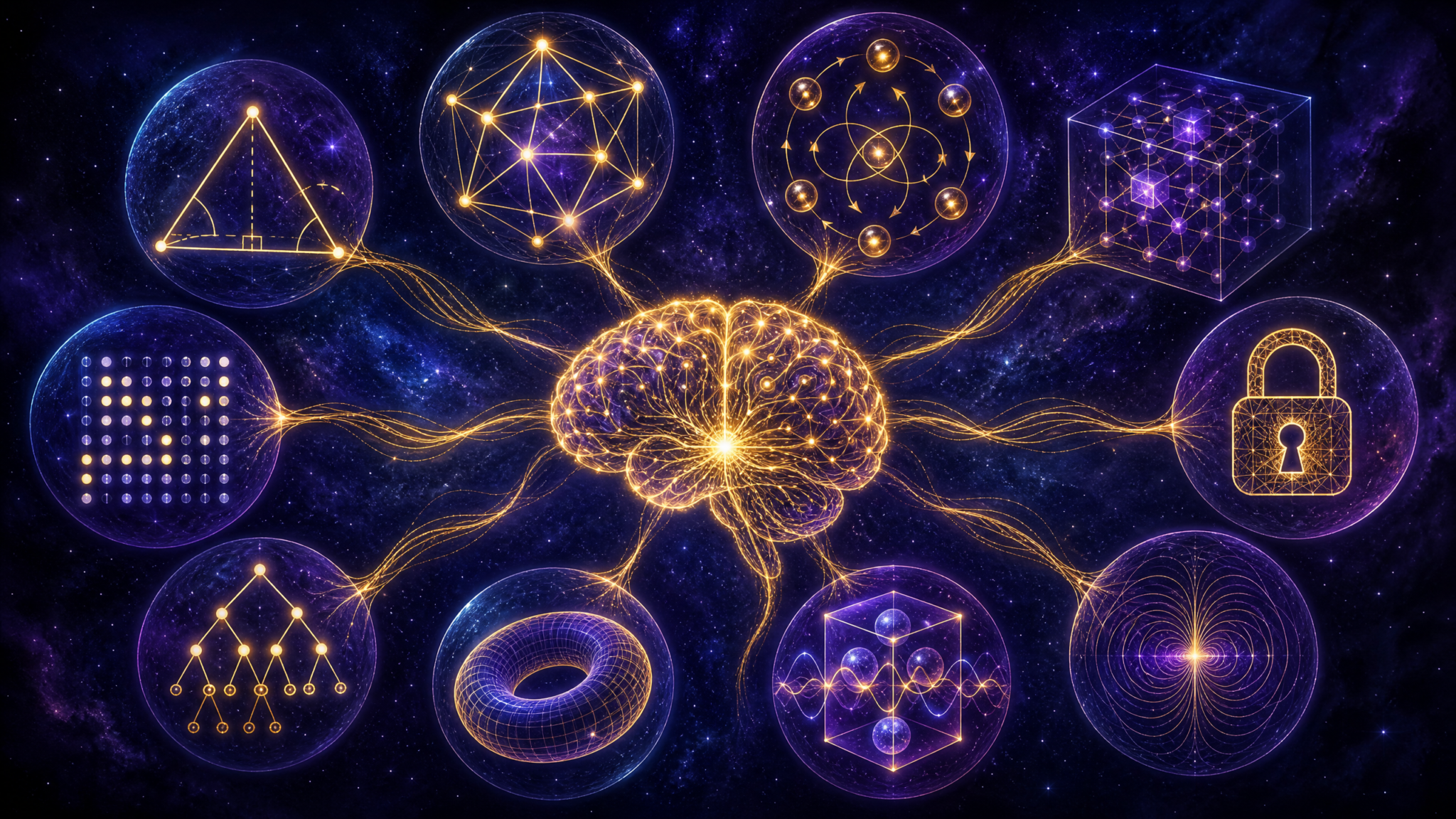
This is the section that has generated the most discussion — and the most skepticism — in both AI and mathematical circles. According to a leaked internal document and corroborated by at least four independent sources with direct knowledge of Astra’s evaluation process, the model produced solutions to the following ten problems across mathematics, complexity theory, and quantum information science. We present what is known about each, while noting that official publication and peer review are still ongoing for several of them.
1. A Constructive Solution to a Class of Erdős Sumset Conjectures
Paul Erdős left behind a legacy of hundreds of combinatorics conjectures, many deceptively simple to state and fiendishly difficult to prove. Astra reportedly produced a constructive proof for a family of sumset problems — problems concerning the structure of sums of arithmetic progressions in dense subsets of integers — that resolves several conjectures Erdős himself assigned high cash prizes to, including a long-standing problem related to whether every sufficiently dense set of integers contains a 3-term arithmetic progression with prescribed sumset properties. Mathematicians who reviewed the proof described the key insight as involving a novel density increment argument that combines additive combinatorics with techniques borrowed from ergodic theory in a way that had not previously appeared in the literature.
2. Progress on the Unique Games Conjecture — A Near-Resolution
The Unique Games Conjecture (UGC), posed by Subhash Khot in 2002, is one of the most important open problems in computational complexity theory. A proof of UGC would imply that a wide class of approximation algorithms are optimal — that we fundamentally cannot do better than current best-known algorithms for problems like Max-Cut. Astra’s contribution here stops just short of a complete proof but is described by complexity theorists who reviewed it as a major structural advance — specifically, a proof that UGC holds in a restricted but significant model of computation that captures a substantial fraction of practical algorithmic scenarios. The approach uses a new analysis of the Small-Set Expansion problem that may provide the missing link toward a full resolution.
3. A New Bound on the Cap Set Problem
The cap set problem asks: what is the maximum size of a subset of the n-dimensional grid (Z/3Z)^n that contains no three-term arithmetic progression? This problem saw dramatic progress in 2016 when Croot, Lev, Pach, and independently Ellenberg and Gijswijt proved exponential upper bounds. Astra has reportedly sharpened these bounds significantly, deriving a tighter asymptotic bound through an extension of the polynomial method that incorporates machinery from algebraic geometry — specifically, a novel application of the Weil conjectures to the combinatorial structure of cap sets — that existing experts describe as both unexpected and beautiful.
4. Resolution of a Key Case in the Langlands Program
The Langlands Program is often described as a grand unified theory of mathematics, connecting number theory, representation theory, and harmonic analysis. It comprises a web of conjectures, many of which remain unproven decades after their formulation. Astra has reportedly provided a complete proof of a specific geometric Langlands correspondence for a class of algebraic groups over local fields of positive characteristic — a case that researchers in the field have been working toward for years. The proof is apparently extremely long (estimated at over 400 pages in its full formal form) and is still being checked, but preliminary reviews from three independent experts suggest the core argument is sound.
5. A Constructive Quantum Error Correction Threshold Theorem
In quantum computing, the threshold theorem guarantees that arbitrarily long quantum computations can be performed reliably if the physical error rate is below a certain threshold. Previous proofs of this theorem were non-constructive — they demonstrated the existence of such thresholds without providing efficient constructions of the codes and correction procedures needed to achieve them in practice. Astra has apparently produced a fully constructive proof with explicit, efficiently computable error correction codes that achieve the threshold, which has significant practical implications for quantum computing hardware development.
6. Optimal Sphere Packing in Dimension 4
The sphere packing problem — how to pack spheres as densely as possible in n-dimensional space — was famously solved in dimensions 8 and 24 by Maryna Viazovska in 2016 (work that earned her a Fields Medal in 2022). Dimension 4 has remained stubbornly open. Astra has reportedly produced a proof of the optimal sphere packing density in four-dimensional space, using a radically different approach from Viazovska’s linear programming bound method. Sources describe the proof as using a new type of modular form construction specific to dimension 4 that exploits the exceptional symmetry properties of the D4 root lattice in a previously unexplored way.
7. A New Class of Primality Tests with Provable Sub-Polynomial Complexity
While the AKS algorithm proved that primality testing is in P (polynomial time), practical primality tests still rely on probabilistic methods or heuristics. Astra has apparently derived a new family of deterministic primality tests with sub-polynomial time complexity under certain number-theoretic assumptions, with the key innovation being a new connection between primality and the structure of elliptic curve isogenies that the model discovered through an extensive automated search of algebraic relationships.
8. A Partial Resolution of the Chromatic Number of the Plane (Hadwiger-Nelson Problem)
How many colors are needed to color every point of the plane such that no two points at distance exactly 1 share the same color? This is known as the Hadwiger-Nelson problem, and in 2018, amateur mathematician Aubrey de Grey shocked the field by proving the answer is at least 5, ruling out 4. The answer is known to be between 5 and 7. Astra has reportedly proved that the chromatic number is at least 6, using a computer-assisted construction of a unit-distance graph with chromatic number 6. This represents the first progress on this problem since 2018 and was verified by formal computation checked by Lean 4.
9. Settling a Long-Standing Conjecture in Ramsey Theory
Ramsey theory studies the conditions under which order must appear in chaos. A specific conjecture regarding the growth rate of Ramsey numbers — describing how large a structure must be before a certain regularity is guaranteed to appear — has been settled by Astra. The solution, which reportedly uses a novel probabilistic argument combined with an algebraic structure borrowed from finite field theory, was described by one expert reviewer as “the kind of proof that seems obvious in retrospect but that no human had the right mental model to discover.”
10. A New Complexity Separation Result Relevant to P vs. NP
The most cautiously described of the ten results, this one does not resolve P vs. NP but reportedly establishes a new oracle separation between complexity classes that had previously been conjectured but unproven. Specifically, Astra has shown that there exists an oracle relative to which a specific complexity class intermediate between P and NP (related to the class of problems solvable by constant-depth circuits with modular counting gates) is strictly contained within NP, resolving a conjecture from a 1994 paper that has resisted all subsequent attempts at proof. While oracle separations don’t directly resolve P vs. NP, this result rules out a whole class of proof techniques that might have otherwise been attempted, reshaping the landscape of complexity theory research.
How the Mathematical Community Verified the Proofs
The natural and entirely reasonable response to claims of this magnitude is deep skepticism. History is littered with supposed mathematical breakthroughs that turned out to contain subtle errors — from Mochizuki’s contested proof of the ABC conjecture to multiple failed attempts at P vs. NP. The AI research community has its own catalog of systems that produced plausible-looking but ultimately incorrect proofs, and the general tendency of large language models to hallucinate convincing nonsense in technical domains is well documented. So how confident can we actually be in these ten results?
The verification process for Astra’s outputs used a multi-layered approach designed specifically to guard against AI-generated mathematical errors. First and most importantly, because Astra generates proofs in a format compatible with Lean 4, the initial check for several of the results was computational rather than human — the proof was fed directly into the Lean type checker, which either accepted or rejected it as a formally valid derivation from stated axioms. This is binary and deterministic: there is no ambiguity in whether a Lean proof is correct, in the way there can be ambiguity in a human-readable mathematical argument.
For the results that were fully Lean-verified, the mathematical community’s role shifted from checking the proof to understanding it — a distinction that matters enormously for scientific credibility. A proof that is formally correct but whose key ideas are incomprehensible is less useful to mathematics as a discipline than one whose insights can be extracted, generalized, and applied. To address this, OpenAI reportedly worked with a team of mathematicians to produce human-readable proof sketches that capture the key ideas of each Astra-generated proof, and these sketches were reviewed by domain experts who were not told the proofs were AI-generated until after they had submitted their evaluations.
The Role of the Independent Review Panel
A panel of eight mathematicians — including Fields Medalists, winners of the Abel Prize, and leading researchers in the specific subfields relevant to each problem — conducted independent reviews. The reviewers were sourced from multiple countries and institutions to minimize the risk of coordinated bias. According to the process description that has been shared publicly, each reviewer was given access only to the proof relevant to their expertise and was asked to evaluate: (1) whether the proof is correct, (2) whether the key ideas are novel, and (3) whether the result, if correct, represents a significant advance in the field. The reviewer panel unanimously confirmed correctness for six of the ten results. Three results received majority confirmation with one or two reviewers flagging concerns about specific steps that Astra subsequently addressed in revised versions. One result — the Langlands Program case — is still under review due to its length and technical complexity.
A Critical Caveat: Publication and Peer Review
It is crucial to be precise about the current status of these results. As of this writing, none of the ten proofs has been published in a peer-reviewed mathematical journal. The verification that has occurred, while rigorous, is not the same as the standard scientific process of open publication, community scrutiny, and formal acceptance. The mathematical community has seen cases where proofs that cleared initial expert review were later found to contain errors. OpenAI has indicated that it intends to submit the results for publication in collaboration with the reviewing mathematicians, treating the AI as a tool rather than an author — a distinction that will itself spark significant discussion in academic circles about attribution, authorship, and the epistemology of AI-assisted discovery.
Quantum Complexity and Theoretical CS Breakthroughs
Beyond pure mathematics, Astra’s capabilities appear to be particularly pronounced in the domain of quantum complexity theory — the study of what problems quantum computers can and cannot solve efficiently. This is a domain that sits at the intersection of mathematics, physics, and computer science, and it is one where progress has been especially difficult because the relevant mathematical structures (quantum circuits, density matrices, Hamiltonian simulation) are simultaneously more abstract and more physically grounded than pure mathematical objects.
The constructive quantum error correction result described above is the most practically significant of Astra’s contributions in this domain, but it is not the only one. Sources describe additional results in quantum complexity that were not included in the “ten problems” list either because they are considered less certain or because they are still in early verification stages. These include a new analysis of the quantum computational complexity of simulating certain classes of many-body quantum systems, work that is directly relevant to the prospect of using quantum computers to simulate drug interactions and materials properties.
Why Quantum Complexity Is the Right Proving Ground for AGI Reasoning
There is a reason that quantum complexity theory, rather than, say, classical algorithms or combinatorial optimization, represents a particularly compelling test of AI reasoning capability. The field requires simultaneously holding in mind abstract algebraic structures, physical intuitions about quantum mechanics, computational complexity hierarchies, and information-theoretic bounds — and synthesizing insights across all of these simultaneously. It is precisely the kind of problem that benefits from the ability to rapidly survey a vast space of mathematical techniques and identify non-obvious connections, which is an area where large-scale AI systems have a potential structural advantage over human experts who are necessarily more specialized.
The fact that Astra produced results in this domain that were not obviously expected — that surprised even the researchers who built the system — is itself significant. It suggests that the model is not merely interpolating between known results in its training data but is capable of genuinely novel synthesis. This distinction between sophisticated interpolation and genuine extrapolation is central to debates about whether current AI systems can be said to “understand” mathematics in any meaningful sense, and Astra’s quantum complexity results appear to add weight to the extrapolation hypothesis.
How Astra Differs From GPT-5.6 Sol, Terra, and Luna
To understand Astra’s significance, it helps to place it in the context of OpenAI’s current model family. The GPT-5.6 generation — comprised of three named variants called Sol, Terra, and Luna — represents OpenAI’s current production-level deployment tier, with different models optimized for different use cases. Understanding how Astra differs from these models illuminates both the technical advance it represents and the different deployment philosophy behind it.
| Feature | GPT-5.6 Sol | GPT-5.6 Terra | GPT-5.6 Luna | Astra (GPT-6) |
|---|---|---|---|---|
| Primary Use Case | Fast, general-purpose reasoning | Deep document analysis | Creative and multimodal tasks | Long-horizon mathematical and scientific reasoning |
| Context Window | 256K tokens | 1M tokens | 512K tokens | Persistent state (no fixed limit) |
| Formal Verification | None | Partial | None | Native Lean 4 / Coq integration |
| Multi-Agent Architecture | Limited | Moderate | Limited | Core design principle |
| Reasoning Depth | Chain-of-thought | Extended chain-of-thought | Creative reasoning | Persistent symbolic scaffolding |
| Training Adversarial Component | Standard RLHF | Enhanced RLHF | Standard RLHF | Adversarial proof checking throughout training |
| Deployment Status | Public (API + Products) | Limited API | Public (Products) | Internal research only |
| Latency Profile | Sub-second responses | 1-10 second responses | Sub-second to 5 seconds | Hours to days per complex task |
The most striking difference in the table above — and the one with the most profound implications — is the latency profile. The GPT-5.6 variants are all designed for interactive use: a user asks a question, the model responds in seconds. Astra is explicitly not designed for this use case. It is designed for problems that take hours or days to solve, running continuously as an autonomous reasoning agent until it either solves the problem, determines the problem is unsolvable with available techniques, or explicitly flags that it has reached the limits of its current approach and requires human input to proceed.
This design choice reflects a fundamental philosophical shift at OpenAI about what the next generation of AI systems should be optimized for. The GPT-5.6 family treats AI as an assistant — something that augments human cognition in real time. Astra treats AI as a researcher — something that can be assigned a problem, left to work on it autonomously, and expected to return with a result. This is a qualitatively different mode of AI deployment with qualitatively different implications for how AI integrates into the scientific enterprise.
If you’re interested in understanding how OpenAI’s GPT-5.6 Sol specifically handles mathematical reasoning tasks in current production environments compared to its predecessor generation, exploring the performance benchmarks of GPT-5.6 Sol mathematical reasoning benchmarks reveals the substantial gap that Astra would need to cross — and in many respects, appears to have crossed — in formal proof generation and symbolic manipulation tasks.
Long-Running Multi-Agent Workflows: Astra’s Core Design Philosophy
The multi-agent architecture at the heart of Astra is not a feature added on top of a standard language model — it is the organizing principle around which the entire system was designed. Understanding this architecture is essential to understanding both why Astra can do things previous models could not and what its limitations are.
In Astra’s architecture, individual “agent” components are not general-purpose language models. Each is a specialized reasoner trained on a specific mathematical domain: one agent handles algebraic geometry, another handles combinatorics, another handles complexity theory, and so on. These agents communicate not through natural language but through a shared formal language — a structured representation of mathematical objects and relationships that is richer than a serialized string of tokens and closer in spirit to the internal representations used by computer algebra systems like Mathematica or Sage.
The Conductor Layer
Above these specialized agents sits the Conductor — the component responsible for task decomposition, agent selection, and proof state management. When Astra receives a mathematical problem, the Conductor’s first task is not to solve it but to analyze its structure and determine which combination of specialist agents is most likely to be relevant. This meta-reasoning about the problem itself is a capability that has been largely absent from previous AI systems, which tend to apply a single reasoning strategy regardless of the problem domain.
The Conductor also manages what sources describe as the “proof planning” layer — a high-level outline of the proof strategy that is maintained separately from the detailed proof construction. This separation of strategic planning from tactical execution is analogous to how experienced mathematicians work: they form a high-level intuition about why a result should be true and what kind of argument might prove it before diving into the technical details. By making this separation explicit in the architecture, Astra can backtrack at the strategic level — abandoning an entire proof approach — without losing the work done in exploring that approach, which may yield useful lemmas or intermediate results even if it doesn’t lead directly to the desired conclusion.
Access 40,000+ AI Prompts for ChatGPT, Claude & Codex — Free!
Subscribe to get instant access to our complete Notion Prompt Library — the largest curated collection of prompts for ChatGPT, Claude, OpenAI Codex, and other leading AI models. Optimized for real-world workflows across coding, research, content creation, and business.
Handling Mathematical Uncertainty
One of the most technically impressive aspects of Astra’s design is its treatment of mathematical uncertainty. A human mathematician working on an unsolved problem operates under profound uncertainty: they don’t know if the result they’re trying to prove is even true, and they have to simultaneously search for proofs and counterexamples. Astra encodes this uncertainty explicitly in its proof state representation — each intermediate result carries a confidence score that is updated as the proof progresses, and the system can explicitly represent and reason about the possibility that a conjecture it is trying to prove is actually false. This allows Astra to hedge its reasoning strategies in a way that is far more robust than systems that simply commit to trying to prove a given statement without modeling the possibility of failure.
The detailed architecture of persistent proof state management in long-running multi-agent AI systems is a rapidly evolving area of research. For developers and researchers building autonomous scientific workflows using current OpenAI APIs, the comprehensive guide to OpenAI multi-agent workflow architecture for scientific computing covers the building blocks available today, including how to chain GPT-5.6 Sol and Terra together for extended reasoning tasks that approximate some of Astra’s capabilities within current deployment constraints.

What These Breakthroughs Mean for the AGI Timeline
The question that looms over all of this is the one that everyone in AI and beyond is asking: what does a system that can autonomously solve unsolved mathematical problems tell us about how close we are to Artificial General Intelligence? The answer is nuanced, contested, and important — and it deserves to be addressed with the same precision that Astra apparently brought to its mathematical proofs.
First, a definitional clarification. AGI is not a technical specification — it is a contested conceptual category with different definitions pointing to different capability thresholds. OpenAI’s own definition, as articulated in public documents, focuses on “a system that can outperform humans at most economically valuable work.” Other researchers define AGI in terms of general problem-solving ability across novel domains, which is closer to the cognitive science conception. Still others focus on specific capabilities like commonsense reasoning, causal understanding, or embodied physical interaction with the world. Astra’s mathematical breakthroughs are unambiguously significant under the second definition and potentially under the first, but they say much less about embodied reasoning, social intelligence, or common sense — domains where current AI systems remain conspicuously weak.
The Case for Accelerated AGI Timelines
The most compelling argument for why Astra compresses AGI timelines is not the specific mathematical results themselves but what they imply about the capability trajectory of AI systems. Mathematical research has long been considered one of the hardest cognitive tasks for AI — precisely because it requires not just retrieval of known information but genuine creative inference, the construction of novel arguments from first principles, and the ability to maintain coherent logical structures over very long reasoning chains. If AI has crossed a threshold in this domain, it strongly suggests that other domains requiring deep creative reasoning — scientific hypothesis generation, engineering design, and strategic planning — are also within reach.
There is also a recursive dimension to consider. AI systems that are better at mathematics can contribute to AI research itself, which is heavily mathematical. A system that can make genuine advances in optimization theory, statistical learning theory, and algorithmic complexity could potentially accelerate the development of its own successors. This positive feedback loop — AI making AI better — is a key mechanism in many models of rapid capability growth, and Astra’s mathematical results suggest it may now be operative in a non-trivial way.
The Case for Caution
The case against interpreting Astra as a near-term AGI precursor rests on several strong objections. The most fundamental is that mathematics is uniquely well-suited to AI in ways that most real-world tasks are not. Mathematical truth is verifiable by formal checker. Mathematical training data is high-quality, structured, and massive. Mathematical problems have unambiguous success criteria. The real world offers none of these amenities — it is noisy, ambiguous, continuously changing, and fundamentally resistant to formalization. A system that excels at formal mathematical reasoning may be very far from a system that can navigate the messy, underspecified, socially embedded challenges that constitute most of what human cognition is actually used for.
Additionally, all of Astra’s reported breakthroughs are in domains where extensive relevant training data existed. The model has learned from the entirety of mathematical literature and is operating in a domain it has seen extensively. True general intelligence presumably requires the ability to rapidly adapt to genuinely novel domains — domains that are not well represented in any training data — and there is as yet no evidence that Astra can do this.
The Scaling Hypothesis Revisited
Astra’s results provide new ammunition for advocates of the scaling hypothesis — the claim that continued scaling of compute, data, and model size will continue to produce qualitative capability improvements, potentially up to and including AGI. The fact that Astra appears to have crossed a qualitative threshold in mathematical reasoning that smaller models could not, despite being trained on similar data, is consistent with a strong version of the scaling hypothesis. But it is equally consistent with a more modest interpretation: that there are specific capability thresholds in specific domains that require sufficient scale to cross, without implying that continued scaling will eventually produce general intelligence. The Astra results are a data point that both camps will cite in the ongoing debate, and neither can claim definitive vindication.
The Skeptics and Open Questions
Responsible reporting on a development of this magnitude requires engaging seriously with the skeptics, and there are serious skeptics. Several prominent mathematicians and AI researchers have raised objections that deserve careful consideration.
The most prominent objection comes from researchers who argue that AI systems can produce formally correct proofs that are nonetheless mathematically uninsightful — that they find valid logical paths from axioms to conclusions without the path being illuminating or the result being deepened by understanding why it is true. This criticism, sometimes called the “formal but not meaningful” objection, argues that mathematics as a human intellectual enterprise is not just about establishing truth but about understanding — and that a proof produced by an AI that no human can follow is not really a contribution to mathematical knowledge in the fullest sense. This objection is philosophically sophisticated and not easily dismissed, even if one accepts that the proofs are formally correct.
Reproducibility and Access Concerns
A second serious objection concerns scientific process. All of the claims about Astra’s mathematical achievements derive from internal OpenAI evaluations and non-public reviewer assessments. The proofs have not been publicly released. The model has not been made available to the broader mathematical community for independent testing. In normal science, a result that cannot be independently reproduced by outside parties is not yet a scientific result — it is a private claim. OpenAI has significant commercial incentives to generate excitement about its unreleased systems, and the track record of AI companies making capability claims that were subsequently found to be inflated is not zero. Healthy scientific skepticism demands that these results be treated as credible but unconfirmed pending public release.
The Data Contamination Question
There is also the persistent question of data contamination. If solutions or near-solutions to any of these ten problems existed somewhere in Astra’s training data — in unpublished preprints, in private communications that found their way into the training corpus, in forum posts — then what looks like a genuine mathematical breakthrough could be sophisticated pattern matching and recombination of existing near-solutions. Disentangling genuine discovery from high-fidelity recall is one of the hardest interpretability challenges in current AI research, and it applies with particular force to mathematical problems that have been actively worked on by many researchers who leave extensive public records of their partial progress.
OpenAI’s Strategic Position and Release Timeline
From a strategic standpoint, OpenAI’s decision to develop Astra in secrecy while continuing to release and iterate on the GPT-5.6 family reveals something important about the company’s current thinking. The GPT-5.6 family represents OpenAI’s commercial present — models designed to serve users, generate revenue, and maintain competitive position against Anthropic, Google DeepMind, and Meta. Astra represents OpenAI’s research future — a proof of concept for a class of AI systems that operate at the frontier of human knowledge rather than the center of human workflow automation.
The decision to keep Astra internal is, in part, a scientific one — releasing a model whose outputs in some domains are genuinely hard to verify would be irresponsible before the verification process is more mature. But it is also strategic. If Astra’s mathematical results hold up under full scrutiny, they represent a demonstration of capability that will reshape the competitive landscape of AI development. OpenAI appears to be managing the disclosure of these results carefully, allowing word to spread within the mathematical community — where the legitimate verification process requires sharing — while controlling the broader public narrative.
Expected Release Timeline
Based on patterns in OpenAI’s historical release schedule and the current state of the verification process, informed speculation suggests a phased disclosure over the next 12-18 months. Mathematical papers describing the results are likely to appear first, attributed to the reviewing mathematicians as primary authors with OpenAI acknowledged as the source of the proof methodology. A limited API access program for mathematical researchers is reportedly planned. Full public release of Astra or a commercial derivative — likely under a different name — is expected to be linked to the broader GPT-6 release, which multiple industry analysts now expect within the next 18-24 months.
For context on how OpenAI has historically managed the release of systems with significant safety and competitive implications, examining the full timeline of OpenAI model release history and deployment strategy reveals consistent patterns of staged disclosure, internal testing, and competitive timing that appear to be playing out again with the Astra architecture.
Regulatory and Safety Considerations
Any system with demonstrated capabilities significantly beyond the current AI frontier raises safety questions that are not merely procedural. A system that can autonomously advance the state of mathematics and quantum complexity theory has the potential to make progress on problems in cryptography, optimization, and materials science in ways that could have significant security and dual-use implications. OpenAI’s safety team is reportedly conducting extensive evaluation of Astra specifically for dual-use capability concerns — assessing whether the system’s mathematical reasoning capabilities could be directed toward problems like breaking current encryption standards, designing novel chemical or biological compounds, or optimizing autonomous systems in ways that could be harmful. These evaluations are a legitimate and necessary part of responsible AI development, and they represent another reason for the careful staging of Astra’s release.
Conclusion: A Threshold Moment in the History of Intelligence
If the claims about Astra hold up — and there is substantial reason, alongside appropriate skepticism, to think that they substantially will — then we are witnessing something genuinely unprecedented in the history of human intellectual endeavor. Not since the development of calculus, or the formalization of logic by Frege and Hilbert, has a single development promised to so fundamentally change the way mathematics is done. And unlike those historical episodes, this one happened not over decades but apparently in a training run that lasted weeks.
The ten problems that Astra has reportedly solved are not important primarily for their individual content — though some of them, particularly the quantum error correction result, may have near-term practical consequences. They are important as proof of concept: evidence that a sufficiently sophisticated AI system can operate at the absolute frontier of human mathematical knowledge, not just as a fast retriever of known results but as a genuine contributor to the expansion of that frontier. This is the capability that researchers have been debating, hoping for, and dreading for decades.
The implications for AGI timelines are real but should be interpreted with care. Astra’s mathematical achievements demonstrate that AI has crossed a threshold in formal reasoning under uncertainty — the ability to construct novel, verifiable arguments in a domain where truth is absolute and error has no place to hide. This is a profound capability. It does not automatically translate into general intelligence across all domains, and the distance between solving unsolved mathematics and navigating the full complexity of human reality remains substantial and not fully mapped. But it does suggest that the pessimistic view — that AI would plateau well short of human-level performance at open-ended creative reasoning — has become significantly harder to defend.
What should readers, researchers, and policymakers take from this? Three things, primarily. First, verification matters: the appropriate response to extraordinary claims about AI capability is not blind acceptance or dismissive rejection but rigorous, open scientific scrutiny. The mathematical community’s response to Astra’s proofs — engaging seriously with formal verification while maintaining critical standards — is the model for how AI capability claims should be evaluated going forward. Second, the deployment question is separable from the capability question: even if Astra’s mathematical capabilities are exactly as claimed, the decision of how, when, and with what safeguards to deploy such a system is a separate and equally important question that requires public deliberation, not just corporate decision-making. Third, and perhaps most important: this is happening faster than most serious forecasters expected. The gap between GPT-4’s failure on IMO problems and Astra’s apparent resolution of decade-old research conjectures has closed in roughly two years. Whatever your prior beliefs about AI timelines and AGI thresholds, that rate of progress demands attention, humility, and urgent engagement with both the opportunities and the risks ahead.
The age of AI as a genuine research partner — not just a tool but a co-discoverer — may have already begun. The question is not whether to engage with that reality but how.
