
Why OpenAI Reduced Codex Context Windows for GPT-5.6 and What It Means for Developer Workflows
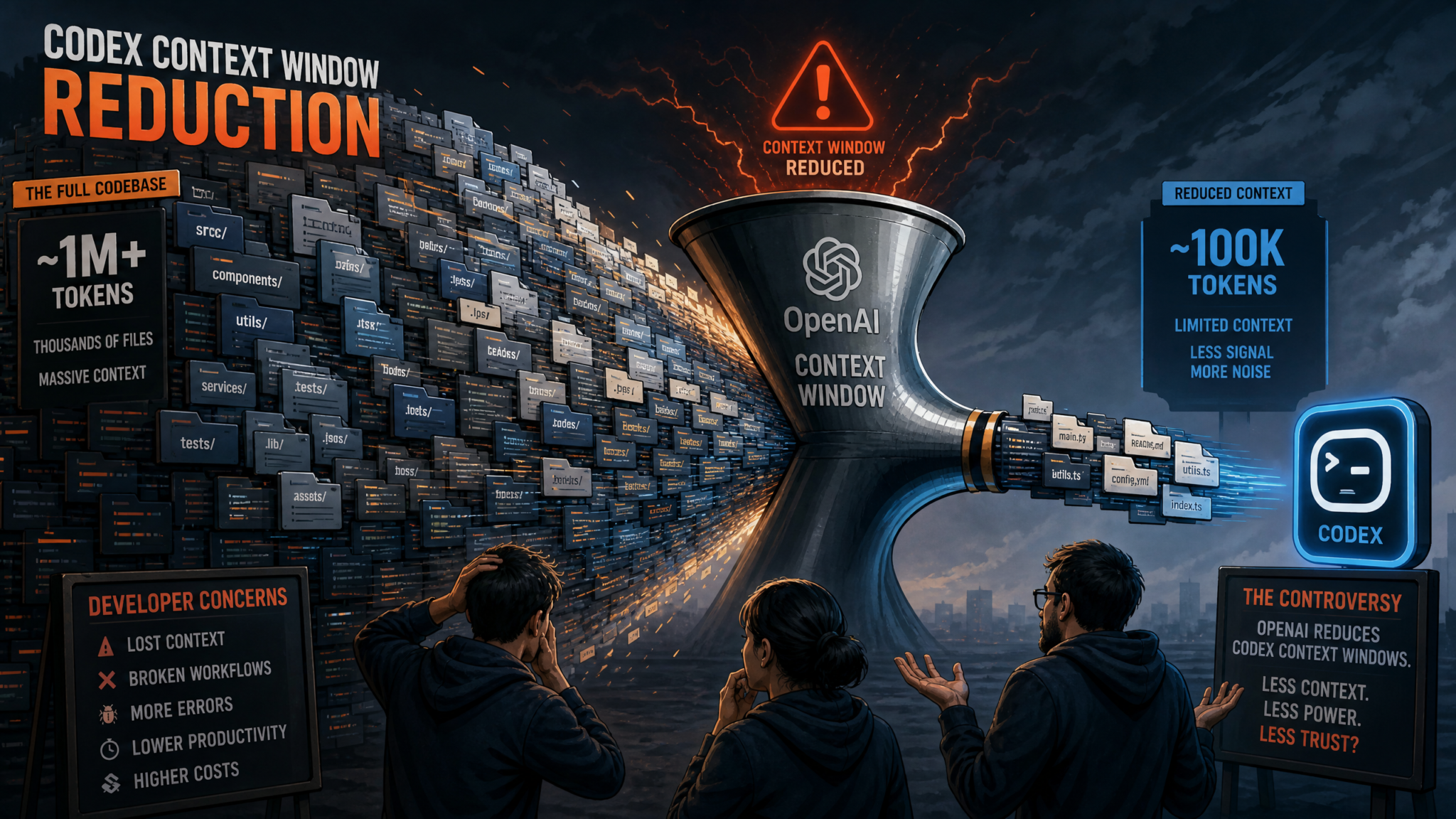
OpenAI’s Codex Context-Window Rollback for GPT‑5.6: What Happened, Why It Matters, and How Developers Can Adapt
Executive summary: In mid‑2026 OpenAI implemented a significant reduction in the Codex context window available to GPT‑5.6-based code assistants. The change — publicly framed as a cost, latency, and quality optimization — immediately sparked a vocal developer backlash because many real‑world coding workflows rely on very long contexts to navigate large repositories, perform multi‑file refactors, and generate documentation that requires global repository knowledge. This article explains what changed, quantifies the practical impact on common tasks, examines the technical tradeoffs behind the move, surveys developer responses, proposes concrete adaptation patterns (chunking, summarization, repository indexing and RAG), compares competing offerings, and outlines enterprise accommodations and economics that shaped the decision. We finish with actionable best practices and community tools that make the new baseline workable for teams of any size.
Who this is for
- Engineering managers evaluating AI-assisted developer tooling
- Developer tooling authors and platform architects
- Enterprise procurement teams negotiating AI SLAs and context guarantees
- Individual engineers who rely on Codex/Copilot for large codebase work
What happened: the specific context window reductions and timetable
OpenAI announced a reduction in the context window available to the Codex variant of GPT‑5.6 that many code‑centric customers and platform vendors relied on. Public and developer reports indicate the change reduced the maximum context size from a very large window — widely used values like 512k–1M tokens in experimental or enterprise tiers — to a smaller but still generous window in the ~200k–256k token range for standard Codex API customers. The change was applied to the default Codex endpoint and took effect for most users in June 2026, with staggered rollouts to enterprise plans and partner integrations over the following weeks.
Important caveat: OpenAI provides different tiered capabilities across public, partner, and enterprise offerings; the exact numbers varied by customer and negotiated agreement. The reduction as reported broadly affected the publicly documented Codex API and hosted integrations such as in-browser assistant experiences.
What this meant in practice:
- High‑context experimental modes (multi‑megabyte contexts) were curtailed for most developers.
- Enterprise customers were offered mitigations such as dedicated throughput, local context stitching, or custom agreements — but not a universal restore of the previous public context ceilings.
- Third‑party developer tools that previously relied on entire repository ingestion into a single prompt required reengineering to work within the new constraints.
OpenAI’s stated rationale
OpenAI publicly explained the move with three primary themes: cost optimization, latency improvement, and a focus on quality. Summarizing the stated reasons:
- Cost optimization: Running extremely long contexts is materially more expensive because transformer self‑attention is O(n²) in the sequence length for standard attention, and memory bandwidth is a limiting factor. OpenAI said reducing the default public context window lets them allocate compute more sustainably across a large user base while still offering premium options for customers who pay for higher guarantees.
- Latency and reliability: Very long single‑shot contexts increase inference latency and make tail‑latency behavior harder to bound. OpenAI framed the reduction as a way to reduce time‑to‑first‑token for the majority of requests and to stabilize response times for interactive developer workflows.
- Quality focus: OpenAI claimed that in practice longer contexts do not always improve developer outcomes; noisy or overly large contexts can dilute attention and cause models to hallucinate or miss the most relevant sections. The company said reinvesting capacity in better model tuning and retrieval‑style patterns would produce more useful outputs.
These are reasonable engineering arguments in the abstract — they reflect real infrastructure tradeoffs — but the devil is in the details of how the change was executed and communicated.
Developer community reaction and backlash
The developer response was fast and intense. Within hours of the public rollout a wave of complaints appeared on issue trackers, community forums, social media, and the issue queues of vendor integrations. The backlash focused on three themes:
- Breaking established workflows: Engineers reported that scripted code assistants, CI jobs, and IDE integrations that previously sent large chunks of repository context to Codex began failing or returning truncated results.
- Poor communication and migration tooling: Developers criticized the lack of clear migration paths, rate calculators, or client libraries to help split or summarize contexts automatically.
- Perceived vendor lock‑in and unpredictability: Many teams felt that a change this fundamental should require more notice or a guaranteed deprecation window for critical tooling.
“It’s not just a smaller number — it’s an operational pivot. We automated a nightly documentation pass that built a global table of contents of the repo and then asked Codex to produce module-level docs. Overnight, that job failed to fit. We lost productivity and had to redesign the pipeline.” — senior engineer at a mid‑sized platform company
Several open source projects and tooling vendors published compatibility guides within days. Demand for alternative approaches (RAG, embeddings, local models) surged, and new community scripts for automatic chunking and summarization began circulating in GitHub repos and package registries.
Impact on common workflows
To appreciate why the reduction mattered, you need to map the context window to concrete developer tasks. Below are the most affected workflows and what changed for each.
Large codebase navigation and comprehension
Before the reduction, many assistants were designed to include several hundred thousand tokens of repository context — README files, multiple module files, dependency lists, and recent commit messages — in a single prompt. That enabled use cases such as:
- Answering high‑level questions like “How does authentication flow from the front end to the database?” with references to specific files and line ranges.
- Generating cross‑repository dependency diagrams and mapping service boundaries.
- Creating global indexes and TOCs used by human search and automation.
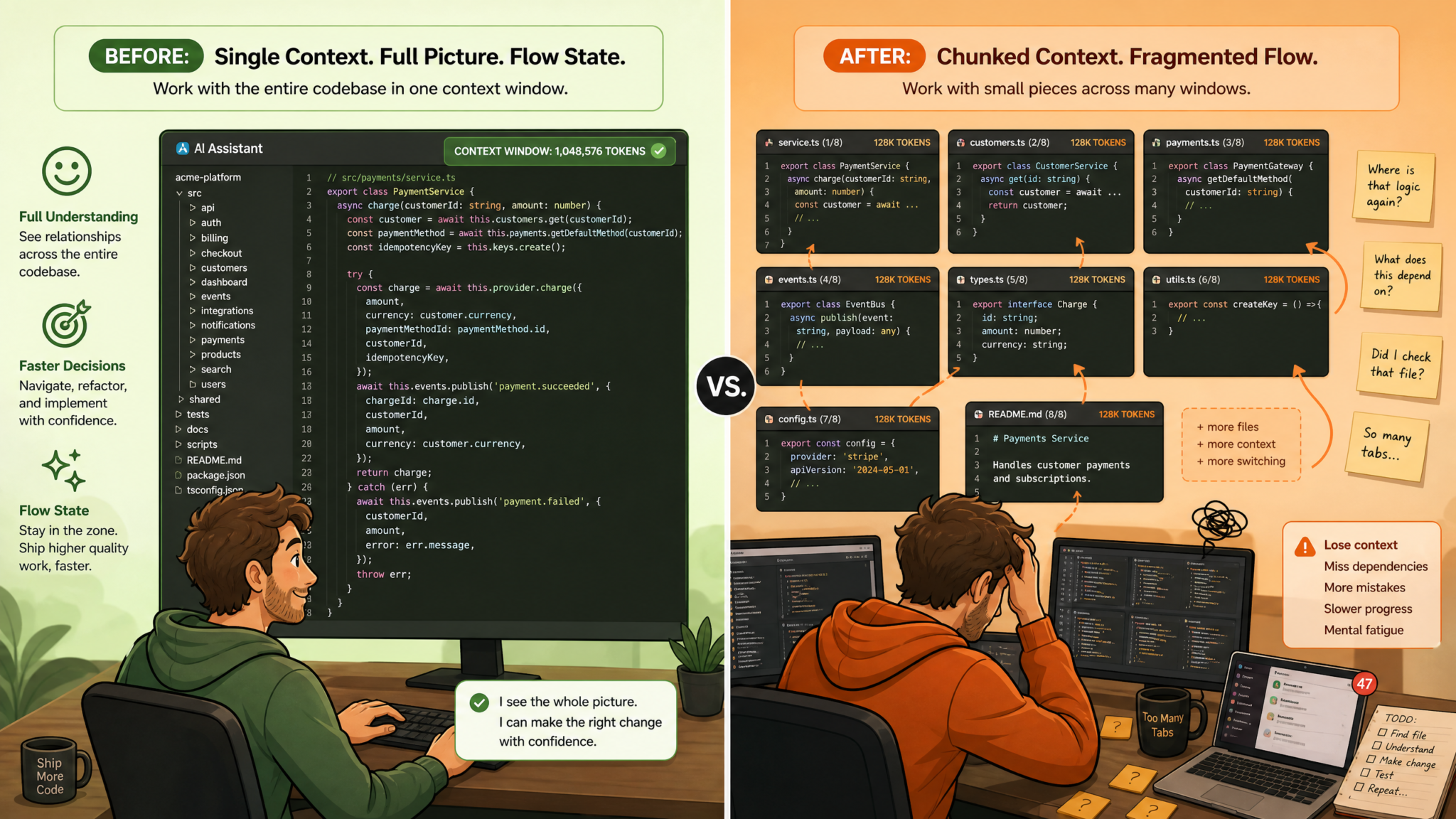
After the reduction, attempts to include equivalent scope either failed to fit or required truncation of the most distant files. That made it much harder for the assistant to ground answers in the entire repository, increasing the need for retrieval and indexing rather than single‑shot context embedding.
Multi‑file refactoring and large PR generation
Large automated refactors often rely on context to validate changes across multiple files — for example, renaming an API surface, updating all typed interfaces across a monorepo, or migrating an internal library. With the larger window, a single prompt could include all affected files and ask Codex to rewrite or propose changes with global awareness.
With the reduced window, these operations must be split into smaller, ordered steps with external coordination (a coordinator program or orchestrator) to ensure consistency. That introduces procedural complexity and increases the risk of coordination bugs.
Documentation and release notes generation
Teams used Codex to synthesize changelogs, release notes, architectural summaries, and API docs by feeding in large swaths of commit logs, diffs, and file contents. Under the new limits, you either summarize the inputs upstream or accept shorter, less comprehensive outputs.
CI/CD jobs and automated code review bots
Automated review bots that ingest the full diff and surrounding context to provide semantic comments are negatively affected. Where previously bots could call a single Codex prompt with the full context and get coherent, cross‑file suggestions, they now must rely on an indexed state or rolling context windows.
Quantifying the impact: what you could do before vs now
Putting numbers on the impact helps teams plan migration. The conversion between tokens and source code will vary by language and coding style; here we use conservative approximations to illustrate practical differences.
- Assumptions:
- 1 token ≈ 4 characters (approximation used by many transformer tokenizers).
- Average line of code ≈ 40 characters (including indentation and punctuation).
- Thus ~1 token maps to ~0.1 lines of code; 10 tokens per line is a reasonable rule of thumb for dense code with comments.
Example conversions:
- A 512k token context maps to roughly 5.12 million lines of code under the rough mapping above — enough to include very large monorepos, multiple modules, and most dependency stacks.
- A 256k token window maps to roughly 2.56 million lines — still large but half the scope.
- A 200k token window maps to roughly 2.0 million lines.
Practical examples:
- Before: You could plausibly include the contents of a 10k‑file monorepo (average file 200 LOC) into a single prompt and ask for a global refactor sketch.
- After: With a 200k‑256k token limit, you must selectively include only the most relevant 2k–5k files in a single prompt, or create a multi‑round orchestration to handle bigger sets.
These numbers are deliberately rough; the precise footprint depends on comments, generated artifacts, JSON blobs, and other non‑code content. But the headline is clear: workflows that relied on multi‑megabyte single prompts must be rearchitected.
Technical analysis: why larger context doesn’t always mean better results
It’s tempting to assume “bigger is always better” when it comes to context windows. In practice, the relationship between context size and output quality is nuanced. Here are the most important technical considerations.
1. Attention dilution and retrieval noise
Transformers allocate attention across the entire context. When much of that context is only tangentially relevant, the model may struggle to prioritize the most salient tokens. That can lead to weaker grounding, hallucinations, and greater variance in generated outputs for complex, multi‑step queries.
2. Latency and user experience
As context grows, batch sizes and memory usage balloon. For interactive tools, the user experience suffers if time‑to‑first‑token increases from hundreds of milliseconds to seconds. For some developer workflows, that latency is the difference between an in‑editor assist being useful or disruptive.
3. O(n²) attention and cost
Standard global attention requires quadratic compute and memory relative to sequence length, which makes extremely long contexts exponentially more expensive. There are alternative attention mechanisms (sparse attention, longformer, linear‑attention, chunked attention) that reduce this growth, but they often involve tradeoffs in model architecture and require retraining or complex engineering.
4. Signal vs. noise in natural codebases
Real repositories include lots of boilerplate, generated files, and transient artifacts. Including everything without filtering reduces the signal‑to‑noise ratio. Carefully curated retrieval or summarization often outperforms brute‑force inclusion.
5. Model calibration and instruction following
Longer contexts can amplify small instruction ambiguities. When the model has to reconcile multiple, overlapping instructions present in many files, the resulting behavior can be less predictable than when prompted with a more focused, concise context plus a robust retrieval layer.
Workarounds and adaptation strategies for developers
Despite the immediate disruption, the developer community has a long history of inventing practical workarounds. The approaches below move from simplest to more architectural changes.
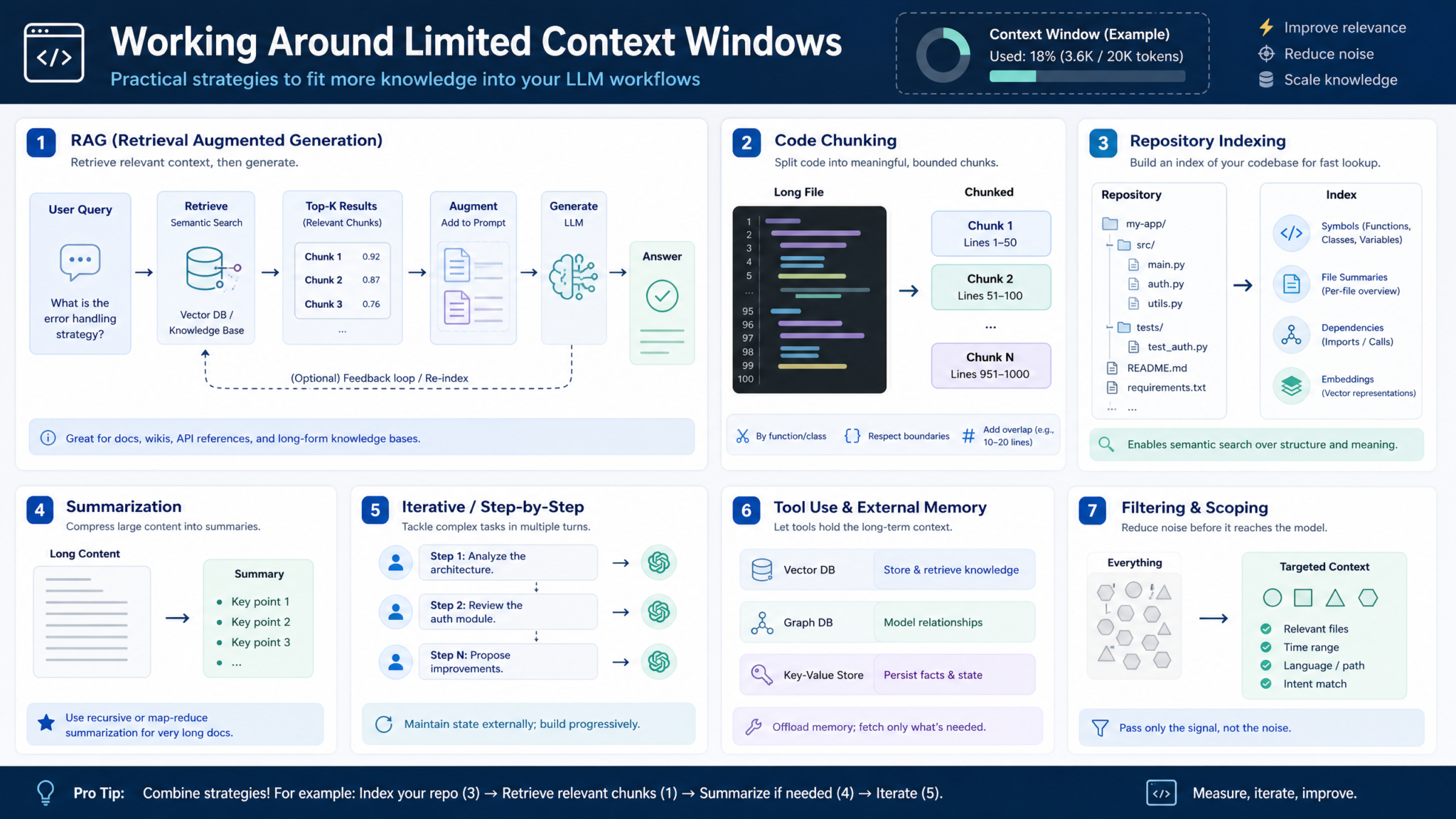
1. Chunking and rolling windows
Break large artifacts into chunks small enough to fit within the new window. Use a coordinator that iterates through chunks, accumulates intermediate summaries, and reconciles changes. This approach is the most direct but requires careful state management to ensure cross‑chunk consistency.
// Pseudocode: rolling-chunk summary loop
for chunk in split(repo_files, chunk_size):
    summary = model.summarize(chunk)
    store_summary(summary_index, summary)
# Reassemble
global_summary = model.synthesize(list(summary_index))
Key implementation notes:
- Use overlapping chunks if you need to preserve context across boundaries (5–10% overlap).
- Persist chunk summaries in a vector index to enable later retrieval.
- Validate multi‑step refactor consistency by running final verification passes that check that no symbol references were missed.
2. Hierarchical summarization
Perform multi‑level summarization: file → module → package → repository. Summaries condense content into short, searchable tokens that fit easily in prompts. This lets you ask the model high‑level questions and retrieve the most relevant detailed chunks when needed.
Implementation recipe:
- Generate per‑file summaries as part of your CI pipeline.
- Create module summaries by combining file summaries and using another summarization pass.
- Store both summaries and original files in a vector DB for retrieval.
3. Repository indexing and RAG (retrieval augmented generation)
Instead of sending the entire repository into a single prompt, index the repository and combine retrieval with generation. RAG pipelines fetch the most relevant chunks for a given query and feed only those chunks to the model, usually within a compact, compositional prompt.
Benefits:
- Scalable: index growth does not change prompt size.
- Lower latencies: retrieval is typically faster than scanning massive contexts.
- Better grounding: retrieval can bring highly relevant pieces into the prompt visibly.
Tools and primitives for RAG:
- Open source: FAISS, Annoy, HNSWlib
- Managed: Pinecone, Milvus Cloud, Weaviate
- Frameworks: LangChain, LlamaIndex (formerly GPT Index)
RAG is now the de facto pattern for large codebases and is covered in depth in many operational guides 40 ChatGPT-5.5 Prompts for Academic Researchers: Literature Reviews, Hypothesis Generation, Data Interpretation, and Paper Writing.
4. Local models and embedding hybrid architectures
For privacy and latency, some teams pair a local, smaller code model for initial ingest and summarization with a hosted Codex instance for higher‑level reasoning. The local model pre‑filters and compresses context, minimizing the need to send large payloads to the cloud.
5. Incremental orchestration and transactional refactoring
Design refactors as a sequence of idempotent, verifiable transactions. Each transaction operates on a bounded set of files, and a central orchestrator tracks applied changes and runs tests between steps. This avoids the need to reason about the entire codebase in a single shot.
Using chunking and summarization effectively
Chunking and summarization are distinct but complementary. Effective production systems combine both to maximize coverage and minimize prompt size. Below is a practical pipeline developers are adopting.
- Preprocess the repository: remove generated artifacts, normalize whitespace, and strip large binaries.
- Split files into semantic chunks (function/method/class boundaries) rather than fixed byte sizes whenever possible.
- Generate per‑chunk embeddings and store them in a vector index.
- Produce per‑chunk summaries asynchronously; create higher‑level summaries from groups of chunk summaries.
- At query time, retrieve the top‑k chunks plus any higher‑level summaries to create a focused prompt for Codex.
Example prompt pattern (concise):
System: You are a code assistant. Use the provided summaries and code chunks to answer precisely.
Context Summaries:
- Module A summary: ...
- Chunk 1: [code snippet]
- Chunk 2: [code snippet]
Question: How should we update the Auth service to include request tracing?
Best practices:
- Keep the “system” instructions short and precise.
- Prefer higher‑level summaries for orientation and include a few concrete code chunks for grounding and verification.
- Use deterministic caching of chunk summaries to speed repeated queries.
Repository indexing and RAG approaches as alternatives
We already introduced RAG; here is a deeper, implementable architecture that many teams are adopting to mitigate reduced context windows.
An operational RAG architecture
- Ingest layer: CI or a background job parses the repo, extracts semantic units (docstrings, functions, classes), and generates embeddings.
- Index layer: Store embeddings in a vector DB with metadata (file path, line range, commit hash).
- Summarization layer: Generate hierarchical summaries (file → module → repo) and store them as small text documents with embeddings.
- Query layer: When a user asks a question, perform a vector search to retrieve top‑k candidates (mix of code chunks and summaries).
- Compose prompt: Build a compact prompt that includes: 1) short system instructions, 2) the highest‑value summaries, 3) the top relevant code chunks, and 4) the user query.
- Verification & test layer: Where changes are proposed, run unit tests or static analyzers on a sandbox to detect regressions.
- Orchestration layer: For multi‑file changes, run the proposal generation step for each chunk and then run a consistency pass that validates cross‑file references.
Advantages of this design:
- Predictable prompt sizes independent of repository scale.
- Faster interactive response time because retrieval is optimized for top‑k lookup.
- Lower cloud costs by splitting storage (vector DB) and compute (model inference).
Tradeoffs:
- Additional system complexity — more components to operate and secure.
- Potential freshness delays — index updates must be triggered on commit.
Many teams combine RAG with CI hooks so that the index stays within a known staleness bound (e.g., updated at each merge to main).
How competing tools compare on context windows
When a major provider tightens public context limits, customers consider alternatives. Two notable competitors in the code assistant space — Anthropic’s Claude and Google’s Gemini family — have historically emphasized large context windows as a differentiator. Below we summarize the landscape based on reported capabilities and commercial positioning.
Claude (Anthropic)
Anthropic positioned Claude as a model family optimized for safe, scalable long‑context reasoning. Claude 2 and later models supported large contexts (hundreds of thousands of tokens in some offerings) with safety and instruction tuning that developers found useful for multi‑file reasoning. Anthropic’s commercial approach emphasized offering specific long‑context tiers for enterprise customers.
Strengths:
- Emphasis on safety and instruction following, which is important for code generation where hallucinations can be costly.
- Dedicated long‑context product options for enterprise contracts.
Limitations:
- Like all hosted solutions, long contexts incur costs and latency tradeoffs.
- Availability and pricing for ultra‑long contexts vary and often require negotiations.
Gemini (Google)
Google’s Gemini line claimed scalable context capabilities combined with strong tooling integrations. Google experimented with memory and retrieval primitives that make it feasible to present a model with a large “apparent” context via an efficient retrieval layer and on‑the‑fly summarization.
Strengths:
- Integrated with Google’s infrastructure (BigQuery, Cloud Storage) for enterprise indexing and retrieval.
- Research into sparse/dense hybrid attention patterns that reduce cost for long context usage.
Limitations:
- Commercial availability of ultra‑long context across regions and pricing tiers varies.
- Developer migration costs — integrating new SDKs and pipelines — can offset benefits in the short term.
Bottom line: competing vendors were quick to highlight their long‑context tiers as an advantage after OpenAI’s change. But in practice, very large contexts come with similar engineering and cost tradeoffs across providers, and many of the same adaptation patterns (RAG, chunking, summarization) remain best practice regardless of the vendor chosen. For a deep dive on switching costs and integration patterns see GPT-5.6 Is Coming: What the Leaked Routing Logs, Agentic Focus, and 1.5M Token Context Window Mean for Enterprise AI Strategy.
Enterprise customers’ response and OpenAI accommodations
Enterprise customers reacted differently than individual developers. Larger customers — cloud providers, fintechs, and large software vendors — were able to open support channels and negotiate bespoke accommodations. OpenAI’s response took several forms:
- Custom capacity plans: For customers who could demonstrate critical dependence on ultra‑long contexts, OpenAI offered private capacity pools with negotiated throughput and custom SLAs.
- Local deployment options: In some cases, customers migrating to on‑prem or private cloud versions of Codex were given greater context allowances subject to resource constraints.
- Migration assistance: OpenAI provided engineering engagements to help customers adopt RAG and summarization patterns and provided code samples and best practices.
Nevertheless, not all enterprise customers were satisfied. Some argued that the default reduction forced them into expensive custom contracts to restore previously available capabilities. Procurement teams began specifying explicit context guarantees in RFPs, and legal teams added clauses related to “functional regressions” in case future context reductions impact critical workflows.
The economics of context windows: compute costs vs user value
Understanding OpenAI’s decision requires economic context. Below are the major cost drivers and value levers.
Cost drivers
- Compute (GPU/TPU) time: Longer contexts increase compute per request; for large batch workloads this multiplies total cloud spend.
- Memory footprint: Large attention matrices use more GPU memory, forcing lower throughput or larger (more expensive) instances.
- Network and I/O: Sending and receiving megabytes per request increases network costs and client latency.
- Operational complexity: More frequent retries, tail‑latency handling, and custom scheduling add engineering costs.
User value and marginal benefit
The marginal value of added tokens is not linear. The first few thousand tokens often have high marginal value because they contain the specific ground truth the model needs for the task. Beyond that, incremental tokens might add diminishing returns, especially for tasks that can be solved with targeted retrieval.
Decision calculus for a provider like OpenAI roughly resembles:
Optimize aggregate value = maximize user benefit per unit compute while keeping the platform economically sustainable for a large, diverse user base.
In plain language: offering 1M token contexts to everyone may maximize capability for some high‑value customers, but it makes the platform more expensive for broad usage. Tiering and targeted enterprise plans are a common market response.
Access 40,000+ AI Prompts for ChatGPT, Claude & Codex — Free!
Subscribe to get instant access to our complete Notion Prompt Library — the largest curated collection of prompts for ChatGPT, Claude, OpenAI Codex, and other leading AI models. Optimized for real-world workflows across coding, research, content creation, and business.
Predictions: reverse course, or continue the trend?
Predicting vendor strategy is always speculative, but several plausible trajectories exist based on incentives and technical trends.
Scenario A — OpenAI doubles down on tiering and RAG
OpenAI maintains the reduced default window for public tiers, invests in tooling and SDKs to make RAG easier, and offers explicit long‑context tiers for enterprise customers. The company positions long context as a premium capability and focuses R&D on retrieval, summarization, and efficient attention mechanisms.
Likelihood: high. This follows typical cloud and SaaS economics where expensive features are monetized via premium tiers.
Scenario B — OpenAI restores public long contexts selectively
Facing sustained developer backlash and competitive pressure, OpenAI may partially restore larger contexts for specific, well‑curated use cases (e.g., read‑only code analysis at limited throughput) or offer a migration window and better tooling. This might be paired with stricter quotas or higher pricing for heavy long‑context usage.
Likelihood: moderate. Restoring features is costly, but vendor reputation and ecosystem lock‑in are real considerations.
Scenario C — OpenAI invests in efficient long‑context tech
OpenAI ships architectural improvements (sparse attention, memory banks, or retrieval‑augmented context stitching) that lower the marginal cost of long context. This would allow wider access to multi‑megabyte contexts without prohibitive cost.
Likelihood: medium. Research is progressing across the industry, but productionizing architectural changes at scale takes time.
Most probable outcome: a combination of A and C — monetized tiers with continued R&D toward cheaper long‑context mechanisms.
Best practices for optimizing Codex usage with reduced context
The following tactical checklist helps teams transition with minimal disruption.
Operational checklist
- Audit current flows: identify prompts and pipelines that rely on single‑shot, large‑context requests.
- Prioritize by value: migrate high‑impact pipelines first (e.g., release notes, API migration) and de‑prioritize low‑value bulk runs.
- Introduce vector indexing: generate embeddings for all repository chunks and summaries as the first step of migration.
- Automate summarization in CI: run summaries on change and keep them up to date with commits to main.
- Design idempotent refactors: treat each step as verifiable and reversible to reduce coordination risk.
- Include a verification pass: run unit tests and static analysis after model‑driven changes.
Prompting and prompt‑engineering tips
- Be explicit about the scope: “Only consider the enclosed files: …” so the model knows to ignore other context.
- Use short system prompts and list retrieved chunks with clear labels (e.g., “Chunk A: path/to/file.py lines 1–200”).
- Include guard rails: ask the model to output a plan and a set of diffs instead of applying changes automatically.
- Use temperature 0–0.2 for deterministic outputs when generating code changes.
Cost control tips
- Cache common queries and their outcomes to avoid repeated model calls for the same reasoning.
- Mix smaller local models for routine summarization with Codex for high‑value reasoning.
- Batch requests where possible and reuse embeddings instead of regenerating them.
Community‑built tools that help manage context limitations
The developer ecosystem responded quickly with practical, open source tools and libraries. Below are representative categories and notable packages and projects you can evaluate.
Chunking & summarization utilities
- Repository chunkers that split code by semantic boundaries (functions, classes) and handle language‑specific parsing.
- Summarizers that create structured metadata (TODOs, public APIs, side effects) rather than freeform text; these are useful for retrieval ranking.
Examples (community projects and libraries):
- Code chunkers built on tree‑sitter that extract functions and docstrings.
- Summarization scripts that generate JSON summaries for each file with keys like “exports”, “dependencies”, and “high level description”.
RAG and indexing frameworks
Frameworks like LangChain and LlamaIndex have grown focused adapters for code repositories, including built‑in heuristics for chunk size, overlap, and mixed embeddings strategies. Vector DBs with code‑aware tokenization make it easier to implement a stable RAG pipeline.
Orchestration and verification tools
Open source orchestration libraries provide state machines that run multi‑step refactors, re‑apply summaries, and run test suites between steps. These reduce the human coordination needed when dividing a large change into many smaller ones.
IDE plugins and editor helpers
Plugins now do local pre‑filtering: they extract the active file, nearby symbols, and a few imported files and reconstruct context that fits the new size limits. These lightweight adjustments preserve the in‑editor flow for many use cases.
Concrete examples: migration recipes
Below are two migration recipes you can adopt quickly: one for documentation generation and one for a multi‑file refactor.
Recipe A: Incremental repository documentation
- CI job triggers on merge to main.
- Extract file metadata: exported functions/classes, top‑level comments, public API signatures.
- Generate per‑file summaries and per‑module summaries; store both in a vector DB.
- Documentation generator queries the vector DB for all module summaries, composes a high‑level table of contents, then selectively retrieves chunks for detailed pages.
- Publish docs to your static site and mark generated code sections with provenance (commit hash, chunk ID).
Recipe B: Multi‑file safe rename
- Run static analysis to identify all references to the symbol across the repo.
- Group references into bounded clusters (e.g., by package or ownership).
- For each cluster:
- Retrieve cluster files and relevant summaries.
- Ask Codex to propose a cluster‑scoped change (diff) with automated test suggestions.
- Run unit tests in an isolated environment; if failures occur, create a ticket for manual review.
- After all clusters are updated, run a final global verification pass that checks for missed references via static analysis or grep.
Sample code: chunk + summarize + retrieve (Python sketch)
from vector_db import VectorDBClient
from codex_api import CodexClient

def chunk_file(file_text, chunk_size=4000, overlap=200):
    # split on semantic boundaries if possible, else naive sliding window
    chunks = []
    i = 0
    while i < len(file_text):
        chunk = file_text[i:i+chunk_size]
        chunks.append(chunk)
        i += chunk_size - overlap
    return chunks

def build_index(repo_files):
    v = VectorDBClient()
    for path, text in repo_files.items():
        for chunk in chunk_file(text):
            summary = CodexClient.summarize(chunk)
            embedding = CodexClient.embed(summary)
            v.upsert(id=f"{path}:{hash(chunk)}", vector=embedding, metadata={"path": path})
    return v

def answer_question(index, question, top_k=5):
    hits = index.search(question, k=top_k)
    prompt = "Use the following summaries to answer precisely:\n"
    for hit in hits:
        prompt += f"- {hit['metadata']['path']}: {hit['summary']}\n"
    prompt += f"\nQuestion: {question}"
    return CodexClient.complete(prompt)
This sketch omits error handling, incremental updates, and CI hooks, but illustrates the high‑level flow.
Closing analysis: long windows, short answers
OpenAI's reduction of Codex context windows for GPT‑5.6 exposed a fundamental tension in AI platform economics and developer tooling design. Very large contexts offer concrete productivity gains for certain high‑value workflows — large refactors, global architecture reasoning, and full‑repo documentation — but they also impose outsized infrastructure costs and complicated latency and quality tradeoffs when offered ubiquitously.
Developers and vendors will adjust via a mixture of:
- Engineering: building robust chunking, summarization, and orchestration layers
- Operational: negotiating enterprise contracts or moving some workloads to local models
- Product: shifting user experiences toward retrieval‑augmented interactions that surface relevant artifacts instead of trying to cram everything into one prompt
The ecosystem response has been rapid and constructive. Within weeks of the announcement, practical tools, CI integrations, and community patterns emerged to keep high‑value workflows operational. The change is a forcing function that accelerates best practices many teams would have needed to adopt anyway — namely, building durable pipelines that separate storage (indexed repository state) from inference (model reasoning).
If you manage developer tooling, the immediate action items are clear: audit your current Codex usage, prioritize high‑impact flows for migration, adopt a vector index and RAG pattern, and bake in verification and test instrumentation for model‑driven code changes. For enterprise buyers, insist on transparent context guarantees, update procurement to request explicit deprecation windows, and include technical evaluation criteria that measure latency and cost per prompt under your expected workload. For individual developers, explore editor plugins and community helpers that provide local summarization and chunking so you can maintain an in‑editor flow.
The final word: Context is still king, but how you present and curate that context matters now more than ever. Reduced default windows are an operational constraint — not the end of large‑scale code reasoning. With RAG, hierarchical summarization, and careful engineering, you can preserve most of the developer productivity gains while keeping costs and latencies manageable.
For additional technical guides and migration templates, see the wider collection of operational references on the platform and developer blogs, including in‑depth pieces on embeddings and vector indexing GPT-Live-1 Complete Guide: How to Use ChatGPT’s Full-Duplex Voice Mode for Real-Time Conversations and practical RAG implementations 40 ChatGPT-5.5 Prompts for Academic Researchers: Literature Reviews, Hypothesis Generation, Data Interpretation, and Paper Writing. If your organization needs a ready‑to‑deploy starter kit that implements the chunk/summarize/RAG pattern with CI integration, explore community starter repos and managed connector templates that emerged in the wake of the rollout Running AI Coding Agents Safely: Enterprise Security Best Practices for Codex.
Further reading and resources
Choose the right next step for your team:
- Small teams: experiment with editor plugins and local summarization hooks to preserve an interactive flow.
- Mid‑sized engineering organizations: adopt a hosted vector DB and index your main branch; automate summarization in CI.
- Large enterprises: negotiate capacity or bring in hybrid architectures (private capacity + cloud inference) with SLAs for long contexts.
Questions or want a migration checklist tailored to your stack? Contact developer community channels and vendor support for hands‑on help — and consider documenting your migration patterns publicly so others can benefit from your learnings.
Author: ChatGPT AI Hub editorial team — technology analysis and developer tooling coverage.
