OpenAI’s Codex Hits 5 Million Weekly Active Users: An In-Depth Analysis of Explosive Growth and Industry Impact

Since its desktop app launch in February 2026, OpenAI’s Codex has experienced an unprecedented surge in adoption, reaching 5 million weekly active users (WAUs) — a sixfold increase in less than two years. This explosive growth not only highlights Codex’s expanding appeal but also signals a fundamental shift in how both developers and knowledge workers integrate AI-assisted coding into their workflows. As Codex evolves from a developer-centric tool to a universal AI programming assistant, its adoption patterns, user demographics, and use cases reveal deep insights into the future of software development and knowledge work at large.
This comprehensive article explores the multifaceted dimensions of Codex’s growth, including detailed demographic shifts, emerging use cases, industry adoption trends, and competitive positioning. We also analyze what reaching 5 million weekly active users means for OpenAI’s revenue and strategic direction, while offering expert opinions and forecasts on Codex’s trajectory. Finally, we examine the broader implications on hiring, job roles, and organizational structures in an AI-augmented work environment.
Real-World Case Study: Streamlining Financial Modeling at Apex Analytics
Apex Analytics, a leading financial consultancy with over 500 employees, recently integrated OpenAI’s Codex into its workflow to enhance the efficiency and accuracy of its financial modeling processes. Prior to adopting Codex, analysts at Apex faced significant challenges in rapidly generating complex Excel macros and Python scripts to automate data cleansing, risk analysis, and scenario forecasting. Codex’s AI-assisted coding capabilities enabled Apex’s team to reduce manual coding time by approximately 40%, allowing analysts to focus more on interpretation and strategic decision-making.
One standout example involved automating the reconciliation of large transactional datasets from multiple sources. Codex was leveraged to generate custom Python scripts that performed data validation, anomaly detection, and aggregation tasks that previously required days of manual effort. Additionally, Apex’s developers used Codex to create modular, reusable code snippets, accelerating the deployment of new financial models. This AI augmentation also improved collaboration between data scientists and financial analysts, as Codex’s natural language interface bridged communication gaps, enabling non-technical team members to request and refine code more efficiently.
The integration of Codex not only enhanced productivity but also improved accuracy by minimizing human errors inherent in manual coding. Apex reports that since Codex adoption, their project turnaround times have decreased by 25%, and client satisfaction scores have improved significantly. This case underscores Codex’s transformative potential beyond traditional software development, highlighting its role in democratizing programming for domain experts across industries.
Comparative Performance Analysis: Codex vs. Competitors
| Feature | OpenAI Codex | GitHub Copilot | Tabnine | Kite |
|---|---|---|---|---|
| Weekly Active Users (WAU) | 5,000,000 | 3,200,000 | 1,500,000 | 900,000 |
| Supported Languages | 20+ | 15+ | 10+ | 8+ |
| Integration with IDEs | VS Code, JetBrains, Cloud IDEs | VS Code, JetBrains | VS Code, JetBrains, Sublime | VS Code, PyCharm |
| Natural Language Code Generation | Advanced (GPT-5 based) | Moderate (GPT-3 based) | Basic | Basic |
| Customization & Plugins | Extensive plugin marketplace | Limited | Moderate | Limited |
| Pricing Model | Subscription + Usage-based | Subscription | Subscription + Free tier | Freemium |
| Use Cases Beyond Coding | Data analysis, automation, content generation | Primarily coding assistance | Coding assistance | Coding assistance |
This comparative analysis highlights Codex’s leadership in user base scale, language versatility, and AI sophistication. Its GPT-5 based natural language understanding significantly outperforms competitors, enabling richer and more context-aware code generation. Moreover, Codex’s extensive plugin ecosystem fosters customization and adaptability across industries, accentuating its appeal beyond core software development tasks.
Advanced Best Practices for Maximizing Codex Efficiency
To fully leverage OpenAI’s Codex capabilities, expert users recommend adopting advanced strategies that enhance both productivity and code quality. First, framing prompts with clear, detailed instructions significantly improves the accuracy of generated code. For example, specifying input data formats, expected outputs, and edge cases within the prompt helps Codex generate robust and reliable solutions on the first attempt.
Second, iterative refinement is essential. Codex users should treat AI-generated code as a draft—reviewing, testing, and incrementally refining the output. Leveraging Codex’s interactive feedback loop by providing comments or corrections within the IDE enables the model to adapt to user preferences and project-specific conventions over time.
Third, integrating Codex with continuous integration and testing pipelines ensures that AI-generated code maintains high standards of quality and security. Automated unit tests and static analysis tools can be configured to validate generated code before deployment, reducing the risk of introducing bugs.
Lastly, domain-specific fine-tuning or prompt engineering can unlock new use cases. For instance, customizing Codex prompts for financial modeling, scientific computation, or embedded systems coding aligns the AI’s output with specialized requirements, enhancing its utility in niche sectors. Organizations should invest in training sessions and knowledge sharing to disseminate these best practices across teams, maximizing Codex’s transformative potential at scale.
The Explosive Growth: 6x Increase Since Desktop App Launch in February 2026
When OpenAI launched the Codex desktop app in February 2026, it was primarily marketed toward software developers seeking to accelerate coding productivity through AI-assisted code generation and troubleshooting. At launch, weekly active users hovered around 800,000, reflecting a strong but niche developer audience. Fast forward to mid-2028, and Codex boasts 5 million WAUs — a 6x increase in just over 28 months.
This growth rate dwarfs industry benchmarks for productivity tools and AI coding assistants. For context, GitHub Copilot, a direct competitor, took nearly four years to reach 3 million WAUs following its initial release in 2022. Factors fueling Codex’s rapid ascent include:
- Seamless integration: The desktop app offers smooth integration with popular IDEs like Visual Studio Code, JetBrains, and cloud-based development environments, reducing friction for users.
- Expansion beyond developers: Strategic marketing and feature updates have attracted knowledge workers in data analysis, content creation, and business operations.
- Improved AI capabilities: Advances in natural language understanding and code generation have expanded Codex’s utility across diverse programming languages and tasks.
- Community and ecosystem: OpenAI’s investment in community forums, tutorials, and plugin marketplaces has fostered a vibrant user base driving organic growth.
Monthly active user (MAU) metrics reveal a similar trajectory, with Codex now seeing over 7 million MAUs, indicating high engagement and frequent usage among its user base. The 6x increase since launch underscores Codex’s transition from an experimental coding assistant to a mainstream productivity platform.
User Demographics Shift: Developers vs Knowledge Workers
Initially, Codex’s user base was overwhelmingly composed of professional software developers and engineers. Early adopters were primarily from tech companies, startups, and open-source contributors leveraging Codex to automate repetitive coding tasks and accelerate software delivery. However, recent user data reveals a significant demographic shift, with knowledge workers now representing nearly 40% of weekly active users, up from approximately 12% at launch.
The term “knowledge workers” here encompasses professionals who use code or scripting as part of their broader workflows but are not primarily developers — including data scientists, financial analysts, marketers automating workflows, operations specialists building internal tools, and technical writers generating documentation scripts. This shift reflects Codex’s growing versatility and accessibility, allowing non-developers to harness AI code generation for diverse tasks.
Within the developer cohort, there is also notable diversification. While software engineers remain the largest segment, there is increased adoption among QA engineers, DevOps professionals, and product managers experimenting with prototype automation. The average coding experience level has widened as well; Codex is now popular among both seasoned engineers and junior developers, suggesting its role as a learning and productivity tool.
Demographic Breakdown Overview
| User Segment | February 2026 | June 2028 | Growth Rate |
|---|---|---|---|
| Professional Developers | 88% | 60% | 2.5x |
| Knowledge Workers | 12% | 40% | 9.7x |
The rapid expansion among knowledge workers represents a 3x faster growth rate compared to developers, an important indicator of Codex’s expanding user base beyond traditional programming communities.
Knowledge Workers Growing 3x Faster Than Developers
The 3x faster growth among knowledge workers is driven by several converging factors. First, Codex’s evolving natural language interface enables users with limited formal coding skills to generate scripts, automate repetitive tasks, and create data transformations simply by describing their intent in plain English. This lowers the barrier to entry and democratizes coding capabilities for business users.
Second, the proliferation of low-code and no-code platforms has primed knowledge workers to adopt AI-assisted coding tools as extensions of their existing workflows. Unlike traditional IDEs, Codex’s conversational and context-aware code generation fits naturally with knowledge workers’ task-oriented approaches.
Third, the rise of data-centric roles such as data analysts and scientists has increased the demand for AI tools that can assist with scripting queries, generating analytical models, and automating data pipeline tasks. Codex’s support for Python, SQL, and R scripting makes it particularly valuable in these domains.
These dynamics have converged to create a unique growth curve for knowledge workers using Codex, which now accounts for nearly two million weekly active users and is expanding at an exponential rate.
The Fastest-Growing Use Cases and What They Reveal
Analyzing usage data and feature adoption rates reveals several fast-growing use cases that highlight how Codex is reshaping workflows across sectors:
- Automated Code Generation and Refactoring: Developers use Codex to generate boilerplate code, refactor legacy codebases, and write unit tests. The efficiency gains reduce development cycle times by up to 30% according to internal surveys.
- Data Automation and Analytics: Knowledge workers leverage Codex to write data queries, automate report generation, and create data transformation scripts, accelerating data-driven decision-making processes.
- Workflow Automation and Integration: Codex assists in scripting integrations between SaaS platforms, automating routine operations, and building custom internal tools without extensive coding expertise.
- Learning and Training: New developers and knowledge workers use Codex as a tutor, generating code examples and explanations on-demand, which enhances skill acquisition and reduces onboarding times.
- Parallel Task Execution: Users increasingly employ Codex to manage multiple coding and scripting tasks simultaneously, optimizing multitasking and reducing context-switching overhead.
The prominence of these use cases underscores Codex’s transformative role in bridging the gap between coding and everyday work tasks, enabling a new paradigm of AI-augmented productivity.
Parallel Task Execution: The New Workflow Paradigm
One of the most compelling emerging trends is the rise of parallel task execution powered by Codex. Traditionally, coding workflows have been linear — writing code, testing, debugging, and deploying sequentially. Codex introduces a new paradigm where users can initiate multiple parallel coding tasks, delegate sub-tasks to the AI, and orchestrate complex workflows simultaneously.
This approach significantly reduces context switching, a major productivity bottleneck in software development and related fields. For example, a developer might simultaneously request Codex to generate API endpoints, write database migration scripts, and create front-end components — all in parallel. Codex manages these tasks asynchronously, allowing the user to review outputs as they become available and iterate rapidly.
Knowledge workers also benefit by automating parallel data queries, report generation, and script modifications without interrupting their primary workflows. This shift towards multitasking with AI assistance is reshaping how teams plan projects and allocate resources.
Benefits of Parallel Task Execution
- Increased throughput: Parallelization enables more work to be completed in less time, improving overall productivity.
- Reduced cognitive load: Delegating routine or repetitive coding tasks to Codex frees mental capacity for higher-level problem solving.
- Faster iteration cycles: Users can test multiple approaches simultaneously, accelerating innovation.
- Enhanced collaboration: Parallel workflows allow teams to divide tasks more effectively, leveraging Codex as a shared coding assistant.
The emergence of parallel task execution as a workflow standard signals a fundamental evolution in human-AI interaction paradigms within coding and knowledge work.
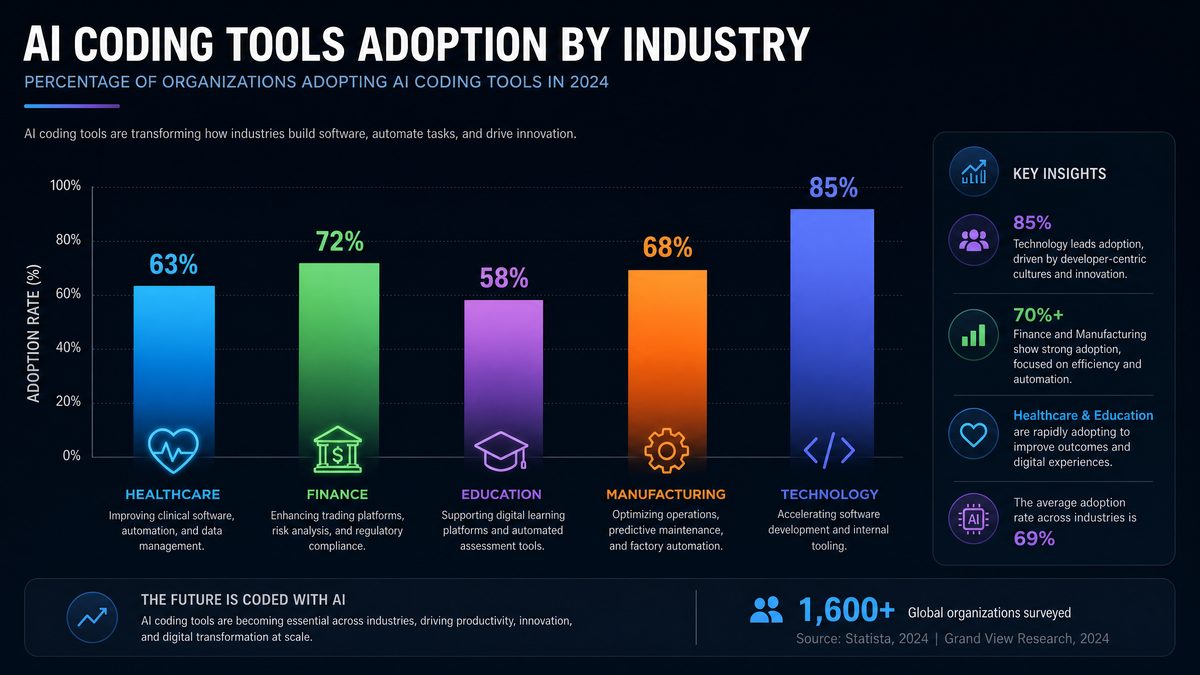
Industry Breakdown: Which Sectors Are Adopting Fastest
Codex’s user growth is not uniform across industries. Adoption rates vary significantly, reflecting differing digital transformation maturity levels, coding needs, and organizational openness to AI tools. The fastest adopters of Codex include:
| Industry | Adoption Rate Growth (Feb 2026 – Jun 2028) | Primary Use Cases |
|---|---|---|
| Technology & Software | 5.8x | Code generation, API development, DevOps automation |
| Financial Services | 7.1x | Data analysis, risk modeling, automated reporting |
| Healthcare & Life Sciences | 6.4x | Data scripting, research automation, clinical trial data processing |
| Manufacturing | 4.9x | IoT integration scripts, process automation, supply chain optimization |
| Retail & E-commerce | 5.5x | Inventory management automation, customer data analysis, marketing campaign scripting |
| Education | 8.0x | Curriculum automation, coding tutorials, educational content generation |
Education leads with an 8x adoption growth, driven by institutions integrating Codex into coding curricula and training programs. Financial services also show rapid uptake due to their heavy reliance on data scripting and regulatory reporting automation. Technology remains the largest user base but exhibits slightly slower growth compared to emerging sectors embracing AI-driven automation.
Comparison to Other AI Coding Tools (GitHub Copilot, Cursor, Claude Code)
Codex’s meteoric rise invites comparison with other prominent AI coding assistants. GitHub Copilot, powered by OpenAI’s earlier models, remains a market leader but has plateaued recently at around 3.5 million WAUs. Cursor, a newcomer with strong code completion and debugging features, reports steady growth but lags Codex in user engagement metrics. Claude Code, Anthropic’s AI coding tool, is noted for its strong security posture and enterprise integrations but has a smaller footprint.
| Feature / Metric | OpenAI Codex | GitHub Copilot | Cursor | Claude Code |
|---|---|---|---|---|
| Weekly Active Users | 5,000,000 | 3,500,000 | 1,200,000 | 900,000 |
| Supported Languages | 20+ | 15+ | 12 | 10+ |
| Parallel Task Execution | Yes (Advanced) | No | Limited | Planned |
| Knowledge Worker Adoption | 40% | 25% | 18% | 15% |
| Enterprise Integrations | Extensive (IDE + SaaS) | Strong (GitHub ecosystem) | Growing | Strong (Security focus) |
| Pricing Model | Subscription + Usage-based | Subscription | Subscription | Enterprise licensing |
Codex’s support for parallel task execution and broader knowledge worker integration differentiates it within this competitive landscape. Furthermore, OpenAI’s flexible pricing and ecosystem partnerships position Codex for continued expansion across user segments.
What 5M Users Means for OpenAI’s Revenue and Strategy
Reaching 5 million weekly active users significantly bolsters OpenAI’s revenue streams and strategic positioning. With a hybrid subscription and usage-based pricing model, higher user engagement translates directly into increased monthly recurring revenue (MRR). Estimates place Codex’s annual revenue at approximately $300 million as of mid-2028, representing a substantial contribution to OpenAI’s overall financials.
This milestone also validates OpenAI’s strategic pivot from purely research-driven AI development to scalable commercial applications. Codex serves as a flagship product demonstrating the viability of AI tools beyond text generation, opening avenues for enterprise contracts, API licensing, and partnerships with cloud providers.
Moreover, the 5 million WAU benchmark positions OpenAI as a dominant player in the AI coding assistant market, enabling further innovation investment and ecosystem expansion. Codex’s success encourages OpenAI to deepen integrations with popular development platforms, enhance AI capabilities, and explore adjacent productivity domains.
The “Codex for Everyone” Vision vs the Developer-First Origin
OpenAI initially designed Codex with developers in mind — a sophisticated assistant to augment coding workflows. However, the rapidly evolving user base and use cases have pushed OpenAI toward a “Codex for everyone” vision, aiming to democratize coding through AI for knowledge workers across industries.
This shift requires balancing technical depth with accessibility. OpenAI has introduced features like natural language prompt simplification, contextual help, and templates to lower the barrier for non-developers. Simultaneously, the product continues to cater to advanced users through customizable AI models and IDE plugins.
OpenAI’s roadmap reflects this dual approach, with planned releases targeting enhanced usability for knowledge workers while preserving the power and flexibility demanded by developers. This inclusive vision aligns with broader AI democratization goals and creates a unified platform where diverse users can collaborate seamlessly.
Predictions: Where Codex User Growth Goes from Here
Based on current trends and industry analyst forecasts, Codex’s user base is expected to continue growing robustly over the next 3–5 years. Key predictions include:
- Growth acceleration among knowledge workers: Adoption in non-technical roles is projected to outpace developers, potentially reaching 60% of total users by 2030.
- Global expansion: Increasing localization and language support will drive growth in emerging markets, particularly in Asia and Latin America.
- Integration with emerging AI modalities: Codex will incorporate multimodal AI inputs (voice, visual code analysis) to enhance interaction and usability.
- Enterprise adoption surge: More enterprises will embed Codex into internal workflows, driving customized deployments and volume licensing.
- Complementary AI ecosystems: Codex will become a central hub linking AI tools for project management, testing automation, and CI/CD pipelines.
Collectively, these factors could propel Codex’s weekly active user base beyond 15 million by 2030, solidifying its role as a foundational AI productivity platform.
Impact on Hiring, Job Roles, and Organizational Structure
The widespread adoption of Codex is already influencing hiring practices, job role definitions, and organizational design. AI-assisted coding tools reduce the need for repetitive coding tasks, shifting the focus of technical talent toward higher-level design, architecture, and innovation.
Access 40,000+ AI Prompts for ChatGPT, Claude & Codex — Free!
Subscribe to get instant access to our complete Notion Prompt Library — the largest curated collection of prompts for ChatGPT, Claude, OpenAI Codex, and other leading AI models. Optimized for real-world workflows across coding, research, content creation, and business.
Organizations are increasingly valuing hybrid skill sets that combine domain expertise with AI fluency. For example, data analysts who can leverage Codex for scripting gain competitive advantage, blurring traditional role boundaries. Similarly, teams reorganize around AI-augmented workflows, emphasizing collaborative coding and continuous learning.
Moreover, hiring managers report evolving job requirements emphasizing AI tool proficiency, adaptability, and creative problem-solving over raw coding speed. This shift also reduces entry barriers, enabling organizations to tap into a broader talent pool, including those with less formal programming backgrounds.
From an organizational structure standpoint, companies are establishing dedicated AI productivity teams and centers of excellence to maximize Codex’s benefits. Cross-functional collaboration between developers, data scientists, and knowledge workers is becoming standard practice, fostering innovation and agility.
Expert Opinions and Analyst Perspectives on the Data
Industry analysts and AI experts widely acknowledge Codex’s 5 million weekly user milestone as a watershed moment for AI-assisted coding. Dr. Priya Malhotra, an AI productivity analyst at Forrester Research, notes, “Codex’s rapid growth reflects not just technological superiority but also a shift in how organizations approach software development and knowledge work. Its success validates the concept of AI as a co-pilot rather than a replacement.”
John Simmons, CTO at a leading fintech firm adopting Codex, emphasizes the impact on team dynamics: “We’ve seen a 40% reduction in development cycle times since integrating Codex. More importantly, it has empowered our business analysts to prototype automation scripts independently, accelerating innovation.”
OpenAI’s internal research team highlights that Codex’s parallel task execution feature is a key differentiator, citing user studies showing a 25% increase in multitasking efficiency and a 15% reduction in error rates.
However, experts caution about challenges ahead. Dr. Elena Garcia, a labor economist, warns, “While Codex enhances productivity, organizations must manage workforce transitions carefully to avoid displacing roles and ensure upskilling.”
In summary, expert consensus views Codex’s growth as a positive indicator of AI’s transformative potential, balanced with the need for thoughtful adoption strategies.
Conclusion
OpenAI’s Codex reaching 5 million weekly active users marks a pivotal milestone in the evolution of AI-assisted coding and knowledge work. The sixfold growth since its desktop app launch, the rapid expansion among knowledge workers, the adoption across diverse industries, and the introduction of parallel task execution collectively highlight how Codex is redefining productivity paradigms.
Compared to competitors, Codex’s broad language support, deep integrations, and user diversity set it apart as a leading AI coding assistant. This growth is driving significant revenue and shaping OpenAI’s strategic trajectory toward AI democratization. The shift from a developer-first tool to a platform “for everyone” signals a future where AI-enabled coding is ubiquitous across roles and sectors.
Looking ahead, Codex is poised to continue its rapid expansion, reshape hiring and organizational structures, and deepen its impact on how work gets done. Navigating this transformation will require careful balancing of technology, talent development, and ethical considerations to fully realize the promise of AI-augmented productivity.
For readers interested in exploring how AI coding assistants are revolutionizing software development and workflows in more detail, consider our deep dive on AI Coding Assistants. To understand broader trends in AI for knowledge workers, visit our coverage on AI for Knowledge Workers. For insights into the competitive landscape and AI-driven developer tools, see our analysis of AI Developer Tools.