
OpenAI’s Enterprise Pivot: How 7 Million Workplace Seats Are Reshaping ChatGPT’s Product Strategy in 2026
OpenAI’s Enterprise Pivot: How 7 Million Workplace Seats Are Reshaping ChatGPT’s Product Strategy in 2026
By the ChatGPT AI Hub Editorial Team | June 18, 2026
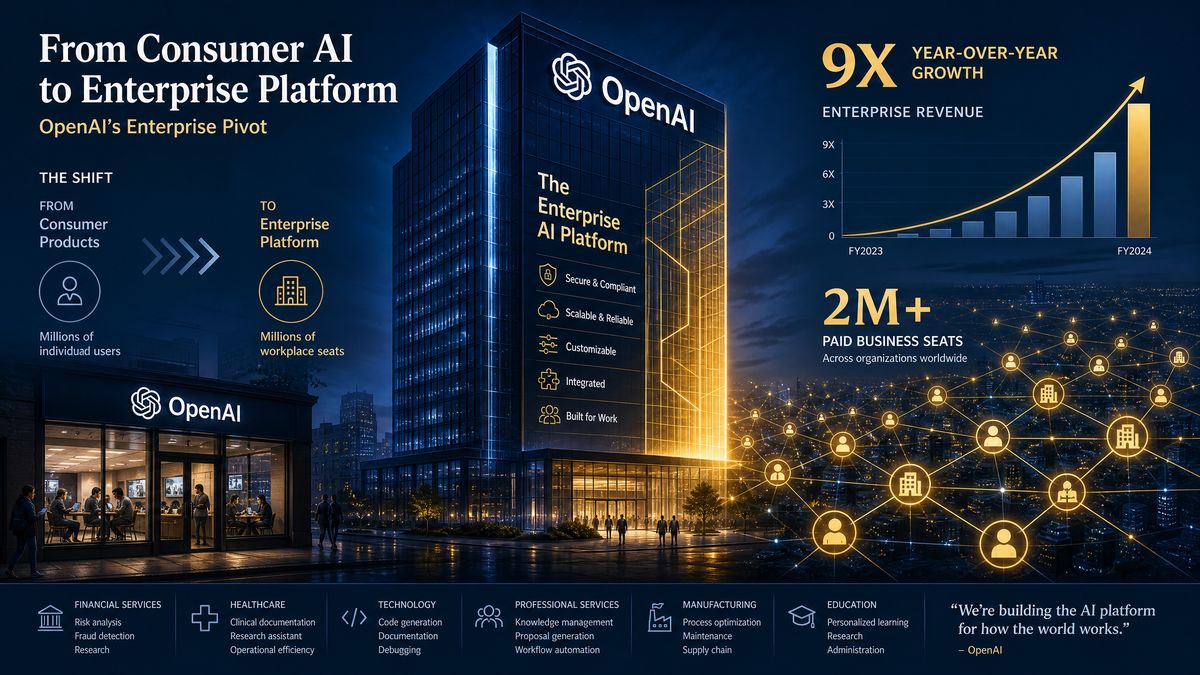
Eighteen months ago, OpenAI was still widely perceived as a consumer technology company that happened to sell API access. Today, that perception has been overtaken by a far more consequential reality: OpenAI is one of the fastest-growing enterprise software vendors in history, with ChatGPT workplace deployments surpassing 7 million seats — a staggering nine-times year-over-year increase that has fundamentally reoriented every layer of the company’s product, pricing, and engineering strategy.
This is not a story about a chatbot becoming popular inside Fortune 500 companies. It is a story about how explosive enterprise adoption has begun reshaping OpenAI’s product roadmap in ways that are creating new opportunities for some builders and new friction for others — particularly the individual developers and small teams who formed the company’s earliest commercial base.
To understand what OpenAI’s enterprise pivot means for the software you build, the models you access, and the pricing you’ll pay through the second half of 2026, you need to understand the forces driving this shift, the specific product decisions it has already produced, and the strategic tensions it is generating internally and externally.
The enterprise pivot is reflected in how ChatGPT’s memory and personalization systems are evolving for organizational use. Our deep dive into ChatGPT Dreaming V3 Memory and background memory architecture explains how OpenAI is building enterprise-grade personalization that learns from organizational patterns while maintaining data isolation between teams.
The Numbers Behind the Pivot
The 7 million workplace seat figure is striking not just for its size but for what it implies about the rate of organizational adoption. When OpenAI launched ChatGPT Enterprise in August 2023, the product was positioned as a premium, security-hardened version of the consumer tool — useful for compliance-sensitive industries that needed data isolation and administrative controls. Adoption was healthy but measured. By Q4 2024, the seat count was approaching 800,000. By mid-2025, it had crossed 2 million. The acceleration from 2 million to 7 million seats in under twelve months represents a qualitative shift in how large organizations are thinking about AI infrastructure.
Several forces converged to produce this acceleration. First, the competitive landscape forced enterprise IT buyers off the fence. Once Microsoft Copilot achieved genuine productivity benchmarks in early 2025 and Google Workspace AI hit general availability with deep Docs and Gmail integration, procurement teams that had been running pilots for eighteen months faced a credible “use it or lose the competitive window” argument. Second, regulatory clarity in the EU around AI Act compliance — particularly the provisions governing high-risk AI use in HR, finance, and legal — made enterprise-grade data processing agreements and audit logs a procurement prerequisite rather than a nice-to-have. Third, and most importantly, the models themselves became measurably better at the multi-step, tool-augmented reasoning tasks that produce genuine ROI in knowledge work environments.
The result is that OpenAI’s enterprise segment now accounts for an estimated 65 to 70 percent of the company’s total revenue — a dramatic inversion from the API-heavy revenue mix that characterized 2023 and early 2024. This financial reality is the engine driving every product decision discussed in the sections that follow.
OpenAI’s enterprise growth is also driving new commerce capabilities that extend AI agents into business transactions. Our developer guide on building agentic commerce workflows with the OpenAI and Visa partnership covers how enterprise teams can leverage AI agents for automated purchasing, expense management, and vendor interactions.
What “Enterprise-First” Actually Means for the Product Roadmap
When a software company’s center of gravity shifts from individual users or developers to enterprise procurement, the product roadmap changes in predictable ways. Features that unlock expansion revenue inside existing accounts take priority. Security, compliance, and administrative capabilities that unblock procurement move up the queue. Interoperability with incumbent enterprise software stacks — identity providers, SIEM tools, ERP systems — becomes a first-order concern. And the feedback loops that drive iteration shift from high-velocity consumer signals to lower-frequency but higher-stakes conversations with a smaller number of very large customers.
For OpenAI in 2026, this pattern is playing out across at least six distinct product dimensions:
1. The Custom GPT and Workspace Architecture Overhaul
The original GPT Store, launched in January 2024, was built around individual creators publishing custom GPTs to a marketplace — a consumer mental model borrowed from the App Store era. Enterprise customers did not want a marketplace. They wanted an internal catalog of approved, company-specific AI applications with role-based access controls, usage logging, and the ability to push updates to all employees simultaneously.
OpenAI’s response was the Enterprise Workspace Architecture, released in Q1 2026, which introduces a fundamentally different deployment model. Administrators can now create “Organizational GPTs” that live in a private namespace, inherit enterprise security policies automatically, and can be scoped to specific departments or security groups. The public GPT Store still exists, but enterprise accounts access it through an allowlist model where IT can approve or block specific GPTs before they become available to employees.
The practical implication for enterprise developers building internal tools is significant. You can now publish a custom GPT to your organization’s private catalog with a fully programmatic deployment pipeline. Here is a simplified example of what a CI/CD-integrated deployment workflow looks like using the OpenAI Admin API:
import openai
import json

client = openai.OpenAI(api_key="YOUR_ENTERPRISE_API_KEY")

# Define the GPT configuration
gpt_config = {
    "name": "Legal Contract Reviewer v2.1",
    "description": "Reviews contract clauses against company policy",
    "instructions": open("prompts/legal_reviewer.txt").read(),
    "tools": [
        {"type": "file_search"},
        {"type": "code_interpreter"}
    ],
    "file_ids": ["file-abc123", "file-xyz789"],
    "metadata": {
        "department": "legal",
        "compliance_reviewed": "true",
        "review_date": "2026-06-01",
        "owner": "[email protected]"
    }
}

# Deploy to organizational catalog
response = client.beta.assistants.create(**gpt_config)

# Update organizational policy to grant access to Legal department
policy_update = client.admin.workspace.policies.update(
    assistant_id=response.id,
    access_groups=["legal-all", "compliance-team"],
    audit_logging=True,
    data_retention_days=90
)

print(f"Deployed: {response.id}")
print(f"Access policy: {json.dumps(policy_update.model_dump(), indent=2)}")
This kind of deployment automation — tying GPT updates to a git-based release process — was nearly impossible to implement cleanly before the Enterprise Workspace Architecture. The new admin API surface is one of the clearest signals that OpenAI has internalized enterprise developer workflows as a first-class use case.
2. Model Access Tiering and the Priority Queue System
Perhaps the most commercially significant change in OpenAI’s 2026 product strategy is the introduction of explicit capacity tiering across its model serving infrastructure. Enterprise customers on annual contracts now receive guaranteed capacity reservations — essentially reserved compute allocations — that insulate them from the rate limiting and increased latency that API users experience during peak demand periods.
This is a meaningful operational advantage. During the GPT-5.5 launch period in April 2026, when API traffic spiked by approximately 340 percent over baseline, enterprise customers on reserved capacity experienced less than 8 percent latency degradation. API customers on the standard tier saw median response times increase by over 200 percent during peak hours. For applications where response latency is user-facing — customer support tools, real-time document drafting assistants, coding copilots — that difference is commercially material.
The tiering structure as of June 2026 breaks down as follows:
| Tier | Capacity Guarantee | Rate Limit (RPM) | Model Access | SLA Uptime | Pricing Model |
|---|---|---|---|---|---|
| Free / ChatGPT Free | None | 3 RPM | GPT-4o (limited) | No SLA | Free |
| ChatGPT Plus | None | 40 RPM | GPT-4o, o3, limited GPT-5.5 | No SLA | $20/month |
| API — Pay As You Go | None (best effort) | 500–5,000 RPM (tier dependent) | All released models | 99.5% | Per-token consumption |
| ChatGPT Team | Soft priority | 100 RPM per seat | All models including o3-pro | 99.7% | $30/seat/month |
| ChatGPT Enterprise | Hard reservation | Custom | All models + early access | 99.9% | Annual contract, negotiated |
| Enterprise API (Dedicated) | Dedicated instances | Unlimited (within reservation) | All models + fine-tuning | 99.95% | Annual contract, starts ~$2M |
The introduction of hard capacity reservations is a structural advantage for enterprise customers that compounds over time. As OpenAI’s user base continues to grow, best-effort capacity becomes increasingly contested. Enterprise customers who locked in reservations during 2025 and early 2026 effectively secured a form of infrastructure hedge against the demand growth they are themselves helping to create.
3. The Compliance and Data Governance Stack
If there is a single area where OpenAI’s enterprise pivot has produced the most concentrated engineering investment, it is compliance infrastructure. This is not glamorous work, but it is the work that unlocks regulated industries — financial services, healthcare, legal, government — which together represent an enormous portion of the addressable enterprise market.
The 2026 Enterprise compliance stack now includes: FedRAMP Moderate authorization (achieved in March 2026, enabling US federal agency deployment), HIPAA Business Associate Agreement support for healthcare customers, SOC 2 Type II annual recertification, ISO 27001 certification, and EU AI Act Article 13 transparency documentation for all deployed models. Additionally, OpenAI launched its Data Residency program in Q2 2026, allowing enterprise customers in the EU, UK, and Japan to specify that all data processing — including intermediate model states during inference — remains within their regulatory jurisdiction.
For enterprise architects designing AI-integrated applications, this compliance infrastructure changes the risk calculus for a significant category of use cases that were previously off-limits or required costly workarounds involving on-premises model deployments. A healthcare provider can now build a clinical documentation assistant that processes PHI through ChatGPT Enterprise without requiring a separately hosted, self-managed model. A European financial institution can use GPT-5.5 for document analysis while satisfying GDPR Article 44 requirements on data transfers.
The Developer Experience Divergence: Individual vs. Enterprise
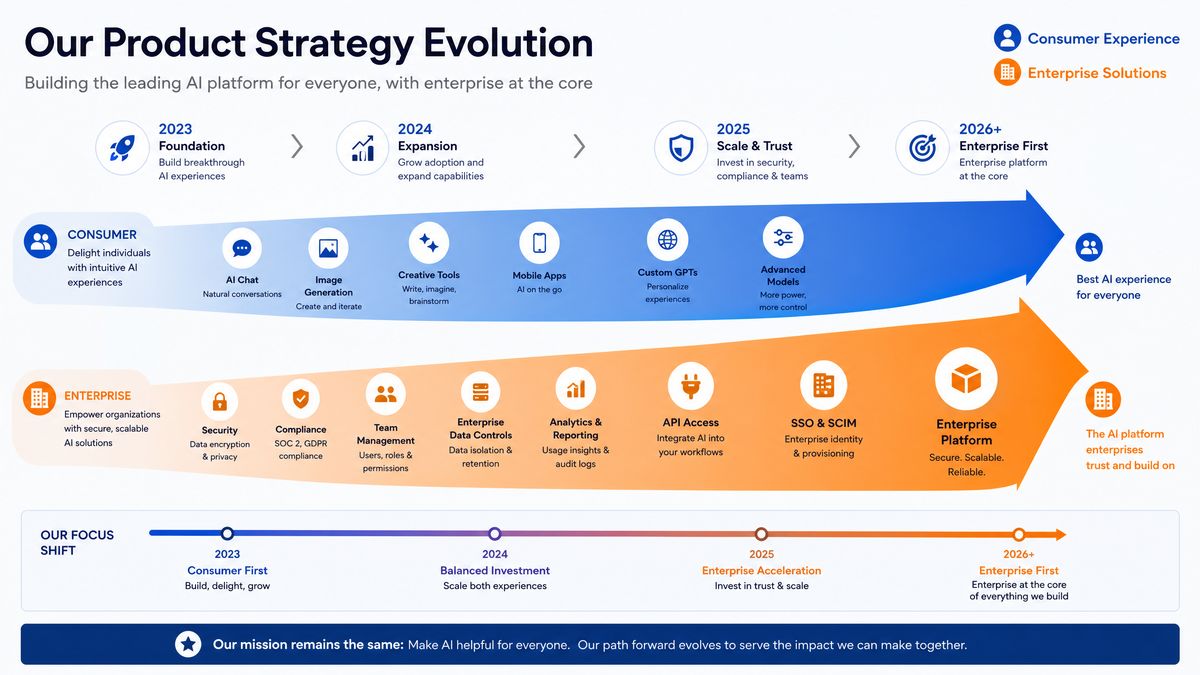
The enterprise pivot has produced a visible bifurcation in the developer experience that is generating significant discussion in the OpenAI developer community. Individual developers and small teams are increasingly finding that the features they most want — expanded context windows, higher default rate limits, access to the latest model capabilities — are being released first or exclusively on enterprise tiers. Meanwhile, the developer tooling and documentation that would help them build more sophisticated applications is receiving comparatively less investment than the administrative and compliance tooling that enterprise customers demand.
This is not unique to OpenAI. It is a recurring pattern in enterprise software history. When Salesforce pivoted toward enterprise in the mid-2000s, individual developer access to the platform became more constrained and more expensive relative to the company’s early days. When Slack pivoted toward enterprise, free tier features were progressively restricted. The pattern is commercially rational but creates real friction for the builders who were early champions of the platform.
For individual API developers, the specific friction points in 2026 include:
- GPT-5.5 access delays: GPT-5.5 has been available to Enterprise customers since April 2026. Pay-as-you-go API access was announced for Q3 2026 but has not yet launched as of this writing.
- Context window restrictions: The 1-million-token context window available in the Enterprise API is capped at 128,000 tokens for standard API tiers, creating a capability gap for long-document processing use cases.
- Fine-tuning availability: Fine-tuning for GPT-5.5 is currently available only through Enterprise API agreements. Standard API customers have access to fine-tuning for GPT-4o only.
- Batch API pricing: The 50 percent discount on asynchronous batch processing is available at all tiers, but enterprise customers have significantly higher batch throughput limits.
- Reasoning model quotas: The o3-pro model, which produces the highest-quality reasoning outputs for complex tasks, is limited to 10 requests per day for Plus subscribers and available without hard caps only on Team and Enterprise tiers.
Understanding this divergence matters not just for individual developers but for enterprise architects deciding which tier to standardize on, and for startup founders deciding whether to architect their product around OpenAI’s infrastructure or to maintain model-agnostic flexibility as a strategic hedge.
Feature Roadmap Analysis: What Enterprise Demand Is Prioritizing
Reading OpenAI’s public product communications alongside enterprise customer interviews and developer conference sessions from the past six months, a coherent picture emerges of where the company is directing engineering resources in response to enterprise demand signals.
Persistent Memory and Organizational Knowledge Graphs
The single most commonly requested feature from enterprise accounts is persistent, structured memory that operates at the organizational level rather than the individual conversation level. Consumer ChatGPT’s memory feature stores individual preferences and facts across conversations. Enterprise customers want something more like an organizational knowledge graph: a structured, query-able representation of company-specific context that any employee’s ChatGPT session can draw on, subject to their access permissions.
OpenAI previewed “Workspace Memory” at its Enterprise Summit in May 2026. The feature, currently in limited beta with approximately 40 enterprise customers, allows administrators to define knowledge domains — product documentation, internal policies, customer data schemas, code architecture descriptions — and make them available as a background context layer for all conversations within specified user groups. Unlike RAG (retrieval-augmented generation) implementations that developers build manually on top of the API, Workspace Memory is native to the ChatGPT interface and requires no custom engineering to expose to end users.
For enterprise developers, this raises an important strategic question: if OpenAI is natively building the organizational memory layer that many teams have been constructing as custom infrastructure on top of the API, does that change the build-vs-buy calculus for knowledge management features in your AI applications?
Agentic Workflows and the Operator Framework
The expansion of ChatGPT’s agentic capabilities — its ability to take sequences of actions across external systems, not just generate text — has been the highest-profile product development of 2026. The Operator framework, which defines how ChatGPT agents authenticate with and act on external systems, has moved from research preview to production availability for Enterprise customers.
For enterprise architects, the Operator framework is best understood as a governed execution layer for AI agents. Rather than building custom agent orchestration (with all the security and auditing concerns that entails), developers can define Operators — essentially permission-scoped action sets — and attach them to GPTs deployed in the enterprise catalog. Here is an example of an Operator definition for a financial reporting assistant:
{
  "operator_id": "financial-reporting-operator-v1",
  "display_name": "Financial Data Operator",
  "description": "Provides read access to financial reporting systems",
  "authentication": {
    "type": "oauth2",
    "scopes": ["financials.read", "reports.generate"],
    "provider": "azure-ad",
    "tenant_id": "YOUR_TENANT_ID"
  },
  "actions": [
    {
      "name": "query_revenue_data",
      "type": "http",
      "method": "GET",
      "url": "https://erp.company.com/api/v2/revenue",
      "parameters": {
        "period": {"type": "string", "required": true},
        "department": {"type": "string", "required": false},
        "currency": {"type": "string", "default": "USD"}
      },
      "response_schema": "schemas/revenue_response.json",
      "audit_log": true,
      "pii_fields": []
    },
    {
      "name": "create_report_draft",
      "type": "http",
      "method": "POST",
      "url": "https://docs.company.com/api/create",
      "requires_approval": true,
      "approval_group": "finance-managers",
      "audit_log": true
    }
  ],
  "rate_limits": {
    "requests_per_hour": 100,
    "requests_per_user_per_hour": 20
  },
  "compliance": {
    "data_classification": "confidential",
    "retention_policy": "90-days",
    "gdpr_applicable": true
  }
}
The requires_approval field on the create_report_draft action illustrates a design pattern that is critical for enterprise agentic deployments: human-in-the-loop checkpoints for actions that have persistent real-world consequences. This pattern — where AI agents can read and analyze freely but require human approval for write operations — is emerging as a governance standard in enterprise AI deployments and is increasingly formalized in the Operator specification.
Advanced Analytics and ROI Attribution
Enterprise procurement cycles for AI tools are increasingly requiring quantifiable ROI evidence, and OpenAI has responded by investing heavily in usage analytics capabilities within the Enterprise dashboard. The Analytics Suite, launched in February 2026, provides per-department, per-use-case, and per-user metrics including: estimated time-to-completion reduction for common tasks, token efficiency metrics that proxy for task complexity, and integration with HR workflow systems to correlate AI usage patterns with productivity metrics from performance management tools.
For enterprise advocates building the business case for AI adoption within their organizations, these analytics capabilities are often more immediately valuable than model capability improvements. The ability to show a CFO that the legal department saved 340 hours of contract review time in Q1, with a specific dollar attribution based on attorney billing rates, is what drives seat expansion from 200 to 2,000 within a single account.
The Pricing Restructuring: What Enterprise Growth Means for API Economics
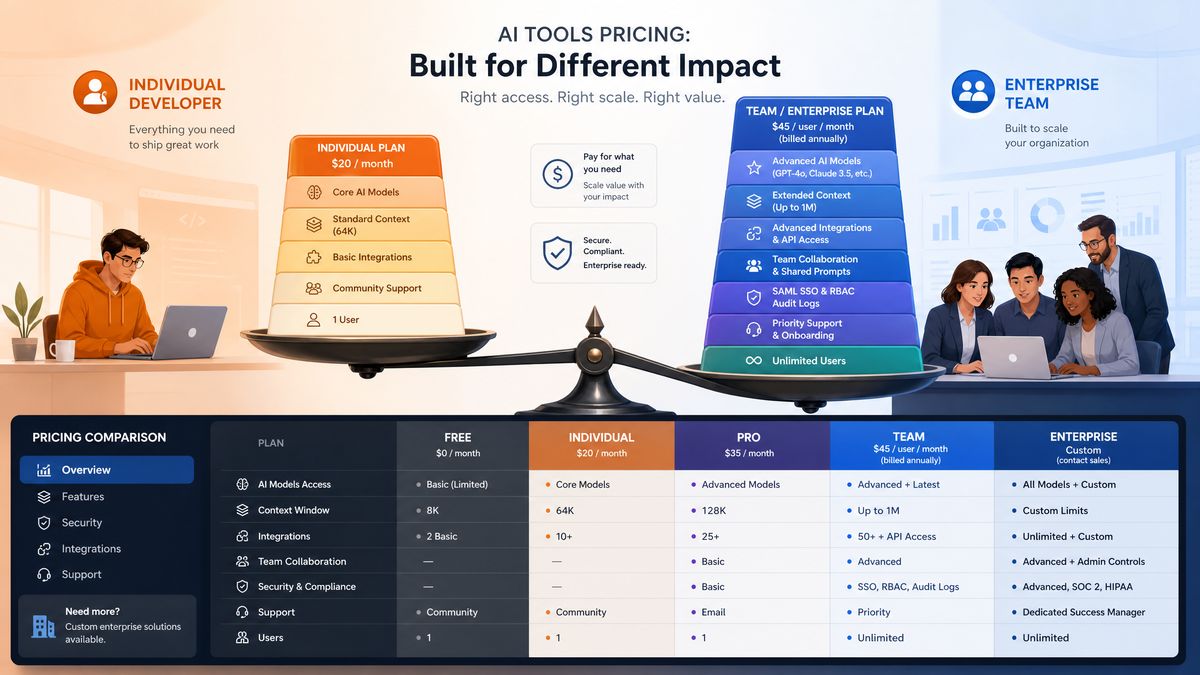
OpenAI has restructured its pricing three times since January 2025, and each restructuring has reflected the same underlying dynamic: enterprise contract revenue provides the margin cushion that allows selective price reductions on API consumption, while simultaneously creating incentive structures that push high-volume API users toward enterprise agreements.
The net effect on API pricing has been mixed. On a pure per-token basis, GPT-4o pricing has decreased by approximately 60 percent since January 2025 — a significant reduction that benefits API-first applications. However, the total cost of accessing the most capable models has increased for many teams because those models (GPT-5.5, o3-pro, 1M-token contexts) are either unavailable on standard API tiers or priced at premiums that effectively require enterprise agreement economics to be cost-sustainable at production scale.
Consider the following cost comparison for a document analysis application processing 10 million tokens per day:
| Scenario | Model | Context Length | Daily Token Cost | Monthly Cost | Annual Cost |
|---|---|---|---|---|---|
| Standard API (current) | GPT-4o | 128K max | ~$150 | ~$4,500 | ~$54,000 |
| Standard API (premium) | GPT-5.5 (when available) | 128K max | ~$380 | ~$11,400 | ~$136,800 |
| Enterprise API | GPT-5.5 | 1M available | ~$220 (committed discount) | ~$6,600 + base fee | ~$100,000–$150,000 total |
| Enterprise API (optimized) | GPT-4o (tier-routed) | Adaptive | ~$95 (volume discount) | ~$2,850 + base fee | ~$80,000–$120,000 total |
The pricing architecture increasingly creates a situation where teams that need sustained high-quality output at scale are economically pressured toward enterprise agreements even if they lack the compliance, administrative, or collaboration requirements that originally defined the enterprise tier. This is a deliberate funnel design — and understanding it is essential for accurate financial planning in AI-integrated product development.
Strategic Implications for Enterprise Architects and Development Teams
For the senior engineers, architects, and technical leaders reading this analysis, the enterprise pivot produces a set of specific strategic questions that need to be worked through systematically rather than reactively.
Build on Native Enterprise Features vs. Build on the API
The most important architectural decision facing enterprise development teams in 2026 is whether to build AI-augmented applications directly on the OpenAI API (retaining maximum flexibility and control) or to build within the native ChatGPT Enterprise environment (leveraging native features like Workspace Memory, Operators, and the Analytics Suite but accepting dependency on OpenAI’s deployment and configuration model).
The tradeoffs are real and non-trivial. Building on the API gives you model-agnostic portability — your application can be migrated to Anthropic, Google, or a locally hosted open-weight model if OpenAI’s pricing, availability, or product direction changes in ways that no longer serve your needs. Building within the native Enterprise environment gives you faster time-to-deployment for standard use cases, built-in compliance infrastructure, and access to features (like Workspace Memory and Operators) that would require significant custom development to replicate via API.
A practical framework for making this decision:
- Assess use case standardization: If the use case is relatively standard — document summarization, email drafting, code review — native Enterprise features will typically be faster to deploy and easier to maintain. If the use case requires deeply custom logic, specific data processing pipelines, or integration patterns that don’t fit the Operator model, API-based development retains advantages.
- Evaluate lock-in risk: For core business processes where AI integration is mission-critical, maintaining some level of model-agnostic portability is a risk management imperative. For productivity augmentation tools where switching costs are lower, native Enterprise integration is more defensible.
- Consider the maintenance burden: Custom RAG pipelines, agent orchestration frameworks, and memory management systems require ongoing maintenance as models evolve. Native Enterprise features are maintained by OpenAI. For small teams, this operational burden difference can be decisive.
- Model the five-year total cost: Enterprise contract pricing is predictable but front-loaded. API-based development has variable costs that scale with usage. The five-year total cost comparison often favors Enterprise agreements for applications with predictable, high-volume usage patterns.
Preparing Your Team for Agentic Deployment Governance
As agentic AI capabilities mature and the Operator framework makes it easier to give ChatGPT agents the ability to take real-world actions, enterprise development teams need governance frameworks that match the expanded capability surface. The following checklist represents a minimum viable governance framework for enterprise agentic deployments:
- Action classification: Every action an agent can take should be classified as read-only, write with reversibility, or write without reversibility. Write-without-reversibility actions (sending emails, submitting transactions, deleting records) should require explicit human approval workflows.
- Scope minimization: Operator permissions should be scoped to the minimum necessary for the defined use case. An agent that answers questions about HR policy does not need write access to the HRIS system.
- Audit trail requirements: Every agent action should generate an immutable audit log entry that includes the user context, the specific action taken, the input data provided to the action, and the output received. This is increasingly a regulatory requirement, not just a best practice.
- Failure mode planning: What happens when an agent takes an incorrect action based on a hallucination or misunderstood instruction? Define rollback procedures for every write action category before deployment, not after an incident.
- Rate limit and cost controls: Agentic workflows can consume tokens at dramatically higher rates than conversational interactions. Implement hard spending limits at the department and application level, with alerting thresholds well below the hard caps.
Model Routing as Cost and Performance Optimization
One of the most impactful engineering practices for enterprise OpenAI deployments is intelligent model routing: automatically directing queries to the least expensive model capable of producing the required output quality for a given task. Enterprises with mature AI platform teams are implementing routing layers that classify incoming requests and direct them to appropriate models:
from openai import OpenAI
from dataclasses import dataclass
from typing import Literal

client = OpenAI(api_key="YOUR_API_KEY")

@dataclass
class RoutingDecision:
    model: str
    max_tokens: int
    reasoning: str

def classify_and_route(
    user_message: str,
    task_type: Literal["simple_qa", "document_analysis",
                       "code_generation", "complex_reasoning",
                       "data_extraction"]
) -> RoutingDecision:
    """
    Route requests to appropriate models based on task complexity.
    Implements a cost-performance optimization strategy.
    """

    routing_table = {
        "simple_qa": RoutingDecision(
            model="gpt-4o-mini",
            max_tokens=1024,
            reasoning="Simple Q&A: low complexity, cost-optimized"
        ),
        "document_analysis": RoutingDecision(
            model="gpt-4o",
            max_tokens=4096,
            reasoning="Document analysis: moderate complexity"
        ),
        "code_generation": RoutingDecision(
            model="gpt-4o",
            max_tokens=8192,
            reasoning="Code gen: structured output, GPT-4o sufficient"
        ),
        "complex_reasoning": RoutingDecision(
            model="o3",
            max_tokens=16384,
            reasoning="Complex reasoning: requires o3 chain-of-thought"
        ),
        "data_extraction": RoutingDecision(
            model="gpt-4o-mini",
            max_tokens=2048,
            reasoning="Structured extraction: pattern recognition task"
        )
    }

    return routing_table[task_type]

def intelligent_completion(
    user_message: str,
    task_type: str,
    system_prompt: str = ""
) -> dict:
    """
    Execute completion with automatic model routing and cost tracking.
    """
    decision = classify_and_route(user_message, task_type)

    messages = []
    if system_prompt:
        messages.append({"role": "system", "content": system_prompt})
    messages.append({"role": "user", "content": user_message})

    response = client.chat.completions.create(
        model=decision.model,
        messages=messages,
        max_tokens=decision.max_tokens
    )

    return {
        "content": response.choices[0].message.content,
        "model_used": decision.model,
        "routing_reason": decision.reasoning,
        "tokens_used": response.usage.total_tokens,
        "estimated_cost": calculate_cost(
            decision.model,
            response.usage.prompt_tokens,
            response.usage.completion_tokens
        )
    }

def calculate_cost(model: str, prompt_tokens: int, completion_tokens: int) -> float:
    """Calculate estimated cost based on current OpenAI pricing."""
    pricing = {
        "gpt-4o-mini": {"prompt": 0.00000015, "completion": 0.0000006},
        "gpt-4o": {"prompt": 0.0000025, "completion": 0.000010},
        "o3": {"prompt": 0.000010, "completion": 0.000040},
        "gpt-5.5": {"prompt": 0.000015, "completion": 0.000060}
    }

    if model not in pricing:
        return 0.0

    p = pricing[model]
    return (prompt_tokens * p["prompt"]) + (completion_tokens * p["completion"])

# Example usage
result = intelligent_completion(
    user_message="Extract all contract dates and party names from this agreement",
    task_type="data_extraction",
    system_prompt="You are a contract analysis assistant. Return structured JSON."
)

print(f"Response: {result['content'][:200]}...")
print(f"Model: {result['model_used']} ({result['routing_reason']})")
print(f"Cost: ${result['estimated_cost']:.6f}")
Enterprise teams that implement model routing typically report 40 to 60 percent reductions in AI infrastructure costs without meaningful degradation in output quality, because a significant portion of real-world enterprise AI queries are genuinely simple tasks that do not require the most capable (and most expensive) models.
The Competitive Landscape Pressure Driving OpenAI’s Enterprise Urgency
No analysis of OpenAI’s enterprise pivot would be complete without acknowledging the competitive dynamics that are accelerating it. Microsoft, through its Copilot M365 integration, has a structural distribution advantage that allows it to reach enterprise knowledge workers through the productivity software they already use daily. Google’s Workspace AI is similarly embedded in the collaboration tools that represent the primary work interface for hundreds of millions of employees globally.
OpenAI’s enterprise offering must compete with these deeply integrated alternatives without the distribution advantages that come from owning the productivity suite. The company’s answer has been to position ChatGPT Enterprise not as a replacement for Copilot or Workspace AI but as a complementary, more capable AI layer — the choice for the most demanding, high-value AI use cases within an organization, even when Microsoft and Google AI handles routine productivity augmentation.
This positioning is pragmatic and commercially defensible, but it means OpenAI’s enterprise growth depends on IT buyers accepting multi-vendor AI strategies — deploying both Copilot for standard productivity use cases and ChatGPT Enterprise for advanced reasoning, complex document work, and custom AI application development. The evidence from current enterprise deployments suggests this pattern is becoming normalized, with many large organizations running three or more AI platforms simultaneously under a “best tool for the task” procurement philosophy.
The other competitive dynamic worth noting is the pressure from open-weight models. As Meta’s Llama series, Mistral’s enterprise offerings, and various domain-specific open-weight models have matured, some enterprise segments — particularly those with strong data governance requirements or sufficient engineering capacity to operate their own inference infrastructure — are pursuing hybrid strategies that route sensitive workloads to self-hosted models while using OpenAI for general-purpose tasks. OpenAI’s enterprise pivot, with its emphasis on data residency, compliance infrastructure, and advanced security features, is partly a response to this competitive pressure: making the case that the governance and compliance overhead of self-hosted models outweighs the data control benefits for most regulated enterprise use cases.
What Individual Developers Should Do Now
If you are an individual developer or a small team building on the OpenAI API, the enterprise pivot produces some specific, actionable considerations for how you architect and plan your work over the next 12 to 18 months.
Architect for model portability from day one. The feature gap between enterprise and standard API tiers will continue to widen. Abstracting your model interactions behind an interface layer that can route to alternative providers — Anthropic’s Claude API, Google’s Gemini API, or local models via Ollama — is no longer a premature optimization. It is straightforward risk management.
Use the Batch API aggressively for non-real-time workloads. The 50 percent pricing discount on asynchronous batch processing is available at all API tiers and represents genuine economic value for workloads that do not require synchronous responses. Document analysis pipelines, data enrichment jobs, and training data generation are all candidates for batch processing.
Monitor the GPT-5.5 general availability timeline closely. When GPT-5.5 becomes available on standard API tiers — expected in Q3 2026 — it will represent a meaningful capability jump for applications that have been constrained by GPT-4o’s limitations in complex reasoning tasks. Having a clear migration plan and test suite ready will allow you to capture that capability improvement quickly.
Consider the Team tier as an intermediate step. For small teams with 2 to 20 seats, the ChatGPT Team tier provides access to o3-pro, higher rate limits, and basic administrative features at a cost that is substantially lower than an Enterprise agreement. For teams that need more than Plus but cannot justify an Enterprise contract, Team is increasingly a viable production tier rather than just an upgrade from consumer plans.
Invest in prompt engineering and model routing before capacity expansion. As model capability improves, well-engineered prompts for simpler models often match the output quality of naive prompts on more expensive models. Building internal expertise in systematic prompt optimization produces compounding returns as you scale usage.
The Longer Arc: What OpenAI’s Enterprise Transformation Means for AI Infrastructure
The 7 million enterprise seat milestone is not just a commercial achievement. It is evidence that the organizational adoption curve for AI infrastructure has entered the phase that technology economists describe as the “chasm crossing” — the transition from early adopter deployments to mainstream organizational infrastructure. When a technology reaches this phase, several things become true simultaneously: it becomes difficult to opt out professionally, it becomes embedded in procurement and compliance frameworks, and it begins to be treated as infrastructure rather than innovation.
For OpenAI, this transition is enormously beneficial commercially but introduces new responsibilities and constraints. Enterprise customers expect infrastructure-level reliability, support, and continuity commitments that are qualitatively different from what a consumer or developer-tools company is accustomed to managing. Model updates that break existing prompts, API deprecations that require application rewrites, and pricing changes that alter the economics of production applications — all of these are manageable inconveniences for individual developers but potential contract violations or operational crises for enterprise customers.
The company has responded by lengthening its model deprecation timelines (GPT-4o is now committed to availability through at least Q4 2027), implementing more rigorous pre-announcement notice periods for API changes, and building dedicated enterprise customer success teams that serve as early warning systems for issues that would otherwise surface as support tickets after they become critical.
These are the behaviors of a company transitioning from a product company to an infrastructure company — and that transition, more than any individual feature or pricing change, is the most important thing to understand about OpenAI’s strategic direction in 2026.
Conclusion: Navigating the New OpenAI Landscape
OpenAI’s enterprise pivot is neither surprising nor regrettable. It is the natural consequence of building technology that genuinely improves knowledge work productivity, operated by a company that needs substantial revenue to fund the compute investments required to continue advancing model capabilities. The 7 million workplace seat figure is not a distraction from OpenAI’s mission — from the company’s perspective, it is evidence that the mission is working.
For enterprise architects and development teams, the pivot creates a landscape with clear advantages: better compliance infrastructure, more reliable capacity, more sophisticated administrative tools, and a vendor that is deeply incentivized to ensure your deployment succeeds because your account represents meaningful recurring revenue. For individual developers and smaller teams, it creates a landscape where access to the most capable models requires either enterprise-level spending commitments or patient waiting for general availability rollouts.
The most important thing either constituency can do is understand the strategic logic driving OpenAI’s product decisions — because companies at this stage of enterprise transition follow predictable patterns, and understanding those patterns allows you to anticipate feature development, pricing changes, and capability access timelines with reasonable accuracy.
OpenAI will continue pushing its most advanced capabilities to enterprise tiers first. It will continue building native features that reduce the build-it-yourself surface area for standard enterprise use cases. It will continue using enterprise contract economics to cross-subsidize consumer and API tier pricing in ways that expand its total addressable market. And it will continue treating compliance, security, and administrative tooling as first-order product investments rather than afterthoughts.
For enterprise developers building on this platform in 2026, working with these dynamics rather than against them — leveraging native enterprise capabilities where they genuinely accelerate your work, maintaining architectural flexibility where lock-in risk is high, and building internal expertise in cost optimization and governance — is the foundation of a sustainable, strategically sound AI development practice.
The enterprise pivot is reshaping ChatGPT’s product strategy in ways that will persist for years. The teams that thrive in this new landscape will be those that understand it clearly enough to make deliberate choices rather than reactive ones.
This analysis was produced by the ChatGPT AI Hub Editorial Team on June 18, 2026. Pricing figures and feature availability reflect publicly available information as of the publication date and are subject to change. Enterprise contract terms vary and the figures cited represent estimates based on publicly reported ranges.
Access 40,000+ AI Prompts for ChatGPT, Claude & Codex — Free!
Subscribe to get instant access to our complete Notion Prompt Library — the largest curated collection of prompts for ChatGPT, Claude, OpenAI Codex, and other leading AI models. Optimized for real-world workflows across coding, research, content creation, and business.
