
The Codex Enterprise Deployment Playbook: 12 Prompts for Team Onboarding, Access Control, and Usage Governance
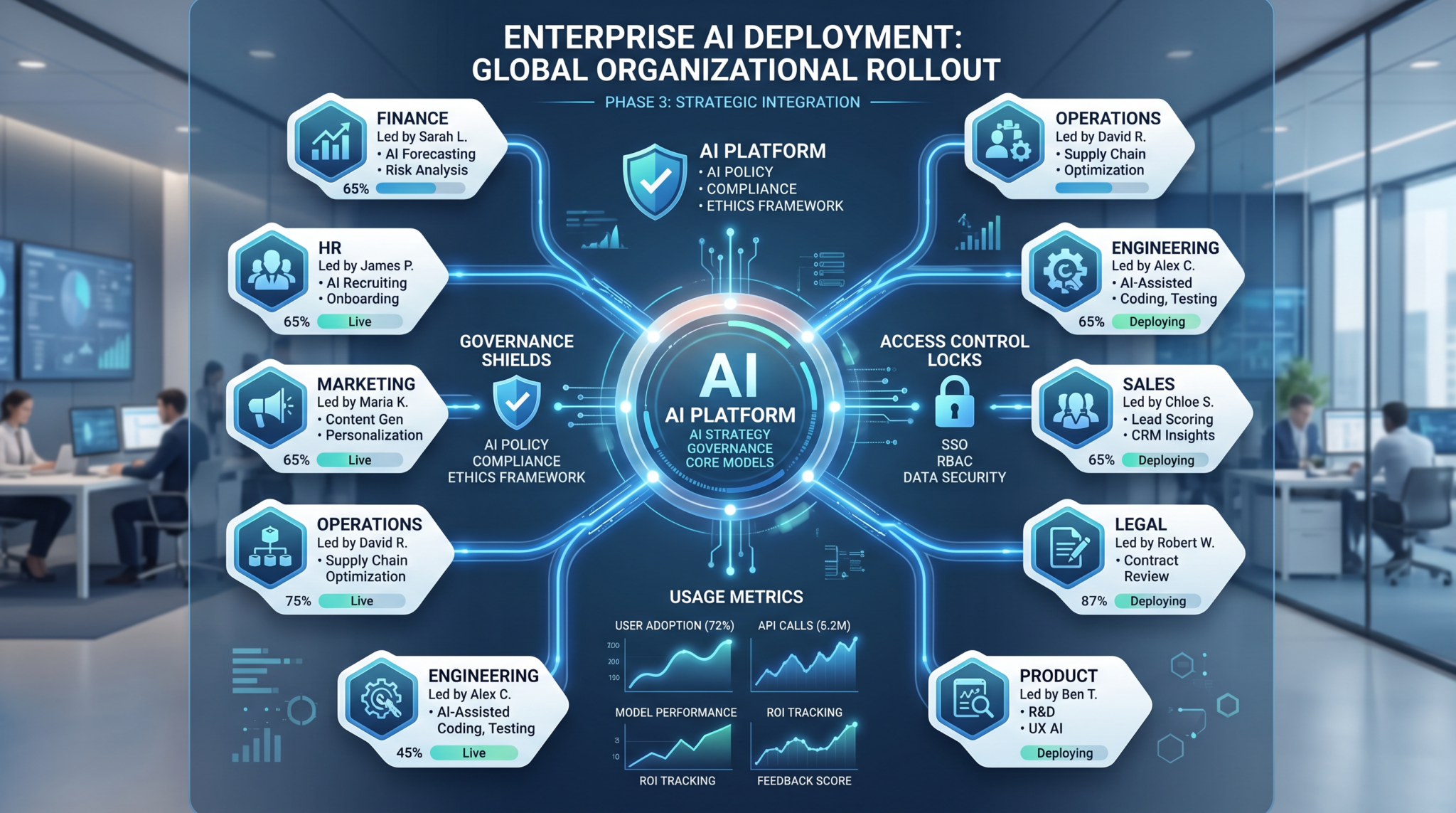
Enterprise Playbook: Deploying OpenAI Codex with Governance-First Discipline
The Complete Guide to ChatGPT and Codex Shared Context | How OpenAI’s $30 Billion Revenue Target Is Reshaping the AI Industry | Setting Up Gemini 3.1 Pro for Enterprise Deployments
Introduction: Why enterprise Codex deployment needs a governance-first approach
OpenAI Codex accelerates software delivery by transforming natural language into working code, tests, and documentation. At enterprise scale, the opportunity is not just faster developers, but consistent patterns, safer refactoring, better code quality, and institutionalized knowledge reuse. However, the same leverage amplifies risk if governance is an afterthought: inadvertent exposure of secrets, uncontrolled spend, non-compliant code generation, and gaps in auditability.
A governance-first approach in Codex deployment prioritizes identity, access, observability, policy, and accountability before mass enablement. This does not slow velocity; it institutionalizes it. By aligning Codex usage with your identity provider, source control permissions, SDLC gates, and security tooling, you convert ad hoc experimentation into a managed capability with measurable ROI. The practical techniques in this playbook assume integration with your existing enterprise stack (e.g., Okta/Azure AD, GitHub/GitLab/Bitbucket, ServiceNow/Jira, Splunk/Elastic/Datadog, Prisma/Checkov/Snyk, and financial systems) and map to compliance obligations (SOC 2, ISO 27001, SOX, HIPAA, GDPR).
This playbook equips IT leaders and platform teams to deploy Codex safely and effectively across multiple business units. It includes a maturity model, twelve ready-to-use governance prompts, a concrete 90-day rollout, KPIs for executive dashboards, and the most common failure modes. Where relevant, you will find link placeholders to related assets: How OpenAI’s $30 Billion Revenue Target Is Reshaping the AI Industry, The Complete Guide to ChatGPT and Codex Shared Context, and Setting Up Gemini 3.1 Pro for Enterprise Deployments.
The deployment maturity model (Pilot → Team → Department → Organization)
Codex adoption succeeds when scaled deliberately. The following maturity model provides stage gates, deliverables, and exit criteria.
| Stage | Primary Objective | Scope | Key Controls | Deliverables | Exit Criteria |
|---|---|---|---|---|---|
| Pilot | Validate value in a controlled sandbox | 1-2 teams, ≤25 users | SSO/SAML, least-privilege keys, sandbox repos, logging POC | Pilot charter, use-case backlog, baseline metrics, initial AUP | ≥20% cycle-time improvement on ≥2 use-cases, no P0 incidents, cost predictability ±10% |
| Team | Operationalize for 1-2 engineering pods | ≤75 users | Role-based access, key rotation, spend alerts, policy binding to repos/branches | RBAC matrix, onboarding runbook, training path, alerting rules | Adoption ≥60% weekly active users, test coverage maintained or improved, 30/60/90-day retention |
| Department | Standardize across multiple teams | 200-500 users | Central cost allocation, org-wide AUP, SDLC gate integrations, SIEM ingestion, DLP | Chargeback model, compliance templates, service catalog entries, audit-ready logs | Zero critical audit gaps, budget variance ≤5%, incident MTTR ≤4 hours |
| Organization | Enterprise-wide capability with continuous improvement | 500+ users across BUs | Automated provisioning, policy-as-code, quarterly red-teaming, executive dashboards | Quarterly scorecards, roadmap, policy pack versioning, external attestation | Business-wide KPIs met for two consecutive quarters, NPS ≥50 among developers |
Stage progression should be gated by measurable performance and risk criteria rather than enthusiasm alone. Emphasize production-like validation early: connect to real repositories under branch protections, simulate spend spikes, rehearsal of key rotation, and confirm that logs trace user-to-action via SSO claims. Embed your internal security champions and compliance officers during Pilot to preempt downstream rework.
Section 1: Team Onboarding (4 prompts)
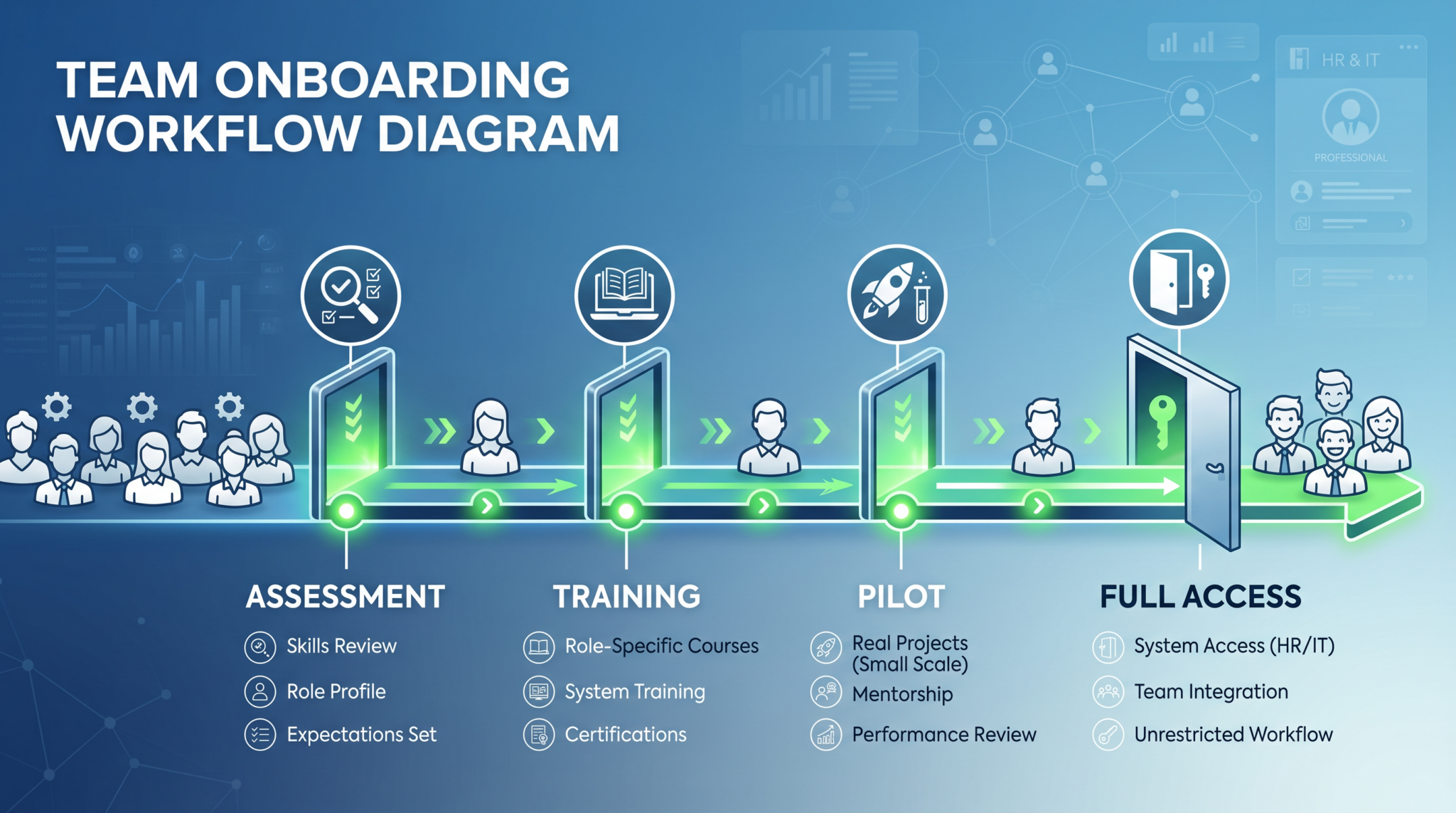
Onboarding determines whether Codex becomes a force multiplier or an ignored plugin. The prompts below generate role-specific onboarding plans, skill assessments, targeted training, and a dashboard to monitor adoption in near real-time.
Prompt 1 — Role-based onboarding plans
Context: when and why
Use this prompt at the beginning of Pilot and again at Team stage to establish differentiated onboarding for roles such as backend engineer, frontend engineer, SRE, data engineer, and QA. Tailored plans reduce time-to-value and ensure guardrails (e.g., approved repositories, branch policies) are immediately understood. Outputs can be used in your service catalog and shared via your LMS.
Full prompt
Objective:
Create role-based onboarding plans for OpenAI Codex at {{ORG_NAME}} that align with our identity, repositories, and SDLC controls.

Inputs:
- Organization: {{ORG_NAME}}
- Business Unit(s): {{BUSINESS_UNITS_LIST}}
- Roles: Backend Engineer, Frontend Engineer, SRE, Data Engineer, QA, Engineering Manager
- Identity Provider: {{IDP}} (e.g., Okta/Azure AD), SSO group names: {{SSO_GROUPS}}
- Source Control: {{SCM}} (e.g., GitHub Enterprise), org: {{SCM_ORG}}, repo patterns: {{REPO_PATTERNS}}, branch protections: {{BRANCH_PROTECTIONS}}
- Issue Tracking: {{ISSUE_TRACKER}} (e.g., Jira), projects: {{JIRA_PROJECTS}}
- CI/CD: {{CICD}} (e.g., GitHub Actions/Azure DevOps)
- Security Tooling: {{SAST_TOOL}}, {{SCA_TOOL}}, {{SECRET_SCANNER}}
- Training/LMS: {{LMS_PLATFORM}}
- Compliance: {{COMPLIANCE_REGIMES}} (e.g., SOC 2, SOX, HIPAA)
- AUP reference: {{AUP_URL}}
- Tooling links: Codex portal {{CODEX_PORTAL_URL}}, docs {{CODEX_DOCS_URL}}

Deliverables:
- For each role: a 14-day onboarding plan with daily tasks, time commitments, prerequisites, and success criteria.
- Access checklist: groups to join, repos to request, keys to provision, approval workflow in {{ITSM_TOOL}} (e.g., ServiceNow).
- Safety checklist: secrets handling, approved data sources, compliance notes.
- First 3 Codex-enabled tasks tailored per role with acceptance criteria.

Constraints:
- Keep time investment ≤ 90 minutes/day in week 1, ≤ 45 minutes/day in week 2.
- Reference concrete repo names and SSO groups using placeholders above.
- Include an escalation matrix and support channels (#codex-help Slack/Teams, email).
- Include “opt-out” steps for teams under regulatory exceptions.

Output format:
- One consolidated onboarding guide with sections per role.
- Checklists in CSV (columns: Role, Task, Owner, Prereq, Due, Link).
- ITSM catalog entry text for {{ITSM_TOOL}}.
Expected deliverable
- A role-indexed onboarding guide in HTML or PDF, plus a CSV checklist for import into ITSM or PM tools.
- Service catalog text describing the “Request Codex Access” workflow with approvals and SLAs.
- Slack/Teams channel announcements templates for #codex-announcements and #codex-help.
Integration notes
- Identity: Map roles to {{SSO_GROUPS}} in {{IDP}}; automate via SCIM. Provisioning flows in {{ITSM_TOOL}} trigger group assignments.
- SCM: Pre-create repository teams in {{SCM_ORG}} that mirror role groups for least-privilege access.
- LMS: Import the per-role plan into {{LMS_PLATFORM}} as a learning path; tag by role and BU.
- Chat: Pin checklists to #codex-help; schedule a recurring office hour invite.
Prompt 2 — Skill assessment frameworks
Context: when and why
Use during Pilot to baseline skills and quarterly thereafter to ensure Codex amplifies rather than masks gaps. The framework should evaluate coding fundamentals, prompt engineering, tool literacy, security hygiene, and compliance awareness. Results feed into targeted training and can be used to gate elevated privileges (e.g., access to production-related repositories).
Full prompt
Objective:
Design a practical skill assessment for Codex users at {{ORG_NAME}} that predicts safe, effective usage in our environment.

Inputs:
- Languages/Stacks: {{LANGUAGES_STACKS}} (e.g., Python, Java, TypeScript, Terraform)
- Frameworks: {{FRAMEWORKS}} (e.g., Spring, React, Django)
- Repos for scenarios: {{ASSESSMENT_REPOS}}
- Policies: {{AUP_URL}}, {{SEC_POLICY_URL}}, {{CODE_REVIEW_POLICY_URL}}
- Security tools: {{SAST_TOOL}}, {{SCA_TOOL}}, {{IAC_SCANNER}}
- Time budget: 60–90 minutes
- Passing thresholds: {{THRESHOLDS}} (e.g., ≥80% overall, no critical policy violations)

Deliverables:
- 5 practical tasks (10–15 minutes each) mixing code generation, test authoring, refactoring, and IaC updates.
- Rubrics with weighted criteria: correctness, security findings, maintainability, adherence to style guides.
- Prompt-crafting section: evaluate clarity, constraints, and iteration behavior.
- Policy quiz: 10 questions tied to {{AUP_URL}} and {{SEC_POLICY_URL}}.
- Scoring template (CSV, JSON) and LMS quiz content.

Constraints:
- Reference real repos via read-only mirrors.
- Incorporate SAST/SCA scan as automated grading steps.
- Ensure tasks are role-tailored (e.g., SRE gets Terraform/logging tasks).

Output format:
- Assessment guide (PDF/HTML).
- Rubric matrix (CSV).
- LMS import package (e.g., SCORM or QTI) for {{LMS_PLATFORM}}.
Expected deliverable
- A standardized assessment kit with executable tasks tied to real code samples.
- Scoring automation scripts or CI workflows invoking {{SAST_TOOL}} and {{SCA_TOOL}}.
- Role-based thresholds to inform access elevation decisions.
Integration notes
- LMS: Publish quiz content and time-boxed tasks; capture completion events to your data warehouse.
- CI: Run assessment repos through {{CICD}} pipelines to auto-attach scan results to candidate submissions.
- Identity: Upon passing, trigger an entitlement workflow to add users to elevated {{SCM_ORG}} teams.
Prompt 3 — Training curriculum generation
Context: when and why
After baselining skills, generate a curriculum that closes gaps and accelerates productivity. This should include Codex prompt patterns, integration into IDEs, secure-by-default practices, and team coding conventions. A blended format (short videos, hands-on labs, code-alongs) respects developer time while driving outcomes.
Full prompt
Objective:
Create a 4-week Codex training curriculum for {{ORG_NAME}} mapped to roles, stacks, and compliance constraints.

Inputs:
- Roles: {{ROLES}}
- Stacks: {{LANGUAGES_STACKS}}
- IDEs: {{IDES}} (e.g., VS Code, JetBrains)
- Toolchain: {{SCM}}, {{CICD}}, {{SAST_TOOL}}, {{SCA_TOOL}}, {{SECRET_SCANNER}}
- Policies: {{AUP_URL}}, {{CODE_REVIEW_POLICY_URL}}, {{DATA_HANDLING_POLICY_URL}}
- Time budget: 2 hours/week
- Outcomes: Reduce PR cycle time by {{CYCLE_TIME_TARGET}}; increase test coverage by {{COVERAGE_TARGET}}.

Deliverables:
- Weekly modules (4): objectives, pre-reads, 2 micro-lectures, 1 lab, 1 retro.
- Prompt patterns: scaffolding, refactoring, tests, docs, IaC, troubleshooting.
- Secure usage: secret redaction, dependency pinning, license-aware generation.
- Team exercises: “Codex pairing” and “prompt critique”.
- Capstone: Commit a Codex-assisted change in {{SCM_ORG}} with automated checks passing.

Constraints:
- Each lab mapped to real repos with safe branches.
- Include evaluation rubrics for labs.
- Provide leader notes for Engineering Managers.

Output format:
- Curriculum outline (HTML), lab guides (MD/PDF), slide templates (PPTX), and code stubs (ZIP).
Expected deliverable
- A complete curriculum package with lab-ready repositories and rubrics.
- Manager enablement guide for weekly retros and metric tracking.
- Capstone definition embedded into existing CI checks to confirm learning outcomes.
Integration notes
- Repos: Create sandbox branches with protected patterns to avoid production risk; enforce required checks.
- IDE: Distribute Codex extensions through enterprise plugin catalogs; preconfigure settings via policy.
- Analytics: Capture lab completion and commit metadata to your adoption dashboard.
Prompt 4 — Adoption metrics dashboards
Context: when and why
Track how Codex changes developer behavior and outcomes. Early signals include weekly active users, prompt-to-accept rates, PR throughput, code review latency, and test coverage. Cost data must be attached to teams for accountable scaling. Surface this as a live dashboard for engineering leadership and FinOps.
Full prompt
Objective:
Generate a specification for a Codex adoption dashboard for {{ORG_NAME}} with data sources, metrics, and visuals.

Inputs:
- Identity: {{IDP}}, groups {{SSO_GROUPS}}
- Codex usage logs: {{CODEX_USAGE_SOURCE}} (e.g., admin API, export)
- SCM analytics: {{SCM}} API (PRs, commits, review times), org {{SCM_ORG}}
- CI metrics: {{CICD}} build durations, test coverage reports
- Cost data: {{BILLING_EXPORT}} (e.g., CSV/S3/BigQuery)
- Targets: WAU ≥ {{WAU_TARGET}}, PR throughput +{{PR_DELTA_TARGET}}%, review latency -{{REVIEW_LATENCY_TARGET}}%

Deliverables:
- Data model: entities (User, Team, Repo, Prompt, Completion, Cost Allocation Unit).
- Metric definitions: WAU, prompts/user/day, accept rate, PRs/week, lead time, coverage delta, $/team/week.
- Visuals: team leaderboard, trend lines, anomaly flags, cost by BU.
- Access: viewer/editor roles; PII minimization strategy.
- Refresh cadence: near-real-time for usage, daily for cost.

Constraints:
- User identity must resolve via SSO; no personal tokens.
- Attribute costs to cost centers {{COST_CENTERS}} via group mapping.
- Redact prompt content beyond first 100 chars by default.

Output format:
- Dashboard spec (YAML/JSON) for {{BI_TOOL}} (e.g., Power BI/Tableau/Looker).
- ER diagram (ASCII or mermaid) and query samples (SQL).
- Data ingestion checklist for {{DATA_PLATFORM}}.
Expected deliverable
- A dashboard specification with metric definitions and example queries, ready for BI tool implementation.
- A data pipeline plan to ingest Codex events, SCM metrics, CI results, and billing exports.
- Access roles and data privacy measures documented for review.
Integration notes
- Ingestion: Stream Codex usage events to {{DATA_PLATFORM}}; join with {{IDP}} group snapshots for attribution.
- SCM/CI: Use webhooks to push PR and pipeline metadata to your warehouse in near real-time.
- Security: Route raw usage logs to SIEM; the dashboard consumes a privacy-sanitized view.
Section 2: Access Control (4 prompts)
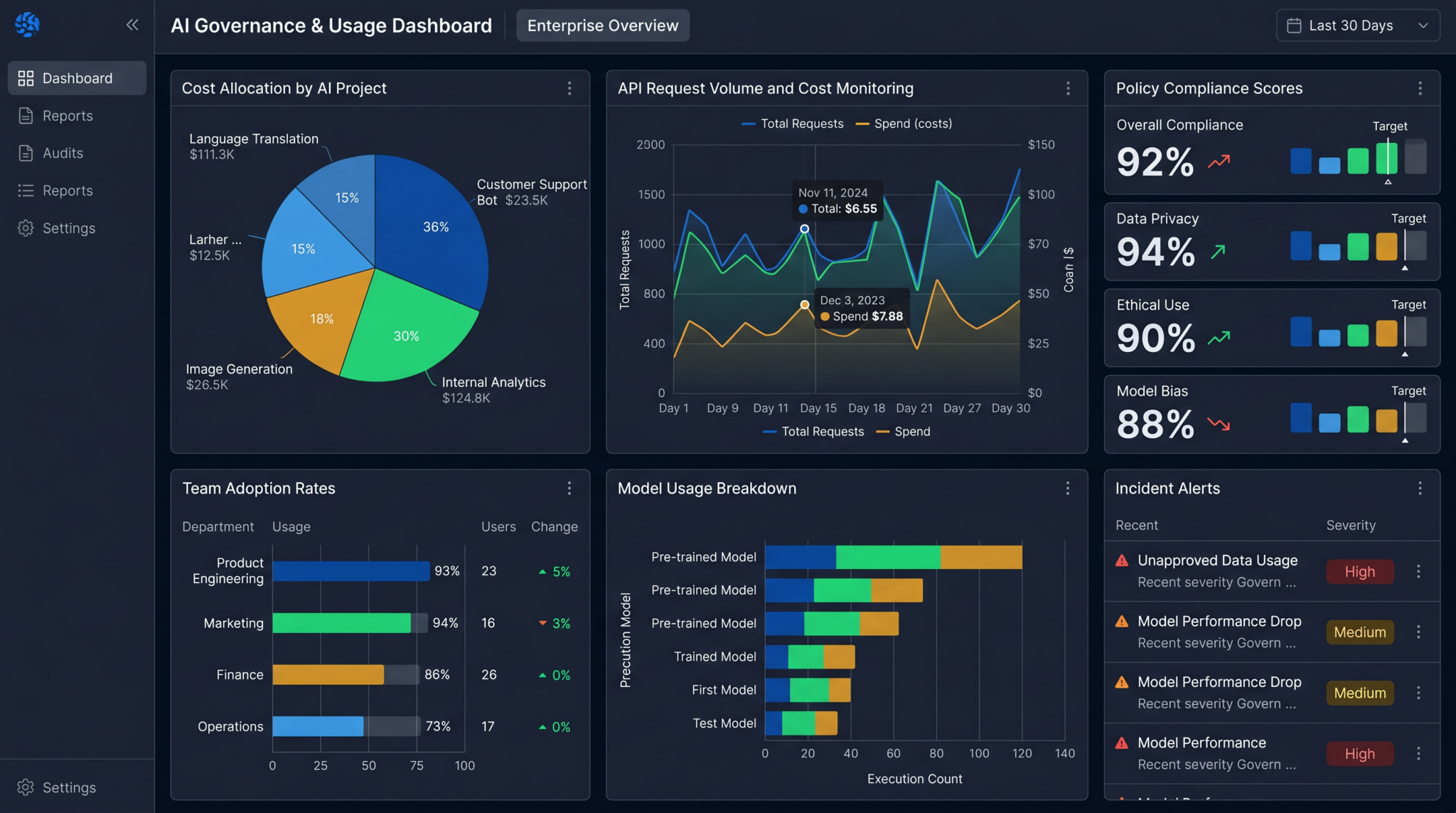
Access architecture underpins safe scaling. The prompts below generate permission matrices, repository access policies, rotation schedules for credentials, and end-to-end audit logging.
Prompt 5 — Permission matrices
Context: when and why
Before expanding beyond Pilot, you need an explicit RBAC mapping that specifies who can prompt Codex against which repositories, environments, and APIs. The matrix also establishes who can administer org-wide settings, rotate keys, and access billing data. Treat this as policy-as-code documentation usable by security reviews and auditors.
Full prompt
Objective:
Define a least-privilege permission matrix for Codex usage and administration at {{ORG_NAME}}.

Inputs:
- Roles: {{ROLES}} (e.g., Dev, SRE, QA, EM, Security Analyst, Platform Admin, FinOps)
- SSO Groups: {{SSO_GROUPS}}
- Repos: {{REPO_CATEGORIES}} (e.g., prod-critical, internal tools, experimental)
- Environments: {{ENVIRONMENTS}} (dev/test/stage/prod)
- Admin scopes: {{ADMIN_SCOPES}} (billing, usage export, policy config, key management)
- Compliance segments: {{DATA_CLASSIFICATIONS}} (Public, Internal, Confidential, Restricted)

Deliverables:
- A matrix mapping Role x Action x Resource with Allow/Deny/Conditional and rationale.
- Conditions referencing: branch protections, codeowner rules, time-of-day, break-glass.
- Separation of duties: who approves escalations; logging requirements per action.
- JSON/YAML policy artifacts suitable for automation.

Constraints:
- Default deny for prod-critical repos unless role passes assessment and managerial approval.
- Break-glass requires ticket in {{ITSM_TOOL}} and auto-revocation.
- Admin actions require MFA enforced by {{IDP}}.

Output format:
- Human-readable table (HTML) and machine-readable policy (YAML/JSON).
- RACI chart for escalations.
Expected deliverable
- RBAC matrix covering all Codex interactions and administrative actions.
- Policy artifact for enforcement in provisioning scripts and CI checks.
- Escalation workflow definitions and RACI assignments.
Integration notes
- Identity: Bind {{SSO_GROUPS}} to SCM teams and Codex org roles via SCIM; enforce MFA for admin scopes.
- Automation: Use policy artifacts in Terraform/Ansible to configure SCM permissions and Codex org settings.
- ITSM: Implement break-glass via change requests with time-bounded approvals.
Prompt 6 — Repository access policies
Context: when and why
Develop clear repository-level guardrails to prevent Codex-generated changes from bypassing your SDLC controls. Policies define which repos are in-scope, branch protections, required checks, and patterns Codex should avoid (e.g., banned licenses, sensitive file paths). These policies also inform IDE configurations and Codex settings for repository scopes.
Full prompt
Objective:
Generate repository access and guardrail policies for Codex-assisted contributions at {{ORG_NAME}}.

Inputs:
- SCM: {{SCM}}; org: {{SCM_ORG}}
- Repo categories: {{REPO_CATEGORIES}} with examples
- Branch protections required checks: {{REQUIRED_CHECKS}} (e.g., SAST, SCA, secrets, tests, CODEOWNERS review)
- Sensitive paths: {{SENSITIVE_PATHS}} (e.g., /config/prod/, /infra/secrets/)
- License policy: {{LICENSE_POLICY_URL}}
- Code style and DCO/CLA: {{STYLE_GUIDE_URL}}, {{DCO_CLA_REQUIREMENTS}}

Deliverables:
- Inclusion list: repos and branches eligible for Codex usage; explicit exclusions.
- Per-repo policy statements: required checks, minimum reviewers, CODEOWNERS patterns.
- Commit message standard: tag Codex-assisted commits (e.g., “[codex]”).
- IDE configuration snippets to restrict Codex scope to eligible repos.

Constraints:
- No direct commits to protected branches; PRs only.
- Codex cannot introduce dependencies with banned licenses.
- Changes touching {{SENSITIVE_PATHS}} require Security review.

Output format:
- Policy document (HTML) with per-repo appendix.
- SCM automation scripts (YAML for {{SCM}}) to enforce branch protections.
- IDE policy JSON for VS Code/JetBrains.
Expected deliverable
- A repository policy pack file set: documentation, SCM configs, and IDE constraints.
- Automated enforcement scripts to apply standardized protections across repos.
- Change management notes to communicate cut-over dates to teams.
Integration notes
- SCM: Use org-level rulesets to enforce required checks and CODEOWNERS; apply via API.
- IDE: Distribute policy JSON using device management (Intune/Jamf) or JetBrains Toolbox admin templates.
- Security: Sync sensitive path list with DLP and secret scanning tools for coverage alignment.
Prompt 7 — API key rotation schedules
Context: when and why
Even with SSO, some workloads require API credentials tied to service accounts (e.g., CI, bots, batch processes). Define an automated rotation schedule, custody model, and break-glass for incidents. Rotation must integrate with vaulting, SCM secrets, and notification systems without disrupting developer workflows.
Full prompt
Objective:
Define a secure, automated API key rotation schedule and process for Codex integrations at {{ORG_NAME}}.

Inputs:
- Vault: {{VAULT}} (e.g., HashiCorp Vault/Azure Key Vault/AWS Secrets Manager)
- Service accounts: {{SERVICE_ACCOUNTS}} (naming convention, owners)
- Rotation frequency: {{ROTATION_INTERVAL}} (e.g., 30/60 days), grace period: {{GRACE_PERIOD}}
- Consumers: {{CONSUMERS}} (CI jobs, IDE, internal services)
- Notification channels: {{NOTIF_CHANNELS}} (email, Slack/Teams)
- Monitoring: {{SIEM}}, {{SECRETS_SCANNER}}

Deliverables:
- Rotation calendar with staggering by environment and BU to minimize blast radius.
- Technical runbook: generate, distribute, validate, revoke; with pre/post-rotate checks.
- Automation scripts/pseudocode integrating {{VAULT}} and SCM secrets APIs.
- Emergency rotation workflow for compromised keys; SLA and comms templates.

Constraints:
- No plaintext keys in repos or CI logs; use OIDC/JWT where possible.
- Rotations must be atomic with automated validation and rollback on failure.
- All events logged with correlation IDs to {{SIEM}}.

Output format:
- Process diagram and RACI.
- YAML/JSON defining rotation schedules and consumers.
- Notification templates (Slack/Email) with placeholders.
Expected deliverable
- A detailed rotation policy with automation-ready artifacts and tested runbooks.
- Backed commitments for SLAs and incident procedures.
- Repository of notification and ticket templates for recurring operations.
Integration notes
- Vault: Use dynamic secrets where possible; otherwise, implement dual-key staging with health checks.
- CI: Inject secrets via ephemeral tokens (e.g., OIDC federation) to reduce key sprawl.
- SIEM: Emit structured logs for rotation events; alert on anomalies such as failed propagation or continued use of retired keys.
Prompt 8 — Audit trail configuration
Context: when and why
Auditability is non-negotiable. You need line-of-sight from user identity to prompt to code change to deployment. Configure event sources, normalization, retention, and dashboards to satisfy internal security, compliance attestation, and forensics.
Full prompt
Objective:
Design an end-to-end audit trail for Codex activities at {{ORG_NAME}} with SIEM integration.

Inputs:
- Identity: {{IDP}} with user and group claims
- Codex events: {{CODEX_AUDIT_EXPORT}} (prompt, completion, token usage, client metadata)
- SCM: commit/PR events, CODEOWNERS reviews
- CI/CD: pipeline runs, artifact hashes, environment promotions
- Infrastructure: {{LOG_AGGREGATOR}} (e.g., Splunk/Elastic/Datadog), retention {{RETENTION_POLICY}}
- Compliance: {{COMPLIANCE_REGIMES}} reporting requirements

Deliverables:
- Event taxonomy and schema mapping across sources; correlation keys (user_id, request_id, commit_sha).
- Data flow: where logs originate, transit, normalize, and persist.
- SIEM dashboards and detections (e.g., anomalous prompt volumes, commits without PR, secrets in prompts).
- Evidence collection procedures and scheduled report definitions.

Constraints:
- Pseudonymize prompt content by default; maintain reversible mapping under strict access control.
- Time sync via NTP/PTP to ensure event ordering.
- Retain audit data for {{RETENTION_POLICY}} with legal hold capability.

Output format:
- Architecture diagram and data dictionary.
- SIEM content pack (dashboards, saved searches, correlation rules) for {{LOG_AGGREGATOR}}.
- Evidence checklist for auditors.
Expected deliverable
- A documented, testable audit pipeline from Codex to SIEM with correlation to SCM and CI events.
- Dashboards highlighting user activity patterns and compliance indicators.
- Audit evidence procedures aligned to SOC 2/ISO 27001 control mappings.
Integration notes
- Data engineering: Normalize timestamps and IDs; hash sensitive fields with keyed hashing; store keys in HSM.
- Compliance: Map dashboards to control IDs and schedule exports tied to audit calendars.
- Security: Add detections for out-of-band activities, such as high-volume prompting during off-hours paired with PR spikes.
Section 3: Usage Governance (4 prompts)
Governance aligns Codex usage with budget, risk appetite, and compliance. The prompts produce a cost allocation model, usage alerts, an Acceptable Use Policy (AUP), and compliance reporting templates usable by risk and audit teams.
Prompt 9 — Cost allocation models
Context: when and why
As teams scale usage, costs must be attributed to the correct cost centers to avoid shared-pool drift and unexpected overruns. This model defines tagging, attribution, budget envelopes, variance thresholds, and chargeback or showback processes.
Full prompt
Objective:
Produce a cost allocation and chargeback model for Codex at {{ORG_NAME}}.

Inputs:
- Financial structure: cost centers {{COST_CENTERS}}, BUs {{BUSINESS_UNITS_LIST}}
- Identity mapping: {{SSO_GROUPS}} to cost centers
- Billing data: {{BILLING_EXPORT}} format and cadence
- Targets: monthly budget per BU {{BUDGETS}}, variance threshold {{VARIANCE_THRESHOLD}}%
- Procurement constraints: {{PROCUREMENT_RULES}} (POs, caps)
- FinOps tooling: {{FINOPS_TOOL}} or BI platform {{BI_TOOL}}

Deliverables:
- Attribution logic: user→group→cost center; fallback for unmapped users.
- Budget envelopes per BU/team; forecasting method (e.g., 3-month EMA).
- Alerts for threshold crossings (75/90/100%) and anomaly detection.
- Showback/chargeback statements: template with usage metrics and business narratives.
- Quarterly review process with BU leads.

Constraints:
- Reconcile to the penny with {{BILLING_EXPORT}}; document any proration/allocation rules.
- Protect PII; surface only team-level aggregates by default.
- Include exception handling (e.g., R&D shared pool).

Output format:
- Policy document (HTML) and allocation spec (SQL/YAML).
- Report templates (PDF/HTML) and automated email/Slack summaries.
Expected deliverable
- Allocation logic ready for data engineering implementation and financial review.
- Monthly showback/chargeback templates with executive summaries.
- Alerting configuration and thresholds mapped to budget owners.
Integration notes
- Data: Join billing exports with SSO group snapshots; persist mappings with slowly changing dimensions to maintain historical accuracy.
- Alerts: Deliver notifications to BU finance channels with links to dashboard detail views.
- Governance: Embed chargeback statements into quarterly business reviews; tie to KPIs and outcomes.
Prompt 10 — Usage monitoring alerts
Context: when and why
Create proactive alerts for spend spikes, anomalous prompting behavior, or policy violations. Alerts should be actionable, noise-controlled, and integrated with incident management tooling. Include runbooks to triage and remediate.
Full prompt
Objective:
Define monitoring and alerting rules for Codex usage anomalies and spend at {{ORG_NAME}}.

Inputs:
- Baselines: historical usage by team {{USAGE_BASELINES}}
- Thresholds: {{SPEND_THRESHOLDS}}, {{VOLUME_THRESHOLDS}}, {{SECURITY_THRESHOLDS}}
- Destinations: {{ALERT_CHANNELS}} (Slack/Teams), {{ITSM_TOOL}} for incidents
- SIEM: {{LOG_AGGREGATOR}} correlation capabilities
- Hours of operation: {{BUSINESS_HOURS}}; paging policy {{PAGING_POLICY}}

Deliverables:
- Alert catalog: name, description, condition, severity, destination, runbook link.
- Conditions: e.g., spend > X stddev above baseline; off-hours spikes; unusual repo access patterns; repeated policy denials.
- Runbooks: triage steps, data to collect, rollback/disable procedures, escalation paths.
- Mute/maintenance windows and false positive handling.

Constraints:
- Max 5 high-severity alerts to avoid alarm fatigue; include suppressed duplicates logic.
- Alerts must include correlation IDs and direct links to dashboards and tickets.
- Auto-open tickets in {{ITSM_TOOL}} for Sev1-2 incidents.

Output format:
- Alert definitions (YAML/JSON) for {{LOG_AGGREGATOR}}/{{ALERTING_TOOL}}.
- Runbooks (HTML) with checklists and decision trees.
Expected deliverable
- An alert catalog with clear ownership and escalation.
- Machine-readable alert rules deployable to your monitoring stack.
- Runbooks consumable by on-call engineers and FinOps analysts.
Integration notes
- SIEM: Implement correlation searches combining Codex, SCM, and CI events to improve fidelity.
- ITSM: Use templates to pre-populate incident fields; auto-assign based on BU or repo ownership.
- ChatOps: Provide “ack/close/snooze” commands in Slack/Teams tied to incident records.
Prompt 11 — Acceptable Use Policy generation
Context: when and why
An AUP translates security and legal requirements into practical guidance for developers and managers. It codifies permitted use cases, prohibited actions, data handling rules, and consequences. Generate a versioned AUP that can be embedded into onboarding and enforced through SDLC checks.
Full prompt
Objective:
Draft an Acceptable Use Policy (AUP) for Codex at {{ORG_NAME}} aligned to legal, security, and compliance.

Inputs:
- Legal constraints: {{LEGAL_REQUIREMENTS}} (IP, licensing, privacy)
- Security constraints: {{SEC_POLICY_URL}}, {{DATA_CLASSIFICATIONS}}
- Compliance: {{COMPLIANCE_REGIMES}} (SOC 2/ISO/SOX/HIPAA/GDPR)
- Engineering norms: {{STYLE_GUIDE_URL}}, {{CODE_REVIEW_POLICY_URL}}
- Enforcement mechanisms: {{ENFORCEMENT_TOOLS}} (pre-commit hooks, CI checks, DLP)
- Audience: engineers, managers, contractors
- Versioning: semantic policy versioning {{AUP_VERSIONING}}

Deliverables:
- AUP sections: scope, permitted uses, prohibited uses, data handling, privacy and logging, licensing, review and enforcement, exceptions and appeals, changes and versioning.
- Plain-language examples of compliant and non-compliant behaviors.
- Attestation process for users; tracking approach and renewal cadence.
- Changelog and governance board (names/roles) for future updates.

Constraints:
- Reference specific enforcement mechanisms integrated into tooling.
- Include multi-language support plan if needed.
- Keep core policy ≤ 3 pages; appendices may extend.

Output format:
- Policy (HTML/PDF) and attestation text for {{LMS_PLATFORM}}/{{IDP}}.
- Short “manager’s briefing” one-pager.
Expected deliverable
- A concise, actionable AUP with examples and enforcement mapping.
- Attestation workflow text and records management approach.
- Governance board charter and update cadence.
Integration notes
- Identity: Configure an AUP acceptance gate in {{IDP}} before group assignment; store attestation in HRIS or GRC.
- Tooling: Link policy checks to CI, pre-commit hooks, and DLP scanners for preventive control.
- LMS: Assign annual refresh and track completion; escalate non-compliance to managers automatically.
Prompt 12 — Compliance reporting templates
Context: when and why
Risk and audit stakeholders need structured reports showing control design and operating effectiveness. Provide templates mapped to standards, populated by your audit trail and governance processes. Automate as much as possible to reduce reporting friction.
Full prompt
Objective:
Create compliance reporting templates for Codex aligned to {{COMPLIANCE_REGIMES}} at {{ORG_NAME}}.

Inputs:
- Controls mapping: {{CONTROLS_MAP}} (e.g., SOC 2 CC6.1, ISO A.12.1.2)
- Evidence sources: {{EVIDENCE_SOURCES}} (SIEM dashboards, policy docs, tickets, training records)
- Reporting cadence: {{CADENCE}} (monthly/quarterly/annual)
- Audience: Internal Audit, External Auditors, Security Steering Committee
- Retention: {{RETENTION_POLICY}}

Deliverables:
- Report templates per standard with control-by-control sections: design, implementation, evidence, exceptions, remediation.
- Evidence request lists with owners and SLAs.
- Automated evidence collection scripts where possible (e.g., API calls to SIEM, LMS, SCM).
- Executive summary highlighting risk posture and trends.

Constraints:
- Minimize manual steps; flag any manual evidence and propose automation.
- Ensure all links are permalinks with retention guarantees.
- Redact sensitive data while maintaining evidentiary value.

Output format:
- Templates (DOCX/HTML), evidence checklist (CSV), and scripts (pseudo or real) for {{AUTOMATION_STACK}}.
Expected deliverable
- Standards-aligned report templates ready for immediate use.
- Evidence collection automation plan with scripts or workflow definitions.
- Ownership matrix and SLAs per evidence item.
Integration notes
- GRC: Link templates to control library; auto-create evidence tasks with due dates.
- Data: Pull from SIEM, LMS, SCM, and ITSM APIs using service accounts with read-only scopes.
- Audit: Schedule periodic dry-runs to ensure evidence freshness and link validity.
Implementation timeline: 90-day rollout plan
This 13-week plan (approximately 90 days) sequences governance, onboarding, access, and adoption efforts. Adjust for holidays and release freezes. Each week lists objectives, actions, owners, and checkpoints.
Weeks 1–2: Foundation and Pilot setup
- Objectives:
- Establish governance baseline and pilot scope.
- Integrate identity, logging, and sandbox repositories.
- Actions:
- Form Codex Working Group (Platform, Security, Legal, FinOps, Dev leads). Approve pilot charter.
- Enable SSO/MFA in Codex org; create administrative roles with least privilege.
- Provision sandbox repos in {{SCM_ORG}} with branch protections and required checks.
- Set up audit pipeline POC: Codex events to {{LOG_AGGREGATOR}} with correlation to SCM.
- Draft AUP v0.9 and circulate for review.
- Owners: Platform (lead), Security, IAM, Dev leads, Legal, FinOps.
- Checkpoints:
- SSO-enabled, test admin role access, logs visible in SIEM.
- Sign-off on pilot repos and success metrics.
Weeks 3–4: Onboarding and assessment
- Objectives:
- Deploy role-based onboarding and skill assessments.
- Begin initial usage with tight guardrails and measure baselines.
- Actions:
- Run Prompt 1 to produce onboarding plans; publish in {{LMS_PLATFORM}} and ITSM catalog.
- Run Prompt 2 to create assessments; onboard pilot users; gate elevated permissions by results.
- Enable Codex IDE extensions; distribute IDE policy configs restricting scope to pilot repos.
- Implement initial adoption dashboard (Prompt 4); capture WAU and PR metrics.
- Owners: Platform, Dev Enablement, IAM, Managers.
- Checkpoints:
- ≥60% pilot WAU; assessment completion ≥90%.
- No policy violations in SIEM; secrets scanner clean.
Weeks 5–6: Access control hardening
- Objectives:
- Turn POC controls into enforceable policies.
- Implement rotation and audit at production readiness.
- Actions:
- Run Prompt 5 to publish RBAC matrix; deploy policy-as-code via Terraform/Ansible.
- Run Prompt 6 to finalize repo access policies; enforce org-wide rulesets.
- Run Prompt 7 to implement rotation schedules; test break-glass rotations.
- Run Prompt 8 to complete SIEM dashboards, correlation rules, and evidence procedures.
- Owners: Platform, Security, IAM, DevOps.
- Checkpoints:
- Rotation dry-run without downtime; audit dashboards show end-to-end traceability.
- Policy violations alerting active; zero Sev1 incidents.
Weeks 7–8: Usage governance and scaling to first department
- Objectives:
- Codify cost allocation and monitoring.
- Promote from Team to Department scale (≤200 users).
- Actions:
- Run Prompt 9 to produce cost allocation model; align with FinOps; create budget envelopes.
- Run Prompt 10 to deploy usage and spend alerts with runbooks.
- Run Prompt 11 to finalize AUP v1.0; enable AUP attestation gate in {{IDP}}.
- Extend onboarding (Prompt 1) and curriculum (Prompt 3) to new teams and managers.
- Owners: FinOps, Platform, Security, Legal, BU Engineering leads.
- Checkpoints:
- Department adoption WAU ≥50%; cost variance within ±10% of forecast.
- AUP attestation ≥95% of active users.
Weeks 9–10: SDLC embedding and compliance readiness
- Objectives:
- Embed Codex into SDLC gates; validate compliance reporting.
- Actions:
- Enforce commit tagging for Codex-assisted changes; require linked Jira/ServiceNow change IDs.
- Integrate SAST/SCA/license checks tuned for Codex patterns.
- Run Prompt 12 to generate compliance reporting templates; test evidence collection.
- Owners: DevOps, Security, Compliance, Platform.
- Checkpoints:
- Pass compliance dry-run with zero critical gaps.
- PR cycle time improves by target {{CYCLE_TIME_TARGET}} while maintaining quality metrics.
Weeks 11–13: Organization readiness and continuous improvement
- Objectives:
- Prepare for org-wide rollout; institutionalize continuous improvement.
- Actions:
- Publish enterprise playbook site including policies, runbooks, dashboards, and FAQs.
- Create a Codex Champions program (1 per team) with monthly forums.
- Finalize chargeback process; schedule quarterly reviews with BU leaders.
- Roadmap next features (e.g., code search and knowledge reuse patterns) and red-team exercises.
- Owners: Platform, BU Engineering Leaders, FinOps, Security.
- Checkpoints:
- Executive dashboard tracking KPIs live; NPS baseline captured.
- Go/No-Go decision for org-wide rollout with clear gating criteria.
Measuring success: KPIs for enterprise AI deployment
KPIs must reflect both productivity and risk controls. Each KPI below includes definition, measurement method, and guardrails to prevent local optimizations that hurt long-term outcomes.
Engineering effectiveness
- Pull Request (PR) cycle time
- Definition: median time from PR open to merge, excluding waiting for external dependencies.
- Measurement: SCM API; bucketed by repo and team; compare pre/post Codex baseline.
- Target: -20% within 90 days; guardrail: no increase in post-merge defects.
- PR throughput per engineer
- Definition: merged PRs per engineer per week, size-adjusted (LOC bands or story points).
- Measurement: SCM analytics; exclude mechanical refactors.
- Target: +15% within 90 days; guardrail: code review time not below policy minimum.
- Test coverage delta
- Definition: change in line/branch coverage for Codex-assisted PRs vs. non-assisted.
- Measurement: CI reports linked to PR metadata (commit tag “[codex]”).
- Target: ≥0% (no regression) across critical repos; stretch +5%.
- Incident rate related to code quality
- Definition: production incidents traced to Codex-assisted changes per 1,000 PRs.
- Measurement: ITSM incident tagging and postmortems; correlation to PR tags.
- Target: ≤ baseline; guardrail: Sev1 count = 0.
Adoption and engagement
- Weekly Active Users (WAU)
- Definition: unique users generating at least 5 completions/week.
- Measurement: Codex usage logs mapped to SSO identity.
- Target: ≥60% in pilot teams; ≥50% department-wide.
- Prompt-to-accept ratio
- Definition: accepted completions divided by total prompts.
- Measurement: Codex event stream; exclude auto-dismissed suggestions.
- Target: improving trend; use as a training feedback loop.
- Manager and developer satisfaction (NPS)
- Definition: quarterly survey on Codex value and ease-of-use.
- Measurement: HR survey tool; tie free-text themes to backlog.
- Target: ≥50 within 2 quarters.
Governance and risk
- Policy violations per month
- Definition: count of AUP breaches, unauthorized repo access, secrets exposure attempts.
- Measurement: SIEM detections, DLP logs.
- Target: downward trend; Sev1 = 0; Sev2 ≤ 1 with MTTR ≤ 4 hours.
- Audit coverage and evidence freshness
- Definition: percent of required evidence items available and updated within SLA.
- Measurement: GRC system; automated evidence pull success rate.
- Target: ≥98% coverage; ≥95% automated collection.
- Key rotation compliance
- Definition: percent of keys rotated within schedule and validated.
- Measurement: Vault/Secrets Manager logs; SCM secret sync status.
- Target: 100% on-time; zero stale keys in use.
Financial performance
- Budget variance by BU
- Definition: actual vs. budgeted Codex spend per BU per month.
- Measurement: allocation model; billing exports reconciled.
- Target: within ±5% by month three.
- Cost per PR or per story point
- Definition: allocated Codex cost divided by merged PRs or delivered story points.
- Measurement: join billing, SCM, and agile metrics.
- Target: stable or improving with increased throughput.
Ensure KPI governance: formal owners, data definitions, and review cadences. Present key metrics on an executive dashboard with drill-downs for engineering managers and FinOps analysts.
Access 40,000+ AI Prompts for ChatGPT, Claude & Codex — Free!
Subscribe to get instant access to our complete Notion Prompt Library — the largest curated collection of prompts for ChatGPT, Claude, OpenAI Codex, and other leading AI models. Optimized for real-world workflows across coding, research, content creation, and business.
Common pitfalls and how to avoid them
Enterprises often stumble not on technology but on process alignment. Below are frequent failure patterns with actionable countermeasures.
Pitfall 1: Shadow access and identity drift
Symptoms: users generating completions with personal tokens; inconsistent group memberships; inability to attribute spend to teams.
- Countermeasures:
- Enforce SSO-only access; block personal tokens at the network egress proxy where possible.
- Automate provisioning via SCIM; treat group assignments as code (GitOps for IAM).
- Run quarterly access reviews; compare SSO groups to org charts and cost centers.
Pitfall 2: Over-broad repository permissions
Symptoms: Codex-generated changes bypass review; protected branches allow direct commits; sensitive paths modified without security sign-off.
- Countermeasures:
- Adopt org-level rulesets with required checks (SAST/SCA/secrets/tests).
- Mandate CODEOWNERS and minimum reviewers; disable admin bypass except via break-glass.
- Tag Codex-assisted commits and enforce policy checks via CI and pre-receive hooks.
Pitfall 3: Missing audit correlation
Symptoms: incomplete forensic trail from prompt to production; auditors request manual screenshots; inconsistent timestamps across systems.
- Countermeasures:
- Normalize IDs (user_id, request_id, commit_sha) across Codex, SCM, CI, and SIEM.
- Enforce time sync; require correlation IDs in commit messages and PR descriptions.
- Automate evidence collection via APIs; eliminate screenshots from audit packages.
Pitfall 4: Cost surprises and misattribution
Symptoms: month-end spend spikes without owner; disputes between teams over usage; finance blocks expansion.
- Countermeasures:
- Implement allocation logic tied to SSO groups and BU cost centers.
- Configure budget alerts at 75/90/100%; route to accountable owners.
- Adopt showback first, then chargeback once stable; include narratives in reports.
Pitfall 5: Training as a one-off event
Symptoms: initial excitement fades; usage varies wildly across teams; recurring policy violations.
- Countermeasures:
- Establish continuous learning loops: monthly Codex clinics, office hours, champions network.
- Use the adoption dashboard to spot teams needing coaching; schedule targeted refreshers.
- Tie AUP attestations to access renewal; integrate training with quarterly goals.
Pitfall 6: Treating Codex like a code generator, not a collaborator
Symptoms: large, low-quality diffs; brittle prompts; developers distrust suggestions.
- Countermeasures:
- Teach iterative prompting and guardrail patterns; enforce small, testable changes.
- Use pairing sessions and “prompt critique” exercises to improve technique.
- Instrument prompt-to-accept metrics; coach teams showing low acceptance.
Pitfall 7: Ignoring license and dependency hygiene
Symptoms: generated code introducing GPL or unknown-licensed snippets; production dependency sprawl.
- Countermeasures:
- Build license checks into CI; maintain an allowlist/denylist.
- Train developers to specify license constraints in prompts.
- Require review for new dependencies; pin versions and track SBOM.
Pitfall 8: Underestimating change management
Symptoms: managers unclear on expectations; policy docs differ from reality; confusion during incidents.
- Countermeasures:
- Publish a single source of truth: a playbook site linking policies, runbooks, dashboards, and contacts.
- Hold manager briefings with clear KPIs and coaching playbooks.
- Run incident game days that simulate policy breaches and key compromise.
Codex becomes an enterprise capability when governance, enablement, and measurement advance together. Start with a narrow Pilot, prove value with guardrails, and scale predictably through the maturity stages. Revisit policies quarterly as usage patterns evolve and keep lines open between platform, security, and engineering leaders to sustain momentum.
