
10 ChatGPT Prompts for Personal Finance: Budgeting, Investing, and Tax Planning with GPT-5.5
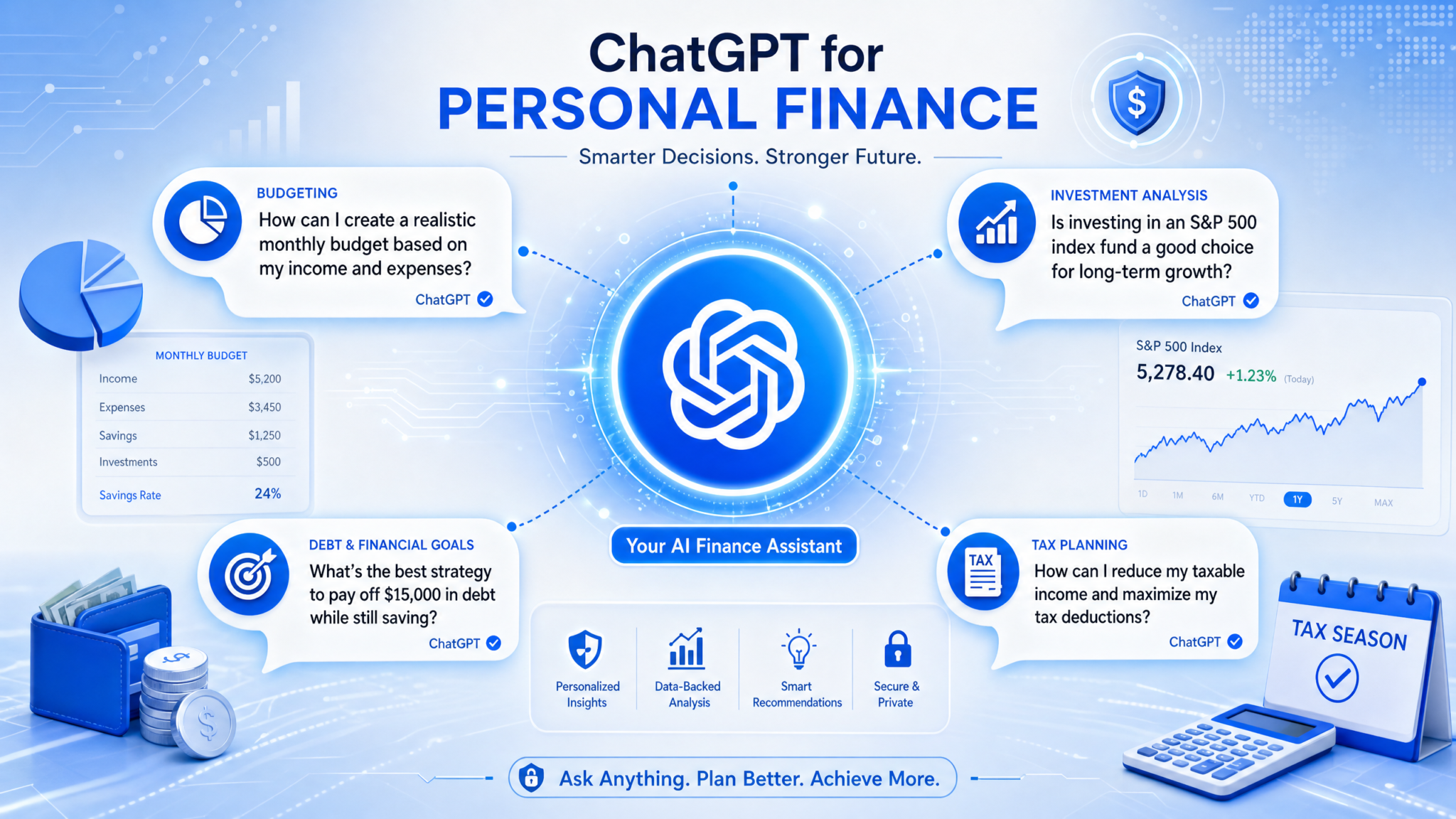
Artificial intelligence is revolutionizing the way we manage personal finances. With the launch of OpenAI’s enhanced personal finance features for ChatGPT Pro users—including seamless connectivity to over 12,000 financial institutions via Plaid—GPT-5.5 is empowering individuals to achieve smarter, data-driven financial decisions. From budgeting to investing and tax planning, the capabilities of ChatGPT have evolved beyond simple tracking to deliver insightful analysis and tailored strategies.
As an AI enthusiast and developer, I have witnessed how precise prompting unlocks the true power of AI tools. This article offers 10 highly effective ChatGPT prompts designed to utilize GPT-5.5’s advanced financial features. These prompts will assist you in managing budgets, optimizing investments, planning taxes, auditing subscriptions, and more—all within a secure and intuitive AI-driven environment.
Why GPT-5.5 and ChatGPT’s New Finance Features Matter for You
The integration of Plaid with ChatGPT marks a new era in personal finance management. This partnership enables secure, real-time access to your transactional data, account balances, and investment portfolios—only with your explicit consent—allowing GPT-5.5 to conduct deep financial analyses previously limited by manual data entry.
GPT-5.5’s enhanced reasoning abilities mean it can grasp complex financial relationships, interpret market data, and forecast future trends with improved accuracy. This transforms ChatGPT into a personal financial co-pilot offering:
- Detailed spending categorization and budgeting insights
- Advanced portfolio health checks and risk assessments
- Tax deduction identification and planning support
- Subscription audits to reduce wasteful expenses
- Debt management and repayment optimization
- Emergency fund planning with realistic savings strategies
- Retirement savings projections and gap analyses
- Goal-oriented saving plans for major purchases
- Income diversification ideas tailored to your skills and time
Top 10 ChatGPT Prompts for Smarter Personal Finance Management
1. Comprehensive Monthly Budget Analysis
Prompt:
“Using my connected financial data for the past three months, generate a detailed monthly budget analysis. Categorize all income and expenses, identify the top three spending categories, and highlight any unusual or outlier transactions. Suggest three actionable strategies to reduce spending in my highest expense category without significantly impacting my quality of life. Assume my financial goal is to increase my monthly savings by 15%.”
Why it works: This prompt leverages contextual data and a clear savings goal. It requests detailed categorization and anomaly detection, enabling GPT-5.5 to provide focused, practical strategies.
2. Investment Portfolio Health Check & Rebalancing Suggestions
Prompt:
“Analyze my current investment portfolio, accessible through my connected accounts. Provide a breakdown of asset allocation (stocks, bonds, real estate, crypto, etc.), calculate my portfolio’s beta against the S&P 500, and assess diversification by industry sectors and geographic regions. Given my risk tolerance is ‘moderate-aggressive’ and a 20-year retirement goal, suggest three rebalancing adjustments to optimize growth while controlling risk, with rationale for each.”
Why it works: This prompt demands granular portfolio metrics and aligns recommendations with personal risk and timelines, offering actionable, well-explained financial advice.
For those interested in extending beyond ChatGPT capabilities, explore our Claude Finance Prompting Guide to learn how Anthropic’s 10 financial agents can automate advanced investment analysis and reporting.
3. Tax Planning: Identifying Potential Deductions and Credits
Prompt:
“Using my income and expense data from the previous tax year, identify potential tax deductions and credits I may qualify for. Focus on common deductions such as charitable donations, medical expenses, home office, and education costs. Provide a list with explanations of eligibility criteria and recommended documentation. Please note, do not give tax advice but highlight areas for professional consultation.”
Why it works: This prompt smartly uses historical data for tax optimization and responsibly disclaims advisory limits, ensuring GPT-5.5 acts as an informative assistant.
4. Subscription Audit & Cost-Saving Opportunities
Prompt:
“Review all recurring transactions from my bank and credit card accounts over the past 12 months. Compile a list of active subscriptions, including service name, cost, and last payment date. Identify unused or overlapping subscriptions (especially those $20+/month) and suggest cancellation or negotiation strategies.”
Why it works: Subscription expenses often drain budgets unnoticed. This prompt harnesses transaction data to uncover and rationalize subscription management, helping you recover significant savings.
To explore more AI tools for financial automation, visit our in-depth guide on Claude Finance Prompting Guide, which details leveraging AI agents for efficient personal finance workflows.
5. Debt Repayment Strategy Optimization
Prompt:
“Analyze my outstanding debts (credit cards, personal loans, student loans) via connected accounts. For each, provide balance, interest rate, and minimum payment. Based on my disposable income (average monthly income minus essential expenses), recommend a debt repayment plan. Compare ‘debt snowball’ and ‘debt avalanche’ methods, analyze pros and cons for my case, and suggest which would help me become debt-free fastest with an aggressive plan.”
Why it works: This prompt combines personalized debt data with cash flow analysis, offering a comparative, well-reasoned path to quicker debt elimination.
6. Emergency Fund Calculation and Funding Plan
Prompt:
“Calculate my emergency fund target based on average essential monthly expenses (rent, utilities, groceries, transportation, insurance) over six months, targeting 6 months of coverage. Then, design a savings plan to reach this goal within 12 months, considering my current monthly surplus. Suggest ways to free up extra funds if surplus is insufficient by analyzing my spending patterns.”
Why it works: This prompt anchors financial security in data-driven targets and provides actionable, realistic steps to achieve this critical goal.
7. Retirement Savings Projection and Gap Analysis
Prompt:
“Project my retirement savings growth based on current 401(k) and IRA contributions, assuming a 7% annual return and 3% inflation. Compare the projected amount at age 65 with a $2 million target (in today’s dollars). If a gap exists, recommend three strategies to bridge it, such as increasing contributions, optimizing asset allocation, or exploring new investments. Include assumptions made.”
Why it works: This forward-looking prompt combines realistic modelling with personalized advice, empowering strategic retirement planning.
8. Major Purchase Saving Plan: Home Down Payment
Prompt:
“I plan to save $50,000 for a home down payment within three years. Using my income, spending habits, and current savings, create a detailed monthly savings plan. Include possible discretionary spending cuts and suggest suitable short-term investment options balancing liquidity and modest growth. Factor in potential interest earnings.”
Why it works: By integrating financial data with goal-oriented planning, this prompt delivers a systematic approach to high-value purchases.
9. Income Stream Diversification Ideas
Prompt:
“Analyze my current income sources (salary, freelance, investments). Considering my professional skills (e.g., software development, writing, marketing) and availability (10 hours/week), suggest three viable new income streams or side hustles. For each, include potential earnings, required initial investment (time/money), and alignment with my skills. Focus on realistic opportunities expected to generate at least $500/month within six months.”
Why it works: This prompt tailors side hustle ideas based on skills and time, targeting achievable supplemental income—ideal for diversifying revenue streams.
10. Financial Goal Tracking and Monthly Progress Report
Prompt:
“Using my connected financial data, create a monthly progress report tracking my key financial goals like savings targets, debt repayment, and investment contributions. Highlight any deviations from the plan and provide three actionable recommendations to realign with my objectives.”
Why it works: Regular monitoring and feedback help maintain momentum toward financial goals, making this prompt ideal for disciplined money management.
Discover More with ChatGPT AI Finance Tools
The prompts above showcase how GPT-5.5 transforms raw financial data into actionable insights and strategic recommendations. For further mastery, we recommend exploring our resources:
- Claude Finance Prompting Guide – Deep dive into Anthropic’s pre-built financial agents for advanced analysis and automation.
- ChatGPT Personal Finance Tools – Overview of the latest plugins and integrations enhancing personal financial management.
Access 40,000+ AI Prompts for ChatGPT, Claude & Codex — Free!
Subscribe to get instant access to our complete Notion Prompt Library — the largest curated collection of prompts for ChatGPT, Claude, OpenAI Codex, and other leading AI models. Optimized for real-world workflows across coding, research, content creation, and business.
Useful Links
- Claude Finance Prompting Guide: How to Use Anthropic’s 10 Pre-Built Financial Agents
- ChatGPT Personal Finance Tools & Integrations
- Plaid: Secure Financial Connectivity Platform
