
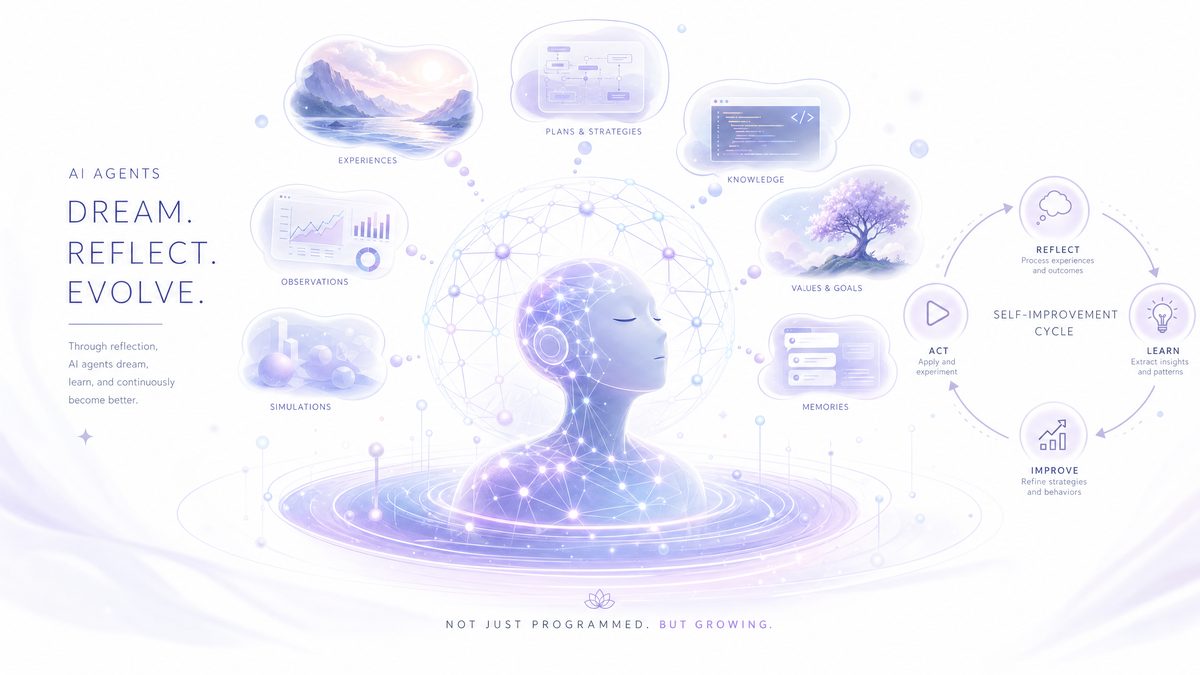
On May 6, 2026, Anthropic introduced a revolutionary enhancement to its Claude Managed Agents platform during the Code with Claude event — the “Dreaming” feature. This cutting-edge innovation empowers AI agents to autonomously review their past interactions and memory data to identify patterns, self-correct, and refine their behavior over time. Dreaming represents a transformative leap in AI lifecycle management, significantly boosting the intelligence and efficiency of Claude Managed Agents, especially in complex, long-running workflows and multi-agent orchestration scenarios.
Since the initial launch of Claude Managed Agents on April 8, 2025 — which accelerated agent build and deployment speeds by an order of magnitude — Anthropic has progressively expanded the platform’s capabilities. Dreaming now complements enhancements to outcomes tracking and multi-agent coordination, contributing to Anthropic’s impressive revenue run rate surpassing $30 billion. This comprehensive guide explores the technical foundation, practical setup, comparative advantages, and best practices for leveraging Dreaming to create truly self-improving AI agents.
Understanding the Dreaming Feature in Claude Managed Agents
The Dreaming feature marks a paradigm shift in how AI agents evolve autonomously. At its core, Dreaming is a scheduled, automated process through which Claude Managed Agents review historical session data and memory stores to uncover patterns and actionable insights. Unlike traditional AI systems that rely heavily on developer-driven updates or static memory snapshots, Dreaming enables agents to self-reflect and refine their internal knowledge bases continuously.
Key aspects of Dreaming include:
- Self-Improvement via Pattern Recognition: Agents analyze recurring mistakes, successful workflows, and team collaboration preferences across sessions, enabling dynamic adaptation to changing user needs and operational contexts without explicit reprogramming.
- Memory Curation and Restructuring: Dreaming selectively curates and reorganizes memories to maintain a high signal-to-noise ratio as agent knowledge evolves, preventing degradation or knowledge bloat.
- Configurable Updates: Developers can choose to allow Dreaming to update agent memories automatically or require manual review and approval before changes are applied, balancing agility with governance.
- Optimization for Long-Term and Multiagent Scenarios: Especially valuable for agents tasked with complex, ongoing projects or coordinating with multiple other agents, enabling scalable and adaptive AI ecosystems.
In practice, Dreaming acts as a continuous feedback loop within the agent ecosystem. By internally reviewing its own “dreams” — the distilled learnings from prior interactions — the agent becomes progressively more competent, efficient, and aligned with user and team goals. This feature addresses a long-standing challenge in AI agent development: how to maintain relevance and accuracy in dynamic, evolving environments without excessive manual intervention.
Furthermore, Dreaming’s capacity to autonomously identify emergent behavior patterns and optimize memory structures provides a foundation for agents to evolve in ways unforeseen by their creators, paving the way for more generalized and robust AI systems.
How Dreaming Works: Technical Architecture and Process
The Dreaming mechanism integrates seamlessly into the Claude Managed Agents architecture, leveraging advanced memory management, large language models (LLMs), and workflow orchestration technologies. Understanding its technical foundation is crucial for developers and AI engineers aiming to maximize its benefits.
1. Data Collection and Session Logging
Every interaction between a user and a Claude Managed Agent is comprehensively logged, capturing:
- Dialogue history, including user queries, agent responses, and contextual metadata such as timestamps and session IDs.
- Agent actions and decisions, such as API calls made, internal decision trees traversed, and task execution outcomes.
- External API calls and responses, enabling cross-system traceability and allowing agents to learn from third-party data interactions.
- Outcome evaluations and success metrics, recorded through embedded feedback mechanisms or post-interaction surveys to assess the quality and effectiveness of agent interventions.
This robust data collection ensures Dreaming has rich contextual information for pattern analysis, enabling it to discern nuanced behavior trends and operational bottlenecks.
2. Scheduled Dreaming Process
Dreaming operates as a scheduled batch process, configurable by developers to occur at intervals aligned with project cadence — ranging from hourly to weekly or even monthly, depending on operational needs. The process includes multiple stages designed to maximize insight extraction and memory optimization:
- Session Review: Aggregates recent session logs and memory stores, compiling a comprehensive dataset representing agent interactions over the configured period.
- Pattern Extraction: Utilizes advanced LLM prompting techniques coupled with statistical analyses to detect recurring mistakes, workflow convergences, and team collaboration tendencies. This includes identifying sequences of actions leading to errors or successes and analyzing communication styles correlating with positive outcomes.
- Memory Curation: Selects high-signal memories for retention and prunes outdated or low-value information. The curation process is guided by heuristics and machine learning models trained to prioritize information relevance, reliability, and recency.
- Memory Restructuring: Organizes memories into optimized data structures such as hierarchical embeddings, topic clusters, or relational graphs to enhance retrieval speed and contextual relevance during agent operation.
This multi-stage process ensures that agents’ knowledge bases remain both comprehensive and streamlined, facilitating faster reasoning and more accurate responses.
3. Update Application and Control
After Dreaming generates its curated memory updates, agents can:
- Automatically apply these updates to their internal memory stores, instantly adapting their behavior. This mode is ideal for non-critical applications or mature agents with proven reliability.
- Require manual approval from developers or team leads, enabling governance and oversight. Reviewers can examine proposed memory changes through a dedicated interface that highlights additions, deletions, and restructurings, ensuring compliance with organizational policies.
This dual mode balances efficiency with control, which is crucial for sensitive or mission-critical deployments where unintended memory alterations could have significant repercussions.
4. Underlying Technologies
Dreaming leverages several key technological components:
- Anthropic’s Claude LLM: Provides contextual understanding and natural language processing for pattern detection. Claude’s advanced reasoning capabilities allow it to interpret complex sequences and infer latent relationships within interaction data.
- Vector-Based Memory Stores: Semantic embeddings enable efficient similarity searches and knowledge retrieval. By embedding textual and structured data into high-dimensional vector spaces, agents can rapidly access relevant memories during reasoning.
- Orchestration Engine: Coordinates multi-agent workflows and manages Dreaming schedules. This engine handles task delegation, memory synchronization, and error handling across distributed agents.
- Analytical Pipelines: Statistical tools identify recurring patterns and anomalies. These include clustering algorithms, time-series analyses, and anomaly detection models that augment LLM-based insights with quantitative rigor.
Together, these elements deliver a seamless self-improvement loop that continuously refines agent intelligence without developer fatigue. The integration of symbolic and statistical AI techniques within Dreaming exemplifies Anthropic’s hybrid approach to robust AI system design.
Setting Up Dreaming for Your Agents: Step-by-Step Guide
Implementing the Dreaming feature requires careful configuration to align with your organization’s workflows and agent objectives. This section provides a detailed step-by-step guide to enable and optimize Dreaming within Claude Managed Agents.
Step 1: Enable Dreaming in Agent Configuration
Within the Claude Managed Agents dashboard or API, activate Dreaming by toggling the feature in your agent’s settings. Key parameters to configure include:
- Dreaming Frequency: Choose the interval (e.g., hourly, daily, weekly) at which Dreaming reviews data. The optimal frequency depends on agent workload intensity and project dynamics.
- Update Mode: Select between automatic memory updates or manual approval workflows. Organizations with strict compliance requirements may prefer manual modes initially.
- Scope of Memory Reviewed: Define which session logs and memory segments Dreaming should analyze — for example, limiting to recent sessions, specific projects, or particular agent roles within a multi-agent system.
These settings can be fine-tuned over time based on performance feedback and operational outcomes.
Step 2: Define Memory Curation Policies
Dreaming’s effectiveness depends heavily on how memories are curated. Developers should specify:
- Retention Criteria: Define what constitutes a “high signal” memory, such as frequently referenced data, successful workflow steps, or positive outcome logs. Domain-specific heuristics can prioritize critical knowledge.
- Pruning Rules: Establish guidelines for discarding outdated, irrelevant, or erroneous memories to prevent knowledge bloat. For example, memories older than a certain threshold without recent references may be archived or removed.
These policies can be codified via JSON schemas or configuration files supported by the platform, enabling versioning and collaborative policy management among teams.
Step 3: Configure Approval Workflows (Optional)
If manual oversight is preferred, set up approval queues and assign reviewers who will vet Dreaming-generated memory updates. Notifications and audit trails are built into the platform to facilitate transparent governance. Reviewers can provide feedback or request modifications before updates are applied, ensuring alignment with organizational standards and ethical considerations.
Step 4: Monitor Dreaming Outcomes and Performance
After enabling Dreaming, monitor its impact through built-in analytics dashboards reporting on:
- Reduction in repeated mistakes, tracked via error recurrence rates before and after Dreaming cycles.
- Changes in agent efficiency, such as task completion times and number of interactions per resolved task.
- Memory store size and quality metrics, including relevance scores and pruning effectiveness.
These insights help fine-tune Dreaming parameters over time, enabling a data-driven approach to continuous agent improvement.
Use Cases: When Dreaming Delivers the Most Value
While Dreaming benefits a broad range of AI applications, certain scenarios stand to gain disproportionately from its self-improving capabilities. Understanding these cases helps organizations prioritize deployment and tailor configurations effectively.
1. Long-Running Projects with Evolving Context
For AI agents supporting projects extending over weeks or months, Dreaming ensures memory stores remain current and relevant despite shifting requirements or stakeholder preferences. For example, an agent managing software release coordination can learn from past bottlenecks—such as delays in QA feedback or resource allocation conflicts—and adapt its workflow recommendations accordingly. Over successive Dreaming cycles, the agent can propose process optimizations that reduce cycle times and improve stakeholder communication.
2. Multi-Agent Orchestration
In environments where multiple Claude Managed Agents collaborate to achieve complex goals, Dreaming helps standardize knowledge and workflows across agents. By surfacing team preferences and convergent workflows, it reduces friction and enhances collective intelligence. For instance, in a financial services firm, agents handling compliance, risk analysis, and client communication can synchronize through shared Dreaming outputs, ensuring consistent messaging and regulatory adherence.
3. Customer Support Automation
Support agents handling high volumes of queries benefit from Dreaming’s ability to identify recurring mistakes—such as misinterpretation of common issues or inconsistent escalation decisions—and automatically refine their knowledge base for improved accuracy and customer satisfaction. Dreaming can also detect emerging issue patterns, enabling proactive knowledge base updates before widespread customer impact.
4. Knowledge-Intensive Domains
Industries like legal, finance, or healthcare require agents to maintain high-signal, compliant knowledge stores. Dreaming enables continuous pruning of outdated regulations or policies, reducing the risk of misinformation. For example, a healthcare AI agent can update its protocols based on newly published medical guidelines or clinical trial results, ensuring advice remains current and evidence-based.
5. Dynamic Team Collaboration Settings
Dreaming can detect and embed implicit team preferences in agent workflows, such as favored communication styles, decision-making approaches, or escalation pathways, thereby enhancing adoption and user experience. In agile software development teams, for example, agents can learn preferred standup formats or sprint planning techniques, tailoring interactions to fit team culture.
These use cases demonstrate Dreaming’s versatility and capacity to drive significant ROI by minimizing manual retraining and maintenance. By systematically embedding learned insights into agent behavior and memory, organizations can sustain high-performance AI ecosystems that adapt fluidly to evolving challenges.
Multi-Agent Orchestration and Outcomes Updates: Enhancing Claude Managed Agents
Alongside Dreaming, Anthropic has expanded the Claude Managed Agents platform’s multi-agent orchestration and outcomes tracking features, creating a synergistic ecosystem for complex AI deployments.
Multi-Agent Orchestration Enhancements
The orchestration engine now supports:
- Dynamic Agent Coordination: Allows agents to delegate tasks, share memory insights, and synchronize actions in real-time. This capability enables adaptive workload balancing and parallelized task execution, improving system responsiveness.
- Cross-Agent Memory Sharing: Facilitates collective Dreaming, where patterns identified across agents inform collective memory restructuring. For example, error patterns detected by one agent can trigger preemptive adjustments in others, enhancing system-wide robustness.
- Conflict Resolution Protocols: Agents autonomously detect and resolve conflicting recommendations or actions using predefined rulesets or consensus algorithms. This reduces operational friction and ensures coherent multi-agent decision-making.
Outcomes Feature Evolution
The outcomes tracking system has been enhanced to provide:
- Granular Success Metrics: Detailed KPIs measuring agent task effectiveness, user satisfaction, and error rates, enabling precise performance benchmarking at both individual and system levels.
- Feedback Loop Integration: Outcomes data feeds back into Dreaming to prioritize memory updates that improve measurable results, creating a closed-loop optimization cycle.
- Customizable Outcome Definitions: Teams can define what success looks like per project or workflow, enabling agents to optimize accordingly. For example, a sales support agent might focus on lead conversion rates, while a compliance agent prioritizes audit pass rates.
Combined, these updates allow Dreaming not only to refine agent memory but also to align continuous learning with clearly defined business goals. This alignment is critical for high-stakes applications requiring traceability and accountability. The ability to map learning improvements directly to KPIs facilitates executive buy-in and resource allocation for AI initiatives.
These orchestration and outcomes capabilities complement Dreaming by providing the infrastructure needed to coordinate large-scale agent deployments and rigorously measure impact, making Claude Managed Agents suitable for enterprise-grade AI workflows.
Dreaming vs Traditional Agent Memory Systems: A Comparative Analysis
To appreciate Dreaming’s unique advantages, it is instructive to compare it with conventional AI agent memory architectures. The table below summarizes key differences:
| Aspect | Traditional Agent Memory | Claude Managed Agents Dreaming |
|---|---|---|
| Memory Update Frequency | Typically manual or ad hoc; infrequent updates. Memory refreshes often require developer intervention or retraining cycles, leading to stale knowledge. | Automated, scheduled reviews enabling continuous refinement. Dreaming ensures agents adapt promptly to new information and operational changes. |
| Pattern Recognition | Limited or reliant on external analytics. Pattern detection is often separate from memory management, introducing delays and integration challenges. | Built-in pattern detection using advanced LLM and statistical methods. Dreaming integrates pattern recognition directly into the memory update process for seamless learning. |
| Memory Curation | Static or manually pruned; risk of knowledge bloat. Without systematic pruning, agents accumulate irrelevant or contradictory information. | Dynamic curation focusing on high-signal memories, pruning low-value data. This maintains a precise and relevant knowledge base, improving agent performance. |
| Update Control | Fully manual; requires developer intervention. This slows adaptation and increases maintenance overhead. | Configurable between automatic and manual approval workflows. Organizations can tailor update governance to risk tolerance and compliance needs. |
| Multi-Agent Integration | Often siloed; limited cross-agent memory sharing. Collaboration between agents is limited, reducing system synergy. | Supports collaborative dreaming and memory sharing across agents. Enables collective intelligence and coordinated adaptation. |
| Adaptation to Team Preferences | Minimal or non-existent. Agents rarely personalize to team workflows or communication styles. | Surfaces and embeds team workflows and preferences automatically. Enhances user experience and agent acceptance. |
This comparison underscores Dreaming’s role as a next-generation AI memory system that fosters agility
