
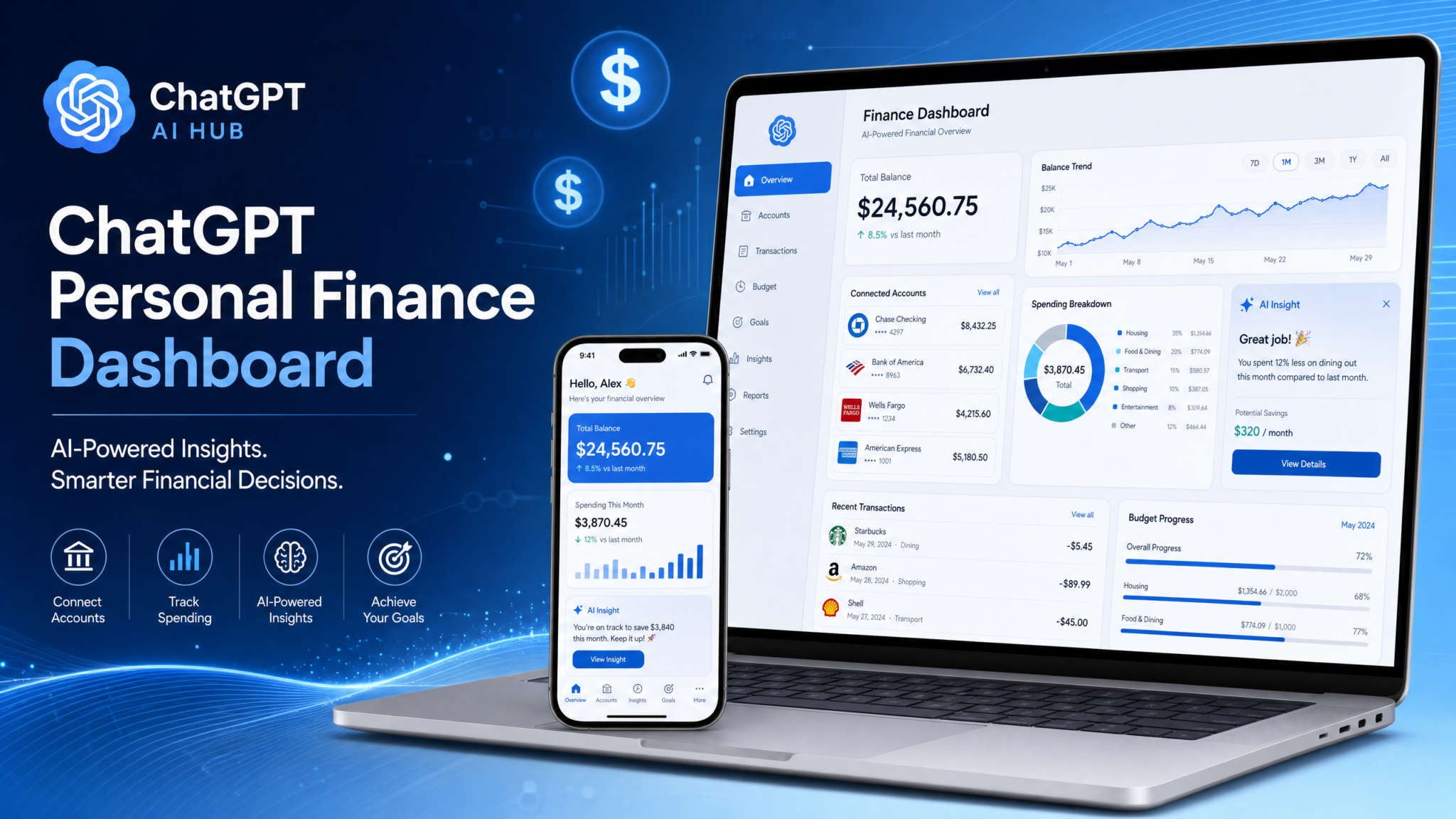
ChatGPT Launches Personal Finance Dashboard: A New Era for Fintech Integration
[IMAGE_PLACEHOLDER_HEADER]
OpenAI has taken a giant leap into the fintech sphere with the official launch of its new Personal Finance Dashboard within ChatGPT. This innovative feature, currently exclusive to ChatGPT Pro subscribers, empowers users to connect securely with over 12,000 financial institutions worldwide—thanks to a strategic partnership with Plaid, a leading fintech data network.
This update is much more than an incremental improvement: it transforms ChatGPT from an intelligent conversational AI into a powerful financial assistant, capable of analyzing, tracking, and advising on your personal finances in real time. It promises to revolutionize how users manage money, offering insights, budgeting tools, investment analysis, and personalized financial planning, all via natural language interaction.
The announcement on May 15, 2026, has sparked enthusiasm across both technology and financial sectors. By seamlessly integrating bank accounts, credit cards, investment portfolios, and other financial products, this dashboard aims to simplify financial management like never before. Below, we explore this groundbreaking feature in depth, including a practical usage guide, a comparison with popular standalone finance apps, and insights into its broader implications for fintech and AI-driven financial advisory.
The Power of Plaid Integration: Connecting Your Financial World Securely
[IMAGE_PLACEHOLDER_SECTION_1]
At the heart of ChatGPT’s finance dashboard lies integration with Plaid, a trusted fintech infrastructure provider that facilitates secure data exchange between users’ financial institutions and applications. Plaid’s sophisticated technology allows ChatGPT to access real-time transaction data, account balances, and investment holdings from thousands of banks, credit unions, brokerage firms, and other financial service providers.
For ChatGPT Pro users, this means all your financial data is consolidated in one intuitive interface. Instead of juggling multiple apps or logging into different portals, you can now manage your entire financial ecosystem within ChatGPT. Connecting your accounts is effortless and secure: after selecting your financial institutions, you authenticate directly through Plaid’s industry-leading multi-factor authentication and encryption protocols, ensuring your credentials remain private and protected.
OpenAI emphasizes that privacy and data security are paramount. Users retain granular control over what financial data is accessed and how it’s used, with full ability to revoke permissions anytime. This transparent approach builds trust while unlocking unprecedented personalization in financial insights.
Previously, AI-powered financial advice often lacked nuance due to missing direct financial data access. The Plaid integration enables ChatGPT to go beyond generic tips by analyzing your unique spending patterns, income streams, debts, and investments. For example, you can now ask questions like:
- “How much did I spend on dining out last month?”
- “Am I on track to meet my savings goal for a home down payment?”
- “What are some subscription services I’m paying for that I haven’t used recently?”
And receive instant, personalized responses based on your up-to-date financial data.
How to Use ChatGPT’s Personal Finance Dashboard
Getting started with the Personal Finance Dashboard is designed to be user-friendly and straightforward. Here’s a comprehensive step-by-step guide for ChatGPT Pro users:
- Subscribe to ChatGPT Pro: This feature is exclusive to Pro subscribers. Upgrade your account if you haven’t yet.
- Locate the Finance Dashboard: Within the ChatGPT interface, find and click the newly added “Finance” or “Dashboard” tab to begin setup.
- Securely Connect Your Accounts via Plaid: Select your bank, credit card issuer, investment firm, or financial provider from the extensive list and authenticate through Plaid’s secure platform. Plaid acts as a secure middleman, so your login credentials aren’t shared directly with OpenAI.
- Grant Data Access Permissions: Approve the types of financial data ChatGPT can access (transactions, balances, holdings, etc.). You have the option to restrict or revoke access anytime from your account settings.
- Review Your Financial Overview: After syncing, your dashboard will display a comprehensive overview of your net worth, categorized spending, recent transactions, budget statuses, and investment performance.
- Interact with AI Insights: Leverage natural language prompts to analyze your finances, for example:
- “Summarize my spending for the last quarter.”
- “Identify any recurring subscriptions I might have forgotten about.”
- “Based on my income and expenses, how much can I realistically save each month?”
- “Analyze my investment portfolio and suggest areas for diversification.”
- “What were my largest expenses in April across all accounts?”
- Set Financial Goals and Budgets: Establish personalized savings goals or budgets, and receive real-time progress updates and recommendations from ChatGPT’s AI assistant.
ChatGPT’s dashboard continually refreshes data to provide timely, actionable insights. OpenAI is actively gathering user feedback to enhance and expand these features in future updates.
ChatGPT vs. Standalone Personal Finance Apps: How Does It Compare?
[IMAGE_PLACEHOLDER_SECTION_2]
ChatGPT’s entry into personal finance places it alongside established applications like Mint, YNAB (You Need A Budget), and Empower (formerly Personal Capital). While these platforms offer years of refined features, ChatGPT’s conversational AI introduces a fundamentally new way to interact with your financial data.
Advantages of ChatGPT’s Personal Finance Dashboard
- Conversational Natural Language Interface: Rather than navigating complex menus and static reports, users can ask direct questions and engage in dynamic dialogue with ChatGPT, making financial management accessible and engaging.
- Contextual and Customized Advice: ChatGPT understands complex queries, cross-references multiple data points, and can factor in broader economic trends along with your personal life events mentioned in conversations, enabling nuanced recommendations.
- All-in-One AI Assistant: Beyond finance, ChatGPT supports tasks like content creation, coding, and research. Integrating finance reduces app fatigue and centralizes your workflow. For example, learn about enhancing productivity with GPT-5.5 connected apps.
- Potential for Advanced AI Analytics: Powered by advanced AI models, ChatGPT can offer predictive analytics and personalized financial strategies that traditional rule-based apps may not match.
Challenges and Considerations
- Feature Specialization: Established apps have specialized tools for tax planning, debt payoff strategies, or detailed investment rebalancing that ChatGPT’s dashboard will need time to develop.
- Learning Curve: Some users might prefer the familiar, visually rich dashboards found in traditional apps over a conversational interface for in-depth reviews.
- Security & Trust: Despite industry-grade security with Plaid, entrusting an AI with sensitive financial data can initially cause hesitation. Transparency and control remain crucial. Learn more about AI-powered security in finance.
- Monetization Neutrality: Unlike standalone apps with separate finance subscriptions or ads, ChatGPT Pro covers finance plus many other AI features. The long-term pricing of finance-specific enhancements remains to be seen.
In essence, while ChatGPT’s finance dashboard may not replace every niche finance app immediately, it democratizes sophisticated financial insights and makes managing money much more approachable for a wider audience.
The Broader Impact on Fintech and Financial Services
This launch heralds a paradigm shift. AI is no longer confined to processing data but is becoming an embedded, proactive agent within everyday financial lives:
- AI as a Personal Financial Advisor: ChatGPT’s ability to analyze detailed financial data and provide tailored, real-time advice approaches the value offered by human advisors, potentially disrupting the traditional advisory market by making advice more accessible and affordable.
- Boosting Financial Literacy: By breaking down complex financial topics into plain language and offering immediate, personalized answers, ChatGPT can significantly enhance financial education for millions.
- New Fintech Partnerships: The collaboration between OpenAI and Plaid exemplifies innovative synergy between AI technology companies and fintech infrastructure providers—a model likely to accelerate future service innovations.
Useful Links
- How European Financial Institutions Are Using GPT-5.5 Trusted Access for Cyber to Defend Critical Infrastructure
- How to Build Automated Workflows with GPT-5.5 Connected Apps: Gmail, Drive, and Calendar Integration
- Plaid Official Website
- ChatGPT Pro Subscription Guide
Access 40,000+ AI Prompts for ChatGPT, Claude & Codex — Free!
Subscribe to get instant access to our complete Notion Prompt Library — the largest curated collection of prompts for ChatGPT, Claude, OpenAI Codex, and other leading AI models. Optimized for real-world workflows across coding, research, content creation, and business.
