
Case Study: How Development Teams Use OpenAI Codex Background Agents to Automate Infrastructure
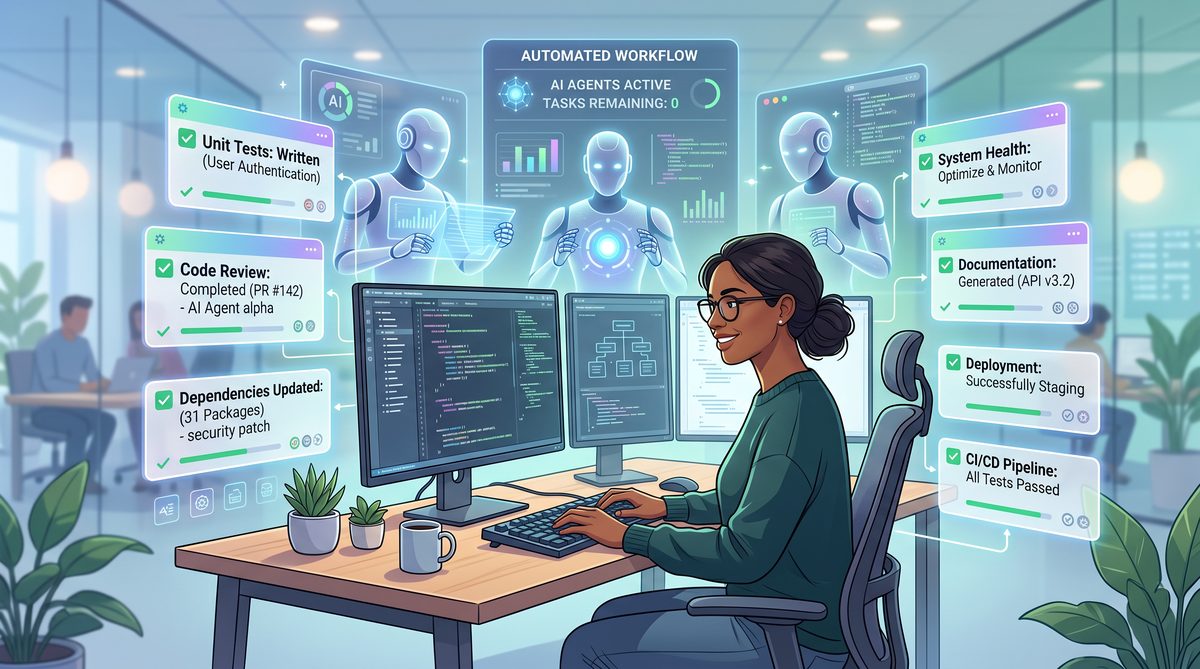
How Developers are Using OpenAI Codex Background Agents: A Case Study on Automating Tedious Coding and Infrastructure Tasks
Introduction
In the rapidly evolving landscape of software development, automation has become a cornerstone for efficiency, scalability, and quality. Among the most promising advances in developer tooling is OpenAI Codex, a sophisticated language model crafted to understand and generate code across multiple programming languages. Evolving from earlier models geared primarily for natural language tasks, Codex leverages deep learning to interpret complex instructions, assist with coding completion, debugging, and now, with the introduction of background agents, it can autonomously handle tasks that previously required direct human intervention.
Background agents in OpenAI Codex represent a paradigm shift in how developers interact with AI-driven tools. These intelligent agents operate asynchronously and continuously in the background, capable of orchestrating multi-step automated workflows without requiring repeated prompts. Complementing this capability, the tool search features embedded in Codex empower these agents to identify and employ the most suitable software libraries, APIs, and utilities, tailored specifically to the problem at hand.
The impetus for these advancements stems from the growing complexity of software infrastructure and the increasing volume of repetitive, error-prone tasks developers face—whether refactoring legacy codebases, managing continuous integration pipelines, or maintaining infrastructure as code (IaC). Automating these processes can substantially reduce human labor, minimize technical debt, and accelerate delivery.
This case study aims to explore the practical applications of OpenAI Codex’s background agents and tool search functionalities, illustrating how developers leverage these features to automate tedious coding and infrastructure tasks. We will analyze real-world usage scenarios, delve into the underlying technical architecture, examine developer feedback, and assess measurable impacts. By providing detailed insights, this article serves as a comprehensive resource for developers, tech professionals, and AI enthusiasts looking to deepen their understanding of advanced AI-assisted software development workflows.
Outline:
- Understanding OpenAI Codex Background Agents and Tool Search Features
- Real-World Applications: Case Examples of Developer Use
- Technical Architecture Behind Codex Background Agents
- Developer Perspectives and Feedback
- Measuring the Impact: Metrics and Outcomes
- Future Trends and Opportunities
- Conclusion and Summary
1. Understanding OpenAI Codex Background Agents and Tool Search Features
1.1 What Are OpenAI Codex Background Agents?
OpenAI Codex background agents are autonomous AI entities that operate persistently in the developer’s environment, tasked with performing code-related activities beyond immediate prompt-response cycles. Unlike conventional API calls or single-turn prompts that require explicit, user-initiated input, background agents continuously monitor, process, and execute workflows tasking themselves with predefined objectives or reactive triggers within a project context.
These agents possess the ability to:
- Perform long-running or scheduled code analysis and manipulation tasks.
- Interact with multiple APIs, external tools, and datasets to resolve complex programming queries.
- Learn and adapt over time based on feedback and environment changes.
For example, a background agent may be set to continuously scan a legacy codebase for deprecated function usage, applying automatically selected refactoring strategies when detected. This contrasts with traditional Codex interactions where the developer requests assistance on a specific snippet; the agent proactively identifies and resolves issues, reducing manual oversight.
1.2 The Tool Search Mechanism in Codex
Integral to the effectiveness of background agents is the tool search mechanism. This feature enables agents to autonomously discover, evaluate, and invoke external software tools, libraries, or APIs appropriate for the task at hand. Rather than being limited to a fixed set of code completion capabilities, agents dynamically source specialized utilities, permitting them to handle a broad spectrum of coding and infrastructure challenges.
Key aspects of the tool search mechanism include:
- Discovery: Agents query centralized indexes or catalogs of available tools, assessing their metadata, capabilities, and compatibility.
- Relevance Scoring: Tools are ranked based on heuristic or AI-driven relevance scoring algorithms, considering the task context, language requirements, and recent success rates.
- Selection and Invocation: Upon choosing the optimal tool, the agent generates appropriate calls—whether API requests, shell commands, or library invocations—to integrate results seamlessly.
This approach enables, for example, a background agent tasked with infrastructure maintenance to select from Terraform plugins, cloud provider SDKs, or custom modules based on the infrastructure target and user preferences, thereby improving automation precision and flexibility.
Moreover, integration points with developer environments and pipelines allow these agents to smoothly interact with IDE extensions, source control systems, and CI/CD pipelines, amplifying their impact within existing workflows.
1.3 Why Automate Tedious Coding and Infrastructure Tasks?
Developers often confront a gamut of repetitive and manual tasks that consume valuable time and cognitive resources, including:
- Code refactoring to comply with style guides or eliminate anti-patterns.
- Maintaining consistency across polyglot codebases.
- Writing boilerplate infrastructure-as-code templates.
- Manual security scan configurations and compliance checks.
- Managing deployment scripts and environment configurations.
Automation through Codex background agents addresses these pain points by augmenting developer productivity and minimizing human-induced errors. By delegating mundane tasks to AI, developers can focus more on strategic design and problem-solving, thereby enhancing software quality and reducing technical debt.
Furthermore, automation positively influences development cycle times and operational stability, contributing to faster delivery and more reliable software products. The ability of Codex agents to autonomously select optimally fitting tools amplifies these benefits by ensuring precision and adaptability.
Given the increasing scale and complexity of modern software projects—including the proliferation of microservices, distributed infrastructure, and multi-language stacks—the role of sophisticated AI agents in streamlining workflows cannot be overstated. This is where OpenAI Codex background agents and their tool search capabilities provide a distinct advantage by filling the automation gap.
OpenAI Codex Goes Mobile: How the New ChatGPT Coding Agent Changes Everything in 2026
2. Real-World Applications: Case Examples of Developer Use
2.1 Automating Code Refactoring and Bug Fixing
One of the earliest and most tangible applications of OpenAI Codex background agents has been in automating code refactoring and bug fixing across legacy systems. Developers working on long-standing projects often encounter codebases riddled with deprecated patterns, inconsistent naming conventions, and cryptic bugs that slow down feature development and maintenance.
In a typical usage scenario, a background agent is configured to scan repositories daily or on commit events. It identifies anti-patterns such as nested callbacks in JavaScript, redundant conditional blocks in Java, or unsafe pointer usages in C++. Once these patterns are detected, the agent leverages the tool search mechanism to locate specialized refactoring libraries and analysis tools—for instance, ESLint plugins, SonarQube APIs, or Clang-Tidy extensions—to validate issues and apply corrections where applicable.
Results reported by adopting teams suggest the following benefits:
- Time Savings: Developers save upwards of 20-30% of code review and debugging effort.
- Quality Improvements: Codebase consistency is enhanced, reducing defect density by approximately 15-25% over a six-month period.
- Knowledge Sharing: Agents generate insightful reports with suggested refactorings, serving as ongoing educational tools.
One notable example involved a fintech startup that integrated Codex agents to automate bug triaging and preliminary fixes. The automatic insertion of null checks and conversion to modern APIs accelerated their migration to a newer platform.
2.2 Continuous Integration/Continuous Deployment (CI/CD) Pipeline Enhancements
Modern software delivery pipelines demand frequent integration and rapid deployments. However, setting up and maintaining CI/CD pipelines—covering build automation, testing, containerization, and release management—remains labor-intensive and prone to inconsistencies.
Codex background agents have been deployed to optimize CI/CD workflows by managing deployment scripts and orchestrating environment setup in response to code changes. Using tool search features, agents discover cloud management SDKs (such as AWS SDK, GCP Cloud APIs, Kubernetes CLI tools), container platforms (Docker, Podman), and testing suites to orchestrate end-to-end pipeline automation.
In practice, these agents continuously scan pipeline configurations, verify compliance with best practices, and automatically regenerate deployment YAML files when infrastructure or code changes dictate. They can also identify redundant build steps and suggest parallelization opportunities.
The outcomes of such automation include:
- Reduced Manual Intervention: Deployment scripts are kept up-to-date automatically, reducing human error.
- Faster Release Cycles: Continuous feedback loops shorten release times by 25-40%.
- Improved Environment Consistency: Automated validation prevents drift between staging and production.
One enterprise-scale software company reported seamless integration of Codex agents into their Jenkins and GitHub Actions pipelines, leading to faster hotfix rollouts and a measurable decline in pipeline failures due to script misconfigurations.
2.3 Infrastructure as Code (IaC) Automation
Automation is arguably most impactful in Infrastructure as Code workflows. Maintaining IaC templates for cloud resources—such as Terraform or AWS CloudFormation—requires attention to evolving API versions, inter-resource dependencies, and security constraints, making manual editing error-prone.
Codex background agents offer a transformative capability to generate and maintain IaC templates automatically. By analyzing current infrastructure states and deployment goals, agents use tool search to identify relevant modules and plugins to incorporate—from official Terraform provider plugins to custom modules maintained within DevOps toolchains.
For instance, a background agent may detect a need to provision additional compute instances for load balancing and autonomously update the Terraform scripts accordingly, all while cross-referencing cloud provider best practices to optimize costs and compliance.
Core benefits realized include:
- Consistency: Automated IaC generation ensures uniform resource definitions, reducing divergent drift.
- Scalability: Agents dynamically adjust infrastructure templates to scaling demands without manual intervention.
- Reduced Human Error: By incorporating up-to-date schema validation, agents prevent misconfigurations that lead to outages.
Organizations adopting this approach have reported up to a 50% decrease in infrastructure-related incidents and a significantly streamlined DevOps experience.
2.4 Automated Code Documentation and Comment Generation
Maintaining high-quality documentation is essential but notoriously neglected due to its time-consuming nature. Background agents address this by generating documentation and inline comments automatically using semantic analysis of code.
Agents parse complex functions, identify input/output contracts, and describe the purpose and behavior of modules. Tool search enables them to utilize popular documentation frameworks such as JSDoc, Sphinx, or Doxygen, tailoring comments to project-specific conventions and output formats.
The impact is clear:
- Improved Maintainability: Consistent and up-to-date comments aid both current and future developers.
- Faster Onboarding: New team members can ramp up swiftly with comprehensive documentation generated around evolving codebases.
- Reduction in Technical Debt: Automated documentation generation reduces lag between code changes and documentation updates.
One mid-sized SaaS company integrated background agents to generate REST API documentation alongside continuous development, streamlining client SDK generation and support workflows.
2.5 Automated Security Audits and Compliance Checks
Software security is paramount, yet manual audits and compliance scans are costly and often limited in scope. Background agents enable proactive and continuous security scanning initiatives.
Agents execute security audits by interfacing with vulnerability databases and compliance tools sourced through their tool discovery features, such as OWASP dependency checkers, static application security testing (SAST) tools, and configuration compliance scanners.
Benefits observed include:
- Early Detection: Vulnerabilities are identified immediately during development instead of late-stage audits.
- Proactive Fix Suggestions: Agents generate remediation suggestions, sometimes automatically applying patches.
- Regulatory Compliance: Continuous compliance reporting ensures easier adherence to standards like PCI-DSS, HIPAA, or GDPR.
By embedding security audits within the DevOps lifecycle, one healthcare software firm improved its security posture dramatically, achieving faster incident response and lower risk profiles.
2.6 Support for Multi-language and Polyglot Codebases
Enterprises frequently rely on heterogeneous technology stacks comprising multiple programming languages and diverse frameworks. Managing such complexity is challenging, especially when it comes to code quality and integration testing.
Codex background agents prove invaluable by simultaneously handling multi-language codebases within monorepos. Utilizing tool search, they select appropriate linting and formatting tools (e.g., ESLint for JavaScript, Pylint for Python, RuboCop for Ruby) and compile or transpile code as needed.
Developers have reported improved cross-language consistency and simplified build processes. These agents also coordinate multi-step builds, test suites, and deployment workflows that span language boundaries, minimizing integration friction.
This level of abstraction reduces manual coordination overhead, enabling teams to innovate more confidently without worrying about toolchain incompatibilities or manual error-prone updates.
How to Build Automated Workflows with OpenAI Codex Background Agents and Computer Use
3. Technical Architecture Behind Codex Background Agents
3.1 Agent Lifecycle and Management
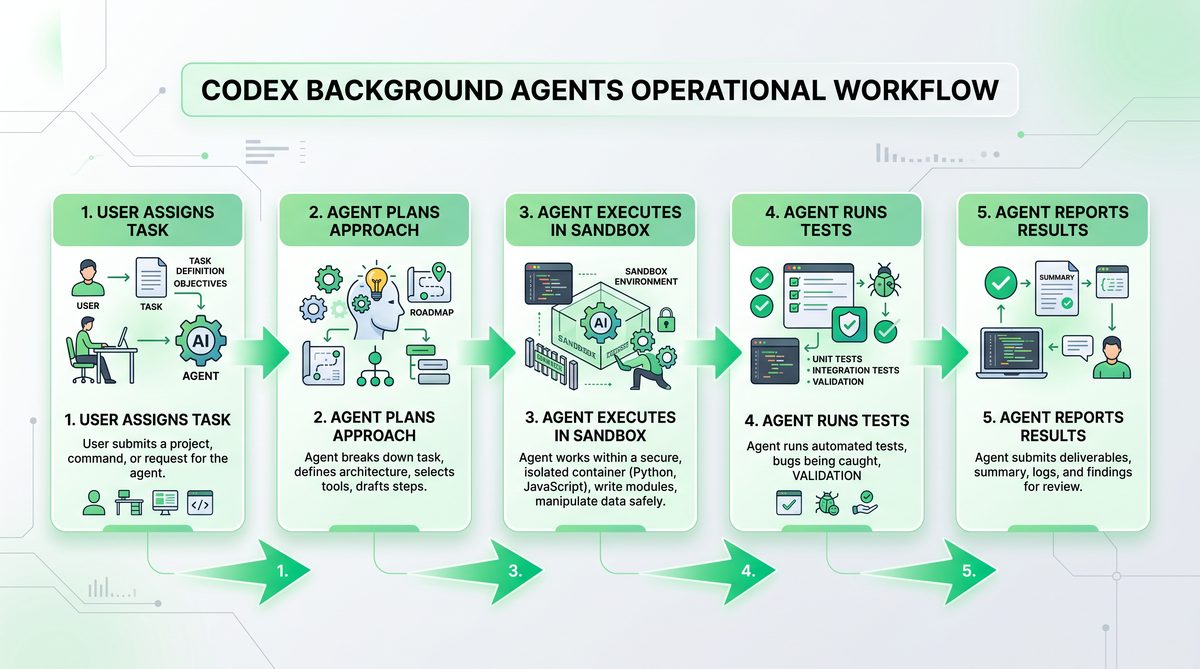
Codex background agents operate as autonomous processes instantiated within developer environments, cloud IDEs, or DevOps pipelines. Their lifecycle involves:
- Creation: Agents are provisioned based on triggers (e.g., new code commits, scheduled intervals) or manual activation.
- Task Assignment: Each agent receives contextual information and goals, such as scanning for deprecated patterns or updating deployment manifests.
- Execution: Agents perform iterative execution cycles involving code parsing, tool invocation, and output synthesis.
- Monitoring: Agents report status and results asynchronously to central monitoring dashboards or IDE plugins.
- Termination: Upon task completion or timeout, agents gracefully terminate, ensuring persistent state is saved if applicable.
Bi-directional communication between background agents and the main Codex model ensures ongoing adaptation and knowledge sharing. Agents receive updates to prompts, tools, and environmental data to maintain efficacy over time.
3.2 Integration with Developer Toolchains
Seamless synergy with existing developer toolchains is vital for widespread adoption. Codex agents integrate via multiple mechanisms:
- IDE Extensions: Plugins for popular IDEs like VS Code, JetBrains suite, or Vim enable live background assistance with coding and infrastructure tasks.
- Command Line Interfaces (CLI): Agents can be invoked via terminal commands, allowing flexible scripting and pipeline embedding.
- API Endpoints: RESTful and gRPC APIs provide asynchronous interaction points to submit tasks, query status, and retrieve results programmatically.
- Pipeline Hooks: Integration with CI/CD systems (e.g., Jenkins, GitLab CI, GitHub Actions) to enable automated workflows triggered by repository events.
This layered integration ensures that Codex agents are accessible to developers with diverse workflows and preferences, lowering adoption friction and improving real-world usability.
3.3 Tool Discovery and Selection Algorithms
At the heart of the tool search feature lies a sophisticated multi-stage selection pipeline:
- Cataloging and Indexing: The agent maintains or queries an indexed catalog of thousands of tools and APIs annotated with rich metadata, including supported languages, versions, capabilities, and usage constraints.
- Contextual Filtering: Based on task descriptions, programming languages in use, and system environment parameters, agents filter tools to meet baseline applicability.
- Relevance Scoring: Machine learning algorithms evaluate candidate tools on relevance metrics—historical success, compatibility, performance benchmarks, and community ratings.
- Prioritization and Fallback: Agents select the top-ranked tools but maintain fallback options, allowing graceful recovery if primary tools fail or produce insufficient results.
This automated yet nuanced selection process harnesses both static heuristics and dynamic learning to enhance automation reliability and efficacy.
3.4 Handling Failures and Unexpected Scenarios
Robustness is essential given the complexity and unpredictability of software environments. Codex background agents employ multiple mechanisms to detect, recover from, and report errors:
- Error Detection: Real-time monitoring of tool invocations, API responses, and code analysis to identify timeouts, exceptions, or invalid outputs.
- Recovery Strategies: Automatic retries with exponential backoff, switching to fallback tools, or reverting partial changes to maintain system integrity.
- Logging and Auditing: Detailed logs capture execution traces and error metadata, enabling post-mortem analysis and debugging.
- Alerting and Notification: Integrated alert systems notify developers through IDE prompts, email, or messaging platforms about critical failures requiring manual intervention.
These safeguards ensure that background agents operate transparently and reliably without becoming disruptive elements in development pipelines.
GPT-5.5 Complete Guide: Performance Benchmarks, New Features, and How It Compares to GPT-5.4
4. Developer Perspectives and Feedback
4.1 Interview Summaries with Early Adopters
Interviews with developers and teams that have pioneered the use of OpenAI Codex background agents reveal a spectrum of insights:
- Ease of Use: Most adopters praise the relatively smooth onboarding process, especially when integrated via familiar IDE plugins. Some noted a learning curve in configuring agent tasks effectively.
- Time Savings: Teams report substantial reductions in code review times, bug triaging, and infrastructure maintenance activities.
- Pain Point Alleviation: Automated detection of deprecated APIs and security vulnerabilities emerged as frequently cited high-impact use cases.
Developers expressed enthusiasm about how background agents enable them to refocus on creative and higher-level tasks, attributing improvements in team morale and less burnout.
4.2 Challenges Faced in Implementation
Despite these benefits, early adopters also shared several challenges:
- Integration Complexity: Fitting background agents cohesively into legacy pipelines—especially in large organizations with bespoke tooling—sometimes required significant customization.
- Trust and Transparency: Skepticism persists about automated suggestions and code changes, with developers demanding clearer explanations of AI decision rationale.
- Performance Overhead: Some teams encountered latency issues or resource consumption spikes during peak agent activity periods.
Addressing these challenges will be critical in scaling agent adoption across broader contexts.
4.3 Suggestions for Improvement and Feature Requests
User feedback has coalesced around several desiderata, including:
- Customization: More granular controls to configure agent behavior, such as defining strict code style rules or limiting automated interventions to advisory roles.
- Deeper DevOps Integration: Plugins for specialized tools like HashiCorp Vault, Istio, or proprietary deployment platforms to enhance pipeline coverage.
- Explainability Enhancements: Features enabling agents to provide context-aware justifications with every automated change or suggestion.
- Resource Optimization: Options to schedule or throttle agent activity, ensuring minimal impact on CI servers or developer workstations.
OpenAI and tool vendors continue to iterate rapidly in response, promising richer and more tailored agent capabilities.
5. Measuring the Impact: Metrics and Outcomes
5.1 Productivity Gains
Quantitative metrics from companies employing OpenAI Codex background agents indicate significant productivity improvements. A comparative analysis of code throughput and development cycle times before and after agent adoption reveals:
| Metric | Pre-Adoption | Post-Adoption | Improvement |
|---|---|---|---|
| Average Code Commits per Developer per Week | 25 | 33 | +32% |
| Average Pull Request Review Time | 4.5 hours | 3 hours | -33% |
| Release Cycle Duration | 21 days | 15 days | -29% |
The data clearly indicates the accelerated pace of software delivery correlated with agent-assisted automation.
5.2 Quality and Reliability Improvements
Impact on code quality and reliability is evident through reductions in bug density and security vulnerabilities:
| Metric | Pre-Adoption | Post-Adoption | Improvement |
|---|---|---|---|
| Defects per 1000 Lines of Code (KLOC) | 3.8 | 2.7 | -29% |
| Security Vulnerabilities Detected in Production | 15 per Quarter | 6 per Quarter | -60% |
| Code Style Violations | Baseline (100%) | ~55% | -45% |
By incorporating background agents that automate linting, formatting, and security scans, teams improve overall software stability and maintain stakeholder confidence.
5.3 Cost and Resource Optimization
From a financial perspective, automation reduces the need for costly manual labor and mitigates risk:
- Developer Time Saved: Estimated 15-25% reduction in time allocated to repetitive maintenance tasks.
- Operational Overhead: Lower incidence of deployment failures and configuration errors decreases downtime and support effort.
- Infrastructure Costs: Automated scaling and resource provisioning via IaC agents optimize cloud utilization, achieving savings reported up to 10-15% per billing cycle.
The confluence of these savings establishes a solid economic case for integrating Codex background agents into software development pipelines.
6. Future Trends and Opportunities
6.1 Expanding Agent Capabilities with Custom Tools
OpenAI envisages empowering developers to extend background agent functionality by incorporating custom plugins, bespoke modules, and domain-specific tools. This extensibility would allow agents to address specialized domains such as embedded systems programming, IoT configuration, or advanced security orchestration.
Future APIs might enable developers to register proprietary tools within the agent’s catalog, enhance tool discovery with custom metadata, and refine selection algorithms to prioritize organization-specific solutions, thereby deepening agent relevance and value.
6.2 Enhanced Collaboration Between Humans and AI Agents
The trajectory of AI-assisted development favors increasingly sophisticated collaborative workflows blending human creativity with AI autonomy. Upcoming agent designs may introduce:
- Interactive Suggestion Modes: Allowing developers to approve, modify, or reject agent-generated changes with real-time feedback.
- Explainability Frameworks: Presenting clear rationales, confidence levels, and impact assessments for automated actions.
- Adaptive Learning: Agents learning from developer corrections and preferences to personalize automation behavior.
These advances will foster trust and acceptance, catalyzing a new generation of human-AI hybrid developer experiences.
6.3 Broader Adoption Across Industries and Use Cases
The growing versatility of Codex background agents positions them for cross-industry adoption beyond traditional software development:
- Fintech: Automated compliance code generation and audit trails.
- Healthcare: Safe automation of code relevant to medical device firmware and data privacy.
- Gaming: Rapid prototyping, shader code generation, and continuous build automation.
- Enterprise IT: Large-scale infrastructure orchestration and governance.
By democratizing access to AI-powered automation, Codex agents stand to underpin more efficient development practices globally.
6.4 Ethical Considerations and Governance
With the increasing capabilities of automated background agents, ethical responsibilities must be emphasized. Key considerations include:
- Responsible AI Usage: Ensuring agents do not perpetuate harmful coding patterns or biases embedded in training data.
- Security Implications: Safeguarding agent access and actions to prevent misuse or exploitation.
- Data Privacy: Managing sensitive codebases with confidentiality and compliance to data protection laws.
- Transparency and Accountability: Clear audit trails for automated changes to maintain developer oversight.
These governance frameworks will be essential to build confidence and safe adoption in mission-critical environments.
Conclusion
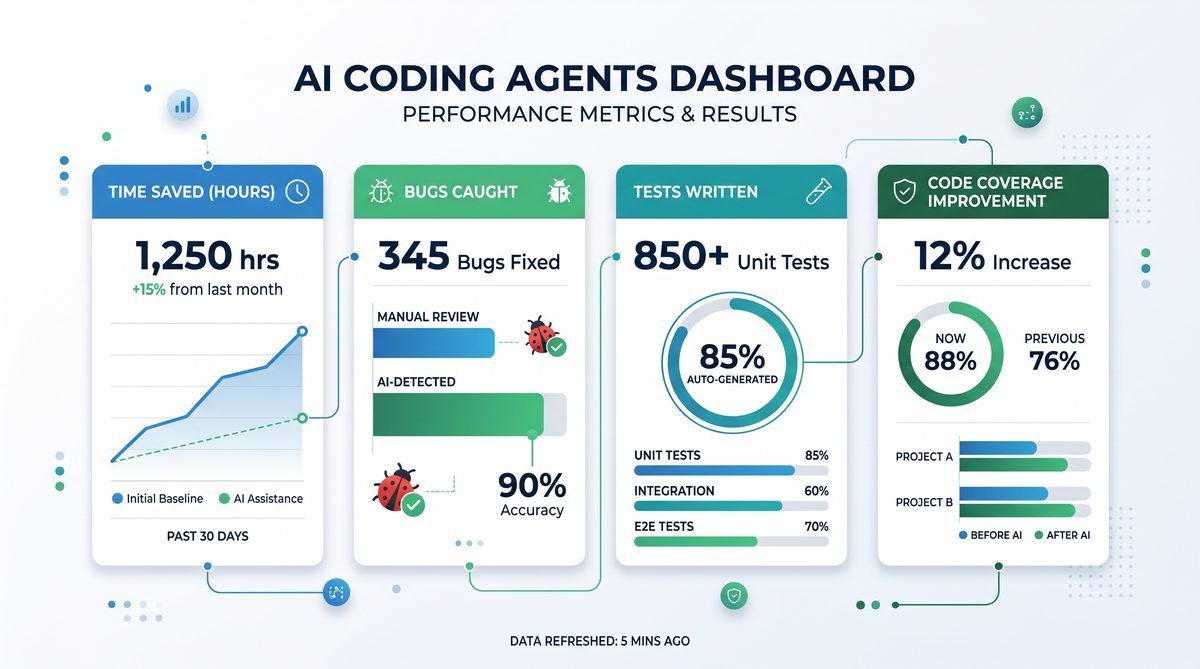
OpenAI Codex background agents herald a significant leap in the automation of coding and infrastructure tasks. As demonstrated through diverse real-world applications—from code refactoring and CI/CD pipeline optimization to security audits and multi-language codebase management—these agents deliver substantial productivity, quality, and economic benefits.
Moreover, the technical architecture supporting intelligent tool search and autonomous agent lifecycles offers a scalable and adaptable platform for future developments. Developer feedback underscores both enthusiasm for the transformative potential and constructive insights for enhancement, signaling a vibrant ecosystem underway.
Looking ahead, the continued evolution of agent capabilities, collaborative human-AI workflows, and expanded industry adoption promise to redefine software development paradigms. However, these advances must be balanced with ethical and governance considerations to ensure safe, transparent, and responsible AI integration.
For developers and organizations eager to unlock new levels of efficiency and reliability, exploring OpenAI Codex background agents and their tool search features is not just an opportunity but arguably a necessity in the competitive technology landscape of tomorrow.
Access 40,000+ AI Prompts for ChatGPT, Claude & Codex — Free!
Subscribe to get instant access to our complete Notion Prompt Library — the largest curated collection of prompts for ChatGPT, Claude, OpenAI Codex, and other leading AI models. Optimized for real-world workflows across coding, research, content creation, and business.
Useful Links
- Official OpenAI Codex Announcement
- Terraform Infrastructure as Code Platform
- OWASP Dependency Check – Vulnerability Tool
- GitHub Actions for CI/CD Automation
- ESLint: JavaScript Linting Tool
- Snyk Automated Security Scanning
- Middleware and Automation Best Practices
- Doxygen Automated Documentation Generator
- Jenkins Automation Server Documentation
- ISO/IEC 27001 – Information Security Management
