
Advanced Prompting Techniques for Claude Opus 4.7: Structured Plans, Deep Reasoning, and Precision

Advanced Prompting for Claude Opus 4.7: Best Practices for Precise Instructions, Structured Plans, and Leveraging Deep Reasoning
Introduction
As large language models (LLMs) continue to evolve, their capabilities in understanding and generating human-like text have reached unprecedented levels. Among the front runners in this innovation is Anthropic’s Claude Opus 4.7, a state-of-the-art LLM designed with a keen focus on advanced reasoning and ethical AI behavior. This iteration, Claude Opus 4.7, effectively bridges complex cognitive tasks with practical applications, empowering developers, researchers, and AI enthusiasts to deploy highly nuanced AI-powered solutions.
Mastering advanced prompting techniques is essential to fully harness Claude Opus 4.7’s unique strengths. Unlike conventional prompt strategies that often rely on simplistic or heuristic input phrases, advanced prompting requires meticulous crafting of instructions to unlock the model’s layered comprehension, multi-step reasoning, and context management abilities. This guide delves deep into best practices, equipping you with the know-how to formulate precise instructions, design structured plans, and leverage Claude Opus’s deep reasoning to handle complex queries effectively.
Throughout the article, you will gain:
- A comprehensive understanding of Claude Opus 4.7’s architecture and reasoning capabilities.
- Concrete methodologies for creating clear and specific prompts that drive desired model behavior.
- Strategies for structuring prompts to enable successful multi-step problem-solving and role-driven output generation.
- Advanced prompt engineering techniques to unlock the full depth of Claude’s reasoning, including reflection, hypothetical scenarios, and iterative refinement.
- Insights on optimizing context management within prompt windows and designing reusable prompt templates.
For developers aiming to build robust AI systems or researchers exploring deep reasoning in language models, this exhaustive tutorial serves as a technical roadmap for maximizing the potential of Claude Opus 4.7 in real-world applications.
1. Understanding Claude Opus 4.7’s Unique Features and Reasoning Abilities
1.1 What Sets Claude Opus 4.7 Apart from Other LLMs
Claude Opus 4.7 represents Anthropic’s latest push toward developing an LLM that excels not only in language generation but also in reasoning fidelity and ethical alignment. Several aspects distinguish it from peers like OpenAI’s GPT-4:
- Refined Architecture for Reasoning: At its core, Claude Opus 4.7 employs an architecture optimized for multi-step reasoning. This includes enhanced attention mechanisms and multi-hop reasoning modules that facilitate chaining of logical inferences over long text spans.
- Ethics-Centric Training: Anthropic’s safety-first approach integrates extensive human feedback and constraint-based reinforcement learning to minimize harmful or biased outputs, resulting in a model inherently tuned to ethical considerations.
- Contextual Depth and Memory: Unlike some models with more limited token windows, Claude offers robust context retention enabling better coherence over lengthy conversations and documents, critical for complex dialogues or multi-part tasks.
To illustrate the advancements, the table below contrasts key distinguishing factors between Claude Opus 4.7 and a comparable contemporary like GPT-4:
| Feature | Claude Opus 4.7 | GPT-4 |
|---|---|---|
| Model Architecture | Enhanced multi-hop reasoning modules, ethical RL tuning | General large transformer with attention optimization |
| Context Window | Extended, optimized for long-term conversation retention | Up to 8,000 tokens (varies by version) |
| Ethical Framework | Core design focused on minimizing harmful bias and toxicity | Robust but not explicitly built for ethics-first |
| Reasoning Capabilities | Strong multi-step logical reasoning and handling ambiguity | Excellent general reasoning with improvements on complex tasks |
| Fine-Grained Control | Supports complex constraints and persona role injection | Supports prompt engineering but less focused on role-play |
This comparison underscores Claude Opus 4.7’s emphasis on reasoning quality and controlled outputs, making it particularly suited for domains demanding rigorous ethical standards and stepwise logical verification.
1.2 Deep Reasoning in Claude: How It Processes Complex Queries
Claude Opus 4.7’s enhanced deep reasoning is anchored in its ability to parse and internally represent multi-step problems, maintain relevant context throughout, and generate coherent, grounded responses. Key aspects of this reasoning process include:
- Multi-Step Logic Handling: Instead of treating a prompt as a flat request, Claude internally decomposes the task into logical units, synthesizing intermediate inferences before producing the final output. This layered approach enables accurate handling of multifaceted or nested queries.
- Context Retention Across Long Conversations: By maintaining extensive contextual memory, Claude can refer back to earlier conversation points while staying anchored in the current query’s scope, avoiding contradictions and ensuring consistency over hundreds or thousands of tokens.
- Nuanced Understanding of Ambiguous Inputs: Claude can detect ambiguity or uncertainty within user prompts and attempt clarifying reasoning, providing multiple perspectives or requesting disambiguation if needed, rather than defaulting to a single surface-level answer.
For example, when prompted with a complex problem such as legal compliance across varying jurisdictions, Claude can internally hold the logical structure of each jurisdiction’s rules, cross-reference them against the scenario’s facts, and produce a comprehensive, stepwise answer with justifications.
1.3 Use Cases That Benefit from Claude’s Advanced Reasoning
The unique deep reasoning strengths of Claude Opus 4.7 make it especially effective in use cases requiring stringent logical workflow and interpretability:
- Legal and Regulatory Analysis: Lawyers and compliance officers can leverage Claude to parse statutes, analyze case details, and generate summaries or recommendations grounded in multi-jurisdictional logic and ethical considerations.
- Scientific and Technical Problem-Solving: Researchers and engineers benefit from Claude’s ability to dissect complex scientific problems, propose hypotheses, and logically analyze experimental data or technical design trade-offs.
- Creative Writing with Complex Plot Structures: Writers crafting multi-threaded stories or game narratives can prompt Claude as a co-author to outline intricate plotlines, develop character motivations, and foresee narrative consequences, all while maintaining coherence over long texts.
These applications showcase Claude Opus 4.7’s versatility beyond mere language generation — it functions as a cognitive partner guiding users through intricate reasoning landscapes with precision and depth.
2. Crafting Precise Instructions: Clarity, Specificity, and Intent
2.1 The Importance of Specificity in Prompting
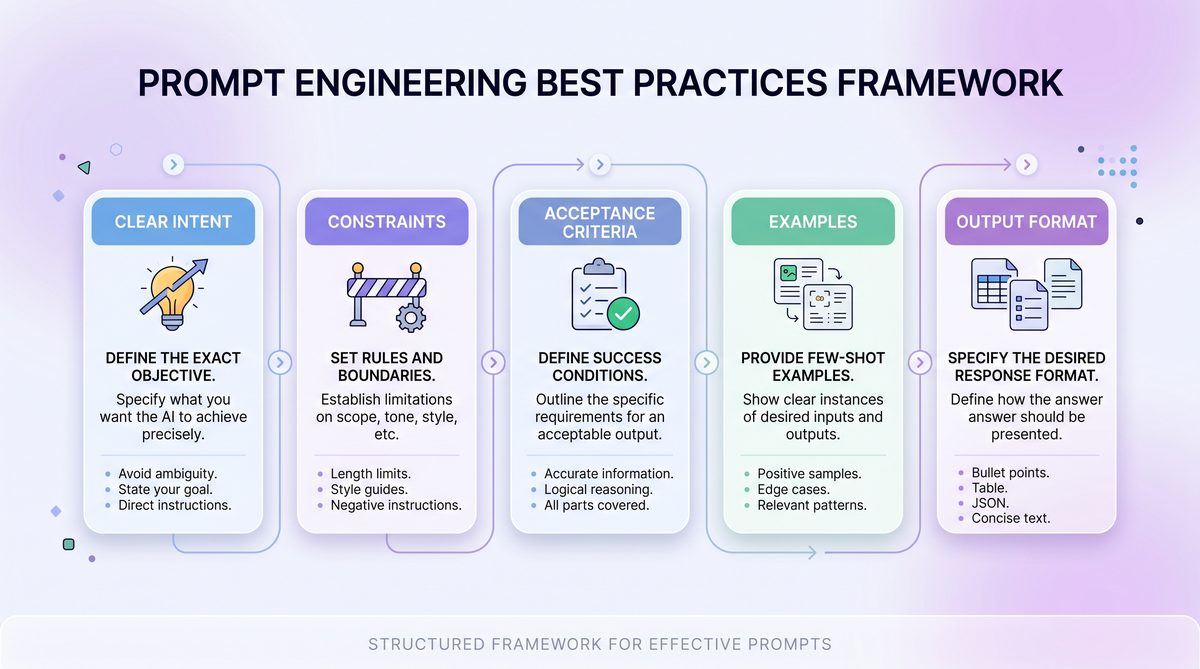
One of the critical determinants of successful interaction with Claude Opus 4.7 is the clarity and specificity of the prompt. Vague or ambiguous commands reduce output quality, causing the model to generate imprecise or off-target responses. Conversely, highly specific instructions help the model understand exactly what is expected and tailor its output accordingly.
Why specificity matters:
- Reduces ambiguity: Precise prompts leave little room for misinterpretation.
- Guides reasoning: The model focuses its multi-step inference towards the relevant dimensions.
- Saves tokens and computation: By avoiding unnecessary background or redundant requests.
Examples of imprecise versus precise instructions:
| Imprecise Prompt | Precise Prompt |
|---|---|
| “Write about climate change.” | “Provide a 300-word summary of recent scientific findings on the impact of climate change on coral reefs, citing data from IPCC reports.” |
| “Explain machine learning.” | “Explain supervised machine learning, including definitions of key terms like training data, features, labels, and give two example algorithms.” |
| “Help me with my resume.” | “Rewrite the professional experience section of my resume to emphasize project management skills, using action verbs and quantifiable achievements.” |
These examples highlight how providing explicit task definitions, output format requirements, and domain-specific context guides Claude Opus 4.7 towards better-targeted and more useful outputs.
2.2 Techniques for Clear and Concise Prompts
Once specificity is understood as vital, the next step is mastering the craft of conciseness blended with clarity. Overly long or convoluted instructions can dilute the core request and overwhelm the model. Best practices include:
- Explicit Task Definition: State exactly what the model should do (summarize, analyze, translate, compare, etc.) and what the expected outcome is.
- Defining Output Format: Specify the format if needed, e.g., bullet points, numbered lists, JSON, code snippets, or essay-style text.
- Controlling Length, Style, and Tone: Use modifiers such as “in 5 bullet points,” “in a formal tone,” or “in layman’s terms” to steer the response style.
Integrating these techniques can be further refined using prompt components like prefixes, suffixes, and inline instructions. For instance, appending “Provide references where applicable” cues Claude to be more rigorous in generating citations.
2.3 Utilizing Constraints and Boundaries
In addition to specifying what to include, instructing Claude on what to exclude or avoid sharpens output relevance. Constraints guide the model’s creativity and reasoning pathways:
- Setting Content Boundaries: For example, “Limit discussion to European Union regulations only,” ensures domain focus.
- Incorporating “Do’s and Don’ts”: Explicitly including negative instructions like “Do not use technical jargon,” or “Avoid speculative statements” helps tailor response quality.
- Using Negative Instructions Effectively: Instead of vague negations, frame negatives precisely. For example, “Exclude examples prior to 2000” rather than “Don’t include old examples.”
Such constraints are invaluable when ensuring compliance, maintaining style, or prioritizing clarity over comprehensiveness.
2.4 Examples of Effective Precise Instructions for Claude Opus 4.7
Below are annotated prompt samples demonstrating how precise instructions capitalize on Claude Opus 4.7’s strengths:
Prompt:
"Summarize the latest advancements in quantum computing in less than 200 words, using layman-friendly language, and include at least two recent research papers from 2023."

Annotations:
- Task: Summarize latest advancements
- Length Constraint: Less than 200 words
- Style: Layman-friendly, accessible language
- Evidence: Include citations to recent 2023 papers to enhance reliability
Prompt:
"As a cybersecurity expert, analyze the potential vulnerabilities in a distributed network architecture with IoT devices, and list five mitigation strategies in bullet points."

Annotations:
- Role-Play: Assign Claude an expert persona (cybersecurity expert)
- Analyze Complex Problem: IoT network vulnerabilities
- Structured Output: Five bullet points for mitigation strategies
These examples integrate explicit roles, output formatting, content constraints, and domain instructions, optimizing the model’s logical clarity and relevance, reducing hallucinations or generic outputs.
Advanced Prompt Engineering Frameworks for 2026: RTF, CREATE, Chain-of-Thought, ReAct, and DSPy
3. Designing Structured Plans to Guide Complex Task Execution
3.1 Why Structure Matters in Multi-Step Tasks
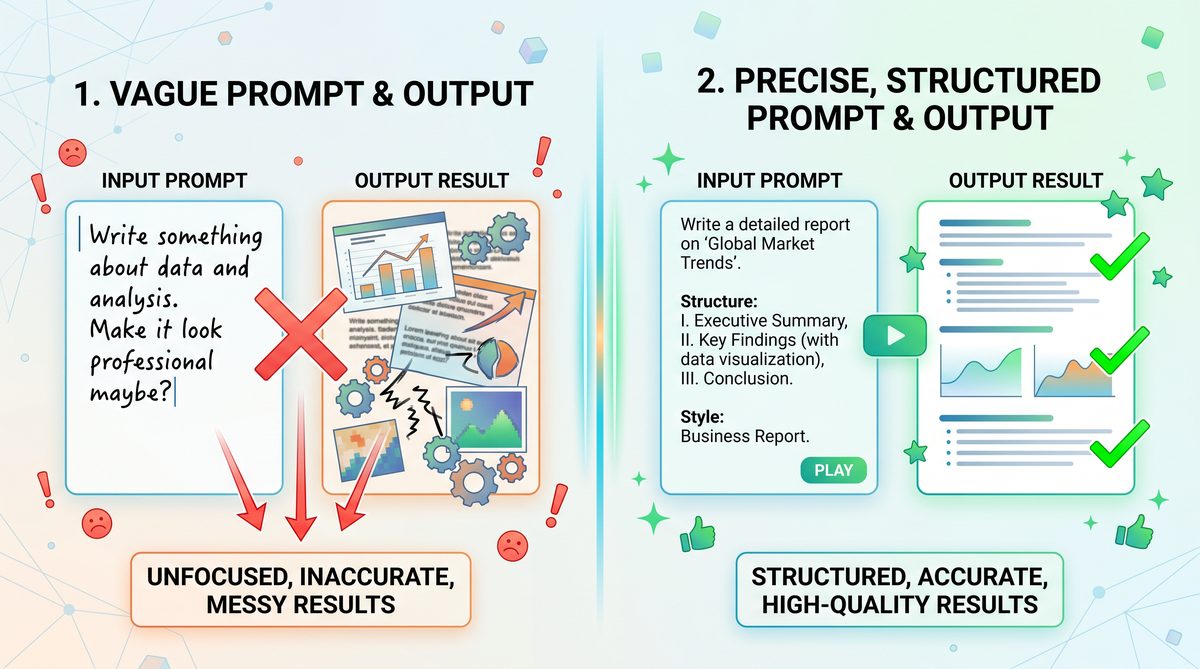
Many advanced use cases involve multi-step workflows or complex problem-solving processes. Without clear prompt structure, Claude’s reasoning—even if capable—can produce disorganized or error-prone outputs.
Benefits of prompt structure include:
- Focus: Clearly delineated steps guide the model’s attention sequentially.
- Logical Flow: Orderly decomposition of the problem reduces cognitive load on the LM.
- Error Reduction: Structured prompts minimize hallucinations by constraining inference pathways.
Failure to impose structure often results in fragmented responses or missed key reasoning steps, limiting utility in rigorous domains.
3.2 Breaking Down Complex Problems into Ordered Steps
Stepwise prompting is a practical technique for facilitating Claude’s logical sequence generation. It involves explicitly enumerating the discrete steps that the model should apply to solve the problem.
- Methodology: Use numbered lists or bullet points within the prompt to break down tasks. For example:
“Please perform the following steps:
1. Identify the main problem.
2. List all assumptions.
3. Analyze constraints.
4. Propose potential solutions.
5. Evaluate solutions and recommend the best option.”
This transparent structure scaffolds Claude’s internal reasoning, improving output coherence and enabling easier evaluation or follow-up refinement.
3.3 Leveraging Role-play and Persona Instructions to Enhance Task Execution
Another method to enrich prompt guidance is by assigning Claude an explicit persona or role relevant to the task domain. This approach affects output style, domain-specific knowledge application, and makes the interaction more contextually grounded.
Examples:
- “As a data scientist, interpret the following dataset.”
- “You are a financial advisor specializing in European markets; advise on portfolio diversification.”
- “Act as a historian specializing in the 20th century and provide an analysis of post-war economic policies.”
Role-play instructions prime Claude’s internal knowledge modules to prioritize relevant concepts and terminologies, thus elevating output precision and relevance.
3.4 Embedding Examples and Templates within Prompts
Embedding concrete examples or template outputs within prompts provides clear guidance for Claude on expected content and formatting. This technique is particularly powerful in data-sensitive tasks or where accuracy and consistency are paramount.
- Sample Output Inclusion: Show a sample of the ideal response format, highlighting what to include.
- “Show Me an Example” Tactic: Before requesting a custom response, asking Claude to generate an example response provides an opportunity to calibrate and refine instructions.
Embedding templates also facilitates automation and scaling of prompt designs, helpful when creating pipelines for routine or high-volume tasks.
3.5 Case Study: Structured Prompt for a Research Summary with Analysis
Consider a use case where a user wants to generate a research summary with critical analysis. Below is a structured prompt approach breakdown:
Prompt:
“Please generate a research summary on the topic of CRISPR gene editing:
Step 1: Provide a concise 150-word summary of the recent advancements.
Step 2: Identify the ethical considerations associated with these advancements.
Step 3: Analyze potential risks in applying CRISPR technologies clinically.
Step 4: Conclude with a balanced recommendation for policy makers.”

Analysis:
- The prompt explicitly delineates each reasoning step.
- Output length and format are clearly indicated.
- The request balances scientific explanation with ethical and policy analysis.
- This structure guides Claude through a comprehensive cognitive process, boosting the depth and reliability of the generated content.
Using structured plans like this enables you to fully exploit Claude Opus 4.7’s capacity for nuanced multi-part responses and disciplined logical breakdowns.
Claude for Small Business: Complete Guide to 15 Agentic Workflows
4. Advanced Prompt Engineering Techniques to Unlock Deep Reasoning
4.1 Prompt Chaining for Complex Reasoning Tasks
To tackle problems too complex to resolve with a single prompt, prompt chaining divides the task into progressive stages, feeding output from one stage as input into the next. This enhances thoroughness and allows incremental reasoning refinement.
For example, in a legal case analysis:
- First prompt asks Claude to extract relevant facts.
- Second prompt requests interpretation of applicable laws referencing the facts.
- Third prompt involves drafting recommendations.
This technique reduces cognitive load in each step and increases output fidelity, especially helpful for domains requiring layered logic or multi-dimensional reasoning.
4.2 Using Hypothetical Reasoning and “What If” Scenarios
Hypothetical reasoning enables exploring counterfactuals by instructing the model to analyze alternate realities or conditional dependencies. This capability is powerful in forecasting, decision-making, and scenario planning.
Examples of such prompts include:
- “What if the interest rates rise by 2% in the next quarter? How will it affect the tech sector investments?”
- “Assuming a 20% increase in renewable energy adoption, predict impacts on global oil prices over five years.”
- “If a software project deadline is moved up by one month, outline the adjusted resource allocation strategy.”
Crafting these prompts invites Claude Opus 4.7 to internally generate alternative logical pathways and evaluate outcomes probabilistically.
4.3 Encouraging Justification and Explanation in Responses
Requesting that Claude articulate its reasoning steps or justify conclusions promotes transparency and increases user trust in AI-generated insights. This practice helps detect errors and validate the logic behind outputs.
Sample prompt structure for justification:
“Provide an answer to the question, and explain each step of your reasoning process in detail.”Benefits of justification include:
- Improved confidence in model outputs.
- Reveal of implicit assumptions or knowledge gaps.
- Facilitation of human-AI collaboration through shared understanding.
4.4 Incorporating Reflection and Self-critique Prompts
Claude Opus 4.7 supports iterative refinement via self-evaluation prompts. By instructing the model to critically review its own prior answer, errors can be detected and corrected autonomously or with minimal human intervention.
A typical approach:
“Review your previous response and identify any potential errors, ambiguities, or unsupported claims. Suggest improvements if necessary.”Such reflection fosters continuous output quality enhancement and is especially important in high-stakes environments like legal or medical AI assistance.
4.5 Handling Ambiguity and Conflicting Information
Real-world information is often incomplete or contradictory. Effective prompting with Claude Opus 4.7 involves instructing it to recognize ambiguities and articulate uncertainty rather than providing definitive but potentially erroneous answers.
Examples of useful prompt patterns:
- “If there are conflicting data points, list both perspectives and explain the reasons for disagreement.”
- “Where information is incomplete, highlight assumptions and possible implications.”
- “Provide probabilities or confidence levels for each suggested conclusion.”
This approach models a nuanced human-like assessment of uncertain situations, enhancing transparency and decision-making trustworthiness.
5. Optimizing Prompt Design with Context Management and Memory
5.1 Managing Context Windows Effectively
Claude Opus 4.7’s extended token window allows handling lengthy contexts, but efficient management remains vital to maintain clarity and coherence.
Strategies include:
- Prioritizing Relevant Information: Include only necessary history or reference material to avoid token overload.
- Summarizing Previous Exchanges: Instead of entire logs, use concise recap prompts preserving user intent and previous key points.
- Segmenting Large Inputs: Break content into manageable sections, processed serially with contextual linking.
These methods ensure that the model’s attention focuses on the most pertinent parts of the prompt, thereby enhancing response quality.
5.2 Techniques for Long-Form Content Generation
Generating long articles, reports, or creative works pushes prompt design into managing token limits and maintaining thematic coherence. Key tactics include:
- Chunking: Divide the content generation task into sequential parts—for example, chapter-wise or section-wise—and combine results post hoc.
- Recap Prompts: At the start of each chunk, prompt Claude to recall important facts from previous parts, maintaining narrative flow.
- Outline-Guided Generation: Start from a structured outline and prompt Claude to progress methodically, ensuring focus and logical progression.
5.3 Using External Knowledge Bases and References within Prompts
While Claude Opus 4.7 has extensive internal knowledge, guiding it to incorporate up-to-date or domain-specific external data enhances reliability and relevance:
- Embedding URLs or Data Excerpts: Include key data points or snippets from authoritative sources within the prompt when requiring factual grounding.
- Citation Requests: Prompt Claude to cite or list references explicitly to increase transparency.
- Use of API-Driven Retrieval: In integrated systems, chain prompts with results from databases for dynamic external knowledge enrichment.
5.4 Prompt Templates for Consistent Context Handling
Reusable prompt templates streamline consistency across repeated tasks such as summarization, classification, or Q&A. Features include:
- Variables for task-specific inputs (e.g., [TOPIC], [DATA], [USER_QUERY])
- Predefined constraints and formatting instructions embedded into the template
- Compatibility with API-driven automation, enabling dynamic generation with minimal manual intervention
Using templates enhances prompt crafting efficiency, reduces errors, and fosters best practice adherence in multi-user or production-grade environments.
6. Evaluating and Iterating on Prompts for Continuous Improvement
6.1 Methods for Assessing Prompt Effectiveness
To continually refine prompt designs, rigorous evaluation methods are essential. Effective evaluation metrics include:
- Relevance: Does the output address the core prompt question?
- Accuracy: Are facts and logical steps correct and verifiable?
- Coherence: Is the output logically consistent and easy to follow?
- Style Adherence: Does the output match specified tone, length, and format?
Combining manual review with user feedback creates a comprehensive evaluative framework to guide improvements.
6.2 Tools and Techniques for Prompt Testing and Debugging
Systematic prompt testing helps detect failure modes such as hallucination, irrelevant outputs, or style deviations:
- Test Suites: Maintain sets of standardized prompts to test changes and measure response stability.
- Response Logging: Store outputs with original prompts for analysis and issue tracking.
- Automated Counters: Use heuristics or ML-based analyzers to flag inconsistencies or off-topic content.
Debugging efforts involve iterative prompt adjustments and re-running tests to isolate and correct problematic patterns.
6.3 Iterative Prompt Refinement Strategies
Based on evaluation outcomes, iterations may focus on:
- Increasing specificity to resolve persistent ambiguity
- Reordering instructions to optimize logical flow
- Adjusting constraints to balance creativity versus precision
- Adding or removing role-play cues or examples for domain focus
Iteration is an essential cycle to adapt prompts responsively as user needs evolve or new challenges arise.
6.4 Collaborating with Claude: Incorporating User Corrections and Preferences
Interactive prompting workflows maximize efficiency by involving Claude in the refinement loop:
- Requesting Claude to review and integrate user feedback dynamically
- Encouraging user annotations within prompts to customize tone or style
- Teaching Claude preferred formats or terminologies gradually through iterative correction
Such collaboration transforms the AI from a passive tool into an adaptive partner in content generation and problem-solving.
Conclusion
Claude Opus 4.7 is a powerful language model distinguished by its extensive reasoning capabilities and ethical design foundations. To fully harness this potential, advanced prompting strategies are crucial. Crafting precise, clear, and constraint-aware instructions lays the foundation for quality outputs. Structuring prompts into ordered logical steps with role-play and embedded examples provides scaffolding for complex problem-solving. Leveraging advanced engineering techniques such as prompt chaining, hypothetical reasoning, justification, and reflection unlocks deep reasoning pathways.
Furthermore, optimizing context management, utilizing external knowledge sources, and deploying reusable prompt templates ensures robust performance in diverse applications. Finally, systematic evaluation and iterative refinement of prompts, coupled with interactive collaboration, facilitate continuous enhancement of AI interactions.
By applying these best practices, developers and AI professionals can unlock the full cognitive power of Claude Opus 4.7, delivering precise and trustworthy AI-driven solutions across highly complex domains.
Access 40,000+ AI Prompts for ChatGPT, Claude & Codex — Free!
Subscribe to get instant access to our complete Notion Prompt Library — the largest curated collection of prompts for ChatGPT, Claude, OpenAI Codex, and other leading AI models. Optimized for real-world workflows across coding, research, content creation, and business.
Useful Links
- Official Claude Opus 4.7 Documentation – Anthropic
- Research Paper: Advanced Prompt Engineering for LLMs
- Understanding ChatGPT and GPT-4 Architectures
- Claude Prompt Examples Repository
- Guide to Prompt Design and Evaluation
- Google AI Blog: Advances in Language Model Reasoning
- DeepMind: AlphaFold and Advances in Scientific AI
- “Chain-of-Thought” Prompting Research Paper
- Comprehensive Prompt Engineering Techniques and Community
- In-depth Article on Transformer Architecture
