
Navigating the Upcoming OpenAI IPO: What It Means for AI
By Markos Symeonides

Introduction
The world of artificial intelligence (AI) is on the cusp of a transformative transition as one of its pioneering entities, OpenAI, prepares for a rumored confidential Initial Public Offering (IPO) filing slated for May 2026. Since its inception, OpenAI has been at the forefront of AI research, innovation, and deployment, dramatically reshaping the technology landscape and influencing how businesses and individuals interact with intelligent systems.
This comprehensive guide aims to dissect the intricacies surrounding OpenAI’s anticipated IPO—examining its historical context, the confidential filing process, potential valuation, and the broader ramifications on the AI ecosystem, including developers, enterprises, investors, and policymakers. For AI professionals, developers, and enthusiasts alike, understanding the undercurrents of this market debut is critical for strategic positioning in an era increasingly defined by AI-led innovation.
We will provide an in-depth analysis of OpenAI’s journey from a non-profit research lab to a dominant commercial powerhouse, unravel the specifics of a confidential IPO, explore valuation methodologies relevant to AI companies, and evaluate the anticipated impact on competition, ethics, and developer communities. As the Artificial Intelligence industry braces for what many foresee as a landmark event, this article serves as a definitive resource to navigate these transformative waves.
1. The Background of OpenAI: From Research Lab to AI Powerhouse
1.1 Origins and Mission of OpenAI
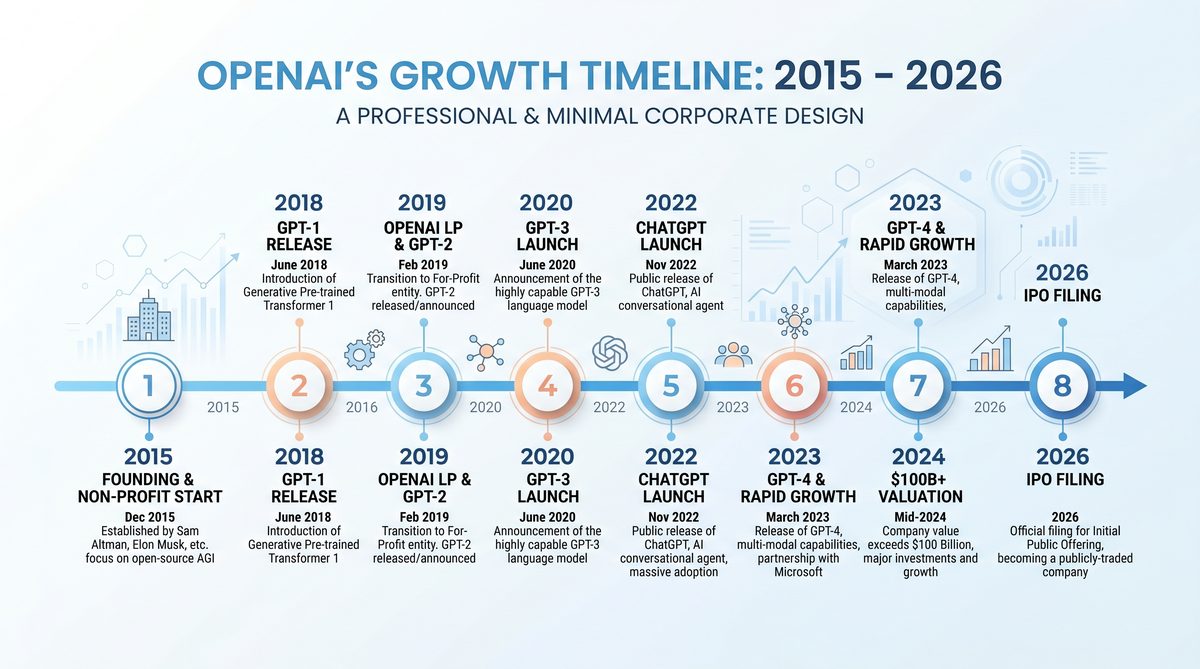
Founded in December 2015 by a coalition of prominent figures including Elon Musk, Sam Altman, Greg Brockman, Ilya Sutskever, Wojciech Zaremba, and John Schulman, OpenAI began as a nonprofit research organization intent on advancing digital intelligence in a way that would broadly benefit humanity. The founding ethos emphasized openness and collaborative progress in AI research as a hedge against concentration of power and unchecked competitive development.
OpenAI’s mission statement centered on ensuring that AI technology remains safe and beneficial, emphasizing transparency and wide accessibility of its breakthroughs. The initial framework championed unrestricted publication of research, open-sourcing of code, and fostering an ecosystem of community-driven AI advancements.
However, the enviable computational and talent demands intrinsic to state-of-the-art AI models spurred a transition in organizational structure. By 2019, OpenAI established OpenAI LP, a “capped-profit” limited partnership, allowing it to attract external investments while adhering to a unique return cap designed to align incentives with the public good. This hybrid structure balanced capital needs with ethical guardrails—one of the first models blending commercial viability and altruistic AI stewardship.
1.2 Key Milestones Leading to 2026
The trajectory of OpenAI’s growth is punctuated with landmark technology releases and strategic alliances that cemented its reputation as an AI powerhouse:
- GPT Series: Beginning with GPT in 2018, followed by GPT-2 (2019), GPT-3 (2020), and GPT-4 (2023), OpenAI’s Generative Pretrained Transformer models revolutionized natural language processing (NLP), enabling diverse applications from chatbots to content generation. Each iteration displayed significant gains in scale, contextual understanding, and versatility.
- DALL·E and DALL·E 2: Introducing generative AI for images from textual prompts, these models broadened the creative possibilities in AI, democratizing access to high-quality art synthesis and design automation.
- Codex and GitHub Copilot: Launched in 2021, Codex powered intelligent code generation, ushering in an era of AI-assisted programming. GitHub Copilot became the flagship commercial adoption of this capability, streamlining developer workflows.
- ChatGPT Iterations: From the original release in November 2022 through continuous improvements, ChatGPT has become the face of conversational AI, driving unprecedented public engagement and commercial integration across industries.
Strategically, OpenAI forged critical partnerships notably with Microsoft, which invested billions, integrated OpenAI’s models into its Azure cloud platform, and embedded AI capabilities in Office 365 and other productivity suites. This alliance fueled OpenAI’s revenue generation through API subscriptions, enterprise contracts, and cloud compute credits.
Adoption trends reveal accelerating enterprise demand for advanced AI solutions, with organizations leveraging OpenAI’s APIs for customer service automation, content moderation, data analysis, and software development acceleration. This commercial momentum has positioned OpenAI at the nexus of cutting-edge innovation and market readiness.
1.3 OpenAI’s Position in the AI Ecosystem Today
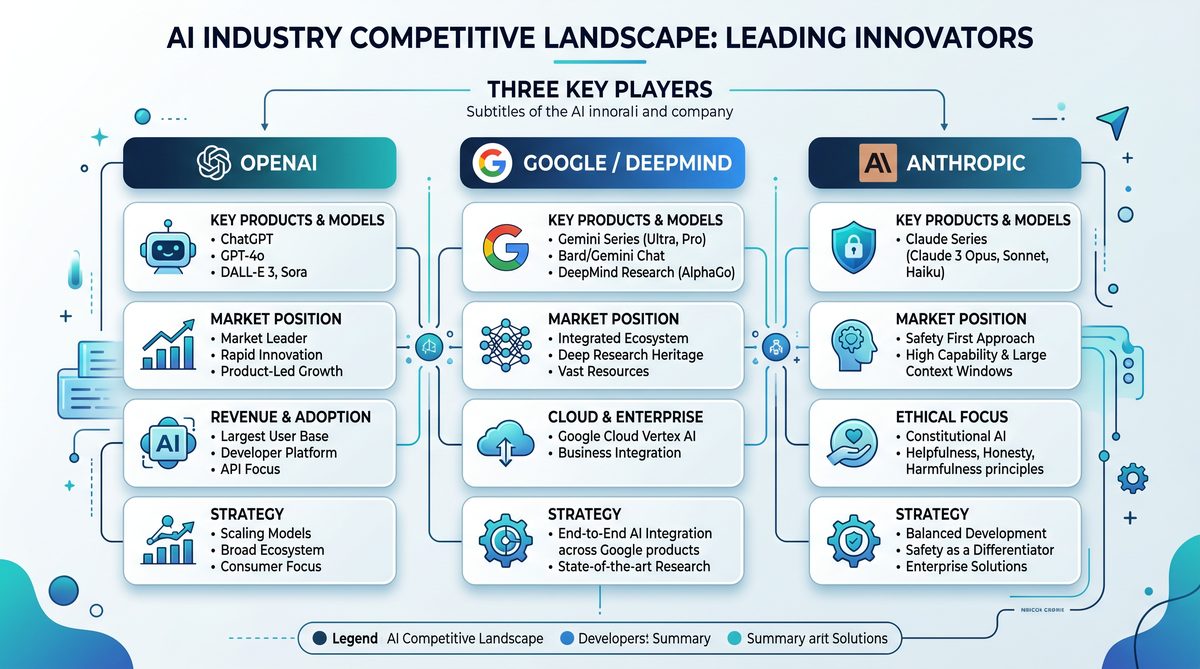
The AI landscape in 2026 is highly competitive, and OpenAI’s standing is the product of both aggressive innovation and community engagement. Its primary competitors include:
- Google DeepMind: With its leading work in reinforcement learning and large-scale model architectures, DeepMind remains a formidable research-driven rival.
- Anthropic: A newer entrant focused on scalable AI safety and interpretability research, backed by veteran AI researchers and investors.
- Others: Numerous startups and established technology corporations like Meta AI, Amazon AI, and smaller specialized firms carve niches in AI model development, deployment, and tooling.
OpenAI’s developer ecosystem is extensive, with millions of developers integrating its APIs into innovative applications spanning virtually every industry. Its developer platform emphasizes scalability, ease of access, and support for multiple programming languages and environments.
Importantly, OpenAI continues to engage actively in AI governance and ethics forums. It emphasizes transparency, safety research, and collaboration with regulatory bodies to steer AI development towards inclusive and responsible outcomes. This dual commitment to pioneering AI utility and stewardship has become a defining characteristic of OpenAI’s identity.
The complexity of AI governance and ecosystem evolution calls for deeper insights into ChatGPT Reaches 900 Million Weekly Users in Q1 2026: What the Growth Data Tells Us related to AI ethics and development infrastructures.
2. Unpacking the Rumored 2026 Confidential IPO Filing
2.1 What is a Confidential IPO Filing?
A confidential IPO filing refers to the process by which a company submits its registration statement—typically an S-1 form—to the U.S. Securities and Exchange Commission (SEC) under confidentiality provisions allowed under the JOBS Act of 2012. This allows emerging growth companies (EGCs) to file initial documentation privately before publicly disclosing sensitive financial and operational details.
This process offers several advantages:
- Reduced public scrutiny during preliminary stages: Management can refine their disclosures, gather investor feedback, and adjust strategy without market pressure.
- Flexible timing: Companies can initiate confidential filings well ahead of the public roadshow, facilitating better coordination of marketing, regulatory compliance, and pricing strategy.
- Preservation of competitive secrecy: Especially important in sectors like AI, where disclosure of metrics and technologies can impact market position and valuation.
For OpenAI, a confidential IPO filing indicates a strategic approach to a public market debut, allowing careful positioning amidst evolving AI industry dynamics and regulatory debates. The confidentiality window usually lasts up to 21 calendar days before the company must publicly disclose the filing.
2.2 Timeline and Key Indicators
Speculation around OpenAI’s IPO has intensified since early 2025, as multiple reports surfaced about ongoing preparatory steps:
- Q4 2025: Signals from insider sources and preliminary financial disclosures hinted at IPO readiness.
- Early 2026: Heightened media coverage and analysis of OpenAI’s business expansion and revenue maturity suggested imminent filing.
- May 2026: Reports indicate a confidential filing with the SEC under review, with expectations the public registration statement will be released between Q3 and Q4 2026.
Following the public filing, a standard IPO timeline comprises:
- Roadshow: A series of presentations to institutional investors explaining the business model, growth potential, and risks.
- Pricing: Final share price determination based on investor demand and market conditions.
- Trading debut: Shares officially listed on a major exchange such as NASDAQ or NYSE.
Market watchers will monitor indicators including OpenAI’s quarterly financial statements, SEC comment letters, and regulatory feedback patterns to gauge timing and scale.
2.3 Potential IPO Structure and Share Distribution
The structure of OpenAI’s public offering remains speculative but can be inferred based on analogous tech and AI IPO precedents along with OpenAI LP’s internal governance:
| Aspect | Details | Implications |
|---|---|---|
| Share Classes | Potential dual-class shares with differential voting rights to preserve founder and management control | Ensures strategic decision-making remains insulated from short-term market pressures |
| Insider Ownership | Founders, early employees, and initial investors likely retain significant stakes | Aligns incentives towards long-term growth and safeguards mission adherence |
| Employee Equity | Stock options or restricted stock units (RSUs) to incentivize retention and performance | Enhances talent acquisition and motivation across technical and leadership teams |
| Existing Investors | Entities like Microsoft expected to reduce holdings partly but maintain strategic positions | Maintains collaborative technology and commercial partnerships post-IPO |
Governance reforms may accompany the IPO, including enhanced board structures incorporating independent directors, audit committees, and compensation committees to satisfy public company compliance standards.
Developers and ecosystem participants should anticipate subtle shifts in policy and communication cadence resulting from increased regulatory and shareholder accountability. Detailed analysis of similar AI public company structures can offer comparative insights OpenAI’s GPT-5.5 Instant Becomes Default ChatGPT Model with Revolutionary Memory Features.
3. Valuation Speculations: How Much is OpenAI Worth?
3.1 Methods Analysts Use to Value AI Companies
Valuation of an AI-centric company like OpenAI requires a multidimensional approach leveraging both traditional financial metrics and forward-looking technological impact. Prominent valuation methodologies include:
- Revenue Multiples: Applying multiples to subscription revenues, API usage fees, and long-term enterprise contracts serves as a baseline. The Software-as-a-Service (SaaS) industry often uses 10x to 20x forward revenue multiples, but AI companies may command premium multiples given growth potential.
- Market Comparables: Benchmarking against recent IPOs and market capitalizations of peers like NVIDIA (GPU and AI hardware leader), C3.ai (enterprise AI platform), and others informs relative valuation tiers.
- Discounted Cash Flow (DCF): Projecting future cash flows derived from model adoption, licensing, and innovation pipelines, discounted for risk and time value, provides intrinsic valuation estimates.
- Option Pricing Models for R&D: Capturing the embedded option-like value of ongoing and future AI research projects, leveraging techniques from financial engineering to quantify uncertain high-growth prospects.
These models must adjust for AI sector-specific nuances such as rapid technology obsolescence, dependency on specialized hardware, and shifting regulatory landscapes. Analysts often triangulate valuation outputs and stress-test assumptions to bound estimation errors.
3.2 Reported Valuation Estimates for OpenAI
Media and analyst reports place OpenAI’s valuation within a broad range due to uncertainty over financial disclosures, growth trajectories, and structural reforms. Estimates currently span:
| Report Source | Valuation Range | Basis for Estimate |
|---|---|---|
| Investment Bank Analysts | $60 billion – $90 billion | Projections based on API revenue growth and Microsoft-backed cloud adoption |
| Market Journalists | $50 billion – $75 billion | Comparisons to late-stage private funding rounds and competitor market caps |
| AI Sector Experts | $80 billion – $110 billion+ | Inclusion of future AI model commercialization potential and R&D pipelines |
Key drivers for the high end of valuations include growing enterprise reliance on AI-driven automation, expansion into specialized industry verticals (finance, healthcare, manufacturing), and ongoing breakthroughs in multimodal models.
Conversely, factors tempering valuation optimism encompass intensifying regulatory scrutiny, emerging competitive entrants, and macroeconomic uncertainties that compress tech market multiples.
3.3 Risks and Uncertainties Impacting Valuation
Valuing an AI company like OpenAI requires acknowledging several significant risks capable of influencing market perception and investor confidence:
- Regulatory Scrutiny: Governments globally are deepening oversight on AI technologies, scrutinizing data privacy, algorithmic fairness, and safety. Potential regulatory constraints could impact OpenAI’s operational flexibility and product deployment timelines.
- Market Volatility and AI Hype Cycles: The AI industry remains susceptible to cyclical investment booms and busts. Investor sentiment could swing dramatically in response to technological breakthroughs or setbacks.
- Competitive Threats: Rapid innovation by competitors like Anthropic, Google DeepMind, and emergent startups could erode market share or undermine technological leadership.
- Ethical and Public Perception Risks: Responsible AI demands place reputational risk on OpenAI. Controversies over biased outputs or misuse of models might trigger backlash.
Careful due diligence and scenario analysis are vital for stakeholders assessing OpenAI’s valuation prospects, including monitoring regulatory news, model performance benchmarks, and ecosystem partnerships. Those interested in AI financial modeling will find Enterprise AI Automation Case Studies 2026: How Companies Are Using AI Agents to Transform Operations resources beneficial.
4. Impact on the AI Industry: Innovation and Competition
4.1 Catalyzing Increased Investment in AI Startups
The anticipated OpenAI IPO is poised to be a watershed event, likely unlocking substantial capital flows into the broader AI startup ecosystem. Historical precedent from tech IPOs suggests that market liquidity and public market appetite tend to increase venture funding and valuations across related sectors.
Specifically, the public validation of OpenAI’s business model can catalyze:
- Venture capital reallocation: Increased funding toward adjacent AI technologies such as model interpretability, AI hardware, and specialized enterprise solutions.
- Strategic corporate venture activity: Larger tech firms ramping up investments in AI startups to secure innovation pipelines and competitive positioning.
- Higher startup valuations: The IPO sets benchmarks elevating perceived market opportunity and encouraging more aggressive funding rounds.
This influx of capital will energize innovation, accelerating the proliferation of AI applications across domains. Investment landscapes will become more nuanced, balancing risk appetite and regulatory awareness.
4.2 Accelerating AI Tool Development and Adoption
OpenAI’s public market presence will likely expedite the integration of advanced AI capabilities into enterprise ecosystems. The infusion of IPO proceeds can fund expansion of:
- Developer tools and SDKs: Enhanced libraries, debugging tools, and multi-language support to facilitate diverse application development.
- Enterprise AI frameworks: Tailored AI solutions for compliance, security, and scalable deployment customized per industry.
- API scalability and pricing models: Potential refinement of subscription tiers, pay-as-you-go structures, or enterprise licensing terms to balance accessibility with monetization.
Moreover, OpenAI’s increased transparency post-IPO may shift the competitive dynamics of AI model licensing, potentially fostering more open standards or, conversely, tighter commercial controls to protect intellectual property.
4.3 Shifts in AI Ethics, Governance, and Transparency
The pressures and obligations imposed by public markets will intensify OpenAI’s focus on ethical AI development and corporate governance. Key effects include:
- Heightened Reporting Requirements: Regular disclosures related to AI safety risk management, bias audits, and data governance practices will become standard.
- Investor and Public Scrutiny: Stakeholders will demand clearer accountability mechanisms, third-party audits, and impact assessments.
- Potential Prioritization of Responsible Innovation: Ethical imperatives may influence roadmap decisions, balancing innovation speed with societal impact considerations.
OpenAI’s leadership in AI ethics could strengthen through this transition, influencing industry norms and regulatory frameworks. Understanding these evolving governance challenges is crucial for all AI stakeholders engaged in .
5. What the IPO Means for AI Developers and the Community
5.1 Opportunities for Developers
The infusion of capital and public accountability derived from OpenAI’s IPO stands to benefit the developer community in multiple ways:
- Increased Funding for Developer Tools: Expanded resources dedicated to improving SDKs, documentation, usage analytics, and integration support.
- Partnership and Collaboration Programs: Greater availability of co-innovation initiatives, hackathons, and developer advocacy programs to nurture ecosystem growth.
- Equity and Stock Option Benefits: Enhanced employee equity packages to attract and retain top talent, alongside potential extended eligibility for contractors or contributors.
Additionally, expanded API functionality and new product offerings may empower developers to build more sophisticated AI-driven applications and accelerate time-to-market.
5.2 Challenges and Concerns
Nevertheless, the transition to a publicly traded entity can introduce challenges:
- Potential API Pricing Changes: To meet shareholder expectations, OpenAI may revise pricing models, possibly reducing free usage tiers or increasing costs for high-volume users.
- Increased Corporate Bureaucracy: Additional compliance, legal, and structural layers might slow down innovation cycles and responsiveness to developer feedback.
- Data Privacy and Usage Policies: Public scrutiny could drive more stringent data policies, which might impact model training federation and access scope.
Developers should prepare for these possible shifts by monitoring OpenAI’s policy communications and participating in community forums to advocate for sustained developer-centric approaches.
5.3 Advice for Developers: Navigating the Post-IPO Landscape
To thrive in the evolving OpenAI ecosystem after the IPO, developers can adopt the following strategies:
- Stay Updated: Regularly review OpenAI’s filings, public disclosures, and product announcements to anticipate changes and opportunities.
- Diversify Skills: Broaden expertise across multiple AI platforms and frameworks to avoid dependency on a single provider and enhance career resilience.
- Engage in Ethics and Governance: Participate in discussions on responsible AI development, data privacy, and industry standards to help shape the ecosystem’s future.
Proactively managing these aspects will empower developers to leverage OpenAI’s innovations while mitigating risks associated with corporate and regulatory evolution.
6. Preparing for the Future: Strategic Takeaways for Stakeholders
6.1 For Investors and Market Watchers
OpenAI’s IPO will be a pivotal milestone redefining AI sector investment strategies. Investors should consider:
- Evaluating Sector Opportunities: Analyzing how OpenAI’s market entry affects valuations and growth prospects of both direct competitors and complementary firms.
- Monitoring Regulatory Environment: Staying abreast of policy developments to anticipate compliance costs and operational constraints shaping AI business models.
- Incorporating Technological Risks: Factoring innovation cycles and AI ethical issues into portfolio risk management frameworks.
6.2 For Enterprises and End-Users
Organizations integrating AI solutions should:
- Anticipate Contractual Changes: Review and renegotiate service-level agreements (SLAs) and pricing terms in light of OpenAI’s public market pressures.
- Plan for Enhanced AI Capabilities: Leverage capital-driven investments by OpenAI to gain early access to cutting-edge AI functionalities and improve operational efficiency.
- Enhance Governance Practices: Implement internal AI ethics frameworks and audit processes aligned with emerging industry standards influenced by OpenAI’s public oversight.
6.3 For Policymakers and Regulators
Regulatory bodies have crucial roles in balancing innovation with societal safeguards:
- Encourage Collaborative Oversight: Work with OpenAI and industry stakeholders to co-develop meaningful AI safety and transparency frameworks.
- Facilitate Innovation: Design regulation that protects public interests without stifling technological advances or creating undue barriers.
- Support Public Awareness: Promote education and transparency initiatives to foster informed AI adoption and mitigate misinformation risks.
These measures help integrate AI advancements responsibly into economic and social fabric, both domestically and globally.
Conclusion
OpenAI’s anticipated IPO represents a landmark junction in the ongoing AI revolution, offering unprecedented opportunities to accelerate innovation while introducing new dynamics in governance, valuation, and ecosystem development. From its mission-driven origins to its evolution as a capped-profit powerhouse, OpenAI exemplifies the fusion of ambitious technology and careful stewardship.
The confidential IPO filing anticipated in May 2026 signals an impending public market debut poised to reshape investment flows, competitive landscapes, and ethical frameworks within the AI domain. While promising immense growth potential, this transition also introduces complex challenges for developers, investors, enterprises, and policymakers alike.
By understanding OpenAI’s IPO context—from its founding principles, valuation drivers, and market strategy to implications for AI tools and ethical governance—technology professionals and stakeholders can strategically engage with the fast-evolving AI ecosystem. This historic moment in AI will not only chart OpenAI’s future trajectory but also influence the shape, accessibility, and responsibility of artificial intelligence for years to come.
Access 40,000+ AI Prompts for ChatGPT, Claude & Codex — Free!
Subscribe to get instant access to our complete Notion Prompt Library — the largest curated collection of prompts for ChatGPT, Claude, OpenAI Codex, and other leading AI models. Optimized for real-world workflows across coding, research, content creation, and business.
Useful Links
- OpenAI Official Blog – Insights and announcements from OpenAI’s team.
- SEC EDGAR Database – Access to public company filings including IPO registrations.
- Understanding Confidential IPO Filings under the JOBS Act — Legal perspective on the confidential filing process.
- NASDAQ IPO Calendar – Track upcoming IPOs and related market data.
- Andreessen Horowitz: AI Wave and Venture Capital Landscape – Analysis of AI investment trends.
- Gartner Research: AI Market Forecast – Industry projections on AI growth and adoption.
- News Article: OpenAI IPO Rumors and Market Impact – Recent journalistic coverage.
- Partnership on AI – Global multi-stakeholder organization dedicated to responsible AI development.
- OpenAI Developer Platform Documentation – Technical resources for integrating OpenAI technologies.
