
Introduction: The AI Platform War of 2026
As 2026 unfolds, the enterprise AI landscape is witnessing an unprecedented competitive surge led by two dominant players—Anthropic and OpenAI. Once the uncontested leader, OpenAI now faces formidable challenges from Anthropic, whose rapid adoption rates and platform innovations are reshaping the market dynamics. This article delves deeply into the head-to-head competition between these AI titans, analyzing market share data, strategic moves, and the broader implications for enterprise adoption of AI technologies.
Anthropic vs. OpenAI: Market Share and Adoption Trends
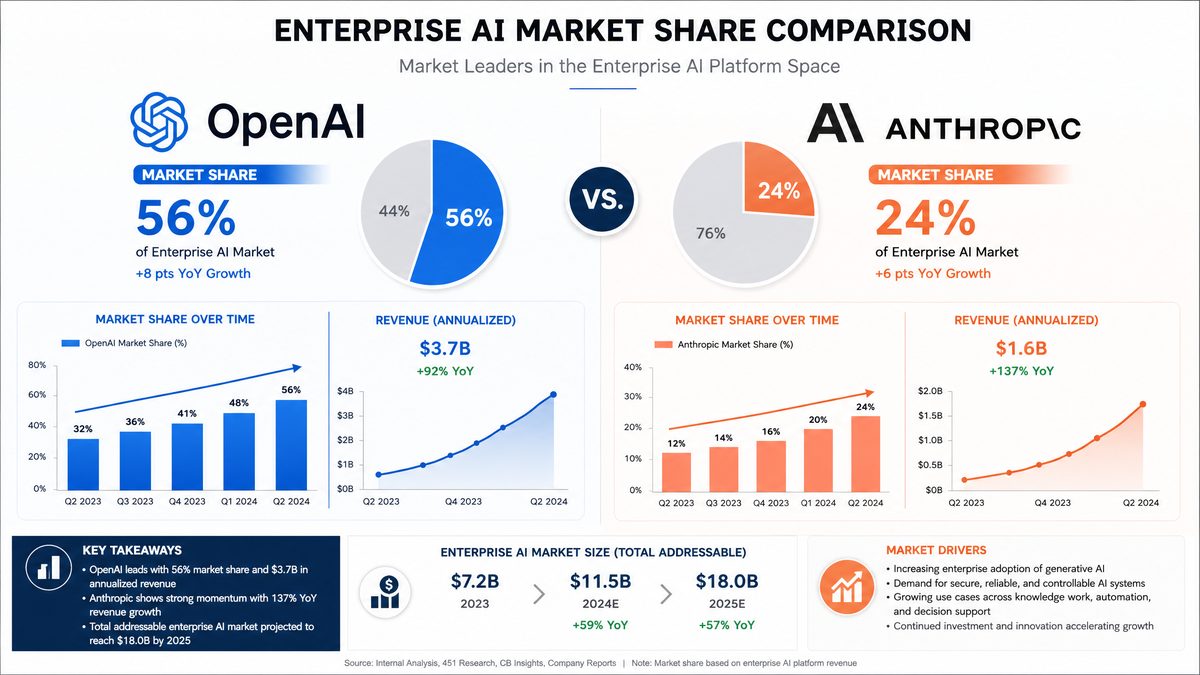
According to a recent VentureBeat report from April 2026, Anthropic has captured a 34.4% share of enterprise AI adoption, slightly edging out OpenAI’s 32.3%. This marks a pivotal shift, as OpenAI had traditionally been the dominant force since the early 2020s. Anthropic’s rise is driven by strategic positioning, innovative product offerings, and a growing enterprise trust factor.
| Company | Enterprise AI Adoption (%) | Key Product Strengths | 2026 Valuation (Approx.) |
|---|---|---|---|
| Anthropic | 34.4% | Claude Code, Security, Compliance | $60B |
| OpenAI | 32.3% | Codex Expansion, AWS Distribution | $75B |
| Cursor (Emerging Challenger) | ~10% | Enterprise Coding AI | $50B |
The slight lead by Anthropic suggests a more fragmented market than ever before. Cursor, an emergent AI coding platform, is also gaining rapid traction with a reported $2 billion in annual recurring revenue (ARR) and a staggering valuation near $50 billion, challenging both Anthropic and OpenAI in the enterprise coding space.
Claude Code’s Dominance in Enterprise Coding AI
Anthropic’s flagship AI model, Claude Code, has become the preferred solution for enterprises seeking AI-driven coding assistance, automation, and software development lifecycle enhancements. Its growing market share is attributed to:
- Robust Security Features: Designed with enterprise-grade security protocols, Claude Code addresses key compliance requirements such as GDPR, HIPAA, and SOC 2.
- Natural Language-to-Code Translation: Advanced contextual understanding enables developers and non-technical staff to generate high-quality code snippets from natural language prompts.
- Integration Ecosystem: Seamless compatibility with popular IDEs, CI/CD pipelines, and cloud platforms.
This focus on security and compliance has positioned Claude Code as a trusted partner for regulated industries like finance, healthcare, and government sectors.
OpenAI’s Defensive Moves: Codex Expansion and AWS Distribution
In response to Anthropic’s gains, OpenAI has embarked on a strategic defensive consolidation, merging its research and enterprise teams to foster agility and innovation. Key initiatives include:
- Codex Expansion: Originally focused on coding assistance, OpenAI has broadened Codex’s capabilities to encompass a wider spectrum of white-collar tasks including document analysis, contract review, and data extraction.
- OpenAI on AWS: Embracing a distribution play, OpenAI’s deployment on Amazon Web Services (AWS) provides enterprises with scalable, secure access and simplifies integration with existing AWS infrastructure.
This dual approach aims to retain existing clients while expanding into new enterprise segments.
Google’s Rising AI Web-Traffic Share: A New Contender
While Anthropic and OpenAI battle for enterprise dominance, Google’s AI-driven web traffic share has soared from 5.7% to 21.5% in the first half of 2026. This surge is attributed to Google’s integration of AI capabilities across its search engine, cloud services, and AI platforms, making it a potent competitor in the broader AI ecosystem.
Enterprises now face a multi-faceted AI market where Google’s offering presents a hybrid model combining consumer-grade accessibility with enterprise-ready tools. This trend challenges both Anthropic and OpenAI to innovate continuously and differentiate their platforms.
Enterprise Buyer Decision Factors: Security, Compliance, Pricing, and Performance
When evaluating AI platforms, enterprises weigh several critical factors that shape procurement and implementation decisions:
| Factor | Importance | Anthropic’s Strength | OpenAI’s Strength |
|---|---|---|---|
| Security | High | Dedicated compliance frameworks, data privacy controls | Strong encryption, AWS’s secure infrastructure |
| Compliance | High | Industry-specific certifications (HIPAA, FedRAMP) | Broad compliance support via AWS ecosystem |
| Pricing | Medium | Flexible enterprise licensing, volume discounts | Pay-as-you-go models via AWS Marketplace |
| Performance | High | Optimized for coding and enterprise workflows | Scalable compute power, multi-domain applications |
Enterprises often balance these factors based on industry needs, regulatory environments, and internal technical expertise.
How Enterprises Should Evaluate and Choose Between Platforms
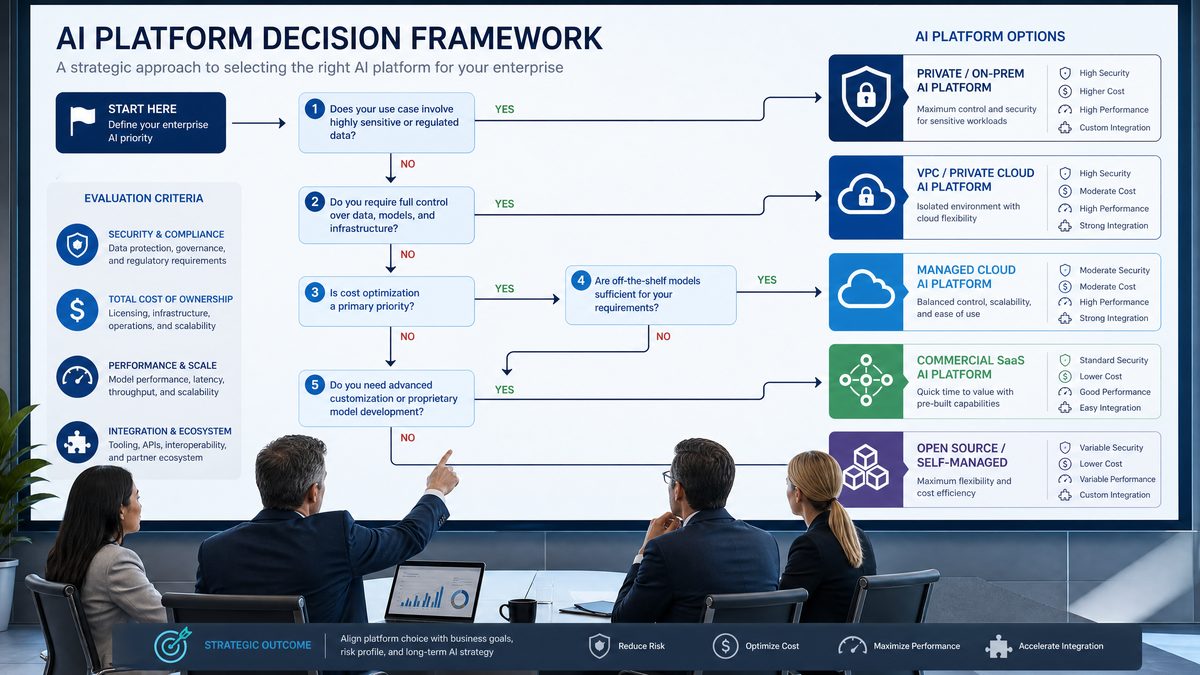
Selecting the optimal AI platform is a multi-dimensional process that requires a structured evaluation framework. Below is a recommended approach for enterprise decision-makers:
- Define Use Cases and Requirements: Identify specific workflows and outcomes the AI solution must support—coding, document analysis, customer service, or data analytics.
- Assess Security and Compliance Needs: Map regulatory and internal governance requirements against platform certifications and data handling policies.
- Evaluate Integration Compatibility: Examine how well the AI platform integrates with existing enterprise infrastructure, including cloud providers, DevOps tools, and data warehouses.
- Conduct Performance Benchmarking: Run pilot projects or proofs of concept to test speed, accuracy, and scalability under real-world conditions.
- Analyze Total Cost of Ownership (TCO): Consider licensing, implementation, support, and potential hidden costs over the platform lifecycle.
- Review Vendor Roadmap and Support: Investigate the vendor’s commitment to innovation, customer service, and ecosystem development.
Using this framework enables enterprises to make data-driven, risk-managed decisions aligned with strategic goals.
For a deeper exploration of related AI capabilities and implementation strategies, our comprehensive resource on How to Set Up OpenAI Codex on Amazon Bedrock: Complete Enterprise Deployment Guide provides additional context, practical examples, and expert analysis that extends the concepts covered in this article.
The Role of Open-Source AI Alternatives
Amid the intense competition between Anthropic and OpenAI, open-source AI models and platforms continue to gain relevance as viable alternatives for enterprises seeking control, transparency, and cost-efficiency. Projects such as LLaMA, Falcon, and others have matured, offering robust capabilities that rival proprietary solutions.
Enterprises weighing open-source options should consider:
- Customization Potential: Ability to tailor models for domain-specific tasks without vendor lock-in.
- Security and Privacy: On-premises deployment options to maintain data sovereignty.
- Community and Ecosystem: Active development communities that drive continuous improvements and support.
- Resource Requirements: Need for specialized talent and infrastructure to manage and optimize models.
While open-source solutions lack some enterprise-grade certifications by default, their evolving maturity means they are increasingly considered alongside Anthropic and OpenAI offerings.
Strategic Implications for Enterprise Buyers
The ongoing AI platform war has several strategic implications for enterprises:
- Multi-Vendor Strategies: Enterprises may adopt hybrid approaches, leveraging strengths of multiple platforms to mitigate risk and maximize capabilities.
- Vendor Negotiation Leverage: Heightened competition empowers buyers to negotiate better terms on pricing, SLAs, and customization.
- Focus on Long-Term Partnerships: Given rapid AI evolution, selecting partners with a clear innovation roadmap is critical.
- Investment in AI Talent: Internal expertise becomes a differentiator for effectively deploying and managing AI solutions.
Understanding these dynamics helps enterprises future-proof their AI investments and align technology adoption with business transformation goals.
Practical Example: Evaluating Anthropic vs OpenAI for a Financial Services Firm
Consider a financial services company seeking to implement AI to automate compliance monitoring and accelerate software development. Applying the evaluation framework:
| Evaluation Criteria | Anthropic (Claude Code) | OpenAI (Codex + AWS) | Decision Impact |
|---|---|---|---|
| Security & Compliance | Strong HIPAA, FedRAMP compliance tailored for finance | Robust AWS compliance but less finance-specific | Preference for Anthropic due to targeted certifications |
| Integration | Supports major IDEs and on-premises options | Seamless AWS cloud integration | OpenAI favored for AWS-centric IT environment |
| Performance | High accuracy in code generation and compliance analytics | Superior scalability and multi-domain support | Depends on workload scale and diversity |
| Pricing | Volume discounts, upfront licenses | Flexible pay-as-you-go on AWS | Cost structure aligned with usage patterns |
In this scenario, the firm might opt for a hybrid deployment, using Anthropic’s Claude Code for compliance-critical applications and OpenAI’s Codex on AWS for scalable development workloads.
For a deeper exploration of related AI capabilities and implementation strategies, our comprehensive resource on **Topic:**
“Mastering Custom GPTs: How Developers Can Build and Deploy Tailored AI Assistants Using OpenAI’s Latest API Features”
**Why it’s trending/high-value:**
With OpenAI’s recent rollout of customizable GPT models, developers now have unprecedented control to create AI assistants fine-tuned for specific industries, workflows, or user needs. This tutorial/news article would dive deep into the step-by-step process of leveraging these new API capabilities, showcasing practical use cases, optimization techniques, and deployment best practices. It addresses the growing developer demand to move beyond generic AI and build specialized, high-performance conversational agents—making it a must-read for the chatgptaihub.com audience eager to stay ahead in the AI app development space. provides additional context, practical examples, and expert analysis that extends the concepts covered in this article.
Code Example: Simple API Call Comparison
Below are simplified code snippets demonstrating how enterprises might interact with Anthropic’s Claude Code API versus OpenAI’s Codex API for code generation tasks.
// Anthropic Claude Code API call example (Node.js)
const axios = require('axios');

async function generateCodeAnthropic(prompt) {
  const response = await axios.post('https://api.anthropic.com/v1/claude/code/generate', {
    prompt: prompt,
    max_tokens: 150
  }, {
    headers: { 'Authorization': `Bearer YOUR_API_KEY` }
  });
  return response.data.completion;
}

// OpenAI Codex API call example (Node.js)
const { Configuration, OpenAIApi } = require('openai');

const configuration = new Configuration({
  apiKey: process.env.OPENAI_API_KEY,
});
const openai = new OpenAIApi(configuration);

async function generateCodeOpenAI(prompt) {
  const response = await openai.createCompletion({
    model: 'code-davinci-002',
    prompt: prompt,
    max_tokens: 150,
  });
  return response.data.choices[0].text;
}
This contrast highlights platform-specific API design and integration considerations.
For a deeper exploration of related AI capabilities and implementation strategies, our comprehensive resource on **Topic:**
“Mastering Custom GPTs: How Developers Can Build and Deploy Tailored AI Assistants Using OpenAI’s Latest API Features”
**Why it’s trending/high-value:**
With OpenAI’s recent rollout of customizable GPT models, developers now have unprecedented control to create AI assistants fine-tuned for specific industries, workflows, or user needs. This tutorial/news article would dive deep into the step-by-step process of leveraging these new API capabilities, showcasing practical use cases, optimization techniques, and deployment best practices. It addresses the growing developer demand to move beyond generic AI and build specialized, high-performance conversational agents—making it a must-read for the chatgptaihub.com audience eager to stay ahead in the AI app development space. provides additional context, practical examples, and expert analysis that extends the concepts covered in this article.
Technological Differentiators: A Deep Dive into AI Architectures
Underlying Models and Innovation
While both Anthropic and OpenAI leverage advanced transformer architectures, their approaches to model safety, interpretability, and training paradigms differ significantly. Anthropic’s flagship models are built on the Claude series, emphasizing constitutional AI frameworks that embed ethical constraints directly into the training objectives. This design prioritizes reducing harmful outputs without sacrificing performance.
OpenAI, on the other hand, continues to refine the GPT series, focusing on massive model scaling and reinforcement learning from human feedback (RLHF). OpenAI’s models benefit from extensive fine-tuning on diverse datasets and integration with multimodal capabilities, such as image and code understanding.
Comparison Table: Architectural and Feature Differences
| Feature | Anthropic (Claude Series) | OpenAI (GPT Series) |
|---|---|---|
| Model Philosophy | Constitutional AI for ethical alignment | Scale and RLHF for performance and safety |
| Model Size | Medium to large scale with focus on efficiency | Large to very large scale (up to GPT-5 rumored) |
| Multimodal Support | Limited, focused on text | Extensive (text, images, code, audio planned) |
| Safety Mechanisms | Embedded constitutional rules, interpretability tools | RLHF, content filters, user feedback loops |
| Integration APIs | Robust APIs with customizable safety settings | Wide range of APIs with extensive documentation |
Practical Implications for Enterprises
Enterprises prioritizing ethical AI deployment and regulatory compliance may find Anthropic’s models better aligned with their needs. Conversely, organizations seeking cutting-edge capabilities in generative tasks, such as creative content generation or multimodal applications, might lean towards OpenAI’s offerings.
Implementing Enterprise AI: Step-by-Step Integration Guide
Step 1: Assess Business Needs and AI Use Cases
Begin by identifying specific pain points and potential AI use cases within your organization, such as customer support automation, data analysis, or content creation. Document expected outcomes and success metrics.
Step 2: Choose the Right AI Platform
Evaluate Anthropic and OpenAI’s offerings based on your use cases, budget, and compliance requirements. Consider pilot testing both platforms to benchmark performance and safety.
Step 3: Set Up Development Environment and Access APIs
Register for enterprise accounts and obtain API keys. Configure your environment with SDKs or HTTP clients to interact with the AI services. Example: Using OpenAI’s Python SDK to generate text:
import openai

openai.api_key = 'YOUR_API_KEY'

response = openai.ChatCompletion.create(
  model="gpt-4",
  messages=[{"role": "user", "content": "Generate a marketing email for a new product launch."}]
)

print(response.choices[0].message.content)
Step 4: Develop and Test AI-Driven Applications
Develop prototypes integrating AI responses into your workflows. Conduct thorough testing focusing on response accuracy, latency, and ethical considerations such as bias and harmful content.
Step 5: Monitor, Optimize, and Scale
Implement monitoring dashboards to track AI usage, performance, and user feedback. Optimize prompts and model parameters as needed. Gradually scale deployments across departments or regions.
Practical Tip:
Leverage prompt engineering techniques and guardrails to maximize AI utility while minimizing risks. Regularly update your models and retrain with fresh data to maintain relevance.
Enterprise AI Adoption: Industry Use Cases and Success Stories
Financial Services: Risk Assessment and Fraud Detection
Major banks have integrated Anthropic’s ethical AI models to analyze transaction patterns for fraud detection while maintaining compliance with strict regulatory standards. OpenAI’s models assist in generating real-time risk reports, improving decision-making speed.
Healthcare: Clinical Documentation and Patient Interaction
Healthcare providers use AI to transcribe and summarize clinical notes, reducing administrative burdens. OpenAI’s models power virtual health assistants that answer patient queries, while Anthropic’s safer models ensure sensitive information is handled appropriately.
Access 40,000+ AI Prompts for ChatGPT, Claude & Codex — Free!
Subscribe to get instant access to our complete Notion Prompt Library — the largest curated collection of prompts for ChatGPT, Claude, OpenAI Codex, and other leading AI models. Optimized for real-world workflows across coding, research, content creation, and business.
Retail: Personalized Customer Experience
E-commerce platforms utilize AI to generate personalized marketing content and chatbots that enhance customer engagement. For example, a leading retailer uses Anthropic’s models to moderate chatbot conversations, ensuring compliance with brand guidelines.
Manufacturing: Predictive Maintenance
Manufacturers employ AI-driven predictive analytics to forecast equipment failures. OpenAI’s models help synthesize complex sensor data into actionable insights, reducing downtime and maintenance costs.
Comparison Table: AI Use Cases by Industry and Platform Strengths
| Industry | Common AI Use Cases | Anthropic Strengths | OpenAI Strengths |
|---|---|---|---|
| Financial Services | Fraud detection, risk reporting | Ethical compliance, interpretability | Real-time analytics, diverse data handling |
| Healthcare | Clinical documentation, patient chatbots | Data privacy, safety in sensitive contexts | Natural language understanding, multimodal |
| Retail | Personalized marketing, customer support | Content moderation, brand safety | Creative content generation, scalability |
| Manufacturing | Predictive maintenance, process optimization | Reliable risk mitigation | Advanced data synthesis, automation |
The Future of Enterprise AI: Trends and Strategic Outlook
Emerging Technologies and Integration
As enterprises demand more versatile AI solutions, integration with emerging technologies like edge computing, 5G connectivity, and IoT devices will become crucial. Both Anthropic and OpenAI are investing in enabling AI models that operate efficiently in decentralized and bandwidth-constrained environments, broadening the scope of AI applications.
Regulatory Landscape and Ethical AI
Governments worldwide are enacting stricter AI regulations focused on transparency, fairness, and accountability. Anthropic’s constitutional AI approach positions it well to meet these requirements proactively. OpenAI is also enhancing its compliance programs, including audit trails and user consent frameworks.
Hybrid AI Models and Customization
Future enterprise AI platforms will offer hybrid models combining pre-trained general intelligence with domain-specific fine-tuning. This will enable businesses to customize AI behavior to their unique contexts while benefiting from continuous improvements in base models.
Strategic Recommendations for Enterprises
- Invest in AI Talent and Training: Build internal expertise to manage and optimize AI deployments effectively.
- Adopt a Multi-Platform Approach: Leverage strengths of both Anthropic and OpenAI where appropriate to maximize innovation and risk mitigation.
- Prioritize Ethics and Transparency: Establish clear governance frameworks for AI use, including bias audits and impact assessments.
- Plan for Scalability: Design AI solutions with future growth and integration capabilities in mind, ensuring agility in evolving markets.
Conclusion
The enterprise AI landscape in 2026 is characterized by rapid innovation, fierce competition, and growing responsibility. Understanding the nuanced differences between Anthropic and OpenAI, combined with strategic implementation and ethical considerations, will empower organizations to harness AI’s transformative potential while navigating the complex future ahead.
“`html
Optimizing AI Platform Costs: Strategies for Enterprise Budget Efficiency
Understanding Pricing Models and Cost Drivers
One of the most critical factors influencing enterprise AI platform decisions in 2026 is cost optimization. While many organizations focus primarily on performance and feature sets, a strategic approach to pricing models can result in significant budget efficiency without compromising on capabilities.
Most leading AI platforms, including Anthropic, OpenAI, and Google, employ a mix of pricing strategies such as pay-as-you-go, subscription tiers, or enterprise licensing agreements. These models often vary based on API call volume, compute usage, training data customization, and advanced feature access.
For example, OpenAI’s pricing tiers typically charge per 1,000 tokens processed, with discounts at higher volume levels. Anthropic’s Claude platform offers both usage-based pricing and enterprise packages with flat fees for guaranteed SLAs. Google’s Vertex AI integrates AI services with Google Cloud billing, often bundling compute resources with AI API calls, making cost monitoring essential.
Actionable Cost Optimization Strategies
- Conduct Usage Audits: Regularly analyze API call volumes and computational resource consumption to identify inefficiencies. For instance, trimming unnecessary or redundant API calls can reduce costs by up to 15% according to enterprise case studies.
- Leverage Tiered Pricing: Negotiate volume-based discounts or commit to subscription tiers if your usage is predictable. Financial services firms with stable monthly demand have achieved up to 25% savings by locking into annual contracts.
- Optimize Prompt Engineering: Shorten prompts and responses to minimize token usage without degrading output quality. This technique, particularly important for large language models, can reduce per-interaction costs significantly.
- Use Caching and Batch Processing: Cache frequent responses and batch requests where possible to reduce the number of API calls. This is especially effective in customer support chatbots and FAQ automation.
- Monitor Cloud Costs Holistically: For platforms like Google Vertex AI, integrate AI cost monitoring with overall cloud spend analytics to avoid unexpected spikes.
Cost Comparison Table: Anthropic vs OpenAI vs Google Vertex AI (Hypothetical)
| Pricing Aspect | Anthropic (Claude) | OpenAI (GPT-4) | Google Vertex AI |
|---|---|---|---|
| Base Price per 1,000 Tokens | $0.012 | $0.015 | Variable (Compute + API calls) |
| Enterprise Subscription Fee | $50,000/year (minimum) | $40,000/year (minimum) | $45,000/year (minimum) |
| Volume Discount | Up to 30% at 1B tokens/month | Up to 25% at 1B tokens/month | Negotiated case-by-case |
| Custom Model Training Cost | Included in enterprise tier | $0.10 per training hour | $0.12 per training hour |
| Support SLA | 24/7 Premium Support | Business Hours with Premium Option | 24/7 Enterprise Support |
Ensuring Ethical AI Compliance: Best Practices for Enterprises
Why Ethical AI Matters in 2026
As AI platforms become deeply embedded in enterprise workflows, ethical considerations are no longer optional—they are essential. Regulatory frameworks such as the EU Artificial Intelligence Act, California’s Consumer Privacy Act (CCPA), and emerging global AI governance standards require enterprises to demonstrate accountability, transparency, and fairness in AI deployments.
Moreover, ethical AI can mitigate brand risks, avoid costly litigation, and build customer trust—critical competitive differentiators in sectors like finance, healthcare, and government.
Key Ethical AI Compliance Areas
- Bias Mitigation: Ensure AI models do not propagate discriminatory outcomes. This involves continuous bias testing and validation using representative datasets.
- Data Privacy and Security: Comply with data protection laws by anonymizing sensitive data and implementing strict access controls.
- Explainability and Transparency: Provide clear documentation and mechanisms to explain AI decisions, particularly in high-stakes scenarios like loan approvals or medical diagnoses.
- Human-in-the-Loop (HITL): Maintain human oversight to review AI outputs and intervene as necessary.
- Auditability: Keep detailed logs and records of AI model decisions and training data provenance to support regulatory audits.
Practical Steps for Enterprises to Achieve Ethical AI Compliance
- Perform an AI Ethics Risk Assessment: Identify potential ethical risks in your AI use cases and prioritize mitigation strategies.
- Implement Bias Detection Tools: Use third-party or open-source bias analysis tools integrated into your model development lifecycle. For example, IBM’s AI Fairness 360 toolkit can be incorporated into model training pipelines.
- Define Clear Data Governance Policies: Establish who owns data, how it’s used, and how consent is managed, ensuring alignment with regulations.
- Train Staff on Ethical AI Principles: Regular training sessions for developers, data scientists, and business users to recognize and address ethical challenges.
- Select AI Platforms with Built-In Compliance Features: Evaluate vendors on their support for explainability, audit trails, and privacy controls. For instance, Google’s Vertex AI offers integrated model explainability and Data Loss Prevention APIs.
- Establish an AI Ethics Board: Create cross-functional committees to oversee AI initiatives, ensuring ongoing ethical oversight and accountability.
Leveraging AI Platform Ecosystems: Maximizing Value Beyond Core AI
The Importance of Ecosystem Integration
Beyond core AI functionalities, the strength of an AI platform’s ecosystem—its integrations, third-party tools, marketplaces, and developer communities—can significantly enhance enterprise value. Ecosystem maturity affects how easily organizations can extend AI capabilities, access complementary services, and innovate rapidly.
For example, OpenAI’s ecosystem includes numerous third-party extensions, plug-ins for popular CRM and ERP systems, and a vibrant developer community contributing open-source tools. Google’s AI ecosystem benefits from seamless integration with Google Cloud Platform services such as BigQuery, Dataflow, and AI Hub, enabling end-to-end AI workflows.
How Enterprises Can Exploit Ecosystem Advantages
- Accelerate Time-to-Value: Use pre-built connectors and templates to reduce integration complexity. For example, financial firms can use OpenAI plug-ins for Salesforce to automate customer communications.
- Enhance Customization: Leverage marketplace apps and third-party modules to tailor AI solutions without heavy custom development.
- Foster Innovation: Participate in developer communities and hackathons to co-create new AI applications and stay ahead of competitors.
- Ensure Future-Proofing: Choose platforms with growing ecosystems to guarantee ongoing access to new features, tools, and support.
Comparison Table: Ecosystem Features of Leading AI Platforms
| Feature | OpenAI | Anthropic | Google Vertex AI |
|---|---|---|---|
| Third-Party Plug-ins Availability | Extensive (e.g., CRM, ERP, analytics) | Limited but growing | Integrated with Google Cloud Marketplace |
| Developer Community Size | Very Large (millions of developers) | Medium (focused on enterprise clients) | Large (Google Cloud developers) |
| Marketplace for AI Models & Tools | Yes (OpenAI Marketplace) | Planned for 2026 Q4 | Yes (Google AI Hub) |
| Integration with Cloud Services | Cloud-agnostic, plugins for AWS, Azure, GCP | Cloud-agnostic with enterprise partnerships | Native Google Cloud Platform integration |
| Support for Custom Extensions | High (via API and SDKs) | Medium (enterprise-focused SDKs) | High (custom pipelines and AutoML) |
“`
Conclusion: Navigating the Enterprise AI Platform Landscape in 2026
The AI platform war of 2026 is characterized by fierce competition, rapid innovation, and shifting market shares. Anthropic’s rise, led by Claude Code and security-centric design, challenges OpenAI’s established dominance and forces strategic recalibrations including Codex’s white-collar expansion and AWS distribution partnerships.
For enterprises, this competitive environment offers unprecedented choice but also complexity. Decision-makers must apply rigorous evaluation frameworks centered on security, compliance, integration, performance, and cost considerations to select the optimal AI platform aligned with their unique business needs.
Moreover, the growing presence of open-source AI solutions and Google’s expanding AI footprint further diversify the ecosystem, urging enterprises to adopt flexible, multi-vendor strategies and invest in internal AI expertise.
Ultimately, the winners in the AI platform war will be those enterprises that harness these technologies strategically—balancing innovation with governance, agility with risk management, and cost with value delivery. Staying informed, proactive, and adaptable remains the best approach to thriving in this dynamic AI era.
