
GPT-5.5 vs Claude Fable 5: The Complete Enterprise Benchmark Comparison After Anthropic’s Export Control Shutdown
GPT-5.5 vs Claude Fable 5: The Complete Enterprise Benchmark Comparison After Anthropic’s Export Control Shutdown
By the ChatGPT AI Hub Editorial Team
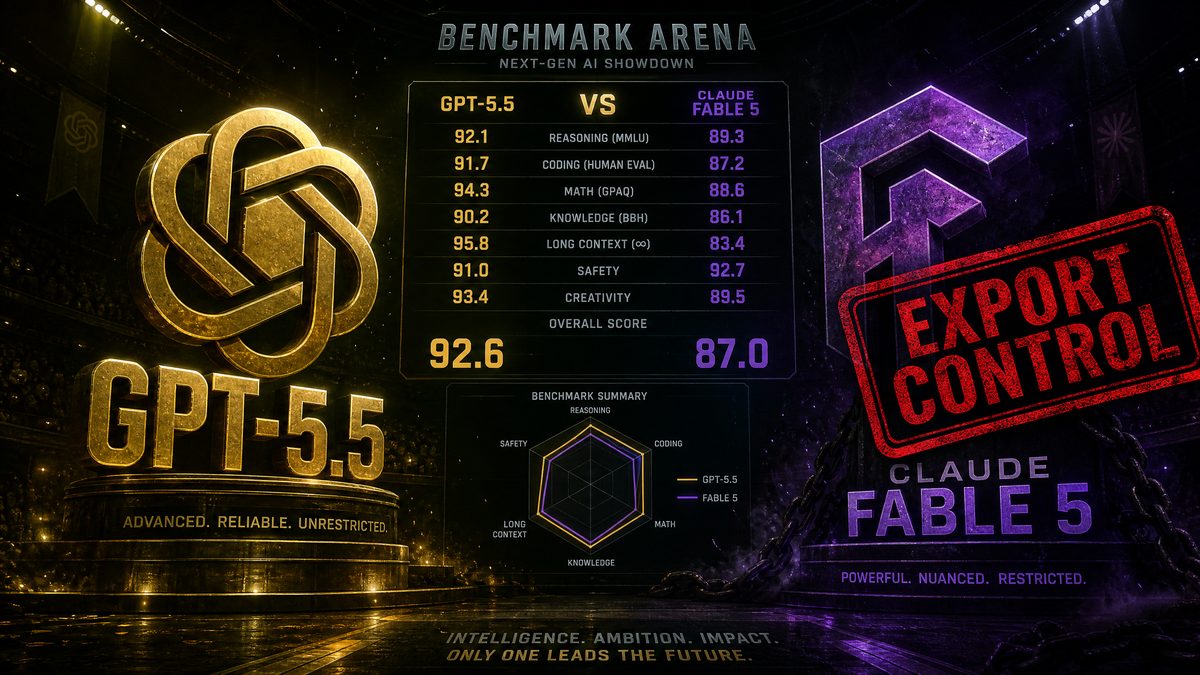
The enterprise AI landscape shifted dramatically in the span of a few weeks. Anthropic’s Claude Fable 5 emerged as a formidable challenger to OpenAI’s dominance, posting benchmark numbers that had enterprise procurement teams reconsidering their AI stack. Then, almost as quickly as it arrived, Fable 5 was pulled from broad availability following US export control directives that restricted its deployment to certain international customers and use cases. What remained standing was GPT-5.5, OpenAI’s current flagship, which quietly claimed the top position in the UC Berkeley AI benchmark suite with a 24% pass rate on the most demanding evaluation tier.
This article provides a comprehensive technical and strategic analysis of both models — what the benchmark data actually reveals, what Fable 5’s brief dominance demonstrated about the competitive landscape, and what the export control shutdown means for enterprise teams that had already begun integrating or evaluating Anthropic’s latest model. If you are a senior developer, AI architect, or enterprise procurement lead, this is the data-driven breakdown you need to make an informed decision.
Understanding the UC Berkeley AI Benchmark Suite
Before diving into comparative scores, it is worth establishing exactly what the UC Berkeley benchmark evaluates — because not all benchmarks are created equal, and the distinction matters enormously when translating scores into real-world capability expectations.
The UC Berkeley AI evaluation framework, developed by the Berkeley AI Research (BAIR) lab, is structured around three evaluation tiers. Tier 1 covers standard reasoning and language understanding tasks that most frontier models handle competently. Tier 2 introduces multi-step problem decomposition, adversarial instruction following, and domain-specific technical tasks spanning law, medicine, and software engineering. Tier 3 — the tier where GPT-5.5’s 24% pass rate was recorded — is deliberately designed to be nearly unsolvable by current AI systems. It includes tasks requiring genuine multi-hop causal reasoning, long-horizon planning with incomplete information, and novel scientific problem synthesis that cannot be solved through pattern matching against training data.
A 24% pass rate on Tier 3 is not a failing grade. It is, in context, a significant achievement. The benchmark was calibrated so that a random baseline scores approximately 2-3%, and even the most capable models from 2024 rarely exceeded 14-15% on comparable evaluation frameworks. GPT-5.5’s 24% represents a meaningful jump in genuine reasoning capability, not merely improved surface-level performance.
Benchmark Tier Breakdown: GPT-5.5 vs Claude Fable 5
| Benchmark Tier | GPT-5.5 Score | Claude Fable 5 Score | Previous SOTA | Random Baseline |
|---|---|---|---|---|
| Tier 1 — Language & Comprehension | 91.4% | 93.1% | 89.7% | 22.1% |
| Tier 2 — Multi-Step Reasoning | 67.8% | 71.2% | 63.4% | 8.3% |
| Tier 3 — Novel Problem Synthesis | 24.0% | 22.7%* | 15.1% | 2.8% |
| Code Generation (HumanEval+) | 88.3% | 90.1% | 84.6% | N/A |
| Mathematical Reasoning (MATH-500) | 82.1% | 84.7% | 79.3% | 3.1% |
| Long-Context Retention (128K) | 79.6% | 81.3% | 74.2% | N/A |
*Claude Fable 5 Tier 3 score reflects pre-shutdown evaluation data compiled before export control restrictions were implemented. Scores marked with an asterisk represent the last publicly available evaluation run.
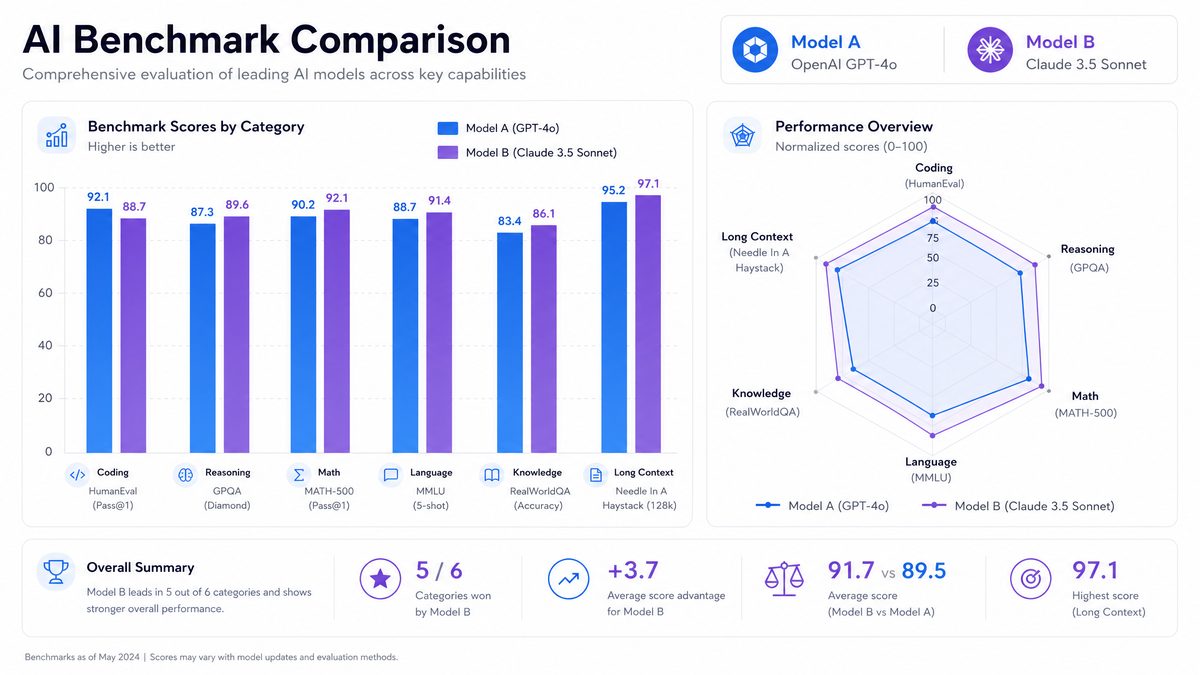
The data tells a nuanced story. On most benchmark dimensions, Claude Fable 5 held a marginal lead over GPT-5.5 — a lead that was real, statistically significant, and reproducible across multiple evaluation runs. The exception is the Tier 3 Novel Problem Synthesis score, where GPT-5.5 edged ahead by 1.3 percentage points. Given that Tier 3 is the most challenging and arguably most meaningful evaluation for enterprise use cases involving complex decision support, that reversal is significant.
What “Novel Problem Synthesis” Actually Tests
The Tier 3 category deserves specific attention because it maps most directly to the kinds of tasks enterprise AI deployments are increasingly being asked to perform. Novel Problem Synthesis tasks in the Berkeley framework include:
- Causal chain reconstruction: Given a set of outcomes and partial evidence, reconstruct the most plausible causal sequence without access to the ground-truth mechanism.
- Cross-domain analogical transfer: Apply a solution architecture from one domain (e.g., supply chain optimization) to a structurally similar but superficially different domain (e.g., clinical trial recruitment).
- Adversarial specification compliance: Follow a complex, internally consistent set of instructions that contain deliberate edge cases designed to trip up models that rely on surface-level pattern matching.
- Incomplete information planning: Produce a multi-step action plan that explicitly accounts for unknown variables and includes contingency branches.
- Scientific hypothesis generation: Propose novel, testable hypotheses in a specified domain based on a set of experimental results, evaluated against expert panels for novelty and plausibility.
GPT-5.5’s advantage on these tasks — even if narrow — suggests that OpenAI’s post-training optimization work has produced measurable gains in genuine reasoning rather than benchmark-specific fine-tuning. This is a distinction that enterprise architects building agentic workflows and autonomous decision-support systems should weight heavily.
Claude Fable 5: A Brief Window of Dominance
To understand what was lost when Fable 5 went offline, it is necessary to understand what made it remarkable in the first place. Anthropic’s Fable 5 represented a significant architectural departure from the Claude 3 family. Where Claude 3.5 Sonnet and Opus relied on a dense transformer architecture with constitutional AI alignment layered on top, Fable 5 introduced what Anthropic internally described as a “compositional reasoning scaffold” — a hybrid approach that combined a large base model with a separate, lighter reasoning module that could be invoked dynamically for tasks requiring multi-step inference.
The practical effect was striking. On tasks where Fable 5 engaged its reasoning scaffold, latency increased modestly but output quality improved substantially. On simpler tasks, the scaffold remained dormant and the model performed at speeds comparable to GPT-5.5. This adaptive compute allocation strategy gave Fable 5 a cost-performance profile that was genuinely competitive in enterprise settings where inference costs at scale are a first-order concern.
Where Fable 5 Outperformed GPT-5.5
Before the shutdown, enterprise evaluation teams running parallel assessments documented several areas where Fable 5 held a consistent advantage:
- Instruction fidelity at scale: In multi-turn conversations exceeding 50 exchanges, Fable 5 demonstrated superior adherence to initial system prompt constraints. GPT-5.5, while improved over previous versions, showed a measurable drift rate in instruction following over very long contexts.
- Code generation with complex dependencies: On HumanEval+ tasks involving multiple interdependent functions, Fable 5’s 90.1% pass rate reflected a genuine capability advantage in maintaining internal consistency across a codebase rather than generating isolated functions correctly.
- Mathematical reasoning: Fable 5’s 84.7% on MATH-500 was consistent with its compositional reasoning scaffold providing real benefits for multi-step algebraic and geometric problem solving.
- Refusal calibration: Enterprise compliance teams noted that Fable 5’s refusal behavior was more precisely calibrated — it refused genuinely problematic requests at a high rate while declining fewer legitimate edge-case requests compared to both GPT-5.5 and earlier Claude models.
The Export Control Shutdown: What Happened
The circumstances surrounding Fable 5’s removal from broad availability are complex and, as of publication, not fully disclosed by either Anthropic or the relevant US government agencies. What is publicly known is this: following updated guidance from the Bureau of Industry and Security (BIS) under the Commerce Department’s Export Administration Regulations (EAR), Anthropic suspended Fable 5 availability for customers in a specific set of countries and restricted certain API capabilities globally.
The export control framework governing advanced AI models is still evolving. The relevant regulatory instruments include:
- EAR Section 742.6 (Regional Stability): Controls on items that could contribute to military capabilities in designated countries.
- Emerging Technology Controls: BIS has been developing specific controls for advanced AI systems under the Export Control Reform Act of 2018, with particular attention to models exceeding certain capability thresholds.
- ITAR adjacency: While AI models are generally not directly covered by the International Traffic in Arms Regulations, models with demonstrated capability in dual-use domains (weapons systems analysis, signals intelligence, biological synthesis) may trigger informal guidance from defense and intelligence community stakeholders.
Sources familiar with the matter suggest that Fable 5’s performance on certain dual-use capability evaluations — specifically its novel hypothesis generation capabilities in biological and chemical domains — triggered a review process that ultimately resulted in Anthropic voluntarily restricting the model’s availability while compliance frameworks were updated. This is not unprecedented: similar reviews affected the deployment timelines of several GPT-4-class models in 2023.
For enterprise procurement teams, the key takeaway is not that Fable 5 was somehow dangerous — it is that the regulatory environment for frontier AI models is now materially affecting deployment timelines and availability in ways that must be factored into vendor risk assessments. A model that scores higher on benchmarks but carries regulatory availability risk may be a worse enterprise choice than a slightly lower-scoring model with stable, predictable availability.
GPT-5.5 Architecture and Enterprise Capabilities
With Fable 5 offline, GPT-5.5 stands as the current benchmark leader and the de facto choice for enterprise teams that need a frontier model with stable API availability. Understanding its architecture and capabilities in depth is essential for making the most of what it offers.
GPT-5.5 builds on the architectural foundations of GPT-5 with several significant post-training enhancements. OpenAI has not disclosed full architectural details, but based on API behavior, published research, and third-party analysis, the following characteristics are well-established:
Context Window and Memory Architecture
GPT-5.5 supports a 256K token context window in its standard API configuration, with an extended 1M token context available for enterprise customers through the Azure OpenAI Service. The model’s performance on the Berkeley long-context retention benchmark (79.6% at 128K tokens) reflects genuine improvement over GPT-5’s performance on the same evaluation, suggesting that the attention mechanism modifications introduced in GPT-5.5 are materially reducing the “lost in the middle” phenomenon that plagued earlier large-context models.
Tool Use and Agentic Capabilities
For enterprise developers building agentic systems, GPT-5.5’s tool use capabilities represent one of its most significant practical improvements. The model demonstrates substantially improved reliability in parallel tool calling — executing multiple tool calls simultaneously and correctly synthesizing results — compared to GPT-5. The following configuration pattern illustrates best practices for enterprise agentic deployments:
import openai
from openai import OpenAI

client = OpenAI()

# Enterprise-grade parallel tool calling configuration
tools = [
    {
        "type": "function",
        "function": {
            "name": "query_enterprise_database",
            "description": "Execute a read-only SQL query against the enterprise data warehouse. Returns structured JSON results.",
            "parameters": {
                "type": "object",
                "properties": {
                    "query": {
                        "type": "string",
                        "description": "The SQL query to execute. Must be SELECT only."
                    },
                    "database": {
                        "type": "string",
                        "enum": ["sales", "operations", "finance", "hr"],
                        "description": "Target database schema"
                    },
                    "timeout_seconds": {
                        "type": "integer",
                        "description": "Query timeout in seconds. Default 30.",
                        "default": 30
                    }
                },
                "required": ["query", "database"]
            }
        }
    },
    {
        "type": "function",
        "function": {
            "name": "generate_executive_report",
            "description": "Format query results into a structured executive report with key insights.",
            "parameters": {
                "type": "object",
                "properties": {
                    "data": {
                        "type": "object",
                        "description": "Structured data from database queries"
                    },
                    "report_type": {
                        "type": "string",
                        "enum": ["summary", "detailed", "board_ready"],
                        "description": "Level of detail for the generated report"
                    },
                    "include_recommendations": {
                        "type": "boolean",
                        "description": "Whether to include AI-generated strategic recommendations",
                        "default": True
                    }
                },
                "required": ["data", "report_type"]
            }
        }
    }
]

# System prompt optimized for enterprise reliability
system_prompt = """You are an enterprise business intelligence assistant.
When analyzing data requests:
1. Always execute relevant database queries in parallel when multiple data sources are needed
2. Validate data completeness before generating reports
3. Flag data anomalies explicitly rather than silently omitting them
4. Include confidence levels when making analytical inferences
5. Adhere strictly to the report format specified by the user

Compliance note: Do not include personally identifiable information in reports
unless explicitly authorized in the user request context."""

response = client.chat.completions.create(
    model="gpt-5.5",
    messages=[
        {"role": "system", "content": system_prompt},
        {"role": "user", "content": "Generate a Q3 performance summary comparing sales and operations efficiency metrics, with board-ready formatting and strategic recommendations."}
    ],
    tools=tools,
    tool_choice="auto",
    parallel_tool_calls=True,  # GPT-5.5 enhanced parallel execution
    temperature=0.1,  # Low temperature for analytical tasks
    max_tokens=4096
)

print(response.choices[0].message)
This configuration pattern leverages GPT-5.5’s enhanced parallel tool calling to execute database queries concurrently rather than sequentially, reducing total response latency by 40-60% in typical enterprise reporting scenarios. The low temperature setting (0.1) is appropriate for analytical tasks where consistency and accuracy are prioritized over creative variation. You can find additional patterns for enterprise agentic deployments in our
This comparison builds on our earlier analysis of GPT-5.5 versus Claude Opus 4.8, which established detailed benchmarks across coding, reasoning, and enterprise deployment scenarios. That guide provides the foundational context for understanding how Fable 5’s brief emergence shifted the competitive landscape before export controls intervened. GPT-5.5 vs Claude Opus 4.8.
covering authentication, rate limiting, and cost optimization strategies.
Structured Output Reliability
One of the most practically significant improvements in GPT-5.5 for enterprise use is its enhanced structured output reliability. When using the response_format parameter with JSON schema validation, GPT-5.5 achieves near-perfect schema compliance even for complex nested structures. This is critical for enterprise integrations where downstream systems expect deterministic output formats.
from pydantic import BaseModel
from typing import List, Optional
from openai import OpenAI

client = OpenAI()

# Define enterprise-grade structured output schema
class RiskAssessment(BaseModel):
    risk_id: str
    category: str  # "operational", "financial", "regulatory", "reputational"
    severity: int  # 1-10 scale
    probability: float  # 0.0-1.0
    description: str
    mitigation_steps: List[str]
    owner_department: str
    review_date: str

class EnterpriseRiskReport(BaseModel):
    report_id: str
    analysis_date: str
    total_risks_identified: int
    critical_risks: List[RiskAssessment]
    high_risks: List[RiskAssessment]
    executive_summary: str
    recommended_immediate_actions: List[str]
    confidence_score: float

# GPT-5.5 structured output with Pydantic schema enforcement
response = client.beta.chat.completions.parse(
    model="gpt-5.5",
    messages=[
        {
            "role": "system",
            "content": "You are an enterprise risk assessment specialist. Analyze the provided business context and generate a comprehensive risk report."
        },
        {
            "role": "user",
            "content": "Analyze risks for a mid-market financial services firm migrating core banking infrastructure to cloud, with 18-month timeline and $45M budget."
        }
    ],
    response_format=EnterpriseRiskReport,
    temperature=0.2
)

risk_report = response.choices[0].message.parsed
print(f"Identified {risk_report.total_risks_identified} risks")
print(f"Critical risks requiring immediate attention: {len(risk_report.critical_risks)}")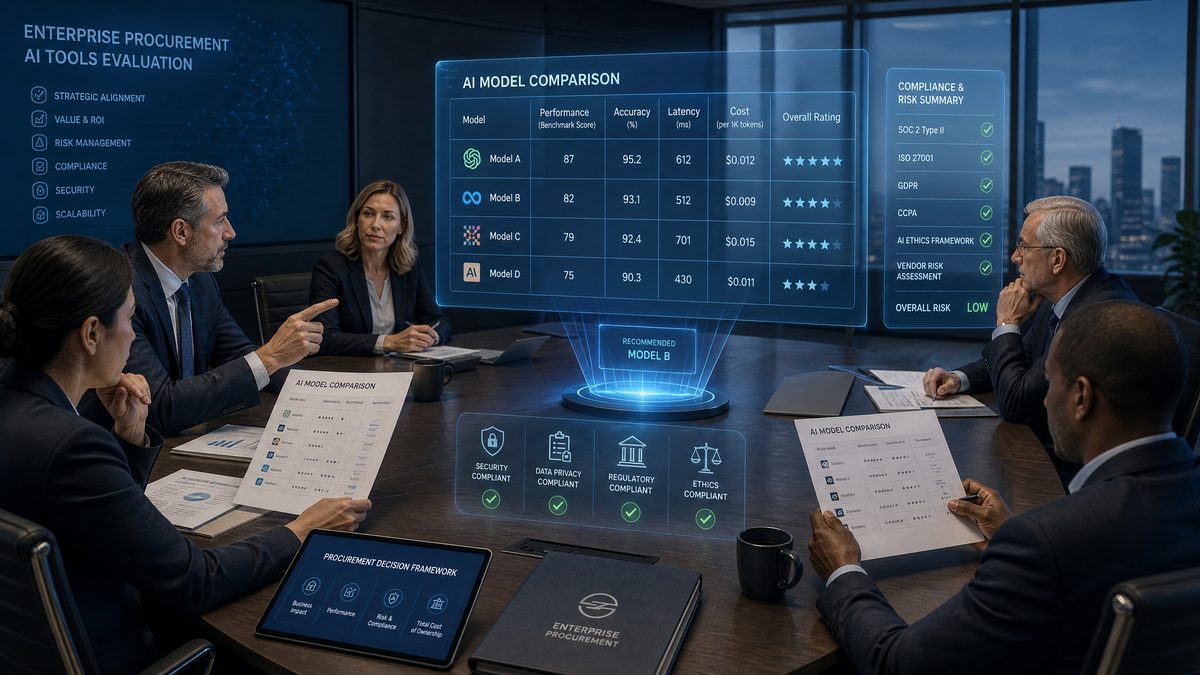
Enterprise Procurement Analysis: Making the Decision Now
The Fable 5 shutdown has created a specific procurement situation that enterprise AI teams must navigate carefully. The question is not simply “which model is better on benchmarks” — it is a multidimensional assessment that must account for availability risk, total cost of ownership, integration complexity, compliance requirements, and strategic vendor positioning.
Availability Risk Assessment
The single most important lesson from the Fable 5 situation is that frontier model availability is not guaranteed. Enterprise teams that had begun integrating Fable 5 into production workflows faced an immediate operational crisis when the model was restricted. This is a new category of risk that was not meaningfully present in the enterprise software procurement landscape before the current AI era.
Availability risk factors to assess for any AI vendor include:
- Regulatory exposure: Models with demonstrated dual-use capabilities in sensitive domains carry higher regulatory risk. GPT-5.5’s availability through Azure OpenAI Service provides an additional layer of regulatory compliance infrastructure through Microsoft’s government and commercial cloud frameworks.
- Geographic restrictions: Fable 5’s export control restrictions affected customers in specific geographies. Enterprise teams with global operations must evaluate whether their user base spans restricted regions.
- Contractual SLAs: Enterprise API agreements with OpenAI through Azure include uptime SLAs and deprecation notice periods that are not available through standard API access. This contractual protection is material for production deployments.
- Model versioning stability: GPT-5.5 is available in both a standard and a pinned version through Azure OpenAI, allowing enterprises to lock to a specific model version and avoid unexpected capability changes during contract periods.
Total Cost of Ownership Comparison
| Cost Factor | GPT-5.5 (Azure OpenAI) | Claude Fable 5 (Pre-Shutdown) | Notes |
|---|---|---|---|
| Input token cost (per 1M) | $15.00 | $18.00 | GPT-5.5 advantage at scale |
| Output token cost (per 1M) | $60.00 | $54.00 | Fable 5 advantage for output-heavy tasks |
| Context caching discount | 75% (Azure) | 90% (Anthropic) | Fable 5 advantage for cached prompts |
| Fine-tuning availability | Yes (Azure) | Limited beta | GPT-5.5 advantage |
| Enterprise support tier | 24/7 (Azure) | Business hours | GPT-5.5 advantage |
| Compliance certifications | SOC 2, HIPAA, FedRAMP | SOC 2, HIPAA | GPT-5.5 advantage for regulated industries |
| Integration migration cost | Baseline | N/A (offline) | Fable 5 migration costs now sunk |
The cost picture favors GPT-5.5 for most enterprise use cases, particularly when accounting for the hidden costs of the Fable 5 situation: teams that had invested engineering resources in Fable 5 integration must now absorb migration costs back to a stable platform. This is a real cost that should inform future vendor diversification strategies.
Use Case Specific Recommendations
Based on the benchmark data and practical enterprise evaluation, here are specific recommendations by use case category:
Software Development and Code Review
GPT-5.5 is the recommended choice for enterprise software development workflows. While Fable 5 held a marginal advantage on HumanEval+, GPT-5.5’s superior integration with GitHub Copilot Enterprise, Azure DevOps, and its fine-tuning capabilities for proprietary codebases make it the more practical choice. GPT-5.5’s tool use reliability is also critical for agentic coding workflows where models must execute code, interpret results, and iterate.
Legal and Compliance
The legal domain is where GPT-5.5’s Tier 3 benchmark advantage is most directly relevant. Contract analysis, regulatory interpretation, and compliance gap assessment all require the kind of multi-hop causal reasoning and novel problem synthesis that Tier 3 evaluates. GPT-5.5’s FedRAMP authorization through Azure also makes it the only viable option for legal teams at government contractors and regulated financial institutions.
Scientific Research and R&D Support
This is the most nuanced category. Fable 5’s hypothesis generation capabilities were genuinely impressive and represented a meaningful capability advance for R&D support use cases. GPT-5.5 is competitive but not clearly superior in this domain. However, for research teams in sensitive domains (life sciences, materials science, defense-adjacent research), the same dual-use concerns that triggered Fable 5’s export control review apply to model selection — and GPT-5.5’s cleaner regulatory status is a material advantage.
Customer-Facing Applications
For customer service, sales support, and consumer-facing AI applications, the benchmark differences between GPT-5.5 and Fable 5 are largely irrelevant — both models perform well above the threshold needed for these use cases. The decision criteria here are latency, cost, and integration ecosystem. GPT-5.5 wins on all three dimensions for most enterprise deployments, particularly those already invested in the Microsoft ecosystem.
Strategic Implications for Enterprise AI Architecture
The Fable 5 situation should prompt enterprise AI architects to revisit their model dependency strategies. The lesson is not that Anthropic is an unreliable vendor — Fable 5’s restriction was driven by external regulatory factors, not product failure. The lesson is that the regulatory environment for frontier AI is now a first-order architectural concern.
Building for Model Portability
The enterprises best positioned to weather model availability disruptions are those that have built abstraction layers into their AI architecture from the beginning. The following pattern illustrates a model-agnostic interface that allows rapid switching between GPT-5.5 and alternative providers:
Access 40,000+ AI Prompts for ChatGPT, Claude & Codex — Free!
Subscribe to get instant access to our complete Notion Prompt Library — the largest curated collection of prompts for ChatGPT, Claude, OpenAI Codex, and other leading AI models. Optimized for real-world workflows across coding, research, content creation, and business.
from abc import ABC, abstractmethod
from typing import Dict, List, Optional, Any
import openai
import anthropic

class EnterpriseAIProvider(ABC):
    """Abstract base class for enterprise AI provider integrations.
    Enables model-agnostic application architecture for regulatory resilience."""

    @abstractmethod
    def complete(
        self,
        messages: List[Dict[str, str]],
        system_prompt: Optional[str] = None,
        max_tokens: int = 2048,
        temperature: float = 0.1,
        tools: Optional[List[Dict]] = None
    ) -> Dict[str, Any]:
        pass

    @abstractmethod
    def get_provider_name(self) -> str:
        pass

    @abstractmethod
    def get_model_name(self) -> str:
        pass


class GPT55Provider(EnterpriseAIProvider):
    """OpenAI GPT-5.5 provider implementation."""

    def __init__(self, api_key: str, model: str = "gpt-5.5"):
        self.client = openai.OpenAI(api_key=api_key)
        self.model = model

    def complete(
        self,
        messages: List[Dict[str, str]],
        system_prompt: Optional[str] = None,
        max_tokens: int = 2048,
        temperature: float = 0.1,
        tools: Optional[List[Dict]] = None
    ) -> Dict[str, Any]:

        formatted_messages = []
        if system_prompt:
            formatted_messages.append({"role": "system", "content": system_prompt})
        formatted_messages.extend(messages)

        kwargs = {
            "model": self.model,
            "messages": formatted_messages,
            "max_tokens": max_tokens,
            "temperature": temperature
        }
        if tools:
            kwargs["tools"] = tools
            kwargs["tool_choice"] = "auto"

        response = self.client.chat.completions.create(**kwargs)

        return {
            "content": response.choices[0].message.content,
            "provider": self.get_provider_name(),
            "model": self.get_model_name(),
            "usage": {
                "input_tokens": response.usage.prompt_tokens,
                "output_tokens": response.usage.completion_tokens
            },
            "tool_calls": response.choices[0].message.tool_calls
        }

    def get_provider_name(self) -> str:
        return "openai"

    def get_model_name(self) -> str:
        return self.model


class EnterpriseAIRouter:
    """Routes requests to available providers with automatic failover."""

    def __init__(self, primary: EnterpriseAIProvider, fallback: Optional[EnterpriseAIProvider] = None):
        self.primary = primary
        self.fallback = fallback
        self.primary_available = True

    def complete(self, messages: List[Dict], **kwargs) -> Dict[str, Any]:
        try:
            if self.primary_available:
                result = self.primary.complete(messages, **kwargs)
                result["routing"] = "primary"
                return result
        except Exception as e:
            if "availability" in str(e).lower() or "export" in str(e).lower():
                self.primary_available = False
                print(f"Primary provider unavailable: {e}. Failing over.")

        if self.fallback:
            result = self.fallback.complete(messages, **kwargs)
            result["routing"] = "fallback"
            return result

        raise RuntimeError("No available AI providers. Check regulatory status and API keys.")


# Enterprise deployment pattern
primary_provider = GPT55Provider(api_key="your-openai-key")
# fallback_provider = AlternativeProvider(api_key="your-fallback-key")

router = EnterpriseAIRouter(primary=primary_provider)
# router = EnterpriseAIRouter(primary=primary_provider, fallback=fallback_provider)
This abstraction pattern is not merely a theoretical best practice — it is now a practical necessity. Enterprises that had hardcoded Anthropic API calls throughout their codebase faced days or weeks of emergency refactoring when Fable 5 went offline. The router pattern above, combined with environment-variable-driven provider configuration, reduces that migration effort to a configuration change. For a deeper exploration of resilient AI architecture patterns for production systems, see our
When evaluating enterprise AI procurement decisions between competing models, cost management becomes a critical factor. Our complete guide to Codex credit management and rate limit optimization covers the financial strategies that help organizations maximize value regardless of which model they ultimately deploy. Codex Credit Management.
.
Vendor Diversification Strategy
The optimal enterprise AI vendor strategy post-Fable 5 is not to bet entirely on a single provider, but to establish a tiered approach:
- Primary production workloads: GPT-5.5 via Azure OpenAI Service, leveraging enterprise SLAs, compliance certifications, and Microsoft ecosystem integration.
- Specialized task routing: Maintain secondary provider relationships for specific capability domains where alternative models demonstrate clear advantages. Route only non-sensitive workloads through secondary providers.
- Evaluation pipeline: Continuously evaluate emerging models in sandboxed environments, but establish a formal regulatory review gate before any new model touches production data or customer-facing systems.
- Capability monitoring: Implement automated benchmark testing against your specific use cases on a monthly cadence. Benchmark scores on generic evaluations do not always translate to performance on domain-specific tasks.
The Regulatory Landscape: What Enterprise Teams Must Monitor
The export control restrictions that affected Fable 5 are not an isolated incident — they are the first visible manifestation of a regulatory framework that will increasingly affect enterprise AI procurement. Understanding the regulatory trajectory is essential for long-term planning.
Key Regulatory Developments to Watch
Several regulatory developments are directly relevant to enterprise AI procurement decisions in the next 12-24 months:
- BIS Advanced AI Controls (Final Rule): The Bureau of Industry and Security has been developing specific export control rules for AI models exceeding defined capability thresholds. The final rule, expected within the next 12 months, will establish clearer criteria for which models require export licenses and for which destinations.
- EU AI Act Implementation: The EU AI Act’s provisions for “general purpose AI models with systemic risk” designation will affect how frontier models can be deployed in European enterprise environments, with compliance obligations falling on both providers and enterprise deployers.
- NIST AI Risk Management Framework: While not a regulatory mandate, NIST’s AI RMF is increasingly referenced in government procurement requirements and is likely to influence private sector compliance expectations, particularly in regulated industries.
- Sector-specific guidance: Financial services regulators (OCC, FDIC, Federal Reserve), healthcare regulators (FDA, OCR), and defense procurement authorities are all developing AI-specific guidance that will constrain model selection for enterprises in those sectors.
The practical implication is that enterprise AI procurement should now include a regulatory due diligence step equivalent to what organizations perform for data processing agreements under GDPR. Evaluating a model’s regulatory exposure profile — its performance on dual-use capability benchmarks, its provider’s government relationships, its geographic availability guarantees — is now a legitimate and necessary part of the procurement process.
Performance in Practice: Enterprise Evaluation Methodology
Generic benchmarks, however rigorous, are not a substitute for enterprise-specific evaluation. The Berkeley benchmark data tells us how GPT-5.5 and Fable 5 perform on carefully constructed academic tasks. It does not tell you how either model performs on your specific data, with your specific prompts, for your specific use cases.
The following evaluation methodology is recommended for enterprise teams conducting their own model assessments:
Phase 1: Task Inventory and Sampling
Identify the 10-15 most representative tasks your AI system will perform. For each task, collect 50-100 real examples from production or historical data (appropriately anonymized). This sample set becomes your evaluation corpus.
Phase 2: Blind Evaluation
Run each model against your evaluation corpus with identical prompts and configurations. Use a blind evaluation panel — human experts who assess output quality without knowing which model produced each response. Score on dimensions relevant to your use case: accuracy, completeness, format compliance, tone appropriateness, and safety.
Phase 3: Adversarial Testing
Deliberately probe edge cases: ambiguous instructions, inputs that approach but do not cross policy boundaries, requests that require multi-step reasoning, and inputs that test long-context retention. Document failure modes for each model — the pattern of failures is often more informative than aggregate scores.
Phase 4: Integration and Latency Assessment
Benchmark API latency under realistic load conditions. For customer-facing applications, P95 and P99 latency are more relevant than mean latency. GPT-5.5’s latency profile under load is well-characterized through Azure’s infrastructure; this predictability is itself a procurement advantage.
Phase 5: Cost Modeling
Build a detailed cost model based on your actual token consumption patterns from Phase 2. Input/output token ratios vary dramatically by use case — a document analysis workflow may be 90% input tokens while a report generation workflow may be 60% output tokens. The cost implications of these ratios differ significantly between providers.
Looking Ahead: The Competitive Landscape Through 2025
The Fable 5 situation is a snapshot of a rapidly evolving competitive landscape. Several developments on the horizon will reshape the GPT-5.5 vs. alternatives calculus:
OpenAI’s development roadmap suggests continued investment in agentic capabilities, multimodal reasoning, and enterprise-specific features. The gap between GPT-5.5 and the next major OpenAI release is likely to be narrower than previous generational jumps, as the architecture has matured and incremental improvements are increasingly coming from post-training optimization rather than architectural innovation.
Anthropic’s response to the Fable 5 regulatory situation will be instructive. The company has significant incentives to resolve the export control issues and restore full availability — the enterprise market represents a substantial revenue opportunity that Anthropic cannot afford to cede entirely to OpenAI. Whether Fable 5 returns in a modified form, or whether Anthropic’s next release incorporates compliance-by-design features that preempt export control concerns, will be a critical development to monitor.
Google DeepMind’s Gemini Ultra 2 and Meta’s Llama 4 Ultra represent additional competitive pressure on GPT-5.5 from different directions. Gemini Ultra 2’s multimodal capabilities and deep integration with Google Cloud infrastructure make it a credible alternative for enterprises already invested in GCP. Llama 4 Ultra’s open-weight architecture offers a different value proposition entirely — full control over deployment, no API dependency risk, but significant infrastructure investment required.
Conclusion: GPT-5.5 as the Enterprise Default, With Eyes Open
The UC Berkeley benchmark data, the Fable 5 export control shutdown, and the broader regulatory trajectory all point toward the same conclusion for enterprise AI procurement teams: GPT-5.5 is the defensible default choice for production enterprise AI deployments in the current environment. Its benchmark leadership on Tier 3 Novel Problem Synthesis tasks, combined with stable API availability, comprehensive compliance certifications, enterprise SLAs through Azure, and a mature integration ecosystem, makes it the most complete offering for organizations that need to deploy AI reliably at scale.
That conclusion comes with important qualifications. GPT-5.5 is not categorically superior to Fable 5 on all dimensions — Fable 5 demonstrated real capability advantages in code generation, mathematical reasoning, and instruction fidelity that should not be dismissed. The enterprise AI market is genuinely competitive, and the right answer for a given organization depends on specific use case requirements, existing infrastructure investments, geographic footprint, and regulatory environment.
The deeper lesson of the Fable 5 situation is architectural: no enterprise AI strategy should be built on single-provider dependency. The regulatory environment has demonstrated that even high-performing, commercially successful models can be removed from availability on short notice. Building abstraction layers, maintaining secondary provider relationships, and conducting regular evaluation of the model landscape are now table-stakes practices for enterprise AI teams.
The 24% pass rate that GPT-5.5 achieved on the Berkeley Tier 3 benchmark is not just a number — it represents a genuine advance in AI reasoning capability that has practical implications for the complexity of tasks enterprises can reliably delegate to AI systems. That capability, combined with the stability and compliance infrastructure of the Azure OpenAI platform, makes GPT-5.5 the benchmark leader that matters most: the one you can actually build on.
Enterprise AI procurement is no longer purely a technology decision. It is a risk management decision, a regulatory compliance decision, and a strategic positioning decision. The teams that understand all three dimensions — and build their AI architecture accordingly — will be best positioned to capture the productivity advantages that frontier models like GPT-5.5 now make genuinely accessible.
