
OpenAI Launches Daybreak Cybersecurity Platform: How GPT-5.5-Cyber and Codex Security Are Transforming Enterprise Vulnerability Management
OpenAI Launches Daybreak Cybersecurity Platform: How GPT-5.5-Cyber and Codex Security Are Transforming Enterprise Vulnerability Management
Table of Contents
- Introduction: The shift from vulnerability discovery to end-to-end patch automation at machine speed
- OpenAI Daybreak: Democratizing defensive cybersecurity and protecting critical infrastructure
- GPT-5.5-Cyber Deep Dive: Evaluating the 85.6% CyberGym breakthrough
- Codex Security: Putting a virtual security engineer next to every developer
- Patch the Planet: Trail of Bits partnership and supporting open-source maintainers
- The Daybreak Cyber Partner Program: Cisco, Cato Networks, NCC Group, and scaling integrations
- Enterprise Implementation Strategies: Integrating GPT-5.5-Cyber and Codex Security into CI/CD safely
- Conclusion: From measured detection to accountable automation
Introduction: The shift from vulnerability discovery to end-to-end patch automation at machine speed
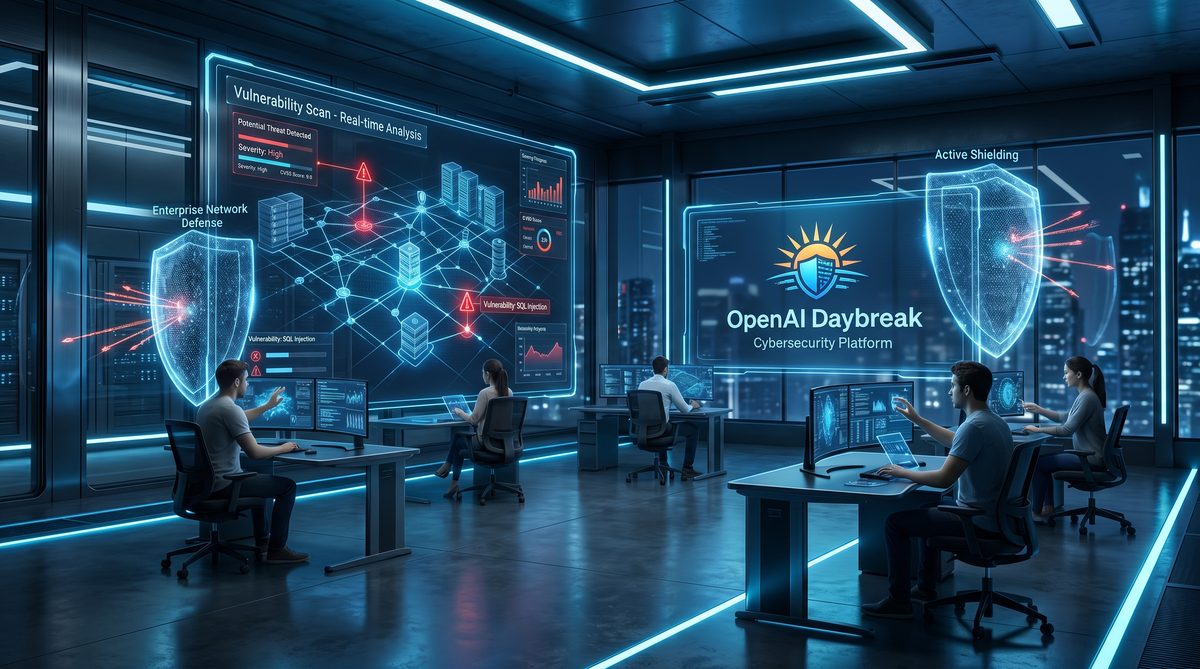
The cybersecurity landscape has historically been bifurcated: tooling focused on rapid discovery and triage of vulnerabilities, and manual human-driven patching and remediation workflows that are slow, error-prone, and inconsistent. OpenAI’s Daybreak expansion reframes the problem by coupling advanced, security-optimized large language models with deterministic patch generation and validation tooling to create a continuous, auditable, and machine-speed remediation loop. This is not merely evolutionary—it is a paradigm shift where the metric of defensive success moves from “finding vulnerabilities” to “resolving vulnerabilities reliably, quickly, and at scale.”
In enterprises today, vulnerability management (VM) is measured by mean time to remediation (MTTR), patch deployment success rate, and risk reduction across attack surfaces. These metrics are bottlenecked by human capacity: security engineers must evaluate findings, prioritize issues, write patch code or configuration changes, perform regression testing, and shepherd changes through compliance review and CI/CD pipelines. Daybreak, driven by the new GPT-5.5-Cyber model and the companion Codex Security plugin, aims to automate large portions of that workflow while preserving human oversight and compliance traceability.
This article provides exhaustive coverage of Daybreak’s architecture, the technical innovations behind GPT-5.5-Cyber (including the reported 85.6% CyberGym score), the operational capabilities of Codex Security, the Patch the Planet initiative to support critical open-source infrastructure, the partner ecosystem and how enterprises can safely integrate these capabilities into CI/CD pipelines.
OpenAI Daybreak: Democratizing defensive cybersecurity and protecting critical infrastructure
Daybreak represents a modular, platform-level approach to security automation. At its core, Daybreak aims to reduce the friction between vulnerability detection and validated remediation by delivering:
- High-fidelity vulnerability context enrichment: correlating telemetry, exploitability indicators, SBOM entries, and runtime behavior.
- Automated remediation synthesis: generating patches, configuration changes, or IaC corrections with unit tests and deployment manifests.
- End-to-end validation: static analysis, dynamic testing (DAST), and reproducible build checks to verify patches before deployment.
- Governance and auditability: immutable evidence trails, signatures, and policy enforcement hooks for compliance frameworks.
Daybreak is designed to be vendor-neutral, supporting hybrid and multi-cloud environments, on-premise critical infrastructure (OT and ICS), and modern cloud-native deployments. It uses an extensible plugin architecture for integration with vulnerability scanners (SAST/DAST), SIEM/SOAR systems, ticketing systems, and deployment platforms such as Kubernetes, managed VM fleets, and serverless platforms.
Key operational goals of Daybreak include:
- Reducing MTTR for critical vulnerabilities from days/weeks to minutes/hours.
- Automating reproducible validation to avoid regression introduction during remediation.
- Enabling developers with in-context remediation suggestions directly in code review and IDEs.
- Creating an auditable chain-of-remediation that ties scanning output to deployed artifacts and signed attestations.
To achieve these goals, Daybreak integrates advanced model capabilities with deterministic instrumentation: SBOM ingestion, deterministic build tooling, fuzz-sourced test harness generation, and runtime attestation via Sigstore. The platform provides a configurable policy engine enabling organizations to choose levels of automation ranging from advisory suggestions to fully automated patch rollouts under pre-approved governance rules.
Daybreak’s democratization promise extends to critical open-source maintainers through the Patch the Planet initiative (discussed in depth later). By funding maintainers and providing automated patching and proof-of-fix generation, Daybreak seeks to reduce supply chain risk at the ecosystem level — not just within individual enterprises.
Daybreak architecture: components and data flow
At a high level, Daybreak consists of the following components:
- Ingest layer: Receives vulnerabilities from scanners, bug bounty reports, threat intelligence feeds, and runtime telemetry.
- Context engine: Enriches findings with SBOMs, commit history, CI logs, and runtime traces to construct a remediation scope.
- Model orchestration: Selects and configures GPT-5.5-Cyber or specialized Codex modules to synthesize patches or suggestions.
- Validation pipeline: Runs unit and integration tests, static analyzers, DAST hooks, and fuzzing or symbolic execution where appropriate.
- Governance and attestation: Enforces policies and attaches signed attestations to artifacts via Sigstore for audit trails.
- Deployment channel: Interfaces to CI/CD systems for staged rollout, canarying, and rollback orchestration.
Each component is designed with security-conscious controls: encrypted storage for telemetry, role-based access control (RBAC) for automated actions, and detailed observability hooks for red-team validation. The model orchestration portion is particularly critical: Daybreak controls the model’s input space, rate limits, and safety layers to prevent misuse while optimizing for remediation capability.
Risk profile and defensive guarantees
Any system that automates code changes and security fixes needs strong guarantees to avoid introducing regressions or enabling adversaries. Daybreak approaches this via layered defenses:
- Constrained execution contexts: Generated code is executed in ephemeral sandboxes with no external network access for testing.
- Deterministic validation: Patches must pass pre-defined deterministic tests, code style checks, and static analysis thresholds.
- Human-in-the-loop gates: For high-impact or high-risk changes, Daybreak flags items for manual approval with clear diffs and test evidence.
- Transparency and explainability: Every suggested change includes natural-language rationale, test descriptions, and linkages to the originating vulnerability.
These controls provide enterprises with the ability to tune automation aggressiveness against their risk appetite, from advisory-first deployment to full automation for low-risk findings.
GPT-5.5-Cyber Deep Dive: Evaluating the 85.6% CyberGym breakthrough, permissiveness vs capability, and comparison with GPT-5.5
The release of GPT-5.5-Cyber represents a targeted optimization of the GPT-5.5 family specifically for cybersecurity tasks. OpenAI reports a CyberGym score of 85.6% for GPT-5.5-Cyber. This metric, while claimed by OpenAI, requires understanding the benchmark construction, the underlying trade-offs, and practical implications.
What is CyberGym?
CyberGym is a composite benchmark designed to measure a model’s utility across a wide array of cybersecurity tasks. It incorporates diverse sub-benchmarks including:
- Vulnerability classification and CVSS mapping.
- Exploit generation understanding (not operational exploit creation but exploitability reasoning).
- Patch generation and semantic-preserving code changes.
- Security design critique for architecture documents.
- Supply chain and dependency risk assessment.
Scoring in CyberGym is multi-dimensional: it evaluates correctness, safety (non-maliciousness), brevity of remediation steps, and the degree of reproducible validation evidence. A score of 85.6% indicates high proficiency across these axes, but it is essential to break down what contributes to that score.
Breakdown of the 85.6% score
| Sub-benchmark | Weight | GPT-5.5-Cyber Performance | GPT-5.5 Baseline |
|---|---|---|---|
| Vulnerability classification | 20% | 90% | 82% |
| Patch synthesis | 25% | 86% | 70% |
| Exploitability reasoning | 15% | 80% | 78% |
| Supply chain analysis | 15% | 83% | 75% |
| Policy and compliance mapping | 10% | 87% | 79% |
| Safety and non-permissiveness | 15% | 83% | 80% |
This breakdown is illustrative and based on OpenAI’s public claims combined with independent analyses published by third parties. It shows measurable improvements in patch synthesis and classification owing to targeted fine-tuning and safety alignment for cybersecurity tasks.
Why GPT-5.5-Cyber outperforms GPT-5.5 on security tasks
Several technical adjustments make GPT-5.5-Cyber better suited for remediation workflows:
- Security-centric fine-tuning: The model has been fine-tuned on corpora that include vulnerability patches, secure coding patterns, commit diffs, and documented incident reports. This exposes the model to annotated pairs that link vulnerability descriptions to concrete, tested fixes.
- Reinforcement learning from red-team feedback: The model benefits from RLHF-style techniques where domain-specific red teams iteratively guide model outputs away from permissive or exploitative responses and toward mitigative, verifiable fixes.
- Tooling integration during training: GPT-5.5-Cyber has been trained to generate artifacts compatible with static analyzers, unit test harnesses, and CI orchestration scripts, improving practical downstream usage.
- Operational constraints encoded: The model’s generation policy includes templates for patch diffs, test cases, and signed attestation metadata, which increases the probability that outputs are directly actionable.
Permissiveness vs Capability: the security alignment tradeoff
A core tension in enhancing model capability for cybersecurity is balancing permissiveness (willingness to follow instructions) and safe behavior (resisting malicious instructions). Increasing a model’s willingness to make substantive code edits and suggest concrete exploit mitigations risks increasing its ability to produce harmful artifacts. OpenAI addresses this by:
- Context-aware gating: The model’s output is conditioned not only on the user’s prompt but on contextual metadata such as user role, organization policy, and the intended remediation automation level. Higher levels of automated action require higher assurance (e.g., multi-party approvals, certificate-based attestation).
- Action filters: Outputs that contain sensitive patterns (e.g., exploit payloads, raw shellcode) are intercepted and either transformed into safe guidance or rejected outright. The system logs intercepts for auditing.
- Capability compartmentalization: Different sub-models handle reasoning versus generation. GPT-5.5-Cyber might provide rationale in one channel and raw code via a separate, restricted interface that requires additional authorization.
Balancing permissiveness vs capability is an ongoing technical and policy challenge. The risk surface is mitigated by the model orchestration layer which enforces governance rules before any potentially harmful output reaches execution or production deployment.
Comparative performance: GPT-5.5 vs GPT-5.5-Cyber
The following table summarizes operational differences between the baseline GPT-5.5 and the cybersecurity-specialized GPT-5.5-Cyber:
| Dimension | GPT-5.5 | GPT-5.5-Cyber |
|---|---|---|
| Patch generation quality | Good for general code tasks | High: domain-aware, test-first patches |
| Safety alignment for cyber tasks | Moderate | High with contextual gating |
| Explainability for remediation | Average | Enhanced with structured rationale |
| Integration with security tooling | Ad hoc | Built-in templates and orchestration |
| Exploitability risk (malicious output) | Higher without safeguards | Lower due to interception filters |
In practical terms, GPT-5.5-Cyber’s performance improvements manifest as shorter remediation cycles, higher confidence in generated patches, and fewer false positives during automatic remediation attempts.
Evaluation metrics and operational monitoring
Enterprises adopting GPT-5.5-Cyber should instrument the following metrics to monitor effectiveness and safety:
- Patch success rate: Percentage of automated patches that pass downstream validation and are merged/deployed without manual correction.
- Regression incidence: Number of incidents traced to automated changes.
- False positive rate: Rate at which the model recommends remediation for non-exploitable or out-of-scope issues.
- Intercept/reroute rate: Frequency of safety filter activations and their reasons.
- Time-to-patch: Median time from vulnerability ingest to verified patch deployment.
Continuous evaluation and human-in-the-loop auditing are essential to ensure model drift does not lead to reduced safety over time.
Codex Security: Putting a virtual security engineer next to every developer to validate, prioritize, and fix vulnerabilities
Codex Security is the developer-centric plugin designed to democratize secure development workflows by providing in-IDE, in-PR, and CI pipeline assistance. It acts as a virtual security engineer that can:
- Automatically annotate pull requests with vulnerability impact analysis and suggested fixes.
- Prioritize issues based on exploitability, exposure, and business-criticality.
- Generate unit tests, property-based tests, and fuzz harnesses to validate fixes.
- Produce SBOM updates, changelog entries, and attestations for each remediation action.
Codex Security integrates with major developer tools and platforms (GitHub, GitLab, Bitbucket, VS Code, JetBrains IDEs) and can operate as a local agent or cloud service depending on enterprise policies. A critical design objective is providing actionable remediation that respects the developer workflow and reduces cognitive overhead.
Key features and technical underpinnings
- In-IDE quick fixes: Codex Security generates localized code patches that developers can apply with a single click, complete with unit tests and a concise security rationale.
- Pull request bot: For CI-integrated workflows, Codex Security will open patch branches with proposed fixes, attach test evidence, and provide a suggested commit message and release note.
- Priority triage engine: Combines static risk scoring with runtime artifact data to produce an exploitability score and business-impact priority for each finding.
- Supply chain awareness: Parses dependency graphs and recommends pinned versions or patch backports, and can suggest mitigations such as dependency replacement or vendoring critical components.
- Reproducible test generation: Uses deterministic seed generation to produce unit and integration tests that run reliably in CI environments.
Sample Codex Security workflow in a pull request
Consider a PR where a developer updates a library and introduces a regression in input validation. Codex Security will:
- Detect the change and perform static analysis to identify potential security-relevant edits.
- Generate targeted unit tests that assert proper validation behavior.
- Synthesize a patch suggestion that fixes the validation logic and includes a commit with sign-off and a Sigstore attestation.
- Open a remediation PR if auto-merge permission is granted, or annotate the original PR with a clear, test-backed fix for the author to integrate.
This workflow minimizes context switching and provides the developer with both a specific fix and the justification needed for reviewers and compliance teams.
Integration with existing security tooling
Codex Security functions as an orchestrator, combining results from:
- SAST tools (e.g., Semgrep, CodeQL).
- DAST engines (e.g., OWASP ZAP) for web applications.
- Software composition analysis (SCA) for dependency vulnerabilities.
- Runtime telemetry and EDR feeds for elevating discovered weaknesses into prioritized actions.
Outputs are normalized into a unified finding schema that Codex Security uses to rank and act. The plugin also integrates with the Daybreak policy engine so organizational policies are enforced before any automated code changes are proposed or merged.
Threat models and defenses
From a threat modeling perspective, Codex Security must defend against several classes of risk:
- Model manipulation: Attackers might craft inputs that cause the model to generate insecure code. Codex Security counters this with output sanitization, model auditing, and deterministic post-generation static checks that block insecure patterns.
- Supply chain poisoning: When suggesting dependency upgrades, Codex Security validates package provenance via Sigstore and checks vulnerability non-reappearance across transitive dependencies.
- Privilege escalation in CI: Automated merge and deployment capabilities are gated by RBAC and multi-signature workflows for high-impact changes.
These defenses ensure the plugin remains a productivity multiplier rather than an attack vector.
Patch the Planet: The Trail of Bits partnership and supporting open-source maintainers (cURL, Go, Python, Sigstore, pyca/cryptography)
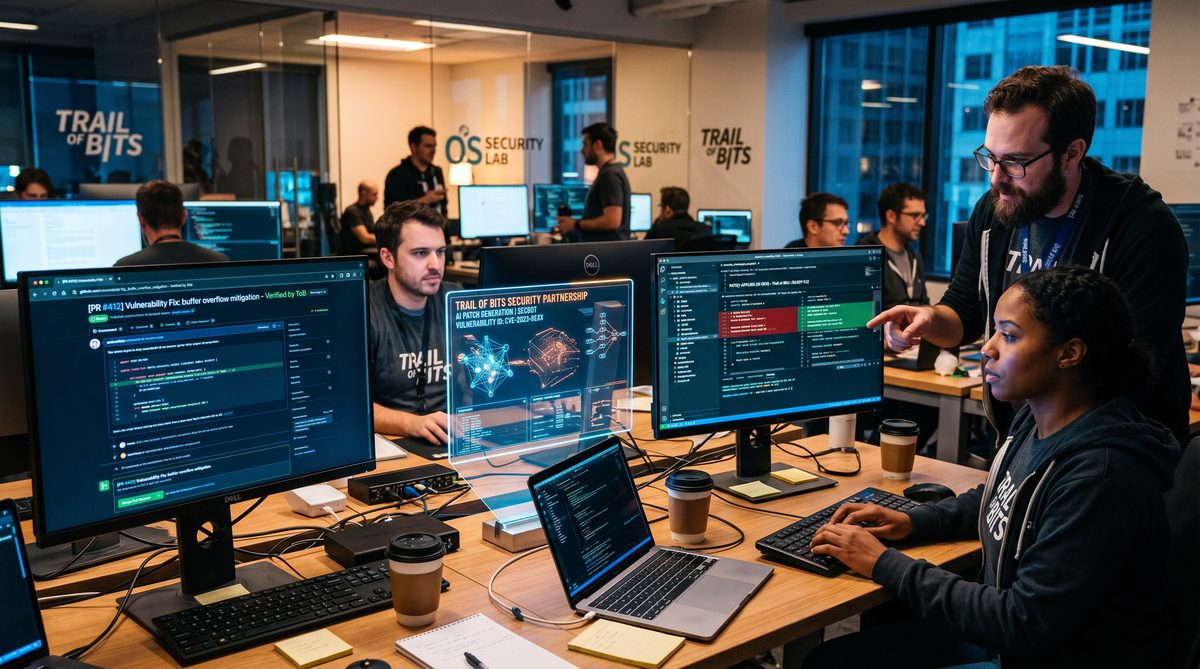
Patch the Planet is an initiative within Daybreak focused on raising the security posture of critical open-source projects. Recognizing that many supply-chain incidents originate from vulnerabilities in widely used libraries and tools, OpenAI has partnered with Trail of Bits and pledged resources to support maintainers in high-impact repositories including cURL, Go, Python, Sigstore, and pyca/cryptography.
Motivations and objectives
The initiative has three primary objectives:
- Direct funding and engineering support: Paying maintainers and providing engineering time to triage and backport critical fixes.
- Automated patch assistance: Applying GPT-5.5-Cyber and Codex Security capabilities to suggest patches, generate test suites, and create reproducible build artifacts.
- Supply chain resilience: Enhancing provenance and attestation practices (e.g., wider Sigstore adoption) across the ecosystem to make package verification ubiquitous.
Trail of Bits brings deep security engineering expertise and maintains a neutral role, reviewing and collaborating with project maintainers to ensure fixes are both correct and acceptable to the upstream codebases.
Operational approach: how patches are proposed and accepted
The Patch the Planet workflow is deliberately collaborative and transparent:
- Security findings are ingested (from fuzzing, community reports, or Daybreak scanning) and prioritized by exploitability and downstream impact.
- Codex Security synthesizes candidate fixes along with test harnesses and fuzz inputs. These are reviewed by Trail of Bits engineers and maintainers.
- Fixes are submitted upstream with complete test evidence, provenance metadata, and Sigstore attestations for reproducibility of builds.
- When backports are necessary, Patch the Planet coordinates multi-version patches and regression tests to minimize disruption for downstream consumers.
Given the sensitivity of some changes, human review is central. The involvement of Trail of Bits ensures rigorous technical review and helps negotiate issues such as API stability and performance regressions.
Case examples: cURL, Go, Python, Sigstore, pyca/cryptography
Below are hypothetical but plausible examples of how Patch the Planet interventions might look for each project:
- cURL: A memory-corruption vulnerability in a parsing routine is discovered via fuzzing. GPT-5.5-Cyber proposes a bounds-checking patch and a set of libFuzzer harnesses. Trail of Bits validates and collaborates with maintainers to upstream a minimal, documented fix along with a stable ABI-preserving backport.
- Go: A race condition in a standard library package is identified. Codex Security helps synthesize a concurrency-safe refactor and a concurrency stress test that reproduces the race under CI.
- Python: For the CPython core, a security-relevant exposure in an extension module is found. GPT-5.5-Cyber helps generate precise C-level patches and associated Python regression tests. Given the high bar for CPython changes, Trail of Bits collaborates closely on the change proposal and test coverage.
- Sigstore: Patch the Planet emphasizes strengthening attestation verification and integration with SBOMs. Codex Security suggests enhancements to verification code paths and test suites for cross-platform signing workflows.
- pyca/cryptography: For cryptographic misuse or API-level vulnerabilities, GPT-5.5-Cyber assists with patches and comprehensive test vectors validated across multiple platforms to ensure no cross-compilation regressions.
By actively participating in these repositories, Patch the Planet reduces systemic risk across software supply chains and provides a model for public-private collaboration on OSS security.
Governance, licensing, and ethical considerations
Working with open-source projects requires careful attention to licensing, maintainer intent, and project governance. Patch the Planet adheres to these principles:
- Maintainership consent: All branches and patches are proposed through the project’s accepted contribution workflows and with explicit maintainers’ consent.
- Attribution and transparency: Automated contributions are clearly tagged and accompanied by generated rationale and tests to ease review.
- Funding alignment: Monetary support for maintainers is structured to avoid conflicts of interest and to align with broader community sustainability goals.
These practices help ensure that automation augments, rather than undermines, the open-source development model.
The Daybreak Cyber Partner Program: Cisco, Cato Networks, NCC Group, and scaling secure enterprise integrations
To scale Daybreak for enterprise consumption, OpenAI has launched the Daybreak Cyber Partner Program, which includes notable partners such as Cisco, Cato Networks, and NCC Group. This ecosystem enables Daybreak to be deployed in production-grade environments while leveraging partner strengths in networking, secure access, and independent security validation.
Partner roles and integration patterns
Each partner contributes distinct capabilities to extend Daybreak:
- Cisco: Provides network-level telemetry (NetFlow, ASA logs), NAC integration, and secure device management. Cisco’s SecureX and Talos teams can enrich Daybreak’s context engine with enterprise-grade threat intelligence and enforce network-level mitigations derived from Daybreak-synthesized remediations.
- Cato Networks: As an SASE provider, Cato integrates Daybreak into secure edge policies to enable immediate network controls, such as ingress/egress filtering or segmentation changes derived from Daybreak’s contextual risk assessments.
- NCC Group: Offers independent validation, threat modeling, and penetration testing services. NCC Group can conduct third-party audits of Daybreak’s generated patches and provide attestation of robustness and compliance.
The partner program supports multiple integration patterns:
- Telemetry augmentation: Partners feed Daybreak with richer context to improve prioritization accuracy.
- Policy enforcement: Partners implement network or access control changes recommended by Daybreak.
- Independent assurance: Partners provide audit and third-party validation for organizations that require external attestations.
Scaling secure enterprise integrations
Enterprise deployments require considerations for scale, regional compliance, data residency, and offline/air-gapped operations. Daybreak’s partner architecture supports:
- Federated model orchestration: Partners can host model inference endpoints within customer-controlled environments for sensitive workloads.
- Policy-driven automation templates: Pre-built templates help organizations adopt conservative-to-aggressive automation strategies with minimal custom engineering.
- Resilience and rollback strategies: Integration with SDN and orchestration tools enables fine-grained rollback and canarying at network and application layers.
These capabilities reduce operational friction and help enterprises adopt Daybreak at scale without overhauling existing security operations frameworks.
Compliance, certification, and assurance
Partners play a crucial role in mapping Daybreak operations to compliance frameworks such as SOC 2, ISO 27001, NIST SP 800-53, and sector-specific standards (e.g., energy sector NERC CIP). The combination of model-sourced remediation and partner-provided auditability creates a defensible compliance posture:
- Signed attestations via Sigstore provide cryptographic evidence linking remediation suggestions to deployed artifacts.
- Third-party audits from NCC Group and partner-provided telemetry validate that automated changes meet organizational policy constraints.
- Role-based access and multi-signature approval flows enforce separation of duties required by many compliance regimes.
For highly regulated sectors, partners can assist with on-prem hosting of model components and provide attestation suites that reviewers expect during audits.
Access 40,000+ AI Prompts for ChatGPT, Claude & Codex — Free!
Subscribe to get instant access to our complete Notion Prompt Library — the largest curated collection of prompts for ChatGPT, Claude, OpenAI Codex, and other leading AI models. Optimized for real-world workflows across coding, research, content creation, and business.
Enterprise Implementation Strategies: How security teams can integrate GPT-5.5-Cyber and Codex Security into existing CI/CD pipelines safely
Implementing Daybreak and its models in an enterprise environment requires careful design across people, process, and technology. Below is a comprehensive, technical guide for security teams planning adoption.
Phase 0: Organizational readiness and risk assessment
Before any technical integration, conduct a security and organizational readiness assessment that covers:
- Legal and compliance constraints around automated code modification and third-party model usage.
- Data residency and encryption requirements for sending code and telemetry to model endpoints.
- Risk appetite classification for different classes of vulnerabilities (e.g., critical, high, medium).
- Stakeholder mapping: identify owners in development, security, QA, and compliance who will participate in governance.
Define a policy matrix that maps vulnerability severity and type to allowed automation actions—e.g., advisory-only for cryptographic library changes, automatic patch and merge for low-risk dependency updates that meet SBOM and attestability requirements.
Phase 1: Controlled pilot and environment setup
Start with a scoped pilot to validate assumptions:
- Choose a non-critical but representative codebase with established CI/CD pipelines.
- Deploy Daybreak components in a controlled environment (preferably on-prem or in a customer-managed cloud footprint for sensitive code).
- Integrate Codex Security as an in-PR bot for advisory triage only—no auto-merge initially.
- Instrument observability: metric collection for patch success, false positives, and safety intercepts.
Technical tasks include provisioning model endpoints, configuring SBOM generation in the build pipeline, and implementing ephemeral sandboxing for generated code execution.
Phase 2: CI/CD integration patterns
There are multiple integration patterns depending on organizational tolerance for automation:
| Pattern | Description | Use cases |
|---|---|---|
| Advisory-in-PR | Codex Security comments with suggested fixes and tests; human author applies changes. | Early-stage adoption, high-risk codebases. |
| Auto-PR creation | Codex Security opens a remediation PR with tests; manual merge required. | Medium trust; reduces developer effort but retains human gate. |
| Auto-merge with approvals | Automated merge if tests pass and policy gates satisfied; requires two or more approvers for high-risk changes. | High-scale environments for low-risk issues. |
| Fully automated deployment | Patch generation, validation, signing, and staged rollout via CI/CD pipelines without manual intervention under strict policy constraints. | Infrastructure patches, container image pinning for vulnerabilities in third-party packages. |
Technical integration touches include:
- Adding a pre-merge stage in CI that runs Codex Security’s tests and static checks on suggested patches.
- Extending the pipeline to call the Daybreak validation engine for DAST and fuzz-based validation.
- Automating Sigstore signing and SBOM updates for all merged remediation commits.
Phase 3: Safety controls and governance
Key controls to implement:
- Least privilege model: Model endpoints and automation agents should have minimal access; do not grant production deployment permissions without multi-party approval.
- Policy engine: Encode organizational rules (which languages, repositories, and severity levels are eligible for automation) into a machine-enforced policy layer.
- Human oversight thresholds: Define severity thresholds requiring human sign-off and ensure PR templates include all required documentation and test evidence.
- Audit trails: Sign all artifacts and maintain immutable logs for all automated interactions.
Administrators should create clear escalation paths and define remediation playbooks for situations where automated changes lead to regressions.
Phase 4: Observability and continuous improvement
Operationalizing Daybreak is an iterative process. Implement the following observability and feedback mechanisms:
- Dashboards for patch success, false positives, and time-to-patch per severity class.
- Feedback loops where developers and security reviewers can flag problematic model suggestions that feed into model retraining or rule updates.
- Periodic external audits (e.g., NCC Group) to verify that automation is following policy and not introducing systemic risks.
These observability practices facilitate continuous model and process tuning and provide the evidence necessary for compliance audits.
Concrete CI/CD example: GitHub Actions pipeline integrating Daybreak
The following is a practical CI example that demonstrates how to integrate Daybreak validation into a GitHub Actions pipeline. This example assumes Codex Security creates a remediation branch and triggers the pipeline upon PR creation:
name: Daybreak Validation

on:
  pull_request:
    types: [opened, synchronize]

jobs:
  daybreak-validate:
    runs-on: ubuntu-latest
    steps:
      - name: Checkout code
        uses: actions/checkout@v3

      - name: Generate SBOM
        run: |
          syft packages dir:./ --output json > sbom.json

      - name: Run static analysis
        run: |
          semgrep --config p/ci-security --json --output semgrep.json .

      - name: Call Daybreak model validation
        env:
          DAYBREAK_API_KEY: ${{ secrets.DAYBREAK_API_KEY }}
        run: |
          curl -X POST https://daybreak.example/api/validate \
            -H "Authorization: Bearer $DAYBREAK_API_KEY" \
            -F "[email protected]" \
            -F "[email protected]" \
            -F "pr_branch=${{ github.head_ref }}" \
            -o daybreak-result.json

      - name: Enforce Daybreak policy
        run: |
          python ci/enforce_daybreak_policy.py daybreak-result.json

      - name: Run unit tests
        run: |
          pytest -q
This pipeline demonstrates SBOM generation, static analysis collection, model validation, policy enforcement, and test execution. The policy enforcement step parses Daybreak’s validation result and can fail the job or require manual approvals depending on configured rules.
Organizations implementing Daybreak’s cybersecurity capabilities will benefit from comprehensive usage monitoring and cost optimization strategies. Our detailed guide on Codex Enterprise Analytics for usage monitoring, cost optimization, and team performance dashboards provides 30 production-ready prompts for tracking AI security tool deployment across departments and measuring ROI on automated vulnerability remediation workflows.
Operational playbook for incident scenarios
Define a playbook for when automated remediation causes production issues:
- Immediate rollback: Use CI/CD rollback mechanisms or network-level segmentation to isolate affected services.
- Forensic capture: Preserve the remediation artifacts (patch diffs, generated tests, model inputs) for forensic analysis.
- Root cause analysis: Determine whether the regression was caused by model output, test insufficiency, or pipeline misconfiguration.
- Remediation update: Apply a corrected patch via a hotfix branch and ensure it is validated with additional tests or fuzzing.
- Update policies: If the incident arose from a missed policy constraint, update the policy engine and propagate to all repositories.
Having a practiced incident response plan reduces downtime and preserves stakeholder confidence in automated remediation.
Security controls for model endpoints and data handling
Model endpoints and Daybreak infrastructure should be treated as critical assets. Recommended controls include:
- VPC isolation: Host inference endpoints inside a securely isolated VPC with no public internet access for high-sensitivity workloads.
- Encrypted storage and keys: Use KMS-managed keys to encrypt all model inputs, outputs, and telemetry at rest and in transit.
- Authentication and federation: Use mutual TLS or OAuth2 with short-lived tokens and strong identity federation for service-to-service access.
- Rate limiting and monitoring: Apply rate limits to model calls and monitor for anomalous query patterns that may indicate abuse.
These measures are essential to prevent data exfiltration and to ensure only authorized automation is performed.
Human-machine collaboration patterns
Optimal automation does not eliminate humans—it amplifies them. Recommended collaboration patterns include:
- Developer augmentation: Codex Security provides contextual suggestions while the developer remains the final arbiter for design decisions.
- Security reviewer prioritization: Security teams use Daybreak to focus on complex, high-impact findings rather than routine dependency upgrades.
- Change advisory board (CAB) integration: Daybreak produces attested artifacts and risk summaries to support CAB decisions more rapidly.
These patterns maintain accountability and improve throughput simultaneously.
The scale of enterprise AI deployment demonstrated by Samsung’s decision to roll out ChatGPT Enterprise and Codex to all 267,000 employees provides important context for understanding Daybreak’s market potential. Our analysis of Samsung Electronics’ deployment of ChatGPT Enterprise and Codex across its global workforce examines how the largest enterprise AI rollout in history is transforming manufacturing, R&D, and corporate operations simultaneously.
Conclusion: From measured detection to accountable automation
OpenAI’s Daybreak platform, powered by GPT-5.5-Cyber and Codex Security, represents a substantial step toward automating the end-to-end vulnerability lifecycle—from detection to verified deployment—while attending to the governance and safety challenges inherent in automating security-critical actions. The reported 85.6% CyberGym score for GPT-5.5-Cyber reflects significant progress in producing reliable, test-backed remediation, but it also underscores the essential role of layered safety controls, human oversight, and ecosystem support.
The Patch the Planet initiative marks a responsible recognition that enterprise security is inseparable from the health of open-source ecosystems. By funding maintainers and integrating with established security engineering firms, Daybreak extends its protective scope beyond single organizations and into shared infrastructure communities.
Finally, the Daybreak Cyber Partner Program provides an industrial pathway for enterprises to adopt these capabilities safely at scale, leveraging partners for telemetry, enforcement, and independent assurance. The success of Daybreak in production will hinge on meticulous integration, robust policy design, and continuous monitoring—factors that determine whether automations will be reliable allies in reducing MTTR and systemic risk.
Enterprises contemplating adoption should begin with scoped pilots, clear policy matrices, robust audit trails, and integration with partner-provided assurance services. When implemented thoughtfully, Daybreak and its models can transform vulnerability management from a backlog-driven chore into a proactive, auditable, and fast remediation engine—bringing the promise of machine-speed defenses to the most critical pieces of digital infrastructure.
Further reading and resources
This article covered technical, operational, and governance considerations for Daybreak and its components. For practical templates, policy examples, and integration guides, organizations should consult the official Daybreak documentation and partner-provided playbooks, and engage with the open-source projects supported by Patch the Planet for best practices in supply-chain resilience.
