
Why OpenAI’s Government-Gated AI Release Changes Everything: The New Era of Regulated Intelligence and What It Means for Developers

The ground has shifted beneath the AI industry. With the Trump administration requesting that OpenAI limit GPT-5.6 to government-approved “trusted partners,” a June 2026 executive order requiring advanced models be shared with the government before broader release, and Anthropic’s Mythos family first restricted for all foreign nationals and then fully disabled for all customers to ensure compliance, a new governance pattern is emerging: government-gated AI. OpenAI, for its part, has said government approval should not be the “long-term default,” and Anthropic has sued the administration alleging illegal retaliation. However the court battles end, the signal is clear for developers and enterprises—the age of unregulated, simultaneous, global availability for frontier models is over, at least for now. This featured analysis explains what these changes mean for API builders, platform teams, and AI strategists, and how to navigate the coming period of uncertainty without stalling innovation.
Table of Contents
- 1. What Changed: Government-Gated Releases and the New Rules of the Road
- 2. Why This Matters: The Precedent and Architecture of AI Regulation
- 3. Implications for Developers Building on OpenAI APIs
- 4. Global Access and International Developer Impact
- 5. How Enterprises Should Plan for Model Access Uncertainty
- 6. Comparisons with Other Regulated Industries
- 7. The Security–Innovation Tension: Speed vs. Prudence
- 8. What Developers Can Do Now: Multi-Model Strategies and Fallback Architectures
- 9. Scenarios and Timelines: What Could Happen Next
- 10. Governance, Compliance, and Ethics for AI Builders
- 11. Key Takeaways
- 12. Frequently Asked Questions
1. What Changed: Government-Gated Releases and the New Rules of the Road
Three developments, taken together, are reshaping the AI release process and the operating environment for builders:
- Government-gated distribution for frontier models: The administration requested that OpenAI limit GPT-5.6 access to government-approved “trusted partners.” This is a release pattern where the model provider defaults to a restricted set of customers vetted under criteria aligned with national security and critical infrastructure concerns.
- Pre-release disclosure and review: The June 2026 executive order requires AI companies to share advanced models with the government prior to broader release. While the mechanisms and timelines of such review are still evolving, the intent is to align capabilities and deployment conditions with risk controls before widespread availability.
- Foreign national restrictions and temporary shutdowns for compliance: Anthropic’s Mythos models were initially restricted for all foreign nationals. Subsequently, Anthropic disabled access for all customers to ensure compliance with government directives—an extraordinary step that underscores the legal and operational stakes. Anthropic has also sued the administration, alleging illegal retaliation. The legal process may take months or longer to resolve.
The net effect: access to top-tier models is no longer a pure function of your credit card and API key. It is increasingly a function of your regulatory status (e.g., nationality, data governance posture, sector classification), your relationship with the model provider (e.g., enterprise due diligence, prior audits), and your use case risk profile (e.g., dual-use potential, autonomy, and deployment scale).
In this environment, developers need to adapt their technical architectures and product roadmaps to accommodate intermittent access, variable capability exposure, and potentially divergent versions of the “same” model depending on trust tier. Enterprises must assume regulatory gating will expand, not contract, over the next 12–24 months.
2. Why This Matters: The Precedent and Architecture of AI Regulation
Government-gated AI releases set a new precedent across four dimensions: timing (pre-release disclosure), scope (who can access and where), capability (what the model can do or which tools it can call), and accountability (who is responsible for monitoring and enforcement).
The shift from “release-to-public” to “release-to-trusted-partners”
Traditional software and even many early AI systems followed a public release paradigm: beta, general availability, and incremental updates. In the current regime, we see a phased release approach conditioned on trust and risk:
- Internal alignment: The provider assesses deployment risks, RLHF safety profiles, and abuse monitoring.
- Government notice or review: For sufficiently advanced models, suppliers share model details, evaluation results, or weights access under secure channels, as now required by the executive order.
- Trusted partner availability: Initial access is granted to vetted organizations who meet specified criteria (compliance regimes, sector role, data controls).
- Broader release (conditional): Wider distribution may follow based on ongoing monitoring, updated evaluations, and government guidance. Or it may remain constrained indefinitely for certain capabilities.
This model introduces systemic latency and variance. Developers should anticipate (1) longer wait times to access frontier capabilities, (2) staggered rollout across geographies and customer types, and (3) conditional or “feature-flagged” capabilities within the same family of models.
Export-control logic without traditional export controls
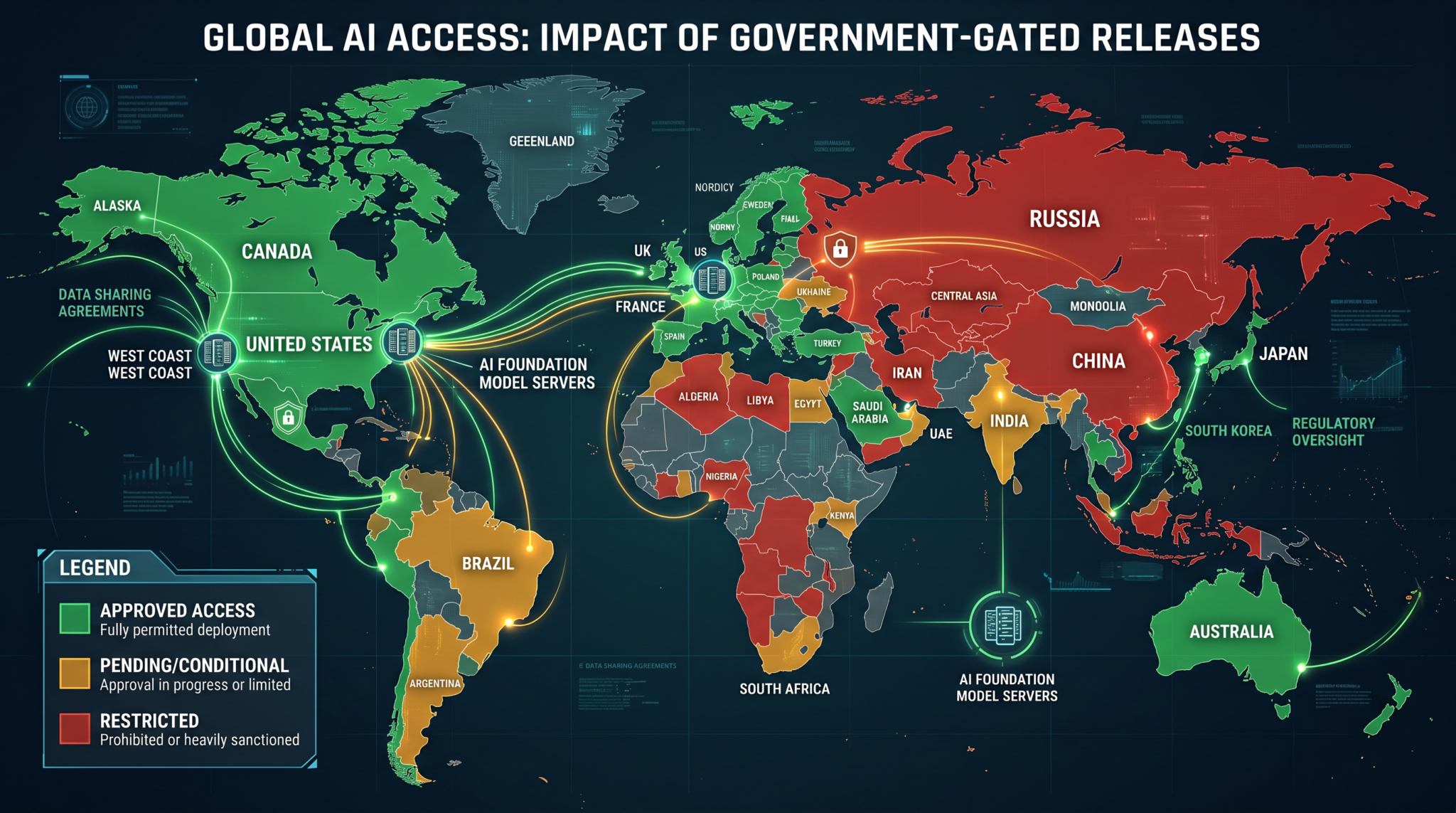
The treatment of Anthropic’s Mythos models—restricting access for foreign nationals and later disabling access for all customers—mirrors the logic of export control regimes used for sensitive technologies. Rather than shipping physical goods subject to the Export Administration Regulations (EAR) or International Traffic in Arms Regulations (ITAR), here the “export” is a capability delivered via API. The government’s approach effectively applies an access control overlay to an inherently borderless product.
This raises hard questions: can capability gating be done at the granularity of use case and user? How are “foreign national” restrictions applied in multi-national teams and cloud environments? What remedies exist for customers caught in mid-release changes? The Anthropic lawsuit indicates a contested legal landscape; meanwhile, developers must design for disruption and ambiguity.
Risk-based gating as the organizing principle
Regulators and providers are coalescing around risk-based gating—limiting access according to the potential for misuse or catastrophic harm. Practical implications include:
- Tiered capability exposure: Tool-use, code execution, autonomous planning, and content generation may be tiered differently across customers.
- Dynamic throttles: Rate limits, session lengths, function-calling privileges, and context window sizes can be adjusted dynamically based on policy signals.
- Continuous audits: Logging and audit trails become prerequisites for access; customers may need to attest to controls and submit to periodic verification.
These measures mirror safety engineering in other high-stakes domains but are novel for many software teams used to consistent, global SDKs.
3. Implications for Developers Building on OpenAI APIs
Developers relying on OpenAI APIs—especially for products that assume parity and stability across customer populations—must rethink assumptions. The shift to government-gated releases and trusted partner distribution will likely manifest in five technical and operational areas.
1) Access tiers and capability variance
Expect capability differences keyed to your organization’s trust tier. For GPT-5.6 (or successors), the same model ID may expose different features or safety filters based on your enrollment status:
- Feature flags: Some orgs may receive advanced tool-use, longer contexts, or plugin-like integrations.
- Safety interlocks: More aggressive refusals for higher-risk prompts; additional logging or human-in-the-loop requirements.
- Rate and concurrency shaping: Dynamic throttling for use cases with higher risk scores or unproven monitoring controls.
Action: Build your product so it does not assume capability uniformity. Feature-detect at runtime and degrade gracefully.
2) Identity, attestation, and audit trails
To qualify as a trusted partner or maintain access, you may need to implement and validate specific controls:
- Identity verification: Strong KYC/KYB for enterprise accounts; enforcement of organizational boundaries and SSO.
- Usage attestation: Documentation of prohibited use cases, red-teaming, and abuse reporting contact points.
- Auditability: End-to-end logs, prompt/response capture with PII safeguards, and incident response procedures.
Action: Treat these as core requirements. Establish an internal “AI compliance checklist,” bake logging into your SDKs, and preemptively prepare artifacts for vendor assessments.
3) API versioning and environment isolation
The model lifecycle may include sudden access restrictions, deprecations, or capability downgrades. To insulate your production systems:
- Pin versions: Use explicit model identifiers and maintain compatibility layers for multiple versions.
- Environment isolation: Separate dev, staging, and prod orgs; ensure configuration-as-code can swap models per environment.
- Traffic control: Use canary releases, circuit breakers, and percentage rollouts for model changes.
Action: Design your AI feature flags to toggle across providers and versions without redeploying core services.
4) Legal and operational shock absorbers
The Anthropic shutdown demonstrates that access can be curtailed abruptly. Build operational buffers:
- Service-level objectives (SLOs): Measure model availability and latency as you would any critical dependency.
- Business continuity plans (BCP): Define RTO/RPO for AI capabilities; document manual fallback workflows.
- Contractual clauses: Negotiate advance notice, escrow of integration artifacts, or service credits recognizing regulatory events.
Action: Run tabletop exercises simulating sudden model unavailability.
5) Cost and performance management under uncertainty
Restricted access may force you to blend advanced and mid-tier models. Carefully track cost-performance tradeoffs:
- Evaluation harnesses: Maintain benchmarks and golden datasets to compare outputs across models.
- Caching and reuse: Cache deterministic steps; generate and reuse tool plans where possible.
- Prompt portability: Write prompts that adapt across models with minimal loss of fidelity.
For a step-by-step guide on building a provider-agnostic router and evaluation harness that can tolerate model churn and capability gating, see our in-depth resource How to Build a a Research Assistant with Claude Code in 2026: Step-by-Step.
Reference architecture: a resilient model router
Below is a minimal illustration of a runtime router that detects capability flags and fails over across providers while preserving auditability.
# Python-like pseudocode

class ModelProvider:
    def __init__(self, name, supports_tools=False, max_context=4096):
        self.name = name
        self.supports_tools = supports_tools
        self.max_context = max_context

    def chat(self, messages, tools=None):
        # Implement provider-specific API call with structured retries
        # Return response plus metadata including capability headers
        pass

class Router:
    def __init__(self, providers, policy):
        self.providers = providers  # ordered by preference
        self.policy = policy        # e.g., risk_score thresholds, geo constraints

    def select(self, request):
        # Choose provider based on required capabilities and policy
        req_tools = request.get("tools_required", False)
        req_ctx = request.get("estimated_ctx", 2048)

        for p in self.providers:
            if req_tools and not p.supports_tools:
                continue
            if req_ctx > p.max_context:
                continue
            if not self.policy.allowed(p, request):
                continue
            yield p

    def execute(self, request):
        messages = request["messages"]
        tools = request.get("tools")

        for provider in self.select(request):
            try:
                resp = provider.chat(messages, tools=tools)
                self.audit_log(provider, request, resp)
                return resp
            except TransientError as e:
                self.audit_log(provider, request, error=e)
                continue
            except PolicyError as e:
                # Capability gated or policy denied; try next
                self.audit_log(provider, request, error=e)
                continue
        raise RuntimeError("No providers available")

    def audit_log(self, provider, request, resp=None, error=None):
        # Persist request metadata, provider, timestamp, outcome, latency
        pass

# Example setup
openai_56 = ModelProvider("gpt-5.6", supports_tools=True, max_context=200000)
openai_4o = ModelProvider("gpt-4o-mini", supports_tools=True, max_context=32768)
claude_m = ModelProvider("mythos", supports_tools=True, max_context=100000)
local_llm = ModelProvider("local-phi", supports_tools=False, max_context=8192)

policy = Policy(
    geo_allow=["US","CA","UK"],
    requires_attestation=True,
    block_foreign_national_use=True  # example policy knob you control
)
router = Router([openai_56, openai_4o, claude_m, local_llm], policy)
Operational telemetry you should collect today
- Per-model success/failure rates, refusal rates, latency percentiles.
- Geography and tenant breakdowns for access anomalies (to detect geofencing).
- Granular reasons for fallback (policy denied vs. capability missing vs. network error).
- Drift dashboards comparing outcome quality across providers over time.
4. Global Access and International Developer Impact
Government-gated releases collide with the reality that AI development teams are global. The restriction of Anthropic’s Mythos models to exclude all foreign nationals, followed by a blanket shutdown, illustrates how blunt instruments can be applied when compliance obligations are poorly specified or time-constrained.
Practical issues for global teams
- Foreign national restrictions within US entities: If a provider limits access to US persons only, US organizations employing non-US nationals may need to segregate access—by VPC, by workstation, or by user identity. This complicates collaboration and CI/CD pipelines.
- Cross-border environments: Geofencing may block API calls from non-approved countries or IP ranges. Cloud regions and egress controls will matter.
- Third-party dependencies: SaaS tools that integrate with restricted models can inherit the same constraints, creating cascading failures in your stack.
Mitigation patterns
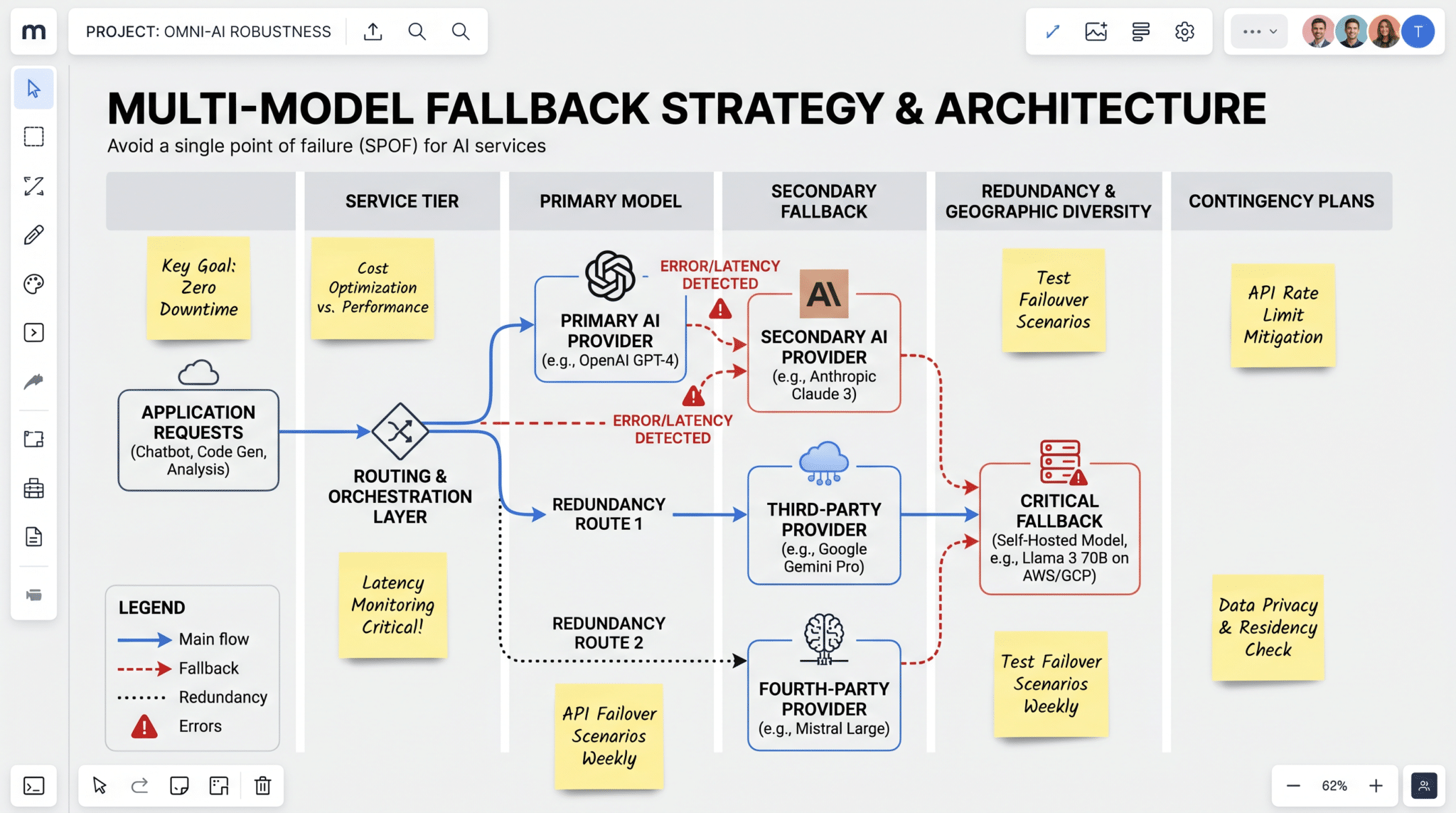
- Region-aware routing: Ensure your model router can steer traffic based on user and data residency requirements.
- Workspace partitioning: Split projects by trust tier; enforce RBAC so restricted models are only accessible to authorized users.
- Open-source fallbacks for prototyping: Maintain a baseline capability using permissive local or managed open-source models for non-sensitive work.
When access is contingent on nationality or geography, process design becomes as important as code. Document clearly who can use which model, from where, and for what purpose; automate enforcement wherever possible.
5. How Enterprises Should Plan for Model Access Uncertainty
Enterprises cannot afford brittle dependencies on a single provider or model. The possibility of sudden gating, capability downgrades, or complete shutdowns requires a programmatic approach to resilience.
Build an AI supply chain program
Treat model providers as part of your critical supplier list, with structured risk management:
- Supplier tiering: Classify providers by criticality and concentration risk.
- Due diligence: Assess model safety practices, audit readiness, and change management processes.
- Contingency planning: Define primary, secondary, and tertiary providers per capability.
Contract for change
Where possible, negotiate terms that address regulatory interventions:
- Advance notice: Reasonable efforts for pre-announced changes, with exceptions for legal compulsion.
- Migration assistance: Commitments for documentation and support in case of access loss.
- Credits or tiered pricing: Reflecting constrained capabilities or outages driven by compliance events.
Design for graceful degradation
Business stakeholders need clear answers when capabilities are curtailed:
- Define “minimum viable intelligence” tiers: What features can be maintained with mid-tier models?
- Fallback experiences: Offer alternative workflows, increased human review, or slower batch processing.
- Customer communication playbooks: Prepare templated messaging for capability changes and incident reports.
Regulatory posture as a competitive advantage
Being a trusted partner will increasingly hinge on your controls. Invest in:
- Data governance: Clear lineage, minimization, encryption, and access controls.
- Safety oversight: Red-teaming programs and issue tracking with SLAs.
- Internal training: Ensure engineers and PMs understand permitted uses, logging obligations, and escalation paths.
6. Comparisons with Other Regulated Industries
While AI isn’t a perfect analog to pharma or defense, lessons from those industries can inform your approach. The table below highlights structural similarities and differences relevant to planning.
| Dimension | Frontier AI (Current Gating) | Pharma | Defense/Export-Controlled Tech |
|---|---|---|---|
| Pre-Release Review | Government notice/review for advanced models per executive order | Formal clinical trials and regulatory approval (e.g., FDA) | Licenses and technical data controls before export |
| Access Scope | Trusted partners; possible foreign national restrictions | Prescriber and patient eligibility constraints | Limited to authorized parties and countries; US person rules |
| Capability Tiers | Dynamic capability flags, safety interlocks per customer | Dosing and indication limitations | Configuration limits, classification levels |
| Post-Release Monitoring | Logging/audit expectations; potential rollback or shutdown | Pharmacovigilance and adverse event reporting | Compliance audits; end-use checks |
| Globalization Constraints | Geofencing; nationality filters; cloud region sensitivity | Regulatory approval per country | Evolving export lists; sanctions regimes |
| Change Velocity | High—models can change weekly; policy can change abruptly | Low—years-long cycles | Medium—policy updates and license changes |
| Mitigation for Builders | Multi-model routing; evaluation harnesses; compliance-by-design | Supply redundancy; regulatory expertise | Technical data controls; trusted supplier networks |
The take-home lesson: evolve your AI engineering into a regulated-systems discipline. Build the muscle memory of controlled releases, traceability, and contingency operations.
7. The Security–Innovation Tension: Speed vs. Prudence
The primary policy argument for government-gated releases is that frontier models have dual-use potential—capable of powering beneficial applications and harmful misuse. Proponents argue that restricting early access allows testing, safeguards, and response planning before capabilities diffuse. Critics warn that gating entrenches incumbents, slows beneficial innovation, and risks creating a two-tier AI ecosystem: one for well-connected entities and another for everyone else.
Risks addressed by gating
- Rapid tool-enabled misuse: Tool use and code execution can supercharge malware development, social engineering, and disinformation.
- Autonomous agent behavior: Models with planning and memory can operate at scale with less human oversight.
- Information hazard leakage: Advanced reasoning may surface know-how that amplifies real-world risks.
Costs of gating
- Innovation slowdowns: Startups and researchers may lose first-mover advantages or be priced out of trusted tiers.
- Concentration of power: Gatekeeping can privilege a narrow set of customers and regions, reducing diversity.
- Compliance thrash: Sudden restrictions (as with Anthropic’s shutdown) can damage trust and impose high switching costs.
OpenAI has stated government approval should not be the long-term default. The open question is how quickly, and under what conditions, temporary gating transitions to durable, risk-proportionate access.
For developers, the debate’s outcome matters less than its operational reality. Plan for a world where high-end capabilities roll out slowly and conditionally, and where your architecture can capture upside when access expands and survive when it contracts.
8. What Developers Can Do Now: Multi-Model Strategies and Fallback Architectures
Technical resilience is your best hedge against policy volatility. A robust multi-model strategy reduces lock-in and minimizes downtime when a provider becomes unavailable or a capability is gated.
Core principles
- Abstraction: Decouple your business logic from provider-specific SDKs with a narrow, stable interface.
- Observability: Instrument end-to-end; you cannot route intelligently without accurate metrics.
- Evaluation: Maintain test sets and automatic comparisons across providers to detect regressions.
- Portability: Keep prompts and tools compatible across models; use adapters for idiosyncrasies.
Minimal cross-provider interface
// TypeScript-like example

export interface ChatRequest {
  messages: Array<{ role: "system" | "user" | "assistant"; content: string }>;
  tools?: Array<ToolSpec>;
  maxTokens?: number;
  temperature?: number;
  metadata?: Record<string, string>;
}

export interface ChatResponse {
  text: string;
  toolCalls?: Array<ToolInvocation>;
  usage?: { promptTokens: number; completionTokens: number };
  provider: string;
  model: string;
  latencyMs: number;
  refusal?: boolean;
  refusalReason?: string;
}

export interface ChatProvider {
  id: string;
  capabilities: { tools: boolean; maxContext: number };
  chat(req: ChatRequest): Promise<ChatResponse>;
}
Build specific providers implementing this interface for each vendor and for local models. Your router then selects based on policy and capability, not hard-coded names.
Prompt portability patterns
- System-first design: Encode core behavior in a concise system message; avoid provider-specific syntax.
- Few-shot neutral formatting: Use examples that do not depend on idiosyncratic markdown or tool schemas.
- Control tokens via metadata, not inline hacks: Keep temperature, token limits, and stop sequences outside the prompt where possible.
If you need a library of resilient prompt templates aligned to multi-model routing and human-in-the-loop review, see The 2026 Prompt Library: 5 Templates for Prompt Engineering.
Caching and canonicalization
For deterministic steps—like classification or data extraction—cache outputs keyed by normalized inputs. Canonicalize requests (lowercase, trimmed whitespace, consistent JSON ordering) to increase cache hits. For variable tasks, cache tool plans rather than final outputs; a weaker model can follow a strong model’s plan if needed.
Circuit breakers and health checks
Implement circuit breakers that detect elevated refusal rates or policy errors from a provider and re-route traffic automatically. Health checks should probe capabilities (e.g., tool-call success) and latency, not just HTTP availability.
Data firewalls for trust tiers
When your organization includes both trusted and untrusted contexts:
- Tag data and users: Attribute every request with user, geo, and data sensitivity.
- Enforce at the router: Deny or reroute requests that combine restricted data with restricted models.
- Audit every decision: Keep immutable logs of routing choices and policy bases.
Evaluation harness example
# Pseudocode for an evaluation harness

tests = load_tests("golden-set.jsonl")  # each test has input, expected, metrics
providers = [openai_56, openai_4o, claude_m, local_llm]

results = []
for t in tests:
    for p in providers:
        start = now()
        out = router.execute({
            "messages": t.messages,
            "tools_required": t.tools_required,
            "estimated_ctx": t.estimated_ctx,
            "metadata": {"test_id": t.id}
        })
        elapsed = now() - start
        score = t.metric(out.text)
        results.append({
            "test": t.id, "provider": p.name, "score": score, "latency": elapsed
        })

report = summarize(results)  # compare means, confidence intervals, cost
render_dashboard(report)
Run this harness on a schedule and before major releases to detect subtle capability changes. This is especially important in a regime where providers may dial back tool use, change refusal behavior, or adjust context limits to satisfy government guidance.
9. Scenarios and Timelines: What Could Happen Next
In a period of regulatory flux, scenario planning is better than prediction. Plan for several trajectories and set triggers to act.
Scenario A: Managed de-escalation
After an initial period of trusted partner releases, the government clarifies criteria for broader access—e.g., attestation templates, sectoral rules, and usage monitors. OpenAI gradually expands GPT-5.6 distribution with capability-specific guardrails. Anthropic reaches an interim agreement allowing partial restoration of Mythos access with nationality and use-case carveouts while litigation proceeds.
- Implication: Developers see staggered access but can qualify by meeting documented controls. Short-term friction, medium-term stability.
- Preparation: Invest in attestation, logging, and automated red-teaming to move up trust tiers quickly.
Scenario B: Prolonged restriction
Government maintains a narrow set of trusted partners for frontier capabilities. Broader release is limited to smaller context windows, no tool use, or heavier refusals. Anthropic’s lawsuit drags on, leaving customers uncertain about future access.
- Implication: A two-speed AI market emerges; startups rely more on open-source and mid-tier APIs.
- Preparation: Elevate your local and open-source model capabilities; refine router and evaluation harnesses.
Scenario C: Regulatory expansion
Additional models and providers are brought under pre-release disclosure mandates. The definition of “advanced” broadens to include mid-tier models with certain tool-use integrations.
- Implication: More of your stack is subject to gating; compliance burden rises.
- Preparation: Consolidate vendor management; standardize on a small set of controls and automate.
Scenario D: Legal reversal
Court rulings constrain the administration’s approach, limiting pre-release mandates or scope of restrictions. Providers maintain voluntary notice but pursue broader releases faster.
- Implication: Access expands, but providers may retain conservative gating for high-risk tools.
- Preparation: Continue building resilience; avoid re-centralizing on a single provider.
10. Governance, Compliance, and Ethics for AI Builders
Your internal governance is the lever you control. It determines both your eligibility for trusted access and your operational resilience when rules change.
Policy framework for AI use
- Permitted vs. prohibited uses: Enumerate allowed applications and explicitly ban high-risk misuse domains.
- Data classification: Define which data can be processed by which model tiers and in which regions.
- Human oversight: Set thresholds for human review across lifecycle stages—prompt design, output acceptance, and deployment.
Controls and audits
- Logging and retention: Capture prompts, responses, tool invocations, and user context in a secure archive with retention aligned to legal requirements.
- Change management: Formalize model updates via RFCs; require approvals and documented rollback plans.
- Red-teaming and safety testing: Establish recurring adversarial evaluations and remediation workflows.
Documentation and transparency
- Model inventories: Maintain a registry of models, versions, capabilities, and approved uses.
- SBOM for AI: Track dependencies, training data provenance where available, and fine-tuning sources.
- User-facing disclosures: Inform users when AI is used, with limitations and escalation channels.
Ethical considerations in a gated world
Gating can reduce misuse but can also entrench inequities. As builders:
- Promote fairness: When you have privileged access, consider offering API-powered services to smaller orgs under safe configurations.
- Invest in open tooling: Support open-source models and safety tools that broaden access responsibly.
- Participate in standards: Engage in industry groups defining audit formats, attestation schemas, and evaluation benchmarks.
11. Key Takeaways
- Government-gated AI releases are here, driven by a June 2026 executive order and specific requests to providers like OpenAI; Anthropic’s restrictive response and lawsuit underline the stakes.
- Access to frontier capabilities will be conditional, phased, and variable by customer—plan for capability flags, dynamic throttling, and evolving safety filters.
- Global teams must contend with nationality and geography restrictions; design your environments to enforce access boundaries programmatically.
- Enterprises need an AI supply chain program, contractual protections, and business continuity plans tailored to model dependencies.
- Borrow resilience patterns from regulated industries: controlled releases, auditable logs, contingency operations, and standards participation.
- Build multi-model, provider-agnostic architectures with robust evaluation and observability; treat resilience as a first-class feature.
- Balance innovation with responsibility—prepare to adopt safeguards that satisfy trust-tier criteria without sacrificing product velocity.
12. Frequently Asked Questions
Q1: I rely on OpenAI for production. What should I do first?
Inventory every feature that depends on a specific model capability (e.g., tool use, long context, function calling). Implement an abstraction layer that lets you switch models per feature flag. Stand up at least one alternative provider and one open-source fallback. Establish logging and attestation artifacts you can provide to vendors to qualify for higher trust tiers.
Q2: How do foreign national restrictions affect my US-based team?
If providers enforce nationality restrictions, you may need to segment access by user identity and network location. Enforce RBAC so only eligible users can invoke restricted models; route other users to alternative providers. Keep careful logs and document your enforcement controls—this can help with vendor due diligence.
Q3: Will gating slow down my product roadmap?
In the short term, yes—frontier capabilities may be slower to arrive or be granted. Mitigate by building prompt portability, multi-model routing, and open-source baselines so that non-critical features continue to evolve. Use evaluation harnesses to quickly validate and adopt newly available capabilities.
Q4: Are smaller companies at a disadvantage?
Trusted partner programs may initially favor larger enterprises with mature governance. Smaller companies can close the gap by adopting compliance-by-design: strong identity, logging, data governance, and transparent safety processes. Partnerships with managed service providers that already meet requirements can help.
Q5: Could the legal challenges reverse government gating?
Courts may limit or define the scope of mandates, but even with legal changes, providers are likely to maintain some gating for high-risk capabilities. Resilience and compliance investments will remain valuable regardless of how the legal landscape evolves.
Access 40,000+ AI Prompts for ChatGPT, Claude & Codex — Free!
Subscribe to get instant access to our complete Notion Prompt Library — the largest curated collection of prompts for ChatGPT, Claude, OpenAI Codex, and other leading AI models. Optimized for real-world workflows across coding, research, content creation, and business.
Closing Thoughts
We are entering a new era where leading-edge AI resembles other sensitive technologies: staged releases, restricted access, and detailed oversight. For developers and enterprises, this is not a reason to slow down; it is a call to level up. Build architectures that absorb shocks, governance that earns trust, and practices that accelerate responsible adoption. Those who adapt quickly will not only weather the transition—they will define the new playbook for regulated intelligence.
