
ChatGPT 5.5 Instant’s Multi-Step Tool Calling Bug: What Broke, What It Means for MCP Integrations, and How to Work Around It

What Happened: Summary of the 5.5 Instant Multi-Step Tool Calling Bug
ChatGPT 5.5 Instant introduced a regression that broke multi-step tool calling chains for a subset of use cases in both App tool integrations and MCP (Model Context Protocol) servers. The symptoms most teams saw:
- The assistant initiated the first tool call but failed to correctly initiate or wire the second or subsequent calls, even when the output of the first tool was necessary and correctly returned.
- The second tool call either never happened, happened with empty or malformed arguments, or referenced the wrong tool_call_id, breaking the chain.
- Context from earlier steps (e.g., a user_id discovered by step 1) wasn’t available to subsequent steps, causing plans to stall or produce incorrect final answers.
- Some developers noted intermittent behavior: identical prompts would sometimes complete correctly, other times stall or truncate prematurely.
The breakage disproportionately impacted MCP-based orchestrations because MCP typically involves tools hosted remotely with explicit routing, correlation IDs, and sometimes higher latency per step. Chains that rely on two or more dependent tools (search → fetch detail; list → read; auth → mutate) became unreliable. Single-step tool calling generally continued to work.
How Multi-Step Tool Calling Works Under the Hood
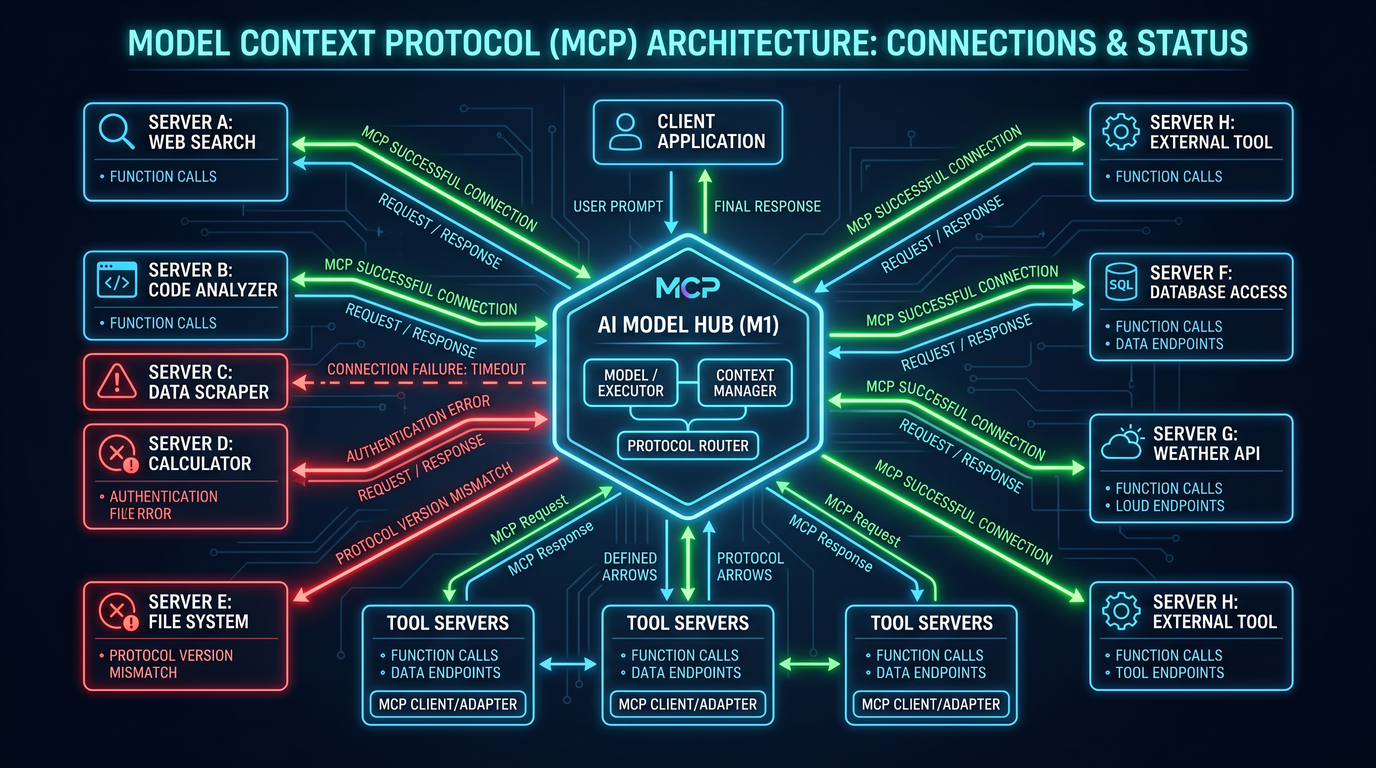
While each vendor’s implementation differs, modern LLM tool calling across OpenAI’s APIs and MCP has converged on a few core ideas:
1) Principles of multi-step tool calling
- Intent recognition and planning: The model determines whether tools are needed, which tools to run, and in what sequence. This can be implicit (model decides) or explicit (you instruct a planner step).
- Tool call emission: The assistant emits tool_calls with a function name and structured JSON arguments. Each call is assigned a tool_call_id (or equivalent) for correlation.
- Host execution: Your runtime or MCP router executes the tool(s), captures outputs, and returns results as tool-role messages tagged with the same correlation ID.
- Context assimilation: The model reads prior user, assistant, and tool messages, integrates tool outputs, and decides whether to make further calls or draft a final answer.
- Iteration until completion: This loop repeats until the model stops issuing tool calls and produces a final assistant message.
2) The message transcript as the single source of truth
In OpenAI-style chat APIs, each turn appends messages to a transcript:
- assistant with tool_calls: Signals which tools to call next and with what arguments.
- tool: Carries the result payload back to the model, paired by tool_call_id.
- assistant: Either calls more tools or provides the user-facing answer.
The reliability of multi-step orchestration hinges on the integrity of this transcript: the chain must preserve ordering, IDs, and enough context for the model to reason about subsequent steps. Any truncation, mismatch, or missing state can derail the chain.
3) MCP mechanics and why latency matters
MCP formalizes how models access external tools, resources, and data via a brokered protocol. Key characteristics:
- Remote procedure over a protocol: Tools are often hosted in separate processes or services. Calls traverse a transport layer with their own correlationId and payload.
- State externalization: Results come back as JSON payloads that must be faithfully re-injected into the chat transcript as tool-role messages.
- Backpressure and buffering: Latencies and streaming can complicate when the model sees which results, especially if multiple calls execute in parallel.
MCP adds flexibility, but also surfaces more ways a fragile link (IDs, out-of-order results, partial transcripts) can break a chain when the model expects deterministic, strictly-ordered context.
What Specifically Broke in 5.5 Instant
Based on developer reports and comparative testing against GPT‑5.5 Standard, the bug manifested in two primary failure modes:
1) Tool call chaining broke between steps
The assistant would correctly produce the first tool call, your runtime executed it, and you returned the result with the correct tool_call_id. But when prompting the model again with the updated transcript, it would:
- Fail to produce the next necessary tool call altogether, prematurely responding with a generic or partial final answer; or
- Produce a second tool call whose arguments were missing fields derived from the first tool’s result; or
- Re-issue the first tool call again (loop) as if the result had not been seen.
2) Context passing between steps degraded
Even when the second call was emitted, the arguments sometimes omitted values that were present in the tool result, such as:
- A record ID or handle obtained in step 1 that must be used in step 2.
- A continuation token or pagination cursor.
- An auth/session token or nonce that a tool explicitly returned.
Developers also observed occasional tool_call_id mismatches: the assistant referenced an ID that didn’t match any prior pending calls, or it attached a result to the wrong ID, confusing the next step.
Plausible root causes (inferred)
OpenAI has not publicly documented an exact root cause at the granularity of internal engine details. However, behavioral signatures point to one or more of:
- Aggressive step coalescing or parallelization: A latency optimization in 5.5 Instant may have coalesced or reordered tool call deltas, interfering with step boundaries and correlation.
- Context window pressure heuristics: Messages with tool-role content may have been truncated or deprioritized in the attention window, obscuring prior step outputs.
- ID propagation regression: A regression in how tool_call_id is generated or carried across stream frames could cause mismatched or missing IDs in the transcript consumed by the model on the next step.
Regardless of internal cause, the externally visible contract—the transcript and the model’s ability to chain calls correctly—was violated in some proportion of runs on 5.5 Instant. GPT‑5.5 Standard did not show the same issues at the same rate, suggesting the bug is specific to the Instant variant’s orchestration heuristics.
Impact on Developers Using MCP Integrations
The immediate impacts varied by architecture and workload profile:
- High-latency, multi-hop MCP flows: Chains like “search tickets → fetch ticket → redact PII → draft reply” suffered partial completions. Systems returned draft replies missing details or skipped the redact step.
- Stateful tools: Tools that return opaque handles or session IDs (common in MCP) saw increased “invalid handle” errors downstream because the second step never received the handle.
- Idempotency and duplicate calls: Some teams reported duplicate first-step calls as the assistant “forgot” it already called a tool. Without idempotency keys, this caused duplicate side effects (e.g., creating duplicate records).
- SLO breaches: Time-to-resolution and correctness dipped. Teams with user-facing assistants had to roll back to GPT‑5.5 Standard or disable impacted features.
| Symptom | Observed Effect | Risk Level | Immediate Mitigation |
|---|---|---|---|
| Second tool call never fires | Model responds prematurely with partial answer | High for multi-hop tasks | Fallback to GPT‑5.5 Standard or orchestrate steps in host code |
| Arguments missing required fields | Tool validation errors; chain stalls | Medium–High | Argument guards; prompt injection of explicit state JSON |
| tool_call_id mismatch | Results not correlated; retries or loops | High | Strict correlation checks; abort on mismatch; idempotency keys |
| Duplicate first calls | Side effects repeated (e.g., duplicate tickets) | High (if non-idempotent) | Idempotency tokens; dedupe at tool boundary |
For MCP specifically, failures impact not just application correctness but protocol trust. MCP servers expect clients to manage correlationId and to return outputs deterministically. When the model’s chain doesn’t honor those expectations, you can still “force” correctness by taking more orchestration responsibility in your client or broker.
Community Reactions and Real-World Reports
The developer community quickly zeroed in on patterns:
- Side-by-side tests: Identical transcripts run on GPT‑5.5 Standard reliably completed; 5.5 Instant intermittently broke after step 1.
- Streaming sensitivity: Some saw higher failure rates when streaming was enabled, suggesting issues in how partial deltas were assembled.
- Parallel tool calls: Disabling or avoiding parallel calls improved reliability; serializing steps in the host reduced broken chains.
- MCP susceptibility: Chains spanning 2–4 tools with MCP routing and 200–1000 ms per step were more fragile, possibly due to timing and buffer heuristics.
Organizations with strict SLOs temporarily pinned to GPT‑5.5 Standard or implemented a hybrid policy: fast path uses 5.5 Instant for single-step tools; multi-step chains route to Standard or a host-orchestrated planner/executor flow. A number of maintainers published minimal repro code and logs that match the failure modes documented in this article.
If you maintain public SDKs or templates related to MCP, consider flagging this issue prominently and offering defaults that bypass 5.5 Instant for multi-step chains until a confirmed fix is deployed. Also, add references to foundational resources like For a deeper exploration of this topic, our comprehensive guide on 10 Best AI Research Tools for data analysis Compared — Features, Pricing, Use Cases provides detailed strategies and implementation frameworks that complement the approaches discussed in this section. and For a deeper exploration of this topic, our comprehensive guide on The Complete Guide to Google’s Agent2Agent Protocol and OpenAI Codex Interoperability: Building Cross-Platform AI Agent Systems provides detailed strategies and implementation frameworks that complement the approaches discussed in this section. in your docs to help users harden their integrations.
Reproducing the Bug: Minimal Test Cases
These examples illustrate the difference between expected behavior and what teams observed with 5.5 Instant. They also provide a scaffold for regression tests you can keep in your CI suite.
Python: two-step chain (broken on 5.5 Instant), works on GPT‑5.5 Standard
# pip install openai
from openai import OpenAI

client = OpenAI()

tools = [
    {
        "type": "function",
        "function": {
            "name": "search_tickets",
            "description": "Searches tickets by keyword and returns a list of {id, title}",
            "parameters": {
                "type": "object",
                "properties": {
                    "q": {"type": "string"}
                },
                "required": ["q"]
            }
        }
    },
    {
        "type": "function",
        "function": {
            "name": "get_ticket",
            "description": "Fetches full ticket details by id",
            "parameters": {
                "type": "object",
                "properties": {
                    "id": {"type": "string"}
                },
                "required": ["id"]
            }
        }
    }
]

messages = [
    {"role": "system", "content": "You are a support assistant. Use tools to fetch accurate ticket details."},
    {"role": "user", "content": "Find the ticket about 'billing limit' and tell me the full description."}
]

def run(model):
    # Step 1: ask the model to use tools
    r = client.chat.completions.create(
        model=model, # try "gpt-5.5-instant" vs "gpt-5.5"
        messages=messages,
        tools=tools,
        tool_choice="auto",
        temperature=0
    )
    a = r.choices[0].message
    print("ASSISTANT(step1):", a)
    # Expect: assistant emits tool_calls -> search_tickets with q="billing limit"

    # Simulate host executing the tool call:
    tool_calls = a.tool_calls or []
    new_messages = messages + [{"role": "assistant", "tool_calls": [tc.dict() for tc in tool_calls]}]

    for tc in tool_calls:
        if tc.function.name == "search_tickets":
            result = {"results": [{"id": "T-1029", "title": "Billing limit raised failure"}]}
        else:
            result = {"error": "unexpected tool"}

        new_messages.append({
            "role": "tool",
            "tool_call_id": tc.id,
            "content": json_dumps(result)
        })

    # Step 2: feed tool results back; expect get_ticket call with id="T-1029"
    r2 = client.chat.completions.create(
        model=model,
        messages=new_messages,
        tools=tools,
        tool_choice="auto",
        temperature=0
    )
    a2 = r2.choices[0].message
    print("ASSISTANT(step2):", a2)

    return a, a2

# On GPT-5.5 Standard, a2.tool_calls[0].function.name == "get_ticket" with correct id.
# On 5.5 Instant (broken case), a2 might be a final answer missing details,
# or a 'get_ticket' call with empty args, or a repeated 'search_tickets'.
In failing runs on 5.5 Instant, we’ve seen the step 2 assistant message either skip the second tool call, or include:
{
  "role": "assistant",
  "tool_calls": [
    {
      "id": "call_abc",
      "type": "function",
      "function": {
        "name": "get_ticket",
        "arguments": "{}"  // Missing "id"
      }
    }
  ]
}
Or it reissues the first step:
{
  "role": "assistant",
  "tool_calls": [
    {
      "id": "call_def",
      "type": "function",
      "function": {
        "name": "search_tickets",
        "arguments": "{\"q\":\"billing limit\"}"
      }
    }
  ]
}
Node.js (Responses API): argument loss and ID mismatch
// npm i openai
import OpenAI from "openai";
const client = new OpenAI();

const tools = [
  {
    type: "function",
    function: {
      name: "list_files",
      description: "List files in a directory",
      parameters: {
        type: "object",
        properties: { path: { type: "string" } },
        required: ["path"]
      }
    }
  },
  {
    type: "function",
    function: {
      name: "read_file",
      description: "Read contents of a file",
      parameters: {
        type: "object",
        properties: { path: { type: "string" }, name: { type: "string" } },
        required: ["path", "name"]
      }
    }
  }
];

async function run(model) {
  const messages = [
    { role: "system", content: "Use tools to inspect files. Always read the most recent log.txt." },
    { role: "user", content: "What was the last error in the logs under /var/app?" }
  ];

  // Step 1
  const r1 = await client.chat.completions.create({
    model,
    messages,
    tools,
    tool_choice: "auto",
    temperature: 0
  });

  const a1 = r1.choices[0].message;
  console.log("ASSISTANT step1:", a1);

  const toolCalls = a1.tool_calls || [];
  const msg2 = [...messages, { role: "assistant", tool_calls: toolCalls }];

  for (const tc of toolCalls) {
    if (tc.function.name === "list_files") {
      const result = { files: [{ name: "log.txt", mtime: 1700000000 }, { name: "old.txt", mtime: 1600000000 }] };
      msg2.push({ role: "tool", tool_call_id: tc.id, content: JSON.stringify(result) });
    }
  }

  // Step 2: expect a read_file call with name="log.txt"
  const r2 = await client.chat.completions.create({
    model,
    messages: msg2,
    tools,
    tool_choice: "auto",
    temperature: 0
  });
  console.log("ASSISTANT step2:", r2.choices[0].message);
}

run("gpt-5.5-instant"); // sometimes broken
// run("gpt-5.5"); // typically works
On failure, step 2 may contain:
- A read_file call with empty arguments:
{"path":"","name":""} - A
tool_call_idreferencing a non-existent prior id - A premature final answer stating “I checked the logs…” without ever calling
read_file
MCP transcript: mis-correlated tool results
On the MCP wire, you might observe a correct callTool request followed by a well-formed toolResult, but the next assistant emission assumes it never received the result. Pseudocode outline:
// client -> MCP server
{
  "type": "callTool",
  "correlationId": "c1",
  "toolName": "accounts.search",
  "args": { "email": "[email protected]" }
}

// MCP server -> client
{
  "type": "toolResult",
  "correlationId": "c1",
  "content": { "userId": "U-77" }
}

// client -> LLM (assistant step 2)
// assistant unexpectedly emits:
// callTool: accounts.search (again)  // should have used accounts.get with userId=U-77
Even with correct MCP handling, the assistant’s reasoning step failed to incorporate the tool result into the next step. This indicates the issue is model-side orchestration rather than an MCP transport or SDK bug in many cases.
Workarounds That Actually Work
Below are pragmatic approaches teams used to stabilize production while retaining as much capability and performance as possible.
1) Prefer GPT‑5.5 Standard for multi-step chains
The simplest path: route multi-step tool sequences to GPT‑5.5 Standard and reserve 5.5 Instant for single-step calls or purely generative tasks. Example policy router:
function selectModel(taskProfile) {
  // Simple heuristic: if a tool plan needs >= 2 dependent steps, avoid Instant
  if (taskProfile.needsMultiStep && !taskProfile.isParallelizable) {
    return "gpt-5.5"; // Standard
  }
  return "gpt-5.5-instant";
}
In practice, this single switch removed the bulk of instability for teams that could tolerate slightly higher latency on complex tasks.
2) Collapse into single-step tool calls when feasible
If your chain only uses the first step to discover a key that you could obtain another way—or if the second step can be parameterized without a separate turn—you can collapse steps. Two strategies:
- Tool accepts richer arguments: Evolve tool schemas to accept both search criteria and an optional ID, with the tool resolving the best record.
- Host-side prefetch: Pre-run the discovery step in host code, then ask the model to call the final tool only with prefilled arguments.
// Before: model calls search_tickets, then get_ticket
// After: single tool that takes a query or id and always returns full detail

{
  "name": "resolve_ticket_details",
  "parameters": {
    "type": "object",
    "properties": {
      "q": { "type": "string" },
      "id": { "type": "string" }
    }
  }
}
3) Host-orchestrated planner/executor pattern
Instead of letting the model directly chain tool calls, you can:
- Ask the model to output a structured plan JSON (no tool calls yet).
- Execute the plan deterministically in your code (or via MCP) step-by-step.
- Return a consolidated state summary to the model for the final write-up or next decision.
// Step A: planning-only prompt
system: "You are a planner. Output a JSON plan of steps with tool names and arguments. Do not call tools."
user: "Find the ticket about 'billing limit' and summarize details."

assistant: {
  "plan": [
    { "tool": "search_tickets", "args": { "q": "billing limit" } },
    { "tool": "get_ticket", "args": { "id": "$.plan[0].result[0].id" } }
  ]
}

// Host executes this plan, then provides:
system: "Here are results from your executed plan. Write the final answer."
assistant(tool_results): { ... full details ... }
This approach removes the assistant’s dependency on multi-step tool chaining logic, using the model primarily for planning and summarization. It’s robust and keeps 5.5 Instant in play for fast planning.
4) Batching tool calls with host-side merging
When steps are independent or can be parallelized safely, batch them and merge results host-side. For example, listing files and reading a predefined file “log.txt” can be parallel if the directory is stable.
// Assistant emits a single tool call with a batch payload:
{
  "role": "assistant",
  "tool_calls": [
    {
      "id": "call_b1",
      "type": "function",
      "function": {
        "name": "batch",
        "arguments": "{\"calls\":[{\"tool\":\"list_files\",\"args\":{\"path\":\"/var/app\"}},{\"tool\":\"read_file\",\"args\":{\"path\":\"/var/app\",\"name\":\"log.txt\"}}]}"
      }
    }
  ]
}
If your infrastructure cannot define a batch tool, implement batching at the host layer: intercept the assistant’s plan or normalize the prompt to nudge the model to propose a batch, then translate into two parallel MCP calls under one correlation umbrella.
5) Force serialization and disable parallel tool calls (if supported)
Some APIs support toggling parallelization hints. If available, set parallel tool calls to false to enforce a single outstanding call per step:
client.chat.completions.create({
  model: "gpt-5.5-instant",
  messages,
  tools,
  // Not all SDKs expose this flag; where available, it can improve reliability.
  parallel_tool_calls: false,
  temperature: 0
});
If your SDK doesn’t support such a flag, serialize at the host layer: do not allow the next request to the model until you have fully injected all tool-role messages for the previous calls.
6) Prompted scratchpad: make state explicit in the transcript
Instruct the assistant to maintain an explicit JSON “state” object at each step, copying forward critical fields. This gives the model a stable anchor and makes truncation more visible.
system: "When you call tools, also maintain a JSON 'state' with derived fields. Always echo state in each assistant message."

assistant (after search_tickets):
"Calling get_ticket with id from state."
STATE: {"selectedTicketId":"T-1029","query":"billing limit"}

assistant.tool_calls: [{ name: "get_ticket", arguments: {"id":"T-1029"} }]
Combined with validation (reject any tool call where state.selectedTicketId is missing), this can prevent silent failures from producing incorrect final answers.
7) Model swap at runtime with circuit breakers
Implement a circuit breaker: if you detect a broken chain (missing required arguments or a premature final answer), retry the same turn on GPT‑5.5 Standard:
async function guardedTurn(request, preferredModel, fallbackModel) {
  const res = await callLLM(preferredModel, request);
  if (isBrokenToolChain(res)) {
    return await callLLM(fallbackModel, request);
  }
  return res;
}
Define isBrokenToolChain conservatively: reject if the model skips expected steps, emits invalid arguments, or produces a final answer where your policy requires a verified tool-backed answer.
Best Practices for Defensive Tool Calling Patterns
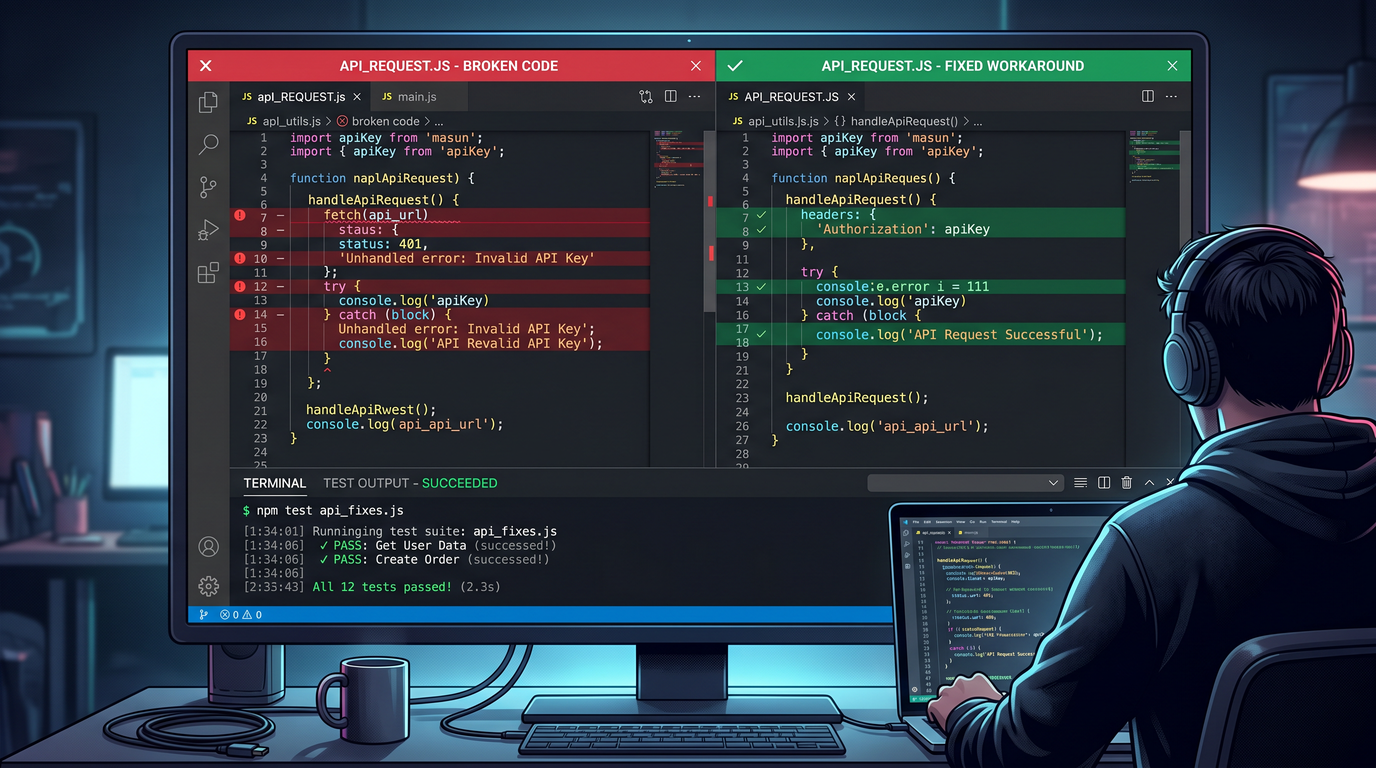
Beyond immediate workarounds, teams should harden their integrations. Tool calling is a distributed system: treat it with the same rigor you apply to microservices orchestration.
1) Strong contracts and correlation
- Enforce correlation: Every tool-role message must include the exact tool_call_id returned by the assistant. If IDs mismatch, abort the step and ask the model to re-issue with a correct ID.
- Idempotency keys: Include a
requestIdoridempotencyKeyper call. Tools should dedupe side effects when processing duplicates. - Opaque handles: Tools should return opaque handles rather than sensitive primary keys, along with a short-lived signature. This lets you verify integrity on subsequent steps.
2) Schemas, guards, and argument validation
- Strict JSON schemas: Validate all arguments against JSON Schema. Reject tool calls with missing required fields; respond with a clear “invalid arguments” tool result for the model to correct itself.
- Value-level guards: Assert invariants: e.g.,
idmust be non-empty;pathmust be absolute;emailmust match regex. Never allow a partial call to proceed. - Canonical references: Where possible, include both human-readable labels and canonical IDs in results. The model might lose the label but retain the ID (or vice versa).
3) State machines and step budgets
- Explicit chain state: Maintain a host-side state machine (DISCOVER → RESOLVE → SUMMARIZE). Only permit transitions that make sense.
- Step budgets: Cap the number of tool call rounds per request to prevent loops. If exceeded, escalate to fallback logic.
- Timeouts and retries: Use exponential backoff and timeouts per tool step. Retries should carry the same idempotency key.
4) Prompt discipline: deterministic scaffolding
- Role separation: Use a planner prompt for deciding steps, and an executor prompt for calling tools. Blend only if you have strong guardrails.
- Structured outputs: Ask the model to produce explicit JSON for plans and for state snapshots. Avoid freeform prose in tool-calling turns.
- Echo critical inputs: Force the model to restate “I will call get_ticket with id=T-1029” in the assistant message content, not just in tool_calls.
5) Telemetry and transcript capture
- Full transcripts: Store the entire message history (minus sensitive payloads) with precise timestamps, tool IDs, and arguments for reproducibility.
- Event metrics: Count per-turn: tool calls requested, tool calls executed, validation failures, ID mismatches, loops detected, fallbacks triggered.
- Golden traces: Maintain a suite of canonical tasks whose correct transcripts are known-good. Compare live runs against these to detect drift.
6) Security hardening
- Least privilege: Tools should scope permissions strictly; a misrouted second step shouldn’t have carte blanche to mutate unrelated data.
- Output filtering: Sanitize tool outputs included in the transcript to prevent untrusted JSON from steering the model into unsafe behavior.
- Red-teaming prompts: Test prompts where the tool returns adversarial content (e.g., “id”: “; DROP TABLE”). Ensure your validators and quoting are robust.
OpenAI’s Response Timeline and How to Track Fixes
Teams observed a familiar incident arc: detection by the community, acknowledgment, mitigations, and eventual fix rollout. Because exact timing varies and may change, use the following as a template rather than gospel.
Representative timeline (reconstructed)
- Day 0: Developers report inconsistent multi-step tool chaining on 5.5 Instant. Minimal repro snippets circulate. Workarounds trend: “Use GPT‑5.5 Standard for multi-step.”
- Day 1: Acknowledgment from OpenAI via support channels and community threads. Guidance to pin to GPT‑5.5 Standard for complex chains; ongoing investigation mentioned.
- Day 2–3: Partial mitigation lands for some regions or accounts (e.g., configuration toggles that reduce aggressive step coalescing). Reliability improves but doesn’t fully match GPT‑5.5 Standard.
- Day 4+: Broader fix rollout. Updated model snapshot notes mention “improved multi-step tool calling stability.” Teams gradually revert traffic back to 5.5 Instant for controlled cohorts.
To track progress reliably:
- Status page and release notes: Monitor official status updates and model snapshot change logs.
- Version pinning: Pin to a known-good model snapshot if available to prevent regressions during auto-updates.
- Canary cohorts: Return 5–10% of traffic to 5.5 Instant first; compare tool chain metrics against GPT‑5.5 Standard before full rollout.
While community accounts suggest a fix is in progress or partially deployed, always verify with your own canary metrics before ramping 5.5 Instant back up for multi-step chains.
Monitoring, Testing, and Safeguards You Should Add Now
Even after vendor-side fixes, keep your safeguards. Tool calling will remain a complex, distributed dance across the model, your host, and often MCP servers. The following practices offer durable protection.
1) Detect broken chains in real time
- Policy validators: For each task profile, declare minimum required steps. If the assistant issues a final answer without hitting these steps, mark as policy violation and trigger a fallback.
- Argument sanity checks: Block tool calls with empty or defaulted critical fields. Provide the model with structured error messages it can use to self-correct.
- Loop detection: Track repeated tool calls with the same arguments; if repeated twice without progress, ask the model to propose an alternative plan or escalate.
2) Golden regressions and shadow testing
- Golden tasks: Maintain a library of canonical transcripts with expected tool call sequences. Periodically re-run them against your current model configuration.
- Shadow runs: When trialing 5.5 Instant again, run shadow requests in parallel with GPT‑5.5 Standard on read-only copies of tools. Compare tool call sequences and final answers.
- Assertion-based prompts: Have the assistant affirm “I called get_ticket with id=T-1029” and verify this against the transcript. Mismatches flag a regression.
3) Contract tests for tools
- Schema contracts: Unit tests asserting that critical arguments are non-empty and valid; fuzz tests for malformed JSON and type mismatches.
- Idempotency tests: Simulate duplicate calls and confirm the tool does not produce double side effects.
- Security contracts: Ensure tools reject directory traversal, SQL injection in arguments, or unexpected command execution vectors.
4) MCP-specific resilience measures
- Correlation fidelity: Propagate correlationId across every hop. Reject any response that cannot be matched cleanly.
- Timeout-aware brokers: If an MCP server is slow, buffer the assistant until all tool results for the step have arrived; avoid partial context re-queries.
- Backpressure and queueing: Limit concurrent MCP calls per session to reduce head-of-line blocking and complexity.
What This Means for the MCP Ecosystem Going Forward
The bug is a reminder that tool calling, especially across a protocol like MCP, is not a single binary capability—it’s a layered system with orchestration semantics, latency, and identity. Several directional shifts are likely:
1) More host-side orchestration for critical paths
Teams will increasingly handle the multi-step chains themselves, relegating the model to planning and natural language interfaces. Expect more open-source “planner/executor” scaffolds in MCP brokers and AI gateways.
2) Schema-first, state-aware tools
Tool authors will embrace stricter schemas, signed state tokens, and explicit step counters. The model will be asked to surface and maintain these tokens between steps in a “state scratchpad” the host can validate.
3) Observability as a first-class concern
MCP toolchains will standardize on trace IDs, structured logs, and transcript archives. Expect to see more tooling that can visualize tool call graphs per request and flag anomalies like skipped steps or argument drift.
4) Stable model contracts and feature flags
Vendors may introduce flags to control parallelization, step coalescing, and transcript shaping, giving developers control over determinism vs. latency. Model snapshot pinning will become the norm for production MCP workloads.
5) Protocol-level guardrails
MCP itself may evolve with optional features for:
- Cross-step state tokens: A standard field for step state and signatures.
- Tool semantics hints: Declaring a tool as non-idempotent or destructive, prompting the client to enforce stricter dedupe before execution.
- Batch and plan primitives: First-class representations for batched or planned sequences to minimize orchestration ambiguity.
For teams migrating from plugin-style integrations to MCP, this incident underscores the importance of staging rollouts and maintaining strong fallbacks. It also strengthens the case for consolidated internal guidance, such as For a deeper exploration of this topic, our comprehensive guide on 40 ChatGPT-5.5 Prompts for Academic Researchers: Literature Reviews, Hypothesis Generation, Data Interpretation, and Paper Writing provides detailed strategies and implementation frameworks that complement the approaches discussed in this section., to ensure teams adopt proven resilience patterns.
Engineering Checklist: Make Your Integration Resilient
Use this checklist as a practical reference while updating your codebase.
Routing and model selection
- Route multi-step chains to GPT‑5.5 Standard until you’ve canaried 5.5 Instant successfully.
- Introduce a circuit breaker that retries broken chains on a fallback model.
- Detect single-step tasks and allow 5.5 Instant for speed.
Orchestration and state
- Adopt a planner/executor pattern for critical paths; keep tool chaining deterministic in host code.
- Maintain an explicit JSON state and require the assistant to echo it each step.
- Enforce step budgets and transitions with a host-side state machine.
Validation and safety
- Validate tool arguments strictly against JSON Schema; reject and request correction on failure.
- Add idempotency keys to every tool call; dedupe side effects server-side.
- Abort on tool_call_id mismatches; never “guess” correlation.
MCP-specific checks
- Propagate and verify correlationId end-to-end; assert ordering where required.
- Serialize steps at the broker if parallelization causes flakiness.
- Buffer and apply backpressure to avoid partial-context requests.
Observability and testing
- Capture full transcripts and tool telemetry with timestamps, IDs, and arguments.
- Maintain golden traces; regularly run them on canary cohorts across model variants.
- Implement shadow testing to compare 5.5 Instant against GPT‑5.5 Standard behavior.
Code: Broken Behavior vs. Working Workarounds
Broken transcript example (5.5 Instant) vs. expected chain
// Expected (Standard)
[
  { "role": "user", "content": "Summarize the description of the latest 'billing limit' ticket." },
  { "role": "assistant", "tool_calls": [
    { "id": "tc1", "type": "function",
      "function": { "name": "search_tickets", "arguments": "{\"q\":\"billing limit\"}" }
    }]
  },
  { "role": "tool", "tool_call_id": "tc1",
    "content": "{\"results\":[{\"id\":\"T-1029\",\"title\":\"Billing limit raised failure\"}]}" },
  { "role": "assistant", "tool_calls": [
    { "id": "tc2", "type": "function",
      "function": { "name": "get_ticket", "arguments": "{\"id\":\"T-1029\"}" }
    }]
  },
  { "role": "tool", "tool_call_id": "tc2",
    "content": "{\"id\":\"T-1029\",\"description\":\"...full text...\"}" },
  { "role": "assistant", "content": "Summary: ..." }
]

// Broken (Instant) - step 2 arguments lost
[
  ... same first three messages ...,
  { "role": "assistant", "tool_calls": [
    { "id": "tc2", "type": "function",
      "function": { "name": "get_ticket", "arguments": "{}" } // <-- lost "id"
    }]
  }
]
Workaround: host-orchestrated plan execution
import json
from openai import OpenAI
client = OpenAI()

PLANNER_PROMPT = """
You are a task planner. Output only valid JSON with a 'plan' array.
Each step has 'tool' and 'args'. No prose.
"""

def plan_task(user_request):
  r = client.chat.completions.create(
    model="gpt-5.5-instant",
    messages=[
      {"role":"system","content":PLANNER_PROMPT},
      {"role":"user","content":user_request}
    ],
    temperature=0
  )
  content = r.choices[0].message.content
  return json.loads(content)["plan"]

def execute_plan(plan, mcp_client):
  state = {}
  results = []
  for i, step in enumerate(plan):
    tool = step["tool"]
    args = resolve_args(step["args"], results, state)
    out = mcp_client.call(tool, args)  # deterministic host execution
    results.append({"step": i, "tool": tool, "args": args, "result": out})
    update_state(state, out)
  return {"state": state, "results": results}

def final_answer(context):
  r = client.chat.completions.create(
    model="gpt-5.5-instant",
    messages=[
      {"role":"system","content":"Write a concise answer using provided results. Do not call tools."},
      {"role":"assistant","content":json.dumps(context)}
    ],
    temperature=0
  )
  return r.choices[0].message.content
Workaround: argument guards with self-correction
function validateArgs(toolName, args) {
  switch (toolName) {
    case "get_ticket":
      if (!args.id || typeof args.id !== "string") {
        return { ok: false, reason: "missing or invalid 'id' for get_ticket" };
      }
      return { ok: true };
    default:
      return { ok: true };
  }
}

async function maybeExecuteToolCall(tc) {
  const parsed = JSON.parse(tc.function.arguments || "{}");
  const v = validateArgs(tc.function.name, parsed);
  if (!v.ok) {
    return {
      role: "tool",
      tool_call_id: tc.id,
      content: JSON.stringify({ error: "ARGUMENT_VALIDATION_FAILED", detail: v.reason })
    };
  }
  const result = await dispatchTool(tc.function.name, parsed);
  return { role: "tool", tool_call_id: tc.id, content: JSON.stringify(result) };
}

// The assistant will often repair arguments on the next turn when given structured error feedback.
Workaround: serialize at MCP broker
// Pseudocode broker ensuring one outstanding tool call at a time per session
class SerialBroker {
  constructor() { this.sessions = new Map(); }
  async handleAssistantStep(sessionId, assistantMsg) {
    const session = this.sessions.get(sessionId) || { queue: [], executing: false };
    for (const tc of (assistantMsg.tool_calls || [])) {
      session.queue.push(tc);
    }
    this.sessions.set(sessionId, session);
    if (!session.executing) {
      await this._drain(sessionId);
    }
  }
  async _drain(sessionId) {
    const session = this.sessions.get(sessionId);
    session.executing = true;
    while (session.queue.length) {
      const tc = session.queue.shift();
      const res = await this._execute(tc); // call MCP server
      await this._returnToolResult(tc.id, res); // inject tool-role message
    }
    session.executing = false;
  }
}
Edge Cases and Subtleties Worth Calling Out
- Streaming deltas: If you stream assistant deltas and execute tool calls immediately upon seeing a partial tool call, you risk acting on incomplete arguments. Buffer until the tool call is complete or until an explicit end-of-call marker.
- Tool result size: Large tool outputs, if not chunked or summarized, may push crucial earlier messages out of the model’s working context. Favor succinct outputs or return references the model can dereference selectively.
- Implicit parallelism: Even if you don’t request parallel calls, the assistant may emit multiple tool calls in one turn. Your runtime must correctly execute and reinject all results before advancing the conversation.
- Retries and determinism: If you retry the same assistant turn, ensure the tool result reinjection remains deterministic. Duplicate tool results with the same tool_call_id can confuse transcript replay. Prefer to regenerate a fresh assistant turn.
- Session stickiness: If you load-balance MCP servers, be sure correlation and ephemeral state follow the session; otherwise, step 2 may see an empty cache.
Frequently Asked Questions
Does this only affect MCP users?
No. The bug surfaces more clearly with MCP due to multi-hop orchestration and latency, but any multi-step tool chain (even local tools) can be impacted.
Is single-step tool calling safe on 5.5 Instant?
Most reports indicate yes. Single-step calls with simple schemas were stable. Still, implement argument validation and idempotency.
Will disabling streaming help?
Some teams saw improved reliability when turning off streaming or when deferring execution until complete tool_calls were received. Your mileage may vary; test against your workload.
How do I know when it’s safe to switch back?
Use canary cohorts and compare your tool chain metrics (completion rate, argument validity, step count) between GPT‑5.5 Standard and 5.5 Instant. Gate rollout on meeting or exceeding SLOs.
Conclusion
ChatGPT 5.5 Instant’s multi-step tool calling regression is a case study in the fragility of implicit orchestration. The fix is likely to land at the vendor level, but robust production systems should not rely solely on model behavior for step sequencing and state integrity. MCP expands what’s possible, but it also increases the surface area for orchestration bugs to matter.
In the short term, partition traffic: keep multi-step chains on GPT‑5.5 Standard or orchestrate them deterministically in your host. In the medium term, invest in schemas, state machines, idempotency, telemetry, and contract tests. In the long term, expect richer controls from vendors and protocol-level features to express plans, batches, and state tokens in first-class ways.
If you’re maintaining SDKs, brokers, or example repos, update your templates to bake in these defensive patterns. Link readers to foundational materials like For a deeper exploration of this topic, our comprehensive guide on 10 Best AI Research Tools for data analysis Compared — Features, Pricing, Use Cases provides detailed strategies and implementation frameworks that complement the approaches discussed in this section. and For a deeper exploration of this topic, our comprehensive guide on The Complete Guide to Google’s Agent2Agent Protocol and OpenAI Codex Interoperability: Building Cross-Platform AI Agent Systems provides detailed strategies and implementation frameworks that complement the approaches discussed in this section. so they can deepen their understanding and apply resilient designs from the start.
Access 40,000+ AI Prompts for ChatGPT, Claude & Codex — Free!
Subscribe to get instant access to our complete Notion Prompt Library — the largest curated collection of prompts for ChatGPT, Claude, OpenAI Codex, and other leading AI models. Optimized for real-world workflows across coding, research, content creation, and business.
