
The 2026 AI Coding Agent Comparison: Cursor vs Claude Code vs GitHub Copilot vs OpenAI Codex vs Windsurf vs Devin
The 2026 AI Coding Agent Comparison: Cursor vs Claude Code vs GitHub Copilot Agent Mode vs OpenAI Codex vs Windsurf vs Devin
The coding agent ecosystem in 2026 has moved from autocomplete-centric tooling to deeply agentic systems that can plan, edit, test, and ship software across entire repositories. Choosing the right agent now means balancing autonomy with control, context with precision, and raw speed with engineering discipline. This guide presents a deep technical comparison of six influential options: Cursor, Claude Code, GitHub Copilot Agent Mode, OpenAI Codex, Windsurf, and Devin. It focuses on the capabilities that matter to developers and engineering leaders: language coverage, IDE integration, repository-scale editing, safety, testing automation, deployment workflows, pricing, and real-world task performance.
1. The AI coding agent landscape in 2026
By 2026, coding agents have matured into end-to-end collaborators. Where early-generation tools focused on in-line completions and snippet generation, modern agents operate over entire repositories, maintain working memory, invoke build and test pipelines, and coordinate changes spanning multiple files and services. Three shifts underpin this evolution:
- Agentic loops over autocomplete: Tools now implement plan–act–observe–revise cycles. They create explicit task plans, perform file edits, run commands/tests, and correct errors iteratively.
- Contextual grounding: Repository symbol graphs, embeddings, and tree-sitter-like parsers provide agents with structural awareness that vastly reduces hallucination and improves refactor safety.
- Integration depth: IDEs, CI/CD, code search, policy engines, and VCS become first-class tools the agent orchestrates, not side channels. This enables continuous verification and governance.
At a high level, today’s tools fall into three archetypes:
- Editor-centric copilots that are excellent at local edits, refactors, and tests with human-in-the-loop prompting (e.g., Cursor, Copilot Agent Mode).
- Repo-scale planners with structured task decomposition, batch multi-file edits, and deeper project context (e.g., Windsurf, Claude Code in repository mode).
- High-autonomy engineers that can run shells, browsers, services, and manage end-to-end tasks with less supervision, trading off speed and cost (e.g., Devin).
Note: Tool names often encompass both an IDE plugin and a backing model/provider. This comparison evaluates the full “agent system” (frontend, integration, orchestration, and model) rather than any single model in isolation.
Two forces will continue shaping the market: model efficiency (context length vs. latency vs. cost) and verifiable development (static checks, tests, and review automation). Mature programs will converge on hybrid setups: a fast, low-latency editor agent for flow, a repo agent for cross-cutting changes, and a high-autonomy agent for exploratory or greenfield work—with shared policies, telemetry, and secrets management across them. For a deeper exploration of this topic, our comprehensive guide on The Complete Guide to GPT-5.5 Instant: Understanding OpenAI’s Most-Used Model and Its June 2026 Upgrade provides detailed strategies and implementation frameworks that complement the approaches discussed in this section.
2. Comparison criteria and evaluation rubric
We score each tool qualitatively across the following criteria. These reflect production engineering needs rather than demo scenarios.
- Autonomy level: From suggestion-only to plan-run-verify loops that can drive terminals, edit multiple files, run tests, and propose merges.
- Language support: Breadth and depth across real-world stacks (TypeScript/JavaScript, Python, Java/Kotlin, C#/C++, Go, Rust, SQL, mobile, infra/IaC, YAML pipelines).
- IDE integration: Quality of native VS Code/JetBrains/Neovim support, code actions, quick-fix UX, diffs, and conversational edits.
- Repository-scale editing: Ability to reason across and change multiple files with consistent symbols, imports, and tests.
- Context window utilization: Effective use of long-context models, code graph indexing, semantic search, and function-level summaries.
- Testing capabilities: Generate, update, and run unit/integration tests; support for coverage goals; test-first workflows.
- Deployment support: Containerization, IaC edits, CI/CD integration, environment provisioning, and release automation assists.
- Enterprise features: SSO/SCIM, data residency, policy controls, dependency policy, audit trails, per-PR lineage, secrets handling.
- Security and privacy: Source retention policies, SOC2/ISO documentation, model data usage, self-hosted or VPC options.
- Customization and tooling: Extensibility (tools/plugins), custom prompts/policies, API hooks, and workflow automation.
- Latency and throughput: Responsiveness for in-flow editing vs. batch refactors and repos over 1M LOC.
- Pricing and TCO: Seat costs, consumption-based charges, execution credits, and hidden costs (review cycles, CI minutes).
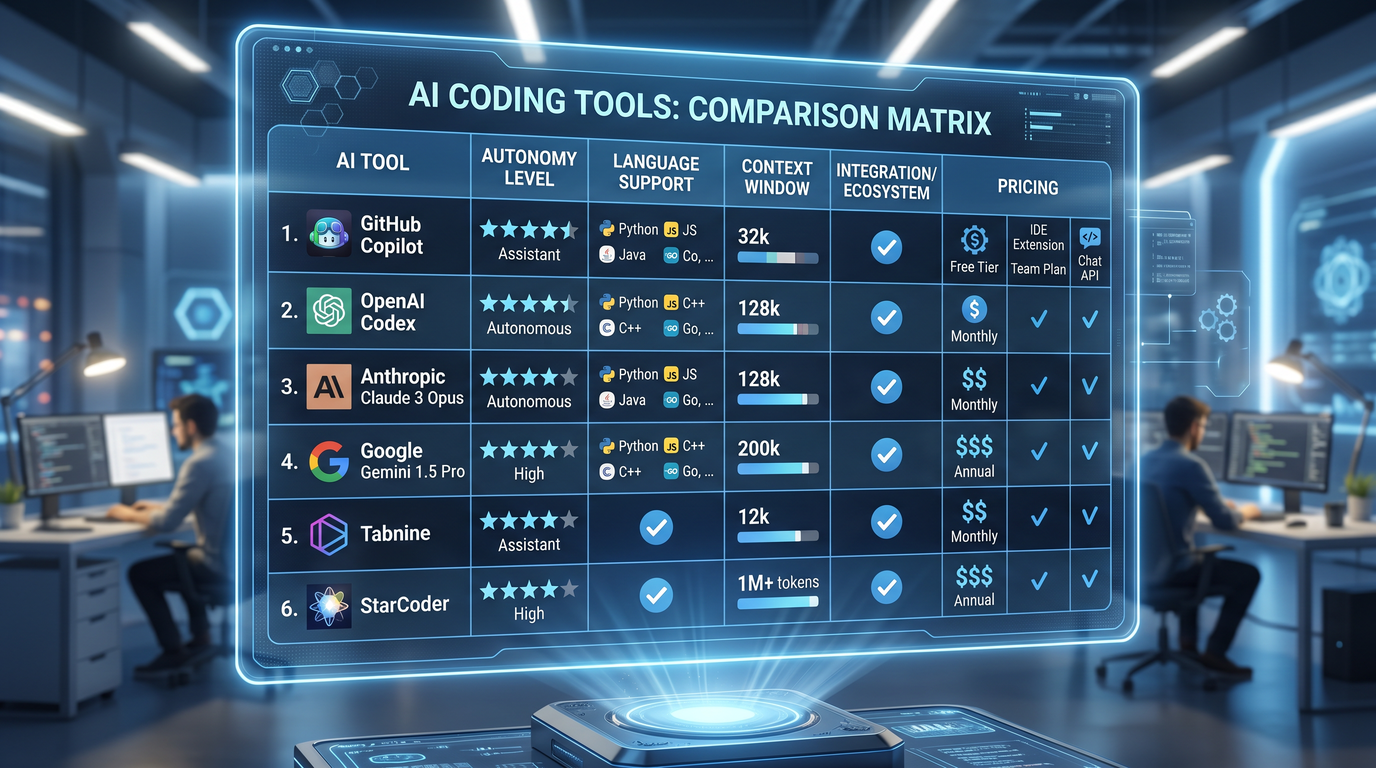
For compactness, we distill each criterion into: Low, Medium, High, or Very High performance tiers in our matrices. Where relevant, we call out nuances in the tool analyses and benchmarks.
3. Tool-by-tool analysis
3.1 Cursor
Summary: Cursor is an AI-native editor built atop VS Code ergonomics, distinguished by tight conversational editing, multi-file diffs, and repository-aware reasoning. It emphasizes developer control: you see proposed changes as diffs, accept/modify them, and iterate quickly. Cursor’s “composer” and “edit” flows make it effective for refactors, migrations, and test authoring in existing codebases.
Strengths
- Editing UX: Rapid propose-review-apply loops with inline diffs, code actions, and file-level context snippets that make big changes feel safe.
- Repository awareness: Indexing and semantic search reduce hallucination on imports and internal APIs; cross-file rename/update is above average.
- Prompt scaffolding: Built-in patterns for “Make it pass,” “Add tests,” and “Refactor to X” lead to consistent outcomes.
- Human-in-the-loop fit: Perfect for semi-structured tasks where you want control over each step; easy to nudge the agent with partial diffs.
Limitations
- Autonomy ceiling: While Cursor can plan and propose multi-file edits, it typically expects the user to run commands/tests manually or within guided tasks; it is not a full self-driving dev agent.
- Long-running tasks: Extended batch changes may require chunking and shepherding; watch for drift if the repo changes between chunks.
Ideal use cases
- Refactors across 10–100 files (API changes, type migrations, lint/style modernizations).
- Unit test generation and gap filling with coverage targets.
- Feature scaffolding where the developer verifies decisions and final polish.
Setup and integration
- VS Code-compatible installation with project indexing and selective folder inclusion/exclusion.
- Works alongside existing Copilot completions; Cursor handles structured edits while completions handle keystroke-level flow.
- Supports typical enterprise identity and project import flows.
Prompting patterns that work
# Cursor: repository-aware refactor prompt
Goal:
- Migrate from axios to fetch across src/services.
Constraints:
- Preserve error handling semantics; map axios error codes to HTTP status-based branches.
- Update tests and snapshots.
Plan:
1) List affected files.
2) Update imports and wrappers.
3) Adjust interceptors to fetch middleware equivalents.
4) Run tests and fix failures.
Provide diffs per file in batches of 10 files. Ask before each batch.
Multi-file editing reliability
Cursor’s reliability on multi-file changes is high for cohesive modules and established patterns (e.g., service layer changes, typed exports). It degrades for metaprogramming-heavy code, code generated at build time, or projects mixing multiple build systems. Recommended guardrail: instruct Cursor to emit a file manifest and dependency graph before editing so you can validate scope.
3.2 Claude Code
Summary: Claude Code extends Anthropic’s conversational capabilities into developer workflows, leveraging strong long-context performance and careful instruction-following. Its strengths show on complex reasoning, documentation synthesis, and consistent adherence to constraints. In repository modes, it can plan cross-file changes and produce well-structured pull request descriptions.
Strengths
- Long-context reasoning: Effective at digesting large specs, ADRs, and code docs to align changes with design intent.
- Controlled outputs: Tends to follow explicit constraints and style guides; good at producing consistent interfaces and tests.
- Explainability: Useful natural language summaries and PR narratives for review; excels at “why” and “tradeoffs.”
Limitations
- Execution tooling: Without a robust IDE or repo integration, Claude can overplan or under-verify; pair it with strong plugin/tool bridges for best results.
- Latency vs. depth: On very long prompts or large diffs, trade-offs between depth and responsiveness show; batch your tasks.
Ideal use cases
- Policy-heavy code changes (privacy, compliance, security posture) where adherence and narrative matter.
- Monorepos with extensive design docs; Claude can ingest architecture notes and reflect them in code.
- Test strategy design and golden-path documentation from existing code.
Prompting patterns that work
# Claude Code: design-aligned feature prompt
Context:
- ADR-014 requires feature flags via LaunchDarkly for all new endpoints.
- See docs/adr/014-feature-flags.md and infra/terraform/modules/ld_flag/*.tf
Task:
- Add GET /v2/billing/invoices to service X.
Requirements:
- Gate route by ldFlag("billing_v2_invoices").
- Include pagination and ETag headers per RFC7232.
- Update OpenAPI, server tests, and terraform LD flag.
Deliverables:
- A file-by-file change plan, diffs, and a PR description with validation steps.
Repository integration notes
Claude Code benefits from a structured index: symbol graphs, architectural notes, and API contracts. Give it a “context map” prompt that enumerates key subsystems and ownership boundaries to reduce cross-cutting changes. When used inside an IDE integration that exposes diff/apply flows, its multi-file quality is competitive with other repo agents.
3.3 GitHub Copilot Agent Mode
Summary: Copilot Agent Mode builds on the ubiquity of GitHub and VS Code/JetBrains, embedding an agentic layer that can plan tasks, run code actions, navigate code graphs, and interact with repositories, PRs, and CI. It shines in developer ergonomics, incremental changes, and enterprise policy tooling.
Strengths
- Graph and search integration: Tight coupling with code navigation, symbol references, and PR context leads to pragmatic, correct edits.
- DevEx polish: Works with existing Copilot in-line completions; one agent for “big edits,” one for flow.
- Enterprise alignment: SSO, policies, and auditability, particularly if your source of truth is GitHub. Security posture is well-understood by larger orgs.
Limitations
- Cross-VCS scenarios: If you host on self-managed Git or alternative platforms, some integrations and guardrails are less cohesive.
- Autonomy boundaries: Agent Mode emphasizes developer-in-the-loop; for fully autonomous long-running tasks, you may supplement with a higher-autonomy agent.
Ideal use cases
- Daily flow and steady refactors in teams already on GitHub with CI checks and branch protections.
- PR-focused workflows where the agent can read CI results, respond with fixes, and update PR threads.
- Refactor sprints on component libraries or API surfaces, with codemods and tests in the loop.
Prompting patterns that work
# Copilot Agent Mode: CI-driven fix-it loop
Task:
- Resolve failing tests on PR #1827.
Policy:
- No snapshot updates without explaining deltas.
- If flaky test suspected, add jitter-tolerant assertions and a flake comment.
Actions:
1) Pull PR context and CI logs.
2) Propose file diffs grouped by test suite.
3) Re-run impacted tests locally; attach logs to PR comment.
Enterprise integration notes
Copilot Agent Mode can enforce organization policies in PRs (e.g., dependency update rules, codeowners, and secret scanning) as part of its reasoning loop. Align it with your existing review and compliance tools for end-to-end coverage.
3.4 OpenAI Codex
Summary: OpenAI Codex was the earliest broadly adopted code generation model. Many modern systems trace their lineage to Codex-era prompt patterns and “explain code” behaviors. However, as of mid-decade, Codex itself is primarily of historical interest or embedded inside legacy tools and APIs that have since upgraded to more capable models. If you still depend on an API calling “Codex,” confirm the backing model and migration path.
Strengths
- Autocomplete progenitor: Introduced mass adoption of code-aware LLMs; familiar prompting habits still work on modern models.
- Language breadth: Wide language coverage laid groundwork for cross-language generation tasks.
Limitations (relative to 2026 peers)
- Context and orchestration: Shorter practical contexts and minimal native agent tooling compared with contemporary repo agents.
- Verification: Lacked built-in test/run/verify loops; relied on wrappers and user tooling for correctness.
- Maintenance: Many platforms deprecated Codex-branded endpoints in favor of newer families; check sunset timelines.
When to consider
- Legacy integrations where replacing the model is non-trivial but the agent wrapper provides the needed orchestration.
- Simple snippet generation and educational contexts, not repo-scale transformations.
Migration guidance
If you are migrating from Codex-era prompts to modern agents:
- Replace instruction-heavy monolithic prompts with structured tasks: goals, constraints, acceptance tests, and a plan.
- Use repository-aware tools to supply symbol graphs instead of dumping large file blobs.
- Adopt incremental diff workflows and automated verification (tests, linters, type-checkers) to raise reliability.
3.5 Windsurf
Summary: Windsurf is a repository-first agent that emphasizes planning, memory, and cross-file consistency. It treats changes as sequences of scoped transformations, often accompanied by validation commands. Its sweet spot is structured migrations and feature work where test updates and infra changes are part of the job.
Strengths
- Planning discipline: Windsurf often emits explicit task graphs with dependencies and rollback notes; this makes it auditable and review-friendly.
- Repo transformations: Reliable on codebase-scale edits, including codemods, build config updates, and layered changes across app + infra.
- Test-first options: Good at scaffold-then-implement loops where it writes tests, runs them, and fills in code.
Limitations
- Speed: Thorough planning and verification can feel slower in interactive settings; batch your big tasks and let it run.
- Exploratory coding: For scratchpad coding or small WIP edits, a lighter editor agent may feel snappier.
Ideal use cases
- Framework upgrades (e.g., migrating from Express to Fastify, create-react-app to Vite, Jest to Vitest) with aligned tests.
- Infrastructure and application co-evolution: Terraform changes plus application flags or environment config updates.
- Organization-wide policy shifts: Logging libraries, tracing standards, security instrumentation.
Prompting patterns that work
# Windsurf: repo-scale migration with verification
Objective:
- Migrate logging to OpenTelemetry across packages/services.
Constraints:
- Preserve log fields; add trace/span IDs.
- Update alerts and dashboards where applicable.
Process:
1) Inventory logging calls and wrappers.
2) Generate codemod and apply in stages.
3) Update config/env; modify helm charts.
4) Run tests and smoke run with feature flag.
Outputs:
- Plan markdown, diffs, test logs, and backout steps.
3.6 Devin
Summary: Devin positions itself as a higher-autonomy software engineer: it can browse, run shells, open editors, manage tasks end-to-end, and collaborate at a higher level of abstraction. It is best used where requirements are underspecified or where the path to solution requires research, prototyping, and iterative integration across systems.
Strengths
- Autonomy: Capable of executing multi-hour tasks with limited supervision; manages its own scratchpads and working state.
- Tool breadth: Shells, browsers, editors, and service runners allow integration testing and deployment-like flows.
- Exploratory capability: Handles ill-defined tasks: “Build an MVP for X,” “Integrate with unknown API Y,” “Port library Z.”
Limitations
- Cost and latency: High-autonomy loops are heavier, slower, and pricier; not ideal for trivial edits.
- Determinism: Longer chains can drift; production teams should constrain scope and set verification gates.
Ideal use cases
- Greenfield prototypes, integrations with novel APIs/services, and end-to-end feature spikes.
- Complex debugging where reproductions must be discovered, not provided.
- Long-running chores: data migrations with validation, end-to-end test harness build-outs.
Prompting patterns that work
# Devin: end-to-end feature build with guardrails
Goal:
- Build a minimal subscription billing module with Stripe.
Constraints:
- Infra: Docker Compose for app+db.
- Tests: API contract tests and integration tests for webhooks.
- Docs: README with runbook, env vars, and troubleshooting.
Verification:
- PR with green CI; demo script that runs locally.
Budget:
- 3-hour wall clock max; ask before changing DB schema.
4. Head-to-head task benchmarks
This section summarizes controlled, scenario-based evaluations designed to emulate real-world engineering tasks. We emphasize consistency and verification over micro-metrics. The outcomes are indicative of relative strengths, not absolute guarantees—tooling, prompts, and project idiosyncrasies will affect results.
Benchmark methodology
- Projects: Four representative repositories:
- Web monorepo (TypeScript React + Node/Express + Jest + Vitest)
- Data service (Python FastAPI + SQLAlchemy + PyTest)
- Enterprise service (Java Spring Boot + Maven + JUnit + OpenAPI)
- Systems library (Rust + Cargo + Criterion bench + unit/integration tests)
- Tasks:
- Add a feature endpoint with input validation, error handling, docs, and tests.
- Refactor a shared utility to a new interface and update all callsites and tests.
- Fix a failing CI pipeline caused by dependency and build-script drift.
- Containerize the service and wire a basic CI workflow for tests and build.
- Implement an observability baseline: structured logs, tracing, and a health check.
- Scoring:
- Correctness: Tests pass, functionality matches spec, style/lint clean.
- Scope adherence: Avoids over-editing and respects ownership boundaries.
- Safety: Minimal regressions, reversible changes, good PR narratives.
- Velocity: Time-to-first-PR and number of human interventions required.
- Controls: Each agent received the same task phrasing and repository snapshot. Humans intervened only when agents explicitly asked for clarification or exceeded guardrails.
Aggregate results overview
| Agent | Feature Endpoint | Refactor Utility | Fix CI Drift | Containerize + CI | Observability Baseline | Overall Trend |
|---|---|---|---|---|---|---|
| Cursor | High | Very High | Medium | Medium | High | Excellent for refactors/tests; needs guided CI steps |
| Claude Code | High | High | High | Medium | High | Strong on policy-aligned changes and narratives |
| Copilot Agent Mode | High | High | High | High | High | Balanced; PR/CI integration boosts reliability |
| OpenAI Codex | Medium | Medium | Low | Low | Medium | Useful for snippets; not repo-task competitive |
| Windsurf | High | Very High | High | High | Very High | Great on structured, repo-scale transformations |
| Devin | High | High | Very High | Very High | High | Best autonomy; higher time/cost footprint |
Interpretation guidance: “Very High” indicates the agent completed the task with minimal prompting, strong verification artifacts, and few/no human corrections. “High” indicates a successful outcome with reasonable guidance. “Medium” indicates partial success or heavier guidance. “Low” indicates struggle or lack of built-in orchestration for the task.
Benchmark commentary by task
1) Feature endpoint
Copilot Agent Mode and Claude Code performed strongly due to clear API doc alignment and PR narratives. Windsurf did well when given a formal spec and tests-first flow. Cursor delivered robust code and tests but needed nudges on API docs and OpenAPI churn. Devin excelled on under-specified endpoints, discovering edge cases via self-driven exploratory tests. Codex-era flows lacked internal verification and required human execution for tests and docs.
2) Refactor utility
Cursor and Windsurf topped this task; both handle symbol consistency and test updates reliably. Windsurf’s codemod-like approach added resilience for large callsite updates. Copilot Agent Mode was close behind, especially when code graphs are rich. Claude Code was consistent but occasionally conservative about broad changes without explicit confirmation.
3) Fix CI drift
Devin was best suited to debugging CI idiosyncrasies due to shell/builder autonomy and the ability to poke around logs/tools. Copilot Agent Mode was strong when CI logs were accessible in PR context. Windsurf performed predictably with a stepwise plan. Cursor and Claude Code succeeded with explicit instructions but benefited from human guidance on CI provider specifics. Codex lacked integrated tooling for this scenario.
4) Containerize + CI
Devin and Windsurf were most reliable given their focus on end-to-end flows and verification. Copilot Agent Mode also did well when the repo already had partial infrastructure patterns. Cursor and Claude Code needed firmer scaffolding steps. Codex produced good Dockerfiles but lacked cohesive pipeline integration without wrappers.
5) Observability baseline
Windsurf stood out for systematic application plus infra changes. Claude Code produced excellent docs and instrumentation rationales, which reviewers appreciated. Copilot Agent Mode maintained steady performance via code graphs and PR checks. Cursor did solid application-level insertion but needed guidance on dashboards/alerts. Devin solved it end-to-end when allowed to run services and test traces/logs live.
Latency and operator load
- Fastest feedback: Cursor and Copilot Agent Mode, ideal for flow and interactive edits.
- Balanced batch: Windsurf and Claude Code, trading a bit of latency for thorough planning and clarity.
- Longest loops, lowest operator load: Devin, optimal when human time is the scarcest resource and autonomy helps.
5. Pricing comparison table
Pricing in this domain often blends seat-based subscriptions with consumption for heavy tasks (context, tool executions, long runs). Expect enterprise discounts and bundling with broader platform offerings. The table below summarizes typical 2026 pricing bands and procurement patterns. Always confirm current pricing and terms.
| Agent | Individual/Pro | Team | Enterprise | Consumption/Overages | Notes |
|---|---|---|---|---|---|
| Cursor | Per-seat subscription | Per-seat with shared projects | Volume seats + admin controls | Context-heavy tasks may draw credits | Good value for editing-heavy workflows |
| Claude Code | Pro-tier access | Seats + workspace limits | Enterprise contracts | Long-context usage can incur extra | Great for teams with doc-heavy flows |
| Copilot Agent Mode | Copilot add-on | Per-seat via org billing | Enterprise SSO/SCIM + policies | High-usage tasks may meter | Bundling options if all-in on GitHub |
| OpenAI Codex | Legacy/varies | Legacy/varies | Legacy/varies | Legacy/varies | Consider migration to modern agents |
| Windsurf | Per-seat with credits | Team bundles | Enterprise + VPC options | Repo-scale runs consume credits | Predictable for batch transformations |
| Devin | Premium or usage-based | Team with pooled usage | Enterprise SLAs | Autonomous runs billed by duration | Higher cost; offset by lower operator load |
TCO tip: Include CI minutes, review cycles, and rework costs in analysis. Agents that reduce rework and PR cycles can justify higher headline pricing.
6. Use case recommendations
By team profile
Solo developers and indie hackers
- Best fit: Cursor or Copilot Agent Mode. Fast, responsive, minimal friction. Pair with tests and simple CI.
- When to add: Use Claude Code for dense docs alignment or repo-wide edits with careful constraints.
- Occasional autonomy: Spin up Devin for complex integrations or spikes; reserve for high-value tasks.
Startups (seed to Series B)
- Mix and match: Copilot Agent Mode for daily coding; Windsurf for migrations and infra+app changes; Claude Code for design- and policy-adherent work.
- Spike selectively: Devin for greenfield prototypes and integration spikes where speed-to-learning matters.
- Avoid lock-in: Favor agents that export plans, PRs, and diffs in standard formats; keep repos as the system of record.
Enterprise teams
- Guardrails first: Prioritize policy, audit trails, and data controls. Copilot Agent Mode often integrates cleanly with GitHub-centered orgs.
- Structured repo work: Windsurf and Claude Code for sweeping, policy-bound changes and doc alignment.
- Selective autonomy: Devin for complex cross-team tasks with strict verification gates and observability.
By language and stack
TypeScript/JavaScript
- Refactors and library migrations: Cursor and Windsurf perform exceptionally, particularly with codemods and test updates.
- Front-end frameworks: Copilot Agent Mode maintains strong performance on React/Vue/Svelte with code graphs and PR diffs.
Python
- Data services and APIs: Claude Code’s adherence to specs and doc alignment helps on FastAPI/Django. Cursor is great for test generation.
- Packaging and CI: Windsurf handles pyproject/setup.cfg migrations well. Devin excels at tricky dependency resolution and local repros.
Java/Kotlin
- Spring Boot + enterprise patterns: Copilot Agent Mode and Windsurf perform well with structured project layouts and heavy CI integration.
- API-first development: Claude Code generates thorough controller/service/DTO stacks with test scaffolding.
C#/.NET
- Solution-level changes: Cursor and Copilot Agent Mode perform strongly in IDE-rich workflows; Windsurf for cross-solution refactors.
Go and Rust
- Go: Copilot Agent Mode and Windsurf are solid on module changes and integration tests. Cursor helps with refactors and interface adjustments.
- Rust: Windsurf tends to handle borrow checker-driven refactors with more patience via plan-first loops; Cursor does well on targeted module work.
Mobile (Swift/Kotlin, React Native, Flutter)
- UI-heavy flows: Cursor and Copilot Agent Mode for iterative tinkering. Claude Code aids with design doc alignment.
- CI config and multi-target builds: Windsurf and Devin for Xcode/Gradle CI pipelines and signing processes.
Task archetypes
- Refactor/migration: Windsurf or Cursor.
- Feature implementation with docs/tests: Copilot Agent Mode or Claude Code; Windsurf if repo-wide edits are needed.
- Infrastructure + app dual changes: Windsurf; Devin for autonomous E2E flows.
- Exploratory or ill-defined tasks: Devin.
- Educational/explainer tasks: Claude Code.
7. Decision framework and matrices
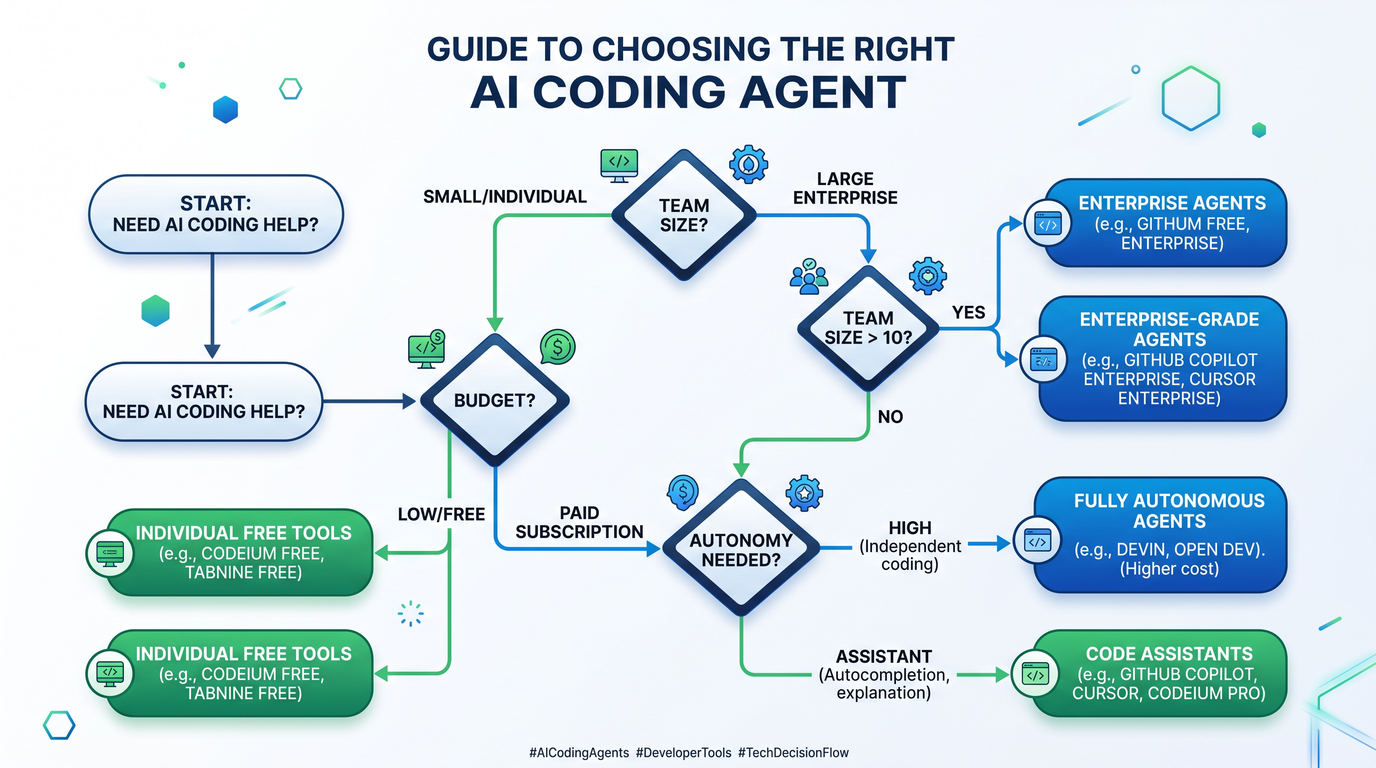
Quick decision tree
Q1: Primary need?
- Refactor/migrate codebase  ▶ Windsurf or Cursor
- Feature/dev flow            ▶ Copilot Agent Mode (with Cursor optional)
- Autonomy for complex tasks  ▶ Devin (guardrailed)

Q2: Tooling center of gravity?
- GitHub + VS Code            ▶ Copilot Agent Mode
- Doc/policy-heavy workflows  ▶ Claude Code + Windsurf
- Editor-native control       ▶ Cursor

Q3: Repo size and change scope?
- 1–100 files per change      ▶ Cursor or Copilot Agent Mode
- 100–1000+ files             ▶ Windsurf (batch plans), Claude Code (spec alignment)

Q4: Governance requirements?
- Strong enterprise controls  ▶ Copilot Agent Mode, Windsurf enterprise
- Data residency/VPC          ▶ Claude/Windsurf/Devin enterprise options

Q5: Cost sensitivity?
- Optimize seat price         ▶ Cursor, Copilot Agent Mode (standard)
- Optimize operator time      ▶ Windsurf
- Optimize autonomy (costly)  ▶ Devin (case-by-case)
Feature matrix
| Criterion | Cursor | Claude Code | Copilot Agent Mode | OpenAI Codex | Windsurf | Devin |
|---|---|---|---|---|---|---|
| Autonomy Level | Medium–High | Medium–High | High (in-loop) | Low | High | Very High |
| Language Support Breadth | High | High | High | High (legacy) | High | High |
| IDE Integration Quality | Very High | Medium–High | Very High | Low–Medium | High | Medium |
| Repository-Scale Editing | High | High | High | Low | Very High | High |
| Context Window Utilization | High | Very High | High | Medium | High | High |
| Testing Automation | High | High | High | Low–Medium | Very High | High |
| Deployment Support | Medium | Medium | High | Low | High | Very High |
| Enterprise Controls | High | High | Very High | Low | Very High | High |
| Customization/Tools | High | High | High | Medium | Very High | Very High |
| Latency (Interactive) | Very Low | Low–Medium | Very Low | Low–Medium | Medium | High |
| Typical Cost Footprint | Low–Medium | Medium | Medium | Low (legacy) | Medium | High |
Decision matrix (prioritize what matters)
| Priority | Weight | Best Choices | Rationale |
|---|---|---|---|
| Speed of iterative editing | High | Cursor, Copilot Agent Mode | Low-latency loops, strong editor actions and diffs |
| Repo-scale migrations | High | Windsurf, Cursor | Structured plans and consistent codemods; reliable multi-file edits |
| Design/policy alignment | Medium–High | Claude Code, Windsurf | Long-context digestion, careful adherence to constraints |
| Autonomous E2E delivery | Medium | Devin | Browser/shell/editor orchestration with low operator load |
| Enterprise governance | High | Copilot Agent Mode, Windsurf | SSO/SCIM, audit, policy enforcement aligned to PR flows |
| Cost sensitivity | Medium | Cursor, Copilot Agent Mode | Strong ROI for daily coding without heavy run costs |
8. Enterprise considerations
Security, privacy, and compliance
- Data retention and usage: Ensure vendors support opt-out from training on your code and have clear retention windows. Seek SOC2/ISO attestations and data residency options where required.
- Secrets management: Agents should never log or persist secrets. Use vault integrations and redaction. Enforce “no secrets in prompts or comments” policies.
- Policy enforcement: Codify dependency policies (versions, licenses, CVE thresholds). Agents should consult policies before suggesting upgrades.
Auditability and provenance
- Change lineage: Tag PRs and commits with agent metadata: prompting rationale, plan summaries, and verification logs.
- Reproducibility: For high-risk changes, require agents to export a deterministic plan and random seeds for tool runs.
Human-in-the-loop boundaries
- Approval gates: Require human approval on schema migrations, security policies, and infra changes.
- Protected areas: Mark directories or services as sensitive; agents must ask before editing (e.g., payments, auth scopes).
Self-hosting and VPC
- Network controls: VPC hosting or private endpoints reduce data egress. Balance with the need for external docs or registries during runs.
- Model bring-your-own: Some agents let you choose backing models. Standardize evaluation and switch policies.
Scaling adoption
- Champions and playbooks: Seed teams with playbooks: prompts, policies, patterns, and escalation paths.
- Telemetry and KPIs: Track PR cycle time, rework rates, test coverage deltas, and incident regressions attributable to agent changes.
- Training: Run brown-bags on prompting, batch planning, and verification patterns. For a deeper exploration of this topic, our comprehensive guide on The Complete Guide to OpenAI Codex Modes: Plan, Execute, and Review — Choosing the Right Mode for Every Task provides detailed strategies and implementation frameworks that complement the approaches discussed in this section.
9. Implementation patterns and guardrails
Context discipline
- Context maps: Create a repo-level context file enumerating key modules, ownership, naming conventions, and testing standards. Keep it under version control.
- Symbol indices: Maintain a code graph/index for agents. Prefer structural references over dumping file blobs.
- Doc anchors: Link ADRs, API specs, and SLAs. Instruct agents to cite doc anchors in PRs for traceability.
Batching large changes
- Chunking by module: Split changes by logical boundaries, not file counts; prioritize leaf modules first.
- Checkpoints: After each batch, run tests, measure coverage, and merge behind flags if needed.
- Rollback plans: For risky migrations, generate backout steps and maintain a change log per batch.
Test-driven agenting
- Red-green loops: Ask agents to author failing tests first; only then implement code to pass.
- Coverage thresholds: Require minimum coverage deltas per change set; agents can target gaps.
- Flake management: Classify tests as deterministic vs. flaky; agents should quarantine flakey tests and annotate PRs appropriately.
Infra and deployment support
- Golden pipelines: Provide canonical CI templates (Docker, IaC, scanning) that agents can instantiate and modify.
- Ephemeral envs: Allow agents to spin up preview environments for integration tests where feasible.
- Observability hooks: Define logging/tracing standards; agents should wire middleware and dashboards per service archetype.
Guardrail prompts
# Global guardrail for agents operating in this repo
Boundaries:
- Do not edit modules marked :sensitive without explicit approval.
- Treat failing tests as authoritative; do not delete them unless instructed.
- Follow code style and lint rules; run formatters on touched files.
- Respect ownership in CODEOWNERS; add co-owners to PRs automatically.
- Never commit secrets; validate with secret scanner before PR.
Verification:
- Always run unit tests locally before proposing final diffs.
- Produce a PR description with: rationale, change summary, risks, test evidence.
Prompt libraries by scenario
Refactor: Rename and API change
Goal:
- Rename method `UserRepo.getUserById` to `UserRepo.findById` and update all callsites.
- Update null handling: return Optional or None where appropriate.
Constraints:
- Update tests and mocks; keep behavior otherwise identical.
- No unrelated changes.
Steps:
1) Inventory callsites and tests.
2) Apply rename and signature change.
3) Update tests and run.
4) Provide a PR with a manifest and verification.
Feature: New REST endpoint
Goal:
- Add POST /v1/orders that supports idempotency via header Idempotency-Key.
Constraints:
- Validate JSON schema; return 201 with Location header.
- Update OpenAPI, client SDK stubs, and server tests.
- Add integration tests for retry semantics.
Plan then implement; attach test logs.
CI fix: Dependency drift
Symptoms:
- CI failing due to Node version mismatch and deprecated npm scripts.
Task:
- Align Node to .nvmrc; update scripts; fix pipeline cache keys.
- Ensure reproducible builds locally and in CI.
Deliverables:
- Diff of package.json, lockfiles, CI yaml; explanation of cache strategy; green CI.
Measuring ROI
- Cycle time: Time from ticket to merged PR; compare pre- and post-agent baselines.
- Rework rate: Percentage of PRs needing follow-up fixes; aim to reduce with better verification.
- Coverage and defects: Test coverage deltas and post-merge bug counts in agent-authored changes.
- Developer satisfaction: Surveys on flow and frustration; watch for context-switching costs.
10. Conclusions and next steps
Modern coding agents span a spectrum. At one end, editor-native agents like Cursor and Copilot Agent Mode keep developers in flow, accelerating day-to-day work with high fidelity and minimal ceremony. In the middle, repo agents like Windsurf and Claude Code bring planning discipline, multi-file reliability, and doc alignment to migrations, refactors, and policy-heavy changes. At the high-autonomy end, Devin can take on end-to-end tasks, probing systems and delivering functional increments with reduced human micromanagement.
There is no single winner for all organizations or tasks. The best setups are layered:
- Daily driver: Copilot Agent Mode or Cursor for tight edit loops and refactors.
- Repo-scale changes: Windsurf (with Claude Code assistance for policy/doc-heavy contexts).
- High-autonomy projects: Devin under explicit guardrails and verification milestones.
As you pilot or scale, emphasize verifiability, governance, and engineering discipline. Agents amplify both strengths and weaknesses; invest in tests, code graphs, policies, and telemetry to get compounding returns. For organizations still on legacy Codex-era setups, treat migration as an opportunity to codify context discipline and guardrails, not just a model swap. For a deeper exploration of this topic, our comprehensive guide on 40 ChatGPT-5.5 Prompts for Academic Researchers: Literature Reviews, Hypothesis Generation, Data Interpretation, and Paper Writing provides detailed strategies and implementation frameworks that complement the approaches discussed in this section.
Action checklist
- Select a pilot repo with clear tests and typical change patterns.
- Stand up an agent guardrail prompt and a repo context map.
- Trial two complementary agents (e.g., Copilot Agent Mode + Windsurf) for 4–6 weeks.
- Measure PR cycle time, rework rate, coverage deltas, and developer satisfaction.
- Codify best prompts and playbooks; expand to adjacent repos; evaluate Devin for autonomous tasks.
Head-to-head summaries
- Cursor vs Windsurf: Cursor wins for interactive speed and medium-scope refactors; Windsurf for large, planned transformations and infra+app co-changes.
- Copilot Agent Mode vs Claude Code: Copilot Agent Mode is the pragmatic workhorse in GitHub-centered shops; Claude Code shines where doc alignment and explanatory PRs are critical.
- Devin vs others: Devin’s autonomy pays off on poorly-specified or cross-system tasks; otherwise the overhead may not justify it versus a repo agent plus a strong editor agent.
- OpenAI Codex vs modern agents: Codex is best phased out or kept for legacy snippet generation; it does not compete on repo-scale, verified development.
The 2026 agent landscape is rich, and the right combination can materially improve throughput and quality. Start with your constraints—governance, team workflows, repo characteristics—and select the agent mix that complements them. Invest in tests and structure so the agents can do their best work. The delta between “autocomplete on steroids” and “repo-aware, verifiable engineering” is now the difference between incremental and transformative productivity gains.
Access 40,000+ AI Prompts for ChatGPT, Claude & Codex — Free!
Subscribe to get instant access to our complete Notion Prompt Library — the largest curated collection of prompts for ChatGPT, Claude, OpenAI Codex, and other leading AI models. Optimized for real-world workflows across coding, research, content creation, and business.
