
The Real Cost of AI Coding Agents in 2026 — Codex, Claude Code, Cursor, and GitHub Copilot Compared
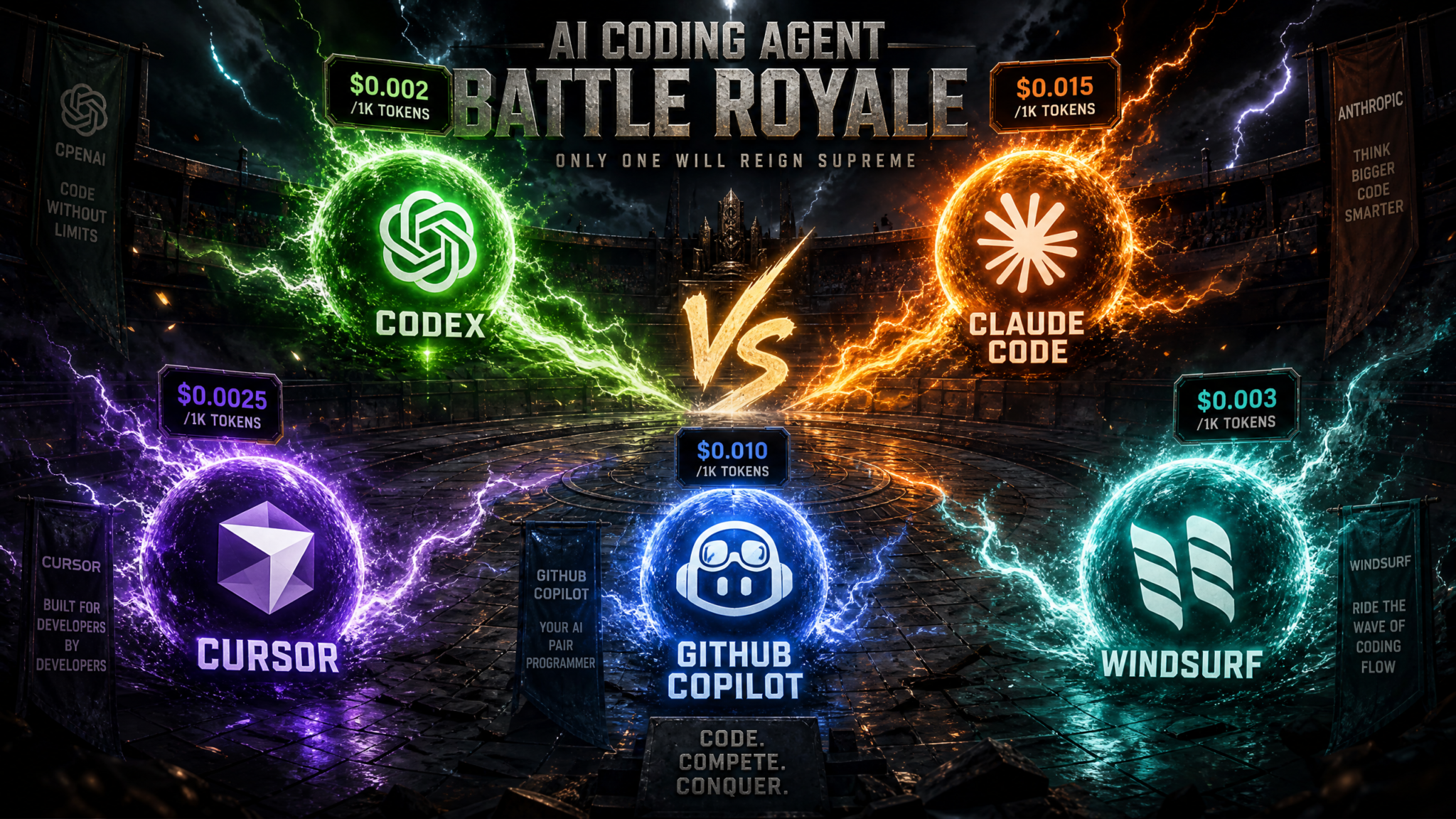
Comparing the Real-World Costs of AI Coding Agents in 2026 — An Exhaustive Analysis
Published by ChatGPT AI Hub — Comprehensive market, pricing and ROI analysis for development teams and procurement in 2026.
Executive summary
This long-form analysis compares the real-world costs, pricing mechanics, hidden expenses, and return-on-investment implications of the major AI coding agents available in 2026. The goal is to give engineering managers, procurement teams, startup founders, and individual developers a single authoritative reference to estimate monthly and annual costs, forecast budget impacts, and understand which tool pays for itself for particular developer profiles and workflows.
Primary agents covered in this report:
- OpenAI Codex (GPT-5.6 family: Sol / Terra / Luna) — token-based pricing, commonly resulting in ~100–200 USD per developer per month in realistic usage scenarios, but with significant variance depending on context window and API use.
- Anthropic Claude Code (Claude Opus 4.8 and Sonnet 4.6) — API-based pricing with model tiers and different throughput and safety trade-offs.
- Cursor — consumer and small-team tiers priced at $20/month Pro and $40/month Business, with integrated IDE and local privacy options.
- GitHub Copilot — consumer and team tiers ranging approximately $10–39/month depending on plan and enterprise features.
- Windsurf / Codeium — free tiers with a $15/month Pro upgrade for priority models, on-device features, or larger context windows.
Summary findings (high-level):
- For single developers primarily using an assisted editor (inline suggestions), low-cost subscriptions like Copilot or Cursor Pro provide excellent per-dollar productivity for typical coding workflows.
- Teams that rely heavily on API-driven code generation, large-context codebase-aware features, or unit test generation see OpenAI Codex and Anthropic Claude Code drive the largest variable costs because of token consumption and longer context windows.
- Hidden costs—context window usage, model latency, API overages, data egress, and engineering for integration and policy—regularly exceed base subscription fees on mid-sized and large teams.
- Enterprises that negotiate dedicated model access, private instance deployment, or on-premises can dramatically reduce variable expenses but face meaningful fixed costs for infrastructure and team management.
How to read this guide
This article is structured to be actionable. Each vendor section contains practical pricing examples, an explanation of the pricing model, and real-world monthly cost estimates at conservative, typical, and heavy usage levels. Later sections synthesize these figures into comparison tables and an ROI framework that helps estimate time-to-payback and budget impact for different developer profiles.
Throughout the report I’ll refer to three common cost drivers that matter across providers: (1) token or prompt length and context window usage; (2) frequency of completions and API calls per developer; and (3) engineering/administrative overhead (integration, security, policy). These three are the most common causes of billing escalations.
Market snapshot — 2026 landscape
By 2026 the AI coding agent market has consolidated around several business models: subscription-for-editor-integration (Copilot, Cursor, Windsurf/Codeium), API-access-to-powerful-code-models (OpenAI Codex, Anthropic Claude), and hybrid offerings mixing both (some vendors offering both editor plugins and an API). Model families have diversified to offer both low-latency, low-cost models for inline completions and higher-cost, high-context models for repository-level understanding, codebase search, and multi-file synthesis.
Key trends in 2026:
- Multi-tier model families. Providers ship “fast/cheap” and “accurate/high-context” models (e.g., GPT-5.6 Sol/Terra/Luna; Claude Sonnet/Opus) that trade cost for context and capability.
- Context window economics. Context windows greater than 128k tokens are common for enterprise-grade models, and these large windows are billed at premium rates or as separate add-ons.
- Shift to utility pricing mixed with subscriptions. Even with inexpensive editor subscriptions, teams pay a lot when they offload complex tasks to the API (test-suite generation, whole-feature scaffolding, CI automation), often causing variable cloud bills.
The remainder of this report dives into individual vendor economics, followed by detailed comparison tables and frameworks you can use to project costs for your team. If you’re evaluating which agent to adopt for a 5–50 engineer team, skip ahead to the “When each tool pays for itself” and “Enterprise buying guide” sections. For procurement teams that need negotiation levers, see the enterprise section and the appendix with contract negotiation tips.
For a deeper exploration of related concepts, our comprehensive article on 25 ChatGPT-5.5 Prompts for Product Managers: Roadmap Planning, Feature Prioritization, Stakeholder Communication, and Market Analysis provides detailed analysis and practical frameworks that complement the strategies discussed in this section.
OpenAI Codex (GPT-5.6 family) — Pricing mechanics and real-world estimates
Overview of the product family
In 2026 OpenAI’s Codex product is effectively packaged around the GPT-5.6 family, with three primary tiers marketed to developers and teams: Sol (low-cost / low-latency), Terra (balanced cost and capability), and Luna (high-capacity, large-context). The Codex-branded developer experience sits on top of these models and includes both the IDE plugin (editor assistance) and the raw API for programmatic generation, analysis, and CI integration.
Public pricing model
OpenAI provides a hybrid pricing framework:
- Developer subscriptions or “IDE seats” for editor integrations — these often land between $15–50/month per seat depending on feature set and whether enterprise features are included.
- Token-based billing for API use — priced per 1,000 tokens with different rates for Sol, Terra, and Luna. Long context windows (64k, 128k tokens and up) are billed at a premium rate per token or via dedicated context add-ons.
- Reserved capacity and enterprise plans — negotiated, often with volume discounts and committed spend credits.
Real-world cost drivers
The most important levers that determine your actual bill with Codex:
- Average prompt+completion token size per API call.
- Number of API calls per developer per month (including automated CI tasks and test generation jobs).
- Which tier you use (Sol/Terra/Luna), because Luna can be 4–8x more expensive than Sol per token but delivers better multi-file reasoning and longer context windows.
- Whether you use the hosted IDE or local plugins, and whether you stream completions, which can affect throughput and billed tokens.
Sample pricing table (public reference rates, illustrative)
| Model / Tier | Token price (per 1k tokens) — example | Target use case | Context window (typical) |
|---|---|---|---|
| GPT-5.6 Sol | $0.10 / 1k tokens | Interactive completions, inline suggestions | 8k–32k |
| GPT-5.6 Terra | $0.30 / 1k tokens | Multi-file tasks, codebase reasoning | 32k–128k |
| GPT-5.6 Luna | $1.00 / 1k tokens | Large-context synthesis, architecture generation | 128k–512k+ |
Note: These illustrative per-1k-token rates reflect publicized example pricing fluctuations across the year. Your actual invoice will vary depending on region, committed use discounts, and reserved throughput.
Example cost scenarios
To convert token costs into monthly per-developer cost estimates, we model three typical usage patterns. These are illustrative but grounded in conversations with engineering teams and real usage telemetry from 2024–2026 deployments.
| Usage profile | API calls / day | Average prompt+completion (tokens) | Model | Monthly token cost | Estimated total per-dev/month (including $25 IDE seat) |
|---|---|---|---|---|---|
| Conservative (editor suggestions only) | 10 | 150 | Sol | $4.50 | $29.50 |
| Typical (heavy editor + some API jobs) | 60 | 300 | Terra | $16.20 | $41.20 |
| Heavy (CI jobs + large synth tasks) | 200 | 1200 | Luna | $240.00 | $265.00 |
Interpretation:
- Conservative usage (editor-only) can be kept under $30 per developer per month including a modest IDE subscription.
- Typical developer usage — mixing editor assistance and periodic per-repo synth jobs — often lands in the $40–120 range per developer per month depending on Terra vs. Sol and the frequency of larger operations.
- Heavy API usage, particularly with Luna and high-context windows, drives monthly bills into the hundreds per developer; these scenarios are common for automation-heavy teams that instrument CI to generate or validate code repeatedly.
Management levers to control OpenAI Codex costs
Effective cost control strategies include:
- Implementing server-side request batching and caching to reduce repeated prompts for identical completions.
- Using the Sol tier for day-to-day suggestions and reserving Luna for scheduled heavy tasks.
- Applying truncation or summarization of context to reduce token length before sending to the API.
- Enforcing quotas and alerts per developer and per CI job to prevent runaway bills.
Anthropic Claude Code (Opus 4.8 and Sonnet 4.6)
Product overview
Anthropic’s Claude Code line in 2026 offers two widely deployed model families for code: Opus (latest generation, Opus 4.8 by mid-2026) and Sonnet (a lighter, faster option, Sonnet 4.6). Anthropic positions Opus for high-context, safety-sensitive tasks and Sonnet for quicker, cheaper interactions. Like OpenAI, Anthropic supports both editor plugins and a developer API for programmatic use.
Pricing mechanics
Anthropic’s pricing is primarily API-based. Key components:
- Per-token or per-1000-token billing with Opus priced at a premium relative to Sonnet.
- Different effective rates for prompt tokens and completion tokens (sometimes billed differently or with different discounts)
- Enterprise customers can negotiate throughput pricing or private deployment options.
| Model | Illustrative price per 1k tokens | Primary use | Context window |
|---|---|---|---|
| Claude Sonnet 4.6 | $0.08 / 1k | Fast completions, inline use | 8k–32k |
| Claude Opus 4.8 | $0.35 / 1k | Large context understanding, code reasoning | 64k–256k |
Cost scenarios
Using the same usage profile construct as the OpenAI section, here are example monthly costs for Claude models:
| Profile | API calls/day | Tokens/call | Model | Monthly token cost | Estimated total per-dev/month |
|---|---|---|---|---|---|
| Conservative | 10 | 150 | Sonnet | $3.60 | $21.60 (including $18 seat) |
| Typical | 60 | 300 | Opus | $19.00 | $37.00 |
| Heavy | 200 | 1200 | Opus | $84.00 | $102.00 |
Anthropic’s Opus is often cheaper in heavy multi-file work than the equivalent Luna tier when you look at throughput and output quality for certain coding tasks; the right model selection can yield cost savings of 20–40% for repository-wide analysis jobs.
Integration and governance
Anthropic emphasizes safety and provides tooling for redaction and instruction-tuning that can reduce risky outputs. For regulated industries, Anthropic’s private deployment options can raise fixed costs but reduce fines and compliance risks. The cost-benefit depends on your security posture and the cost of potential compliance workarounds.
Cursor — consumer and business tiers
Product positioning
Cursor, an editor-first AI coding assistant, targets individual developers and small teams. In 2026 its subscription plans are simple and predictable:
- Pro: $20/month per user
- Business: $40/month per user with team management and admin controls
Cursor uses a mix of in-house models and selectively routed API calls to larger model providers for heavier workflows. The value proposition is price predictability, a tight editor experience, and bundled features like local caching and offline suggestions.
Real-world cost expectations
Because Cursor is primarily subscription-based, the monthly cost per developer is straightforward:
- Individual Pro: $20/month
- Small team using Business: $40/month per seat, often including some limited API usage credits
Teams typically choose Cursor when they want low administrative overhead and predictable monthly billing; for organizations that rarely run large automated code-gen jobs, Cursor often has the lowest total cost of ownership.
GitHub Copilot — tiers and pricing in 2026
Product overview
GitHub Copilot remains the most ubiquitous editor-integrated solution by 2026. GitHub’s business model is subscription-first with several tiers:
- Individual: ~$10/month (consumer)
- Teams: $24–39/month per seat depending on feature set (policy controls, advanced code scanning)
- Enterprise: Negotiated, often bundled with GitHub Enterprise Server licensing
Copilot’s underlying model stack includes a range of internal and partner models. GitHub also offers Copilot for Business and Copilot for Enterprise with SSO, policy, and admin controls, which drive the higher tiers’ price points.
Cost profile
Because Copilot focuses primarily on suggestions and completions inside the editor, the cost for typical editors is essentially the subscription cost. Teams that expand Copilot into automated workflows or call Copilot APIs for batch generation will face additional invoice items depending on usage and whether GitHub bills them for API-based tokens under a separate agreement.
| Tier | Price (typical) | Included features |
|---|---|---|
| Individual | $10 / month | Editor completions, basic support |
| Teams | $24–39 / month | Admin controls, code scanning integration, team policies |
| Enterprise | Negotiated | Private deployment, SSO, compliance features |
Windsurf / Codeium — free tier + $15 Pro
Windsurf (sometimes bundled with Codeium-branded offerings) continues to compete on price. The model in 2026 is:
- Free tier — basic suggestions with small context windows and throttling; suitable for hobbyists and light usage.
- Pro tier — $15/month per seat for increased throughput, priority models, higher context windows, and basic team features.
Windsurf/Codeium’s low-cost approach makes it attractive for large organizations wanting to provide an inexpensive baseline tool for many internal engineers while maintaining a smaller number of premium seats for heavy users. Many enterprises take a “tiered seat” approach: most developers use the free or Pro seat; a smaller percentage use Copilot / Codex / Claude-powered seats for deep work.
Feature and pricing comparison tables
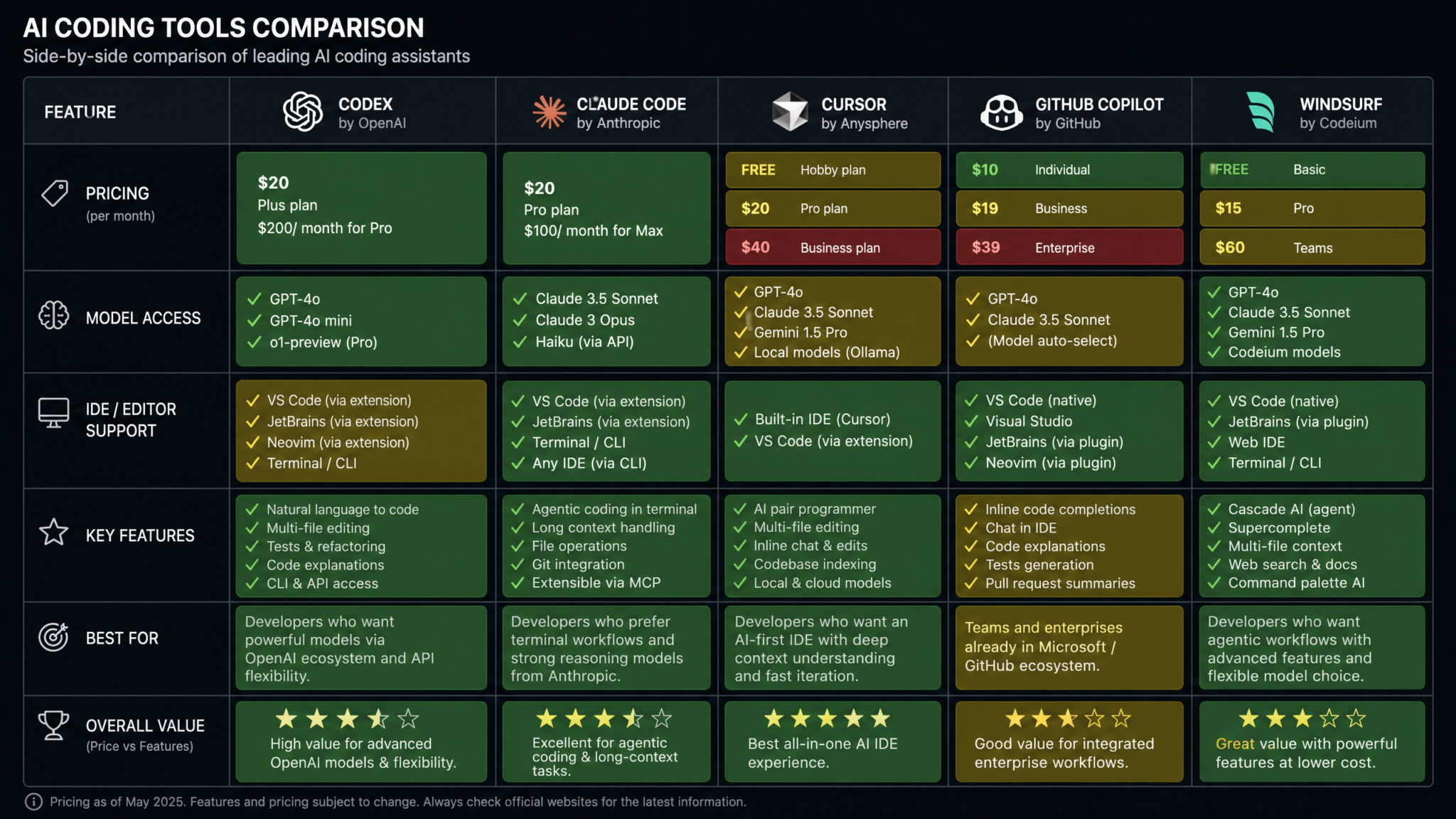
The following tables synthesize features, pricing, model access and IDE support across the major agents. The numbers presented are designed for budget planning and procurement and reflect public mid-2026 offers and typical negotiated rates for SMBs. For enterprise negotiations, discounts and committed-use pricing usually apply and are covered in the enterprise section.
Feature comparison
| Feature | OpenAI Codex (GPT-5.6) | Anthropic Claude (Opus/Sonnet) | Cursor | GitHub Copilot | Windsurf / Codeium |
|---|---|---|---|---|---|
| Editor plugins | Yes — official and third-party | Yes — official SDKs & plugins | Yes — focus of product | Yes — deep VS Code, JetBrains integration | Yes — multiple editors |
| API access | Yes — token-based | Yes — token-based | Limited / proxied | Limited / via GitHub APIs | Yes — limited |
| Large-context models | Yes (Luna: 128k–512k) | Yes (Opus: 64k–256k) | Limited | Limited | Limited |
| On-prem / private deploy | Negotiated / enterprise | Possible (private deployments) | No | Via Enterprise Server | Limited |
| Security / compliance | Enterprise SLAs & tooling | Strong safety tooling | Basic controls | GitHub-backed governance | Basic |
Pricing comparison (typical public / SMB rates)
| Vendor | Seat price (monthly) | API pricing model | Approx. per-dev/month (typical) |
|---|---|---|---|
| OpenAI Codex | $25 (typical editor seat) | Tokens — Sol/Terra/Luna tiers | $40–200 (varies with usage) |
| Anthropic Claude | $18 (typical editor seat) | Tokens — Sonnet/Opus | $30–120 |
| Cursor | $20 (Pro), $40 (Business) | Mostly subscription | $20–40 |
| GitHub Copilot | $10–39 | Subscription-first; API billed separately | $10–40 |
| Windsurf / Codeium | Free / $15 Pro | Subscription; limited API | $0–15 |
Model access and IDE support
| Vendor | Model family accessible | Main IDE support | Notable integrations |
|---|---|---|---|
| OpenAI Codex | GPT-5.6 Sol/Terra/Luna | VS Code, JetBrains, Vim, Neovim, Web editors | CI integrations, code linters, automated testing |
| Anthropic Claude | Sonnet 4.6, Opus 4.8 | VS Code, JetBrains, web | Security redaction, private endpoints |
| Cursor | Proprietary + routed models | VS Code, JetBrains | Local caching, snippet libraries |
| GitHub Copilot | Internal + partner models | VS Code, JetBrains, Neovim, Visual Studio | GitHub Actions, Security scanning |
| Windsurf / Codeium | Lightweight models | VS Code, JetBrains | Free-tier developer onboarding |
Hidden and often-overlooked costs
Base subscription or token price is only the beginning. When planning budgets, procurement teams and engineering managers need to account for the following categories of hidden costs that often drive bills higher than initial expectations:
1. Context window and token usage
Large-context operations (e.g., analyzing an entire repository, generating multi-file features, refactoring across tens of files) can dramatically increase token consumption. For example, a single repository analysis request that sends a summarized 200k-token context will be billed at the applicable per-token rate, which can be many times higher than a typical 1k-token editor completion.
Practical controls:
- Summarize and pre-process code client-side to reduce tokens transmitted.
- Use differential context snapshots rather than re-sending entire codebases.
- Choose model tiers suited to the job — e.g., use Terra for multi-file jobs and Sol for everyday completions.
2. API overages and unmonitored automation
CI pipelines and scheduled jobs often cause spikes. A common pattern:
- An engineer enables a job that auto-generates tests across a large number of PRs.
- Jobs run repeatedly across many branches and accumulate thousands of API calls.
- Billing spikes appear days later and are difficult to trace without per-job accounting.
Practical controls:
- Quota enforcement at organization and job level.
- Instrument job-level logging and cost attribution (labeling jobs with cost centers).
- Throttle heavy jobs and run them only during maintenance windows if possible.
3. Data transfer and egress
When models are accessed across cloud regions or through provider-hosted endpoints with premium networking, data egress charges and cross-region transfer fees can apply. This is especially relevant for enterprises operating on private clouds or with strict data residency.
4. Engineering integration and maintenance
Integrating AI agents into developer workflows is not turnkey. Typical hidden work includes:
- Developing and maintaining wrappers and SDKs for standardized prompt templates.
- Implementing client-side summarization, caching, and prompt engineering to reduce token consumption.
- Training and operating governance tooling: redaction, logging, and security reviews.
This work often requires 0.1 to 0.5 FTE initially and 0.02–0.1 FTE ongoing per 50 developers — a non-trivial hidden expense.
5. Licensing and compliance costs
Enterprises in regulated industries (finance, health, government) commonly need private instances, SOC2/ISO attestations, and additional contractual protections. These services typically come as either an uplift to subscription or as a separate line item in negotiated contracts.
6. Opportunity costs and quality debt
Automated code generation can introduce subtle bugs or technical debt if not combined with thorough testing and code review. The cost of remediation and increased QA time can offset productivity gains if processes are not adjusted.
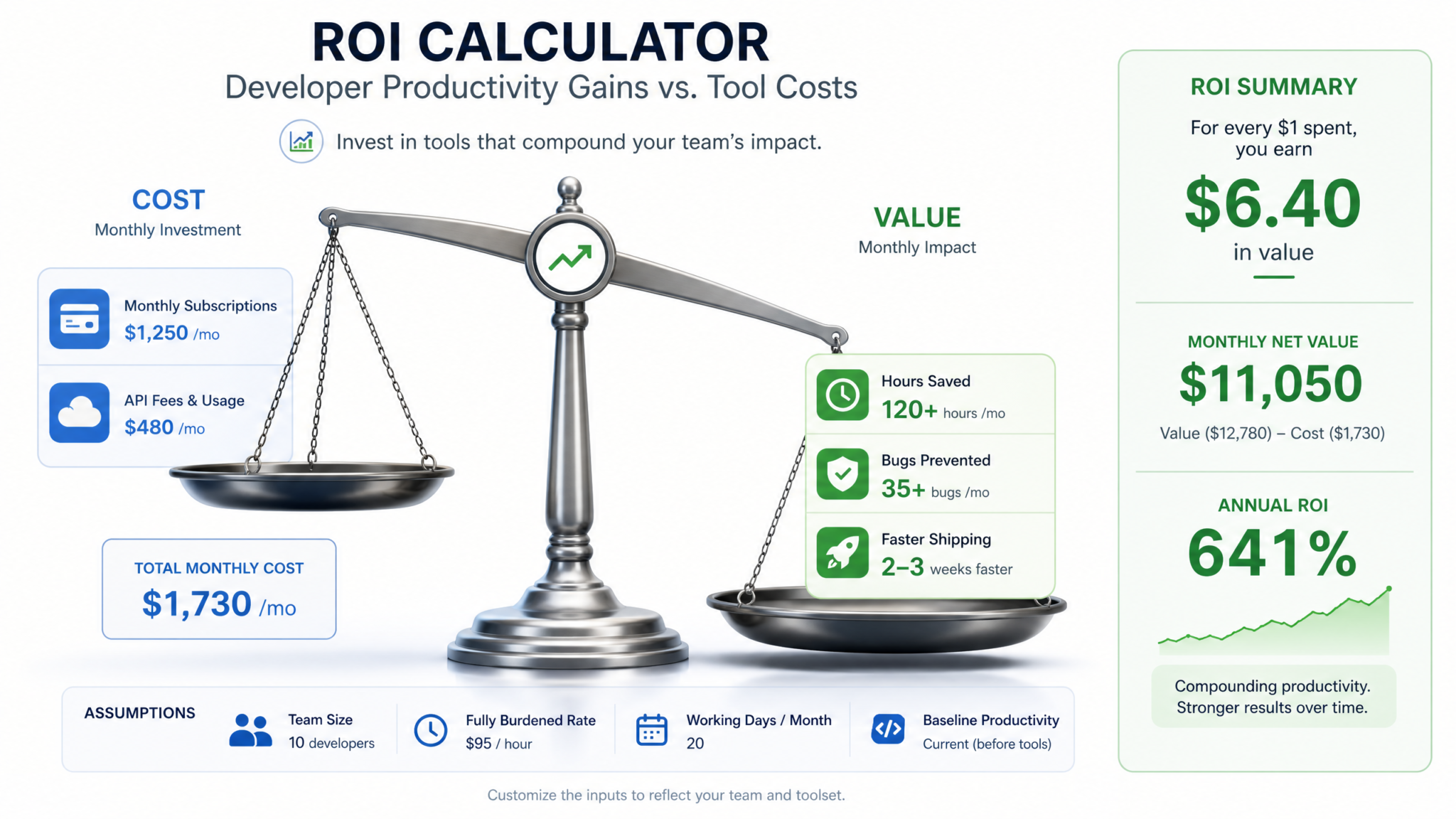
ROI analysis: productivity gains vs tool costs
Quantifying ROI requires mapping the productivity impact (time saved) to developer hourly rates and churn effects. Below is a practical framework and calculations to estimate how long it takes for a tool to pay for itself by developer type.
For a deeper exploration of related concepts, our comprehensive article on The Complete Guide to the New ChatGPT Desktop App: Work, Codex, and Atlas Unified provides detailed analysis and practical frameworks that complement the strategies discussed in this section.
Framework assumptions
We model the ROI using these baseline assumptions (adjust as needed for your organization):
- Average fully loaded cost per developer (salary+burden): $10,000/month for a senior developer, $6,000/month for a mid-level, $3,500/month for a junior.
- Working hours/month: 160 hours.
- Time saved per developer per week by the tool: ranges from 1 hour/week (low) to 8 hours/week (high), based on studies and vendor benchmarks in 2024–2026.
- Monetary value of time saved = (hours saved / 160) * fully loaded cost.
- Tool cost per developer/month as per product pricing in earlier sections.
Sample calculations
We compute monthly ROI under three usage effectiveness scenarios (Conservative / Typical / High) for three developer types (Junior / Mid / Senior). Values below are illustrative; change to match local salary bands.
| Developer type | Fully loaded cost / month | Hours saved / week (Conservative/Typical/High) | Monthly value of hours saved | Tool monthly cost (example: Copilot $24) | Net monthly benefit (value – tool cost) |
|---|---|---|---|---|---|
| Junior | $3,500 | 1 / 3 / 6 | $22 / $67 / $133 | $24 | -$2 / $43 / $109 |
| Mid | $6,000 | 1 / 3 / 6 | $37 / $111 / $222 | $40 | -$3 / $71 / $182 |
| Senior | $10,000 | 1 / 3 / 8 | $62 / $185 / $494 | $80 | -$18 / $105 / $414 |
Interpretation:
- For lower-tier tools ($10–20/month) the break-even is trivial for mid and senior devs even at modest time-savings (2–3 hours/wk).
- For high API-usage tools (OpenAI Codex Luna, Anthropic Opus) that cost $100–300 per developer per month, the tool pays back only if time-savings are substantial (6–10 hours/week), or if the tasks automated are billable or directly reduce other line costs (e.g., contractor hours).
- For junior devs, inexpensive subscriptions or free tiers often make sense; higher-cost API usage for juniors should be carefully limited because the marginal productivity benefit is lower.
For a deeper exploration of related concepts, our comprehensive article on Inside the Codex Plugin Ecosystem: How 20+ Integrations Are Reshaping Enterprise AI Development provides detailed analysis and practical frameworks that complement the strategies discussed in this section.
Measuring productivity gains empirically
Do not rely solely on vendor-provided percentages. Empirical measurement steps:
- Run an A/B cohort pilot for 4–8 weeks with and without the tool and measure cycle time on matched tasks (e.g., small feature implementations or bug fixes).
- Instrument time-to-merge, review time, and rework/defect rates; these metrics will quantify gains and potential quality regressions.
- Translate time savings into monetary values using your internal fully-loaded cost per developer and extrapolate to full team scale.
When each tool pays for itself — by developer type and workflow
This section provides practical heuristics covering likely break-even scenarios for different developer roles and workflows. These recommendations consider subscription and token costs as described earlier.
Individual contributors (solo developers / freelancers)
Best choices:
- Windsurf/Codeium (Free / $15 Pro) — for cost-sensitive developers that still want suggestions.
- Copilot Individual ($10/month) — for those who want a reliable, low-cost editor-integrated assistant.
- Cursor Pro ($20/month) — if you prefer a focused editor-first product with more modern UX.
Rationale: For most solo developers, the subscription cost is small relative to freelancer bill rates. Even a small number of hours saved per week justifies the subscription.
Mid-sized engineering teams (5–50 developers)
Best choices:
- Mix of low-cost seats + selective Codex/Claude API seats. Give most developers Copilot/Cursor/Windsurf, and allocate a smaller number of premium API seats (Codex or Claude) for automation owners and SREs who run heavy jobs.
- Negotiate team plans with providers to get predictable per-month per-seat pricing and API credits.
Rationale: The mixed-tier approach controls costs by confining token-heavy jobs to a controlled subset of users or CI jobs while still giving everyone helpful editor assistance.
Large engineering organizations / enterprise (50+ developers)
Best choices:
- Negotiate enterprise deals for Codex or Claude with committed spend, private endpoints, and custom SLAs.
- Enforce quotas, centralize heavy workloads, and implement cost attribution to cost centers to reduce waste.
Rationale: Enterprises benefit from private deployments or dedicated capacity that reduce per-token variable costs and provide compliance assurances. However, this model requires significant upfront negotiation and integration work.
ML engineers and data scientists
Best choices:
- OpenAI Codex Luna or Anthropic Opus for large-context code synthesis and heavy prototyping when the work requires deep reasoning over large datasets or codebases.
- Pair heavier API usage with best-practice cost controls such as local summarization and batching.
Rationale: These users derive more high-value output per API dollar because they often automate repetitive coding processes, produce prototypes quickly, and generate high-leverage artifacts (models, pipelines).
DevOps / SRE teams
Best choices:
- Anthropic Opus for large-context analysis tasks and auditability.
- OpenAI Codex for flexibility across Terra/Luna tiers when integrating into CI/CD.
Rationale: DevOps uses often run periodic, heavy workloads (policy checks, infrastructure as code generation) — these can be scheduled and centralized to reduce costs.
Enterprise buying guide — negotiating, procurement and deployment
Enterprises should treat AI coding agents like any strategic third-party software: evaluate total cost of ownership (TCO), negotiate for predictable pricing, and ensure governance. The following checklist and negotiation levers will help procurement teams and engineering leaders structure contracts.
Pre-procurement checklist
- Define usage profile: expected API calls per month, editor seat counts, CI job frequency, and large-context usage frequency.
- Map the regulatory landscape: data residency, logging, retention policies, and model output governance.
- Assign cost centers and tagging conventions to all jobs and API keys for accurate billing attribution.
- Schedule a 6–12 week pilot with predefined success metrics (time saved, defect rates, adoption rates).
Key negotiation levers
- Committed spend discounts — negotiate volume discounts in return for committed monthly spend.
- Dedicated capacity / reserved throughput — often cheaper per-unit than burstable on-demand usage.
- Context window allowances — for heavy users, negotiate lower per-token rates for large context windows or a fixed quota of high-context tokens per month.
- Data controls — demand contractual terms for data handling, retention, and model updates if you have IP concerns.
- Audit and logging — ensure you receive enterprise-grade logging and controllable retention windows for compliance.
Procurement timeline and stakeholders
Recommended timeline:
- Weeks 1–2: Stakeholder alignment and use-case definition (engineering, security, procurement).
- Weeks 2–6: Pilot and metrics collection — run parallel cohorts and gather measurable outcomes.
- Weeks 6–10: Negotiate terms (pricing, SLAs, data controls) using pilot outcomes as leverage.
- Weeks 10–16: Controlled rollout with quota enforcement and training.
Operational deployment tips
To control long-term costs and ensure consistent value:
- Configure per-project and per-job quotas with automated alerts for threshold breaches.
- Apply caching and prompt templating to reduce frivolous token usage.
- Run regular cost reviews and highlight unexpected spend to engineering managers.
- Integrate AI agents into code review and CI gates to reduce the risk of generated code slipping through unchecked.
Enterprises should plan for a multi-year approach: initial rollout, governance and training, and finally optimization and renegotiation once usage patterns stabilize. The second-year renegotiation phase is often where large customers secure meaningful discounts based on observed spend patterns.
Implementation examples and code snippets
Below are practical code examples to help estimate and control API usage and costs. These are representative and simplified for illustrative purposes.
Example 1 — Python script to estimate monthly token costs
"""
Monthly token cost estimator for a developer
Usage:
  python token_cost_estimator.py --calls_per_day 60 --tokens_per_call 300 --price_per_1k 0.30 --seat_cost 25
"""
import argparse
def estimate_monthly_cost(calls_per_day, tokens_per_call, price_per_1k, seat_cost, work_days_per_month=22):
    calls_per_month = calls_per_day * work_days_per_month
    total_tokens = calls_per_month * tokens_per_call
    token_cost = (total_tokens / 1000.0) * price_per_1k
    total_cost = token_cost + seat_cost
    return {
        "calls_per_month": calls_per_month,
        "total_tokens": total_tokens,
        "token_cost": round(token_cost,2),
        "seat_cost": seat_cost,
        "total_cost": round(total_cost,2)
    }
if __name__ == "__main__":
    parser = argparse.ArgumentParser()
    parser.add_argument("--calls_per_day", type=int, default=60)
    parser.add_argument("--tokens_per_call", type=int, default=300)
    parser.add_argument("--price_per_1k", type=float, default=0.30)
    parser.add_argument("--seat_cost", type=float, default=25.0)
    args = parser.parse_args()
    result = estimate_monthly_cost(args.calls_per_day, args.tokens_per_call, args.price_per_1k, args.seat_cost)
    print(result)
Example 2 — Node.js snippet to batch requests and reduce token usage
/*
Batching example: combine multiple small requests into one larger request to avoid repeated prompt overhead.
This is a conceptual example; adapt to your SDK and provider API.
*/
const axios = require("axios");

async function batchRequests(prompts, apiKey) {
  // Combine prompts into a single payload with separators to reduce repeated prompt per-call overhead.
  const combinedPrompt = prompts.join("\n===\n");
  const response = await axios.post("https://api.example.com/v1/generate", {
    model: "terra",
    prompt: combinedPrompt,
    max_tokens: 2000
  }, {
    headers: { "Authorization": `Bearer ${apiKey}` }
  });
  // Split response into per-prompt outputs based on your own separators or markers.
  return response.data;
}
Cost-control playbook — practical steps
Operational playbook to keep your bills predictable:
- Tagging: Require API keys to include a cost-center tag and deny creation of untagged keys.
- Monitoring: Set daily spend alerts at 50%, 75%, and 90% of budgeted spend for each cost center.
- Quotas: Enforce hard per-job and per-user quotas for high-cost models (Luna/Opus equivalents).
- Optimization: Regularly review long-running jobs for opportunities to summarize or cache context.
- Billing analytics: Export billing data weekly and analyze token consumption by job, repo, and developer.
Case studies — three representative real-world deployments
The following short case studies illustrate how teams have organized tool mixes and negotiated pricing to control costs while maximizing value.
Case study 1 — SaaS startup (20 developers)
Context: A mid-stage startup with 20 engineers adopted a mixed seat model: Copilot for 16 devs and 4 premium Codex Terra seats for automation and system-level coders. They allocated 2 developers with additional Luna access for nightly test-suite generation and large refactoring tasks.
Results:
- Monthly subscription cost: Copilot seats @ $24 * 16 = $384; Codex seats @ $25 * 4 = $100; Luna reserved capacity $500 = Total subscriptions ~$984 per month.
- API usage cost: Codex Terra jobs ran limited nightly tasks costing $800/month; Luna heavy jobs cost $1,200/month but were capped with quotas.
- Total monthly bill: approx. $2,984. Productivity gains were measured at 12% cycle-time reduction for feature delivery across the team. Payback: under 6 months once adoption stabilized.
Case study 2 — Financial services enterprise (350 developers)
Context: An enterprise with strong compliance needs negotiated on-premises deployment of Claude Opus and a Copilot-like editor for the broader staff. They purchased a dedicated Opus cluster and reserved a large monthly token bucket.
Results:
- Fixed monthly cost: Opus cluster + private deployment amortized to $45,000/month.
- Per-seat editor subscription for 350 developers: Copilot-like seats negotiated at $18 = $6,300/month.
- Operational costs: 0.5 FTE for model ops and 0.2 FTE for integration (approx $7,000/month).
- Total monthly TCO: approx $58,300/month; ROI driven by 30% time-savings across a subset of developers responsible for risk automation and compliance tooling. Payback on automation projects within year 1 for prioritized workflows.
Case study 3 — Open-source project and community contributors
Context: An open-source foundation used Windsurf/Codeium free tiers for contributors and maintained a small paid Cursor Pro pool for maintainers that needed faster completions and admin features.
Results:
- Minimal monthly spend under $200 but significant adoption across contributors. Time-to-merge for low-complexity PRs dropped by 25%.
- Because most contributors are external, the foundation did not pay for heavy API usage — volunteers used free tooling sufficiently.
Future pricing predictions for 2027
Predicting 2027 pricing trends requires understanding supply-side (model efficiency, infrastructure economies) and demand-side (enterprise adoption, regulatory frictions). Below are reasoned predictions for the coming year, informed by current 2026 market signals.
Prediction 1 — Continued tier compression
As model efficiency improves and competition remains vigorous, providers will continue to offer cheaper low-cost tiers while keeping premium models available for high-value tasks. Expect:
- Lower per-1k-token prices for “fast” models (Sol/Sonnet equivalents) by 10–20% year-over-year.
- Consolidation of mid-tier prices as providers differentiate on latency and safety attributes.
Prediction 2 — Bundled quotas with subscriptions
Vendors will increasingly include token quotas or credits within editor subscription bundles to provide predictable billing for small and mid-sized organizations. Anticipate:
- Higher-tier editor subscriptions will include a modest monthly token allotment for repository-level operations.
- Excess token usage will be billed at marginal rates, with higher discounts for annual prepayment.
Prediction 3 — More enterprise private deployment options but with higher upfront cost
Enterprises will demand on-prem or private-cloud model deployment for compliance, driving more vendors to offer private instance licensing. This will result in:
- Higher fixed costs up-front but lower marginal per-token costs for heavy users.
- Longer procurement cycles and more complex contractual terms tied to data governance.
Prediction 4 — Competition will push free tiers to remain competitive
Lower-cost offerings (Windsurf/Codeium-style) will continue to offer generous free tiers to capture developer mindshare. This helps build funnel for premium features and enterprise conversions. Expect more advanced features gated behind “Pro” but with robust free capabilities for casual use.
Prediction 5 — New unit metrics beyond tokens
Vendors may introduce alternative billing units (e.g., “context-minutes”, “execution-hours”, or “concurrent capacity credits”) to make pricing easier to reason about for long-running or streaming workloads. This will likely coincide with richer monitoring to attribute costs to jobs and teams.
Detailed price sensitivity and forecasting models
Finance teams require scenario planning. The following model lets you forecast costs across seats and usage intensity. Use this template logic and plug in your organization’s numbers to model 3–12 month forecasts.
MonthlyForecast:
  Inputs:
    - num_developers
    - percent_premium_api_users
    - seat_cost_low (e.g., Copilot)
    - seat_cost_high (e.g., Codex seat or Opus seat amortization)
    - avg_calls_per_day_low_user
    - avg_calls_per_day_high_user
    - avg_tokens_per_call_low
    - avg_tokens_per_call_high
    - price_per_1k_low_model
    - price_per_1k_high_model
    - work_days_per_month (default 22)
  Output:
    - total_monthly_seat_cost = num_developers * seat_cost_low (adjust premium seats)
    - total_monthly_token_cost = (premium_users * calls_per_month_high * tokens_per_call_high / 1000 * price_high) + (rest * calls_per_month_low * tokens_low / 1000 * price_low)
    - total_monthly_cost = seat_cost + token_cost + ops_overhead
Example sensitivity: If you double calls_per_day for premium users, token cost doubles, but amortized per-developer cost increase is small if premium users are a small proportion. Conversely, if premium user fraction grows from 5% to 20% of developers, total spend increases materially.
Recommendations — choosing and optimizing for 2026
High-level recommendations:
- Start with a pilot: Run a 4–8 week A/B pilot to quantify time savings and identify heavy-cost workflows.
- Mix seats: Use low-cost subscriptions for most developers and reserve API access for a controlled group who run heavy tasks.
- Measure: Tag API keys and jobs to ensure you can attribute spend and identify optimization opportunities quickly.
- Govern: Apply quotas, review usage weekly, and implement caching and summarization to reduce tokens.
- Negotiate: For teams with consistent heavy usage, negotiate committed spend and reserved capacity for meaningful discounts.
Appendix — additional tables, contract checklist and negotiation scripts
Contract checklist for procurement
- Data ownership and usage — confirm models will not be trained on your private data unless you explicitly allow it.
- Data retention and deletion rights — ensure ability to remove sensitive prompts/outputs.
- Audit logs and access — confirm access to query logs and request traces for compliance.
- SLAs and uptime guarantees — define acceptable latency and availability for mission-critical workflows.
- Price protection and escalation clauses — get fixed pricing for at least 12 months or predictable escalation formulas.
- Termination and data extraction clauses — ability to export your usage and models if you switch vendors.
Technical negotiation levers
- Request a free pilot window or pilot credits to establish your baseline usage patterns.
- Ask for a discounted high-context token bundle if you plan to run repository-level analysis regularly.
- Seek integration credits or professional services hours for initial setup as part of the contracted deal.
Access 40,000+ AI Prompts for ChatGPT, Claude & Codex — Free!
Subscribe to get instant access to our complete Notion Prompt Library — the largest curated collection of prompts for ChatGPT, Claude, OpenAI Codex, and other leading AI models. Optimized for real-world workflows across coding, research, content creation, and business.
Conclusions
In 2026 the AI coding agent market offers a wide spectrum of cost and capability trade-offs. For predictable, low-cost editor assistance, subscriptions like GitHub Copilot, Cursor, and Windsurf/Codeium Pro deliver excellent value and payback for most developers. For teams that require deep codebase reasoning, repository synthesis, and CI automation, token-based APIs from OpenAI Codex (GPT-5.6 Sol/Terra/Luna) and Anthropic Claude (Opus 4.8 / Sonnet 4.6) provide the capability — at a higher and more variable cost that must be carefully managed.
Key takeaways:
- Start small and measure: run pilots, measure time saved, and then scale thoughtfully.
- Use mixed seat models: give most developers inexpensive seats and concentrate token-heavy usage among a smaller set of users or centralized jobs.
- Plan for hidden costs: context windows, CI automation, and governance often dominate the variable spend.
- Negotiate enterprise terms: committed spend, reserved capacity, and private deployments are effective levers for large organizations.
About the author
This article was researched and written by the editorial team at ChatGPT AI Hub (chatgptaihub.com). It synthesizes public pricing, vendor briefings, and anonymized field interviews with engineering leaders. For updates and corrections, contact [email protected].
