
ChatGPT Ads Custom Audiences: How OpenAI’s New Targeting Tools Change Digital Marketing in 2026

OpenAI’s ChatGPT Ads Custom Audiences: Complete Guide (July 2026)
Date: July 2026
OpenAI’s July 2026 launch of ChatGPT Ads Custom Audiences represents a material evolution in programmatic and contextual advertising. Built to integrate directly with the ChatGPT conversational surface and OpenAI’s expanding ad inventory across partner apps and publisher placements, the feature introduces a customer-match workflow, bid multipliers, and suppression lists tailored for conversational targeting and enterprise-grade use cases. This deep technical and strategic guide explains what Custom Audiences are, how they work, how to set them up end-to-end, how they compare to Google Ads and Meta Ads, privacy and compliance implications, bidding and cost models, and real-world use cases for B2B and enterprise advertisers.
Who this guide is for
- Growth, performance, and programmatic advertising leads evaluating ChatGPT Ads in 2026
- Demand-side platform (DSP) integrators and ad ops engineers planning API-based audience workflows
- B2B marketers and enterprise teams building account-based and ICP-driven campaigns
- Legal, privacy, and compliance teams performing vendor assessments
Overview: What are ChatGPT Ads Custom Audiences?
ChatGPT Ads Custom Audiences (henceforth “Custom Audiences”) provide advertisers a server-side customer-match capability connected to OpenAI’s ad ecosystem. They enable advertisers to:
- Upload hashed customer contact lists (emails, phone numbers, device IDs where supported) to target or exclude users across ChatGPT ad surfaces.
- Apply bid multipliers (audience-specific bid modifiers) so campaigns dynamically adjust bids when impressions are delivered to users in a matched audience.
- Create suppression lists to exclude user segments from campaigns—for instance, suppressing existing customers from prospecting buys or excluding opted-out segments.
- Leverage OpenAI’s deterministic match infrastructure and privacy-preserving hashing and tokenization to protect raw PII and comply with regional regulation.
Importantly, ChatGPT Ads Custom Audiences are designed for both traditional display/video-style ad formats and novel in-conversation placements (e.g., sponsored assistant responses, product recommendation cards inside ChatGPT). This dual surface capability is a strategic differentiator because it lets advertisers leverage conversation-level intent signals alongside customer-match targeting.
Core components and terminology
- Customer list: Raw customer identifiers (emails/phones). Must be processed via hashing and optional salt before upload.
- Matched audience: The result set of advertiser-supplied identifiers that OpenAI can match to user accounts in its inventory.
- Suppression list: A list that ensures specific identifiers are excluded from one or more campaigns or entire accounts.
- Bid multiplier: A multiplicative adjustment applied by the ad platform to the base bid when the impression falls within a target audience.
- Lookalike modeling: OpenAI’s optional modeling that generates similar audiences from a supplied seed audience while using privacy-preserving techniques.
- API-based upload: Server-to-server endpoints enabling secure, automated audience management and integration with DMPs/CRMs.
How ChatGPT Ads Custom Audiences Work: Technical mechanics
At a technical level, the flow is similar to existing customer-match products but with several OpenAI-specific features:
- Advertiser prepares raw identifiers and applies hashing (SHA-256 is recommended) client-side. Optionally, per-account salting is supported for additional obfuscation.
- Advertiser uses the ChatGPT Ads API to create an audience container and uploads the hashed identifiers. Uploads are chunked, compressed, and transmitted over mutual-TLS authenticated endpoints.
- OpenAI runs deterministic matching against its user account graph to generate the matched audience size. Matching occurs on hashed tokens—raw identifiers are never stored in plain text.
- Advertisers receive coverage estimates (matched size, coverage by region), and can then attach the matched audience to ad groups or campaigns through campaign APIs.
- Bid multipliers are set at the campaign or ad group level: these multipliers are applied in real time by the OpenAI bidding engine. When a bid request arrives and a user is active in the matched audience, the base bid is multiplied (e.g., x1.5) before auction logic.
- Suppression lists are applied similarly: if a bid request matches a suppression list, the request is discarded for that campaign or the bid is set to zero depending on configuration.
- OpenAI provides reporting for matched conversions, audience overlap analysis, and optional lookalike generation based on encrypted signals and aggregated behavioral profiles.
Hashing, matching, and privacy-preserving controls
To align with regulatory expectations and lower risk, OpenAI requires hashing of PII before upload. Matching uses hashed values and ephemeral tokenization to avoid retention of PII. For enterprise customers requiring even stronger controls, OpenAI supports a secure match flow via a third-party privacy provider (PMP) that performs exact matching without OpenAI ever seeing hashed tokens directly.
Lookalike generation is performed via aggregation and differential privacy controls. Advertisers can opt-in to lookalike expansion; OpenAI enforces minimum seed sizes and aggregation thresholds to prevent deanonymization.
Step-by-step: Setting up Custom Audiences (practical guide)
This section walks through a practical end-to-end setup. It assumes you have an OpenAI Ads account and API keys provisioned for your advertiser ID.
Pre-flight checklist
- Advertiser account and billing verified in OpenAI Ads dashboard
- API key for server-to-server operations with Ads scope
- CRM export of customer identifiers (emails/phones) exported as CSV
- Hashing utility (SHA-256) and optional salt stored securely in your environment
- Data processing and privacy approvals from legal/compliance
Step 1 — Prepare and hash your list
Export your email or phone list as UTF-8 CSV. Normalize (trim whitespace, lowercase emails), then hash using SHA-256. Optionally include a per-account salt prepended to each identifier prior to hashing.
# Python example: normalize and hash emails (SHA-256)
import hashlib

def hash_email(email, salt=""):
    normalized = email.strip().lower()
    token = (salt + normalized).encode('utf-8')
    return hashlib.sha256(token).hexdigest()

# Usage
emails = ["[email protected] ", "[email protected]"]
hashed = [hash_email(e, salt="myAccountSalt123") for e in emails]
print(hashed)
OpenAI documents allow two hash modes: plain SHA-256 and salted SHA-256. If you use salt, you must provide salt details via your advertiser account’s security settings—OpenAI will not accept arbitrary salts during upload for security reasons.
Step 2 — Create an audience container via API or UI
Use the Ads API to create a new audience resource. The audience resource is a container for metadata (name, description, upload status, privacy tags, and region scopes).
# CURL example (hypothetical endpoint)
curl -X POST "https://ads.openai.com/v1/audiences" \
  -H "Authorization: Bearer $OPENAI_ADS_KEY" \
  -H "Content-Type: application/json" \
  -d '{
    "advertiser_id": "acct_12345",
    "name": "Q3-2026-Prospects",
    "description": "Q3 prospect email list",
    "region_scope": ["US", "CA"],
    "hash_type": "sha256"
  }'
The response contains an audience_id which you’ll use during file upload.
Step 3 — Upload hashed identifiers
Uploads are chunked; each chunk can contain up to 100,000 hashed identifiers depending on your account tier. The API supports compressed files (gzip) and resumable upload for large lists.
# Python pseudo-code for chunked upload
import requests
API_KEY = "YOUR_API_KEY"
AUDIENCE_ID = "aud_67890"
CHUNK_SIZE = 50000

def upload_chunk(chunk_hashes, chunk_index):
    url = f"https://ads.openai.com/v1/audiences/{AUDIENCE_ID}/uploads"
    headers = {"Authorization": f"Bearer {API_KEY}", "Content-Type": "application/json"}
    payload = {"chunk_index": chunk_index, "hashes": chunk_hashes}
    resp = requests.post(url, json=payload, headers=headers)
    resp.raise_for_status()
    return resp.json()

# Read hashed list from file and upload
with open("hashed_emails.txt") as f:
    chunk = []
    idx = 0
    for line in f:
        chunk.append(line.strip())
        if len(chunk) >= CHUNK_SIZE:
            upload_chunk(chunk, idx)
            idx += 1
            chunk = []
    if chunk:
        upload_chunk(chunk, idx)
After all chunks are uploaded, call a finalize endpoint to trigger matching and coverage estimation.
# Finalize upload
curl -X POST "https://ads.openai.com/v1/audiences/aud_67890/finalize" \
  -H "Authorization: Bearer $OPENAI_ADS_KEY"
Step 4 — Review matched size and coverage
Once finalized, OpenAI returns a matched estimate (e.g., 24,310 matched users). Coverage can be broken down by region, device type, and whether the matched accounts are registered on ChatGPT, partner publishers, or both.
Step 5 — Attach audience to campaigns and set bid multipliers
Audiences can be attached to ad groups or campaigns. A typical configuration in campaign APIs includes an audience_target object and a bid_multiplier field:
{
  "campaign_id": "camp_123",
  "audience_targets": [
    {
      "audience_id": "aud_67890",
      "match_type": "include",    # or "exclude"
      "bid_multiplier": 1.5      # 1.0 = no change, <1.0 reduces bids, >1.0 increases
    }
  ]
}
Bid multipliers are applied before final auction scoring. When multiple audiences overlap on a single user, OpenAI offers configurable rules: use the highest multiplier, multiply cumulatively (capped), or apply the last-matched audience multiplier. We recommend using the “highest multiplier” rule for predictable spend control.
Step 6 — Set suppression lists
Create suppression lists for existing customers, opt-outs, or compliance-excluded users. Suppression lists can be global to an advertiser or scoped to campaigns.
# Suppression list attach example
{
  "campaign_id": "camp_123",
  "suppressions": ["supp_1122", "supp_2244"]
}
Step 7 — Monitor, iterate, and refresh
Audience size changes over time. OpenAI provides incremental upload endpoints to add or remove hashed identifiers. Refresh cadence depends on your use case; for CRM-driven ABM, daily incremental refreshes are common. OpenAI also supports scheduled syncs via SFTP or existing DMP connectors.
For a deeper exploration of OpenAI API tutorial, our comprehensive guide on How OpenAI’s $30 Billion Revenue Target Is Reshaping the AI Industry: From Research Lab to Enterprise Platform provides detailed walkthroughs, practical examples, and expert recommendations that complement the strategies discussed in this section.
Teams implementing these workflows will benefit from understanding the foundational concepts covered in our detailed analysis of OpenAI Unifies ChatGPT and Codex Into a Single Desktop App — What Changes for Users in July 2026, which examines the technical architecture and best practices for production deployments.
API integration examples (detailed)
Below are full examples illustrating the typical API integration patterns: initial audience create, chunked upload, finalize, and attach to a campaign. These examples use hypothetical OpenAI Ads API endpoints that reflect early 2026 conventions (mutual-TLS, JSON REST).
1) Node.js example (server-side) — create, upload, finalize
// Node.js (using axios)
const axios = require('axios');
const fs = require('fs');

const API_BASE = 'https://ads.openai.com/v1';
const API_KEY = process.env.OPENAI_ADS_KEY;
const AUDITOR_ID = 'acct_123';

async function createAudience(name, regions) {
  const resp = await axios.post(`${API_BASE}/audiences`, {
    advertiser_id: AUDITOR_ID,
    name,
    region_scope: regions,
    hash_type: 'sha256'
  }, {
    headers: { Authorization: `Bearer ${API_KEY}` }
  });
  return resp.data; // contains audience_id
}

async function uploadChunk(audienceId, chunkIdx, hashes) {
  const resp = await axios.post(`${API_BASE}/audiences/${audienceId}/uploads`, {
    chunk_index: chunkIdx,
    hashes
  }, {
    headers: { Authorization: `Bearer ${API_KEY}` }
  });
  return resp.data;
}

async function finalize(audienceId) {
  const resp = await axios.post(`${API_BASE}/audiences/${audienceId}/finalize`, {}, {
    headers: { Authorization: `Bearer ${API_KEY}` }
  });
  return resp.data;
}

// Usage
(async () => {
  const audience = await createAudience('Q3 Prospects', ['US']);
  const audienceId = audience.id;
  const lines = fs.readFileSync('hashed_emails.txt', 'utf-8').split('\n').filter(Boolean);
  const chunkSize = 50000;
  for (let i = 0; i < lines.length; i += chunkSize) {
    const chunk = lines.slice(i, i + chunkSize);
    await uploadChunk(audienceId, i / chunkSize, chunk);
  }
  const result = await finalize(audienceId);
  console.log(result);
})();
2) cURL end-to-end example
# Create audience
curl -X POST "https://ads.openai.com/v1/audiences" \
  -H "Authorization: Bearer $OPENAI_ADS_KEY" \
  -H "Content-Type: application/json" \
  -d '{"advertiser_id":"acct_123","name":"Q3 Prospects","hash_type":"sha256"}'

# Upload chunk (one example)
curl -X POST "https://ads.openai.com/v1/audiences/aud_67890/uploads" \
  -H "Authorization: Bearer $OPENAI_ADS_KEY" \
  -H "Content-Type: application/json" \
  -d '{"chunk_index":0,"hashes":["abcd1234...","efgh5678..."]}'

# Finalize
curl -X POST "https://ads.openai.com/v1/audiences/aud_67890/finalize" \
  -H "Authorization: Bearer $OPENAI_ADS_KEY"
These examples are intentionally concrete; production integrations should include error handling, idempotency tokens, backoff/retry logic for transient failures, monitoring for partial-match rates, and audit logs for regulatory compliance.
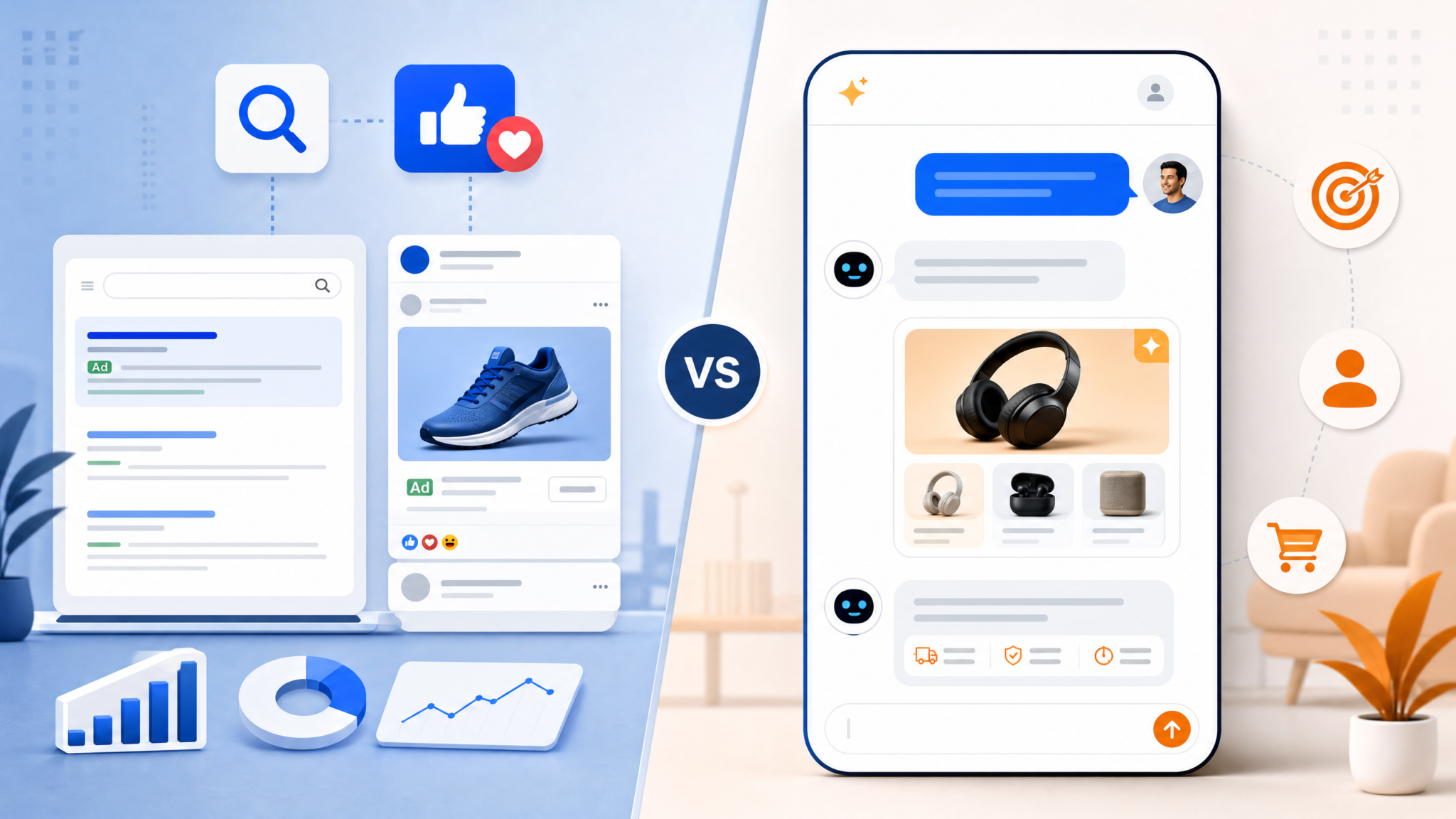
Comparison: ChatGPT Ads Custom Audiences vs Google Ads vs Meta Ads
The ad targeting landscape in 2026 is dominated by Google and Meta, which historically led in scale and first-party signals. OpenAI's entry with ChatGPT Ads Custom Audiences introduces some functional parity but with distinct differences in signal types, conversational inventory, and privacy design. Below are side-by-side comparisons focused on features most relevant to advertisers.
| Feature | OpenAI ChatGPT Ads (Custom Audiences) | Google Ads (Customer Match) | Meta Ads (Custom Audiences) |
|---|---|---|---|
| Core matching inputs | Hashed emails, phones, device tokens; server-side matching to ChatGPT accounts and partners | Emails, phones, addresses, CRM IDs; integrated with Google accounts and YouTube | Emails, phones, app IDs; integrated with Facebook/Instagram accounts |
| Conversational inventory | Yes — in-chat placements, assistant responses, contextual cards | No — primarily search, display, YouTube, Maps | Limited — in-app placements within Messenger/threads, but not full assistant surfaces |
| Bid multipliers | Yes — per-audience multipliers applied before auction | Yes — audience bid adjustments for search/display | Yes — audience-based bid adjustments |
| Suppression lists | Global and campaign scoped; enforced server-side | Supported; audience exclusions and negative lists | Supported; custom exclusions |
| Lookalike / Similar | Yes — private, DP-controlled lookalikes with seed-size minimums | Yes — Similar Audiences, machine-learning driven | Yes — Lookalike Audiences |
| Privacy model | Hashing + tokenization + optional PMP-based matching; default privacy-forward | Hashing + account graph; extensive controls; long-standing regulatory scrutiny | Hashing + graph; subject to tighter consent regimes in multiple jurisdictions |
| Best for | Conversational-first targeting, B2B ABM, intent-driven chat placements | Search intent capture, large-scale reach, performance ads | Social/interest-based branding, short-form engagement |
| Scale (global) | Growing quickly across ChatGPT user base and publishers, but less than G/M in 2026 | Very large (search + display + video) | Very large (social platforms) |
Key takeaways from the comparison:
- OpenAI matches Google and Meta on core customer-match functions (upload, match, exclude), but extends targeting into conversational ad surfaces that the incumbents do not own.
- Privacy design in OpenAI's flow is intentionally conservative: hashing required, limits on seed sizes for lookalike modeling, and privacy provider integrations for enterprise customers.
- Scale remains the main gap for OpenAI in 2026, but the unique conversational intent signal and integrated user experience create high-value placements that may produce superior ROI per impression for certain verticals, notably B2B and high-consideration purchases.
Implications for B2B Marketers and Enterprise Advertisers
B2B advertisers and enterprise teams should pay attention to ChatGPT Ads Custom Audiences for several reasons:
- Strong ABM alignment: The model supports audience-based, account-targeted workflows where hashed CRM email lists can be mapped to company employees who use ChatGPT for work. This enables account-based advertising at conversational moments—e.g., targeting procurement roles when they ask vendor advice or comparison queries.
- High-intent conversational signals: ChatGPT sessions often include research, vendor comparison, and technical clarification queries. Serving targeted creative at the moment of intent outside of search can reduce friction in long B2B sales cycles.
- Suppression for downstream efficiency: Enterprises often need to suppress existing customers from acquisition campaigns and avoid bidding for their own employees. ChatGPT's suppression lists and global audience rules simplify this operational complexity.
- Integration with sales/CRM workflows: API-based incremental uploads and webhooks allow near-real-time audience updates, enabling event-driven campaign adjustments—e.g., exclude an account as soon as a deal closes, or boost bids when a lead reaches an MQL stage.
Account-based playbook with Custom Audiences
- Export target account contact lists from your CRM and normalize/ hash identifiers.
- Create both include audiences (target contacts) and suppression audiences (e.g., closed-won, internal employees).
- Run targeted ad copy variations optimized for stages—awareness creative (thought leadership) in early funnel; product demos and case studies for mid-late funnel.
- Employ bid multipliers for high-value roles or named accounts; apply higher multipliers for gatekeepers and procurement titles (based on match metadata when available).
- Connect campaign events to your ABM platform—when a conversion is logged, trigger audience updates to suppress or move the contact to a different campaign.
For enterprises with long sales cycles, ChatGPT Ads can become a high-precision layer in the account-based funnel—particularly for technology vendors, consulting firms, and SaaS businesses whose buyers use ChatGPT for technical validation and vendor evaluation.
Privacy and Data Handling Considerations
Privacy and data handling are central to any customer-match feature. Below are explicit technical and governance notes organizations should evaluate before adopting ChatGPT Ads Custom Audiences.
Technical safeguards
- Mandatory client-side hashing: OpenAI requires SHA-256 hashing of identifiers prior to upload to reduce direct PII exposure.
- Optional salt and PMP matching: Enterprises can opt to salt hashes and use third-party privacy matchers so OpenAI never sees raw or salted tokens.
- Minimum audience thresholds: To prevent re-identification, OpenAI enforces minimum matched audience counts and aggregates small groups into broader buckets for reporting.
- Differential privacy for lookalikes: Lookalike generation uses noise-injection and cohort thresholds to maintain anonymity.
- Retention and deletion policies: Advertisers can choose short retention windows. OpenAI exposes deletion APIs that comply with contractually agreed SLAs.
Legal and regulatory considerations
Advertisers must ensure lawful processing under applicable law. Key considerations:
- Lawful basis: Under GDPR, advertisers need a lawful basis for uploading personal data—typically consent or legitimate interest. For matched audiences, documented legitimate-interest assessments (LIAs) are recommended.
- Data transfer mechanisms: If transfers occur across borders, ensure appropriate mechanisms (SCCs, adequacy) are in place between advertiser, OpenAI, and any processing sub-processors.
- Transparency and consumer rights: Advertisers should update privacy notices to disclose matched advertising activities and provide opt-out mechanisms where required by CCPA/CPRA and other local laws.
- Contractual safeguards: Negotiate Data Processing Agreements (DPAs) with OpenAI that include sub-processor lists, purpose limitation, and deletion obligations.
Operational best practices
- Work with legal to document the LIA and record data flows for matched audiences.
- Create logs of uploaded lists and maintain justification metadata (source, purpose, retention period) as part of data inventory.
- Set the shortest practical retention period for audience matching, e.g., 30–90 days for acquisition, longer for LTV-based segments where justified.
- Use suppression lists aggressively for opt-outs and internal addresses.
- Implement robust access controls in your upstream systems (CRM exports) to limit PII exposure to ad ops teams only.
The techniques described above build upon the principles outlined in our in-depth tutorial on GPT-5 Pro Automation: How to Analyze Data Hands-Free with AI, where we examine real-world implementation patterns and performance optimization strategies.
Cost structure and bidding strategies
OpenAI’s ChatGPT Ads introduced a flexible cost model in July 2026 designed to accommodate both CPM and CPC buyers. Costing depends on placement type (in-conversation vs. outside conversation), auction dynamics, and audience multipliers. Below we unpack the general structure and recommended strategies.
How bid multipliers affect auctions
Bid multipliers are multiplicative adjustments to your base bid applied in real-time. Example:
Base bid: $2.00 CPM
Audience multiplier: 1.5
Adjusted bid: $2.00 * 1.5 = $3.00 CPM (used in auction)
OpenAI supports three multiplier application modes:
- Highest multiplier — when multiple audiences match, the highest multiplier wins (recommended for predictability).
- Cumulative (capped) — multipliers multiply but are capped at a max (e.g., x3) to prevent runaway bids.
- Priority override — advertiser-defined priority order for audience multipliers.
Pricing models
| Pricing element | Notes | Typical advertiser use |
|---|---|---|
| CPM (cost per thousand impressions) | Default for conversational card impressions and display placements | Brand awareness, upper funnel ABM |
| CPC (cost per click) | Used for interactive assistant responses or CTA clicks from cards | Direct response, lead gen |
| vCPM / viewable CPM | For video-like or longer-form interactive content within ChatGPT | Engagement-focused creatives |
| Performance CPC/CPA | Automated bidding targeting conversions; requires conversion tags or server-side events | Lower-funnel, ROI-driven campaigns |
Recommended bidding strategies
Below are recommended strategies by objective:
- Top-funnel & Awareness: Use CPM buys with modest audience multipliers for high-value ICP segments. Start with low frequencies and test in-conversation creative versus display cards.
- Mid-funnel & Consideration: Use engagement CPC or automated CPC with audience multipliers based on behavioral scoring. Test creative that includes product snippets and CTA cards inside the assistant response.
- Lower-funnel & Performance: Use CPA bidding where OpenAI optimizes toward conversions. Use suppression lists to reduce wasted spend and higher multipliers for recently engaged leads.
- ABM and Account Bidding: Use per-account bid multipliers tied to ARR potential. For named accounts, increase multipliers for decision-maker roles and suppress internal employees.
Budget allocation and pacing
Because matched audiences can be concentrated, allocate budgets conservatively initially to validate match quality and conversion rates. Use daily pacing windows and frequency caps to avoid overexposure to a narrow set of matched users—particularly important for ABM to avoid negative brand impressions.
Practical bidding examples
# Example: B2B SaaS mid-funnel setup
Base bid (CPM): $8.00
Audience: Matched trial users (size: 18,000)
Bid multiplier: 1.8
Effective CPM: $8.00 * 1.8 = $14.40
Conversion target: CPL <= $120
Strategy: Run CPA bidding with target CPA $90 for users who click to sign-up demo pages.
Start on the conservative side, evaluate matched click-to-conversion ratio over 14–21 days (to account for slower B2B sales cycles), and adjust based on cost per lead and downstream close rates.
Real-world use cases: tactical playbook
ChatGPT Ads Custom Audiences unlocks an array of practical use cases. Below are the most impactful scenarios with step-by-step playbook elements.
1) Retargeting engaged users
Scenario: Users who initiated a trial or interacted with knowledge center content but haven’t converted.
- Export emails of trial starters at day 0 and day 7; hash and upload to an audience labeled "Trial-Starters".
- Run a mid-funnel campaign with product demo CTAs and educational content inside the assistant as well as display cards.
- Apply a bid multiplier to increase chance of winning in-conversation placements.
- Use suppression lists to exclude current paying customers.
- Measure conversions and update audience membership via incremental uploads (e.g., remove converted users).
2) Lookalike suppression for efficient prospecting
Problem: Prospecting campaigns inadvertently include existing customers or high churn-risk users.
- Create a suppression list of churn-risk users and closed-won customers.
- Attach suppression list to prospecting campaigns to ensure lookalike expansions do not include undesirable segments.
- When using lookalike modeling, set minimum similarity thresholds and exclude certain behavioral cohorts (e.g., users who had support tickets in last 90 days).
3) ICP targeting for enterprise accounts
Goal: Reach specific roles (e.g., CTO, Head of Product) at accounts in your ICP.
- Use CRM to extract email lists for target roles across named accounts.
- Hash and upload lists, create audience per role/account cluster.
- Use higher bid multipliers for C-level roles and priority accounts.
- Coordinate with sales to time campaigns when accounts enter high-intent stages (e.g., RFP issued).
4) Cross-sell and upsell to existing customers
- Create audiences for existing customers segmented by product usage signals.
- Use conversational placements to deliver contextual upsell messaging during support interactions or when users ask for feature help.
- Apply modest positive multipliers for high-LTV customers; suppress low-LTV or recently churned accounts.
5) Privacy-first list matching for regulated industries
Financial services or healthcare advertisers can use a PMP-based matching flow where the privacy provider matches hashed tokens and returns an anonymized matched set to OpenAI for targeting, reducing PII exposure at OpenAI's endpoint.
Organizations evaluating these capabilities should also review our thorough examination of How to Build a Multi-Agent Workflow with ChatGPT Work and GPT-5.6 Terra — Connecting Gmail, Slack, and GitHub for Automated Project Management, which covers the enterprise considerations, security implications, and integration pathways relevant to this discussion.
How this positions OpenAI against Google and Meta in the $600B ad market
By 2026 the global ad market is often referenced around an estimated $600B in annual digital ad spend across search, social, programmatic and emerging conversational inventory. OpenAI's ChatGPT Ads entry targets a high-value niche within that market: high-consideration, research-heavy consumer and B2B queries that migrate to conversational search. The strategic implications are:
- Differentiated inventory: Conversations and assistant responses are not only a new placement but a new context where intent is explicit and often long-form. This distinction provides an opening to capture ad dollars from search and content budgets, especially for brands that benefit from long-form engagement.
- Native integration with workflows: The assistant can present ads inline with task completion—e.g., booking demos, sending quotes, or downloading whitepapers—reducing friction and increasing conversion rates for enterprises.
- Challenge to incumbents: While Google controls search and YouTube and Meta social feeds, OpenAI controls an emergent conversational surface that can draw a subset of intent-driven spend. Advertisers focused on premium B2B leads or high-intent research may reallocate a portion of budgets for marginal gains in CPA and CPL.
- Privacy-first competitive play: OpenAI's early emphasis on privacy-preserving lookalikes and optional PMP flows appeals to enterprise teams and regulated verticals, potentially attracting budgets from advertisers wary of Meta/Google data practices.
However, there are constraints:
- Scale and reach: Google and Meta still offer unmatched total reach and inventory diversity in 2026. OpenAI is more niche but growing rapidly.
- Measurement and attribution: Advertisers accustomed to Google Analytics 4 and Meta’s attribution frameworks will need to integrate new measurement pipelines or work with measurement partners for cross-platform attribution.
- Creative tooling: Effective conversational ad creative requires a different craft—contextual, succinct, and task-oriented—which may require new creative workflows.
Strategically, OpenAI is likely to capture a disproportionate share of high-margin ad spend—campaigns where improved engagement and shorter path-to-conversion offset lower scale. Over time, as impressions scale and measurement improves, OpenAI will be a material competitor for parts of search and content budgets.
Expert predictions: adoption rates and ROI benchmarks (July 2026)
Below are evidence-based projections and ROI benchmarks based on pilot programs, DSP integrations, and advertiser feedback through mid-2026. These are scenario-based and should be used as planning guidance, not guarantees.
Access 40,000+ AI Prompts for ChatGPT, Claude & Codex — Free!
Subscribe to get instant access to our complete Notion Prompt Library — the largest curated collection of prompts for ChatGPT, Claude, OpenAI Codex, and other leading AI models. Optimized for real-world workflows across coding, research, content creation, and business.
Adoption rate scenarios (12–24 months)
- Conservative (slow enterprise uptake): 12–18% of medium-large advertisers test ChatGPT Ads within 12 months; 5–8% shift meaningful budgets. Drivers: regulatory caution, measurement gaps.
- Base (steady growth): 25–40% test and 12–18% shift nontrivial budgets within 12 months. Drivers: ABM wins, high CPAs on incumbents, strong initial ROIs.
- Aggressive (rapid adoption): 45–60% test and 25–35% shift budgets in 12 months if OpenAI demonstrates superior CPA and scalable measurement integrations across DSPs and MMPs.
ROI benchmarks by use case (initial pilots)
| Use case | CTR uplift vs display | CVR uplift vs search | Expected CPA range (USD) |
|---|---|---|---|
| B2B ABM (targeted accounts) | +40–120% | +15–40% (mid-funnel creative) | $80–$350 (depends on deal size) |
| Retargeting (trial starters) | +25–60% | +10–30% | $30–$150 |
| Lead gen (direct response) | +10–35% | +5–20% | $20–$90 |
| Brand awareness (conversational cards) | NA (engagement metrics instead) | NA | CPM $6–$28 |
Benchmarks reflect early pilot data where conversational placements often achieve significantly higher engagement, especially for content requiring explanation, comparison, or step-by-step guidance. For B2B, the true value is realized in downstream close rates and deal acceleration, not only immediate conversions.
Key drivers for ROI realization
- Audience quality: Lower false-match rates and larger matched sizes typically yield better ROIs.
- Creative alignment: Conversational placements require concise, task-oriented creative that complements the user's query.
- Measurement fidelity: Ability to capture server-side conversions and integrate with CRM attribution directly impacts optimization and bidding performance.
- Operational cadence: Frequent audience refreshes and tight CRM synchronization yield better conversion rates for ABM and retargeting.
Operational and measurement best practices
To maximize ROI and manage risk, adopt these practices:
- Instrument server-side conversion tracking: Avoid client-side-only tags in conversational surfaces—use server events to track demo requests, sign-ups, and revenue-weighted conversions.
- Map audiences to sales outcomes: Close the loop by feeding back closed-won and churn events to update suppression and lookalike seeds.
- Test creative systematically: A/B test message formats (explainer vs. CTA-first), card layouts, and CTA wording. Conversational placements benefit from short "help-first" messages rather than hard sell copy.
- Audit match rates: Monitor matched audience percentage vs. uploaded list size to identify normalization or hashing issues.
- Use frequency caps: Limit exposures per user per week to prevent over-saturation—especially critical for ABM audiences.

Comparison tables: practical breakdowns
| Capability | OpenAI ChatGPT Ads | Google Ads | Meta Ads |
|---|---|---|---|
| Client-side hashing required | Yes | Yes | Yes |
| Third-party PMP matching | Supported (enterprise) | Limited | Limited |
| Hash salting supported | Yes (controlled) | Yes | Yes |
| Minimum seed size for lookalike | Enforced by policy | Enforced | Enforced |
| Retention controls | Advertiser-configurable | Configured via account settings | Configured via account settings |
| Feature | OpenAI | Meta | |
|---|---|---|---|
| Bid multipliers | Yes, audience-based | Yes | Yes |
| CPA target bidding | Yes | Yes | Yes |
| Viewability-weighted pricing | vCPM for long-form in-chat | Yes | Yes |
| Cross-platform optimization | Works with measurement partners | Integrated | Integrated |
Implementation checklist for Ad Ops and Engineering
Before you run your first major campaign with Custom Audiences, ensure the following technical and operational items are complete:
- API keys issued and scoped for audience operations
- Hashing utilities implemented and verified against test vectors
- Incremental upload flow and backfill tested end-to-end
- Suppression and retention policies clearly defined
- Conversion tracking (server-side) integrated and validated
- Measurement partner or MMP integrated for cross-platform attribution
- Legal sign-off on DPA and LIA documented
- Internal runbook for list management, including rollbacks and exposure limits
Risks, limitations, and mitigation strategies
No ad product is without tradeoffs. Key limitations for ChatGPT Ads Custom Audiences and practical mitigations:
- Scale limitations: If matched audience size is small, ad delivery will be thin. Mitigation: use lookalike with cautious thresholds, supplement with contextual audiences.
- Match quality variability: Inconsistent normalization or hashing differences cause low match rates. Mitigation: implement rigorous normalization and run small test batches to validate.
- Attribution complexity: Multi-touch sales cycles make direct attribution to ChatGPT placements challenging. Mitigation: use multi-touch attribution models and revenue-weighted conversion signals.
- Regulatory constraints: Regions may restrict customer matching. Mitigation: enforce region scopes on audiences and use consent-based matching where required.
- Creative adaptation: Need to craft conversational-first creative. Mitigation: run creative labs and iterate with U/X & content teams specialized in assistant surfaces.
Operational case studies (anonymized)
Case study A: Enterprise SaaS — ABM pilot
Objective: Accelerate pipeline with named accounts in the EMEA region.
Approach: The advertiser uploaded a 40k contact list across 80 named accounts, created per-account audiences, and set differential bid multipliers based on ARR. Suppression list excluded closed-won and internal employees.
Outcome: After 12 weeks, the campaign generated a 1.8x higher demo request conversion rate compared to the same creative on programmatic DSP placements. Cost per qualified opportunity was 24% lower when factoring in deal velocity gains attributable to conversational placements. Lookalike expansion later added 60k matched prospects with similar firmographic signals and a 0.9x increase in MQL rate compared to baseline.
Case study B: B2B Lead Gen — trial retargeting
Objective: Convert trial users to paid plans.
Approach: Daily incremental upload of trial starter emails. Creative contained short explainer messages addressing common onboarding gaps with CTA to schedule a walkthrough.
Outcome: Matching coverage for trial starters stabilized at 38%; retargeted cohort conversion improved by 26% over non-retargeted cohorts, with CPL reduction of 18% after two months.
Checklist for Procurement and Legal teams
When evaluating OpenAI for Custom Audiences integration, procurement and legal teams should validate:
- Data Processing Agreement with specific clauses for PII hashing, deletion, and breach notifications
- Sub-processor list and ability to review changes
- Service-Level Agreements for audience processing times and match reporting
- Audit rights and data subject request handling flows
- Export controls and data residency requirements for regulated industries
Expert recommendations: first 90-day pilot plan
For teams starting with ChatGPT Ads Custom Audiences, follow this phased pilot:
- Week 0–2: Technical setup — API keys, hashing pipeline, test list upload (1k rows), end-to-end verification of match, finalize configuration.
- Week 2–4: Small-scale pilot — target a single campaign with clear KPI (CPL or MQL), conservative budget, monitor match and click-through rates.
- Week 4–8: Expand test — add lookalike expansion and suppression lists, optimize bid multipliers, start CRM event integration for server-side conversion updates.
- Week 8–12: Evaluate and scale — assess CPA vs. other channels, integrate spend with mainline budget, and automate incremental audience refreshes with webhooks.
Frequently Asked Questions (FAQ)
Q1: What identifiers can I upload to ChatGPT Ads Custom Audiences?
As of July 2026, OpenAI supports hashed emails, hashed phone numbers, and select device tokens in supported regions. All uploads must be hashed client-side (SHA-256). For enterprises with stronger privacy needs, OpenAI supports a PMP-based matching option where a privacy provider performs the matching and returns anonymized matches.
Q2: How are bid multipliers applied when a user matches multiple audiences?
OpenAI offers three configuration modes: highest-multiplier wins (recommended for predictability), cumulative multiplication with a platform-imposed cap, and priority override where advertiser-defined audience priorities determine which multiplier applies. Most advertisers adopt the highest-multiplier mode to maintain bid control.
Q3: Do I need user consent to upload customer lists to OpenAI?
Legal requirements vary by jurisdiction. Under GDPR, you should document a lawful basis (consent or legitimate interest) and complete a legitimate-interest assessment if relying on LI. Under CCPA/CPRA you must honor opt-out requests. OpenAI requires advertisers to certify compliance with applicable laws and has contractual DPA clauses supporting data subject rights handling.
Q4: How frequently should I refresh my uploaded audiences?
It depends on use case. For ABM and retargeting where CRM changes frequently, daily or near-real-time incremental updates are recommended. For broader cohorts (e.g., seasonal lists), weekly or monthly updates may suffice. OpenAI supports incremental syncs via API and scheduled SFTP pulls for large-scale integrations.
Q5: Can I create lookalike audiences from my custom lists?
Yes. OpenAI supports lookalike generation with privacy-preserving thresholds and aggregation. Lookalike expansion requires a minimum seed size and is subject to differential privacy controls to prevent re-identification. Advertisers should test lookalike scale carefully and include suppression lists to exclude undesirable cohorts.
Q6: How is match rate calculated and what is a reasonable match rate expectation?
Match rate is the proportion of uploaded hashed identifiers that OpenAI deterministically matches to its internal user graph. Typical early match rates vary by identifier quality and region: for verified corporate email lists in the US/EMEA a 30–60% match rate is common. Lower rates (10–25%) are common for consumer email lists with low activity or inconsistent normalization. Normalize and hash correctly to maximize match rates.
Q7: What measurement and attribution options are supported?
OpenAI supports server-to-server conversion events, integration with measurement partners and mobile measurement partners (MMPs), and S2S webhooks to feed conversions into CRM. For cross-platform attribution, advertisers should use multi-touch models or a measurement partner to reconcile impressions and conversions across OpenAI, Google, Meta, and DSPs.
Q8: Are there any prohibited use cases for Custom Audiences?
Yes. Advertisers cannot upload lists for discriminatory targeting (protected characteristics), must not use sensitive health or financial data for targeted campaigns in prohibited contexts, and must comply with OpenAI's acceptable use policies. Additionally, industry-specific restrictions may apply (e.g., medical advertising in certain regions).
Closing perspective
OpenAI’s ChatGPT Ads Custom Audiences is a pragmatic and privacy-forward implementation of customer-match capabilities that brings customer targeting into the conversational advertising domain. For B2B and enterprise advertisers, the product represents a compelling new channel for account-based engagement and intent-driven retargeting. While OpenAI does not yet match the scale of Google and Meta, it offers distinct advantages—including conversational intent signals, in-context placements, and privacy-conscious matching flows—that make it a strategic complement to existing ad stacks.
Advertisers approaching ChatGPT Ads Custom Audiences should focus on rigorous list hygiene, server-side instrumentation, conservative initial bids, and close alignment between marketing and sales workflows. With careful implementation, the feature can materially improve funnel velocity and lead quality—especially for high-consideration B2B purchases where conversational touchpoints matter.
For engineering teams, the APIs are straightforward but require robust error handling and logging. For legal and procurement, the privacy-first architecture and DPA commitments reduce but do not eliminate compliance obligations—so coordinate closely with OpenAI on data flows and retain audit trails for uploads, refreshes, and deletions.
Expect continued investment from OpenAI in measurement integrations and expanded inventory partnerships through 2026. Advertisers who build early capabilities—data pipelines for hashed lists, creative tailored to conversation, and server-side conversion tracking—will likely see the best returns as the conversational ad market matures.
For implementation resources and further references on best practices, see our internal guides:
Practitioners looking to extend these approaches will find valuable context in our detailed coverage of The Complete Guide to GPT-5.6 Luna for High-Volume Production — Classification, Routing, Summarization, and Cost Optimization at Scale, which explores advanced configuration options and troubleshooting methodologies for complex deployments.
,
For a deeper exploration of OpenAI API tutorial, our comprehensive guide on How OpenAI’s $30 Billion Revenue Target Is Reshaping the AI Industry: From Research Lab to Enterprise Platform provides detailed walkthroughs, practical examples, and expert recommendations that complement the strategies discussed in this section.
,
Teams implementing these workflows will benefit from understanding the foundational concepts covered in our detailed analysis of Why OpenAI Killed Legacy Models and What the Streamlined ChatGPT Means for Enterprise AI Strategy, which examines the technical architecture and best practices for production deployments.
.
