
Understanding ChatGPT’s 2026 Usage Limits: Rate Limits, Token Budgets, and How to Maximize Your Allowance
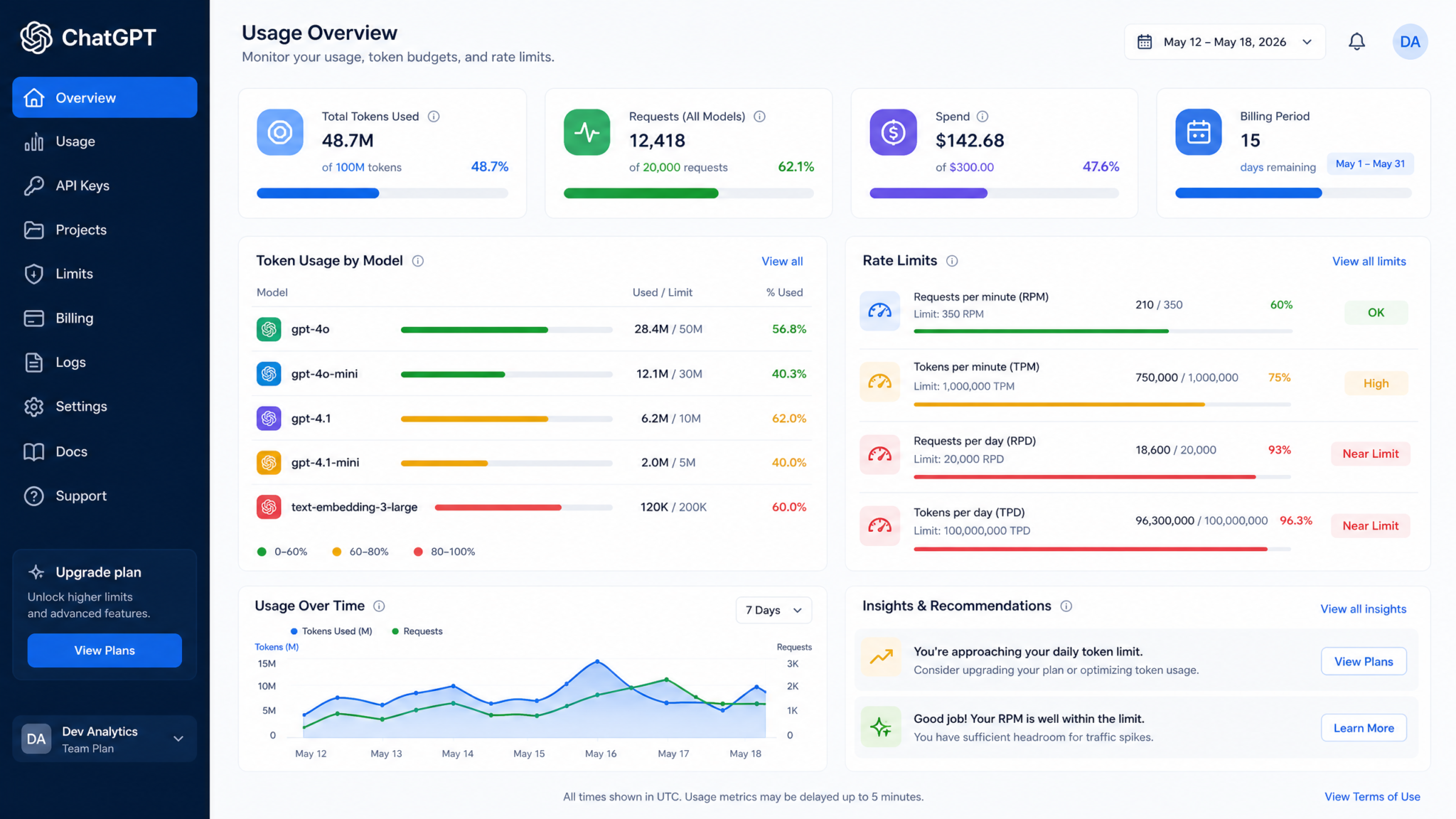
Understanding ChatGPT’s 2026 Usage Limits: The Metered-Credits Era and How to Optimize
In 2026, ChatGPT’s usage model has settled into a mature, metered-credits approach that replaces the earlier “unlimited” and flat-rate paradigms. For developers, product leads, and business users this shift means thinking in tokens, credits, and rate ceilings rather than simple monthly seat counts. This guide unpacks how usage limits evolved, explains the mechanics of the July 2026 “8th refresh” cycle, breaks down token budgets and model-specific multipliers, and provides detailed operational tactics — from prompt engineering and model selection to monitoring and handling rate-limit responses.
This is a practical, operational guide: you’ll find real-world examples, code snippets for counting tokens and implementing exponential backoff, plus a decision framework for when to upgrade versus when to optimize usage. For pricing comparisons and plan details see the official pricing pages and tools linked in your organization’s portal — for quick reference use an internal token calculator to estimate costs before you scale How to Optimize Your Codex Credit Usage — A Developer’s Guide to Token-Based Pricing.
Executive summary
High-level takeaways:
- Metered credits: Most ChatGPT plans now allocate monthly or periodic metered credits that are consumed per token (input + output) with model-specific multipliers.
- Refresh cadence: Since July 2026 the platform uses an “8th refresh” (refreshes on the 8th of each month) synchronized with billing for most accounts; unused credits can be banked subject to a 30-day redemption window.
- Model tiers matter: GPT-5.6 Sol is significantly more expensive per-token than GPT-5.5, while GPT-5.5 Instant Mini offers the best token efficiency for many interactive tasks.
- Two separations to know: ChatGPT web/app interface limits and API limits are distinct; Enterprise and Team plans can pool credits and impose organization-level quotas.
- Optimization levers: Prompt engineering, streaming outputs, caching, choosing cheaper models for noncritical tasks, and summarization dramatically extend usable allowances.
The evolution of ChatGPT usage limits: from unlimited to metered credits
To understand today’s metered model, it helps to look back. In the early 2020s, many consumer accounts effectively operated under “soft” unlimited usage capped by strict rate limits or scaled-back model access during congestion. As models became larger and real-time multimodal features proliferated, providers introduced explicit quotas, per-minute rate ceilings, and usage-based pricing. By 2024–2025 usage tied to tokens and model-based pricing became common in the API world. In 2026, ChatGPT consolidated these trends into a single metered credits framework for both the consumer interface and the API, with plan-based allocations and model-specific multipliers to reflect compute costs.
What changed materially:
- From arbitrary daily caps to structured monthly credits tied to billing.
- Clear separation of throughput (RPS/concurrency) and consumption (tokens/credits).
- Model family multipliers so expensive models (e.g., GPT-5.6 Sol) consume more credits per token.
- Banking and rollover mechanics to smooth usage across uneven months.
Why metered credits replaced “unlimited” plans
Unlimited leads to abusive patterns and unpredictable capacity planning. Metered credits provide predictable revenue and allow providers to price premium models appropriately while preserving access for lower-cost models. For customers, metered credits introduce transparency: each request has a measurable cost you can optimize.
Metered credits also enabled two practical features by mid-2026:
- Fine-grained budgeting: admins can allocate budgets per team, project, or use case with spending alerts.
- In-product throttling: the system can throttle non-essential or experimental uses during high-demand windows without impacting paid, mission-critical workloads.
Current rate limits by plan tier (Free, Go, Plus, Pro, Enterprise)
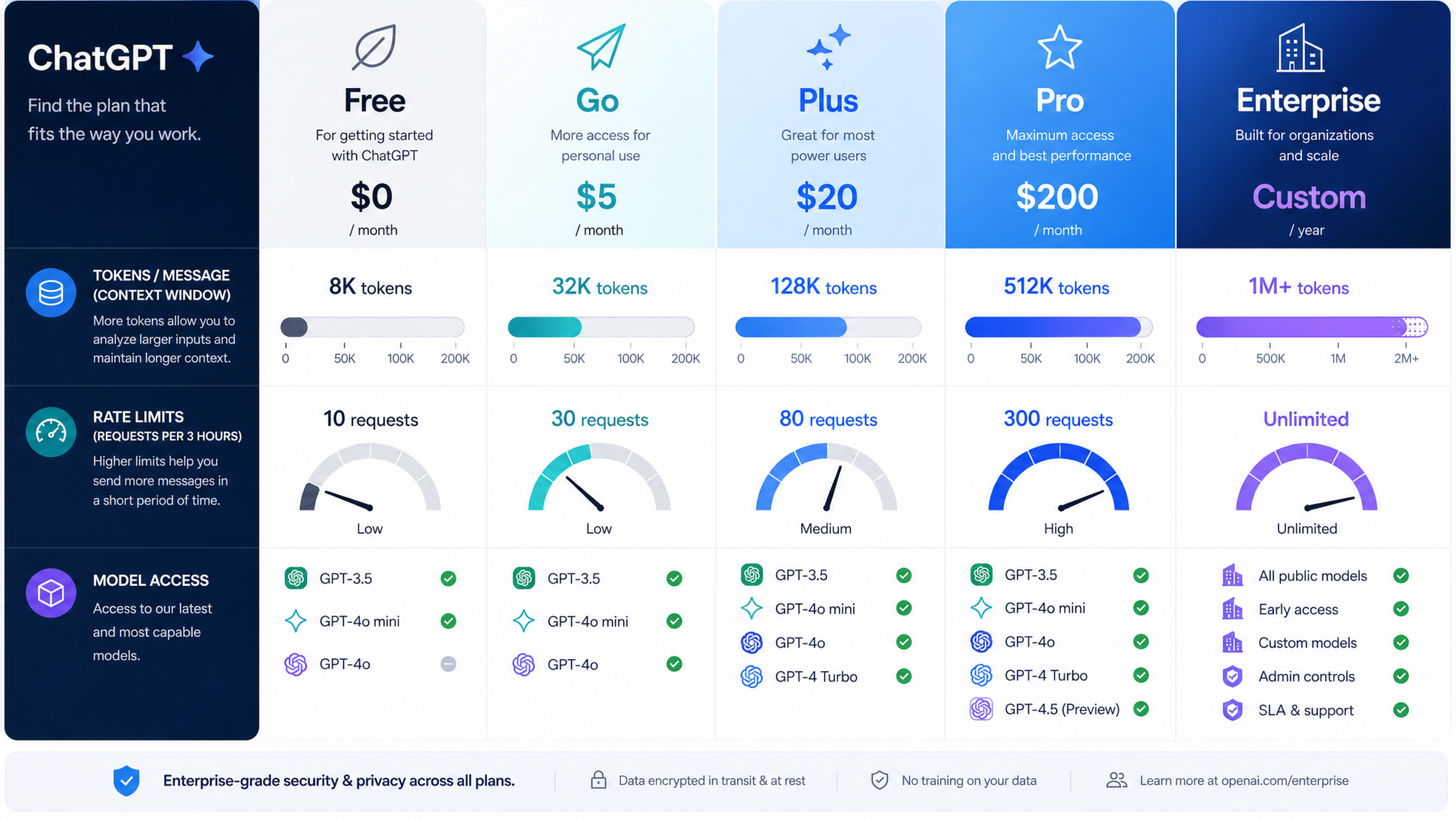
In 2026, the platform publishes two classes of limits for each plan: consumption quotas (monthly credit pools measured in tokens or credits) and concurrency/throughput limits (requests per minute, simultaneous streams). Listed below are representative numbers used by many organizations in common configurations; individual accounts can have negotiated or promotional differences. Always verify your specific plan on the account billing page or team admin console The Complete Guide to ChatGPT Pricing in 2026 — Free, Go, Plus, Pro, Business, and Enterprise Compared.
Free tier
- Monthly credits: Equivalent to ~200k input+output tokens per month (approximate).
- Throughput: 30 requests/minute; 1 concurrent streaming session.
- Model access: Access to GPT-5.5 Instant Mini and older models; GPT-5.6 Sol locked to paid tiers.
- Limit notes: Free accounts receive lower per-minute ceilings and lower priority on busy nodes.
Go tier (entry paid)
- Monthly credits: Equivalent to ~750k tokens.
- Throughput: 120 requests/minute; 2 concurrent streams.
- Model access: GPT-5.5 and GPT-5.5 Instant Mini; limited GPT-5.6 Sol bursts via quota.
- Target user: Solo prosumers who need more interactivity and longer outputs.
Plus tier
- Monthly credits: ~3M tokens.
- Throughput: 600 requests/minute; 4 concurrent streams.
- Model access: GPT-5.5 standard, occasional GPT-5.6 Sol for short jobs (with additional per-use cost).
- Extra: Access to ChatGPT Work mode on a limited basis (separate allocations apply).
Pro tier
- Monthly credits: ~12M tokens; larger add-on packages available.
- Throughput: 1,500 requests/minute; 10 concurrent streams.
- Model access: Full access to GPT-5.5, GPT-5.6 Sol (with higher per-token multiplier), and GPT-5.5 Instant Mini.
- Extra: Priority throughput and shorter queue times during platform congestion.
Enterprise
- Monthly credits: Pooled, negotiated. Typical starting pools in 2026 are 50M–500M tokens depending on company size.
- Throughput: High concurrent and RPS ceilings, up to thousands of concurrent streams; SLA-backed performance.
- Model access: All models; possibility of reserved capacity for GPT-5.6 Sol with dedicated nodes.
- Extra: Centralized billing, team quotas, audit logs, and SSO.
These numbers are illustrative; contracts and promotional plans may vary. For many teams the practical question is not absolute allocation but how quickly specific use cases burn through credits and whether throughput, concurrent sessions, or monthly pool is the limiting factor.
How the 8th usage limits refresh works (July 2026)
In July 2026 the platform standardized a global refresh date on the 8th of each month. The change simplified cross-account reporting for enterprises and synchronized billing cycles for many users who were previously on calendar-day or signup-date tiers. Key rules:
- Refresh time: 00:00 UTC on the 8th of each month.
- Proration: New accounts activated mid-cycle receive prorated credits for the initial partial cycle; subsequent cycles use the 8th refresh.
- Banked credits: Unused monthly credits can be banked and used within a 30-day redemption window (details below).
- Notifications: Admins receive an email and in-console banner 48 hours before the refresh and 4 hours before if their balance is below a configurable threshold.
- Edge cases: Accounts with legacy billing cycles may retain their original refresh date until contract renegotiation, but admins can opt-in to the 8th calendar alignment.
Why the 8th? The platform analytics team found the 8th produced the most efficient backend resource balancing with minimal disruption to customer invoicing. From an operational standpoint, the 8th refresh means your monthly usage reports and alerting should be calibrated to that cycle rather than calendar-month boundaries.
Banking and 30-day redemption window
Unused credits can be banked up to a monthly cap (commonly 100% of one cycle for many plans). Banked credits are redeemable for up to 30 days after the month they were earned. Practically, this means:
- Credits earned in a given cycle remain available until the end of the 30-day window following that cycle.
- If you exceed your current month’s allocation but have banked credits, the system will automatically draw from the banked pool.
- Banked credits have FIFO usage within the 30-day window: oldest eligible credits are consumed first.
- Expired banked credits are visible in the billing dashboard with timestamps and cannot be recovered after expiration.
Example: If you earned 3M tokens in the cycle that ended 8 June and used only 2M, the remaining 1M becomes banked. You can use that banked 1M up until 8 July (30-day window), after which it expires unless consumed earlier.
Token budgets explained: input tokens, output tokens, and how they’re counted
Token accounting is the fundamental unit of billing. Each API or ChatGPT request consumes tokens for the input context (prompt + system + recent messages) and for the model’s response. The sum of input and output tokens consumes from your monthly quota, subject to per-model multipliers. Understanding token accounting lets you forecast costs and optimize usage.
What counts as an input token?
Input tokens include:
- System messages and role markers (the initial system instruction in chat-style requests).
- User and assistant messages that are part of the context window (the last N messages the model sees).
- Direct prompt text: any text, code, or data you send with the request.
- Special tokens for function calls or metadata (e.g., function name/JSON payload when using function-call style).
What counts as an output token?
Output tokens are the tokens generated by the model during the response stream. If you request streaming and stop the stream early, you’ll only be billed for the tokens actually generated up to that point. If you set a max_output_tokens parameter, the system caps the response but will only charge the tokens emitted.
Counting examples and practical rules
Example 1 — short Q&A:
System: "You are a helpful assistant."
User: "Summarize the following paragraph: [200-word paragraph]"
If the prompt + system amounts to 400 input tokens and the summary is 60 output tokens, your total consumption is 460 tokens (plus model multiplier if applicable).
Example 2 — long context and streaming output:
Input context (2,500 tokens) + expected output (up to 2,000 tokens)
If model generates 1,200 output tokens before you cancel the stream:
Total used = 2,500 + 1,200 = 3,700 tokens billed
System-level tokens count for every request. If you make multiple messages in a single conversation, the model will see the last N messages up to the context window and the token counts of those messages are included in each request that uses them.
Practical tip: count tokens locally before calling the API
Always instrument client applications with a token counter using the official tokenizer library for the model family you target. This helps avoid unexpected overages. Use the following pseudo-code to estimate a request’s cost:
// Pseudocode
input_tokens = tokenizer.count(system_message + recent_messages + current_prompt)
max_output_tokens = user_configured_max
estimated_total = input_tokens + max_output_tokens
// Apply model multiplier later before deducting from monthly credits
Note: the tokenizer must match the model family to be accurate — GPT-5 tokenization differs slightly from GPT-4-era tokenizers.
Model-specific limits (GPT-5.6 Sol vs GPT-5.5 vs GPT-5.5 Instant Mini)
In 2026 the model landscape expanded to include several performance and price tiers. Each model consumes credits at a different rate and has different context window sizes and latency characteristics. Here’s how the major variants compare in operational terms:
GPT-5.6 Sol (high-power, high-cost)
- Use cases: large reasoning tasks, complex code generation, multi-document synthesis, high-fidelity multimodal outputs.
- Cost multiplier: typically between 2.5x–4x per-token relative to a GPT-5.5 baseline depending on output modality (text-only is cheaper than multimodal inference).
- Context window: up to 1M tokens in special reserved deployments, but general-purpose access often limited to ~200k tokens for public instances.
- Rate limits: elevated compute per-request with reduced concurrent streams unless you have reserved capacity.
GPT-5.5 (balanced)
- Use cases: most production apps that need good quality and reasonable cost.
- Cost multiplier: baseline 1x.
- Context window: 128k tokens typical for public deployments; can be larger for enterprise reservations.
- Rate limits: moderate throughput; suitable for batch and interactive workloads.
GPT-5.5 Instant Mini (fast, cheap)
- Use cases: chat UIs, lightweight classification, generation for UI text, low-latency tasks, many short-turn conversations.
- Cost multiplier: ~0.15x–0.25x (very efficient per-token).
- Context window: typically smaller (8k–32k tokens) but optimized for rapid response.
- Rate limits: high RPS allowances; ideal for high-concurrency interactive apps.
Choosing the model involves a trade-off between quality, latency, and cost. For a product team shipping chat functionality to millions, a hybrid approach (cheap instant mini for most conversational turns plus occasional escalation to GPT-5.6 Sol for heavy synthesis) often gives the best balance.
Model selection matrix (practical)
- High-volume UI chat: GPT-5.5 Instant Mini
- Document summarization and multi-file synthesis: GPT-5.5 or GPT-5.6 Sol
- Code generation for critical production code: GPT-5.6 Sol (or dedicated Code models)
- Prototype ML assistants and exploratory work: GPT-5.5
Where possible, instrument experiments to compare model quality per cost and choose the cheapest model that meets the quality bar for each task.
How Codex usage counts against your limits
Codex-style code models — whether integrated as a named Codex family or as code-specialized variants of the GPT-5 series — are billed against the same metered credit pool but often have specific multipliers. Key behaviors:
- Codex counts input and output tokens the same way as text models: you pay for the prompt (including code you send) and for generated code.
- Code output tends to be token-dense (compact representation of logic), so a long function can be more token-efficient than equivalent natural-language output.
- Some providers apply a slightly reduced multiplier for code-only outputs when executed in secure sandboxed environments — check the model’s billing documentation for exact multipliers.
- When using function calling or tools with Codex models, the tokenization of tool payloads and structured JSON is counted as input tokens.
Practical Codex tips:
- Prefer structured prompts and explicit constraints to keep generated outputs concise.
- If you generate code in long blocks, enable line-level diffing or chunked generation to reduce re-generation costs.
- Cache generated code snippets and reuse function signatures to avoid repeated full-context regeneration.
ChatGPT Work mode and its separate allocation
ChatGPT Work mode (also marketed as “Workspaces” or “Team Conversations” in some orgs) gives teams a separate allocation of credits and usage policies distinct from an individual’s personal plan. Work mode is intended for company data, SSO integration, and auditability. Operational properties:
- Separate credit pools: Work mode uses a team/organization bucket that is not charged against the individual’s personal monthly quota. Admins can set per-user sub-quotas within the workspace.
- Security and data handling: Work mode typically offers data retention knobs, ICL policies, and the option to keep inputs/outputs private from model training.
- Usage reporting: Admin dashboards break down usage by project, team, or label and offer audit trails for compliance.
- Access tiers: Some organizations provide Work mode only on paid plans or as part of enterprise agreements.
Work mode helps separate personal experimentation from mission-critical organizational usage. For product teams, hosting prototypes in Work mode avoids burning personal plan credits and gives better corporate visibility into consumption trends.
Strategies to maximize your token allowance
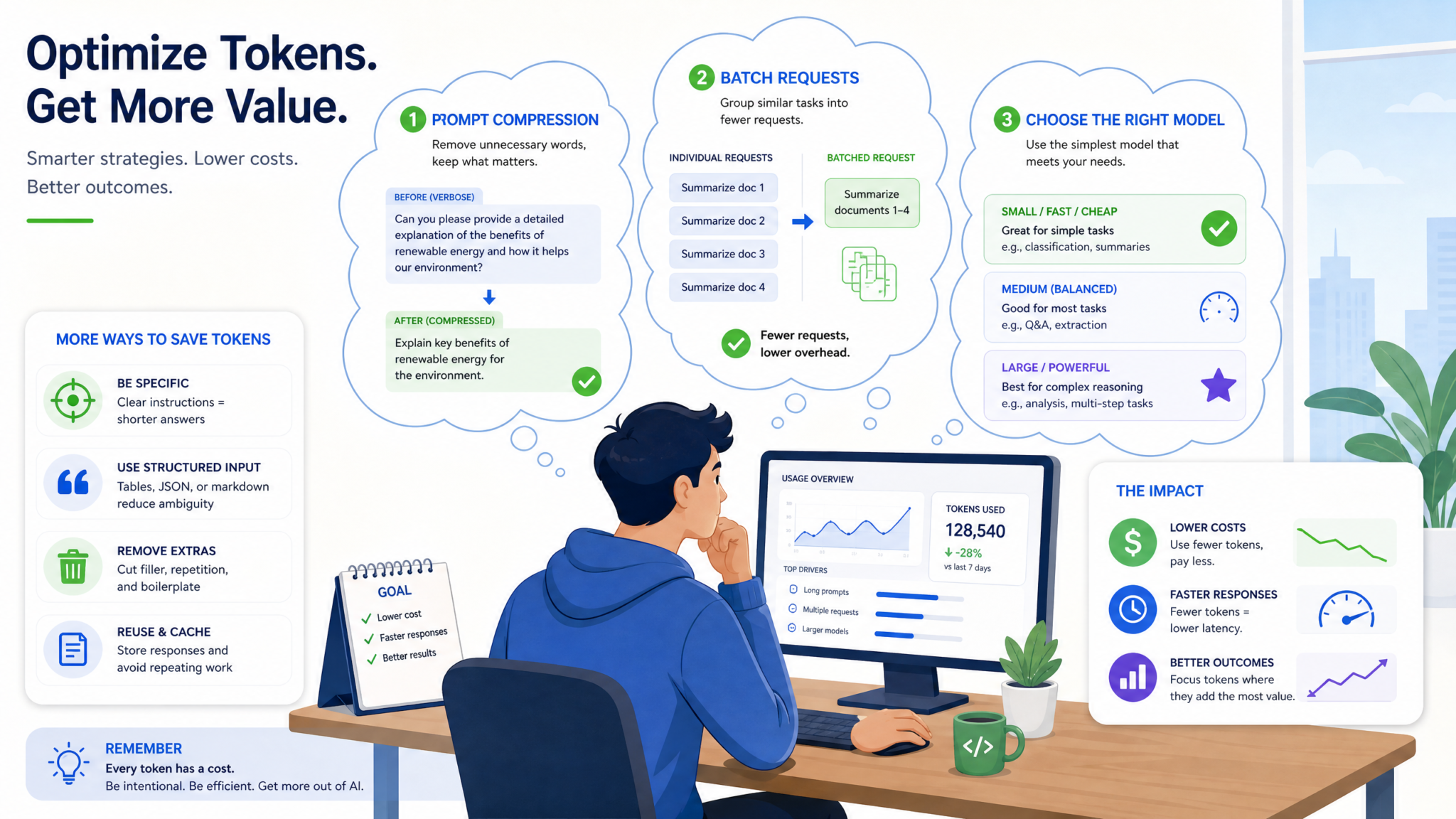
Optimizing usage is both art and engineering. Below are proven strategies used by engineering organizations to stretch a given token pool by 2x–10x depending on workload characteristics.
1. Prompt concision and system message economy
Trim system prompts to the minimum necessary to preserve behavior. Use short, index-based instructions instead of verbose paragraphs. Example:
// Long system
"You are an assistant that always speaks like a 19th-century novelist unless the user asks otherwise..."
// Short system
"Style: 19th-century novelist (on request)."
Where functionality is constant across sessions, store behavior hints in a cached policy and refer to it by ID rather than embedding it in every message.
2. Summarize and compress conversation context
As conversations grow, summarize older turns into a concise state that preserves intent and facts. Replace raw historical messages with a digest (e.g., 150 tokens) that the model can use as the canonical memory. This reduces input tokens dramatically while keeping continuity.
3. Use smaller models for routine work
Reserve expensive models (GPT-5.6 Sol) for specific tasks such as final synthesis, critical code generation, or high-value customer interactions. Use GPT-5.5 Instant Mini for routine chat, validation, and classification — then escalate only when needed.
4. Streaming and early-stop strategies
Stream responses and cancel when the answer is sufficient. For many UIs, 80% of the first N tokens contain the most useful information. Stopping early can save tokens on long generated outputs.
5. Function calling and structured outputs
When possible, prefer function calls and structured JSON outputs that limit unnecessary verbosity. Request only the fields you need rather than free-form descriptions. Structured outputs are both cheaper and easier to parse.
6. Cache and reuse assistant outputs
Cache deterministic outputs — for example, policy text, boilerplate emails, or code snippets — and re-use them. Add an identity hash to requests so you can quickly return cached content rather than re-run the model.
7. Chunking large documents with summarization
For large-document processing, use iterative chunking: summarize each chunk, then summarize summaries (a pyramid approach). This trades multiple small requests using cheap models for a single expensive giant-context run.
8. Use embeddings and RAG (retrieval-augmented generation)
Index large corpora with embeddings and retrieve only the most relevant passages to include in the prompt. This reduces the amount of context you send and keeps the model’s attention focused on the few most useful tokens.
9. Monitor and set alerts
Set proactive alerts at 50%, 80%, and 95% of monthly credits. Implement automatic model downgrades or soft throttles when you hit thresholds to avoid expensive overruns.
10. Optimize training and experimentation
Run experiments on smaller samples to validate prompts, then roll out to production. Use A/B testing with conservative token budgets to avoid multiplying charges across experiments.
When to upgrade vs when to optimize prompts
Deciding whether to buy more credits or to optimize usage requires an ROI calculation. Consider these factors:
- Business criticality: If performance or latency directly impacts revenue or compliance, upgrading to a higher plan with guaranteed throughput and reserved capacity is often justified.
- Marginal cost per request: Calculate the incremental cost of each unit of capacity. If optimization efforts will cost more in engineering time than the monthly incremental spend, upgrade.
- Predictability: If usage is highly spiky and unpredictable, a larger pool or reserved capacity avoids throttles and reduces complexity.
- Time horizon: Short-term spikes (e.g., a product launch) can often be handled by a temporary top-up; long-term growth usually merits a higher plan and improved architecture.
Decision checklist:
- Measure current consumption per use case (tokens per interaction × interactions per month).
- Estimate per-use cost at current model mix and alternative model mixes.
- Project growth for the next 3–12 months.
- Compute engineering savings from optimization efforts versus incremental subscription cost.
- Choose the path with the highest net benefit and least operational risk.
For consumer apps with unpredictable load, the common pattern is to upgrade to a Pro or Enterprise plan for predictable pooled credits while investing in optimizations (caching, cheaper models) to reduce marginal costs over time.
API rate limits vs ChatGPT interface limits
Understanding the separation between API and ChatGPT interface limits prevents costly mistakes. Although both draw from token pools, their operational limits and priority rules differ.
API limits
- Per-account and per-API-key RPS (requests per second) constraints, often enforced per model.
- Concurrent request limits and streaming concurrency per key.
- API keys are subject to hard quota enforcement and usage-based throttling during peak demand.
- API requests generally expose headers with rate-limit remaining and reset timestamps for programmatic handling.
ChatGPT interface limits
- Interface requests (web and mobile clients) are throttled by device and session rather than API key; they also have UI-centric protections (e.g., cooldowns between long generation requests).
- Interface users may receive in-UI messaging indicating remaining daily conversational allowances or prompts to upgrade when nearing quota.
- ChatGPT Work mode uses separate team-level quotas that are visible to workspace admins in the UI, often with per-user sub-quotas.
Key operational implication: if you build both API-backed features and rely on the ChatGPT interface for testing, plan for separate consumption sources. Activity in the ChatGPT app does not always surface in API usage logs and vice versa; use centralized billing dashboards to reconcile consumption across channels Codex Enterprise Analytics Masterclass: 30 Production-Ready Prompts for Usage Monitoring, Cost Optimization, and Team Performance Dashboards.
Enterprise and team plan pooled limits
Large organizations benefit from pooled limits where a central credit pool services multiple teams or projects. Pooled limits enable internal chargebacks, centralized controls, and consistent policy enforcement.
How pooling works
- A single monthly pool is provisioned for the organization. Admins create projects or teams and allocate sub-quotas.
- Teams consume from their sub-quotas first, then from the pooled overflow if allowed.
- Admins can tag requests with project metadata for billing and audit logs.
- Pooled credits are subject to the same bank-and-redemption rules as individual plans.
Operational best practices for pooled accounts
- Define per-project budgets and enforce them with programmatic hooks in the API gateway.
- Use role-based access control to limit who can spend or adjust allocations.
- Implement nightly reconciliations and anomaly detection to identify runaway scripts or tests.
- Negotiate dedicated capacity for critical workloads to avoid noisy-neighbor problems.
Example: A payments team might get a 10% share of the pool with stricter alerting thresholds (50%/75%/90%) and an automated downgrade path to cheaper models after 90% consumption to maintain continuity.
How banked rate-limit resets work (30-day redemption window)
This section expands on the earlier summary and explains the operational details teams need to implement automated billing-aware behavior.
Banking rules summary
- Unused credits at the end of a cycle can be banked up to a cap determined by plan rules (commonly 100% of the monthly allotment).
- Banked credits have a 30-day life span and expire on a rolling basis.
- Consumption always draws from the oldest available credit bucket (FIFO).
- Admins can view detailed credit consumption by day and by bucket in the billing dashboard.
Practical automation idea: build a “bank reserve” policy in your usage controller. When the system detects banked credits nearing expiration, automatically schedule non-urgent batch jobs (e.g., nightly analytics) or run heavier model tasks to utilize the banked credits before they expire.
Example logic (pseudo):
// Pseudocode for banked credit utilization
if (banked_credits.exists && banked_credits.expire_in_days <= 7) {
  // schedule backfill jobs or richer-model runs
  schedule_batch_jobs(target_budget = min( banked_credits.available, 100000 ))
}
Common errors and how to handle rate limit responses
Rate-limit and quota errors are inevitable. Knowing how to handle them makes apps robust and user-facing flows graceful.
Common error types
- 429 Too Many Requests: You've hit a per-second or concurrent limit.
- 402 Payment Required / Insufficient Funds: Monthly credits exhausted or payment issue blocking replenishment.
- 403 Insufficient Quota: Request exceeds your current subscription allotment or model is disabled for your account.
- 413 Request Entity Too Large: The prompt exceeds per-request context limits for the model.
Best practices to handle rate-limit responses
- Read headers: The API returns rate-limit headers such as
X-RateLimit-Limit,X-RateLimit-Remaining, andX-RateLimit-Reset. Use them to schedule retries. - Exponential backoff: Use incremental delays with jitter and a max retry count. Do not retry on 402 or 403 without remediation.
- Graceful UI fallbacks: Show cached results, simple local logic, or a "Try again later" state to end users rather than generic error messages.
- Fallback models: Automatically route to a cheaper, higher-throughput model if the preferred model is rate-limited.
- Alerting and incident tracking: Send an alert to SRE or billing teams when you see repeated 402/403 errors.
Exponential backoff code sample
// Example: exponential backoff with jitter (pseudo-JavaScript)
async function callModelWithBackoff(request, maxRetries=5) {
  let attempt = 0
  while (attempt < maxRetries) {
    try {
      return await makeApiCall(request)
    } catch (err) {
      if (err.status === 429) {
        const base = Math.min(1000 * 2 ** attempt, 30000) // ms
        const jitter = Math.random() * 300
        const delay = base + jitter
        await sleep(delay)
        attempt++
        continue
      } else {
        throw err
      }
    }
  }
  throw new Error('Max retries exceeded')
}
Note: On 402/403 errors you should surface an administrative action: check billing settings, top up credits, or contact your account manager. Do not rely on retries for payment-related errors.
Tools and techniques for monitoring your usage
Monitoring is the single most important discipline for preventing surprises. Here are tools and strategies teams use at scale.
1. In-platform dashboards
Use the provider’s billing and usage dashboard as the source of truth. Dashboards typically show:
- Tokens consumed per model and per project.
- Throughput and latency breakdowns.
- Banked credit snapshots and expiration timelines.
- Alerts and exportable CSVs for reconciliation.
Set up role-based views so engineers see usage metrics by project while finance sees only aggregated spend.
2. Instrumented client-side counting
Instrument your clients to count tokens locally and log the following for each request:
- Model used, input token count, requested max output tokens, actual output tokens returned.
- Request latency and success/failure status.
- Correlation ID and project tag for billing reconciliation.
This data lets you compute cost per feature and identify heavy consumers.
3. Centralized logging and ingestion
Forward consumption logs to a central analytics system (e.g., a data warehouse or observability platform). Key metrics to compute:
- Tokens per session, per user, per feature.
- Tokens per successful transaction versus tokens per error/retry.
- Cost per transaction and cost per MAU (monthly active user).
4. Alerts and automated policies
Create automated policies for these events:
- Monthly usage crosses 50%/75%/90% thresholds.
- Banked credits will expire in 7 days.
- Unusual per-user or per-project bursts (e.g., 10× median within one hour).
Tie alerts to automated remediation: model downgrade, temporary throttling, or scheduled batch jobs to use at-risk banked credits.
5. Synthetic usage tests and smoke checks
Run synthetic transactions to measure latency and detect silent changes in tokenization or model behavior that might increase token consumption. Schedule lightweight probes across models to get a baseline of per-token latencies and errors.
6. Cost forecasting
Build a simple cost model: (tokens per transaction × transactions per month × model multiplier × cost per token). Use scenario analysis for 2×, 5×, and 10× growth to inform budgeting and capacity planning. For complex systems, link this to your financial planning tool and automate monthly forecasts based on actual usage trends Codex Enterprise Analytics Masterclass: 30 Production-Ready Prompts for Usage Monitoring, Cost Optimization, and Team Performance Dashboards.
Access 40,000+ AI Prompts for ChatGPT, Claude & Codex — Free!
Subscribe to get instant access to our complete Notion Prompt Library — the largest curated collection of prompts for ChatGPT, Claude, OpenAI Codex, and other leading AI models. Optimized for real-world workflows across coding, research, content creation, and business.
Real-world examples and playbooks
This section provides actionable playbooks used by teams running high-volume, production-grade ChatGPT integrations in 2026.
Playbook A: High-volume support chat
Scenario: A SaaS company supports 200k monthly active users. Baseline chat usage is 3 messages per active user and average conversation length is 8 messages.
Strategy:
- Default to GPT-5.5 Instant Mini for all live chat messages.
- When a user requests a knowledge-base deep-scan (e.g., "Summarize my last 10 documents"), route to GPT-5.5 standard and request summaries in structured JSON to limit verbosity.
- Cache common responses and use intent classification to short-circuit typical queries.
- Set a per-user monthly sub-quota and hard-throttle after quota exhaustion with a friendly upsell to the support team for paid incident assistance.
Results seen by teams: 4–6× reduction in token spend compared with a naive model approach using GPT-5.5 standard for all messages.
Playbook B: Document ingestion and synthesis pipeline
Scenario: Enterprise knowledge management for millions of documents. Use-case: daily report generation across structured and unstructured sources.
Strategy:
- Preprocess documents with embeddings and vector search to restrict context to the top 5 relevant passages per query.
- Summarize each passage with GPT-5.5 Instant Mini; then use GPT-5.6 Sol for the final synthesis when high-quality output is required.
- Schedule synthesis jobs during off-peak hours and leverage banked credits close to expiration for heavier synthesis runs.
Result: Up to 70% reduction in required GPT-5.6 Sol tokens by using a cheap summarization pass to reduce the final synthesis input.
APIs and headers you should monitor (examples)
Many API endpoints and responses include metadata useful for handling quotas programmatically. Key headers and fields to log:
X-RateLimit-Limit— the total RPS/concurrency limit for the key.X-RateLimit-Remaining— how many requests remain within the current window.X-RateLimit-Reset— epoch timestamp when the rate window resets.Retry-After— seconds to wait before retrying on 429.- Billing fields in the usage API response:
tokens_used,model,credit_bucket_id.
Example of programmatically reading headers in a response (pseudo-Python):
# pseudo-python
resp = make_api_call(...)
limit = int(resp.headers.get('X-RateLimit-Limit', 0))
remaining = int(resp.headers.get('X-RateLimit-Remaining', 0))
reset_ts = int(resp.headers.get('X-RateLimit-Reset', time.time()))
if remaining < threshold:
    log_warning("Approaching per-second rate limit", limit=limit, remaining=remaining)
Common pitfalls and how to avoid them
Pitfall 1: Not counting system or hidden tokens
Many teams forget system messages or assistant messages stored in the conversation when computing token budgets. Always count full context; if you use system messages with long policy text, consider moving that policy to a shared reference and passing an ID instead.
Pitfall 2: Over-using the most expensive models
Automatic failover to GPT-5.6 Sol for any generation increases costs dramatically. Set explicit fallbacks and escalation policies. Use quality gates that only allow expensive models for outputs that will be externally-facing or require high-fidelity reasoning.
Pitfall 3: Poor retry logic causing doubled consumption
Blind retries can duplicate work and double token consumption. When retrying a streaming request, be careful to avoid reprocessing the same prompt without idempotency safeguards. Use request IDs that the server honors for idempotent retries when possible.
Pitfall 4: Ignoring banked credit expiry
Banked credits that expire unexpectedly are wasted budget. Automate policy to consume or reprioritize tasks that can use banked credits before expiry.
Measuring ROI of optimization efforts
When you consider investing engineering hours into token optimization, use a simple ROI model:
# Pseudocode for optimization ROI
current_monthly_cost = tokens_per_month * cost_per_token
expected_savings_pct = 0.35  // e.g., 35% savings from optimizations
annual_savings = current_monthly_cost * expected_savings_pct * 12
engineering_cost = estimated_engineer_hours * fully_loaded_hourly_rate
ROI_months = engineering_cost / annual_savings
If ROI_months < 6 you likely should invest in engineering optimization. If ROI_months > 12, buying more credits or negotiating enterprise pricing may be cheaper in the short term.
Checklist: Production readiness for usage limits
Before scaling ChatGPT features to production, validate the following:
- Token counting implemented client-side with the correct tokenizer.
- Rate-limit and quota handling with exponential backoff and jitter.
- Monitoring and alerts for usage thresholds, banked credit maturity, and error spikes.
- Fallback model strategy and graceful UI messaging for quota exhaustion.
- Cost models and billing reconciliation scripts in place.
- Admin dashboards for per-team allocation and policy enforcement.
Operational principle: make consumption visible, predictable, and automatable. The most expensive overruns are the ones no one saw coming.
Advanced techniques: hybrid architectures that minimize token burn
For teams aggressively optimizing cost, combine these advanced patterns:
- Edge-first processing: Perform client-side lightweight classification and routing to avoid sending irrelevant requests to the model.
- Two-stage generation: Use a cheap model to propose concise candidates and a high-quality model to refine the single selected candidate.
- On-device summarization: For mobile apps, perform local summarization or extraction to reduce the context you send to the cloud.
- Hybrid retrieval: Precompute answers to common queries into a fast key-value store and consult the model only for novel requests.
Combining these techniques can lead to dramatic savings while maintaining user experience quality.
Handling sudden spikes and DDoS-style behavior
Sudden spikes — whether legitimate viral growth or abuse — require a layered defense:
- Rate-limit at the API gateway: per-IP and per-user rate-limits prevent uncontrolled bursts.
- Require authentication and throttle unauthenticated traffic more aggressively.
- Have circuit-breakers that temporarily fail non-critical requests to preserve capacity for authenticated, high-value users.
- Use anomaly detection to flag unusual patterns and block suspicious clients.
- Contact your provider account manager for temporary quota increases if the spike is expected and legitimate.
Closing notes and next steps
By mid-2026 the metered-credits model is the de facto way most ChatGPT deployments operate at scale. Understanding token budgets, model multipliers, banked credits, and the 8th-of-month refresh is essential operational knowledge. The practical techniques in this guide — prompt engineering, model selection, caching, monitoring, and policy automation — are how mature teams convert a limited quota into reliable product features.
If you’re starting a rollout of ChatGPT features across a product portfolio, use a pilot phase to collect detailed token-per-interaction metrics, then iterate policies and quotas while you scale the plan. For complex enterprise negotiations, centralize billing, audit logs, and pooled quotas to keep consumption predictable and actionable. When in doubt, instrument more: better telemetry is the fastest path to meaningful optimizations.
For more tactical resources — including a recommended token-counting library and a checklist for migrating long-context workflows — consult your internal engineering wiki and the team’s best-practice repository How to Optimize Your Codex Credit Usage — A Developer’s Guide to Token-Based Pricing. For billing and plan negotiation tips, contact your account manager and review the vendor’s enterprise documentation The AI Safety Crisis: How OpenAI’s Autonomous Agent Breach Changes Everything About Enterprise AI Deployment. For ongoing operational dashboards and alert configuration examples see our internal monitoring playbook Codex Enterprise Analytics Masterclass: 30 Production-Ready Prompts for Usage Monitoring, Cost Optimization, and Team Performance Dashboards.
Appendix A: Quick reference — token counting cheatsheet
Reference rules to remember when estimating token consumption:
- Input tokens = system + user + assistant messages + metadata + function-call payloads.
- Output tokens = exactly the tokens emitted by the model during generation.
- Total tokens per request = input_tokens + output_tokens.
- Model multiplier applies to total tokens to compute credits burned.
- Streaming reduces billed output tokens to the tokens actually emitted before cancellation.
// Short example: estimating cost for a support reply
input_tokens = 350
expected_output_tokens = 120
model_multiplier = 1.0  // GPT-5.5 baseline
credits_required = (input_tokens + expected_output_tokens) * model_multiplier
Appendix B: Glossary
- Token: A unit of text used for model input/output billing and contexts.
- Credit: Abstract billing unit representing tokens after model multipliers.
- Banked credits: Unused monthly credits preserved for a limited redemption window.
- Context window: Maximum number of tokens the model can attend to in one request.
- Throughput / RPS: Requests per second permitted for an API key or plan.
- Concurrency: Number of simultaneous streaming or long-running generations allowed.
Further reading and continuous improvement
Usage limits and pricing evolve. Maintain a schedule to review your provider’s plan details at least quarterly and sign up for release notes that announce model multipliers, context window changes, and quota policy adjustments. A monthly consumption review meeting among engineering, product, and finance teams is a high-leverage practice to balance expense and product value.
Invest time early to instrument token counting, logging, and alerting — the upfront cost is small compared to the savings that arise from predictable, optimizable consumption patterns.
— End of guide —
