
The Complete Guide to OpenAI’s Student Collective 2026-2027: How to Become a Campus AI Lead and Build Your University’s AI Community
The Complete Guide to OpenAI’s Student Collective 2026-2027: How to Become a Campus AI Lead and Build Your University’s AI Community
Artificial intelligence is no longer the exclusive territory of research labs and tech giants — it has arrived on college campuses, and OpenAI wants students to be the ones leading the charge. The OpenAI Student Collective 2026-2027 campus lead program is one of the most exciting student opportunities in the AI space today, offering undergraduates from every discipline — not just computer science — the chance to become recognized AI ambassadors at their universities, receive direct support from OpenAI, earn a cash stipend, and shape the AI literacy of an entire generation of college students. Whether you are a biology major curious about how AI is changing drug discovery, a journalism student exploring AI-generated content, or a software engineering student building your first LLM-powered application, this program was designed with you in mind.
Table of Contents
- What Is the OpenAI Student Collective?
- Why This Program Matters in 2026
- Eligibility Requirements: Who Can Apply?
- What Campus AI Leads Actually Do
- Benefits, Cash Stipend, and Resources
- The Application Process: Step-by-Step
- What Makes a Strong Application
- Program Timeline and Key Dates
- How to Plan Your First AI Workshop on Campus
- Building a Thriving University AI Community
- OpenAI’s Broader Education Strategy
- Tips From Successful Campus Leads
- Conclusion: Your Opportunity to Shape AI on Campus
1. What Is the OpenAI Student Collective?
The OpenAI Student Collective is a structured, year-long campus ambassador program that recruits undergraduate students to serve as designated Campus AI Leads at their respective universities. Launched as part of OpenAI’s commitment to responsible AI education and equitable access to AI tools, the program creates a grassroots network of student advocates who host educational events, facilitate workshops, build AI clubs and communities, and serve as a liaison between their campus population and OpenAI’s platform ecosystem.
At its core, the program is about democratizing AI knowledge. OpenAI recognizes that a large percentage of students — even those who use ChatGPT daily — lack the structured understanding to use AI tools critically, ethically, and effectively. Campus leads are trained and empowered to close that gap. They receive direct support from OpenAI’s education team, access to exclusive resources, and the organizational infrastructure to make meaningful impact at scale.
The 2026-2027 cohort represents the most ambitious iteration of the program yet. OpenAI has expanded the program’s geographic footprint, increased the stipend amounts, introduced a tiered milestone system for rewards, and added structured mentorship from OpenAI staff. For students interested in AI policy, AI product development, AI ethics, or simply becoming more informed users of powerful technology, this program offers a uniquely accessible entry point.
The program operates on a straightforward model: selected campus leads commit to organizing a set number of AI-focused events per semester, growing their campus AI community, documenting their impact, and participating in national cohort activities such as virtual summits and collaborative projects. In return, they receive financial support, professional development, and direct access to OpenAI’s team.
2. Why This Program Matters in 2026
To understand why the OpenAI Student Collective is particularly significant in 2026, you need to appreciate the scale and pace of AI adoption that has swept through higher education over the past several years. From professors integrating AI writing assistants into their syllabi, to university research labs using large language models for data synthesis, to career centers advising students on AI-proof skill sets — AI is no longer a futuristic topic in higher education. It is the present.
Yet despite this ubiquity, there remains a profound structural gap in how AI is taught and understood on college campuses. Most universities have not yet integrated comprehensive AI literacy into their core curricula. Students in the humanities, social sciences, and arts often graduate with limited exposure to the practical and ethical dimensions of AI tools that will absolutely affect their careers. Meanwhile, computer science and engineering students frequently receive deep technical training without enough exposure to the societal, philosophical, and policy implications of the systems they build.
The OpenAI Student Collective exists precisely to address this gap through a model that academic institutions have struggled to replicate from the top down: student-to-student learning. Research in educational psychology consistently shows that peer-led instruction significantly improves knowledge retention and reduces psychological barriers to learning. When a fellow student — not a distant professor or a corporate trainer — explains why prompt engineering matters or how to think critically about an AI-generated response, the information lands differently and sticks longer.
There is also a timeliness argument. The students who shape AI culture on their campuses in 2026 and 2027 will be entering the workforce as AI becomes fully embedded in virtually every industry. The campus leads who develop skills in community organizing, technical communication, AI ethics facilitation, and event production during this program will carry those experiences into careers in ways that significantly differentiate them from peers who merely used AI tools passively throughout college.
3. Eligibility Requirements: Who Can Apply?
One of the most refreshing aspects of the OpenAI Student Collective campus lead program is its deliberate inclusivity in terms of academic background. Unlike many tech company programs that implicitly or explicitly favor STEM applicants, this program is explicitly open to undergraduates from any discipline. OpenAI has made it clear that diverse perspectives — from the arts, social sciences, law, business, medicine, and beyond — are not just welcomed but actively sought.
Core Eligibility Criteria
| Criterion | Requirement | Notes |
|---|---|---|
| Enrollment Status | Current undergraduate student | Must be enrolled full-time or part-time at an accredited college or university |
| Academic Year | Must be able to serve the full 2026-2027 academic year | Graduating early or studying abroad for a full year may affect eligibility |
| GPA Requirement | No minimum GPA specified | Academic record is considered holistically but no hard cutoff exists |
| Major/Discipline | Open to all majors | Diversity of disciplines is explicitly encouraged |
| Geographic Location | U.S.-based institutions (with select international) | International expansion continues; check current guidelines |
| Prior AI Experience | Not required | Curiosity and willingness to learn are weighted heavily |
| Leadership Experience | Preferred but not mandatory | Any form of community or organizational involvement counts |
Who This Program Is Specifically Designed For
The program is particularly well-suited for students who sit at the intersection of curiosity and community. You do not need to be able to write Python code or understand transformer architectures to be an excellent campus lead. What the program prioritizes instead is the ability to engage, communicate, and organize. A theater major with a passion for storytelling who also happens to be fascinated by how AI generates creative content could be a more impactful lead than a computer science junior who has technical skills but limited interest in community engagement.
That said, students with some technical background will find certain aspects of the role more natural — particularly when designing technically-focused workshop content. OpenAI provides training and resources to help leads without deep technical backgrounds develop enough fluency to facilitate meaningful conversations about AI tools, their capabilities, and their limitations.
International Students and Non-U.S. Universities
International students enrolled at U.S. universities are generally eligible to apply. For students at non-U.S. universities, OpenAI has been gradually expanding the program internationally, with particular focus on universities in Canada, the United Kingdom, Australia, India, and select countries in Europe and Latin America. Prospective applicants outside the U.S. should check the official OpenAI Student Collective page for the most current geographic eligibility information, as the international program structure may have different timelines and support structures.
4. What Campus AI Leads Actually Do
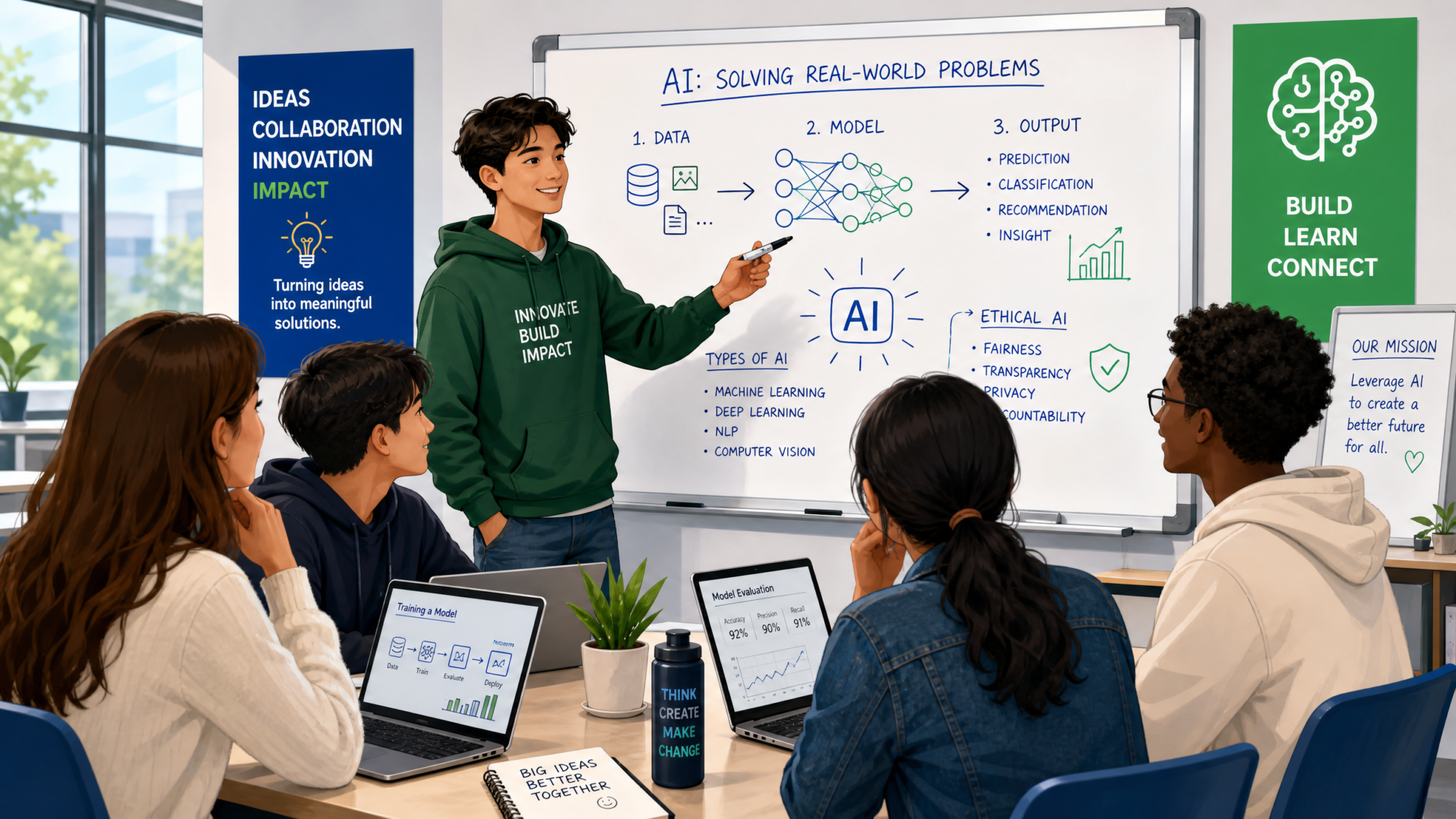
The day-to-day and week-to-week activities of a Campus AI Lead are diverse and genuinely substantive. This is not a passive brand ambassador role where you post sponsored content on social media and call it a day. Campus leads are expected to create measurable educational impact on their campuses through a mix of event programming, community building, content creation, and reporting.
Core Responsibilities
The program structures responsibilities around what it calls “pillars” of campus AI leadership:
- Workshop Facilitation: Leads are required to host a minimum number of AI workshops or educational sessions each semester (typically 2-4 per semester, depending on campus size). These can range from beginner sessions on using ChatGPT effectively, to more advanced workshops on AI ethics, prompt engineering, or building basic AI-powered tools using the OpenAI API.
- Community Building: Leads are expected to establish or grow an AI-focused student community on campus — whether through an existing club, a new organization, or a recurring meetup format. The goal is a sustained, growing network of AI-interested students, not a series of one-off events.
- Cross-Disciplinary Outreach: One of OpenAI’s explicit goals is reaching students in disciplines that do not traditionally think of themselves as AI audiences. Leads are encouraged to partner with departments, clubs, and organizations outside the typical tech sphere — arts organizations, pre-med societies, law journals, journalism programs, social science departments, and more.
- Documentation and Reporting: Leads submit regular updates to OpenAI documenting their activities, attendance numbers, feedback received, and community growth metrics. This reporting is not onerous but is taken seriously and feeds into the milestone reward system.
- National Cohort Participation: Campus leads participate in virtual or in-person cohort events including orientation, mid-year summits, and closing showcases. These are opportunities to learn from peers, share best practices, and receive advanced training from OpenAI staff.
- Content Creation: Many leads create blog posts, social media content, or short educational videos about AI topics for their campus audience. This is not mandatory for every lead but is strongly encouraged and supported.
What a Typical Month Looks Like
To give applicants a concrete picture of the time commitment and variety of the role, here is a realistic look at what a campus lead’s month might involve:
Plan and promote an upcoming workshop on “AI Tools for Research and Writing” targeting sophomore students from multiple disciplines. Coordinate with the campus library for venue and co-promotion. Design a simple promotional flyer and share across campus social channels and class-specific Discord servers.
Host the workshop (1.5-2 hours). Facilitate hands-on activities where attendees use ChatGPT to assist with research summaries, discuss citation ethics, and explore how to critically evaluate AI-generated content. Collect feedback forms. Send a post-event email with resources.
Attend the monthly cohort virtual check-in with OpenAI and fellow campus leads. Discuss challenges, share successful strategies, preview next month’s programming ideas. Spend time recruiting new members to the AI community group by tabling at a campus involvement fair.
Submit monthly report to OpenAI with event metrics, community growth numbers, and qualitative feedback highlights. Begin planning a panel event with faculty members from philosophy, computer science, and journalism to discuss AI’s societal impact — an event targeted at a broader, more academically engaged audience.
The total time commitment generally ranges from 5 to 10 hours per week, making it compatible with a full academic course load for most students. The program does recognize that academic obligations vary throughout the semester, and leads are given flexibility during high-stress periods such as midterms and finals.
5. Benefits, Cash Stipend, and Resources
The OpenAI Student Collective is not merely a volunteer experience — it comes with meaningful financial compensation and a robust package of resources and professional development opportunities that significantly enhance its value for participants.
Financial Compensation
Campus leads receive a monthly cash stipend for the duration of their active service in the program. For the 2026-2027 cohort, the base stipend is structured as follows:
| Tier | Monthly Stipend | Qualification |
|---|---|---|
| Base Tier | $500/month | All active campus leads meeting minimum activity requirements |
| Performance Tier | $700/month | Leads who exceed event and community growth milestones |
| Excellence Tier | $1,000/month | Top-performing leads recognized quarterly by OpenAI’s education team |
| Event Budget | Up to $300/event | Reimbursable budget for approved campus events (food, materials, printing) |
The tiered structure is designed to reward genuine impact without creating unnecessary pressure. Most leads who consistently fulfill their core responsibilities operate comfortably at the Base or Performance tier. The Excellence Tier is reserved for leads who demonstrate exceptional community-building outcomes, highly innovative programming, or particularly strong cross-campus collaboration.
Non-Financial Benefits
Beyond the stipend, campus leads receive a suite of non-financial benefits that many participants report finding equally or more valuable:
- ChatGPT Plus Access: All campus leads receive complimentary access to ChatGPT Plus (and applicable OpenAI tools) for the duration of the program, ensuring they can use and demonstrate the tools they are teaching.
- OpenAI API Credits: Leads receive API credits to experiment with building and demonstrating applications — valuable for any lead interested in the technical development side of AI.
- Curriculum and Workshop Templates: OpenAI provides a comprehensive library of ready-to-use workshop curricula, slide decks, activity guides, and facilitation notes. Leads can use these as-is or adapt them for their specific campus context.
- Dedicated OpenAI Mentor: Each lead is assigned a point of contact within OpenAI’s education team who provides guidance, feedback, and support throughout the year.
- Professional Network Access: Leads gain access to a private Slack community and networking events that connect them with OpenAI employees, alumni of the program, and peers from across the national cohort.
- Letter of Recognition: Upon completing the program, leads receive an official letter of recognition from OpenAI documenting their role and impact — a valuable addition to any resume, graduate school application, or LinkedIn profile.
- Potential for Direct OpenAI Internship Consideration: While not guaranteed, program alumni have noted that the campus lead experience significantly strengthens applications for OpenAI internships and other positions within the AI industry.
If you are comparing the OpenAI Student Collective to other AI-focused student programs and want a comprehensive breakdown of how OpenAI’s various educational initiatives — including the educator grants, university partnerships, and research access programs — fit together, our detailed overview of OpenAI Education Programs and University Partnerships explains the full ecosystem of ways OpenAI is investing in academic communities and what each pathway offers students at different stages of their academic careers.
6. The Application Process: Step-by-Step
The application process for the OpenAI Student Collective campus lead program is competitive but navigable for prepared candidates. Understanding each stage — and what OpenAI evaluates at each step — is essential for putting your best foot forward.
Stage 1: Online Application Form
The application begins with an online form hosted on OpenAI’s website. The form collects basic personal information, enrollment verification, and responses to a series of short-answer questions. These questions are the first substantive opportunity to distinguish yourself, so they warrant serious attention. Typical questions in recent cohorts have included:
- Why do you want to become a Campus AI Lead? What impact do you hope to have at your institution?
- Describe a community or group you’ve built or contributed to building. What was your role, and what did you learn?
- What is a misconception about AI that you frequently encounter among your peers, and how would you address it?
- Describe a workshop or educational event you would like to host in your first month as a Campus AI Lead.
- How does AI intersect with your field of study? What are the most interesting or pressing questions it raises?
Stage 2: Video Introduction
Applicants are asked to submit a short video introduction (typically 2-3 minutes) in which they introduce themselves and speak to their motivation and vision for the role. The video does not need to be professionally produced — OpenAI explicitly values authenticity over production quality. What they are assessing is communication clarity, genuine enthusiasm, and the ability to explain AI concepts and their relevance in an accessible, engaging way.
Stage 3: Skills Assessment or Activity Submission
For the 2026-2027 cohort, OpenAI introduced an optional (but strongly recommended) supplemental submission in which applicants provide evidence of any relevant community-building or educational activities they have already undertaken. This could be:
- A workshop agenda or outline for an AI event you have already hosted or planned
- A link to a blog post, newsletter, or social media thread you wrote about an AI topic
- Evidence of an existing AI club, study group, or community you have organized
- A sample workshop curriculum or educational activity you have designed
This submission is not required, but applicants who include it consistently perform better in the selection process because it demonstrates initiative and provides concrete evidence of the skills being assessed.
Stage 4: Interview (Finalist Stage)
Shortlisted candidates are invited to a 30-45 minute video interview with members of OpenAI’s education and community team. The interview format is conversational rather than formal, and questions typically focus on community-building philosophy, specific event ideas, how you would handle common challenges (low attendance, hostile questions about AI, limited university support), and your long-term interest in AI.
Stage 5: Final Selection and Onboarding
Selected campus leads receive their offer via email and are enrolled in a structured onboarding process that typically spans the first two weeks of the program. Onboarding includes virtual training sessions on facilitation techniques, workshop curriculum orientation, platform and tools training, and an introduction to the full campus lead cohort.
7. What Makes a Strong Application
Having analyzed successful applications from previous cohorts and synthesized feedback from program alumni, several consistent themes emerge that distinguish competitive applicants from the rest of the pool.
Specificity Over Generality
The most common weakness in campus lead applications is vagueness. Answers like “I want to help my peers understand AI” or “I’m passionate about technology” are so broad as to be meaningless to an evaluator reading dozens of applications in a single sitting. Strong applications are relentlessly specific. Instead of saying you want to help your peers understand AI, describe the specific misconception you encounter most often in your social circle (for example, that AI chatbots are simply plagiarism machines rather than probabilistic language generators), explain why that misconception matters, and outline how a specific workshop format you have in mind would address it.
Evidence of Community-Building Instinct
OpenAI is hiring a community builder, not a subject matter expert. Applications that demonstrate a genuine instinct and track record for bringing people together — whether through running a student organization, organizing informal study groups, founding a peer tutoring program, or building an online community — are significantly stronger. If you have relevant community experience, make it the center of your narrative, not a footnote.
Cross-Disciplinary Vision
Applications that demonstrate an understanding of AI’s relevance across multiple disciplines — not just computer science — signal alignment with one of the program’s core objectives. An English major who can articulate how AI is changing literary analysis, academic writing, and content creation, while also understanding how to build a bridge to the pre-law students in their dorm who are anxious about AI’s impact on their future careers, is telling a much more compelling story than a CS major who only plans to host hackathons.
Authentic Engagement With AI Ethics
Strong applicants demonstrate that they have genuinely grappled with the ethical dimensions of AI — not just in a surface-level way, but with nuance and personal intellectual engagement. This does not mean you need to have published academic work on AI ethics. It means your application should reflect that you have thought carefully about questions like: Who benefits from AI tools and who is excluded? How should students think about academic integrity in an era of generative AI? What does responsible AI use actually look like in practice? Demonstrating that you can hold these questions with intellectual honesty, rather than defaulting to either uncritical enthusiasm or reflexive skepticism, is a hallmark of a strong campus lead candidate.
Realistic, Concrete Event Plans
Applications that include specific, executable workshop or event ideas — complete with a target audience, a rough agenda, and a rationale for why that format would resonate on your specific campus — perform significantly better than applications that describe events in abstract terms. You are not locked into these plans if accepted, but they demonstrate to OpenAI that you have thought seriously about the practical realities of the role.
Crafting compelling written responses is an art form that applies not just to the OpenAI campus lead application but to a wide range of professional and academic opportunities in the AI space. Our comprehensive guide on How to Write a Winning AI Internship Application covers proven frameworks for answering behavioral questions, structuring your personal narrative around AI experience, and tailoring your written materials to the specific values and priorities of AI-focused organizations — all of which translate directly to the campus lead application process.
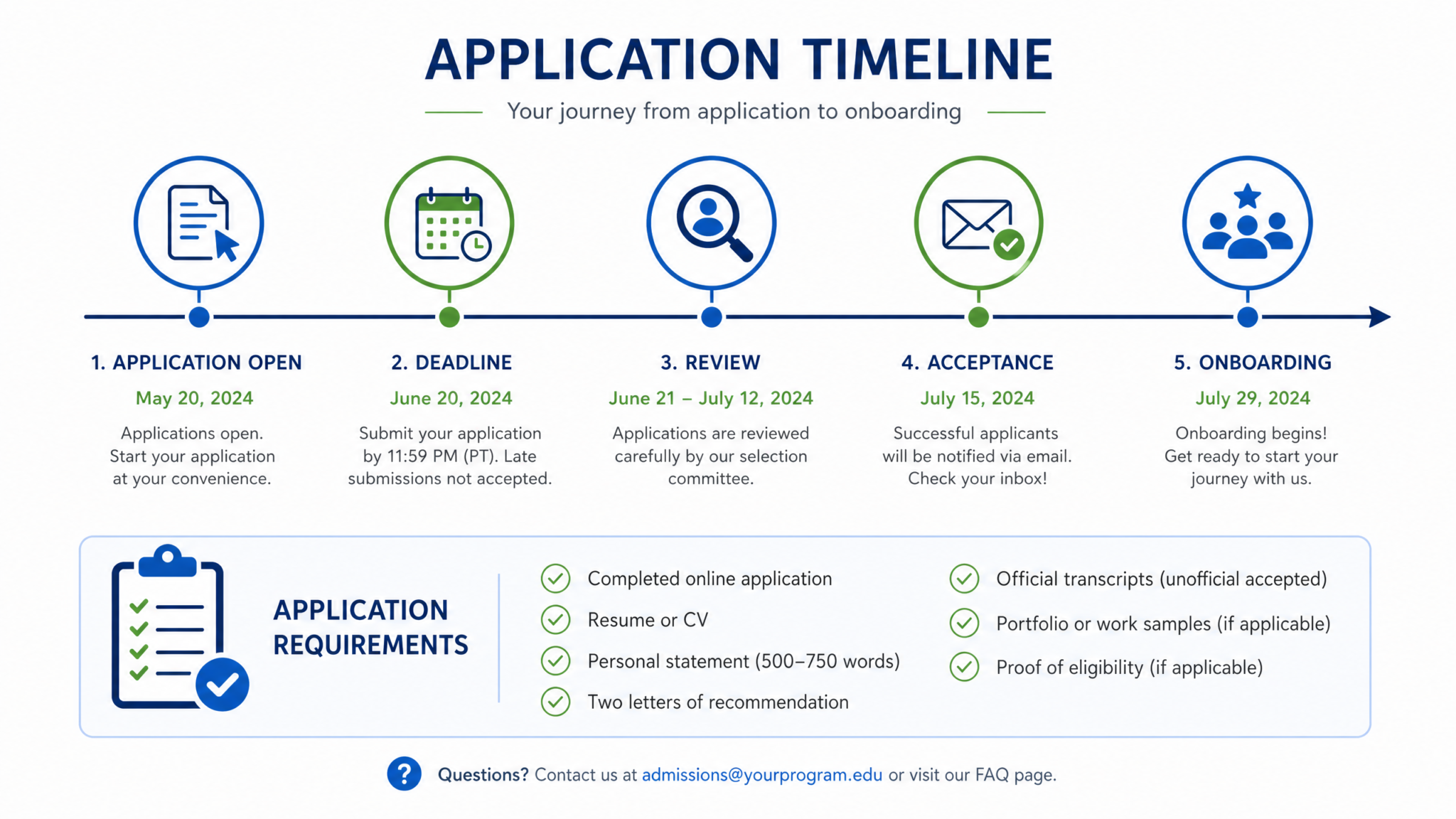
8. Program Timeline and Key Dates
Understanding the program timeline is critical for planning your application and managing your academic calendar around program commitments. Note that specific dates may shift slightly from year to year; always verify current dates on the official OpenAI website.
| Phase | Approximate Timing | What Happens |
|---|---|---|
| Application Opens | Spring semester (March-April) | Online application portal goes live; program details announced |
| Application Deadline | Late April / Early May | All application materials must be submitted by 11:59 PM PT |
| Interview Invitations | May | Shortlisted candidates contacted for interviews |
| Interviews Conducted | May – June | 30-45 minute video interviews with OpenAI team |
| Acceptance Notifications | June | Selected leads receive official offers |
| Onboarding Program | Late July – August | Virtual training, curriculum orientation, cohort introduction |
| Fall Semester Active Period | September – December | Events, workshops, community building; Fall Summit |
| Winter Check-in | December / January | Mid-year review, progress reporting, spring planning |
| Spring Semester Active Period | January – April | Continued programming; Spring Summit |
| Program Closing | April / May | Final reports, Showcase event, letters of recognition issued |
One strategic implication of this timeline is that you should begin preparing your application in January or February — well before the portal opens in March or April. Use the months leading up to the application window to strengthen your candidacy: start an AI reading group or informal discussion series, write a blog post or opinion piece about AI for your campus newspaper, or organize even a single small workshop. These activities not only strengthen your application but also give you authentic experiences to write about.
9. How to Plan Your First AI Workshop on Campus
For many newly selected campus leads, the first workshop is the most intimidating milestone. Even applicants who described compelling event ideas in their applications sometimes freeze when it comes to actually executing. This section provides a concrete, step-by-step framework for designing and hosting an effective AI workshop for a college audience.
Access 40,000+ AI Prompts for ChatGPT, Claude & Codex — Free!
Subscribe to get instant access to our complete Notion Prompt Library — the largest curated collection of prompts for ChatGPT, Claude, OpenAI Codex, and other leading AI models. Optimized for real-world workflows across coding, research, content creation, and business.
Step 1: Define Your Target Audience and Learning Objectives
The most common mistake first-time workshop facilitators make is trying to design for everyone. An effective workshop is targeted. Before choosing a topic or format, answer these two questions clearly:
- Who specifically am I designing this for? (Example: first-year students with no coding background who use ChatGPT but don’t fully understand its limitations)
- What specific understanding or skill do I want them to leave with? (Example: the ability to critically evaluate an AI-generated text and identify where it might be unreliable)
Step 2: Choose the Right Format
AI workshops for undergraduate audiences tend to fall into three broad formats, each with distinct strengths:
| Format | Best For | Ideal Duration | Engagement Level |
|---|---|---|---|
| Hands-On Lab | Teaching specific tools or skills (prompt engineering, API basics) | 90-120 minutes | Very High |
| Moderated Discussion / Socratic Session | Exploring AI ethics, policy, societal impact | 60-90 minutes | High (small groups) |
| Panel + Q&A | Bringing in diverse expert perspectives, larger audiences | 60-90 minutes | Medium |
| Demo + Challenge | Showcasing AI capabilities and inspiring experimentation | 60 minutes | High |
| Study Group / Reading Circle | Sustained engagement, deeper conceptual exploration | 60 minutes recurring | Very High (small groups) |
Step 3: Design the Activity Flow
A well-structured 90-minute introductory AI workshop might follow this architecture:
[0:00 - 0:10]  Welcome and Icebreaker
               → Ask: "What's the most interesting/surprising thing
                 you've ever seen an AI do?"

[0:10 - 0:25]  Brief Conceptual Framing (NOT a lecture)
               → What is a large language model? (5 slides max)
               → What can it do? What can't it do?

[0:25 - 0:55]  Hands-On Activity (30 minutes)
               → Attendees work in pairs with specific prompting
                 challenges on their own devices
               → Example: "Get ChatGPT to confidently state
                 something false. Screenshot it."

[0:55 - 1:10]  Debrief and Discussion
               → What did you find? What does it tell us about
                 how these models work?
               → Connect back to academic and professional contexts

[1:10 - 1:20]  Ethical Dimension Discussion
               → One focused question: "Given what you just saw,
                 what does responsible use look like?"

[1:20 - 1:30]  Q&A, Resources, Community Invite
               → Share reading list, upcoming events, AI community
                 group link
Step 4: Promote Effectively
Attendance at campus events lives and dies on promotion strategy. The most effective promotional approaches for campus AI workshops combine personal outreach (texting or messaging specific friends and classmates directly) with broader digital promotion (campus event boards, department listservs, class Discord servers). A personalized message from someone who knows you converts exponentially better than a flyer posted to a generic campus bulletin board. Make sure to reach out to faculty members who might be willing to announce the event in their classes — a 30-second shoutout in a large lecture course can fill a workshop more effectively than a week of social media posts.
Step 5: Collect Feedback and Iterate
After every event, distribute a short (5-7 question) digital feedback form. Ask specifically what was most valuable, what was confusing, what topics attendees want more of, and how they heard about the event. This data is gold — not only for your own improvement as a facilitator, but for the reporting you submit to OpenAI and for building the case for continued institutional support from your university.
10. Building a Thriving University AI Community
Individual events are valuable, but the most impactful campus leads are those who build sustained communities around AI — groups of students who engage with the topic regularly, recruit their peers, and take on organizing roles themselves. Building this kind of community is harder than hosting a one-time workshop, but it is also far more rewarding and durable.
The Community-Building Flywheel
Successful campus AI communities tend to grow through a self-reinforcing cycle: excellent first events attract engaged early members, those early members become informal ambassadors who recruit their peers, the growing community’s energy attracts higher-profile speakers and collaborators, which generates more visibility, which attracts more members. Your job as a campus lead is to prime this flywheel — getting it spinning requires deliberate effort in the early months, but it becomes increasingly self-sustaining over time.
Structural Choices That Matter
The organizational form your community takes has significant implications for its sustainability. Consider these options:
- Registered Student Organization (RSO): Formal university recognition provides access to funding, spaces, and institutional legitimacy. It also creates a structure that outlasts any individual lead. The tradeoff is administrative overhead and a longer setup time.
- Department-Affiliated Interest Group: Partnering with an existing department (Computer Science, Library, Student Innovation Center) provides resources and a built-in venue without the overhead of running an independent organization.
- Federated Network of Subject-Specific AI Groups: Rather than one monolithic AI club, some leads have successfully created a network of discipline-specific AI interest groups (AI in Medicine, AI in Journalism, AI in Law) that cross-pollinate through joint events. This model is particularly effective at reaching non-technical students.
Sustaining Engagement Between Events
The biggest challenge in campus AI communities is maintaining engagement between in-person events. Students are busy, and a community that only activates around scheduled workshops will struggle to maintain momentum. Effective engagement tools include:
- A Discord server with channels for different AI topics, a #news-and-resources channel with daily or weekly shares, and a #projects channel where members share what they are building
- A weekly or biweekly email newsletter with AI news relevant to your campus community’s disciplines
- Informal reading challenges or “AI experiments” that members can do independently and report back on
- A dedicated channel or thread for members to share interesting prompts, unexpected AI outputs, or tools they have discovered
11. OpenAI’s Broader Education Strategy
The OpenAI Student Collective does not exist in isolation — it is one piece of a comprehensive education strategy that OpenAI has been developing and refining since the early days of ChatGPT’s public launch. Understanding the broader strategic context helps campus leads situate their work within OpenAI’s larger mission and also helps them leverage other OpenAI education resources available to their campus communities.
OpenAI’s education strategy rests on several interconnected pillars. First, there is the access pillar: ensuring that students, educators, and educational institutions have affordable or free access to OpenAI tools. This includes reduced pricing for verified students, free API credits for educational projects, and the institutional partnership program that brings OpenAI tools into university systems.
Second, there is the literacy pillar: ensuring that people who use AI tools have the foundational knowledge to use them responsibly and critically. This is where the Student Collective fits most directly — campus leads are essentially field agents for AI literacy, operating at the grassroots level where top-down curriculum mandates cannot easily reach.
Third, there is the research and safety pillar: engaging the academic community in the project of AI safety research, alignment work, and policy development. OpenAI’s university research partnerships, fellowship programs, and grants program serve this pillar. While the Student Collective is not primarily a research program, leads are encouraged to create bridges between their campus communities and these research-oriented opportunities.
Fourth, there is the ethics and governance pillar: building public understanding of and engagement with the policy questions surrounding AI. OpenAI engages with faculty, policy researchers, student governments, and advocacy organizations to ensure that the societal conversation about AI governance is informed by accurate technical understanding. Campus leads who engage their student government, campus newspaper, or pre-law organizations with AI policy discussions contribute meaningfully to this pillar.
The Student Collective’s integration into this broader strategy means that campus leads are not just throwing events — they are contributing to an intentional, long-term campaign to shape how a generation of future leaders, professionals, and citizens understands and relates to AI technology. That is a genuinely significant responsibility, and the best campus leads carry it with appropriate seriousness.
OpenAI’s education strategy is increasingly intertwined with how universities are revising their academic integrity policies, course design frameworks, and research methodologies in response to generative AI. Our in-depth analysis of How Universities Are Adapting to the ChatGPT Era: Academic Policy Changes Explained examines specific case studies from institutions across the U.S. and internationally, offering campus leads a rich contextual foundation for the conversations they will inevitably facilitate about AI’s role in academic life — from the classroom to the research lab.
12. Tips From Successful Campus Leads
The following insights have been synthesized from interviews and public reflections shared by alumni of previous OpenAI student ambassador and collective cohorts. While program structures and names have evolved over time, the human dynamics of effective campus AI leadership have remained remarkably consistent.
“Lead with the question, not the answer.”
One of the most effective facilitation techniques reported by successful leads is the practice of entering every workshop and community conversation with intellectual humility — positioning yourself as a fellow explorer of AI’s possibilities and challenges, not as an expert with all the answers. College students, especially those with strong academic backgrounds, are quick to detect and resent condescension. A lead who says “Here’s what I’ve been wrestling with about AI-generated images and academic art programs — what do you all think?” will generate richer discussion and deeper trust than one who lectures from a position of assumed authority.
“Partner with faculty early and often.”
Faculty partnerships are among the highest-leverage activities a campus lead can pursue. A single professor who mentions your AI community in their 200-person lecture class generates more interest than three months of social media posts. More importantly, faculty partnerships lend institutional legitimacy to your work, open doors to department-sponsored events, and create opportunities for interdisciplinary programming that reaches students who would never seek out an AI club on their own. The approach: identify 3-5 faculty members who are publicly engaging with AI questions in their teaching or research, attend their office hours or send a brief, thoughtful email introducing yourself and the program, and propose a specific collaboration — whether co-presenting a class module, hosting a panel, or co-facilitating a departmental workshop.
“Measure obsessively, learn constantly.”
The campus leads who grow most rapidly during the program are those who treat every event as a learning experiment. They track attendance, capture feedback systematically, and conduct informal “exit interviews” with a handful of attendees after each event. They iterate their workshop designs based on what they observe — if the hands-on activity section consistently generates the most energy, they expand it and cut down the lecture portion. If ethics discussions fall flat with first-year students but resonate deeply with juniors and seniors, they segment their programming accordingly. This empirical, learning-oriented mindset is also exactly what OpenAI’s education team most appreciates seeing in the monthly reports.
“Your non-technical peers are your greatest audience.”
Leads from technical backgrounds frequently report that their most impactful events were not hackathons or coding workshops but sessions designed for students who had never thought of themselves as AI audiences. A workshop titled “What Writers Need to Know About AI” hosted in partnership with the campus literary magazine drew three times the attendance of a technical prompt engineering session — and generated twice the community membership growth, because the audience was people who had never felt the AI community was for them. Meeting people where they are is not just a community-building best practice; it is core to OpenAI’s mission of ensuring that the benefits and understanding of AI are equitably distributed across society.
“Build your successor from day one.”
One of the structural weaknesses of single-lead programs is their dependence on one person. The most thoughtful campus leads begin identifying and mentoring potential successors — students who might take on leadership of the AI community after the current lead graduates or moves on — from the very beginning of the program. This means gradually delegating event planning responsibilities to engaged members, being transparent about the organizational structure of the community, and actively encouraging ambitious members to take on visible leadership roles. A community that outlasts its founding lead is the ultimate measure of a campus lead’s impact.
Common Pitfalls to Avoid
- Over-programming in the fall and burning out by spring. Pace yourself. Two excellent workshops per month consistently maintained are far better than five events in September followed by nothing in February.
- Neglecting the reporting component. OpenAI uses lead reports to understand program impact and allocate support. Leads who submit detailed, thoughtful reports receive more responsive support and are considered first for Excellence Tier recognition.
- Building a community exclusively of CS students. This is the fastest way to plateau at a small, homogeneous membership. Intentionally recruit across disciplines from the first event.
- Treating AI as a solved topic rather than an evolving field. The AI landscape changes rapidly. Leads who position their workshops as engagement with an evolving, uncertain, genuinely interesting field maintain credibility and audience interest far more effectively than those who present AI as a static subject with definitive answers.
- Underutilizing OpenAI’s curriculum resources. Many leads in early cohorts spent significant time developing workshop content from scratch when high-quality curriculum materials already existed in the lead resource portal. Use and adapt what OpenAI has built; save your creative energy for tailoring it to your specific campus context.
13. Conclusion: Your Opportunity to Shape AI on Campus
The OpenAI Student Collective 2026-2027 campus lead program arrives at a genuinely historic moment for both artificial intelligence and higher education. The decisions that students, educators, and institutions make in the next few years about how AI is understood, taught, and used will shape the AI fluency — and the AI culture — of an entire generation. That is not a small thing.
If you are an undergraduate student who has read this guide and feels the pull of this opportunity, trust that instinct. You do not need to be a computer scientist. You do not need prior AI experience. You need intellectual curiosity, a genuine desire to build something meaningful with your peers, and the energy to translate that desire into organized, sustained action.
The campus lead role is one of those rare opportunities that is genuinely transformative in both directions: you change your campus’s relationship with AI, and the experience changes you. The skills you build — community organizing, technical communication, event facilitation, ethical reasoning about emerging technology — are skills that will matter in almost every professional and civic context you enter after graduation.
The application process is competitive, but it is not a lottery. Every element of what makes a strong application is within your control to develop and demonstrate. Start building now: attend AI events, read thoughtfully about AI’s implications in your field, organize a small informal discussion with your peers, write a short essay or blog post about an AI question that genuinely interests you. By the time the application portal opens, you will not just have a stronger application — you will have the foundation for a genuinely impactful year of campus AI leadership.
OpenAI built the Student Collective because it understands something important: the next chapter of AI’s development will not be written only in research labs and boardrooms. It will be written on college campuses, in dormitory common rooms, in library study spaces, and at club fair tables. The students who step up to lead those conversations now are not just building their resumes — they are building the AI-literate society that makes beneficial AI possible. That is work worth doing.
Apply with intention. Show up with curiosity. Build something that lasts. Your university’s AI community is waiting to be built, and the OpenAI Student Collective is offering you the resources, support, and platform to build it.
This guide was prepared by the ChatGPTAIHub.com editorial team based on publicly available program information, alumni accounts, and OpenAI’s published education materials. Program details including stipend amounts, timelines, and eligibility criteria are subject to change. Always consult the official OpenAI website and the Student Collective program page for the most current and accurate program information before applying.
