
Why 82% of Companies Can’t Track Their AI Spending: Complete Guide to AI Cost Visibility, Budget Governance, and FinOps for 2026
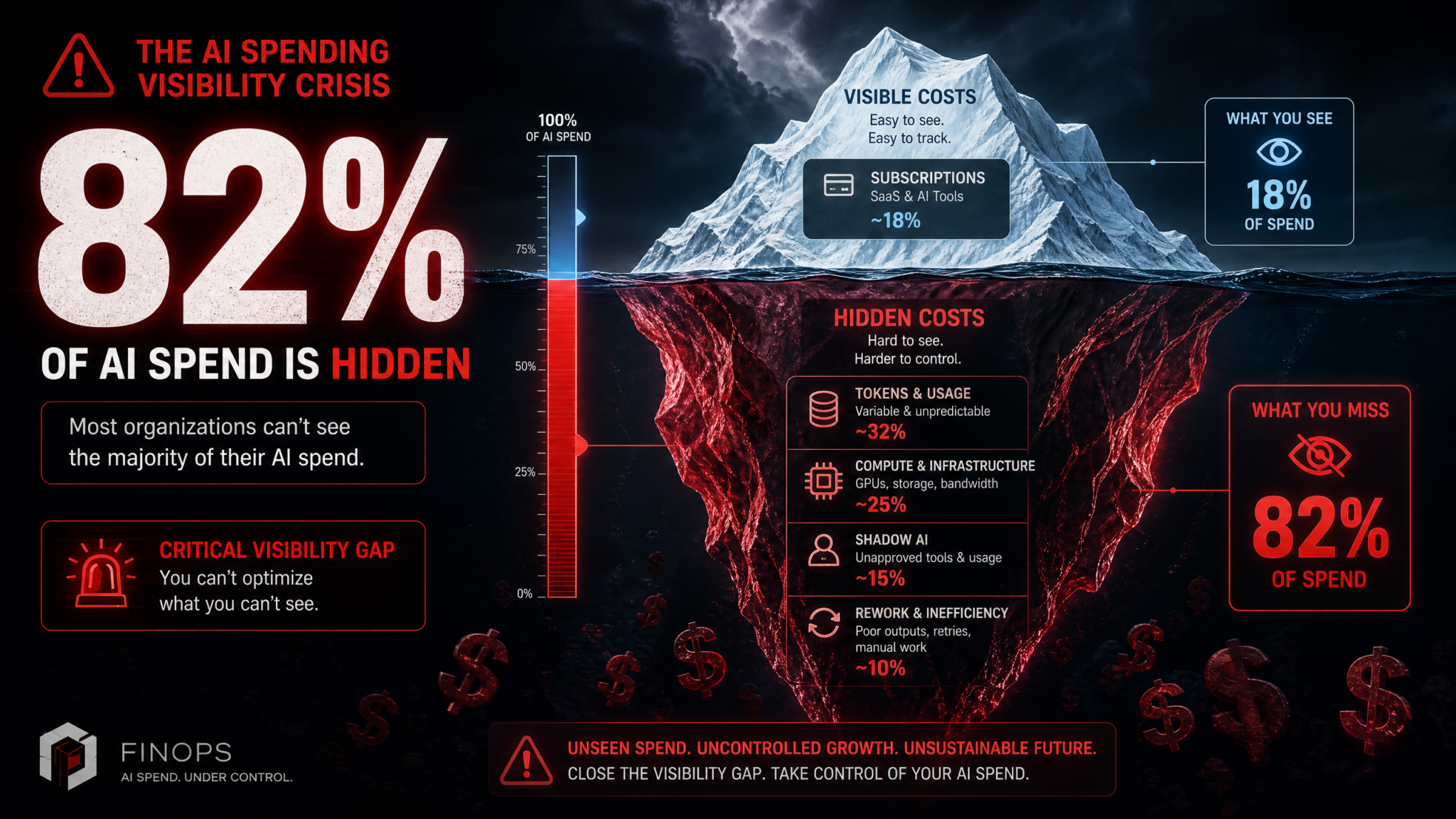
The 82 Percent Problem: Why AI Spending Is Invisible
In 2025, enterprise AI adoption accelerated faster than any previous technology wave in corporate history. Organizations deployed large language models, generative AI tools, AI-powered copilots, and custom-trained models across virtually every department. The results in productivity were often dramatic. The results in financial transparency were almost universally catastrophic. According to research published by Gartner in late 2024, 82 percent of enterprise organizations identified AI spending visibility as a top-three financial governance challenge — a statistic so striking that it forced CFOs, CIOs, and FinOps practitioners worldwide to pause and reckon with a fundamental question: how did companies that carefully managed cloud costs, software licensing, and vendor contracts completely lose track of a spending category growing at 40 percent annually?
This guide exists because the answer to that question is both complicated and actionable. AI spending opacity is not a failure of individual financial managers. It is a structural mismatch between how AI services are priced, consumed, and deployed and how traditional IT financial frameworks were designed. Legacy IT budgeting was built for predictable licensing fees, fixed data center costs, and annual contract negotiations. AI spending is none of those things. It is consumption-based, decentralized, variable by the millisecond, and spread across dozens of tools that individual employees adopt without procurement involvement. The combination produces a financial blind spot that, left unaddressed, will compound dramatically as AI workloads scale through 2026 and beyond.
The financial stakes are not trivial. IDC projected that global enterprise AI spending would exceed $500 billion by the end of 2025, growing to over $700 billion by 2027. McKinsey & Company’s 2024 State of AI report found that companies in the top quartile of AI adoption had average AI-related expenditures representing between 3 and 7 percent of their total operating budgets — yet fewer than one in five of those companies could report AI spend with the same accuracy they could report SaaS subscriptions or cloud infrastructure. The gap between spending magnitude and spending visibility represents one of the most significant governance failures in modern corporate finance.
This comprehensive guide walks through every dimension of that failure and provides the frameworks, templates, governance policies, and tactical guidance needed to achieve genuine AI cost visibility before 2026. Whether you are a FinOps practitioner building your first AI cost tracking program, a CFO trying to understand why AI line items keep surprising you at quarter-end, or a CTO designing governance infrastructure for a scaling AI platform, this guide gives you a complete operating model for AI financial governance.
Why Traditional IT Budgeting Fails for AI Workloads
The Predictability Assumption
Traditional IT budgeting operates on a predictability assumption: you negotiate a contract, you receive a fixed service, you pay a fixed price. A three-year enterprise agreement with a major software vendor might flex slightly based on user count changes, but the core financial commitment is known at the start of each fiscal year. Finance teams can model this. They can accrue it accurately. They can hold budget owners accountable to variances because variances are visible and understandable.
AI pricing completely breaks this model. OpenAI’s API charges per token — a unit of text roughly equivalent to four characters — at rates that vary by model, by input versus output, and by tier. Anthropic’s Claude charges differently for Haiku, Sonnet, and Opus. Google’s Gemini models carry distinct pricing for context window size. A single application that calls GPT-4o to summarize customer support tickets might consume 200,000 tokens on a slow Monday and 4.7 million tokens on a peak day following a product launch. No traditional IT budget cycle accounts for that kind of variance because no traditional IT cost category worked that way before 2023.
Shadow AI: The Procurement-Free Adoption Pattern
The second structural failure is what industry analysts now call shadow AI — the organizational equivalent of shadow IT, but moving faster and more pervasively. A marketing manager subscribes to ChatGPT Plus on a personal credit card and submits it on expense reports under “software tools.” A developer team adopts GitHub Copilot through a free trial that automatically converts to a paid subscription. A product manager uses Claude.ai directly through a browser, bypassing IT procurement entirely. A data science team begins fine-tuning models on AWS SageMaker using credits from a developer account that was never formally provisioned or approved.
Research from Productiv in 2024 found that the average enterprise employee was using 4.7 AI-powered tools per month, and IT departments had visibility into fewer than 60 percent of those tools. The remaining 40 percent represented untracked spending, unreviewed security exposure, and unaccountable productivity claims. When you multiply that across hundreds or thousands of employees, the result is an AI spending portfolio that looks like a sprawling archipelago of small-to-medium expenditures, none individually alarming, but collectively representing millions of dollars in unmanaged spend.
Multiple Tools Per Team, Zero Coordination Between Teams
In organizations that have begun tracking AI tool adoption, a common discovery is that multiple teams have independently purchased functionally equivalent tools. A legal team subscribes to Harvey AI for contract review. The sales team uses a different AI-powered contract analysis tool embedded in their CRM. The corporate development team uses a third vendor for M&A document analysis. All three tools overlap substantially in capability. None of the teams know what the others are using. Legal is paying $45,000 annually, sales is paying $28,000, and corporate development is paying $19,000 — for a total of $92,000 for three overlapping tools that could be served by a single $40,000 enterprise contract if anyone had the visibility to identify the redundancy.
This pattern plays out across industries and departments with remarkable consistency. Content teams duplicate AI writing assistants. Engineering teams independently adopt AI code review tools. HR departments separately purchase AI-powered recruiting assistants. The fragmentation is not the result of bad decision-making at the individual team level — each purchase looks reasonable in isolation. The problem is the absence of an organizational layer that can see all AI tool purchases simultaneously and identify consolidation opportunities.
Token Costs: The Invisible Metered Expense
For organizations that have deployed AI applications internally — chatbots, search tools, document analysis systems, automated workflow assistants — token costs represent a category of expense that most financial systems are simply not designed to track. Unlike software licenses or cloud compute instances, which can be tagged, allocated, and reported through standard procurement and FinOps tooling, token consumption happens at the API call level, in microseconds, across thousands or millions of individual transactions. The bill arrives at the end of the month as a single line item from OpenAI or Anthropic or Google, with no automatic breakdown by team, application, use case, or business outcome.
Organizations that have invested in internal AI platform development are beginning to discover that token costs scale in non-linear ways that are genuinely difficult to predict. A retrieval-augmented generation (RAG) system that processes customer inquiries might consume 1,500 tokens per query when the knowledge base is small and clean, but 7,000 tokens per query six months later when the knowledge base has grown and queries have become more complex. Without instrumentation at the application level that tracks token consumption per query, per user, and per use case, there is no mechanism to identify the drift, no trigger for optimization, and no accountability when monthly bills double unexpectedly.
The Organizational Accounting Gap
Many organizations currently book all AI-related costs into a single budget code — often something generic like “cloud services” or “software and tools” — because their chart of accounts was designed before AI spending became material. This creates a reporting gap where the CFO can see that cloud spending increased by $340,000 in Q3, but cannot determine whether that increase was driven by AI API consumption, expanded compute for AI training workloads, additional AI-related SaaS subscriptions, or some combination of all three. Without that granularity, cost optimization is impossible, budget forecasting is inaccurate, and ROI measurement is essentially impossible.
AI Spending Categories Most Companies Miss
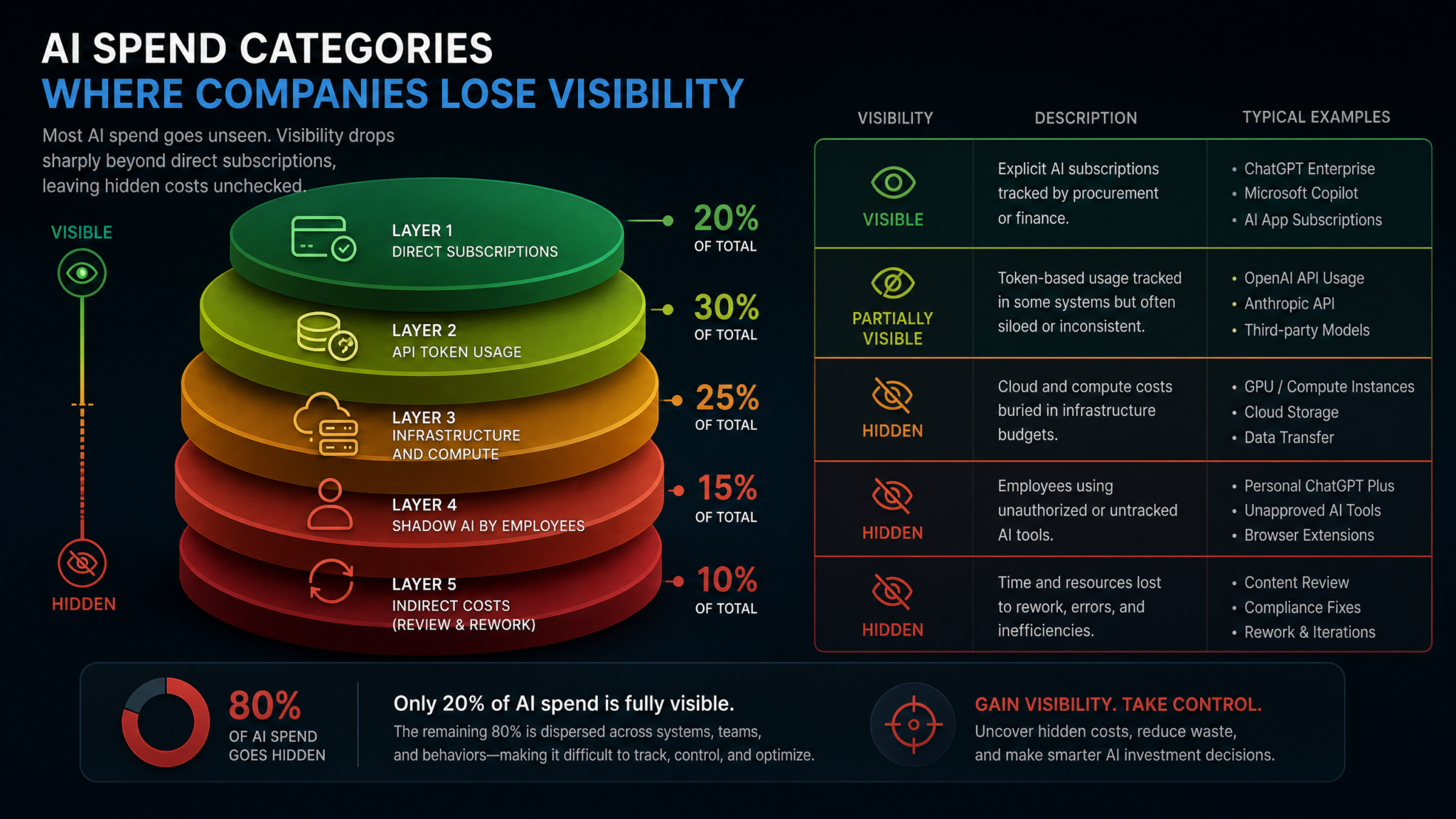
Direct Subscriptions: The Visible Tip of the Iceberg
Most finance teams have at least partial visibility into direct AI subscriptions — the monthly or annual contracts with ChatGPT Enterprise, Claude for Work, Microsoft Copilot, Google Gemini for Workspace, and similar productivity-layer AI tools. These subscriptions are the most visible category because they often go through formal procurement channels, appear on credit card statements, or surface in software asset management reviews. However, even in this most visible category, the research consistently shows significant undercounting.
The undercounting problem in direct subscriptions has several sources. First, as discussed above, individual employees frequently purchase AI tools personally and expense them without formal procurement tracking. Second, team-level tool adoption often begins under trial terms that automatically convert to paid subscriptions after 14 or 30 days, with the billing notification going to a developer or manager’s email rather than to finance. Third, subscription pricing often has usage-based components that add unpredictable charges on top of the fixed seat fee — many organizations discover this only when they review a detailed invoice and find per-query or per-document charges they did not anticipate.
API Usage Costs: Tokens, Embeddings, and Compute
API usage costs are where AI financial visibility problems become most acute. Organizations that have built internal AI applications — customer-facing chatbots, internal knowledge assistants, automated document processing pipelines, AI-powered analytics tools — are incurring per-token API costs that can vary dramatically based on model choice, prompt engineering quality, context window management, caching strategy, and user behavior patterns. These costs do not appear in SaaS subscription trackers, are not captured in traditional software asset management tools, and are frequently consolidated into a single monthly invoice line item from the API provider.
| Provider and Model | Input Cost (per 1M tokens) | Output Cost (per 1M tokens) | Context Window |
|---|---|---|---|
| OpenAI GPT-4o | $2.50 | $10.00 | 128K tokens |
| OpenAI GPT-4o mini | $0.15 | $0.60 | 128K tokens |
| Anthropic Claude 3.5 Sonnet | $3.00 | $15.00 | 200K tokens |
| Anthropic Claude 3 Haiku | $0.25 | $1.25 | 200K tokens |
| Google Gemini 1.5 Pro | $1.25 | $5.00 | 1M tokens |
| Google Gemini 1.5 Flash | $0.075 | $0.30 | 1M tokens |
These rates illustrate why model selection decisions have profound financial implications that product teams, without financial visibility, are not positioned to make optimally. Switching from GPT-4o to GPT-4o mini for a high-volume summarization task that does not require frontier model capability can reduce API costs by up to 93 percent — a savings that is invisible unless someone is measuring per-task token costs and connecting them to model selection decisions.
Infrastructure Costs: GPU Cloud, Fine-Tuning, and Vector Databases
Organizations that have moved beyond API consumption into model training, fine-tuning, and hosting their own models face a distinct set of infrastructure costs that are frequently underreported because they are mixed into general cloud infrastructure budgets without AI-specific tagging. GPU compute on AWS (via P4d or P5 instances), Google Cloud (via A100 or H100 TPU pods), or Azure (via NC-series instances) carries a significant premium over standard compute, and AI workloads on these instances can incur costs that look explosive compared to conventional compute workloads.
A single fine-tuning run on a 70B parameter open-source model using 8 A100 GPUs on AWS can cost between $800 and $4,000 depending on dataset size and training duration. Organizations that run experiments — multiple fine-tuning iterations, hyperparameter searches, model comparisons — can accumulate tens of thousands of dollars in GPU costs in a single sprint cycle. Without tagging these workloads with project codes, team identifiers, and business justification metadata at the time of provisioning, tracing them back to a budget owner two weeks later during a monthly cloud cost review becomes extremely difficult.
Vector databases — Pinecone, Weaviate, Qdrant, pgvector on RDS — represent another frequently missed AI infrastructure cost. These are purpose-built databases for AI applications, required for RAG systems and semantic search, and their costs scale with the volume of embeddings stored and queried. Organizations that initially provision a vector database for a single proof-of-concept often find its costs growing as it is repurposed for additional applications, again without the cost allocation tracking needed to attribute those costs appropriately.
Hidden Costs: Where the Real Money Disappears
The most significantly undercounted AI cost category is not any of the above — it is the human cost embedded in AI-driven workflows that financial models consistently ignore. These hidden costs fall into four primary buckets.
Developer time for prompt engineering and integration: Building and maintaining AI-powered features requires specialized skills. Senior engineers who spend 30 to 40 percent of their time on AI integration, prompt optimization, and reliability engineering are representing a cost that does not appear in any AI budget line — it is absorbed into general engineering headcount. Organizations that have attempted to quantify this find it typically represents 1.5 to 3 times the direct API and subscription costs in total developer labor.
Review and verification overhead: AI outputs in high-stakes domains — legal documents, financial analysis, medical information, compliance reporting — require human review before use. This review time is real labor cost that organizations almost never account for in their AI ROI calculations. A document drafting workflow where AI produces a first draft and a lawyer spends 45 minutes reviewing and correcting it is not necessarily more efficient than the lawyer writing from scratch — but it will appear as a productivity win in AI usage metrics while burying the review labor cost in the legal department’s general headcount expenses.
Rework costs from AI errors: When AI outputs contain errors that reach downstream processes before being caught, the cost of fixing those errors — in customer service time, in data correction, in reputational management — can exceed the savings the AI was supposed to generate. These costs are especially difficult to attribute to AI because they appear in the budgets of entirely different departments than where the AI tool is deployed.
Data preparation and maintenance: Fine-tuned models and RAG systems require high-quality training data and continuously maintained knowledge bases. The human effort involved in curating, cleaning, labeling, and updating that data is a real, ongoing AI operational cost that rarely appears in AI budgets.
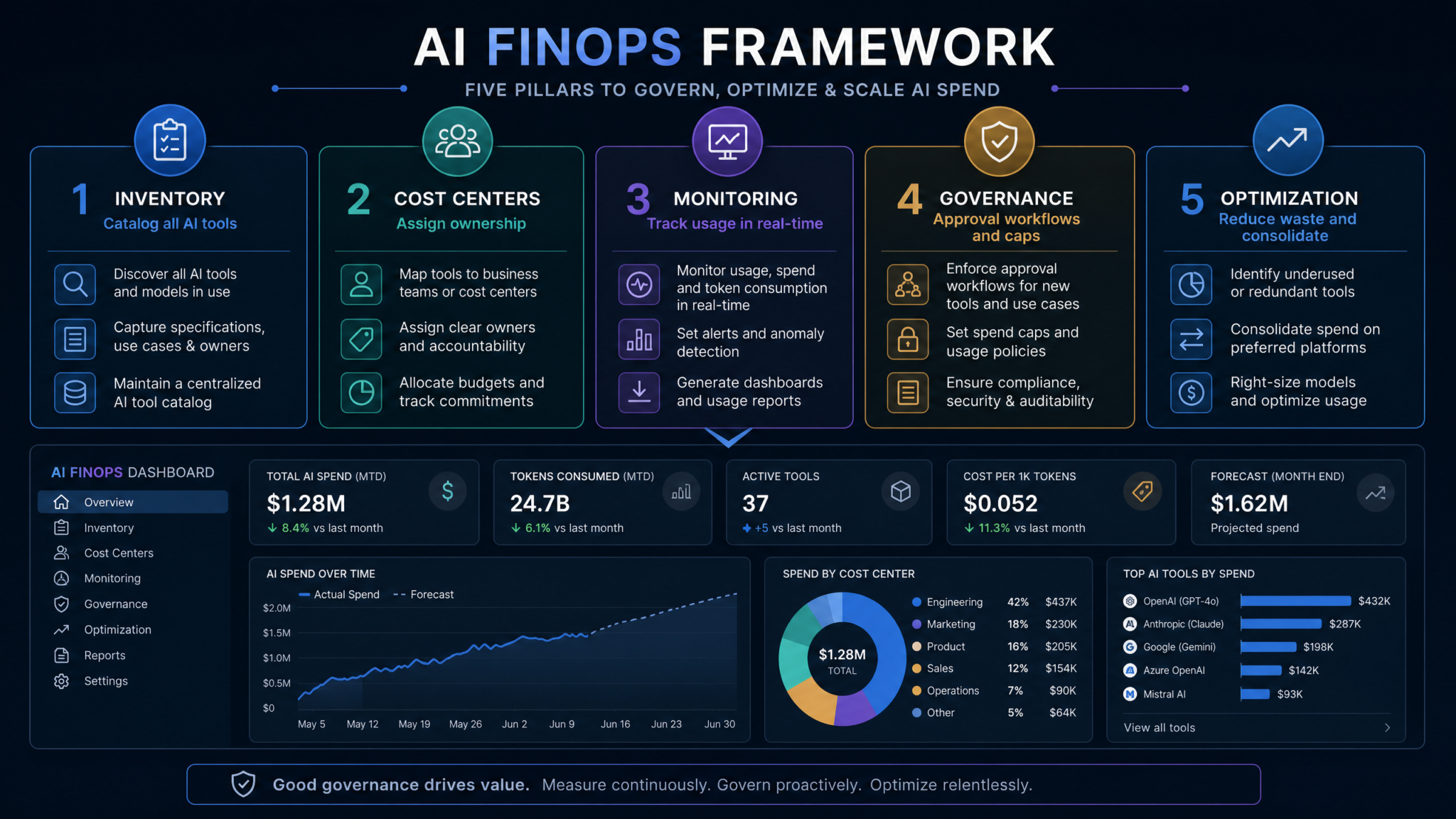
Building an AI FinOps Framework from Scratch
Phase 1: Complete AI Tool and Spending Inventory
No governance framework can function without an accurate inventory of what exists. Building that inventory for AI spending requires going substantially further than a traditional SaaS discovery exercise because AI tools appear in more channels, are adopted faster, and are frequently not visible to IT security or procurement through standard SaaS management platforms. A comprehensive AI inventory process requires five simultaneous discovery channels.
Expense report mining: Configure your expense management system to flag expenses submitted under categories like “software,” “AI tools,” “subscriptions,” “productivity software,” and “cloud services” for manual review. Extract six months of historical data and search for known AI vendor names: OpenAI, Anthropic, Midjourney, Runway, ElevenLabs, GitHub Copilot, Jasper, Copy.ai, Perplexity, Cursor, and dozens of others. This single step typically surfaces 30 to 50 percent of shadow AI spending within the first two weeks.
Credit card and virtual card review: Work with AP to pull transaction-level data from all corporate credit cards and virtual card programs. AI vendors are increasingly easy to identify — their merchant category codes and billing descriptors are distinctive. This catches spending that was never submitted for reimbursement because employees used company cards directly.
Cloud account audit: Review all active cloud accounts across AWS, Google Cloud, and Azure. Look specifically for AI/ML service usage: AWS Bedrock, AWS SageMaker, Google Vertex AI, Google AI Platform, Azure OpenAI Service, Azure Machine Learning. Pull detailed billing reports and identify which team accounts are driving AI-specific usage.
Browser extension and SSO review: Work with IT security to review which browser extensions are installed across managed devices — many AI tools are accessed primarily through browser extensions (Grammarly, Compose AI, various Copilot-adjacent tools). Review SSO logs for authentications to known AI platforms, even for tools not formally provisioned through IT.
Engineering repository review: Ask engineering leads to review active repositories for API keys, SDK imports, or environment variables pointing to AI APIs. A quick grep across your codebase for `openai`, `anthropic`, `cohere`, `replicate`, or `huggingface` typically surfaces API integrations that finance has no visibility into.
Phase 2: Establish Cost Centers and Allocation Structures
Once you have completed the inventory, the next step is establishing a cost center structure specifically designed for AI spending. This requires collaboration between Finance, IT, and the business units that own AI workloads. The goal is not to create bureaucratic overhead — it is to create the minimum tagging and allocation discipline needed to answer three critical questions at any point in time: how much is the organization spending on AI in total, which teams or business units are driving that spending, and what business outcomes are those expenditures supporting.
A practical AI cost center taxonomy for mid-to-large enterprises typically looks like this:
- AI Productivity Tools — Subscriptions to AI-powered productivity software (Copilot, ChatGPT Enterprise, Gemini for Workspace) used broadly across the organization
- AI Development Platform — API costs, model hosting, vector databases, and GPU compute supporting internal AI application development
- AI by Business Function — Subcategories under each major business unit (Sales AI, Marketing AI, Engineering AI, Operations AI, Legal AI, HR AI) capturing AI tools and services specific to those functions
- AI Research and Experimentation — A separate cost center for exploratory AI work, proof-of-concept projects, and model training experiments not yet tied to production applications
- AI Infrastructure and Platform Engineering — The human and compute costs associated with building and maintaining the organization’s AI platform capabilities
Phase 3: Implement Usage Monitoring and Instrumentation
Cost center structure tells you where AI spending is allocated. Usage monitoring tells you why it is occurring and whether it is being used as intended. For every material AI tool or API integration, implement the following monitoring layers.
For SaaS AI subscriptions, configure admin dashboards to export monthly active user counts, feature utilization rates, and any per-usage charges. Most enterprise AI platforms (ChatGPT Enterprise, Claude for Work, Copilot) provide admin analytics dashboards — these should be reviewed monthly by a designated AI FinOps owner, not just by the IT administrator who initially provisioned the account.
For API-based AI services, instrument every application that calls an external AI API with usage telemetry that captures: tokens consumed per request (input and output separately), model used, calling application and endpoint, associated user or team identifier, and latency. This telemetry should feed into a central monitoring store — a time-series database, a data warehouse table, or a purpose-built FinOps platform — where it can be queried, visualized, and alerted against.
For GPU and AI compute infrastructure, implement cloud cost tagging as a mandatory provisioning requirement. Every AI compute resource — every SageMaker training job, every Vertex AI endpoint, every EC2 P-series instance — must be tagged at creation time with at minimum: a team or cost center tag, a project tag, and an environment tag (development, staging, production). Cloud cost management tools like AWS Cost Explorer, Google Cloud Billing, and Azure Cost Management can then generate AI-specific spend reports by team, project, and environment.
Phase 4: Set Budget Alerts and Anomaly Detection
Static monthly budget reviews are insufficient for AI cost management because AI spending can change dramatically within a single day, let alone a month. Organizations that successfully manage AI costs implement proactive alerting at multiple thresholds: a soft alert when spending reaches 70 percent of the monthly budget for a given cost center, a hard alert at 90 percent, and an immediate alert for any single-day spending that exceeds a defined anomaly threshold (typically three standard deviations above the 30-day moving average for that cost center).
For API-based spending, configure spend alerts directly within API providers’ billing platforms. OpenAI, Anthropic, and Google Cloud all support email and webhook alerts when spending crosses defined thresholds. These provider-level alerts provide a safety net that catches runaway costs before they accumulate into significant overages — particularly important for development environments where a misconfigured loop or a poorly bounded recursive prompt chain can generate thousands of dollars in API charges in minutes.
Phase 5: Create Chargeback and Showback Models
Chargeback models — where AI costs are formally charged back to the business units that incur them — are the most powerful mechanism for creating cost accountability at the team level. When an engineering team’s P&L is directly impacted by the token costs their applications generate, they have strong incentives to optimize prompt efficiency, select appropriately-priced models, implement caching, and avoid wasteful experimentation in production environments. When those costs are pooled into a central IT budget, those incentives disappear entirely.
Organizations that are not yet ready for full chargeback can implement showback models — where costs are tracked and attributed to business units but charged to a central budget rather than directly to business unit P&Ls. Showback creates visibility and accountability without the political friction that sometimes accompanies chargeback implementation, and it provides the historical data needed to design fair chargeback models when the organization is ready to make the transition.
Tool-by-Tool Cost Tracking Strategies
ChatGPT Enterprise and OpenAI API
ChatGPT Enterprise provides organization-level admin consoles with usage analytics, domain-level controls, and the ability to view usage aggregated by department. For FinOps purposes, the critical configuration step is to set up separate API keys for each application or team that calls the OpenAI API directly, then tag those keys with cost center metadata in your internal key management system. OpenAI’s usage dashboard can segment by API key, giving you application-level cost attribution without any additional instrumentation. Set up usage-based billing alerts at both the organization level and the individual key level.
Microsoft Copilot M365
Microsoft Copilot is licensed per user per month and is managed through the Microsoft 365 admin center. Cost tracking complexity here comes primarily from ensuring that licensed seats are actively used — Microsoft itself reported that in early enterprise Copilot deployments, 30 to 40 percent of purchased seats showed minimal active usage in the first 60 days. Implement quarterly license reviews that compare licensed seat counts against Microsoft 365 activity reports to identify unused licenses that can be reclaimed.
GitHub Copilot
GitHub Copilot is billed per active developer per month. The engineering management challenge is that “active” in GitHub’s billing model means any user with a seat assigned — not any user who actively used the feature. Implement monthly reviews through the GitHub organization admin console to identify developers with assigned Copilot seats who have not made completions in the past 30 days. Reclaiming these seats and redistributing them to active developers or candidates on a waiting list is a common quick-win cost optimization with minimal productivity impact.
Anthropic Claude API
Track Claude API costs using the same key-per-application strategy described for OpenAI. One Claude-specific consideration is the importance of tracking context window utilization — Claude’s extended context window capability (200K tokens) is a genuine technical differentiator, but it is also a cost accelerator if used without discipline. An application that passes an entire 50,000-token document as context for every query will incur dramatically higher costs than one that implements document chunking and retrieval to pass only the relevant 2,000-token section. Context window instrumentation — tracking actual tokens in the system prompt, the user message, and the retrieved context separately — is essential for Claude-intensive applications.
Google Cloud AI and Vertex AI
Google Cloud’s AI services are managed through the standard Google Cloud billing console, which supports robust project-level and label-level cost attribution. The FinOps best practice for Google AI spend is to create separate Google Cloud projects for each major AI application or team, then use billing exports to BigQuery to run SQL-based cost analysis across projects. This approach provides more granular attribution than is available through the standard Cloud Billing dashboard and enables custom cost reporting that maps to your internal cost center taxonomy.
Open Source Models on Self-Managed Infrastructure
Organizations running open-source models (Llama 3, Mistral, Phi-3, Falcon) on self-managed infrastructure face a different cost tracking challenge: there are no vendor invoices to reconcile, but the infrastructure costs — GPU instance hours, storage for model weights, networking for inference traffic — are entirely within the organization’s control and responsibility. Implement strict tagging policies for all AI inference infrastructure, and consider implementing showback reports that translate infrastructure costs into per-query or per-token equivalent figures that can be compared directly against commercial API costs to validate the build-vs.-buy decision on an ongoing basis.
Governance Policies, Approval Workflows, and Spending Caps
The AI Procurement Policy Framework
Effective AI governance begins with a clear, written procurement policy that defines which AI tools can be adopted without formal approval, which require team-level sign-off, and which require enterprise procurement review. A three-tier framework works well for most organizations:
Tier 1 — Pre-approved tools (no additional approval required): A curated list of AI tools that have already been vetted for security, privacy, and compliance and are available for any employee to subscribe to up to a defined per-month cost threshold (typically $50 to $100 per month for individual subscriptions). This list includes tools like ChatGPT Plus, Claude Pro, GitHub Copilot individual, Grammarly Business, and similar productivity-focused AI subscriptions. Including a Tier 1 list removes friction for legitimate individual use while maintaining a defined boundary.
Tier 2 — Team tools requiring manager and IT approval: AI tools with costs above the Tier 1 threshold, tools that involve organizational data or customer data, tools that will be used by more than 5 people, or tools that integrate with company systems. These require a lightweight approval workflow — typically a 3 to 5 business day review by IT (security assessment), Finance (budget confirmation), and Legal (data processing agreement review) before purchase.
Tier 3 — Enterprise AI tools requiring full procurement review: Any AI tool with annual contract value exceeding a defined threshold (typically $25,000 to $50,000 depending on organization size), any AI tool that will be embedded in a customer-facing product, any AI tool that processes regulated data categories, and any AI platform that could create vendor lock-in. Tier 3 procurement follows the full enterprise vendor evaluation process including security review, data processing agreement negotiation, and executive approval.
Monthly Spending Caps and Escalation Policies
Every AI cost center should have a formally approved monthly spending cap that is documented in the organization’s budget management system and enforced through both alert-based monitoring and, where possible, provider-level spending limits. When spending reaches 80 percent of the monthly cap, the cost center owner receives an automated notification. At 95 percent, the notification escalates to the department head. At 100 percent, further spending requires explicit CFO or CTO authorization before proceeding.
For API spending, many providers support hard spending limits at the API key or account level. OpenAI allows you to set monthly hard limits that prevent further API calls once the limit is reached. While invoking a hard limit in a production application is not ideal, it is far preferable to discovering a $50,000 unexpected bill at month-end because a production application encountered an edge case that triggered runaway API consumption. Use hard limits as a circuit breaker for development and experimentation environments, and use soft limits with human review for production environments.
Vendor Consolidation Programs
Once you have completed the AI tool inventory described in the FinOps framework section, vendor consolidation becomes one of the highest-ROI governance activities available. The path to consolidation involves three steps: mapping all current AI tools against a functional taxonomy (content generation, code assistance, data analysis, image generation, voice and video, search and RAG, document review), identifying functional overlaps, and building a consolidation roadmap that replaces redundant tools with a smaller number of enterprise agreements that provide superior functionality, better pricing, and stronger governance controls.
Enterprise agreements with AI vendors typically provide significant pricing advantages over per-seat or per-consumption pricing at scale. Organizations that have consolidated scattered AI tool spending into enterprise agreements with two or three primary AI vendors consistently report total cost reductions of 25 to 40 percent alongside improvements in security compliance and data governance.
Access 40,000+ AI Prompts for ChatGPT, Claude & Codex — Free!
Subscribe to get instant access to our complete Notion Prompt Library — the largest curated collection of prompts for ChatGPT, Claude, OpenAI Codex, and other leading AI models. Optimized for real-world workflows across coding, research, content creation, and business.
Building Your AI Spending Dashboard
Core Metrics for the AI Financial Command Center
An effective AI spending dashboard provides real-time and historical visibility into six core metric categories. These metrics should be accessible to FinOps practitioners, engineering leaders, business unit heads, and executive leadership through a shared dashboard platform — whether that is a purpose-built FinOps tool, a custom implementation in Tableau, PowerBI, Grafana, or a simple shared spreadsheet updated on a regular cadence for organizations just beginning their cost visibility journey.
Total AI spend by category: A top-level view showing the breakdown of AI spending across direct subscriptions, API usage, infrastructure, and any tracked human cost components. This should show current month actuals against budget, the prior month for comparison, and a rolling 12-month trend line.
Spend by business unit and cost center: A drill-down view showing how total AI spend is distributed across the organization. This is the foundation of accountability — budget owners should see their AI cost center’s spend every time they open the dashboard, not once a month in a report.
API consumption metrics: For organizations with material API-based AI spending, a dedicated view showing total tokens consumed (input and output separately), broken down by provider, model, and application. This view should include a cost-per-query or cost-per-output metric that makes the economic efficiency of each AI application visible and comparable.
Seat utilization rates: For all per-seat AI subscriptions (Copilot, ChatGPT Enterprise, Claude for Work), a view showing licensed seats versus active seats versus highly active seats. Seat utilization below 70 percent is typically a signal that licenses should be reclaimed and reallocated.
Budget pacing and forecast: A view showing current-month spend pacing against the monthly budget, with a simple linear or seasonality-adjusted forecast of projected end-of-month spend. This gives cost center owners early warning of budget overruns well before they occur.
Cost per business outcome: The most advanced metric, but arguably the most important for justifying AI investment. Where possible, the dashboard should include a cost-per-outcome metric that connects AI spending to a measurable business result — cost per customer inquiry resolved, cost per code commit with AI assistance, cost per marketing asset produced, cost per contract reviewed. Building this metric requires connecting the AI cost data to operational performance data from other systems, but organizations that have done so consistently report that it fundamentally changes how business leaders think about AI investment.
Technical Architecture for AI Cost Data Collection
For organizations building a centralized AI cost tracking system, a reference architecture that works at most scales consists of the following components. A data collection layer that pulls cost and usage data from provider APIs (OpenAI usage API, Anthropic API billing, cloud billing exports) on a scheduled basis, enriches it with internal metadata (team tags, project tags, application identifiers), and loads it into a central cost data store. A central store — a time-series database like InfluxDB or TimescaleDB for high-frequency API usage data, or a cloud data warehouse like BigQuery or Snowflake for aggregated reporting. A visualization layer built in Grafana, Metabase, or a commercial BI tool that provides the dashboard views described above. And an alerting layer using Grafana alerts, PagerDuty, or cloud-native alerting services to deliver proactive notifications when spending thresholds are crossed.
Organizations that do not have the engineering resources to build this infrastructure from scratch have an increasing number of commercial options available. Platforms like Apptio Cloudability, CloudHealth, Harness Cloud Cost Management, and CAST AI are adding AI-specific cost tracking capabilities. Additionally, a growing category of AI-native FinOps tools — including Vantage, Kubecost with AI extensions, and several well-funded 2024 entrants — are building dashboards specifically designed around AI API and subscription cost tracking.
ROI Measurement Alongside Cost Tracking
The Cost-Without-Benefit Trap
One of the most common mistakes in AI FinOps programs is building robust cost tracking without connecting it to benefit measurement. This creates what practitioners call the cost-without-benefit trap: leadership sees clearly how much AI is costing, but has no corresponding view of what that spending is producing, leading to premature cost-cutting that eliminates high-ROI AI applications alongside genuinely wasteful spending. Effective AI FinOps must measure both sides of the equation simultaneously.
Productivity ROI Framework
For AI tools deployed to improve individual or team productivity, a practical ROI measurement framework has three components. First, establish a baseline measurement of the activity the AI tool is intended to accelerate — average time to complete a specific task, volume of output produced per unit of time, or error rate on a specific class of work. Second, measure the same activity after AI tool deployment, controlling as much as possible for other factors that might influence the result. Third, translate the productivity improvement into economic value using fully-loaded labor cost rates for the role in question, then compare that value against the total cost of the AI tool (subscription cost plus implementation and maintenance overhead).
A practical example: a legal team implements an AI contract review tool at an annual cost of $60,000 including subscription, integration, and the lawyer time spent on training and prompt refinement. Baseline measurement shows that contract review averaged 2.8 hours per contract across the team. Post-implementation measurement shows that review time has decreased to 1.4 hours per contract, a 50 percent reduction. If the team reviews 400 contracts annually at a fully-loaded hourly rate of $180 for the reviewing lawyers, the value of the time saved is 400 × 1.4 hours × $180 = $100,800. Against a $60,000 total cost, the ROI is $40,800 or 68 percent. That is a clear, defensible financial case — but it only exists because someone measured both the cost and the benefit.
Revenue Impact Measurement
For AI tools deployed in customer-facing or revenue-generating contexts — AI-powered sales tools, customer service automation, AI-enhanced marketing personalization — ROI measurement must connect to revenue metrics. This requires tagging customers or customer segments who interact with AI-powered experiences, measuring their conversion rates, average order values, and retention rates against a comparable control group that did not receive AI-enhanced experiences, and translating those differences into revenue impact. This is more complex than productivity ROI measurement and requires coordination between the FinOps function, marketing analytics, and customer success, but it is the only measurement approach that can justify large-scale AI investment at the executive level.
Cost Avoidance Measurement
A frequently overlooked ROI category is cost avoidance — using AI to prevent costs that would otherwise be incurred rather than directly generating value. AI-powered fraud detection systems, predictive maintenance applications, automated compliance monitoring, and AI-assisted cybersecurity threat detection all generate ROI primarily through cost avoidance. Measuring cost avoidance ROI requires estimating the counterfactual — what costs would have been incurred without the AI system — using historical data, industry benchmarks, or actuarial modeling, and comparing that estimate against the cost of the AI system. While inherently less precise than measuring direct productivity or revenue impact, cost avoidance measurement is essential for justifying AI investment in risk management, compliance, and operational resilience contexts.
Case Studies: Companies That Solved the AI Visibility Problem
Case Study 1: A 2,000-Person Professional Services Firm
A mid-size management consulting firm with 2,000 employees discovered in Q2 2024, during a routine SaaS spend review, that they had 23 distinct AI tools active across their organization — 17 of which had been adopted without IT procurement involvement. Total identified AI spending was $1.2 million annually, but finance estimated that the actual figure, including untracked API usage and personal expense submissions, was closer to $1.8 million. The CFO’s office launched a 90-day AI FinOps initiative with the following outcomes.
During the discovery phase, the team identified eight functional overlaps where multiple teams were paying for substantially equivalent capabilities. Consolidation of these overlaps through enterprise agreements with two primary AI vendors — one for productivity tools and one for document analysis and research — reduced the normalized annual AI spend from $1.8 million to $1.1 million, a 39 percent reduction, while simultaneously expanding access to better tools for all affected teams through enterprise licensing that covered the entire organization rather than fragmented team-level seats.
The firm implemented a centralized AI cost dashboard using Metabase connected to a Snowflake data warehouse that ingested billing data from all AI providers through scheduled API pulls. Within six months of launch, cost center owners were reviewing AI spend weekly, three additional optimization opportunities had been identified through usage analytics (primarily underutilized seats in departments with low adoption), and the finance team had for the first time included a formally budgeted and tracked AI cost line in the annual operating budget.
Case Study 2: A B2B SaaS Company with Internal AI Product Features
A 400-person B2B SaaS company building AI-powered features into their core product faced a different challenge: their product’s LLM API costs were scaling faster than their product revenue, and they had no visibility into which product features were driving the cost growth. The company’s AI API spend had grown from $12,000 per month in Q1 2024 to $67,000 per month by Q3 2024 — a 5.6x increase in six months — but engineering and product leadership could not identify which features were responsible for the growth.
The company implemented per-feature API usage instrumentation by adding a custom metadata header to every LLM API call that identified the calling product feature. They built a Grafana dashboard that showed token consumption and estimated cost by feature in real time. Within two weeks of deploying the instrumentation, they discovered that a single “AI summary” feature used by fewer than 8 percent of their customer base was responsible for 34 percent of their total LLM API costs, primarily because it was calling GPT-4o for summaries that could be handled adequately by GPT-4o mini at one-tenth the cost. Switching that feature to the smaller model reduced monthly API costs by $18,000 without any measurable change in customer satisfaction scores — a savings that would have remained invisible without per-feature cost instrumentation.
Case Study 3: A Financial Services Organization Managing Compliance and AI Governance Together
A regional bank with 5,000 employees faced the dual challenge of building AI cost visibility while simultaneously satisfying regulators’ growing demands for AI governance documentation. Their AI FinOps program was designed from the start to serve both purposes — the tool inventory, cost center structure, usage monitoring, and approval workflows were all designed to produce audit-ready documentation as a byproduct of normal cost management operations.
The bank’s AI governance framework required every AI tool to be registered in a central AI inventory that captured not just cost attribution data but also data classification (does this tool process regulated data?), vendor risk tier, model transparency documentation, and human oversight requirements. This dual-purpose registry meant that when regulators requested a comprehensive inventory of AI systems in use, the bank could produce it within hours from the same system that was generating their weekly AI cost reports. The operational efficiency of combining FinOps and governance documentation reduced the compliance preparation burden for AI-related regulatory requests by an estimated 70 percent compared to the ad-hoc, manual documentation processes they had used previously.
Predictions for AI Cost Management in 2027
AI Pricing Will Become More Complex Before It Becomes Simpler
The current period of AI pricing experimentation will intensify before it stabilizes. Providers are actively testing new pricing models: outcome-based pricing (paying per task completed rather than per token consumed), subscription tiers with usage pools rather than hard per-token rates, enterprise commitments with dynamic allocation across models, and agent-specific pricing for multi-step autonomous AI workflows. By 2027, enterprise AI contracts will likely resemble cloud commitment agreements more than traditional software licenses — with reserved capacity commitments, spot pricing for burst workloads, and savings plans for predictable usage. FinOps practitioners who develop expertise in this pricing complexity will be among the most valuable people in enterprise finance functions.
AI Cost Will Become a Standard Operating Metric
By 2027, the concept of AI unit cost — the cost per AI-driven transaction, per AI-assisted output, or per AI-resolved customer issue — will be a standard operational and financial metric in the same way that cloud cost per server or cost per software seat is standard today. Organizations that begin building the instrumentation and measurement frameworks for AI unit cost now will be positioned to optimize and benchmark against industry standards as those standards emerge. Organizations that delay will be catching up to competitors who have two to three years of historical data and optimization experience.
Agentic AI Will Create Entirely New Cost Complexity
The emergence of autonomous AI agents — systems that chain multiple LLM calls, tool uses, web browsing actions, code executions, and API calls together to complete complex multi-step tasks — will create cost tracking challenges that current FinOps frameworks are not designed to handle. A single agentic task might consume tokens across five or six different models, call a dozen external APIs, provision and tear down cloud resources, and run for minutes or hours. Attributing the total cost of that task to a business outcome, a cost center, and a ROI calculation will require new instrumentation paradigms, new cost data schemas, and new analytical approaches. The organizations that begin developing agentic AI cost tracking capabilities in 2025 and 2026 will be significantly better positioned when agentic workloads become mainstream in 2027.
Regulatory Requirements Will Mandate Cost and Governance Documentation
Emerging AI regulatory frameworks — the EU AI Act, proposed US federal AI governance legislation, and sector-specific AI regulations in financial services, healthcare, and critical infrastructure — are increasingly incorporating requirements for AI system documentation, impact assessments, and operational records that substantially overlap with what a mature AI FinOps program would produce naturally. By 2027, organizations in regulated industries that have not implemented AI cost governance programs will face regulatory compliance costs that dwarf the savings they believed they were generating by deferring governance investment.
Budget Templates, Governance Policy Examples, and Cost Tracking Frameworks
Annual AI Budget Template
The following template provides a starting structure for an annual AI budget that captures all major cost categories. Adapt column headings and row categories to match your organization’s cost center taxonomy and business unit structure.
| Category | Q1 Budget | Q2 Budget | Q3 Budget | Q4 Budget | Annual Total | Notes |
|---|---|---|---|---|---|---|
| Productivity AI Subscriptions (Org-Wide) | $45,000 | $45,000 | $48,000 | $48,000 | $186,000 | Includes M365 Copilot, ChatGPT Ent. |
| AI Developer Tools (Engineering) | $18,000 | $18,000 | $20,000 | $20,000 | $76,000 | GitHub Copilot, Cursor, code AI tools |
| LLM API Costs (Internal Products) | $55,000 | $65,000 | $75,000 | $85,000 | $280,000 | OpenAI, Anthropic, Google APIs |
| AI Infrastructure (GPU, Vector DB) | $30,000 | $35,000 | $40,000 | $40,000 | $145,000 | AWS SageMaker, Pinecone, compute |
| Business Unit AI Tools | $28,000 | $30,000 | $32,000 | $35,000 | $125,000 | Sales, Marketing, Legal, HR AI tools |
| AI Research and Experimentation | $12,000 | $15,000 | $15,000 | $18,000 | $60,000 | POCs, fine-tuning experiments |
| Total AI Budget | $188,000 | $208,000 | $230,000 | $246,000 | $872,000 |
AI Tool Approval Request Template
Every new AI tool request for Tier 2 or Tier 3 approval should submit the following information. This template can be implemented as a form in your internal ticketing system (Jira, ServiceNow, Monday.com) to create a consistent, auditable approval workflow.
AI TOOL APPROVAL REQUEST

Requestor Name and Department:
Tool Name and Vendor:
Intended Use Case (specific, measurable description):
Number of Users (at launch / projected 12 months):
Estimated Monthly Cost (base subscription):
Estimated Variable Costs (per-use or per-seat scaling):
Annual Cost Projection:
Data Classification (will this tool process: PII / financial data / regulated data / internal proprietary data / public data only):
Integration Requirements (which internal systems will this connect to):
Vendor Security Documentation Available (SOC 2 Type II / ISO 27001 / other):
Business Justification (expected outcomes and measurement approach):
Cost Center for Billing Allocation:
Proposed Review Date (for usage and ROI assessment):
Budget Owner Approval (manager signature):

---
IT SECURITY REVIEW:
LEGAL / DPA REVIEW:
FINANCE BUDGET CONFIRMATION:
FINAL APPROVAL (IT Director / CFO for Tier 3):
Monthly AI FinOps Review Checklist
The following checklist defines the minimum activities that should occur in every monthly AI FinOps review cycle:
- Pull and reconcile AI spend actuals from all provider billing accounts against the monthly budget for each cost center
- Review seat utilization reports for all per-seat AI subscriptions and flag any cost center with utilization below 75 percent for reclamation review
- Review API usage anomalies — any application or cost center with month-over-month API cost growth exceeding 20 percent without a corresponding business justification should be flagged for engineering review
- Update the AI tool inventory with any new tools approved during the month, and flag any shadow AI tools identified through expense report or cloud account review
- Review the AI research and experimentation cost center for any projects that have exceeded their approved budget or timeline and require a renewal decision
- Generate the monthly AI cost report for distribution to cost center owners, department heads, and the FinOps leadership team
- Update the AI spending forecast for the remainder of the fiscal year based on current actuals and any anticipated changes in tool usage or headcount
- Review any pending AI tool approval requests and complete within the defined SLA (5 business days for Tier 2, 15 business days for Tier 3)
AI Governance Policy Statement — Sample Language
The following sample policy language can be adapted for inclusion in your organization’s information security policy, acceptable use policy, or dedicated AI governance policy:
AI Tool Acquisition and Usage Policy
All employees, contractors, and third-party partners who access organization resources are prohibited from subscribing to, integrating, or using AI-powered software, platforms, or APIs on behalf of the organization without following the organization’s AI Tool Approval Process as defined in this policy. This includes, but is not limited to, large language model services, generative AI platforms, AI-powered productivity tools, machine learning APIs, and autonomous AI agents.
AI tools that process organizational data of any classification must be reviewed and approved by IT Security, Legal, and Finance prior to use. The review process includes assessment of data residency, data retention, training data opt-out provisions, security certifications, and compliance with applicable data protection regulations.
All approved AI tools must be registered in the organization’s AI Tool Inventory within five business days of approval. Costs for approved AI tools must be allocated to the designated cost center at time of procurement. Employees who use personal payment methods for AI tools intended for business use must submit expenses within 30 days and must have received prior Tier 1 pre-approval for the tool in question.
The organization reserves the right to audit AI tool usage, revoke access to AI tools that are found to be in violation of this policy, and require the immediate decommissioning of any AI tool that poses an identified security, privacy, or compliance risk.
The Path Forward: Starting Your AI FinOps Journey Today
The organizations that will emerge from the current period of AI cost opacity with a competitive advantage are not those that wait for perfect tooling, perfect policies, or perfect organizational alignment before acting. They are the organizations that begin with imperfect but functional inventory, establish basic cost center structures in the next quarter, instrument one or two high-spend AI applications for usage tracking in the following quarter, and build incrementally from there. The 82 percent of organizations that currently lack AI spending visibility will not solve this problem through a single major transformation initiative — they will solve it through consistent, disciplined, incremental progress in financial instrumentation, governance policy, and cost accountability culture.
The frameworks, templates, and strategies in this guide provide a complete starting point for that journey. The organizations that begin it today will be the ones who, when AI spending represents 10 or 15 percent of their total operating budget — a threshold many will cross by 2027 — have the financial visibility to optimize it, justify it, and govern it with the same rigor they apply to every other material business expense. The 82 percent statistic is alarming precisely because it represents a solvable problem that most organizations have not yet chosen to solve. The question for every finance leader, technology leader, and FinOps practitioner reading this guide is simply: which category do you intend to be in?
