
AI-Generated Code Has 75% More Bugs: What the 2026 New Relic and Faros Studies Mean for Development Teams Using Codex and Copilot
Published: June 2025 | Category: AI Development, Engineering Research, Code Quality
The Growing Rift Between AI Hype and Code Quality Reality
The promise was intoxicating: AI coding assistants would dramatically accelerate software development, reduce developer toil, and democratize the creation of high-quality code. Since GitHub Copilot’s public launch in 2022, the industry has sprinted toward AI-assisted development with almost reckless enthusiasm. By early 2025, an estimated 84% of professional developers reported using at least one AI coding tool in their daily workflow. Enterprise adoption of tools like OpenAI Codex, GitHub Copilot, Cursor, and Anthropic’s Claude Code has become less a competitive advantage and more a baseline expectation. Yet as adoption has soared, a body of rigorous, data-driven research has begun accumulating a very different picture — one that enterprise engineering leaders ignore at serious peril.
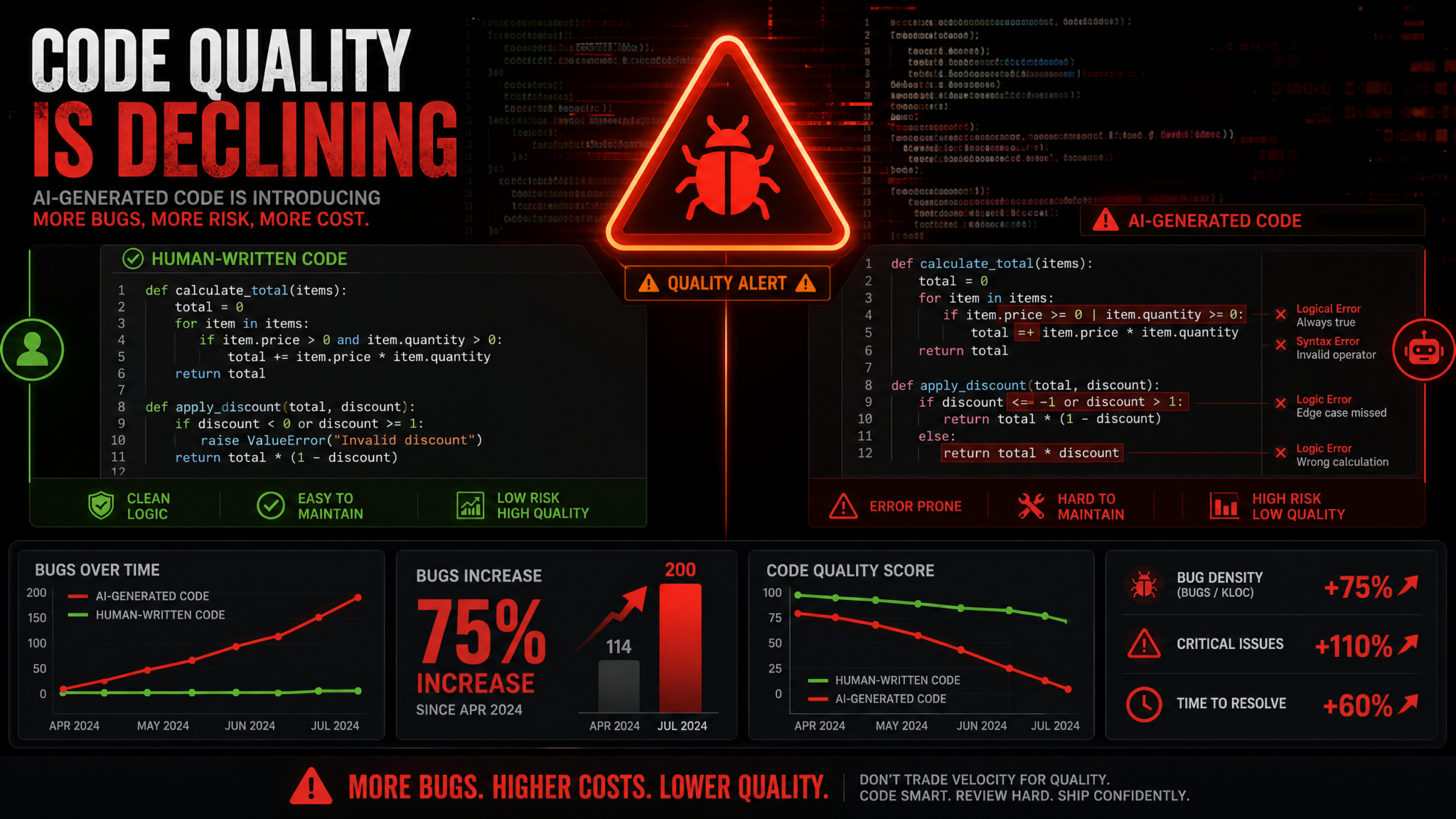
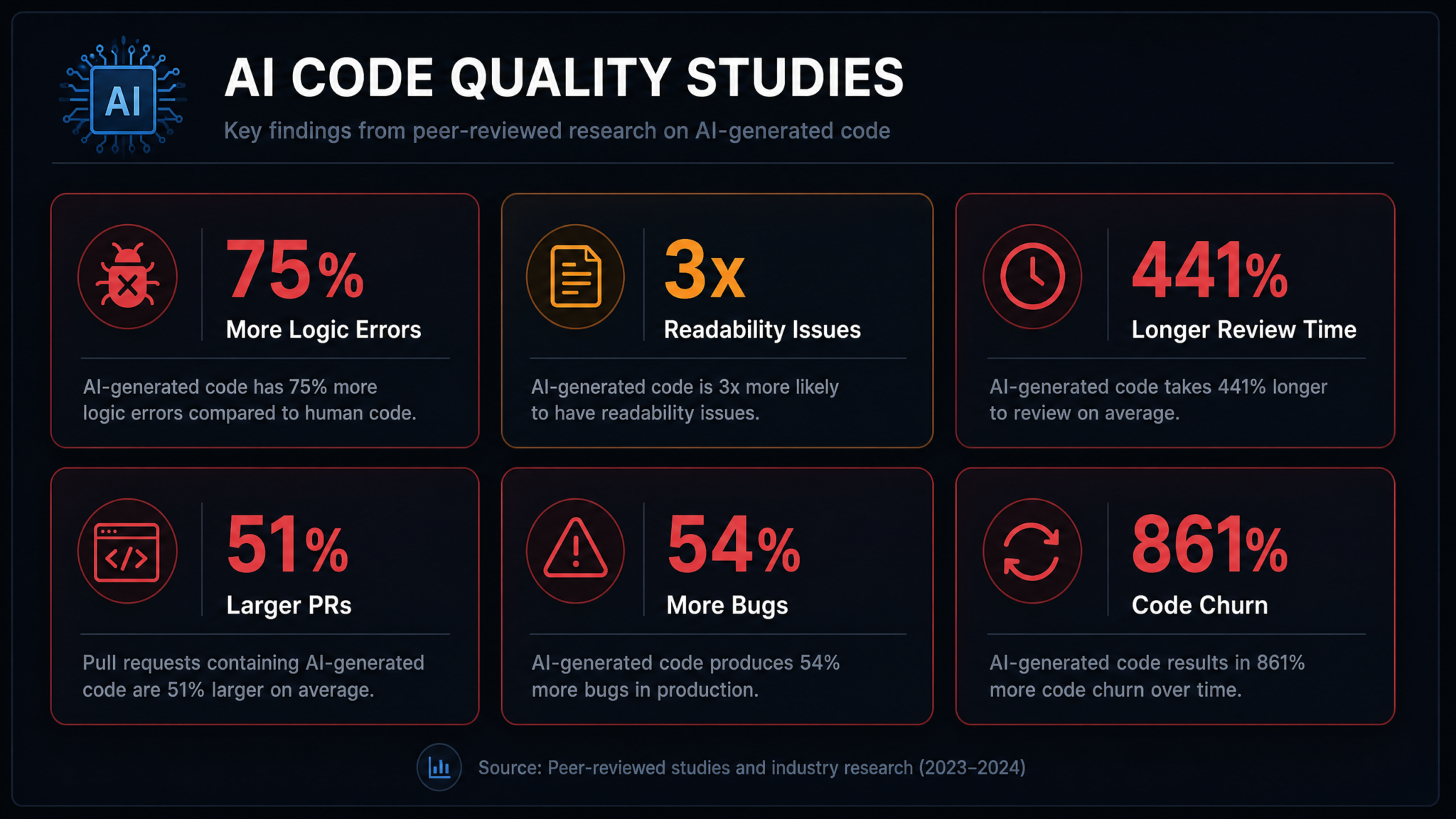
Two landmark studies released in the first half of 2026 have given the software industry its most detailed empirical portrait yet of what AI-generated code actually looks like when it arrives in your pull request queue. New Relic’s 2026 State of AI Coding report analyzed millions of pull requests across enterprise customers and found that logic and correctness errors are 75% more common in AI-generated code than in human-authored code. Readability issues appear at three times the rate. Error handling gaps — the silent killers of production stability — appear twice as frequently. Meanwhile, Faros AI’s provocatively titled Acceleration Whiplash report documents a phenomenon that will be familiar to any engineering manager who has deployed AI tools at scale: the apparent speed gains on individual developer metrics are being overwhelmed by downstream costs in review time, rework, and systemic code churn. Pull requests are 51% larger. They contain 54% more bugs. Median code review time has ballooned by 441%. And code churn — the expensive, demoralizing cycle of writing, breaking, and rewriting code — has surged by a staggering 861%.
These figures represent more than academic data points. They carry direct operational implications for development teams making architecture decisions, capacity planning calls, and toolchain investments right now. This article breaks down both studies in granular detail, contextualizes their findings against each other and against complementary research from cybersecurity firm Dark Reading, examines the specific quality profiles of the most widely deployed AI coding tools, and provides a framework of actionable recommendations engineering leaders can begin implementing immediately.
New Relic’s 2026 State of AI Coding: The Data Breakdown
New Relic occupies a unique analytical vantage point in the software industry. As an observability platform embedded deeply in both development pipelines and production environments, the company has visibility into code quality metrics that most researchers can only approximate. Its 2026 State of AI Coding study drew on anonymized telemetry from thousands of enterprise engineering organizations, analyzing pull request metadata, code review comments, post-merge defect rates, and production incident correlation data. The resulting dataset represents one of the most comprehensive empirical investigations of AI coding quality ever published.
Logic and Correctness Errors: The Core Finding
The headline finding — that logic and correctness errors appear 75% more frequently in AI-generated pull requests compared to human-authored ones — demands careful interpretation. New Relic’s methodology defined “logic errors” as defects where code executes without throwing an exception but produces incorrect output or behavior, and “correctness errors” as code that satisfies surface-level syntactic and stylistic requirements but fails to meet functional specifications. These are, notably, the hardest categories of bugs to detect through automated linting or static analysis, because by definition they are not syntax problems or type mismatches. They are semantic failures — code that does the wrong thing correctly.
This finding aligns with what experienced engineers have observed informally for years: AI models are extraordinarily good at producing code that looks right and remarkably bad at producing code that is right in the full semantic sense. The models are trained on vast corpora of existing code, which teaches them patterns of structure and syntax. But understanding whether a particular business rule, algorithm variant, or edge case condition has been correctly implemented requires contextual reasoning that current large language models handle inconsistently at best.
Readability: Three Times More Issues
The finding that readability issues appear at three times the rate in AI-generated code may be the most surprising result for developers who have experienced AI assistants producing elegantly formatted, well-structured-looking code. New Relic’s definition of readability issues encompassed several distinct subcategories:
- Inconsistent naming conventions that diverge from established project or team standards
- Excessive complexity in function logic, measured by cyclomatic complexity metrics
- Poor abstraction choices that either over-engineer simple operations or under-abstract repetitive patterns
- Misleading variable and function names that suggest different behavior than what is implemented
- Insufficient or inaccurate inline comments, particularly for non-obvious logic
- Context mismatch, where code style diverges from the surrounding codebase even when syntactically valid
The context mismatch issue is particularly instructive. AI models generate code based on their training data and the immediate context window provided. They do not have access to the broader architectural decisions, team conventions, and unwritten rules that experienced engineers absorb over years of working on a specific codebase. The result is code that is technically correct in isolation but stylistically alien in context — creating a cognitive burden for every future developer who works in that area.
Error Handling: The Silent Production Risk
Perhaps the most operationally dangerous finding from New Relic’s study is the 2x higher frequency of error handling gaps in AI-generated code. Error handling is notoriously unglamorous work. It involves anticipating failure modes, writing code for paths that developers hope will never execute, and ensuring that when things do go wrong, they fail gracefully and informatively rather than catastrophically and silently. AI models, optimized for producing code that appears functional and complete, systematically underperform on error handling in ways that may not surface until a production incident occurs under specific load or input conditions.
| Quality Dimension | AI-Generated Code | Human-Authored Code | Relative Difference |
|---|---|---|---|
| Logic & Correctness Errors | High prevalence | Baseline | +75% more frequent |
| Readability Issues | High prevalence | Baseline | 3× more frequent |
| Error Handling Gaps | High prevalence | Baseline | 2× more frequent |
| Security Vulnerability Rate | Elevated | Baseline | Significantly higher |
| Test Coverage Alignment | Lower | Baseline | Notably weaker |
New Relic’s researchers were careful to note that these findings do not suggest AI coding tools should be abandoned. Rather, they argue that organizations are deploying these tools without the quality infrastructure necessary to compensate for their systematic weaknesses. The report’s recommendations center on treating AI-generated code as a distinct category requiring enhanced review protocols — a recommendation that, as we will see, the data strongly supports.
AI Code Review Best Practices for Enterprise Engineering Teams
Faros AI’s Acceleration Whiplash Report: Speed Gains, Quality Losses
While New Relic’s study focused primarily on code quality dimensions, Faros AI’s Acceleration Whiplash report takes a systems-level view, examining how AI coding tool adoption affects engineering team performance metrics holistically. Faros, whose platform is specifically designed to track DORA metrics and engineering effectiveness, was able to measure not just the quality of individual artifacts but the downstream effects on the entire development pipeline. The results paint a picture of a dangerous optimization trap: organizations are achieving measurable speed improvements on individual developer metrics while simultaneously degrading the systemic health of their engineering operations.
PRs 51% Larger: The Volume Problem
The finding that AI-assisted developers submit pull requests that are on average 51% larger than those submitted by developers not using AI tools appears counterintuitive at first glance. Shouldn’t AI assistance help developers work more efficiently, producing focused, appropriately scoped changes? The reality is more complex. When developers use AI tools, they tend to generate code more quickly and at higher volume. The psychological barrier to writing more code decreases. Features that might previously have been broken into several smaller, more reviewable pull requests get bundled into single large submissions because generating the additional code feels nearly effortless.
Large pull requests are a well-documented antipattern in software engineering. Research consistently shows that code review effectiveness degrades sharply as pull request size increases. Reviewers asked to assess 400+ lines of changes are cognitively overwhelmed, default to surface-level review, and miss substantive issues. The 51% increase in PR size documented by Faros effectively means that reviewers are being asked to absorb and critically evaluate significantly more code per review session — at exactly the moment when that code contains more bugs than human-authored equivalents.
54% More Bugs: The Quality Multiplication Effect
Faros’s finding that AI-assisted PRs contain 54% more bugs than non-AI-assisted PRs is directionally consistent with New Relic’s findings, though the methodologies differ. Where New Relic categorized bugs by type, Faros’s analysis focused on bug density relative to PR size and time-to-detection. One of Faros’s most important contributions is the concept of the “quality multiplication effect”: because AI-assisted PRs are both larger and have higher per-unit bug density, the total defect count per PR is dramatically higher than either metric alone would suggest. A PR that is 51% larger with 54% higher bug density doesn’t just have more bugs — it has bugs distributed in ways that are harder to isolate, attribute, and resolve.
441% Longer Review Times: The Hidden Tax
The most operationally impactful figure in the Faros report may be the 441% increase in median code review time for AI-assisted pull requests. For organizations that have deployed AI tools under the premise that they will accelerate development cycles, this finding is potentially devastating. If developer velocity — measured by lines of code generated or features submitted — has increased by, say, 30-40% (a figure commonly cited in AI tool marketing), but code review time per PR has increased by 441%, the net effect on cycle time depends critically on review capacity.
In most engineering organizations, code review is not an infinitely scalable resource. Senior engineers — typically the most qualified reviewers — are already heavily utilized. When each PR requires 441% more review time, the bottleneck shifts dramatically from code generation to code validation. The perceived speed gains from AI tools effectively create a review debt that accumulates until it manifests as either dramatically extended cycle times or, more dangerously, review shortcuts that allow defects to pass into the main branch and ultimately production.
861% Code Churn Increase: The Rework Catastrophe
The single most alarming figure in the Faros report is the 861% increase in code churn attributable to AI coding tool adoption. Code churn — the proportion of code that is written, then significantly modified or deleted within a short timeframe — is a widely recognized proxy for wasted engineering effort and underlying quality problems. High churn indicates that code is being written that doesn’t serve its intended purpose, requires substantial rework, or creates dependencies that must subsequently be unwound.
| Metric | Change Attributed to AI Tool Adoption | Operational Implication |
|---|---|---|
| Average PR Size | +51% | Reviewer cognitive overload, reduced review effectiveness |
| Bug Density per PR | +54% | Higher defect injection rate into main branch |
| Median Code Review Time | +441% | Severe review bottleneck, cycle time degradation |
| Code Churn Rate | +861% | Massive increase in wasted development effort |
| Individual Developer Velocity | Increased (short-term) | Creates false impression of overall efficiency gain |
Faros’s researchers introduced the “acceleration whiplash” concept to describe the experience of organizations that initially celebrate AI-driven velocity metrics, only to be blindsided months later by degraded system-level indicators. The 861% churn figure suggests that a substantial portion of AI-generated code is effectively throw-away work that consumes reviewer bandwidth, introduces instability into the codebase, and must ultimately be rewritten by human engineers — often without clear attribution of the root cause to AI tool usage.
DORA Metrics and AI Development Tools: Tracking What Actually Matters
The Perception Paradox: Why 94% of Leaders Are Getting This Wrong
One of the most striking — and troubling — data points in the broader AI coding research landscape is the persistent, dramatic disconnect between leadership perception and measurable reality. Surveys consistently find that approximately 94% of engineering leaders and technical executives rate the quality of AI-generated code as equal to or better than human-authored code. This figure appears across multiple independent surveys conducted throughout 2024 and into 2025. It stands in direct contradiction to the empirical findings of New Relic, Faros, and a growing body of academic research.
How does such a massive perception gap arise and persist? Several interlocking mechanisms appear to be at work:
Selection Bias in Visible Outputs
When an engineering leader reviews a demo, a presentation, or even a code sample shared in a team meeting, they are almost inevitably seeing AI-generated code that has been curated, reviewed, and in many cases post-processed by a human developer. The logic errors, readability problems, and error handling gaps that New Relic documented are precisely the kinds of issues that get caught and corrected before code is presented to leadership. Leaders see the fixed outputs; the data reflects the raw inputs to the review process.
Velocity Metrics Dominate Executive Dashboards
Most engineering leadership dashboards are built around productivity and velocity metrics: story points completed, features shipped, deployment frequency. These metrics genuinely do tend to improve in the short term after AI tool adoption, for the simple reason that generating code takes less time. What these dashboards typically don’t show is code churn rates, review time per PR, or the ratio of defects introduced to defects caught in review. The Faros report explicitly documents how the metrics that look good improve while the metrics that reveal systemic problems are not yet being tracked by most organizations.
Cognitive Sunk Cost and Adoption Bias
Organizations that have invested significantly in AI coding tool licenses, internal training programs, and workflow redesigns have strong institutional incentives to perceive those investments as successful. Executives who championed AI tool adoption are motivated to interpret ambiguous evidence favorably. Engineers who have integrated AI assistants into their workflows experience real subjective benefits in terms of reduced tedium and faster boilerplate generation, even when the downstream effects on code quality and review burden are negative.
Temporal Displacement of Consequences
Many of the costs of AI-generated code quality problems manifest with a significant time delay. A logic error in a PR merged today may not surface as a production incident for weeks or months. Code churn associated with AI-generated modules may not become apparent until a team attempts to extend or refactor those modules in a future sprint. The 861% code churn increase that Faros documented is the kind of metric that only becomes visible in retrospect, when teams realize they have been repeatedly rewriting the same areas of the codebase.
“We’re observing a systematic mismatch between how AI coding tools are being evaluated and how their effects actually propagate through engineering organizations. Leaders are measuring at the wrong granularity and at the wrong time horizon. By the time the systemic costs become visible in the metrics they do track, they’ve often been accumulating for months.”
— Composite analysis drawn from Faros AI Acceleration Whiplash Report commentary, 2026
84% Daily Usage, 29% Trust: The Confidence Gap Explained
If the perception gap between leaders and empirical data is troubling, the gap between AI coding tool usage and developer trust in those tools is almost paradoxical. Research conducted across multiple developer surveys in 2024-2025 consistently shows that while approximately 84% of professional developers use AI coding tools daily, only 29% report trusting the output of those tools without independent verification. Developers are using these tools extensively while simultaneously distrusting them deeply.
This is not necessarily irrational behavior. Developers use AI assistants for the same reasons anyone uses a fast, unreliable tool: the speed benefit is real and immediate, while the cost of checking the output — though significant in aggregate — is manageable at the level of individual interactions. Writing a unit test to verify an AI-generated function is a familiar, low-friction activity for most developers. The problem is that this individual-level compensatory behavior doesn’t scale cleanly to the systemic level, and the 29% trust figure suggests that most developers are operating with a persistent background cognitive load of suspicion that has not been adequately addressed by any of the major AI coding platforms.
What Developers Distrust Specifically
Survey data and qualitative research reveal distinct categories of AI output that developers trust at very different rates:
- Boilerplate and scaffolding code: Relatively high trust (~70%). Developers generally feel comfortable letting AI generate standard CRUD endpoints, configuration files, and routine data transformations with moderate review.
- Algorithm implementation: Low trust (~35%). Developers are acutely aware that AI models can produce plausible-looking algorithm implementations that have subtle correctness issues, particularly around edge cases, boundary conditions, and off-by-one errors.
- Security-sensitive code: Very low trust (~18%). Authentication logic, input validation, cryptographic operations, and authorization checks are areas where developers are highly skeptical of AI-generated output — for good reason, as the Dark Reading research discussed below demonstrates.
- Business logic: Very low trust (~22%). Code that encodes specific business rules, regulatory requirements, or domain-specific logic is widely recognized as an area where AI models lack the contextual understanding necessary to produce reliably correct output.
- Error handling and edge case management: Low trust (~28%). Consistent with the New Relic finding that error handling gaps appear 2x more frequently in AI code, developers express significant skepticism about AI-generated exception handling, retry logic, and failure recovery code.
The pattern that emerges is telling: developer trust is highest precisely in the areas where the productivity benefit of AI assistance is lowest (trivial, mechanical code), and lowest in the areas where the productivity benefit would be highest (complex, high-stakes code). This inversion suggests a fundamental mismatch between AI coding tools’ current capability profiles and the use cases where their adoption would generate the most genuine value.
Responsible AI Tool Adoption Framework for Software Engineering Organizations
AI Patches Failing 50% of the Time: The Security Dimension
The quality concerns documented by New Relic and Faros extend into the security domain with particular severity. Research published by Dark Reading in late 2024, drawing on analysis of AI-generated security patches and vulnerability fixes across both open-source repositories and enterprise codebases, found that AI-generated security patches fail to correctly remediate the target vulnerability approximately 50% of the time. This is not a finding about patches that introduce new vulnerabilities (though that phenomenon is also documented); it is specifically about patches that simply fail to fix the problem they purport to address.
The security dimension of AI code quality is uniquely dangerous for several reasons. Security vulnerabilities are often subtle, with correct remediation requiring understanding of attack vectors, trust boundaries, and threat models that extend well beyond the immediate code context. An AI model asked to fix an SQL injection vulnerability may correctly parameterize the obvious query while missing a secondary code path that introduces the same class of vulnerability through a different input vector. The resulting code looks fixed, passes superficial review, and may even pass some automated security scanning tools — while leaving the underlying vulnerability exploitable.
The Vulnerability Introduction Problem
Beyond patching failures, AI coding tools have been documented to introduce new security vulnerabilities in code that was previously secure. Several distinct mechanisms drive this problem:
- Outdated training data: AI models trained on code from several years ago may generate patterns that were considered safe at the time but are now known to be vulnerable. Known-insecure cryptographic patterns, deprecated authentication approaches, and outdated dependency recommendations all fall into this category.
- Context blindness in security requirements: AI models generating code for one component of an application cannot fully account for security assumptions made in other components. An AI-generated function that handles user input may be technically safe in isolation but creates a vulnerability when integrated with upstream input handling that the model was not shown.
- Over-eager code completion: AI tools that attempt to be maximally helpful will sometimes auto-complete code in ways that disable or bypass existing security checks, simplify overly complex validation logic in ways that remove necessary security controls, or introduce convenience functions that expose privileged operations through insecure interfaces.
- Hallucinated security libraries and patterns: A documented phenomenon in AI coding tools is the occasional invention of security-related function calls, library methods, or configuration patterns that do not exist. Developers who implement these hallucinated patterns end up with code that compiles and runs but provides no actual security benefit — or worse, creates a false sense of security while leaving a real gap unaddressed.
| Security Risk Category | Finding | Source / Context |
|---|---|---|
| Security patch effectiveness | ~50% failure rate | Dark Reading, 2024-2025 analysis |
| Vulnerability introduction rate | Elevated vs. human-authored | Multiple academic studies, 2023-2025 |
| Developer trust in AI security code | ~18% (lowest category) | Developer survey composite data |
| Error handling gaps (enabler of security issues) | 2× more frequent in AI code | New Relic 2026 State of AI Coding |
| Outdated security pattern usage | Documented across all major AI tools | Security research community, 2024-2025 |
Codex, Copilot, Cursor, and Claude Code: How Each Platform Measures Up
While the studies examined in this article measure aggregate effects across AI coding tools rather than providing platform-specific breakdowns, the distinct architectures, training approaches, and use-case optimizations of the major AI coding platforms produce meaningfully different quality profiles. Understanding these differences is essential for development teams trying to optimize their toolchain choices and configure appropriate quality controls for each tool.
GitHub Copilot
As the market-leading AI coding assistant with the largest installed base and the longest field history, GitHub Copilot has accumulated more real-world quality data than any competitor. The tool’s inline completion model — suggesting code as developers type, within the IDE context — tends to produce code that is well-aligned with the immediate syntactic context but often misses broader architectural and business logic considerations. Copilot’s strength is in accelerating completion of patterns it has seen extensively in training data; its weakness is in novel or domain-specific logic where the nearest training analogs may be misleading rather than helpful.
Access 40,000+ AI Prompts for ChatGPT, Claude & Codex — Free!
Subscribe to get instant access to our complete Notion Prompt Library — the largest curated collection of prompts for ChatGPT, Claude, OpenAI Codex, and other leading AI models. Optimized for real-world workflows across coding, research, content creation, and business.
The 2024 introduction of Copilot Workspace and the expanded context window capabilities in more recent versions have partially addressed some early limitations, but quality research consistently shows that Copilot-generated code requires more extensive review for business logic correctness than for stylistic conformance. Teams using Copilot report particular challenges with error handling completeness — consistent with New Relic’s finding — and with maintaining consistency across large, complex codebases where the context window cannot capture the full scope of relevant constraints.
OpenAI Codex
OpenAI Codex, which underlies several coding tools and APIs, represents a different usage paradigm: typically accessed programmatically for automated code generation tasks, refactoring, and integration into custom developer tooling. The quality profile of Codex-generated code shares the broad characteristics documented across the industry — elevated bug density, error handling gaps, readability inconsistencies — with particular challenges in maintaining long-range consistency across generated artifacts. Teams building agentic coding pipelines on Codex need to be especially attentive to the compound effect of errors in multi-step generation workflows, where an early-stage quality issue can propagate and amplify through subsequent generation steps.
Cursor
Cursor has gained significant traction among individual developers and smaller teams through its IDE-first approach and particularly effective codebase indexing, which gives the underlying model better contextual grounding than many alternatives. Quality research on Cursor specifically is less comprehensive than for Copilot, but developer survey data consistently rates Cursor highly for context awareness while flagging similar concerns about logic correctness and error handling as apply across the category. Cursor’s “Apply” model, which generates and applies code changes in an agentic loop, introduces particular quality control considerations: when multiple rounds of AI-generated changes are applied in sequence, the compounding error rate can exceed what any single-generation quality metric would suggest.
Claude Code (Anthropic)
Anthropic’s Claude Code represents the most recently matured entry in the major AI coding tool category, and its quality profile reflects both Anthropic’s constitutional AI approach and the company’s particular emphasis on safety and harmlessness in outputs. Claude Code tends to perform comparatively well on error handling completeness and security-sensitive code generation — areas where Anthropic has invested specific research effort. However, it is not immune to the category-wide issues documented by New Relic and Faros. Logic correctness errors remain a concern across complex reasoning tasks, and the tool’s tendency toward verbose, well-commented code can paradoxically contribute to the readability inconsistency problem when its output style diverges from a team’s existing conventions.
| Tool | Logic Correctness | Error Handling | Security Awareness | Context Retention | Style Consistency |
|---|---|---|---|---|---|
| GitHub Copilot | Moderate concern | High concern | Moderate concern | Improving with updates | Good for common patterns |
| OpenAI Codex (API) | High concern in chains | High concern | Moderate concern | Context-limited | Variable |
| Cursor | Moderate concern | Moderate concern | Moderate concern | Strong (indexed) | Good |
| Claude Code | Moderate concern | Lower concern (relative) | Lower concern (relative) | Strong in long context | Can diverge from team style |
GitHub Copilot vs Claude Code vs Cursor: Enterprise Engineering Comparison Guide
Root Causes: Why AI Code Fails in Production Environments
Understanding the empirical findings reported by New Relic and Faros requires grounding in the fundamental architectural reasons why current large language models produce code with the quality profile they do. This is not a peripheral academic question — understanding root causes is prerequisite to designing effective mitigations.
Pattern Matching vs. Semantic Reasoning
At their core, large language models are extraordinarily powerful pattern matching systems. They have been trained on enormous quantities of code and have developed sophisticated statistical models of code structure, syntax, and common patterns. What they lack is genuine semantic understanding — the ability to reason from first principles about what a piece of code should do in terms of the real-world system it is part of, the business rules it encodes, and the failure modes it must handle. The 75% higher logic and correctness error rate documented by New Relic is a direct consequence of this architectural reality. AI models can produce code that matches the statistical patterns of correct code without actually implementing correct logic.
Training Data Distribution Problems
AI coding models are trained on code that exists in public repositories, documentation, and other sources. This training corpus has systematic biases: it overrepresents certain languages, frameworks, and programming paradigms; it underrepresents proprietary business logic patterns; it contains substantial quantities of buggy, abandoned, or deprecated code alongside high-quality code; and it reflects the state of security knowledge and best practices at the time of training, which may not reflect the current threat landscape. Every piece of code generated by an AI assistant is shaped by this potentially misleading training distribution.
The Context Window Limitation
Even the most capable AI coding tools have finite context windows. A model asked to implement a new function in a complex codebase can only “see” a portion of the relevant context — a subset of related modules, historical decisions, architectural constraints, and requirement specifications. The code it generates is therefore optimized for the visible context, which may be substantially incomplete. This is a primary driver of the readability and context consistency issues documented across research: the AI is producing code that is appropriate given what it can see, but inappropriate given the full context that an experienced human engineer would bring to the same task.
Lack of Specification Grounding
Human engineers, when writing code, are typically working from some combination of formal specifications, requirements documents, user stories, verbal discussions, and deep domain knowledge. AI coding assistants typically receive a fraction of this context — at best, a natural language prompt describing the immediate task. The gap between the prompt provided and the full specification required to implement correct behavior is a fundamental source of the logic and correctness errors that New Relic documents. AI models fill specification gaps with plausible-seeming assumptions drawn from training data — assumptions that may be wrong in ways that are not detectable without comprehensive testing.
Actionable Recommendations: Quality Gates, Testing Strategies, and Review Processes
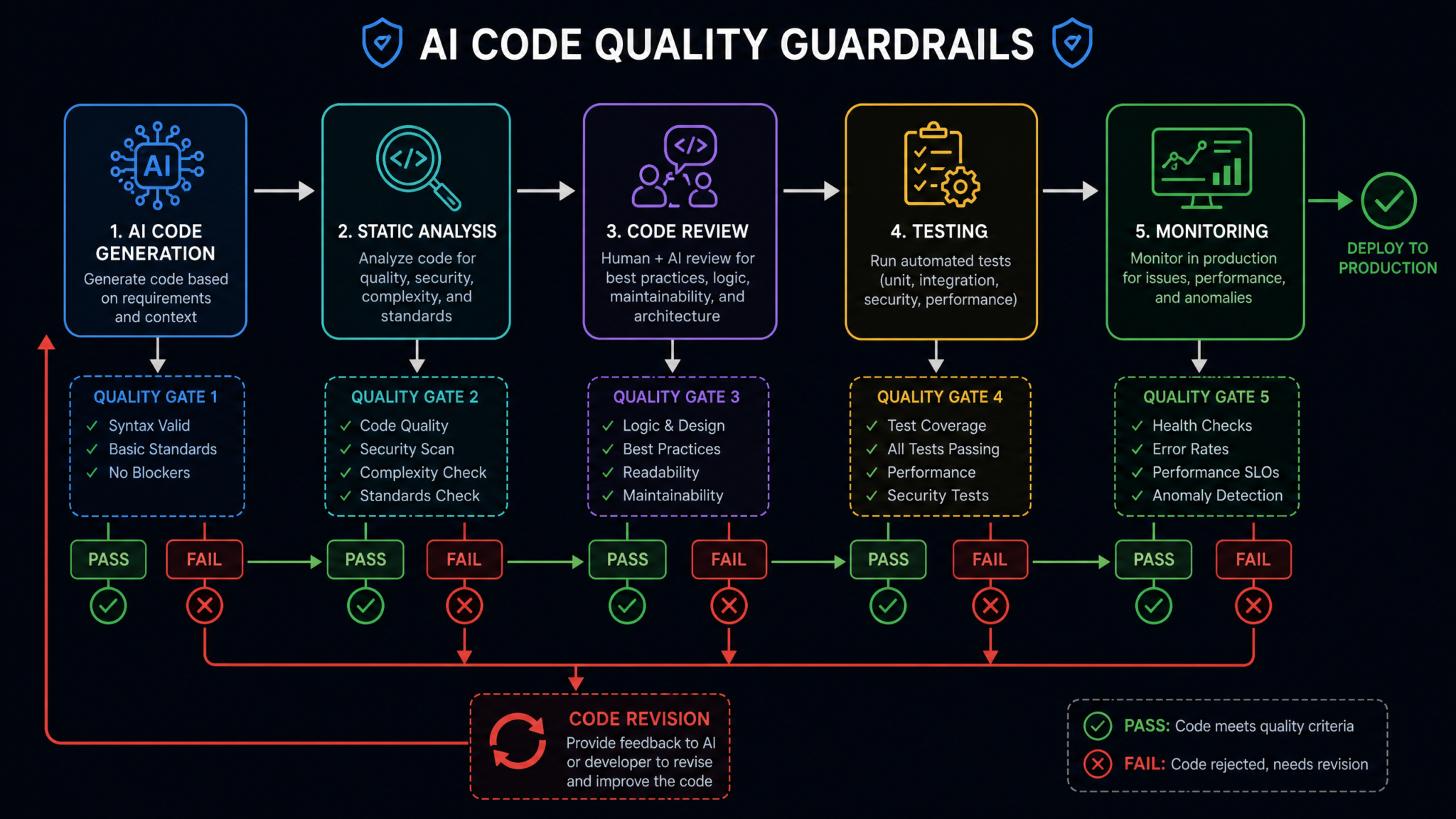
The research examined in this article provides a strong foundation for concrete, implementable changes to how engineering organizations use AI coding tools. The goal is not to abandon tools that do provide real productivity benefits in appropriate use cases, but to build the quality infrastructure necessary to compensate for their documented systematic weaknesses.
1. Implement AI-Aware Quality Gates in Your CI/CD Pipeline
Organizations should differentiate their automated quality checks based on whether code was AI-assisted, applying enhanced validation criteria to AI-generated portions. Practical implementation approaches include:
- Mandatory static analysis with elevated sensitivity for PRs flagged as AI-assisted, using tools configured to catch the specific categories of errors documented by New Relic — particularly logic errors that might evade standard linting.
- Automated complexity thresholds: Flag any AI-generated function with a cyclomatic complexity above a conservative threshold (e.g., 10) for mandatory human review of logic, not just style.
- Error handling coverage requirements: Require automated verification that every exception type explicitly raised in an AI-generated module has a corresponding handler somewhere in the call chain, and that all network calls, file operations, and external service interactions include explicit failure handling.
- PR size gates: Given Faros’s finding that AI-assisted PRs are 51% larger, implement a PR size limit policy that explicitly accounts for AI-generated code. A reasonable starting point is to reduce your existing PR size limit by 30% for AI-assisted submissions, incentivizing developers to break large AI-generated changes into smaller, more reviewable increments.
2. Redesign Your Code Review Process for AI-Generated Code
The 441% increase in review time documented by Faros suggests that teams are currently applying human review processes to AI-generated code without adequate process adjustments. More effective approaches include:
- Two-reviewer requirements for AI-generated business logic: Given the 75% higher logic error rate, critical business logic should require sign-off from two qualified reviewers rather than the standard one.
- Specification-first review: Reviewers of AI-generated code should begin by reading the original requirement or specification, then the AI-generated implementation, rather than reading the implementation and trying to infer the intent. This catches cases where the AI has implemented something plausible but wrong.
- Dedicated error handling review pass: Treat error handling as a distinct review concern, conducting an explicit “failure mode” pass through AI-generated code that specifically traces what happens when each operation fails.
- Security review escalation: Any AI-generated code touching authentication, authorization, input validation, cryptography, or external data handling should automatically escalate to security-specialist review, given both the 50% security patch failure rate from Dark Reading and the elevated vulnerability introduction risk.
3. Build Comprehensive Testing Infrastructure Specifically for AI-Generated Code
The systematic quality issues documented across the research demand testing strategies that are specifically designed to catch the failure modes that AI code is most prone to:
- Property-based testing: AI-generated algorithms are particularly susceptible to edge case and boundary condition errors. Property-based testing frameworks (such as Hypothesis for Python, fast-check for TypeScript, or QuickCheck for Haskell) systematically probe boundary conditions in ways that manually written example-based tests often miss.
- Mutation testing: Given the logic correctness issues documented by New Relic, mutation testing — which systematically introduces small logic changes and verifies that tests catch them — is particularly valuable for validating that test suites are actually detecting the classes of errors AI code is prone to.
- Contract testing for AI-generated service interfaces: AI coding tools frequently generate interface code that is plausible but subtly mismatched with the contracts expected by consumers. Contract testing frameworks catch these integration failures before they reach production.
- Chaos engineering for error handling validation: Given the 2x higher error handling gap rate, systematically injecting failures (using tools like Chaos Monkey or custom fault injection middleware) in staging environments with AI-generated code is a high-value investment.
4. Track the Right Metrics to Detect Acceleration Whiplash
One of the most actionable implications of the Faros report is the need to instrument engineering organizations to detect the “acceleration whiplash” pattern before it becomes a systemic crisis. Specifically:
- Track code churn rate per author and per PR: A rising churn rate in the months following AI tool adoption is an early warning signal. Consider integrating churn tracking into your DORA metrics dashboard if it isn’t there already.
- Measure review time per PR by AI-assistance status: This is the only way to detect the 441% review time increase before it fully undermines your cycle time metrics.
- Monitor defect escape rate by code origin: Track whether defects found in production, in QA, or in post-merge code review are disproportionately associated with AI-assisted code. This correlation, measured over time, provides an empirical basis for calibrating your quality gate policies.
- Survey developer confidence, not just developer usage: The 84% usage / 29% trust gap is invisible if you only ask “are you using AI tools?” Track developer trust and confidence in AI-generated output as a distinct metric.
5. Develop Tool-Specific Prompting Standards and Context Protocols
Since AI coding quality is significantly influenced by the quality of context provided, organizations should invest in standardizing how developers prompt AI tools for different categories of work:
- Mandatory context templates: For high-stakes code generation tasks, require developers to populate a standardized context template before prompting AI tools. This template should include: the specific business rule or requirement being implemented, relevant existing patterns in the codebase, known edge cases and failure modes, security considerations, and performance constraints.
- Explicit error handling requirements: Include explicit requirements for error handling in every AI coding prompt. Prompts that simply say “implement function X” yield code with the systematic error handling gaps documented by New Relic. Prompts that say “implement function X, including explicit handling for network failures, invalid input, and upstream service unavailability” yield meaningfully better error handling.
- Post-generation review prompts: Develop a library of follow-up prompts specifically designed to probe the weakness categories identified in the research — asking the model to identify its own assumptions, enumerate failure cases it may not have handled, and explain its logic for non-obvious algorithm choices.
AI Code Quality Gates: Implementation Guide for DevOps and Platform Engineering Teams
The Road Ahead: Can AI Code Quality Improve Fast Enough?
The research reviewed in this article reflects the state of AI coding tools as they exist and are being used at enterprise scale in 2025-2026. It would be incomplete to present this data without acknowledging that AI capabilities are improving rapidly, and that some of the specific limitations documented here may be meaningfully different in 12-24 months. OpenAI, Anthropic, Google DeepMind, and the other major model developers are actively researching and deploying improvements specifically targeted at the code quality dimensions where current models underperform.
Several trajectories in current AI development research are particularly relevant to the code quality problem. Formal verification integration — combining LLM-based code generation with automated formal verification tools — has shown promise in research settings for dramatically reducing logic correctness errors. Retrieval-augmented generation approaches that give AI models real-time access to a team’s full codebase, specification documents, and architectural decision records can partially address the context limitation problem. And constitutional AI approaches, which train models to apply specific quality criteria during generation rather than as a post-processing step, may improve error handling and security practices in ways that pure scaling has not.
However, several cautionary observations apply. First, the rate of quality improvement in AI code generation has historically lagged the rate of adoption. Organizations have been deploying these tools at scale for the past two to three years while quality infrastructure has been slow to follow. The research findings reported here represent real costs being borne by real engineering teams right now. Second, even substantial improvements in raw model quality will not eliminate the need for organizational quality processes. Human-authored code also has bugs; human engineers also make logic errors and miss edge cases. The answer is not to wait for perfect AI but to build quality systems that work for imperfect AI — just as mature engineering organizations have built quality systems that work for imperfect humans.
Third, and perhaps most importantly, the perception paradox documented in the leadership trust data suggests that quality improvements in AI tools will not automatically translate into improved awareness at the organizational decision-making level. Engineering leaders who have developed comfortable narratives about AI coding quality will need active exposure to the kind of rigorous empirical data provided by New Relic and Faros to recalibrate their mental models. The research infrastructure to generate that data needs to be built and maintained even as the underlying tools evolve.
Conclusion: Recalibrating Your AI Coding Strategy
The 2026 research landscape on AI coding quality delivers a message that is simultaneously sobering and actionable. New Relic’s finding that AI-generated code contains 75% more logic errors, three times as many readability issues, and twice as many error handling gaps represents not a condemnation of AI coding tools but a specification for the quality infrastructure those tools require. Faros’s documentation of 54% higher bug density, 441% longer review times, and 861% more code churn represents not evidence that AI tools should be abandoned but a blueprint for where organizations are currently failing to account for their real costs.
The 94% of leaders who believe AI code quality matches or exceeds human quality are operating on incomplete information, misaligned metrics, and selection-biased observations. The 84% of developers who use AI tools daily while only 29% trust the output are navigating a real capability gap without adequate organizational support structures. The 50% failure rate of AI-generated security patches represents an existential risk for organizations deploying AI tools in security-sensitive contexts without specialist review protocols.
None of these findings require abandoning the genuine productivity benefits that AI coding tools provide in appropriate use cases. They do require that engineering organizations stop treating AI coding tool adoption as a simple accelerator that can be dropped into existing processes without adaptation. The data is clear: AI-assisted development requires AI-aware quality processes. Organizations that build those processes — enhanced quality gates, redesigned review workflows, comprehensive AI-specific testing strategies, and rigorous metrics programs — will capture the real benefits of AI coding assistance while managing the documented risks. Organizations that don’t will continue to experience acceleration whiplash: the painful discovery that speed gains at the front of the pipeline are being consumed by quality costs everywhere else.
The tools are real. The productivity potential is real. So are the quality challenges. The research now gives us the specificity we need to address them with precision rather than anxiety. The question for every engineering leader reading this data is not whether to use AI coding tools, but whether your organization is prepared to use them responsibly.
